

- Market Size (2026)
- USD 4.9 Bn
- Forecast (2036)
- USD 12.4 Bn
- CAGR (2026 to 2036)
- 9.7%
How big is Healthcare Satellite Connectivity Market in 2026?
USD 4.9 billion in 2026 and USD 12.4 billion by 2036 at a 9.7% CAGR.
Demand for healthcare satellite connectivity is projected to expand at approximately 9.7% CAGR between 2026 and 2036, increasing valuation from USD 4.9 billion in 2026 to USD 12.4 billion by 2036. Clinical continuity requires dependable telehealth and telemedicine access at care sites beyond reliable terrestrial network coverage. A March 2025 NHS England Digital case study documented satellite links for community hubs within a ten-hospital Manchester trust. The trial linked network performance with access to patient records and pop-up clinical services instead of general broadband availability.
Hospital information technology teams design remote healthcare connections around secure records and tested video performance during terrestrial outages. Managed remote patient monitoring adds recurring revenue through bandwidth control and security updates, while contracted field maintenance supports remote sites under one accountable agreement.
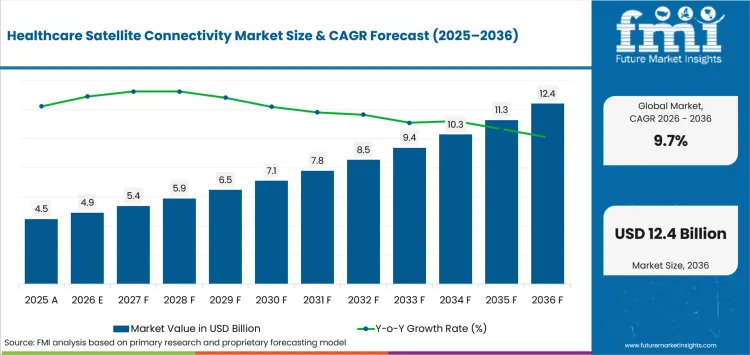
Key Takeaways of Healthcare Satellite Connectivity Market
- Rural facilities and disaster teams require satellite links to preserve records, consultations, and operational coordination during terrestrial failures.
- Satellite communication equipment is projected to represent 31.0% of product-type demand in 2026 owing to its site-qualification role.
- Telemedicine and telehealth are estimated to account for 34.0% share in 2026 supported by specialist-access requirements.
- Hospitals are forecast to capture 37.0% by end-user in 2026 driven by combined clinical and continuity workloads.
- Latency and protected power requirements can delay approval despite adequate satellite coverage at the intended clinical site.
- Viasat, SES, Eutelsat, Iridium, Hughes, SpaceX, Gilat, and EchoStar focus on capacity, terminals, mobility, IoT, and managed operations.
Analyst Perspective
“A satellite link earns a hospital contract once clinical teams prove that video consultation and record access remain usable during a terrestrial outage. Providers pairing application testing with protected power and local maintenance can convert resilience budgets into repeatable multi-site service contracts.”
- Anurag Sharma, Principal Consultant, Future Market Insights
How is the Healthcare Satellite Connectivity Market segmented?
The healthcare satellite connectivity industry is segmented by product type, application, end user, distribution channel, connectivity type, and region.
The healthcare satellite connectivity market is segmented by product type, application, end user, distribution channel, connectivity type, and region. Product type covers equipment, broadband services, IoT solutions, telemedicine platforms, and managed support across fixed or mobile sites. Application and end-user categories distinguish virtual care, emergency services, monitoring, hospital networks, public agencies, and research organizations. Distribution routes include direct contracts, integrators, resellers, telecom providers, and digital channelswhile connectivity covers fixed, mobile, LEO, GEO, and MEO services, with hybrid solutions offered within the MEO category.
How does satellite communication equipment shape demand within the product-type category?
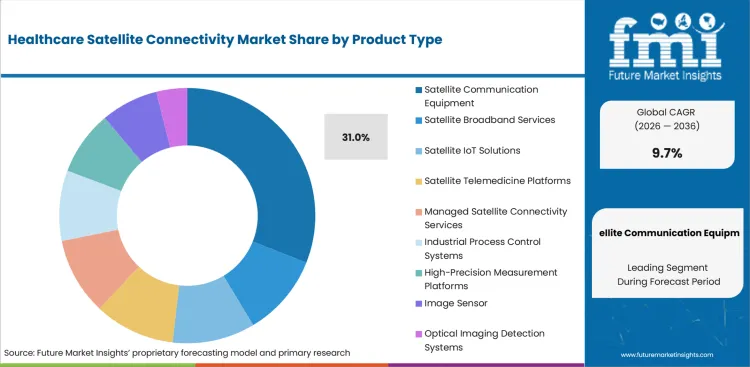
Satellite communication equipment establishes the physical link between each care site and its selected network. Hospital teams qualify terminal placement and routing controls within one continuity package that also covers protected power.
- Satellite communication equipment is projected to hold 31.0% share in 2026 owing to its central role in site qualification and failover testing.
- Clinical engineering teams select VSAT terminals for fixed rural facilities that require persistent connectivity and established maintenance routes. Compact flat panel antennas fit deployable clinics that need faster installation and documented sky-view procedures.
What supports demand for telemedicine and telehealth within the application category?
Telemedicine and telehealth convert satellite bandwidth into direct clinical interaction between remote patients and distant specialists. Secure video supports live consultation, while IoT in healthcare systems carry lower-bandwidth monitoring data through separate escalation routes.
- By application, telemedicine and telehealth are forecast to represent 34.0% in 2026 driven by immediate specialist-access needs across rural hospitals and mobile care settings.
- Public-health teams select controlled endpoints that protect identity and patient records during scheduled specialist consultations. High latency or weak local Wi-Fi can interrupt clinical decisions during time-sensitive referrals from remote facilities.
How do hospital networks evaluate satellite connectivity within the end-user category?
Hospitals combine consultation, imaging, pharmacy, and continuity workloads within one formal network qualification review process. Security teams review identity controls as clinical engineers coordinate antenna placement and protected power across each facility.
- Based on end user, hospitals are projected to account for 37.0% in 2026 due to combined clinical and continuity workloads across regional care networks.
- Hospital networks select satellite links as backup paths that preserve record access during terrestrial failures. Contracts progress once operators document application performance and maintain local replacement stock for critical terminal components.
What role do fixed satellite services play within the connectivity-type category?
Fixed satellite services suit hospitals and public-health sites that can install stable antennas at known addresses. Predictable geometry supports documented link budgets, while LEO satellite capacity can carry interactive workloads through monitored hybrid networks.
- In 2026, fixed satellite services are expected to lead connectivity type with 36.0% share because fixed care sites support stable antenna geometry and planned maintenance.
- Health systems pair fixed services with terrestrial failover under one site policy that prioritizes clinical traffic. Satellite IoT channels carry low-data telemetry through a separate route that limits bandwidth expense across remote sites.
What are the drivers, restraints and opportunities in the Healthcare Satellite Connectivity Market?
Clinical continuity drives demand while site limits delay approval and hybrid managed networks provide a practical deployment route.
- Driver: Healthcare systems require independent communication paths that preserve clinical workflows during terrestrial outages and remote operations.
- Restraint: Latency and line-of-sight limits alongside protected-power requirements can prevent available satellite links from meeting clinical application needs.
- Opportunity: Hybrid multi-orbit services can separate interactive care from low-data monitoring under one accountable operating model.
Remote clinicians can lose record access during terrestrial outages and ambulance teams can lose coordination beyond cellular coverage. An independent satellite path protects both workflows across rural facilities and emergency communication vehicles that lack dependable alternatives.
Hospitals test latency and jitter against firewall behavior during clinical application approval at each site. Protected power and incident escalation add engineering work that advertised throughput figures cannot resolve alone.
Managed network services assign interactive care and low-data telemetry to separate paths under one operating policy. Network operators earn recurring revenue through monitoring and security updates while field maintenance supports remote sites.
Which country CAGRs are profiled in the Healthcare Satellite Connectivity Market?
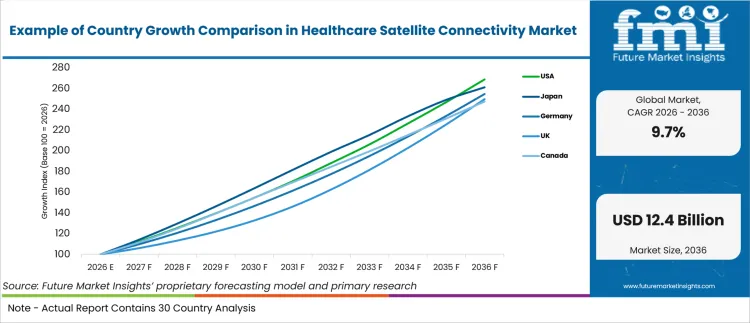
| Country | CAGR |
|---|---|
| United States | 10.4% |
| Japan | 10.1% |
| Germany | 9.8% |
| United Kingdom | 9.6% |
| Canada | 9.5% |
How do country-level CAGRs compare in the Healthcare Satellite Connectivity Market?
The country range spans 0.9 percentage point and forms a compact forecast band across five healthcare systems. The spacing reflects different care-delivery routes instead of current market size or installed satellite capacity.
- The United States combines rural-health funding with formal service comparisons that shape satellite qualification across remote healthcare facilities.
- Japan links island-care continuity with regulated online-care workflows that require trained staff and documented escalation routes.
- Germany places satellite resilience inside secure hospital architecture supporting national electronic patient-record workflows across participating facilities.
- The United Kingdom tests deployable community links under NHS installation controls covering security and application performance.
- Canada balances remote-community coverage with provincial integration and long service distances across weather-exposed installation routes.
Comparable CAGRs can produce different market entry conditions. The full report provides country-level CAGR analysis across North America, Latin America, Europe, East Asia, South Asia and Pacific, and the Middle East and Africa.
Country-wise Analysis
- Federal rural-health funding shapes satellite purchasing across remote clinical sites that lack dependable terrestrial communications. These sites often have limited technical staffing for outage recovery and routine specialist consultations. Healthcare satellite connectivity sales in the United States are forecast to expand at 10.4% CAGR by 2036, driven by documented funding routes and experienced integrators. USAC reported in June 2026 that the FCC directed up to USD 226.42 million in unused funds toward full FY2026 Rural Health Care Program demand, while competitive bidding and bandwidth-equivalent service comparisons require transparent proposals that assign installation responsibility and local maintenance support across distant facilities.
- Japanese telemedicine rules that took effect in April 2026 connect online treatment with in-person care and trained local support, while a July 2026 health ministry casebook documented municipal implementation routes for remote and island communities. Adoption of healthcare satellite connectivity in Japan is estimated to expand at 10.1% CAGR through 2036, supported by island-care requirements and coordinated national guidance. National guidance provides a clear workflow for nurse-assisted consultations. However, typhoon exposure and distant field service require weather-hardened terminals, secure patient-data handling, and defined replacement routes, since severe storms can limit technician access to isolated clinical sites.
- German hospitals must integrate satellite resilience with national electronic patient records and established data-protection controls across existing regional clinical networks. The Federal Ministry of Health reported in April 2025 that nationwide ePA access began on April 29 and provider use became compulsory on October 1, giving hospital technology teams a defined digital workflow for remote access and continuity planning. Germany's healthcare satellite connectivity outlook is anticipated to advance at 9.8% CAGR over the assessment period, supported by formal digital workflows and capable enterprise integrators while complex hospital architecture requires each satellite path to preserve identity controls and incident-response procedures during terrestrial outages.
- NHS community-care programs use satellite links at temporary sites and locations that lack dependable fixed-line service during routine operations or emergencies. In the United Kingdom, healthcare satellite connectivity demand is predicted to advance at 9.6% CAGR through 2036 shaped by public network expertise and remote-care resilience. NHS England Digital reported in September 2025 that Manchester deployments required repeated site visits for cabling and equipment placement, while installation approvals and operating costs require tested application performance with coordinated local support across community hubs and temporary care locations serving clinicians through secure NHS network controls during planned services or terrestrial outages.
- Canadian remote and Indigenous communities face long service routes for healthcare facilities that depend on public broadband programs and local technical support, while a November 2025 CRTC release reported improved service across more than 320 communities including 135 Indigenous communities and essential health facilities. The Canadian healthcare satellite connectivity sector is projected to record 9.5% CAGR during the assessment period, supported by remote-care demand and established public funding experience. Provincial integration and extreme weather remain material frictions that require community engagement with weather-hardened equipment and remote management that limits unnecessary technician travel across distant service territories during prolonged network disruptions.
Who are the notable companies in the Healthcare Satellite Connectivity Market?
Viasat Inc., SES S.A., Eutelsat Communications S.A., Iridium Communications Inc., Hughes Network Systems, LLC, Gilat Satellite Networks Ltd., EchoStar Corporation, and SpaceX (Starlink) shape competition across satellite capacity, terminals, managed services, mobility, and IoT connectivity.
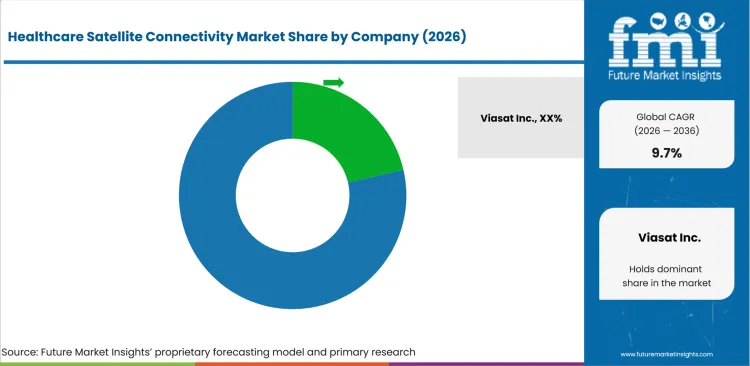
Competition spans operators, terminal specialists, and managed platforms that control different capacity or field-support resources. Healthcare contracts favor providers that accept responsibility for clinical application performance at each connected site.
- Viasat and Iridium combine mobile coverage with satellite IoT services for remote monitoring and healthcare workflows.
- SES and Eutelsat Communications provide multi-orbit capacity for public-health networks that require broad coverage and differentiated latency profiles.
- Hughes Network Systems and Gilat compete through terminals and managed operations while SpaceX provides the Starlink LEO platform. EchoStar remains Hughes Network Systems’ corporate parent and provides the wider corporate structure behind its managed platform.
Competitive Benchmarking: Healthcare Satellite Connectivity Market
| Company | Satellite Service Breadth | Managed Networks and Terminals | Mobility and IoT Coverage | Geographic Reach |
|---|---|---|---|---|
| Viasat Inc. | High | High | High | Global |
| SES S.A. | High | Medium | Medium | Global |
| Eutelsat Communications S.A. | High | Medium | Medium | Global |
| Iridium Communications Inc. | Medium | Medium | High | Global |
| Hughes Network Systems, LLC | High | High | Medium | Global |
| Gilat Satellite Networks Ltd. | Medium | High | High | Global |
| EchoStar Corporation | High | High | Medium | Global |
| SpaceX (Starlink) | Medium | Medium | Medium | Global |
Scoring basis: Breadth rates High for three families, Medium for two, and Low for one. Managed capability rates High for terminals plus operations and Medium for either while Low confirms one. Mobility and IoT rates High for both uses and Medium for one while Low confirms limited scope.
Key Developments in the Healthcare Satellite Connectivity Market
- In June 2026, Iridium Communications Inc. made its 9604 hybrid IoT module commercially available with integrated satellite-cellular connectivity and positioning for remote-monitoring developers.
- In December 2025, Eutelsat Communications S.A. and Airtel deployed OneWeb capacity that supported continuous telemedicine during flood-relief operations in Sri Lanka.
- In July 2025, SES S.A. completed its acquisition of Intelsat and expanded the combined operator’s multi-orbit capacity and managed-network reach.
- In April 2025, Viasat Inc. added Pivotel to its ELEVATE ecosystem, extending satellite connectivity across remote sectors, including emergency response, in Australia and New Zealand.
Healthcare Satellite Connectivity Market - Report Scope
| Coverage field | Report scope |
|---|---|
| Market breakdown | By product type, application, end user, distribution channel, connectivity type, and region. |
| Quantitative Units | Revenue in USD billion and CAGR in %. |
| Market Definition | The market covers satellite equipment and managed connectivity used to support healthcare communication beyond dependable terrestrial networks. |
| Regions Covered | North America, Latin America, Europe, East Asia, South Asia and Pacific, and Middle East and Africa. |
| Countries Covered | United States, Japan, Germany, United Kingdom, Canada, and 20+ countries included in the full report. |
| Key Companies Profiled | Viasat Inc., SES S.A., Eutelsat Communications S.A., Iridium Communications Inc., Hughes Network Systems, LLC, Gilat Satellite Networks Ltd., EchoStar Corporation, SpaceX (Starlink) |
| Forecast Period | 2026 to 2036. |
| Approach | Primary and secondary research with market triangulation. |
Healthcare Satellite Connectivity Market - Research Methodology
| Method | Approach |
|---|---|
| Primary Research | FMI analysts gathered input from manufacturers, service providers, technology developers, distributors, end users, procurement teams, and subject-matter experts. Interviews examined purchasing decisions, product or service evaluation, adoption barriers, approval requirements, pricing considerations, and expectations for technical or commercial support. Respondents were also asked what evidence is required before a trial, pilot, or initial order develops into regular purchasing. |
| Desk Research | Desk research covered government statistics, regulatory publications, trade data, industry associations, technical literature, standards, company filings, product information, and official corporate announcements. Sources were reviewed for relevance, publication date, geographic coverage, and consistency with the defined market scope. Claims relating to performance, applications, approvals, capacity, investment, and commercial activity were retained only when supported by credible public evidence. |
| Market Sizing and Forecasting | The market model combined the baseline value with historical performance, segment structure, pricing and volume indicators, adoption levels, company participation, and country-level demand conditions. Forecast assumptions considered economic activity, investment trends, regulatory developments, technology adoption, purchasing cycles, supply availability, and barriers to wider market use. Segment and regional estimates were reconciled before the final market total was calculated. |
| Data Validation | Estimates were checked against multiple independent indicators, including public data, company activity, trade patterns, industry developments, and findings from primary interviews. Validation also tested whether products, services, applications, and company revenues fell within the defined market boundaries. Adjacent categories, unsupported claims, overlapping revenues, and activities without direct market relevance were excluded to reduce double counting and maintain consistency across segments and countries. |
Healthcare Satellite Connectivity Market by Segments
Healthcare Satellite Connectivity Market By Product Type
- Satellite Communication Equipment
- VSAT Terminals
- Satellite Antennas
- Satellite Broadband Services
- Fixed Satellite Broadband
- Mobile Satellite Broadband
- Satellite IoT Solutions
- Remote Patient Monitoring Connectivity
- Medical Asset Tracking
- Satellite Telemedicine Platforms
- Video Consultation Systems
- Clinical Collaboration Platforms
- Managed Satellite Connectivity Services
- Network Management Services
- Maintenance & Support Services
Healthcare Satellite Connectivity Market By Application
- Telemedicine & Telehealth
- Remote Consultation
- Virtual Specialist Care
- Emergency Medical Services
- Disaster Response
- Air Ambulance Communication
- Remote Patient Monitoring
- Chronic Disease Monitoring
- Wearable Device Connectivity
- Hospital Network Connectivity
- Rural Hospital Connectivity
- Mobile Medical Units
- Medical Research & Public Health
- Epidemiological Surveillance
- Clinical Research Communication
Healthcare Satellite Connectivity Market By End User
- Hospitals
- Public Hospitals
- Private Hospitals
- Healthcare Providers
- Telemedicine Providers
- Primary Care Networks
- Government Healthcare Agencies
- Public Health Departments
- Defense Medical Services
- Emergency Medical Service Providers
- Ambulance Services
- Disaster Relief Organizations
- Research Institutes
- Academic Medical Centers
- Public Health Research Institutes
Healthcare Satellite Connectivity Market By Distribution Channel
- Direct Sales
- Enterprise Contracts
- Government Contracts
- System Integrators
- Healthcare IT Integrators
- Network Solution Providers
- Value-Added Resellers
- Authorized Resellers
- Technology Partners
- Telecommunication Service Providers
- Managed Connectivity Providers
- Satellite Network Operators
- Online Sales
- Company Websites
- Digital Procurement Platforms
Healthcare Satellite Connectivity Market By Connectivity Type
- Fixed Satellite Services (FSS)
- C-Band Connectivity
- Ku-Band Connectivity
- Mobile Satellite Services (MSS)
- L-Band Connectivity
- Maritime & Aviation Connectivity
- Low Earth Orbit (LEO) Connectivity
- Low-Latency Broadband
- Remote Healthcare Networks
- Geostationary Earth Orbit (GEO) Connectivity
- High-Capacity Satellite Links
- Wide-Area Coverage
- Medium Earth Orbit (MEO) Connectivity
- Medium-Latency Networks
- Hybrid Satellite Solutions
Healthcare Satellite Connectivity Market by Region:
- North America
- United States
- Canada
- Latin America
- Brazil
- Chile
- Mexico
- Rest of Latin America
- Western Europe
- Germany
- United Kingdom
- Italy
- Spain
- France
- Nordics
- Benelux
- Rest of Western Europe
- Eastern Europe
- Russia
- Poland
- Hungary
- Balkan and Baltic States
- Rest of Eastern Europe
- East Asia
- China
- Japan
- South Korea
- South Asia and Pacific
- India
- ASEAN
- Australia and New Zealand
- Rest of South Asia and Pacific
- Middle East and Africa
- Kingdom of Saudi Arabia
- Other GCC Countries
- Türkiye
- South Africa
- Other African Union Countries
- Rest of Middle East and Africa
Research Sources and Bibliography
- NHS England Digital. (2025, March 26). Wi-Fi and satellite rapid deployment.
- Universal Service Administrative Company. (2026, June 8). FCC announces availability of unused funds to fully fund Rural Health Care Program demand for FY2026.
- Ministry of Health, Labour and Welfare. (2026, July 23).[About online medical care].
- Federal Ministry of Health. (2025, April 28). ePA für alle startet morgen [The electronic patient record for everyone starts tomorrow].
- NHS England Digital. (2025, September 11). Practical guide to Starlink deployment.
- Canadian Radio-television and Telecommunications Commission. (2025, November 17). CRTC helps bring high-speed Internet to 27 communities in Saskatchewan.
- Iridium Communications Inc. (2026, June 23). Iridium’s next-generation hybrid IoT module and development kit are now commercially available.
- Eutelsat Communications S.A. (2025, December 16). Eutelsat and Airtel power LEO connectivity for Indian Army relief efforts in Sri Lanka.
- SES S.A. (2025, July 17). SES completes acquisition of Intelsat, creating global multi-orbit connectivity powerhouse.
- Viasat Inc. (2025, April 3). Pivotel joins Viasat ELEVATE: Expanding connectivity in remote regions.
- Hughes Network Systems, LLC. (2025, April 10). Hughes announces launch of innovative compact ESA, further expanding global connectivity solutions.
- USA Securities and Exchange Commission. (2026, March 16). EDGAR filing documents for 0001178913-26-000929.
- NHS England Digital. (2026, May 29). Technical solutions.
- EchoStar Corporation. (2026, March 2). 0001104659-26-021817 | 10-K | EchoStar Corporation.
This bibliography is provided for reader reference and is not exhaustive. The full report contains the complete reference list and detailed citations
This Report Answers
- How large is the healthcare satellite connectivity market through the 2036 forecast period?
- Which clinical workflows require satellite connectivity beyond dependable terrestrial network coverage?
- How do latency and cybersecurity requirements affect healthcare satellite qualification decisions?
- Which segments hold the largest 2026 shares across the principal market categories?
- How do profiled country CAGRs reflect different healthcare operating routes?
- Which companies combine satellite capacity with terminals and managed support services?
- How do fixed and LEO services fit different clinical operating settings?
- Which commercial routes support managed failover and remote monitoring deployments?
- What should hospital information technology and clinical engineering teams validate for a satellite connectivity contract?
Frequently Asked Questions
How big is the Healthcare Satellite Connectivity Market in 2026?
The healthcare satellite connectivity market is valued at USD 4.9 billion in 2026 and is forecast to reach USD 12.4 billion by 2036. Growth is supported by clinical continuity needs that require dependable telehealth access at care sites beyond reliable terrestrial network coverage.
What is the CAGR of the Healthcare Satellite Connectivity Market from 2026 to 2036?
The healthcare satellite connectivity market grows at a CAGR of 9.7% between 2026 and 2036, driven by healthcare systems requiring independent communication paths that preserve clinical workflows during terrestrial outages, while latency and protected-power requirements can delay site approval.
Which product type leads the Healthcare Satellite Connectivity Market?
Satellite communication equipment leads the healthcare satellite connectivity market by product type, holding 31.0% share in 2026 owing to its central role in site qualification and failover testing. Hospital teams qualify terminal placement within one continuity package covering protected power.
How much will the Healthcare Satellite Connectivity Market add between 2026 and 2036?
The healthcare satellite connectivity market is set to add USD 7.5 billion between 2026 and 2036, growing from USD 4.9 billion to USD 12.4 billion as hospitals and rural facilities expand satellite links to preserve clinical continuity during terrestrial network outages.
Who are the leading companies in the Healthcare Satellite Connectivity Market?
Eight companies lead the healthcare satellite connectivity market, including Viasat, SES, Eutelsat, Iridium, Hughes Network Systems, Gilat, EchoStar, and SpaceX, competing through satellite capacity, terminals, mobility coverage, IoT connectivity, and managed network services.
Preview the report firsthand - request a free sample
Get SampleGet the brochure for pricing and purchase details.
Get PDFTable of Content
- Key Takeaways
- Market Size and CAGR
- Top Growth Driver
- Fastest Growing Segment
- Leading Region
- Key Companies
- Emerging Opportunities
- Executive Summary
- Global Market Outlook
- Demand-side Trends
- Supply-side Trends
- Technology Roadmap Analysis
- Analysis and Recommendations
- Analyst Perspective (What is happening? Why now? What should investors know?)
- Key Questions Answered
- How large is the market?
- What is the CAGR?
- What are key trends?
- Which region dominates?
- Who are the leaders?
- Market Overview
- Market Coverage / Taxonomy
- Market Definition / Scope / Limitations
- Research Methodology
- Chapter Orientation
- Analytical Lens and Working Hypotheses
- Market Structure, Signals, and Trend Drivers
- Benchmarking and Cross-market Comparability
- Market Sizing, Forecasting, and Opportunity Mapping
- Research Design and Evidence Framework
- Desk Research Programme (Secondary Evidence)
- Expert Input and Fieldwork (Primary Evidence)
- Tooling, Models, and Reference Databases
- Data Engineering and Model Build
- Quality Assurance and Audit Trail
- Market Background
- Market Dynamics (Drivers, Restraints, Opportunity, Trends)
- Scenario Forecast (Optimistic, Likely, Conservative)
- Impact Analysis
- AI Impact
- Sustainability Impact
- Regulatory Impact
- Technology Impact
- Consumer / Buyer Analysis
- Purchase Drivers
- Adoption Barriers
- Buyer Journey
- Opportunity Map Analysis
- Product Life Cycle Analysis
- Supply Chain Analysis
- Investment Feasibility Matrix
- Value Chain Analysis
- PESTLE and Porter's Analysis
- Regulatory Landscape
- Regional Parent Market Outlook
- Production and Consumption Statistics
- Import and Export Statistics
- Global Market Analysis and Forecast, 2021 to 2036
- Historical Market Size Value (USD Billion) Analysis, 2021 to 2025
- Current and Future Market Size Value (USD Billion) Projections, 2026 to 2036
- Y-o-Y Growth Trend Analysis
- Absolute $ Opportunity Analysis
- Global Market Pricing Analysis, 2021 to 2036
- Global Market Analysis and Forecast, By Product Type, 2021 to 2036
- Introduction / Key Findings
- Historical Market Size Value (USD Billion) Analysis By Product Type, 2021 to 2025
- Current and Future Market Size Value (USD Billion) Analysis and Forecast By Product Type, 2026 to 2036
- Satellite Communication Equipment
- Satellite Broadband Services
- Satellite IoT Solutions
- Satellite Telemedicine Platforms
- Managed Satellite Connectivity Services
- Industrial Process Control Systems
- High-Precision Measurement Platforms
- Image Sensor
- Optical Imaging Detection Systems
- Satellite Communication Equipment
- Y-o-Y Growth Trend Analysis By Product Type, 2021 to 2025
- Absolute $ Opportunity Analysis By Product Type, 2026 to 2036
- Global Market Analysis and Forecast, By Application, 2021 to 2036
- Introduction / Key Findings
- Historical Market Size Value (USD Billion) Analysis By Application, 2021 to 2025
- Current and Future Market Size Value (USD Billion) Analysis and Forecast By Application, 2026 to 2036
- Telemedicine & Telehealth
- Emergency Medical Services
- Remote Patient Monitoring
- Hospital Network Connectivity
- Medical Research & Public Health
- Infrastructure Monitoring Systems
- Industrial Safety Detection Platforms
- Laser Technology
- Laser-Based Sensing Systems
- Telemedicine & Telehealth
- Y-o-Y Growth Trend Analysis By Application, 2021 to 2025
- Absolute $ Opportunity Analysis By Application, 2026 to 2036
- Global Market Analysis and Forecast, By End User, 2021 to 2036
- Introduction / Key Findings
- Historical Market Size Value (USD Billion) Analysis By End User, 2021 to 2025
- Current and Future Market Size Value (USD Billion) Analysis and Forecast By End User, 2026 to 2036
- Hospitals
- Healthcare Providers
- Government Healthcare Agencies
- Emergency Medical Service Providers
- Research Institutes
- Equipment Condition Monitoring Systems
- Smart Factory Sensing Platforms
- Healthcare
- Medical Diagnostics Systems
- Hospitals
- Y-o-Y Growth Trend Analysis By End User, 2021 to 2025
- Absolute $ Opportunity Analysis By End User, 2026 to 2036
- Global Market Analysis and Forecast, By Distribution Channel, 2021 to 2036
- Introduction / Key Findings
- Historical Market Size Value (USD Billion) Analysis By Distribution Channel, 2021 to 2025
- Current and Future Market Size Value (USD Billion) Analysis and Forecast By Distribution Channel, 2026 to 2036
- Direct Sales
- System Integrators
- Value-Added Resellers
- Telecommunication Service Providers
- Online Sales
- Real-Time Data Acquisition Systems
- Large-Area Monitoring Platforms
- Point Sensing Systems
- Localized Detection Architectures
- Direct Sales
- Y-o-Y Growth Trend Analysis By Distribution Channel, 2021 to 2025
- Absolute $ Opportunity Analysis By Distribution Channel, 2026 to 2036
- Global Market Analysis and Forecast, By Connectivity Type, 2021 to 2036
- Introduction / Key Findings
- Historical Market Size Value (USD Billion) Analysis By Connectivity Type, 2021 to 2025
- Current and Future Market Size Value (USD Billion) Analysis and Forecast By Connectivity Type, 2026 to 2036
- Fixed Satellite Services (FSS)
- Mobile Satellite Services (MSS)
- Low Earth Orbit (LEO) Connectivity
- Geostationary Earth Orbit (GEO) Connectivity
- Medium Earth Orbit (MEO) Connectivity
- IoT-Enabled Monitoring Systems
- Automated Alert Management Platforms
- Conventional Monitoring Solutions
- Standalone Detection Systems
- Fixed Satellite Services (FSS)
- Y-o-Y Growth Trend Analysis By Connectivity Type, 2021 to 2025
- Absolute $ Opportunity Analysis By Connectivity Type, 2026 to 2036
- Global Market Analysis and Forecast, By Connectivity Type
- Introduction / Key Findings
- Historical Market Size Value (USD Billion) Analysis By Connectivity Type, 2021 to 2025
- Current and Future Market Size Value (USD Billion) Analysis and Forecast By Connectivity Type, 2026 to 2036
- Wired Photonic Sensors
- Fiber-Connected Monitoring Systems
- High-Reliability Industrial Sensing Platforms
- Continuous Data Transmission Solutions
- Fixed Infrastructure Applications
- Long-Distance Optical Communication Systems
- Mission-Critical Monitoring Platforms
- Wireless Photonic Sensors
- Remote Monitoring Systems
- Wired Photonic Sensors
- Y-o-Y Growth Trend Analysis By Connectivity Type, 2021 to 2025
- Absolute $ Opportunity Analysis By Connectivity Type, 2026 to 2036
- Global Market Analysis and Forecast, By Region, 2021 to 2036
- Introduction
- Historical Market Size Value (USD Billion) Analysis By Region, 2021 to 2025
- Current Market Size Value (USD Billion) Analysis and Forecast By Region, 2026 to 2036
- North America
- Latin America
- Western Europe
- Eastern Europe
- East Asia
- South Asia and Pacific
- Middle East & Africa
- Market Attractiveness Analysis By Region
- North America Market Analysis and Forecast, By Country, 2021 to 2036
- Historical Market Size Value (USD Billion) Trend Analysis By Market Taxonomy, 2021 to 2025
- Market Size Value (USD Billion) Forecast By Market Taxonomy, 2026 to 2036
- By Country
- USA
- Canada
- By Product Type
- By Application
- By End User
- By Distribution Channel
- By Connectivity Type
- By Connectivity Type
- By Country
- Market Attractiveness Analysis
- By Country
- By Product Type
- By Application
- By End User
- By Distribution Channel
- By Connectivity Type
- By Connectivity Type
- Key Takeaways
- Latin America Market Analysis and Forecast, By Country
- Historical Market Size Value (USD Billion) Trend Analysis By Market Taxonomy, 2021 to 2025
- Market Size Value (USD Billion) Forecast By Market Taxonomy, 2026 to 2036
- By Country
- Brazil
- Mexico
- Chile
- Rest of Latin America
- By Product Type
- By Application
- By End User
- By Distribution Channel
- By Connectivity Type
- By Connectivity Type
- By Country
- Market Attractiveness Analysis
- By Country
- By Product Type
- By Application
- By End User
- By Distribution Channel
- By Connectivity Type
- By Connectivity Type
- Key Takeaways
- Western Europe Market Analysis and Forecast, By Country
- Historical Market Size Value (USD Billion) Trend Analysis By Market Taxonomy, 2021 to 2025
- Market Size Value (USD Billion) Forecast By Market Taxonomy, 2026 to 2036
- By Country
- Germany
- UK
- Italy
- Spain
- France
- Nordic
- BENELUX
- Rest of Western Europe
- By Product Type
- By Application
- By End User
- By Distribution Channel
- By Connectivity Type
- By Connectivity Type
- By Country
- Market Attractiveness Analysis
- By Country
- By Product Type
- By Application
- By End User
- By Distribution Channel
- By Connectivity Type
- By Connectivity Type
- Key Takeaways
- Eastern Europe Market Analysis and Forecast, By Country
- Historical Market Size Value (USD Billion) Trend Analysis By Market Taxonomy, 2021 to 2025
- Market Size Value (USD Billion) Forecast By Market Taxonomy, 2026 to 2036
- By Country
- Russia
- Poland
- Hungary
- Balkan & Baltic
- Rest of Eastern Europe
- By Product Type
- By Application
- By End User
- By Distribution Channel
- By Connectivity Type
- By Connectivity Type
- By Country
- Market Attractiveness Analysis
- By Country
- By Product Type
- By Application
- By End User
- By Distribution Channel
- By Connectivity Type
- By Connectivity Type
- Key Takeaways
- East Asia Market Analysis and Forecast, By Country
- Historical Market Size Value (USD Billion) Trend Analysis By Market Taxonomy, 2021 to 2025
- Market Size Value (USD Billion) Forecast By Market Taxonomy, 2026 to 2036
- By Country
- China
- Japan
- South Korea
- By Product Type
- By Application
- By End User
- By Distribution Channel
- By Connectivity Type
- By Connectivity Type
- By Country
- Market Attractiveness Analysis
- By Country
- By Product Type
- By Application
- By End User
- By Distribution Channel
- By Connectivity Type
- By Connectivity Type
- Key Takeaways
- South Asia and Pacific Market Analysis and Forecast, By Country
- Historical Market Size Value (USD Billion) Trend Analysis By Market Taxonomy, 2021 to 2025
- Market Size Value (USD Billion) Forecast By Market Taxonomy, 2026 to 2036
- By Country
- India
- ASEAN
- Australia & New Zealand
- Rest of South Asia and Pacific
- By Product Type
- By Application
- By End User
- By Distribution Channel
- By Connectivity Type
- By Connectivity Type
- By Country
- Market Attractiveness Analysis
- By Country
- By Product Type
- By Application
- By End User
- By Distribution Channel
- By Connectivity Type
- By Connectivity Type
- Key Takeaways
- Middle East & Africa Market Analysis and Forecast, By Country
- Historical Market Size Value (USD Billion) Trend Analysis By Market Taxonomy, 2021 to 2025
- Market Size Value (USD Billion) Forecast By Market Taxonomy, 2026 to 2036
- By Country
- Kingdom of Saudi Arabia
- Other GCC Countries
- Türkiye
- South Africa
- Other African Union
- Rest of Middle East & Africa
- By Product Type
- By Application
- By End User
- By Distribution Channel
- By Connectivity Type
- By Connectivity Type
- By Country
- Market Attractiveness Analysis
- By Country
- By Product Type
- By Application
- By End User
- By Distribution Channel
- By Connectivity Type
- By Connectivity Type
- Key Takeaways
- Key Countries Market Analysis
- USA
- Pricing Analysis
- Market Share Analysis, 2025
- By Product Type
- By Application
- By End User
- By Distribution Channel
- By Connectivity Type
- By Connectivity Type
- Canada
- Pricing Analysis
- Market Share Analysis, 2025
- By Product Type
- By Application
- By End User
- By Distribution Channel
- By Connectivity Type
- By Connectivity Type
- Mexico
- Pricing Analysis
- Market Share Analysis, 2025
- By Product Type
- By Application
- By End User
- By Distribution Channel
- By Connectivity Type
- By Connectivity Type
- Brazil
- Pricing Analysis
- Market Share Analysis, 2025
- By Product Type
- By Application
- By End User
- By Distribution Channel
- By Connectivity Type
- By Connectivity Type
- Chile
- Pricing Analysis
- Market Share Analysis, 2025
- By Product Type
- By Application
- By End User
- By Distribution Channel
- By Connectivity Type
- By Connectivity Type
- Germany
- Pricing Analysis
- Market Share Analysis, 2025
- By Product Type
- By Application
- By End User
- By Distribution Channel
- By Connectivity Type
- By Connectivity Type
- UK
- Pricing Analysis
- Market Share Analysis, 2025
- By Product Type
- By Application
- By End User
- By Distribution Channel
- By Connectivity Type
- By Connectivity Type
- Italy
- Pricing Analysis
- Market Share Analysis, 2025
- By Product Type
- By Application
- By End User
- By Distribution Channel
- By Connectivity Type
- By Connectivity Type
- Spain
- Pricing Analysis
- Market Share Analysis, 2025
- By Product Type
- By Application
- By End User
- By Distribution Channel
- By Connectivity Type
- By Connectivity Type
- France
- Pricing Analysis
- Market Share Analysis, 2025
- By Product Type
- By Application
- By End User
- By Distribution Channel
- By Connectivity Type
- By Connectivity Type
- India
- Pricing Analysis
- Market Share Analysis, 2025
- By Product Type
- By Application
- By End User
- By Distribution Channel
- By Connectivity Type
- By Connectivity Type
- ASEAN
- Pricing Analysis
- Market Share Analysis, 2025
- By Product Type
- By Application
- By End User
- By Distribution Channel
- By Connectivity Type
- By Connectivity Type
- Australia & New Zealand
- Pricing Analysis
- Market Share Analysis, 2025
- By Product Type
- By Application
- By End User
- By Distribution Channel
- By Connectivity Type
- By Connectivity Type
- China
- Pricing Analysis
- Market Share Analysis, 2025
- By Product Type
- By Application
- By End User
- By Distribution Channel
- By Connectivity Type
- By Connectivity Type
- Japan
- Pricing Analysis
- Market Share Analysis, 2025
- By Product Type
- By Application
- By End User
- By Distribution Channel
- By Connectivity Type
- By Connectivity Type
- South Korea
- Pricing Analysis
- Market Share Analysis, 2025
- By Product Type
- By Application
- By End User
- By Distribution Channel
- By Connectivity Type
- By Connectivity Type
- Russia
- Pricing Analysis
- Market Share Analysis, 2025
- By Product Type
- By Application
- By End User
- By Distribution Channel
- By Connectivity Type
- By Connectivity Type
- Poland
- Pricing Analysis
- Market Share Analysis, 2025
- By Product Type
- By Application
- By End User
- By Distribution Channel
- By Connectivity Type
- By Connectivity Type
- Hungary
- Pricing Analysis
- Market Share Analysis, 2025
- By Product Type
- By Application
- By End User
- By Distribution Channel
- By Connectivity Type
- By Connectivity Type
- Kingdom of Saudi Arabia
- Pricing Analysis
- Market Share Analysis, 2025
- By Product Type
- By Application
- By End User
- By Distribution Channel
- By Connectivity Type
- By Connectivity Type
- Türkiye
- Pricing Analysis
- Market Share Analysis, 2025
- By Product Type
- By Application
- By End User
- By Distribution Channel
- By Connectivity Type
- By Connectivity Type
- South Africa
- Pricing Analysis
- Market Share Analysis, 2025
- By Product Type
- By Application
- By End User
- By Distribution Channel
- By Connectivity Type
- By Connectivity Type
- USA
- Market Structure Analysis
- Competition Dashboard
- Competition Benchmarking
- Market Share Analysis of Top Players
- By Regional
- By Product Type
- By Application
- By End User
- By Distribution Channel
- By Connectivity Type
- By Connectivity Type
- Emerging Startups
- Innovation Benchmarking
- Competition Analysis
- Competition Deep Dive
- Viasat Inc.
- Overview
- Product Portfolio
- Profitability by Market Segments
- Sales Footprint
- Strategy Overview
- Marketing Strategy
- Product Strategy
- Channel Strategy
- SES S.A.
- Eutelsat Communications S.A.
- Iridium Communications Inc.
- Hughes Network Systems LLC
- SpaceX (Starlink)
- Gilat Satellite Networks Ltd.
- EchoStar Corporation
- Finisar Corporation
- Viasat Inc.
- Case Studies
- Success Stories
- Recent Developments
- Competition Deep Dive
- Assumptions & Acronyms Used


