

- Industry Size (2026)
- USD 1.99 Bn
- Forecast (2036)
- USD 5.51 Bn
- CAGR (2026 to 2036)
- 10.7%
Surgical Snare Market size, market forecast and outlook by FMI
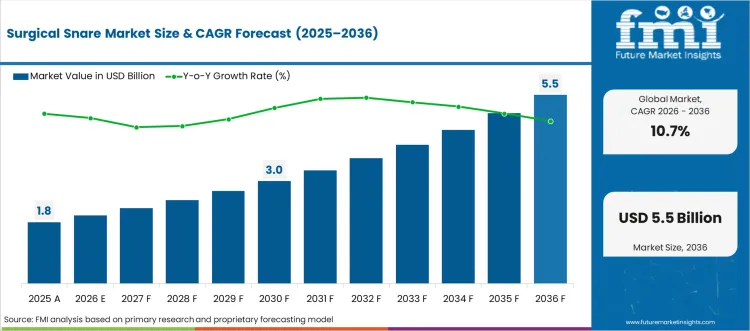
The surgical snare market was valued at USD 1.80 billion in 2025, projected to reach USD 1.99 billion in 2026, and is forecast to expand to USD 5.51 billion by 2036 at a 10.7% CAGR. Expanding procedural volumes in gastrointestinal endoscopy, driven by colorectal cancer screening mandates and polypectomy rate increases across aging populations, are accelerating single-use snare procurement cycles. Hospital infection prevention committees increasingly require disposable endoscopic accessories as standard protocol, displacing reusable device inventories in high-throughput endoscopy suites.
Summary of Surgical Snare Market
- Market Snapshot
- The surgical snare market is valued at USD 1.80 billion in 2025 and is projected to reach USD 5.51 billion by 2036.
- The industry is expected to grow at a 10.7% CAGR from 2026 to 2036, creating an incremental opportunity of USD 3.51 billion.
- The market operates as a procedure-linked, infection-control-driven consumable category where single-use compliance, endoscopy suite throughput, and device performance consistency define competitive positioning.
- Demand and Growth Drivers
- Demand is driven by expanding colorectal cancer screening programs that increase polypectomy procedure volumes and require standardized single-use endoscopic accessories.
- Adoption of disposable snares is accelerating as hospital infection prevention committees mandate single-use device protocols for all endoscopic tissue retrieval procedures.
- Growth is further supported by procedural expansion into laparoscopic, urological, and gynecological endoscopy applications that broaden per-facility snare consumption rates.
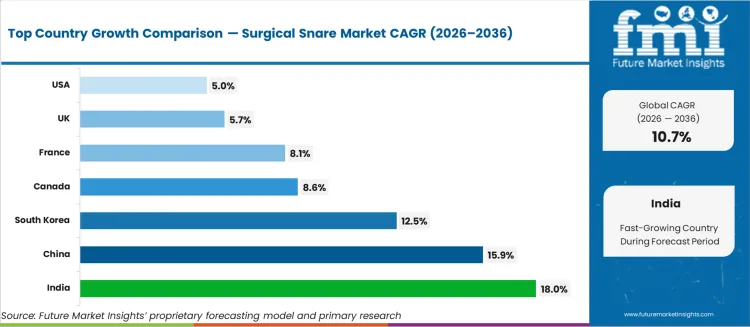
- Among key countries, India leads at 18.0% CAGR, China at 15.9%, South Korea at 12.5%, Canada at 8.6%, France at 8.1%, UK at 5.7%.
- Product and Segment View
- The market includes single-use and reusable endoscopic snares used for tissue retrieval and polypectomy across gastrointestinal, laparoscopic, urological, gynecological, and bronchoscopic procedures.
- Single-use leads by Usability with 82.6% share in 2026.
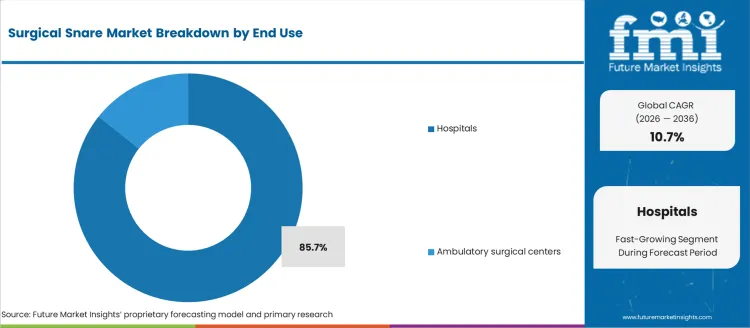
- Hospitals leads by End Use with 85.7% share in 2026.
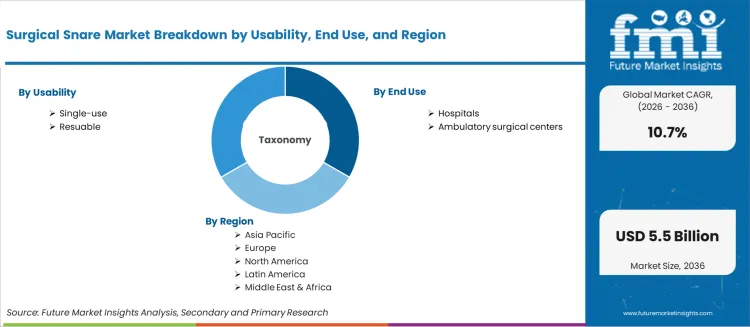
- Scope includes Usability, End Use, Application segmentation with regional coverage across seven global regions.
- Geography and Competitive Outlook
- India and China are the fastest-growing markets, while North America and Europe remain mature demand bases.
- Competition is shaped by product quality, distribution reach, and regulatory compliance, with key players including Olympus Corporation, Medtronic, Boston Scientific Corporation, Medline Industries Inc., CONMED Corporation, Steris, Merit Medical Systems, Avalign Technologies, Hill-Rom Holdings Inc., and Sklar Surgical Instrument.
FMI analysts observe that the surgical snare sector is consolidating around single-use device formats as infection control mandates tighten across endoscopy departments. Hospitals that previously maintained reprocessed snare inventories are shifting to disposable procurement models to eliminate reprocessing liability and comply with updated device hygiene standards. This transition elevates per-procedure consumable costs but reduces sterilization infrastructure requirements. Gastrointestinal endoscopy accounts for the dominant application share, with laparoscopic and urological endoscopy applications contributing supplementary volume streams as minimally invasive procedural portfolios expand across surgical specialties.
Country-level growth trajectories reflect endoscopy infrastructure expansion stages. India leads at 18.0% CAGR, fueled by national colorectal screening program rollouts and endoscopy unit construction in tier-2 hospital networks. China follows at 15.9%, where public hospital endoscopy departments are transitioning to disposable accessory procurement. South Korea at 12.5% benefits from advanced endoscopy center density and per-procedure device standardization. Mature markets including Canada at 8.6% and France at 8.1% sustain replacement-driven volumes anchored by established screening program participation rates.
Surgical Snare Market key takeaways
| Metric | Details |
|---|---|
| Industry Size (2026) | USD 1.99 billion |
| Industry Value (2036) | USD 5.51 billion |
| CAGR (2026 to 2036) | 10.7% |
Source: Future Market Insights, 2026
Surgical Snare Market definition
Surgical Snare encompasses wire-loop endoscopic accessories designed to encircle, transect, and retrieve tissue specimens during minimally invasive procedures. These devices are deployed through endoscope working channels across gastrointestinal, urological, gynecological, and pulmonary applications. The market covers both single-use disposable and reusable sterilizable formats, with primary consumption concentrated in hospital endoscopy departments and ambulatory surgical centers performing polypectomy and tissue sampling procedures.
Surgical Snare Market inclusions
Market scope includes global and regional market sizes, a 2026 to 2036 forecast period, segment breakdowns by Usability, End Use, Application, and regional analysis across North America, Latin America, Europe, East Asia, South Asia, Oceania, and Middle East and Africa. Pricing trend analysis and competitive positioning assessments are incorporated within the analytical framework.
Surgical Snare Market exclusions
The scope excludes biopsy forceps, retrieval baskets, and other endoscopic accessories that do not employ wire-loop snare mechanisms. Electrosurgical generators and endoscope capital equipment are also excluded from the valuation.
Surgical Snare Market research methodology
- Primary Research: Analysts engaged with endoscopy department directors, hospital infection prevention officers, and surgical accessory procurement leads to map device selection criteria and single-use adoption decision gates.
- Desk Research: Data collection aggregated clinical practice guidelines, regulatory device approval databases, hospital procedure volume registries, and medical society publications relevant to surgical instrument and consumable markets.
- Market-Sizing and Forecasting: Baseline values derive from a bottom-up aggregation of product-level revenues, applying region-specific adoption curves to project future demand velocity.
- Data Validation and Update Cycle: Projections are tested against publicly reported expenditure guidance from leading industry participants and cross-referenced with regulatory filings.
Key Industry Highlights
Growth Factors Influencing the Surgical Snare Market
A growing number of surgeries and a significant increase in minimally invasive procedures are expected to fuel the growth. As the adoption of endoscopic ambulatory surgery centers rises, this will boost the growth of the industry. Increasing investments in hospitals and demand for endoscopy instruments are stimulating growth.
Fundings from the public sector and regulations to stimulate surgical snare production. Snare are becoming more useful with technological advances, including electrocautery or diathermy, allowing for more complex methods and improving patient outcomes.
A wide range of designs and mechanisms will increase the demand for this product. The rising popularity of laparoscopic and robotic surgeries has pushed the use of surgical snare. Snare are a common tool for manipulating and removing tissue with these technologies.
As the minimally invasive surgery industry develops, snare are integrating AI-robotics to improve accuracy. Environmental concerns are addressed through the production of biodegradable snare. This innovation is being spearheaded by companies. 3D printing technology is also increasingly being used to customize fibers for specific patients.
Surgical Snare Market Latest Trends
As medical gadgets and instruments become more sophisticated, artificial intelligence and machine learning are becoming more prominent. By combining these two elements, surgical snare are potentially more effective and accurate, ultimately improving patient safety.
Manufacturing processes and material science can be improved to produce smaller, more ergonomic, and more efficient surgical snare. Advances in surgical procedures may allow surgeons to perform more accurate operations by reducing invasiveness and increasing maneuverability.
Disposable snare have become more prevalent in endoscopic procedures to reduce cross-contamination risks. Design innovations also aim to improve flexibility, precision, and resolve complex surgical procedures.
A focus on ergonomics and user-friendliness is evident among vendors as they strive to increase surgeon satisfaction and improve patient outcomes. Surgical incisions are poised for further growth and innovation as the demand for minimally invasive surgery grows.
Surgical Snare Market Opportunities
Polypectomy snare for single-use are expected to grow rapidly in the market. Drones and video traps are useful for keeping an eye on sites where illicit snare are reported to have been placed.
These tools can support law enforcement efforts by assisting in the identification and tracking of those engaged in the illegal wildlife trade. Law enforcement agencies, educators, and conservation organizations can use technology to provide educational resources. By identifying, reporting, and combating illegal snare, these resources can help raise awareness about their harmful impacts.
Large amounts of data collected from multiple sources can be analyzed using a variety of data analysis methods, including machine learning and artificial intelligence. By showing patterns and trends linked to unlawful snare usage, authorities can better target their enforcement efforts.
Technology has increased the ease with which the general public can report illicit snare in the modern world. Wildlife trafficking and illegal snare can be reported using dedicated hotlines, websites, and mobile applications. This will result in the collection of important data and the raising of public awareness.
Rising Costs and Constrained Spaces May Limit Market Growth
Increasing costs and a lack of infrastructure facilities hinder market growth. A lack of awareness and slow growth in the economy is expected to impede the growth. Government regulations and reimbursement policies are insufficient to restrain the industry.
Device placement may be challenging in small or constrained anatomical spaces. Through the endoscope, limited visual access can make snare placement or resection monitoring challenging.
Snare are complex instruments that require extensive training and practice to operate safely and efficiently. A variety of snare technology systems are not available in healthcare facilities, potentially affecting the quality of care. A high level of maintenance and sterilization may adversely affect the group.
A lack of standardized procedures and guidelines may lead to inconsistent use of surgical snare. The limited range of snare and supporting equipment may require improvisation, which will increase the risk of the procedure. Reused snare may lose much of their effectiveness due to wear and tear, resulting in malfunctions at crucial moments.
2021 to 2025 Surgical Snare Sales Outlook Compared to Demand Forecast from 2026 to 2036
A better hemostasis system reduces bleeding and complications, which leads to better patient results and a shorter recovery time. Streamlining strategies enables faster snare resection and enhanced performance, resulting in better patient outcomes and lower healthcare costs.
The number of programs supporting the detection of colorectal cancers at the national and international levels has grown. Snare are frequently used in these programs to remove polyps during colonoscopies. Some international locations like the United States and lots of European countries have robust screening programs that make polyp removal easier.
A computer-aided polyp detection gadget powered by artificial intelligence is integrated into Medtronic's GI Genius wise endoscopy module. With the help of this module, physicians will be able to recognize and treat colorectal cancer better during colonoscopy by providing better visualization.
Polyps can be identified more accurately and more quickly using the module's superior algorithms, which allows for better patient outcomes and more accurate diagnoses.
Surgical snare can be reused several times after cleaning, sterilizing, and renovating them properly. The decision to use reusable machines depends on things like cost-efficiency, contamination management requirements, and instrument quality and safety. Reprocessing reusable devices involves sterilization strategies, nice assurance systems, and considering devices' features.
Market Concentration
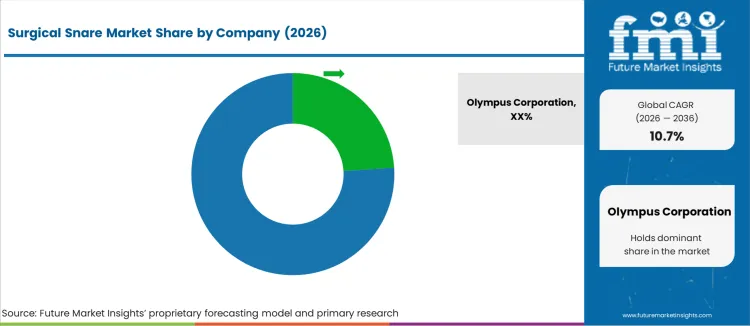
Tier 1 companies represent market leaders, capturing a sizable market share of 62.5% in the global market. The companies have a massive scale, a substantial product portfolio, and a significant global impact. A strong research and development investment program, an international presence, and several strategic acquisitions have contributed to its success.
Creating a steady stream of new products is crucial for maintaining the competitive edge of companies. Economies of scale enable companies such as these to lower their prices and increase their profits. Prominent companies within Tier 1 include Medtronic and Boston Scientific Corporation.
Players in Tier 2 hold a 23.7% share of the market and have a significant presence in certain regions. Compared to Tier 1, Tier 2 companies have stronger product positions, diverse product offerings, and significant innovation, but they are more focused on specific areas.
A strong brand reputation, technological advancements, and innovative products make them profitable. Tier 2 companies include Olympus Corporation, Hill-Rom Holdings, Inc, and Steris.
Tier 3 players thrive by specializing, offering quality products and services, and serving niche markets effectively. They often control their particular industries. A unique niche knowledge and constant product innovation enable the manufacturer to remain competitive in the medical devices industry.
Players include Medline Industries, Inc, CONMED Corporation, Merit Medical Systems, Avalign Technologies and Sklar Surgical Instruments.
Country-wise Insights
A detailed market analysis of surgical snare industries is presented for various countries. India, China, and South Korea have seen an increase in the use of surgical snare in recent years.
Medical equipment produced in these countries is recognized for its high quality and is priced considerably less than equipment produced in Canada. Through 2036, Canada is expected to have a CAGR of 8.6%, while China is expected to have a CAGR of 15.9%. In the coming years, India, South Korea, and China will take the lead in terms of growth.
.webp "Top Country Growth Comparison Surgical Snare Market Cagr (2026 2036)")
| Countries | Value CAGR (2026 to 2036) |
|---|---|
| United States | 5% |
| Canada | 8.6% |
| United Kingdom | 5.7% |
| Germany | 5% |
| India | 18% |
| China | 15.9% |
| South Korea | 12.5% |
| France | 8.1% |
Invasive Treatments to Boost Sales for Surgical Snare in Canada
As Canada's population ages, more chronic diseases occur, requiring endoscopic procedures, which has increased the demand for surgical snare. The popularity of snare and advanced surgical instruments can be attributed to their wide use and demand.
The quality of surgical care is being improved throughout the country as healthcare facilities upgrade their equipment. With the aid of these tools, physicians are able to provide patients with less invasive treatments.
Manufacturers in Canada are developing surgical equipment with the intent of improving accuracy and safety during surgery. A high degree of accuracy is particularly important when performing procedures such as multiple dissections and other endoscopic interventions.
The government has also developed policies that improve the healthcare system and provide more funding for medical devices. This creates a favorable environment for the growth of surgical snare in Canada.
Canada's aging population, chronic disease prevalence, and surgical collaborations have all contributed to the growth of surgical networks. Snare for surgical use in Canada are expected to grow in the future.
A Modern Healthcare System and Innovative Technologies to Boost Demand for Surgical Snare in France
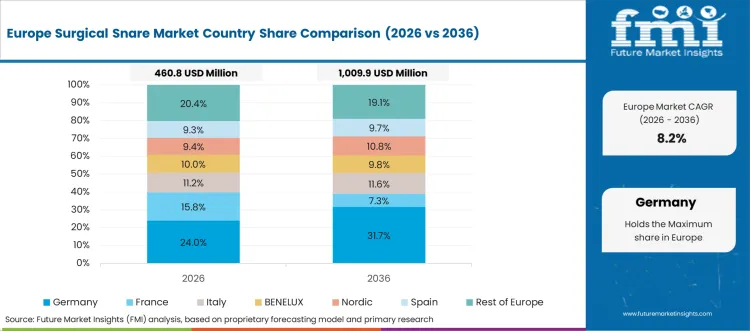
The development of better healthcare facilities and the priority placed on medical research will drive demand in France. The prevalence of diseases requiring endoscopic treatment in France fuels the demand for surgical snare. By providing high-performance connectivity and services, patients can access high-quality hospital treatment.
Research and innovation have also contributed significantly to the development of surgical snare. Many hospitals and medical research institutes throughout the country are involved in the development of medical devices.
This has led to more accurate, more secure, and more pleasant intraoperative communication. Major players in the medical device industry also support and develop surgical communication systems.
Advanced Treatment and High Quality Healthcare to Propel Demand for Surgical Snare in China
China's government's efforts to expand and modernize its healthcare system contributed significantly to the trend. Investing in healthcare infrastructure has led to several hospitals and clinics being equipped with modern scientific devices, including advanced surgical snare.
By expanding access to medical services, the authorities aim to provide greater access to exceptional surgical equipment for a wide range of procedures.
China has experienced rapid economic growth in recent years, resulting in a growing middle class and great healthcare options. With the shift in demographics, advanced treatments have become more accessible and popular, including minimally invasive surgeries utilizing surgical snare.
The emphasis on improving healthcare quality and patient outcomes has led hospitals to adopt new technology. Tonsils are predicted to increase in prevalence, due to the growing number of clinics, surgeries, and tonsil surgeries.
Category-wise Insights
Detailed information about the industry's leading segments can be found in this section. A value share of 82.6% was attributable to the single-use segment in 2026. In terms of end use, hospitals held an 85.7% market share in 2026.
Contamination Awareness will lead the Single-use Surgical Snare Industry
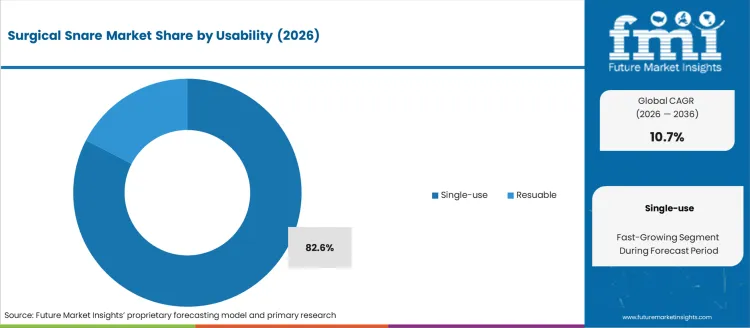
| Type | Single-use |
|---|---|
| Value Share (2026) | 82.6% |
A single-use surgical snare eliminates the danger of cross-contamination and hospital-acquired infections, which is vital in healthcare facilities. The use of single-use devices is becoming more common as sterilization and contamination control regulations become more stringent.
The use of single-use snare eliminates the need for time-consuming and expensive sterilization methods. Growing green substances and recycling packages may become more popular to reduce the environmental impact of single-use devices.
Using disposable units allows hospitals and clinics to better anticipate and control the cost of surgical procedures. Since single-use snare are pre-sterilized and ready to use, surgical approaches are streamlined, and educational time is reduced. Ensure constant performance with each single-use snare by preventing wear and tear and preventing failures from developing.
The development of new substances and production techniques has improved the accuracy and effectiveness of single-use snare. Innovating and tailoring designs to different clinical practices is easier and more efficient for manufacturers.
An Outpatient Surgery Program and Regular Maintenance will enhance Surgical Snare Use in Hospitals
| End Use | Hospitals |
|---|---|
| Value Share (2026) | 85.7% |
Snare used in surgery are preserved and analyzed in hospitals to ensure they remain in good working order. Regular maintenance and inspections ensure that the equipment is in good working order and that any problems are discovered. In recent years, there has been an increase in the number of non-compulsory surgeries, like bariatric procedures or cosmetic procedures.
A surgical snare is commonly used in elective approaches to remove tissue or lesions. Surgical complications are common with conditions like obesity, diabetes, and cardiovascular disease. Patients with persistent GI problems might need snare as part of an endoscopic approach.
Hospitals follow protocols to ensure that surgical snare are thoroughly sterilized before use to prevent infection. Regulatory bodies and manufacturers can also enjoin companies to follow specific cleaning and sterilization protocols.
Outpatient procedures can be performed for several minimally invasive surgical procedures, so extended hospital stays may not be necessary for these procedures. By increasing comfort, more techniques can be performed, resulting in a greater demand for surgical snare.
The development of recent hospitals and the upgrade of existing facilities have been one of the main focuses of many countries' investments in healthcare infrastructure. As the population grows, surgical units like snare will be in higher demand. As hospitals invest in modern technology to attract patients, the growth of private healthcare has also increased the demand.
Competitive Landscape of the Surgical Snare Industry
Key players in the surgical snare industry are being used by manufacturers to increase customer acquisition, including new product launches, international expansion, and partnerships. Numerous healthcare facilities and companies have already established their presence in the surgical suture industry.
Recent Industry Developments in Surgical Snare Market
- Medtronic is a leading provider of services, healthcare technology, and solutions. Their extensive product line includes surgical snare, which are designed for endoscopy and bronchoscopy procedures. With accuracy and reliability, Medtronic snare have gained a solid reputation in the medical field.
- Boston Scientific produces medical devices that are used for a variety of interventions. Snare are manufactured by them for removal of polyps or foreign bodies through endoscopic procedures. Known for their precision and durability, their snare are highly regarded.
Scope of the report
| Metric | Value |
|---|---|
| Quantitative Units | USD 1.99 billion to USD 5.51 billion, at a CAGR of 10.7% |
| Market Definition | Surgical Snare encompasses wire-loop endoscopic accessories designed to encircle, transect, and retrieve tissue specimens during minimally invasive procedures. These devices are deployed through endos... |
| Usability Segmentation | Single-use, Resuable |
| End Use Segmentation | Hospitals, Ambulatory surgical centers |
| Application Segmentation | Gastrointestinal endoscopy, Laparoscopy, Urology endoscopy, Gynecological endoscopy, Arthroscopy, Bronchoscopy, Mediastinoscopy, Laryngoscopy |
| Regions Covered | North America, Latin America, Europe, East Asia, South Asia, Oceania, Middle East and Africa |
| Countries Covered | India, China, South Korea, Canada, France, UK, USA, and 40 plus countries |
| Key Companies Profiled | Olympus Corporation, Medtronic, Boston Scientific Corporation, Medline Industries Inc., CONMED Corporation, Steris, Merit Medical Systems, Avalign Technologies, Hill-Rom Holdings Inc., and Sklar Surgical Instrument |
| Forecast Period | 2026 to 2036 |
| Approach | Forecasting models apply a bottom-up methodology starting with global installed base metrics and projecting the conversion rate to advanced product adoption. |
Surgical Snare Market Segmentation
By Usability:
In terms of usability, the segment is divided into single-use and resuable.
By Application:
In terms of application, the sector is segmented into gastrointestinal endoscopy, laparoscopy, urology endoscopy, gynecological endoscopy, arthroscopy, bronchoscopy, mediastinoscopy, laryngoscopy, and others.
By End Use:
The industry is classified by end-use industries as hospitals and ambulatory surgical centers.
By Region:
Key countries of North America, Latin America, Western Europe, Eastern Europe, South Asia, East Asia, Middle East, and Africa have been covered in the report.
Bibliography
- 1. World Health Organization. (2024). Global Health Expenditure Database. WHO.
- 2. USA Food and Drug Administration. (2024). Medical Device Databases. FDA.
- 3. European Commission. (2024). Regulation (EU) 2017/745 on Medical Devices, consolidated text. EUR-Lex.
- 4. Organisation for Economic Co-operation and Development. (2024). Health at a Glance 2024: OECD Indicators. OECD Publishing.
- 5. The World Bank. (2024). World Development Indicators: Health Systems. World Bank Group.
This bibliography is provided for reader reference. The full Future Market Insights report contains the complete reference list with primary research documentation.
Frequently Asked Questions
How large is the demand for Surgical Snare in the global market in 2026?
Demand for surgical snare in the global market is estimated to be valued at USD 1.99 billion in 2026.
What will be the market size of Surgical Snare in the global market by 2036?
Market size for surgical snare is projected to reach USD 5.51 billion by 2036.
What is the expected demand growth for Surgical Snare between 2026 and 2036?
Demand for surgical snare is expected to grow at a CAGR of 10.7% between 2026 and 2036.
Which Usability is poised to lead global sales by 2026?
Single-use accounts for 82.6% share in 2026 as it addresses the primary demand requirements across global markets.
How significant is the role of Hospitals in driving surgical snare adoption in 2026?
Hospitals represents 85.7% of segment share as end-user demand consolidates around established application pathways.
What is driving demand in India?
India is projected to grow at a CAGR of 18.0% during 2026 to 2036, driven by expanding infrastructure investment and regulatory modernization.
What does market forecast mean on this page?
The market forecast represents a model-based projection built on defined industry and supply chain assumptions for strategic planning purposes.
How does FMI build and validate the surgical snare forecast?
Forecasting models apply a bottom-up methodology starting with global installed base metrics and cross-validate projections against quarterly industry revenue volumes.
Preview the report firsthand - request a free sample
Get SampleGet the brochure for pricing and purchase details.
Get PDFTable of Content
- Executive Summary
- Global Market Outlook
- Demand-side Trends
- Supply-side Trends
- Technology Roadmap Analysis
- Analysis and Recommendations
- Market Overview
- Market Coverage / Taxonomy
- Market Definition / Scope / Limitations
- Research Methodology
- Chapter Orientation
- Analytical Lens and Working Hypotheses
- Market Structure, Signals, and Trend Drivers
- Benchmarking and Cross-market Comparability
- Market Sizing, Forecasting, and Opportunity Mapping
- Research Design and Evidence Framework
- Desk Research Programme (Secondary Evidence)
- Company Annual and Sustainability Reports
- Peer-reviewed Journals and Academic Literature
- Corporate Websites, Product Literature, and Technical Notes
- Earnings Decks and Investor Briefings
- Statutory Filings and Regulatory Disclosures
- Technical White Papers and Standards Notes
- Trade Journals, Industry Magazines, and Analyst Briefs
- Conference Proceedings, Webinars, and Seminar Materials
- Government Statistics Portals and Public Data Releases
- Press Releases and Reputable Media Coverage
- Specialist Newsletters and Curated Briefings
- Sector Databases and Reference Repositories
- FMI Internal Proprietary Databases and Historical Market Datasets
- Subscription Datasets and Paid Sources
- Social Channels, Communities, and Digital Listening Inputs
- Additional Desk Sources
- Expert Input and Fieldwork (Primary Evidence)
- Primary Modes
- Qualitative Interviews and Expert Elicitation
- Quantitative Surveys and Structured Data Capture
- Blended Approach
- Why Primary Evidence is Used
- Field Techniques
- Interviews
- Surveys
- Focus Groups
- Observational and In-context Research
- Social and Community Interactions
- Stakeholder Universe Engaged
- C-suite Leaders
- Board Members
- Presidents and Vice Presidents
- R&D and Innovation Heads
- Technical Specialists
- Domain Subject-matter Experts
- Scientists
- Physicians and Other Healthcare Professionals
- Governance, Ethics, and Data Stewardship
- Research Ethics
- Data Integrity and Handling
- Primary Modes
- Tooling, Models, and Reference Databases
- Desk Research Programme (Secondary Evidence)
- Data Engineering and Model Build
- Data Acquisition and Ingestion
- Cleaning, Normalisation, and Verification
- Synthesis, Triangulation, and Analysis
- Quality Assurance and Audit Trail
- Market Background
- Market Dynamics
- Drivers
- Restraints
- Opportunity
- Trends
- Scenario Forecast
- Demand in Optimistic Scenario
- Demand in Likely Scenario
- Demand in Conservative Scenario
- Opportunity Map Analysis
- Product Life Cycle Analysis
- Supply Chain Analysis
- Investment Feasibility Matrix
- Value Chain Analysis
- PESTLE and Porter’s Analysis
- Regulatory Landscape
- Regional Parent Market Outlook
- Production and Consumption Statistics
- Import and Export Statistics
- Market Dynamics
- Global Market Analysis 2021 to 2025 and Forecast, 2026 to 2036
- Historical Market Size Value (USD Million) Analysis, 2021 to 2025
- Current and Future Market Size Value (USD Million) Projections, 2026 to 2036
- Y-o-Y Growth Trend Analysis
- Absolute $ Opportunity Analysis
- Global Market Pricing Analysis 2021 to 2025 and Forecast 2026 to 2036
- Global Market Analysis 2021 to 2025 and Forecast 2026 to 2036, By Usability
- Introduction / Key Findings
- Historical Market Size Value (USD Million) Analysis By Usability , 2021 to 2025
- Current and Future Market Size Value (USD Million) Analysis and Forecast By Usability , 2026 to 2036
- Single-use
- Resuable
- Single-use
- Y-o-Y Growth Trend Analysis By Usability , 2021 to 2025
- Absolute $ Opportunity Analysis By Usability , 2026 to 2036
- Global Market Analysis 2021 to 2025 and Forecast 2026 to 2036, By End Use
- Introduction / Key Findings
- Historical Market Size Value (USD Million) Analysis By End Use, 2021 to 2025
- Current and Future Market Size Value (USD Million) Analysis and Forecast By End Use, 2026 to 2036
- Hospitals
- Ambulatory surgical centers
- Hospitals
- Y-o-Y Growth Trend Analysis By End Use, 2021 to 2025
- Absolute $ Opportunity Analysis By End Use, 2026 to 2036
- Global Market Analysis 2021 to 2025 and Forecast 2026 to 2036, By Application
- Introduction / Key Findings
- Historical Market Size Value (USD Million) Analysis By Application, 2021 to 2025
- Current and Future Market Size Value (USD Million) Analysis and Forecast By Application, 2026 to 2036
- Gastrointestinal endoscopy
- Laparoscopy
- Urology endoscopy
- Gynecological endoscopy
- Arthroscopy
- Bronchoscopy
- Mediastinoscopy
- Laryngoscopy
- Gastrointestinal endoscopy
- Y-o-Y Growth Trend Analysis By Application, 2021 to 2025
- Absolute $ Opportunity Analysis By Application, 2026 to 2036
- Global Market Analysis 2021 to 2025 and Forecast 2026 to 2036, By Region
- Introduction
- Historical Market Size Value (USD Million) Analysis By Region, 2021 to 2025
- Current Market Size Value (USD Million) Analysis and Forecast By Region, 2026 to 2036
- North America
- Latin America
- Western Europe
- Eastern Europe
- East Asia
- South Asia and Pacific
- Middle East & Africa
- Market Attractiveness Analysis By Region
- North America Market Analysis 2021 to 2025 and Forecast 2026 to 2036, By Country
- Historical Market Size Value (USD Million) Trend Analysis By Market Taxonomy, 2021 to 2025
- Market Size Value (USD Million) Forecast By Market Taxonomy, 2026 to 2036
- By Country
- USA
- Canada
- Mexico
- By Usability
- By End Use
- By Application
- By Country
- Market Attractiveness Analysis
- By Country
- By Usability
- By End Use
- By Application
- Key Takeaways
- Latin America Market Analysis 2021 to 2025 and Forecast 2026 to 2036, By Country
- Historical Market Size Value (USD Million) Trend Analysis By Market Taxonomy, 2021 to 2025
- Market Size Value (USD Million) Forecast By Market Taxonomy, 2026 to 2036
- By Country
- Brazil
- Chile
- Rest of Latin America
- By Usability
- By End Use
- By Application
- By Country
- Market Attractiveness Analysis
- By Country
- By Usability
- By End Use
- By Application
- Key Takeaways
- Western Europe Market Analysis 2021 to 2025 and Forecast 2026 to 2036, By Country
- Historical Market Size Value (USD Million) Trend Analysis By Market Taxonomy, 2021 to 2025
- Market Size Value (USD Million) Forecast By Market Taxonomy, 2026 to 2036
- By Country
- Germany
- UK
- Italy
- Spain
- France
- Nordic
- BENELUX
- Rest of Western Europe
- By Usability
- By End Use
- By Application
- By Country
- Market Attractiveness Analysis
- By Country
- By Usability
- By End Use
- By Application
- Key Takeaways
- Eastern Europe Market Analysis 2021 to 2025 and Forecast 2026 to 2036, By Country
- Historical Market Size Value (USD Million) Trend Analysis By Market Taxonomy, 2021 to 2025
- Market Size Value (USD Million) Forecast By Market Taxonomy, 2026 to 2036
- By Country
- Russia
- Poland
- Hungary
- Balkan & Baltic
- Rest of Eastern Europe
- By Usability
- By End Use
- By Application
- By Country
- Market Attractiveness Analysis
- By Country
- By Usability
- By End Use
- By Application
- Key Takeaways
- East Asia Market Analysis 2021 to 2025 and Forecast 2026 to 2036, By Country
- Historical Market Size Value (USD Million) Trend Analysis By Market Taxonomy, 2021 to 2025
- Market Size Value (USD Million) Forecast By Market Taxonomy, 2026 to 2036
- By Country
- China
- Japan
- South Korea
- By Usability
- By End Use
- By Application
- By Country
- Market Attractiveness Analysis
- By Country
- By Usability
- By End Use
- By Application
- Key Takeaways
- South Asia and Pacific Market Analysis 2021 to 2025 and Forecast 2026 to 2036, By Country
- Historical Market Size Value (USD Million) Trend Analysis By Market Taxonomy, 2021 to 2025
- Market Size Value (USD Million) Forecast By Market Taxonomy, 2026 to 2036
- By Country
- India
- ASEAN
- Australia & New Zealand
- Rest of South Asia and Pacific
- By Usability
- By End Use
- By Application
- By Country
- Market Attractiveness Analysis
- By Country
- By Usability
- By End Use
- By Application
- Key Takeaways
- Middle East & Africa Market Analysis 2021 to 2025 and Forecast 2026 to 2036, By Country
- Historical Market Size Value (USD Million) Trend Analysis By Market Taxonomy, 2021 to 2025
- Market Size Value (USD Million) Forecast By Market Taxonomy, 2026 to 2036
- By Country
- Kingdom of Saudi Arabia
- Other GCC Countries
- Turkiye
- South Africa
- Other African Union
- Rest of Middle East & Africa
- By Usability
- By End Use
- By Application
- By Country
- Market Attractiveness Analysis
- By Country
- By Usability
- By End Use
- By Application
- Key Takeaways
- Key Countries Market Analysis
- USA
- Pricing Analysis
- Market Share Analysis, 2025
- By Usability
- By End Use
- By Application
- Canada
- Pricing Analysis
- Market Share Analysis, 2025
- By Usability
- By End Use
- By Application
- Mexico
- Pricing Analysis
- Market Share Analysis, 2025
- By Usability
- By End Use
- By Application
- Brazil
- Pricing Analysis
- Market Share Analysis, 2025
- By Usability
- By End Use
- By Application
- Chile
- Pricing Analysis
- Market Share Analysis, 2025
- By Usability
- By End Use
- By Application
- Germany
- Pricing Analysis
- Market Share Analysis, 2025
- By Usability
- By End Use
- By Application
- UK
- Pricing Analysis
- Market Share Analysis, 2025
- By Usability
- By End Use
- By Application
- Italy
- Pricing Analysis
- Market Share Analysis, 2025
- By Usability
- By End Use
- By Application
- Spain
- Pricing Analysis
- Market Share Analysis, 2025
- By Usability
- By End Use
- By Application
- France
- Pricing Analysis
- Market Share Analysis, 2025
- By Usability
- By End Use
- By Application
- India
- Pricing Analysis
- Market Share Analysis, 2025
- By Usability
- By End Use
- By Application
- ASEAN
- Pricing Analysis
- Market Share Analysis, 2025
- By Usability
- By End Use
- By Application
- Australia & New Zealand
- Pricing Analysis
- Market Share Analysis, 2025
- By Usability
- By End Use
- By Application
- China
- Pricing Analysis
- Market Share Analysis, 2025
- By Usability
- By End Use
- By Application
- Japan
- Pricing Analysis
- Market Share Analysis, 2025
- By Usability
- By End Use
- By Application
- South Korea
- Pricing Analysis
- Market Share Analysis, 2025
- By Usability
- By End Use
- By Application
- Russia
- Pricing Analysis
- Market Share Analysis, 2025
- By Usability
- By End Use
- By Application
- Poland
- Pricing Analysis
- Market Share Analysis, 2025
- By Usability
- By End Use
- By Application
- Hungary
- Pricing Analysis
- Market Share Analysis, 2025
- By Usability
- By End Use
- By Application
- Kingdom of Saudi Arabia
- Pricing Analysis
- Market Share Analysis, 2025
- By Usability
- By End Use
- By Application
- Turkiye
- Pricing Analysis
- Market Share Analysis, 2025
- By Usability
- By End Use
- By Application
- South Africa
- Pricing Analysis
- Market Share Analysis, 2025
- By Usability
- By End Use
- By Application
- USA
- Market Structure Analysis
- Competition Dashboard
- Competition Benchmarking
- Market Share Analysis of Top Players
- By Regional
- By Usability
- By End Use
- By Application
- Competition Analysis
- Competition Deep Dive
- Olympus Corporation
- Overview
- Product Portfolio
- Profitability by Market Segments (Product/Age /Sales Channel/Region)
- Sales Footprint
- Strategy Overview
- Marketing Strategy
- Product Strategy
- Channel Strategy
- Medtronic
- Boston Scientific Corporation
- Medline Industries Inc.
- CONMED Corporation
- Steris
- Merit Medical Systems
- Avalign Technologies
- Hill-Rom Holdings Inc.
- Sklar Surgical Instrument
- Olympus Corporation
- Competition Deep Dive
- Assumptions & Acronyms Used


