

- Industry Size (2026)
- USD 6213.2 Mn
- Forecast (2036)
- USD 9806.2 Mn
- CAGR (2026 to 2036)
- 4.7%
Surgical Irrigation Market size, market forecast and outlook By FMI
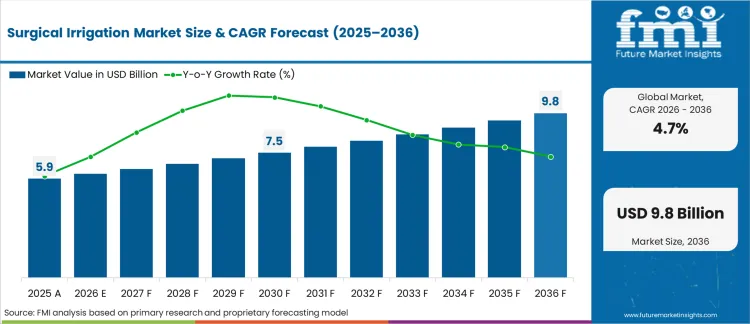
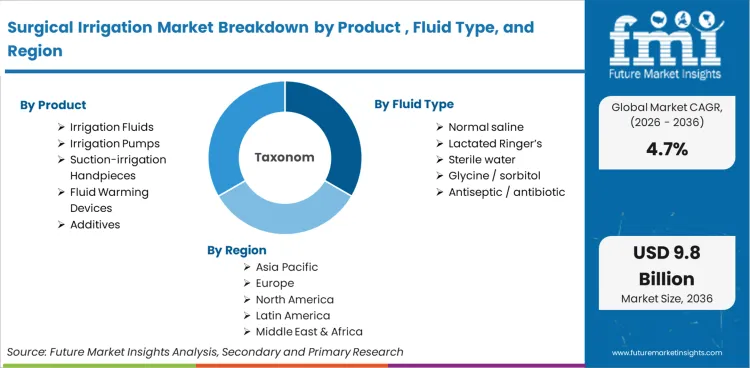
In 2026, the surgical irrigation market was valued at USD 6,213.2 million. Based on Future Market Insights analysis, demand for surgical irrigation is estimated to grow to USD 9,806.2 million by 2036. FMI projects a CAGR of 4.7% during the forecast period.
Absolute dollar growth of USD 290.1 million over the decade points to steady scale-up rather than a one-time reset. As per FMI, demand is expected to be supported by rising procedure throughput and higher adoption of controlled irrigation in arthroscopy and minimally invasive workflows, while tender discipline and commoditization of core fluids are expected to limit outsized value expansion.
"This European launch marks a significant milestone in advancing surgical care Surgical Site Infections are multifactorial and continue to present serious challenges to both patient outcomes and healthcare systems. Surgiphor supports clinicians in implementing evidence-based practices such as surgical wound irrigation to help reduce risk, enhance recovery, and improve overall surgical safety." said Rian Seger, Worldwide President of BD Surgery.
Summary of Surgical Irrigation Market
- Global Surgical Irrigation Market Definition
- The industry covers sterile irrigation fluids, delivery systems, and accessories used to irrigate operative fields for visualization, debris removal, and thermal control across surgical procedures.
- Demand Drivers in the Market
- Procedure volumes in orthopedics, laparoscopy, and endoscopy are sustaining steady consumption of irrigation consumables.
- ASC expansion is increasing demand for standardized, easy-to-set irrigation setups that reduce room turnover time.
- Clinical preference for clear visualization and controlled pressure is reinforcing use of pumps and managed delivery workflows.
- Key Segments Analyzed in the FMI Report
- By Product Category: Irrigation Fluids lead at 58% share in 2026, followed by Irrigation Pumps/Systems at 18% share.
- By Fluid Type: Normal Saline leads at 62% share in 2026, followed by lactated Ringer’s at 12% share.
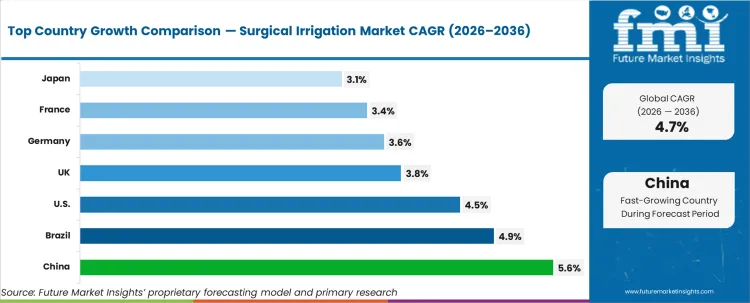
- Geography: China and Brazil show the fastest growth at 5.6% and 4.9% CAGR, supported by higher surgical throughput and facility capacity additions.
- Analyst Opinion at FMI
- Sabyasachi Ghosh, Principal Consultant at Future Market Insights, opines, ‘Supplier preference is being decided by delivery consistency, contamination control discipline, and predictable total setup cost per case, since irrigation performance is being treated as a workflow reliability input rather than a discretionary add-on.’
- Strategic Implications and Executive Takeaways
- Protect fluid leadership with dependable supply planning and pack configurations aligned to high-frequency procedures and case cart standards.
- Expand pump-assisted placements by linking value to visibility stability, staff handling simplicity, and reduced interruption risk during longer cases.
- Build ASC-oriented offerings with simplified setup, bundled accessories, and service coverage that supports rapid turnover environments.
- Methodology
- As per FMI, market sizing and splits were reconciled using company primary disclosures, portfolio mapping, and procedure-linked demand logic.
- Segment shares were validated by aligning product usage patterns to procedure mix and site-of-care purchasing behavior.
- Pricing sensitivity was stress tested across fluids and delivery modes to confirm revenue response under plausible mix shifts.
Based on FMI’s report, China (5.6% CAGR, supported by operating room capacity growth and higher minimally invasive procedure volumes) and Brazil (4.9% CAGR, driven by expanding private hospital throughput and arthroscopy adoption) are expected to lead growth. The U.S. (4.5% CAGR) is expected to stay supported by high procedure density and protocolized irrigation use in orthopedic and general surgery. Mature markets including the UK (3.8%), Germany (3.6%), France (3.4%), and Japan (3.1%) are expected to contribute more through replacement demand, constrained by budget caps and procurement standardization.
Global Surgical Irrigation Market definition
The market covers devices, and accessories used to irrigate surgical sites to clear blood, debris, and tissue during operative and endoscopic procedures. Products include irrigation fluids, pumps or systems, suction-irrigation handpieces, fluid warming or temperature control equipment, and procedure-linked additives. Purchases are made by hospitals, ambulatory surgical centers, and clinic settings to support workflows in orthopedics, general surgery, urology, neurosurgery, ENT, and wound care. Demand is shaped by procedure volume, preferred delivery mode, and protocol requirements for fluid selection and flow control, with revenue generated through recurring fluid consumption and system-related consumables.
Global Surgical Irrigation Market inclusions
The report includes global and regional market sizing and a 10-year forecast for 2026 to 2036. Segment-level sizing is provided by product category, procedure, fluid type, delivery mode, and end user, along with country-level CAGR comparisons across major markets. Competitive positioning is covered for leading suppliers, with analysis of purchasing pathways, standardization practices, and how pump installed base and consumable pull-through influence supplier selection, as per FMI.
Global Surgical Irrigation Market exclusions
The scope excludes surgical imaging systems, endoscopes, general surgical instruments, and sterile drapes or disposables not used for irrigation delivery. It also omits intravenous infusion therapy products and non-surgical wound cleansing products sold for routine outpatient hygiene. Pharmaceuticals used as standalone therapeutics are excluded, with additives covered only where supplied as part of irrigation use in surgical workflows. The focus remains on irrigation-related fluids, delivery systems, and directly associated accessories within the stated segments.
Global Surgical Irrigation Market research methodology
- Primary research: Interviews were conducted with operating room nurses, procurement managers, surgeons across key specialties, and supplier commercial teams to validate usage patterns, delivery preferences, and contracting behavior.
- Desk research: Public information from health systems, professional associations, regulators, and company primary disclosures was reviewed to benchmark protocol practice and category positioning.
- Market-sizing and forecasting: A hybrid model was used, combining operational-level demand logic with segment shares by product category and fluid type, then align through value build-up using pricing bands and mix.
- Data validation and update cycle: Outputs were checked through consistency review across segments and countries, with variance review applied before finalization.
Segmental Analysis
Global Surgical Irrigation Market Analysis by Product Category
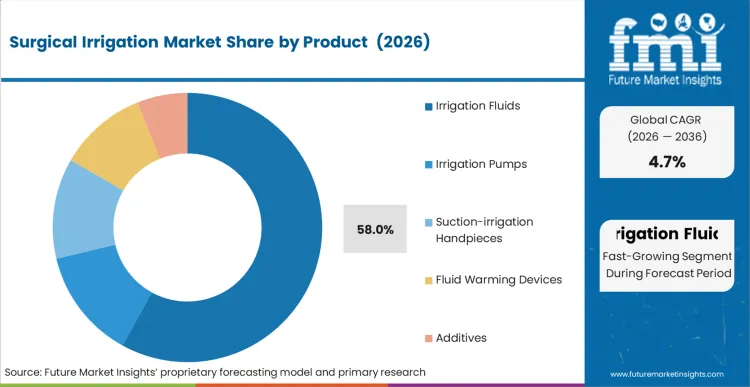
Based on FMI’s report, Irrigation Fluids are estimated to hold 58% share in 2026, followed by irrigation pumps and systems at 18% share. Irrigation Fluids remain the primary volume driver due to high surgical volumes, sterile solution consumption, which creates repeat purchasing tied to procedure throughput. Pumps and systems hold the second position where controlled pressure and stable flow are preferred, which concentrates demand in longer procedures and higher complexity workflows.
- High Procedural Volume: Surgical Procedure such as Laparoscopy, Orthopedics, General Surgery and Urology requires significant irrigation fluids to maintain visibility & debride wounds. Average procedure consumption remains 3-9 liters of surgical fluid volume vs. equipment used which remains as a fixed cost regardless of fluid dispensed.
- The "Consumable" Revenue Model: This revenue model drives due to its shifts from one-time capital purchases to high-frequency, predictable revenue. While irrigation pumps remains as a multi-year investment, irrigation fluids are single-use essentials required for every procedures which create a massive recurring sales volume which outpaces the cost of the hardware component.
Global Surgical Irrigation Market Analysis by Fluid Type
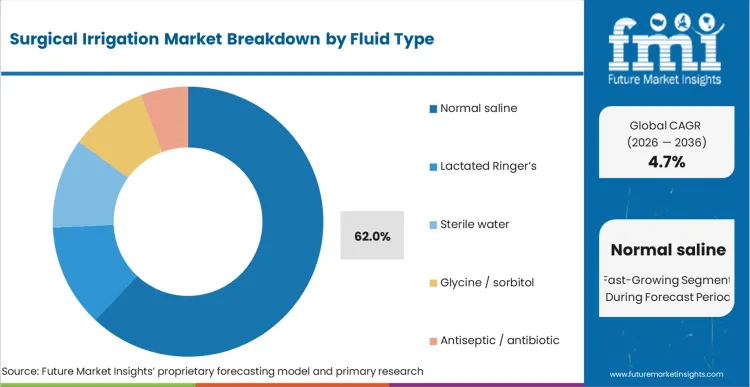
Normal Saline Fluids accounts for 62% share in 2026, followed by lactated Ringer’s at 12%, based on FMI’s report. Saline Fluid leads since it is widely used for broad procedural irrigation needs and is typically treated as the default selection in many facility supply lists. Lactated Ringer’s remains the second choice in sites where clinician preference and protocol differences shape selection for specific procedures, while other fluids remain narrower in use.
- Contracting and Portfolio Investments: Long-term access is being secured through supply partnerships such as Amsino’s three-year agreement with Partners Cooperative to provide pre-filled saline flush syringes with defined supply-resiliency commitments, while adjacent regulated sterile-fluid capabilities are being expanded through Kodak’s launch of USA-manufactured PBS and WFI offerings with lot-traceability and quality-process positioning, indicating continued investment in sterile aqueous solution infrastructure that underpins saline-led procurement confidence.
- Enhanced Surgical Field Visibility: Hot Saline Irrigation is a game-changer for endoscopic sinus surgery, leveraging thermal vasoconstriction to clear the surgical field. By using saline heated to approximately 40°C, surgeons achieve superior visibility and reduce blood loss. This low-cost, intervention trims nearly 10 minutes off operative times, proving that simple temperature adjustments can outperform expensive pharmacological hemostatic agents without risking patient stability.
Global Surgical Irrigation Market Drivers, Restraints, and Opportunities
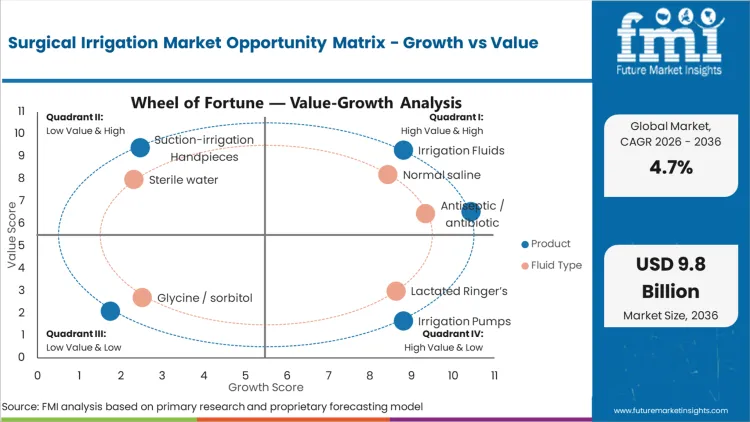
Future Market Insights analysis that historical patterns point at a steady, procedure-anchored surgical consumables category where demand is linked to operative volume and visualization requirements across multiple specialties. Estimated valuation in 2026 is USD 6,213.2 million and is projected to reach USD 9,806.2 million by 2036 at a 4.7% CAGR, based on FMI’s report, with purchasing shaped by hospital contracting discipline and site-of-care expansion into ASCs.
While unit pricing remains constrained by tender structures and standardization of core fluids (price pressure), value growth is being supported by higher adoption of pump-assisted delivery where procedural complexity and visualization stability influence purchasing decisions. The forecast trajectory reflects a purchasing balance where hospitals remain the largest end user at 68% share, ASCs expand consumption at 26%, and product selection is filtered through setup reliability, contamination control expectations, and total cost per case.
- Workflow reliability upgrading: Growth is shifting toward delivery approaches that reduce interruption risk and stabilize visualization during longer cases.
- Qualification lock-in restraint: Once products are embedded in case carts and purchasing contracts, switching is slowed by protocol and training burden.
- Delivery mode mix shift: Pump-assisted delivery at 42% is gaining weight where controlled flow is preferred, while gravity at 34% remains cost-led.
Regional Analysis
.webp "Top Country Growth Comparison Surgical Irrigation Market Cagr (2026 2036)")
Based on the regional analysis, surgical irrigation market is segmented into North America, Latin America, Europe, East Asia, South Asia, Oceania and Middle East & Africa across 40+ countries. Regional performance is assessed using country-level demand signals tied to procedure volumes, hospital procurement practices, and adoption of irrigation systems and fluids across operating rooms, as per FMI. The full report also offers market attractiveness analysis based on regional trends.
| Country | CAGR |
|---|---|
| USA | 4.5% |
| India | 3.6% |
| Germany | 3.8% |
| UK | 3.4% |
| Japan | 3.1% |
| China | 5.6% |
| Brazil | 4.9% |
Source: Future Market Insights (FMI) analysis and primary research
North America Surgical Irrigation Market Analysis
North America is shaped by OR standardization and infection prevention governance, where product selection is driven by hospital protocols, value analysis committees, and supply continuity expectations across large health systems. Baxter holds strong access in hospital fluid portfolios and contract coverage. B. Braun competes through irrigation fluids and systems supported by clinical education and hospital accounts.
- United States: Surgical irrigation demand in the United States is expected to rise at 4.5% CAGR through 2036. Growth is fueled by consistent surgical throughput across inpatient and outpatient settings, with normal saline remaining the most used fluid type in routine procedures. Adoption of surgical fluids is also supported by conservative use of surgical irrigation fluids in different procedures to avoid sudden shortage. [4]
FMI’s report includes a detailed analysis of the growth in the North American region, along with a country-wise assessment that includes the United States. Readers can also find regional trends, regulations, and market growth based on different segments and countries in the North America region.
Asia Pacific Surgical Irrigation Market Analysis
Asia Pacific is expected to register the fastest growth, supported by surgical capacity expansion, rising procedure volumes, and wider deployment of irrigation pumps and integrated systems across high-throughput hospitals. Stryker and Zimmer Biomet influence demand where arthroscopy platform placement drives accessory and disposables usage linked to irrigation workflows. Future Market Insights analysis links growth to operating room expansion and higher utilization of pump-assisted irrigation in procedures with sustained fluid management needs.
- China: Demand for surgical irrigation in China is projected to rise at 5.6% CAGR through 2036. Growth is supported by rising surgical throughput in large public hospitals and continued expansion of procedure capacity in urban centers. Demand is expected to stay weighted toward irrigation fluids, with increasing use of irrigation systems in orthopedics and laparoscopy where controlled delivery supports workflow efficiency.
- Japan: Surgical irrigation demand in Japan is expected to expand at a 3.1% CAGR through 2036. Cultivating growth of Japan is by stable surgical utilization and high protocol discipline in operating rooms, which sustains repeat demand for standard irrigation fluids and compatible delivery sets. Volume expansion is moderated by a mature surgical infrastructure and tighter utilization governance that limits rapid step-ups in consumables use per case.
The full report analyze the surgical irrigation market across East and South Asia from 2021-2036, covering pricing, trends, and growth drivers in China, Japan, South Korea, India, Indonesia, Malaysia, and Thailand. The assessment highlights trends that dictate regional demand and procurement behavior.
Latin America Surgical Irrigation Market Analysis
Latin America is driven by mixed public and private procurement, where import exposure and distributor coverage influence supply continuity for irrigation fluids and systems. Baxter and B. Braun hold hospital access through established fluid supply chains and contract coverage. FMI opines that demand conversion is shaped by tender cadence and budgeting cycles in public hospitals, while private hospital networks support more stable reorder patterns.
- Brazil: Demand for surgical irrigation in Brazil is projected to rise at 4.9% CAGR through 2036. The growth is driven by steady surgical volumes across public hospitals and private providers, with normal saline remaining the default irrigation fluid in routine procedures. Acceptance of pump-assisted delivery is expected to increase in higher throughput centres where orthopedics and laparoscopy volumes support system utilisation. Constraint is created by procurement variability and price sensitivity in public tenders, which can affect system upgrade pace and favour standard consumable formats.
The report consists of a detailed analysis for the market in Brazil, Mexico, Chile, Argentina, Peru and Rest of Latin America. Readers can find detailed information about several factors, such as the pricing analysis and regional trends, which are impacting growth in the Latin America region.
Europe Surgical Irrigation Market Analysis
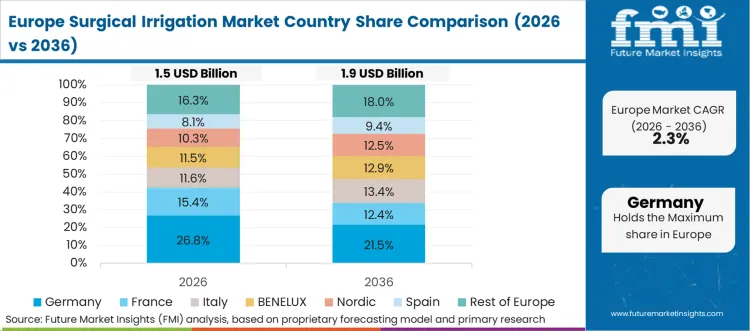
Europe is tender-led and protocol-driven, where procurement is shaped by hospital framework awards, documentation expectations, and standardization of perioperative consumables. B. Braun maintains strong reach through hospital accounts and irrigation fluid availability. Future Market Insights analysis indicates that growth is supported by steady procedure volumes, with pricing and product mix governed by tender discipline.
- Germany: Demand for surgical irrigation in Germany is projected to rise at 3.6% CAGR through 2036. Growth is driven by stable hospital surgical throughput, with orthopedics and general surgery sustaining irrigation fluid consumption. Pump-assisted delivery is expected to remain relevant in higher complexity procedures where controlled flow is preferred.
- United Kingdom: Demand for surgical irrigation in the United Kingdom is projected to rise at 3.8% CAGR through 2036. Growth is promoted by steady surgical activity and the need to maintain OR efficiency, which sustains repeat demand for standard irrigation fluids and delivery sets. Adoption pace for systems is shaped by procurement frameworks and trust-level standardization, which can concentrate share among awarded suppliers.
FMI’s analysis of surgical irrigation market in Europe consists of country-wise assessment that includes the Germany, Italy, France, UK, Spain, Russia, Nordic, Benelux and Rest of Europe. Readers can know various regulations and latest trends in the regional market.
Competitive aligners for market players
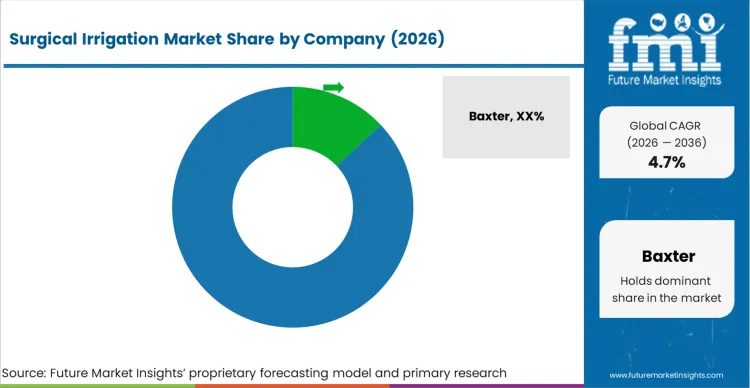
Market structure remains fragmented, yet practical competition is concentrated among a limited set of suppliers that can meet hospital-scale volumes, packaging and sterility expectations, and service needs across procedure rooms and sterile processing workflows. FMI analysis indicates a clear scale leader at about 12% share, while the remaining demand is spread across diversified Medtech manufacturers and fluid suppliers. The main competitive driver is total landed cost within contracted supply, rather than episodic pricing. Contract renewals are typically shaped by supply continuity, packaging consistency, and the ability to support high-throughput orthopedic and general surgery suites where irrigation usage is routine, as per FMI.
Companies with broad procedure portfolios and facility relationships hold structural advantages because irrigation demand is often purchased as part of bundled perioperative supply. Leaders benefit from distribution reach, established hospital contracting pathways, and the ability to align irrigation fluids with pumps, tubing sets, and suction irrigation handpieces in standardized kits. Where normal saline accounts for the dominant fluid share, scale and fill reliability matter more than differentiation claims, so suppliers that can protect availability during demand spikes tend to defend shelf space and framework positions. Smaller players rely more on distributor pull-through and department-level preference, which leaves them exposed when hospitals consolidate vendors during rebids, based on FMI’s report.
Recent Developments
The report includes full coverage of key trends from competitive benchmarking. Some of the recent developments covered in the reports:
- In 2025, In a strategic move to dominate the wound management sector, Mölnlycke Health Care has acquired P.G.F. Industry Solutions, the Austrian manufacturer of Granudacyn®. This acquisition integrates high-performance hypochlorous acid (HOCl) solutions into Mölnlycke’s portfolio which reinforces their commitment towards advanced infection control and the high-volume, recurring revenue model of the surgical irrigation and wound cleansing market.
- In 2025, Clyra Medical Technologies is accelerating the launch of ViaCLYR, its advanced antimicrobial wound irrigation solution through multiple established distributors for a strong domestic and international reach. Leveraging FDA clearances and a pending CE Mark, the company is targeting the EMEA region through strategic distribution partnerships. This move positions ViaCLYR as a high-growth contender in the global surgical and wound care markets, prioritizing clinician-led evaluations to drive rapid adoption.
- In 2025, Dyne Medical Group Secures Exclusive Rights for ROSI System. Dyne Medical Group has secured exclusive Korean distribution rights for VTI’s ROSI, a robotic suction-irrigation system. Designed for laparoscopic integration, ROSI allows surgeons to control irrigation directly from the robotic console, eliminating the need for extra support staff. With regulatory approval targeted for 2026, this partnership marks a strategic move into the high-growth robotic surgery market.
Key Players in Surgical Irrigation Market
- Baxter
- B. Braun
- Fresenius Kabi
- Stryker
- Mölnlycke AB
- Medtronic
- Smith+Nephew
- Zimmer Biomet
- Arthrex
- BD
- Irrimax
Scope of the Report
| Metric | Value |
|---|---|
| Quantitative units | USD 6213.2 million (2026) to USD 9,806.2million (2036), at a CAGR of 4.7% |
| Market definition | The surgical irrigation market comprises the global production and trade of sterile irrigation fluids, delivery systems, and supporting accessories used to irrigate surgical sites during open, minimally invasive, and endoscopic procedures, where usage is driven by procedure volume, standard OR protocols for field visibility and debris removal, and site specific workflow preferences across hospitals and ambulatory settings. |
| By Product Category | Irrigation fluids, Irrigation pumps or systems, Suction irrigation handpieces, Fluid warming or temperature control, Additives |
| By Procedure | Orthopedics/arthroscopy, Laparoscopy/general surgery, Urology/endoscopy Neurosurgery, ENT/ophthalmic, and Wound/trauma |
| By Fluid Type | Normal saline, Lactated Ringer’s, Sterile water, Glycine/sorbitol, and Antiseptic/antibiotic |
| By Delivery Mode | Gravity, Pump-assisted, Pressurized bag, and Integrated endoscopy tower |
| By End User | Hospitals, ASCs, and Clinics/office-based |
| Regions covered | North America, Latin America, East Asia, South Asia & Pacific, Western Europe, Eastern Europe, and Middle East & Africa. |
| Countries covered | United States, Canada, Mexico, Brazil, Argentina, Germany, France, United Kingdom, Italy, Spain, China, India, Japan, South Korea, Indonesia, Australia and 40 plus countries |
| Key companies profiled | Baxter, B. Braun, Fresenius Kabi, Stryker, Mölnlycke AB, Medtronic, Smith+Nephew, Zimmer Biomet, Arthrex, BD, and Irrimax |
| Forecast period | 2026 to 2036 |
| Approach | Hybrid top down and bottom up market modeling validated through primary interviews with OR supply stakeholders and procedure area users, supported by procurement benchmarking and product portfolio mapping, as per FMI. |
Surgical Irrigation Market analysis by segments
By Product Category
- Irrigation Fluids
- Irrigation Pumps
- Suction-irrigation Handpieces
- Fluid Warming Devices
- Additives
By Procedure
- Arthroscopy Procedure
- Laparoscopic Procedures
- Urology Procedures
- Neurosurgery
- ENT Procedure
- Wound/Trauma Care
By Delivery Mode
- Gravity-based
- Pump-assisted
- Pressurized Bag
- Integrated Endoscopy Tower
By Fluid Type
- Normal Saline,
- Lactated Ringer’s,
- Sterile Water,
- Glycine/Sorbitol
- Antiseptic/Antibiotic
By End user
- Hospitals
- Ambulatory Surgical Centers
- Office-based Clinics
- Others
Regions
- North America
- USA
- Canada
- Mexico
- Latin America
- Brazil
- Argentina
- Rest of Latin America
- East Asia
- China
- Japan
- South Korea
- South Asia & Pacific
- India
- ASEAN Countries
- Australia & New Zealand
- Rest of South Asia
- Western Europe
- Germany
- UK
- France
- Italy
- Spain
- BENELUX
- Nordic Countries
- Rest of Western Europe
- Eastern Europe
- Russia
- Hungary
- Poland
- Rest of Eastern Europe
- Middle East & Africa
- Saudi Arabia
- Türkiye
- South Africa
- Other African Union
- Rest of Middle East & Africa
Bibliography
- [1] 2025, Advances in Orthopedic Surgery Irrigation: A Review of Traditional Agents and the Emergence of Citrate-Based Solutions, Mitchell K Ng et al.
- [2] 2025, Amsino announces multi-year partnership to ensure reliable access to pre-filled saline flush syringes for Partners Cooperative members
- [3] 2026, Hot Saline Irrigation for Improving Surgical Field Visibility in Endoscopic Sinus Surgery, Abdur Rehman, Shahzaib Maqbool et al.
- [4] 2025, Evidence-Based Framework for Surgical Irrigation Fluid Stewardship and Endoscopic Case Prioritization During Fluid Shortages, Kevin Koo and Meghan A. Cooper et al.
This report addresses
- Market intelligence to enable structured strategic decision making across OR consumables, capital systems, and procedure growth planning
- Market size estimation and 10 year revenue forecasts from 2026 to 2036 for surgical irrigation demand
- Growth opportunity mapping across product category, procedure mix, fluid type, delivery mode, and end user purchasing pools
- Segment and regional revenue forecasts aligned to the stated taxonomy and covered geographies
- Competition strategy assessment including positioning by fluid portfolios, system placement, and facility coverage benchmarking
- Product and compliance tracking focused on sterile fluid handling expectations and device documentation requirements for regulated supply
- Regulatory and guideline impact analysis covering infection prevention expectations and OR protocol standardisation affecting irrigation practices
- Market report delivery in PDF, Excel, PPT, and interactive dashboard formats for executive and operational use
Frequently Asked Questions
What will be the market size of Surgical irrigation in the global market by 2036?
Market size for Surgical irrigation is projected to reach USD 9,806.2 Million by 2036.
What is the expected demand growth for Surgical irrigation in the global market between 2026 and 2036?
Demand for Surgical irrigation in the global market is expected to grow at a CAGR of 4.7% between 2026 and 2036.
Which product category is poised to lead global sales by 2026?
Irrigation Fluids are expected to be the dominant product category, capturing 58% share in 2026.
Which fluid type is expected to account for the largest share in 2026?
Normal Saline is expected to hold the highest share at 62% in 2026.
How significant is the role of hospitals in driving Surgical irrigation adoption in 2026?
Hospitals are projected to hold 68% share of end user demand in 2026.
Preview the report firsthand - request a free sample
Get SampleGet the brochure for pricing and purchase details.
Get PDFTable of Content
- Executive Summary
- Global Market Outlook
- Demand-side Trends
- Supply-side Trends
- Technology Roadmap Analysis
- Analysis and Recommendations
- Market Overview
- Market Coverage / Taxonomy
- Market Definition / Scope / Limitations
- Research Methodology
- Chapter Orientation
- Analytical Framework
- Market Structure, Signals, and Trend Drivers
- Benchmarking and Cross-market Comparability
- Market Sizing, Forecasting, and Opportunity Mapping
- Research Design and Evidence Framework
- Desk Research Programme (Secondary Evidence)
- Company Annual and Sustainability Reports
- Peer-reviewed Journals and Academic Literature
- Corporate Websites, Product Literature, and Technical Notes
- Earnings Decks and Investor Briefings
- Statutory Filings and Regulatory Disclosures
- Technical White Papers and Standards Notes
- Trade Journals, Industry Magazines, and Analyst Briefs
- Conference Proceedings, Webinars, and Seminar Materials
- Government Statistics Portals and Public Data Releases
- Press Releases and Reputable Media Coverage
- Specialist Newsletters and Curated Briefings
- Sector Databases and Reference Repositories
- FMI Proprietary Databases and Historical Market Data
- Subscription Datasets and Paid Sources
- Social Channels, Communities, and Digital Listening Inputs
- Additional Desk Sources
- Expert Input and Fieldwork (Primary Evidence)
- Primary Modes
- Qualitative Interviews and Expert Elicitation
- Quantitative Surveys and Structured Data Capture
- Blended Approach
- Why Primary Evidence is Used
- Field Techniques
- Interviews
- Surveys
- Focus Groups
- Observational and In-context Research
- Social and Community Interactions
- Stakeholder Universe Engaged
- C-suite Leaders
- Board Members
- Presidents and Vice Presidents
- R&D and Innovation Heads
- Technical Specialists
- Domain Subject-matter Experts
- Scientists
- Physicians and Other Healthcare Professionals
- Governance, Ethics, and Data Stewardship
- Research Ethics
- Data Integrity and Handling
- Primary Modes
- Research Methods and Reference Sources
- Desk Research Programme (Secondary Evidence)
- Market Data Analysis and Forecast Development
- Data Collection
- Data Review and Validation
- Synthesis, Triangulation, and Analysis
- Research Quality and Validation
- Market Background
- Market Dynamics
- Drivers
- Restraints
- Opportunity
- Trends
- Scenario Forecast
- Demand in Optimistic Scenario
- Demand in Likely Scenario
- Demand in Conservative Scenario
- Opportunity Map Analysis
- Product Life Cycle Analysis
- Supply Chain Analysis
- Investment Feasibility Matrix
- Value Chain Analysis
- PESTLE and Porter’s Analysis
- Regulatory Landscape
- Regional Parent Market Outlook
- Production and Consumption Statistics
- Import and Export Statistics
- Market Dynamics
- Global Market Analysis 2021 to 2025 and Forecast, 2026 to 2036
- Historical Market Size Value (USD Million) Analysis, 2021 to 2025
- Current and Future Market Size Value (USD Million) Projections, 2026 to 2036
- Y-o-Y Growth Trend Analysis
- Absolute $ Opportunity Analysis
- Global Market Pricing Analysis 2021 to 2025 and Forecast 2026 to 2036
- Global Market Analysis 2021 to 2025 and Forecast 2026 to 2036, By Product
- Introduction / Key Findings
- Historical Market Size Value (USD Million) Analysis By Product , 2021 to 2025
- Current and Future Market Size Value (USD Million) Analysis and Forecast By Product , 2026 to 2036
- Irrigation Fluids
- Irrigation Pumps
- Suction-irrigation Handpieces
- Fluid Warming Devices
- Additives
- Irrigation Fluids
- Y-o-Y Growth Trend Analysis By Product , 2021 to 2025
- Absolute $ Opportunity Analysis By Product , 2026 to 2036
- Global Market Analysis 2021 to 2025 and Forecast 2026 to 2036, By Fluid Type
- Introduction / Key Findings
- Historical Market Size Value (USD Million) Analysis By Fluid Type, 2021 to 2025
- Current and Future Market Size Value (USD Million) Analysis and Forecast By Fluid Type, 2026 to 2036
- Normal saline
- Lactated Ringer’s
- Sterile water
- Glycine / sorbitol
- Antiseptic / antibiotic
- Normal saline
- Y-o-Y Growth Trend Analysis By Fluid Type, 2021 to 2025
- Absolute $ Opportunity Analysis By Fluid Type, 2026 to 2036
- Global Market Analysis 2021 to 2025 and Forecast 2026 to 2036, By Region
- Introduction
- Historical Market Size Value (USD Million) Analysis By Region, 2021 to 2025
- Current Market Size Value (USD Million) Analysis and Forecast By Region, 2026 to 2036
- North America
- Latin America
- Western Europe
- Eastern Europe
- East Asia
- South Asia and Pacific
- Middle East & Africa
- Market Attractiveness Analysis By Region
- North America Market Analysis 2021 to 2025 and Forecast 2026 to 2036, By Country
- Historical Market Size Value (USD Million) Trend Analysis By Market Taxonomy, 2021 to 2025
- Market Size Value (USD Million) Forecast By Market Taxonomy, 2026 to 2036
- By Country
- USA
- Canada
- Mexico
- By Product
- By Fluid Type
- By Country
- Market Attractiveness Analysis
- By Country
- By Product
- By Fluid Type
- Key Takeaways
- Latin America Market Analysis 2021 to 2025 and Forecast 2026 to 2036, By Country
- Historical Market Size Value (USD Million) Trend Analysis By Market Taxonomy, 2021 to 2025
- Market Size Value (USD Million) Forecast By Market Taxonomy, 2026 to 2036
- By Country
- Brazil
- Chile
- Rest of Latin America
- By Product
- By Fluid Type
- By Country
- Market Attractiveness Analysis
- By Country
- By Product
- By Fluid Type
- Key Takeaways
- Western Europe Market Analysis 2021 to 2025 and Forecast 2026 to 2036, By Country
- Historical Market Size Value (USD Million) Trend Analysis By Market Taxonomy, 2021 to 2025
- Market Size Value (USD Million) Forecast By Market Taxonomy, 2026 to 2036
- By Country
- Germany
- UK
- Italy
- Spain
- France
- Nordic
- BENELUX
- Rest of Western Europe
- By Product
- By Fluid Type
- By Country
- Market Attractiveness Analysis
- By Country
- By Product
- By Fluid Type
- Key Takeaways
- Eastern Europe Market Analysis 2021 to 2025 and Forecast 2026 to 2036, By Country
- Historical Market Size Value (USD Million) Trend Analysis By Market Taxonomy, 2021 to 2025
- Market Size Value (USD Million) Forecast By Market Taxonomy, 2026 to 2036
- By Country
- Russia
- Poland
- Hungary
- Balkan & Baltic
- Rest of Eastern Europe
- By Product
- By Fluid Type
- By Country
- Market Attractiveness Analysis
- By Country
- By Product
- By Fluid Type
- Key Takeaways
- East Asia Market Analysis 2021 to 2025 and Forecast 2026 to 2036, By Country
- Historical Market Size Value (USD Million) Trend Analysis By Market Taxonomy, 2021 to 2025
- Market Size Value (USD Million) Forecast By Market Taxonomy, 2026 to 2036
- By Country
- China
- Japan
- South Korea
- By Product
- By Fluid Type
- By Country
- Market Attractiveness Analysis
- By Country
- By Product
- By Fluid Type
- Key Takeaways
- South Asia and Pacific Market Analysis 2021 to 2025 and Forecast 2026 to 2036, By Country
- Historical Market Size Value (USD Million) Trend Analysis By Market Taxonomy, 2021 to 2025
- Market Size Value (USD Million) Forecast By Market Taxonomy, 2026 to 2036
- By Country
- India
- ASEAN
- Australia & New Zealand
- Rest of South Asia and Pacific
- By Product
- By Fluid Type
- By Country
- Market Attractiveness Analysis
- By Country
- By Product
- By Fluid Type
- Key Takeaways
- Middle East & Africa Market Analysis 2021 to 2025 and Forecast 2026 to 2036, By Country
- Historical Market Size Value (USD Million) Trend Analysis By Market Taxonomy, 2021 to 2025
- Market Size Value (USD Million) Forecast By Market Taxonomy, 2026 to 2036
- By Country
- Kingdom of Saudi Arabia
- Other GCC Countries
- Turkiye
- South Africa
- Other African Union
- Rest of Middle East & Africa
- By Product
- By Fluid Type
- By Country
- Market Attractiveness Analysis
- By Country
- By Product
- By Fluid Type
- Key Takeaways
- Key Countries Market Analysis
- USA
- Pricing Analysis
- Market Share Analysis, 2025
- By Product
- By Fluid Type
- Canada
- Pricing Analysis
- Market Share Analysis, 2025
- By Product
- By Fluid Type
- Mexico
- Pricing Analysis
- Market Share Analysis, 2025
- By Product
- By Fluid Type
- Brazil
- Pricing Analysis
- Market Share Analysis, 2025
- By Product
- By Fluid Type
- Chile
- Pricing Analysis
- Market Share Analysis, 2025
- By Product
- By Fluid Type
- Germany
- Pricing Analysis
- Market Share Analysis, 2025
- By Product
- By Fluid Type
- UK
- Pricing Analysis
- Market Share Analysis, 2025
- By Product
- By Fluid Type
- Italy
- Pricing Analysis
- Market Share Analysis, 2025
- By Product
- By Fluid Type
- Spain
- Pricing Analysis
- Market Share Analysis, 2025
- By Product
- By Fluid Type
- France
- Pricing Analysis
- Market Share Analysis, 2025
- By Product
- By Fluid Type
- India
- Pricing Analysis
- Market Share Analysis, 2025
- By Product
- By Fluid Type
- ASEAN
- Pricing Analysis
- Market Share Analysis, 2025
- By Product
- By Fluid Type
- Australia & New Zealand
- Pricing Analysis
- Market Share Analysis, 2025
- By Product
- By Fluid Type
- China
- Pricing Analysis
- Market Share Analysis, 2025
- By Product
- By Fluid Type
- Japan
- Pricing Analysis
- Market Share Analysis, 2025
- By Product
- By Fluid Type
- South Korea
- Pricing Analysis
- Market Share Analysis, 2025
- By Product
- By Fluid Type
- Russia
- Pricing Analysis
- Market Share Analysis, 2025
- By Product
- By Fluid Type
- Poland
- Pricing Analysis
- Market Share Analysis, 2025
- By Product
- By Fluid Type
- Hungary
- Pricing Analysis
- Market Share Analysis, 2025
- By Product
- By Fluid Type
- Kingdom of Saudi Arabia
- Pricing Analysis
- Market Share Analysis, 2025
- By Product
- By Fluid Type
- Turkiye
- Pricing Analysis
- Market Share Analysis, 2025
- By Product
- By Fluid Type
- South Africa
- Pricing Analysis
- Market Share Analysis, 2025
- By Product
- By Fluid Type
- USA
- Market Structure Analysis
- Competition Dashboard
- Competition Benchmarking
- Market Share Analysis of Top Players
- By Regional
- By Product
- By Fluid Type
- Competition Analysis
- Competition Deep Dive
- Baxter
- Overview
- Product Portfolio
- Profitability by Market Segments (Product/Age /Sales Channel/Region)
- Sales Footprint
- Strategy Overview
- Marketing Strategy
- Product Strategy
- Channel Strategy
- B. Braun
- Fresenius Kabi
- Stryker
- Mölnlycke AB
- Medtronic
- Smith+Nephew
- Zimmer Biomet
- Arthrex
- BD
- Irrimax
- Baxter
- Competition Deep Dive
- Assumptions & Acronyms Used


