

- Industry Size (2026)
- USD 1.31 Bn
- Forecast (2036)
- USD 2.38 Bn
- CAGR (2026 to 2036)
- 6.2%
Surgical Navigation System Market size, market forecast and outlook by FMI
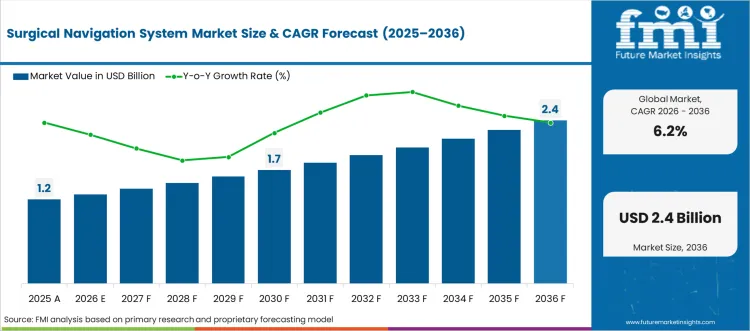
The surgical navigation system market was valued at USD 1.23 billion in 2025, projected to reach USD 1.31 billion in 2026, and is forecast to expand to USD 2.38 billion by 2036 at a 6.2% CAGR. Growing procedural complexity across neurosurgery and orthopedic disciplines, coupled with hospital purchasing mandates for intraoperative accuracy verification, is accelerating the transition from fluoroscopy-dependent workflows to integrated navigation platforms. Capital allocation committees now treat navigation compatibility as a prerequisite for operating room construction approvals.
Summary of Surgical Navigation System Market
- Market Snapshot
- The surgical navigation system market is valued at USD 1.23 billion in 2025 and is projected to reach USD 2.38 billion by 2036.
- The industry is expected to grow at a 6.2% CAGR from 2026 to 2036, creating an incremental opportunity of USD 1.08 billion.
- The market operates as a platform-driven surgical technology category where intraoperative accuracy, system interoperability, and clinical workflow integration define competitive standing.
- Demand and Growth Drivers
- Demand is increasing as hospital systems mandate intraoperative navigation compatibility for all new operating room construction and equipment procurement contracts.
- Multi-specialty expansion from neurosurgery into orthopedic, ENT, and cardiac applications is multiplying per-facility navigation system utilization rates.
- Growth is further supported by surgical training program requirements that now include navigation proficiency as a credentialing prerequisite.
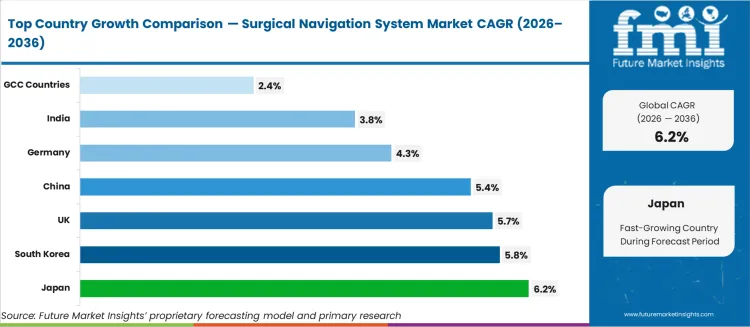
- Among key countries, Japan leads at 6.2% CAGR, South Korea at 5.8%, UK at 5.7%, China at 5.4%, Germany at 4.3%, India at 3.8%.
- Product and Segment View
- The market includes CT-based, electromagnetic, optical, hybrid, and fluoroscopy-based surgical navigation platforms used for intraoperative guidance across neurosurgery, orthopedic, ENT, and cardiac procedures.
- CT-based navigation system leads by Technology with 36.4% share in 2026.
- hospitals and physician leads by End-User with 58.0% share in 2026.
- Scope includes Technology, End-User, Application segmentation with regional coverage across seven global regions.
- Geography and Competitive Outlook
- Japan and South Korea are the fastest-growing markets, while North America and Europe remain mature demand bases.
- Competition is shaped by product quality, distribution reach, and regulatory compliance, with key players including Medtronic Inc, GE Healthcare Ltd., Siemens Healthineers, Stryker Corporation, B. Braun, Bausch & Lomb, CAScination AG, Brainlab AG, Koninklijke Philips N.V., Johnson & Johnson Services, Inc., and Exactech, Inc.
FMI is of the opinion that the surgical navigation system sector is consolidating around platform ecosystems rather than standalone hardware sales. Hospitals that commit to a navigation vendor for neurosurgery are extending that relationship into orthopedic and ENT applications to reduce training overhead and maintain data interoperability. This platform lock-in effect is compressing the competitive field and elevating switching costs for procurement departments.
Country-level growth trajectories span a range of adoption stages. Japan at 6.2% leads as infrastructure expansion and regulatory modernization accelerate procurement cycles. South Korea at 5.8% follows, supported by manufacturing sector demand and technology upgrade requirements. Mature markets including UK at 5.7%, China at 5.4% generate steady replacement-driven demand as installed base equipment reaches end-of-life thresholds.
Surgical Navigation System Market key takeaways
| Metric | Details |
|---|---|
| Industry Size (2026) | USD 1.31 billion |
| Industry Value (2036) | USD 2.38 billion |
| CAGR (2026 to 2036) | 6.2% |
Source: Future Market Insights, 2026
Surgical Navigation System Market definition
Surgical Navigation System encompasses intraoperative guidance platforms that provide real-time spatial tracking of surgical instruments relative to patient anatomy. These systems integrate imaging data from CT, MRI, or fluoroscopy with tracking hardware to improve procedural accuracy in neurosurgery, orthopedic surgery, ENT, and cardiac interventions. The market covers CT-based, electromagnetic, optical, hybrid, and fluoroscopy-based navigation configurations.
Surgical Navigation System Market inclusions
Market scope includes global and regional market sizes, a 2026 to 2036 forecast period, segment breakdowns by Technology, End-User, Application, and regional analysis across North America, Latin America, Europe, East Asia, South Asia, Oceania, and Middle East and Africa. Pricing trend analysis and competitive positioning assessments are incorporated within the analytical framework.
Surgical Navigation System Market exclusions
The scope excludes standalone surgical imaging systems (CT, MRI, fluoroscopy units) that do not include integrated navigation tracking capabilities. Robotic surgical platforms with embedded guidance features are categorized separately from navigation-only systems.
Surgical Navigation System Market research methodology
- Primary Research: Analysts engaged with interventional cardiologists, hospital procurement directors, and clinical engineering leads to map device selection criteria and procedural adoption decision gates.
- Desk Research: Data collection aggregated clinical trial registries, regulatory approval databases, hospital capital expenditure disclosures, and procedure volume publications from medical societies and health ministries.
- Market-Sizing and Forecasting: Baseline values derive from a bottom-up aggregation of product-level revenues, applying region-specific adoption curves to project future demand velocity.
- Data Validation and Update Cycle: Projections are tested against publicly reported expenditure guidance from leading industry participants and cross-referenced with regulatory filings.
Category-wise Insights
The section contains information about the leading segments in the industry. By technology, CT-based navigation system segment hold highest share of the market.
CT-based Navigation System Segment Dominate the Surgical Navigation System Market in terms of Value
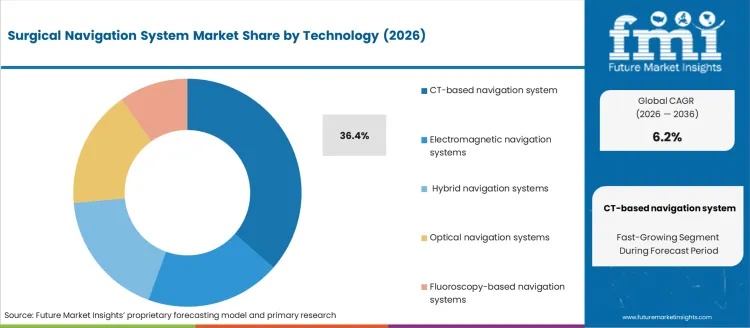
| Technology | CT-based Navigation System |
|---|---|
| Value Share (2026) | 36.4% |
CT-based navigation systems holds the dominant position in the surgical navigation market owing to their high precision and detailed imaging capabilities. The systems integrated with this technologies have abilities to convert CT scans into 3D models, which allows surgeons to visualize a patient's anatomy with accuracy.
Such accuracy minimizes the chances of errors and optimizes outcomes. Moreover, these CT-based systems are highly useful for preoperative planning and intraoperative guidance with continuous, real-time feedback.
They are further proliferated because of the high-resolution CT imaging, which is widely available in most hospitals and surgical centers, hence accessible and reliable. Although more expensive than other technologies, the advantages of greater precision in surgery, fewer complications, and faster recovery times justify their dominant share in the market.
Increased Focus of Hospitals towards Investing Heavily in Providing Improved treatment Outcomes for their Patients aid it to hold dominant Position
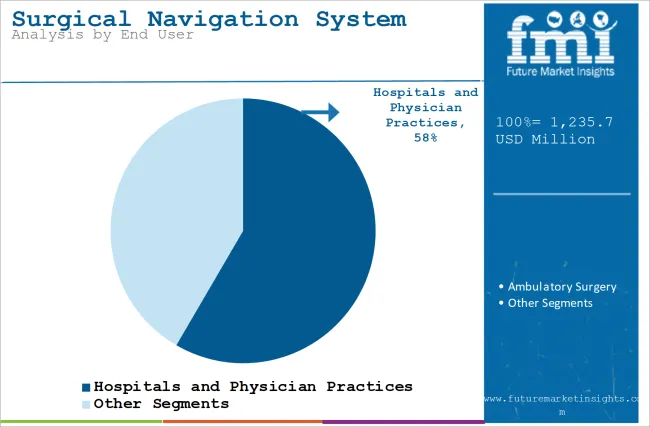
| End Use | Hospitals and Physician Practices |
|---|---|
| Value Share (2036) | 58.0% |
The hospitals segment is forecast to account for a share of 58.0% and is poised to expand at a substantial CAGR during the forecast period.
The dominating segment of the surgical navigation system market includes the hospital and physician practices due to several interconnected reasons. The hospital and physician practices are primary environments for complex and precision-driven surgeries, such as orthopedics, neurosurgery, and spinal procedures; therefore, these are key consumers of surgical navigation systems.
These technologies enhance surgical accuracy, improve patient outcomes, and reduce complications, thus becoming indispensable in both high-volume hospitals and specialized physician practices.
While hospitals have the financial capability to invest in advanced systems, physician practices-let alone physician practices with their focus on specialized surgeries-are increasingly using navigation systems as a way to compete and improve treatment efficacy.
The increasing demand for minimally invasive procedures, requiring accurate navigation, also boosts the rate of adoption. In addition, the rise in patient expectations for safer and more effective treatments, along with the concentration on enhancing operational efficiency, makes surgical navigation systems a priority for both hospitals and physician practices in maintaining high standards of care.
Key Industry Highlights
Growing Emphasis of Manufacturers on Launch of New Products to the Market Surges its Market Growth
An increasing demand for advanced, accurate, and minimally invasive surgeries, manufacturing companies are now concentrating on designing new SNS that can help meet the changing demands of healthcare providers.
Newer systems boast of high-definition imaging, real-time tracking, artificial intelligence, and integration with robotic surgical platforms. These improvements in surgical outcome, reduction in complications, and reduced recovery period make them very lucrative to hospitals and clinics.
Besides these, the introduction of user-friendly interfaces, faster times of processing, and customization features for various types of surgeries-for instance, neurosurgery, orthopedic, and ENT-have increased their acceptance. Many manufacturers are adding data-driven analytics to aid the surgeon in decision-making for better safety and outcomes for the patients.
The competitive market of the industry continuously innovates, and each company is making efforts to provide state-of-the-art technology that can give accurate guidance for complex procedures.
This has eventually led to increased acceptance and trust in surgeons and health care providers. The diverse range of solutions, along with strong marketing campaigns and after-sales services, are driving the use of SNS globally.
For instance, in July 2023, Stryker launched Q Guidance System. This new system is integrated with cranial guidance software that assists neurosurgeons for surgical planning.
Such investments by health care institutions towards upgrading their surgery-related capabilities assure continuous growth in the SNS market.
Growing Focus of Manufacturers on Expansion of their Geographical Presence Anticipate the Market Growth
The main driver behind the growth of Surgical Navigation Systems (SNS) market from the standpoint of manufacturers relates to an increasing geographical presence. By widening their reach to new regions, they can acquire a much greater customer base and reach the widespread increased demand for advanced healthcare technologies.
Manufacturers entering these markets offer high-tech solutions to the hospitals and surgical centers where the demand for precision surgery is increasing owing to rising disease burdens, and greater emphasis on minimally invasive surgeries. This geographic expansion enables companies to serve markets where surgical technologies are in demand.
Apart from this, localization support and the training offered to manufacturers in those new markets build more adoption to surgeons and professionals in healthcare areas.
Companies become more accessible as well as useable by SNS by extending region-specific solution, including local service models culturally appropriate and with language support; this strategy results in sales-driven growth and then helps in sustaining a global platform for long periods of time that ensures market prosperity.
For instance, in September 2023, Sirius Medical Systems B.V., expanded their geographical presence in Maryland, where they have planned to offer tumor localization using Pintuition surgical marker navigation system.
Integration of New Technologies for Expanding Application of Surgical Navigation System can bring Manufacturers Growth Opportunities
Integrating of advanced technologies in SNS systems can make surgical procedures more precise, integration of augmented realty can enable systems to analyze real-time data and predict the probable outcome of a surgery. These integration can simplify complex surgeries such as neurosurgery and orthopedic procedures.
AR and VR, further enhance the systems by creating 3D visualizations and virtual training environments through which surgeons may practice complex procedures from a distance. Manufacturers, by integrating these technologies, would be able to provide solutions that go beyond just surgeries but surgical training and preoperative planning also open up avenues into the market of medical education.
Likewise, an increasing number of robotic surgeries allow for the flawless integration of navigation systems with surgical robotic arms, thus also reducing human factors. Manufacturers may then expand into a much more extensive customer base if they could produce compatible systems for robots.
Finally, integration of cloud-based systems and remote access can support telemedicine, such that surgeons in remote areas can perform surgeries with experts' guidance, thereby expanding the reach of technology into emerging markets and underserved regions. With these technologies, new paths of growth and differentiation open in an evolving healthcare landscape.
Product Recall of Surgical Navigation System Hinder its Market Growth
Surgical navigation systems are important for accuracy in complex surgeries; any recall may raise concern over the reliability and safety of the technology. This leads to a lack of confidence among medical professionals and hospitals that might subsequently shift to using other products provided by competitors. It may also lead to disruption in sales and financial losses, as the recall can include product replacement, repairs, or refunds.
Moreover, a recall is usually accompanied by adverse publicity, which further destroys the reputation of the company by demonstrating an inability to efficiently manage product quality.
This may result in market share loss and irreversible brand image damage, from which consumer confidence is hardly restored for a company. For highly competitive medical technology markets, such problems can have very long-lasting implications for the growth trajectory and financial stability of a company.
2021 to 2025 Global Surgical Navigation System Sales Outlook Compared to Demand Forecast from 2026 to 2036
Surgical navigation systems are majorly used by surgeons during operations, as they provide real time imaging allowing better accuracy. The high demand for minimally invasive surgeries, and advancing technologies in imaging modalities such as MRI and CT, have significantly contributed to their growth.
With healthcare providers focusing on the improvement of patient safety, complications, and speedier recovery times, surgical navigation systems. Systems integrated with AI and ML have further developed the capabilities of the systems, offering surgeons better options for individualized surgery and predictive analytics.
Coupled with the integration of augmented and virtual reality with 3D visualization in real time, new trends are driving this field of study toward its goal of further assisting surgeons to plan and accomplish surgeries more skillfully.
An increasing global elderly population that presents a high demand for orthopedic and spinal surgery is a few of the important factors that are projected to anticipate the growth of the market in near future.
Innovation in navigation systems integrated with robotics, AI, and cloud-based data management that have ability to improve accuracy, and efficiency in surgery is projected to further contribute to the growth of the market.
Therefore, the regulatory support and funding of medical research, extended by government organizations for development of surgical navigation systems is further projected to be an integral part of modern healthcare infrastructure.
Market Concentration
Tier 1 companies comprise market leaders with a market revenue of above USD 100 million capturing significant market share of 64.6% in global market. These market leaders are characterized by high production capacity and a wide product portfolio.
These market leaders are distinguished by their extensive expertise in manufacturing and reconditioning across multiple packaging formats and a broad geographical reach, underpinned by a robust consumer base. Prominent companies within tier 1 include GE Healthcare Ltd., Siemens Healthineers and Stryker Corporation.
Tier 2 companies include mid-size players with revenue of USD 50 to 100 million having presence in specific regions and highly influencing the local market and holds around 26.7% market share.
These are characterized by a strong presence overseas and strong market knowledge. These market players have good manufacturing technology and ensure regulatory compliance but may not have access to global reach. Prominent companies in tier 2 include Medtronic Inc, Bausch & Lomb and Brainlab AG.
Finally, Tier 3 companies, act as a suppliers to the established market players. They are essential for the market as they specialize in specific products and cater to niche markets, adding diversity to the industry.
Overall, while Tier 1 companies are the primary drivers of the market, Tier 2 and 3 companies also make significant contributions, ensuring the surgical navigation system market remains dynamic and competitive.
Country-wise Insights
The section below covers the industry analysis for the surgical navigation system market for different countries. Market demand analysis on key countries in several regions of the globe, including North America, Latin America, East Asia, South Asia and Pacific, Western Europe, Eastern Europe, and Middle East & Africa, is provided.
The United States is anticipated to remain at the forefront in North America, with a value share of 58.7% through 2036. In East Asia, South Korea is projected to witness a CAGR of 5.8% by 2036.
.webp "Top Country Growth Comparison Surgical Navigation System Market Cagr (2026 2036)")
| Countries | Value CAGR (2026 to 2036) |
|---|---|
| UK | 5.7% |
| China | 5.4% |
| Japan | 6.2% |
| South Korea | 5.8% |
| Germany | 4.3% |
| India | 3.8% |
| GCC Countries | 2.4% |
Increase in focus of Manufacturers on Launch of Surgical Navigation System to meet the Growing demand in the USA anticipate its market growth
USA surgical navigation system market is poised to exhibit a CAGR of 6.6% between 2026 and 2036, reaching over USD 80.1 million by 2036. Currently, it holds the highest share in the North American market, and the trend is expected to continue during the forecast period.
The aging population in the USA contributes to the growing demand for more complex surgical procedures, which anticipates increase in adoption of these advanced navigation technologies. This rising demands for minimally invasive, and robotic-assisted surgeries, have become an urgent need of the hour. This advanced navigation systems aid in achieving better surgical outcomes with fewer complications.
Manufacturing companies are increasingly investing in new technologies that offer enhanced imaging, real-time guidance, and intuitive interfaces for a wide range of specialties. These advancements are supportive of the increasing need for personalized and accurate treatment, addressing both patient expectations and healthcare efficiency.
Therefore, to meet this growing demand manufacturing companies are focusing on receiving approval for their products for launching it to this growing market. For instance, in November 2024, Zeta Surgical Inc., received approval for their artificial intelligence (AI)-powered Zeta navigation system from the USA FDA.
In view of this, the market for surgical navigation systems is continue to exhibit growth, driven by continuous technological innovation and changing healthcare needs in both hospitals and outpatient settings.
Increase in Number of Patients Undergoing Minimally Invasive Surgery Anticipate the Growing adoption of Surgical Navigation System in Japan
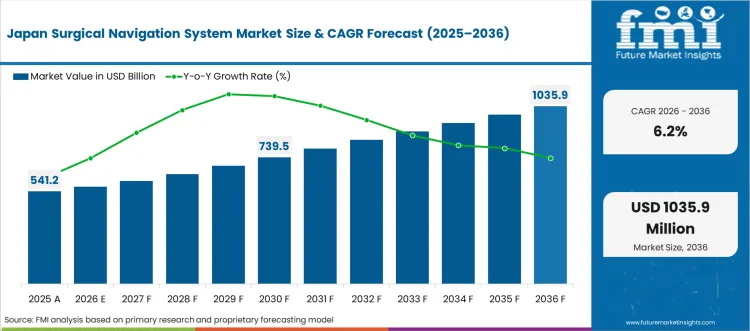
Japan currently holds around 36.4% share of the surgical navigation system market and is anticipated to grow at a substantial CAGR throughout the forecast period.
The growth of minimally invasive surgeries (MIS) in patients is one of the major reason that contributes to the growing demand of surgical navigation systems. Minimally invasive surgeries techniques involves reduced tissue damage and smaller incisions which are recovered in minimal times.
As such, modern technology is always needed to assure the precision and safety of a surgical procedure, which is delivered by surgical navigation systems. In other words, with real-time imaging and guidance offered by surgical navigation systems, it allows surgeons to have greater confidence when navigating their instruments to successfully execute delicate procedures.
With an elderly population in Japan and an ongoing trend towards preferring less invasive therapies, MIS proves to be beneficial for achieving maximally optimized surgery outcomes. Applications of these techniques are highly applied in orthopedics, neurosurgery, and urology procedures mainly because they show precision in interventions.
With improvements in recovery among patients and minimized hospital stay as a primary preference, these advanced technologies is witnessing continues growing. Thus, the growth of minimally invasive surgeries directly corresponds to the rising demand for advanced surgical navigation systems in Japan's healthcare market.
Growing Demand for Medical Devices of International Quality Anticipate the growth of the market in Germany
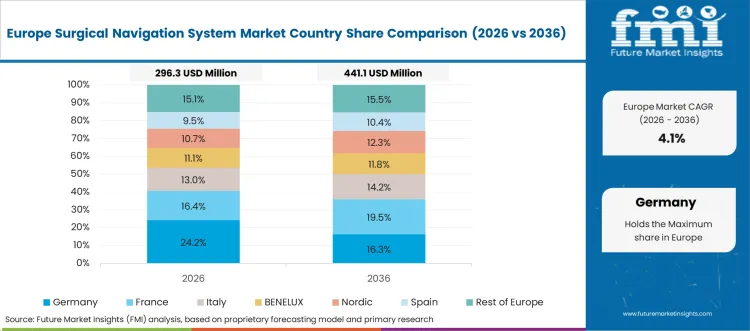
Germany is expected to have a strong foothold when it comes to technology innovation. In 2023 the country is projected to account for substantial share of the surgical navigation system market.
Real-time imaging, augmented reality, and artificial intelligence greatly enhance the power of surgical navigation system in terms of precision and efficiency. Artificial Intelligence helps them with predictive analytics and decision-making.
This factors enhances their role in planning and outcome analysis during surgeries. Additionally, this growing trend toward minimally invasive procedures, require more accuracy, hence fuels the demand for technologically advanced navigation tools.
Due to the strong research and development of medical technology in Germany, surgical navigation systems have become increasingly sophisticated in the country that offers intraoperative imaging with integrated robotic surgery platforms.
Such enhancements have proven to be of particular benefit in highly complex procedures such as neurosurgery, orthopedic, and spine surgeries. Therefore, the increasing trend of providing better treatment outcomes at substantial cost drives the growth of surgical navigation systems within Germany.
Competitive Landscape
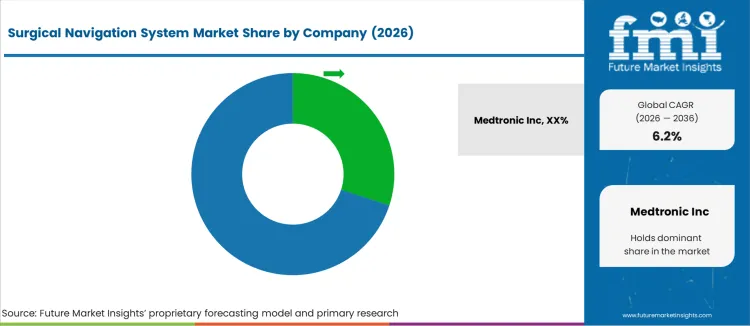
Substantial investments and focus is seen in the surgical navigation system industry towards launch of new series of products to the market. Another key strategic focus of these companies is to actively look for strategic partners to bolster their product portfolios and expand their global market presence.
Scope of the report
| Metric | Value |
|---|---|
| Quantitative Units | USD 1.31 billion to USD 2.38 billion, at a CAGR of 6.2% |
| Market Definition | Surgical Navigation System encompasses intraoperative guidance platforms that provide real-time spatial tracking of surgical instruments relative to patient anatomy. These systems integrate imaging da... |
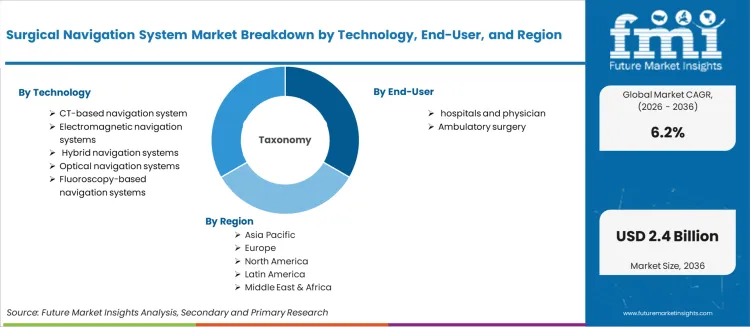
| Technology Segmentation | CT-based navigation system, Electromagnetic navigation systems, Hybrid navigation systems, Optical navigation systems, Fluoroscopy-based navigation systems |
| End-User Segmentation | hospitals and physician, Ambulatory surgery |
| Application Segmentation | Neurosurgery, Orthopedic surgery, ENT surgery, Cardiac surgery |
| Regions Covered | North America, Latin America, Europe, East Asia, South Asia, Oceania, Middle East and Africa |
| Countries Covered | Japan, South Korea, UK, China, Germany, India, GCC Countries, and 40 plus countries |
| Key Companies Profiled | Medtronic Inc, GE Healthcare Ltd., Siemens Healthineers, Stryker Corporation, B. Braun, Bausch & Lomb, CAScination AG, Brainlab AG, Koninklijke Philips N.V., Johnson & Johnson Services, Inc., and Exactech, Inc. |
| Forecast Period | 2026 to 2036 |
| Approach | Forecasting models apply a bottom-up methodology starting with global installed base metrics and projecting the conversion rate to advanced product adoption. |
Key Segments of Surgical Navigation System Industry
By Technology:
In terms of technology, the industry is divided into electromagnetic navigation systems, hybrid navigation systems, optical navigation systems, fluoroscopy-based navigation systems, CT-based navigation system and others.
By Application:
In terms of application, the industry is segregated into neurosurgery, orthopedic surgery, ENT surgery, cardiac surgery and others.
By End-User:
The industry is classified by end user as hospitals and physician practices and ambulatory surgery.
By Region:
Key countries of North America, Latin America, Western Europe, Eastern Europe, East Asia, South Asia and Pacific, and Middle East and Africa (MEA) have been covered in the report.
Bibliography
- 1. USA Food and Drug Administration. (2024). Medical Device Databases: 510(k) and PMA. FDA.
- 2. World Health Organization. (2024). Global Health Expenditure Database. WHO.
- 3. Organisation for Economic Co-operation and Development. (2024). Health at a Glance 2024. OECD Publishing.
- 4. European Commission. (2024). Medical Device Regulation (EU) 2017/745, implementation status. EUR-Lex.
- 5. The World Bank. (2024). World Development Indicators: Health Systems. World Bank Group.
This bibliography is provided for reader reference. The full Future Market Insights report contains the complete reference list with primary research documentation.
Frequently Asked Questions
How large is the demand for Surgical Navigation System in the global market in 2026?
Demand for surgical navigation system in the global market is estimated to be valued at USD 1.31 billion in 2026.
What will be the market size of Surgical Navigation System in the global market by 2036?
Market size for surgical navigation system is projected to reach USD 2.38 billion by 2036.
What is the expected demand growth for Surgical Navigation System between 2026 and 2036?
Demand for surgical navigation system is expected to grow at a CAGR of 6.2% between 2026 and 2036.
Which Technology is poised to lead global sales by 2026?
CT-based navigation system accounts for 36.4% share in 2026 as it addresses the primary demand requirements across global markets.
How significant is the role of hospitals and physician in driving surgical navigation system adoption in 2026?
hospitals and physician represents 58.0% of segment share as end-user demand consolidates around established application pathways.
What is driving demand in Japan?
Japan is projected to grow at a CAGR of 6.2% during 2026 to 2036, driven by expanding infrastructure investment and regulatory modernization.
What does market forecast mean on this page?
The market forecast represents a model-based projection built on defined industry and supply chain assumptions for strategic planning purposes.
How does FMI build and validate the surgical navigation system forecast?
Forecasting models apply a bottom-up methodology starting with global installed base metrics and cross-validate projections against quarterly industry revenue volumes.
Preview the report firsthand - request a free sample
Get SampleGet the brochure for pricing and purchase details.
Get PDFTable of Content
- Executive Summary
- Global Market Outlook
- Demand-side Trends
- Supply-side Trends
- Technology Roadmap Analysis
- Analysis and Recommendations
- Market Overview
- Market Coverage / Taxonomy
- Market Definition / Scope / Limitations
- Research Methodology
- Chapter Orientation
- Analytical Lens and Working Hypotheses
- Market Structure, Signals, and Trend Drivers
- Benchmarking and Cross-market Comparability
- Market Sizing, Forecasting, and Opportunity Mapping
- Research Design and Evidence Framework
- Desk Research Programme (Secondary Evidence)
- Company Annual and Sustainability Reports
- Peer-reviewed Journals and Academic Literature
- Corporate Websites, Product Literature, and Technical Notes
- Earnings Decks and Investor Briefings
- Statutory Filings and Regulatory Disclosures
- Technical White Papers and Standards Notes
- Trade Journals, Industry Magazines, and Analyst Briefs
- Conference Proceedings, Webinars, and Seminar Materials
- Government Statistics Portals and Public Data Releases
- Press Releases and Reputable Media Coverage
- Specialist Newsletters and Curated Briefings
- Sector Databases and Reference Repositories
- FMI Internal Proprietary Databases and Historical Market Datasets
- Subscription Datasets and Paid Sources
- Social Channels, Communities, and Digital Listening Inputs
- Additional Desk Sources
- Expert Input and Fieldwork (Primary Evidence)
- Primary Modes
- Qualitative Interviews and Expert Elicitation
- Quantitative Surveys and Structured Data Capture
- Blended Approach
- Why Primary Evidence is Used
- Field Techniques
- Interviews
- Surveys
- Focus Groups
- Observational and In-context Research
- Social and Community Interactions
- Stakeholder Universe Engaged
- C-suite Leaders
- Board Members
- Presidents and Vice Presidents
- R&D and Innovation Heads
- Technical Specialists
- Domain Subject-matter Experts
- Scientists
- Physicians and Other Healthcare Professionals
- Governance, Ethics, and Data Stewardship
- Research Ethics
- Data Integrity and Handling
- Primary Modes
- Tooling, Models, and Reference Databases
- Desk Research Programme (Secondary Evidence)
- Data Engineering and Model Build
- Data Acquisition and Ingestion
- Cleaning, Normalisation, and Verification
- Synthesis, Triangulation, and Analysis
- Quality Assurance and Audit Trail
- Market Background
- Market Dynamics
- Drivers
- Restraints
- Opportunity
- Trends
- Scenario Forecast
- Demand in Optimistic Scenario
- Demand in Likely Scenario
- Demand in Conservative Scenario
- Opportunity Map Analysis
- Product Life Cycle Analysis
- Supply Chain Analysis
- Investment Feasibility Matrix
- Value Chain Analysis
- PESTLE and Porter’s Analysis
- Regulatory Landscape
- Regional Parent Market Outlook
- Production and Consumption Statistics
- Import and Export Statistics
- Market Dynamics
- Global Market Analysis 2021 to 2025 and Forecast, 2026 to 2036
- Historical Market Size Value (USD Million) Analysis, 2021 to 2025
- Current and Future Market Size Value (USD Million) Projections, 2026 to 2036
- Y-o-Y Growth Trend Analysis
- Absolute $ Opportunity Analysis
- Global Market Pricing Analysis 2021 to 2025 and Forecast 2026 to 2036
- Global Market Analysis 2021 to 2025 and Forecast 2026 to 2036, By Technology
- Introduction / Key Findings
- Historical Market Size Value (USD Million) Analysis By Technology , 2021 to 2025
- Current and Future Market Size Value (USD Million) Analysis and Forecast By Technology , 2026 to 2036
- CT-based navigation system
- Electromagnetic navigation systems
- Hybrid navigation systems
- Optical navigation systems
- Fluoroscopy-based navigation systems
- CT-based navigation system
- Y-o-Y Growth Trend Analysis By Technology , 2021 to 2025
- Absolute $ Opportunity Analysis By Technology , 2026 to 2036
- Global Market Analysis 2021 to 2025 and Forecast 2026 to 2036, By End-User
- Introduction / Key Findings
- Historical Market Size Value (USD Million) Analysis By End-User, 2021 to 2025
- Current and Future Market Size Value (USD Million) Analysis and Forecast By End-User, 2026 to 2036
- hospitals and physician
- Ambulatory surgery
- hospitals and physician
- Y-o-Y Growth Trend Analysis By End-User, 2021 to 2025
- Absolute $ Opportunity Analysis By End-User, 2026 to 2036
- Global Market Analysis 2021 to 2025 and Forecast 2026 to 2036, By Application
- Introduction / Key Findings
- Historical Market Size Value (USD Million) Analysis By Application, 2021 to 2025
- Current and Future Market Size Value (USD Million) Analysis and Forecast By Application, 2026 to 2036
- Neurosurgery
- Orthopedic surgery
- ENT surgery
- Cardiac surgery
- Neurosurgery
- Y-o-Y Growth Trend Analysis By Application, 2021 to 2025
- Absolute $ Opportunity Analysis By Application, 2026 to 2036
- Global Market Analysis 2021 to 2025 and Forecast 2026 to 2036, By Region
- Introduction
- Historical Market Size Value (USD Million) Analysis By Region, 2021 to 2025
- Current Market Size Value (USD Million) Analysis and Forecast By Region, 2026 to 2036
- North America
- Latin America
- Western Europe
- Eastern Europe
- East Asia
- South Asia and Pacific
- Middle East & Africa
- Market Attractiveness Analysis By Region
- North America Market Analysis 2021 to 2025 and Forecast 2026 to 2036, By Country
- Historical Market Size Value (USD Million) Trend Analysis By Market Taxonomy, 2021 to 2025
- Market Size Value (USD Million) Forecast By Market Taxonomy, 2026 to 2036
- By Country
- USA
- Canada
- Mexico
- By Technology
- By End-User
- By Application
- By Country
- Market Attractiveness Analysis
- By Country
- By Technology
- By End-User
- By Application
- Key Takeaways
- Latin America Market Analysis 2021 to 2025 and Forecast 2026 to 2036, By Country
- Historical Market Size Value (USD Million) Trend Analysis By Market Taxonomy, 2021 to 2025
- Market Size Value (USD Million) Forecast By Market Taxonomy, 2026 to 2036
- By Country
- Brazil
- Chile
- Rest of Latin America
- By Technology
- By End-User
- By Application
- By Country
- Market Attractiveness Analysis
- By Country
- By Technology
- By End-User
- By Application
- Key Takeaways
- Western Europe Market Analysis 2021 to 2025 and Forecast 2026 to 2036, By Country
- Historical Market Size Value (USD Million) Trend Analysis By Market Taxonomy, 2021 to 2025
- Market Size Value (USD Million) Forecast By Market Taxonomy, 2026 to 2036
- By Country
- Germany
- UK
- Italy
- Spain
- France
- Nordic
- BENELUX
- Rest of Western Europe
- By Technology
- By End-User
- By Application
- By Country
- Market Attractiveness Analysis
- By Country
- By Technology
- By End-User
- By Application
- Key Takeaways
- Eastern Europe Market Analysis 2021 to 2025 and Forecast 2026 to 2036, By Country
- Historical Market Size Value (USD Million) Trend Analysis By Market Taxonomy, 2021 to 2025
- Market Size Value (USD Million) Forecast By Market Taxonomy, 2026 to 2036
- By Country
- Russia
- Poland
- Hungary
- Balkan & Baltic
- Rest of Eastern Europe
- By Technology
- By End-User
- By Application
- By Country
- Market Attractiveness Analysis
- By Country
- By Technology
- By End-User
- By Application
- Key Takeaways
- East Asia Market Analysis 2021 to 2025 and Forecast 2026 to 2036, By Country
- Historical Market Size Value (USD Million) Trend Analysis By Market Taxonomy, 2021 to 2025
- Market Size Value (USD Million) Forecast By Market Taxonomy, 2026 to 2036
- By Country
- China
- Japan
- South Korea
- By Technology
- By End-User
- By Application
- By Country
- Market Attractiveness Analysis
- By Country
- By Technology
- By End-User
- By Application
- Key Takeaways
- South Asia and Pacific Market Analysis 2021 to 2025 and Forecast 2026 to 2036, By Country
- Historical Market Size Value (USD Million) Trend Analysis By Market Taxonomy, 2021 to 2025
- Market Size Value (USD Million) Forecast By Market Taxonomy, 2026 to 2036
- By Country
- India
- ASEAN
- Australia & New Zealand
- Rest of South Asia and Pacific
- By Technology
- By End-User
- By Application
- By Country
- Market Attractiveness Analysis
- By Country
- By Technology
- By End-User
- By Application
- Key Takeaways
- Middle East & Africa Market Analysis 2021 to 2025 and Forecast 2026 to 2036, By Country
- Historical Market Size Value (USD Million) Trend Analysis By Market Taxonomy, 2021 to 2025
- Market Size Value (USD Million) Forecast By Market Taxonomy, 2026 to 2036
- By Country
- Kingdom of Saudi Arabia
- Other GCC Countries
- Turkiye
- South Africa
- Other African Union
- Rest of Middle East & Africa
- By Technology
- By End-User
- By Application
- By Country
- Market Attractiveness Analysis
- By Country
- By Technology
- By End-User
- By Application
- Key Takeaways
- Key Countries Market Analysis
- USA
- Pricing Analysis
- Market Share Analysis, 2025
- By Technology
- By End-User
- By Application
- Canada
- Pricing Analysis
- Market Share Analysis, 2025
- By Technology
- By End-User
- By Application
- Mexico
- Pricing Analysis
- Market Share Analysis, 2025
- By Technology
- By End-User
- By Application
- Brazil
- Pricing Analysis
- Market Share Analysis, 2025
- By Technology
- By End-User
- By Application
- Chile
- Pricing Analysis
- Market Share Analysis, 2025
- By Technology
- By End-User
- By Application
- Germany
- Pricing Analysis
- Market Share Analysis, 2025
- By Technology
- By End-User
- By Application
- UK
- Pricing Analysis
- Market Share Analysis, 2025
- By Technology
- By End-User
- By Application
- Italy
- Pricing Analysis
- Market Share Analysis, 2025
- By Technology
- By End-User
- By Application
- Spain
- Pricing Analysis
- Market Share Analysis, 2025
- By Technology
- By End-User
- By Application
- France
- Pricing Analysis
- Market Share Analysis, 2025
- By Technology
- By End-User
- By Application
- India
- Pricing Analysis
- Market Share Analysis, 2025
- By Technology
- By End-User
- By Application
- ASEAN
- Pricing Analysis
- Market Share Analysis, 2025
- By Technology
- By End-User
- By Application
- Australia & New Zealand
- Pricing Analysis
- Market Share Analysis, 2025
- By Technology
- By End-User
- By Application
- China
- Pricing Analysis
- Market Share Analysis, 2025
- By Technology
- By End-User
- By Application
- Japan
- Pricing Analysis
- Market Share Analysis, 2025
- By Technology
- By End-User
- By Application
- South Korea
- Pricing Analysis
- Market Share Analysis, 2025
- By Technology
- By End-User
- By Application
- Russia
- Pricing Analysis
- Market Share Analysis, 2025
- By Technology
- By End-User
- By Application
- Poland
- Pricing Analysis
- Market Share Analysis, 2025
- By Technology
- By End-User
- By Application
- Hungary
- Pricing Analysis
- Market Share Analysis, 2025
- By Technology
- By End-User
- By Application
- Kingdom of Saudi Arabia
- Pricing Analysis
- Market Share Analysis, 2025
- By Technology
- By End-User
- By Application
- Turkiye
- Pricing Analysis
- Market Share Analysis, 2025
- By Technology
- By End-User
- By Application
- South Africa
- Pricing Analysis
- Market Share Analysis, 2025
- By Technology
- By End-User
- By Application
- USA
- Market Structure Analysis
- Competition Dashboard
- Competition Benchmarking
- Market Share Analysis of Top Players
- By Regional
- By Technology
- By End-User
- By Application
- Competition Analysis
- Competition Deep Dive
- Medtronic Inc
- Overview
- Product Portfolio
- Profitability by Market Segments (Product/Age /Sales Channel/Region)
- Sales Footprint
- Strategy Overview
- Marketing Strategy
- Product Strategy
- Channel Strategy
- GE Healthcare Ltd.
- Siemens Healthineers
- Stryker Corporation
- B. Braun
- Bausch & Lomb
- CAScination AG
- Brainlab AG
- Koninklijke Philips N.V.
- Johnson & Johnson Services, Inc.
- Exactech, Inc.
- Medtronic Inc
- Competition Deep Dive
- Assumptions & Acronyms Used


