

- Industry Size (2026):
- USD 859.6 Mn
- Forecast (2036)
- USD 2270.5 Mn
- CAGR (2026 to 2036)
- 10.2%
Surgical Counting & Detection System Market Forecast and Outlook 2026 to 2036
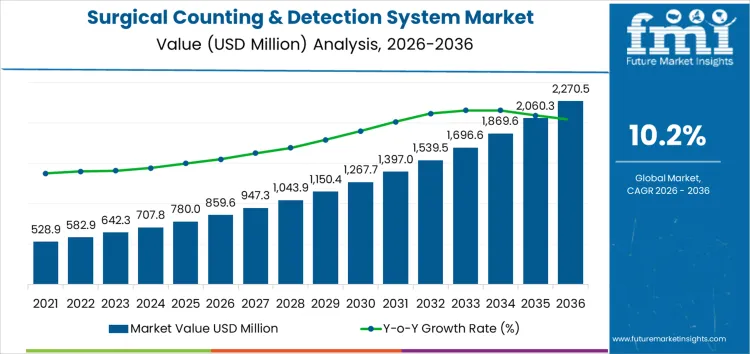
The surgical counting and detection system market is projected to experience robust growth from 2026 to 2036. In 2026, the market value is expected to be USD 859.6 million, with steady growth anticipated, reaching USD 2,270.5 million by 2036. The compound annual growth rate (CAGR) for this market is forecasted at 10.2%, driven by the increasing need for safety, accuracy, and efficiency during surgeries. Surgical counting and detection systems are essential for preventing retained surgical instruments or sponges, ensuring patient safety, and streamlining surgical processes. With advancements in technology, these systems are becoming more integrated with operating room technologies, improving the overall surgical environment.
The market's growth is supported by rising awareness of the importance of surgical safety and the increasing adoption of automation and digital technologies in the operating room. With the growing global focus on reducing medical errors and improving patient outcomes, the demand for surgical counting and detection systems will continue to rise. Additionally, as the healthcare industry focuses on enhancing operational efficiency and reducing surgical delays, these systems will become a crucial part of modern surgical practices. Over the forecast period, the market is expected to experience steady growth, driven by these factors and continued technological advancements.
Quick Stats of the Surgical Counting & Detection System Market
- Surgical Counting & Detection System Market Value (2026): USD 859.6 million
- Surgical Counting & Detection System Market Forecast Value (2036): USD 2,270.5 million
- Surgical Counting & Detection System Market Global Forecast CAGR (2026-2036): 10.2%
- Surgical Counting & Detection System Market Leading Segment: Sponge Counting 65%
- Key Growth Regions in Surgical Counting & Detection System Market: India and China
- Top Players in Surgical Counting & Detection System Market: Medtronic (Situate), Stryker, Censis Technologies, B Braun, Haldor Advanced
What is the Growth Forecast for the Surgical Counting & Detection System Market through 2036?
The growth forecast for the surgical counting and detection system market indicates steady expansion, with a projected rolling CAGR of 10.2%. Starting at USD 859.6 million in 2026, the market will experience year-on-year growth, reaching USD 947.2 million in 2027, USD 1,043.9 million in 2028, and USD 1,150.3 million in 2029. By 2030, the market value is projected to rise to USD 1,267.7 million, continuing its growth throughout the forecast period. This steady increase reflects the growing demand for safety-enhancing technologies in surgeries.
From 2031 to 2036, the market will continue to expand, reaching USD 1,397 million in 2031, USD 1,539.5 million in 2032, and USD 1,696.5 million in 2033. The market will maintain its upward trajectory, with values rising to USD 1,869.5 million in 2034, USD 2,060.2 million in 2035, and USD 2,270.5 million by 2036. The rolling CAGR analysis highlights a consistent growth pattern, driven by the increasing integration of surgical counting and detection systems in healthcare settings, coupled with rising healthcare safety standards.
Surgical Counting & Detection System Market Key Takeaways
| Metric | Value |
|---|---|
| Industry Sales Value (2026) | USD 859.6 million |
| Industry Forecast Value (2036) | USD 2,270.5 million |
| Industry Forecast CAGR (2026-2036) | 10.2% |
What Is Driving the Demand for the Surgical Counting & Detection System Market Globally?
The global demand for surgical counting and detection systems is driven by increasing emphasis on patient safety, regulatory mandates to prevent retained surgical items (RSIs), and rising surgical procedure volumes worldwide. Surgical counts traditionally rely on manual tracking of instruments, sponges, needles, and other materials, but human error in high pressure operating room environments can lead to RSIs, which carry clinical, legal, and financial consequences. Healthcare providers, including hospitals and ambulatory surgical centres, are adopting automated counting and detection solutions that use radiofrequency, RFID, barcodes, or imaging technology to verify the presence and location of surgical items before closure.
These systems enhance procedural confidence by reducing dependence on manual counts alone and by providing electronic documentation that supports compliance with safety protocols. The expansion of complex surgical specialties, such as minimally invasive, robotic, and multi disciplinary procedures, increases the number and variety of instruments in play, reinforcing demand for technology that standardises item tracking and mitigates risk. Growing awareness among surgical teams of quality assurance tools that improve workflow efficiency and reduce cognitive burden also contributes to broader uptake.
Future demand for surgical counting and detection systems is expected to grow as healthcare systems continue prioritising quality outcomes, infection prevention, and operational efficiency. Advances in sensor accuracy, real time analytics, and integration with electronic health records will make these systems more interoperable with broader surgical care pathways, enabling seamless documentation and audit readiness. Regulatory frameworks in many regions are tightening expectations for device tracking and procedural verification, which may accelerate adoption, especially in facilities aiming for accreditation or risk reduction benchmarks.
Continued growth in surgical volumes globally, driven by ageing populations, increased access to surgical care in emerging markets, and expansion of elective procedure, will maintain pressure to implement technologies that reduce variances and support consistent protocol adherence. Cost considerations, including reductions in re operations, liability exposure, and inventory inefficiencies, are strengthening the business case for automated counting systems. As hospitals pursue digital transformation and embrace data driven quality metrics, solutions that improve accountability, enhance team communication, and reduce the incidence of retained items are poised to see sustained expansion across global surgery markets.
What are the Leading Segments in the Global Surgical Counting & Detection System Market?
The global surgical counting & detection system market is segmented by type and application. Among types, RFID-based systems lead the market, capturing 50% of the share, followed by barcode-based systems and hybrid solutions. RFID-based systems are preferred for their ability to provide accurate, real-time tracking of surgical instruments and sponges, which helps reduce the risk of retained surgical items. On the application side, sponge counting dominates the market, holding 65% of the share, followed by instrument counting. Sponge counting is crucial in preventing retained surgical sponges, a serious complication in surgeries.
What Drives the Growth of RFID-Based Systems in the Surgical Counting & Detection System Market?
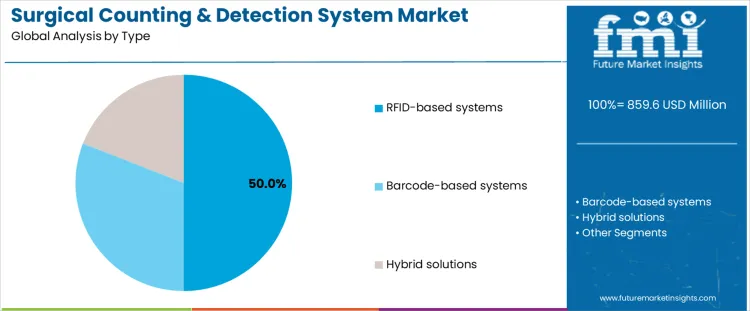
RFID-based systems are the leading type in the surgical counting & detection system market, holding 50% of the share. These systems are preferred due to their ability to provide real-time tracking and automated counting of surgical instruments and sponges, reducing the risk of human error and improving surgical safety. RFID-based systems use radio-frequency identification to tag surgical items, allowing them to be tracked throughout the procedure. The growing emphasis on patient safety, regulatory compliance, and reducing surgical complications, such as retained foreign objects, is driving the demand for RFID-based counting systems. These systems are also more efficient and reliable compared to traditional manual counting methods, further fueling their adoption in operating rooms. As the healthcare industry continues to focus on improving surgical outcomes and reducing errors, the demand for RFID-based systems in surgical counting is expected to remain strong, ensuring their continued dominance in the market.
What is Driving the Demand for Sponge Counting in the Surgical Counting & Detection System Market?
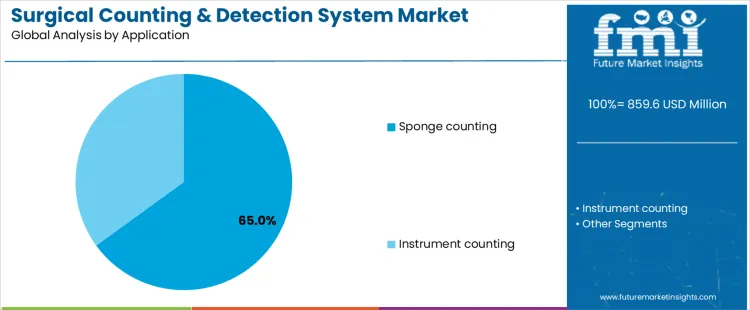
Sponge counting is the leading application in the surgical counting & detection system market, capturing 65% of the share. This high demand is driven by the need to prevent retained surgical sponges, a serious medical error that can lead to complications, prolonged hospital stays, and legal issues. Accurate sponge counting during surgery is critical to ensure all sponges are accounted for before the patient leaves the operating room. The use of advanced counting systems, such as RFID or barcode-based technologies, has greatly improved the accuracy and efficiency of this process, reducing the risk of human error. The growing awareness of patient safety and the increasing adoption of technology in healthcare to streamline surgical workflows and reduce errors are driving the demand for effective sponge counting systems. As hospitals and surgical centers prioritize safety and compliance with regulatory standards, the demand for sponge counting systems is expected to continue growing, reinforcing its position as the dominant application in the market.
What are the Key Dynamics in the Global Surgical Counting & Detection System Market?
The global surgical counting and detection system market is expanding as hospitals and surgical facilities adopt advanced tools to reduce retained surgical item (RSI) incidents, enhance patient safety, and improve operating room workflow. These systems combine technologies like radio frequency identification (RFID), barcode scanning, imaging and automated counting to track instruments, sponges and other consumables throughout procedures. Growth reflects heightened regulatory pressure for accountability, growing awareness of clinical risk management, and rising demand for data-driven surgical quality assurance. Adoption spans general surgery, orthopedics, cardiovascular and minimally invasive procedures where precision and compliance are paramount.
What are the Key Drivers for the Global Surgical Counting & Detection System Market?
A key driver is increasing focus on patient safety and risk mitigation, as retained surgical items can lead to severe complications, extended hospital stays and legal liability. Healthcare accreditation bodies and internal quality programs are mandating tighter control and documentation of surgical instruments and consumables, which fuels demand for automated, error-reducing solutions. Advances in RFID, computer vision and intelligent tracking provide higher accuracy and real-time visibility than manual counting alone. Rising surgical volumes globally, especially in emerging markets, and the shift toward minimally invasive and complex procedures increase the need for dependable detection and counting workflows. Hospitals are also prioritizing digital integration to streamline reporting, compliance and audit readiness.
What are the Restraints for the Global Surgical Counting & Detection System Market?
One restraint is the initial investment and implementation cost associated with deploying advanced counting and detection solutions, which can be a barrier for smaller facilities or hospitals in regions with limited healthcare funding. Integration with existing operating room systems, electronic health records (EHR) and workflows may require technical resources and staff training. Some clinicians and OR teams may resist change from familiar manual counting processes, especially when adoption depends on behavior change and technology acceptance. Variability in regulatory requirements and standards across regions can complicate product certification and rollout in global markets, adding compliance effort and cost.
What are the Key Trends in the Global Surgical Counting & Detection System Market?
A key trend is integration of surgical counting and detection systems with OR analytics and digital quality platforms that enable predictive insights, trend tracking and real-time alerts to support clinical decision-making. Adoption of RFID-enabled instrumentation and smart sponges with embedded tags is gaining traction, as these technologies reduce human error and streamline reconciliation processes. Cloud-based solutions and interoperable software support data aggregation across facilities, enhancing benchmarking and performance dashboards. There is increasing emphasis on hybrid systems that combine barcode scanning with sensor-based detection to deliver layered verification. Collaboration between system vendors, hospital risk management teams and clinical stakeholders is driving user-centric design, workflow alignment and broader market uptake.
What is the Country-Wise Analysis of the Surgical Counting & Detection System Market?
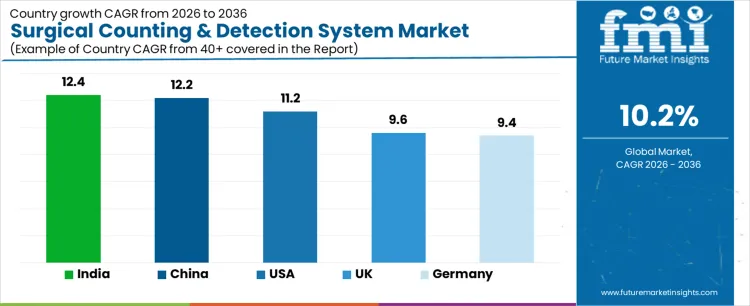
The surgical counting and detection system market is projected to grow significantly, driven by the increasing demand for safety, precision, and efficiency during surgical procedures. These systems, which are used to track surgical instruments, sponges, and other medical devices, help prevent retained surgical items, ensuring patient safety and improving surgical outcomes. High-growth markets such as India and China are experiencing strong demand due to the expansion of healthcare infrastructure, rising numbers of surgeries, and increasing awareness of the importance of surgical safety. Developed markets such as the USA, UK, and Germany are also experiencing steady growth, supported by stringent regulations, advancements in surgical technologies, and a focus on improving the quality of healthcare services.
| Country | CAGR (2026-2036) |
|---|---|
| India | 12.4% |
| China | 12.2% |
| United States | 11.2% |
| United Kingdom | 9.6% |
| Germany | 9.4% |
What is the Growth Outlook for the Surgical Counting & Detection System Market in India?
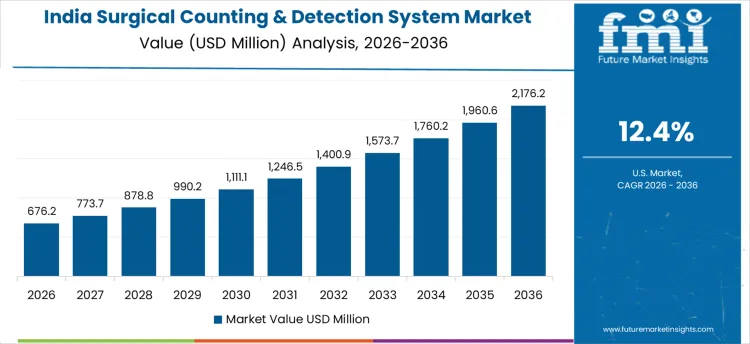
The surgical counting and detection system market in India is expected to grow at the highest rate, with a projected CAGR of 12.4%. India’s rapidly expanding healthcare sector, along with increasing access to medical facilities, is driving the demand for innovative solutions to improve surgical safety. The growing number of surgeries, especially in urban areas, is further fueling the adoption of surgical counting and detection systems to ensure patient safety. India’s increasing focus on healthcare quality, regulatory improvements, and patient-centric care is contributing to the market’s growth. Furthermore, government initiatives aimed at enhancing healthcare infrastructure and raising awareness about the importance of surgical safety are expected to support continued demand for these systems. As healthcare awareness improves across the country, surgical counting and detection systems are becoming integral to ensuring better outcomes in surgeries.
What is the Market Outlook for the Surgical Counting & Detection System Market in China?
The surgical counting and detection system market in China is projected to grow steadily, with a projected CAGR of 12.2%. China’s rapidly expanding healthcare sector, driven by growing investments in medical technologies and increasing surgery rates, is contributing to strong demand for surgical safety systems. The country’s large population, coupled with a rising incidence of surgical procedures and the increasing focus on healthcare quality, is creating opportunities for advanced solutions like surgical counting and detection systems. As China continues to modernize its healthcare infrastructure and adopt international standards, the demand for systems that improve surgical precision and reduce medical errors is expected to rise. Additionally, China’s growing focus on patient safety, improved healthcare regulations, and an increasing awareness of surgical risks are key factors supporting market growth.
What is the Growth Forecast for the Surgical Counting & Detection System Market in the United States?
The surgical counting and detection system market in the United States is expected to grow steadily, with a projected CAGR of 11.2%. The U.S. has one of the largest and most technologically advanced healthcare systems globally, where patient safety and surgical precision are prioritized. Surgical counting and detection systems are essential for ensuring that surgical instruments and materials are accounted for, preventing incidents such as retained foreign objects, which can result in serious complications. The increasing number of surgeries, rising healthcare costs, and growing regulatory pressures are contributing to the adoption of these systems. Additionally, as hospitals and surgical centers strive to meet high safety standards, the demand for these advanced technologies is expected to continue rising. The U.S. market is also influenced by ongoing advancements in medical device technology, with surgical counting and detection systems becoming an integral part of surgical workflow optimization.
What is the Market Outlook for the Surgical Counting & Detection System Market in the United Kingdom?
The surgical counting and detection system market in the United Kingdom is projected to grow at a moderate pace, with a projected CAGR of 9.6%. The UK’s healthcare system places a strong emphasis on patient safety, making surgical safety technologies like counting and detection systems increasingly vital. The growing demand for high-precision surgical practices, combined with the need to reduce medical errors and improve patient outcomes, is driving the adoption of these systems. The UK’s healthcare institutions, which are continually adopting cutting-edge technologies to enhance safety and efficiency, are fueling demand for surgical counting solutions. Additionally, as awareness about the importance of reducing retained surgical items increases, surgical counting and detection systems are becoming standard practice in hospitals and surgical centers across the country. The market’s growth is supported by stringent healthcare regulations that require hospitals to implement safety measures in all surgeries.
What are the Growth Prospects for the Surgical Counting & Detection System Market in Germany?
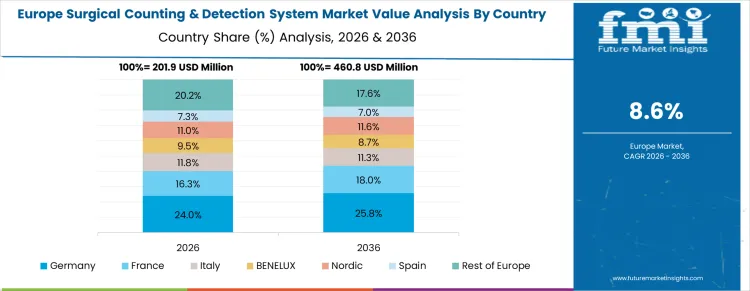
The surgical counting and detection system market in Germany is expected to grow at a steady pace, with a projected CAGR of 9.4%. Germany’s healthcare system is known for its high standards and commitment to patient safety, which is driving the adoption of technologies that reduce surgical errors. The country’s robust healthcare infrastructure, coupled with increasing awareness of surgical risks and safety, is contributing to the demand for surgical counting and detection systems. With a growing number of surgical procedures and an increasing focus on reducing healthcare costs by preventing complications, demand for such systems is expected to rise. As Germany continues to prioritize patient safety and integrate advanced technologies into medical practices, the market for surgical counting and detection systems will likely experience steady growth, supported by government regulations and industry-wide quality improvements.
What is the Competitive Landscape for the Surgical Counting & Detection System Market?
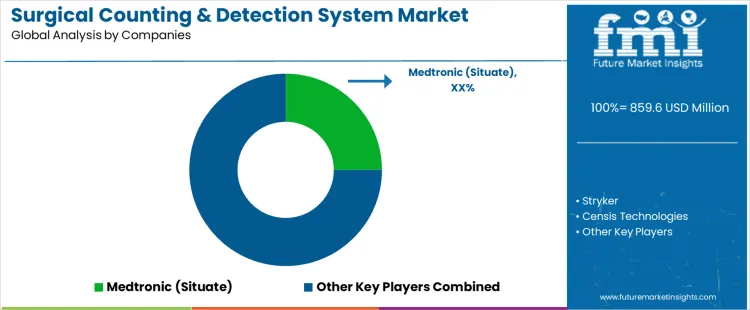
The surgical counting and detection system market is expanding rapidly as healthcare facilities seek innovative technologies to improve surgical safety and prevent retained surgical items. Medtronic (Situate) leads the market with its Situate surgical counting and detection systems, offering advanced technologies that ensure the accurate tracking of surgical instruments, sponges, and other items during procedures. Their focus on improving patient safety and operational efficiency positions them as a dominant player in the market. Stryker, Censis Technologies, and B. Braun are significant competitors, each providing specialized solutions for surgical counting and detection. Stryker offers integrated systems designed to enhance surgical safety and workflow, while Censis Technologies focuses on providing reliable, real-time tracking systems for surgical instruments. B. Braun delivers comprehensive surgical counting solutions that improve accuracy and reduce the risk of retained surgical items.
Haldor Advanced and Others further contribute to the competitive landscape by offering advanced technologies for surgical counting and detection. Haldor Advanced provides specialized systems designed to improve instrument and sponge tracking in real-time. Others refers to emerging and regional players that offer affordable, effective solutions to meet the growing demand for enhanced surgical safety and efficient item detection during procedures. These companies compete by focusing on product accuracy, ease of integration, and the ability to meet the increasing need for reliable counting systems in surgical environments.
Key Players of the Surgical Counting & Detection System Market
- Medtronic (Situate)
- Stryker
- Censis Technologies
- B Braun
- Haldor Advanced
Scope of the Report
| Items | Values |
|---|---|
| Quantitative Units (2026) | USD Million |
| Type | RFID-Based Systems, Barcode-Based Systems, Hybrid Solutions |
| Application | Sponge Counting, Instrument Counting, Others |
| End User | Hospitals, ASCs |
| Companies | Medtronic (Situate), Stryker, Censis Technologies, B Braun, Haldor Advanced |
| Regions Covered | North America, Latin America, Western Europe, Eastern Europe, South Asia and Pacific, East Asia, Middle East & Africa |
| Countries Covered | United States, Canada, Mexico, Brazil, Argentina, Germany, France, United Kingdom, Italy, Spain, Netherlands, China, India, Japan, South Korea, ANZ, GCC Countries, South Africa |
| Additional Attributes | Dollar by sales by type, application, end user, and region. Includes market trends in surgical counting and detection systems, focusing on RFID-based, barcode-based, and hybrid solutions. Highlights the role of sponge and instrument counting in hospitals and ASCs. Focus on performance, regulatory compliance, cost-effectiveness, market share, and competitive positioning of key companies in the surgical equipment and detection market. |
Surgical Counting & Detection System Market Segmentation
Type:
- RFID-based systems
- Barcode-based systems
- Hybrid solutions
Application:
- Sponge counting
- Instrument counting
- Others
End User:
- Hospitals
- ASCs
Region:
- Asia Pacific
- China
- Japan
- South Korea
- India
- Australia & New Zealand
- ASEAN
- Rest of Asia Pacific
- Europe
- Germany
- United Kingdom
- France
- Italy
- Spain
- Nordic
- BENELUX
- Rest of Europe
- North America
- United States
- Canada
- Mexico
- Latin America
- Brazil
- Chile
- Rest of Latin America
- Middle East & Africa
- Kingdom of Saudi Arabia
- Other GCC Countries
- Turkey
- South Africa
- Other African Union
- Rest of Middle East & Africa
Frequently Asked Questions
How big is the surgical counting & detection system market in 2026?
The global surgical counting & detection system market is estimated to be valued at USD 859.6 million in 2026.
What will be the size of surgical counting & detection system market in 2036?
The market size for the surgical counting & detection system market is projected to reach USD 2,270.5 million by 2036.
How much will the surgical counting & detection system market grow between 2026 and 2036?
The surgical counting & detection system market is expected to grow at a 10.2% CAGR between 2026 and 2036.
What are the key product types in the surgical counting & detection system market?
The key product types in surgical counting & detection system market are RFID-based systems, barcode-based systems and hybrid solutions.
Which application segment is expected to contribute a significant share in the surgical counting & detection system market in 2026?
In terms of application, sponge counting segment to command 65.0% share in the surgical counting & detection system market in 2026.
Preview the report firsthand - request a free sample
Get SampleGet the brochure for pricing and purchase details.
Get PDFTable of Content
- Executive Summary
- Global Market Outlook
- Demand-side Trends
- Supply-side Trends
- Technology Roadmap Analysis
- Analysis and Recommendations
- Market Overview
- Market Coverage / Taxonomy
- Market Definition / Scope / Limitations
- Market Background
- Market Dynamics
- Drivers
- Restraints
- Opportunity
- Trends
- Scenario Forecast
- Demand in Optimistic Scenario
- Demand in Likely Scenario
- Demand in Conservative Scenario
- Opportunity Map Analysis
- Product Life Cycle Analysis
- Supply Chain Analysis
- Investment Feasibility Matrix
- Value Chain Analysis
- PESTLE and Porter’s Analysis
- Regulatory Landscape
- Regional Parent Market Outlook
- Production and Consumption Statistics
- Import and Export Statistics
- Market Dynamics
- Global Market Analysis 2021 to 2025 and Forecast, 2026 to 2036
- Historical Market Size Value (USD Million) Analysis, 2021 to 2025
- Current and Future Market Size Value (USD Million) Projections, 2026 to 2036
- Y-o-Y Growth Trend Analysis
- Absolute $ Opportunity Analysis
- Global Market Pricing Analysis 2021 to 2025 and Forecast 2026 to 2036
- Global Market Analysis 2021 to 2025 and Forecast 2026 to 2036, By Type
- Introduction / Key Findings
- Historical Market Size Value (USD Million) Analysis By Type , 2021 to 2025
- Current and Future Market Size Value (USD Million) Analysis and Forecast By Type , 2026 to 2036
- RFID-based systems
- Barcode-based systems
- Hybrid solutions
- RFID-based systems
- Y-o-Y Growth Trend Analysis By Type , 2021 to 2025
- Absolute $ Opportunity Analysis By Type , 2026 to 2036
- Global Market Analysis 2021 to 2025 and Forecast 2026 to 2036, By Application
- Introduction / Key Findings
- Historical Market Size Value (USD Million) Analysis By Application, 2021 to 2025
- Current and Future Market Size Value (USD Million) Analysis and Forecast By Application, 2026 to 2036
- Sponge counting
- Instrument counting
- Sponge counting
- Y-o-Y Growth Trend Analysis By Application, 2021 to 2025
- Absolute $ Opportunity Analysis By Application, 2026 to 2036
- Global Market Analysis 2021 to 2025 and Forecast 2026 to 2036, By End User
- Introduction / Key Findings
- Historical Market Size Value (USD Million) Analysis By End User, 2021 to 2025
- Current and Future Market Size Value (USD Million) Analysis and Forecast By End User, 2026 to 2036
- Hospitals
- ASCs
- Others
- Hospitals
- Y-o-Y Growth Trend Analysis By End User, 2021 to 2025
- Absolute $ Opportunity Analysis By End User, 2026 to 2036
- Global Market Analysis 2021 to 2025 and Forecast 2026 to 2036, By Region
- Introduction
- Historical Market Size Value (USD Million) Analysis By Region, 2021 to 2025
- Current Market Size Value (USD Million) Analysis and Forecast By Region, 2026 to 2036
- North America
- Latin America
- Western Europe
- Eastern Europe
- East Asia
- South Asia and Pacific
- Middle East & Africa
- Market Attractiveness Analysis By Region
- North America Market Analysis 2021 to 2025 and Forecast 2026 to 2036, By Country
- Historical Market Size Value (USD Million) Trend Analysis By Market Taxonomy, 2021 to 2025
- Market Size Value (USD Million) Forecast By Market Taxonomy, 2026 to 2036
- By Country
- USA
- Canada
- Mexico
- By Type
- By Application
- By End User
- By Country
- Market Attractiveness Analysis
- By Country
- By Type
- By Application
- By End User
- Key Takeaways
- Latin America Market Analysis 2021 to 2025 and Forecast 2026 to 2036, By Country
- Historical Market Size Value (USD Million) Trend Analysis By Market Taxonomy, 2021 to 2025
- Market Size Value (USD Million) Forecast By Market Taxonomy, 2026 to 2036
- By Country
- Brazil
- Chile
- Rest of Latin America
- By Type
- By Application
- By End User
- By Country
- Market Attractiveness Analysis
- By Country
- By Type
- By Application
- By End User
- Key Takeaways
- Western Europe Market Analysis 2021 to 2025 and Forecast 2026 to 2036, By Country
- Historical Market Size Value (USD Million) Trend Analysis By Market Taxonomy, 2021 to 2025
- Market Size Value (USD Million) Forecast By Market Taxonomy, 2026 to 2036
- By Country
- Germany
- UK
- Italy
- Spain
- France
- Nordic
- BENELUX
- Rest of Western Europe
- By Type
- By Application
- By End User
- By Country
- Market Attractiveness Analysis
- By Country
- By Type
- By Application
- By End User
- Key Takeaways
- Eastern Europe Market Analysis 2021 to 2025 and Forecast 2026 to 2036, By Country
- Historical Market Size Value (USD Million) Trend Analysis By Market Taxonomy, 2021 to 2025
- Market Size Value (USD Million) Forecast By Market Taxonomy, 2026 to 2036
- By Country
- Russia
- Poland
- Hungary
- Balkan & Baltic
- Rest of Eastern Europe
- By Type
- By Application
- By End User
- By Country
- Market Attractiveness Analysis
- By Country
- By Type
- By Application
- By End User
- Key Takeaways
- East Asia Market Analysis 2021 to 2025 and Forecast 2026 to 2036, By Country
- Historical Market Size Value (USD Million) Trend Analysis By Market Taxonomy, 2021 to 2025
- Market Size Value (USD Million) Forecast By Market Taxonomy, 2026 to 2036
- By Country
- China
- Japan
- South Korea
- By Type
- By Application
- By End User
- By Country
- Market Attractiveness Analysis
- By Country
- By Type
- By Application
- By End User
- Key Takeaways
- South Asia and Pacific Market Analysis 2021 to 2025 and Forecast 2026 to 2036, By Country
- Historical Market Size Value (USD Million) Trend Analysis By Market Taxonomy, 2021 to 2025
- Market Size Value (USD Million) Forecast By Market Taxonomy, 2026 to 2036
- By Country
- India
- ASEAN
- Australia & New Zealand
- Rest of South Asia and Pacific
- By Type
- By Application
- By End User
- By Country
- Market Attractiveness Analysis
- By Country
- By Type
- By Application
- By End User
- Key Takeaways
- Middle East & Africa Market Analysis 2021 to 2025 and Forecast 2026 to 2036, By Country
- Historical Market Size Value (USD Million) Trend Analysis By Market Taxonomy, 2021 to 2025
- Market Size Value (USD Million) Forecast By Market Taxonomy, 2026 to 2036
- By Country
- Kingdom of Saudi Arabia
- Other GCC Countries
- Turkiye
- South Africa
- Other African Union
- Rest of Middle East & Africa
- By Type
- By Application
- By End User
- By Country
- Market Attractiveness Analysis
- By Country
- By Type
- By Application
- By End User
- Key Takeaways
- Key Countries Market Analysis
- USA
- Pricing Analysis
- Market Share Analysis, 2025
- By Type
- By Application
- By End User
- Canada
- Pricing Analysis
- Market Share Analysis, 2025
- By Type
- By Application
- By End User
- Mexico
- Pricing Analysis
- Market Share Analysis, 2025
- By Type
- By Application
- By End User
- Brazil
- Pricing Analysis
- Market Share Analysis, 2025
- By Type
- By Application
- By End User
- Chile
- Pricing Analysis
- Market Share Analysis, 2025
- By Type
- By Application
- By End User
- Germany
- Pricing Analysis
- Market Share Analysis, 2025
- By Type
- By Application
- By End User
- UK
- Pricing Analysis
- Market Share Analysis, 2025
- By Type
- By Application
- By End User
- Italy
- Pricing Analysis
- Market Share Analysis, 2025
- By Type
- By Application
- By End User
- Spain
- Pricing Analysis
- Market Share Analysis, 2025
- By Type
- By Application
- By End User
- France
- Pricing Analysis
- Market Share Analysis, 2025
- By Type
- By Application
- By End User
- India
- Pricing Analysis
- Market Share Analysis, 2025
- By Type
- By Application
- By End User
- ASEAN
- Pricing Analysis
- Market Share Analysis, 2025
- By Type
- By Application
- By End User
- Australia & New Zealand
- Pricing Analysis
- Market Share Analysis, 2025
- By Type
- By Application
- By End User
- China
- Pricing Analysis
- Market Share Analysis, 2025
- By Type
- By Application
- By End User
- Japan
- Pricing Analysis
- Market Share Analysis, 2025
- By Type
- By Application
- By End User
- South Korea
- Pricing Analysis
- Market Share Analysis, 2025
- By Type
- By Application
- By End User
- Russia
- Pricing Analysis
- Market Share Analysis, 2025
- By Type
- By Application
- By End User
- Poland
- Pricing Analysis
- Market Share Analysis, 2025
- By Type
- By Application
- By End User
- Hungary
- Pricing Analysis
- Market Share Analysis, 2025
- By Type
- By Application
- By End User
- Kingdom of Saudi Arabia
- Pricing Analysis
- Market Share Analysis, 2025
- By Type
- By Application
- By End User
- Turkiye
- Pricing Analysis
- Market Share Analysis, 2025
- By Type
- By Application
- By End User
- South Africa
- Pricing Analysis
- Market Share Analysis, 2025
- By Type
- By Application
- By End User
- USA
- Market Structure Analysis
- Competition Dashboard
- Competition Benchmarking
- Market Share Analysis of Top Players
- By Regional
- By Type
- By Application
- By End User
- Competition Analysis
- Competition Deep Dive
- Medtronic (Situate)
- Overview
- Product Portfolio
- Profitability by Market Segments (Product/Age /Sales Channel/Region)
- Sales Footprint
- Strategy Overview
- Marketing Strategy
- Product Strategy
- Channel Strategy
- Stryker
- Censis Technologies
- B Braun
- Haldor Advanced
- Others
- Medtronic (Situate)
- Competition Deep Dive
- Assumptions & Acronyms Used
- Research Methodology


