

- Industry Size (2025)
- USD 61.6 Mn
- Forecast (2035)
- USD 97.0 Mn
- CAGR (2025 to 2035)
- 4.7%
Demand for Surgical Navigation System in Japan Forecast and Outlook 2025 to 2035
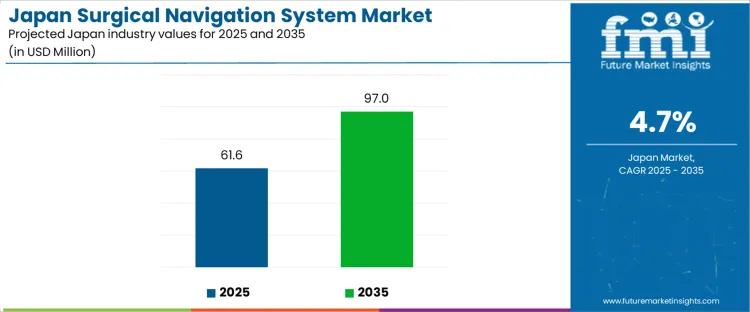
Demand for surgical navigation systems in Japan is projected to grow from USD 61.6 million in 2025 to USD 97.0 million by 2035, reflecting a compound annual growth rate (CAGR) of 4.7%. Surgical navigation systems, which guide surgeons during procedures using real-time imaging and computer-assisted technologies, are becoming increasingly integral to improving the precision and outcomes of complex surgeries, including orthopedics, neurosurgery, and spine surgery. As the healthcare industry continues to emphasize minimally invasive procedures and enhanced surgical precision, the demand for these systems is expected to rise steadily.
Growth is further supported by ongoing technological advancements, including improved imaging capabilities, greater system accuracy, and the integration of artificial intelligence to enhance surgical navigation. With Japan's strong healthcare infrastructure and technological innovation, the adoption of surgical navigation systems is expected to increase over the next decade, making surgical procedures safer and more efficient.
Quick Stats of the Demand for Surgical Navigation System in Japan
- Demand for Surgical Navigation System in Japan Value (2025): USD 61.6 million
- Demand for Surgical Navigation System in Japan Forecast Value (2035): USD 97.0 million
- Demand for Surgical Navigation System in Japan Forecast CAGR (2025-2035): 4.7%
- Demand for Surgical Navigation System in Japan Leading Technology: Electromagnetic Navigation Systems (37%)
- Demand for Surgical Navigation System in Japan Key Growth Regions: Kyushu & Okinawa, Kanto, Kansai, Chubu, Tohoku, Rest of Japan
- Demand for Surgical Navigation System in Japan Key Players: Siemens Healthineers, GE Healthcare Ltd., Medtronic Inc, Stryker Corporation, B. Braun
What is the Growth Forecast for the Surgical Navigation System Market through 2035?
The early growth phase of the surgical navigation system market in Japan shows gradual increases in demand, with the market rising from USD 61.6 million in 2025 to USD 64.5 million in 2026 and USD 67.4 million in 2027. This reflects early-stage adoption, where the systems are becoming increasingly integrated into specialized surgical fields. The early years indicate steady growth as more hospitals and surgical centers adopt these systems, driven by the increasing focus on surgical precision and patient safety.
From 2027 onward, the growth rate begins to pick up, with the market reaching USD 70.6 million in 2028 and USD 73.9 million in 2029. This marks the transition to the late growth phase, where demand for surgical navigation systems accelerates due to increased adoption across a broader range of surgical disciplines. By 2035, the market reaches USD 97.0 million, reflecting significant growth as surgical navigation systems become more common in routine procedures. The late-stage growth is driven by technological advancements, increased awareness of their benefits, and the expanded use of these systems in various surgical specialties. The comparison highlights a more pronounced acceleration in the latter years, as technological integration and broader acceptance foster greater market expansion.
Key Takeaways of Surgical Navigation System Industry in Japan
| Metric | Value |
|---|---|
| Industry Sales Value (2025) | USD 61.6 million |
| Industry Forecast Value (2035) | USD 97 million |
| Industry Forecast CAGR (2025-2035) | 4.7% |
What Is Driving the Demand for Surgical Navigation Systems in Japan?
The demand for surgical navigation systems in Japan reflects rising need for precision in surgeries among an aging population. Use of minimally invasive surgical procedures has been increasing, especially in orthopedics, neurosurgery, spinal surgery, and ENT. This shift has encouraged hospitals and surgical centers to adopt navigation systems that offer real-time imaging, guidance, and enhanced anatomical mapping for safer operations. Healthcare providers appear to favour these systems where surgical accuracy matters in delicate procedures. Improvements in imaging modalities and integration of navigation systems with modern surgical workflows have supported their adoption.
Future demand for surgical navigation systems in Japan is expected to grow further as the population ages and chronic conditions requiring surgery become more common. Continued expansion of minimally invasive and image-guided procedures will push uptake of navigation systems across more surgical specialties. Advances in software, navigation technology, and possibly robotic-assisted interventions may increase acceptance. Pressure to improve patient outcomes and reduce complications will sustain demand for precision tools. Long-term growth will depend on cost, regulatory environment, and integration with hospital infrastructure and surgeon training.
What Are the Key Segments in Surgical Navigation System Market in Japan?
The surgical navigation system market in Japan is segmented by technology and application. Electromagnetic navigation systems lead the technology segment, accounting for 37% of the market share. In terms of application, neurosurgery is the dominant segment, representing 34% of the market. The growing demand for precision and minimally invasive surgery is driving the adoption of advanced surgical navigation systems in Japan.
Which Technology Drives Surgical Navigation System Demand in Japan?
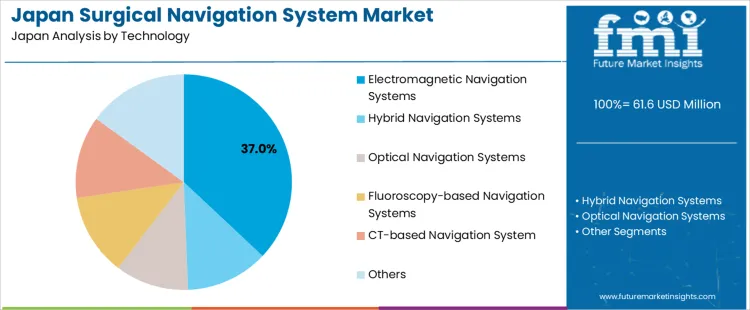
Electromagnetic navigation systems are the most widely used technology in the surgical navigation system market in Japan, holding 37% of the market share. These systems use electromagnetic fields to track surgical instruments in real-time, providing accurate guidance during complex surgeries. Electromagnetic navigation systems are particularly valued for their precision and ability to work in environments without the need for line-of-sight, which is crucial for surgeries where instruments need to be tracked in deep or complex regions.
The increasing adoption of these systems is driven by their accuracy, ease of use, and ability to enhance surgical outcomes, particularly in neurosurgery and orthopedic procedures. While hybrid navigation systems, optical navigation systems, and fluoroscopy-based systems also have their applications, electromagnetic systems remain the preferred choice due to their versatile and reliable performance.
Which Application Drives Surgical Navigation System Demand in Japan?
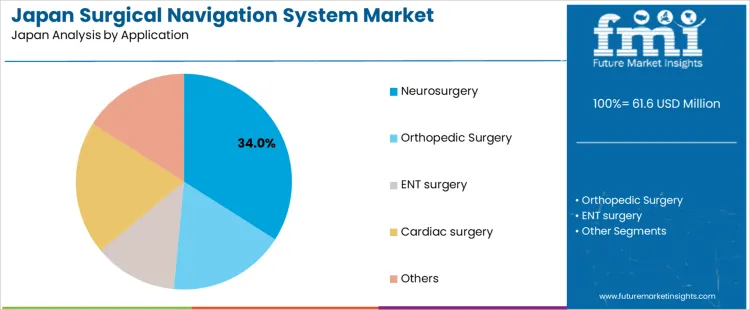
Neurosurgery is the leading application for surgical navigation systems in Japan, accounting for 34% of the market share. Neurosurgery often requires high precision due to the delicate nature of the brain and nervous system. Surgical navigation systems help guide surgeons with real-time imaging, ensuring accuracy and minimizing risks during operations such as tumor removal, deep brain stimulation, and spinal surgeries. The increasing incidence of neurological disorders and the demand for more effective and minimally invasive neurosurgical procedures are driving the growth of surgical navigation systems in this field.
While orthopedic surgery, ENT surgery, and cardiac surgery also contribute to the market, neurosurgery remains the dominant application due to the critical need for precise navigation in the surgical treatment of brain and spinal conditions. The continued advancements in navigation technology are expected to further improve surgical outcomes in neurosurgery and other complex procedures.
What are the Key Dynamics for Surgical Navigation System in Japan?
Demand for surgical navigation systems in Japan is increasing as the healthcare industry seeks to improve the accuracy and efficiency of surgical procedures. Surgical navigation systems use advanced imaging technology to guide surgeons during surgery, enhancing precision and minimizing risks associated with complex procedures. These systems are particularly useful in neurosurgery, orthopedics, and other high-stakes medical fields. As Japan continues to invest in advanced medical technologies to improve patient outcomes, the market for surgical navigation systems is expected to grow, driven by both technological advancements and an increasing emphasis on patient safety.
What are the Drivers of Demand for Surgical Navigation System in Japan?
Several factors are driving the demand for surgical navigation systems in Japan. First, the increasing complexity of surgeries and the need for precision in procedures, particularly in neurosurgery and orthopedics, is pushing the adoption of surgical navigation systems. These systems provide real-time imaging and guidance, allowing surgeons to plan and execute procedures with greater accuracy. Second, Japan's aging population is driving the demand for surgeries related to degenerative diseases, joint replacements, and cancer, which benefits from the enhanced precision provided by navigation systems.
Third, the growing focus on improving patient outcomes and reducing recovery times is encouraging healthcare providers to adopt technologies that improve surgical efficiency. Finally, advancements in imaging technology, such as 3D imaging and real-time tracking, are making surgical navigation systems more effective and accessible, contributing to their widespread adoption.
What are the Restraints on Demand for Surgical Navigation System in Japan?
Despite the growing demand, there are several factors that may limit the adoption of surgical navigation systems in Japan. One significant restraint is the high cost of these systems, which can be a barrier for smaller hospitals or healthcare facilities with limited budgets. The complexity of the technology also requires specialized training for surgeons and medical staff, which could add to the operational cost and time required for adoption.
Additionally, some healthcare providers may be hesitant to invest in new technologies without a clear return on investment, particularly if the benefits of the system are not immediately apparent in terms of improved surgical outcomes. Lastly, the integration of surgical navigation systems with existing medical equipment and infrastructure can be challenging, limiting their widespread adoption in some healthcare settings.
What are the Key Trends Influencing Demand for Surgical Navigation System in Japan?
Several key trends are influencing the demand for surgical navigation systems in Japan. One major trend is the increasing focus on minimally invasive surgery, where surgical navigation systems play a crucial role in guiding precise movements with smaller incisions and faster recovery times. Another trend is the growing integration of artificial intelligence (AI) and machine learning in surgical navigation systems, allowing for enhanced decision-making and improved patient outcomes.
Additionally, the rise in outpatient surgeries and the push toward quicker, more efficient procedures are driving the demand for systems that can provide real-time guidance. The development of 3D imaging and augmented reality technologies is also contributing to advancements in surgical navigation, further enhancing their precision and appeal in complex surgeries. Finally, Japan's commitment to healthcare innovation and technological advancement is fostering an environment conducive to the adoption of these systems across various surgical specialties.
What is the Regional Demand Outlook for the Surgical Navigation System Market in Japan?
The Surgical Navigation System market in Japan is projected to experience steady growth, with Kyushu & Okinawa leading the way at a projected CAGR of 5.8%. Kanto follows with a growth rate of 5.3%, while Kansai is expected to grow at 4.7%. Chubu is projected to grow at a rate of 4.1%, while Tohoku and Rest of Japan show more moderate growth, with CAGRs of 3.6% and 3.4%, respectively. Surgical navigation systems, which assist surgeons in performing precise operations using real-time imaging and navigation tools, are in high demand as healthcare providers increasingly adopt technologies to improve surgical accuracy, reduce recovery times, and enhance patient outcomes.
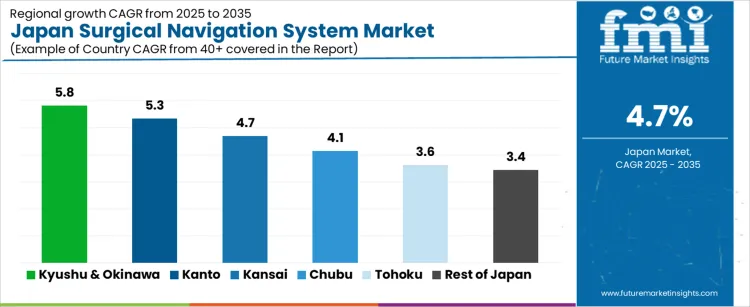
| Region | CAGR (2025-2035) |
|---|---|
| Kyushu & Okinawa | 5.8% |
| Kanto | 5.3% |
| Kansai | 4.7% |
| Chubu | 4.1% |
| Tohoku | 3.6% |
| Rest of Japan | 3.4% |
What is Driving the Growth of Surgical Navigation Systems in Kyushu & Okinawa?
Kyushu & Okinawa is projected to experience the highest growth in the Surgical Navigation System market, with a projected CAGR of 5.8%. The region’s increasing adoption of advanced medical technologies, combined with a rising focus on improving surgical precision and patient safety, is a significant driver of this growth. States like Okinawa, with a growing elderly population, are seeing more complex surgeries being performed, necessitating the use of surgical navigation systems for better outcomes.
Additionally, Kyushu & Okinawa’s healthcare providers are increasingly investing in cutting-edge surgical technologies, including robotic-assisted and minimally invasive surgeries, where navigation systems play a critical role. The region’s healthcare systems are also focused on reducing complications and enhancing the effectiveness of surgical procedures, driving the demand for advanced navigation systems.
Why is the Surgical Navigation System Market Expanding in Kanto?
In Kanto, the demand for surgical navigation systems is projected to grow at a CAGR of 5.3%. Kanto, which includes Japan's capital Tokyo, is a hub for healthcare innovation, and the region's advanced medical infrastructure is a major driver of the demand for surgical navigation systems. With a high concentration of leading hospitals and surgical centers, Kanto is increasingly adopting robotic-assisted surgeries and minimally invasive procedures, where navigation systems are essential for ensuring precision. The region’s large and aging population, which requires more surgeries, is further contributing to the rising demand for these advanced systems. The focus on improving patient outcomes, reducing recovery times, and enhancing surgical accuracy in Kanto is expected to continue driving the market for surgical navigation systems.
How is the Surgical Navigation System Market Growing in Kansai?
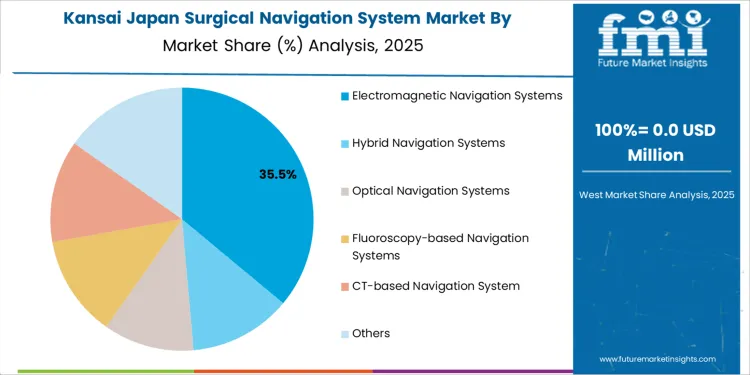
In Kansai, the Surgical Navigation System market is projected to grow at a CAGR of 4.7%. The region’s strong healthcare infrastructure, particularly in cities like Osaka and Kyoto, is contributing to the growing adoption of advanced surgical technologies. As the incidence of complex surgeries increases, particularly in elderly populations, healthcare providers in Kansai are increasingly turning to surgical navigation systems to improve surgical outcomes and reduce the risk of complications. Kansai’s focus on improving patient care through the use of innovative technologies is helping to drive market growth. Additionally, the region’s large number of hospitals and medical centers is contributing to the increasing demand for surgical navigation systems in both routine and specialized surgeries.
What is Contributing to the Growth of Surgical Navigation Systems in Chubu?
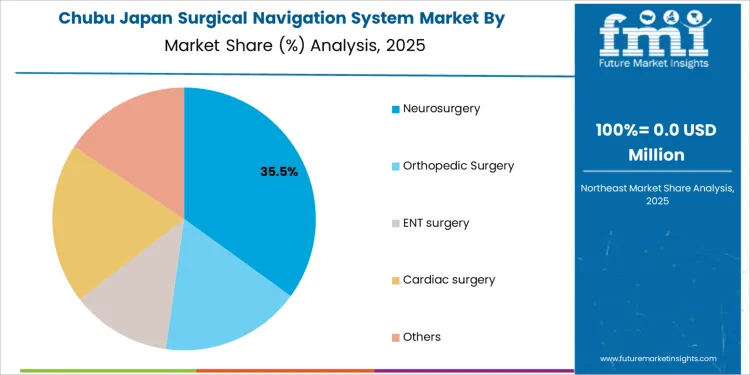
In Chubu, the Surgical Navigation System market is expected to grow at a CAGR of 4.1%. The region’s healthcare providers are increasingly adopting advanced technologies like surgical navigation systems to enhance the precision and safety of surgeries. Chubu, which includes cities like Nagoya, has a growing healthcare market, with hospitals and clinics investing in state-of-the-art equipment to meet the needs of their patients. The rise in the number of complex surgeries, particularly those involving the elderly and those requiring precise navigation, is contributing to the growing adoption of surgical navigation systems. As Chubu’s healthcare system continues to expand and evolve, the market for surgical navigation systems is expected to grow steadily.
What is Influencing the Growth of Surgical Navigation Systems in Tohoku?
In Tohoku, the Surgical Navigation System market is projected to grow at a CAGR of 3.6%. While the growth rate in Tohoku is moderate compared to other regions, there is still growing demand for advanced surgical technologies due to the increasing prevalence of surgeries and the aging population in the region. Tohoku’s healthcare providers are recognizing the benefits of surgical navigation systems in improving surgical outcomes and reducing complications, particularly for complex surgeries. The region’s growing healthcare infrastructure and the adoption of minimally invasive surgery techniques are also contributing to the rise in demand for navigation systems. As awareness of the benefits of these systems grows, the market in Tohoku is expected to continue expanding at a steady pace.
What is Contributing to the Growth of Surgical Navigation Systems in Rest of Japan?
In Rest of Japan, the Surgical Navigation System market is expected to grow at a more moderate rate of 3.4%. Although the region has a smaller healthcare market compared to major metropolitan areas, there is still a demand for advanced surgical technologies, driven by the increasing prevalence of complex surgeries and the aging population. As healthcare providers in Rest of Japan continue to prioritize improving surgical outcomes and patient safety, the adoption of surgical navigation systems is expected to grow.
The region’s expanding healthcare infrastructure and increasing awareness of the benefits of precision surgery are contributing to the gradual adoption of surgical navigation systems. While the market in Rest of Japan is smaller, it is expected to see continued steady growth as access to advanced healthcare technologies improves.
What is the Competitive Landscape for Demand for Surgical Navigation Systems in Japan?
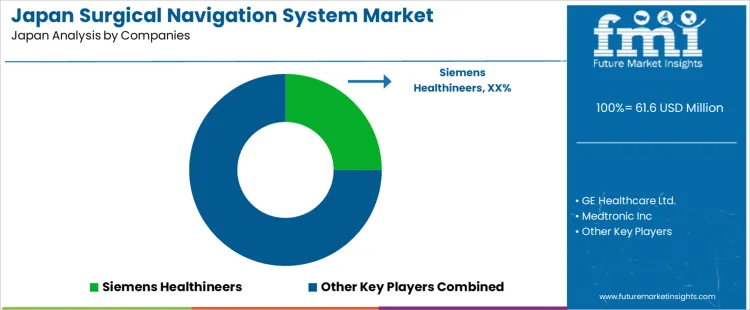
Demand for surgical navigation systems in Japan is rising as medical providers increasingly favor minimally invasive, image-guided surgical procedures that offer greater precision and improved patient outcomes. An aging population with a high incidence of degenerative spinal, neurological, orthopedic and vascular conditions is fueling a growing volume of surgeries requiring advanced navigation. The shift toward minimally invasive surgery (MIS), along with rising adoption of image-guided procedures, has driven expanded use of navigation systems in orthopaedic, neuro, spinal and general surgery across Japanese hospitals and surgical centers.
The main players include Siemens Healthineers, GE Healthcare Ltd., Medtronic Inc., Stryker Corporation, and B. Braun. These companies supply surgical navigation hardware and software, including imaging suites, navigation-assisted surgical tools, intraoperative guidance platforms and associated instruments.
Competition among these firms centers on imaging quality, precision and reliability of navigation systems, breadth of surgical applications covered (spine, neuro, orthopaedics, vascular), after-sales support, compliance with Japanese regulations and ability to integrate with hospital workflows. Firms offering advanced, clinically proven navigation solutions with strong support services and broad product portfolios are best positioned to capture growth as demand expands across Japan’s healthcare sector.
Key Players of the Surgical Navigation System Industry in Japan
- Siemens Healthineers
- GE Healthcare Ltd.
- Medtronic Inc
- Stryker Corporation
- B. Braun
Scope of the Report
| Items | Details |
|---|---|
| Quantitative Units | USD Million |
| Regions Covered | Japan |
| Technology | Electromagnetic Navigation Systems; Hybrid Navigation Systems; Optical Navigation Systems; Fluoroscopy-based Navigation Systems; CT-based Navigation Systems; Others |
| Application | Neurosurgery; Orthopedic Surgery; ENT Surgery; Cardiac Surgery; Others (spine, general surgery, etc.) |
| End User | Hospitals & Physician Practices; Ambulatory Surgery Centres (ASCs) & Clinics; Specialty Surgery Units |
| Key Companies | Siemens Healthineers; GE Healthcare Ltd.; Medtronic Inc.; Stryker Corporation; B. Braun |
| Additional Attributes | Dollar sales by technology and application show rising demand - particularly for optical, electromagnetic, hybrid, and CT-based navigation systems - driven by growing adoption of minimally invasive and image-guided surgeries. The strong aging population in Japan, increasing volume of orthopedic, neurosurgical and ENT procedures, and emphasis on precision & safety are key growth drivers. Hospitals remain the dominant end-users, but smaller clinics and ASCs are increasingly adopting navigation to enable complex surgeries with lower overhead. |
Key Segments in the Demand for Surgical Navigation System in Japan
Technology
- Electromagnetic Navigation Systems
- Hybrid Navigation Systems
- Optical Navigation Systems
- Fluoroscopy-based Navigation Systems
- CT-based Navigation System
- Others
Application
- Neurosurgery
- Orthopedic Surgery
- ENT Surgery
- Cardiac Surgery
- Others
End User
- Hospitals and Physician Practices
- Ambulatory Surgery
Region
- Kyushu & Okinawa
- Kanto
- Kansai
- Chubu
- Tohoku
- Rest of Japan
Frequently Asked Questions
How big is the demand for surgical navigation system in Japan in 2025?
The demand for surgical navigation system in Japan is estimated to be valued at USD 61.6 million in 2025.
What will be the size of surgical navigation system in Japan in 2035?
The market size for the surgical navigation system in Japan is projected to reach USD 97.0 million by 2035.
How much will be the demand for surgical navigation system in Japan growth between 2025 and 2035?
The demand for surgical navigation system in Japan is expected to grow at a 4.7% CAGR between 2025 and 2035.
What are the key product types in the surgical navigation system in Japan?
The key product types in surgical navigation system in Japan are electromagnetic navigation systems, hybrid navigation systems, optical navigation systems, fluoroscopy-based navigation systems, ct-based navigation system and others.
Which application segment is expected to contribute significant share in the surgical navigation system in Japan in 2025?
In terms of application, neurosurgery segment is expected to command 34.0% share in the surgical navigation system in Japan in 2025.
Preview the report firsthand - request a free sample
Get SampleGet the brochure for pricing and purchase details.
Get PDFTable of Content
- Executive Summary
- Japan Market Outlook
- Demand-side Trends
- Supply-side Trends
- Technology Roadmap Analysis
- Analysis and Recommendations
- Market Overview
- Market Coverage / Taxonomy
- Market Definition / Scope / Limitations
- Market Background
- Market Dynamics
- Drivers
- Restraints
- Opportunity
- Trends
- Scenario Forecast
- Demand in Optimistic Scenario
- Demand in Likely Scenario
- Demand in Conservative Scenario
- Opportunity Map Analysis
- Product Life Cycle Analysis
- Supply Chain Analysis
- Investment Feasibility Matrix
- Value Chain Analysis
- PESTLE and Porter’s Analysis
- Regulatory Landscape
- Regional Parent Market Outlook
- Production and Consumption Statistics
- Import and Export Statistics
- Market Dynamics
- Japan Market Analysis 2020 to 2024 and Forecast, 2025 to 2035
- Historical Market Size Value (USD Million) Analysis, 2020 to 2024
- Current and Future Market Size Value (USD Million) Projections, 2025 to 2035
- Y-o-Y Growth Trend Analysis
- Absolute $ Opportunity Analysis
- Japan Market Pricing Analysis 2020 to 2024 and Forecast 2025 to 2035
- Japan Market Analysis 2020 to 2024 and Forecast 2025 to 2035, By Technology
- Introduction / Key Findings
- Historical Market Size Value (USD Million) Analysis By Technology , 2020 to 2024
- Current and Future Market Size Value (USD Million) Analysis and Forecast By Technology , 2025 to 2035
- Electromagnetic Navigation Systems
- Hybrid Navigation Systems
- Optical Navigation Systems
- Fluoroscopy-based Navigation Systems
- CT-based Navigation System
- Others
- Y-o-Y Growth Trend Analysis By Technology , 2020 to 2024
- Absolute $ Opportunity Analysis By Technology , 2025 to 2035
- Japan Market Analysis 2020 to 2024 and Forecast 2025 to 2035, By Application
- Introduction / Key Findings
- Historical Market Size Value (USD Million) Analysis By Application, 2020 to 2024
- Current and Future Market Size Value (USD Million) Analysis and Forecast By Application, 2025 to 2035
- Neurosurgery
- Orthopedic Surgery
- ENT surgery
- Cardiac surgery
- Others
- Y-o-Y Growth Trend Analysis By Application, 2020 to 2024
- Absolute $ Opportunity Analysis By Application, 2025 to 2035
- Japan Market Analysis 2020 to 2024 and Forecast 2025 to 2035, By End User
- Introduction / Key Findings
- Historical Market Size Value (USD Million) Analysis By End User, 2020 to 2024
- Current and Future Market Size Value (USD Million) Analysis and Forecast By End User, 2025 to 2035
- Hospitals and Physician Practices
- Ambulatory Surgery
- Y-o-Y Growth Trend Analysis By End User, 2020 to 2024
- Absolute $ Opportunity Analysis By End User, 2025 to 2035
- Market Structure Analysis
- Competition Dashboard
- Competition Benchmarking
- Market Share Analysis of Top Players
- By Regional
- By Technology
- By Application
- By End User
- Competition Analysis
- Competition Deep Dive
- Siemens Healthineers
- Overview
- Product Portfolio
- Profitability by Market Segments (Product/Age /Sales Channel/Region)
- Sales Footprint
- Strategy Overview
- Marketing Strategy
- Product Strategy
- Channel Strategy
- GE Healthcare Ltd.
- Medtronic Inc
- Stryker Corporation
- B. Braun
- Siemens Healthineers
- Competition Deep Dive
- Assumptions & Acronyms Used
- Research Methodology


