

- Market Size (2026)
- USD 126.8 Mn
- Forecast (2036)
- USD 258.9 Mn
- CAGR (2026 to 2036)
- 7.4%
Rapid Mycotoxin Detection Systems for Grain Handling Facilities Market Size, Market Forecast and Outlook By FMI
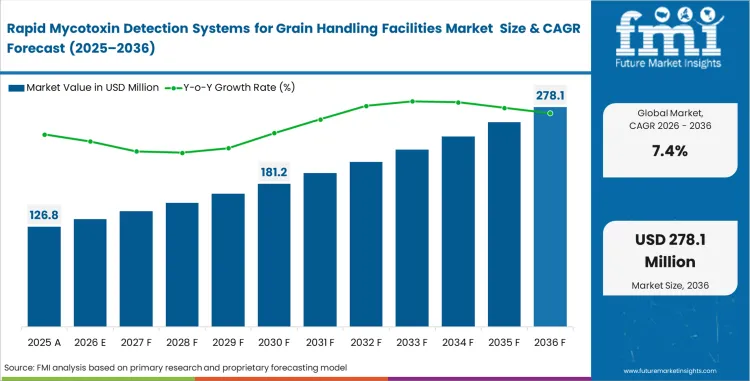
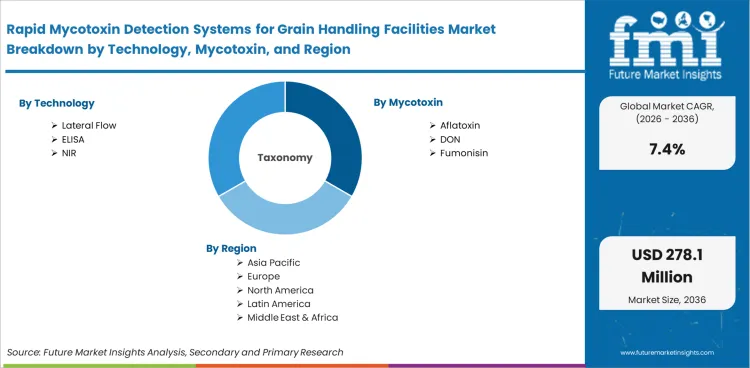
Rapid mycotoxin detection systems for grain handling facilities market was valued at USD 118.1 million in 2025. Industry valuation is expected to reach USD 126.8 million in 2026 at a CAGR of 7.4% during the forecast period. Cumulative market expansion takes valuation to USD 258.9 million by 2036 as grain handlers are being pushed to make lot release and segregation decisions at intake, before questionable grain enters storage, blending, or dispatch flows.
Summary of Rapid Mycotoxin Detection Systems for Grain Handling Facilities Market
- The market is forecast to reach USD 258.9 million by 2036.
- The market is expected to grow at a CAGR of 7.4% from 2026 to 2036.
- The market was estimated at USD 118.1 million in 2025.
- The forecast period represents an incremental opportunity of USD 140.8 million.
- Rapid mycotoxin detection systems are used for intake screening, lot release, segregation decisions, and grain routing at handling facilities.
- Lateral flow-based systems dominate due to their speed, ease of use, and suitability for high-pressure intake environments.
- Portable readers remain widely adopted as they provide fast, documented results without requiring full lab infrastructure.
Key Takeaways, Market Size, and Forecast
- Rapid Mycotoxin Detection Systems for Grain Handling Facilities Market is projected to grow from USD 126.8 million in 2026 to USD 258.9 million by 2036, at a CAGR of 7.4%.
- The rapid mycotoxin detection systems for grain handling facilities market was valued at USD 118.1 million in 2025.
- By 2036, the Rapid Mycotoxin Detection Systems for Grain Handling Facilities Market is expected to be worth USD 258.9 million.
- During 2026 to 2036, the market is anticipated to expand at a CAGR of 7.4%.
- The market is predicted to create an incremental opportunity of USD 132.1 million between 2026 and 2036.
- In 2026, Lateral Flow is expected to account for 41.0% of the technology segment.
- India (8.8%) and Brazil (8.2%) are projected to be two of the fastest growing markets.
Rapid Mycotoxin Detection Systems for Grain Handling Facilities Market Key Takeaways
| Metric | Value |
|---|---|
| Market Size (2025) | USD 118.1 million |
| Market Size (2026) | USD 126.8 million |
| Market Size (2036) | USD 258.9 million |
| CAGR (2026-2036) | 7.4% |
| Incremental Opportunity | USD 132.1 million |
| Leading Technology | Lateral Flow (41%) |
| Leading Mycotoxin | Aflatoxin (29%) |
| Leading Deployment | Receiving Bays (34%) |
| Leading Mode | Portable Readers (47%) |
| Leading End User | Country Elevators (32%) |
Source: Future Market Insights (FMI) analysis, based on proprietary forecasting model and primary research
Grain quality teams now have to decide whether toxin screening remains a follow-up lab exercise or becomes a regular step inside receiving operations. Delay carries a real operating cost because slow results can hold trucks, complicate bin assignment, and raise the chance of mixing suspect grain with saleable inventory. Current movement across food testing and mycotoxin testing points buyers toward tools that fit daily lot movement rather than instruments that work best in a separate lab routine. One point often missed is that early adopters are not always the most automated sites. Many are locations that need faster screening with current staff and limited bench space.
Confidence in matrix-specific rapid results is the condition that turns occasional use into routine use. Elevator lab heads, terminal managers, and feed mill quality teams set that pace when they can rely on the method for first-pass release decisions without creating a second bottleneck. Once that point is reached, repeat testing becomes part of day-to-day control instead of a last-minute reaction.
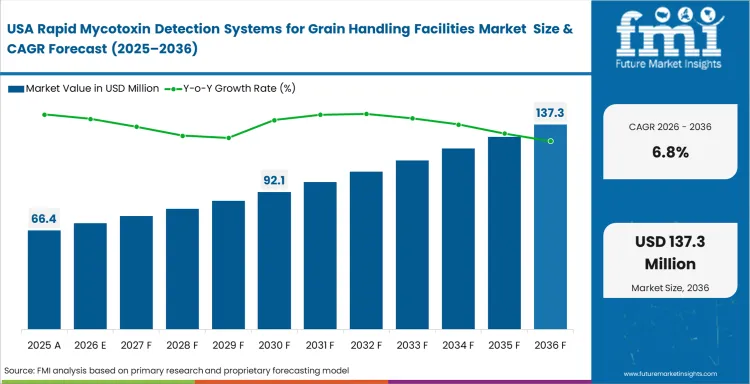
India is expected to post 8.8% CAGR, Brazil 8.2%, China 7.9%, Argentina 7.8%, the European Union 7.2%, the United States 6.8%, and Canada 6.7% during 2026 to 2036. Steady country outlooks are tied to rising formalization of intake testing and export-linked quality checks, while North America adds volume more through reader replacement, broader toxin menus, and tighter audit records inside mature grain systems.
Segmental Analysis
Key Facts About Segments
- Fast intake decisions keep lateral flow as the leading technology, with 41% share projected in 2026. Its ability to deliver quick, first-pass results supports continuous grain unloading and lot screening.
- High-risk toxin monitoring keeps aflatoxin at the forefront, with 29% share expected in 2026. Its strong impact on grain acceptance and routing decisions reinforces its priority in screening workflows.
- Early-stage control requirements position receiving bays as the leading deployment segment, holding 34% share in 2026. First-contact testing helps prevent mixing of contaminated grain.
- Mobility and documentation needs drive portable readers to lead mode selection, capturing 47% share in 2026. Their ability to combine speed with recorded outputs supports audit-ready operations.
- Frequent intake-level decision-making keeps country elevators as the leading end user, with 32% share projected in 2026. Daily lot segregation and routing needs sustain consistent demand.
Rapid Mycotoxin Detection Systems for Grain Handling Facilities Market Analysis by Technology
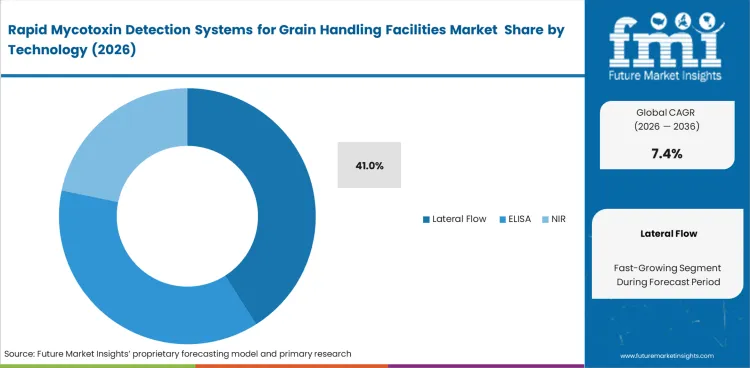
Slow laboratory routing no longer works well once grain intake volumes climb and truck queues start to build at receiving points. Facilities need a method that can screen suspect lots without turning each toxin check into a separate bench exercise, and that operating need keeps lateral flow in the lead. Lateral flow is expected to account for 41% share in 2026 because it matches the pace of day-to-day grain movement better than more equipment-heavy formats. Setup is simpler, training time is shorter, and the method fits sites that cannot dedicate a full lab team to every inbound load. Buyers choosing this route are usually looking for fast triage first, then confirmatory follow-up only when a lot falls outside tolerance or needs dispute review. Trouble begins when a site buys a format that produces good analytical output but slows intake decisions enough to create a second choke point. Facilities comparing aflatoxin kits with broader mycotoxin testing options increasingly favor tools that keep the first decision close to the pit or elevator lab.
- Qualification fit: Lateral flow works well where the method must be learned quickly and repeated consistently by lean operating teams. Poor method fit leaves managers with sound chemistry but slower lot handling.
- Throughput balance: Fast screening matters because intake pressure rises before storage and blending decisions are made. Equipment that slows this step can create avoidable unloading delays.
- Method discipline: Reliable performance still depends on sample handling, extraction practice, and reader use. Sites that neglect those routines often add retests and lose the speed benefit they were trying to buy.
Rapid Mycotoxin Detection Systems for Grain Handling Facilities Market Analysis by Mycotoxin
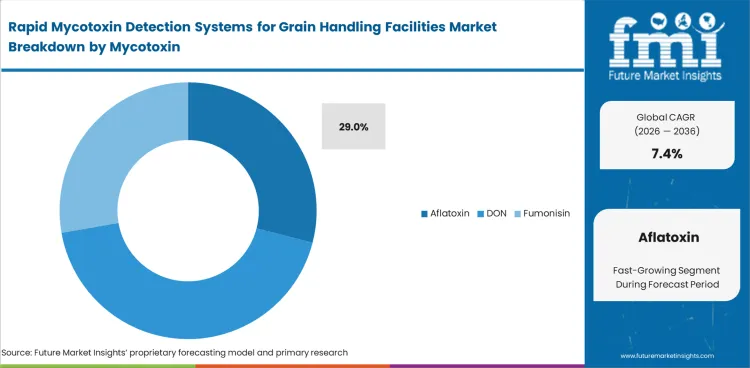
Commercial grain handling rarely treats all toxins with equal urgency at the receiving stage. Aflatoxin remains the issue most likely to trigger immediate concern in many grain chains because one suspect result can alter where a load is stored, whether it is blended, and how confidently it can move toward food or feed use. Aflatoxin is projected to secure 29% share in 2026, and that lead comes from how often grain handlers place it at the top of first-pass screening priorities. Result speed matters here, but so does familiarity. Many facilities already organize training, controls, and documentation around aflatoxin risk, which makes the buying decision more straightforward than it is for broader toxin menus. Another point matters as well. Sites do not always move into multi-toxin programs as soon as a broader reader becomes available. Many move in stages, starting with the toxin category that has the clearest commercial consequence at intake and building outward later through food safety testing and food authenticity control routines.
- Crop exposure: Aflatoxin remains closely tied to intake decisions in corn-heavy grain flows where one result can alter release or routing choices very quickly.
- Release pressure: Grain handlers prioritize toxin categories that carry immediate handling consequences. Test menus that do not align with those first decisions often receive lower spending priority.
- Confirmatory burden: First-pass screening still needs a clear escalation path when a result is close to tolerance. Weak escalation planning can slow dispute handling and lot clearance.
Rapid Mycotoxin Detection Systems for Grain Handling Facilities Market Analysis by Deployment
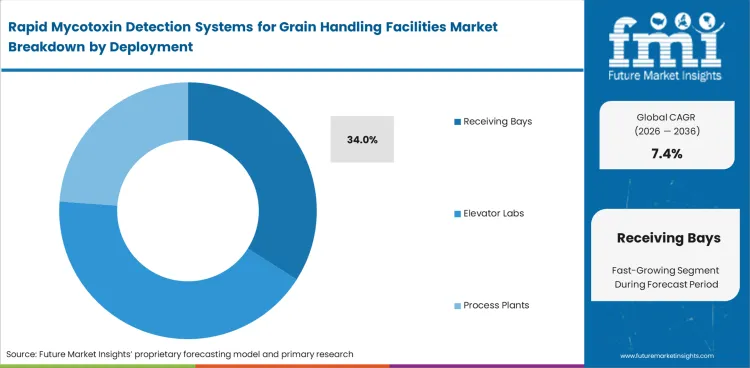
First-contact testing carries more weight than many grain handlers gave it a few years ago. Once a questionable lot passes beyond the receiving point, every downstream action becomes harder to unwind, from storage assignment to blending discipline and outbound documentation. Receiving bays are likely to represent 34% of total market share in 2026 because they give quality teams the earliest practical point to separate, hold, or reroute grain before more value has been added to the lot. Deployment choice is less about finding physical space for a device and more about placing the test where it prevents the next operating mistake. That is why elevator labs and process plants continue to matter, yet the leading deployment position stays with the intake zone. Teams that underinvest here often pay twice, first in slower lot sorting and then in extra internal handling once suspect grain has already moved deeper into the site. Broader activity in agricultural testing is reinforcing the same point: earlier screening protects more downstream activity.
- Intake timing: Testing at the earliest practical step helps managers act before storage, blending, or truck release decisions are locked in.
- Bin control: Earlier detection reduces the chance of placing a suspect lot into storage locations that complicate later segregation work.
- Turnaround pressure: Truck flow and unloading pace matter during busy intake windows. Delayed screening can move the bottleneck from the lab to the yard.
Rapid Mycotoxin Detection Systems for Grain Handling Facilities Market Analysis by Mode
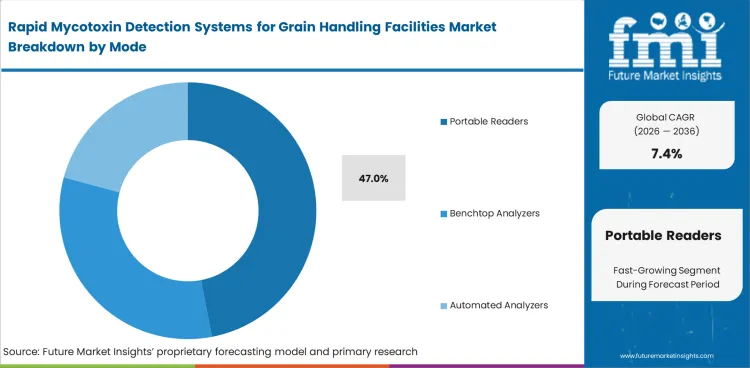
Audit-ready results are becoming just as important as raw testing speed, and that is why portable readers lead mode selection rather than simple visual strips alone. Portable readers are expected to contribute 47% share in 2026 because they give grain handlers a workable balance between fast screening, recorded output, and limited space needs near active receiving or handling points. Buyers choosing portable formats are usually trying to avoid a false trade-off between mobility and documentation. A reader that can move with the workflow, retain results, and support operator consistency reduces rechecking and makes internal review easier when lots are challenged. Benchtop analyzers still have a role where central lab space is available and higher batch control is needed, yet many country elevators and terminals do not want every toxin decision tied to a fixed testing location. Activity in adjacent food testing and animal feed categories points to the same buyer preference for documented results that travel with day-to-day operations.
- Audit trail: Portable readers help facilities retain clearer records for lot-level checks, internal review, and customer-facing documentation.
- Operator fit: Mobility matters when testing has to happen close to intake activity without adding a second room, extra wiring, or a dedicated bench routine.
- Power access: Benchtop-heavy setups can work well in established labs, yet they are less attractive when space and operator time are already constrained.
Rapid Mycotoxin Detection Systems for Grain Handling Facilities Market Analysis by End User
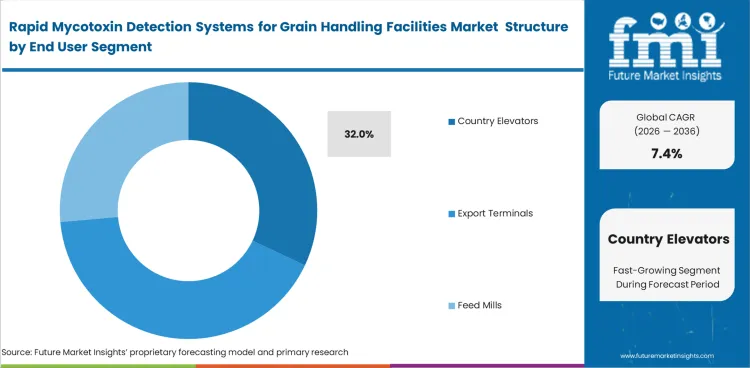
Country elevators sit closest to the daily uncertainty of inbound grain quality, and that operating position explains why they remain the largest end-user group. Market estimates place country elevators at 32% share in 2026 because they must decide quickly whether a lot can move into normal storage, needs segregation, or should be redirected before it affects other grain already on site. Export terminals and feed mills also buy these systems for clear reasons, but country elevators face the decision earlier and more often. Speed at this level is not a convenience item. It is part of keeping grain movement orderly when staffing is lean and storage assignments cannot be revised repeatedly. A large terminal can absorb more process steps than an independent elevator usually can. That difference keeps early-stage handlers at the center of demand for feed grain and commercial grain mills related screening tools.
- Lot segregation: Country elevators need screening that helps separate grain before it affects larger storage positions or downstream contractual use.
- Staffing reality: Lean teams tend to favor fast methods that can be repeated without building a full lab routine around each load.
- Margin protection: One delayed or poorly documented intake decision can affect handling efficiency, storage use, and the quality standing of later outbound grain.
Rapid Mycotoxin Detection Systems for Grain Handling Facilities Market Drivers, Restraints, and Opportunities
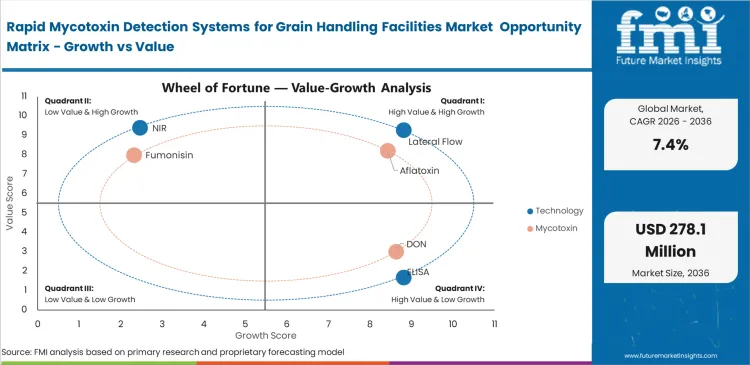
Receiving-point decisions are becoming harder to postpone. Grain handlers have to decide earlier whether a lot moves into standard storage, requires separate handling, or needs more review before release. Faster screening supports that decision because waiting for a slower testing cycle can hold trucks, reduce unloading efficiency, and widen the chance of mixing uncertain grain with clean volume. Export-linked grain channels add another layer, since documentation and buyer confidence depend on showing that suspect lots were identified before they entered broader handling flows. Industry outlook is tied less to laboratory sophistication alone and more to how much operating control a site wants to keep over intake, segregation, and dispatch timing.
Method choice still faces a real barrier, and it is not simply the price of the kit or reader. Validation burden across grain types, toxin targets, sampling routines, and operator discipline can slow adoption even when a facility clearly needs faster testing. Many sites understand the value of rapid screening but hesitate when they are unsure how the method will perform across changing crop origins or mixed lot conditions. Training can ease part of that burden, and stronger reader guidance helps, yet no system fully removes the need for careful sample preparation and internal test discipline. Facilities that underestimate this step often add repeat checks and lose the time advantage they were hoping to gain.
Opportunities in the Rapid Mycotoxin Detection Systems for Grain Handling Facilities Market
- Multi-toxin panels: Broader test menus become more attractive when facilities want one intake workflow to cover multiple commercial risks instead of adding a separate check for every toxin category. Export terminals and larger feed mills are well placed to capture this benefit through broader lot-screening routines.
- Connected records: Readers that store and organize result histories can reduce paperwork burden and improve traceability during customer review. Sites building closer links with food safety testing and feed binders control steps stand to benefit most.
- Service reach: Suppliers with stronger local training, distributor support, and consumable availability can win share in regions where facilities need method confidence before they expand regular use. Country elevators and independent mills often respond first to that type of support.
Regional Analysis
Key Facts About Countries
- Expanding grain quality controls place India at the fastest growth pace, with a CAGR of 8.8%. Increasing formalization of intake testing is driving rapid adoption.
- Strong export-linked grain movement supports Brazil’s growth at a CAGR of 8.2%. Early toxin screening helps improve shipment readiness and reduce routing delays.
- Large-scale grain handling operations keep China on a steady growth path, with a CAGR of 7.9%. Facilities are adopting rapid systems to enable faster intake decisions.
- Export-driven grain systems position Argentina at a CAGR of 7.8%. Early detection helps maintain quality control before storage and shipment.
- Established quality frameworks support the European Union market, growing at a CAGR of 7.2%. Demand is driven by structured documentation and compliance requirements.
- Mature grain handling infrastructure keeps the United States at a CAGR of 6.8%. Growth is driven by replacement demand and improved documentation systems.
- Disciplined grain handling and export orientation support Canada’s steady growth at a CAGR of 6.7%. Reliable and repeatable screening remains a key requirement.
Based on the regional analysis, the Rapid Mycotoxin Detection Systems for Grain Handling Facilities market is segmented into Americas, Europe, and Asia Pacific across 40 plus countries.
.webp "Top Country Growth Comparison Rapid Mycotoxin Detection Systems For Grain Handling Facilities Market Cagr (2026 2036)")
| Country | CAGR (2026 to 2036) |
|---|---|
| India | 8.8% |
| Brazil | 8.2% |
| China | 7.9% |
| Argentina | 7.8% |
| European Union | 7.2% |
| United States | 6.8% |
| Canada | 6.7% |
Source: Future Market Insights (FMI) analysis, based on proprietary forecasting model and primary research
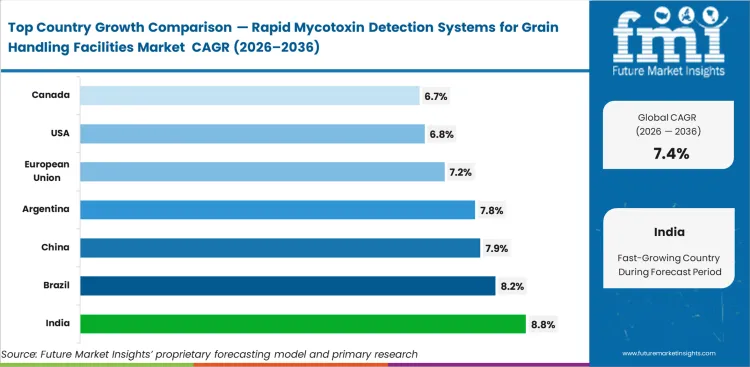
Americas Rapid Mycotoxin Detection Systems for Grain Handling Facilities Market Analysis
Grain handling across the Americas keeps rapid mycotoxin screening close to live operating decisions. North America brings a mature base of elevator, terminal, and feed operations where test speed now matters as much as method familiarity, while South America adds stronger urgency around export-linked lot control before storage and dispatch steps become harder to reverse. Vendor comparison in this region usually comes down to matrix fit, reader usability, record clarity, and the dependability of local strip supply. Screening tools that work well inside animal feed and feed detoxifiers aligned grain chains are gaining more room because grain handlers want quicker toxin visibility without slowing unloading or internal movement.
- United States: Mature grain handling practice keeps the United States from leading the country ranking by pace, but industry outlook remains positive because many facilities are still replacing older methods with reader-based systems that improve documentation and result consistency. Rapid mycotoxin detection systems in the United States are projected to record 6.8% CAGR through 2036. Operating logic is clear at site level. A test has value only when it helps teams decide whether grain can move into storage, blending, or shipment without creating another delay. Large elevators and feed mills therefore favor validated methods that fit existing intake routines, especially when broader toxin coverage can be added without making operator workflows heavier.
- Canada: Licensed elevator networks, export-focused grain handling, and disciplined quality routines keep Canada commercially relevant even with a slightly lower pace than faster-rising markets. Canada is likely to post 6.7% CAGR in this sector by 2036. Grain handlers here place steady weight on repeatability because grain often moves through tightly managed handling steps tied to quality expectations and clear lot records. Reader-supported systems suit that requirement better than loosely documented screening methods. Industry movement in Canada is not being shaped by first-time adoption at scale. Refinement of current testing practice, stronger recordkeeping, and cleaner repeat use remain the main factors holding the country on a positive trend.
- Brazil: Export-facing grain movement gives Brazil a stronger case for earlier toxin screening than many mature handling systems. Timing matters because once a questionable lot has moved beyond intake, rerouting becomes more complicated and holding costs become harder to absorb during active shipment periods. Industry outlook for rapid mycotoxin detection systems in Brazil points to 8.2% CAGR through 2036. Grain handlers with high seasonal intake place more value on tools that keep screening close to the receiving point while still producing defensible records for later review. Faster uptake here is tied to commercial discipline at intake, especially where storage, blending, and shipment readiness all depend on getting a reliable first-pass result early.
- Argentina: Export-linked grain channels keep intake discipline high in Argentina, and that operating reality supports regular use of rapid testing rather than occasional checking. Rapid mycotoxin detection systems in Argentina are forecast to register 7.8% CAGR over the study period. Grain handlers need methods that support earlier lot decisions because once grain enters normal storage or blending, the cost of correcting a questionable call rises quickly. Reader mobility also matters in this country because many sites want dependable screening without turning each result into a separate lab event. Better handling at this step can ease internal movement, reduce avoidable interruptions, and improve shipment readiness when grain quality is under closer review.
FMI's report includes Mexico and the Caribbean. Grain handlers in these areas add further regional depth because export channels, feed use, and improving internal quality routines are widening the case for earlier toxin checks. Adoption remains uneven, yet facilities that formalize intake testing usually gain better control over lot routing and result documentation before grain moves deeper into storage or processing.
Europe Rapid Mycotoxin Detection Systems for Grain Handling Facilities Market Analysis
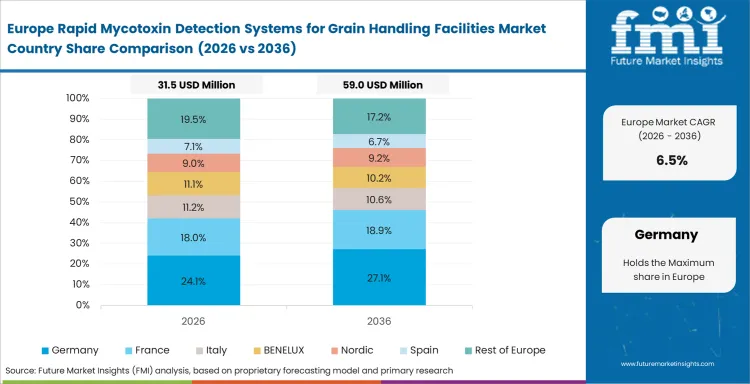
Europe remains a disciplined testing environment where grain quality control is closely tied to storage, milling, feed use, and internal review routines. Grain handlers in this region place clear value on documented results, operator consistency, and methods that can fit established quality procedures without turning first-pass screening into a heavy bench exercise. Industry outlook is supported by sites that want quicker visibility on suspect lots while keeping review discipline intact. Reader- and strip-based systems aligned with commercial grain mills and food safety testing related workflows are therefore gaining more ground, especially where one intake decision can influence storage control, blending discipline, and later processing steps.
- European Union: Documented grain quality routines, milling discipline, and feed-related control requirements keep rapid toxin screening relevant across the European Union. European Union demand for rapid mycotoxin detection systems is expected to register a CAGR of 7.2% by 2036. Buyers in this region are not simply looking for faster chemistry. Day-to-day value comes from methods that fit cleanly into recorded operating steps and support internal review when a lot needs to be held, segregated, or escalated for follow-up action. Multi-toxin interest is also inclining because one intake workflow that covers more than one exposure risk can reduce duplicate handling effort. Sites that get this balance right improve test efficiency without weakening control discipline.
FMI's report includes Benelux and Nordic regions. Grain handling facilities in these areas serve as important hubs for storage, feed use, milling activity, and cross-border grain movement, making documented first-pass toxin screening more relevant than a simple spot-check routine. Eastern Europe is also part of the wider study, where crop mix, storage conditions, and export orientation create varied but meaningful room for rapid methods.
Asia Pacific Rapid Mycotoxin Detection Systems for Grain Handling Facilities Market Analysis
Asia Pacific carries the fastest overall pace in this study because grain intake controls are becoming more formal across large crop systems, mixed testing maturity levels, and wider feed and food-use channels. A practical question sits at the center of vendor selection across this region: how much screening can be moved closer to intake without slowing throughput or stretching already limited lab capacity. Portable readers and simpler workflows answer that question better in many locations than fixed, heavier testing setups. Industry direction is also being supported by broader activity in food testing and agricultural testing, where routine onsite screening is becoming more acceptable as grain handling and internal control routines become more formal.
- China: Large grain flows, expanding feed use, and wider attention to lot-level quality control are keeping China on an upward path in this market. China is expected to record 7.9% CAGR during the forecast period. Grain handlers usually look for a workable balance between testing speed, method repeatability, and clear result capture because grain often moves through multiple commercial steps before final use. Portable readers and standardized strips fit that requirement well when teams need earlier decisions without large lab expansion. Better intake testing in China improves confidence before grain is committed to storage, milling, or feed channels, and that practical advantage is supporting broader use.
- India: Grain handling activity in India is becoming more supportive of rapid toxin screening because earlier grain checks help reduce uncertainty at intake and improve control over routing decisions in working storage and handling settings. Rapid mycotoxin detection systems in India are set to advance at a CAGR of 8.8% through 2036. Many sites prefer tools that can be deployed with limited bench burden while still producing documented output, especially where formal testing routines are widening faster than lab build-out. A clear operational advantage appears when questionable lots can be isolated sooner instead of moving deeper into the handling chain. Industry outlook in India therefore remains stronger than in most other countries covered in this study.
FMI's report includes Southeast Asia and Oceania. Countries such as Thailand, Vietnam, Indonesia, and Australia add important regional context because grain import dependence, feed use, storage practice, and export discipline do not move in the same direction across these markets. Wider adoption will depend on how quickly facilities can pair rapid methods with dependable training, result recording, and method confidence at intake.
Competitive Aligners for Market Players
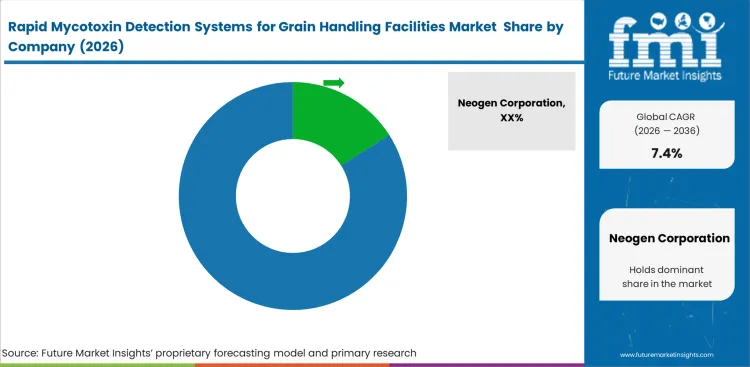
Competition in this category is moderate rather than widely open because grain handlers do not choose a system on price alone. Neogen Corporation, Charm Sciences, Romer Labs, Waters Corporation under VICAM, EnviroLogix, ProGnosis Biotech, and R-Biopharm AG are judged on how well their methods fit grain matrices, how clearly readers document results, and how easily operators can repeat the workflow during busy receiving periods. Grain handlers usually compare matrix coverage, reader usability, training support, and consumable availability before they compare advanced instrument features. A supplier can lose ground quickly if a method looks strong on paper but adds retests or slows intake decisions in practice.
Incumbents hold an advantage because validation support and method familiarity are hard to build quickly. Facilities that already know how a vendor’s strips, readers, and controls behave inside corn, wheat, or mixed grain flows are slow to retest the entire workflow unless a challenger offers a clear operating gain. Service reach and consistent supply are therefore just as important as assay performance. Vendors that connect their offer to adjacent needs in food testing or mycotoxin testing can widen account depth, yet new entrants still need credibility at the intake point before broader expansion becomes realistic.
Large grain handlers do push back against single-vendor dependence, especially when one supplier controls both reader logic and recurring strip supply. Even so, switching remains slower than it appears because internal validation files, operator habits, and audit records all favor continuity. Through 2036, competition is likely to widen through broader toxin menus, stronger software-linked traceability, and better local service coverage rather than through abrupt displacement of current leaders. Grain handlers want options, but they do not want to rebuild a working test routine unless the gain shows up clearly in handling speed, documentation, or reduced retesting.
Key Players in Rapid Mycotoxin Detection Systems for Grain Handling Facilities Market
- Neogen Corporation
- Charm Sciences, Inc.
- Romer Labs
- Waters Corporation
- EnviroLogix, Inc.
- ProGnosis Biotech
- R-Biopharm AG
Scope of the Report
| Metric | Value |
|---|---|
| Quantitative Units | USD 126.8 million to USD 258.9 million, at a CAGR of 7.4% |
| Market Definition | Rapid mycotoxin detection systems for grain handling facilities include fast onsite and near-site screening tools used to test grain lots during receiving, storage, blending, processing, or dispatch. Scope focuses on systems that support quick handling decisions inside commercial grain operations rather than central confirmatory lab work. |
| Technology Segmentation | Lateral Flow, ELISA, Fluorometric, NIR, Biosensors |
| Mycotoxin Segmentation | Aflatoxin, DON, Fumonisin, Zearalenone, Ochratoxin, Multi-toxin |
| Deployment Segmentation | Receiving Bays, Elevator Labs, Export Terminals, Process Plants, Mobile QA |
| Mode Segmentation | Portable Readers, Benchtop Analyzers, Automated Analyzers, Connected Readers |
| End User Segmentation | Country Elevators, Export Terminals, Feed Mills, Flour Mills, Inspection Labs |
| Regions Covered | Americas, Europe, Asia Pacific |
| Countries Covered | United States, Canada, Brazil, Argentina, European Union, China, India, and 40 plus countries |
| Key Companies Profiled | Neogen Corporation, Charm Sciences, Inc., Romer Labs, Waters Corporation, EnviroLogix, Inc., ProGnosis Biotech, R-Biopharm AG |
| Forecast Period | 2026 to 2036 |
| Approach | FMI built the baseline from commercial grain handling points, testing frequency, and installed use patterns for rapid readers and strips. Interviews covered facility-level quality managers and grain handling decision makers responsible for intake control and lot release. Forecasts were checked against operating adoption patterns, replacement demand, and country-specific grain handling conditions. |
Source: Future Market Insights (FMI) analysis, based on proprietary forecasting model and primary research
Rapid Mycotoxin Detection Systems for Grain Handling Facilities Market Analysis by Segments
Technology:
- Lateral Flow
- ELISA
- Fluorometric
- NIR
- Biosensors
Mycotoxin:
- Aflatoxin
- DON
- Fumonisin
- Zearalenone
- Ochratoxin
- Multi-toxin
Deployment:
- Receiving Bays
- Elevator Labs
- Export Terminals
- Process Plants
- Mobile QA
Mode:
- Portable Readers
- Benchtop Analyzers
- Automated Analyzers
- Connected Readers
End User:
- Country Elevators
- Export Terminals
- Feed Mills
- Flour Mills
- Inspection Labs
Region:
- Americas
- United States
- Canada
- Brazil
- Argentina
- Europe
- European Union
- Benelux
- Nordic
- Eastern Europe
- Asia Pacific
- China
- India
- Southeast Asia
- Oceania
Bibliography
- USA. Food and Drug Administration. (2025, September). CP 7307.001, Mycotoxins in Domestic and Imported Human Foods. USA Food and Drug Administration.
- USA Department of Agriculture, Agricultural Marketing Service. (2026, January 30). FGIS Performance Verified Aflatoxin Test Kits. USA Department of Agriculture.
- Canadian Grain Commission. (2025, May 1). Grain Elevators in Canada reports. Canadian Grain Commission.
- Canadian Food Inspection Agency. (2024, July 03). Compositional and safety standards for livestock feeds. Canadian Food Inspection Agency.
- Food Safety and Standards Authority of India. (2025, April). Food Safety and Standards (Contaminants, Toxins and Residues) Regulations, 2011 (Version VIII). Food Safety and Standards Authority of India.
This bibliography is provided for reader reference. The full FMI report contains the complete reference list with primary source documentation.
This Report Addresses
- Market intelligence to support decision making across lateral flow strips, portable readers, benchtop analyzers, and connected grain-screening tools
- Market size estimation and 10-year revenue forecasts from 2026 to 2036, supported by facility-level testing frequency, reader placement logic, and recurring consumable use
- Opportunity mapping across technology, mycotoxin, deployment, mode, and end-user categories with emphasis on intake-stage screening and lot-release control
- Segment and regional revenue forecasts covering lateral flow, aflatoxin, receiving bays, portable readers, and country elevators across export-linked and domestically handled grain channels
- Competition assessment covering matrix fit, reader documentation, operator ease, validation support, and recurring consumable availability
- Product and capability tracking across rapid strips, reader-supported workflows, multi-toxin screening, lot-level result recording, and intake-zone deployment practices
- Market access analysis covering grain quality control routines, intake-stage testing discipline, export documentation needs, and method-validation requirements inside handling sites
- Market report delivery in PDF, Excel, PPT, and interactive dashboard formats for executive planning, quality control design, and operating benchmark use
Frequently Asked Questions
How big is this market in 2026?Why does Canada remain important in this market?
Rapid Mycotoxin Detection Systems for Grain Handling Facilities Market is valued at USD 126.8 million in 2026. This is a focused testing category used in grain handling, not the full food lab testing business.
What could the market reach by 2036?
Valuation is expected to reach USD 258.9 million by 2036. That points to wider use of rapid screening in day-to-day grain intake and lot control.
What CAGR is projected for 2026 to 2036?
Current outlook points to a CAGR of 7.4% from 2026 to 2036. Pace stays healthy because grain handlers want faster toxin checks before grain moves deeper into storage or dispatch.
Which technology segment leads?
Lateral flow leads the technology segment. It is expected to account for 41% share in 2026 because it is quick to use, easier to train on, and better suited to busy intake points.
Which mycotoxin segment leads?
Aflatoxin leads the mycotoxin segment. It is projected to secure 29% share in 2026 because many grain handlers treat it as a first-check issue at intake.
Which deployment segment leads?
Receiving bays lead deployment. They are likely to represent 34% share in 2026 because early screening helps teams act before grain is mixed, stored, or rerouted.
Which mode leads the market?
Portable readers lead by mode. They are expected to contribute 47% share in 2026 because they combine faster testing with recorded results and do not need large fixed lab space.
Which end user leads the market?
Country elevators lead the end-user segment. They are expected to account for 32% share in 2026 because they face early lot decisions with lean staffing and limited room for delay.
What is pushing this market forward?
Earlier lot-control decisions are a main reason. Grain handlers want toxin results before a load is stored, blended, or sent onward, because later correction is harder and more costly.
What is the main restraint?
Validation remains the biggest hurdle. A method has to work well across grain types, toxin targets, and real sample conditions, or teams lose confidence in daily use.
Which country has the fastest outlook?
India has the fastest country outlook in this study. It is expected to post 8.8% CAGR through 2036 because formal grain testing is widening and rapid methods are moving closer to intake routines.
Why does intake-stage testing matter so much?
Intake is the point where grain handlers still have room to act quickly. Once a questionable lot moves into storage or blending, fixing the decision becomes more difficult.
Why are portable readers becoming more common?
Portable readers help teams keep records without building a large lab around each test. They also fit better near working intake areas where speed and documentation both matters.
Why does lateral flow stay in the lead?
Lateral flow fits real operating pressure well. It gives teams a fast first answer and does not add much complexity at busy receiving points.
Why is aflatoxin still the main toxin focus?
Aflatoxin often carries the clearest commercial risk at intake. Many facilities already center training, controls, and review steps around it, so it stays high on the testing list.
Why do receiving bays lead deployment?
Receiving bays are the first practical place to hold, separate, or reroute a suspect lot. Earlier testing helps prevent extra handling work later in the process.
Why do country elevators lead the end-user mix?
Country elevators are usually the first sites making storage and segregation calls on inbound grain. Fast screening matters more there because decisions have to be made quickly and with limited staff.
Why is the United States not the fastest-growing country?
United States activity is already built on a mature installed base. Much of the added value comes from replacing older methods and adding better documentation rather than from first-time rollout.
Why does Canada remain important in this market?
Canada has disciplined grain handling routines and export-linked quality control needs. That keeps rapid testing relevant even with a slower pace than some faster-rising countries.
Why is Brazil one of the faster-rising markets?
Brazil benefits from strong grain movement and export-linked handling needs. Early screening helps reduce uncertainty before grain reaches storage and shipment stages.
Why is Argentina part of the faster group?
Argentina works within export-driven grain channels where early lot discipline matters. Reliable rapid testing helps teams act before suspect grain affects later handling and shipment readiness.
Why does the European Union matter in this market?
European grain handling puts strong weight on documented control steps. Rapid toxin screening fits well when teams need quicker first-pass checks without losing internal review quality.
What supports China’s outlook?
China combines large grain flows with wider lot-level quality control needs. Rapid systems are useful there because teams want quicker decisions without major lab expansion.
What is included in this market?
Included products are rapid strips, readers, benchtop screening analyzers, controls, and result-capture tools used in grain handling. Central confirmatory lab systems and general grain quality tools are outside this scope.
Preview the report firsthand - request a free sample
Get SampleGet the brochure for pricing and purchase details.
Get PDFTable of Content
- Executive Summary
- Global Market Outlook
- Demand-side Trends
- Supply-side Trends
- Technology Roadmap Analysis
- Analysis and Recommendations
- Market Overview
- Market Coverage / Taxonomy
- Market Definition / Scope / Limitations
- Research Methodology
- Chapter Orientation
- Analytical Lens and Working Hypotheses
- Market Structure, Signals, and Trend Drivers
- Benchmarking and Cross-market Comparability
- Market Sizing, Forecasting, and Opportunity Mapping
- Research Design and Evidence Framework
- Desk Research Programme (Secondary Evidence)
- Company Annual and Sustainability Reports
- Peer-reviewed Journals and Academic Literature
- Corporate Websites, Product Literature, and Technical Notes
- Earnings Decks and Investor Briefings
- Statutory Filings and Regulatory Disclosures
- Technical White Papers and Standards Notes
- Trade Journals, Industry Magazines, and Analyst Briefs
- Conference Proceedings, Webinars, and Seminar Materials
- Government Statistics Portals and Public Data Releases
- Press Releases and Reputable Media Coverage
- Specialist Newsletters and Curated Briefings
- Sector Databases and Reference Repositories
- FMI Internal Proprietary Databases and Historical Market Datasets
- Subscription Datasets and Paid Sources
- Social Channels, Communities, and Digital Listening Inputs
- Additional Desk Sources
- Expert Input and Fieldwork (Primary Evidence)
- Primary Modes
- Qualitative Interviews and Expert Elicitation
- Quantitative Surveys and Structured Data Capture
- Blended Approach
- Why Primary Evidence is Used
- Field Techniques
- Interviews
- Surveys
- Focus Groups
- Observational and In-context Research
- Social and Community Interactions
- Stakeholder Universe Engaged
- C-suite Leaders
- Board Members
- Presidents and Vice Presidents
- R&D and Innovation Heads
- Technical Specialists
- Domain Subject-matter Experts
- Scientists
- Physicians and Other Healthcare Professionals
- Governance, Ethics, and Data Stewardship
- Research Ethics
- Data Integrity and Handling
- Primary Modes
- Tooling, Models, and Reference Databases
- Desk Research Programme (Secondary Evidence)
- Data Engineering and Model Build
- Data Acquisition and Ingestion
- Cleaning, Normalisation, and Verification
- Synthesis, Triangulation, and Analysis
- Quality Assurance and Audit Trail
- Market Background
- Market Dynamics
- Drivers
- Restraints
- Opportunity
- Trends
- Scenario Forecast
- Demand in Optimistic Scenario
- Demand in Likely Scenario
- Demand in Conservative Scenario
- Opportunity Map Analysis
- Product Life Cycle Analysis
- Supply Chain Analysis
- Investment Feasibility Matrix
- Value Chain Analysis
- PESTLE and Porter’s Analysis
- Regulatory Landscape
- Regional Parent Market Outlook
- Production and Consumption Statistics
- Import and Export Statistics
- Market Dynamics
- Global Market Analysis 2021 to 2025 and Forecast, 2026 to 2036
- Historical Market Size Value (USD Million) Analysis, 2021 to 2025
- Current and Future Market Size Value (USD Million) Projections, 2026 to 2036
- Y-o-Y Growth Trend Analysis
- Absolute $ Opportunity Analysis
- Global Market Pricing Analysis 2021 to 2025 and Forecast 2026 to 2036
- Global Market Analysis 2021 to 2025 and Forecast 2026 to 2036, By Technology
- Introduction / Key Findings
- Historical Market Size Value (USD Million) Analysis By Technology , 2021 to 2025
- Current and Future Market Size Value (USD Million) Analysis and Forecast By Technology , 2026 to 2036
- Lateral Flow
- ELISA
- NIR
- Lateral Flow
- Y-o-Y Growth Trend Analysis By Technology , 2021 to 2025
- Absolute $ Opportunity Analysis By Technology , 2026 to 2036
- Global Market Analysis 2021 to 2025 and Forecast 2026 to 2036, By Mycotoxin
- Introduction / Key Findings
- Historical Market Size Value (USD Million) Analysis By Mycotoxin, 2021 to 2025
- Current and Future Market Size Value (USD Million) Analysis and Forecast By Mycotoxin, 2026 to 2036
- Aflatoxin
- DON
- Fumonisin
- Aflatoxin
- Y-o-Y Growth Trend Analysis By Mycotoxin, 2021 to 2025
- Absolute $ Opportunity Analysis By Mycotoxin, 2026 to 2036
- Global Market Analysis 2021 to 2025 and Forecast 2026 to 2036, By Deployment
- Introduction / Key Findings
- Historical Market Size Value (USD Million) Analysis By Deployment, 2021 to 2025
- Current and Future Market Size Value (USD Million) Analysis and Forecast By Deployment, 2026 to 2036
- Receiving Bays
- Elevator Labs
- Process Plants
- Receiving Bays
- Y-o-Y Growth Trend Analysis By Deployment, 2021 to 2025
- Absolute $ Opportunity Analysis By Deployment, 2026 to 2036
- Global Market Analysis 2021 to 2025 and Forecast 2026 to 2036, By Mode
- Introduction / Key Findings
- Historical Market Size Value (USD Million) Analysis By Mode, 2021 to 2025
- Current and Future Market Size Value (USD Million) Analysis and Forecast By Mode, 2026 to 2036
- Portable Readers
- Benchtop Analyzers
- Automated Analyzers
- Portable Readers
- Y-o-Y Growth Trend Analysis By Mode, 2021 to 2025
- Absolute $ Opportunity Analysis By Mode, 2026 to 2036
- Global Market Analysis 2021 to 2025 and Forecast 2026 to 2036, By End User
- Introduction / Key Findings
- Historical Market Size Value (USD Million) Analysis By End User, 2021 to 2025
- Current and Future Market Size Value (USD Million) Analysis and Forecast By End User, 2026 to 2036
- Country Elevators
- Export Terminals
- Feed Mills
- Country Elevators
- Y-o-Y Growth Trend Analysis By End User, 2021 to 2025
- Absolute $ Opportunity Analysis By End User, 2026 to 2036
- Global Market Analysis 2021 to 2025 and Forecast 2026 to 2036, By Region
- Introduction
- Historical Market Size Value (USD Million) Analysis By Region, 2021 to 2025
- Current Market Size Value (USD Million) Analysis and Forecast By Region, 2026 to 2036
- North America
- Latin America
- Western Europe
- Eastern Europe
- East Asia
- South Asia and Pacific
- Middle East & Africa
- Market Attractiveness Analysis By Region
- North America Market Analysis 2021 to 2025 and Forecast 2026 to 2036, By Country
- Historical Market Size Value (USD Million) Trend Analysis By Market Taxonomy, 2021 to 2025
- Market Size Value (USD Million) Forecast By Market Taxonomy, 2026 to 2036
- By Country
- USA
- Canada
- Mexico
- By Technology
- By Mycotoxin
- By Deployment
- By Mode
- By End User
- By Country
- Market Attractiveness Analysis
- By Country
- By Technology
- By Mycotoxin
- By Deployment
- By Mode
- By End User
- Key Takeaways
- Latin America Market Analysis 2021 to 2025 and Forecast 2026 to 2036, By Country
- Historical Market Size Value (USD Million) Trend Analysis By Market Taxonomy, 2021 to 2025
- Market Size Value (USD Million) Forecast By Market Taxonomy, 2026 to 2036
- By Country
- Brazil
- Chile
- Rest of Latin America
- By Technology
- By Mycotoxin
- By Deployment
- By Mode
- By End User
- By Country
- Market Attractiveness Analysis
- By Country
- By Technology
- By Mycotoxin
- By Deployment
- By Mode
- By End User
- Key Takeaways
- Western Europe Market Analysis 2021 to 2025 and Forecast 2026 to 2036, By Country
- Historical Market Size Value (USD Million) Trend Analysis By Market Taxonomy, 2021 to 2025
- Market Size Value (USD Million) Forecast By Market Taxonomy, 2026 to 2036
- By Country
- Germany
- UK
- Italy
- Spain
- France
- Nordic
- BENELUX
- Rest of Western Europe
- By Technology
- By Mycotoxin
- By Deployment
- By Mode
- By End User
- By Country
- Market Attractiveness Analysis
- By Country
- By Technology
- By Mycotoxin
- By Deployment
- By Mode
- By End User
- Key Takeaways
- Eastern Europe Market Analysis 2021 to 2025 and Forecast 2026 to 2036, By Country
- Historical Market Size Value (USD Million) Trend Analysis By Market Taxonomy, 2021 to 2025
- Market Size Value (USD Million) Forecast By Market Taxonomy, 2026 to 2036
- By Country
- Russia
- Poland
- Hungary
- Balkan & Baltic
- Rest of Eastern Europe
- By Technology
- By Mycotoxin
- By Deployment
- By Mode
- By End User
- By Country
- Market Attractiveness Analysis
- By Country
- By Technology
- By Mycotoxin
- By Deployment
- By Mode
- By End User
- Key Takeaways
- East Asia Market Analysis 2021 to 2025 and Forecast 2026 to 2036, By Country
- Historical Market Size Value (USD Million) Trend Analysis By Market Taxonomy, 2021 to 2025
- Market Size Value (USD Million) Forecast By Market Taxonomy, 2026 to 2036
- By Country
- China
- Japan
- South Korea
- By Technology
- By Mycotoxin
- By Deployment
- By Mode
- By End User
- By Country
- Market Attractiveness Analysis
- By Country
- By Technology
- By Mycotoxin
- By Deployment
- By Mode
- By End User
- Key Takeaways
- South Asia and Pacific Market Analysis 2021 to 2025 and Forecast 2026 to 2036, By Country
- Historical Market Size Value (USD Million) Trend Analysis By Market Taxonomy, 2021 to 2025
- Market Size Value (USD Million) Forecast By Market Taxonomy, 2026 to 2036
- By Country
- India
- ASEAN
- Australia & New Zealand
- Rest of South Asia and Pacific
- By Technology
- By Mycotoxin
- By Deployment
- By Mode
- By End User
- By Country
- Market Attractiveness Analysis
- By Country
- By Technology
- By Mycotoxin
- By Deployment
- By Mode
- By End User
- Key Takeaways
- Middle East & Africa Market Analysis 2021 to 2025 and Forecast 2026 to 2036, By Country
- Historical Market Size Value (USD Million) Trend Analysis By Market Taxonomy, 2021 to 2025
- Market Size Value (USD Million) Forecast By Market Taxonomy, 2026 to 2036
- By Country
- Kingdom of Saudi Arabia
- Other GCC Countries
- Turkiye
- South Africa
- Other African Union
- Rest of Middle East & Africa
- By Technology
- By Mycotoxin
- By Deployment
- By Mode
- By End User
- By Country
- Market Attractiveness Analysis
- By Country
- By Technology
- By Mycotoxin
- By Deployment
- By Mode
- By End User
- Key Takeaways
- Key Countries Market Analysis
- USA
- Pricing Analysis
- Market Share Analysis, 2025
- By Technology
- By Mycotoxin
- By Deployment
- By Mode
- By End User
- Canada
- Pricing Analysis
- Market Share Analysis, 2025
- By Technology
- By Mycotoxin
- By Deployment
- By Mode
- By End User
- Mexico
- Pricing Analysis
- Market Share Analysis, 2025
- By Technology
- By Mycotoxin
- By Deployment
- By Mode
- By End User
- Brazil
- Pricing Analysis
- Market Share Analysis, 2025
- By Technology
- By Mycotoxin
- By Deployment
- By Mode
- By End User
- Chile
- Pricing Analysis
- Market Share Analysis, 2025
- By Technology
- By Mycotoxin
- By Deployment
- By Mode
- By End User
- Germany
- Pricing Analysis
- Market Share Analysis, 2025
- By Technology
- By Mycotoxin
- By Deployment
- By Mode
- By End User
- UK
- Pricing Analysis
- Market Share Analysis, 2025
- By Technology
- By Mycotoxin
- By Deployment
- By Mode
- By End User
- Italy
- Pricing Analysis
- Market Share Analysis, 2025
- By Technology
- By Mycotoxin
- By Deployment
- By Mode
- By End User
- Spain
- Pricing Analysis
- Market Share Analysis, 2025
- By Technology
- By Mycotoxin
- By Deployment
- By Mode
- By End User
- France
- Pricing Analysis
- Market Share Analysis, 2025
- By Technology
- By Mycotoxin
- By Deployment
- By Mode
- By End User
- India
- Pricing Analysis
- Market Share Analysis, 2025
- By Technology
- By Mycotoxin
- By Deployment
- By Mode
- By End User
- ASEAN
- Pricing Analysis
- Market Share Analysis, 2025
- By Technology
- By Mycotoxin
- By Deployment
- By Mode
- By End User
- Australia & New Zealand
- Pricing Analysis
- Market Share Analysis, 2025
- By Technology
- By Mycotoxin
- By Deployment
- By Mode
- By End User
- China
- Pricing Analysis
- Market Share Analysis, 2025
- By Technology
- By Mycotoxin
- By Deployment
- By Mode
- By End User
- Japan
- Pricing Analysis
- Market Share Analysis, 2025
- By Technology
- By Mycotoxin
- By Deployment
- By Mode
- By End User
- South Korea
- Pricing Analysis
- Market Share Analysis, 2025
- By Technology
- By Mycotoxin
- By Deployment
- By Mode
- By End User
- Russia
- Pricing Analysis
- Market Share Analysis, 2025
- By Technology
- By Mycotoxin
- By Deployment
- By Mode
- By End User
- Poland
- Pricing Analysis
- Market Share Analysis, 2025
- By Technology
- By Mycotoxin
- By Deployment
- By Mode
- By End User
- Hungary
- Pricing Analysis
- Market Share Analysis, 2025
- By Technology
- By Mycotoxin
- By Deployment
- By Mode
- By End User
- Kingdom of Saudi Arabia
- Pricing Analysis
- Market Share Analysis, 2025
- By Technology
- By Mycotoxin
- By Deployment
- By Mode
- By End User
- Turkiye
- Pricing Analysis
- Market Share Analysis, 2025
- By Technology
- By Mycotoxin
- By Deployment
- By Mode
- By End User
- South Africa
- Pricing Analysis
- Market Share Analysis, 2025
- By Technology
- By Mycotoxin
- By Deployment
- By Mode
- By End User
- USA
- Market Structure Analysis
- Competition Dashboard
- Competition Benchmarking
- Market Share Analysis of Top Players
- By Regional
- By Technology
- By Mycotoxin
- By Deployment
- By Mode
- By End User
- Competition Analysis
- Competition Deep Dive
- Neogen Corporation
- Overview
- Product Portfolio
- Profitability by Market Segments (Product/Age /Sales Channel/Region)
- Sales Footprint
- Strategy Overview
- Marketing Strategy
- Product Strategy
- Channel Strategy
- Charm Sciences, Inc.
- Romer Labs
- Waters Corporation
- EnviroLogix, Inc.
- ProGnosis Biotech
- Neogen Corporation
- Competition Deep Dive
- Assumptions & Acronyms Used


