

- Industry Size (2026)
- USD 0.6 Bn
- Forecast (2036)
- USD 1.3 Bn
- CAGR (2026 to 2036)
- 8.0%
Fugitive Emissions Detection and Quantification Test Systems Market Size, Market Forecast and Outlook By FMI
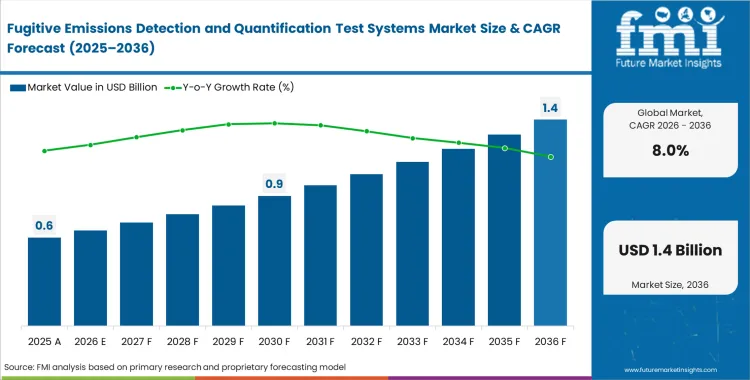
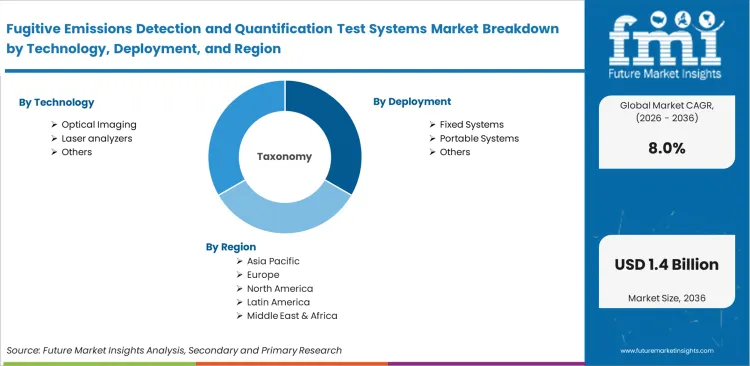
The fugitive emissions detection and quantification test systems market crossed a valuation of USD 0.5 billion in 2025 and is set to reach USD 0.6 billion in 2026, reflecting an 8.0% CAGR. Market value rises to USD 1.3 billion by 2036 as regulators shift from periodic leak checks to continuous mass‑rate measurement, prompting operators to replace legacy survey tools with integrated monitoring platforms.
Methane detection and quantification buyers now assess systems through the lens of regulatory assurance and market access rather than simple leak identification. Compliance structures increasingly require verified mass‑rate outputs, which pushes operators toward multi-sensor architectures and advanced analytics. Producers that postpone these upgrades face escalating penalties and reduced eligibility for premium certified-gas programs. Integration work has become a major cost driver, with software, data fusion, and workflow configuration often accounting for more spending than the hardware itself.
Report Summary of Fugitive Emissions Detection and Quantification Test Systems Market
- Market Snapshot
- The fugitive emissions detection and quantification test systems market is valued at USD 0.5 billion in 2025 and is projected to reach USD 1.3 billion by 2036.
- The industry is expected to expand at 8.0% CAGR from 2026 to 2036, creating an incremental opportunity of USD 0.76 billion over the period.
- This remains a specification-driven industrial instrumentation market where purchase decisions depend on measurement accuracy, field durability, certification status, quantification capability, and compatibility with LDAR and methane MRV reporting requirements.
- Demand is concentrated in methane-intensive applications, particularly across upstream and midstream oil and gas, though chemical plants, utilities, landfills, and selected mining operations also contribute.
- Demand and Growth Drivers
- Demand is rising because the U.S. methane rule now recognizes advanced detection pathways, including alternative test methods and continuous monitoring approaches, which expands the addressable market for fugitive emissions test systems.
- The EU methane regulation is pushing operators toward stricter measurement, monitoring, reporting, and verification practices, which favors systems that can quantify emissions rather than only indicate leaks.
- Adoption of QOGI, laser analyzers, and continuous monitoring platforms is improving because operators increasingly need faster leak localization and defensible quantification, not just basic detection.
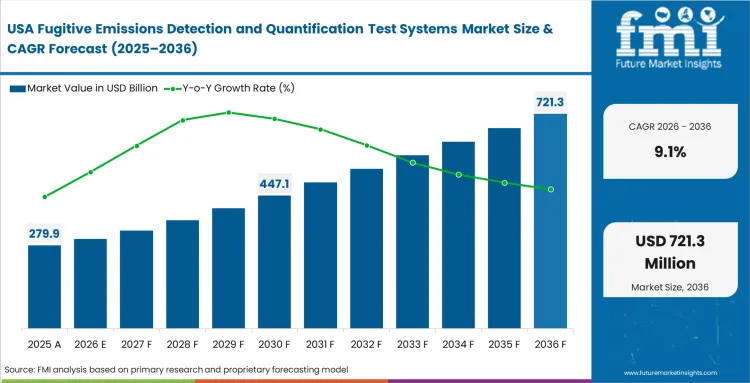
- Among key countries, India leads at 9.8% CAGR, followed by China at 9.5%, the United States at 9.1%, Canada at 8.7%, Germany at 8.4%, the Netherlands at 8.2%, and Saudi Arabia at 7.6%.
- Growth is still moderated by calibration burden, false-positive risk in field conditions, fragmented validation standards, and the fact that many operators are only beginning to move from periodic leak detection toward quantified emissions workflows.
- Product and Segment View
- The market covers OGI cameras, quantitative OGI systems, tunable-laser analyzers, open-path instruments, continuous methane monitoring nodes, mobile survey systems, and controlled-release or verification tools used in fugitive emissions programs.
- These systems are used for leak detection, emissions quantification, localization, mapping, repair verification, and audit-ready reporting across regulated industrial assets.
- Optical imaging is expected to account for 34% share in 2026, supported by the installed base of OGI systems and the gradual shift toward QOGI-enabled measurement.
- Fixed systems are projected to represent 31% share in 2026, reflecting the move from campaign-based inspection toward permanent or semi-permanent monitoring at priority facilities.
- Detection is forecast to command 42% share in 2026 because many buyers still enter the market through compliance-led leak finding before expanding into quantified emissions inventories.
- Oil & gas is likely to contribute 49% share in 2026, as methane regulation and abatement economics are most clearly established in this end-use segment.
- Hardware is estimated to hold 57% share in 2026 since infrared imagers, laser analyzers, and sensor nodes continue to account for the largest share of spending.
- Scope includes methane and hydrocarbon fugitive-emissions test systems, field quantification platforms, and verification tools, but excludes general plant safety detectors, broad CEMS stacks, and non-emissions laboratory instruments outside fugitive workflow use.
- Geography and Competitive Outlook
- India, China, and the United States are the fastest-rising national markets, while Germany and the Netherlands remain stable high-value compliance markets and Saudi Arabia offers expansion potential from a large existing hydrocarbon base.
- Competition is being shaped by OGI-to-QOGI upgrades, continuous monitoring rollouts, measurement-software integration, and tighter proof-of-performance expectations from regulators and large operators.
- Teledyne FLIR, Thermo Fisher Scientific, ABB, Honeywell, Sensirion Connected Solutions, and Baker Hughes are among the main active participants in this space.
- The market remains moderately fragmented, leaving room for specialized technology providers even as large instrumentation firms retain distribution reach and certification advantages.
Continuous monitoring gains momentum once regulators accept automated data streams as a substitute for manual optical surveys. Certified sensor‑array equivalency enables this shift. Equipment providers that secure this status unlock faster purchasing cycles as operators move quickly to lower recurring labor requirements and tighten emissions accounting across deployments that now sit alongside broader portfolios of global gas leak detectors.
India is projected to grow at 9.8% as expanding gas networks and structured methane-measurement pilots bring continuous‑monitoring systems into mainstream operational use. China is expected to progress at 9.5%, supported by broader investment in industrial environmental‑monitoring infrastructure. The United States market is set to expand at 9.1%, reflecting the direct link between enforcement activity and equipment deployment. Canada is likely to post 8.7%, driven by comparable compliance pressure on upstream operators. Germany is forecast at 8.4%, with the Netherlands at 8.2%, both shaped by the EU methane‑management framework and the shift toward verified mass‑quantification requirements. Saudi Arabia is anticipated to reach 7.6% as methane‑management programs scale across a large hydrocarbon asset base, marking a clear distinction between markets adopting full mass‑rate reporting and those still operating on qualitative leak identification.
Segmental Analysis
Fugitive Emissions Detection and Quantification Test Systems Market Analysis by Technology
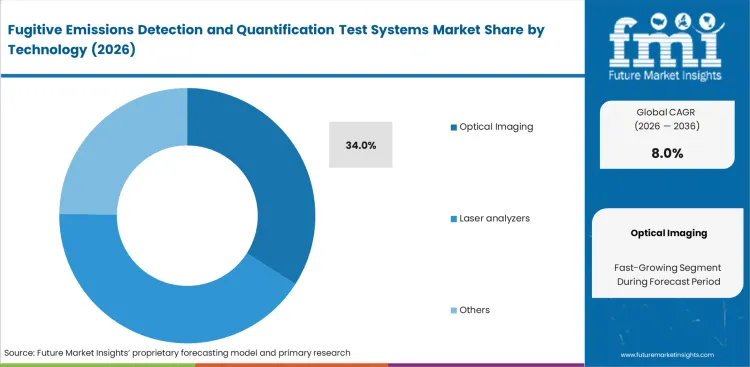
Optical imaging remains the preferred acquisition choice because regulators formally recognize this modality as the baseline standard for leak detection and repair programs. Optical imaging is estimated to hold 34.0% share in 2026, as equipment reliability and audit acceptance continue to support its leading position. Compliance directors often review the distinction between OGI and QOGI when they consider changing inspection workflows. Shifting to an unapproved alternative can expose facilities to costly enforcement risk if a significant release is missed during the audit period. Acquisition managers also tend to underestimate the operator training needed to interpret visual outputs correctly. Facilities without trained thermographers often end up outsourcing continuous emission monitors oversight to specialized contractors at a higher ongoing cost.
- Regulatory validation: Initial purchase decisions depend on whether local environmental agencies explicitly recognize the device as an approved compliance tool. During OGI versus QOGI evaluations, compliance directors usually avoid uncertified technologies regardless of claimed performance gains.
- Field certification: Qualification teams test methane analyzer market sensitivity against controlled releases under real operating conditions. Devices that fail to detect very small leaks under harsh solar loading are usually rejected early in the approval process.
- Algorithm upgrades: Renewal cycles increasingly depend on software updates that convert raw visual data into estimated mass rates. Operations managers favor vendors that can connect these outputs with existing resource planning systems without adding reporting delays.
Fugitive Emissions Detection and Quantification Test Systems Market Analysis by Deployment
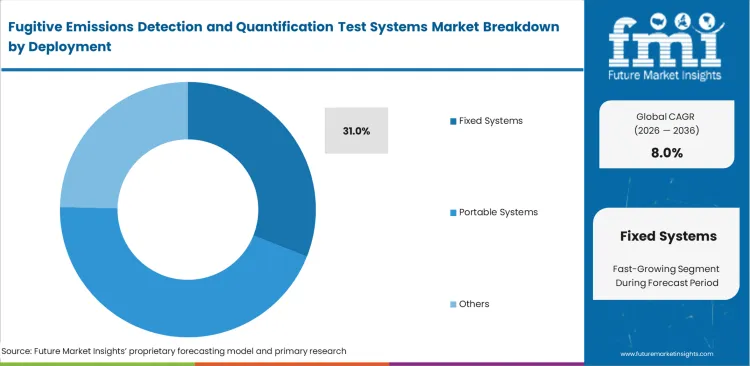
Facility operators prefer fixed monitoring infrastructure because it reduces the recurring labor cost tied to manual site surveys across large operating areas. Maintenance teams place permanent FTIR gas analyzers at critical valve stations so they can receive immediate digital alerts when seal failures or gas releases begin to develop. Comparison of continuous methane monitoring with periodic LDAR programs often shows that fixed deployment offers a stronger long-term cost case, especially at sites with persistent leak risk and wide equipment spread. Fixed systems are expected to account for 31.0% share in 2026. Their appeal also comes from the need for continuous oversight in facilities where gas accumulation can escalate into a major safety incident before the next manual inspection cycle begins. Early deployments have also shown that constant monitoring creates large data volumes, which many sites struggle to manage without dedicated analytics support. Operators that rely only on portable units across extensive facilities often end up with rising overtime expense, uneven coverage, and slower response to developing leaks.
- Installation footprint: Sourcing teams calculate the exact cost per monitored node before committing to permanent perimeter systems. Every continuous methane monitoring solution provider must prove physical durability and scalability to support widespread deployment.
- Maintenance burden: Hidden costs emerge rapidly when permanent sensors require frequent manual recalibration in hazardous zones. Control room operators learn to distrust sensors that drift out of calibration following severe weather events.
- Lifecycle comparison: Total ownership models reveal that initial hardware expenses represent a fraction of the long-term software licensing fees. Financial directors ultimately approve fixed networks only when proven to reduce annual manual inspection hours significantly.
Fugitive Emissions Detection and Quantification Test Systems Market Analysis by Measurement Mode
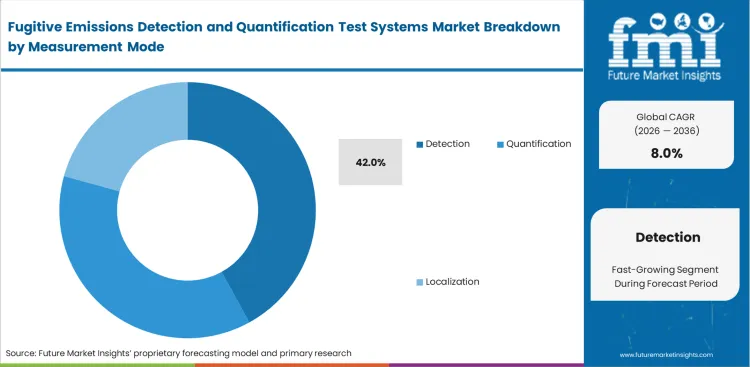
Early regulatory requirements focused on identifying the presence of a hazard before measuring its exact scale, which is why detection remains the entry point in many leak-management workflows. Field teams use fugitive methane testing equipment to isolate the source of a leak detection event across dense piping networks before bringing in secondary tools for measurement and repair planning. Detection is expected to account for 42.0% share in 2026. That position reflects its continued role in first-pass site scanning, where operators need to locate the release reliably before deciding how to quantify it. Moving straight to quantification without a dependable detection layer usually creates inefficiencies in maintenance workflows, since crews can waste time measuring in the wrong place or revisiting the same area. Detection-only instruments still have a clear limitation because they do not indicate release severity, and facilities using leak repair verification instrumentation without quantification support often struggle to rank repairs in the right order.
- Hazard prevention: Basic detection prevents immediate explosive risks by initiating automatic shutdown sequences when gas concentrations spike. Safety directors rely on these rapid-response instruments to protect human life.
- Contextual blindness: Residual risk remains high because simple alarms cannot differentiate between a harmless brief venting event and a continuous seal failure. Control room operators frequently dispatch emergency crews for negligible releases.
- Process optimization: Capturing full operational benefits requires integrating basic alarms with methane localization and quantification tools. Engineering leads must build customized data bridges between legacy safety monitors and modern environmental reporting platforms.
Fugitive Emissions Detection and Quantification Test Systems Market Analysis by End Use
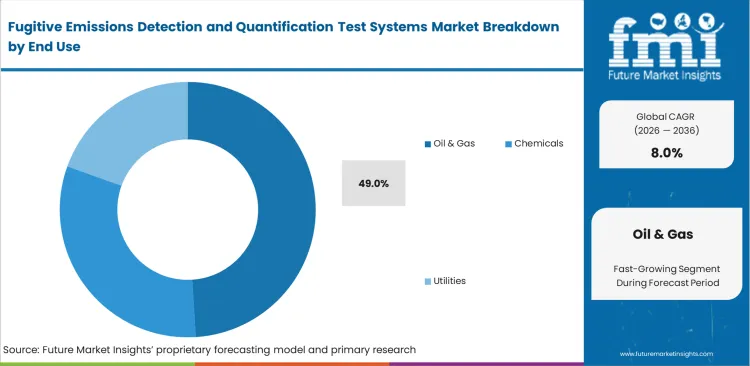
Upstream energy producers are under growing international pressure to measure and reduce methane intensity across operating assets. Oil & gas is expected to capture 49.0% share in 2026, as certified gas markets increasingly favor operators that can demonstrate lower emission profiles. Production managers are deploying advanced natural gas analyzers across remote well pads to meet internal sustainability commitments and external reporting requirements. Running these distributed systems calls for reliable satellite connectivity and ruggedized field hardware that can withstand harsh operating conditions. FMI’s assessment suggests that many mid-tier operators participating in the oil and gas methane monitoring equipment sector do not have the in-house engineering depth to manage complex acoustic data streams on their own. Producers using upstream methane leak detection equipment are also better positioned to reduce divestment pressure from large institutional investors.
- Tier-one operators: Major international producers are usually the first to adopt advanced mapping technologies in response to strict corporate methane targets. Environmental directors often deploy advanced refinery leak detection and quantification systems to separate overlapping plumes across large and complex sites.
- Mid-tier producers: Mid-sized operators tend to move once regulators require continuous monitoring for defined asset classes. Maintenance managers in this group usually favor proven turnkey systems that can be installed with limited custom engineering support.
- Marginal asset owners: Smaller private operators generally adopt monitoring equipment later and often in response to direct enforcement pressure. Financial officers approve purchases once the cost of non-compliance starts to exceed the cost of the equipment.
Fugitive Emissions Detection and Quantification Test Systems Market Analysis by Offering
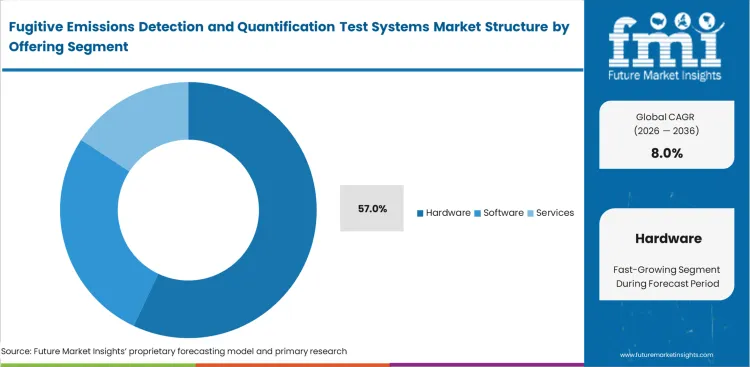
Building a full monitoring network requires heavy upfront spending on physical sensing infrastructure, especially at sites that need broad coverage across hazardous operating zones. Buyers still qualify equipment first on durability, because failure in the field creates both safety risk and replacement cost. Suppliers of fugitive emissions monitoring equipment assess environmental monitoring cameras closely for explosive-atmosphere suitability, corrosion resistance, and operating reliability under refinery conditions. Hardware is expected to account for 57.0% share in 2026. Delicate laboratory-style instruments are poorly suited to corrosive coastal facilities, where exposure conditions can shorten usable equipment life very quickly. Hardware still leads current spending, but vendors and buyers both recognize that the profit pool is shifting toward recurring software and analytics layers tied to methane MRV systems. Facilities that overcommit to proprietary sensor ecosystems without assessing those downstream software dependencies can end up with vendor lock-in that makes later upgrades slower and more expensive.
- Specialized manufacturing: Only a few specialized manufacturers produce optical gas imaging cores capable of surviving extreme industrial deployment. Supply chain directors must navigate long lead times for highly calibrated optical lenses.
- Component shortages: Buyers must plan around sporadic availability of specific cooled infrared detectors required for maximum sensitivity. Project managers frequently delay facility-wide rollouts due to constrained hardware supply.
- Evolving architecture: The supply landscape toward 2036 will shift from discrete bulky cameras toward miniaturized distributed sensor nodes. Operations directors anticipate a future where basic LDAR monitoring equipment is essentially commoditized.
Fugitive Emissions Detection and Quantification Test Systems Market Drivers, Restraints, and Opportunities
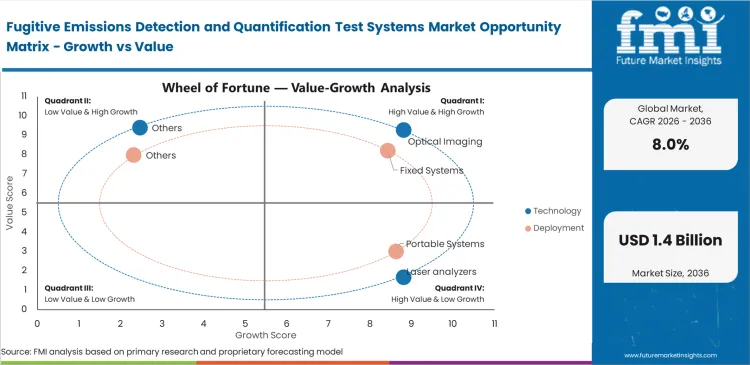
Strict mandates across North America and Europe now levy massive financial penalties based on total emitted volume rather than simple leak occurrence, forcing environmental compliance directors to replace qualitative optical surveys with auditable mass quantification systems immediately. Analysts observing how are methane leaks quantified in oil and gas note that delaying this infrastructure upgrade guarantees failed audits and restricts access to premium certified natural gas markets. Operators utilizing legacy portable gas detection equipment cannot generate the continuous, verifiable data streams required by modern compliance frameworks. This commercial pressure forces rapid deployment of automated fixed networks across thousands of remote well pads.
Algorithm validation remains the fundamental operational friction slowing adoption even when operations managers possess the budget to deploy advanced hardware. Translating raw optical or acoustic data into an exact mass emission rate requires complex wind dispersion modeling that regulators have historically viewed with skepticism. Until environmental agencies universally certify specific software models through rigorous controlled release methane testing, operators hesitate to trust their compliance status to proprietary algorithms. Emerging pilot programs demonstrate the accuracy of these calculations, but variations in ambient conditions still degrade data confidence.
Opportunities in the Fugitive Emissions Detection and Quantification Test Systems Market
- Certified algorithm integration: Software developers linking raw sensor data directly to approved regulatory reporting templates capture lucrative recurring subscriptions from compliance directors.
- Automated drone surveys: Service providers offering turnkey aerial inspections bypass the massive capital expenditure barriers facing mid-tier facility operators.
- Methane-intensity verification: Firms capable of auditing and verifying air quality monitoring systems data gain exclusive contracts from operators seeking certified gas pricing premiums.
Regional Analysis
Based on regional analysis, fugitive emissions detection and quantification test systems market is segmented into North America, Asia Pacific, Europe, and other key regions across 40 plus countries.
.webp "Top Country Growth Comparison Fugitive Emissions Detection And Quantification Test Systems Market Cagr (2026 2036)")
| Country | CAGR (2026 to 2036) |
|---|---|
| India | 9.8% |
| China | 9.5% |
| United States | 9.1% |
| Canada | 8.7% |
| Germany | 8.4% |
| Netherlands | 8.2% |
| Saudi Arabia | 7.6% |
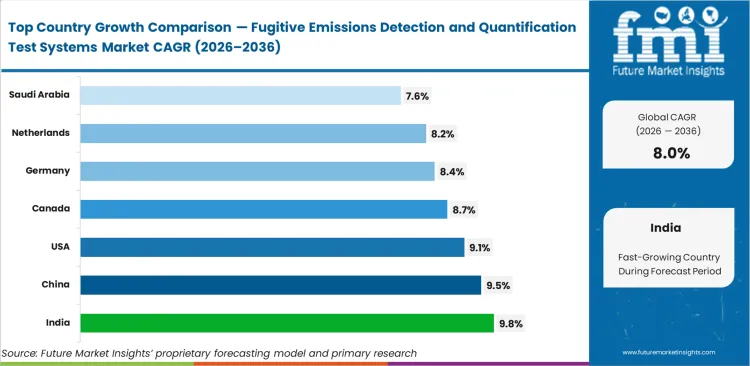
Source: Future Market Insights (FMI) analysis, based on proprietary forecasting model and primary research
North America Fugitive Emissions Detection and Quantification Test Systems Market Analysis
Regulatory enforcement has transitioned entirely from voluntary incentive programs to rigid continuous monitoring requirements. FMI's analysis indicates that federal agencies now demand empirical mass quantification rather than simple leak detection. Compliance directors across major production basins deploy advanced hardware to avoid crippling super-emitter penalties. Companies leveraging legacy manual inspection protocols face mounting legal exposure and operational disruptions. Advanced sensor networks now integrate directly with facility shutdown systems to minimize total release volumes during critical failures.
- United States: High federal scrutiny forces production managers to install continuous monitoring equipment across thousands of older well pads. Demand for fugitive emissions test systems in the United States is anticipated to rise at a CAGR of 9.1% through 2036. Operations managers successfully deploying these automated networks gain a distinct cost advantage over competing producers who still rely on expensive manual contracting services.
- Canada: Methane reduction targets compel facility supervisors to winterize advanced optical imaging systems for severe arctic deployments. Operators in this region frequently pioneer new cold-weather calibration standards that eventually shape global deployment protocols. Canada is projected to witness 8.7% CAGR in the fugitive emissions monitoring market through 2036. This sustained growth ultimately secures continuous compliance across highly isolated production sites.
Asia Pacific Fugitive Emissions Detection and Quantification Test Systems Market Analysis
Rapid expansion of natural gas transmission infrastructure dictates the adoption curve across this geography. FMI observes that massive new pipeline networks require automated oversight to prevent high product loss. Engineering leads prioritize wide-area mapping technologies capable of covering hundreds of kilometers of remote terrain. Midstream operators favor drone-mounted architectures that drastically reduce the time required to survey inaccessible routing corridors. Facilities failing to secure reliable detection networks experience severe community pushback following any localized release event.
- India: The fugitive emissions detection segment in India is poised to expand at a CAGR of 9.8% from 2026 to 2036. Massive investments in urban gas distribution networks pull continuous monitoring systems directly into dense population centers. Upgrading these urban grids provides pipeline operators with the critical social license necessary to secure future expansion permits and maintain uninterrupted regional supply operations.
- China: Government mandates targeting industrial efficiency create high adoption of multi-gas analytical platforms alongside broader environmental monitoring investments. Sales of fugitive emissions test systems in China are expected to increase at a CAGR of 9.5% during the forecast period. Facility directors executing these upgrades fundamentally alter their operational workflows, shifting entirely from reactive hazard maintenance toward highly profitable predictive asset management.
Europe Fugitive Emissions Detection and Quantification Test Systems Market Analysis
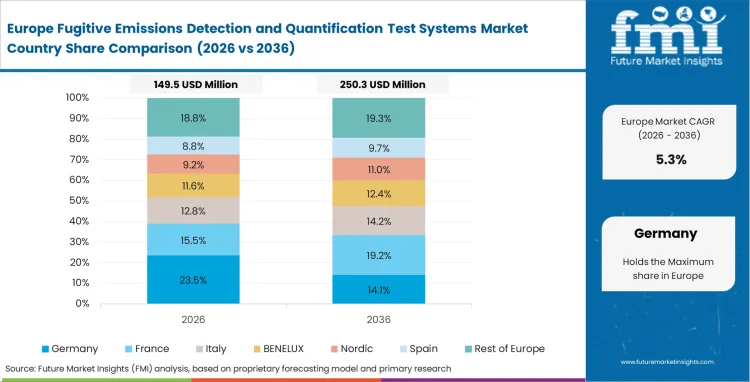
Stringent supranational methane frameworks define the operational reality for every energy importer and producer on the continent. Based on FMI's assessment, the Europe methane quantification equipment market depends on operators proving their emission intensity falls below strict thresholds to maintain market access. Purchasing directors aggressively source high-fidelity laser spectrometers to satisfy rigorous verification audits. Legacy basic detection cameras no longer meet the baseline documentation requirements mandated by regional authorities. Facilities master continuous quantification or face immediate operational restrictions and devastating public relations crises.
- Germany: Germany is anticipated to see fugitive emissions detection adoption grow at a CAGR of 8.4% over the forecast period. Deep industrial decarbonization initiatives compel chemical facility managers to install continuous fence-line monitoring arrays immediately. Behind this numerical growth lies a preference among German operators for locally engineered analytical components over imported alternatives, which heavily influences long-term regional sourcing strategies.
- Netherlands: Dense coastal refining clusters require hyper-accurate dispersion modeling to differentiate overlapping emission plumes effectively. Refineries mastering this complex multi-source attribution model secure a commanding competitive position against less sophisticated regional peers. The Netherlands sector is expected to register a CAGR of 8.2% through 2036. Capturing this data ultimately ensures compliance while validating massive sustainability investments to external stakeholders.
FMI's report includes detailed assessments of the United Kingdom, Japan, and other critical energy markets. Saudi Arabia advances at 7.6% as national operators upgrade methane management across legacy hydrocarbon assets to align with evolving global emission intensity standards.
Competitive Aligners for Market Players
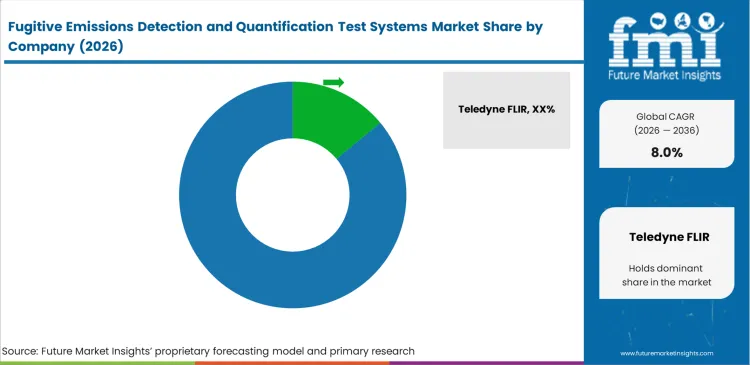
Competition in this sector separates broad industrial automation vendors from specialist sensor companies with a much narrower technical focus. Buyers assessing OGI, laser analyzers, and continuous methane monitoring for fugitive emissions are not choosing on detection sensitivity alone. Agency acceptance matters just as much, since a strong hardware platform has limited commercial value if its algorithm cannot support regulated field use. Vendors without experienced regulatory affairs teams often struggle to convert technical performance into repeat deployment contracts.
Established suppliers hold an advantage because they can build on large installed bases of legacy air quality monitoring equipment already operating across customer sites. That installed footprint gives companies such as Thermo Fisher Scientific and Honeywell a practical route to sell upgraded quantification software into maintenance organizations that already know their systems. Their global service networks also matter. Maintaining and calibrating thousands of distributed sensors each year requires field coverage, spare-parts access, and dependable service response. Challengers usually have to compete by proving that drone-based or satellite-derived data can flow into existing control room systems without creating extra workload for operators. Suppliers that offer standalone hardware without strong data aggregation and reporting capability are often pushed into lower-margin component roles.
Large energy operators are still cautious about vendor lock-in and regularly structure procurement around interoperability. Engineering teams may pair internal control environments with ABB analyzers or other third-party instruments to keep leverage during renewal discussions. That changes the competitive requirement. Vendors need to show that their software can calculate mass emissions accurately using inputs from external hardware, not just from their own installed base. Companies that handle cross-platform compliance reporting well are better placed to win long-duration enterprise agreements.
Key Players in Fugitive Emissions Detection and Quantification Test Systems Market
- Teledyne FLIR
- Thermo Fisher Scientific
- ABB
- Honeywell
- Sensirion Connected Solutions
- Baker Hughes
Scope of the Report
| Metric | Value |
|---|---|
| Quantitative Units | USD 0.6 billion to USD 1.3 billion, at a CAGR of 8.00% |
| Market Definition | Fugitive emissions detection and quantification test systems comprise specialized diagnostic hardware and analytical software engineered to identify, measure, and map unintended gas releases across industrial infrastructure. This category centers on equipment capable of calculating exact mass emission rates rather than merely alerting operators to the presence of a hazard. |
| Segmentation | Technology, Deployment, Measurement mode, End use, Offering, and Region |
| Regions Covered | North America, Latin America, Europe, Asia Pacific, Middle East and Africa |
| Countries Covered | United States, Canada, China, India, Germany, Netherlands, Saudi Arabia, and more |
| Key Companies Profiled | Teledyne FLIR, Thermo Fisher Scientific, ABB, Honeywell, Sensirion Connected Solutions, Baker Hughes |
| Forecast Period | 2026 to 2036 |
| Approach | Modeling baseline equipment demand against announced regulatory enforcement schedules and primary validation. |
Source: Future Market Insights (FMI) analysis, based on proprietary forecasting model and primary research
Fugitive Emissions Detection and Quantification Test Systems Market Analysis by Segments
Technology
- Optical imaging
- Laser analyzers
- Continuous monitors
- Mobile surveys
- Component testers
Deployment
- Fixed systems
- Portable systems
- Vehicle-mounted
- Drone-mounted
- Bench systems
Measurement mode
- Detection
- Quantification
- Localization
- Mapping
- Verification
End use
- Oil & gas
- Chemicals
- Utilities
- Landfills
- Mining
Offering
- Hardware
- Software
- Services
- Calibration
- Data platforms
Region:
- North America
- United States
- Canada
- Europe
- Germany
- United Kingdom
- France
- Italy
- Spain
- Asia Pacific
- China
- Japan
- South Korea
- Taiwan
- Singapore
- Latin America
- Brazil
- Mexico
- Argentina
- Middle East & Africa
- GCC Countries
- South Africa
Bibliography
- Chen, Q., Kimura, Y., & Allen, D. T. (2024). Defining detection limits for continuous monitoring systems for methane emissions at oil and gas facilities. Atmosphere, 15(3), Article 383.
- Crowe, L., Jedlikowski, E., Kantharaj, P., Madu, M., Mattix, R., Modi, J., Restrepo, M., Schauer, R., Silva, A., Taylor, A., von Fischer, J., Vann, A., & Wilson, N. (2025). Integrated Methane Monitoring Platform Extension, Volume I: Final Technical Report. U.S. Department of Energy Office of Scientific and Technical Information.
- Environmental Protection Agency. (2024). Standards of performance for new, reconstructed, and modified sources and emissions guidelines for existing sources: Oil and Natural Gas Sector Climate Review. Federal Register, 89(47), 16820-17227.
- European Parliament, & Council of the European Union. (2024). Regulation (EU) 2024/1787 of the European Parliament and of the Council of 13 June 2024 on the reduction of methane emissions in the energy sector and amending Regulation (EU) 2019/942. Official Journal of the European Union.
- Ilonze, C., Wang, J., Ravikumar, A. P., & Zimmerle, D. (2024). Methane quantification performance of the quantitative optical gas imaging (QOGI) system using single-blind controlled release assessment. Sensors, 24(13), Article 4044.
- Karion, A., Shepson, P., Butcher, T., Commane, R., Fernandez, J., Ferrara, T., Hajny, K., Jackson, R. B., Lamb, B., Lopez-Coto, I., Magavi, Z., McDonald, B., Merrin, Z., Miller, S. M., Mueller, K., Murray, L., Pitt, J., Trieste, R., Trojanowski, R., & von Fischer, J. (2024). Workshop on Quantifying Methane Emissions Across Natural Gas Infrastructure in Urban Environments (NIST SP 1500-22). National Institute of Standards and Technology.
This bibliography is provided for reader reference. The full FMI report contains the complete reference list with primary source documentation.
This Report Addresses
- Detailed evaluation of hardware and software components enabling precise mass emission calculations across industrial facilities.
- Comprehensive analysis of how new regulatory frameworks shift purchasing priorities toward continuous monitoring solutions.
- Assessment of the integration challenges facing operators attempting to aggregate data from drone, fixed, and portable sensor arrays.
- Identification of the barriers slowing the adoption of proprietary dispersion modeling algorithms by environmental agencies.
- Regional breakdown of enforcement timelines driving rapid equipment deployment across North America and Europe.
- Comparative review of optical gas imaging versus continuous point sensors in harsh field environments.
- Strategic guidance for instrumentation vendors navigating the complex alternative test method certification process.
- Examination of the hidden lifecycle costs associated with permanent sensor calibration and maintenance.
Frequently Asked Questions
What is the fugitive emissions detection and quantification test systems market?
This sector encompasses advanced diagnostic instrumentation and software platforms utilized to identify and calculate the exact mass rate of unintended industrial gas releases rather than merely alerting operators to hazards.
How are methane leaks detected and quantified in oil and gas operations?
Field technicians sweep complex piping manifolds using optical imaging or laser analyzers to locate sources, followed by software integration and wind dispersion modeling to calculate exact mass emission rates.
What is the difference between OGI and QOGI?
OGI visualizes invisible hydrocarbon plumes to identify leak locations, while QOGI integrates complex algorithms to translate that raw visual data into precise kilograms-per-hour metrics.
Why are continuous methane monitoring systems gaining traction?
These permanent networks eliminate the exorbitant recurring labor costs associated with manual site-wide optical surveys and prevent the buildup of explosive gases.
Which regulations are increasing demand for fugitive emissions test systems?
Global regulatory bodies across North America and Europe now enforce severe financial penalties based on total emitted volume, forcing immediate hardware upgrades to prove compliance.
Which industries use fugitive emissions detection and quantification tools?
While upstream oil and gas accounts for the dominant share, chemical facilities, utilities, landfills, and mining operations increasingly deploy these tools to meet sustainability targets.
Who are the leading companies in methane quantification equipment?
Key vendors shaping the sector include Teledyne FLIR, Thermo Fisher Scientific, ABB, Honeywell, Sensirion Connected Solutions, Baker Hughes.
Which countries are driving growth in this market?
India and China expand rapidly due to massive gas infrastructure investments, while the United States and European nations create demand through stringent continuous monitoring enforcement.
How do fixed systems compare with portable systems?
Fixed architectures offer uninterrupted automated oversight but require massive initial capital, whereas portable systems limit upfront costs but generate skyrocketing manual labor expenses over time.
What should buyers evaluate before selecting a methane quantification platform?
Purchase directors must ensure the vendor's proprietary algorithm holds formal agency approval, validating that the software can reliably translate sensor data into certified compliance reporting.
How do operators resist vendor lock-in?
Engineering leads demand open-source data architectures that permit cross-platform integration of third-party analytical hardware.
What hidden costs impact fixed sensor networks?
Routine manual recalibration in hazardous environments generates massive recurring maintenance expenses that operators rarely forecast accurately.
Why do mid-tier producers lag in adoption?
These operators lack the internal engineering resources required to manage complex multi-stream data analytics independently.
How do certified gas markets influence sourcing?
Buyers reward low-emission producers with pricing premiums, creating a direct financial return on advanced instrumentation investments.
What role do drone-mounted systems play?
Aerial platforms bypass the massive capital expenditure required to install fixed sensors across hundreds of kilometers of remote pipeline.
Why is algorithm validation a bottleneck?
Operators refuse to trust their compliance status to proprietary software until regulators formally certify the calculation method as equivalent to physical testing.
How do cold-weather environments alter equipment selection?
Canadian and Northern European deployments require heavily winterized enclosures that significantly increase the per-node installation cost.
What defines the competitive boundary for specialized vendors?
Boutique sensor manufacturers must prove their hardware integrates seamlessly into the massive control systems dominated by industrial incumbents.
How does alarm fatigue threaten system viability?
Overly sensitive fixed networks generate excessive false positives, causing control room personnel to eventually ignore critical alerts.
Why are marginal well operators the last to adopt?
Financial officers refuse to approve compliance hardware purchases until direct regulatory penalties exceed the cost of the equipment.
What dictates the renewal cycle for optical cameras?
Manufacturers releasing software updates that automate reporting formats run replacement cycles faster than physical hardware degradation.
How do satellite communications impact remote deployments?
Offshore and deep-basin assets require robust telemetry to transmit high-fidelity continuous monitoring data back to centralized cloud platforms.
Preview the report firsthand - request a free sample
Get SampleGet the brochure for pricing and purchase details.
Get PDFTable of Content
- Executive Summary
- Global Market Outlook
- Demand-side Trends
- Supply-side Trends
- Technology Roadmap Analysis
- Analysis and Recommendations
- Market Overview
- Market Coverage / Taxonomy
- Market Definition / Scope / Limitations
- Research Methodology
- Chapter Orientation
- Analytical Lens and Working Hypotheses
- Market Structure, Signals, and Trend Drivers
- Benchmarking and Cross-market Comparability
- Market Sizing, Forecasting, and Opportunity Mapping
- Research Design and Evidence Framework
- Desk Research Programme (Secondary Evidence)
- Company Annual and Sustainability Reports
- Peer-reviewed Journals and Academic Literature
- Corporate Websites, Product Literature, and Technical Notes
- Earnings Decks and Investor Briefings
- Statutory Filings and Regulatory Disclosures
- Technical White Papers and Standards Notes
- Trade Journals, Industry Magazines, and Analyst Briefs
- Conference Proceedings, Webinars, and Seminar Materials
- Government Statistics Portals and Public Data Releases
- Press Releases and Reputable Media Coverage
- Specialist Newsletters and Curated Briefings
- Sector Databases and Reference Repositories
- FMI Internal Proprietary Databases and Historical Market Datasets
- Subscription Datasets and Paid Sources
- Social Channels, Communities, and Digital Listening Inputs
- Additional Desk Sources
- Expert Input and Fieldwork (Primary Evidence)
- Primary Modes
- Qualitative Interviews and Expert Elicitation
- Quantitative Surveys and Structured Data Capture
- Blended Approach
- Why Primary Evidence is Used
- Field Techniques
- Interviews
- Surveys
- Focus Groups
- Observational and In-context Research
- Social and Community Interactions
- Stakeholder Universe Engaged
- C-suite Leaders
- Board Members
- Presidents and Vice Presidents
- R&D and Innovation Heads
- Technical Specialists
- Domain Subject-matter Experts
- Scientists
- Physicians and Other Healthcare Professionals
- Governance, Ethics, and Data Stewardship
- Research Ethics
- Data Integrity and Handling
- Primary Modes
- Tooling, Models, and Reference Databases
- Desk Research Programme (Secondary Evidence)
- Data Engineering and Model Build
- Data Acquisition and Ingestion
- Cleaning, Normalisation, and Verification
- Synthesis, Triangulation, and Analysis
- Quality Assurance and Audit Trail
- Market Background
- Market Dynamics
- Drivers
- Restraints
- Opportunity
- Trends
- Scenario Forecast
- Demand in Optimistic Scenario
- Demand in Likely Scenario
- Demand in Conservative Scenario
- Opportunity Map Analysis
- Product Life Cycle Analysis
- Supply Chain Analysis
- Investment Feasibility Matrix
- Value Chain Analysis
- PESTLE and Porter’s Analysis
- Regulatory Landscape
- Regional Parent Market Outlook
- Production and Consumption Statistics
- Import and Export Statistics
- Market Dynamics
- Global Market Analysis 2021 to 2025 and Forecast, 2026 to 2036
- Historical Market Size Value (USD Million) Analysis, 2021 to 2025
- Current and Future Market Size Value (USD Million) Projections, 2026 to 2036
- Y-o-Y Growth Trend Analysis
- Absolute $ Opportunity Analysis
- Global Market Pricing Analysis 2021 to 2025 and Forecast 2026 to 2036
- Global Market Analysis 2021 to 2025 and Forecast 2026 to 2036, By Technology
- Introduction / Key Findings
- Historical Market Size Value (USD Million) Analysis By Technology , 2021 to 2025
- Current and Future Market Size Value (USD Million) Analysis and Forecast By Technology , 2026 to 2036
- Optical Imaging
- Laser analyzers
- Others
- Optical Imaging
- Y-o-Y Growth Trend Analysis By Technology , 2021 to 2025
- Absolute $ Opportunity Analysis By Technology , 2026 to 2036
- Global Market Analysis 2021 to 2025 and Forecast 2026 to 2036, By Deployment
- Introduction / Key Findings
- Historical Market Size Value (USD Million) Analysis By Deployment, 2021 to 2025
- Current and Future Market Size Value (USD Million) Analysis and Forecast By Deployment, 2026 to 2036
- Fixed Systems
- Portable Systems
- Others
- Fixed Systems
- Y-o-Y Growth Trend Analysis By Deployment, 2021 to 2025
- Absolute $ Opportunity Analysis By Deployment, 2026 to 2036
- Global Market Analysis 2021 to 2025 and Forecast 2026 to 2036, By Measurement Mode
- Introduction / Key Findings
- Historical Market Size Value (USD Million) Analysis By Measurement Mode, 2021 to 2025
- Current and Future Market Size Value (USD Million) Analysis and Forecast By Measurement Mode, 2026 to 2036
- Detection
- Quantification
- Localization
- Detection
- Y-o-Y Growth Trend Analysis By Measurement Mode, 2021 to 2025
- Absolute $ Opportunity Analysis By Measurement Mode, 2026 to 2036
- Global Market Analysis 2021 to 2025 and Forecast 2026 to 2036, By End Use
- Introduction / Key Findings
- Historical Market Size Value (USD Million) Analysis By End Use, 2021 to 2025
- Current and Future Market Size Value (USD Million) Analysis and Forecast By End Use, 2026 to 2036
- Oil & Gas
- Chemicals
- Utilities
- Oil & Gas
- Y-o-Y Growth Trend Analysis By End Use, 2021 to 2025
- Absolute $ Opportunity Analysis By End Use, 2026 to 2036
- Global Market Analysis 2021 to 2025 and Forecast 2026 to 2036, By Offering
- Introduction / Key Findings
- Historical Market Size Value (USD Million) Analysis By Offering, 2021 to 2025
- Current and Future Market Size Value (USD Million) Analysis and Forecast By Offering, 2026 to 2036
- Hardware
- Software
- Services
- Hardware
- Y-o-Y Growth Trend Analysis By Offering, 2021 to 2025
- Absolute $ Opportunity Analysis By Offering, 2026 to 2036
- Global Market Analysis 2021 to 2025 and Forecast 2026 to 2036, By Region
- Introduction
- Historical Market Size Value (USD Million) Analysis By Region, 2021 to 2025
- Current Market Size Value (USD Million) Analysis and Forecast By Region, 2026 to 2036
- North America
- Latin America
- Western Europe
- Eastern Europe
- East Asia
- South Asia and Pacific
- Middle East & Africa
- Market Attractiveness Analysis By Region
- North America Market Analysis 2021 to 2025 and Forecast 2026 to 2036, By Country
- Historical Market Size Value (USD Million) Trend Analysis By Market Taxonomy, 2021 to 2025
- Market Size Value (USD Million) Forecast By Market Taxonomy, 2026 to 2036
- By Country
- USA
- Canada
- Mexico
- By Technology
- By Deployment
- By Measurement Mode
- By End Use
- By Offering
- By Country
- Market Attractiveness Analysis
- By Country
- By Technology
- By Deployment
- By Measurement Mode
- By End Use
- By Offering
- Key Takeaways
- Latin America Market Analysis 2021 to 2025 and Forecast 2026 to 2036, By Country
- Historical Market Size Value (USD Million) Trend Analysis By Market Taxonomy, 2021 to 2025
- Market Size Value (USD Million) Forecast By Market Taxonomy, 2026 to 2036
- By Country
- Brazil
- Chile
- Rest of Latin America
- By Technology
- By Deployment
- By Measurement Mode
- By End Use
- By Offering
- By Country
- Market Attractiveness Analysis
- By Country
- By Technology
- By Deployment
- By Measurement Mode
- By End Use
- By Offering
- Key Takeaways
- Western Europe Market Analysis 2021 to 2025 and Forecast 2026 to 2036, By Country
- Historical Market Size Value (USD Million) Trend Analysis By Market Taxonomy, 2021 to 2025
- Market Size Value (USD Million) Forecast By Market Taxonomy, 2026 to 2036
- By Country
- Germany
- UK
- Italy
- Spain
- France
- Nordic
- BENELUX
- Rest of Western Europe
- By Technology
- By Deployment
- By Measurement Mode
- By End Use
- By Offering
- By Country
- Market Attractiveness Analysis
- By Country
- By Technology
- By Deployment
- By Measurement Mode
- By End Use
- By Offering
- Key Takeaways
- Eastern Europe Market Analysis 2021 to 2025 and Forecast 2026 to 2036, By Country
- Historical Market Size Value (USD Million) Trend Analysis By Market Taxonomy, 2021 to 2025
- Market Size Value (USD Million) Forecast By Market Taxonomy, 2026 to 2036
- By Country
- Russia
- Poland
- Hungary
- Balkan & Baltic
- Rest of Eastern Europe
- By Technology
- By Deployment
- By Measurement Mode
- By End Use
- By Offering
- By Country
- Market Attractiveness Analysis
- By Country
- By Technology
- By Deployment
- By Measurement Mode
- By End Use
- By Offering
- Key Takeaways
- East Asia Market Analysis 2021 to 2025 and Forecast 2026 to 2036, By Country
- Historical Market Size Value (USD Million) Trend Analysis By Market Taxonomy, 2021 to 2025
- Market Size Value (USD Million) Forecast By Market Taxonomy, 2026 to 2036
- By Country
- China
- Japan
- South Korea
- By Technology
- By Deployment
- By Measurement Mode
- By End Use
- By Offering
- By Country
- Market Attractiveness Analysis
- By Country
- By Technology
- By Deployment
- By Measurement Mode
- By End Use
- By Offering
- Key Takeaways
- South Asia and Pacific Market Analysis 2021 to 2025 and Forecast 2026 to 2036, By Country
- Historical Market Size Value (USD Million) Trend Analysis By Market Taxonomy, 2021 to 2025
- Market Size Value (USD Million) Forecast By Market Taxonomy, 2026 to 2036
- By Country
- India
- ASEAN
- Australia & New Zealand
- Rest of South Asia and Pacific
- By Technology
- By Deployment
- By Measurement Mode
- By End Use
- By Offering
- By Country
- Market Attractiveness Analysis
- By Country
- By Technology
- By Deployment
- By Measurement Mode
- By End Use
- By Offering
- Key Takeaways
- Middle East & Africa Market Analysis 2021 to 2025 and Forecast 2026 to 2036, By Country
- Historical Market Size Value (USD Million) Trend Analysis By Market Taxonomy, 2021 to 2025
- Market Size Value (USD Million) Forecast By Market Taxonomy, 2026 to 2036
- By Country
- Kingdom of Saudi Arabia
- Other GCC Countries
- Turkiye
- South Africa
- Other African Union
- Rest of Middle East & Africa
- By Technology
- By Deployment
- By Measurement Mode
- By End Use
- By Offering
- By Country
- Market Attractiveness Analysis
- By Country
- By Technology
- By Deployment
- By Measurement Mode
- By End Use
- By Offering
- Key Takeaways
- Key Countries Market Analysis
- USA
- Pricing Analysis
- Market Share Analysis, 2025
- By Technology
- By Deployment
- By Measurement Mode
- By End Use
- By Offering
- Canada
- Pricing Analysis
- Market Share Analysis, 2025
- By Technology
- By Deployment
- By Measurement Mode
- By End Use
- By Offering
- Mexico
- Pricing Analysis
- Market Share Analysis, 2025
- By Technology
- By Deployment
- By Measurement Mode
- By End Use
- By Offering
- Brazil
- Pricing Analysis
- Market Share Analysis, 2025
- By Technology
- By Deployment
- By Measurement Mode
- By End Use
- By Offering
- Chile
- Pricing Analysis
- Market Share Analysis, 2025
- By Technology
- By Deployment
- By Measurement Mode
- By End Use
- By Offering
- Germany
- Pricing Analysis
- Market Share Analysis, 2025
- By Technology
- By Deployment
- By Measurement Mode
- By End Use
- By Offering
- UK
- Pricing Analysis
- Market Share Analysis, 2025
- By Technology
- By Deployment
- By Measurement Mode
- By End Use
- By Offering
- Italy
- Pricing Analysis
- Market Share Analysis, 2025
- By Technology
- By Deployment
- By Measurement Mode
- By End Use
- By Offering
- Spain
- Pricing Analysis
- Market Share Analysis, 2025
- By Technology
- By Deployment
- By Measurement Mode
- By End Use
- By Offering
- France
- Pricing Analysis
- Market Share Analysis, 2025
- By Technology
- By Deployment
- By Measurement Mode
- By End Use
- By Offering
- India
- Pricing Analysis
- Market Share Analysis, 2025
- By Technology
- By Deployment
- By Measurement Mode
- By End Use
- By Offering
- ASEAN
- Pricing Analysis
- Market Share Analysis, 2025
- By Technology
- By Deployment
- By Measurement Mode
- By End Use
- By Offering
- Australia & New Zealand
- Pricing Analysis
- Market Share Analysis, 2025
- By Technology
- By Deployment
- By Measurement Mode
- By End Use
- By Offering
- China
- Pricing Analysis
- Market Share Analysis, 2025
- By Technology
- By Deployment
- By Measurement Mode
- By End Use
- By Offering
- Japan
- Pricing Analysis
- Market Share Analysis, 2025
- By Technology
- By Deployment
- By Measurement Mode
- By End Use
- By Offering
- South Korea
- Pricing Analysis
- Market Share Analysis, 2025
- By Technology
- By Deployment
- By Measurement Mode
- By End Use
- By Offering
- Russia
- Pricing Analysis
- Market Share Analysis, 2025
- By Technology
- By Deployment
- By Measurement Mode
- By End Use
- By Offering
- Poland
- Pricing Analysis
- Market Share Analysis, 2025
- By Technology
- By Deployment
- By Measurement Mode
- By End Use
- By Offering
- Hungary
- Pricing Analysis
- Market Share Analysis, 2025
- By Technology
- By Deployment
- By Measurement Mode
- By End Use
- By Offering
- Kingdom of Saudi Arabia
- Pricing Analysis
- Market Share Analysis, 2025
- By Technology
- By Deployment
- By Measurement Mode
- By End Use
- By Offering
- Turkiye
- Pricing Analysis
- Market Share Analysis, 2025
- By Technology
- By Deployment
- By Measurement Mode
- By End Use
- By Offering
- South Africa
- Pricing Analysis
- Market Share Analysis, 2025
- By Technology
- By Deployment
- By Measurement Mode
- By End Use
- By Offering
- USA
- Market Structure Analysis
- Competition Dashboard
- Competition Benchmarking
- Market Share Analysis of Top Players
- By Regional
- By Technology
- By Deployment
- By Measurement Mode
- By End Use
- By Offering
- Competition Analysis
- Competition Deep Dive
- Teledyne FLIR
- Overview
- Product Portfolio
- Profitability by Market Segments (Product/Age /Sales Channel/Region)
- Sales Footprint
- Strategy Overview
- Marketing Strategy
- Product Strategy
- Channel Strategy
- Thermo Fisher Scientific
- ABB
- Honeywell
- Sensirion Connected Solutions
- Baker Hughes
- Teledyne FLIR
- Competition Deep Dive
- Assumptions & Acronyms Used


