

- Industry Size (2026)
- USD 770 Mn
- Forecast (2036)
- USD 1310 Mn
- CAGR (2026 to 2036)
- 5.5%
Stack Emissions Real-Time Speciation and Compliance Test Systems Market Size, Market Forecast and Outlook By FMI
The stack emissions real-time speciation and compliance test systems market crossed a valuation of USD 730 million in 2025. Revenue is projected to reach USD 770 million in 2026 and USD 1,310 million by 2036. Growth is likely to reflect a CAGR of 5.5% from 2026 to 2036, supported by broader use of integrated multi-gas analytical systems in regulated industrial environments.
Summary of Stack Emissions Real-Time Speciation and Compliance Test Systems Market
- Market Snapshot
- The stack emissions testing equipment market stood at USD 730 million in 2025 and is on track to scale USD 1,310 million by 2036.
- Industry expansion is seemingly ready to project at a 5.5% CAGR through the next decade, adding USD 545.3 million in new revenue on top of the USD 770 million base in 2026.
- Strict environmental laws drive this instrumentation space, forcing plant operators to prioritize rugged sensors that survive harsh, wet smokestacks and deliver unbroken audit records over finding the cheapest hardware.
- The industry covers continuous gas analyzers, heated sample tubes, and secure data logging software designed permanently for heavy industrial smokestacks.
- Demand and Growth Drivers
- Expanding environmental rules across the United States, Europe, India, and South Korea force factory owners to install permanent, continuous emission tracking equipment to keep their operating permits.
- Industrial buyers increasingly prefer multi-gas optical sensors because they measure several different hazardous chemicals at once, eliminating the need to buy and maintain separate machines for every regulated pollutant.
- Factories are rapidly abandoning older single-gas monitors in favor of unified setups that test multiple compounds and automatically log the data for government inspectors.
- China anticipated to lead global adoption with a 6.8% CAGR, while India likely to follow closely at a 6.5% CAGR, South Korea projected to track at a 6.1% CAGR, Germany at a 5.7% CAGR, the United States at 5.1% CAGR, Japan at 4.8% CAGR, and the United Kingdom at 4.6% CAGR.
- Upgrading these complex sensors requires factories to completely halt production, meaning new installations usually only happen during rare scheduled maintenance turnarounds.
- Product and Segment View
- The equipment landscape includes various optical and laser sensors used to track regulated exhaust gases pouring out of heavy industrial chimneys.
- Plants install these systems primarily across power generation, waste burning, cement production, oil refining, and metal smelting facilities.
- Industrial sites highly favor FTIR systems poised to secure an expected 41% share in 2026, as heavy manufacturing requires equipment capable of tracking multiple hazardous gases at once.
- An estimated 54% segment share in 2026 is likely to belong to extractive setups, primarily because factory engineers must physically pull hot gases out of the smokestack and cool them before touching sensitive electronic sensors.
- Environmental permits now demand simultaneous live reporting for secondary pollutants alongside basic greenhouse gases, anticipating multi-gas tracking to account for a projected 48% share in 2026.
- Utility operators managing massive fleets of aging coal and gas generators will help project power plants to represent a 29% share in 2026, driven entirely by strict and long-standing federal oversight.
- Anticipated to capture a 36% share in 2026, analyzer cabinets act as the reinforced central brain protecting fragile internal mirrors from brutal factory heat and dust.
- This specific industrial category strictly ignores basic handheld workplace alarms, temporary testing kits, and generic laboratory equipment that cannot survive direct smokestack connections.
- Geography and Competitive Outlook
- Asian manufacturing hubs are installing new monitoring infrastructure at the fastest rate, while North American facilities focus on replacing massive networks of aging equipment.
- Equipment suppliers win large industrial bids by offering fully integrated testing cabinets with built-in reporting software, rather than just selling bare optical sensors.
- Major suppliers navigating this space include Thermo Fisher Scientific, HORIBA, ENVEA, SICK, MKS Instruments, Siemens, and Fuji Electric.
- Smaller regional services still secure steady contracts by managing the daily gas calibration and physical pipe maintenance, while massive global instrument builders dominate the core technology.
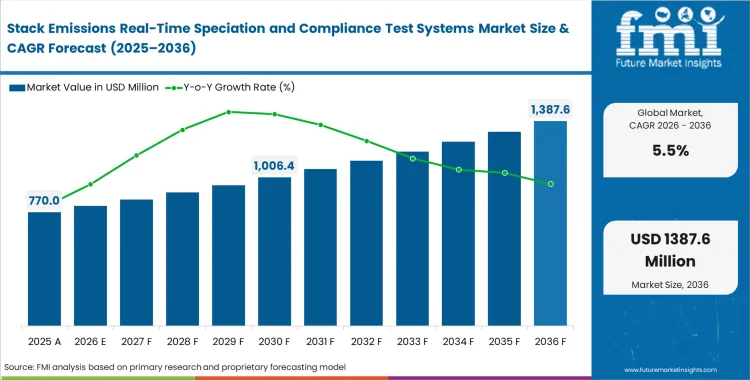
Industrial sites are moving away from aging single-gas instruments as continuous tracking requirements expand across multiple emission streams. Facilities operating with older monitoring architecture face rising compliance risk when uninterrupted records are required for a wider set of pollutants. Demand is shifting toward integrated testing cabinets that combine measurement, diagnostics, and data handling in one system. Hardware value alone does not define purchasing decisions, as calibration needs, service continuity, and long-term system reliability carry equal weight in deployment planning.
Preference is gradually shifting from stand-alone components toward complete compliance-ready systems because certification timelines depend on configuration accuracy and data stability. Pre-integrated software improves system usability by identifying calibration drift early and reducing the chance of reporting gaps. Operational efficiency gains are becoming more relevant in complex treatment environments where maintenance visibility directly affects uptime. Market demand, as a result, is being shaped by the need for dependable performance across both compliance and plant-level monitoring functions.
Regional demand is estimated to diverge according to how strictly industrial operators must maintain uninterrupted emissions records. China is projected to expand at a CAGR of 6.8% from 2026 to 2036, supported by continued upgrades in heavy industrial monitoring infrastructure. India is likely to grow at 6.5% through 2036 as online emissions reporting requirements widen across high-emission sectors. South Korea is expected to record 6.1% CAGR over the forecast period, reflecting tighter clean air compliance needs. Germany is projected to witness 5.7% CAGR from 2026 to 2036 as facilities modernize extractive monitoring setups. Demand in the United States is likely to rise at 5.1% CAGR over the same period, while Japan is estimated to advance at 4.8% and the United Kingdom at 4.6%, reflecting replacement demand across mature installed bases.
Segmental Analysis
Stack Emissions Real-Time Speciation and Compliance Test Systems Market Analysis by Technology
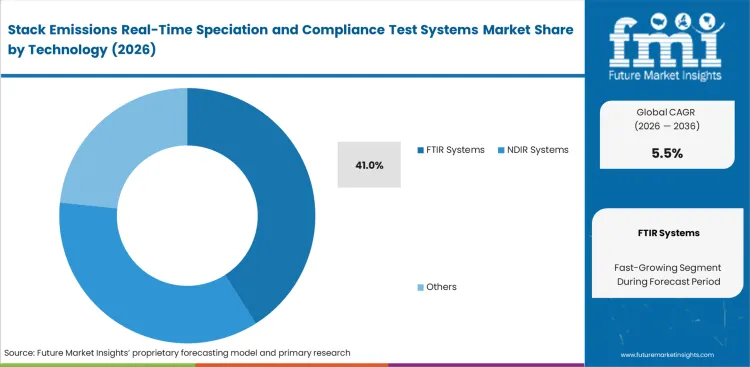
FTIR systems are estimated to account for 41.0% of market share in 2026, supported by demand from heavy manufacturing environments that require simultaneous measurement of multiple hazardous gases. Older monitoring formats are losing relevance where environmental permits require immediate multi-component tracking across changing process conditions. Integration of emissions management software with FTIR platforms is strengthening system value by improving calibration discipline and supporting more stable day-to-day monitoring performance. Facilities replacing single-gas sensors are also likely to reduce maintenance disruptions, while equipment selection increasingly reflects preference for software that can anticipate optic degradation before it affects data quality.
- Interference Mitigation: Spectral overlap remains a key accuracy constraint in older optical configurations during abrupt process variation. Modern algorithmic compensation is helping reduce moisture-related interference and improve signal reliability across complex gas streams. Use of outdated compensation models is likely to raise compliance risk where precise component separation is required.
- Corrosive Degradation: Acidic condensation is estimated to remain a major durability challenge for exposed optic lenses in harsh stack environments. Heated cell components are widely preferred because they help maintain sample temperatures above acid dew points and protect internal optical assemblies. Weak thermal management can shorten service life and reduce long-term measurement stability.
- Audit Trace Gaps: Missing calibration records can undermine the integrity of continuous emissions data during compliance review. Internal software is increasingly configured to log zero and span checks independently, which supports traceability even when plant-wide systems face interruption. Redundant audit logging is becoming essential in facilities where uninterrupted verification records shape compliance readiness.
Stack Emissions Real-Time Speciation and Compliance Test Systems Market Analysis by Deployment
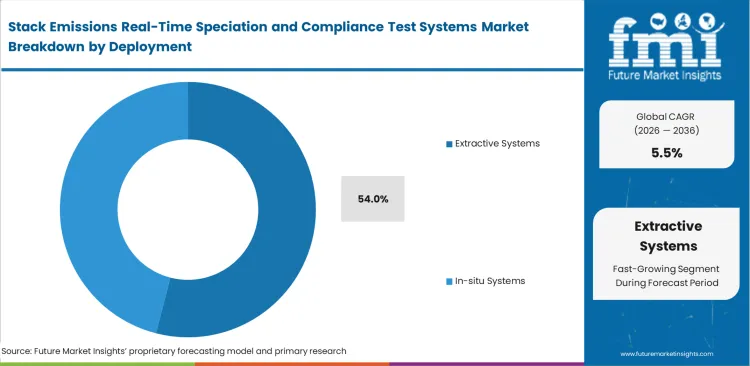
Site engineers strongly prefer extractive setups since operators must physically pull hot gases out of the smokestack and treat them before touching sensitive optical cells. This physical requirement explains why extractive systems are projected to secure a 54.0% share in 2026, as factories need reliable ways to condition harsh emissions. Setting up pollution monitoring equipment in this remote format keeps fragile electronics safely away from extreme heat and intense vibrations. Centralized extractive cabinets allow maintenance crews to service several sample lines from the ground instead of climbing dangerous stacks. Purchasing groups often overlook the massive amount of electricity required to keep long sample lines continuously heated. Cutting costs on these heated transport lines leads to immediate sample freezing, ruining the compliance data entirely.
- Thermal Line Sizing: Long sample runs require massive electrical tracing to maintain constant temperatures above 180°C. Maintenance technicians struggle to diagnose cold spots in aging lines. Dropping below target temperatures causes water-soluble pollutants to wash out before reaching analyzers.
- Chiller Condensation: Removing moisture without removing soluble acid gases demands precise thermoelectric chilling. Instrumentation specialists adjust cooling profiles based on fuel sulfur content. Poor moisture removal floods analytical cells and destroys optical mirrors.
- Blowback Automation: High particulate loads blind sample probes rapidly during solid fuel combustion. Operators program automatic compressed air blowback cycles to clear sintered filters. Inadequate blowback frequency causes sample starvation and triggers system fault alarms.
Stack Emissions Real-Time Speciation and Compliance Test Systems Market Analysis by Pollutant Scope
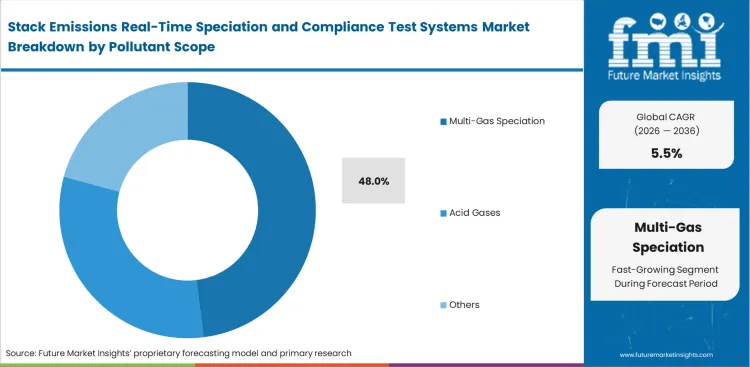
Industrial plants are actively moving away from basic single-gas tracking as global environmental regulations tighten. Environmental permits now demand simultaneous live reporting for ammonia slip, hydrogen chloride, and volatile organics right alongside traditional greenhouse gases. Installing advanced process spectroscopy setups satisfies these expanded rules using just one unified optical path. Shifting toward comprehensive gas reading prevents a factory from having to drill brand new holes in its smokestack every time a new compound gets regulated. Adding new chemical species to an existing modern analyzer usually just requires a simple software unlock rather than buying expensive physical hardware. Factories clinging to outdated standalone sensors face massive integration costs, projecting multi-gas speciation to account for an estimated 48.0% share in 2026 as compliance demands peak across heavy industries.
- Ammonia Slip Detection: Post-combustion NOx reduction systems inject ammonia, risking unreacted chemical slip into atmosphere. Environmental officers monitor this specific compound to balance reagent costs against compliance limits. Excessive slip generates immediate fines and wastes expensive chemical additives.
- Acid Gas Profiling: Waste incinerators produce highly variable acidic emissions depending on municipal trash composition. Plants use continuous speciation to adjust scrubber dosing rates dynamically. Delayed acid gas readings cause severe corrosion in downstream pollution control equipment.
- Hydrocarbon Tracking: Refining operations face strict limits on unburned volatile organics escaping through flaring systems. Compliance technicians rely on fast-response optical analysis to prove destruction efficiency. Missing these transient emission spikes violates strict air quality permits.
Stack Emissions Real-Time Speciation and Compliance Test Systems Market Analysis by End Use
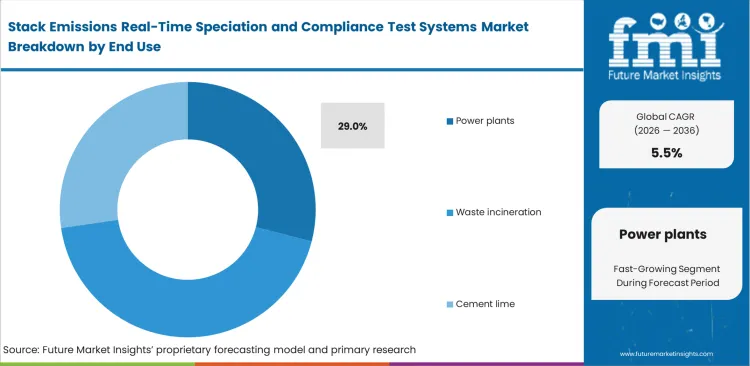
Decades of strict government oversight helped power plants build a massive base of compliance equipment, positioning this sector to command a 29.0% share in 2026 across the industrial landscape. Utility operators currently manage hundreds of aging analyzers that urgently need replacement before they fail mandatory audits. Applying modern environmental monitoring technology allows energy producers to use the exact same parts across several different generating units. Replacing a chaotic mix of old equipment with one unified platform heavily reduces staff training hours and cuts down expensive spare parts inventory. Having existing heated sample lines already built into the smokestacks gives old power stations a huge structural advantage, making equipment swap-outs much cheaper than building from scratch. Delaying these crucial upgrades leaves older plants struggling to find replacement parts for obsolete sensors, creating a high risk of prolonged shutdowns during surprise compliance checks.
- Coal Fleet Transition: Aging solid fuel plants require robust dust and acid gas monitoring to maintain operating licenses. Instrumentation engineers replace failing dilution systems with fully heated extractive setups. Achieving reliable data proves critical for extending operating life under tightening environmental scrutiny.
- Combined Cycle Tracking: Natural gas turbines produce extremely low NOx concentrations requiring high-sensitivity detection. Operators specify specialized optical benches capable of single-digit parts-per-million accuracy. Failing to measure trace emissions accurately forces turbines to operate at reduced loads.
- Biomass Conversion: Facilities switching from coal to biomass face entirely new emission profiles featuring high moisture and complex organic compounds. Compliance branches must re-certify entire analytical trains for these new conditions. Using incorrect analyzer ranges during fuel transitions invalidates all generated compliance data.
Stack Emissions Real-Time Speciation and Compliance Test Systems Market Analysis by Component
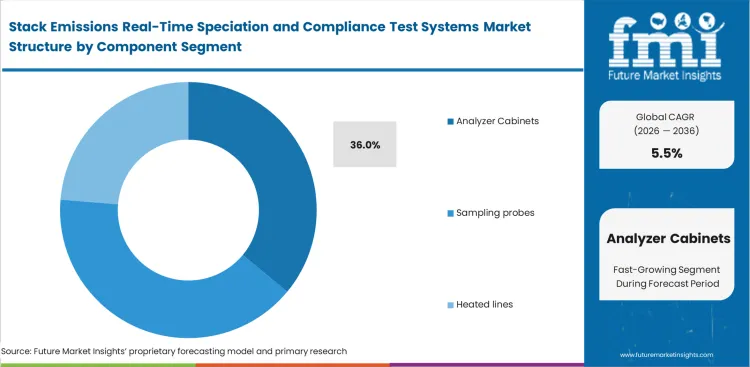
Industrial buyers view reinforced enclosures as the central brain for entire emission monitoring setups, relying on them to protect highly sensitive analytical hardware. This critical function drives analyzer cabinets likely to represent an anticipated 36.0% market share in 2026, as plants prioritize upgrading their core infrastructure. Integrating sensitive FTIR gas analyzers into climate-controlled enclosures protects fragile internal mirrors from brutal factory environments. Centralizing all the electronics into one spot simplifies daily maintenance access and creates a highly stable environment for storing sensitive calibration gases. Poorly designed cabinet ventilation causes more equipment failures during hot summer months than natural component aging. Buying a cabinet with weak air conditioning guarantees continuous temperature alarms, forcing maintenance crews to waste hours on constant manual recalibration.
- Optical Bench Stability: Precision interferometers require strict temperature control to maintain baseline stability. Maintenance technicians calibrate internal cabinet heaters to prevent thermal shocking. Fluctuating internal temperatures destroy measurement accuracy for low-concentration gases.
- Gas Cylinder Management: Centralized cabinets house specialized calibration gas mixtures required for daily automated checks. Purchasing agents negotiate bulk supply contracts to ensure uninterrupted QA testing. Running out of certified calibration gas forces an immediate system fault state.
- Data Security Isolation: Compliance records must remain secure from unauthorized manipulation or accidental deletion. IT officers isolate analyzer networks from general plant control systems. Breaching data security protocols voids entire compliance reporting periods and triggers governmental investigations.
Stack Emissions Real-Time Speciation and Compliance Test Systems Market Drivers, Restraints, and Opportunities
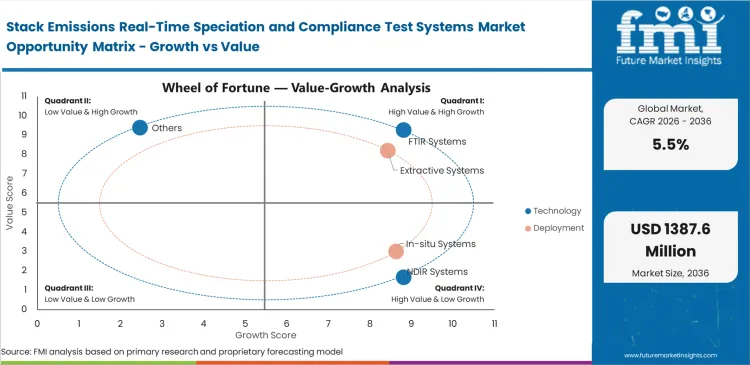
Strict new environmental rules are forcing heavy industries to completely rebuild their aging smokestack monitoring setups. Industrial plants can no longer rely on older sensors that measure just one type of gas at a time. Regulatory agencies now expect continuous, live data feeds for a wide mix of secondary pollutants, including hydrogen chloride and ammonia. Falling behind on these upgrades exposes operating companies to sudden plant shutdowns and massive fines during routine environmental audits. Combining live gas speciation with advanced process liquid analyzer data gives operators a total picture of plant health and compliance status. Authorities across major manufacturing hubs refuse to accept quarterly manual testing anymore, insisting on unbroken, automated data trails transmitted directly to government servers. Industrial sites are left with no choice but to invest in modern analytical equipment and secure data software just to keep their basic operating permits valid. The immediate need to avoid costly legal trouble and forced downtime drives continuous investment in better testing hardware.
Upgrading an industrial smokestack is a difficult physical process that slows down the adoption of new equipment. Replacing embedded sample lines, heated tubes, and sensitive optical sensors is nearly impossible while a factory is actively running. Facilities often must wait for major scheduled maintenance shutdowns, which might only happen every two or three years, just to swap out old testing hardware safely. Evolving wireless technology offers some help, but government regulations still strictly demand hardwired, highly secure data cables for official environmental reporting. The sheer logistical difficulty of tearing out old wiring and installing new physical infrastructure deep inside a hazardous smokestack creates a natural speed limit on market growth. Companies want better data, but they cannot afford to stop production purely to install new sensors outside of their regular turnaround windows.
- Mercury Tracking Integration: Industrial power producers are facing fresh regulations specifically targeting heavy metal emissions. Embedding mercury analyzers directly into existing monitoring cabinets solves this problem without building entirely new testing stations. Adding this specific detection capability keeps older facilities compliant and extends their total operating lifespan.
- Predictive Maintenance Software: Unexpected sensor failures cause immediate reporting gaps and potential fines. Software that predicts exactly when a glass optic will degrade or fail allows operators to schedule precise repairs. Catching these component issues early prevents expensive emergency shutdowns and keeps the continuous data flowing.
- Remote Diagnostic Services: Finding skilled technicians capable of fixing complex optical equipment in remote industrial areas remains highly challenging. Secure remote-access contracts allow equipment manufacturers to log in and troubleshoot calibration errors from anywhere. Fixing software or calibration faults from a distance radically cuts down system offline time.
Regional Analysis
.webp "Top Country Growth Comparison Stack Emissions Real Time Speciation And Compliance Test Systems Market Cagr (2026 2036)")
Regional demand depends heavily on local enforcement of air quality standards and carbon reporting mandates. Facilities in areas with active, real-time penalty systems are upgrading legacy setups much faster than those operating under periodic, manual reporting rules.
| Country | CAGR (2026 to 2036) |
|---|---|
| China | 6.8% |
| India | 6.5% |
| South Korea | 6.1% |
| Germany | 5.7% |
| United States | 5.1% |
| Japan | 4.8% |
| United Kingdom | 4.6% |
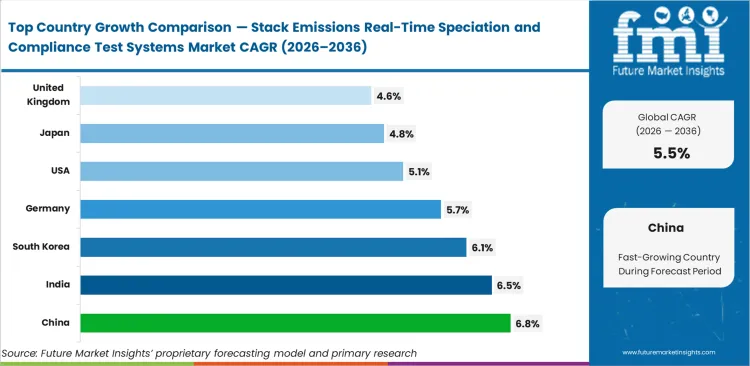
Source: Future Market Insights (FMI) analysis, based on proprietary forecasting model and primary research
Asia Pacific Stack Emissions Real-Time Speciation and Compliance Test Systems Market Analysis
Stringent pollutant reporting mandates force heavy industry across Asia Pacific to overhaul legacy monitoring stacks. Environmental protection agencies no longer accept mathematical emission estimates, demanding physical sensor data instead. Capital expenditure for environmental compliance now represents a non-negotiable requirement for any new industrial construction project in the region.
- China: China is set to record a CAGR of 6.8% in the stack emissions compliance sector during the assessment period. State-owned enterprises prioritize turnkey systems utilizing mercury capture sorbents to avoid piecemeal integration failures. Operations personnel rely on these unified setups to pass unannounced governmental inspections without halting production lines.
- India: Expanded online continuous emission monitoring system requirements force high-polluting sectors to abandon manual sampling. Demand for compliance-grade analyzers in India is anticipated to rise at a CAGR of 6.5% from 2026 to 2036. Plant operators increasingly demand equipment capable of self-calibration to overcome local shortages of skilled instrumentation technicians.
- South Korea: Intensified national clean air legislation demands parts-per-billion precision for hazardous air pollutants, requiring instrumentation engineers to qualify advanced gas sensors to meet these tightened limits. Consequently, South Korea is projected to witness a 6.1% CAGR in this instrumentation through 2036, as corporate leadership prioritizes these investments to maintain long-term industrial operating licenses.
- Japan: Japan is likely to post a CAGR of 4.8% in compliance analyzers by 2036. Aging industrial infrastructure necessitates frequent maintenance cycle optimization on mature installed bases. Plant operators upgrade to predictive diagnostic software alongside tunable diode laser analyzer technology to extend equipment lifespan and satisfy current environmental reporting requirements.
FMI's report includes detailed analysis of broader regions like Southeast Asia and Australasia. Evolving local air quality regulations in these territories slowly shift buyer preference toward automated continuous measurement over periodic manual testing. Regional plants now prioritize integrated software platforms capable of formatting raw data specifically for local environmental agency servers.
Europe Stack Emissions Real-Time Speciation and Compliance Test Systems Market Analysis
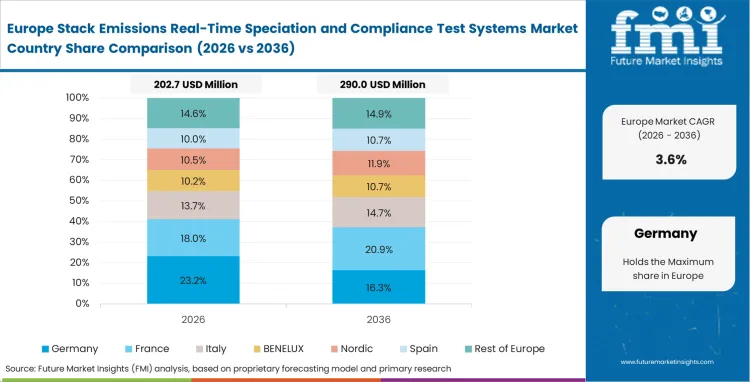
Tightening Industrial Emissions Directive standards require European facility operators to upgrade existing extractive setups. Regulatory focus has shifted toward measuring trace acidic compounds alongside traditional greenhouse gases. Investing in systems with predictive diagnostic software allows maintenance personnel to replace failing optical components during scheduled plant shutdowns rather than facing emergency outages.
- Germany: Local environmental authorities enforce some of the strictest emission limit values globally, triggering an automatic regulatory investigation for missing a single hour of continuous reporting. Germany is forecast to record steady growth in stack compliance monitors at a CAGR of 5.7% through 2036. Environmental compliance personnel use this uninterrupted data trail to prove scrubber efficiency during variable industrial production cycles.
- United Kingdom: Site operators optimize calibration gas consumption to manage rising operational overheads by negotiating long-term service agreements for natural gas analyzers to stabilize total lifecycle costs. Understanding these service dynamics reveals why United Kingdom adoption is anticipated to register a CAGR of 4.6% through 2036, as actual profitability depends heavily on minimizing costly maintenance interventions.
FMI's report includes detailed analysis of broader regions like Eastern Europe and Scandinavia. Progressive carbon taxation frameworks in these territories force operators to adopt highly accurate mass emission calculation systems. Data transparency determines whether plants receive continued operating authorization, driving the need for fully redundant architectures to guarantee zero downtime.
North America Stack Emissions Real-Time Speciation and Compliance Test Systems Market Analysis
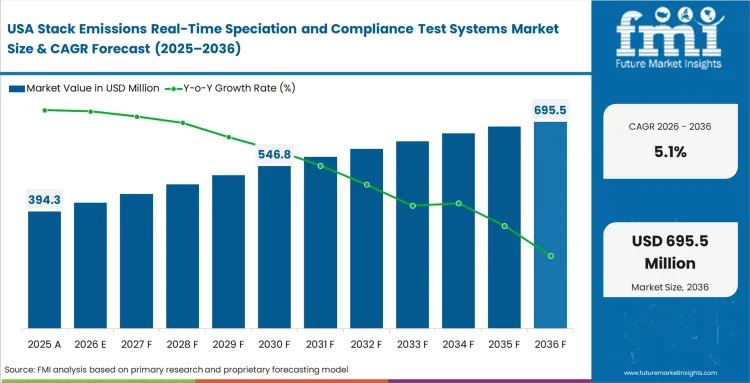
Complex Environmental Protection Agency rules regarding secondary aerosol precursors dictate North American upgrade cycles. Protecting compliance networks from external manipulation has become just as important as measuring the physical gas streams accurately. Installing robust analytical hardware provides plant executives with defensible engineering data to counter public pollution claims.
- United States: Sales of compliance systems in the United States are expected to increase at a CAGR of 5.1% during the forecast period. Changing federal mandates force power generation facilities to measure trace metals and acid gases continuously. Regulatory compliance personnel specify heated sample handling systems alongside high performance mercury sorbent tracking to prevent condensation of hazardous compounds, ensuring energy producers can defend their operational permits during intense environmental audits.
FMI's report includes detailed analysis of Canada and Mexico. Cross-border environmental agreements gradually harmonize compliance standards, pushing southern facilities toward automated real-time reporting architectures. Long-term operational viability in this region requires treating environmental monitoring systems as critical production infrastructure rather than optional accessory equipment.
Competitive Aligners for Market Players
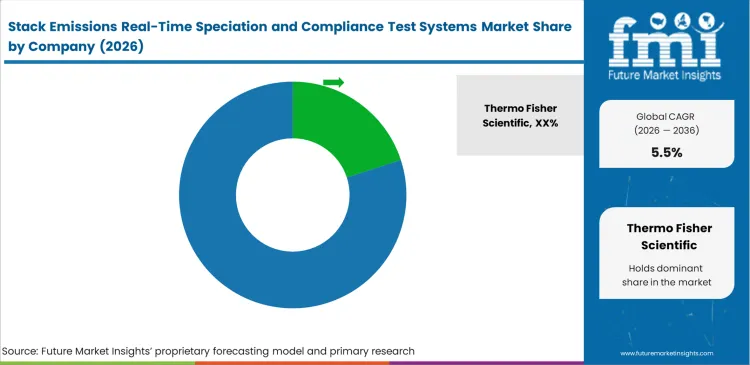
Securing large industrial contracts depends heavily on how well a supplier builds a complete, ready-to-use solution. Companies like Thermo Fisher Scientific and HORIBA deliver fully integrated packages that include heated sample probes, climate-controlled cabinets, and certified reporting software. Industrial plants facing strict regulatory deadlines refuse to assemble these complex setups piece by piece. Offering a standalone environmental radiation monitor or a basic optical bench fails to meet current operational needs. To win bids, vendors must guarantee the entire system works continuously and take full responsibility for the initial regulatory certification testing.
Local service access gives entrenched vendors a massive operational advantage over new competitors. Firms like ENVEA and SICK use their existing site presence to win lucrative replacement contracts. Challengers struggle to match the rapid four-hour emergency response times that large power plants require. Built-in software systems and integrated flue gas coolers create strong customer lock-in. Switching to a new software platform forces plant operators to retrain staff and rewrite customized government reporting templates, making them highly reluctant to change suppliers.
Ongoing maintenance costs dictate vendor selection much more than the initial equipment price. Multinational chemical firms use their purchasing volume to secure long-term price guarantees on specialized calibration gases and consumable spare parts. These large industrial customers routinely impose aggressive financial penalties on vendors for any analyzer downtime. Equipment manufacturers counter this pressure by developing self-calibrating optics and features similar to integrated battery emissions and off-gassing characterization systems. These built-in upgrades reduce the daily need for expensive bottled gas mixtures. Vendors failing to lower these daily maintenance burdens risk losing market access entirely.
Key Players in Stack Emissions Real-Time Speciation and Compliance Test Systems Market
- Thermo Fisher Scientific
- HORIBA
- ENVEA
- SICK
- MKS Instruments
- Siemens
- Fuji Electric
Scope of the Report
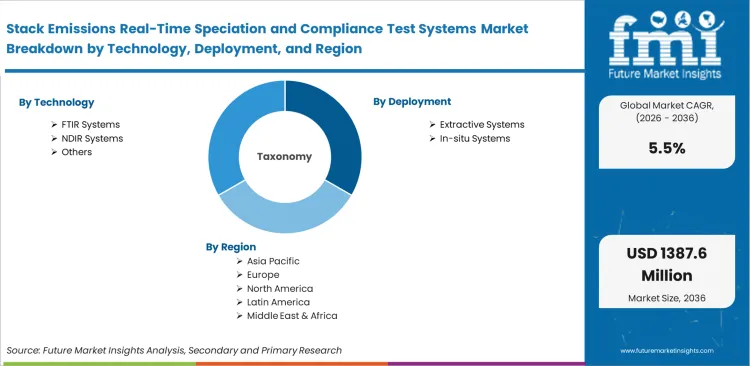
| Metric | Value |
|---|---|
| Quantitative Units | USD 770 million to USD 1,310 million, at a CAGR of 5.5% |
| Market Definition | Scope covers compliance-grade real-time stack analyzers, multi-gas speciation systems, heated sample handling hardware, data acquisition modules, and quality assurance components used on fixed industrial emission sources. This sector focuses on instrumentation engineered to survive corrosive stack conditions while generating defensible audit trails for regulatory bodies. |
| Segmentation | Technology, Deployment, Pollutant scope, End use, Component, Region |
| Regions Covered | North America, Latin America, Europe, Asia Pacific, Middle East and Africa |
| Countries Covered | United States, Germany, United Kingdom, China, Japan, India, South Korea |
| Key Companies Profiled | Thermo Fisher Scientific, HORIBA, ENVEA, SICK, MKS Instruments, Siemens, Fuji Electric |
| Forecast Period | 2026 to 2036 |
| Approach | Installed base estimates for major industrial smokestacks anchored by regulatory permit renewals. |
Source: Future Market Insights (FMI) analysis, based on proprietary forecasting model and primary research
Key Segments
Technology
- FTIR systems
- NDIR systems
- UV systems
- TDLAS systems
- Hybrid systems
Deployment
- Extractive systems
- In-situ systems
- Portable systems
- Trailer systems
Pollutant Scope
- Multi-gas speciation
- Acid gases
- Mercury systems
- Dust opacity
- Flow oxygen
End Use
- Power plants
- Waste incineration
- Cement lime
- Refining petrochemicals
- Metals mining
- Chemicals
Component
- Analyzer cabinets
- Sampling probes
- Heated lines
- Conditioning units
- DAHS software
- QA modules
Regions:
- Asia Pacific
- India
- China
- Japan
- South Korea
- Indonesia
- Australia & New Zealand
- ASEAN
- Rest of Asia Pacific
- Europe
- Germany
- Italy
- France
- United Kingdom
- Spain
- Benelux
- Nordics
- Central & Eastern Europe
- Rest of Europe
- North America
- United States
- Canada
- Mexico
- Latin America
- Brazil
- Argentina
- Chile
- Rest of Latin America
- Middle East & Africa
- Kingdom of Saudi Arabia
- United Arab Emirates
- South Africa
- Turkey
- Rest of Middle East & Africa
Bibliography
- Environment Agency. (2024). Monitoring stack emissions: standards for continuous monitoring and sampling. GOV.UK.
- European Parliament and Council. (2024). Directive (EU) 2024/1785 of the European Parliament and of the Council of 24 April 2024 amending Directive 2010/75/EU of the European Parliament and of the Council on industrial emissions (integrated pollution prevention and control) and Council Directive 1999/31/EC on the landfill of waste (Text with EEA relevance). EUR-Lex.
- Nguyen, M. T. N., & Lee, J. S. (2024). Development of a chemical sensor device for monitoring hazardous gases generated in the semiconductor manufacturing process. Chemosensors, 12(11), 233.
- Worden, J., Green, P., Eldering, A., & Sherwin, E. (2025). Common practices for quantifying methane emissions from plumes detected by remote sensing (NIST Interagency Report 8575). National Institute of Standards and Technology.
This bibliography is provided for reader reference. The full FMI report contains the complete reference list with primary source documentation.
This Report Addresses
- Regional policy mandates forcing heavy industry to overhaul legacy monitoring stacks across key geographic markets.
- Structural shift from single-pollutant monitors to integrated multi-gas analytical trains in compliance applications.
- Operational friction caused by calibration gas consumption and strict audit testing protocols.
- Financial justification for specifying predictive optic degradation software inside analyzer cabinets.
- Compliance risks associated with unheated sample lines and inadequate moisture removal conditioning units.
- Service network density requirements for system integrators bidding on large power generation fleet contracts.
- Impact of changing federal EPA regulations on secondary aerosol precursors and acid gas reporting.
- Sourcing strategies multinational firms use to negotiate extended service agreements and stabilize lifecycle costs.
Frequently Asked Questions
How large is the Stack Emissions Real-Time Speciation and Compliance Test Systems industry currently?
Valuation reached USD 770 million in 2026. This figure reflects widespread industrial upgrades driven by expanding environmental compliance mandates.
What valuation will this sector achieve by 2036?
Forecasts indicate total revenue crossing USD 1,310 million by 2036. Sustained investment stems from facilities replacing aging standalone sensors with integrated analytical systems.
What is the projected compound annual growth rate?
Sales are poised to expand at 5.5% CAGR through 2036. Tightening regulatory audits force operators to continuously modernize their data acquisition capabilities.
Why do FTIR systems lead the technology segment?
These optical benches quantify multiple hazardous gases simultaneously. Facilities require this capability to satisfy complex multi-pollutant environmental permits efficiently.
Why are extractive systems dominant in deployment?
Removing and conditioning stack gas isolates fragile electronics from extreme heat. Instrumentation engineers rely on this architecture to maintain long-term analytical accuracy.
What drives the adoption of multi-gas speciation?
Regulators constantly add secondary pollutants to local monitoring requirements. Upgrading to comprehensive speciation prevents facilities from drilling new stack ports for every newly regulated compound.
Why do power plants hold significant end-use share?
Decades of strict regulatory oversight force fleet operators to maintain massive installed bases. Fleet officers standardize analytical platforms across multiple generating units to reduce spare parts inventory.
What makes analyzer cabinets a high-value component?
Centralizing control electronics simplifies maintenance access and provides climate control for sensitive interferometers. Integrating these systems protects delicate hardware from harsh industrial environments.
How does China's growth compare to other regions?
China records a 6.8% CAGR due to stringent carbon and secondary aerosol tracking rules. State-owned enterprises prioritize turnkey systems to avoid piecemeal integration failures.
What structural condition drives India's expansion?
Expanded online continuous emission reporting requirements force high-polluting sectors to abandon manual sampling. Reaching full compliance eliminates constant risk of forced operational shutdowns.
How do European regulations impact local upgrades?
Tightening Industrial Emissions Directive standards require facilities to measure trace acidic compounds. Data transparency determines whether plants receive continued operating authorization.
What hidden costs affect equipment selection?
Calibration gas consumption represents a massive ongoing expenditure. Experienced operators prioritize software capable of reducing scheduled maintenance events over basic hardware discounts.
Why is data acquisition software critical for compliance?
Missing calibration records invalidate weeks of continuous emission data during regulatory reviews. Compliance officers configure software to log zero and span checks automatically.
What risk do unheated sample lines pose?
Dropping below target temperatures causes water-soluble pollutants to wash out before reaching analyzers. Facilities attempting to cut electrical costs face immediate sample freezing and compliance invalidation.
How does moisture removal impact optical cells?
Removing moisture without removing soluble acid gases demands precise thermoelectric chilling. Poor moisture removal floods analytical cells and destroys expensive internal mirrors.
Why do biomass conversions require new analyzers?
Switching fuel types creates entirely new emission profiles featuring high moisture content. Compliance branch must re-certify entire analytical trains for these altered conditions.
What role does cabinet ventilation play in reliability?
Precision interferometers require strict temperature control to maintain baseline stability. Poorly designed ventilation causes severe thermal drift alarms during summer months.
How do incumbents maintain competitive advantage?
Established regional service networks guarantee rapid emergency response times. Owning proprietary reporting software creates significant vendor lock-in across large industrial fleets.
Why do challengers struggle to gain market share?
Building service density required to support four-hour response times demands massive capital investment. Supplying basic hardware without integration capabilities fails to attract compliance-focused buyers.
What technical feature reduces maintenance friction?
Self-calibrating optics minimize reliance on expensive bottled gas mixtures. Vendors developing these predictive features align perfectly with buyers prioritizing lowest total lifecycle costs.
How does cybersecurity impact analyzer networks?
Compliance records must remain secure from unauthorized manipulation. IT ofiicers isolate emission networks from general plant control systems to prevent data breaches.
What consequence awaits facilities failing audits?
Missing transient emission spikes violates strict air quality permits. Regulators levy severe fines and enforce mandatory production halts until compliance systems receive recertification.
Preview the report firsthand - request a free sample
Get SampleGet the brochure for pricing and purchase details.
Get PDFTable of Content
- Executive Summary
- Global Market Outlook
- Demand-side Trends
- Supply-side Trends
- Technology Roadmap Analysis
- Analysis and Recommendations
- Market Overview
- Market Coverage / Taxonomy
- Market Definition / Scope / Limitations
- Research Methodology
- Chapter Orientation
- Analytical Lens and Working Hypotheses
- Market Structure, Signals, and Trend Drivers
- Benchmarking and Cross-market Comparability
- Market Sizing, Forecasting, and Opportunity Mapping
- Research Design and Evidence Framework
- Desk Research Programme (Secondary Evidence)
- Company Annual and Sustainability Reports
- Peer-reviewed Journals and Academic Literature
- Corporate Websites, Product Literature, and Technical Notes
- Earnings Decks and Investor Briefings
- Statutory Filings and Regulatory Disclosures
- Technical White Papers and Standards Notes
- Trade Journals, Industry Magazines, and Analyst Briefs
- Conference Proceedings, Webinars, and Seminar Materials
- Government Statistics Portals and Public Data Releases
- Press Releases and Reputable Media Coverage
- Specialist Newsletters and Curated Briefings
- Sector Databases and Reference Repositories
- FMI Internal Proprietary Databases and Historical Market Datasets
- Subscription Datasets and Paid Sources
- Social Channels, Communities, and Digital Listening Inputs
- Additional Desk Sources
- Expert Input and Fieldwork (Primary Evidence)
- Primary Modes
- Qualitative Interviews and Expert Elicitation
- Quantitative Surveys and Structured Data Capture
- Blended Approach
- Why Primary Evidence is Used
- Field Techniques
- Interviews
- Surveys
- Focus Groups
- Observational and In-context Research
- Social and Community Interactions
- Stakeholder Universe Engaged
- C-suite Leaders
- Board Members
- Presidents and Vice Presidents
- R&D and Innovation Heads
- Technical Specialists
- Domain Subject-matter Experts
- Scientists
- Physicians and Other Healthcare Professionals
- Governance, Ethics, and Data Stewardship
- Research Ethics
- Data Integrity and Handling
- Primary Modes
- Tooling, Models, and Reference Databases
- Desk Research Programme (Secondary Evidence)
- Data Engineering and Model Build
- Data Acquisition and Ingestion
- Cleaning, Normalisation, and Verification
- Synthesis, Triangulation, and Analysis
- Quality Assurance and Audit Trail
- Market Background
- Market Dynamics
- Drivers
- Restraints
- Opportunity
- Trends
- Scenario Forecast
- Demand in Optimistic Scenario
- Demand in Likely Scenario
- Demand in Conservative Scenario
- Opportunity Map Analysis
- Product Life Cycle Analysis
- Supply Chain Analysis
- Investment Feasibility Matrix
- Value Chain Analysis
- PESTLE and Porter’s Analysis
- Regulatory Landscape
- Regional Parent Market Outlook
- Production and Consumption Statistics
- Import and Export Statistics
- Market Dynamics
- Global Market Analysis 2021 to 2025 and Forecast, 2026 to 2036
- Historical Market Size Value (USD Million) Analysis, 2021 to 2025
- Current and Future Market Size Value (USD Million) Projections, 2026 to 2036
- Y-o-Y Growth Trend Analysis
- Absolute $ Opportunity Analysis
- Global Market Pricing Analysis 2021 to 2025 and Forecast 2026 to 2036
- Global Market Analysis 2021 to 2025 and Forecast 2026 to 2036, By Technology
- Introduction / Key Findings
- Historical Market Size Value (USD Million) Analysis By Technology , 2021 to 2025
- Current and Future Market Size Value (USD Million) Analysis and Forecast By Technology , 2026 to 2036
- FTIR Systems
- NDIR Systems
- Others
- FTIR Systems
- Y-o-Y Growth Trend Analysis By Technology , 2021 to 2025
- Absolute $ Opportunity Analysis By Technology , 2026 to 2036
- Global Market Analysis 2021 to 2025 and Forecast 2026 to 2036, By Deployment
- Introduction / Key Findings
- Historical Market Size Value (USD Million) Analysis By Deployment, 2021 to 2025
- Current and Future Market Size Value (USD Million) Analysis and Forecast By Deployment, 2026 to 2036
- Extractive Systems
- In-situ Systems
- Extractive Systems
- Y-o-Y Growth Trend Analysis By Deployment, 2021 to 2025
- Absolute $ Opportunity Analysis By Deployment, 2026 to 2036
- Global Market Analysis 2021 to 2025 and Forecast 2026 to 2036, By Pollutant Scope
- Introduction / Key Findings
- Historical Market Size Value (USD Million) Analysis By Pollutant Scope, 2021 to 2025
- Current and Future Market Size Value (USD Million) Analysis and Forecast By Pollutant Scope, 2026 to 2036
- Multi-Gas Speciation
- Acid Gases
- Others
- Multi-Gas Speciation
- Y-o-Y Growth Trend Analysis By Pollutant Scope, 2021 to 2025
- Absolute $ Opportunity Analysis By Pollutant Scope, 2026 to 2036
- Global Market Analysis 2021 to 2025 and Forecast 2026 to 2036, By End Use
- Introduction / Key Findings
- Historical Market Size Value (USD Million) Analysis By End Use, 2021 to 2025
- Current and Future Market Size Value (USD Million) Analysis and Forecast By End Use, 2026 to 2036
- Power plants
- Waste incineration
- Cement lime
- Power plants
- Y-o-Y Growth Trend Analysis By End Use, 2021 to 2025
- Absolute $ Opportunity Analysis By End Use, 2026 to 2036
- Global Market Analysis 2021 to 2025 and Forecast 2026 to 2036, By Component
- Introduction / Key Findings
- Historical Market Size Value (USD Million) Analysis By Component, 2021 to 2025
- Current and Future Market Size Value (USD Million) Analysis and Forecast By Component, 2026 to 2036
- Analyzer Cabinets
- Sampling probes
- Heated lines
- Analyzer Cabinets
- Y-o-Y Growth Trend Analysis By Component, 2021 to 2025
- Absolute $ Opportunity Analysis By Component, 2026 to 2036
- Global Market Analysis 2021 to 2025 and Forecast 2026 to 2036, By Region
- Introduction
- Historical Market Size Value (USD Million) Analysis By Region, 2021 to 2025
- Current Market Size Value (USD Million) Analysis and Forecast By Region, 2026 to 2036
- North America
- Latin America
- Western Europe
- Eastern Europe
- East Asia
- South Asia and Pacific
- Middle East & Africa
- Market Attractiveness Analysis By Region
- North America Market Analysis 2021 to 2025 and Forecast 2026 to 2036, By Country
- Historical Market Size Value (USD Million) Trend Analysis By Market Taxonomy, 2021 to 2025
- Market Size Value (USD Million) Forecast By Market Taxonomy, 2026 to 2036
- By Country
- USA
- Canada
- Mexico
- By Technology
- By Deployment
- By Pollutant Scope
- By End Use
- By Component
- By Country
- Market Attractiveness Analysis
- By Country
- By Technology
- By Deployment
- By Pollutant Scope
- By End Use
- By Component
- Key Takeaways
- Latin America Market Analysis 2021 to 2025 and Forecast 2026 to 2036, By Country
- Historical Market Size Value (USD Million) Trend Analysis By Market Taxonomy, 2021 to 2025
- Market Size Value (USD Million) Forecast By Market Taxonomy, 2026 to 2036
- By Country
- Brazil
- Chile
- Rest of Latin America
- By Technology
- By Deployment
- By Pollutant Scope
- By End Use
- By Component
- By Country
- Market Attractiveness Analysis
- By Country
- By Technology
- By Deployment
- By Pollutant Scope
- By End Use
- By Component
- Key Takeaways
- Western Europe Market Analysis 2021 to 2025 and Forecast 2026 to 2036, By Country
- Historical Market Size Value (USD Million) Trend Analysis By Market Taxonomy, 2021 to 2025
- Market Size Value (USD Million) Forecast By Market Taxonomy, 2026 to 2036
- By Country
- Germany
- UK
- Italy
- Spain
- France
- Nordic
- BENELUX
- Rest of Western Europe
- By Technology
- By Deployment
- By Pollutant Scope
- By End Use
- By Component
- By Country
- Market Attractiveness Analysis
- By Country
- By Technology
- By Deployment
- By Pollutant Scope
- By End Use
- By Component
- Key Takeaways
- Eastern Europe Market Analysis 2021 to 2025 and Forecast 2026 to 2036, By Country
- Historical Market Size Value (USD Million) Trend Analysis By Market Taxonomy, 2021 to 2025
- Market Size Value (USD Million) Forecast By Market Taxonomy, 2026 to 2036
- By Country
- Russia
- Poland
- Hungary
- Balkan & Baltic
- Rest of Eastern Europe
- By Technology
- By Deployment
- By Pollutant Scope
- By End Use
- By Component
- By Country
- Market Attractiveness Analysis
- By Country
- By Technology
- By Deployment
- By Pollutant Scope
- By End Use
- By Component
- Key Takeaways
- East Asia Market Analysis 2021 to 2025 and Forecast 2026 to 2036, By Country
- Historical Market Size Value (USD Million) Trend Analysis By Market Taxonomy, 2021 to 2025
- Market Size Value (USD Million) Forecast By Market Taxonomy, 2026 to 2036
- By Country
- China
- Japan
- South Korea
- By Technology
- By Deployment
- By Pollutant Scope
- By End Use
- By Component
- By Country
- Market Attractiveness Analysis
- By Country
- By Technology
- By Deployment
- By Pollutant Scope
- By End Use
- By Component
- Key Takeaways
- South Asia and Pacific Market Analysis 2021 to 2025 and Forecast 2026 to 2036, By Country
- Historical Market Size Value (USD Million) Trend Analysis By Market Taxonomy, 2021 to 2025
- Market Size Value (USD Million) Forecast By Market Taxonomy, 2026 to 2036
- By Country
- India
- ASEAN
- Australia & New Zealand
- Rest of South Asia and Pacific
- By Technology
- By Deployment
- By Pollutant Scope
- By End Use
- By Component
- By Country
- Market Attractiveness Analysis
- By Country
- By Technology
- By Deployment
- By Pollutant Scope
- By End Use
- By Component
- Key Takeaways
- Middle East & Africa Market Analysis 2021 to 2025 and Forecast 2026 to 2036, By Country
- Historical Market Size Value (USD Million) Trend Analysis By Market Taxonomy, 2021 to 2025
- Market Size Value (USD Million) Forecast By Market Taxonomy, 2026 to 2036
- By Country
- Kingdom of Saudi Arabia
- Other GCC Countries
- Turkiye
- South Africa
- Other African Union
- Rest of Middle East & Africa
- By Technology
- By Deployment
- By Pollutant Scope
- By End Use
- By Component
- By Country
- Market Attractiveness Analysis
- By Country
- By Technology
- By Deployment
- By Pollutant Scope
- By End Use
- By Component
- Key Takeaways
- Key Countries Market Analysis
- USA
- Pricing Analysis
- Market Share Analysis, 2025
- By Technology
- By Deployment
- By Pollutant Scope
- By End Use
- By Component
- Canada
- Pricing Analysis
- Market Share Analysis, 2025
- By Technology
- By Deployment
- By Pollutant Scope
- By End Use
- By Component
- Mexico
- Pricing Analysis
- Market Share Analysis, 2025
- By Technology
- By Deployment
- By Pollutant Scope
- By End Use
- By Component
- Brazil
- Pricing Analysis
- Market Share Analysis, 2025
- By Technology
- By Deployment
- By Pollutant Scope
- By End Use
- By Component
- Chile
- Pricing Analysis
- Market Share Analysis, 2025
- By Technology
- By Deployment
- By Pollutant Scope
- By End Use
- By Component
- Germany
- Pricing Analysis
- Market Share Analysis, 2025
- By Technology
- By Deployment
- By Pollutant Scope
- By End Use
- By Component
- UK
- Pricing Analysis
- Market Share Analysis, 2025
- By Technology
- By Deployment
- By Pollutant Scope
- By End Use
- By Component
- Italy
- Pricing Analysis
- Market Share Analysis, 2025
- By Technology
- By Deployment
- By Pollutant Scope
- By End Use
- By Component
- Spain
- Pricing Analysis
- Market Share Analysis, 2025
- By Technology
- By Deployment
- By Pollutant Scope
- By End Use
- By Component
- France
- Pricing Analysis
- Market Share Analysis, 2025
- By Technology
- By Deployment
- By Pollutant Scope
- By End Use
- By Component
- India
- Pricing Analysis
- Market Share Analysis, 2025
- By Technology
- By Deployment
- By Pollutant Scope
- By End Use
- By Component
- ASEAN
- Pricing Analysis
- Market Share Analysis, 2025
- By Technology
- By Deployment
- By Pollutant Scope
- By End Use
- By Component
- Australia & New Zealand
- Pricing Analysis
- Market Share Analysis, 2025
- By Technology
- By Deployment
- By Pollutant Scope
- By End Use
- By Component
- China
- Pricing Analysis
- Market Share Analysis, 2025
- By Technology
- By Deployment
- By Pollutant Scope
- By End Use
- By Component
- Japan
- Pricing Analysis
- Market Share Analysis, 2025
- By Technology
- By Deployment
- By Pollutant Scope
- By End Use
- By Component
- South Korea
- Pricing Analysis
- Market Share Analysis, 2025
- By Technology
- By Deployment
- By Pollutant Scope
- By End Use
- By Component
- Russia
- Pricing Analysis
- Market Share Analysis, 2025
- By Technology
- By Deployment
- By Pollutant Scope
- By End Use
- By Component
- Poland
- Pricing Analysis
- Market Share Analysis, 2025
- By Technology
- By Deployment
- By Pollutant Scope
- By End Use
- By Component
- Hungary
- Pricing Analysis
- Market Share Analysis, 2025
- By Technology
- By Deployment
- By Pollutant Scope
- By End Use
- By Component
- Kingdom of Saudi Arabia
- Pricing Analysis
- Market Share Analysis, 2025
- By Technology
- By Deployment
- By Pollutant Scope
- By End Use
- By Component
- Turkiye
- Pricing Analysis
- Market Share Analysis, 2025
- By Technology
- By Deployment
- By Pollutant Scope
- By End Use
- By Component
- South Africa
- Pricing Analysis
- Market Share Analysis, 2025
- By Technology
- By Deployment
- By Pollutant Scope
- By End Use
- By Component
- USA
- Market Structure Analysis
- Competition Dashboard
- Competition Benchmarking
- Market Share Analysis of Top Players
- By Region
- By Technology
- By Deployment
- By Pollutant Scope
- By End Use
- By Component
- Competition Analysis
- Competition Deep Dive
- Thermo Fisher Scientific
- Overview
- Product Portfolio
- Profitability by Market Segments (Product/Age /Sales Channel/Region)
- Sales Footprint
- Strategy Overview
- Marketing Strategy
- Product Strategy
- Channel Strategy
- HORIBA
- ENVEA
- SICK
- MKS Instruments
- Siemens
- Fuji Electric
- Thermo Fisher Scientific
- Competition Deep Dive
- Assumptions & Acronyms Used


