

- Industry Size (2026)
- USD 3250.0 Mn
- Forecast (2036)
- USD 6824.0 Mn
- CAGR (2026 to 2036)
- 7.7%
Gas Sensors Market Forecast and Outlook 2026 to 2036
The gas sensors market is likely to be valued at USD 3,250.0 million in 2026 and is forecasted to reach USD 6,824.0 million by 2036 at a CAGR of 7.7%. Value behavior is shaped by mandatory deployment within safety critical environments rather than discretionary instrumentation upgrades. Adoption reflects regulatory exposure across oil and gas facilities, chemical plants, mining operations, and confined infrastructure assets. Capital allocation prioritizes sensing solutions that deliver continuous detection, fast response times, and reliable alerting under hazardous conditions. Investment decisions align with risk severity, inspection frequency, and consequences of undetected leaks on personnel safety and asset integrity. Demand persistence follows compliance driven installation density and replacement cycles governed by calibration limits.
Operational environments impose constraints that directly influence achievable deployment scale and lifecycle economics. Sensors experience performance degradation from humidity, temperature extremes, corrosive gases, and particulate exposure. Frequent calibration requirements increase downtime and skilled labor dependence, especially in distributed installations. Sensor poisoning and drift reduce usable service life, affecting trust in readings and audit outcomes. Power consumption limits adoption in remote or battery dependent locations. Integration with legacy control systems raises commissioning complexity and cost. Certification renewal and region specific standards add administrative burden. Supply concentration for specialized sensing materials introduces cost volatility across high performance detection categories.
Quick Stats for Gas Sensors Market
- Gas Sensors Market Value (2026): USD 3,250.0 million
- Gas Sensors Market Forecast Value (2036): USD 6,824 million
- Gas Sensors Market Forecast CAGR 2026 to 2036: 7.7%
- Leading Technology Type by Demand Share: Electrochemical Sensors
- Fastest-Growing Countries: India, China, USA, Germany, Japan
- Top Players in Global Demand: Honeywell, Siemens, ABB, Bosch Sensortec, Figaro Engineering
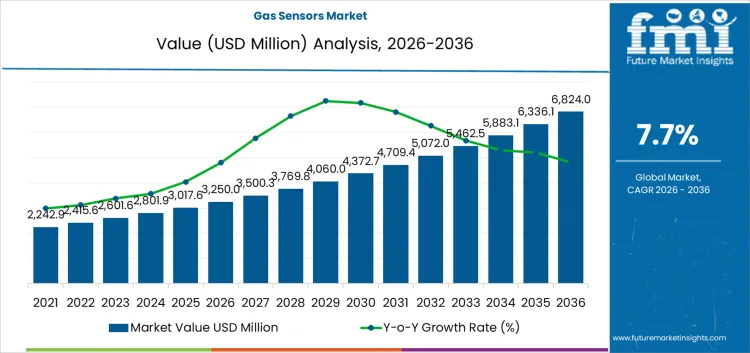
Gas Sensors Market Key Takeaways
| Metric | Value |
|---|---|
| Market Value (2026) | USD 3,250.0 million |
| Market Forecast Value (2036) | USD 6,824.0 million |
| Forecast CAGR 2026 to 2036 | 7.7% |
Why is the Demand for Gas Sensors Market Growing?
The demand for gas sensors is rising as industrial facilities implement stringent safety protocols to detect hazardous leaks and prevent workplace incidents. Oil and gas refineries, chemical processing plants, and mining operations install fixed and portable sensors to continuously monitor toxic and combustible gases. Environmental monitoring programs require precise detection to assess air quality near urban centers and industrial zones. HVAC system integrators incorporate gas detection modules to maintain indoor air standards in commercial buildings and research laboratories. Public infrastructure projects that include tunnels, parking structures, and transit hubs specify gas sensors to manage risks associated with vehicle emissions and confined spaces.
Technological progress in sensor fabrication is encouraging adoption across sectors that require real time data and remote connectivity. Semiconductor and MEMS based sensors offer smaller footprints and lower power consumption, supporting integration into wearable safety devices and autonomous systems. Increasing use of predictive maintenance frameworks motivates facilities to deploy gas sensing networks that feed analytics platforms to identify equipment degradation. Regulatory frameworks governing emissions and worker protection influence capital planning decisions that allocate budgets for monitoring solutions. Expansion of smart city initiatives promotes installation of distributed sensing arrays to support urban resilience planning.
How Are the Segments Classified in the Gas Sensors Market?
Demand for gas sensing systems expands due to safety compliance requirements, automation integration, and continuous monitoring needs across critical operations. Industrial processes depend on real time detection to manage exposure risks and maintain operational continuity. Expansion of emission oversight and workplace safety frameworks increases deployment intensity. Advancements in sensor miniaturization and reliability also support broader installation across fixed and portable detection environments.
Which technology type represents the largest share of demand?
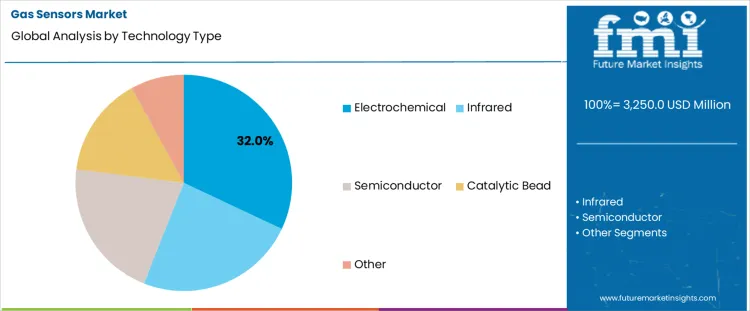
Electrochemical sensing leads technology adoption with a 32.0% share, reflecting strong suitability for precise gas concentration measurement. High sensitivity to target gases supports accurate detection at low exposure thresholds critical for safety applications. Stable signal output enables dependable performance across variable temperature and humidity conditions. Low power consumption supports portable and battery operated detection devices. Selective response characteristics reduce cross sensitivity, improving reliability in multi gas environments. Maintenance requirements remain manageable, supporting long term deployment across industrial safety infrastructures.
Key Points:
- Delivers high sensitivity for low concentration detection
- Maintains stable performance across variable environments
- Supports portable and fixed safety detection systems
Which gas type accounts for the highest share of demand?
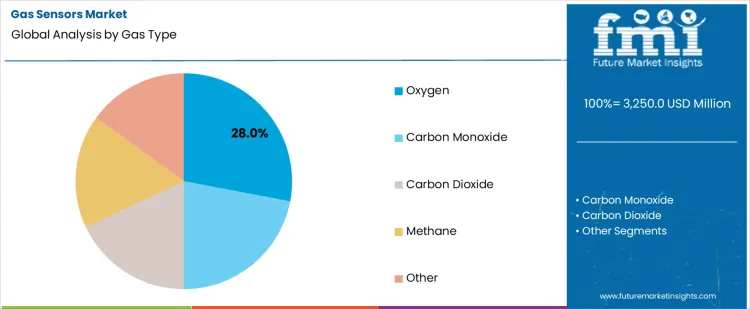
Oxygen monitoring dominates gas type demand at 28.0%, driven by essential safety requirements in confined and controlled environments. Accurate oxygen level measurement remains critical for preventing hypoxic or enriched conditions. Continuous monitoring supports worker safety across industrial, medical, and environmental settings. Sensor deployment aligns with regulatory mandates governing air quality and occupational exposure. Reliability and rapid response characteristics sustain widespread installation across safety critical applications where oxygen imbalance poses immediate risk.
Key Points:
- Addresses fundamental safety requirements across industries
- Enables continuous monitoring of breathable air conditions
- Supports compliance with occupational safety standards
Which end use accounts for the highest share of demand?
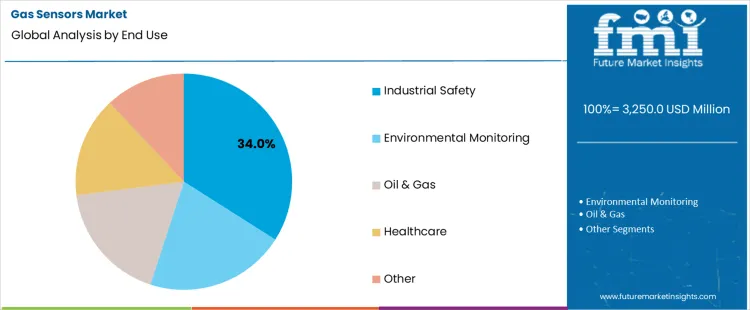
Industrial safety represents the largest end use with a 34.0% share, reflecting extensive deployment across hazardous operational environments. Facilities rely on continuous detection to prevent accidents, equipment damage, and personnel exposure. Integration with alarm and control systems supports rapid response to abnormal gas levels. High consequence risk environments prioritize reliable sensing to maintain regulatory compliance. Ongoing infrastructure upgrades sustain consistent replacement and expansion of installed detection systems.
Key Points:
- Concentrates deployment within high risk operational settings
- Integrates with automated alarm and control frameworks
- Prioritizes compliance driven continuous monitoring systems
What are the Key Dynamics in the Gas Sensors Market?
Demand dynamics in the gas sensors market reflect safety compliance, process control, and environmental monitoring requirements across industrial and commercial settings. Global adoption concentrates on detection accuracy, response time, and reliability under continuous operation. Value formation depends on sensing technology selection, calibration stability, and system integration. Purchasing aligns with regulatory exposure, risk mitigation needs, and lifecycle operating cost considerations.
How do safety compliance and process monitoring requirements shape adoption?
Adoption accelerates where occupational safety regulations mandate continuous monitoring of toxic, combustible, and oxygen-depleting gases. Demand strengthens across oil and gas facilities, chemical processing plants, mining operations, and confined workspace environments. Process automation increases reliance on fixed and portable sensors delivering real-time alerts and data logging. Expansion of smart factories elevates integration with distributed control systems and predictive maintenance platforms. Environmental monitoring obligations drive deployment in emission tracking and air quality assessment. Performance requirements emphasize sensitivity thresholds, cross-sensitivity management, and fast recovery times. Certification standards influence technology choice across electrochemical, infrared, catalytic, and semiconductor platforms. Replacement cycles follow calibration drift limits, exposure severity, and regulatory audit schedules rather than mechanical failure patterns.
How do calibration burden and environmental exposure constraints influence market scalability?
Market scalability faces constraints from calibration frequency, sensor poisoning risks, and harsh operating environments. Demand encounters resistance where frequent recalibration increases downtime and skilled labor dependence. Exposure to humidity, temperature extremes, dust, and corrosive gases degrades sensing elements, shortening service life. False alarms and drift undermine operational trust and raise compliance risk. Power consumption limits deployment in remote and battery-operated applications. Integration complexity with legacy monitoring infrastructure increases commissioning cost. Certification renewal and region-specific compliance testing add administrative expense. Supply constraints for specialized sensing materials further affect cost stability across high-performance detection categories.
How Is Demand for the Gas Sensors Market Evolving Globally?
Global demand for gas sensors is increasing due to stricter industrial safety norms, environmental monitoring mandates, and automation-driven process control requirements. Expansion of manufacturing, energy infrastructure, and smart building deployments is reinforcing continuous monitoring adoption across regions. Demand growth reflects regulatory enforcement intensity, workforce safety exposure, and digitization of operational risk management. India records 9.6% CAGR, China records 8.8% CAGR, the USA records 7.4% CAGR, Germany records 6.9% CAGR, and Japan records 6.5% CAGR. Adoption remains structurally linked to compliance-driven installation density, equipment modernization cycles, and integration with industrial control systems globally.
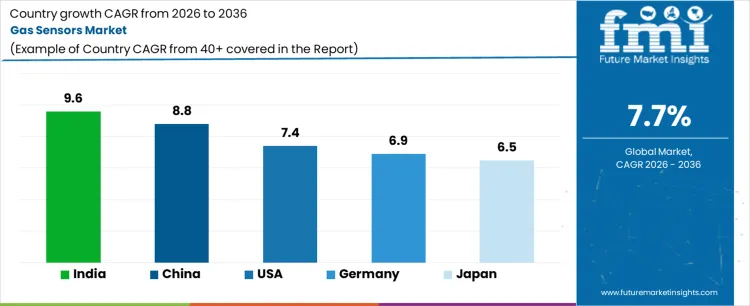
| Country | CAGR (%) |
|---|---|
| India | 9.6% |
| China | 8.8% |
| USA | 7.4% |
| Germany | 6.9% |
| Japan | 6.5% |
What is driving growth of gas sensors demand in India?
Demand for gas sensors in India is rising as industrial safety enforcement strengthens across manufacturing, mining, and energy operations. Expansion at 9.6% CAGR reflects heightened scrutiny of hazardous gas exposure and workplace incident prevention. Infrastructure growth in refineries, chemicals, and urban utilities increases fixed and portable sensor installations. Adoption accelerates within smart city initiatives emphasizing air quality monitoring and leak detection. Domestic manufacturing growth drives demand for cost-effective, ruggedized sensor technologies. Procurement favors multi-gas detection, wireless connectivity, and low maintenance designs. Replacement cycles shorten where legacy equipment lacks digital integration. Public sector investments and private industrial compliance jointly sustain long-term demand momentum.
- Industrial safety regulation tightening
- Expansion of energy infrastructure
- Smart city air monitoring programs
- Growth of domestic sensor manufacturing
Why is China seeing expansion in gas sensors adoption?
Gas sensors demand in China is expanding due to regulatory pressure on industrial emissions and workplace safety compliance. Growth at 8.8% CAGR aligns with modernization of heavy industry, chemicals, and urban infrastructure systems. Environmental monitoring mandates increase deployment across factories and municipal networks. Adoption favors sensors integrated with automation platforms and centralized data systems. Domestic suppliers support scale availability and competitive pricing. Industrial digitization initiatives accelerate replacement of analog detection equipment. Demand strengthens where inspection regimes enforce continuous monitoring rather than periodic testing. Export-oriented manufacturers adopt advanced sensing to meet international audit requirements.
- Emissions compliance enforcement
- Industrial automation integration
- Strong domestic supplier ecosystem
- Environmental monitoring mandates
How is the USA supporting growth of gas sensors demand?
Sales of gas sensors in the USA are increasing as regulatory oversight emphasizes occupational safety and environmental accountability. Growth of 7.4% CAGR reflects sustained investment across oil and gas, chemicals, and advanced manufacturing. Demand concentrates on high accuracy sensors supporting leak detection and process safety systems. Smart building adoption expands indoor air quality monitoring applications. Procurement prioritizes certified performance, cybersecurity compatibility, and long service life. Replacement demand emerges from aging industrial infrastructure upgrades. Federal and state level regulations reinforce continuous monitoring expectations. Integration with predictive maintenance platforms supports broader digital transformation across facilities.
- Oil and gas safety compliance
- Smart building air quality monitoring
- Infrastructure modernization programs
- Integration with predictive maintenance
What factors are shaping gas sensors sales in Germany?
Gas sensors demand in Germany is shaped by stringent industrial safety standards and environmental protection frameworks. Expansion at 6.9% CAGR reflects adoption within advanced manufacturing, automotive production, and energy systems. Industry emphasis on precision monitoring drives uptake of high reliability sensor technologies. Hydrogen infrastructure development supports demand for specialized gas detection solutions. Procurement favors long calibration stability and system interoperability. Industrial automation maturity supports embedded sensing across production lines. Replacement cycles align with equipment digitization and Industry 4.0 investments. Compliance audits and worker safety certification sustain baseline demand across regulated sectors.
- Stringent safety regulations
- Hydrogen infrastructure development
- Industry 4.0 integration
- Emphasis on precision sensing
How is Japan supporting growth of gas sensors demand?
Gas sensors market demand in Japan is advancing as industrial safety culture and technology sophistication reinforce monitoring adoption. Growth at 6.5% CAGR reflects steady investment in electronics manufacturing, chemicals, and urban infrastructure. Earthquake resilience planning increases demand for leak detection and early warning systems. Adoption emphasizes compact, high sensitivity sensors suited to space constrained facilities. Domestic technology leadership supports advanced sensing innovation. Procurement prioritizes reliability, longevity, and integration with building management systems. Replacement demand persists through modernization of aging plants. Public safety regulations and disaster preparedness initiatives jointly reinforce market stability.
- Disaster risk mitigation needs
- Advanced electronics manufacturing
- Compact sensor technology preference
- Aging industrial facility upgrades
What is the competitive landscape of demand for the gas sensors market globally?
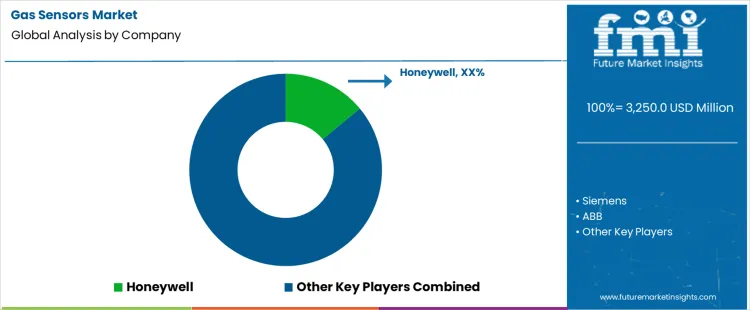
Demand for gas sensors is driven by industrial safety regulation, emissions monitoring, automation expansion, and urban air quality management. Buyers evaluate sensitivity accuracy, response time, calibration stability, operating lifespan, environmental tolerance, and integration with control systems. Procurement behavior prioritizes certified performance, multi gas detection capability, supply continuity, and long term service support. Purchasing decisions emphasize total ownership cost, compliance documentation, and interoperability with industrial and building management platforms. Trend in the gas sensors market reflects increased deployment in smart infrastructure, tighter workplace safety enforcement, and growing adoption across healthcare, automotive, and energy monitoring applications.
Honeywell holds leading positioning through broad portfolios spanning industrial safety, environmental monitoring, and integrated sensing platforms. Siemens supports demand through building automation and industrial process sensor integration aligned with digital control ecosystems. ABB competes by embedding gas sensing into power, utilities, and industrial safety solutions for large scale facilities. Bosch Sensortec addresses compact and low power sensing demand for consumer, automotive, and IoT applications. Figaro Engineering maintains relevance through semiconductor gas sensors serving appliance, air quality, and cost sensitive monitoring needs. Competitive differentiation depends on accuracy reliability, certification breadth, application coverage, and global service infrastructure depth.
Key Players in the Gas Sensors Market
- Honeywell
- Siemens
- ABB
- Bosch Sensortec
- Figaro Engineering
Scope of the Report
| Items | Values |
|---|---|
| Quantitative Units | USD million |
| Technology Type | Electrochemical; Infrared; Semiconductor; Catalytic Bead; Other |
| Gas Type | Oxygen; Carbon Monoxide; Carbon Dioxide; Methane; Other |
| End Use | Industrial Safety; Environmental Monitoring; Oil & Gas; Healthcare; Other |
| Regions Covered | Asia Pacific, Europe, North America, Latin America, Middle East & Africa |
| Countries Covered | India, China, USA, Germany, Japan, and 40+ countries |
| Key Companies Profiled | Honeywell; Siemens; ABB; Bosch Sensortec; Figaro Engineering |
| Additional Attributes | Dollar sales by technology type, gas type, end use, and sales channel; sensor sensitivity, response time, and cross-sensitivity performance across electrochemical, infrared, and semiconductor platforms; calibration stability and drift management under continuous monitoring conditions; durability in harsh industrial and oil and gas environments; compliance with safety and emissions standards; procurement patterns spanning industrial safety integrators, OEM system embedding, and replacement-driven aftermarket demand. |
Gas Sensors Market by Segment
By Technology Type:
- Electrochemical
- Infrared
- Semiconductor
- Catalytic Bead
- Other
By Gas Type:
- Oxygen
- Carbon Monoxide
- Carbon Dioxide
- Methane
- Other
By End Use:
- Industrial Safety
- Environmental Monitoring
- Oil & Gas
- Healthcare
- Other
By Region:
- Asia Pacific
- China
- Japan
- South Korea
- India
- Australia & New Zealand
- ASEAN
- Rest of Asia Pacific
- Europe
- Germany
- United Kingdom
- France
- Italy
- Spain
- Nordic
- BENELUX
- Rest of Europe
- North America
- United States
- Canada
- Mexico
- Latin America
- Brazil
- Chile
- Rest of Latin America
- Middle East & Africa
- Kingdom of Saudi Arabia
- Other GCC Countries
- Turkey
- South Africa
- Other African Union
- Rest of Middle East & Africa
Bibliography
- International Organization for Standardization. (2024). Gas detection and analysis instruments-Performance requirements and test methods for safety applications. ISO Technical Committee 146.
- National Institute for Occupational Safety and Health. (2023). Guidance on selection, calibration, and use of gas sensors for occupational exposure monitoring. Centers for Disease Control and Prevention.
- United States Environmental Protection Agency. (2024). Air quality monitoring technologies and gas sensing systems for industrial and urban environments. USA Environmental Protection Agency.
- European Agency for Safety and Health at Work. (2023). Detection and prevention of hazardous gas exposure in industrial workplaces. Publications Office of the European Union.
- International Electrotechnical Commission. (2024). Electrochemical and semiconductor gas sensors for industrial safety systems. IEC Technical Committee 31.
- Organisation for Economic Co-operation and Development. (2023). Industrial safety, emissions monitoring, and sensor-based compliance frameworks. OECD Publishing.
Frequently Asked Questions
How big is the gas sensors market in 2026?
The global gas sensors market is estimated to be valued at USD 3,250.0 million in 2026.
What will be the size of gas sensors market in 2036?
The market size for the gas sensors market is projected to reach USD 6,824.0 million by 2036.
How much will be the gas sensors market growth between 2026 and 2036?
The gas sensors market is expected to grow at a 7.7% CAGR between 2026 and 2036.
What are the key product types in the gas sensors market?
The key product types in gas sensors market are electrochemical, infrared, semiconductor, catalytic bead and other.
Which gas type segment to contribute significant share in the gas sensors market in 2026?
In terms of gas type, oxygen segment to command 28.0% share in the gas sensors market in 2026.
Preview the report firsthand - request a free sample
Get SampleGet the brochure for pricing and purchase details.
Get PDFTable of Content
- Executive Summary
- Global Market Outlook
- Demand-side Trends
- Supply-side Trends
- Technology Roadmap Analysis
- Analysis and Recommendations
- Market Overview
- Market Coverage / Taxonomy
- Market Definition / Scope / Limitations
- Market Background
- Market Dynamics
- Drivers
- Restraints
- Opportunity
- Trends
- Scenario Forecast
- Demand in Optimistic Scenario
- Demand in Likely Scenario
- Demand in Conservative Scenario
- Opportunity Map Analysis
- Product Life Cycle Analysis
- Supply Chain Analysis
- Investment Feasibility Matrix
- Value Chain Analysis
- PESTLE and Porter’s Analysis
- Regulatory Landscape
- Regional Parent Market Outlook
- Production and Consumption Statistics
- Import and Export Statistics
- Market Dynamics
- Global Market Analysis 2021 to 2025 and Forecast, 2026 to 2036
- Historical Market Size Value (USD Million) Analysis, 2021 to 2025
- Current and Future Market Size Value (USD Million) Projections, 2026 to 2036
- Y-o-Y Growth Trend Analysis
- Absolute $ Opportunity Analysis
- Global Market Pricing Analysis 2021 to 2025 and Forecast 2026 to 2036
- Global Market Analysis 2021 to 2025 and Forecast 2026 to 2036, By Technology Type
- Introduction / Key Findings
- Historical Market Size Value (USD Million) Analysis By Technology Type, 2021 to 2025
- Current and Future Market Size Value (USD Million) Analysis and Forecast By Technology Type, 2026 to 2036
- Electrochemical
- Infrared
- Semiconductor
- Catalytic Bead
- Other
- Electrochemical
- Y-o-Y Growth Trend Analysis By Technology Type, 2021 to 2025
- Absolute $ Opportunity Analysis By Technology Type, 2026 to 2036
- Global Market Analysis 2021 to 2025 and Forecast 2026 to 2036, By Gas Type
- Introduction / Key Findings
- Historical Market Size Value (USD Million) Analysis By Gas Type, 2021 to 2025
- Current and Future Market Size Value (USD Million) Analysis and Forecast By Gas Type, 2026 to 2036
- Oxygen
- Carbon Monoxide
- Carbon Dioxide
- Methane
- Other
- Oxygen
- Y-o-Y Growth Trend Analysis By Gas Type, 2021 to 2025
- Absolute $ Opportunity Analysis By Gas Type, 2026 to 2036
- Global Market Analysis 2021 to 2025 and Forecast 2026 to 2036, By End Use
- Introduction / Key Findings
- Historical Market Size Value (USD Million) Analysis By End Use, 2021 to 2025
- Current and Future Market Size Value (USD Million) Analysis and Forecast By End Use, 2026 to 2036
- Industrial Safety
- Environmental Monitoring
- Oil & Gas
- Healthcare
- Other
- Industrial Safety
- Y-o-Y Growth Trend Analysis By End Use, 2021 to 2025
- Absolute $ Opportunity Analysis By End Use, 2026 to 2036
- Global Market Analysis 2021 to 2025 and Forecast 2026 to 2036, By Region
- Introduction
- Historical Market Size Value (USD Million) Analysis By Region, 2021 to 2025
- Current Market Size Value (USD Million) Analysis and Forecast By Region, 2026 to 2036
- North America
- Latin America
- Western Europe
- Eastern Europe
- East Asia
- South Asia and Pacific
- Middle East & Africa
- Market Attractiveness Analysis By Region
- North America Market Analysis 2021 to 2025 and Forecast 2026 to 2036, By Country
- Historical Market Size Value (USD Million) Trend Analysis By Market Taxonomy, 2021 to 2025
- Market Size Value (USD Million) Forecast By Market Taxonomy, 2026 to 2036
- By Country
- USA
- Canada
- Mexico
- By Technology Type
- By Gas Type
- By End Use
- By Country
- Market Attractiveness Analysis
- By Country
- By Technology Type
- By Gas Type
- By End Use
- Key Takeaways
- Latin America Market Analysis 2021 to 2025 and Forecast 2026 to 2036, By Country
- Historical Market Size Value (USD Million) Trend Analysis By Market Taxonomy, 2021 to 2025
- Market Size Value (USD Million) Forecast By Market Taxonomy, 2026 to 2036
- By Country
- Brazil
- Chile
- Rest of Latin America
- By Technology Type
- By Gas Type
- By End Use
- By Country
- Market Attractiveness Analysis
- By Country
- By Technology Type
- By Gas Type
- By End Use
- Key Takeaways
- Western Europe Market Analysis 2021 to 2025 and Forecast 2026 to 2036, By Country
- Historical Market Size Value (USD Million) Trend Analysis By Market Taxonomy, 2021 to 2025
- Market Size Value (USD Million) Forecast By Market Taxonomy, 2026 to 2036
- By Country
- Germany
- UK
- Italy
- Spain
- France
- Nordic
- BENELUX
- Rest of Western Europe
- By Technology Type
- By Gas Type
- By End Use
- By Country
- Market Attractiveness Analysis
- By Country
- By Technology Type
- By Gas Type
- By End Use
- Key Takeaways
- Eastern Europe Market Analysis 2021 to 2025 and Forecast 2026 to 2036, By Country
- Historical Market Size Value (USD Million) Trend Analysis By Market Taxonomy, 2021 to 2025
- Market Size Value (USD Million) Forecast By Market Taxonomy, 2026 to 2036
- By Country
- Russia
- Poland
- Hungary
- Balkan & Baltic
- Rest of Eastern Europe
- By Technology Type
- By Gas Type
- By End Use
- By Country
- Market Attractiveness Analysis
- By Country
- By Technology Type
- By Gas Type
- By End Use
- Key Takeaways
- East Asia Market Analysis 2021 to 2025 and Forecast 2026 to 2036, By Country
- Historical Market Size Value (USD Million) Trend Analysis By Market Taxonomy, 2021 to 2025
- Market Size Value (USD Million) Forecast By Market Taxonomy, 2026 to 2036
- By Country
- China
- Japan
- South Korea
- By Technology Type
- By Gas Type
- By End Use
- By Country
- Market Attractiveness Analysis
- By Country
- By Technology Type
- By Gas Type
- By End Use
- Key Takeaways
- South Asia and Pacific Market Analysis 2021 to 2025 and Forecast 2026 to 2036, By Country
- Historical Market Size Value (USD Million) Trend Analysis By Market Taxonomy, 2021 to 2025
- Market Size Value (USD Million) Forecast By Market Taxonomy, 2026 to 2036
- By Country
- India
- ASEAN
- Australia & New Zealand
- Rest of South Asia and Pacific
- By Technology Type
- By Gas Type
- By End Use
- By Country
- Market Attractiveness Analysis
- By Country
- By Technology Type
- By Gas Type
- By End Use
- Key Takeaways
- Middle East & Africa Market Analysis 2021 to 2025 and Forecast 2026 to 2036, By Country
- Historical Market Size Value (USD Million) Trend Analysis By Market Taxonomy, 2021 to 2025
- Market Size Value (USD Million) Forecast By Market Taxonomy, 2026 to 2036
- By Country
- Kingdom of Saudi Arabia
- Other GCC Countries
- Turkiye
- South Africa
- Other African Union
- Rest of Middle East & Africa
- By Technology Type
- By Gas Type
- By End Use
- By Country
- Market Attractiveness Analysis
- By Country
- By Technology Type
- By Gas Type
- By End Use
- Key Takeaways
- Key Countries Market Analysis
- USA
- Pricing Analysis
- Market Share Analysis, 2025
- By Technology Type
- By Gas Type
- By End Use
- Canada
- Pricing Analysis
- Market Share Analysis, 2025
- By Technology Type
- By Gas Type
- By End Use
- Mexico
- Pricing Analysis
- Market Share Analysis, 2025
- By Technology Type
- By Gas Type
- By End Use
- Brazil
- Pricing Analysis
- Market Share Analysis, 2025
- By Technology Type
- By Gas Type
- By End Use
- Chile
- Pricing Analysis
- Market Share Analysis, 2025
- By Technology Type
- By Gas Type
- By End Use
- Germany
- Pricing Analysis
- Market Share Analysis, 2025
- By Technology Type
- By Gas Type
- By End Use
- UK
- Pricing Analysis
- Market Share Analysis, 2025
- By Technology Type
- By Gas Type
- By End Use
- Italy
- Pricing Analysis
- Market Share Analysis, 2025
- By Technology Type
- By Gas Type
- By End Use
- Spain
- Pricing Analysis
- Market Share Analysis, 2025
- By Technology Type
- By Gas Type
- By End Use
- France
- Pricing Analysis
- Market Share Analysis, 2025
- By Technology Type
- By Gas Type
- By End Use
- India
- Pricing Analysis
- Market Share Analysis, 2025
- By Technology Type
- By Gas Type
- By End Use
- ASEAN
- Pricing Analysis
- Market Share Analysis, 2025
- By Technology Type
- By Gas Type
- By End Use
- Australia & New Zealand
- Pricing Analysis
- Market Share Analysis, 2025
- By Technology Type
- By Gas Type
- By End Use
- China
- Pricing Analysis
- Market Share Analysis, 2025
- By Technology Type
- By Gas Type
- By End Use
- Japan
- Pricing Analysis
- Market Share Analysis, 2025
- By Technology Type
- By Gas Type
- By End Use
- South Korea
- Pricing Analysis
- Market Share Analysis, 2025
- By Technology Type
- By Gas Type
- By End Use
- Russia
- Pricing Analysis
- Market Share Analysis, 2025
- By Technology Type
- By Gas Type
- By End Use
- Poland
- Pricing Analysis
- Market Share Analysis, 2025
- By Technology Type
- By Gas Type
- By End Use
- Hungary
- Pricing Analysis
- Market Share Analysis, 2025
- By Technology Type
- By Gas Type
- By End Use
- Kingdom of Saudi Arabia
- Pricing Analysis
- Market Share Analysis, 2025
- By Technology Type
- By Gas Type
- By End Use
- Turkiye
- Pricing Analysis
- Market Share Analysis, 2025
- By Technology Type
- By Gas Type
- By End Use
- South Africa
- Pricing Analysis
- Market Share Analysis, 2025
- By Technology Type
- By Gas Type
- By End Use
- USA
- Market Structure Analysis
- Competition Dashboard
- Competition Benchmarking
- Market Share Analysis of Top Players
- By Regional
- By Technology Type
- By Gas Type
- By End Use
- Competition Analysis
- Competition Deep Dive
- Honeywell
- Overview
- Product Portfolio
- Profitability by Market Segments (Product/Age /Sales Channel/Region)
- Sales Footprint
- Strategy Overview
- Marketing Strategy
- Product Strategy
- Channel Strategy
- Siemens
- ABB
- Bosch Sensortec
- Figaro Engineering
- Honeywell
- Competition Deep Dive
- Assumptions & Acronyms Used
- Research Methodology


