

- Industry Size (2026)
- USD 0.84 Bn
- Forecast (2036)
- USD 1.38 Bn
- CAGR (2026 to 2036)
- 5.1%
Demand for Hemostasis Testing Systems in USA Size, Market Forecast and Outlook By FMI
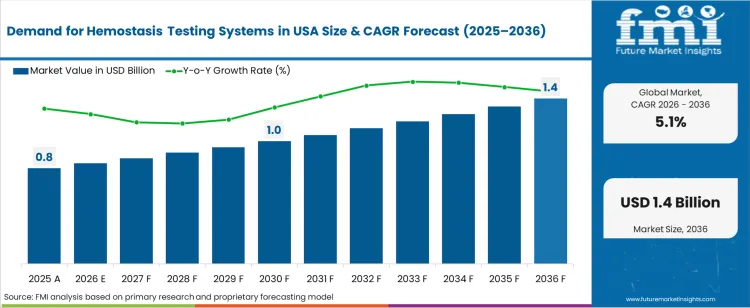
The demand for hemostasis testing systems in usa was valued at USD 0.80 billion in 2025, projected to reach USD 0.84 billion in 2026, and is forecast to expand to USD 1.38 billion by 2036 at a 5.1% CAGR. The expanding anticoagulant therapy patient base across Medicare and commercially insured populations is driving sustained coagulation testing volumes in hospital central laboratories and point-of-care settings. FDA clearances for next-generation multi-channel coagulation analysers are accelerating the installed base replacement cycle, while the growing complexity of perioperative bleeding risk assessment protocols is broadening the test menu per patient encounter.
Summary of Demand for Hemostasis Testing Systems in USA
- Market Snapshot
- The demand for hemostasis testing systems in usa is valued at USD 0.80 billion in 2025 and is projected to reach USD 1.38 billion by 2036.
- The industry is expected to grow at a 5.1% CAGR from 2026 to 2036, creating an incremental opportunity of USD 0.54 billion.
- The market is driven by expanding anticoagulant therapy patient volumes, analyser replacement cycles, and the broadening of hemostasis test menus from single-assay to comprehensive panel formats.
- Demand and Growth Drivers
- Expanding anticoagulant therapy prescriptions across Medicare and commercially insured populations are increasing coagulation testing volumes in hospital and ambulatory settings.
- FDA clearances for next-generation multi-channel coagulation analysers are accelerating the installed base replacement cycle and broadening test menu capabilities.
- Growing direct oral anticoagulant monitoring requirements are generating demand for drug-specific assay kits at higher per-test pricing than conventional PT/INR reagents.
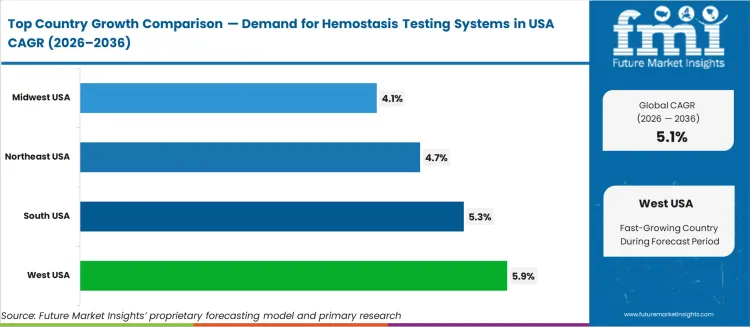
- Among tracked regions, the West leads at 5.9% CAGR, followed by the South at 5.3%, the Northeast at 4.7%, and the Midwest at 4.1%.
- Product and Segment View
- The market covers laboratory analysers, point-of-care testing systems, and consumables (reagent kits, calibrators, controls) used for coagulation and bleeding disorder diagnostics.
- Core applications include hemophilia testing, Von Willebrand disease diagnostics, and acquired bleeding disease assessment across hospital and ambulatory settings.
- Laboratory Analyzers lead by product type with 61.0% share in 2026.
- Hemophilia leads by application with 25.0% share in 2026.
- The scope includes hemostasis testing instruments and consumables and excludes general clinical chemistry analysers, hematology cell counters, and blood banking equipment.
- Geography and Competitive Outlook
- The West and South are the fastest-growing regions, driven by health system network expansion and high anticoagulant prescribing rates.
- The Northeast and Midwest reflect steady demand from academic medical centre testing portfolios and rural hospital automation investments.
- Competition is concentrated among global IVD manufacturers with FDA-cleared coagulation testing portfolios, including Siemens Healthineers, Roche Diagnostics, Abbott Laboratories, Becton Dickinson (BD), Instrumentation Laboratory (Werfen).
Demand for Hemostasis Testing Systems in USA Key Takeaways
| Metric | Details |
|---|---|
| Industry Size (2026) | USD 0.84 billion |
| Industry Value (2036) | USD 1.38 billion |
| CAGR (2026 to 2036) | 5.1% |
Source: Future Market Insights, 2026
The incremental opportunity between 2026 and 2036 amounts to USD 0.54 billion. FMI analysts observe that the transition from single-assay coagulation testing toward comprehensive hemostasis panels is increasing reagent consumption per analyser. Direct oral anticoagulant monitoring requirements are generating demand for drug-specific assay kits that command higher per-test pricing than conventional PT/INR and aPTT reagents. The shift toward outpatient anticoagulation management is expanding point-of-care coagulation testing device placements in physician offices and ambulatory clinics.
Sub-national growth trajectories reflect healthcare infrastructure density and anticoagulant prescribing patterns. West at 5.9%, South at 5.3%, Northeast at 4.7%, Midwest at 4.1%. The West leads, driven by California's concentration of large health system networks with centralised coagulation reference laboratories and high direct oral anticoagulant prescribing rates. The South follows, where expanding hospital construction across the sunbelt states is adding new laboratory capacity. The Northeast benefits from dense academic medical centre networks with high-complexity testing portfolios, while the Midwest reflects steady growth from rural hospital laboratory automation investments and telemedicine-supported anticoagulation management programmes.
Demand for Hemostasis Testing Systems in USA Definition
Hemostasis testing systems are diagnostic instruments and consumables used to evaluate blood coagulation function, detect bleeding disorders, and monitor anticoagulant therapy. The USA market covers laboratory analysers, point-of-care testing systems, and associated consumables (reagent kits, calibrators, quality controls) used for hemophilia assessment, Von Willebrand disease diagnostics, and acquired bleeding disease evaluation. These systems are deployed across hospital central laboratories, ambulatory clinics, surgical centres, and physician office settings.
Demand for Hemostasis Testing Systems in USA Inclusions
Market scope includes automated coagulation analysers, semi-automated coagulation instruments, point-of-care coagulation testing devices, and associated consumables including reagent kits, calibrators, and quality control materials. Replacement parts, software upgrades, and service contracts for installed analyser platforms are included.
Demand for Hemostasis Testing Systems in USA Exclusions
General clinical chemistry analysers, hematology cell counters, blood banking equipment, blood gas analysers, and molecular diagnostic platforms are excluded. Surgical hemostatic agents, topical wound sealants, and transfusion medicine products are outside the analytical scope.
Demand for Hemostasis Testing Systems in USA Research Methodology
- Primary Research: Analysts engaged with procurement managers, laboratory directors, and facility operators to map decision triggers, specification requirements, and adoption timelines across institutional and commercial channels.
- Desk Research: Data collection aggregated regulatory filings, public procurement records, industry association publications, and manufacturer financial disclosures to establish baseline market parameters.
- Market-Sizing and Forecasting: Baseline values derive from a bottom-up aggregation of unit shipment data and average selling prices, applying region-specific adoption curves to project forward demand trajectories.
- Data Validation and Update Cycle: Projections are cross-validated against publicly reported financial disclosures from leading manufacturers and verified against institutional procurement records.
Why is the Demand for Hemostasis Testing Systems in the USA Growing?
Demand for hemostasis testing systems in the USA is increasing because hospitals and diagnostic laboratories require faster and more accurate monitoring of coagulation disorders, especially among patients receiving anticoagulant therapy. Cardiovascular disease, atrial fibrillation and venous thromboembolism remain significant health concerns, and clinical teams rely on coagulation testing to manage bleeding and clotting risks during treatment. The growing number of surgeries and emergency care procedures also strengthens the need for reliable testing within operating rooms and intensive care units.
Point of care systems expand USAge in outpatient clinics and home health programs, allowing rapid decisions in settings where immediate results reduce hospital admissions. Blood banks adopt hemostasis testing to support safer transfusions and compatibility assessments. The increase in cancer therapies and chronic liver diseases contributes to higher demand for coagulation monitoring throughout complex care pathways. Constraints include capital cost for advanced analyzers and ongoing expenses for reagents, which may challenge smaller facilities. Skilled staff are required for accurate interpretation, and integration with electronic laboratory systems can extend adoption timelines. Some providers continue using older analyzers until replacement cycles align with budget planning.
Which Product Types and Applications Lead Demand for Hemostasis Testing Systems in the USA?
Demand for hemostasis testing systems in the United States is influenced by the increasing prevalence of bleeding disorders, expanded surgical volumes, and routine coagulation monitoring in hospitals and specialized labs. The U.S. healthcare facilities prioritize timely diagnostics, automation, and integration with electronic lab systems to enhance clinical decision-making. Adoption is also driven by aging demographics and patients receiving anticoagulant therapy who require continuous coagulation screening.
By Product Type, Laboratory Analyzers Hold the Largest Share
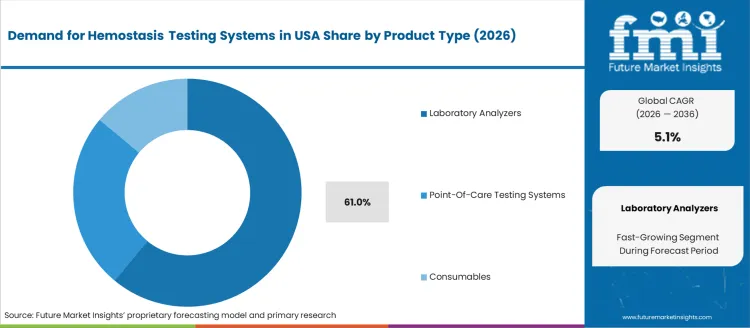
Laboratory analyzers account for 61.0%, reflecting their dominant role in centralized diagnostic laboratories where high-throughput testing is performed. These systems support comprehensive coagulation panels for emergency, pre-operative, and chronic disease monitoring. Large hospitals and reference labs prefer automated analyzers for accuracy, reduced manual error, and greater cost efficiency at scale. Point-of-care systems address bedside needs in critical settings but remain a smaller segment due to higher per-test costs and selective adoption. Consumables support recurring revenue streams for reagent manufacturers, driven by frequent testing requirements and stringent quality control standards across U.S. facilities. Demand alignment reflects a strong preference toward centralized, automated workflows that improve turnaround time and diagnostic precision nationwide.
Key Points:
- Laboratory analyzers dominate due to high-volume automated testing
- Point-of-care systems serve urgent intervention settings
- Consumables ensure continuous Usage and operational continuity
By Application, Hemophilia Represents the Largest Share
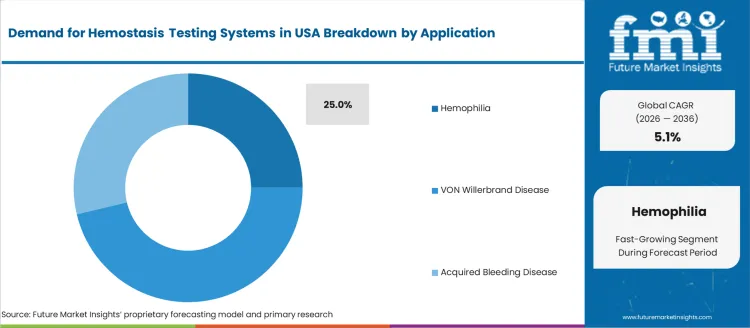
Hemophilia accounts for 25.0% of application-based demand as patients require lifelong coagulation monitoring, especially those receiving factor replacement or gene-based therapies. U.S. treatment guidelines emphasize routine APTT, PT, and inhibitor testing to prevent bleeding complications and optimize dosage. Von Willebrand disease and other acquired bleeding disorders make up the remaining application share, associated with oncology treatments, liver disease, and cardiovascular drug Usage. Testing frequency rises in hospitals and specialty hematology centers where precision monitoring is critical. Broader diagnostic adoption aligns with improving access to specialized care and advancing therapies for clotting factor deficiencies.
Key Points:
- Hemophilia care drives recurring test volume nationwide
- Acquired bleeding disorders expand testing in hospitals and cancer care
- Standardized monitoring improves treatment safety and outcomes
What are the Drivers, Restraints, and Key Trends of the Demand for Hemostasis Testing Systems in the USA?
Growth of cardiovascular and coagulation disorder screening, increased surgical volume and wider adoption of point of care systems are driving demand.
In the United States, hemostasis testing systems gain steady use as hospitals manage a high prevalence of thrombotic and bleeding disorders linked to aging, obesity and chronic disease. Cardiology and oncology practices regularly monitor clotting status for patients on anticoagulant therapy, creating repeated testing requirements. Operating rooms and emergency departments depend on rapid coagulation testing to guide transfusion decisions during trauma care and complex surgeries. Outpatient clinics and dialysis centers adopt compact analyzers to improve patient management without requiring full laboratory processing. National attention on stroke and venous thromboembolism prevention supports broader physician ordering of PT, aPTT and platelet function tests. These clinical needs maintain continuous procurement across hospital laboratories and decentralized care sites.
High equipment cost, reimbursement variation for point of care tests and staffing shortages in laboratory departments restrain demand.
Advanced analyzers require capital investment and ongoing consumable costs that smaller facilities evaluate carefully before adoption. Reimbursement rules for diagnostic tests differ across private and public payers, which may limit the financial viability of frequent point of care use. Skilled lab personnel are needed to manage calibration and quality control, which can slow procurement in facilities facing workforce gaps. Integration with electronic medical records may require IT support and compliance validation, creating operational barriers for rapid expansion. These financial and logistical factors lead to staged upgrades rather than universal deployment.
Shift toward viscoelastic testing in trauma centers, increased home monitoring interest for anticoagulation therapy and rising automation within hospital labs define key trends.
Trauma and transplant programs are adopting viscoelastic technology to guide real time clotting management and reduce blood product waste. Patients on long term anticoagulants show growing interest in remote monitoring supported by digital reporting systems that link to clinical providers. Hospital laboratories invest in automated analyzers that streamline throughput and reduce manual steps to handle rising test volumes. Data connectivity improves result turnaround times and supports clinical decision protocols during surgery and intensive care. These developments indicate sustained, outcomes focused demand for hemostasis testing systems across the United States healthcare network.
Analysis of the Demand for Hemostasis Testing Systems in the USA by Region
Demand for hemostasis testing systems in the United States is growing due to the rising need for coagulation monitoring in surgery, trauma care, and chronic disease management. Hospitals and diagnostic labs are expanding platforms for rapid PT/INR, aPTT, platelet function, and D-dimer testing to support clinical response times. Cardiovascular disease prevalence, aging demographics, and anticoagulant therapy use strengthen baseline testing volumes. Automated analyzers and point-of-care devices improve sample-to-result efficiency in emergency settings. Vendor evaluation focuses on reagent continuity, digital reporting compatibility, and clinical data accuracy. Growth differs across regions: West USA leads at 5.9% CAGR, South USA follows with 5.3%, Northeast USA at 4.7%, and Midwest USA at 4.1%, reflecting infrastructure density and patient-care access levels.
.webp "Top Country Growth Comparison Demand For Hemostasis Testing Systems In Usa Cagr (2026 2036)")
| Region | CAGR (2026-2036) |
|---|---|
| West USA | 5.9% |
| South USA | 5.3% |
| Northeast USA | 4.7% |
| Midwest USA | 4.1% |
How is West USA advancing demand for hemostasis testing systems?
West USA records a 5.9% compound annual growth rate, reflecting strong adoption of coagulation analyzers across California, Washington, and Arizona’s acute-care hospitals. Trauma centers and high-volume surgical facilities require accurate clotting assessment to manage perioperative bleeding and anticoagulant reversal. Point-of-care models are deployed inside emergency departments to reduce diagnostic turnaround times for stroke and trauma treatment. Research networks assess innovative markers such as thromboelastography to evaluate clot quality rather than time-based indicators alone. Diagnostic labs emphasize full automation, reagent-stability assurance, and digital integration with hospital information systems to support continuous reporting workflows. Population diversity increases screening needs related to genetic clotting disorders and chronic disease comorbidities.
- Trauma and surgical volumes sustaining analyzer requirements
- Rapid testing improving stroke and emergency-care decisions
- Research institutions adopting advanced coagulation parameters
- Digital connectivity reinforcing workflow efficiency
How is South USA shaping requirements for coagulation testing?
South USA exhibits approximately 5.3% CAGR, driven by cardiovascular disease prevalence and extensive surgical-care networks in Texas, Florida, and Georgia. Hospitals manage anticoagulation therapy for aging populations, which increases follow-up monitoring frequency. Healthcare systems invest in analyzers capable of handling fluctuation in inpatient and outpatient sample volumes. Emergency facilities emphasize fast INR confirmation to accelerate thrombolysis eligibility in stroke cases. Training programs support consistent reagent USAge and sample handling to maintain accuracy in community-based labs. Forecasting teams monitor supply chain continuity for consumables, given humid climate conditions that can affect storage.
- High chronic-disease burden reinforcing testing necessity
- Emergency stroke-care pathways depending on quick INR data
- Consumable planning supporting uninterrupted operation
- Community lab participation growing test-access points
How is Northeast USA contributing to national utilization?
Northeast USA grows at around 4.7% CAGR, supported by advanced tertiary hospitals throughout New York, Pennsylvania, and Massachusetts that prioritize complex coagulation diagnostics. Teaching institutions validate new hemostasis markers and ensure clinical staff remain updated on testing protocols. Dense metropolitan patient populations lead to significant sample throughput managed by automated systems with strong uptime reliability. Specialized oncology and transplant centers require precise coagulation tracking under high-risk therapy conditions. Laboratories emphasize LIS integration, calibration quality, and reagent traceability for regulatory compliance. Seasonal respiratory illness waves increase hospitalization rates and indirectly elevate clot-risk monitoring demand.
- Specialized-care networks elevating comprehensive testing
- Automation capacity meeting high-volume workflow needs
- Regulatory alignment guiding equipment and reagent choices
- Increased hospitalization cycles influencing test frequency
How is Midwest USA influencing test-system adoption?
Midwest USA advances at a 4.1% growth rate, reflecting steady expansion across regional hospitals and community laboratories in Illinois, Ohio, Missouri, and Michigan. Healthcare networks focus on reliable analyzer performance supporting emergency stabilization and chronic therapy management. Investment decisions emphasize durability, cost-efficient reagents, and simplified maintenance cycles that suit dispersed facility layouts. Point-of-care units enhance testing availability in smaller hospitals, decreasing reliance on centralized lab transport times. Education initiatives improve anticoagulation oversight to prevent adverse bleeding episodes in primary-care environments. Procurement strategies evaluate consistent vendor support to maintain uptime during severe weather events affecting logistics.
- Community-based access growing point-of-care relevance
- Cost and durability shaping product selection
- Workflow improvements reducing dependency on central labs
- Vendor reliability critical for reagent continuity
What does the competitive landscape for hemostasis testing system demand in the United States look like?
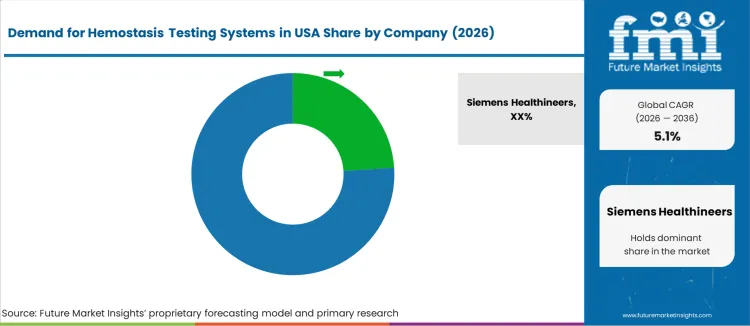
Demand for hemostasis testing systems in the United States is driven by hospitals, diagnostic laboratories, transfusion centers, and emergency-care facilities that require reliable coagulation panels, rapid clotting-time analysis, and stable thrombosis/bleeding-risk assessment. Requirements focus on test accuracy, throughput capacity, regulatory compliance, and integration with lab-information systems. Procurement decisions favour suppliers offering validated reagent kits, software support for result interpretation, and strong after-sales service networks to maintain 24/7 lab operations. Siemens Healthineers holds an estimated 24.2% share. Its coagulation analyzers and reagent systems are widely deployed in U.S. hospital laboratories and large reference labs, valued for consistent clotting-time measurement, validated quality control, and integration with laboratory-information workflows.
Roche Diagnostics contributes significantly with immuno-coagulation and automated analyzer solutions used in hospitals and blood-bank screening labs to manage hemostatic disorders and pre-surgical workups. Abbott Laboratories supports demand through compact coagulation systems suited for both central and point-of-care lab environments, offering reliability in throughput and ease of use for smaller clinical settings. Becton Dickinson (BD) adds presence via sample-management and cartridge-based systems used in transfusion and outpatient clinics, where quick turnaround and ease of operation are priorities. Instrumentation Laboratory (Werfen) serves specialized coagulation testing needs, such as thromboelastography and advanced clot-dynamics monitoring, supporting trauma centers and critical-care units managing complex bleeding or anticoagulation therapies. Competition in the USA emphasizes analytical precision, system automation, reagent stability, wide test panels, and accreditation support. Demand remains stable as healthcare providers rely on hemostasis diagnostics for safe surgical planning, thrombosis risk assessment, and patient-specific anticoagulant management.
Key Players in USA Hemostasis Testing Systems Demand
- Siemens Healthineers
- Roche Diagnostics
- Abbott Laboratories
- Becton Dickinson (BD)
- Instrumentation Laboratory (Werfen)
Scope of the Report
| Metric | Value |
|---|---|
| Quantitative Units | USD 0.84 to USD 1.38 billion, at a CAGR of 5.1% |
| Market Definition | Hemostasis testing systems are diagnostic instruments and consumables used to evaluate blood coagulation function, detect bleeding disorders, and monitor anticoagulant therapy. The USA market covers laboratory analysers, point-of-care testing systems, and associated consumables (reagent kits, calibrators, quality controls) used for hemophilia assessment, Von Willebrand disease diagnostics, and acquired bleeding disease evaluation. |
| Segmentation | Product Type (Laboratory Analyzers, Point-of-Care Testing Systems, Consumables), Application (Hemophilia, Von Willebrand Disease, Acquired Bleeding Disease) |
| Regions Covered | West, South, Northeast, Midwest |
| Key Companies Profiled | Siemens Healthineers, Roche Diagnostics, Abbott Laboratories, Becton Dickinson (BD), Instrumentation Laboratory (Werfen) |
| Forecast Period | 2026 to 2036 |
| Approach | Forecasting models apply a bottom-up methodology starting with unit shipment and average selling price data, cross-validated against manufacturer financial disclosures and institutional procurement records. |
USA Hemostasis Testing Systems Demand by Segments
Product Type:
- Laboratory Analyzers
- Point-Of-Care Testing Systems
- Consumables
Application:
- Hemophilia
- VON Willerbrand Disease
- Acquired Bleeding Disease
Region:
- West USA
- South USA
- Northeast USA
- Midwest USA
Bibliography
- 1. Centers for Medicare and Medicaid Services. (2024). Clinical Laboratory Fee Schedule and Reimbursement Codes. CMS.
- 2. USA Food and Drug Administration. (2024). In Vitro Diagnostic Device Classification Database. FDA.
- 3. American Society of Hematology. (2024). Clinical Practice Guidelines on Anticoagulation Monitoring. ASH.
- 4. College of American Pathologists. (2024). Laboratory Accreditation Programme Standards for Coagulation Testing. CAP.
- 5. Siemens Healthineers. (2024). Annual Report 2024: Diagnostics Division. Siemens Healthineers.
- 6. World Federation of Hemophilia. (2024). Annual Global Survey: Bleeding Disorder Prevalence and Treatment. WFH.
This bibliography is provided for reader reference. The full Future Market Insights report contains the complete reference list with primary research documentation.
Frequently Asked Questions
How large is the demand for hemostasis testing systems in usa in 2026?
The demand for hemostasis testing systems in usa is estimated to be valued at USD 0.84 billion in 2026.
What will be the market size of demand for hemostasis testing systems in usa by 2036?
Market size for demand for hemostasis testing systems in usa is projected to reach USD 1.38 billion by 2036.
What is the expected growth rate for demand for hemostasis testing systems in usa between 2026 and 2036?
The demand for hemostasis testing systems in usa is expected to grow at a CAGR of 5.1% between 2026 and 2036.
Which product type is poised to lead by 2026?
Laboratory Analyzers accounts for 61.0% share in 2026, driven by established procurement patterns and institutional adoption.
How is hemophilia positioned in driving adoption in 2026?
Hemophilia holds 25.0% share of the application segment in 2026, reflecting concentrated institutional demand.
What is the growth outlook for West?
West is projected to grow at a CAGR of 5.9% during 2026 to 2036.
What is included in the scope of this report?
Market scope includes automated coagulation analysers, semi-automated coagulation instruments, point-of-care coagulation testing devices, and associated consumables including reagent kits, calibrators, and quality control materials. Replacement parts, software upgrades, and service contracts for installed analyser platforms are included.
How does FMI build and validate the demand for hemostasis testing systems in usa forecast?
Forecasting models apply a bottom-up methodology starting with unit shipment and average selling price data, cross-validated against manufacturer financial disclosures and institutional procurement records.
Preview the report firsthand - request a free sample
Get SampleGet the brochure for pricing and purchase details.
Get PDFTable of Content
- Executive Summary
- Global Market Outlook
- Demand-side Trends
- Supply-side Trends
- Technology Roadmap Analysis
- Analysis and Recommendations
- Market Overview
- Market Coverage / Taxonomy
- Market Definition / Scope / Limitations
- Research Methodology
- Chapter Orientation
- Analytical Lens and Working Hypotheses
- Market Structure, Signals, and Trend Drivers
- Benchmarking and Cross-market Comparability
- Market Sizing, Forecasting, and Opportunity Mapping
- Research Design and Evidence Framework
- Desk Research Programme (Secondary Evidence)
- Company Annual and Sustainability Reports
- Peer-reviewed Journals and Academic Literature
- Corporate Websites, Product Literature, and Technical Notes
- Earnings Decks and Investor Briefings
- Statutory Filings and Regulatory Disclosures
- Technical White Papers and Standards Notes
- Trade Journals, Industry Magazines, and Analyst Briefs
- Conference Proceedings, Webinars, and Seminar Materials
- Government Statistics Portals and Public Data Releases
- Press Releases and Reputable Media Coverage
- Specialist Newsletters and Curated Briefings
- Sector Databases and Reference Repositories
- FMI Internal Proprietary Databases and Historical Market Datasets
- Subscription Datasets and Paid Sources
- Social Channels, Communities, and Digital Listening Inputs
- Additional Desk Sources
- Expert Input and Fieldwork (Primary Evidence)
- Primary Modes
- Qualitative Interviews and Expert Elicitation
- Quantitative Surveys and Structured Data Capture
- Blended Approach
- Why Primary Evidence is Used
- Field Techniques
- Interviews
- Surveys
- Focus Groups
- Observational and In-context Research
- Social and Community Interactions
- Stakeholder Universe Engaged
- C-suite Leaders
- Board Members
- Presidents and Vice Presidents
- R&D and Innovation Heads
- Technical Specialists
- Domain Subject-matter Experts
- Scientists
- Physicians and Other Healthcare Professionals
- Governance, Ethics, and Data Stewardship
- Research Ethics
- Data Integrity and Handling
- Primary Modes
- Tooling, Models, and Reference Databases
- Desk Research Programme (Secondary Evidence)
- Data Engineering and Model Build
- Data Acquisition and Ingestion
- Cleaning, Normalisation, and Verification
- Synthesis, Triangulation, and Analysis
- Quality Assurance and Audit Trail
- Market Background
- Market Dynamics
- Drivers
- Restraints
- Opportunity
- Trends
- Scenario Forecast
- Demand in Optimistic Scenario
- Demand in Likely Scenario
- Demand in Conservative Scenario
- Opportunity Map Analysis
- Product Life Cycle Analysis
- Supply Chain Analysis
- Investment Feasibility Matrix
- Value Chain Analysis
- PESTLE and Porter’s Analysis
- Regulatory Landscape
- Regional Parent Market Outlook
- Production and Consumption Statistics
- Import and Export Statistics
- Market Dynamics
- Global Market Analysis 2021 to 2025 and Forecast, 2026 to 2036
- Historical Market Size Value (USD Million) Analysis, 2021 to 2025
- Current and Future Market Size Value (USD Million) Projections, 2026 to 2036
- Y-o-Y Growth Trend Analysis
- Absolute $ Opportunity Analysis
- Global Market Pricing Analysis 2021 to 2025 and Forecast 2026 to 2036
- Global Market Analysis 2021 to 2025 and Forecast 2026 to 2036, By Product Type
- Introduction / Key Findings
- Historical Market Size Value (USD Million) Analysis By Product Type , 2021 to 2025
- Current and Future Market Size Value (USD Million) Analysis and Forecast By Product Type , 2026 to 2036
- Laboratory Analyzers
- Point-Of-Care Testing Systems
- Consumables
- Laboratory Analyzers
- Y-o-Y Growth Trend Analysis By Product Type , 2021 to 2025
- Absolute $ Opportunity Analysis By Product Type , 2026 to 2036
- Global Market Analysis 2021 to 2025 and Forecast 2026 to 2036, By Application
- Introduction / Key Findings
- Historical Market Size Value (USD Million) Analysis By Application, 2021 to 2025
- Current and Future Market Size Value (USD Million) Analysis and Forecast By Application, 2026 to 2036
- Hemophilia
- VON Willerbrand Disease
- Acquired Bleeding Disease
- Hemophilia
- Y-o-Y Growth Trend Analysis By Application, 2021 to 2025
- Absolute $ Opportunity Analysis By Application, 2026 to 2036
- Global Market Analysis 2021 to 2025 and Forecast 2026 to 2036, By Region
- Introduction
- Historical Market Size Value (USD Million) Analysis By Region, 2021 to 2025
- Current Market Size Value (USD Million) Analysis and Forecast By Region, 2026 to 2036
- North America
- Latin America
- Western Europe
- Eastern Europe
- East Asia
- South Asia and Pacific
- Middle East & Africa
- Market Attractiveness Analysis By Region
- North America Market Analysis 2021 to 2025 and Forecast 2026 to 2036, By Country
- Historical Market Size Value (USD Million) Trend Analysis By Market Taxonomy, 2021 to 2025
- Market Size Value (USD Million) Forecast By Market Taxonomy, 2026 to 2036
- By Country
- USA
- Canada
- Mexico
- By Product Type
- By Application
- By Country
- Market Attractiveness Analysis
- By Country
- By Product Type
- By Application
- Key Takeaways
- Latin America Market Analysis 2021 to 2025 and Forecast 2026 to 2036, By Country
- Historical Market Size Value (USD Million) Trend Analysis By Market Taxonomy, 2021 to 2025
- Market Size Value (USD Million) Forecast By Market Taxonomy, 2026 to 2036
- By Country
- Brazil
- Chile
- Rest of Latin America
- By Product Type
- By Application
- By Country
- Market Attractiveness Analysis
- By Country
- By Product Type
- By Application
- Key Takeaways
- Western Europe Market Analysis 2021 to 2025 and Forecast 2026 to 2036, By Country
- Historical Market Size Value (USD Million) Trend Analysis By Market Taxonomy, 2021 to 2025
- Market Size Value (USD Million) Forecast By Market Taxonomy, 2026 to 2036
- By Country
- Germany
- UK
- Italy
- Spain
- France
- Nordic
- BENELUX
- Rest of Western Europe
- By Product Type
- By Application
- By Country
- Market Attractiveness Analysis
- By Country
- By Product Type
- By Application
- Key Takeaways
- Eastern Europe Market Analysis 2021 to 2025 and Forecast 2026 to 2036, By Country
- Historical Market Size Value (USD Million) Trend Analysis By Market Taxonomy, 2021 to 2025
- Market Size Value (USD Million) Forecast By Market Taxonomy, 2026 to 2036
- By Country
- Russia
- Poland
- Hungary
- Balkan & Baltic
- Rest of Eastern Europe
- By Product Type
- By Application
- By Country
- Market Attractiveness Analysis
- By Country
- By Product Type
- By Application
- Key Takeaways
- East Asia Market Analysis 2021 to 2025 and Forecast 2026 to 2036, By Country
- Historical Market Size Value (USD Million) Trend Analysis By Market Taxonomy, 2021 to 2025
- Market Size Value (USD Million) Forecast By Market Taxonomy, 2026 to 2036
- By Country
- China
- Japan
- South Korea
- By Product Type
- By Application
- By Country
- Market Attractiveness Analysis
- By Country
- By Product Type
- By Application
- Key Takeaways
- South Asia and Pacific Market Analysis 2021 to 2025 and Forecast 2026 to 2036, By Country
- Historical Market Size Value (USD Million) Trend Analysis By Market Taxonomy, 2021 to 2025
- Market Size Value (USD Million) Forecast By Market Taxonomy, 2026 to 2036
- By Country
- India
- ASEAN
- Australia & New Zealand
- Rest of South Asia and Pacific
- By Product Type
- By Application
- By Country
- Market Attractiveness Analysis
- By Country
- By Product Type
- By Application
- Key Takeaways
- Middle East & Africa Market Analysis 2021 to 2025 and Forecast 2026 to 2036, By Country
- Historical Market Size Value (USD Million) Trend Analysis By Market Taxonomy, 2021 to 2025
- Market Size Value (USD Million) Forecast By Market Taxonomy, 2026 to 2036
- By Country
- Kingdom of Saudi Arabia
- Other GCC Countries
- Turkiye
- South Africa
- Other African Union
- Rest of Middle East & Africa
- By Product Type
- By Application
- By Country
- Market Attractiveness Analysis
- By Country
- By Product Type
- By Application
- Key Takeaways
- Key Countries Market Analysis
- USA
- Pricing Analysis
- Market Share Analysis, 2025
- By Product Type
- By Application
- Canada
- Pricing Analysis
- Market Share Analysis, 2025
- By Product Type
- By Application
- Mexico
- Pricing Analysis
- Market Share Analysis, 2025
- By Product Type
- By Application
- Brazil
- Pricing Analysis
- Market Share Analysis, 2025
- By Product Type
- By Application
- Chile
- Pricing Analysis
- Market Share Analysis, 2025
- By Product Type
- By Application
- Germany
- Pricing Analysis
- Market Share Analysis, 2025
- By Product Type
- By Application
- UK
- Pricing Analysis
- Market Share Analysis, 2025
- By Product Type
- By Application
- Italy
- Pricing Analysis
- Market Share Analysis, 2025
- By Product Type
- By Application
- Spain
- Pricing Analysis
- Market Share Analysis, 2025
- By Product Type
- By Application
- France
- Pricing Analysis
- Market Share Analysis, 2025
- By Product Type
- By Application
- India
- Pricing Analysis
- Market Share Analysis, 2025
- By Product Type
- By Application
- ASEAN
- Pricing Analysis
- Market Share Analysis, 2025
- By Product Type
- By Application
- Australia & New Zealand
- Pricing Analysis
- Market Share Analysis, 2025
- By Product Type
- By Application
- China
- Pricing Analysis
- Market Share Analysis, 2025
- By Product Type
- By Application
- Japan
- Pricing Analysis
- Market Share Analysis, 2025
- By Product Type
- By Application
- South Korea
- Pricing Analysis
- Market Share Analysis, 2025
- By Product Type
- By Application
- Russia
- Pricing Analysis
- Market Share Analysis, 2025
- By Product Type
- By Application
- Poland
- Pricing Analysis
- Market Share Analysis, 2025
- By Product Type
- By Application
- Hungary
- Pricing Analysis
- Market Share Analysis, 2025
- By Product Type
- By Application
- Kingdom of Saudi Arabia
- Pricing Analysis
- Market Share Analysis, 2025
- By Product Type
- By Application
- Turkiye
- Pricing Analysis
- Market Share Analysis, 2025
- By Product Type
- By Application
- South Africa
- Pricing Analysis
- Market Share Analysis, 2025
- By Product Type
- By Application
- USA
- Market Structure Analysis
- Competition Dashboard
- Competition Benchmarking
- Market Share Analysis of Top Players
- By Regional
- By Product Type
- By Application
- Competition Analysis
- Competition Deep Dive
- Siemens Healthineers
- Overview
- Product Portfolio
- Profitability by Market Segments (Product/Age /Sales Channel/Region)
- Sales Footprint
- Strategy Overview
- Marketing Strategy
- Product Strategy
- Channel Strategy
- Roche Diagnostics
- Abbott Laboratories
- Becton Dickinson (BD)
- Instrumentation Laboratory (Werfen)
- Siemens Healthineers
- Competition Deep Dive
- Assumptions & Acronyms Used


