

- Industry Size (2026)
- USD 498.7 Mn
- Forecast (2036)
- USD 1127.7 Mn
- CAGR (2026 to 2036)
- 7.7%
Demand for Eddy Current Testing in USA Forecast and Outlook 2026 to 2036
The demand for eddy current testing in the USA is projected to grow from USD 498.7 million in 2026 to USD 1127.7 million in 2036, reflecting a 7.7% CAGR. The growth is driven by the increasing need for non-destructive testing (NDT) across various sectors such as aerospace, automotive, power generation, and manufacturing. Eddy current testing is essential for detecting surface and subsurface flaws in conductive materials, offering a reliable, non-invasive inspection method that supports safety, quality control, and regulatory compliance. Key drivers include the rise in industrial automation, advancements in technology, and the growing adoption of eddy current testing in emerging sectors like renewable energy.
Quick Stats of the Demand for Eddy Current Testing in USA
- Demand for Eddy Current Testing in USA Value (2026): USD 498.7 million
- Demand for Eddy Current Testing in USA Forecast Value (2036): USD 1127.7 million
- Demand for Eddy Current Testing in USA Forecast CAGR (2026-2036): 7.7%
- Demand for Eddy Current Testing in USA Leading Technique: Altering Current Field Measurement
- Demand for Eddy Current Testing in USA Key Growth Regions: West USA, South USA, Northeast USA, Midwest USA
- Demand for Eddy Current Testing in USA Top Players: Ashtead Technology Ltd, Eddyfi NDT Inc., ETher NDE Ltd, Fidgeon Ltd, General Electric Company, ibg NDT System Corporation, Magnetic Analysis Corporation, MISTRAS Group Inc, Olympus Corporation, TÜV Rheinland Inc.

By 2026, inspection services are expected to account for the largest share of the demand for eddy current testing, with manufacturing industries driving the adoption of these services for quality control. Regions such as West USA lead the growth due to their strong aerospace and automotive industries, while other areas like South USA and Northeast USA also experience steady increases in demand. The demand for eddy current testing is expected to be further supported by the integration of digital data analysis, advanced probes, and portable systems that enhance accuracy and speed. However, challenges such as the need for skilled technicians, the high cost of equipment, and the complexity of signal interpretation may limit growth in some sectors. Despite these challenges, the demand for eddy current testing is expected to continue growing, driven by safety regulations, technological innovation, and the increasing focus on preventive maintenance.
Demand for Eddy Current Testing in USA Key Takeaways
| Metric | Value |
|---|---|
| Demand for Eddy Current Testing in USA Value (2026) | USD 498.7 million |
| Demand for Eddy Current Testing in USA Forecast Value (2036) | USD 1127.7 million |
| Demand for Eddy Current Testing in USA Forecast CAGR (2026-2036) | 7.7% |
Why is the Demand for Eddy Current Testing in USA Growing?
The demand for eddy current testing in the USA is growing due to the increasing need for non-destructive testing (NDT) in various industries, including aerospace, automotive, power generation, and manufacturing. Eddy current testing is a widely used NDT technique that helps detect surface and subsurface flaws in conductive materials without causing any damage. The growing emphasis on safety, quality control, and regulatory compliance in sectors like aerospace, where components must meet stringent safety standards, is driving the demand for eddy current testing. The need to prevent equipment failures and reduce maintenance costs is encouraging industries to adopt advanced testing methods like eddy current testing to monitor the condition of critical components.
Key drivers for this growth include the rise in industrial automation, where precision and safety are paramount, especially in the manufacturing of complex parts. As industries continue to focus on improving product quality and reducing downtime, the role of effective and efficient inspection methods like eddy current testing becomes more vital. The growing adoption of eddy current testing in emerging industries such as renewable energy, including wind turbine inspections, is also contributing to the demand. Furthermore, advancements in eddy current testing technology, such as digital systems that offer improved accuracy and faster results, are making this technique even more attractive.
Despite the strong growth, challenges such as the need for skilled technicians and the cost of high-end eddy current testing equipment may limit adoption in some smaller or less regulated sectors. However, the continued push for higher quality standards, safety, and predictive maintenance in critical infrastructure and industrial applications is expected to drive sustained growth in the demand for eddy current testing in the USA through 2036.
What is the Segment-Wise Analysis of Demand for Eddy Current Testing in USA?
Demand for eddy current testing in the USA is segmented by service type, industry verticals, and region. By service type, inspection services lead with 46.2% of the demand, followed by equipment rental services, calibration services, and training services. In terms of industry verticals, manufacturing accounts for 41.8% of the demand, with oil & gas, automotive, power generation, and government infrastructure & public safety sectors contributing to the rest. Regionally, demand is distributed across West USA, South USA, Northeast USA, and Midwest USA.
How Does Inspection Services Lead the Demand for Eddy Current Testing in USA?
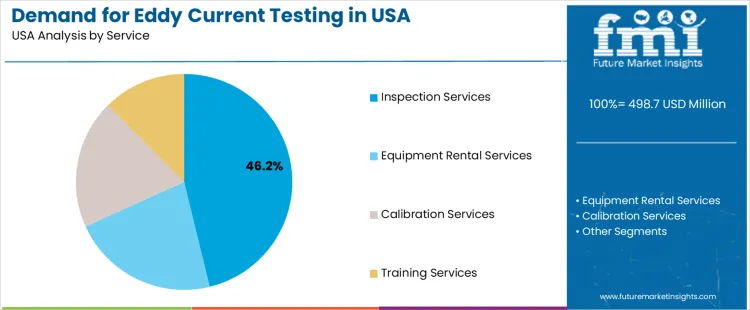
Inspection services account for 46.2% of the demand for eddy current testing in the USA, driven by the increasing need for non-destructive testing (NDT) to detect surface and subsurface defects in materials. Eddy current testing is widely used in industries such as manufacturing, aerospace, and power generation, where precision and safety are critical. These services are valued for their ability to provide fast, reliable results without damaging the tested materials. As industries prioritize equipment safety, quality control, and regulatory compliance, the demand for professional inspection services continues to rise. The ability of eddy current testing to detect cracks, corrosion, and other defects in metals and conductive materials makes it indispensable in ensuring product quality and preventing failures, contributing to its dominance in the industry.
How Does Manufacturing Industry Vertical Lead the Demand for Eddy Current Testing in USA?
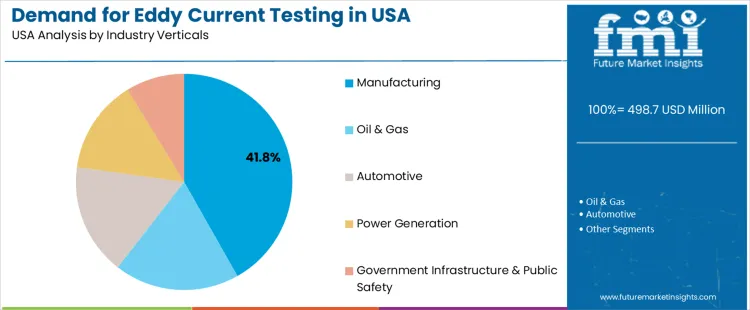
The manufacturing industry vertical accounts for 41.8% of the demand for eddy current testing in the USA, driven by the need for quality control and ensuring product integrity. Manufacturing industries, including aerospace, automotive, and heavy equipment, rely on eddy current testing to detect surface and subsurface flaws in components made from metals and alloys. The technology’s ability to identify defects early in the production process helps avoid costly failures, improve safety, and maintain regulatory compliance. As manufacturing processes become increasingly automated and products demand higher precision, the need for effective non-destructive testing methods like eddy current testing continues to grow. The manufacturing sector's emphasis on operational efficiency, safety, and product quality is expected to sustain the demand for eddy current testing, making it a critical part of quality assurance programs.
What are the Key Trends, Drivers and Restraints in Demand for Eddy Current Testing in USA?
Eddy current testing detects surface and near‑surface defects in conductive materials without harming the tested part. Key trends include integration with digital data analysis, portable scanners, and advanced probes that improve accuracy and speed. Drivers include stringent safety and quality standards in aerospace, automotive, power generation, and oil & gas, where fatigue cracks or corrosion must be detected early. Restraints include the need for highly trained technicians and initial investment in equipment and software, which may deter smaller service providers. Complexity in interpreting signals can also limit adoption without proper training and calibration.
Why is Demand for Eddy Current Testing Growing in USA?
Demand for eddy current testing in the USA is growing as maintenance, safety, and quality concerns increase across critical sectors. In aerospace, eddy current testing is used to inspect aircraft components for cracks and corrosion, supporting rigorous safety standards. Electric utilities use it to check turbine blades and heat exchanger tubes, while automotive manufacturers rely on it for quality control in engine parts and welds. Growth in infrastructure inspection requirements and preventive maintenance programs boosts testing frequency. Eddy current testing supports regulations that mandate regular inspection of pipelines, rail components, and industrial equipment. As companies prioritize asset longevity and risk mitigation, demand for reliable non‑destructive testing solutions like eddy current continues to expand.
How are Technological and Industry Innovations Driving Eddy Current Testing Demand in USA?
Technological advances are significantly enhancing eddy current testing demand in the USA. Innovations include high‑resolution digital instrumentation, advanced probe technologies, and phased array eddy current systems that improve flaw detection and characterization. Integration with automated scanning rigs and robotic platforms allows consistent inspection of large or complex geometries with minimal human error. Software improvements, data visualization tools, and machine learning algorithms help analysts interpret results faster and more accurately. Portable and lightweight test units make field inspections easier and more cost‑effective. These innovations expand applicability across aerospace, power generation, automotive, and manufacturing, making eddy current testing more efficient and reliable, while lowering barriers to adoption for more inspection scenarios.
What is the Regional Demand Outlook for Eddy Current Testing in USA?
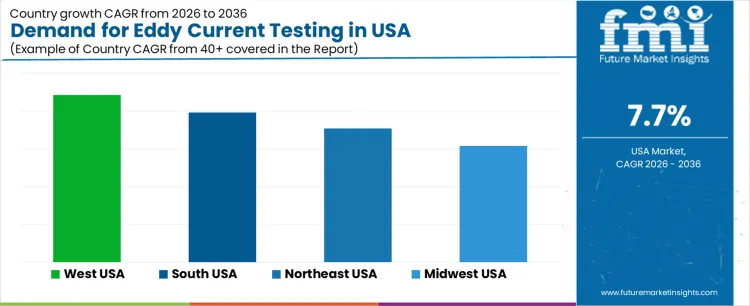
| Region | CAGR (%) |
|---|---|
| West USA | 8.8% |
| South USA | 7.9% |
| Northeast USA | 7.1% |
| Midwest USA | 6.2% |
Demand for eddy current testing in the USA is growing rapidly, with West USA leading at an 8.8% CAGR, driven by strong industries in aerospace, automotive, and renewable energy. South USA follows with a 7.9% CAGR, fueled by the region’s expanding manufacturing base and focus on industrial automation and quality control. Northeast USA shows a 7.1% CAGR, supported by a strong manufacturing and aerospace sector that increasingly relies on non-destructive testing methods. Midwest USA experiences a 6.2% CAGR, with steady growth driven by the region’s established automotive and heavy machinery industries.
How is Demand for Eddy Current Testing Growing in West USA?
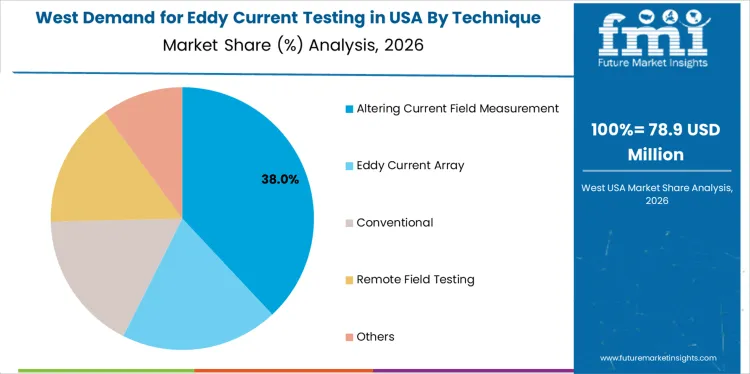
West USA leads the demand for eddy current testing (ECT), growing at an 8.8% CAGR. The region’s prominent aerospace, automotive, and renewable energy industries are central to this rise. States like California, Washington, and Oregon are at the forefront of innovation, where ECT is essential for detecting surface and sub-surface defects in metal components critical to industries like aerospace and energy. The growing focus on high manufacturing standards and safety regulations, combined with the region’s emphasis on environmental sustainability, further boosts the demand for non-destructive testing methods like ECT. The increasing need for predictive maintenance in sectors such as power generation, defense, and transportation drives the adoption of ECT, as it is vital for assessing the integrity of materials used in these fields. With the ongoing expansion of renewable energy projects, space exploration, and high-tech manufacturing, the demand for reliable and accurate testing methods like eddy current testing is expected to grow rapidly in West USA.
Why is Demand for Eddy Current Testing Rising in South USA?
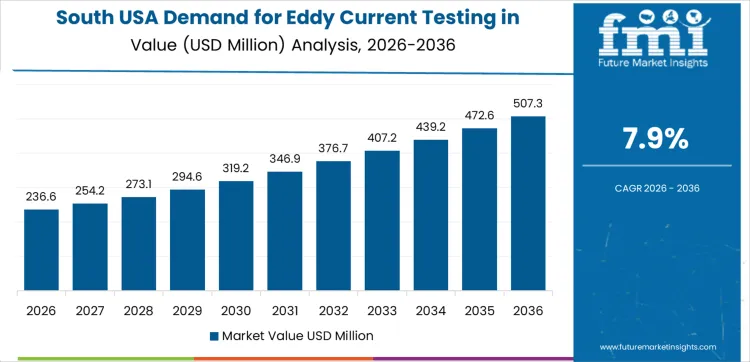
South USA is experiencing steady demand for eddy current testing (ECT), with a 7.9% CAGR. The region’s expanding aerospace, automotive, and manufacturing sectors are major contributors to the increasing need for this non-destructive testing method. States like Texas, Florida, and Georgia are home to significant manufacturing hubs where ECT is used to inspect and maintain metal components in industries such as aerospace, automotive, and energy production. The ability of ECT to detect defects like cracks and corrosion in metals without damaging them makes it particularly valuable in these high-risk industries. As industries in the South continue to invest in automation, quality control, and infrastructure, the adoption of advanced testing methods, including ECT, will only increase. Furthermore, as the region embraces new technologies and focuses on improving safety and product quality, the demand for ECT will continue to grow.
How is Demand for Eddy Current Testing Expanding in Northeast USA?
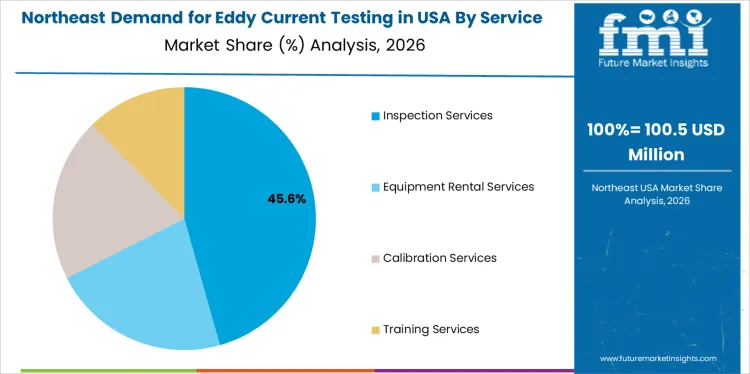
Northeast USA is seeing steady demand for eddy current testing (ECT), with a 7.1% CAGR. The region’s long-standing focus on aerospace, defense, and advanced manufacturing industries is driving this growth. States like New York, Pennsylvania, and Massachusetts are hubs for major aerospace and manufacturing facilities where ECT is crucial for detecting defects in metal components, particularly those involved in high-stakes operations like aerospace and automotive production. As industries in the Northeast continue to prioritize safety and quality control in their manufacturing processes, the use of non-destructive testing solutions like ECT is on the rise. The region’s commitment to technological advancements and maintaining high standards in production processes further supports this demand. As the Northeast continues to be a leader in industrial development, the increasing need for ECT in ensuring product integrity and reducing maintenance costs will drive further adoption.
Why is Demand for Eddy Current Testing Growing in Midwest USA?
Midwest USA is experiencing moderate demand for eddy current testing (ECT), with a 6.2% CAGR. The region's strong manufacturing base, particularly in automotive and heavy machinery sectors, is contributing to the rising adoption of this advanced testing technique. States like Michigan, Ohio, and Illinois are key players in the automotive industry, where ECT plays a critical role in inspecting vital components like engines, transmission systems, and structural materials. As the Midwest continues to prioritize quality control, efficiency, and safety in its production processes, non-destructive testing methods such as ECT are becoming essential tools for ensuring material integrity and preventing costly failures. As the region's industrial sectors grow and evolve, the use of ECT for routine inspections and maintenance is expanding. The focus on precision and reliability in manufacturing, coupled with an increasing interest in predictive maintenance, is fueling the demand for ECT.
What is the Competitive Landscape of Eddy Current Testing in USA?
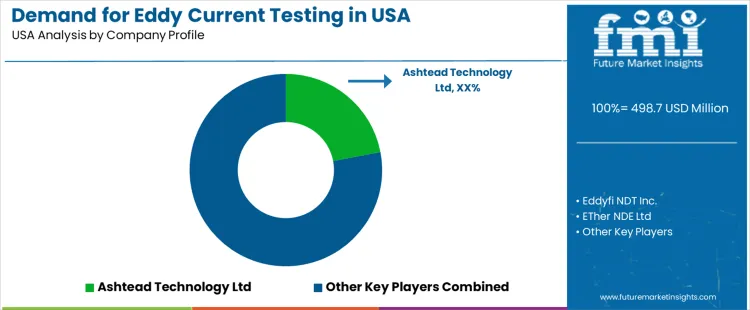
Demand for eddy current testing in the USA is growing as industries turn to non-destructive testing (NDT) solutions to assess the integrity of materials and components. This technology, widely used in aerospace, automotive, energy, and manufacturing sectors, is essential for detecting surface and sub-surface defects, corrosion, and cracks. With industries demanding precision, reliability, and quality control, eddy current testing is becoming increasingly important to ensure the safety and performance standards of critical components.
Ashtead Technology Ltd plays a key role in the industry by providing flexible, high-quality eddy current testing equipment and services. The company focuses on innovative NDT solutions, offering cutting-edge technologies for industries that require precise inspections to maintain the safety of their assets. Ashtead’s commitment to delivering reliable, advanced testing solutions has earned it a strong reputation across various sectors.
Eddyfi specializes in advanced, custom-built inspection technologies for critical infrastructure, particularly in aerospace and power generation. GE, Olympus, and MISTRAS leverage their established industry presence to offer comprehensive testing services, integrating eddy current technology with other inspection methods to ensure reliability in a wide range of applications. As the demand for NDT solutions continues to rise, these companies are focusing on innovations such as enhanced sensitivity, improved portability, and ease of use, which will drive the future of the eddy current testing industry in the USA.
Key Players in USA Eddy Current Testing Demand
- Ashtead Technology Ltd
- Eddyfi NDT Inc.
- ETher NDE Ltd
- Fidgeon Ltd
- General Electric Company
- ibg NDT System Corporation
- Magnetic Analysis Corporation
- MISTRAS Group Inc
- Olympus Corporation
- TÜV Rheinland Inc.
Scope of Report
| Items | Values |
|---|---|
| Quantitative Units (2026) | USD million |
| Key Segments | Altering Current Field Measurement, Eddy Current Array, Conventional, Remote Field Testing, Others |
| Service | Inspection Services, Equipment Rental Services, Calibration Services, Training Services |
| Industry Verticals | Manufacturing, Oil & Gas, Automotive, Power Generation, Government Infrastructure & Public Safety |
| Key Country | USA |
| Region | West USA, South USA, Northeast USA, Midwest USA |
| Key Players Profiled | Ashtead Technology Ltd, Eddyfi NDT Inc., ETher NDE Ltd, Fidgeon Ltd, General Electric Company, ibg NDT System Corporation, Magnetic Analysis Corporation, MISTRAS Group Inc, Olympus Corporation, TÜV Rheinland Inc. |
| Additional Attributes | Dollar sales by technique, service, and industry verticals; regional CAGR and growth trends in Eddy Current Testing in the USA |
USA Eddy Current Testing Demand by Key Segments
Technique:
- Altering Current Field Measurement
- Eddy Current Array
- Conventional
- Remote Field Testing
- Others
Service:
- Inspection Services
- Equipment Rental Services
- Calibration Services
- Training Services
Industry Verticals:
- Manufacturing
- Oil & Gas
- Automotive
- Power Generation
- Government Infrastructure & Public Safety
Region:
- West USA
- South USA
- Northeast USA
- Midwest USA
Frequently Asked Questions
How big is the demand for eddy current testing in USA in 2026?
The demand for eddy current testing in USA is estimated to be valued at USD 498.7 million in 2026.
What will be the size of eddy current testing in USA in 2036?
The market size for the eddy current testing in USA is projected to reach USD 1,127.7 million by 2036.
How much will be the demand for eddy current testing in USA growth between 2026 and 2036?
The demand for eddy current testing in USA is expected to grow at a 7.7% CAGR between 2026 and 2036.
What are the key product types in the eddy current testing in USA?
The key product types in eddy current testing in USA are altering current field measurement, eddy current array, conventional, remote field testing and others.
Which service segment is expected to contribute significant share in the eddy current testing in USA in 2026?
In terms of service, inspection services segment is expected to command 46.2% share in the eddy current testing in USA in 2026.
Preview the report firsthand - request a free sample
Get SampleGet the brochure for pricing and purchase details.
Get PDFTable of Content
- Executive Summary
- USA Market Outlook
- Demand-side Trends
- Supply-side Trends
- Technology Roadmap Analysis
- Analysis and Recommendations
- Market Overview
- Market Coverage / Taxonomy
- Market Definition / Scope / Limitations
- Market Background
- Market Dynamics
- Drivers
- Restraints
- Opportunity
- Trends
- Scenario Forecast
- Demand in Optimistic Scenario
- Demand in Likely Scenario
- Demand in Conservative Scenario
- Opportunity Map Analysis
- Product Life Cycle Analysis
- Supply Chain Analysis
- Investment Feasibility Matrix
- Value Chain Analysis
- PESTLE and Porter’s Analysis
- Regulatory Landscape
- Regional Parent Market Outlook
- Production and Consumption Statistics
- Import and Export Statistics
- Market Dynamics
- USA Market Analysis 2021 to 2026 and Forecast, 2026 to 2036
- Historical Market Size Value (USD Million) Analysis, 2021 to 2026
- Current and Future Market Size Value (USD Million) Projections, 2026 to 2036
- Y-o-Y Growth Trend Analysis
- Absolute $ Opportunity Analysis
- USA Market Pricing Analysis 2021 to 2026 and Forecast 2026 to 2036
- USA Market Analysis 2021 to 2026 and Forecast 2026 to 2036, By Technique
- Introduction / Key Findings
- Historical Market Size Value (USD Million) Analysis By Technique , 2021 to 2026
- Current and Future Market Size Value (USD Million) Analysis and Forecast By Technique , 2026 to 2036
- Altering Current Field Measurement
- Eddy Current Array
- Conventional
- Remote Field Testing
- Others
- Y-o-Y Growth Trend Analysis By Technique , 2021 to 2026
- Absolute $ Opportunity Analysis By Technique , 2026 to 2036
- USA Market Analysis 2021 to 2026 and Forecast 2026 to 2036, By Service
- Introduction / Key Findings
- Historical Market Size Value (USD Million) Analysis By Service, 2021 to 2026
- Current and Future Market Size Value (USD Million) Analysis and Forecast By Service, 2026 to 2036
- Inspection Services
- Equipment Rental Services
- Calibration Services
- Training Services
- Y-o-Y Growth Trend Analysis By Service, 2021 to 2026
- Absolute $ Opportunity Analysis By Service, 2026 to 2036
- USA Market Analysis 2021 to 2026 and Forecast 2026 to 2036, By Industry Verticals
- Introduction / Key Findings
- Historical Market Size Value (USD Million) Analysis By Industry Verticals, 2021 to 2026
- Current and Future Market Size Value (USD Million) Analysis and Forecast By Industry Verticals, 2026 to 2036
- Manufacturing
- Oil & Gas
- Automotive
- Power Generation
- Government Infrastructure & Public Safety
- Y-o-Y Growth Trend Analysis By Industry Verticals, 2021 to 2026
- Absolute $ Opportunity Analysis By Industry Verticals, 2026 to 2036
- Market Structure Analysis
- Competition Dashboard
- Competition Benchmarking
- Market Share Analysis of Top Players
- By Regional
- By Technique
- By Service
- By Industry Verticals
- Competition Analysis
- Competition Deep Dive
- Ashtead Technology Ltd
- Overview
- Product Portfolio
- Profitability by Market Segments (Product/Age /Sales Channel/Region)
- Sales Footprint
- Strategy Overview
- Marketing Strategy
- Product Strategy
- Channel Strategy
- Eddyfi NDT Inc.
- ETher NDE Ltd
- Fidgeon Ltd
- General Electric Company
- ibg NDT System Corporation
- Magnetic Analysis Corporation
- MISTRAS Group Inc
- Olympus Corporation
- TÜV Rheinland Inc.
- Ashtead Technology Ltd
- Competition Deep Dive
- Assumptions & Acronyms Used
- Research Methodology


