

- Industry Size (2025)
- USD 1.3 Bn
- Forecast (2035)
- USD 1.8 Bn
- CAGR (2025 to 2035)
- 3.4%
Demand for Antimicrobial Susceptibility Testing in USA Forecast and Outlook 2025 to 2035
Demand for antimicrobial susceptibility testing (AST) in the USA is expected to grow from USD 1.3 billion in 2025 to USD 1.8 billion by 2035, reflecting a compound annual growth rate (CAGR) of 3.4%. Growth is driven by the increasing need to combat antimicrobial resistance (AMR), a growing public health threat. AST is essential for determining antibiotic effectiveness against pathogens, which is critical for guiding treatment plans and improving patient outcomes. As healthcare systems focus more on personalized medicine and more effective infection control strategies, the adoption of antimicrobial susceptibility testing is expected to rise.
Growth is also supported by the increasing number of hospital-acquired infections (HAIs) and the demand for rapid, accurate diagnostic tests. Advances in AST technologies, including automated systems, digital platforms, and rapid testing methods, are expected to improve efficiency, accuracy, and turnaround times, contributing to market growth. Furthermore, government and healthcare initiatives aimed at curbing antimicrobial resistance are likely to accelerate the use of AST, supporting the expansion of the market in the USA over the next decade.
Quick Stats of the Demand for Antimicrobial Susceptibility Testing in USA
- Demand for Antimicrobial Susceptibility Testing in USA Value (2025): USD 1.3 billion
- Demand for Antimicrobial Susceptibility Testing in USA Forecast Value (2035): USD 1.8 billion
- Demand for Antimicrobial Susceptibility Testing in USA Forecast CAGR (2025-2035): 3.4%
- Demand for Antimicrobial Susceptibility Testing in USA Leading Product: Instruments (40%)
- Demand for Antimicrobial Susceptibility Testing in USA Key Growth Regions: West USA, South USA, Northeast USA, Midwest USA
- Demand for Antimicrobial Susceptibility Testing in USA Key Players: Thermo Fisher Scientific, BD, Danaher, Bio-Rad, Creative Diagnostics
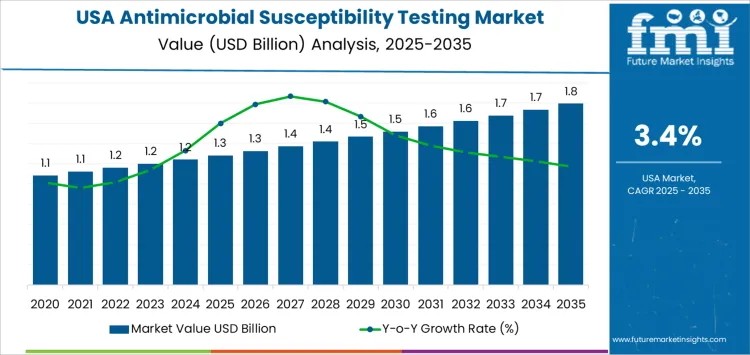
What is the Growth Forecast for the Antimicrobial Susceptibility Testing Market through 2035?
Market share analysis for antimicrobial susceptibility testing in the USA shows gradual growth, but with limited fluctuations in market share. Starting at USD 1.3 billion in 2025, the market shows consistent growth, reaching USD 1.3 billion in 2026 and USD 1.4 billion in 2027. This period reflects modest growth driven by ongoing healthcare needs, but at a relatively slow pace, as the adoption of antimicrobial testing continues to expand within healthcare systems.
As the market matures, growth continues steadily, with the market reaching USD 1.4 billion in 2028, USD 1.5 billion in 2029, and USD 1.5 billion in 2030. However, growth remains stable, indicating that while demand for AST continues to increase, its market share relative to other diagnostic testing technologies has not risen dramatically. In the later years of the forecast, from 2030 to 2035, the market value reaches USD 1.6 billion in 2031, USD 1.7 billion in 2032, and USD 1.8 billion in 2035, showing consistent, steady growth with no significant erosion in market share.
USA Antimicrobial Susceptibility Testing Industry Key Takeaways
| Metric | Value |
|---|---|
| Industry Sales Value (2025) | USD 1.3 billion |
| Industry Forecast Value (2035) | USD 1.8 billion |
| Industry Forecast CAGR (2025-2035) | 3.4% |
Why is the Demand for Antimicrobial Susceptibility Testing Growing in the USA?
Demand for antimicrobial susceptibility testing (AST) in the USA is increasing significantly because drug resistant infections are becoming more common and pose a serious public health challenge. Each year in the USA, millions of infections are caused by antibiotic resistant bacteria, and tens of thousands result in fatalities. In this context, AST plays a critical role: by testing which antimicrobials a pathogen responds to, AST guides clinicians toward the most effective treatment. This reduces misuse of antibiotics, helps contain resistance spread, and improves patient outcomes. As microbes evolve new resistance mechanisms and superbugs emerge, the need for precise, timely testing becomes more urgent.
At the same time, structural changes in USA healthcare, including increased investments in diagnostic infrastructure, growth of hospital and reference lab capacity, and rising demand for efficient treatment protocols, support increased uptake of AST. North America leads the global AST market, with the USA accounting for the vast majority of regional demand. Also, innovations in rapid and automated testing methods are accelerating adoption. Faster turnaround times and improved diagnostic accuracy make AST more practical and cost effective for routine clinical use, including in hospital settings, diagnostic labs, and public health microbiology facilities. Because antimicrobial resistance shows no signs of slowing, and as healthcare providers emphasize antibiotic stewardship and precision medicine, demand for antimicrobial susceptibility testing in the USA is expected to continue growing steadily in the coming years.
What Are the Key Segments in Antimicrobial Susceptibility Testing Market in the USA?
Antimicrobial susceptibility testing (AST) market in the USA is segmented by product and application. Instruments lead the product segment, holding 40% of the market share. In terms of applications, sepsis is the leading condition diagnosed, with respiratory infections accounting for 18% of the market. The demand for AST is driven by the increasing prevalence of antimicrobial-resistant infections and the growing need for rapid, accurate testing to guide appropriate treatment strategies.
Which Product Drives Antimicrobial Susceptibility Testing Demand in the USA?
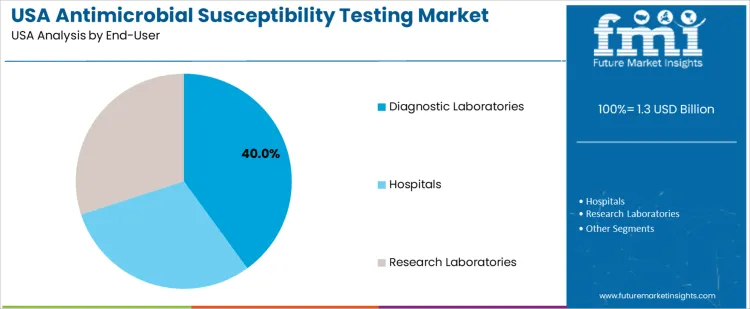
Instruments dominate the antimicrobial susceptibility testing market in the USA, accounting for 40% of the market. These instruments, which include automated systems for testing bacterial susceptibility to antibiotics, are essential for clinical laboratories to conduct antimicrobial susceptibility tests efficiently. The accuracy, speed, and high throughput of these instruments make them indispensable in diagnosing infections and determining the most effective antimicrobial therapies. Although software & services and kits & reagents are also important components of the AST market, instruments are the primary driver of market growth, as they enable rapid results, improve laboratory workflow, and reduce human error. As antimicrobial resistance becomes an increasingly urgent public health concern, the demand for these instruments continues to rise, with hospitals and clinics investing in advanced testing technologies to better manage patient care.
Which Application Drives Antimicrobial Susceptibility Testing Demand in the USA?
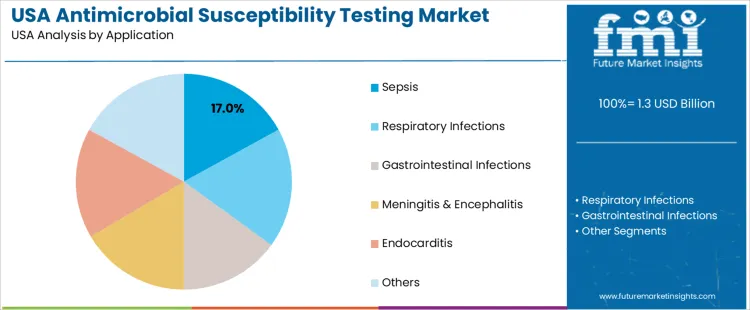
Sepsis is the leading application for antimicrobial susceptibility testing in the USA, driven by the high morbidity and mortality associated with the condition. Timely and accurate antimicrobial susceptibility testing is crucial for identifying the most effective antibiotics to treat sepsis, a life-threatening infection that can progress rapidly. The ability to perform AST in sepsis cases allows healthcare providers to administer appropriate therapies more quickly, improving patient outcomes. Respiratory infections, which account for 18% of the market share, also drive significant demand for AST, as rapid identification of resistant pathogens is essential for effective treatment. Other applications, such as gastrointestinal infections, meningitis & encephalitis, and endocarditis, also contribute to the market, as AST plays a critical role in determining the best therapeutic approach for various diseases.
What are the Key Dynamics of the Antimicrobial Susceptibility Testing in USA?
Demand for antimicrobial susceptibility testing (AST) in the USA is rising steadily as hospitals, diagnostic laboratories, pharmaceutical companies, and research institutions increasingly rely on AST to guide effective treatment of infections. With rising concern about antibiotic resistance and the need for more targeted therapies, AST plays a crucial role in selecting the appropriate antibiotic for treatment. The growing focus on precision medicine, along with advancements in testing technology, is driving the expansion of the AST market. AST helps reduce antibiotic misuse, contributing to better patient outcomes and reducing the spread of resistance.
What are the Drivers of Demand for Antimicrobial Susceptibility Testing in USA?
Several factors are driving the demand for AST in the USA First, the increasing prevalence of antibiotic-resistant infections and multidrug-resistant pathogens is creating a critical need for precise testing to guide effective treatments and prevent further resistance. Second, the growing emphasis on antimicrobial stewardship and infection control in hospitals is driving the widespread use of AST to ensure proper antibiotic use. Third, advancements in diagnostic technologies, such as automated systems and high-throughput testing platforms, are making AST more efficient and reliable, which is expanding its use across clinical settings. Additionally, the rising demand for personalized medicine, where treatments are tailored to the individual, is fueling the need for accurate and rapid AST to guide appropriate therapy decisions.
What are the Restraints on Demand for Antimicrobial Susceptibility Testing in USA?
Despite the growing demand, several factors could limit the adoption of AST in the USA. One key restraint is the high cost of advanced AST technologies, particularly rapid testing platforms and automated systems, which may be prohibitive for smaller laboratories or healthcare providers. Another challenge is the complexity and technical requirements of performing AST, which may require skilled personnel and specialized equipment that are not always available in every clinical setting. Additionally, while AST is essential for guiding treatment decisions, it is not always used, particularly when physicians rely on empirical antibiotic therapy. Finally, the time required for some traditional AST methods, such as culture-based testing, may delay treatment, which could limit their use in urgent or emergencies.
What are the Key Trends Influencing Demand for Antimicrobial Susceptibility Testing in USA?
Several key trends are shaping the demand for AST in the USA. A significant trend is the increasing use of rapid and automated AST technologies, which reduce testing time and allow for faster treatment decisions. Adoption of molecular and genetic testing methods is also rising, enabling speedier detection of resistance genes and improving the accuracy of AST. Another trend is growing integration of AST into antimicrobial stewardship programs, where its use is central to ensuring proper antibiotic use and reducing resistance. There is also an increasing focus on real-time surveillance of antibiotic resistance patterns, which drives demand for more frequent and widespread use of AST in hospitals and clinics. Lastly, with the growing emphasis on personalized medicine, the need for more precise and tailored treatments is further driving the adoption of AST in clinical decision-making.
What is the Regional Demand Outlook for the Antimicrobial Susceptibility Testing Market in the USA?
Growth in the USA is expected to be steady across regions, with the West leading the way at a projected CAGR of 3.9%. South USA follows closely with a growth rate of 3.5%, while the Northeast USA is expected to grow at 3.1%. The Midwest USA shows more moderate growth with a CAGR of 2.7%. AST is crucial for determining the effectiveness of antimicrobial agents against specific pathogens, and its importance in diagnosing and treating infectious diseases is driving market expansion. As healthcare providers increasingly rely on AST for more precise antibiotic prescribing, the demand for AST solutions continues to rise.
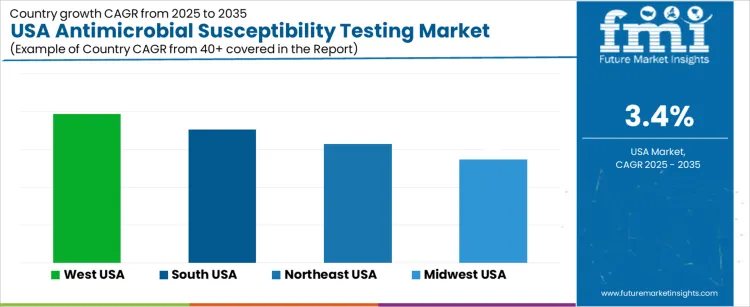
| Region | CAGR (2025-2035) |
|---|---|
| West USA | 3.9% |
| South USA | 3.5% |
| Northeast USA | 3.1% |
| Midwest USA | 2.7% |
What is Driving the Growth of Antimicrobial Susceptibility Testing in the West USA?
The West USA is projected to experience the highest growth in the Antimicrobial Susceptibility Testing market, with a projected CAGR of 3.9%. The region’s robust healthcare infrastructure, combined with its focus on advanced diagnostic technologies, is a key driver of this growth. States like California, Washington, and Oregon are home to leading medical research institutions and hospitals that are increasingly adopting AST to combat antimicrobial resistance (AMR). With rising concerns about drug-resistant infections, the West USA is prioritizing precision medicine and antimicrobial stewardship programs, which rely heavily on accurate and timely AST results. Additionally, the growing awareness of AMR, along with the region’s commitment to innovation in healthcare, further fuels the demand for AST solutions. The increased investment in diagnostics and laboratory automation in the West is also contributing to the market’s growth.
Why is the Antimicrobial Susceptibility Testing Market Expanding in South USA?
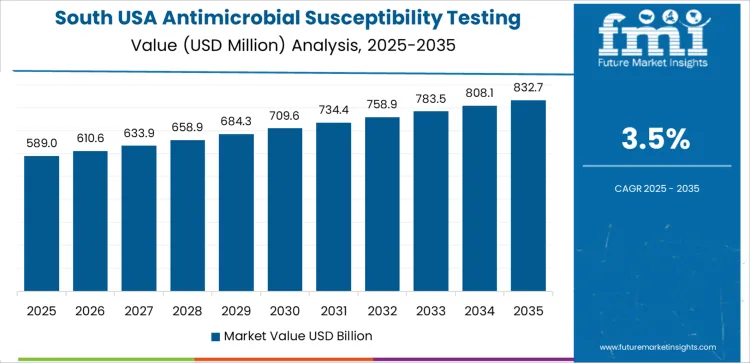
In South USA, the Antimicrobial Susceptibility Testing market is projected to grow at a CAGR of 3.5%. The region’s large healthcare infrastructure, especially in states like Texas, Florida, and Georgia, is a significant factor in the increased adoption of AST. As the incidence of infectious diseases, including drug-resistant infections, continues to rise, healthcare providers in the South are turning to AST to ensure more targeted antibiotic treatments. The growing recognition of the importance of antimicrobial stewardship in reducing the spread of resistant pathogens is driving the demand for AST solutions in the region. Moreover, the expansion of healthcare facilities and diagnostic laboratories in Southern states is making AST more accessible, further contributing to the market’s growth. The South’s diverse population and large number of hospital admissions also support the increasing demand for AST to guide treatment decisions.
How is the Antimicrobial Susceptibility Testing Market Growing in Northeast USA?
In Northeast USA, the Antimicrobial Susceptibility Testing market is projected to grow at a CAGR of 3.1%. The region’s dense population, coupled with its well-established healthcare systems, is driving the demand for more accurate and efficient diagnostic tools like AST. Cities such as New York, Boston, and Philadelphia have large medical research centers and hospitals that are increasingly focusing on combating antimicrobial resistance. The growing emphasis on precision medicine and targeted therapies is contributing to the adoption of AST as a critical tool for determining the most effective treatment options for infections. The Northeast’s high rate of healthcare spending and its advanced diagnostic infrastructure make it an important market for AST solutions. As awareness of antimicrobial resistance continues to grow, healthcare providers in the region are increasingly relying on AST to guide antibiotic prescribing practices and improve patient outcomes.
What is Contributing to the Growth of Antimicrobial Susceptibility Testing in Midwest USA?
In Midwest USA, the Antimicrobial Susceptibility Testing market is expected to grow at a CAGR of 2.7%. The Midwest’s strong healthcare and research institutions, particularly in states like Illinois, Ohio, and Michigan, are contributing to the market’s growth. As the region experiences an increase in the number of antimicrobial-resistant infections, there is a growing need for precise diagnostic tools like AST. The Midwest’s healthcare facilities are investing in AST technologies to help clinicians make informed decisions about antibiotic use and reduce the spread of resistant infections. While the region’s growth rate is more moderate compared to other USA regions, the rising awareness of AMR and the ongoing push for antimicrobial stewardship are expected to drive continued demand for AST solutions in the Midwest. Additionally, the region’s increasing focus on public health initiatives to control infectious diseases is supporting the growth of the market.
What is the Competitive Landscape for the Demand for Antimicrobial Susceptibility Testing in the USA?
Demand for antimicrobial susceptibility testing (AST) in the USA has surged as the threat from antibiotic resistant infections becomes more serious. Rising rates of multidrug resistant bacteria and growing awareness of antimicrobial resistance (AMR) among clinicians and health authorities have made AST indispensable for guiding effective and safe antibiotic therapy. Timely and accurate AST helps doctors select effective drugs, avoid ineffective treatments, and support antimicrobial stewardship programs. Advances in technology, including automated and rapid AST platforms, increased hospital adoption, and rising investment in diagnostics further boost demand across clinical microbiology labs, hospitals, and reference laboratories nationwide.
On the supply side, a few major diagnostics and life science companies dominate the market. According to your list, Thermo Fisher Scientific leads with about 24% market share; other key players include BD (Becton, Dickinson and Company), Danaher Corporation, Bio-Rad Laboratories, and Creative Diagnostics. These firms supply AST systems, reagents, consumables, and software workflows used in hospitals and clinical labs. Competition among suppliers centers on speed and accuracy of testing, breadth of pathogen and antibiotic coverage, ease of automation, data management and reporting, regulatory compliance, and after sales support. Suppliers that deliver reliable, rapid, clinically validated AST solutions and maintain robust distribution networks are best positioned to capture growth as demand rises for antimicrobial susceptibility testing in response to increasing AMR pressures.
Key Players of the Antimicrobial Susceptibility Testing Industry in USA
- Thermo Fisher Scientific
- BD
- Danaher
- Bio-Rad
- Creative Diagnostics
Scope of the Report
| Items | Details |
|---|---|
| Quantitative Units | USD Billion |
| Regions Covered | USA |
| Product | Instruments; Software & Services; Kits & Reagents (Consumables) |
| Application | Sepsis; Respiratory Infections; Gastrointestinal Infections; Meningitis & Encephalitis; Endocarditis; Others (various bacterial/fungal infections needing AST) |
| End User | Diagnostic Laboratories; Hospitals; Research Laboratories |
| Key Companies Profiled | Thermo Fisher Scientific; BD (Becton, Dickinson & Co.); Danaher; Bio Rad Laboratories; Creative Diagnostics |
| Additional Attributes | Dollar sales by product type and application show strong demand for kits & reagents and instruments, especially linked to infectious disease diagnostics (sepsis, respiratory and gastrointestinal infections). Automated AST systems are growing faster than manual test methods as labs seek quicker, more reliable results. Demand is driven by rising antimicrobial resistance (AMR), greater clinical focus on precise antibiotic prescription, and increased use in hospitals and diagnostic labs. |
Key Segments in the Demand for Antimicrobial Susceptibility Testing in USA
Product
- Instruments
- Software & Services
- Kits & Reagents
Application
- Sepsis
- Respiratory Infections
- Gastrointestinal Infections
- Meningitis & Encephalitis
- Endocarditis
- Others
End User
- Diagnostic Laboratories
- Hospitals
- Research Laboratories
Region
- Northeast USA
- West USA
- Midwest USA
- South USA
Frequently Asked Questions
How big is the demand for antimicrobial susceptibility testing in USA in 2025?
The demand for antimicrobial susceptibility testing in USA is estimated to be valued at USD 1.3 billion in 2025.
What will be the size of antimicrobial susceptibility testing in USA in 2035?
The market size for the antimicrobial susceptibility testing in USA is projected to reach USD 1.8 billion by 2035.
How much will be the demand for antimicrobial susceptibility testing in USA growth between 2025 and 2035?
The demand for antimicrobial susceptibility testing in USA is expected to grow at a 3.4% CAGR between 2025 and 2035.
What are the key product types in the antimicrobial susceptibility testing in USA?
The key product types in antimicrobial susceptibility testing in USA are instruments, software & services and kits & reagents.
Which application segment is expected to contribute significant share in the antimicrobial susceptibility testing in USA in 2025?
In terms of application, sepsis segment is expected to command 17.0% share in the antimicrobial susceptibility testing in USA in 2025.
Preview the report firsthand - request a free sample
Get SampleGet the brochure for pricing and purchase details.
Get PDFTable of Content
- Executive Summary
- USA Market Outlook
- Demand-side Trends
- Supply-side Trends
- Technology Roadmap Analysis
- Analysis and Recommendations
- Market Overview
- Market Coverage / Taxonomy
- Market Definition / Scope / Limitations
- Market Background
- Market Dynamics
- Drivers
- Restraints
- Opportunity
- Trends
- Scenario Forecast
- Demand in Optimistic Scenario
- Demand in Likely Scenario
- Demand in Conservative Scenario
- Opportunity Map Analysis
- Product Life Cycle Analysis
- Supply Chain Analysis
- Investment Feasibility Matrix
- Value Chain Analysis
- PESTLE and Porter’s Analysis
- Regulatory Landscape
- Regional Parent Market Outlook
- Production and Consumption Statistics
- Import and Export Statistics
- Market Dynamics
- USA Market Analysis 2020 to 2024 and Forecast, 2025 to 2035
- Historical Market Size Value (USD Million) Analysis, 2020 to 2024
- Current and Future Market Size Value (USD Million) Projections, 2025 to 2035
- Y-o-Y Growth Trend Analysis
- Absolute $ Opportunity Analysis
- USA Market Pricing Analysis 2020 to 2024 and Forecast 2025 to 2035
- USA Market Analysis 2020 to 2024 and Forecast 2025 to 2035, By Product
- Introduction / Key Findings
- Historical Market Size Value (USD Million) Analysis By Product , 2020 to 2024
- Current and Future Market Size Value (USD Million) Analysis and Forecast By Product , 2025 to 2035
- Instruments
- Software & Services
- Kits & Reagents
- Y-o-Y Growth Trend Analysis By Product , 2020 to 2024
- Absolute $ Opportunity Analysis By Product , 2025 to 2035
- USA Market Analysis 2020 to 2024 and Forecast 2025 to 2035, By Application
- Introduction / Key Findings
- Historical Market Size Value (USD Million) Analysis By Application, 2020 to 2024
- Current and Future Market Size Value (USD Million) Analysis and Forecast By Application, 2025 to 2035
- Sepsis
- Respiratory Infections
- Gastrointestinal Infections
- Meningitis & Encephalitis
- Endocarditis
- Others
- Y-o-Y Growth Trend Analysis By Application, 2020 to 2024
- Absolute $ Opportunity Analysis By Application, 2025 to 2035
- USA Market Analysis 2020 to 2024 and Forecast 2025 to 2035, By End-User
- Introduction / Key Findings
- Historical Market Size Value (USD Million) Analysis By End-User, 2020 to 2024
- Current and Future Market Size Value (USD Million) Analysis and Forecast By End-User, 2025 to 2035
- Diagnostic Laboratories
- Hospitals
- Research Laboratories
- Y-o-Y Growth Trend Analysis By End-User, 2020 to 2024
- Absolute $ Opportunity Analysis By End-User, 2025 to 2035
- Market Structure Analysis
- Competition Dashboard
- Competition Benchmarking
- Market Share Analysis of Top Players
- By Regional
- By Product
- By Application
- By End-User
- Competition Analysis
- Competition Deep Dive
- Thermo Fisher Scientific
- Overview
- Product Portfolio
- Profitability by Market Segments (Product/Age /Sales Channel/Region)
- Sales Footprint
- Strategy Overview
- Marketing Strategy
- Product Strategy
- Channel Strategy
- BD
- Danaher
- Bio-Rad
- Creative Diagnostics
- Thermo Fisher Scientific
- Competition Deep Dive
- Assumptions & Acronyms Used
- Research Methodology


