

- Industry Size (2026)
- USD 10.6 Mn
- Forecast (2036)
- USD 29.4 Mn
- CAGR (2026 to 2036)
- 10.7%
Demand for VRF Systems in USA 2026 to 2036
Demand for VRF systems in USA is valued at USD 10.6 million in 2026 and is forecasted to reach USD 29.4 million by 2036, reflecting a CAGR of 10.7%. Demand accelerates as commercial buildings, healthcare facilities, and multi-family developments adopt energy-efficient HVAC solutions with precise zone-level control. Electrification initiatives, tighter building energy codes, and replacement of legacy systems support continued installation activity across new construction and retrofit projects.
Heat pump systems lead system-type usage because these configurations provide both heating and cooling with high seasonal efficiency and reduced carbon intensity. Variable refrigerant flow technology enables simultaneous heating and cooling across multiple zones, improving occupant comfort and lowering operating costs. Advances in inverter-driven compressors, refrigerant management, and smart controls enhance system reliability and performance in diverse climate conditions.
Quick Stats for Demand for VRF Systems in USA
- USA VRF Systems Sales Value (2026): USD 10.6 million
- USA VRF Systems Forecast Value (2036): USD 29.4 million
- USA VRF Systems Forecast CAGR (2026 to 2036): 10.7%
- Leading System Type in USA Demand: Heat pump systems
- Key Growth Regions in USA Demand: West USA, South USA, Northeast USA, Midwest USA
- Top Players in USA Demand: Daikin Applied, Mitsubishi Electric Trane HVAC, LG Air Conditioning Technologies, Samsung HVAC America, Toshiba Carrier Corporation
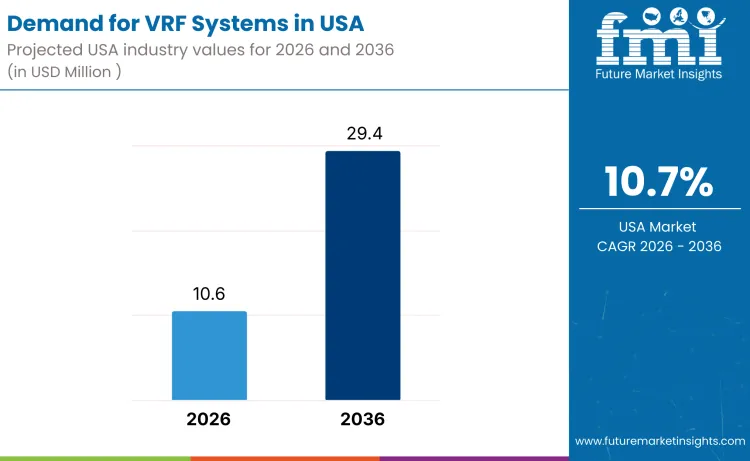
West USA, South USA, Northeast USA, and Midwest USA represent key growth regions driven by mixed-use development, commercial retrofits, and demand for flexible HVAC architectures. Daikin Applied, Mitsubishi Electric Trane HVAC, LG Air Conditioning Technologies, Samsung HVAC America, and Toshiba Carrier Corporation anchor competitive activity through expanded product portfolios, integrated controls, and contractor support programs aligned with evolving efficiency standards and building performance requirements across USA installations.
USA VRF Systems Key Takeaways
| Metric | Value |
|---|---|
| USA VRF Systems Sales Value (2026) | USD 10.6 million |
| USA VRF Systems Forecast Value (2036) | USD 29.4 million |
| USA VRF Systems Forecast CAGR (2026 to 2036) | 10.7% |
How Are the Segments Classified in the Demand for VRF Systems in the USA?
Demand for variable refrigerant flow systems in the USA is shaped by energy-efficiency regulations, space-conditioning flexibility requirements, and rising adoption of zoned HVAC solutions. Buyers evaluate system scalability, part-load efficiency, control precision, and suitability for mixed-use buildings. Adoption patterns reflect increased installation across residential and commercial buildings seeking reduced operating costs, lower emissions, and compatibility with modern building automation standards within USA construction and retrofit activity.
Which Component Accounts for the Largest Share of Demand in the USA?
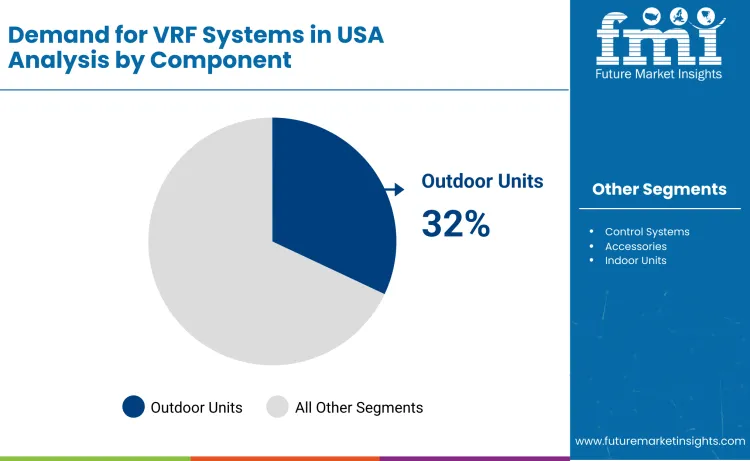
Outdoor units hold 32.0%, making them the leading component segment in the USA. Outdoor units integrate compressors, heat exchangers, and inverter-driven components that determine system capacity and efficiency. These units represent the highest value contribution due to complex engineering and refrigerant management requirements. Indoor units support zoning flexibility and occupant comfort across multiple spaces. Control systems enable centralized monitoring, load balancing, and energy optimization. Accessories support installation, piping, and system integration. Component distribution reflects higher capital concentration in outdoor units within USA VRF installations.
Key Points:
- Outdoor units dominate due to high engineering and value concentration.
- Indoor units enable zoning and space-specific conditioning.
- Control systems support efficiency and system coordination.
Which System Type Accounts for the Largest Share of Demand in the USA?
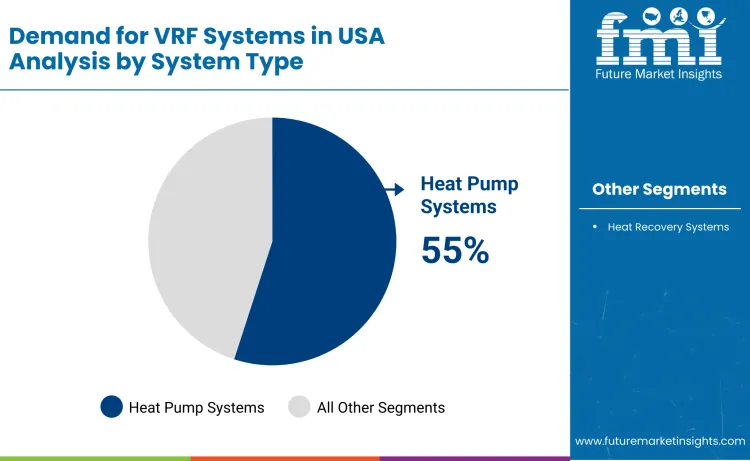
Heat pump systems hold 55.0%, making them the leading system-type segment in the USA. These systems provide both heating and cooling using reversible refrigerant cycles, supporting year-round operation. Heat pump VRF systems align with electrification goals and reduced fossil-fuel reliance in building heating. Heat recovery systems serve buildings requiring simultaneous heating and cooling across zones, typically in commercial environments. System-type distribution reflects broader adoption of heat pump configurations due to versatility, energy efficiency, and suitability for USA climate diversity.
Key Points:
- Heat pump systems support both heating and cooling needs.
- Electrification trends favor reversible VRF configurations.
- Heat recovery systems serve complex multi-zone buildings.
Which End-User Segment Accounts for the Largest Share of Demand in the USA?
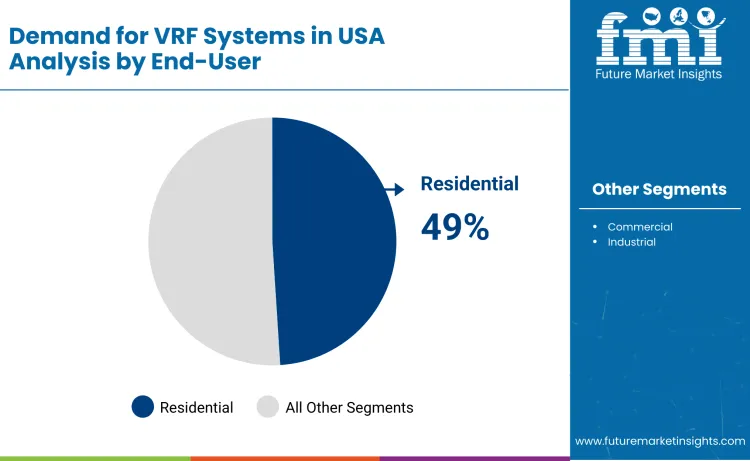
Residential end users hold 49.0%, making them the leading end-user segment in the USA. VRF systems are adopted in multi-family housing and high-end residential projects requiring zoning flexibility and quiet operation. Commercial buildings use VRF systems to manage variable occupancy and reduce energy consumption. Industrial facilities apply VRF selectively in offices and controlled environments. End-user distribution reflects strong residential uptake driven by energy-efficiency incentives, retrofit activity, and demand for flexible comfort solutions.
Key Points:
- Residential buildings lead due to zoning and efficiency benefits.
- Commercial users adopt VRF for variable occupancy management.
- Industrial use remains limited to specific conditioned spaces.
What are the Key Dynamics in the VRF Systems Industry in USA?
Demand increases as commercial buildings, multi-family housing, and mixed-use developments in USA adopt VRF systems for zoned temperature control, energy efficiency, and space optimization. Adoption aligns with tightening building energy codes, retrofit activity in urban corridors, and preference for electrified HVAC solutions. Office renovation, hospitality projects, and healthcare facilities drive steady installation volumes across major metropolitan regions.
How are energy efficiency regulations and building modernization driving VRF system adoption in USA?
USA building owners adopt VRF systems to meet state and city energy performance standards targeting reduced HVAC energy consumption. Variable refrigerant flow technology supports precise load matching, which improves efficiency in buildings with diverse occupancy patterns. Commercial retrofits use VRF to replace ageing rooftop units where duct modification is limited. Developers value simultaneous heating and cooling capability in large floorplate buildings. Electrification policies in states such as California and New York increase interest in non-gas HVAC systems. Hospitality and multi-family projects adopt VRF for quiet operation and individual zone control. Utility incentive programs support deployment through rebates tied to measured efficiency gains.
How do installation cost, technical complexity, and market awareness influence demand stability?
VRF systems require higher upfront investment compared with conventional HVAC, affecting adoption in cost-sensitive projects. Installation demands specialized contractor training for refrigerant piping, controls integration, and commissioning. USA labour shortages in skilled HVAC technicians extend project timelines. Building owners evaluate refrigerant regulations and long-term service availability when selecting systems. Retrofit complexity increases in older buildings with limited electrical capacity. Some regions maintain limited familiarity with VRF among specifiers and inspectors. Maintenance planning and proprietary control systems influence lifecycle cost assessments. Demand remains strongest in large urban markets where efficiency mandates and operating cost savings justify system complexity.
How Is Demand for VRF Systems in USA Evolving by Region?
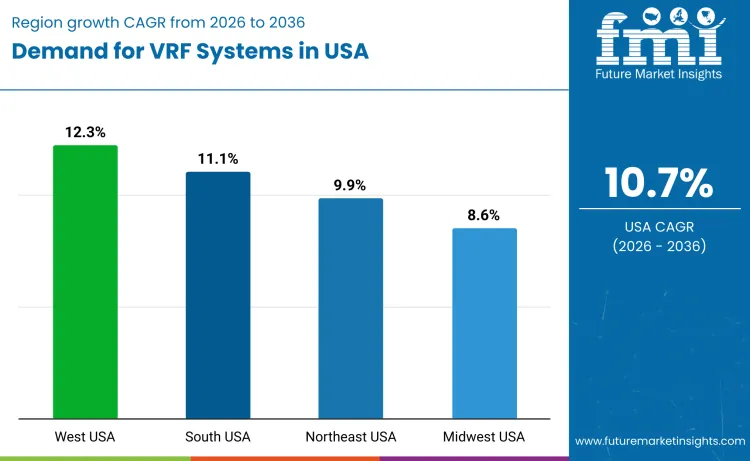
Demand for VRF systems in the USA is rising due to stricter energy-efficiency codes, electrification of buildings, and preference for zoned climate control in commercial and multi-family properties. West USA leads with a 12.3% CAGR, supported by decarbonization mandates, retrofit activity, and high electricity adoption. South USA follows at 11.1%, driven by cooling-intensive climates, commercial construction, and replacement of legacy HVAC systems. Northeast USA records a 9.9% CAGR, shaped by building retrofits, space-constrained installations, and cold-climate VRF adoption. Midwest USA posts an 8.6% CAGR, reflecting gradual penetration into commercial buildings and institutional facilities. Regional variation reflects climate demand, regulatory pressure, and retrofit feasibility across the USA.
| Region | CAGR (2026 to 2036) |
|---|---|
| West USA | 12.3% |
| South USA | 11.1% |
| Northeast USA | 9.9% |
| Midwest USA | 8.6% |
How is West USA driving demand for VRF Systems?
West USA demand is driven by aggressive energy-efficiency targets, electrification policies, and high adoption of advanced building technologies. The region’s CAGR of 12.3% reflects strong deployment of VRF systems in office buildings, mixed-use developments, healthcare facilities, and high-rise residential projects. Developers favor VRF for precise zoning, reduced ductwork, and compatibility with all-electric building designs. Retrofit projects replace gas-based HVAC systems to meet emissions standards. Utilities support adoption through incentive programs and demand-response integration. Demand favors heat-pump-based VRF systems with advanced controls, inverter-driven compressors, and building management system compatibility.
- Electrification-driven HVAC replacement projects
- High adoption in commercial and mixed-use buildings
- Utility incentives supporting VRF deployment
- Preference for advanced controls and heat-pump VRF
How is South USA driving demand for VRF Systems?
South USA demand is shaped by high cooling loads, long operating hours, and growth in commercial real estate. The region’s CAGR of 11.1% reflects increasing use of VRF systems in hotels, retail centers, hospitals, and educational campuses. Building owners adopt VRF to reduce peak energy demand and improve part-load efficiency in hot climates. New construction integrates VRF for flexible zoning across large floor plates. Retrofit activity targets aging rooftop units in commercial buildings. Demand emphasizes high-capacity outdoor units, robust refrigerant management, and serviceability under continuous operation conditions.
- Cooling-dominant climate driving VRF adoption
- Commercial buildings replacing rooftop HVAC units
- Energy savings from part-load efficiency
- Demand for high-capacity, durable VRF configurations
How is Northeast USA driving demand for VRF Systems?
Northeast USA demand reflects retrofit-driven adoption, space limitations, and tightening building energy codes. The region’s CAGR of 9.9% is supported by VRF installation in urban office buildings, multi-family housing, and healthcare facilities. Older buildings adopt VRF to avoid extensive ductwork and structural modification. Cold-climate VRF heat pumps gain acceptance due to improved low-temperature performance. Building owners value zoning flexibility for mixed-use occupancy. Demand favors compact indoor units, heat-recovery VRF systems, and compliance with local energy and emissions regulations.
- Retrofit-friendly HVAC solutions for older buildings
- Cold-climate VRF heat pump adoption
- Urban space constraints favoring ductless systems
- Emphasis on zoning and heat-recovery capability
How is Midwest USA driving demand for VRF Systems?
Midwest USA demand is steady and cost-conscious, reflecting gradual transition from conventional HVAC systems. The region’s CAGR of 8.6% reflects adoption of VRF in offices, universities, healthcare facilities, and manufacturing-adjacent buildings. Facility managers evaluate VRF for lifecycle cost reduction and zoning efficiency rather than rapid deployment. Cold winters influence preference for hybrid systems combining VRF with supplemental heating. New institutional construction supports incremental growth. Demand favors reliable systems with simplified maintenance and strong distributor support.
- Institutional and campus-based installations
- Hybrid HVAC configurations for cold climates
- Lifecycle cost and efficiency evaluation focus
- Gradual adoption through new construction and upgrades
What is the competitive landscape of demand for VRF systems in the USA?
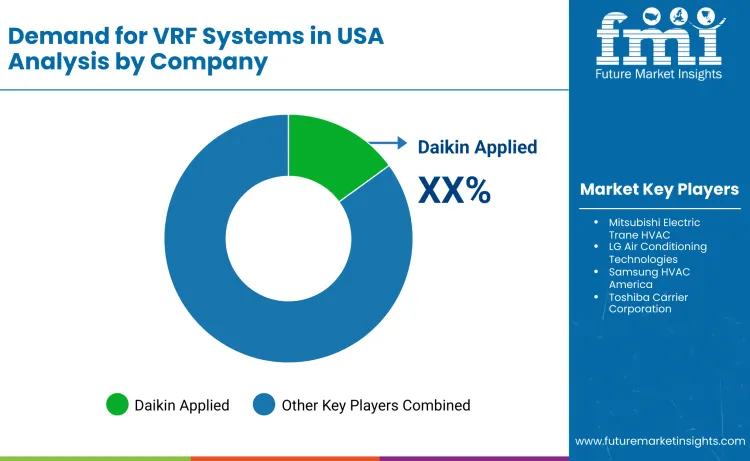
Demand for VRF systems in the USA is shaped by requirements for energy efficiency, zoning flexibility, and space-saving HVAC solutions across commercial buildings. Applications span offices, healthcare facilities, hospitality properties, multifamily housing, and education campuses requiring precise temperature control. Buyers evaluate system reliability, part-load efficiency, refrigerant management, and compatibility with USA building codes and efficiency standards. Procurement teams prioritize manufacturers with domestic service networks, trained installer ecosystems, and strong aftersales technical support. Trend in the USA market reflects retrofit activity in aging commercial stock, electrification initiatives, and interest in reducing operating costs through variable-capacity systems.
Daikin Applied maintains extensive VRF installations across the USA supported by domestic manufacturing, training centers, and distributor coverage. Mitsubishi Electric Trane HVAC US delivers VRF platforms widely specified for commercial and institutional projects requiring proven performance and service depth. LG Air Conditioning Technologies USA supplies VRF systems adopted in mixed-use developments emphasizing compact design and advanced controls. Samsung HVAC America participates with VRF solutions integrated with building automation and energy management platforms. Toshiba Carrier Corporation USA supports demand through VRF offerings aligned with light commercial and specialized retrofit applications. Competitive positioning in the USA reflects compliance with local codes, installer support strength, system reliability, and long-term service capability across diverse building types.
Key Players in USA VRF Systems Demand
- Daikin Applied
- Mitsubishi Electric Trane HVAC
- LG Air Conditioning Technologies
- Samsung HVAC America
- Toshiba Carrier Corporation
Scope of the Report
| Items | Values |
|---|---|
| Quantitative Units | USD billion |
| Component | Outdoor Units (Value in USD million & Volume in units); Indoor Units (Value in USD million & Volume in units); Control Systems; Accessories |
| System Type | Heat Pump Systems; Heat Recovery Systems |
| End-User | Residential; Commercial; Industrial |
| Regions Covered | West USA; South USA; Northeast USA; Midwest USA |
| Key Companies Profiled | Daikin Applied; Mitsubishi Electric Trane HVAC; LG Air Conditioning Technologies; Samsung HVAC America; Toshiba Carrier Corporation |
| Additional Attributes | Dollar sales by component and system type; unit shipment trends for indoor and outdoor modules; adoption patterns across commercial retrofit and new construction projects; growth driven by energy-efficiency standards, zoning flexibility, and increasing preference for low-emission HVAC solutions in urban developments. |
USA VRF Systems Demand by Segments
Component:
- Outdoor Value (USD Million) & Volume (Units)
- Indoor Value (USD Million) & Volume (Units)
- Control Systems
- Accessories
System Type:
- Heat Pump Systems
- Heat Recovery Systems
End-User:
- Residential
- Commercial
- Industrial
Region:
- West USA
- South USA
- Northeast USA
- Midwest USA
Frequently Asked Questions
How big is the demand for VRF systems in USA in 2026?
The demand for VRF systems in USA is estimated to be valued at USD 10.6 million in 2026.
What will be the size of VRF systems demand in USA in 2036?
The demand size for VRF systems in USA is projected to reach USD 29.4 million by 2036.
How much will the demand for VRF systems in USA grow between 2026 and 2036?
The demand for VRF systems in USA is expected to grow at a 10.7% CAGR between 2026 and 2036.
What are the key components in the VRF systems demand in USA?
The key components in VRF systems demand in USA include outdoor units, indoor units, and control systems.
Which system-type segment is expected to contribute a significant share in the VRF systems demand in USA in 2026?
In terms of system type, heat pump systems are expected to command 55.0% share in the VRF systems demand in USA in 2026.
Preview the report firsthand - request a free sample
Get SampleGet the brochure for pricing and purchase details.
Get PDFTable of Content
- Executive Summary
- USA Market Outlook
- Demand Side Trends
- Supply Side Trends
- HVAC Energy Efficiency and Electrification Regulations
- Analysis and Recommendations
- Market Overview
- Market Coverage and Taxonomy
- Market Definition Scope and Limitations
- Market Background
- Market Dynamics
- Drivers
- Restraints
- Opportunities
- Trends
- Scenario Forecast
- Demand in Optimistic Scenario
- Demand in Likely Scenario
- Demand in Conservative Scenario
- Opportunity Map Analysis
- Product Life Cycle Analysis
- Supply Chain Analysis
- Investment Feasibility Matrix
- Value Chain Analysis
- PESTLE and Porter Analysis
- Building Codes and HVAC Regulatory Framework
- Regional Parent Market Outlook
- Production and Consumption Statistics
- Import and Export Statistics
- USA VRF Systems Demand Analysis 2020 to 2024 and Forecast 2025 to 2035
- Historical Market Size Value USD Million Analysis 2020 to 2024
- Current and Future Market Size Value USD Million Projections 2025 to 2035
- Year on Year Growth Trend Analysis
- Absolute Dollar Opportunity Analysis
- USA VRF Systems Pricing Analysis 2020 to 2024 and Forecast 2025 to 2035
- USA VRF Systems Demand Analysis 2020 to 2024 and Forecast 2025 to 2035 By Component
- Introduction and Key Findings
- Historical Market Size Value USD Million Analysis by Component 2020 to 2024
- Current and Future Market Size Value USD Million Analysis and Forecast by Component 2025 to 2035
- Outdoor Units
- Indoor Units
- Control Systems
- Accessories
- Year on Year Growth Trend Analysis by Component
- Absolute Dollar Opportunity Analysis by Component
- USA VRF Systems Demand Analysis 2020 to 2024 and Forecast 2025 to 2035 By System Type
- Introduction and Key Findings
- Historical Market Size Value USD Million Analysis by System Type 2020 to 2024
- Current and Future Market Size Value USD Million Analysis and Forecast by System Type 2025 to 2035
- Heat Pump Systems
- Heat Recovery Systems
- Year on Year Growth Trend Analysis by System Type
- Absolute Dollar Opportunity Analysis by System Type
- USA VRF Systems Demand Analysis 2020 to 2024 and Forecast 2025 to 2035 By End User
- Residential
- Commercial
- Industrial
- USA VRF Systems Demand Analysis 2020 to 2024 and Forecast 2025 to 2035 By Region
- West USA
- South USA
- Northeast USA
- Midwest USA
- Market Structure Analysis
- Competition Dashboard
- Competition Benchmarking
- Market Share Analysis of Key Players
- By Component
- By System Type
- By End User
- By Region
- Competition Analysis
- Competition Deep Dive
- Daikin Applied
- Mitsubishi Electric Trane HVAC
- LG Air Conditioning Technologies
- Samsung HVAC America
- Toshiba Carrier Corporation
- Assumptions and Acronyms Used
- Research Methodology


