

- Industry Size (2026)
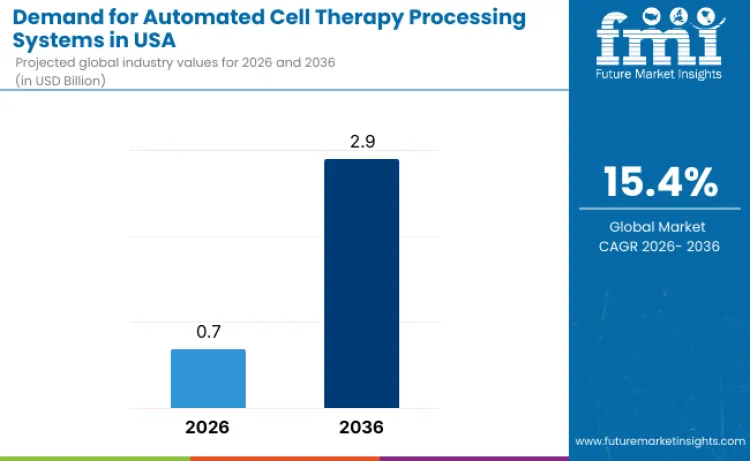
- USD 0.7 Bn
- Forecast (2036)
- USD 2.9 Bn
- CAGR (2026 to 2036)
- 15.4%
Demand for Automated Cell Therapy Processing Systems in USA 2026 to 2036
Demand for automated cell therapy processing systems in USA is valued at USD 0.7 billion in 2026 and is projected to reach USD 2.9 billion by 2036, reflecting a CAGR of 15.4%. Demand accelerates due to rapid expansion of regenerative medicine programs, rising clinical trial activity, and scaling requirements for commercial cell therapies. Emphasis on process automation, closed-system manufacturing, and compliance with GMP standards supports strong adoption across biopharma facilities and academic medical centers.
Stem cell therapy systems lead type-segment usage because these platforms enable standardized, reproducible processing for both autologous and allogeneic workflows. Automated solutions support cell isolation, expansion, washing, and formulation while reducing contamination risk and operator variability. Integration of single-use consumables, digital monitoring, and modular configurations improves throughput and cost efficiency.
West USA, South USA, Northeast USA, and Midwest USA represent key growth regions driven by concentration of biotech clusters, clinical research institutions, and advanced therapy manufacturing sites. Terumo Blood and Cell Technologies, Miltenyi Biotec, Lonza, Cytiva (GE Healthcare Life Sciences), and Sartorius anchor competitive activity through end-to-end automation platforms, localized technical support, and scalable solutions aligned with evolving regulatory expectations and commercialization timelines across USA cell therapy ecosystems.
Quick Stats for Demand for Automated Cell Therapy Processing Systems in USA
- USA Automated Cell Therapy Processing Systems Sales Value (2026): USD 0.7 billion
- USA Automated Cell Therapy Processing Systems Forecast Value (2036): USD 2.9 billion
- USA Automated Cell Therapy Processing Systems Forecast CAGR (2026 to 2036): 15.4%
- Leading Type Segment in USA: Stem Cell Therapy Systems
- Key Growth Regions in USA: West USA, South USA, Northeast USA, Midwest USA
- Top Players in USA: Terumo Blood and Cell Technologies, Miltenyi Biotec, Lonza, Cytiva (GE Healthcare Life Sciences), Sartorius
USA Automated Cell Therapy Processing Systems Key Takeaways
| Metric | Value |
|---|---|
| USA Automated Cell Therapy Processing Systems Sales Value (2026) | USD 0.7 billion |
| USA Automated Cell Therapy Processing Systems Forecast Value (2036) | USD 2.9 billion |
| USA Automated Cell Therapy Processing Systems Forecast CAGR (2026 to 2036) | 15.4% |
How Are the Segments Classified in the Demand for Automated Cell Therapy Processing Systems in USA?
Demand for automated cell therapy processing systems in USA is shaped by clinical trial volume, regulatory oversight, and need for reproducible manufacturing workflows. Buyers evaluate automation reliability, contamination control, data traceability, and scalability aligned with FDA-compliant development pathways. Adoption patterns reflect strong research-driven deployment across academic centers and biotechnology firms, with selective progression toward controlled commercial manufacturing environments supporting advanced therapy pipelines.
By Type, Does Stem Cell Therapy Hold the Largest Share of Demand in USA?
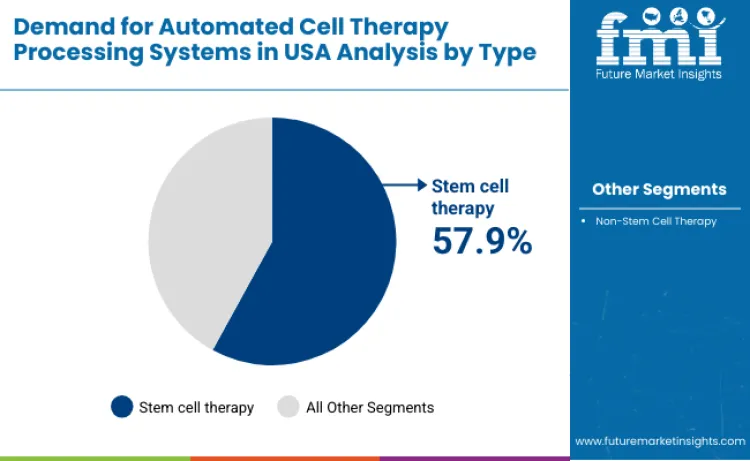
Stem cell therapy systems hold 57.9%, making them the leading type segment in USA demand. These systems support standardized cell isolation, expansion, and formulation workflows required for regenerative medicine and oncology-related therapies. Automation reduces operator variability and supports consistent batch documentation critical for investigational and late-stage trials. Non-stem cell therapy systems hold 42.1%, supporting immune cell and gene-modified therapies with distinct processing requirements. Type distribution reflects broader clinical pipelines, higher procedural complexity, and sustained research investment associated with stem cell–based programs across USA development institutions.
Key Points
- Stem cell systems dominate due to complex processing requirements.
- Automation supports reproducibility and regulatory documentation.
- Non-stem systems serve immune and gene-modified therapy workflows.
By Scale, Does Pre-commercial and Research Scale Represent the Largest Share of Demand in USA?
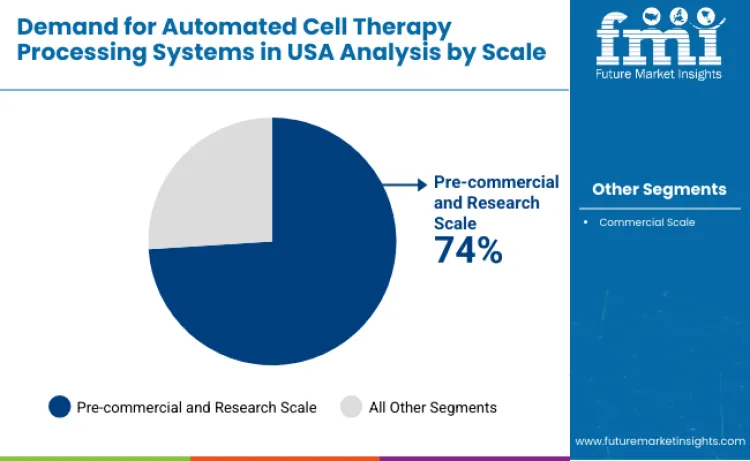
Pre-commercial and research and development scale holds 74.0%, making it the dominant scale segment in USA. These systems support protocol optimization, small-batch manufacturing, and frequent process adjustments during clinical development. Academic hospitals, biotechnology companies, and contract development organizations rely on flexible platforms accommodating evolving trial needs. Commercial scale holds 26.0%, reflecting selective expansion toward validated manufacturing for approved or late-stage therapies. Scale distribution indicates continued emphasis on research-led development under stringent regulatory and quality control expectations.
Key Points
- Research-scale systems dominate due to active clinical development.
- Flexible platforms support iterative process refinement.
- Commercial deployment remains selective and tightly regulated.
What are the Key Dynamics in the Automated Cell Therapy Processing Systems Industry in USA?
Demand increases as biopharmaceutical developers, clinical centers, and manufacturing facilities in USA adopt automated systems to improve consistency, reduce contamination risk, and accelerate cell therapy workflows. Automated cell therapy processing systems support cell isolation, expansion, formulation, and closed handling across autologous and allogeneic programs. Adoption aligns with expansion of clinical trials, commercial production scale-up, and regulatory emphasis on quality and traceability within USA healthcare and biotech sectors.
How do clinical trial growth and commercial manufacturing needs drive demand in USA?
USA hosts a large share of global cell therapy clinical trials, particularly in oncology and regenerative medicine, which fuels demand for automated systems that enhance reproducibility and throughput. Academic medical centers and specialized cell therapy groups use closed, programmable platforms to manage complex processes at scale. Contract development and manufacturing organizations (CDMOs) adopt automation to support multi-client portfolios while meeting stringent Food and Drug Administration quality and documentation expectations. Automation improves process control, reduces manual error, and supports digital traceability required for GMP compliance. Growth in allogeneic product development increases interest in platforms suitable for batch processing and serial manufacturing.
How do capital investment, workforce skills, and regulatory compliance influence demand stability in USA?
Automated systems require substantial capital outlay, which limits adoption among smaller research labs and early-stage developers. Skilled operators and engineers are necessary to program, validate, and maintain automated platforms, shaping deployment timelines. FDA regulatory requirements for process validation, data integrity, and aseptic control add documentation and quality assurance measures that prolong implementation. Facility space constraints and cleanroom capacity influence prioritization of automation projects. Reimbursement uncertainty for certain cell therapies affects long-term investment planning. Demand remains robust among well-funded clinical and commercial programs, while broader growth depends on cost rationalization, workforce development, and continued regulatory clarity within USA advanced therapy ecosystems.
How Is Demand for Automated Cell Therapy Processing Systems in USA Evolving by Region?
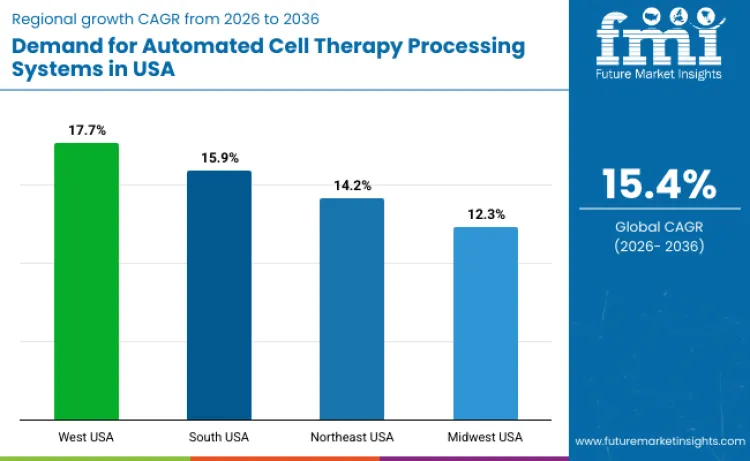
Demand for automated cell therapy processing systems in the USA is expanding due to growth in regenerative medicine, oncology cell therapies, and transition toward scalable GMP manufacturing. West USA leads with a 17.7% CAGR, driven by biopharma clusters and early commercialization activity. South USA follows at 15.9%, supported by manufacturing scale-up, cost-efficient facilities, and contract development activity. Northeast USA records a 14.2% CAGR, shaped by clinical trial density and academic research translation. Midwest USA posts 12.3%, reflecting manufacturing discipline and process standardization needs. Regional differences reflect clinical concentration, manufacturing maturity, regulatory readiness, and pace of transition from research to commercial-scale cell therapy production within the USA.
| Region | CAGR (2026 to 2036) |
|---|---|
| West USA | 17.7% |
| South USA | 15.9% |
| Northeast USA | 14.2% |
| Midwest USA | 12.3% |
How is West USA driving demand for Automated Cell Therapy Processing Systems in the USA?
West USA drives demand through concentration of cell therapy developers, biotech startups, and commercial-stage manufacturing facilities. Region’s CAGR of 17.7% reflects extensive deployment of automated systems for cell expansion, washing, formulation, and closed-system processing. Companies prioritize automation to reduce contamination risk, improve batch reproducibility, and support rapid scale-up for autologous and allogeneic therapies. Integration with digital batch records and real-time monitoring supports regulatory compliance. Venture-backed firms invest in modular platforms to accommodate evolving therapy pipelines. Demand remains commercialization-led, aligned with late-stage clinical programs, technology transfers, and preparation for regulatory inspections and market launch activities.
- High density of cell therapy developers
- Commercial-scale GMP manufacturing expansion
- Modular and digitally integrated platforms
- Late-stage clinical and launch readiness
How is South USA driving demand for Automated Cell Therapy Processing Systems in the USA?
South USA demand is shaped by expansion of bio manufacturing capacity, lower operating costs, and rising CDMO activity. Region’s CAGR of 15.9% reflects adoption of automated processing systems to support contract manufacturing, technology transfer, and multi-client production environments. Facilities emphasize scalability, operational efficiency, and reduced labor dependency. Automation supports consistent output across multiple therapy programs and improves facility utilization. Workforce availability and state-level incentives encourage investment in modern GMP infrastructure. Demand favors standardized, high-throughput platforms compatible with diverse cell therapy workflows. Growth remains manufacturing-led and cost-efficiency focused within the USA cell therapy supply chain.
- Growth of CDMO and contract manufacturing
- Focus on scalability and labor efficiency
- Multi-program production environments
- Incentive-supported GMP facility expansion
How is Northeast USA driving demand for Automated Cell Therapy Processing Systems in the USA?
Northeast USA demand is driven by academic medical centers, clinical trial sponsors, and translational research hubs. Region’s CAGR of 14.2% reflects strong use of automated systems in hospital-based GMP suites and centralized manufacturing supporting clinical trials. Institutions prioritize process consistency, documentation accuracy, and compliance with evolving FDA expectations. Automation reduces operator variability across multi-site trials and accelerates protocol standardization. Demand favors flexible platforms capable of supporting multiple cell types and early commercial preparation. Growth aligns with progression of therapies from Phase II to late-stage development rather than full commercial volume production.
- Academic and clinical trial concentration
- Hospital-based GMP manufacturing
- Protocol standardization and documentation focus
- Transition from clinical to pre-commercial scale
How is Midwest USA driving demand for Automated Cell Therapy Processing Systems in the USA?
Midwest USA demand reflects emphasis on manufacturing discipline, process engineering, and operational reliability. Region’s CAGR of 12.3% is supported by adoption of automated systems to standardize workflows, improve yield control, and support reproducible cell processing. Facilities prioritize equipment robustness, uptime, and integration with existing quality systems. Investment decisions align with long-term production planning and risk mitigation rather than rapid expansion. Automation supports pilot manufacturing, early commercial supply, and workforce efficiency. Growth remains steady and process-focused, aligned with gradual expansion of cell therapy manufacturing capabilities across the USA.
- Manufacturing standardization and yield control
- Reliability and uptime prioritization
- Pilot and early commercial production
- Long-term operational planning
What is the competitive landscape of demand for automated cell therapy processing systems in the USA?
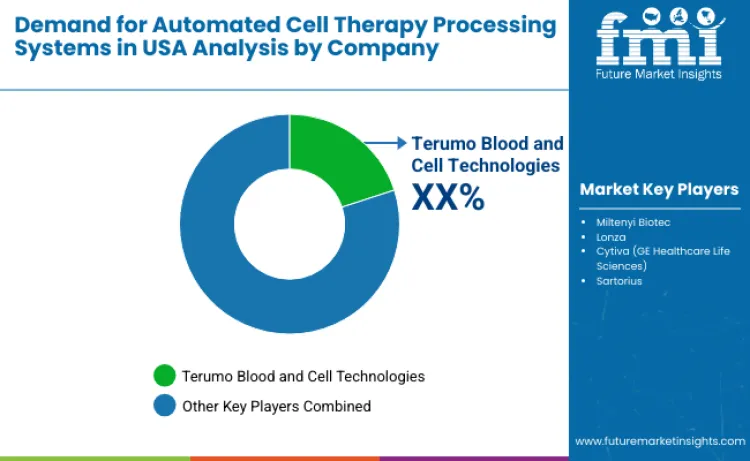
Demand for automated cell therapy processing systems in the USA is driven by growth in regenerative medicine, CAR-T and TCR therapies, and clinical manufacturing scale-up. Adoption spans closed-system cell isolation, expansion, washing, formulation, and cryopreservation workflows used by academic centers, contract development and manufacturing organizations (CDMOs), and biopharmaceutical producers. Buyers evaluate process reproducibility, sterility assurance, integration with cleanroom environments, and compatibility with USA GMP and FDA regulatory expectations.
Procurement teams prioritize suppliers offering validated automated workflows, robust software controls, and local technical support capable of addressing complex cell manufacturing operations. Trend in the USA market reflects strong clinical pipeline progression, collaboration between research institutions and industry, and emphasis on reducing manual intervention to improve product consistency and reduce contamination risk.
Terumo Blood and Cell Technologies holds a significant role through automated cell processing platforms widely adopted in clinical and commercial manufacturing settings, supported by USA service infrastructure and application expertise. Miltenyi Biotec USA participates with automated cell separation and processing systems used for research and early clinical production tasks requiring precise handling.
Lonza USA supports demand with scalable platforms integrating expansion and process control for larger-volume cell therapy runs. GE Healthcare Life Sciences, operating through Cytiva, contributes automated bioprocessing solutions used by development and manufacturing teams. Sartorius USA maintains visibility with cell processing instruments and software supporting workflow automation and quality management. Competitive positioning in the USA reflects regulatory alignment, automation depth, throughput flexibility, and strong domestic support networks supporting critical cell therapy production requirements.
Key Players in USA Automated Cell Therapy Processing Systems Industry
- Terumo Blood and Cell Technologies
- Miltenyi Biotec
- Lonza
- Cytiva (GE Healthcare Life Sciences)
- Sartorius
Scope of the Report
| Items | Values |
|---|---|
| Quantitative Units | USD billion |
| Type | Stem Cell Therapy; Non-Stem Cell Therapy |
| Scale | Pre-commercial/Research & Development Scale; Commercial Scale |
| Regions Covered | West USA; South USA; Northeast USA; Midwest USA |
| Key Companies Profiled | Terumo Blood and Cell Technologies, Miltenyi Biotec, Lonza, Cytiva (GE Healthcare Life Sciences), Sartorius |
| Additional Attributes | Dollar sales by therapy type and processing scale; adoption driven by biopharmaceutical investment and regenerative medicine commercialization; strong uptake in commercial-scale manufacturing and R&D facilities; automation enhances reproducibility, throughput, and compliance; regional demand aligned with major cell therapy hubs and biotech clusters across the United States. |
USA Automated Cell Therapy Processing Systems Demand by Segments
By Type:
- Stem Cell Therapy
- Non-Stem Cell Therapy
By Scale:
- Pre-commercial/Research and Development Scale
- Commercial Scale
By Region:
- West USA
- South USA
- Northeast USA
- Midwest USA
Frequently Asked Questions
How big is the demand for automated cell therapy processing systems in USA in 2026?
The demand for automated cell therapy processing systems in USA is estimated to be valued at USD 0.7 billion in 2026.
What will be the size of automated cell therapy processing systems demand in USA in 2036?
The demand size for automated cell therapy processing systems in USA is projected to reach USD 2.9 billion by 2036.
How much will the demand for automated cell therapy processing systems in USA grow between 2026 and 2036?
The demand for automated cell therapy processing systems in USA is expected to grow at a 15.4% CAGR between 2026 and 2036.
What are the key types in the automated cell therapy processing systems demand in USA?
The key types in automated cell therapy processing systems demand in USA include stem cell therapy systems and other cell therapy processing platforms.
Which scale segment is expected to contribute a significant share in the automated cell therapy processing systems demand in USA in 2026?
In terms of scale, pre-commercial and research and development systems are expected to command 74.0% share in the automated cell therapy processing systems demand in USA in 2026.
Preview the report firsthand - request a free sample
Get SampleGet the brochure for pricing and purchase details.
Get PDFTable of Content
- Executive Summary
- USA Market Outlook
- Demand Side Trends
- Supply Side Trends
- Cell Therapy and Advanced Biomanufacturing Context
- Analysis and Recommendations
- Market Overview
- Market Coverage and Taxonomy
- Market Definition Scope and Limitations
- Market Background
- Market Dynamics
- Drivers
- Restraints
- Opportunities
- Trends
- Scenario Forecast
- Demand in Optimistic Scenario
- Demand in Likely Scenario
- Demand in Conservative Scenario
- Opportunity Map Analysis
- Technology Life Cycle Analysis
- Cell Therapy Manufacturing Value Chain Analysis
- Investment Feasibility Matrix
- PESTLE and Porter Analysis
- Regulatory and GMP Compliance Framework
- Regional Parent Market Outlook
- USA Automated Cell Therapy Processing Systems Demand Analysis 2021 to 2025 and Forecast 2026 to 2036
- Historical Demand Value USD Billion Analysis 2021 to 2025
- Current and Future Demand Value USD Billion Projections 2026 to 2036
- Year on Year Growth Trend Analysis
- Absolute Dollar Opportunity Analysis
- USA Automated Cell Therapy Processing Systems Pricing Analysis 2021 to 2025 and Forecast 2026 to 2036
- USA Automated Cell Therapy Processing Systems Demand Analysis 2021 to 2025 and Forecast 2026 to 2036 By Type
- Introduction and Key Findings
- Historical Demand Value USD Billion Analysis by Type 2021 to 2025
- Current and Future Demand Value USD Billion Analysis and Forecast by Type 2026 to 2036
- Stem Cell Therapy Systems
- Non-Stem Cell Therapy Systems
- Year on Year Growth Trend Analysis by Type
- Absolute Dollar Opportunity Analysis by Type
- USA Automated Cell Therapy Processing Systems Demand Analysis 2021 to 2025 and Forecast 2026 to 2036 By Scale
- Introduction and Key Findings
- Historical Demand Value USD Billion Analysis by Scale 2021 to 2025
- Current and Future Demand Value USD Billion Analysis and Forecast by Scale 2026 to 2036
- Pre-commercial and Research and Development Scale
- Commercial Scale
- Year on Year Growth Trend Analysis by Scale
- Absolute Dollar Opportunity Analysis by Scale
- USA Automated Cell Therapy Processing Systems Demand Analysis 2021 to 2025 and Forecast 2026 to 2036 By Region
- West USA
- South USA
- Northeast USA
- Midwest USA
- Market Structure Analysis
- Competition Dashboard
- Competition Benchmarking
- Market Share Analysis of Key Players
- By Type
- By Scale
- By Region
- Competition Analysis
- Competition Deep Dive
- Terumo Blood and Cell Technologies
- Miltenyi Biotec
- Lonza
- Cytiva GE Healthcare Life Sciences
- Sartorius
- Assumptions and Acronyms Used
- Research Methodology


