

- Industry Size (2026)
- USD 180 Bn
- Forecast (2036)
- USD 549 Bn
- CAGR (2026 to 2036)
- 11.8%
Cell Therapy Cryopreservation and Thaw Performance Test Platforms Market Size, Market Forecast and Outlook By FMI
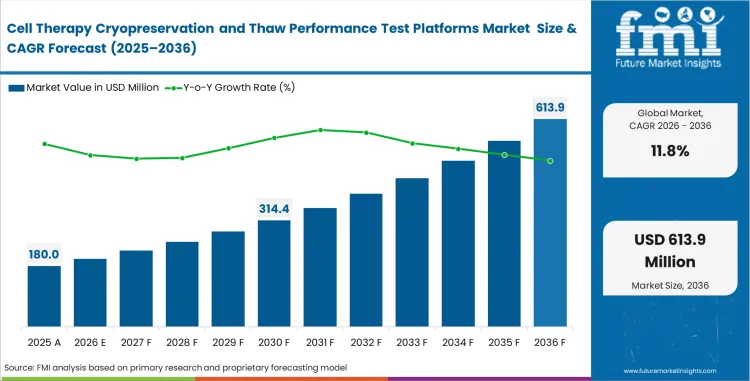
Cell therapy cryopreservation and thaw performance test platforms market crossed a valuation of USD 180 million in 2026 and expand at a CAGR of 11.8% from 2026 to 2036. Market value is projected to rise to USD 549 million by 2036. Growth is driven by the need to control thawing, assess post-thaw viability and improve handling consistency before release or administration.
Key Takeaways, Market Size, and Forecast
- Cell Therapy Cryopreservation and Thaw Performance Test Platforms Market is projected to grow from USD 180 million in 2026 to USD 549 million by 2036, at a CAGR of 11.8%.
- The cell therapy cryopreservation and thaw performance test platforms market was valued at USD 161 million in 2025.
- By 2036, the Cell Therapy Cryopreservation and Thaw Performance Test Platforms Market is expected to be worth USD 549 million.
- The market is forecast to expand at a CAGR of 11.8% from 2026 to 2036.
- In 2026, Post-thaw analyzers are expected to account for 32.0% of the platform type segment.
- China (13.8%) and South Korea (13.1%) are two of the fastest growing markets.
Cell Therapy Cryopreservation and Thaw Performance Test Platforms Market Key Takeaways
| Parameter | Details |
|---|---|
| Market value (2026) | USD 180 million |
| Forecast value (2036) | USD 549 million |
| CAGR (2026 to 2036) | 11.8% |
| Estimated market value (2025) | USD 161 million |
| Leading platform type | Post-thaw analyzers |
| Platform share (2026) | 32% |
| Leading assay readout | Viability assays |
| Assay share (2026) | 29% |
| Leading cell type | CAR-T cells |
| Cell type share (2026) | 31% |
| Leading preservation format | Cryobags |
| Format share (2026) | 38% |
| Leading automation level | Semi-automated systems |
| Automation share (2026) | 41% |
| Leading end user | Biopharma developers |
| End-user share (2026) | 33% |
| Leading workflow stage | Process development |
| Workflow share (2026) | 28% |
Source: Future Market Insights, 2026.
Manufacturing and quality teams are replacing manual thawing and isolated lab routines. Cell therapy batches move across various sites operators and delivery points, where variation in thaw timing and handling can create data gaps and review issues. Stronger testing platforms can reduce this risk.
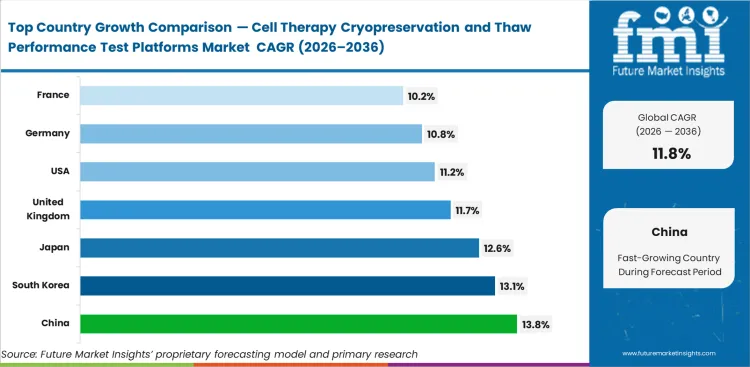
China is expected to record 13.8% CAGR through 2036, followed by South Korea at 13.1% and Japan at 12.6%. The United Kingdom is projected at 11.7%, the United States at 11.2%, Germany at 10.8%, and France at 10.2% by the forecast period.
Cell Therapy Cryopreservation and Thaw Performance Test Platforms Market Definition
Cell therapy cryopreservation and thaw performance test platforms market covers tools used to check how frozen cell therapy products behave during freezing, storage and thawing. Scope includes instruments and workflow tools that measure viability, recovery and temperature control.
Cell Therapy Cryopreservation and Thaw Performance Test Platforms Market Inclusions
This market includes post-thaw analyzers, automated thawing units, controlled-rate freezing systems, thermal mapping tools, and assay platforms used in cell therapy development and quality control. Method-transfer support and comparability testing tied to those platforms also fall within scope when they support freeze-thaw performance assessment. Related platform demand also connects with freeze thaw system.
Cell Therapy Cryopreservation and Thaw Performance Test Platforms Market Exclusions
General bio storage freezers, passive cold-chain packaging, transport-only shippers, and broad laboratory instruments are excluded when they have no cryopreservation or thaw-testing role. Cell expansion systems, fill-finish lines, and therapy revenue are excluded from this market because the report focuses on testing platforms. Storage-only tools are relevant to adjacent areas such as cryopreservation systems.
Cell Therapy Cryopreservation and Thaw Performance Test Platforms Market Research Methodology
- Primary Research: Interviews focused on manufacturing, QC, process development, and clinical supply roles directly involved in cryopreservation and thaw practice.
- Desk Research: Assessment of advanced-therapy guidance, cell therapy standards, investor filings, technical product literature, and association data on therapy activity.
- Sizing Logic: Market sizing ties platform spend to cell therapy workflow maturity, post-thaw test intensity, and the level of control needed from development through release.
- Validation Approach: Cross-checks used active therapy counts, approval progress, standards activity, and the breadth of vendor participation in adjoining cell therapy tools.
Segmental Analysis
Key Facts About Segments
- Post-thaw analyzers hold 32% share in 2026 and support direct measurement after thaw.
- Viability assays account for 29% and remain the first test in most workflows.
- CAR-T cells represent 31% share due to higher handling sensitivity.
- Cryobags contribute 38% share and support larger volume handling.
- Semi-automated systems lead with 41% as they improve timing control.
- Process development holds 28% share and defines early method setup.
Cell Therapy Cryopreservation and Thaw Performance Test Platforms Market Analysis by Platform Type
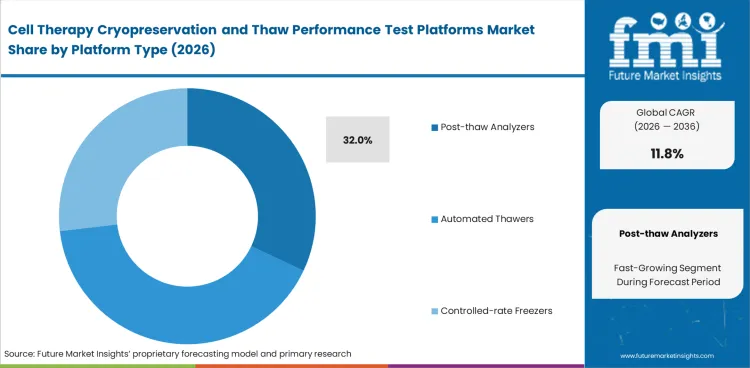
Release teams need more than visual checks when thaw results must remain consistent across sites, operators, and batches. Post-thaw analyzers lead because they measure viability and recovery after thaw and short hold periods. In 2026, post-thaw analyzers are expected to account for 32% share. Automated thawers and controlled-rate freezers are part of the workflow, through analyzers play the clearest role in release review. They bring measurement and control to a sensitive handling step.
- Measurement clarity: Analyzer output helps teams connect thaw handling with viability and recovery in a way that is easier to review.
- Release support: Quality groups use these systems to reduce uncertainty before the next testing or handling step.
- Operator control: Standardized readouts cut down avoidable differences between one user and another.
Cell Therapy Cryopreservation and Thaw Performance Test Platforms Market Analysis by Assay Readout
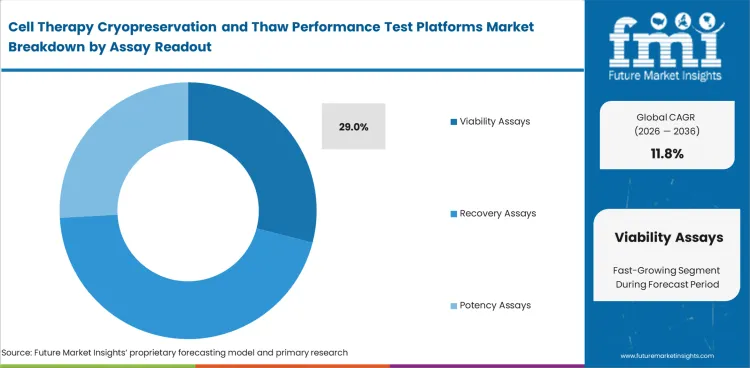
Viability assays are likely to represent 29% of the market in 2026. Post-thaw work starts by checking whether enough cells remain viable for the next step. Viability assays stay in front because they answer that question faster than more detailed methods. Recovery, phenotype, potency, and stress testing provide deeper analytical insight. Viability usually comes first because it serves as the initial check before further evaluation. Preference in this category centers on methods that are easy to repeat and compare across runs.
- First checkpoint: Viability remains the opening test in many workflows because it confirms whether the sample is usable.
- Method fit: Labs favor readouts that do not slow handling more than necessary.
- Result confidence: A stable viability method makes later assay results easier to interpret.
Cell Therapy Cryopreservation and Thaw Performance Test Platforms Market Analysis by Cell Type
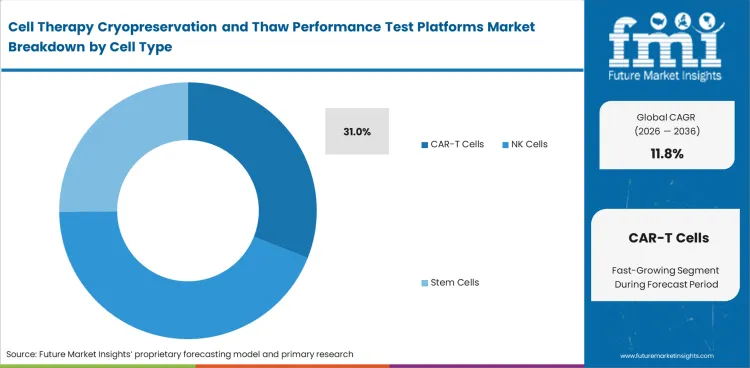
Commercial cell therapy work raises the importance of freeze-thaw control when cell types are harder to recover after storage. CAR-T cells lead platform demand because handling quality can affect dose availability and later comparability work. CAR-T cells are projected to hold 31% share in 2026. NK cells, stem cells, and MSC products expand the broader application base, though early platform selection often follows CAR-T requirements. This area depends on strong alignment between thaw method, measured recovery, and downstream use.
- Dose sensitivity: CAR-T handling leaves less room for avoidable cell loss during thaw.
- Documentation need: Teams often need stronger proof that thaw conditions stay repeatable.
- Workflow pressure: Platform decisions made here tend to carry into later development stages.
Cell Therapy Cryopreservation and Thaw Performance Test Platforms Market Analysis by Preservation Format
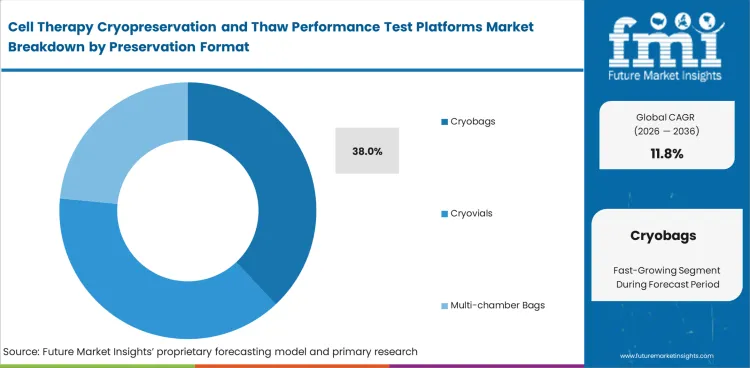
Cryobags are projected to secure 38% share in 2026. Container choice affects more than storage convenience. Cryobags lead because many cell therapy workflows use larger fill volumes and need closed handling. Bag-based formats force teams to pay closer attention to thaw uniformity, temperature control, and downstream handling than small-vial routines usually require. Cryovials still remain useful in early lab work and smaller lots. Bag use grows once programs move closer to repeatable manufacturing and administration readiness, where handling discipline matters more.
- Volume handling: Cryobags create a greater need for controlled warming across the full container.
- Closed transfer: Buyers value formats that reduce manual contact during later handling steps.
- Scale fit: Bag-based workflows become harder to replace once dose size and process maturity increase.
Cell Therapy Cryopreservation and Thaw Performance Test Platforms Market Analysis by Automation Level
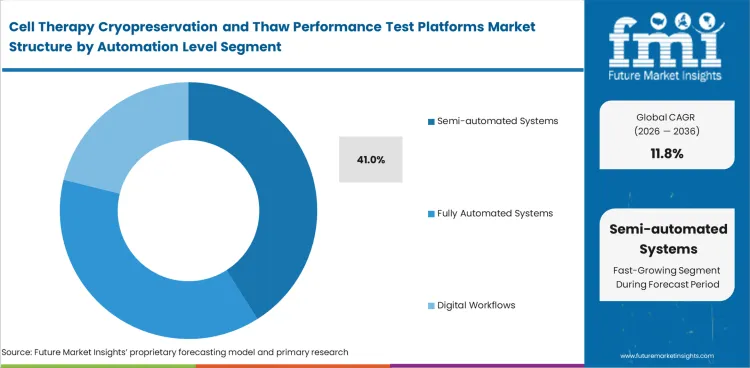
Many laboratories move beyond manual thawing before they are ready for a fully automated line. Semi-automated systems fit that stage because they improve timing control and repeatability without requiring a full process rebuild. Semi-automated systems are projected to hold 41% share in 2026. Manual setups remain common where throughput is low. Fully automated platforms gain more attention where scale is higher and workflow standardization is broader. Semi-automated tools appeal to buyers who need a measurable improvement now while still working within familiar lab routines and tighter capital limits.
- Upgrade path: Semi-automated systems offer a practical first move away from manual practice.
- Control gain: Labs can tighten thaw timing and consistency without redesigning the entire workflow.
- Capital balance: Buyers can improve performance without taking on the heaviest system burden.
Cell Therapy Cryopreservation and Thaw Performance Test Platforms Market Analysis by End User
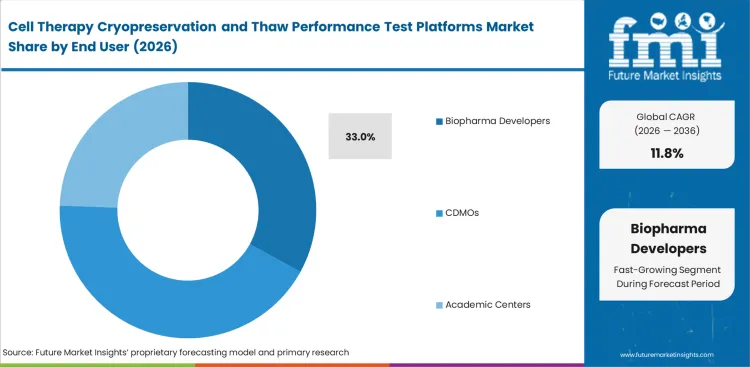
Biopharma developers are closest to the platform decision that shape later evidence quality. They define thaw methods, decide which checks matter, and set the handling rules others may later follow. Biopharma developers are anticipated to emerge with 33% market share in 2026. CDMOs buy actively and often work within methods first defined by their clients. Academic centers and hospital laboratories contribute to demand though platform selection in those settings is usually narrower and tied to specific programs. Lead position comes from direct ownership of process decisions and from the cost of carrying weak thaw logic too far into development, which also keeps this group closely linked with broader work in automated and closed cell therapy processing systems.
- Method ownership: Developers usually set the handling rules that later partners must follow.
- Transfer readiness: Early platform choices matter more when methods have to move across sites.
- Program continuity: Buyers in this group often prefer systems that remain useful beyond one study stage.
Cell Therapy Cryopreservation and Thaw Performance Test Platforms Market Analysis by Workflow Stage
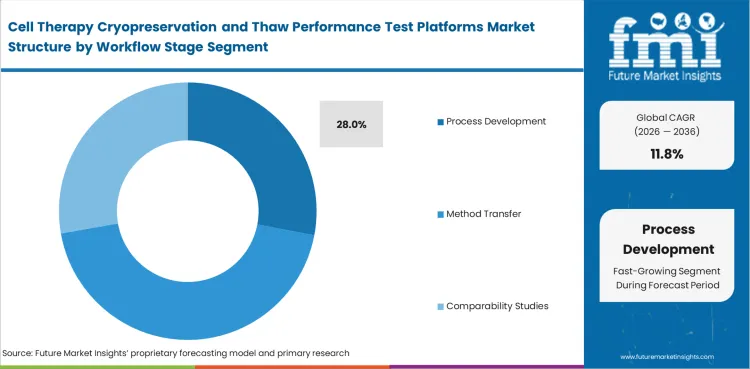
Process development leads because it is still the stage where thaw conditions, assay logic, and handling routines can be compared before later adjustment becomes difficult. By 2026, process development is expected to contribute 28% of total market share. Method transfer, lot release, and pre-infusion checks become more important later, yet many of those needs are shaped by earlier decisions. Weak setup at this stage tends to reappear in comparability work and deviation review.
- Early control: Better setup in process development reduces later correction work.
- Comparability support: Stronger method definition helps teams interpret later differences more clearly.
- Carryover value: Tools chosen here often stay relevant after the first development question is answered.
Freeze-Thaw Performance Is Becoming Release-Critical
Buyers asking whether thaw-performance platforms still sit at the edge of quality control should recalibrate. FDA’s 2025 regulatory action for WASKYRA states that post-thaw drug-product data were used to demonstrate post-thaw stability. FDA still required an additional in-use drug-product stability study that included the administration set filter and assessed viability under the administration conditions described in the BLA. FDA’s 2025 Q1 draft guideline for advanced therapy medicinal products also states that, for live cell-based products stored frozen, viability should be measured after thaw as part of stability studies, and that changes in viability and cell concentration should be considered for subsequent processing or dosing.[1]
Regional Analysis
Key Facts About Country
- Japan records 12.6% CAGR with steady method adoption.
- China leads with 13.8% CAGR supported by expanding capacity.
- Germany posts 10.8% CAGR with consistent validation practices.
- The United Kingdom shows 11.7% CAGR with strong therapy activity.
- France reaches 10.2% CAGR with steady program demand.
- South Korea grows at 13.1% CAGR with faster workflow setup.
- The United States records 11.2% CAGR with ongoing platform upgrades.
Based on the regional analysis, the Cell Therapy Cryopreservation and Thaw Performance Test Platforms market is segmented into North America, Europe, Asia Pacific, Latin America, and Middle East & Africa across 40 plus countries.
.webp "Top Country Growth Comparison Cell Therapy Cryopreservation And Thaw Performance Test Platforms Market Cagr (2026 2036)")
| Country | CAGR (2026 to 2036) |
|---|---|
| China | 13.8% |
| South Korea | 13.1% |
| Japan | 12.6% |
| United Kingdom | 11.7% |
| United States | 11.2% |
| Germany | 10.8% |
| France | 10.2% |
Source: Future Market Insights (FMI) analysis, based on proprietary forecasting model and primary research
North America Cell Therapy Cryopreservation and Thaw Performance Test Platforms Market Analysis
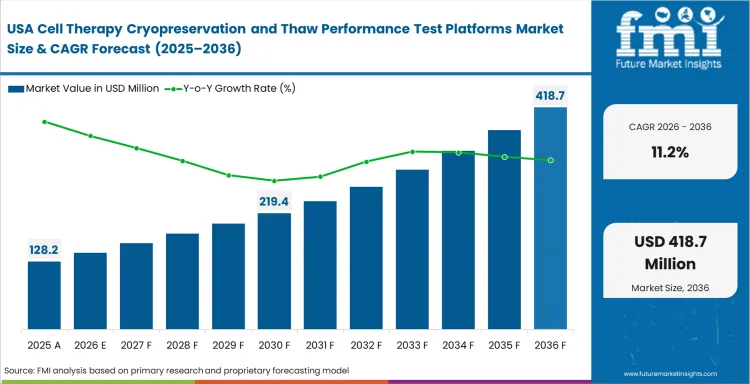
North America stays important because commercial cell therapy handling is already advanced enough for thaw-performance control to matter beyond early lab work. Buyers here are usually deciding which platform setup can support cleaner handoffs across process development, QC and manufacturing.
- United States: Thaw-performance testing carries greater importance in the USA because cell therapy activity is more advanced. Programs often move across internal sites, outside partners, and clinical settings, so method consistency matters early. The United States is expected to grow at a CAGR of 11.2% through 2036. Platform selection depends on how well systems reduce gaps between development data and later release checks. Demand in this country is shaped by depth of use, which keeps competition focused on repeatability, data handling, and workflow fit.
Report coverage also includes Canada and other North American countries. Activity there generally follows the United States, though the installed base is smaller. Interest rises as advanced therapy work becomes more formalized and site-to-site comparability gains weight.
Europe Cell Therapy Cryopreservation and Thaw Performance Test Platforms Market Analysis
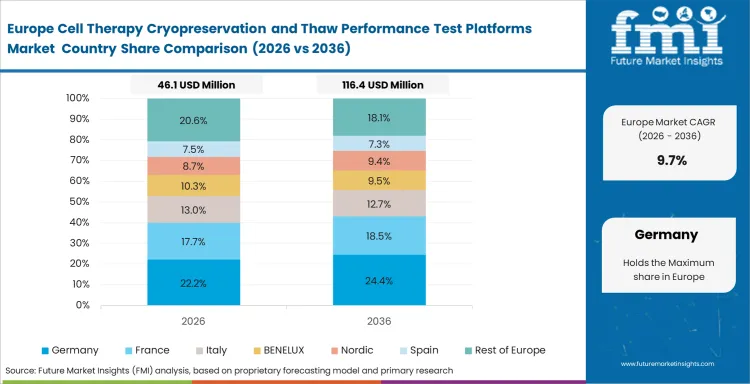
Europe follows a deliberate pace because many buying decisions are tied to qualification discipline, cross-border operating practice, and the need to fit new tools into documented workflows. Demand is established across the region, and replacement cycles carry more importance than in faster-rising parts of Asia.
- United Kingdom: The United Kingdom is likely to post 11.7% CAGR in this sector by 2036. Development teams and quality groups need thaw and post-thaw methods that remain consistent across development, release preparation, and clinical-use logistics. The country is advancing faster than several continental peers because advanced therapy work is more established and method discipline matters early in the process. This supports service depth and smoother cross-site transfer instead of isolated instrument sales.
- Germany: Germany holds strong position because manufacturing discipline and documentation quality are taken seriously. Laboratories often take longer to change a method once it is embedded, which can slow new platform adoption and strengthens suppliers retention qualification. Germany is forecast to register 10.8% CAGR in this space through 2036. Competition often turns on reliability, record quality, and how smoothly a new tool fits existing lab routines. Suppliers with credible support depth are better placed than those offering headline functionality alone.
- France: The French market is expected to expand at a CAGR of 10.2% through 2036. Clinical and translational work supports demand, while buying decisions remain selective and tied to specific program needs. Laboratories focus on whether a platform addresses a handling or data issue rather than wider instrument replacement. Growth is steady rather than fast. Suppliers perform well when they make qualification easier and reduce operator burden in daily laboratory work.
The FMI report coverage also includes Italy, Spain, Switzerland, the Netherlands, Belgium, and Nordic countries. Adoption across those areas usually rises when advanced therapy work moves from academic concentration toward more repeatable manufacturing and release-oriented handling.
Asia Pacific Cell Therapy Cryopreservation and Thaw Performance Test Platforms Market Analysis
Asia Pacific is growing faster because cell therapy activity is expanding across several countries, while many programs are still building workflow discipline and choosing platform setups. Buyers in this region often place more value on methods that can standardize quickly across growing teams and new facilities. Better thaw control at an early stage can selection more strongly than in regions with deeper legacy setup.
- China: The country is expanding its cell therapy base, which is increasing cryopreservation and thaw-testing demand. Development groups often build or upgrade methods while capacity is still taking shape, which gives suppliers more room to influence standard practice at an early stage. China is expected to grow at a CAGR of 13.8% through 2036. Laboratories prefer tools that support repeatable thaw and post-thaw evidence across expanding programs instead of depending on local variation. The country also has further room for installed-base expansion before replacement demand becomes the main driver.
- Japan: Japan is set to advance at a CAGR of 12.6% through 2036. The market place strong emphasis on disciplined handling and method reliability. Labs usually look for thaw-performance tools that reduce avoidable inconsistency without adding unnecessary complexity. Demand quality carries more weight than simple program count. Buyers often prefer solutions that fit a controlled operating style and help preserve continuity from development work into later-use settings.
- South Korea: South Korea has a strong expansion path because advanced biopharmaceutical buildout is still creating room for tighter thaw control. Newer development groups often want better-defined methods before local practices become fixed. South Korea is expected to grow at a CAGR of 13.1% through 2036. Growth stays high because adoption is linked to new capacity buildout as well as replacement demand. Much of this growth comes from putting clearer handling and test logic in place while capacity continues to expand.
Report coverage also includes Australia, Singapore, India, and other Asia Pacific countries. Markets across that group usually differ by how fast trial activity turns into documented manufacturing practice and how quickly post-thaw checks move from optional use into routine work.
Competitive Aligners for Market Players
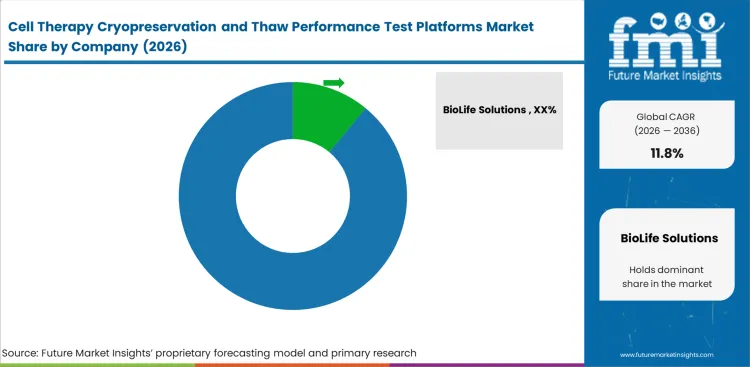
Competition in this space centers on thaw control, freezing discipline, post-thaw cell measurement, and data traceability meet. BioLife Solutions, Thermo Fisher Scientific, Cytiva, Beckman Coulter Life Sciences, ChemoMetec, PHC Corporation, and Sartorius approach the opportunity from different technical positions. Platform selection depends on whether a tool can produce repeatable thaw or viability evidence, fit existing laboratory routines, and support method adoption without triggering a long requalification process. Commercial strength depends on easier validation and stable day-to-day use.
Developers gain more influence when they want to avoid one narrow method path from development through release. Large therapy programs compare how well platforms export data, support method transfer, and fit more than one container or assay logic. Vendors want early placement so their tools remain embedded through later stages. Concentration is likely to remain moderate through 2036 because thawing, freezing, counting, and support analytics shape platform selection from different directions. Related investment in high-density cell banking also keeps adjacent suppliers in view..
Key Players in Cell Therapy Cryopreservation and Thaw Performance Test Platforms Market
- BioLife Solutions
- Thermo Fisher Scientific
- Cytiva
- Beckman Coulter Life Sciences
- ChemoMetec
- PHC Corporation
- Sartorius
Scope of the Report
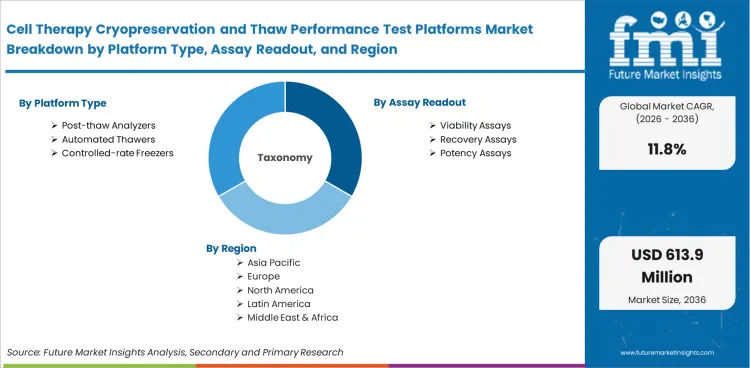
| Metric | Value |
|---|---|
| Quantitative Units | USD 180 million to USD 549 million, at a CAGR of 11.8% |
| Market Definition | Cell Therapy Cryopreservation and Thaw Performance Test Platforms Market covers tools used to test how cryopreserved cell therapy products perform during freezing, storage, thawing, and immediate post-thaw handling. Scope includes platforms tied to viability, recovery, thermal behavior, method repeatability, and readiness for downstream use. Storage-only hardware without a test role is excluded. |
| Platform Type Segmentation | Post-thaw Analyzers, Automated Thawers, Controlled-rate Freezers, Thermal Mappers, Integrated Workstations, Cold-chain Simulators |
| Assay Readout Segmentation | Viability Assays, Recovery Assays, Potency Assays, Phenotype Assays, Sterility Assays, Stress Assays |
| Cell Type Segmentation | CAR-T Cells, NK Cells, Stem Cells, MSC Products, iPSC Products, Dendritic Cells |
| Preservation Format Segmentation | Cryobags, Cryovials, Multi-chamber Bags, Cartridges, Plates |
| Automation Level Segmentation | Manual Setups, Semi-automated Systems, Fully Automated Systems, Digital Workflows |
| End User Segmentation | Biopharma Developers, CDMOs, Academic Centers, Hospital Labs, Reference Labs |
| Workflow Stage Segmentation | Process Development, Method Transfer, Comparability Studies, Lot Release, Pre-infusion Checks, Excursion Studies |
| Regions Covered | North America, Europe, Asia Pacific, Latin America, Middle East & Africa |
| Countries Covered | United States, China, Japan, South Korea, United Kingdom, Germany, France, and 40 plus countries |
| Key Companies Profiled | BioLife Solutions, Thermo Fisher Scientific, Cytiva, Beckman Coulter Life Sciences, ChemoMetec, PHC Corporation, Sartorius |
| Forecast Period | 2026 to 2036 |
| Approach | Analysis combines primary interviews with manufacturing, QC, and process development roles; review of guidance, standards, investor disclosures, and technical literature; and forecast validation against therapy activity, platform relevance, and adjoining cell therapy workflow demand. |
Source: Future Market Insights (FMI) analysis, based on proprietary forecasting model and primary research
Cell Therapy Cryopreservation and Thaw Performance Test Platforms Market Analysis by Segments
Platform Type:
- Post-thaw Analyzers
- Automated Thawers
- Controlled-rate Freezers
- Thermal Mappers
- Integrated Workstations
- Cold-chain Simulators
Assay Readout:
- Viability Assays
- Recovery Assays
- Potency Assays
- Phenotype Assays
- Sterility Assays
- Stress Assays
Cell Type:
- CAR-T Cells
- NK Cells
- Stem Cells
- MSC Products
- iPSC Products
- Dendritic Cells
Preservation Format:
- Cryobags
- Cryovials
- Multi-chamber Bags
- Cartridges
- Plates
- Automation Level:
- Manual Setups
- Semi-automated Systems
- Fully Automated Systems
- Digital Workflows
End User:
- Biopharma Developers
- CDMOs
- Academic Centers
- Hospital Labs
- Reference Labs
Workflow Stage:
- Process Development
- Method Transfer
- Comparability Studies
- Lot Release
- Pre-infusion Checks
- Excursion Studies
Region:
-
North America
- United States
- Canada
-
Europe
- United Kingdom
- Germany
- France
- Italy
- Spain
- Switzerland
- Netherlands
- Belgium
- Nordic Countries
- Asia Pacific
- China
- Japan
- South Korea
- Australia
- Singapore
- India
- Latin America
- Middle East & Africa
Bibliography
- USA Food and Drug Administration. (2025, April 11). Q1 stability testing of drug substances and drug products. USA Department of Health and Human Services.
- AABB. (2025, July 1). Standards for Cellular Therapy Services.
- National Institute of Standards and Technology. (2025, September 18). Report from the 2023 NIST-Hosted Workshop on Collaborative Efforts to Enable Adoption of Rapid Microbial Testing Methods for Advanced Therapy Products.
- Thermo Fisher Scientific. (2026, April 7). Annual Report 2025.
This bibliography is provided for reader reference. The full FMI report contains the complete reference list with primary source documentation.
This Report Addresses
- Market intelligence for post-thaw analyzers, automated thawers, controlled-rate freezers, and assay-linked testing tools used in cell therapy handling.
- Market size estimates and a 10-year forecast from 2026 to 2036.
- Opportunity mapping across platform type, assay readout, cell type, preservation format, automation level, end user, and workflow stage.
- Segment and regional analysis covering cryobags, viability assays, CAR-T cells, semi-automated systems, biopharma developers, and process development.
- Competition review based on repeatability, validation ease, support quality, data handling, and workflow fit.
- Product tracking across thaw control, post-thaw viability checks, controlled freezing, traceable records, and comparability support.
- Market access review tied to method transfer, release-readiness needs, and quality expectations in cell therapy handling.
- Delivery formats for executive review, operating plans, and benchmarking use.
Frequently Asked Questions
How large is the Cell Therapy Cryopreservation and Thaw Performance Test Platforms Market in 2026?
Industry valuation is estimated at USD 180 million in 2026. Figure shows a focused testing market with a clear role in cell therapy development, handling, and quality work.
What will the market be worth by 2036?
Valuation is projected to reach USD 549 million by 2036. Increase reflects broader use of controlled thawing and post-thaw testing across more programs and sites.
What CAGR is expected from 2026 to 2036?
Projected CAGR for the forecast period is 11.8%. Pace suggests steady expansion rather than a short burst of equipment buying.
Which Platform Type segment leads in 2026?
Post-thaw analyzers lead Platform Type. Their share is expected to reach 32% in 2026 because they give a direct check on cell condition right after thaw.
Which Assay Readout segment leads in 2026?
Viability assays lead Assay Readout with an expected 29% share in 2026. Most labs start here because cell health is the first thing they need to confirm.
Which Cell Type segment leads in 2026?
CAR-T cells lead Cell Type in 2026 with 31% share. Commercial use and tighter handling needs keep this segment at the center of platform demand.
Which Preservation Format segment leads in 2026?
Cryobags lead Preservation Format. They are expected to represent 38% of the market in 2026 because they fit larger-volume and closed-handling workflows.
Which Automation Level segment leads in 2026?
Semi-automated systems lead this segment with 41% share in 2026. Many labs choose them because they improve control without forcing a full automation build.
Which End User segment leads in 2026?
Biopharma developers lead End User in 2026. Market share for this group is expected to reach 33% because they set many of the methods used later across the workflow.
Which Workflow Stage segment leads in 2026?
Process development leads Workflow Stage with 28% share in 2026. Early method choices often carry into transfer, comparability, and later quality work.
What is this market?
This market covers tools used to test how frozen cell therapy products behave before, during, and after thaw. It includes analyzers, thaw systems, temperature checks, and related testing tools used to judge viability, recovery, and repeatability.
Why does thaw testing matter in cell therapy?
Frozen cells can lose quality when thawing is poorly controlled. Testing helps labs see whether the product still performs as expected before it moves to the next step.
Why are post-thaw analyzers important?
They turn a sensitive handling step into a measurable check. That makes batch comparison easier and gives labs a clearer basis for review.
Why do viability assays lead this market?
Viability is often the first question after thaw. If that result is unclear, later assay results become harder to trust.
Why do cryobags matter so much?
Cryobags fit many practical cell therapy workflows. Their size and handling needs make thaw control more important than it is in a small-vial setup.
Why do semi-automated systems lead instead of fully automated systems?
Many labs want better timing control and repeatability without rebuilding the whole process. Semi-automated tools fit that need better than manual practice and cost less than full automation.
Why do biopharma developers buy the most?
They usually define the methods first. Choices made at that stage often carry into CDMO work, internal QC, and later transfer activity.
Why does process development lead Workflow Stage?
Process development is where teams still have room to test and compare methods. Weak decisions made there can create extra work later.
Which country grows fastest?
China grows fastest, with a projected CAGR of 13.8% through 2036. Local cell therapy activity is still expanding, so more first-time platform adoption is taking place.
How does the United States differ from China in this market?
United States demand comes from a deeper installed base and more replacement-led buying. China still has more room for first-use adoption while programs and facilities continue to expand.
Why does the United Kingdom outpace Germany and France?
Advanced therapy activity gives the United Kingdom a stronger base in this niche. Germany and France remain important, but adoption there often moves through a slower qualification path.
What sits outside the scope of this report?
General storage equipment, passive cold-chain packs, transport-only shippers, and therapy revenue are outside scope. Report focuses on testing platforms, not the therapies themselves.
Why is repeatability such a big issue here?
Cell therapy work often moves across sites, operators, and handling steps. A method that works only in one lab is harder to defend when product use becomes broader.
What makes this market different from general lab equipment?
General lab tools may support handling, but this market is built around checking freeze-thaw performance. That testing role is what sets it apart.
Preview the report firsthand - request a free sample
Get SampleGet the brochure for pricing and purchase details.
Get PDFTable of Content
- Executive Summary
- Global Market Outlook
- Demand-side Trends
- Supply-side Trends
- Technology Roadmap Analysis
- Analysis and Recommendations
- Market Overview
- Market Coverage / Taxonomy
- Market Definition / Scope / Limitations
- Research Methodology
- Chapter Orientation
- Analytical Lens and Working Hypotheses
- Market Structure, Signals, and Trend Drivers
- Benchmarking and Cross-market Comparability
- Market Sizing, Forecasting, and Opportunity Mapping
- Research Design and Evidence Framework
- Desk Research Programme (Secondary Evidence)
- Company Annual and Sustainability Reports
- Peer-reviewed Journals and Academic Literature
- Corporate Websites, Product Literature, and Technical Notes
- Earnings Decks and Investor Briefings
- Statutory Filings and Regulatory Disclosures
- Technical White Papers and Standards Notes
- Trade Journals, Industry Magazines, and Analyst Briefs
- Conference Proceedings, Webinars, and Seminar Materials
- Government Statistics Portals and Public Data Releases
- Press Releases and Reputable Media Coverage
- Specialist Newsletters and Curated Briefings
- Sector Databases and Reference Repositories
- FMI Internal Proprietary Databases and Historical Market Datasets
- Subscription Datasets and Paid Sources
- Social Channels, Communities, and Digital Listening Inputs
- Additional Desk Sources
- Expert Input and Fieldwork (Primary Evidence)
- Primary Modes
- Qualitative Interviews and Expert Elicitation
- Quantitative Surveys and Structured Data Capture
- Blended Approach
- Why Primary Evidence is Used
- Field Techniques
- Interviews
- Surveys
- Focus Groups
- Observational and In-context Research
- Social and Community Interactions
- Stakeholder Universe Engaged
- C-suite Leaders
- Board Members
- Presidents and Vice Presidents
- R&D and Innovation Heads
- Technical Specialists
- Domain Subject-matter Experts
- Scientists
- Physicians and Other Healthcare Professionals
- Governance, Ethics, and Data Stewardship
- Research Ethics
- Data Integrity and Handling
- Primary Modes
- Tooling, Models, and Reference Databases
- Desk Research Programme (Secondary Evidence)
- Data Engineering and Model Build
- Data Acquisition and Ingestion
- Cleaning, Normalisation, and Verification
- Synthesis, Triangulation, and Analysis
- Quality Assurance and Audit Trail
- Market Background
- Market Dynamics
- Drivers
- Restraints
- Opportunity
- Trends
- Scenario Forecast
- Demand in Optimistic Scenario
- Demand in Likely Scenario
- Demand in Conservative Scenario
- Opportunity Map Analysis
- Product Life Cycle Analysis
- Supply Chain Analysis
- Investment Feasibility Matrix
- Value Chain Analysis
- PESTLE and Porter’s Analysis
- Regulatory Landscape
- Regional Parent Market Outlook
- Production and Consumption Statistics
- Import and Export Statistics
- Market Dynamics
- Global Market Analysis 2021 to 2025 and Forecast, 2026 to 2036
- Historical Market Size Value (USD Million) Analysis, 2021 to 2025
- Current and Future Market Size Value (USD Million) Projections, 2026 to 2036
- Y-o-Y Growth Trend Analysis
- Absolute $ Opportunity Analysis
- Global Market Pricing Analysis 2021 to 2025 and Forecast 2026 to 2036
- Global Market Analysis 2021 to 2025 and Forecast 2026 to 2036, By Platform Type
- Introduction / Key Findings
- Historical Market Size Value (USD Million) Analysis By Platform Type , 2021 to 2025
- Current and Future Market Size Value (USD Million) Analysis and Forecast By Platform Type , 2026 to 2036
- Post-thaw Analyzers
- Automated Thawers
- Controlled-rate Freezers
- Post-thaw Analyzers
- Y-o-Y Growth Trend Analysis By Platform Type , 2021 to 2025
- Absolute $ Opportunity Analysis By Platform Type , 2026 to 2036
- Global Market Analysis 2021 to 2025 and Forecast 2026 to 2036, By Assay Readout
- Introduction / Key Findings
- Historical Market Size Value (USD Million) Analysis By Assay Readout, 2021 to 2025
- Current and Future Market Size Value (USD Million) Analysis and Forecast By Assay Readout, 2026 to 2036
- Viability Assays
- Recovery Assays
- Potency Assays
- Viability Assays
- Y-o-Y Growth Trend Analysis By Assay Readout, 2021 to 2025
- Absolute $ Opportunity Analysis By Assay Readout, 2026 to 2036
- Global Market Analysis 2021 to 2025 and Forecast 2026 to 2036, By Cell Type
- Introduction / Key Findings
- Historical Market Size Value (USD Million) Analysis By Cell Type, 2021 to 2025
- Current and Future Market Size Value (USD Million) Analysis and Forecast By Cell Type, 2026 to 2036
- CAR-T Cells
- NK Cells
- Stem Cells
- CAR-T Cells
- Y-o-Y Growth Trend Analysis By Cell Type, 2021 to 2025
- Absolute $ Opportunity Analysis By Cell Type, 2026 to 2036
- Global Market Analysis 2021 to 2025 and Forecast 2026 to 2036, By Preservation Format
- Introduction / Key Findings
- Historical Market Size Value (USD Million) Analysis By Preservation Format, 2021 to 2025
- Current and Future Market Size Value (USD Million) Analysis and Forecast By Preservation Format, 2026 to 2036
- Cryobags
- Cryovials
- Multi-chamber Bags
- Cryobags
- Y-o-Y Growth Trend Analysis By Preservation Format, 2021 to 2025
- Absolute $ Opportunity Analysis By Preservation Format, 2026 to 2036
- Global Market Analysis 2021 to 2025 and Forecast 2026 to 2036, By Automation Level
- Introduction / Key Findings
- Historical Market Size Value (USD Million) Analysis By Automation Level, 2021 to 2025
- Current and Future Market Size Value (USD Million) Analysis and Forecast By Automation Level, 2026 to 2036
- Semi-automated Systems
- Fully Automated Systems
- Digital Workflows
- Semi-automated Systems
- Y-o-Y Growth Trend Analysis By Automation Level, 2021 to 2025
- Absolute $ Opportunity Analysis By Automation Level, 2026 to 2036
- Global Market Analysis 2021 to 2025 and Forecast 2026 to 2036, By End User
- Introduction / Key Findings
- Historical Market Size Value (USD Million) Analysis By End User, 2021 to 2025
- Current and Future Market Size Value (USD Million) Analysis and Forecast By End User, 2026 to 2036
- Biopharma Developers
- CDMOs
- Academic Centers
- Biopharma Developers
- Y-o-Y Growth Trend Analysis By End User, 2021 to 2025
- Absolute $ Opportunity Analysis By End User, 2026 to 2036
- Global Market Analysis 2021 to 2025 and Forecast 2026 to 2036, By Workflow Stage
- Introduction / Key Findings
- Historical Market Size Value (USD Million) Analysis By Workflow Stage, 2021 to 2025
- Current and Future Market Size Value (USD Million) Analysis and Forecast By Workflow Stage, 2026 to 2036
- Process Development
- Method Transfer
- Comparability Studies
- Process Development
- Y-o-Y Growth Trend Analysis By Workflow Stage, 2021 to 2025
- Absolute $ Opportunity Analysis By Workflow Stage, 2026 to 2036
- Global Market Analysis 2021 to 2025 and Forecast 2026 to 2036, By Region
- Introduction
- Historical Market Size Value (USD Million) Analysis By Region, 2021 to 2025
- Current Market Size Value (USD Million) Analysis and Forecast By Region, 2026 to 2036
- North America
- Latin America
- Western Europe
- Eastern Europe
- East Asia
- South Asia and Pacific
- Middle East & Africa
- Market Attractiveness Analysis By Region
- North America Market Analysis 2021 to 2025 and Forecast 2026 to 2036, By Country
- Historical Market Size Value (USD Million) Trend Analysis By Market Taxonomy, 2021 to 2025
- Market Size Value (USD Million) Forecast By Market Taxonomy, 2026 to 2036
- By Country
- USA
- Canada
- Mexico
- By Platform Type
- By Assay Readout
- By Cell Type
- By Preservation Format
- By Automation Level
- By End User
- By Workflow Stage
- By Country
- Market Attractiveness Analysis
- By Country
- By Platform Type
- By Assay Readout
- By Cell Type
- By Preservation Format
- By Automation Level
- By End User
- By Workflow Stage
- Key Takeaways
- Latin America Market Analysis 2021 to 2025 and Forecast 2026 to 2036, By Country
- Historical Market Size Value (USD Million) Trend Analysis By Market Taxonomy, 2021 to 2025
- Market Size Value (USD Million) Forecast By Market Taxonomy, 2026 to 2036
- By Country
- Brazil
- Chile
- Rest of Latin America
- By Platform Type
- By Assay Readout
- By Cell Type
- By Preservation Format
- By Automation Level
- By End User
- By Workflow Stage
- By Country
- Market Attractiveness Analysis
- By Country
- By Platform Type
- By Assay Readout
- By Cell Type
- By Preservation Format
- By Automation Level
- By End User
- By Workflow Stage
- Key Takeaways
- Western Europe Market Analysis 2021 to 2025 and Forecast 2026 to 2036, By Country
- Historical Market Size Value (USD Million) Trend Analysis By Market Taxonomy, 2021 to 2025
- Market Size Value (USD Million) Forecast By Market Taxonomy, 2026 to 2036
- By Country
- Germany
- UK
- Italy
- Spain
- France
- Nordic
- BENELUX
- Rest of Western Europe
- By Platform Type
- By Assay Readout
- By Cell Type
- By Preservation Format
- By Automation Level
- By End User
- By Workflow Stage
- By Country
- Market Attractiveness Analysis
- By Country
- By Platform Type
- By Assay Readout
- By Cell Type
- By Preservation Format
- By Automation Level
- By End User
- By Workflow Stage
- Key Takeaways
- Eastern Europe Market Analysis 2021 to 2025 and Forecast 2026 to 2036, By Country
- Historical Market Size Value (USD Million) Trend Analysis By Market Taxonomy, 2021 to 2025
- Market Size Value (USD Million) Forecast By Market Taxonomy, 2026 to 2036
- By Country
- Russia
- Poland
- Hungary
- Balkan & Baltic
- Rest of Eastern Europe
- By Platform Type
- By Assay Readout
- By Cell Type
- By Preservation Format
- By Automation Level
- By End User
- By Workflow Stage
- By Country
- Market Attractiveness Analysis
- By Country
- By Platform Type
- By Assay Readout
- By Cell Type
- By Preservation Format
- By Automation Level
- By End User
- By Workflow Stage
- Key Takeaways
- East Asia Market Analysis 2021 to 2025 and Forecast 2026 to 2036, By Country
- Historical Market Size Value (USD Million) Trend Analysis By Market Taxonomy, 2021 to 2025
- Market Size Value (USD Million) Forecast By Market Taxonomy, 2026 to 2036
- By Country
- China
- Japan
- South Korea
- By Platform Type
- By Assay Readout
- By Cell Type
- By Preservation Format
- By Automation Level
- By End User
- By Workflow Stage
- By Country
- Market Attractiveness Analysis
- By Country
- By Platform Type
- By Assay Readout
- By Cell Type
- By Preservation Format
- By Automation Level
- By End User
- By Workflow Stage
- Key Takeaways
- South Asia and Pacific Market Analysis 2021 to 2025 and Forecast 2026 to 2036, By Country
- Historical Market Size Value (USD Million) Trend Analysis By Market Taxonomy, 2021 to 2025
- Market Size Value (USD Million) Forecast By Market Taxonomy, 2026 to 2036
- By Country
- India
- ASEAN
- Australia & New Zealand
- Rest of South Asia and Pacific
- By Platform Type
- By Assay Readout
- By Cell Type
- By Preservation Format
- By Automation Level
- By End User
- By Workflow Stage
- By Country
- Market Attractiveness Analysis
- By Country
- By Platform Type
- By Assay Readout
- By Cell Type
- By Preservation Format
- By Automation Level
- By End User
- By Workflow Stage
- Key Takeaways
- Middle East & Africa Market Analysis 2021 to 2025 and Forecast 2026 to 2036, By Country
- Historical Market Size Value (USD Million) Trend Analysis By Market Taxonomy, 2021 to 2025
- Market Size Value (USD Million) Forecast By Market Taxonomy, 2026 to 2036
- By Country
- Kingdom of Saudi Arabia
- Other GCC Countries
- Turkiye
- South Africa
- Other African Union
- Rest of Middle East & Africa
- By Platform Type
- By Assay Readout
- By Cell Type
- By Preservation Format
- By Automation Level
- By End User
- By Workflow Stage
- By Country
- Market Attractiveness Analysis
- By Country
- By Platform Type
- By Assay Readout
- By Cell Type
- By Preservation Format
- By Automation Level
- By End User
- By Workflow Stage
- Key Takeaways
- Key Countries Market Analysis
- USA
- Pricing Analysis
- Market Share Analysis, 2025
- By Platform Type
- By Assay Readout
- By Cell Type
- By Preservation Format
- By Automation Level
- By End User
- By Workflow Stage
- Canada
- Pricing Analysis
- Market Share Analysis, 2025
- By Platform Type
- By Assay Readout
- By Cell Type
- By Preservation Format
- By Automation Level
- By End User
- By Workflow Stage
- Mexico
- Pricing Analysis
- Market Share Analysis, 2025
- By Platform Type
- By Assay Readout
- By Cell Type
- By Preservation Format
- By Automation Level
- By End User
- By Workflow Stage
- Brazil
- Pricing Analysis
- Market Share Analysis, 2025
- By Platform Type
- By Assay Readout
- By Cell Type
- By Preservation Format
- By Automation Level
- By End User
- By Workflow Stage
- Chile
- Pricing Analysis
- Market Share Analysis, 2025
- By Platform Type
- By Assay Readout
- By Cell Type
- By Preservation Format
- By Automation Level
- By End User
- By Workflow Stage
- Germany
- Pricing Analysis
- Market Share Analysis, 2025
- By Platform Type
- By Assay Readout
- By Cell Type
- By Preservation Format
- By Automation Level
- By End User
- By Workflow Stage
- UK
- Pricing Analysis
- Market Share Analysis, 2025
- By Platform Type
- By Assay Readout
- By Cell Type
- By Preservation Format
- By Automation Level
- By End User
- By Workflow Stage
- Italy
- Pricing Analysis
- Market Share Analysis, 2025
- By Platform Type
- By Assay Readout
- By Cell Type
- By Preservation Format
- By Automation Level
- By End User
- By Workflow Stage
- Spain
- Pricing Analysis
- Market Share Analysis, 2025
- By Platform Type
- By Assay Readout
- By Cell Type
- By Preservation Format
- By Automation Level
- By End User
- By Workflow Stage
- France
- Pricing Analysis
- Market Share Analysis, 2025
- By Platform Type
- By Assay Readout
- By Cell Type
- By Preservation Format
- By Automation Level
- By End User
- By Workflow Stage
- India
- Pricing Analysis
- Market Share Analysis, 2025
- By Platform Type
- By Assay Readout
- By Cell Type
- By Preservation Format
- By Automation Level
- By End User
- By Workflow Stage
- ASEAN
- Pricing Analysis
- Market Share Analysis, 2025
- By Platform Type
- By Assay Readout
- By Cell Type
- By Preservation Format
- By Automation Level
- By End User
- By Workflow Stage
- Australia & New Zealand
- Pricing Analysis
- Market Share Analysis, 2025
- By Platform Type
- By Assay Readout
- By Cell Type
- By Preservation Format
- By Automation Level
- By End User
- By Workflow Stage
- China
- Pricing Analysis
- Market Share Analysis, 2025
- By Platform Type
- By Assay Readout
- By Cell Type
- By Preservation Format
- By Automation Level
- By End User
- By Workflow Stage
- Japan
- Pricing Analysis
- Market Share Analysis, 2025
- By Platform Type
- By Assay Readout
- By Cell Type
- By Preservation Format
- By Automation Level
- By End User
- By Workflow Stage
- South Korea
- Pricing Analysis
- Market Share Analysis, 2025
- By Platform Type
- By Assay Readout
- By Cell Type
- By Preservation Format
- By Automation Level
- By End User
- By Workflow Stage
- Russia
- Pricing Analysis
- Market Share Analysis, 2025
- By Platform Type
- By Assay Readout
- By Cell Type
- By Preservation Format
- By Automation Level
- By End User
- By Workflow Stage
- Poland
- Pricing Analysis
- Market Share Analysis, 2025
- By Platform Type
- By Assay Readout
- By Cell Type
- By Preservation Format
- By Automation Level
- By End User
- By Workflow Stage
- Hungary
- Pricing Analysis
- Market Share Analysis, 2025
- By Platform Type
- By Assay Readout
- By Cell Type
- By Preservation Format
- By Automation Level
- By End User
- By Workflow Stage
- Kingdom of Saudi Arabia
- Pricing Analysis
- Market Share Analysis, 2025
- By Platform Type
- By Assay Readout
- By Cell Type
- By Preservation Format
- By Automation Level
- By End User
- By Workflow Stage
- Turkiye
- Pricing Analysis
- Market Share Analysis, 2025
- By Platform Type
- By Assay Readout
- By Cell Type
- By Preservation Format
- By Automation Level
- By End User
- By Workflow Stage
- South Africa
- Pricing Analysis
- Market Share Analysis, 2025
- By Platform Type
- By Assay Readout
- By Cell Type
- By Preservation Format
- By Automation Level
- By End User
- By Workflow Stage
- USA
- Market Structure Analysis
- Competition Dashboard
- Competition Benchmarking
- Market Share Analysis of Top Players
- By Regional
- By Platform Type
- By Assay Readout
- By Cell Type
- By Preservation Format
- By Automation Level
- By End User
- By Workflow Stage
- Competition Analysis
- Competition Deep Dive
- BioLife Solutions
- Overview
- Product Portfolio
- Profitability by Market Segments (Product/Age /Sales Channel/Region)
- Sales Footprint
- Strategy Overview
- Marketing Strategy
- Product Strategy
- Channel Strategy
- Thermo Fisher Scientific
- Cytiva
- Beckman Coulter Life Sciences
- ChemoMetec
- PHC Corporation
- Sartorius
- BioLife Solutions
- Competition Deep Dive
- Assumptions & Acronyms Used


