

- Industry Size (2026)
- USD 0.7 Bn
- Forecast (2036)
- USD 1.6 Bn
- CAGR (2026 to 2036)
- 8.6%
Industrial Carbon Capture Performance and Verification Test Platforms Market Size, Market Forecast and Outlook By FMI
Industrial carbon capture performance and verification test platforms market was valued at USD 0.6 billion in 2025, is estimated at USD 0.7 billion in 2026, and is projected to reach USD 1.6 billion by 2036, reflecting an 8.6% CAGR from 2026 to 2036.
Summary of Industrial Carbon Capture Performance and Verification Test Platforms Market
- The market is forecast to reach USD 1.6 billion by 2036.
- The market is expected to grow at a CAGR of 8.6% from 2026 to 2036.
- The market was estimated at USD 0.6 billion in 2025.
- The market is projected to reach USD 0.7 billion in 2026.
- The forecast period represents an incremental opportunity of USD 0.9 billion.
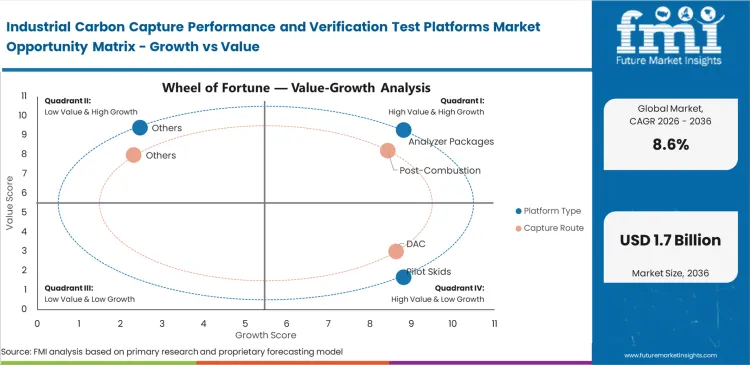
- Analyzer packages lead by platform type with a 36.0% share in 2026.
- Post-combustion dominates capture route with a 49.0% share in 2026.
- Stream purity leads verification function with a 31.0% share in 2026.
- Pilot/demo systems dominate deployment scale with a 42.0% share in 2026.
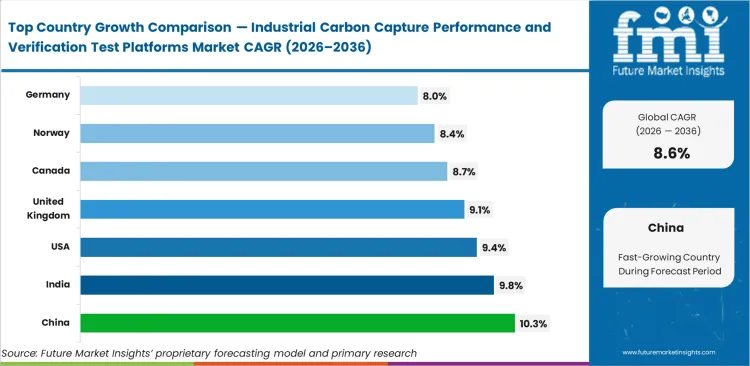
- China is the fastest-growing market at 10.3%, followed by India at 9.8% and the United States at 9.4%.
- The market is driven by regulatory compliance requirements, tax-credit-linked verification systems, and the shift toward continuous, audit-ready carbon capture monitoring infrastructure.
- Key companies in the market include ABB, Emerson, Endress+Hauser, SICK, AMETEK Process Instruments, HORIBA, and SGS.
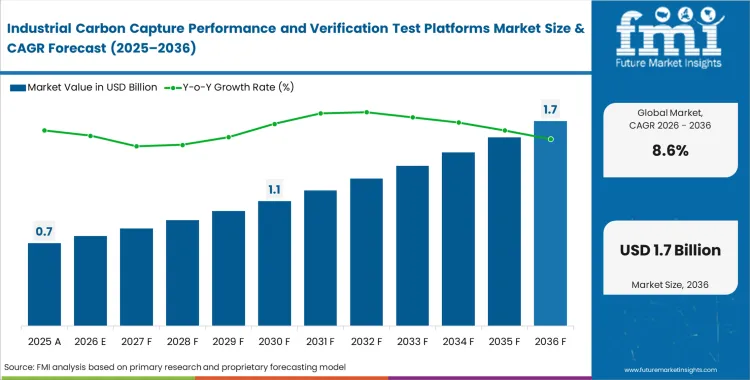
Key Takeaways, Market Size, and Forecast
- 2025 market size: USD 0.6 billion
- 2026 market size: USD 0.7 billion
- 2036 forecast: USD 1.6 billion
- CAGR: 8.6%
- Top platform type: Analyzer packages (36.0%)
- Top capture route: Post-combustion (49.0%)
- Top verification function: Stream purity (31.0%)
- Top end use: Cement (24.0%)
- Top deployment scale: Pilot/demo systems (42.0%)
- Top growth market: China (10.3% CAGR)
Compliance requirements are pushing carbon capture projects away from periodic checks and toward continuous, audit-ready measurement systems. This shift is turning verification into a core operating function rather than a secondary technical task. Industrial operators need reliable proof of capture performance, gas quality, and transfer readiness before CO₂ volumes can move into transport and carbon capture and storage networks. Legacy sensor configurations often fall short when facilities need continuous validation, traceable records, and defensible reporting. Delayed upgrades can lead to shipment rejection, weaker tax-credit claims, and lower confidence from transport and storage counterparties. Buyers are responding by adopting integrated platforms that combine measurement, validation, and reporting within a single operating system.
Tax-credit rules are also changing capital-allocation priorities. Once incentive payments depend on complete and auditable records, management teams place greater weight on data reliability than on lowering initial equipment cost. Advanced carbon capture performance validation equipment is gaining traction because incomplete logs, inconsistent readings, or weak verification trails can directly reduce project returns. Demand is rising fastest where operators treat monitoring systems as infrastructure that protects revenue and supports compliance.
China remains the lead growth market as industrial carbon capture projects move from pilot activity to cluster-scale deployment. Demand is forecast to rise at a CAGR of 10.3% through 2036, supported by the country’s concentration of large industrial hubs and the need to verify capture performance across integrated sites. India is set to record 9.8% CAGR as project execution strengthens and new installations move into monitored operating phases. In the United States, tighter 45Q documentation and verification requirements keep demand for test platforms on a firm trajectory, with the market projected to grow at 9.4% through 2036. The United Kingdom is expected to post 9.1% CAGR as cluster sequencing policies increase the need for structured monitoring and validation systems. Canada is projected to expand at 8.7%, while Norway and Germany are forecast at 8.4% and 8.0%, where growth remains steadier under country-specific reporting rules and more disciplined project rollout.
Segmental Analysis
Industrial Carbon Capture Performance and Verification Test Platforms Market Analysis by Platform Type
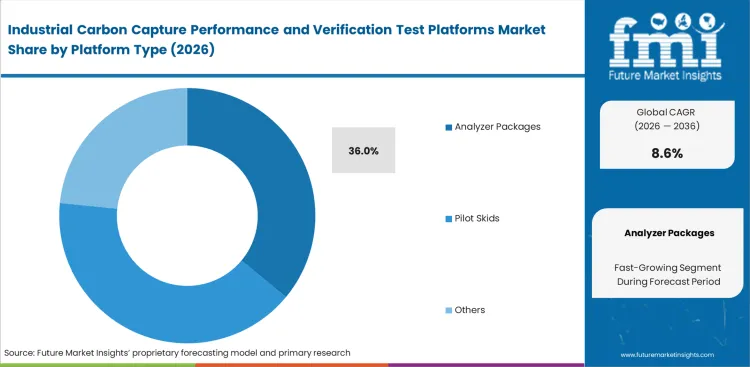
Major industrial sites favor continuous measurement architecture over periodic checks when selecting carbon capture verification systems. Once engineering teams qualify a specific infrared setup for stack monitoring, changing hardware often reopens approval work, software validation, and audit mapping. That is one reason analyzer packages are estimated to account for 36.0% share in 2026. Integrated systems reduce manual sampling dependence, lower reporting errors, and fit more cleanly into registry-facing workflows. Plants operating with disconnected tools often spend heavily on data handling rather than measurement itself. Dedicated continuous platforms also improve traceability across regulated operating environments. Reliable process instrumentation supports that shift by keeping certified data streams stable from capture unit to reporting layer.
- Initial qualification: Tax credit filings require continuous baseline data before full operations begin. Regulatory teams install carbon capture analyzers early to establish an auditable measurement record.
- Operational validation: Acidic gas exposure reduces hardware reliability over time. Maintenance teams recalibrate process liquid analyzer units frequently to preserve measurement accuracy.
- Expansion lock-in: Capacity additions usually follow previously qualified monitoring architecture. Engineering teams reorder approved process spectroscopy systems rather than risk permit delays and revalidation work.
Industrial Carbon Capture Performance and Verification Test Platforms Market Analysis by Capture Route
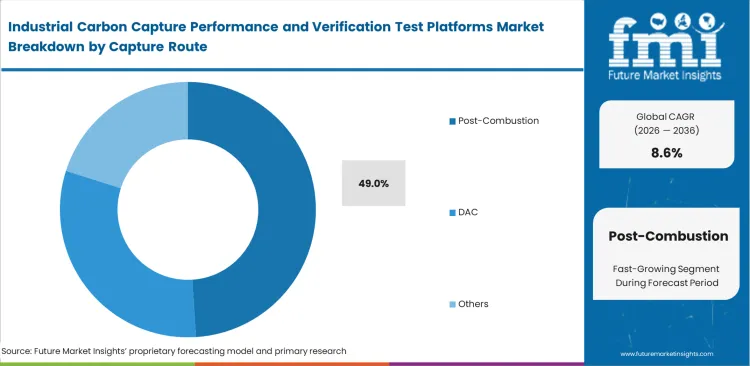
Technology selection in heavy industry is often determined by the equipment already installed at the plant. Operators with existing smokestack systems usually favor retrofit options that fit around current boilers, ducting, and absorber arrangements rather than reworking the entire process train. Advanced capture carbon substrates suit that requirement because they can be deployed within established post-combustion setups. Post-combustion is expected to account for 49.0% share in 2026. The route also requires more rigorous testing because exhaust streams contain fluctuating contaminant loads that influence sensor lifespan, optical performance, and calibration frequency. Standard monitoring hardware often performs poorly in such conditions, especially where flue gas coolers are undersized or not properly integrated.
- Cost economics: Initial instrumentation spending for post-combustion systems may appear reasonable during project planning. Operating teams often encounter higher sensor replacement and maintenance costs once the system is in service.
- Hidden operations: Flue gas impurities rapidly foul optical surfaces during continuous operation. Plant teams need frequent cleaning routines to avoid signal drift and loss of data quality.
- Lifecycle totals: Total ownership cost becomes more visible over time. Lower-cost sensors often create a heavier expense burden through repeated replacement cycles.
Industrial Carbon Capture Performance and Verification Test Platforms Market Analysis by Verification Function
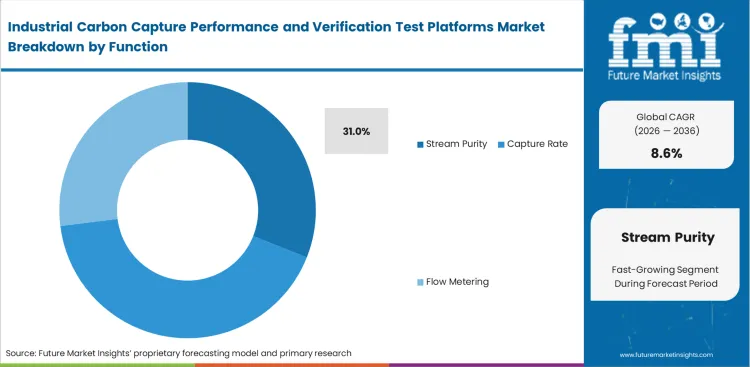
Transport operators maintain tight contaminant limits because pipeline acceptance depends on gas quality, not just capture volume. Moisture, oxygen, and trace impurity levels directly affect corrosion risk, transport integrity, and storage eligibility. Stream purity is therefore anticipated to capture 31.0% share in 2026 within the verification function segment. Facilities that fail purity thresholds can lose transport access and invalidate associated credit claims. Cross-sensitivity remains a major operating issue, since low-grade sensors may misread interfering gases and generate false compliance signals. High-performance FTIR gas analyzers reduce that risk and improve confidence during external review. Multi-gas platforms also work better alongside certified global gas leak detectors and structured emissions management systems when operators need defensible records across the full monitoring chain.
- Moisture failure: Condensation inside transport lines accelerates acidic corrosion and raises operating risk quickly. Pipeline operators require clear dehydration proof before opening intake access.
- Residual risk: Even advanced sensors drift over long operating cycles. Metrology teams run routine bump tests with certified gases to keep readings within tolerance.
- Benefit capture: Accurate compliance logs support incentive recovery and reporting discipline. Finance teams rely on complete records for quarterly submissions and claim validation.
Industrial Carbon Capture Performance and Verification Test Platforms Market Analysis by End Use
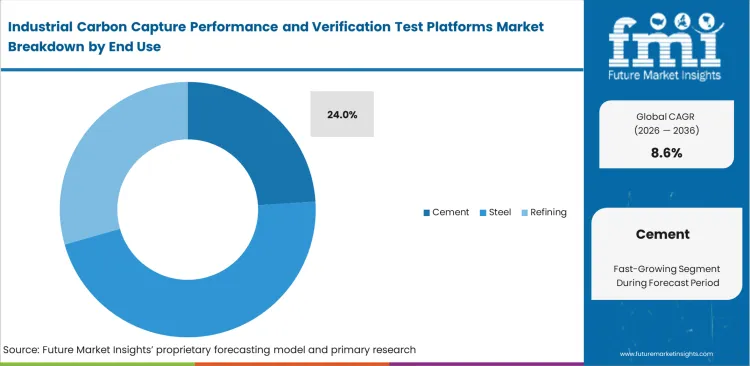
Cement plants present a harder monitoring environment than many standard combustion facilities because the exhaust stream carries heavy dust loading, elevated temperatures, and abrasive particulate matter. These conditions shorten probe life, foul optical paths, and raise the maintenance burden on extraction assemblies. Cement is projected to command 24.0% share in 2026 for that reason, as decarbonization pressure in construction materials continues to push adoption of specialized verification hardware. Standard analytical setups often fail quickly in these lines, especially when dust binds to hot optical surfaces and distorts readings. Heated extractive systems address that specific issue more effectively and keep data continuity intact. The same logic is increasingly relevant in other difficult process industries where uninterrupted measurement is tied directly to compliance and operating continuity.
- Early adopters: Large steel groups move early when emissions disclosure pressure intensifies. Management teams approve premium budgets for carbon capture instrumentation to secure credible reporting.
- Follower shift: Mid-sized refineries often replicate hardware choices after successful pilot programs elsewhere. Proven monitoring blueprints lower adoption risk and speed internal approval.
- Late converts: Smaller chemical producers tend to upgrade after reporting rules tighten. Compliance teams authorize purchases when operating exposure becomes difficult to defer.
Industrial Carbon Capture Performance and Verification Test Platforms Market Analysis by Deployment Scale
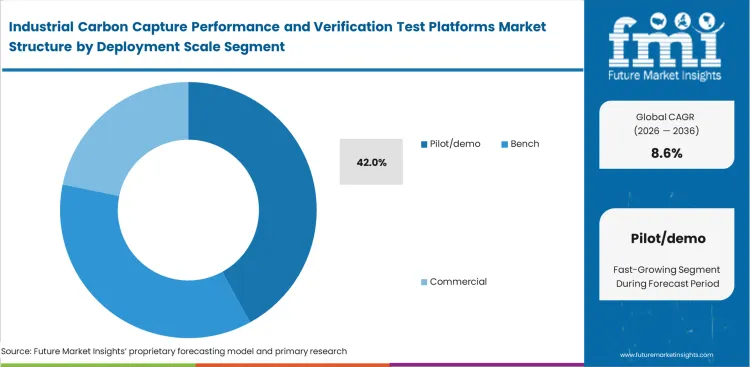
Pilot-scale validation remains a necessary step before developers commit major capital to full commercial systems. Operators need evidence on solvent behavior, capture efficiency, sensor response, and operating stability under controlled but realistic conditions. Dense instrumentation on small skids supports that learning process, especially where process chemistry is still being tuned. 42.0% share in 2026 is expected to come from pilot/demo systems. Engineering teams use these configurations to refine design assumptions before scale-up. They also rely on carbon capture and sequestration test architecture to evaluate flow behavior, purity performance, and control logic without exposing a full-scale project to avoidable execution risk. The result is unusually high instrumentation intensity at the pilot stage.
- High density: Experimental skids need measurement points across nearly every critical junction. Instrument teams install redundant sensors to build a complete performance picture.
- Supply constraints: Rising pilot activity tightens availability of specialized hardware. Buyers often face long lead times for highly specific measurement devices.
- Future landscape: Validated pilot designs frequently become the template for commercial expansion. Operations teams rarely change qualified layouts once scale-up moves forward.
Industrial Carbon Capture Performance and Verification Test Platforms Market Drivers, Restraints, and Opportunities
Tax credit monetization protocols require financial officers to deploy continuous industrial decarbonization measurement platforms immediately. Delaying these installations directly freezes million-dollar incentive payouts and ruins quarterly revenue projections. Government agencies refuse to process claims lacking uninterrupted high-resolution data logs. Facilities operating without robust validation frameworks face severe audits and potential clawbacks of previously awarded funds. This financial pressure accelerates puchase cycles dramatically across all heavy manufacturing sectors.
Lengthy regulatory approval cycles for novel measurement technologies slow adoption even when plant managers desperately want modern upgrades. National environmental agencies mandate strict equivalency testing before allowing facilities to replace outdated legacy monitors. This bureaucratic friction traps operators in expensive maintenance loops with older equipment. Emerging software-based predictive emissions monitoring offers partial relief, but authorities still demand physical hardware cross-checks.
Opportunities in the Industrial Carbon Capture Performance and Verification Test Platforms Market
- Predictive maintenance integration: Instrument manufacturers can bundle predictive AI software with physical sensors. Maintenance directors gain actionable warnings before critical compliance failures occur.
- Mobile calibration rigs: Independent testing firms can deploy modular calibration services utilizing a mobile carbon capture calibration rig. Quality assurance managers avoid shipping delicate instruments to distant laboratories.
- Direct air capture customization: Engineering teams designing direct air capture facilities require specialized ultra-low concentration analyzers. R&D directors need extreme sensitivity to validate atmospheric removal rates accurately.
Regional Analysis
Based on regional analysis, industrial carbon capture performance and verification test platforms market is segmented into North America, Europe, and Asia Pacific across 40 plus countries.
.webp "Top Country Growth Comparison Industrial Carbon Capture Performance And Verification Test Platforms Market Cagr (2026 2036)")
| Country | CAGR (2026 to 2036) |
|---|---|
| China | 10.3% |
| India | 9.8% |
| United States | 9.4% |
| United Kingdom | 9.1% |
| Canada | 8.7% |
| Norway | 8.4% |
| Germany | 8.0% |
Source: Future Market Insights (FMI) analysis, based on proprietary forecasting model and primary research
Asia Pacific Industrial Carbon Capture Performance and Verification Test Platforms Market Analysis
State-backed industrial clusters are transitioning rapidly from planning phases into active construction across the region. Regional authorities now mandate strict continuous monitoring integration before issuing operational permits. Operators utilizing basic spot-checking methods face immediate shutdown orders under the new environmental frameworks. Plant managers prioritize rugged analyzer packages capable of surviving harsh manufacturing environments to satisfy provincial inspection teams.
- China: Demand for validation hardware in China is anticipated to rise at a CAGR of 10.3% through 2036. Provincial regulators enforce stringent continuous monitoring rules across extensive steel and cement hubs. Environmental directors face severe personal liabilities for data falsification, driving high demand for tamper-proof digital measurement tools. Equipment suppliers capturing these initial contracts secure substantial long-term replacement revenue streams.
- India: Initial demonstration projects across heavy manufacturing sectors require intensive validation hardware to prove technological viability. The industrial carbon capture test platforms industry in India is poised to expand at a CAGR of 9.8% during the forecast period. Process engineers demand robust gas sensors to handle highly variable local coal compositions. Successful pilot validations establish clear operational blueprints for nationwide commercial technology rollouts.
North America Industrial Carbon Capture Performance and Verification Test Platforms Market Analysis
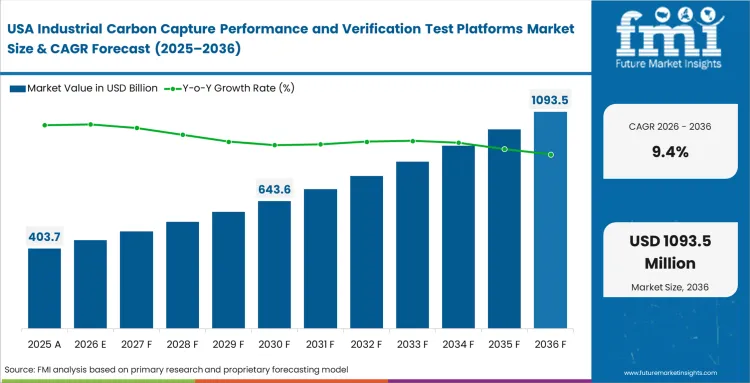
Strict tax credit reporting mandates dominate purchasing decisions across this region. Facilities must prove exact sequestration volumes to access lucrative financial incentives. Plant operators cannot afford missing data points during critical quarterly audit periods. Financial officers authorize premium instrumentation budgets to guarantee uninterrupted compliance logs. Upgrading legacy systems prevents severe revenue losses tied to rejected tax claims.
- United States: EPA 45Q requirements enforce strict auditable data trails for every ton of carbon injected underground. Tax compliance officers demand flawless integration between physical sensors and federal reporting portals to maintain accurate logs. USA adoption of these verification platforms is expected to register a CAGR of 9.4% from 2026 to 2036. Modernizing measurement networks effectively eliminates substantial financial risks associated with failed audits.
- Canada: Canada is projected to witness an 8.7% CAGR in the carbon capture instrumentation sector through 2036. Federal investment tax credits subsidize major capital expenditures for advanced monitoring hardware. Purchasing directors utilize these specialized funds to specify premium multi-component analyzer packages for their facilities. North American instrumentation standards established here increasingly influence baseline regulatory expectations across the global market.
Europe Industrial Carbon Capture Performance and Verification Test Platforms Market Analysis
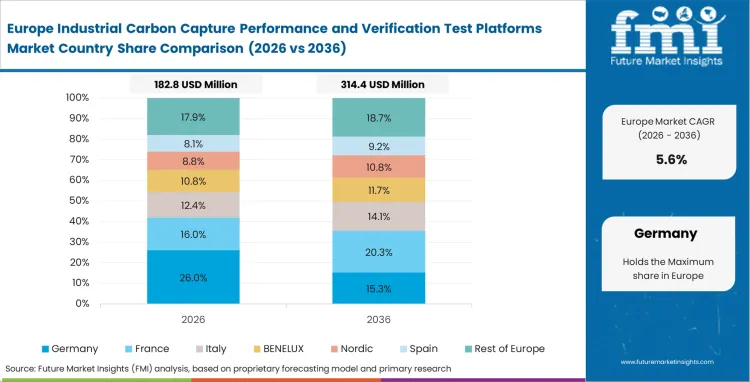
Mature carbon pricing mechanisms push operators toward extremely precise volume measurement architectures. High trading values for emission allowances make microscopic measurement errors incredibly expensive. Measurement technicians require advanced calibration tools to sustain absolute accuracy across extended periods. Facilities employing outdated flow meters lose significant capital through inaccurate emissions reporting. Upgrading to Coriolis mass flow systems tightens financial accounting significantly.
- United Kingdom: Cluster sequencing protocols dictate standardized reporting formats across diverse participating industries requiring cluster carbon capture monitoring systems. The market for validation platforms in the United Kingdom is expected to grow at a CAGR of 9.1% during the study period. Network operators mandate identical measurement confidence from power plants and chemical facilities alike. Standardized instrumentation approaches generate highly efficient regional maintenance networks.
- Norway: Offshore storage initiatives require exceptionally robust underwater environmental monitoring equipment to verify containment integrity. Subsea engineers specify highly specialized acoustic and chemical sensors to detect microscopic leaks within extreme pressure environments. Norway is forecast to record steady growth in this equipment at a CAGR of 8.4% through 2036. Advanced subsea validation techniques developed here directly inform future global regulations.
- Germany: Heavy industrial sites place strong emphasis on feeding carbon measurement data into existing environmental management systems. The industrial carbon capture verification tools market in Germany is projected to grow at a CAGR of 8.0% from 2026 to 2036. Buyers place high value on communication protocols that allow field instruments to connect smoothly with centralized databases. Stronger digital integration helps reduce the reporting burden tied to detailed regulatory compliance requirements.
FMI's report includes detailed assessments covering France, Italy, and Japan. Emerging policies in these nations heavily prioritize digital reporting automation over manual sampling techniques.
Competitive Aligners for Market Players
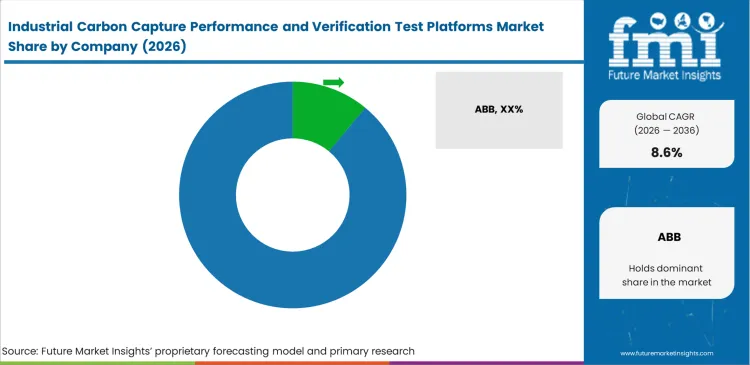
Certification requirements keep entry barriers high for new instrument manufacturers trying to enter this sector. Established engineering firms seldom specify unproven analyzers for billion-dollar carbon capture facilities. ABB and Emerson benefit from existing relationships with global EPC contractors, giving them an advantage in early front-end engineering design phases where hardware preferences are often set long before sourcing starts. Their specifications are frequently written into project documents well ahead of vendor selection.
Established suppliers also hold deeper banks of regulatory approvals and certified reference installations that new entrants cannot build in a short period. Capture facilities require automation and instrumentation components backed by hazardous area certifications and metrology approvals. Ametek Process Instruments and SICK maintain dedicated compliance capabilities to keep devices aligned with changing global standards. Any challenger entering as a carbon capture verification services provider usually faces multi-year field validation before operators are willing to review the proposal seriously.
Large industrial buyers still work to avoid sole-source dependence by insisting on open communication protocols from carbon capture monitoring platform suppliers. Standard outputs remain important because they preserve interoperability across instruments from different vendors. Suppliers that push closed software environments risk losing position during technical evaluation. Preference stays with total carbon analyzers that combine sensor performance with open digital integration across plant systems.
Key Players in Industrial Carbon Capture Performance and Verification Test Platforms Market
- ABB
- Emerson
- Endress+Hauser
- SICK
- AMETEK Process Instruments
- HORIBA
- SGS
Scope of the Report
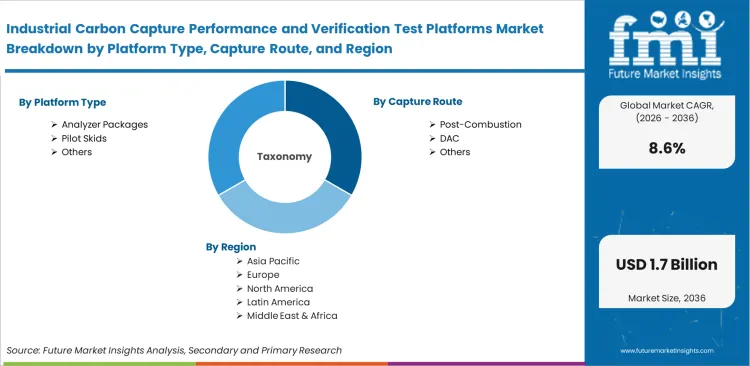
| Metric | Value |
|---|---|
| Quantitative Units | USD 0.7 billion to USD 1.6 billion, at a CAGR of 8.60% |
| Market Definition | Industrial Carbon Capture Performance and Verification Test Platforms comprise integrated analytical hardware and software systems designed to measure, validate, and report CO₂ volumes and stream purity. |
| Segmentation | By platform type, capture route, verification function, end use, deployment scale, and Region. |
| Regions Covered | North America, Latin America, Europe, East Asia, South Asia & Pacific, Middle East & Africa |
| Countries Covered | China, India, United States, United Kingdom, Canada, Norway, Germany |
| Key Companies Profiled | ABB, Emerson, Endress+Hauser, SICK, AMETEK Process Instruments, HORIBA, SGS |
| Forecast Period | 2026 to 2036 |
| Approach | Bottom-up hybrid model using active CCUS projects multiplied by standard analyzer package metrics |
Source: Future Market Insights (FMI) analysis, based on proprietary forecasting model and primary research
Industrial Carbon Capture Performance and Verification Test Platforms Market Analysis by Segments
By Platform Type
- Analyzer packages
- Pilot skids
- Solvent labs
- Digital MMV
- Calibration rigs
By Capture Route
- Post-combustion
- Pre-combustion
- Oxy-fuel
- DAC
- Mineralization
By Verification Function
- Stream purity
- Capture rate
- Flow metering
- Leakage tracking
- Data assurance
By End Use
- Cement
- Steel
- Refining
- Chemicals
- Power
By Deployment Scale
- Pilot/demo
- Bench
- Commercial
- Cluster
- Storage-site
Region:
- North America
- United States
- Canada
- Europe
- Germany
- United Kingdom
- France
- Italy
- Spain
- Asia Pacific
- China
- Japan
- South Korea
- Taiwan
- Singapore
- Latin America
- Brazil
- Mexico
- Argentina
- Middle East & Africa
- GCC Countries
- South Africa
Bibliography
- National Energy Technology Laboratory. (2024). NETL DAC Center test report: Lanxess Lewatit VP OC 1065 sorbent benchmark test, #NETL-2024-002. USA Department of Energy.
- Office of Clean Energy Demonstrations. (2024). Portfolio insights: Carbon capture in the power sector. USA Department of Energy.
- USA Department of Energy, Office of Fossil Energy and Carbon Management, & National Energy Technology Laboratory. (2024). Point-source carbon capture: Roles for artificial intelligence in support of FECM RDD&D priorities.
- USA Environmental Protection Agency. (2024). Geologic sequestration of carbon dioxide: Subpart RR, Greenhouse Gas Reporting Program.
- Zakkour, P., & Cook, G. (2024). Measurement, reporting and verification and accounting for carbon dioxide removal in the context of both project-based approaches and national greenhouse gas inventories. IEAGHG.
This bibliography is provided for reader reference. The full FMI report contains the complete reference list with primary source documentation.
This Report Addresses
- Detailed measurement architecture specifications required for modern tax credit compliance workflows.
- Specific hardware failure mechanisms encountered across heavy calcination and offshore storage applications.
- Regional divergence separating sheer capacity validation models from strict financial audit frameworks globally.
- Primary purchase constraints affecting advanced multi-gas capable continuous emissions monitoring integration.
- Exact lifecycle cost realities contrasting cheap generic sensors against premium process spectroscopy units.
- Emerging predictive maintenance integrations combining physical analyzers with advanced digital AI software tools.
- Strategic vulnerabilities confronting mid-sized producers navigating initial pilot test skid validation phases.
- Incumbent supply chain dominance strategies securing front-end engineering design contracts across mega-clusters.
Frequently Asked Questions
What is a carbon capture verification platform?
These systems comprise integrated analytical hardware and software designed to measure, validate, and report CO₂ volumes and stream purity. They ensure industrial emission captures meet pipeline transport specifications and regulatory tax credit requirements.
Explain the industrial carbon capture performance and verification test platforms market?
This sector involves the specialized instrumentation, pilot skids, and digital reporting software required to prove carbon capture efficacy. Strict environmental mandates and lucrative tax credits push industrial facilities to adopt these auditable monitoring architectures globally.
Give me the market size of carbon capture verification test platforms?
Baseline revenue reached USD 0.6 billion in 2025. Cumulative revenue is forecast to hit USD 1.6 billion by 2036, expanding at an 8.60% CAGR.
What is carbon capture market size?
While the broader carbon capture market reaches tens of billions, the specific instrumentation and verification layer focuses entirely on the measurement validation components, presenting a highly specialized, rapidly growing niche.
Which companies supply carbon capture monitoring and verification systems?
Leading suppliers include ABB, Emerson, Endress+Hauser, SICK, AMETEK Process Instruments, HORIBA, and SGS. These incumbents dominate early front-end engineering design phases across major industrial clusters.
What sectors buy industrial carbon capture test platforms?
Major buyers include operators in cement, steel, refining, chemicals, and power generation. Facilities undergoing decarbonization require these systems to ensure regulatory compliance and secure associated financial incentives.
How is carbon capture performance tested?
Facilities utilize specialized analyzer packages and pilot skids to measure stream purity, capture rates, and flow metering. Continuous gas analyzers validate the concentration of captured CO₂ against strict pipeline and storage specifications.
How do operators verify carbon capture rates?
Operators integrate high-precision mass flow meters and predictive digital software to track exact sequestration volumes. Continuous data logs provide the auditable proof required by national environmental agencies for tax credit disbursement.
What is MMV in carbon capture?
MMV stands for Measurement, Monitoring, and Verification. This framework ensures that captured CO₂ is accurately quantified, safely transported, and permanently stored without leakage, utilizing strict data assurance protocols.
Why does carbon capture need CO2 purity monitoring?
Pipeline operators enforce zero-tolerance policies regarding contaminant levels. Condensation or impurities inside pipelines cause acidic corrosion, prompting networks to reject entire batches if trace oxygen or water vapor exceeds microscopic thresholds.
What is the best analyzer technology for CO2 purity monitoring?
Process engineers heavily favor high-end FTIR gas analyzers and specialized infrared architectures. These premium platforms eliminate cross-sensitivity interference, preventing false compliance reports during external audits.
How is CO2 transport quality measured?
Transport quality is verified using integrated continuous emission monitoring systems and specialized gas chromatographs. These instruments detect trace impurities before the gas enters custody transfer points, preventing pipeline rejection.
What instruments are used in carbon capture plants?
Plants rely on process liquid analyzers, process spectroscopy units, total carbon analyzers, and advanced mass flow meters. Instrumentation engineers install redundant sensors to capture comprehensive performance data continuously.
How does capture efficiency measurement impact operations?
Accurate capture efficiency data dictates the financial viability of a project. Dropping below extraction rates severely restricts the amount of tax credits a facility can claim, directly impacting quarterly revenue projections.
What is carbon capture project measurement uncertainty?
Measurement uncertainty refers to the allowable error margin in reporting sequestered volumes. Regulatory bodies require highly calibrated instrumentation to minimize this uncertainty, ensuring all claimed carbon credits represent actual atmospheric removals.
How do buyers request quote carbon capture analyzer package?
Acquisition directors issue detailed technical specifications to major instrumentation vendors during the front-end engineering design phase. Engineering teams evaluate these quotes based on regulatory compliance, hardware longevity, and open digital integration capabilities.
Why invest in a carbon capture transport metering skid?
These specialized skids provide exact custody transfer measurements before captured gas enters shared transport networks. Flawless accounting at this junction guarantees accurate financial compensation between capture facilities and storage operators.
Compare ABB Emerson and Endress+Hauser for carbon capture measurement?
ABB and Emerson leverage vast EPC contractor relationships to secure early design-phase integrations, while Endress+Hauser aggressively competes by offering highly open communication protocols that prevent sole-source vendor lock-in.
How does deployment scale shape early sourcing trends?
Pilot testing skids represent 42.0% share because scaling unproven chemical processes risks losses. Engineering firms utilize dense sensor arrays on small platforms to refine operational parameters safely before full commercial expansion.
Why do operators resist substituting analytical platforms during expansion?
Re-certifying alternative hardware restarts long regulatory approval clocks. Acquisition heads simply reorder qualified platforms rather than risking massive compliance delays and expensive manual sampling routines.
How do independent testing firms capitalize on cluster deployment?
Testing firms deploy modular calibration services across widespread industrial hubs. Quality assurance managers utilize these mobile rigs to avoid shipping delicate instruments to distant laboratories.
How does predictive maintenance integration alter operational risk?
Instrument manufacturers now bundle AI software with physical sensors. Maintenance directors gain actionable warnings before critical compliance failures occur, drastically reducing unexpected downtime and massive revenue losses.
Preview the report firsthand - request a free sample
Get SampleGet the brochure for pricing and purchase details.
Get PDFTable of Content
- Executive Summary
- Global Market Outlook
- Demand-side Trends
- Supply-side Trends
- Technology Roadmap Analysis
- Analysis and Recommendations
- Market Overview
- Market Coverage / Taxonomy
- Market Definition / Scope / Limitations
- Research Methodology
- Chapter Orientation
- Analytical Lens and Working Hypotheses
- Market Structure, Signals, and Trend Drivers
- Benchmarking and Cross-market Comparability
- Market Sizing, Forecasting, and Opportunity Mapping
- Research Design and Evidence Framework
- Desk Research Programme (Secondary Evidence)
- Company Annual and Sustainability Reports
- Peer-reviewed Journals and Academic Literature
- Corporate Websites, Product Literature, and Technical Notes
- Earnings Decks and Investor Briefings
- Statutory Filings and Regulatory Disclosures
- Technical White Papers and Standards Notes
- Trade Journals, Industry Magazines, and Analyst Briefs
- Conference Proceedings, Webinars, and Seminar Materials
- Government Statistics Portals and Public Data Releases
- Press Releases and Reputable Media Coverage
- Specialist Newsletters and Curated Briefings
- Sector Databases and Reference Repositories
- FMI Internal Proprietary Databases and Historical Market Datasets
- Subscription Datasets and Paid Sources
- Social Channels, Communities, and Digital Listening Inputs
- Additional Desk Sources
- Expert Input and Fieldwork (Primary Evidence)
- Primary Modes
- Qualitative Interviews and Expert Elicitation
- Quantitative Surveys and Structured Data Capture
- Blended Approach
- Why Primary Evidence is Used
- Field Techniques
- Interviews
- Surveys
- Focus Groups
- Observational and In-context Research
- Social and Community Interactions
- Stakeholder Universe Engaged
- C-suite Leaders
- Board Members
- Presidents and Vice Presidents
- R&D and Innovation Heads
- Technical Specialists
- Domain Subject-matter Experts
- Scientists
- Physicians and Other Healthcare Professionals
- Governance, Ethics, and Data Stewardship
- Research Ethics
- Data Integrity and Handling
- Primary Modes
- Tooling, Models, and Reference Databases
- Desk Research Programme (Secondary Evidence)
- Data Engineering and Model Build
- Data Acquisition and Ingestion
- Cleaning, Normalisation, and Verification
- Synthesis, Triangulation, and Analysis
- Quality Assurance and Audit Trail
- Market Background
- Market Dynamics
- Drivers
- Restraints
- Opportunity
- Trends
- Scenario Forecast
- Demand in Optimistic Scenario
- Demand in Likely Scenario
- Demand in Conservative Scenario
- Opportunity Map Analysis
- Product Life Cycle Analysis
- Supply Chain Analysis
- Investment Feasibility Matrix
- Value Chain Analysis
- PESTLE and Porter’s Analysis
- Regulatory Landscape
- Regional Parent Market Outlook
- Production and Consumption Statistics
- Import and Export Statistics
- Market Dynamics
- Global Market Analysis 2021 to 2025 and Forecast, 2026 to 2036
- Historical Market Size Value (USD Million) Analysis, 2021 to 2025
- Current and Future Market Size Value (USD Million) Projections, 2026 to 2036
- Y-o-Y Growth Trend Analysis
- Absolute $ Opportunity Analysis
- Global Market Pricing Analysis 2021 to 2025 and Forecast 2026 to 2036
- Global Market Analysis 2021 to 2025 and Forecast 2026 to 2036, By Platform Type
- Introduction / Key Findings
- Historical Market Size Value (USD Million) Analysis By Platform Type , 2021 to 2025
- Current and Future Market Size Value (USD Million) Analysis and Forecast By Platform Type , 2026 to 2036
- Analyzer Packages
- Pilot Skids
- Others
- Analyzer Packages
- Y-o-Y Growth Trend Analysis By Platform Type , 2021 to 2025
- Absolute $ Opportunity Analysis By Platform Type , 2026 to 2036
- Global Market Analysis 2021 to 2025 and Forecast 2026 to 2036, By Capture Route
- Introduction / Key Findings
- Historical Market Size Value (USD Million) Analysis By Capture Route, 2021 to 2025
- Current and Future Market Size Value (USD Million) Analysis and Forecast By Capture Route, 2026 to 2036
- Post-Combustion
- DAC
- Others
- Post-Combustion
- Y-o-Y Growth Trend Analysis By Capture Route, 2021 to 2025
- Absolute $ Opportunity Analysis By Capture Route, 2026 to 2036
- Global Market Analysis 2021 to 2025 and Forecast 2026 to 2036, By Function
- Introduction / Key Findings
- Historical Market Size Value (USD Million) Analysis By Function, 2021 to 2025
- Current and Future Market Size Value (USD Million) Analysis and Forecast By Function, 2026 to 2036
- Stream Purity
- Capture Rate
- Flow Metering
- Stream Purity
- Y-o-Y Growth Trend Analysis By Function, 2021 to 2025
- Absolute $ Opportunity Analysis By Function, 2026 to 2036
- Global Market Analysis 2021 to 2025 and Forecast 2026 to 2036, By End Use
- Introduction / Key Findings
- Historical Market Size Value (USD Million) Analysis By End Use, 2021 to 2025
- Current and Future Market Size Value (USD Million) Analysis and Forecast By End Use, 2026 to 2036
- Cement
- Steel
- Refining
- Cement
- Y-o-Y Growth Trend Analysis By End Use, 2021 to 2025
- Absolute $ Opportunity Analysis By End Use, 2026 to 2036
- Global Market Analysis 2021 to 2025 and Forecast 2026 to 2036, By Deployment Scale
- Introduction / Key Findings
- Historical Market Size Value (USD Million) Analysis By Deployment Scale, 2021 to 2025
- Current and Future Market Size Value (USD Million) Analysis and Forecast By Deployment Scale, 2026 to 2036
- Pilot/demo
- Bench
- Commercial
- Pilot/demo
- Y-o-Y Growth Trend Analysis By Deployment Scale, 2021 to 2025
- Absolute $ Opportunity Analysis By Deployment Scale, 2026 to 2036
- Global Market Analysis 2021 to 2025 and Forecast 2026 to 2036, By Region
- Introduction
- Historical Market Size Value (USD Million) Analysis By Region, 2021 to 2025
- Current Market Size Value (USD Million) Analysis and Forecast By Region, 2026 to 2036
- North America
- Latin America
- Western Europe
- Eastern Europe
- East Asia
- South Asia and Pacific
- Middle East & Africa
- Market Attractiveness Analysis By Region
- North America Market Analysis 2021 to 2025 and Forecast 2026 to 2036, By Country
- Historical Market Size Value (USD Million) Trend Analysis By Market Taxonomy, 2021 to 2025
- Market Size Value (USD Million) Forecast By Market Taxonomy, 2026 to 2036
- By Country
- USA
- Canada
- Mexico
- By Platform Type
- By Capture Route
- By Function
- By End Use
- By Deployment Scale
- By Country
- Market Attractiveness Analysis
- By Country
- By Platform Type
- By Capture Route
- By Function
- By End Use
- By Deployment Scale
- Key Takeaways
- Latin America Market Analysis 2021 to 2025 and Forecast 2026 to 2036, By Country
- Historical Market Size Value (USD Million) Trend Analysis By Market Taxonomy, 2021 to 2025
- Market Size Value (USD Million) Forecast By Market Taxonomy, 2026 to 2036
- By Country
- Brazil
- Chile
- Rest of Latin America
- By Platform Type
- By Capture Route
- By Function
- By End Use
- By Deployment Scale
- By Country
- Market Attractiveness Analysis
- By Country
- By Platform Type
- By Capture Route
- By Function
- By End Use
- By Deployment Scale
- Key Takeaways
- Western Europe Market Analysis 2021 to 2025 and Forecast 2026 to 2036, By Country
- Historical Market Size Value (USD Million) Trend Analysis By Market Taxonomy, 2021 to 2025
- Market Size Value (USD Million) Forecast By Market Taxonomy, 2026 to 2036
- By Country
- Germany
- UK
- Italy
- Spain
- France
- Nordic
- BENELUX
- Rest of Western Europe
- By Platform Type
- By Capture Route
- By Function
- By End Use
- By Deployment Scale
- By Country
- Market Attractiveness Analysis
- By Country
- By Platform Type
- By Capture Route
- By Function
- By End Use
- By Deployment Scale
- Key Takeaways
- Eastern Europe Market Analysis 2021 to 2025 and Forecast 2026 to 2036, By Country
- Historical Market Size Value (USD Million) Trend Analysis By Market Taxonomy, 2021 to 2025
- Market Size Value (USD Million) Forecast By Market Taxonomy, 2026 to 2036
- By Country
- Russia
- Poland
- Hungary
- Balkan & Baltic
- Rest of Eastern Europe
- By Platform Type
- By Capture Route
- By Function
- By End Use
- By Deployment Scale
- By Country
- Market Attractiveness Analysis
- By Country
- By Platform Type
- By Capture Route
- By Function
- By End Use
- By Deployment Scale
- Key Takeaways
- East Asia Market Analysis 2021 to 2025 and Forecast 2026 to 2036, By Country
- Historical Market Size Value (USD Million) Trend Analysis By Market Taxonomy, 2021 to 2025
- Market Size Value (USD Million) Forecast By Market Taxonomy, 2026 to 2036
- By Country
- China
- Japan
- South Korea
- By Platform Type
- By Capture Route
- By Function
- By End Use
- By Deployment Scale
- By Country
- Market Attractiveness Analysis
- By Country
- By Platform Type
- By Capture Route
- By Function
- By End Use
- By Deployment Scale
- Key Takeaways
- South Asia and Pacific Market Analysis 2021 to 2025 and Forecast 2026 to 2036, By Country
- Historical Market Size Value (USD Million) Trend Analysis By Market Taxonomy, 2021 to 2025
- Market Size Value (USD Million) Forecast By Market Taxonomy, 2026 to 2036
- By Country
- India
- ASEAN
- Australia & New Zealand
- Rest of South Asia and Pacific
- By Platform Type
- By Capture Route
- By Function
- By End Use
- By Deployment Scale
- By Country
- Market Attractiveness Analysis
- By Country
- By Platform Type
- By Capture Route
- By Function
- By End Use
- By Deployment Scale
- Key Takeaways
- Middle East & Africa Market Analysis 2021 to 2025 and Forecast 2026 to 2036, By Country
- Historical Market Size Value (USD Million) Trend Analysis By Market Taxonomy, 2021 to 2025
- Market Size Value (USD Million) Forecast By Market Taxonomy, 2026 to 2036
- By Country
- Kingdom of Saudi Arabia
- Other GCC Countries
- Turkiye
- South Africa
- Other African Union
- Rest of Middle East & Africa
- By Platform Type
- By Capture Route
- By Function
- By End Use
- By Deployment Scale
- By Country
- Market Attractiveness Analysis
- By Country
- By Platform Type
- By Capture Route
- By Function
- By End Use
- By Deployment Scale
- Key Takeaways
- Key Countries Market Analysis
- USA
- Pricing Analysis
- Market Share Analysis, 2025
- By Platform Type
- By Capture Route
- By Function
- By End Use
- By Deployment Scale
- Canada
- Pricing Analysis
- Market Share Analysis, 2025
- By Platform Type
- By Capture Route
- By Function
- By End Use
- By Deployment Scale
- Mexico
- Pricing Analysis
- Market Share Analysis, 2025
- By Platform Type
- By Capture Route
- By Function
- By End Use
- By Deployment Scale
- Brazil
- Pricing Analysis
- Market Share Analysis, 2025
- By Platform Type
- By Capture Route
- By Function
- By End Use
- By Deployment Scale
- Chile
- Pricing Analysis
- Market Share Analysis, 2025
- By Platform Type
- By Capture Route
- By Function
- By End Use
- By Deployment Scale
- Germany
- Pricing Analysis
- Market Share Analysis, 2025
- By Platform Type
- By Capture Route
- By Function
- By End Use
- By Deployment Scale
- UK
- Pricing Analysis
- Market Share Analysis, 2025
- By Platform Type
- By Capture Route
- By Function
- By End Use
- By Deployment Scale
- Italy
- Pricing Analysis
- Market Share Analysis, 2025
- By Platform Type
- By Capture Route
- By Function
- By End Use
- By Deployment Scale
- Spain
- Pricing Analysis
- Market Share Analysis, 2025
- By Platform Type
- By Capture Route
- By Function
- By End Use
- By Deployment Scale
- France
- Pricing Analysis
- Market Share Analysis, 2025
- By Platform Type
- By Capture Route
- By Function
- By End Use
- By Deployment Scale
- India
- Pricing Analysis
- Market Share Analysis, 2025
- By Platform Type
- By Capture Route
- By Function
- By End Use
- By Deployment Scale
- ASEAN
- Pricing Analysis
- Market Share Analysis, 2025
- By Platform Type
- By Capture Route
- By Function
- By End Use
- By Deployment Scale
- Australia & New Zealand
- Pricing Analysis
- Market Share Analysis, 2025
- By Platform Type
- By Capture Route
- By Function
- By End Use
- By Deployment Scale
- China
- Pricing Analysis
- Market Share Analysis, 2025
- By Platform Type
- By Capture Route
- By Function
- By End Use
- By Deployment Scale
- Japan
- Pricing Analysis
- Market Share Analysis, 2025
- By Platform Type
- By Capture Route
- By Function
- By End Use
- By Deployment Scale
- South Korea
- Pricing Analysis
- Market Share Analysis, 2025
- By Platform Type
- By Capture Route
- By Function
- By End Use
- By Deployment Scale
- Russia
- Pricing Analysis
- Market Share Analysis, 2025
- By Platform Type
- By Capture Route
- By Function
- By End Use
- By Deployment Scale
- Poland
- Pricing Analysis
- Market Share Analysis, 2025
- By Platform Type
- By Capture Route
- By Function
- By End Use
- By Deployment Scale
- Hungary
- Pricing Analysis
- Market Share Analysis, 2025
- By Platform Type
- By Capture Route
- By Function
- By End Use
- By Deployment Scale
- Kingdom of Saudi Arabia
- Pricing Analysis
- Market Share Analysis, 2025
- By Platform Type
- By Capture Route
- By Function
- By End Use
- By Deployment Scale
- Turkiye
- Pricing Analysis
- Market Share Analysis, 2025
- By Platform Type
- By Capture Route
- By Function
- By End Use
- By Deployment Scale
- South Africa
- Pricing Analysis
- Market Share Analysis, 2025
- By Platform Type
- By Capture Route
- By Function
- By End Use
- By Deployment Scale
- USA
- Market Structure Analysis
- Competition Dashboard
- Competition Benchmarking
- Market Share Analysis of Top Players
- By Region
- By Platform Type
- By Capture Route
- By Function
- By End Use
- By Deployment Scale
- Competition Analysis
- Competition Deep Dive
- ABB
- Overview
- Product Portfolio
- Profitability by Market Segments (Product/Age /Sales Channel/Region)
- Sales Footprint
- Strategy Overview
- Marketing Strategy
- Product Strategy
- Channel Strategy
- Emerson
- Endress+Hauser
- SICK
- AMETEK Process Instruments
- HORIBA
- ABB
- Competition Deep Dive
- Assumptions & Acronyms Used


