

- Industry Size (2026)
- USD 3800.0 Mn
- Forecast (2036)
- USD 11802.2 Mn
- CAGR (2026 to 2036)
- 12.0%
Low-Carbon Hydrogen for Industrial Clusters Market Forecast and Outlook 2026 to 2036
The low-carbon hydrogen for industrial clusters market is positioned to advance from USD 3,800.0 million in 2026 to USD 11,802.2 million by 2036, demonstrating a robust 12.0% CAGR throughout the forecast period. Growth reflects how industrial cluster development is becoming the preferred strategy for hydrogen deployment as co-located facilities enable economies of scale, shared infrastructure optimization, and risk mitigation through diversified customer bases and integrated value chains. Low-carbon hydrogen cluster systems are engineered for supply security, production flexibility, and distribution efficiency that transforms individual facility hydrogen requirements into coordinated regional energy systems where production capacity, storage integration, and demand balancing influence operational reliability, investment economics, and collective decarbonization outcomes.
Large-scale cluster development programs are implementing shared electrolysis facilities, integrated storage systems, and smart distribution networks that enable optimized hydrogen allocation while reducing individual facility investment requirements and operational risks. Systems that can demonstrate scalable production capacity, reliable supply coordination, and flexible demand management across multiple industrial users are being prioritized in cluster planning and development phases. As regional decarbonization policies strengthen and industrial competitiveness considerations intensify, cluster operators evaluate hydrogen systems not only on production costs but also on supply reliability, demand flexibility, and contribution to collective decarbonization targets that influence regulatory compliance, competitive positioning, and access to public funding and support programs.
Green hydrogen production through renewable-powered electrolysis leads where long-term cost competitiveness and complete decarbonization are essential for achieving net-zero emissions targets and accessing green financing opportunities. Blue hydrogen systems dominate applications requiring immediate large-scale deployment and cost optimization while building toward green hydrogen transition pathways. Shared backbone infrastructure configurations serve clusters demanding operational flexibility and investment optimization through coordinated development and resource sharing. Under-construction clusters remain the largest development segment, followed by announced planning projects, while operational clusters provide proven performance validation and expansion opportunities for technology refinement and market development.
Quick Stats for Low-Carbon Hydrogen for Industrial Clusters Market
- Low-Carbon Hydrogen for Industrial Clusters Market Value (2026): USD 3,800.0 million
- Low-Carbon Hydrogen for Industrial Clusters Market Forecast Value (2036): USD 11,802.2 million
- Low-Carbon Hydrogen for Industrial Clusters Market Forecast CAGR: 12.0%
- Leading Production Route in Low-Carbon Hydrogen for Industrial Clusters Market: Green Hydrogen (Electrolysis) (44%)
- Key Growth Countries in Low-Carbon Hydrogen for Industrial Clusters Market: China, Germany, USA, UK, South Korea, Japan
- Key Players in Low-Carbon Hydrogen for Industrial Clusters Market: Air Liquide, Linde, Air Products, Shell, BP
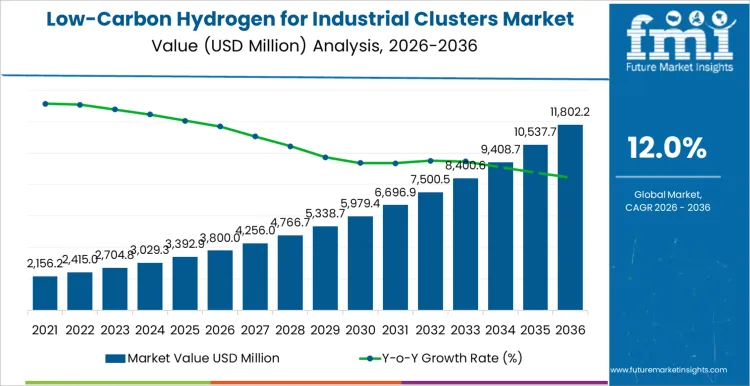
Low-Carbon Hydrogen for Industrial Clusters Market Key Takeaways
| Metric | Value |
|---|---|
| Market Value (2026) | USD 3,800.0 million |
| Market Forecast Value (2036) | USD 11,802.2 million |
| Forecast CAGR 2026 to 2036 | 12.0% |
How Are Regional Decarbonization Policies Shaping Industrial Cluster Development?
Regional decarbonization mandates are driving coordinated industrial cluster development as governments recognize that collective action and shared infrastructure provide more efficient pathways to achieving emissions reduction targets compared to individual facility decarbonization efforts. Modern industrial policy frameworks increasingly emphasize cluster-based approaches that enable resource optimization, technology sharing, and coordinated investment while reducing overall decarbonization costs and implementation complexity. This policy evolution pushes hydrogen developers toward integrated cluster solutions that can serve multiple industrial users while achieving economies of scale essential for commercial viability and widespread adoption.
The implementation of just transition policies and regional development programs creates additional opportunities for hydrogen cluster development through targeted funding, infrastructure support, and workforce development initiatives that benefit from coordinated planning and resource allocation. Industrial cluster policies increasingly recognize hydrogen as enabling infrastructure that supports multiple policy objectives including emissions reduction, economic development, and energy security while providing opportunities for international cooperation and technology leadership. These comprehensive policy frameworks create favorable conditions for large-scale hydrogen cluster investment while establishing clear performance expectations and support mechanisms.
How Is the Market Structured Across Development and Operational Phases?
The low-carbon hydrogen for industrial clusters market demonstrates distinct segmentation patterns based on project development stages and operational maturity levels that directly influence investment requirements, risk profiles, and technology selection criteria. Under-construction clusters capture 42.0% market activity through their representation of committed investment and near-term deployment opportunities that provide concrete market development and technology validation opportunities. These projects benefit from secured financing, established customer commitments, and proven technology selection while providing reference cases for subsequent cluster development and market expansion.
Announced and planned clusters achieve 30.0% market representation through their indication of future market potential and technology requirements that influence current investment decisions and strategic planning activities. These early-stage projects create opportunities for technology developers and strategic positioning while providing market signals that support supply chain development and capability building. The planning phase activities drive technology selection and commercial negotiation that influence market structure and competitive positioning while establishing performance requirements and cost targets that guide technology development priorities.
Which Production Technology Route Generates the Highest Market Adoption?
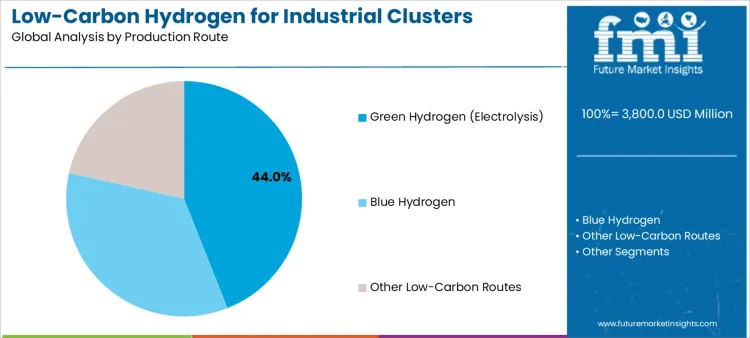
Green hydrogen through renewable electrolysis maintains 44.0% market preference, establishing renewable-powered hydrogen production as the preferred long-term solution for achieving complete decarbonization objectives while accessing green financing and regulatory incentives. These systems benefit from declining renewable electricity costs and improving electrolysis technology efficiency while providing complete lifecycle carbon neutrality that supports corporate sustainability commitments and regulatory compliance requirements. Green hydrogen production creates opportunities for integrated renewable energy development while providing long-term cost stability and energy independence benefits.
Which Business Model Configuration Leads Cluster Development?
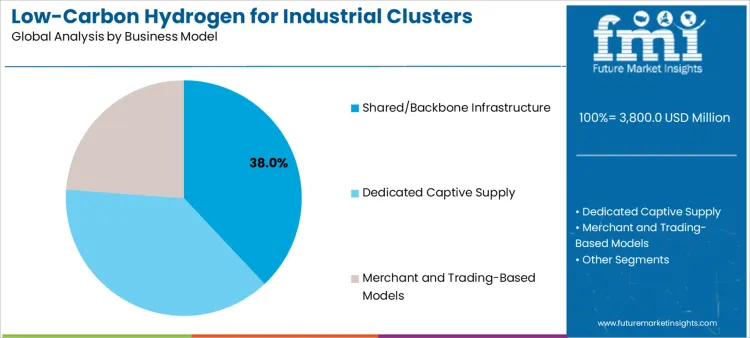
Shared backbone infrastructure systems command 38.0% of business model adoption, establishing coordinated development and resource sharing as the preferred approach for optimizing investment efficiency and operational flexibility across multiple cluster participants. These models enable infrastructure sharing, risk distribution, and operational cost optimization while providing individual facilities with access to larger-scale hydrogen production and storage capabilities than would be economically feasible for standalone projects. Backbone infrastructure development creates opportunities for specialized hydrogen infrastructure companies while enabling industrial users to focus on core operations.
Which End-Use Application Segment Drives Market Demand?
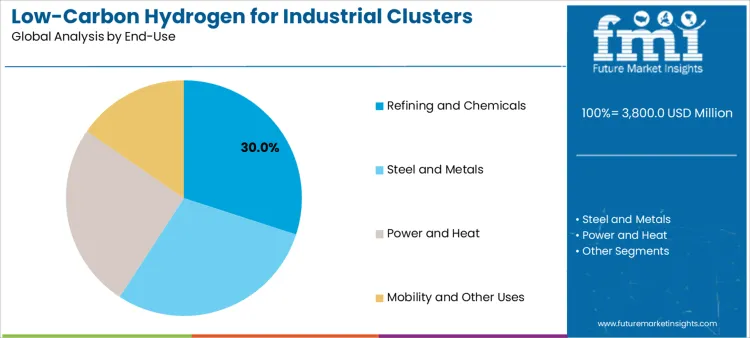
Refining and chemical applications represent 30.0% of cluster demand, establishing petrochemical complexes and refineries as primary anchor customers for hydrogen cluster development due to their substantial hydrogen requirements and existing infrastructure capabilities. These facilities provide predictable demand volumes and established hydrogen handling expertise while offering opportunities for integration with existing operations and infrastructure. Refining and chemical cluster participation creates foundation demand that supports cluster economics while enabling expansion to other industrial users and applications.
How Is Renewable Energy Cost Reduction Driving Green Hydrogen Competitiveness?
Renewable energy cost declines are creating fundamental shifts in hydrogen production economics as declining electricity costs make green hydrogen increasingly competitive with conventional production methods while providing complete decarbonization benefits that support regulatory compliance and corporate sustainability objectives. Solar and wind electricity cost reductions enable green hydrogen production at competitive pricing while providing long-term cost stability and energy security benefits that support industrial planning and investment decisions. This cost trajectory drives cluster development toward renewable-powered hydrogen production while creating opportunities for integrated renewable energy and hydrogen infrastructure projects.
The integration of renewable energy development with hydrogen production creates additional economic opportunities through power purchase agreements, grid services, and energy storage applications that optimize overall project economics while providing multiple revenue streams and risk mitigation benefits. Renewable hydrogen projects increasingly incorporate grid integration and energy market participation that enhance project viability while supporting grid stability and renewable energy integration objectives. These integrated approaches benefit cluster development through improved economics and enhanced value proposition for participating industrial users.
What Infrastructure Development Challenges Constrain Cluster Expansion?
The primary infrastructure barrier affecting low-carbon hydrogen cluster development centers on the substantial capital investment required for production facilities, storage systems, and distribution networks while maintaining cost structures that support competitive hydrogen pricing for participating industrial users. Cluster infrastructure development requires coordinated investment across multiple project components and stakeholder groups while managing technical complexity and regulatory requirements that can delay project development and increase costs. These infrastructure challenges create barriers to cluster development while requiring innovative financing and partnership approaches.
Grid connection and electricity supply constraints also limit cluster development in regions where renewable electricity availability or transmission capacity cannot support large-scale electrolysis operations at competitive pricing. Hydrogen cluster development requires substantial electricity supply that can overwhelm local grid capacity while requiring transmission infrastructure investment and grid integration planning that adds complexity and cost to project development. These grid constraints drive cluster development toward regions with abundant renewable resources and robust electricity infrastructure while potentially limiting deployment opportunities in industrial regions with limited renewable energy access.
How Do International Hydrogen Trade Opportunities Create Growth Drivers?
International hydrogen trade development is creating substantial opportunities for industrial cluster expansion through export market access and technology transfer that enable larger-scale cluster development while providing access to global hydrogen demand and premium pricing opportunities. Hydrogen export capabilities enable cluster development beyond domestic industrial demand while creating opportunities for technology leadership and international market participation that support domestic industry development and economic benefits. These export opportunities benefit cluster development through enhanced project economics and strategic positioning for international competitiveness.
Cross-border hydrogen cooperation agreements create additional opportunities for cluster development through shared technology development, joint infrastructure investment, and coordinated market development that reduce individual country investment requirements while accelerating technology deployment and market creation. International collaboration increasingly emphasizes hydrogen technology deployment and supply chain development that benefits cluster projects through technology sharing, financing opportunities, and market access while supporting global decarbonization objectives and technology advancement.
How Is the Low-Carbon Hydrogen for Industrial Clusters Market Expected to Evolve Across Major Nations?
The global low-carbon hydrogen for industrial clusters market reflects regional variations in industrial capacity, renewable energy resources, and policy support frameworks that influence cluster development opportunities and technology deployment patterns across different economic zones. Leading industrial economies drive cluster innovation and early deployment while emerging markets focus on establishing policy frameworks and infrastructure capabilities that support future cluster development and industrial decarbonization objectives.
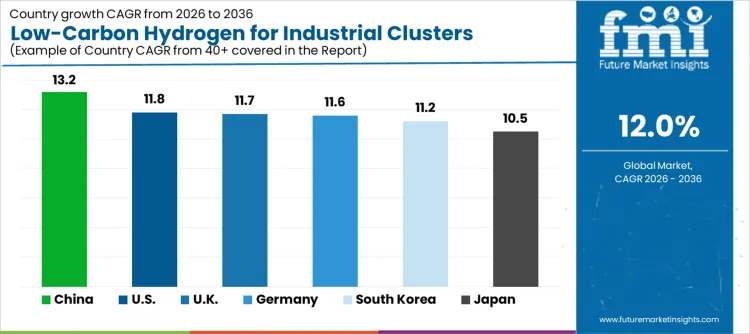
| Country | CAGR (%) |
|---|---|
| China | 13.2% |
| Germany | 11.6% |
| USA | 11.8% |
| Japan | 10.5% |
| South Korea | 11.2% |
| UK | 11.7% |
What Drives China's Market Leadership?
China's low-carbon hydrogen for industrial clusters market is projected to achieve the highest growth rate at 13.2% CAGR, driven primarily by massive industrial concentration and comprehensive government policies promoting hydrogen industry development and industrial cluster coordination. The country's position as the world's largest industrial producer creates enormous opportunities for cluster development while fostering domestic hydrogen technology advancement and manufacturing capabilities. Chinese industrial policies increasingly emphasize coordinated development and shared infrastructure that benefit hydrogen cluster projects while supporting domestic technology leadership and international competitiveness.
Government initiatives promoting hydrogen industry development and renewable energy deployment accelerate cluster adoption while creating favorable regulatory conditions for integrated project development and investment attraction. The integration of renewable energy expansion with industrial development creates unique opportunities for green hydrogen clusters that can support both decarbonization objectives and economic development while utilizing domestic technology capabilities and manufacturing advantages. China's industrial scale enables cost-effective cluster development while supporting technology advancement and export opportunities to international markets.
How Is Germany Advancing Hydrogen Cluster Excellence?
Sales of low-carbon hydrogen for industrial clusters in Germany are likely to increase at a CAGR of 11.6% reflects the country's leadership in hydrogen strategy implementation and comprehensive cluster development policies that support coordinated industrial decarbonization and technology advancement. German regulatory frameworks establish favorable conditions for hydrogen cluster development while providing clear incentives for industrial cooperation and shared infrastructure investment. The emphasis on technological excellence and environmental performance creates opportunities for sophisticated hydrogen cluster systems that demonstrate superior integration capabilities and decarbonization effectiveness compared to individual facility approaches.
The country's strong hydrogen infrastructure sector combined with advanced industrial capabilities drives adoption of innovative cluster systems that optimize operational efficiency while supporting comprehensive decarbonization objectives. German cluster development emphasizes technical integration and operational optimization that influences global standards for hydrogen cluster design while fostering innovation in cluster management and coordination technologies that enhance economic viability and operational performance.
Why Is the USA Market Emphasizing Technology Innovation and Regional Development?
The United States market experiences 11.8% CAGR growth supported by substantial industrial capacity and emerging policy frameworks that create favorable conditions for hydrogen cluster development and technology commercialization. Federal and state-level initiatives promoting clean energy infrastructure and industrial decarbonization create substantial market opportunities while supporting regional development programs that benefit from cluster-based approaches to economic development and environmental improvement. The emphasis on domestic technology leadership creates opportunities for advanced cluster technologies and management systems.
Regional hydrogen hub development programs create concentrated opportunities for cluster development while supporting technology demonstration and market creation activities that benefit the entire hydrogen industry. The development of clean energy clusters in the USA creates opportunities for integrated approaches that combine hydrogen production with renewable energy development and industrial user coordination while providing comprehensive regional decarbonization solutions and economic development benefits.
How Is Japanese Quality Focus Driving Premium Cluster Applications?
Demand for low-carbon hydrogen for industrial clusters in Japan is estimated to expand at a CAGR of 10.5% is supported by the country's leadership in hydrogen technology development and precision industrial management that creates demand for sophisticated cluster systems with exceptional performance and reliability characteristics. Japanese industrial companies maintain strict quality standards that require cluster systems to demonstrate superior operational coordination and supply reliability while providing verified decarbonization benefits that support corporate sustainability objectives and regulatory compliance requirements.
The country's expertise in hydrogen technologies and industrial system integration creates opportunities for advanced cluster management systems that incorporate precision control and optimization capabilities while maintaining the reliability standards required for continuous industrial operations. Japanese technology development emphasizes long-term durability and comprehensive performance management that influences global standards for hydrogen clusters while fostering innovation in system integration and operational optimization technologies.
What Opportunities Exist in South Korea's Industrial Ecosystem?
The industry for low-carbon hydrogen for industrial clusters in South Korea is likely to rise at a CAGR of 11.2% CAGR growth is driven by the country's substantial industrial capacity and comprehensive hydrogen strategy that creates favorable conditions for cluster market development and technology deployment. Korean industrial companies require cluster systems that support high-quality production while meeting stringent environmental compliance requirements and maintaining international competitiveness. The integration of advanced automation and digital systems creates demand for cluster technologies with exceptional coordination capabilities and performance reliability that enable optimized operations across multiple industrial users.
The country's leadership in shipbuilding and petrochemical industries creates opportunities for specialized cluster applications that require advanced technical capabilities and system integration expertise. Korean industrial technology development emphasizes efficiency and coordination that drives demand for cluster systems designed to optimize resource utilization while maintaining the quality standards required for global market competitiveness and regulatory compliance.
What Strategies Help Developers Maintain Competitive Position in Low-Carbon Hydrogen for Industrial Clusters?
Cluster developers maintain market leadership in low-carbon hydrogen for industrial clusters through comprehensive project integration that encompasses technology selection, infrastructure coordination, and customer relationship management while providing proven performance data and reliable operational support that builds stakeholder confidence and ensures project success. Market leaders establish competitive advantages through development capabilities that can demonstrate superior coordination expertise, operational reliability, and cost optimization while maintaining project structures that support long-term customer satisfaction and cluster expansion opportunities.
Successful developers invest in comprehensive cluster management capabilities that optimize system performance, coordinate customer requirements, and manage operational complexity while providing participants with transparent performance tracking and responsive technical support. Investment in digital platform development and operational optimization allows cluster management that maximizes system efficiency while providing predictive maintenance and performance optimization that support customer satisfaction and operational reliability. These capabilities create differentiation opportunities while enabling premium service positioning that supports long-term customer relationships and cluster expansion.
Innovation in partnership development and stakeholder coordination enables cluster developers to create integrated solutions that address multiple participant requirements while leveraging complementary capabilities and resources from technology providers, industrial users, and financial partners. Collaboration with industrial customers, technology suppliers, and policy makers during cluster development phases allows optimization of cluster design and operational structure for specific regional conditions and market requirements while ensuring successful project implementation and stakeholder satisfaction that supports cluster growth and market development.
Key Players in the Low-Carbon Hydrogen for Industrial Clusters Market
- Air Liquide
- Linde
- Air Products
- Shell
- BP
- Equinor
- RWE
- ENGIE
- Iberdrola
- Ørsted
Scope of Report
| Items | Values |
|---|---|
| Quantitative Units | USD Million |
| Production Route Segments | Green Hydrogen (Electrolysis); Blue Hydrogen; Other Low-Carbon Routes |
| End-Use Categories | Refining and Chemicals; Steel and Metals; Power and Heat; Mobility and Other Uses |
| Cluster Stage Types | Mature/Operational Clusters; Under-Construction Clusters; Announced/Planned Clusters |
| Business Model Categories | Dedicated Captive Supply; Shared/Backbone Infrastructure; Merchant and Trading-Based Models |
| Regions Covered | North America, Europe, Asia Pacific, Latin America, Middle East & Africa |
| Key Countries | USA, Germany, China, Japan, South Korea, UK |
| Key Companies Profiled | Air Liquide, Linde, Air Products, Shell, BP, and others |
| Additional Attributes | Dollar sales measured for low-carbon hydrogen cluster systems including production facilities, distribution infrastructure, and management services, specified by production capacity, supply reliability, cluster coordination, and decarbonization effectiveness |
Low-Carbon Hydrogen for Industrial Clusters Market by Segment
By Production Route:
- Green Hydrogen (Electrolysis)
- Blue Hydrogen
- Other Low-Carbon Routes
By End-Use:
- Refining and Chemicals
- Steel and Metals
- Power and Heat
- Mobility and Other Uses
By Cluster Stage:
- Mature/Operational Clusters
- Under-Construction Clusters
- Announced/Planned Clusters
By Business Model:
- Dedicated Captive Supply
- Shared/Backbone Infrastructure
- Merchant and Trading-Based Models
Bibliography
- International Energy Agency. (2023). Hydrogen hubs and industrial clusters: Policy frameworks and infrastructure development. IEA.
- International Renewable Energy Agency. (2023). Green hydrogen deployment in industrial clusters and hubs. IRENA.
- European Commission. (2024). Hydrogen valleys and industrial cluster integration under the EU hydrogen strategy. Publications Office of the European Union.
Frequently Asked Questions
How big is the low-carbon hydrogen for industrial clusters market in 2026?
The global low-carbon hydrogen for industrial clusters market is estimated to be valued at USD 3,800.0 million in 2026.
What will be the size of low-carbon hydrogen for industrial clusters market in 2036?
The market size for the low-carbon hydrogen for industrial clusters market is projected to reach USD 11,802.2 million by 2036.
How much will be the low-carbon hydrogen for industrial clusters market growth between 2026 and 2036?
The low-carbon hydrogen for industrial clusters market is expected to grow at a 12.0% CAGR between 2026 and 2036.
What are the key product types in the low-carbon hydrogen for industrial clusters market?
The key product types in low-carbon hydrogen for industrial clusters market are green hydrogen (electrolysis), blue hydrogen and other low-carbon routes.
Which end-use segment to contribute significant share in the low-carbon hydrogen for industrial clusters market in 2026?
In terms of end-use, refining and chemicals segment to command 30.0% share in the low-carbon hydrogen for industrial clusters market in 2026.
Preview the report firsthand - request a free sample
Get SampleGet the brochure for pricing and purchase details.
Get PDFTable of Content
- Executive Summary
- Global Market Outlook
- Demand-side Trends
- Supply-side Trends
- Technology Roadmap Analysis
- Analysis and Recommendations
- Market Overview
- Market Coverage / Taxonomy
- Market Definition / Scope / Limitations
- Market Background
- Market Dynamics
- Drivers
- Restraints
- Opportunity
- Trends
- Scenario Forecast
- Demand in Optimistic Scenario
- Demand in Likely Scenario
- Demand in Conservative Scenario
- Opportunity Map Analysis
- Product Life Cycle Analysis
- Supply Chain Analysis
- Investment Feasibility Matrix
- Value Chain Analysis
- PESTLE and Porter’s Analysis
- Regulatory Landscape
- Regional Parent Market Outlook
- Production and Consumption Statistics
- Import and Export Statistics
- Market Dynamics
- Global Market Analysis 2021 to 2025 and Forecast, 2026 to 2036
- Historical Market Size Value (USD Million) Analysis, 2021 to 2025
- Current and Future Market Size Value (USD Million) Projections, 2026 to 2036
- Y-o-Y Growth Trend Analysis
- Absolute $ Opportunity Analysis
- Global Market Pricing Analysis 2021 to 2025 and Forecast 2026 to 2036
- Global Market Analysis 2021 to 2025 and Forecast 2026 to 2036, By Production Route
- Introduction / Key Findings
- Historical Market Size Value (USD Million) Analysis By Production Route , 2021 to 2025
- Current and Future Market Size Value (USD Million) Analysis and Forecast By Production Route , 2026 to 2036
- Green Hydrogen (Electrolysis)
- Blue Hydrogen
- Other Low-Carbon Routes
- Green Hydrogen (Electrolysis)
- Y-o-Y Growth Trend Analysis By Production Route , 2021 to 2025
- Absolute $ Opportunity Analysis By Production Route , 2026 to 2036
- Global Market Analysis 2021 to 2025 and Forecast 2026 to 2036, By End-Use
- Introduction / Key Findings
- Historical Market Size Value (USD Million) Analysis By End-Use, 2021 to 2025
- Current and Future Market Size Value (USD Million) Analysis and Forecast By End-Use, 2026 to 2036
- Refining and Chemicals
- Steel and Metals
- Power and Heat
- Mobility and Other Uses
- Refining and Chemicals
- Y-o-Y Growth Trend Analysis By End-Use, 2021 to 2025
- Absolute $ Opportunity Analysis By End-Use, 2026 to 2036
- Global Market Analysis 2021 to 2025 and Forecast 2026 to 2036, By Cluster Stage
- Introduction / Key Findings
- Historical Market Size Value (USD Million) Analysis By Cluster Stage, 2021 to 2025
- Current and Future Market Size Value (USD Million) Analysis and Forecast By Cluster Stage, 2026 to 2036
- Under-Construction Clusters
- Mature/Operational Clusters
- Announced/Planned Clusters
- Under-Construction Clusters
- Y-o-Y Growth Trend Analysis By Cluster Stage, 2021 to 2025
- Absolute $ Opportunity Analysis By Cluster Stage, 2026 to 2036
- Global Market Analysis 2021 to 2025 and Forecast 2026 to 2036, By Business Model
- Introduction / Key Findings
- Historical Market Size Value (USD Million) Analysis By Business Model, 2021 to 2025
- Current and Future Market Size Value (USD Million) Analysis and Forecast By Business Model, 2026 to 2036
- Shared/Backbone Infrastructure
- Dedicated Captive Supply
- Merchant and Trading-Based Models
- Shared/Backbone Infrastructure
- Y-o-Y Growth Trend Analysis By Business Model, 2021 to 2025
- Absolute $ Opportunity Analysis By Business Model, 2026 to 2036
- Global Market Analysis 2021 to 2025 and Forecast 2026 to 2036, By Region
- Introduction
- Historical Market Size Value (USD Million) Analysis By Region, 2021 to 2025
- Current Market Size Value (USD Million) Analysis and Forecast By Region, 2026 to 2036
- North America
- Latin America
- Western Europe
- Eastern Europe
- East Asia
- South Asia and Pacific
- Middle East & Africa
- Market Attractiveness Analysis By Region
- North America Market Analysis 2021 to 2025 and Forecast 2026 to 2036, By Country
- Historical Market Size Value (USD Million) Trend Analysis By Market Taxonomy, 2021 to 2025
- Market Size Value (USD Million) Forecast By Market Taxonomy, 2026 to 2036
- By Country
- USA
- Canada
- Mexico
- By Production Route
- By End-Use
- By Cluster Stage
- By Business Model
- By Country
- Market Attractiveness Analysis
- By Country
- By Production Route
- By End-Use
- By Cluster Stage
- By Business Model
- Key Takeaways
- Latin America Market Analysis 2021 to 2025 and Forecast 2026 to 2036, By Country
- Historical Market Size Value (USD Million) Trend Analysis By Market Taxonomy, 2021 to 2025
- Market Size Value (USD Million) Forecast By Market Taxonomy, 2026 to 2036
- By Country
- Brazil
- Chile
- Rest of Latin America
- By Production Route
- By End-Use
- By Cluster Stage
- By Business Model
- By Country
- Market Attractiveness Analysis
- By Country
- By Production Route
- By End-Use
- By Cluster Stage
- By Business Model
- Key Takeaways
- Western Europe Market Analysis 2021 to 2025 and Forecast 2026 to 2036, By Country
- Historical Market Size Value (USD Million) Trend Analysis By Market Taxonomy, 2021 to 2025
- Market Size Value (USD Million) Forecast By Market Taxonomy, 2026 to 2036
- By Country
- Germany
- UK
- Italy
- Spain
- France
- Nordic
- BENELUX
- Rest of Western Europe
- By Production Route
- By End-Use
- By Cluster Stage
- By Business Model
- By Country
- Market Attractiveness Analysis
- By Country
- By Production Route
- By End-Use
- By Cluster Stage
- By Business Model
- Key Takeaways
- Eastern Europe Market Analysis 2021 to 2025 and Forecast 2026 to 2036, By Country
- Historical Market Size Value (USD Million) Trend Analysis By Market Taxonomy, 2021 to 2025
- Market Size Value (USD Million) Forecast By Market Taxonomy, 2026 to 2036
- By Country
- Russia
- Poland
- Hungary
- Balkan & Baltic
- Rest of Eastern Europe
- By Production Route
- By End-Use
- By Cluster Stage
- By Business Model
- By Country
- Market Attractiveness Analysis
- By Country
- By Production Route
- By End-Use
- By Cluster Stage
- By Business Model
- Key Takeaways
- East Asia Market Analysis 2021 to 2025 and Forecast 2026 to 2036, By Country
- Historical Market Size Value (USD Million) Trend Analysis By Market Taxonomy, 2021 to 2025
- Market Size Value (USD Million) Forecast By Market Taxonomy, 2026 to 2036
- By Country
- China
- Japan
- South Korea
- By Production Route
- By End-Use
- By Cluster Stage
- By Business Model
- By Country
- Market Attractiveness Analysis
- By Country
- By Production Route
- By End-Use
- By Cluster Stage
- By Business Model
- Key Takeaways
- South Asia and Pacific Market Analysis 2021 to 2025 and Forecast 2026 to 2036, By Country
- Historical Market Size Value (USD Million) Trend Analysis By Market Taxonomy, 2021 to 2025
- Market Size Value (USD Million) Forecast By Market Taxonomy, 2026 to 2036
- By Country
- India
- ASEAN
- Australia & New Zealand
- Rest of South Asia and Pacific
- By Production Route
- By End-Use
- By Cluster Stage
- By Business Model
- By Country
- Market Attractiveness Analysis
- By Country
- By Production Route
- By End-Use
- By Cluster Stage
- By Business Model
- Key Takeaways
- Middle East & Africa Market Analysis 2021 to 2025 and Forecast 2026 to 2036, By Country
- Historical Market Size Value (USD Million) Trend Analysis By Market Taxonomy, 2021 to 2025
- Market Size Value (USD Million) Forecast By Market Taxonomy, 2026 to 2036
- By Country
- Kingdom of Saudi Arabia
- Other GCC Countries
- Turkiye
- South Africa
- Other African Union
- Rest of Middle East & Africa
- By Production Route
- By End-Use
- By Cluster Stage
- By Business Model
- By Country
- Market Attractiveness Analysis
- By Country
- By Production Route
- By End-Use
- By Cluster Stage
- By Business Model
- Key Takeaways
- Key Countries Market Analysis
- USA
- Pricing Analysis
- Market Share Analysis, 2025
- By Production Route
- By End-Use
- By Cluster Stage
- By Business Model
- Canada
- Pricing Analysis
- Market Share Analysis, 2025
- By Production Route
- By End-Use
- By Cluster Stage
- By Business Model
- Mexico
- Pricing Analysis
- Market Share Analysis, 2025
- By Production Route
- By End-Use
- By Cluster Stage
- By Business Model
- Brazil
- Pricing Analysis
- Market Share Analysis, 2025
- By Production Route
- By End-Use
- By Cluster Stage
- By Business Model
- Chile
- Pricing Analysis
- Market Share Analysis, 2025
- By Production Route
- By End-Use
- By Cluster Stage
- By Business Model
- Germany
- Pricing Analysis
- Market Share Analysis, 2025
- By Production Route
- By End-Use
- By Cluster Stage
- By Business Model
- UK
- Pricing Analysis
- Market Share Analysis, 2025
- By Production Route
- By End-Use
- By Cluster Stage
- By Business Model
- Italy
- Pricing Analysis
- Market Share Analysis, 2025
- By Production Route
- By End-Use
- By Cluster Stage
- By Business Model
- Spain
- Pricing Analysis
- Market Share Analysis, 2025
- By Production Route
- By End-Use
- By Cluster Stage
- By Business Model
- France
- Pricing Analysis
- Market Share Analysis, 2025
- By Production Route
- By End-Use
- By Cluster Stage
- By Business Model
- India
- Pricing Analysis
- Market Share Analysis, 2025
- By Production Route
- By End-Use
- By Cluster Stage
- By Business Model
- ASEAN
- Pricing Analysis
- Market Share Analysis, 2025
- By Production Route
- By End-Use
- By Cluster Stage
- By Business Model
- Australia & New Zealand
- Pricing Analysis
- Market Share Analysis, 2025
- By Production Route
- By End-Use
- By Cluster Stage
- By Business Model
- China
- Pricing Analysis
- Market Share Analysis, 2025
- By Production Route
- By End-Use
- By Cluster Stage
- By Business Model
- Japan
- Pricing Analysis
- Market Share Analysis, 2025
- By Production Route
- By End-Use
- By Cluster Stage
- By Business Model
- South Korea
- Pricing Analysis
- Market Share Analysis, 2025
- By Production Route
- By End-Use
- By Cluster Stage
- By Business Model
- Russia
- Pricing Analysis
- Market Share Analysis, 2025
- By Production Route
- By End-Use
- By Cluster Stage
- By Business Model
- Poland
- Pricing Analysis
- Market Share Analysis, 2025
- By Production Route
- By End-Use
- By Cluster Stage
- By Business Model
- Hungary
- Pricing Analysis
- Market Share Analysis, 2025
- By Production Route
- By End-Use
- By Cluster Stage
- By Business Model
- Kingdom of Saudi Arabia
- Pricing Analysis
- Market Share Analysis, 2025
- By Production Route
- By End-Use
- By Cluster Stage
- By Business Model
- Turkiye
- Pricing Analysis
- Market Share Analysis, 2025
- By Production Route
- By End-Use
- By Cluster Stage
- By Business Model
- South Africa
- Pricing Analysis
- Market Share Analysis, 2025
- By Production Route
- By End-Use
- By Cluster Stage
- By Business Model
- USA
- Market Structure Analysis
- Competition Dashboard
- Competition Benchmarking
- Market Share Analysis of Top Players
- By Regional
- By Production Route
- By End-Use
- By Cluster Stage
- By Business Model
- Competition Analysis
- Competition Deep Dive
- Air Liquide
- Overview
- Product Portfolio
- Profitability by Market Segments (Product/Age /Sales Channel/Region)
- Sales Footprint
- Strategy Overview
- Marketing Strategy
- Product Strategy
- Channel Strategy
- Linde
- Air Products
- Shell
- BP
- Equinor
- RWE
- ENGIE
- Iberdrola
- Ørsted
- Air Liquide
- Competition Deep Dive
- Assumptions & Acronyms Used
- Research Methodology


