

- Industry Size (2026)
- USD 2.8 Bn
- Forecast (2036)
- USD 7.9 Bn
- CAGR (2026 to 2036)
- 10.9%
Industrial Human-Robot Interaction Sensor Market Size, Market Forecast and Outlook By FMI
The industrial human-robot interaction sensor market progressed from a valuation of USD 2.5 billion in 2025 with a trajectory that is ready to reach USD 2.8 billion in 2026 at a CAGR of 10.9% during the forecast period. Continuous capital injection propels the industry growth to USD 7.9 billion through 2036 as manufacturing facilities transition from isolated heavy automation to uncaged, collaborative workflows requiring continuous safety monitoring.
Plant managers and safety directors are currently forced to choose between bolting discrete robot sensor packages onto legacy equipment or investing in natively integrated arrays that support dynamic speed and separation monitoring. Those who delay upgrading their detection architectures face prolonged integration cycles and higher rates of false safety stops, directly impacting overall equipment effectiveness. While early pilot programs heavily emphasize vision-based tracking, the true operational bottlenecks consistently emerge from inadequate physical feedback loops.
Summary of Industrial Human-Robot Interaction Sensor Market
- Industrial Human-Robot Interaction Sensor Market Definition
- This market covers the specialized hardware layer that allows automated systems to perceive and safely react to human proximity and physical contact, transforming rigid production cells into shared workspaces.
- Demand Drivers in the Market
- The shift toward high-mix, low-volume production requires process engineers to deploy automated systems alongside human operators to maintain assembly flexibility.
- Stringent occupational safety mandates compel facility directors to upgrade machine guarding from physical barriers to dynamic, sensor-based monitoring architectures.
- Rising wage inflation pushes procurement teams to adopt robotics as a service models that rely heavily on integrated safety monitoring to protect leased assets.
- Key Segments Analyzed in the FMI Report
- Force and Torque Sensors: This segment is anticipated to hold a 31.2% share in 2026, driven by the absolute requirement for immediate, deterministic physical feedback during unexpected human contact.
- Industrial Robotics: Industrial Robotics is expected to account for a 58.3% share in 2026, as established manufacturing lines retrofit legacy heavy-payload arms for collaborative applications.
- Manufacturing: Manufacturing is estimated to capture a 45.0% share in 2026, reflecting the massive installed base of assembly operations requiring human oversight.
- MEMS-based: This technology is projected to lead in 2026, owing to its compact form factor and ability to integrate directly into robotic joints without adding excessive mass.
- China: Expected to achieve a 12.8% CAGR, fueled by aggressive state-backed industrial automation initiatives and a rapid shift toward high-tech electronics assembly.
- Analyst Opinion at FMI
- Sudip Saha, Principal Analyst, Technology, at FMI, opines, "Standard automation metrics accurately capture the declining cost of individual sensors, but they completely miss the compounding expense of integration latency. Facility managers are not constrained by the hardware price of a torque monitor; they are constrained by the weeks of engineering time required to map that sensor's output into a functional safety controller without triggering continuous false alarms."
- Strategic Implications / Executive Takeaways
- Component manufacturers must develop native plug-and-play interfaces to reduce the integration burden on mid-tier manufacturing facilities.
- System integrators should pivot away from selling discrete safety components toward offering pre-validated sensor fusion architectures to accelerate deployment timelines.
- Plant managers face a transition period where investing in premium, safety-rated detection arrays is necessary to avoid severe productivity losses from over-sensitive robotic shutdowns.
- Methodology
- Primary Research: Direct consultation with safety engineers and integration specialists to validate adoption timelines.
- Desk Research: Aggregation of compliance databases and functional safety certifications.
- Market-Sizing and Forecasting: Anchored to verifiable collaborative robotic unit deployments.
- Data Validation and Update Cycle: Triangulated against tier-one component supplier shipment volumes.
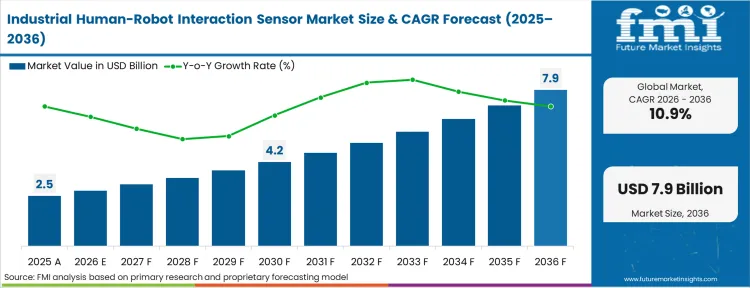
Before widespread deployment of uncaged systems becomes economically viable across mid-tier manufacturing, standardizing plug-and-play communication protocols must occur. Original equipment manufacturers who integrate these unified interfaces trigger a shift where qualifying a new collaborative robot takes days instead of weeks. Once this integration threshold is crossed, the cost of deploying multi-modal sensing drops significantly.
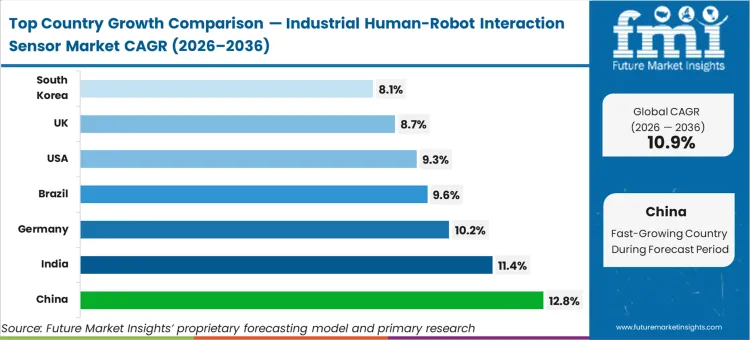
China tracks to a 12.8% compound rate, followed by India at 11.4%, Germany at 10.2%, Brazil at 9.6%, the USA at 9.3%, the UK at 8.7%, and South Korea at 8.1%. Asian manufacturing hubs are accelerating deployment of flexible assembly lines to counter rising labor costs and quality control demands. European operations expand their sensory capabilities primarily to satisfy rigorous occupational safety directives, while North American facilities focus on retrofitting existing industrial robots for high-mix production environments.
Industrial Human-Robot Interaction Sensor Market Definition
The market encompasses specialized detection and feedback components designed specifically to facilitate safe, productive proximity between human workers and automated equipment. It excludes generic industrial sensors used solely for machine-to-machine coordination or process control. The functional boundary is defined by the sensor's role in interpreting human presence, intent, or physical contact to dynamically alter a machine's operational state.
Industrial Human-Robot Interaction Sensor Market Inclusions
Scope includes collision detection devices, safety-rated laser scanners, skin-like tactile sensors, and multi-axis force monitoring units installed on robotic joints or end-effectors. It covers both hardware components and the localized processing units necessary to translate raw sensory data into actionable safety commands for the controller.
Industrial Human-Robot Interaction Sensor Market Exclusions
General purpose facility surveillance cameras and basic photoelectric presence barriers used for perimeter guarding are excluded. These legacy components trigger hard emergency stops rather than enabling continuous, adaptive human-machine collaboration, placing them outside the functional definition of interaction-specific sensing.
Industrial Human-Robot Interaction Sensor Market Research Methodology
- Primary Research: FMI conducted structured interviews with automation safety engineers, robotics integration specialists, and plant floor operations managers responsible for collaborative cell deployment.
- Desk Research: Analysts aggregated data from occupational safety certification registries, component procurement specifications, and functional safety compliance databases.
- Market-Sizing and Forecasting: The baseline anchors to annual global deployments of collaborative and dynamically guarded industrial robotic units.
- Data Validation and Update Cycle: Forecast models were cross-validated against supply chain shipment volumes from tier-one automation component manufacturers.
Segmental Analysis
Industrial Human-Robot Interaction Sensor Market Analysis by Sensor Type
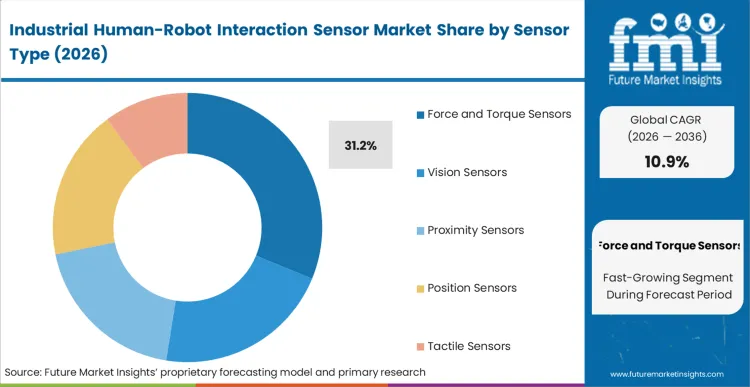
Legacy safety architectures relied on simple area scanners that completely halted production upon human entry, a blunt approach that modern high-throughput facilities can no longer tolerate. Force and Torque Sensors solve this by providing the localized, physical feedback required to distinguish between an intentional guiding touch and an accidental collision, allowing them to secure a 31.2% share in 2026. According to FMI's estimates, this tactile confirmation forms the ultimate fail-safe layer when optical systems are compromised by factory debris or poor lighting. Operations managers rely on these joint-mounted devices to enable true hand-guiding capabilities for complex teaching tasks. Failing to implement robust physical feedback mechanisms forces operators to interact with robotic arms through cumbersome pendants, negating the primary speed advantage of collaborative setups.
- Collision Verification: High-resolution torque monitoring instantly detects abnormal resistance across robotic joints. Safety controllers use this data to trigger immediate protective stops, preventing severe crushing injuries.
- Hand-guiding Enablement: Multi-axis force inputs allow operators to physically move the robotic arm through desired waypoints. This bypasses traditional programming interfaces, drastically reducing setup time for short-run production batches.
- Payload Anomaly Detection: Continuous weight monitoring identifies improper grasping or unexpected mass variations. Process engineers utilize this function to prevent dropped parts and reduce scrap rates in delicate handling applications.
Industrial Human-Robot Interaction Sensor Market Analysis by Application
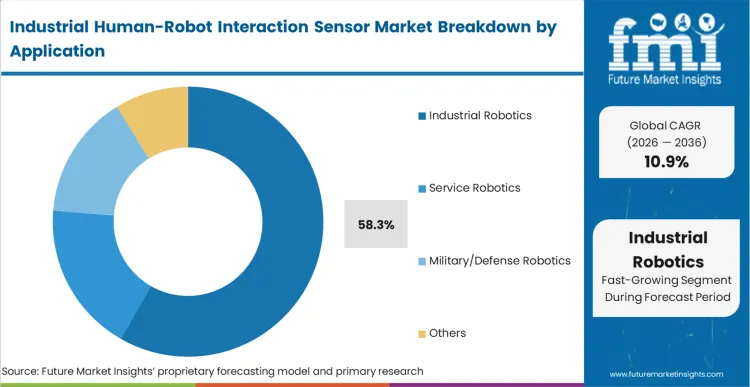
Facilities that attempt to run mixed-model assembly without these interactive safeguards inevitably experience severe bottlenecks when operators must repeatedly clear physical cages to inspect workpieces. Integration specialists are currently deciding whether to replace aging heavy-payload arms or upgrade them with advanced sensory suites to allow human workers back onto the floor. Industrial Robotics commands a 58.3% share in 2026 because the capital sunk into existing heavy manufacturing infrastructure makes complete replacement financially unviable. FMI analysts opine that adding interactive capabilities to palletizing robots and welding units represents the most direct path to improving line flexibility. This application segment focuses heavily on dynamic speed monitoring, where the robot slows proportionally as a human approach.
- Dynamic Zone Monitoring: Layered sensor architectures establish virtual safety boundaries that adjust based on robot speed and trajectory. Plant managers achieve higher floor density by eliminating rigid physical fencing.
- Intervention Recovery: Safe limited speed protocols allow operators to enter the workspace, clear jams, and exit without triggering a full system reboot. Production supervisors maintain higher uptime metrics by streamlining the error recovery sequence.
- Tooling Validation: Integrated sensors confirm proper end-effector engagement before initiating high-speed motion. Quality control directors minimize damage to expensive components during automated kitting robots operations.
Industrial Human-Robot Interaction Sensor Market Analysis by End-Use Industry
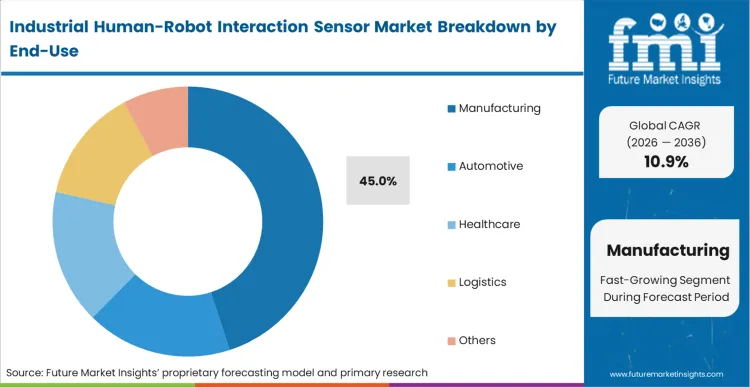
The 45.0% share held by Manufacturing is structurally anchored by the automotive and electronics sectors, where the demand for mass customization has outpaced the capabilities of purely rigid automation. As per FMI's projection, standardizing sensor protocols across diverse assembly lines allows tier-one suppliers to rapidly reconfigure their floor layouts for different product models. These environments utilize complex modular robotics that rely heavily on distributed sensor networks to maintain spatial awareness. The initial hardware investment is heavily offset by the reduction in dedicated hard-tooling and perimeter guarding. Procurement directors who underestimate the hidden integration costs of disparate sensor brands often face budget overruns during the final commissioning phase of the assembly line.
- Floor Space Optimization: Removing physical cages allows manufacturers to compress assembly line footprints. Industrial engineers utilize this recovered space to introduce additional value-add stations within the same facility footprint.
- Line Reconfiguration: Software-defined safety zones can be reprogrammed without moving physical barriers. Operations directors rapidly pivot production lines to accommodate seasonal demand shifts or new product introductions.
- Compliance Documentation: Networked sensors automatically log interaction events and safety stops. Plant compliance officers use these digital audit trails to verify adherence to occupational health standards during regulatory inspections.
Industrial Human-Robot Interaction Sensor Market Analysis by Technology
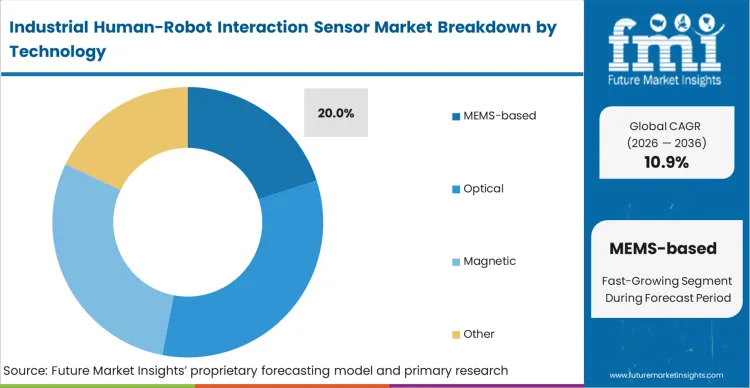
A fundamental tension exists between the need for high-fidelity spatial resolution and the requirement for low-latency processing at the robotic joint level. MEMS-based technology leads the segment by resolving this conflict, offering the microscopic form factor necessary for dense integration without overwhelming the central controller with raw data. Based on FMI's assessment, the ability to embed these micro-electromechanical systems directly into the structural components of anthropomorphic robot inertial sensor setups drives their widespread adoption. These components deliver the ruggedness required for industrial environments while maintaining the sensitivity needed for delicate human interaction. System architects who specify legacy, bulky optical encoders often struggle with complex wire routing and increased payload penalties on the robotic arm.
- Embedded Joint Placement: Miniaturized inertial and torque sensors fit within the confined spaces of modern robotic actuators. Hardware designers maintain sleek arm profiles, reducing the risk of snagging on adjacent equipment.
- Vibration Filtering: Advanced internal algorithms separate baseline operational noise from genuine collision signatures. Integration engineers reduce false-positive stops in environments with heavy adjacent machinery.
- Thermal Compensation: Integrated temperature monitoring ensures consistent sensor accuracy across shifting factory conditions. Quality managers maintain precise force application during continuous, multi-shift production runs.
Industrial Human-Robot Interaction Sensor Market Drivers, Restraints, and Opportunities
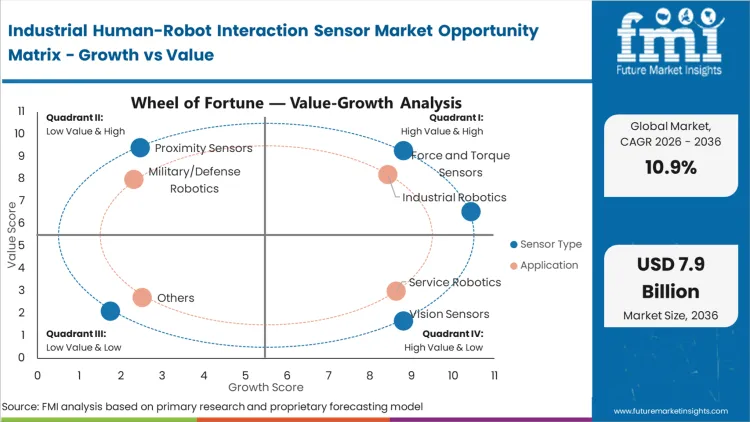
The structural pressure to maintain assembly flexibility while managing rising labor costs compels manufacturing operations managers to deploy collaborative workstations. This dynamic forces facilities to transition from static physical guarding to intelligent, sensor-driven safety architectures. When plant directors integrate physical AI systems for adaptive torque and pressure control, they enable continuous production even when human operators enter the active workspace. Delaying this transition locks a facility into rigid, high-volume production models that cannot profitably execute the short-run, customized orders increasingly demanded by modern supply chains.
The primary friction slowing adoption is the extreme complexity of synthesizing diverse data streams within functional safety controllers. Integration specialists face significant engineering hurdles when attempting to merge optical tracking data with joint-level force feedback without introducing unacceptable latency. This processing bottleneck often forces engineers to set overly conservative safety margins, inadvertently reducing the robot's operational speed to a crawl. While pre-certified sensor fusion packages are emerging, their high initial cost limits deployment primarily to tier-one automotive and electronics manufacturers.
Opportunities in the Industrial Human-Robot Interaction Sensor Market
- Predictive Maintenance Mapping: Continuous torque monitoring provides a secondary data stream detailing joint wear and friction increases. Maintenance directors capture this opportunity by using interaction sensor data to schedule targeted actuator replacements before catastrophic failure occurs.
- Mobile Manipulation: The integration of robust spatial awareness sensors allows collaborative arms to be mounted on autonomous mobile platforms. Intralogistics managers deploy these un-tethered units to dynamically service multiple machine tending stations across the facility floor.
- Retrofit Standardization: Aging industrial manipulators require specialized sensory skins to operate safely without cages. Engineering service providers capitalize on this by offering standardized industrial robotics retrofit service packages that bring legacy equipment into compliance with modern interaction standards.
Regional Analysis
Based on the regional analysis, the Industrial Human-Robot Interaction Sensor market is segmented into North America, Latin America, Europe, Asia-Pacific, and Middle East and Africa across 40 plus countries. Facility modernization rates, capital availability, and varying occupational safety frameworks dictate distinct geographical adoption patterns for collaborative sensing technologies.
.webp "Top Country Growth Comparison Industrial Human Robot Interaction Sensor Market Cagr (2026 2036)")
| Country | CAGR (2026 to 2036) |
|---|---|
| China | 12.8% |
| India | 11.4% |
| Germany | 10.2% |
| Brazil | 9.6% |
| USA | 9.3% |
| UK | 8.7% |
| South Korea | 8.1% |
Source: Future Market Insights (FMI) analysis, based on proprietary forecasting model and primary research
Asia-Pacific Industrial Human-Robot Interaction Sensor Market Analysis
Severe wage inflation and rapid workforce attrition across the manufacturing corridor force procurement teams to aggressively transition from purely manual assembly toward hybrid collaborative cells. While tier-one hubs prioritize high-speed, precision tactile feedback systems to manage consumer electronics density, emerging sectors favor retrofitting affordable robotic chassis with advanced safety overlays. In FMI's view, this polarization creates a dynamic landscape where component suppliers must balance scalable, cost-effective detection arrays against the need to undercut premium brands to gain share. The overarching focus remains strictly on achieving compliance with baseline safety standards without sacrificing line agility across diverse capital constraints.
- China: Advancing at a 12.8% CAGR trajectory to 2036, China's state-subsidized pivot toward intelligent manufacturing heavily incentivizes the deployment of collaborative technologies within tier-two supply chains. Operations directors actively integrate sensor-rich precision metrology robots to execute complex, automated quality inspections alongside human personnel. This strategic upgrade mitigates severe labor shortages while guaranteeing the rigorous defect detection demanded by global electronics manufacturers. Early adopters of these native interaction systems capture lucrative contracts from Western brands demanding rigorous, automated defect detection without sacrificing line agility.
- India: The rapid expansion of automotive and electronics assembly sectors requires flexible automation frameworks capable of operating safely within highly populated factory floors. Plant managers increasingly deploy ruggedized force and proximity sensors, driving an 11.4% CAGR for the market in India across the forecast decade. These tactile fail-safe protect workers navigating dense machining centers, allowing facility directors to clear critical safety audits. Integrating these tactile fail-safe allows facility directors to clear critical safety audits, fundamentally shifting their operations from manual part loading to semi-automated machine tending without halting production lines.
- South Korea: Exceptionally tight spatial constraints within high-density automation hubs force systems integrators to prioritize advanced sensor fusion for human-assistive arms. Safety engineers managing semiconductor and battery facilities implement millimeter-accurate tracking networks to prevent catastrophic collisions in fragile cleanroom environments. This continuous push to secure cleanroom mobility sustains an 8.1% CAGR as baseline capability requirements evolve. This trajectory indicates a rapid shift from basic collision detection toward predictive intent recognition systems over the next decade.
FMI's report includes extensive coverage of Japan, Taiwan, Indonesia, Australia, and the broader ASEAN region. A prevailing structural condition across these emerging manufacturing hubs is the accelerated localization of electronic component assembly. This shift forces contract assembly directors to deploy unified sensor architectures capable of satisfying stringent tier-one OEM traceability requirements without inflating their historically low operational costs. Integrating these native interaction modules directly addresses the persistent quality control gaps that previously hindered regional facilities from capturing higher-value export allocations.
Europe Industrial Human-Robot Interaction Sensor Market Analysis
Rigorous functional safety qualification processes and stringent occupational health directives strictly govern the adoption velocity across the European landscape. Plant managers upgrade sensory hardware not merely to optimize throughput, but to satisfy complex machinery directives that actively penalize rigid, unmonitored automation cells. Based on FMI's assessment, this compliance-heavy environment structurally rewards established component vendors possessing comprehensive certification portfolios, forcing integration engineers to prioritize documented sensor reliability and redundant architectures over sheer deployment speed.
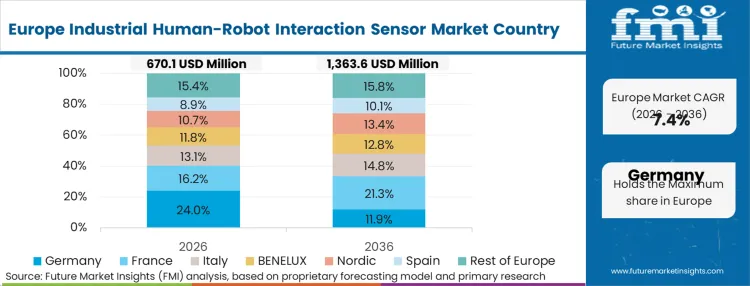
- Germany: Complex extended producer responsibility frameworks and strict machinery safety directives establish a direct operational penalty for facilities still relying on easily bypassed perimeter guarding. Logistics operators and tier-one automotive suppliers increasingly integrate advanced robotics detection suites, anchoring Germany's 10.2% CAGR to 2036. Replacing outdated perimeter defenses with continuous safety monitoring allows operations to maintain absolute compliance while significantly increasing floor density. The structural transition toward continuous safety monitoring establishes a baseline requirement that locks out uncertified, low-cost component manufacturers from major procurement bids.
- UK: Tracking at an 8.7% CAGR through the planning window, strict workplace liability standards compel facility directors to invest heavily in redundant sensor architectures for automated equipment operating near pedestrian zones. Health and safety officers strictly demand verifiable, unalterable event logs generated by integrated safety controllers to mitigate liability risks. Upgrading these detection frameworks fundamentally streamlines the risk assessment process, allowing operations managers to reallocate compliance resources to actual production optimization.
FMI's report includes comprehensive analysis of Italy, France, Spain, the Nordics, and the Benelux region. A critical structural pattern across these nations is the integration of collaborative sensing directly into sustainable, zero-waste manufacturing initiatives. Capital project directors upgrading legacy production lines must deploy highly sensitive tactile arrays to minimize material scrap rates during automated part handling. This dual-purpose requirement balances strict machinery safety directives with aggressive environmental targets, forcing regional procurement leads to standardize on premium sensor ecosystems capable of generating continuous operational telemetry.
North America and Latin America Industrial Human-Robot Interaction Sensor Market Analysis
The regional landscape presents a stark structural polarity, where advanced aerospace and automotive sectors demand cutting-edge multi-modal sensing while broader general manufacturing operations struggle with fundamental integration hurdles. According to FMI's estimates, the widespread availability of robust digital infrastructure allows tier-one facilities to deploy highly networked, cloud-connected safety monitoring systems, contrasting sharply with the price-sensitive, modular approaches required in emerging southern markets.
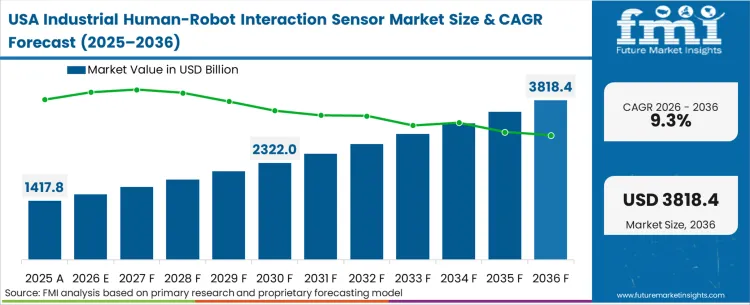
- USA: The massive installed base of legacy automation forces integrators to navigate complex interoperability bottlenecks when injecting collaborative capabilities into older work cells. Systems engineers frequently rely on independent anthropomorphic robot inertial sensor modules, sustaining a 9.3% CAGR for the United States as they bypass outdated central controllers. Behind this steady expansion lies the daily practitioner reality where integration teams expend the majority of their commissioning time resolving critical communication latency between modern safety scanners and decades-old programmable logic controllers.
- Brazil: Fluctuating capital availability forces local procurement teams to heavily scrutinize the total lifecycle cost of interaction sensors, deliberately favoring modular systems that allow rapid, localized replacement. Agricultural equipment and heavy machinery manufacturers actively utilize specialized multi-axis truss robot configurations equipped with basic tactile bumpers to safely assist manual welders. Integrating these accessible safety modules drives Brazil's sector to expand at a 9.6% CAGR over the forecast period. Facilities that successfully integrate these modular fail-safe position themselves to bid on international export contracts that mandate verifiable occupational safety standards.
FMI's report includes extensive analysis of emerging automation hubs across Latin America, the Middle East, and Africa. Facilities in these secondary markets increasingly bypass legacy caged automation entirely, leapfrogging directly to natively collaborative systems that inherently demand advanced interaction sensing from day one.
Competitive Aligners for Market Players
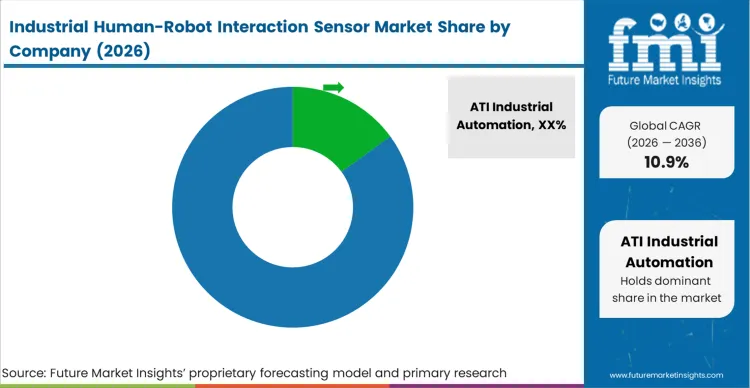
The competitive structure of this market is heavily concentrated at the premium tier, driven by the intense liability and certification requirements associated with functional safety hardware. Leading component manufacturers dominate the space because tier-one automotive and aerospace buyers refuse to specify unproven hardware for applications involving human proximity. Procurement directors distinguish qualified vendors almost entirely based on their portfolio of certified safety integrity levels and performance levels.
Incumbents hold a distinct structural advantage rooted in their deep integration with major robotic arm controllers. Companies like SICK AG and Cognex Corporation maintain proprietary communication protocols and pre-validated software blocks that drastically reduce commissioning time. A challenger attempting to disrupt this space must build an extensive library of verified integration drivers that allow their electrically actuated micro robots sensors to interface seamlessly with legacy equipment.
Large systems integrators actively resist hardware lock-in by advocating for open safety protocols like IO-Link Safety. This creates a structural tension between dominant component suppliers, who prefer closed ecosystems to defend margins, and the end-users demanding interchangeable hardware. As the market moves toward 2036, the landscape will likely fragment at the component level but consolidate at the software and sensor-fusion layer, as the value shifts from raw data collection to the intelligent synthesis of multi-modal safety inputs.
Key Players in Industrial Human-Robot Interaction Sensor Market
- ATI Industrial Automation
- Honeywell International Inc.
- SICK AG
- Cognex Corporation
- OMRON Corporation
- FANUC Corporation
- Keyence Corporation
Scope of the Report
| Metric | Value |
|---|---|
| Quantitative Units | USD 2.8 billion to USD 7.9 billion, at a CAGR of 10.9% |
| Market Definition | The market encompasses specialized hardware layer that allows automated systems to perceive and safely react to human proximity and physical contact. It enables rigid production cells to transform into shared workspaces. |
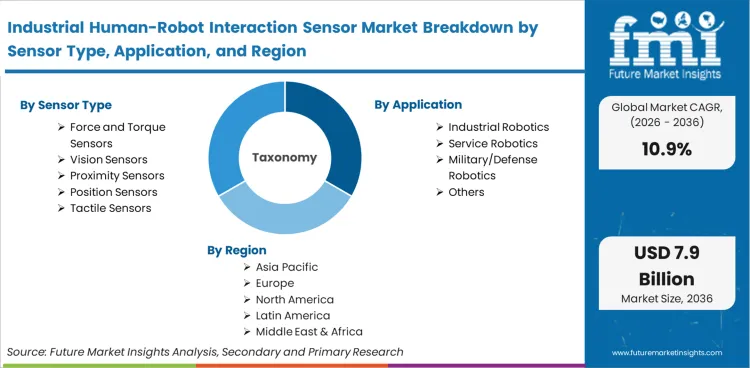
| Sensor Type Segmentation | Force and Torque Sensors, Vision Sensors, Proximity Sensors, Position Sensors, Tactile Sensors |
| Application Segmentation | Industrial Robotics, Service Robotics, Military/Defense Robotics, Others |
| End-Use Industry Segmentation | Manufacturing, Automotive, Healthcare, Logistics, Others |
| Technology Segmentation | MEMS-based, Optical, Magnetic, Other |
| Regions Covered | North America, Latin America, Europe, East Asia, South Asia, Oceania, Middle East and Africa |
| Countries Covered | China, India, Germany, Brazil, USA, UK, South Korea, and 40 plus countries |
| Key Companies Profiled | ATI Industrial Automation, Honeywell International Inc., SICK AG, Cognex Corporation, OMRON Corporation, FANUC Corporation, Keyence Corporation |
| Forecast Period | 2026 to 2036 |
| Approach | FMI conducted structured interviews with automation safety engineers and robotics integration specialists. The baseline anchors to annual global deployments of collaborative and dynamically guarded industrial robotic units. Forecast models were cross-validated against supply chain shipment volumes from tier-one component manufacturers. |
Source: Future Market Insights (FMI) analysis, based on proprietary forecasting model and primary research
Key Segments
Sensor Type:
- Force and Torque Sensors
- Vision Sensors
- Proximity Sensors
- Position Sensors
- Tactile Sensors
Application:
- Industrial Robotics
- Service Robotics
- Military/Defense Robotics
- Others
End-Use Industry:
- Manufacturing
- Automotive
- Healthcare
- Logistics
- Others
Technology:
- MEMS-based
- Optical
- Magnetic
- Other
Regions:
- North America
- USA
- South America
- Brazil
- Asia Pacific
- China
- India
- Japan
- Australia
- Europe
- Germany
Bibliography
- National Institute of Standards and Technology. (2024, January). FY24 soft robotics report.
- National Institute of Standards and Technology. (2024, January). Research opportunities for advancing measurement science for manufacturing robotics.
- National Institute for Occupational Safety and Health. (2024, January). Safe operations of construction robots on human-robot collaborative construction sites. Centers for Disease Control and Prevention.
- Centers for Disease Control and Prevention. (2024, November). Transforming construction: Automation and robotics for a safer future. National Institute for Occupational Safety and Health.
- Fraunhofer Institute for Factory Operation and Automation IFF. (2025, January). Cognitive robotics and new safety technologies for human-robot collaboration. Fraunhofer.
- Fraunhofer Institute for Cognitive Systems IKS. (2025, January). Human-robot collaboration: How we are going to work together with robots in the future.
- U.S. Department of Homeland Security. (2025, May). Multifunctional unmanned ground vehicles for emergency response. DHS.
- Robotic Industries Association. (2026, February). Association for Advancing Automation. A3. Robots Aren’t Taking Jobs: Uncovering the Real Crisis in Manufacturing. Whitepapers.
This bibliography is provided for reader reference. The full FMI report contains the complete reference list with primary source documentation.
This Report Addresses
- Market intelligence to support strategic decision making across force and torque detection components, advanced vision systems, and localized processing hardware from this market.
- Market size estimation and 10-year revenue forecasts from 2026 to 2036, supported by cross-validation against supply chain shipment volumes from tier-one automation component manufacturers.
- Growth opportunity mapping across specific sensor types and application environments with emphasis on standardizing plug-and-play communication protocols to reduce integration latency.
- Segment and regional revenue forecasts covering critical force monitoring and predictive tracking subsystems across the stringent functional safety and machinery compliance environments detailed in this article.
- Competition strategy assessment including evaluation of safety integrity levels, proprietary communication ecosystems, and the availability of verified integration drivers.
- Hardware development tracking including dynamic speed and separation monitoring algorithms, IO-Link Safety protocols, and embedded inertial measurement frameworks discussed in this article.
- Market access analysis covering European extended producer responsibility mandates, machinery safety directives, and rigorous occupational health auditing standards.
- Market report delivery in PDF, Excel, PPT, and interactive dashboard formats for executive strategy, robotics integration engineering, and operational benchmarking use.
Frequently Asked Questions
How large is the Industrial Human-Robot Interaction Sensor Market in 2026?
The market is projected to reach USD 2.8 billion in 2026 as mid-tier manufacturing facilities initiate their transition from caged machinery to dynamically guarded, collaborative assembly cells.
What will it be valued at by 2036?
The total opportunity expands to USD 7.9 billion by 2036, signaling the point where integrated sensing shifts from a premium add-on to a mandatory, foundational requirement for all automated equipment.
What CAGR is projected?
A CAGR of 10.9% is expected, sustained by both new robot sales and the massive secondary market for retrofitting legacy industrial arms with advanced sensory overlays.
Which Sensor Type segment leads?
Force and Torque Sensors lead the market with a 31.2% share, providing the deterministic physical feedback loop that serves as the ultimate fail-safe when optical systems are compromised.
Which Application segment leads?
Industrial Robotics accounts for the dominant 58.3% share as plant managers prioritize upgrading existing heavy-payload infrastructure with interaction capabilities over replacing them entirely.
Which End-Use Industry segment leads?
Manufacturing holds a 45.0% share due to the rapid shift toward mass customization in automotive and electronics assembly requiring operators to work within active robotic envelopes.
What drives rapid growth?
Rising wage inflation and severe labor shortages compel procurement teams to adopt robust interaction sensors to deploy robotic assets onto crowded factory floors without expensive physical barriers.
What is the primary restraint?
Synthesizing diverse sensor data streams into a unified controller introduces processing latency, often forcing engineers to set overly conservative safety margins that limit robot operational speed.
Which country grows fastest?
China advances at the fastest pace with a 12.8% CAGR as facilities aggressively deploy humanoid prototypes and flexible sensory suites to maximize production agility and output density.
How do European machinery directives impact sensor adoption?
Rigorous occupational safety mandates heavily penalize unprotected automation, forcing facility directors to deploy premium, certified hardware that locks uncertified manufacturers out of major procurement frameworks.
Why is MEMS-based technology gaining traction?
Miniaturized electromechanical systems deliver high-fidelity data without adding excessive mass or complex wire routing to the robotic joint, maintaining sleek and efficient arm profiles.
What structural advantage do incumbent suppliers hold?
Leading safety component manufacturers maintain proprietary communication protocols and pre-validated software blocks that drastically reduce commissioning time, creating a formidable barrier to entry.
How does the USA market trajectory differ from East Asia?
Integration teams in the USA spend extensive time resolving communication latency with legacy controllers, whereas East Asian facilities frequently leapfrog these systems with natively collaborative setups.
What operational outcome occurs when Brazilian facilities adopt these sensors?
Integrating modular, tactile fail-safes enables local heavy machinery manufacturers to meet international worker protection standards, allowing them to successfully bid on global export contracts.
Why do safety engineers in the UK demand redundant sensor architectures?
Strict workplace liability standards compel health and safety officers to require redundant arrays to ensure a verifiable, unalterable digital audit trail even if one sensing modality fails.
What commercial opportunity exists in Germany's regulatory environment?
Logistics operators must align with updated liability frameworks, allowing component suppliers who offer pre-certified, rapidly deployable sensor fusion architectures to capture preferred vendor status.
How does sensor integration change floor space optimization?
Replacing physical perimeter cages with sensor-monitored safety zones compresses the assembly line footprint, allowing industrial engineers to introduce additional value-add stations without expanding the facility.
What prevents faster adoption in South Asian hubs?
Capital constraints force procurement directors to favor affordable retrofits and mid-tier component suppliers who focus strictly on baseline collision compliance rather than high-speed dynamic tracking.
Why do pilot programs often miscalculate sensor requirements?
Facilities frequently over-index on vision systems and ignore tactile integration, leading to false-positive safety stops that prove robust torque monitoring is operationally necessary.
What role do predictive maintenance algorithms play?
Continuous torque monitoring provides data on joint friction and wear, allowing maintenance directors to schedule targeted actuator replacements and prevent catastrophic mechanical failures.
How do standard automation metrics fail to measure integration costs?
Basic metrics track declining sensor unit prices but miss the compounding expense of the extensive engineering and programming time required to map sensor outputs effectively.
What defines the boundary of this market's inclusions?
The scope covers specialized hardware that interprets human intent or physical contact to alter machine states, explicitly excluding general-purpose surveillance cameras or basic photoelectric barriers.
Preview the report firsthand - request a free sample
Get SampleGet the brochure for pricing and purchase details.
Get PDFTable of Content
- Executive Summary
- Global Market Outlook
- Demand-side Trends
- Supply-side Trends
- Technology Roadmap Analysis
- Analysis and Recommendations
- Market Overview
- Market Coverage / Taxonomy
- Market Definition / Scope / Limitations
- Research Methodology
- Chapter Orientation
- Analytical Lens and Working Hypotheses
- Market Structure, Signals, and Trend Drivers
- Benchmarking and Cross-market Comparability
- Market Sizing, Forecasting, and Opportunity Mapping
- Research Design and Evidence Framework
- Desk Research Programme (Secondary Evidence)
- Company Annual and Sustainability Reports
- Peer-reviewed Journals and Academic Literature
- Corporate Websites, Product Literature, and Technical Notes
- Earnings Decks and Investor Briefings
- Statutory Filings and Regulatory Disclosures
- Technical White Papers and Standards Notes
- Trade Journals, Industry Magazines, and Analyst Briefs
- Conference Proceedings, Webinars, and Seminar Materials
- Government Statistics Portals and Public Data Releases
- Press Releases and Reputable Media Coverage
- Specialist Newsletters and Curated Briefings
- Sector Databases and Reference Repositories
- FMI Internal Proprietary Databases and Historical Market Datasets
- Subscription Datasets and Paid Sources
- Social Channels, Communities, and Digital Listening Inputs
- Additional Desk Sources
- Expert Input and Fieldwork (Primary Evidence)
- Primary Modes
- Qualitative Interviews and Expert Elicitation
- Quantitative Surveys and Structured Data Capture
- Blended Approach
- Why Primary Evidence is Used
- Field Techniques
- Interviews
- Surveys
- Focus Groups
- Observational and In-context Research
- Social and Community Interactions
- Stakeholder Universe Engaged
- C-suite Leaders
- Board Members
- Presidents and Vice Presidents
- R&D and Innovation Heads
- Technical Specialists
- Domain Subject-matter Experts
- Scientists
- Physicians and Other Healthcare Professionals
- Governance, Ethics, and Data Stewardship
- Research Ethics
- Data Integrity and Handling
- Primary Modes
- Tooling, Models, and Reference Databases
- Desk Research Programme (Secondary Evidence)
- Data Engineering and Model Build
- Data Acquisition and Ingestion
- Cleaning, Normalisation, and Verification
- Synthesis, Triangulation, and Analysis
- Quality Assurance and Audit Trail
- Market Background
- Market Dynamics
- Drivers
- Restraints
- Opportunity
- Trends
- Scenario Forecast
- Demand in Optimistic Scenario
- Demand in Likely Scenario
- Demand in Conservative Scenario
- Opportunity Map Analysis
- Product Life Cycle Analysis
- Supply Chain Analysis
- Investment Feasibility Matrix
- Value Chain Analysis
- PESTLE and Porter’s Analysis
- Regulatory Landscape
- Regional Parent Market Outlook
- Production and Consumption Statistics
- Import and Export Statistics
- Market Dynamics
- Global Market Analysis 2021 to 2025 and Forecast, 2026 to 2036
- Historical Market Size Value (USD Million) Analysis, 2021 to 2025
- Current and Future Market Size Value (USD Million) Projections, 2026 to 2036
- Y-o-Y Growth Trend Analysis
- Absolute $ Opportunity Analysis
- Global Market Pricing Analysis 2021 to 2025 and Forecast 2026 to 2036
- Global Market Analysis 2021 to 2025 and Forecast 2026 to 2036, By Sensor Type
- Introduction / Key Findings
- Historical Market Size Value (USD Million) Analysis By Sensor Type , 2021 to 2025
- Current and Future Market Size Value (USD Million) Analysis and Forecast By Sensor Type , 2026 to 2036
- Force and Torque Sensors
- Vision Sensors
- Proximity Sensors
- Position Sensors
- Tactile Sensors
- Force and Torque Sensors
- Y-o-Y Growth Trend Analysis By Sensor Type , 2021 to 2025
- Absolute $ Opportunity Analysis By Sensor Type , 2026 to 2036
- Global Market Analysis 2021 to 2025 and Forecast 2026 to 2036, By Application
- Introduction / Key Findings
- Historical Market Size Value (USD Million) Analysis By Application, 2021 to 2025
- Current and Future Market Size Value (USD Million) Analysis and Forecast By Application, 2026 to 2036
- Industrial Robotics
- Service Robotics
- Military/Defense Robotics
- Others
- Industrial Robotics
- Y-o-Y Growth Trend Analysis By Application, 2021 to 2025
- Absolute $ Opportunity Analysis By Application, 2026 to 2036
- Global Market Analysis 2021 to 2025 and Forecast 2026 to 2036, By End-Use
- Introduction / Key Findings
- Historical Market Size Value (USD Million) Analysis By End-Use, 2021 to 2025
- Current and Future Market Size Value (USD Million) Analysis and Forecast By End-Use, 2026 to 2036
- Manufacturing
- Automotive
- Healthcare
- Logistics
- Others
- Manufacturing
- Y-o-Y Growth Trend Analysis By End-Use, 2021 to 2025
- Absolute $ Opportunity Analysis By End-Use, 2026 to 2036
- Global Market Analysis 2021 to 2025 and Forecast 2026 to 2036, By Technology
- Introduction / Key Findings
- Historical Market Size Value (USD Million) Analysis By Technology, 2021 to 2025
- Current and Future Market Size Value (USD Million) Analysis and Forecast By Technology, 2026 to 2036
- MEMS-based
- Optical
- Magnetic
- Other
- MEMS-based
- Y-o-Y Growth Trend Analysis By Technology, 2021 to 2025
- Absolute $ Opportunity Analysis By Technology, 2026 to 2036
- Global Market Analysis 2021 to 2025 and Forecast 2026 to 2036, By Region
- Introduction
- Historical Market Size Value (USD Million) Analysis By Region, 2021 to 2025
- Current Market Size Value (USD Million) Analysis and Forecast By Region, 2026 to 2036
- North America
- Latin America
- Western Europe
- Eastern Europe
- East Asia
- South Asia and Pacific
- Middle East & Africa
- Market Attractiveness Analysis By Region
- North America Market Analysis 2021 to 2025 and Forecast 2026 to 2036, By Country
- Historical Market Size Value (USD Million) Trend Analysis By Market Taxonomy, 2021 to 2025
- Market Size Value (USD Million) Forecast By Market Taxonomy, 2026 to 2036
- By Country
- USA
- Canada
- Mexico
- By Sensor Type
- By Application
- By End-Use
- By Technology
- By Country
- Market Attractiveness Analysis
- By Country
- By Sensor Type
- By Application
- By End-Use
- By Technology
- Key Takeaways
- Latin America Market Analysis 2021 to 2025 and Forecast 2026 to 2036, By Country
- Historical Market Size Value (USD Million) Trend Analysis By Market Taxonomy, 2021 to 2025
- Market Size Value (USD Million) Forecast By Market Taxonomy, 2026 to 2036
- By Country
- Brazil
- Chile
- Rest of Latin America
- By Sensor Type
- By Application
- By End-Use
- By Technology
- By Country
- Market Attractiveness Analysis
- By Country
- By Sensor Type
- By Application
- By End-Use
- By Technology
- Key Takeaways
- Western Europe Market Analysis 2021 to 2025 and Forecast 2026 to 2036, By Country
- Historical Market Size Value (USD Million) Trend Analysis By Market Taxonomy, 2021 to 2025
- Market Size Value (USD Million) Forecast By Market Taxonomy, 2026 to 2036
- By Country
- Germany
- UK
- Italy
- Spain
- France
- Nordic
- BENELUX
- Rest of Western Europe
- By Sensor Type
- By Application
- By End-Use
- By Technology
- By Country
- Market Attractiveness Analysis
- By Country
- By Sensor Type
- By Application
- By End-Use
- By Technology
- Key Takeaways
- Eastern Europe Market Analysis 2021 to 2025 and Forecast 2026 to 2036, By Country
- Historical Market Size Value (USD Million) Trend Analysis By Market Taxonomy, 2021 to 2025
- Market Size Value (USD Million) Forecast By Market Taxonomy, 2026 to 2036
- By Country
- Russia
- Poland
- Hungary
- Balkan & Baltic
- Rest of Eastern Europe
- By Sensor Type
- By Application
- By End-Use
- By Technology
- By Country
- Market Attractiveness Analysis
- By Country
- By Sensor Type
- By Application
- By End-Use
- By Technology
- Key Takeaways
- East Asia Market Analysis 2021 to 2025 and Forecast 2026 to 2036, By Country
- Historical Market Size Value (USD Million) Trend Analysis By Market Taxonomy, 2021 to 2025
- Market Size Value (USD Million) Forecast By Market Taxonomy, 2026 to 2036
- By Country
- China
- Japan
- South Korea
- By Sensor Type
- By Application
- By End-Use
- By Technology
- By Country
- Market Attractiveness Analysis
- By Country
- By Sensor Type
- By Application
- By End-Use
- By Technology
- Key Takeaways
- South Asia and Pacific Market Analysis 2021 to 2025 and Forecast 2026 to 2036, By Country
- Historical Market Size Value (USD Million) Trend Analysis By Market Taxonomy, 2021 to 2025
- Market Size Value (USD Million) Forecast By Market Taxonomy, 2026 to 2036
- By Country
- India
- ASEAN
- Australia & New Zealand
- Rest of South Asia and Pacific
- By Sensor Type
- By Application
- By End-Use
- By Technology
- By Country
- Market Attractiveness Analysis
- By Country
- By Sensor Type
- By Application
- By End-Use
- By Technology
- Key Takeaways
- Middle East & Africa Market Analysis 2021 to 2025 and Forecast 2026 to 2036, By Country
- Historical Market Size Value (USD Million) Trend Analysis By Market Taxonomy, 2021 to 2025
- Market Size Value (USD Million) Forecast By Market Taxonomy, 2026 to 2036
- By Country
- Kingdom of Saudi Arabia
- Other GCC Countries
- Turkiye
- South Africa
- Other African Union
- Rest of Middle East & Africa
- By Sensor Type
- By Application
- By End-Use
- By Technology
- By Country
- Market Attractiveness Analysis
- By Country
- By Sensor Type
- By Application
- By End-Use
- By Technology
- Key Takeaways
- Key Countries Market Analysis
- USA
- Pricing Analysis
- Market Share Analysis, 2025
- By Sensor Type
- By Application
- By End-Use
- By Technology
- Canada
- Pricing Analysis
- Market Share Analysis, 2025
- By Sensor Type
- By Application
- By End-Use
- By Technology
- Mexico
- Pricing Analysis
- Market Share Analysis, 2025
- By Sensor Type
- By Application
- By End-Use
- By Technology
- Brazil
- Pricing Analysis
- Market Share Analysis, 2025
- By Sensor Type
- By Application
- By End-Use
- By Technology
- Chile
- Pricing Analysis
- Market Share Analysis, 2025
- By Sensor Type
- By Application
- By End-Use
- By Technology
- Germany
- Pricing Analysis
- Market Share Analysis, 2025
- By Sensor Type
- By Application
- By End-Use
- By Technology
- UK
- Pricing Analysis
- Market Share Analysis, 2025
- By Sensor Type
- By Application
- By End-Use
- By Technology
- Italy
- Pricing Analysis
- Market Share Analysis, 2025
- By Sensor Type
- By Application
- By End-Use
- By Technology
- Spain
- Pricing Analysis
- Market Share Analysis, 2025
- By Sensor Type
- By Application
- By End-Use
- By Technology
- France
- Pricing Analysis
- Market Share Analysis, 2025
- By Sensor Type
- By Application
- By End-Use
- By Technology
- India
- Pricing Analysis
- Market Share Analysis, 2025
- By Sensor Type
- By Application
- By End-Use
- By Technology
- ASEAN
- Pricing Analysis
- Market Share Analysis, 2025
- By Sensor Type
- By Application
- By End-Use
- By Technology
- Australia & New Zealand
- Pricing Analysis
- Market Share Analysis, 2025
- By Sensor Type
- By Application
- By End-Use
- By Technology
- China
- Pricing Analysis
- Market Share Analysis, 2025
- By Sensor Type
- By Application
- By End-Use
- By Technology
- Japan
- Pricing Analysis
- Market Share Analysis, 2025
- By Sensor Type
- By Application
- By End-Use
- By Technology
- South Korea
- Pricing Analysis
- Market Share Analysis, 2025
- By Sensor Type
- By Application
- By End-Use
- By Technology
- Russia
- Pricing Analysis
- Market Share Analysis, 2025
- By Sensor Type
- By Application
- By End-Use
- By Technology
- Poland
- Pricing Analysis
- Market Share Analysis, 2025
- By Sensor Type
- By Application
- By End-Use
- By Technology
- Hungary
- Pricing Analysis
- Market Share Analysis, 2025
- By Sensor Type
- By Application
- By End-Use
- By Technology
- Kingdom of Saudi Arabia
- Pricing Analysis
- Market Share Analysis, 2025
- By Sensor Type
- By Application
- By End-Use
- By Technology
- Turkiye
- Pricing Analysis
- Market Share Analysis, 2025
- By Sensor Type
- By Application
- By End-Use
- By Technology
- South Africa
- Pricing Analysis
- Market Share Analysis, 2025
- By Sensor Type
- By Application
- By End-Use
- By Technology
- USA
- Market Structure Analysis
- Competition Dashboard
- Competition Benchmarking
- Market Share Analysis of Top Players
- By Regional
- By Sensor Type
- By Application
- By End-Use
- By Technology
- Competition Analysis
- Competition Deep Dive
- ATI Industrial Automation
- Overview
- Product Portfolio
- Profitability by Market Segments (Product/Age /Sales Channel/Region)
- Sales Footprint
- Strategy Overview
- Marketing Strategy
- Product Strategy
- Channel Strategy
- Honeywell International Inc.
- SICK AG
- Cognex Corporation
- OMRON Corporation
- FANUC Corporation
- Keyence Corporation
- ATI Industrial Automation
- Competition Deep Dive
- Assumptions & Acronyms Used


