

- Industry Size (2026)
- USD 0.5 Bn
- Forecast (2036)
- USD 3.4 Bn
- CAGR (2026 to 2036)
- 20%
Industrial AGV Swarm-Management Software Market Size, Market Forecast and Outlook By FMI
The industrial AGV swarm market size progressed from USD 0.4 billion in 2025 and is poised to cross USD 0.5 billion in 2026 at a CAGR of 20% during the forecast period, propelling the industry growth to be assessed at USD 3.4 billion by 2036 as operators shift from single-vendor closed ecosystems to hardware-agnostic fleet orchestration layers that enable true cross-platform interoperability.
Procurement directors are fundamentally changing how they buy robotics, pivoting rapidly toward dedicated AGV swarm coordination software. Instead of purchasing hardware with bundled proprietary routing logic, organizations are splitting their procurement tracks to specify the control layer before selecting physical vehicles. This structural transformation effectively breaks vendor lock-in, allowing distribution centers to deploy heavy-payload units from one manufacturer alongside fast-picking units from another on the same floor. Buyers who delay this decoupling strategy risk creating isolated automated islands that cannot share spatial data or execute real time AGV swarm optimization, ultimately capping their facility's maximum throughput capacity. Analyzing the integration of automated guided vehicles alongside intelligent algorithms reveals how floor space is transitioning from a static asset into a dynamic, algorithmic variable.
Summary of Industrial AGV Swarm-Management Software Market
- Industrial AGV Swarm-Management Software Market Definition
- This market tracks the deployment of universal AGV swarm intelligence platform architectures that coordinate routing and tasking for mixed fleets. It represents the crucial software layer that prevents traffic deadlocks and enables distinct robotic hardware brands to collaborate within the same facility.
- Demand Drivers in the Market
- The necessity to integrate diverse hardware brands forces warehouse operations directors to abandon proprietary control applications in favor of multi robot AGV coordination software.
- Escalating throughput targets compel facility architects to deploy real-time dynamic routing layers that can recalculate fleet paths instantly around unexpected obstacles.
- Continuous facility expansions push IT procurement heads to mandate cloud-hosted control systems that can scale processing power across multiple warehouse footprints without localized server constraints.
- Key Segments Analyzed in the FMI Report
- Cloud-based Swarm Management: Cloud-based Swarm Management is expected to account for 65% share in 2026, as multi-site operators require centralized data aggregation to benchmark fleet efficiency across their entire network.
- Warehouse & Distribution: Warehouse & Distribution is projected to grab 45% share in 2026, driven by the extreme variability of daily routing requirements that static assembly lines do not face.
- China: 25% CAGR, driven by a high concentration of newly constructed greenfield fulfillment centers designed natively for third-party automated orchestration.
- Analyst Opinion at FMI
- Rahul Pandita, Principal Analyst, Technology, at FMI, opines, "The standard industry narrative assumes operators buy an AGV multi agent software simply to make their robots move faster. The reality on the floor is entirely different. Procurement teams are buying this software to break the negotiating leverage of their hardware vendors. By owning the control layer independently, a logistics provider can run a competitive bid for their next batch of physical robots, knowing the new hardware will plug seamlessly into their existing traffic system."
- Strategic Implications / Executive Takeaways
- Software product directors must prioritize API openness to ensure rapid qualification under emerging industrial interoperability standards.
- Logistics procurement heads should separate their automation tenders into distinct hardware and software tracks to prevent long-term ecosystem lock-in while carefully modeling the initial AGV swarm deployment cost.
- Legacy hardware manufacturers face a structural mandate to unbundle their proprietary routing logic or risk disqualification from enterprise-level mixed-fleet bids.
- Methodology
- Primary Research: Insight gathering from robotics integration specialists and facility operations managers.
- Desk Research: Aggregation of technical API documentation and software licensing frameworks.
- Market-Sizing and Forecasting: Baseline established via recurring revenue metrics from pure-play automation software vendors to determine the AGV swarm management cagr.
- Data Validation and Update Cycle: Verification through cross-referencing global automated warehouse construction pipelines.
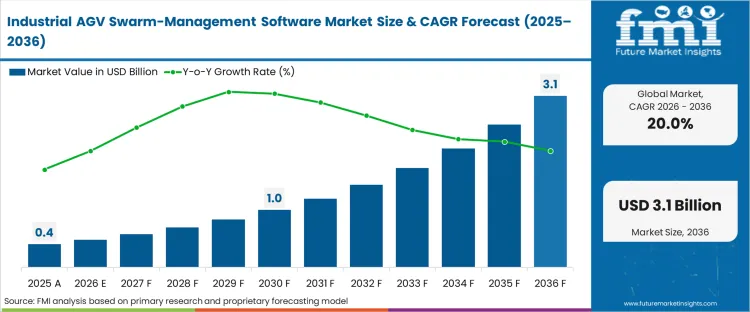
The operational ceiling for proprietary software breaks when a facility's mixed-fleet density reaches a critical traffic threshold. Once operators cross this density gate, relying on separate mapping applications creates routing conflicts that halt production. The transition to a unified AGV intelligent swarm system resolves these deadlocks by establishing a master traffic controller, turning isolated robotic units into a synchronized network capable of real-time spatial negotiation. Rising AGV intelligent management USA adoption reflects this exact operational threshold being crossed in high-throughput fulfillment centers.
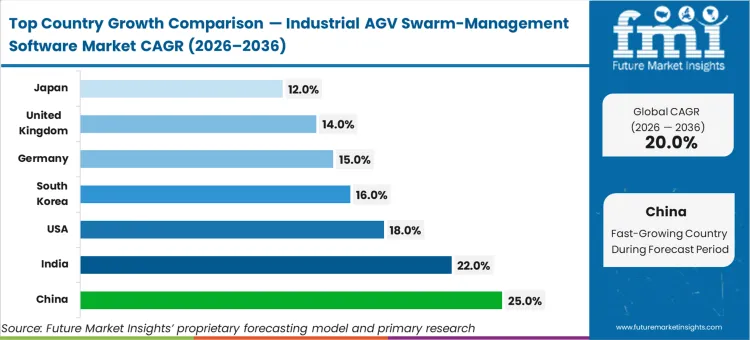
China is estimated to advance at 25%, followed by India at 22%, the United States at 18%, South Korea at 16%, Germany at 15%, the United Kingdom at 14%, and Japan at 12%. This geographic divergence in swarm management for AGV 2026 is not merely a reflection of varying labor costs. The steepest growth curves correlate directly with regions executing greenfield mega-warehouse constructions, where operators can deploy universal software architectures from day one rather than retrofitting legacy systems.
Industrial AGV Swarm-Management Software Market Definition
The Industrial AGV Swarm-Management Software Market consists of hardware-agnostic control platforms designed to orchestrate the movement, task allocation, and traffic negotiation of an industrial automated guided vehicle swarm. These systems function as the central nervous system for robotic fleets, differentiating themselves as a distinct multi AGV fleet management platform that translates higher-level warehouse management system commands into optimized, conflict-free routing protocols for diverse mobile assets operating in shared physical spaces.
Industrial AGV Swarm-Management Software Market Inclusions
The market encompasses AGV swarm robotics software licenses, application programming interfaces for fleet integration, real-time spatial mapping modules, and dynamic task-allocation algorithms. Subscriptions for continuous software updates, implementation consulting directly tied to the software deployment, and middleware connecting robotic platforms to enterprise resource planning systems are fully included. Advancements in AGV intelligent management systems and specific AGV dispatch management platforms form the core revenue streams evaluated within this boundary.
Industrial AGV Swarm-Management Software Market Exclusions
Physical automated guided vehicles and their onboard sensor arrays are explicitly excluded from this software-focused valuation. Enterprise resource planning systems, overarching warehouse management systems, and generic facility Wi-Fi networking infrastructure are also excluded. These systems provide the operational context or hardware execution for the swarm, but they do not perform the localized multi-agent traffic negotiation that defines an AGV fleet orchestration software category.
Industrial AGV Swarm-Management Software Market Research Methodology
- Primary Research: Chief technology officers at logistics firms, warehouse automation architects, and product directors at top AGV swarm software companies were interviewed to validate software decoupling trends.
- Desk Research: Interoperability standard publications, technical integration whitepapers from leading automation vendors, and software-as-a-service pricing documentation were analyzed to map deployment patterns.
- Market-Sizing and Forecasting: The baseline anchors to the verifiable installed base of mixed-fleet automated environments and enterprise software licensing contracts within tier-one logistics hubs.
- Data Validation and Update Cycle: Forecast trajectories were cross-validated against cloud computing infrastructure investments tailored for edge-processing in industrial environments.
Segmental Analysis
Industrial AGV Swarm-Management Software Market Analysis by Deployment Mode
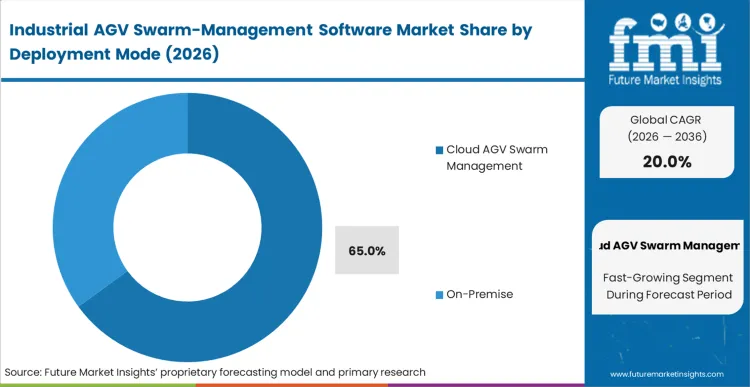
According to FMI's estimates, shifting the algorithmic heavy lifting to a cloud layer removes this localized constraint. Operations managers utilizing cloud architectures gain the distinct advantage of applying machine learning insights generated from their entire global network to optimize a single local facility. The structural reason cloud AGV swarm management holds its 65% share position is the sheer computational load required for continuous multi-agent path recalculation. On-premise servers quickly hit processing bottlenecks when a facility scales beyond fifty active units constantly negotiating spatial priorities. Moving away from localized servers allows operators to deploy sophisticated smart fleet management protocols without capital-intensive hardware upgrades in every building. The integration of advanced motor telemetry, such as monitoring brushless motor for AGV performance, becomes significantly easier when diagnostic data streams into a centralized cloud dashboard. Buyers who restrict themselves to on-premise logic inherently cap their maximum fleet size and limit their ability to deploy predictive maintenance analytics.
- Processing Scalability: Cloud layers absorb the exponential math required for real-time spatial negotiation. Operators scale their robotic density without crashing localized facility servers.
- Network Benchmarking: Centralized architectures compare routing efficiency across distinct geographical locations. Supply chain directors identify underperforming facilities instantly by analyzing normalized movement data.
- Deployment Velocity: Software updates deploy simultaneously across all connected warehouses. IT managers eliminate the operational downtime associated with manual patching of isolated on-premise control modules.
Industrial AGV Swarm-Management Software Market Analysis by Application
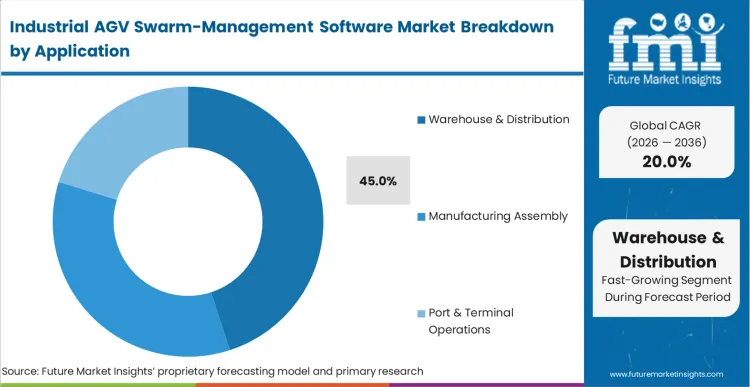
Facility managers who rely on elementary point-to-point routing applications in these high-variability spaces suffer severe throughput degradation during peak seasonal operations. Warehouse & Distribution holds a decisive 45% share in 2026 because these environments feature the highest degree of unpredictable spatial variability. Unlike manufacturing floors where material moves along fixed assembly corridors, fulfillment centers require an advanced warehouse AGV swarm software to navigate dynamic environments where pallets, human pickers, and temporary storage create constantly shifting obstacles. FMI analysts opine that standard automated material handling equipment logic fails in these environments without a responsive orchestration layer. The software must calculate thousands of potential routing permutations every second to prevent gridlock in narrow storage aisles. Implementing robust warehouse robotics control systems transforms a chaotic fulfillment floor into a predictable, mathematically optimized fulfillment engine.
- Dynamic Pathfinding: Algorithms instantly recalculate routes when primary corridors become congested. Fulfillment operators maintain high picking velocities even when aisles are blocked by temporary obstacles.
- Priority Sequencing: The software assigns intersection right-of-way based on order urgency rather than arbitrary arrival times. Distribution managers ensure expedited shipments bypass lower-priority inventory transfers automatically.
- Space Optimization: Intelligent routing reduces the physical buffer zones required between moving units. Facility architects safely pack more automated assets into the exact same physical footprint.
Industrial AGV Swarm-Management Software Market Analysis by Industry Vertical
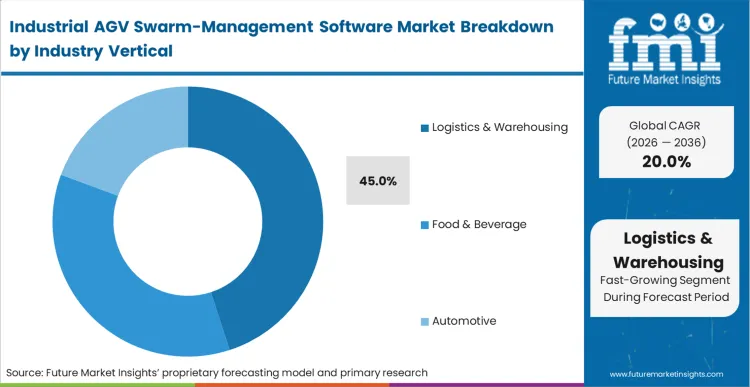
The integration of automotive AI agents within an AI AGV swarm control system requires a unified robotic data stream. Plant managers who attempt to bridge multiple proprietary software networks manually face unacceptable latency in part-delivery schedules. Procurement teams in the Automotive sector are currently forcing a shift toward open-architecture orchestration to manage massive just-in-time assembly component flows. Legacy systems fail when an automotive plant attempts to integrate specialized heavy-lift chassis carriers with lightweight parts-delivery tuggers sourced from different manufacturers. Based on FMI's assessment, deploying a unified automotive AGV swarm platform is no longer optional for maintaining production line synchronicity. The deployment of interoperable mobile robots governed by hardware-agnostic software eliminates the integration blind spots that historically plagued automotive assembly floors.
- Mixed-fleet Orchestration: Unified platforms bridge communication gaps between heavy-payload units and lightweight tuggers. Plant managers sequence complex assembly staging without relying on human intervention to coordinate different hardware brands.
- Just-in-time Synchronization: The software links material movement directly to the assembly line's real-time consumption rate. Logistics coordinators eliminate lineside inventory bottlenecks by pacing deliveries precisely to the minute.
- Asset Utilization: Centralized dashboards reveal which specialized carriers sit idle during specific shifts. Production directors reallocate underutilized hardware dynamically to alternate assembly zones.
Industrial AGV Swarm-Management Software Market Drivers, Restraints, and Opportunities
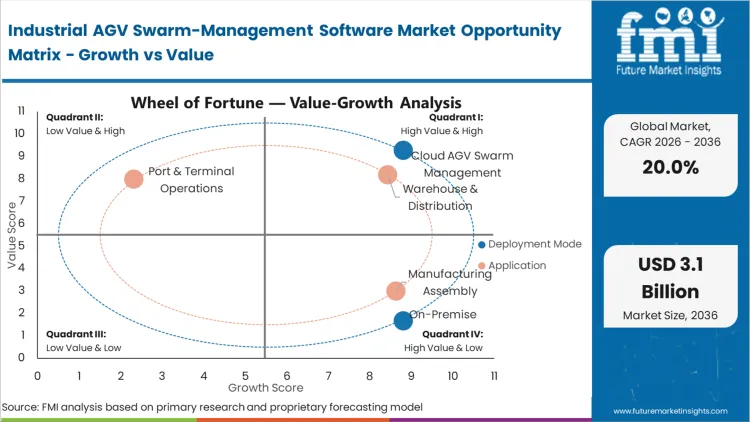
The necessity to master AGV swarm integration with WMS (Warehouse Management Systems) compels operations directors to abandon proprietary control applications in favor of unified orchestration software. As facilities scale, buyers realize that being locked into a single hardware vendor's ecosystem severely limits their negotiating power and technological flexibility. This structural pressure forces procurement teams to mandate open-architecture control layers that act as a universal translator for mixed robotic fleets. By decoupling the software layer from the physical vehicle, organizations regain the commercial leverage required to select the optimal hardware for specific tasks without compromising facility-wide traffic coordination.
The fundamental tension between AGV swarm vs fleet management creates a persistent organizational friction for IT security directors. Operations teams understand that traditional fleet management sequentially pushes orders, while true swarm management allows agents to collectively negotiate space, yet they resist relinquishing localized floor control to third-party cloud architectures. This friction forces software providers to develop hybrid-edge solutions that maintain localized fail-safes. However, these hybrid models add immense integration complexity, slowing the initial deployment cycle and extending the time to value for the purchasing organization.
Opportunities in the Industrial AGV Swarm-Management Software Market
- Standardized API Deployment: The emergence of universal interoperability protocols creates a distinct opening for pure-play software developers. Independent vendors capture market share by positioning their platforms as the definitive integration hub for any compliant hardware brand.
- Predictive Traffic Modeling: Aggregating vast amounts of spatial movement data enables the creation of highly accurate predictive routing models. Software architects monetize these insights by offering advanced analytical modules that simulate facility expansions before physical construction begins.
- Unified Telemetry Integration: Linking swarm navigation data directly with advanced vehicle networking diagnostics allows for proactive fleet maintenance. Operations directors reduce total downtime by servicing units based on algorithmic stress calculations rather than static calendars.
Regional Analysis
The regional trajectory of the industrial AGV swarm-management software market highlights a stark contrast between greenfield mega-deployments in emerging manufacturing hubs and the strategic algorithmic optimization of existing automated assets in mature economies. Based on the regional analysis, the market is segmented into Asia Pacific, North America, Europe across 40 plus countries.
.webp "Top Country Growth Comparison Industrial Agv Swarm Management Software Market Cagr (2026 2036)")
| Country | CAGR (2026 to 2036) |
|---|---|
| China | 25% |
| India | 22% |
| United States | 18% |
| South Korea | 16% |
| Germany | 15% |
| United Kingdom | 14% |
| Japan | 12% |
Source: Future Market Insights (FMI) analysis, based on proprietary forecasting model and primary research
Asia Pacific Industrial AGV Swarm-Management Software Market Analysis
As economies in the Asia Pacific shift rapidly from labor-intensive production models to highly automated export powerhouses, the sheer scale of new facility construction creates an ideal environment for advanced software integration. In FMI's view, rather than progressing slowly through single-vendor setups, regional operators are leapfrogging directly to third-party orchestration layers engineered for massive scale. The aggressive deployment of automated control architectures is directly dictated by this rapid industrial modernization. Highlighting a strict focus on algorithmic efficiency over basic mechanical hardware, localized frameworks such as fleet management Japan methodologies are gaining traction. The region's dedication to software-driven operational dominance in the end is proven by the widespread adoption of bespoke intelligent management systems across its primary manufacturing corridors.
- China: China's market trajectory is uniquely defined by a massive pipeline of greenfield fulfillment centers that are built natively to support third-party automated orchestration. Instead of retrofitting software into older architectural constraints, new facilities are literally constructed around the spatial algorithms of the control systems. By acting decisively to implement these advanced layers, logistics operators are unlocking unprecedented throughput volumes and entirely shifting the competitive balance of regional export fulfillment. Advancing at a remarkable 25% CAGR through 2036, reflecting this aggressive architectural shift in the market.
- India: Driven forward by a powerful 22% CAGR, the total opportunity in India is expanding rapidly as supply chain operators race to standardize material handling across deeply fragmented third-party logistics networks. The critical bottleneck of mismatched warehouse technologies operating across different state borders is effectively resolved through the integration of unified control layers. By adopting hardware-agnostic platforms, operators gain the flexibility to deploy a variety of cost-effective, regional robotic units while maintaining strict centralized visibility.
- South Korea: Procurement teams within South Korea's densely packed electronics manufacturing sector are compelled to execute sub-millimeter precision routing protocols to safeguard their operations. Because high-value components move simultaneously in such tight proximity, operators require advanced swarm logic to completely neutralize collision risks. Demonstrating a clear structural mandate for specialized algorithmic control, the sector is advancing at a solid 16% CAGR over the forecast period. By achieving this absolute synchronization, plant directors can systematically shatter legacy theoretical limits and maximize their production output.
- Japan: Tracking a steady 12% growth trajectory, the Japanese market is entirely shaped by the urgent need to combat an acute labor shortage using algorithmic efficiency. Because many existing material handling facilities feature older, multi-story architectures, facility managers must focus intensely on advanced route optimization software to overcome strict physical constraints. By maximizing the output of every deployed robotic unit through these sophisticated orchestration frameworks, organizations can successfully uphold strict domestic delivery guarantees even as workforce availability shrinks.
FMI's report includes secondary industrial hubs across Southeast Asia and Oceania. These emerging markets reflect a delayed but identical pattern, adopting hardware-agnostic software only after initial experiments with proprietary closed-loop systems fail to scale effectively across multiple facilities.
North America Industrial AGV Swarm-Management Software Market Analysis
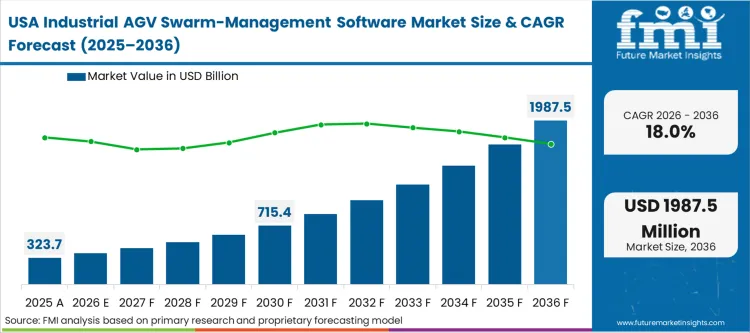
Hyper-competitive e-commerce fulfillment networks and strict return-on-capital calculations dictate the adoption curve across the North American landscape. Because major retail distributors battle on razor-thin margins, squeezing more performance out of existing automated assets takes precedence over simply purchasing new robotic hardware. The outsized enterprise contracts as a result are awarded to software platforms proven to extract even an additional ten percent of throughput from a current fleet. The established use of advanced commercial vehicle telematics for exterior yard operations sets a high benchmark, creating an absolute expectation for equivalent, real-time algorithmic visibility inside the warehouse walls.
- United States: Facing immense pressure to flawlessly execute next-day delivery targets, retail fulfillment giants in the United States require software capable of calculating optimal dispatch sequencing in milliseconds. To handle this, operations directors are deploying advanced swarm logic that actively prioritizes inventory movement against real-time order intake streams. As these massive logistics networks continuously upgrade their algorithmic firepower, the United States market is expanding rapidly at an 18% CAGR. The operators who in the end master this form of dynamic, real-time sequencing build a formidable delivery speed advantage that regional competitors are unable to match.
FMI's report includes extensive analysis of the Canadian and Mexican industrial software sectors. Cross-border logistics networks increasingly standardize their internal warehouse software to match the unified architecture utilized in their primary United States fulfillment nodes.
Europe Industrial AGV Swarm-Management Software Market Analysis
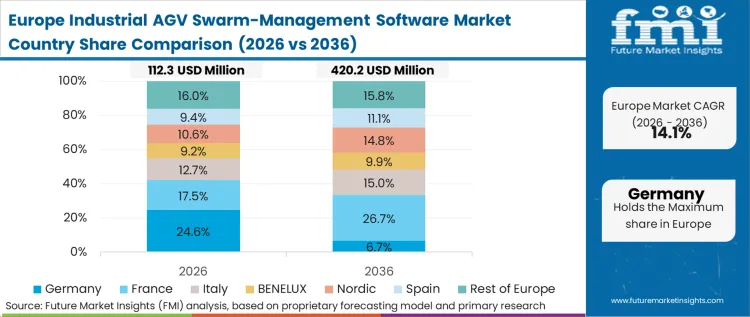
The aggressive implementation of open industrial interoperability standards distinctly shapes Europe's structural trajectory in this software category. As per FMI's projection, European buyers are now actively disqualifying any vendor that refuses to expose their hardware to third-party orchestration platforms. This formalized mandate to standardize communication protocols forces manufacturers to abandon hardware lock-in strategies and compete strictly on the intelligence of their routing algorithms. A broader continent-wide pivot toward software-defined operational frameworks is clearly confirmed by recent observations in the fleet management western Europe context. Meanwhile, the rising demand for localized AGV management systems UK highlights how individual nations are tailoring these universal standards to fit their specific spatial and regulatory environments.
- Germany: Forecast to register a strong CAGR of 15%, the German market acts as the primary testing ground for advanced industrial interoperability protocols within its dense automotive and heavy manufacturing core. On these massive production floors, industrial architects are demanding unified platforms that can seamlessly integrate decades-old heavy-payload carriers alongside highly agile, modern delivery units. By fully embracing these unified software standards today, German organizations are structurally positioning themselves to dictate commercial terms to their hardware suppliers well into the next decade.
- United Kingdom: Because the warehouse real estate market in the United Kingdom is severely constrained, operators are forced to rely on high-density automated storage solutions managed by highly complex collision-avoidance algorithms. To safely run maximum-capacity fleets within such minimal square footage, facility managers depend entirely on advanced swarm software logic. Competitors still clinging to basic point-to-point routing logic are rapidly falling behind early adopters, who utilize specialized spatial negotiation software to extract massively higher throughput per square meter. The national market sustains a 14% CAGR, reflecting this intense space-driven adoption curve.
FMI's report includes the Nordic and Eastern European logistics corridors. These regions demonstrate a rapid acceleration in software procurement, specifically targeting unified platforms that can manage cross-border inventory transfers within deeply integrated manufacturing supply chains.
Competitive Aligners for Market Players
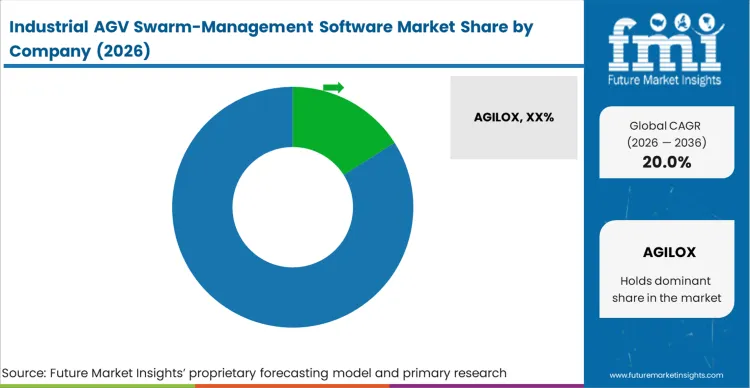
The industrial AGV swarm-management software market exhibits a fragmented but rapidly consolidating structure driven by the technical complexity of true hardware-agnostic integration. Companies like AGILOX, KUKA, and Dematic command significant influence because buyers prioritize proven operational stability over theoretical algorithmic superiority. When procurement directors evaluate the best AGV swarm management solution, the primary variable they use to distinguish qualified platforms is the software's demonstrable capability to manage mixed-brand fleets simultaneously without requiring customized, expensive middleware for every new hardware addition.
Incumbents maintain their structural advantage through deeply embedded relationships with major warehouse management system providers. Formulators and developers at Seegrid and ABB possess pre-certified integration pathways into the world's largest enterprise resource planning ecosystems, effectively shielding them from untested challengers. A new entrant aiming to disrupt this space must build equivalent, seamless enterprise connectivity, ensuring their routing logic communicates flawlessly with the facility's master inventory database. Integrating advanced automotive OEM telematics principles into material handling environments provides a massive structural advantage for vendors capable of bridging exterior and interior data streams.
Large logistics buyers systematically resist lock-in by demanding adherence to open API standards in every new procurement contract. The structural tension between operators seeking total hardware flexibility and legacy vendors attempting to protect proprietary ecosystems defines the market's trajectory through 2036. The sector is structurally compelled to become more concentrated as pure-play software developers either acquire smaller algorithm specialists or are absorbed into comprehensive construction equipment fleet management software and broader industrial orchestration suites.
Key Players in Industrial AGV Swarm-Management Software Market
- AGILOX
- FARobot
- KUKA
- KINEXON
- Dematic
- Seegrid
- ABB
Scope of the Report
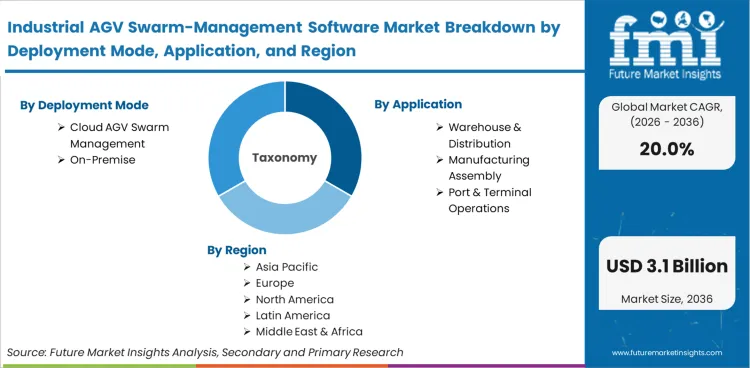
| Metric | Value |
|---|---|
| Quantitative Units | USD 0.5 billion to USD 3.4 billion, at a CAGR of 20% |
| Market Definition | The market covers hardware-agnostic software platforms that orchestrate routing, task allocation, and traffic negotiation for multiple automated guided vehicles. It encompasses the cloud and on-premise logic layers required to prevent collisions and optimize throughput in mixed-fleet industrial environments. |
| Deployment Mode Segmentation | Cloud-based Swarm Management, On-Premise |
| Application Segmentation | Warehouse & Distribution, Manufacturing Assembly, Port & Terminal Operations |
| Industry Vertical Segmentation | Automotive, Logistics & Warehousing, Food & Beverage |
| Regions Covered | Asia Pacific, North America, Europe |
| Countries Covered | China, India, United States, South Korea, Germany, United Kingdom, Japan, and 40 plus countries |
| Key Companies Profiled | AGILOX, FARobot, KUKA, KINEXON, Dematic, Seegrid, ABB |
| Forecast Period | 2026 to 2036 |
| Approach | Primary interviews were conducted with logistics technology officers and warehouse automation architects. The baseline data anchors to recurring enterprise software licensing contracts within tier-one distribution hubs. Forecasts were cross-validated against cloud edge-processing investments and global warehouse construction pipelines. |
Source: Future Market Insights (FMI) analysis, based on proprietary forecasting model and primary research
Segments
Deployment Mode:
- Cloud-based Swarm Management
- On-Premise
Application:
- Warehouse & Distribution
- Manufacturing Assembly
- Port & Terminal Operations
Industry Vertical:
- Automotive
- Logistics & Warehousing
- Food & Beverage
Functionality:
- Navigation
- Task Allocation
- Safety
Regions:
- North America
- United States
- Canada
- Latin America
- Brazil
- Mexico
- Europe
- Germany
- United Kingdom
- France
- Italy
- Spain
- Asia-Pacific
- China
- Japan
- South Korea
- India
- Rest of Asia-Pacific
Bibliography
- International Federation of Robotics. (2025). World robotics 2025 Report: Service robots. IFR Press.
- Zhou, W., et al. (2025). Co-optimization of the operation and energy for AGVs in automated container terminals. ACM Digital Library.
- Wang, H. (2024). Optimal policy for scheduling automated guided vehicles in intelligent transportation systems. Transportation Research Part A: Policy and Practice.
- Science China Information Sciences. (2026). Integrated sensing, communication, and control for multi-agent networked formation control. Springer.
- Expert Systems with Applications. (2026). Hierarchical agent architecture-based large-scale AGV cluster real-time control. Elsevier.
- Preprints.org. (2026). Energy-aware spatio-temporal multi-agent route planning for AGVs. Preprints.
This bibliography is provided for reader reference. The full FMI report contains the complete reference list with primary source documentation.
This Report Addresses
- Market intelligence to support strategic decision making across cloud-based and on-premise fleet orchestration categories
- Market size estimation and 10-year revenue forecasts from 2026 to 2036, supported by recurring software licensing baseline metrics
- Growth opportunity mapping across deployment and application dimensions with emphasis on the mandatory adoption of interoperability protocols
- Segment and regional revenue forecasts covering Warehouse & Distribution segments across hyper-competitive e-commerce fulfillment environments
- Competition strategy assessment including API openness, enterprise integration depth, and spatial mapping capabilities
- Software capability development tracking including cloud edge-processing, dynamic task allocation, and real-time path recalculation
- Market access analysis covering enterprise procurement tracks, interoperability standards compliance, and hybrid-edge security models
- Market report delivery in PDF, Excel, PPT, and interactive dashboard formats for executive strategy, facility automation planning, and operational benchmarking use
Frequently Asked Questions
How large is the industrial AGV swarm market size in 2026?
The market reaches USD 0.5 billion in 2026, signaling the decisive moment when tier-one logistics providers abandon proprietary routing tools in favor of dedicated, scalable orchestration platforms.
What will it be valued at by 2036?
The valuation expands to USD 3.4 billion by 2036, reflecting the total absorption of third-party control software into the baseline architecture of every new automated fulfillment center globally.
What is the AGV swarm management cagr projected?
The 20% CAGR captures the rapid replacement cycle of legacy control systems as facility architects restructure their IT frameworks to support massive mixed-fleet deployments.
Which Deployment Mode segment leads?
Cloud-based Swarm Management secures a 65% share in 2026 because the immense computational demands of real-time multi-agent routing quickly exceed the processing capabilities of isolated, on-premise facility servers.
Which Application segment leads?
Warehouse & Distribution captures 45% share in 2026 as the extreme spatial unpredictability of modern fulfillment centers requires continuous algorithmic recalculation to prevent severe traffic gridlocks.
Which Industry Vertical segment leads?
The Automotive vertical commands substantial early adoption because precise, just-in-time assembly sequencing cannot tolerate the data latency caused by bridging mismatched proprietary software networks.
What drives rapid growth?
The strict operational necessity to integrate specialized hardware from multiple vendors without crashing the master facility schedule forces procurement teams to mandate open-architecture control layers.
What is the primary restraint?
The acute organizational friction generated by IT security teams refusing to grant third-party cloud algorithms direct operational control over critical physical infrastructure slows enterprise-wide deployment cycles.
Which country grows fastest?
China's 25% expansion outpaces India's 22% because Chinese operators are deploying universal software architectures directly into newly constructed greenfield mega-warehouses, bypassing the complex retrofitting process required in mature markets.
How does spatial variability impact software selection?
Facilities with shifting obstacles and dynamic picking routes demand predictive machine-learning models, whereas static assembly lines often survive temporarily on simpler, rule-based point-to-point logic.
Why is API standardization critical to market expansion?
Standardization fundamentally decouples software procurement from hardware purchasing, allowing buyers to switch physical vehicle suppliers without dismantling their entire traffic control infrastructure.
How do incumbents protect their market position against pure-play software developers?
Legacy vendors maintain deeply established integration pathways into major enterprise resource planning databases, creating a high technical barrier for new entrants attempting to sync routing data with master inventory records.
What operational outcome occurs when traffic density exceeds the software's capability?
Mixed-fleet vehicles encounter intersecting paths and enter localized deadlock states, instantly halting throughput until human operators manually intervene to reset the routing logic.
How does cloud architecture influence multi-facility network optimization?
Centralized processing allows supply chain directors to benchmark the algorithmic efficiency of a facility in Europe directly against an identically equipped facility in North America in real time.
What prevents smaller manufacturers from deploying advanced swarm management?
The heavy initial integration required to map the software to legacy enterprise resource planning systems creates a capital barrier that smaller facilities struggle to justify against lower robotic densities.
How does the unbundling of hardware and software alter the procurement cycle?
Operations directors now conduct distinct qualification processes for the control layer first, ensuring the chosen software platform dictates the API requirements for all subsequent physical hardware bids.
Why is the United Kingdom market expanding despite constrained physical real estate?
Extreme space limitations force British operators to deploy high-density storage configurations, which absolutely rely on sub-millimeter algorithmic precision to prevent vehicle collisions in narrow corridors.
What defines the difference in AGV swarm vs fleet management logic?
Basic fleet management issues sequential orders to individual units from a top-down server; true swarm logic processes the entire fleet dynamically, allowing agents to negotiate space based on collective spatial efficiency.
How do predictive maintenance models integrate with swarm orchestration?
Continuous motor telemetry routed through the swarm dashboard allows algorithms to automatically pull stressed units from active duty and assign replacement vehicles without interrupting the workflow sequence.
What role do AGV swarm safety software modules play in this market?
Integrated safety architectures serve as a necessary compromise for security-conscious IT departments, keeping critical collision-avoidance logic hard-coded on the edge while pushing historical efficiency analytics to the cloud.
How does the software manage priority sequencing during peak fulfillment seasons?
Algorithms dynamically assign intersection right-of-way based on the real-time urgency of the specific order a robot is carrying, actively pausing lower-priority inventory transfers to clear vital corridors.
What signals the final transition away from single-vendor closed systems?
The transition concludes when major automotive and e-commerce buyers rewrite their mandatory vendor guidelines to explicitly disqualify any robotic platform that refuses to integrate with third-party orchestration software.
Preview the report firsthand - request a free sample
Get SampleGet the brochure for pricing and purchase details.
Get PDFTable of Content
- Executive Summary
- Global Market Outlook
- Demand-side Trends
- Supply-side Trends
- Technology Roadmap Analysis
- Analysis and Recommendations
- Market Overview
- Market Coverage / Taxonomy
- Market Definition / Scope / Limitations
- Research Methodology
- Chapter Orientation
- Analytical Lens and Working Hypotheses
- Market Structure, Signals, and Trend Drivers
- Benchmarking and Cross-market Comparability
- Market Sizing, Forecasting, and Opportunity Mapping
- Research Design and Evidence Framework
- Desk Research Programme (Secondary Evidence)
- Company Annual and Sustainability Reports
- Peer-reviewed Journals and Academic Literature
- Corporate Websites, Product Literature, and Technical Notes
- Earnings Decks and Investor Briefings
- Statutory Filings and Regulatory Disclosures
- Technical White Papers and Standards Notes
- Trade Journals, Industry Magazines, and Analyst Briefs
- Conference Proceedings, Webinars, and Seminar Materials
- Government Statistics Portals and Public Data Releases
- Press Releases and Reputable Media Coverage
- Specialist Newsletters and Curated Briefings
- Sector Databases and Reference Repositories
- FMI Internal Proprietary Databases and Historical Market Datasets
- Subscription Datasets and Paid Sources
- Social Channels, Communities, and Digital Listening Inputs
- Additional Desk Sources
- Expert Input and Fieldwork (Primary Evidence)
- Primary Modes
- Qualitative Interviews and Expert Elicitation
- Quantitative Surveys and Structured Data Capture
- Blended Approach
- Why Primary Evidence is Used
- Field Techniques
- Interviews
- Surveys
- Focus Groups
- Observational and In-context Research
- Social and Community Interactions
- Stakeholder Universe Engaged
- C-suite Leaders
- Board Members
- Presidents and Vice Presidents
- R&D and Innovation Heads
- Technical Specialists
- Domain Subject-matter Experts
- Scientists
- Physicians and Other Healthcare Professionals
- Governance, Ethics, and Data Stewardship
- Research Ethics
- Data Integrity and Handling
- Primary Modes
- Tooling, Models, and Reference Databases
- Desk Research Programme (Secondary Evidence)
- Data Engineering and Model Build
- Data Acquisition and Ingestion
- Cleaning, Normalisation, and Verification
- Synthesis, Triangulation, and Analysis
- Quality Assurance and Audit Trail
- Market Background
- Market Dynamics
- Drivers
- Restraints
- Opportunity
- Trends
- Scenario Forecast
- Demand in Optimistic Scenario
- Demand in Likely Scenario
- Demand in Conservative Scenario
- Opportunity Map Analysis
- Product Life Cycle Analysis
- Supply Chain Analysis
- Investment Feasibility Matrix
- Value Chain Analysis
- PESTLE and Porter’s Analysis
- Regulatory Landscape
- Regional Parent Market Outlook
- Production and Consumption Statistics
- Import and Export Statistics
- Market Dynamics
- Global Market Analysis 2021 to 2025 and Forecast, 2026 to 2036
- Historical Market Size Value (USD Million) Analysis, 2021 to 2025
- Current and Future Market Size Value (USD Million) Projections, 2026 to 2036
- Y-o-Y Growth Trend Analysis
- Absolute $ Opportunity Analysis
- Global Market Pricing Analysis 2021 to 2025 and Forecast 2026 to 2036
- Global Market Analysis 2021 to 2025 and Forecast 2026 to 2036, By Deployment Mode
- Introduction / Key Findings
- Historical Market Size Value (USD Million) Analysis By Deployment Mode , 2021 to 2025
- Current and Future Market Size Value (USD Million) Analysis and Forecast By Deployment Mode , 2026 to 2036
- Cloud AGV Swarm Management
- On-Premise
- Cloud AGV Swarm Management
- Y-o-Y Growth Trend Analysis By Deployment Mode , 2021 to 2025
- Absolute $ Opportunity Analysis By Deployment Mode , 2026 to 2036
- Global Market Analysis 2021 to 2025 and Forecast 2026 to 2036, By Application
- Introduction / Key Findings
- Historical Market Size Value (USD Million) Analysis By Application, 2021 to 2025
- Current and Future Market Size Value (USD Million) Analysis and Forecast By Application, 2026 to 2036
- Warehouse & Distribution
- Manufacturing Assembly
- Port & Terminal Operations
- Warehouse & Distribution
- Y-o-Y Growth Trend Analysis By Application, 2021 to 2025
- Absolute $ Opportunity Analysis By Application, 2026 to 2036
- Global Market Analysis 2021 to 2025 and Forecast 2026 to 2036, By Industry Vertical
- Introduction / Key Findings
- Historical Market Size Value (USD Million) Analysis By Industry Vertical, 2021 to 2025
- Current and Future Market Size Value (USD Million) Analysis and Forecast By Industry Vertical, 2026 to 2036
- Logistics & Warehousing
- Food & Beverage
- Automotive
- Logistics & Warehousing
- Y-o-Y Growth Trend Analysis By Industry Vertical, 2021 to 2025
- Absolute $ Opportunity Analysis By Industry Vertical, 2026 to 2036
- Global Market Analysis 2021 to 2025 and Forecast 2026 to 2036, By Region
- Introduction
- Historical Market Size Value (USD Million) Analysis By Region, 2021 to 2025
- Current Market Size Value (USD Million) Analysis and Forecast By Region, 2026 to 2036
- North America
- Latin America
- Western Europe
- Eastern Europe
- East Asia
- South Asia and Pacific
- Middle East & Africa
- Market Attractiveness Analysis By Region
- North America Market Analysis 2021 to 2025 and Forecast 2026 to 2036, By Country
- Historical Market Size Value (USD Million) Trend Analysis By Market Taxonomy, 2021 to 2025
- Market Size Value (USD Million) Forecast By Market Taxonomy, 2026 to 2036
- By Country
- USA
- Canada
- Mexico
- By Deployment Mode
- By Application
- By Industry Vertical
- By Country
- Market Attractiveness Analysis
- By Country
- By Deployment Mode
- By Application
- By Industry Vertical
- Key Takeaways
- Latin America Market Analysis 2021 to 2025 and Forecast 2026 to 2036, By Country
- Historical Market Size Value (USD Million) Trend Analysis By Market Taxonomy, 2021 to 2025
- Market Size Value (USD Million) Forecast By Market Taxonomy, 2026 to 2036
- By Country
- Brazil
- Chile
- Rest of Latin America
- By Deployment Mode
- By Application
- By Industry Vertical
- By Country
- Market Attractiveness Analysis
- By Country
- By Deployment Mode
- By Application
- By Industry Vertical
- Key Takeaways
- Western Europe Market Analysis 2021 to 2025 and Forecast 2026 to 2036, By Country
- Historical Market Size Value (USD Million) Trend Analysis By Market Taxonomy, 2021 to 2025
- Market Size Value (USD Million) Forecast By Market Taxonomy, 2026 to 2036
- By Country
- Germany
- UK
- Italy
- Spain
- France
- Nordic
- BENELUX
- Rest of Western Europe
- By Deployment Mode
- By Application
- By Industry Vertical
- By Country
- Market Attractiveness Analysis
- By Country
- By Deployment Mode
- By Application
- By Industry Vertical
- Key Takeaways
- Eastern Europe Market Analysis 2021 to 2025 and Forecast 2026 to 2036, By Country
- Historical Market Size Value (USD Million) Trend Analysis By Market Taxonomy, 2021 to 2025
- Market Size Value (USD Million) Forecast By Market Taxonomy, 2026 to 2036
- By Country
- Russia
- Poland
- Hungary
- Balkan & Baltic
- Rest of Eastern Europe
- By Deployment Mode
- By Application
- By Industry Vertical
- By Country
- Market Attractiveness Analysis
- By Country
- By Deployment Mode
- By Application
- By Industry Vertical
- Key Takeaways
- East Asia Market Analysis 2021 to 2025 and Forecast 2026 to 2036, By Country
- Historical Market Size Value (USD Million) Trend Analysis By Market Taxonomy, 2021 to 2025
- Market Size Value (USD Million) Forecast By Market Taxonomy, 2026 to 2036
- By Country
- China
- Japan
- South Korea
- By Deployment Mode
- By Application
- By Industry Vertical
- By Country
- Market Attractiveness Analysis
- By Country
- By Deployment Mode
- By Application
- By Industry Vertical
- Key Takeaways
- South Asia and Pacific Market Analysis 2021 to 2025 and Forecast 2026 to 2036, By Country
- Historical Market Size Value (USD Million) Trend Analysis By Market Taxonomy, 2021 to 2025
- Market Size Value (USD Million) Forecast By Market Taxonomy, 2026 to 2036
- By Country
- India
- ASEAN
- Australia & New Zealand
- Rest of South Asia and Pacific
- By Deployment Mode
- By Application
- By Industry Vertical
- By Country
- Market Attractiveness Analysis
- By Country
- By Deployment Mode
- By Application
- By Industry Vertical
- Key Takeaways
- Middle East & Africa Market Analysis 2021 to 2025 and Forecast 2026 to 2036, By Country
- Historical Market Size Value (USD Million) Trend Analysis By Market Taxonomy, 2021 to 2025
- Market Size Value (USD Million) Forecast By Market Taxonomy, 2026 to 2036
- By Country
- Kingdom of Saudi Arabia
- Other GCC Countries
- Turkiye
- South Africa
- Other African Union
- Rest of Middle East & Africa
- By Deployment Mode
- By Application
- By Industry Vertical
- By Country
- Market Attractiveness Analysis
- By Country
- By Deployment Mode
- By Application
- By Industry Vertical
- Key Takeaways
- Key Countries Market Analysis
- USA
- Pricing Analysis
- Market Share Analysis, 2025
- By Deployment Mode
- By Application
- By Industry Vertical
- Canada
- Pricing Analysis
- Market Share Analysis, 2025
- By Deployment Mode
- By Application
- By Industry Vertical
- Mexico
- Pricing Analysis
- Market Share Analysis, 2025
- By Deployment Mode
- By Application
- By Industry Vertical
- Brazil
- Pricing Analysis
- Market Share Analysis, 2025
- By Deployment Mode
- By Application
- By Industry Vertical
- Chile
- Pricing Analysis
- Market Share Analysis, 2025
- By Deployment Mode
- By Application
- By Industry Vertical
- Germany
- Pricing Analysis
- Market Share Analysis, 2025
- By Deployment Mode
- By Application
- By Industry Vertical
- UK
- Pricing Analysis
- Market Share Analysis, 2025
- By Deployment Mode
- By Application
- By Industry Vertical
- Italy
- Pricing Analysis
- Market Share Analysis, 2025
- By Deployment Mode
- By Application
- By Industry Vertical
- Spain
- Pricing Analysis
- Market Share Analysis, 2025
- By Deployment Mode
- By Application
- By Industry Vertical
- France
- Pricing Analysis
- Market Share Analysis, 2025
- By Deployment Mode
- By Application
- By Industry Vertical
- India
- Pricing Analysis
- Market Share Analysis, 2025
- By Deployment Mode
- By Application
- By Industry Vertical
- ASEAN
- Pricing Analysis
- Market Share Analysis, 2025
- By Deployment Mode
- By Application
- By Industry Vertical
- Australia & New Zealand
- Pricing Analysis
- Market Share Analysis, 2025
- By Deployment Mode
- By Application
- By Industry Vertical
- China
- Pricing Analysis
- Market Share Analysis, 2025
- By Deployment Mode
- By Application
- By Industry Vertical
- Japan
- Pricing Analysis
- Market Share Analysis, 2025
- By Deployment Mode
- By Application
- By Industry Vertical
- South Korea
- Pricing Analysis
- Market Share Analysis, 2025
- By Deployment Mode
- By Application
- By Industry Vertical
- Russia
- Pricing Analysis
- Market Share Analysis, 2025
- By Deployment Mode
- By Application
- By Industry Vertical
- Poland
- Pricing Analysis
- Market Share Analysis, 2025
- By Deployment Mode
- By Application
- By Industry Vertical
- Hungary
- Pricing Analysis
- Market Share Analysis, 2025
- By Deployment Mode
- By Application
- By Industry Vertical
- Kingdom of Saudi Arabia
- Pricing Analysis
- Market Share Analysis, 2025
- By Deployment Mode
- By Application
- By Industry Vertical
- Turkiye
- Pricing Analysis
- Market Share Analysis, 2025
- By Deployment Mode
- By Application
- By Industry Vertical
- South Africa
- Pricing Analysis
- Market Share Analysis, 2025
- By Deployment Mode
- By Application
- By Industry Vertical
- USA
- Market Structure Analysis
- Competition Dashboard
- Competition Benchmarking
- Market Share Analysis of Top Players
- By Regional
- By Deployment Mode
- By Application
- By Industry Vertical
- Competition Analysis
- Competition Deep Dive
- AGILOX
- Overview
- Product Portfolio
- Profitability by Market Segments (Product/Age /Sales Channel/Region)
- Sales Footprint
- Strategy Overview
- Marketing Strategy
- Product Strategy
- Channel Strategy
- FARobot
- KUKA
- KINEXON
- Dematic
- Seegrid
- AGILOX
- Competition Deep Dive
- Assumptions & Acronyms Used


