

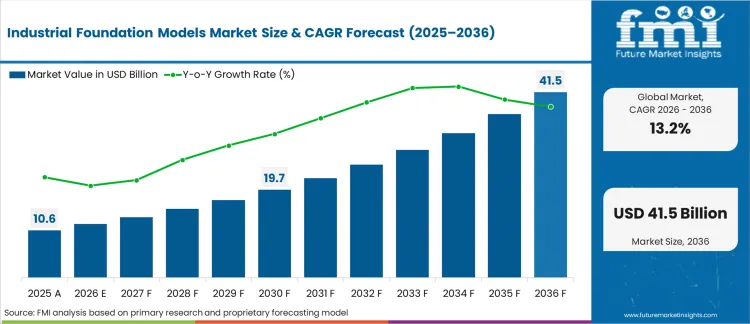
- Industry Size (2026)
- USD 12 Bn
- Forecast (2036)
- USD 22.5 Bn
- CAGR (2026 to 2036)
- 13.20%
Industrial Foundation Models Market Size, Market Forecast and Outlook By FMI
The industrial foundation models market, valued at USD 10.6 billion in 2025, is projected to expand to USD 12 billion by 2026 and further to USD 22.5 billion by 2036. This trajectory reflecting a 13.20% CAGR, signals a structural shift in industrial digitalization, as Tier‑1 manufacturers increasingly require deterministic, simulation‑grade generative AI systems to validate process outcomes before committing capital to large‑scale operational investments. Software procurement teams are shifting vendor qualification criteria from standalone point solutions toward unified, multi-modal industrial architectures.
Capital allocation decisions validate this infrastructure transition away from fragmented pilot projects. Plant directors interpret this hardware-software integration as a definitive signal that digital twin deployments now require generative simulation to qualify for enterprise-wide scaling. Procurement officers lacking integration roadmaps for these unified frameworks face an operational agility deficit they cannot bridge through legacy analytics.
Raj Sharma, EY Global Managing Partner, Growth and Innovation, opined, “AI agents are critical to empower teams with intelligent capabilities working in collaboration between humans and AI. This is why we are working with ServiceNow and our Ecosystems partners to harness the full potential of agentic AI across our AI platforms at enterprise scale, enabling us to integrate and contextualize data across our entire organization in real time, with the high levels of trust and transparency we need built in.” [14]. This assertion fundamentally resets procurement criteria for enterprise IT buyers.
Summary of Industrial Foundation Models Market
- Industrial Foundation Models Market Definition
- A class of large-scale, pre-trained generative artificial intelligence architectures engineered specifically to process industrial telemetry, manufacturing data, and enterprise code bases for scalable adaptation across distinct operational tasks.
- Demand Drivers in the Market
- Shortages of specialized OT programming personnel force manufacturers to adopt natural language copilots for equipment troubleshooting.
- Rising complexity in global supply networks requires multimodal models to interpret unstructured logistics documentation alongside real-time sensor streams.
- Strict latency constraints in factory environments drive demand for localized, parameter-efficient models capable of on-premises edge execution.
- Key Segments Analyzed in the FMI Report
- Large Language Models (LLMs): 42% share as enterprises prioritize text-based conversational interfaces for legacy database querying.
- IT & Telecom: 32.00% share driven by automated code generation mandates and network anomaly simulation workloads.
- India: 20% CAGR supported by rapid IT outsourcing transitions toward AI-augmented service delivery frameworks.
- Analyst Opinion at FMI
- Nikhil Kaitwade,Principal Consultant for Industrial Automation, opines, “Through our recent evaluation, we observed that deterministic reliability remains the primary bottleneck for factory-floor deployment. Suppliers investing in retrieval-augmented generation to ground industrial models in proprietary schematic data will secure stronger positioning in enterprise vendor qualification pipelines.”
- Strategic Implications / Executive Takeaways
- Mandate strict data governance protocols to prepare legacy documentation for vector database ingestion before licensing foundation models.
- Prioritize small, domain-specific models over generalized APIs to reduce cloud computing costs and latency in production environments.
- Build strategic alliances with cloud infrastructure providers to secure guaranteed compute capacity ahead of localized shortage events.
- Methodology
- Direct interviews with AI integration managers, enterprise software architects, and manufacturing operations directors.
- Custom import/export datasets from national IT hardware registries and corporate capacity announcements.
- Analysts developed a bottom-up adoption model starting from regional data center build-outs.
Software directors are no longer purchasing isolated generative tools; they are mandating orchestration layers that can monitor, govern, and audit autonomous agents across the network. Suppliers entering 2027 tender cycles without verifiable multi-agent control architectures face a disqualification window they cannot close after shortlisting begins.
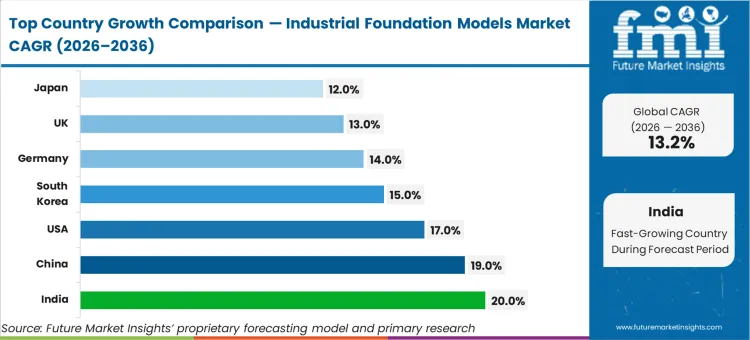
The geographic expansion of foundation model architecture reveals distinct structural velocities across regions. India is poised to advance at a 20% CAGR, driven by mass adoption within IT outsourcing hubs scaling automated code generation. China follows closely at a 19% CAGR, as national mandates to achieve compute self-sufficiency accelerate domestic model training for manufacturing digital twins. The USA, expanding at 17%, transitions from experimental deployments to system-of-record integrations across defense and advanced engineering sectors. South Korea and Germany expand at 15% and 14% respectively, anchored by heavy automotive OEMs embedding AI into shop-floor robotics. The UK (13%) and Japan (12%) exhibit steady integration curves, constrained primarily by specialized talent shortages that delay the scaling of complex multimodal deployments.
Industrial Foundation Models Market Definition
Industrial foundation models represent large-scale, pre-trained neural network architectures adapted specifically for enterprise, manufacturing, and operational technology environments. These systems ingest heterogeneous data, including text, code, telemetry, and schematics, to generate context-aware outputs for predictive maintenance, process optimization, and automation tasks. The category includes both generalized multimodal engines and domain-specific small language models optimized for low-latency edge computing.
Industrial Foundation Models Market Inclusions
The category includes commercial licenses for proprietary foundation models, open-source model customization services, and application programming interface (API) access fees intended for enterprise operational use. It covers integration software, orchestration layers, and localized fine-tuning frameworks designed to deploy these models within corporate firewalls or private cloud environments. Models adapted for industrial copilots, supply chain optimization, and code generation are fully within scope.
Industrial Foundation Models Market Exclusions
The scope excludes generalized consumer-facing chatbots and raw computing hardware such as graphical processing units (GPUs) and server racks. It does not include standard legacy machine learning models trained on narrow, task-specific datasets without foundational pre-training methodologies. Fully outsourced IT consulting services where the foundation model is merely an internal tool for the agency, rather than a licensed product for the end-user, are strictly excluded.
Industrial Foundation Models Market Research Methodology
- Primary Research: Direct interviews with enterprise IT architects, manufacturing directors, and AI startup founders across North America, Europe, and Asia Pacific.
- Desk Research: Custom data center capacity announcements, open-source repository commits metrics, and corporate patent filings.
- Market-Sizing and Forecasting: Analysts developed a bottom-up adoption model starting from enterprise cloud computing consumption ratios, applying historical software integration costs to project licensing revenue.
- Data Validation and Update Cycle: Findings underwent cross-verification against official government AI adoption surveys and computing industry journals before final forecast integration.
Segmental Analysis
Industrial Foundation Models Market Analysis by Model Type
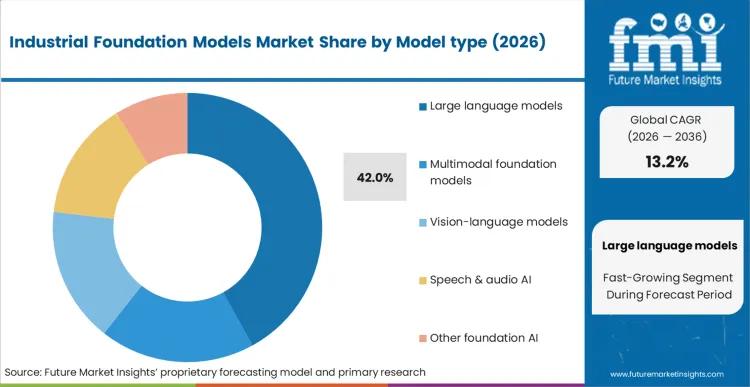
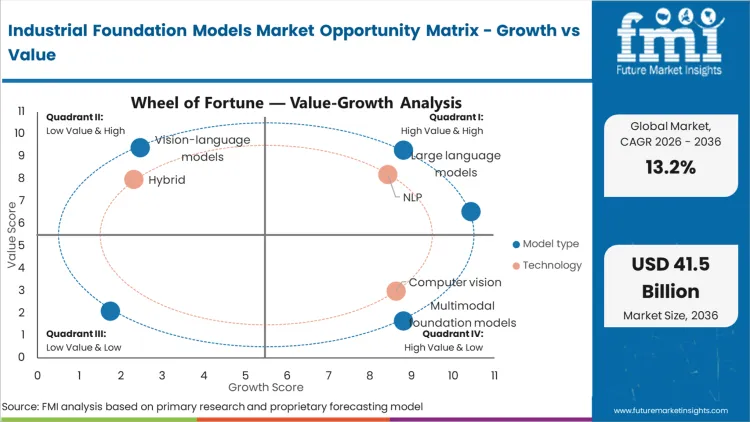
Large language models (LLMs) capture a 42% share in 2026, reflecting the immediate operational necessity of conversational interfaces for unstructured data retrieval. Factory operators rely on generative AI frameworks to bypass complex SQL queries when interacting with legacy maintenance logs. Procurement teams specify these connective architectures to prevent data fragmentation across discrete software suites. Buyers demanding unified operational visibility prioritize vendors offering seamless integration with established workplace productivity tools.
- Technical Validation: Enterprise software providers embed bidirectional APIs to ensure models read and write accurately across ERP systems.
- Process Compatibility: Plant managers avoid capital expenditure on extensive interface training by adopting natural language querying.
- Supplier Positioning: Vendors demonstrate provable reduction in hallucination rates during complex technical documentation retrieval.
Industrial Foundation Models Market Analysis by Technology
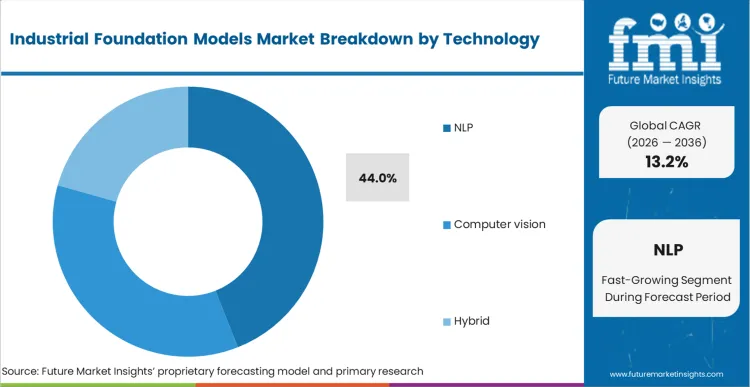
NLP dominates the technology segment with a 44% share in 2026, driven by the urgency to automate text-heavy compliance reporting and technical documentation. Honeywell unveiled an AI assistant for industrial operators in February 2025 [9], demonstrating how natural language interfaces compress the time required to diagnose equipment failures. Facilities prioritize vendors that deliver deterministic, auditable text outputs for regulatory environments. Incorporating Natural Language Processing (NLP) ensures that frontline workers can query manuals without specialized database training. Organizations lacking these capabilities face protracted downtime during complex mechanical diagnostic procedures.
- Product Innovation: Equipment manufacturers release specialized assistants trained exclusively on proprietary machinery schematics.
- Adoption Acceleration: Operators face high turnover rates and require immediate knowledge transfer to junior technicians.
- Requalification cycles: Buyers mandate rigorous proof-of-concept trials to verify terminology accuracy in distinct industrial contexts.
Industrial Foundation Models Market Analysis by Deployment Type
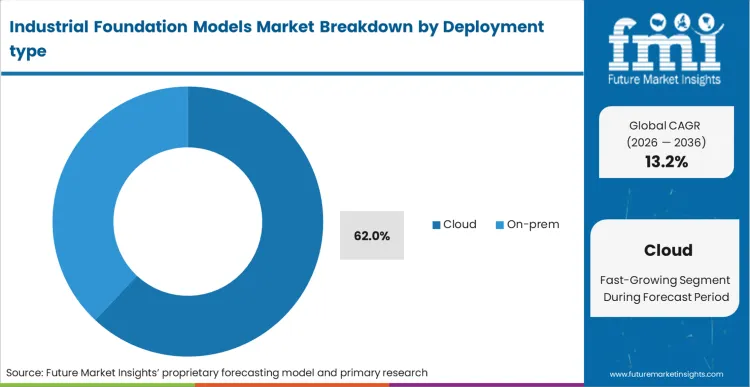
Cloud configurations account for 62% of segment share in 2026, reflecting the massive computational resources required to host and update billion-parameter architectures. FMI analysts opine that IT directors centralize telemetry within cloud data warehouses to enable continuous model fine-tuning without localized hardware constraints. Deploying AI in IOT applications via cloud infrastructure allows distributed manufacturing networks to share a unified analytical baseline. Procurement officers who attempt to run extensive pre-training on-premises face severe hardware acquisition delays.
- Logistics Advantage: Centralized cloud hosting eliminates the need for site-specific hardware deployments across global factory networks.
- Cost Structures: Hyperscalers adjust API pricing models based on token consumption rather than flat enterprise licensing.
- Procurement Shifts: Security mandates increasingly require virtual private cloud implementations rather than multi-tenant public environments.
Industrial Foundation Models Market Analysis by Application
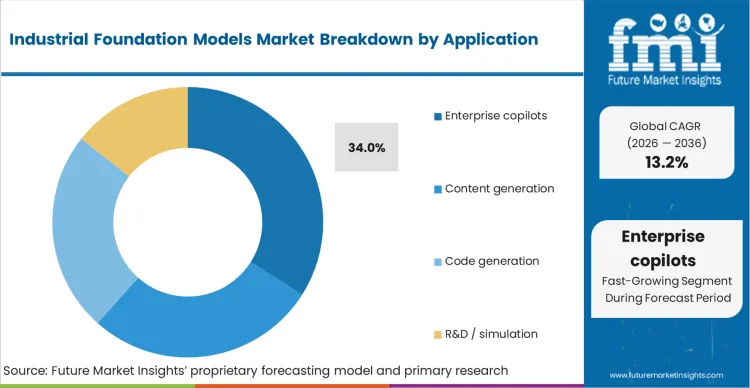
Enterprise copilots command 34% of the volume in 2026 as manufacturers seek to augment engineering workflows without replacing human oversight. ABB launched My Measurement Assistant+ leveraging generative AI for device troubleshooting in March 2025 [12], establishing a baseline expectation that industrial hardware includes native AI guidance. Organizations deploying Edge AI for smart manufacturing tools specify these assistants to reduce reliance on centralized technical support desks. All software vendors compete strictly on the contextual awareness of their copilots within specific vertical industries. Buyers who delay integration risk widening the productivity gap between digitally augmented and legacy engineering teams.
- Dietary Compliance: Data governance protocols force a transition away from public web-scraping toward walled-garden knowledge bases.
- Volume Concentration: Platforms capable of ingesting proprietary CAD files and producing verified structural recommendations.
- Cost Structures: Engineering firms evaluate subscription models strictly against measurable reductions in drafting and diagnostic times.
Industrial Foundation Models Market Drivers, Restraints, and Opportunities
A pronounced deficit in specialized operational technology personnel forces enterprise manufacturers to substitute manual coding with automated generation. The UK government reported that approximately 16% of UK businesses are currently using at least one AI technology [4], an adoption rate primarily driven by the need to bridge these exact capability gaps. FMI analysts opine that production lines adapt to these novel digital assistants rapidly to ensure operational continuity. Mid-market operators that fail to implement foundational code-generation tooling face severe project delays as senior engineering talent becomes critically scarce.
Energy consumption requirements restrict the rapid scaling of continuous model training across enterprise networks. Industrial processors holding local utility agreements must throttle processing workloads during peak pricing windows. Buyers mitigate this exposure by shifting toward parameter-efficient small language models that execute specific tasks without requiring massive, persistent cloud to compute loads.
- Edge Deployment Localization: Industrial operators mandate lightweight models capable of executing anomaly detection directly on physical hardware. Siemens and NVIDIA expanded their partnership to build an industrial AI operating system [2].
- Predictive Maintenance Overhaul: Asset-heavy firms replace scheduled servicing with dynamic, telemetry-driven interventions. PTC released its ServiceMax AI field service assistant [13].
- Federated Training Networks: Consortia invest in collaborative architectures that preserve proprietary data privacy while improving baseline accuracy. The National Science Foundation reported a USD 100 million investment in National AI Research Institutes [16].
Regional Analysis
.webp "Top Country Growth Comparison Industrial Foundation Models Market Cagr (2026 2036)")
Based on the regional analysis, the Industrial Foundation Models market is segmented into North America, Latin America, Europe, East Asia, South Asia, Oceania and Middle East & Africa across 40+ countries. The full report also offers market attractiveness analysis based on regional trends.
| Country | CAGR (2026 to 2036) |
|---|---|
| India | 20.0% |
| China | 19.0% |
| USA | 17.0% |
| South Korea | 15.0% |
| Germany | 14.0% |
| UK | 13.0% |
| Japan | 12.0% |
Source: Future Market Insights (FMI) analysis, based on proprietary forecasting model and primary research
Asia Pacific Industrial Foundation Models Market Analysis
Asia Pacific's commercialization pace is defined by rapid state-backed industrial digitization confronting severe compute infrastructure deficits. Operators prioritize the deployment of localized, cost-effective models designed specifically for high-volume manufacturing environments. The World Economic Forum dataset covers 1,000+ employers representing 14M+ workers [5], highlighting the massive scale of workforce transition required across the region. The domestic software providers focus heavily on computer vision and defect detection applications to maintain export quality standards. Procurement directors must secure specialized hardware supply chains well before 2028 to avoid the processing bottlenecks that currently penalize late adopters in the sector.
- India: IT service providers navigating margin compression are rapidly deploying automated code generation to service global contracts, pushing the market for industrial foundation models in India to forecast a CAGR of 20.0% through 2036. The USA Census story notes rapid increases in AI usage reporting [18], a trend mirrored in offshore service hubs adopting identical tooling. Service integrators must upgrade their underlying network infrastructure to support continuous model access or face contract losses to more automated competitors.
- China: National mandates for technological self-sufficiency force domestic cloud providers to isolate proprietary training methodologies from Western architectures. China is expected to see its industrial foundation models sector grow at a CAGR of 19.0% over the forecast period. Buyers must transition to approved domestic model frameworks before impending cybersecurity audits to restrict cross-border data routing.
- Japan: The ILO reported 1 in 4 jobs worldwide is potentially exposed to GenAI [10], which aligns with Japanese efforts to aggressively automate routine engineering tasks. Aging demographic profiles strictly limit the availability of manual inspection personnel across legacy automotive plants, putting sales of industrial foundation models in Japan on track to record a CAGR of 12.0% from 2026 to 2036. Manufacturing leaders must implement multi-modal simulation tools to capture retiring worker knowledge before institutional expertise is permanently lost.
- South Korea: A CAGR of 15.0% is expected for industrial foundation models in South Korea over the forecast period. Heavy industrial conglomerates are integrating natural language querying directly into shipbuilding and semiconductor fabrication management systems. IT directors without verified data warehousing capabilities cannot deploy these foundational architectures at the scale required for global competitiveness.
FMI's report includes a comprehensive evaluation of the Asia Pacific landscape, detailing how specific hardware constraints impact model selection across ASEAN and Oceania. Operators in Vietnam and Thailand evaluate foundational architectures strictly based on their ability to function within low-bandwidth, high-latency network conditions.
North America Industrial Foundation Models Market Analysis
North America functions as the technical proving ground for advanced, multi-modal systems under strict data security and compliance rules. Defense contractors and critical infrastructure operators demand models capable of parsing legacy schematics without exposing intellectual property to public clouds. The National Institute of Standards and Technology reported it is investing USD 20 million to establish two centers for AI in manufacturing and critical infrastructure [3]. FMI analysts opine that this institutional backing establishes rigorous new baseline requirements for cybersecurity and deterministic output accuracy.
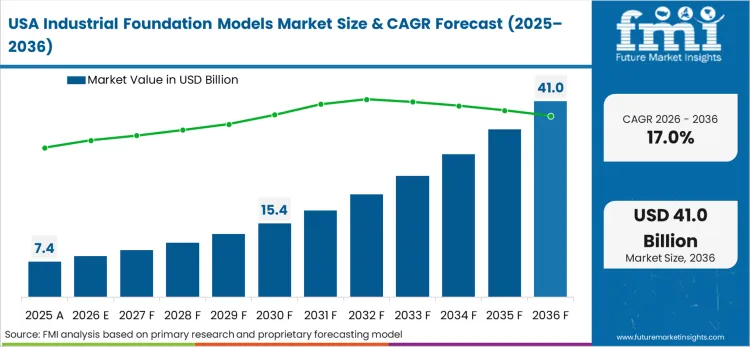
- USA: Hyperscale cloud providers dictate the pace of integration by releasing pre-configured industrial environments directly to enterprise clients. Demand for industrial foundation models in the USA is estimated to expand at a CAGR of 17.0% through 2036. The IEA projects global data centre electricity use will reach approximately 945 TWh by 2030 [1], creating severe energy provisioning challenges for new domestic training facilities. Facilities managers without guaranteed, long-term power purchase agreements face immediate capacity rationing that halts large-scale deployments.
FMI's report includes granular tracking of the North American environment, mapping how compute availability limits shape procurement strategies across Canada and Mexico. Automotive suppliers in Mexico prioritize parameter-efficient models that can operate securely on edge servers without requiring constant round-trip communication to US-based hyperscale facilities.
Europe Industrial Foundation Models Market Analysis
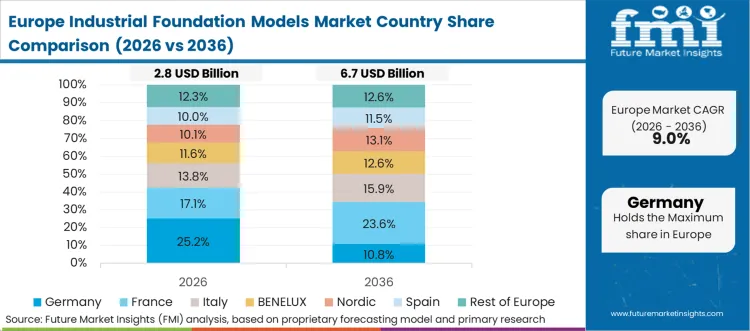
Europe's integration strategy is heavily constrained by strict sovereign data mandates and rigorous environmental reporting requirements. Processors evaluate foundation architectures based on their auditability and the geographic location of their host servers. The Office for National Statistics reported that 23% of businesses were using AI in late Sept 2025 [6], indicating a transition from pilot phases into structured enterprise integration. The vendors must differentiate through transparent training data provenance rather than sheer parameter volume.
- Germany: Germany's industrial foundation models industry is expected to demonstrate a CAGR of 14.0% through 2036. Deep integration into legacy operational technology hardware forces vendors to build specialized connectors for standard industrial protocols. The IEA reports renewables supply approximately 27% of electricity consumed by data centres globally [15], a metric heavily scrutinized by German manufacturing boards enforcing strict ESG mandates. Software vendors must certify the carbon footprint of their model execution processes to qualify for Tier-1 automotive procurement contracts.
- UK: Disparate adoption rates across sectors expose severe vulnerabilities in baseline technical training. The UK AI Labour Market Survey reported that 97% of respondents identified at least one AI skills gap [17]. The industrial foundation models' space in the UK is forecast to observe a CAGR of 13.0% during the assessment period. Procurement directors face a hard operational barrier and must mandate managed orchestration services, rather than raw APIs, to compensate for the lack of internal engineering talent.
FMI's report includes extensive coverage of the European regulatory ecosystem, charting how the AI Act influences deployment timelines in France and Italy. Heavy industrial operators in these jurisdictions prioritize hybrid deployment architectures to keep sensitive telemetry data strictly isolated from public cloud ingestion pathways.
Competitive Aligners for Market Players
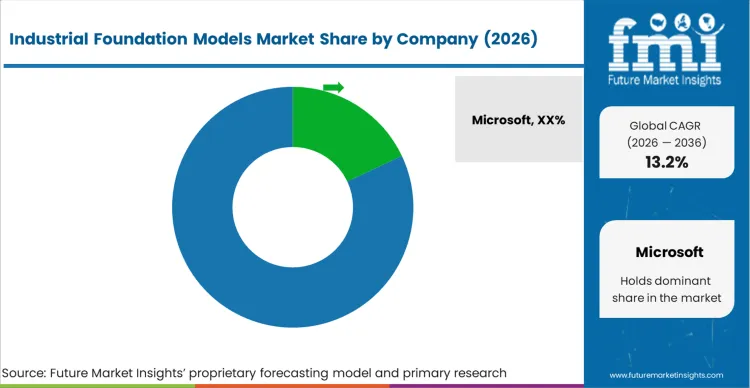
Technological capability differentiates premium platforms from commoditized API wrappers. Companies holding intellectual property for verifiable retrieval-augmented generation command higher margins by delivering deterministic answers to engineers. Databricks announced its intent to acquire Neon to support AI-native systems and AI agents [7], validating that orchestration and reliability constitute the primary barriers to entry for enterprise deployment. Buyers navigating this landscape must audit vendor methodologies for hallucination suppression before integrating models into critical control systems.
Strategic alliances and ecosystem integrations determine long-term commercial survivability. Standalone model providers face severe distribution disadvantages against hyperscalers that embed foundational capabilities directly into existing enterprise resource planning software. Software procurement officers evaluate new vendor proposals strictly on their ability to interface natively with established identity management and productivity environments.
Capacity constraints and compute provisioning dictate delivery timelines for extensive on-premises deployments. Vendors that secure dedicated hardware pipelines maintain a structural advantage over competitors reliant on spot-market GPU availability. Operators must lock in multi-year service agreements to insulate their operations from anticipated shortages in specialized processing hardware.
Recent Developments
The report includes full coverage of key trends from competitive benchmarking. Some of the recent developments covered in the reports:
- In January 2026, SAP announced bidirectional integration between Joule and Microsoft 365 Copilot to unify enterprise functionality. [8]
- In January 2026, Snowflake announced its intent to acquire Observe to deliver AI-powered observability at enterprise scale. [11]
Key Players in Industrial Foundation Models Market
- Microsoft
- Amazon Web Services
- Meta Platforms
- Alibaba Cloud
- IBM
- NVIDIA
- Siemens
- Schneider Electric
- Databricks
- Snowflake
- SAP
Scope of the Report
| Metric | Value |
|---|---|
| Quantitative Units | USD 12 billion (2026) to USD 22.5 billion (2036), at a CAGR of 13.20% |
| Market Definition | A class of large-scale, pre-trained generative artificial intelligence architectures engineered specifically to process industrial telemetry, manufacturing data, and enterprise code bases. |
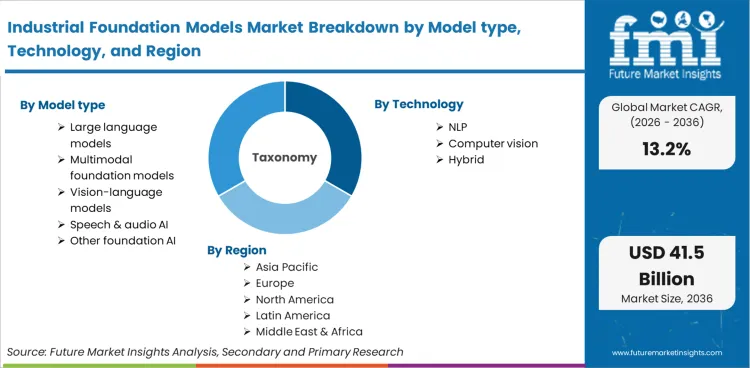
| Model type Segmentation | Large language models (LLMs), Multimodal foundation models, Vision-language models, Speech & audio AI, Other foundation AI |
| Technology Segmentation | NLP, Computer vision, Hybrid |
| Deployment type Segmentation | Cloud, On-prem |
| Application Segmentation | Enterprise copilots, Content generation, Code generation, R&D / simulation |
| Regions Covered | North America, Latin America, Europe, East Asia, South Asia, Oceania, Middle East and Africa |
| Countries Covered | United States, Canada, Mexico, Brazil, Argentina, Germany, France, United Kingdom, Italy, Spain, China, India, Japan, South Korea, Indonesia, Australia and 40 plus countries |
| Key Companies Profiled | Microsoft, Google, Amazon Web Services, Meta Platforms, Alibaba Cloud, IBM, NVIDIA |
| Forecast Period | 2026 to 2036 |
| Approach | Hybrid top-down and bottom-up market modeling validated through primary interviews with IT architects and facility managers. |
Source: Future Market Insights (FMI) analysis, based on proprietary forecasting model and primary research
Segmental Analysis
Model type:
- Large language models (LLMs)
- Multimodal foundation models
- Vision-language models
- Speech & audio AI
- Other foundation AI
Technology:
- NLP
- Computer vision
- Hybrid
Deployment type:
- Cloud
- On-prem
Application:
- Enterprise copilots
- Content generation
- Code generation
- R&D / simulation
End use industry:
- IT & telecom
- BFSI
- Healthcare
- Manufacturing
- Public sector & others
Region:
- Asia Pacific
- India
- China
- Japan
- South Korea
- Indonesia
- Australia & New Zealand
- ASEAN
- Rest of Asia Pacific
- Europe
- Germany
- Italy
- France
- United Kingdom
- Spain
- Benelux
- Nordics
- Central & Eastern Europe
- Rest of Europe
- North America
- United States
- Canada
- Mexico
- Latin America
- Brazil
- Argentina
- Chile
- Rest of Latin America
- Middle East & Africa
- Kingdom of Saudi Arabia
- United Arab Emirates
- South Africa
- Turkey
- Rest of Middle East & Africa
Bibliography
- [1] International Energy Agency (IEA). (2025, April 10). Energy demand from AI (Government report).
- [2] Siemens. (2026, January 06). Siemens and NVIDIA expand partnership to build an industrial AI operating system (Press release).
- [3] National Institute of Standards and Technology (NIST). (2025, December 22). NIST launches centers for AI in manufacturing and critical infrastructure (Government report).
- [4] UK Government. (2026, February 13). AI adoption research (Government report).
- [5] World Economic Forum (WEF). (2025, January). The future of jobs report 2025 (Industry report).
- [6] Office for National Statistics (ONS). (2025, October 02). Business insights and impact on the UK economy (Government report).
- [7] Databricks. (2025, May 14). Databricks agrees to acquire Neon (Press release).
- [8] SAP. (2026, January 14). SAP business AI release highlights (Press release).
- [9] Honeywell. (2025, February 11). Honeywell unveils innovative AI assistant (Press release).
- [10] International Labour Organization (ILO). (2025, May 20). Generative AI and jobs (Government report).
- [11] Snowflake. (2026, January 08). Snowflake announces intent to acquire Observe (Press release).
- [12] ABB. (2025, March 25). ABB simplifies industrial device maintenance with generative AI (Press release).
- [13] PTC. (2025, February 12). PTC launches ServiceMax AI (Press release).
- [14] ServiceNow. (2025, January 29). ServiceNow announces new agentic AI innovations (Press release).
- [15] International Energy Agency (IEA). (2025, April). Energy supply for AI (Government report).
- [16] National Science Foundation (NSF). (2026, January 15). NSF keeping US scientific research cutting edge (Government report).
- [17] UK Government. (2025, January). UK AI labour market survey (Government report).
- [18] USA Census Bureau. (2025, September 17). Technology impact (Government report).
This bibliography is provided for reader reference and is not exhaustive. The full report contains the complete reference list and detailed citations.
This Report Addresses
- Market size estimation and revenue forecasts from 2026 to 2036, supported by validated capacity and deployment benchmarks across major hyperscale computing hubs.
- Growth opportunity mapping across cloud and on-premises architectures with emphasis on deterministic industrial control integration.
- Segment and regional revenue forecasts covering critical applications like code generation, predictive maintenance, and operational simulations.
- Competition strategy assessment including alliance integration models, latency survivability positioning, and process capability benchmarking.
- Product requirement tracking covering key metrics such as hallucination suppression, token cost efficiency, and legacy systems interfacing.
- Regulatory impact analysis evaluating strict sovereign data mandates, safety protocols, and cross-border telemetry transmission guidelines.
- Market report delivery in PDF, Excel, PPT, and interactive dashboard formats for executive and operational use.
Frequently Asked Questions
How large is the demand for Industrial Foundation Models in the global market in 2026?
Demand for Industrial Foundation Models in the global market is estimated to be valued at USD 12 billion in 2026.
What will be the market size of Industrial Foundation Models in the global market by 2036?
Market size for Industrial Foundation Models is projected to reach USD 22.5 billion by 2036.
What is the expected demand growth for Industrial Foundation Models in the global market between 2026 and 2036?
Demand for Industrial Foundation Models is expected to grow at a CAGR of 13.20% between 2026 and 2036.
Which model type is poised to lead global sales by 2026?
Large language models (LLMs) command 42% in 2026 as organizations prioritize conversational retrieval for unstructured legacy documentation.
How significant is the role of IT & telecom in driving Industrial Foundation Models adoption in 2026?
IT & telecom represents 32.00% of segment share as service providers deploy automated code generation across massive offshore operational hubs.
What is driving demand in India?
Strict mandates for cost-efficient IT outsourcing execution drive the mass scaling of foundational code generation tools.
What compliance standards or regulations are referenced for India?
Network bandwidth provisions and infrastructure scaling protocols govern domestic integration capabilities.
What is the India growth outlook in this report?
India is projected to grow at a CAGR of 20.0% during 2026 to 2036.
Why is North America described as a priority region in this report?
Aggressive defense and critical infrastructure modernization investments force the implementation of localized, secure multi-modal environments.
What type of demand dominates in North America?
Deterministic output validation and isolated on-premises implementations dominate regional deployment demands.
What is China's growth outlook in this report?
China is projected to expand at a CAGR of 19.0% during 2026 to 2036.
Does the report cover the United States in its regional analysis?
Yes, the United States is included within North America under the regional scope of analysis.
What are the sources referred to for analyzing the United States?
Energy capacity projections from the IEA and corporate ecosystem announcements form the analytical baseline.
What is the main demand theme linked to the United States in its region coverage?
Energy provisioning constraints directly restrict the mass deployment of hardware required for continuous architectural pre-training.
Does the report cover the United Kingdom in its regional analysis?
Yes, the United Kingdom is included within Europe under the regional coverage framework.
What is the main United Kingdom related demand theme in its region coverage?
Severe domestic engineering skills gaps force the procurement of managed orchestration layers over raw software components.
Which product formats or configurations are strategically important for Asia Pacific supply chains?
Cost-efficient computer vision models operating natively on edge servers remain highly strategic.
What are Industrial Foundation Models and what are they mainly used for?
They are massive pre-trained neural networks used to automate code, parse text, and manage operational anomalies natively.
What does Industrial Foundation Models mean in this report?
The market refers to the commercial licensing and enterprise integration of large-scale AI architectures for factory and IT environments.
What is included in the scope of this Industrial Foundation Models report?
The scope includes proprietary model licenses, integration layers, and specialized APIs intended specifically for corporate integration.
What is excluded from the scope of this report?
General consumer chatbots, raw processing hardware, and rudimentary single-task algorithms without underlying foundational training are excluded.
What does market forecast mean on this page?
The market forecast represents a model-based projection built on defined technological integration and capacity constraints for strategic planning purposes.
How does FMI build and validate the Industrial Foundation Models forecast?
Forecasts combine top-down server capacity figures with bottom-up software licensing metrics, validated by primary IT architect interviews.
What does zero reliance on speculative third-party market research mean here?
Primary interviews, verified integration logs, and official government computing datasets are used exclusively instead of unverified syndicated estimates.
Preview the report firsthand - request a free sample
Get SampleGet the brochure for pricing and purchase details.
Get PDFTable of Content
- Executive Summary
- Global Market Outlook
- Demand-side Trends
- Supply-side Trends
- Technology Roadmap Analysis
- Analysis and Recommendations
- Market Overview
- Market Coverage / Taxonomy
- Market Definition / Scope / Limitations
- Research Methodology
- Chapter Orientation
- Analytical Lens and Working Hypotheses
- Market Structure, Signals, and Trend Drivers
- Benchmarking and Cross-market Comparability
- Market Sizing, Forecasting, and Opportunity Mapping
- Research Design and Evidence Framework
- Desk Research Programme (Secondary Evidence)
- Company Annual and Sustainability Reports
- Peer-reviewed Journals and Academic Literature
- Corporate Websites, Product Literature, and Technical Notes
- Earnings Decks and Investor Briefings
- Statutory Filings and Regulatory Disclosures
- Technical White Papers and Standards Notes
- Trade Journals, Industry Magazines, and Analyst Briefs
- Conference Proceedings, Webinars, and Seminar Materials
- Government Statistics Portals and Public Data Releases
- Press Releases and Reputable Media Coverage
- Specialist Newsletters and Curated Briefings
- Sector Databases and Reference Repositories
- FMI Internal Proprietary Databases and Historical Market Datasets
- Subscription Datasets and Paid Sources
- Social Channels, Communities, and Digital Listening Inputs
- Additional Desk Sources
- Expert Input and Fieldwork (Primary Evidence)
- Primary Modes
- Qualitative Interviews and Expert Elicitation
- Quantitative Surveys and Structured Data Capture
- Blended Approach
- Why Primary Evidence is Used
- Field Techniques
- Observational and In-context Research
- Social and Community Interactions
- Stakeholder Universe Engaged
- C-suite Leaders
- Board Members
- Presidents and Vice Presidents
- R&D and Innovation Heads
- Technical Specialists
- Domain Subject-matter Experts
- Scientists
- Physicians and Other Healthcare Professionals
- Governance, Ethics, and Data Stewardship
- Research Ethics
- Data Integrity and Handling
- Primary Modes
- Tooling, Models, and Reference Databases
- Desk Research Programme (Secondary Evidence)
- Data Engineering and Model Build
- Data Acquisition and Ingestion
- Cleaning, Normalisation, and Verification
- Synthesis, Triangulation, and Analysis
- Quality Assurance and Audit Trail
- Market Background
- Market Dynamics
- Drivers
- Restraints
- Opportunity
- Trends
- Scenario Forecast
- Demand in Optimistic Scenario
- Demand in Likely Scenario
- Demand in Conservative Scenario
- Opportunity Map Analysis
- Product Life Cycle Analysis
- Supply Chain Analysis
- Investment Feasibility Matrix
- Value Chain Analysis
- PESTLE and Porter’s Analysis
- Regulatory Landscape
- Regional Parent Market Outlook
- Production and Consumption Statistics
- Import and Export Statistics
- Market Dynamics
- Global Market Analysis 2021 to 2025 and Forecast, 2026 to 2036
- Historical Market Size Value (USD Million) Analysis, 2021 to 2025
- Current and Future Market Size Value (USD Million) Projections, 2026 to 2036
- Y-o-Y Growth Trend Analysis
- Absolute $ Opportunity Analysis
- Global Market Pricing Analysis 2021 to 2025 and Forecast 2026 to 2036
- Global Market Analysis 2021 to 2025 and Forecast 2026 to 2036, By Model type
- Introduction / Key Findings
- Historical Market Size Value (USD Million) Analysis By Model type , 2021 to 2025
- Current and Future Market Size Value (USD Million) Analysis and Forecast By Model type , 2026 to 2036
- Large language models
- Multimodal foundation models
- Vision-language models
- Speech & audio AI
- Other foundation AI
- Large language models
- Y-o-Y Growth Trend Analysis By Model type , 2021 to 2025
- Absolute $ Opportunity Analysis By Model type , 2026 to 2036
- Global Market Analysis 2021 to 2025 and Forecast 2026 to 2036, By Technology
- Introduction / Key Findings
- Historical Market Size Value (USD Million) Analysis By Technology, 2021 to 2025
- Current and Future Market Size Value (USD Million) Analysis and Forecast By Technology, 2026 to 2036
- NLP
- Computer vision
- Hybrid
- NLP
- Y-o-Y Growth Trend Analysis By Technology, 2021 to 2025
- Absolute $ Opportunity Analysis By Technology, 2026 to 2036
- Global Market Analysis 2021 to 2025 and Forecast 2026 to 2036, By Deployment type
- Introduction / Key Findings
- Historical Market Size Value (USD Million) Analysis By Deployment type, 2021 to 2025
- Current and Future Market Size Value (USD Million) Analysis and Forecast By Deployment type, 2026 to 2036
- Cloud
- On-prem
- Cloud
- Y-o-Y Growth Trend Analysis By Deployment type, 2021 to 2025
- Absolute $ Opportunity Analysis By Deployment type, 2026 to 2036
- Global Market Analysis 2021 to 2025 and Forecast 2026 to 2036, By Application
- Introduction / Key Findings
- Historical Market Size Value (USD Million) Analysis By Application, 2021 to 2025
- Current and Future Market Size Value (USD Million) Analysis and Forecast By Application, 2026 to 2036
- Enterprise copilots
- Content generation
- Code generation
- R&D / simulation
- Enterprise copilots
- Y-o-Y Growth Trend Analysis By Application, 2021 to 2025
- Absolute $ Opportunity Analysis By Application, 2026 to 2036
- Global Market Analysis 2021 to 2025 and Forecast 2026 to 2036, By Region
- Introduction
- Historical Market Size Value (USD Million) Analysis By Region, 2021 to 2025
- Current Market Size Value (USD Million) Analysis and Forecast By Region, 2026 to 2036
- North America
- Latin America
- Western Europe
- Eastern Europe
- East Asia
- South Asia and Pacific
- Middle East & Africa
- Market Attractiveness Analysis By Region
- North America Market Analysis 2021 to 2025 and Forecast 2026 to 2036, By Country
- Historical Market Size Value (USD Million) Trend Analysis By Market Taxonomy, 2021 to 2025
- Market Size Value (USD Million) Forecast By Market Taxonomy, 2026 to 2036
- By Country
- USA
- Canada
- Mexico
- By Model type
- By Technology
- By Deployment type
- By Application
- By Country
- Market Attractiveness Analysis
- By Country
- By Model type
- By Technology
- By Deployment type
- By Application
- Key Takeaways
- Latin America Market Analysis 2021 to 2025 and Forecast 2026 to 2036, By Country
- Historical Market Size Value (USD Million) Trend Analysis By Market Taxonomy, 2021 to 2025
- Market Size Value (USD Million) Forecast By Market Taxonomy, 2026 to 2036
- By Country
- Brazil
- Chile
- Rest of Latin America
- By Model type
- By Technology
- By Deployment type
- By Application
- By Country
- Market Attractiveness Analysis
- By Country
- By Model type
- By Technology
- By Deployment type
- By Application
- Key Takeaways
- Western Europe Market Analysis 2021 to 2025 and Forecast 2026 to 2036, By Country
- Historical Market Size Value (USD Million) Trend Analysis By Market Taxonomy, 2021 to 2025
- Market Size Value (USD Million) Forecast By Market Taxonomy, 2026 to 2036
- By Country
- Germany
- UK
- Italy
- Spain
- France
- Nordic
- BENELUX
- Rest of Western Europe
- By Model type
- By Technology
- By Deployment type
- By Application
- By Country
- Market Attractiveness Analysis
- By Country
- By Model type
- By Technology
- By Deployment type
- By Application
- Key Takeaways
- Eastern Europe Market Analysis 2021 to 2025 and Forecast 2026 to 2036, By Country
- Historical Market Size Value (USD Million) Trend Analysis By Market Taxonomy, 2021 to 2025
- Market Size Value (USD Million) Forecast By Market Taxonomy, 2026 to 2036
- By Country
- Russia
- Poland
- Hungary
- Balkan & Baltic
- Rest of Eastern Europe
- By Model type
- By Technology
- By Deployment type
- By Application
- By Country
- Market Attractiveness Analysis
- By Country
- By Model type
- By Technology
- By Deployment type
- By Application
- Key Takeaways
- East Asia Market Analysis 2021 to 2025 and Forecast 2026 to 2036, By Country
- Historical Market Size Value (USD Million) Trend Analysis By Market Taxonomy, 2021 to 2025
- Market Size Value (USD Million) Forecast By Market Taxonomy, 2026 to 2036
- By Country
- China
- Japan
- South Korea
- By Model type
- By Technology
- By Deployment type
- By Application
- By Country
- Market Attractiveness Analysis
- By Country
- By Model type
- By Technology
- By Deployment type
- By Application
- Key Takeaways
- South Asia and Pacific Market Analysis 2021 to 2025 and Forecast 2026 to 2036, By Country
- Historical Market Size Value (USD Million) Trend Analysis By Market Taxonomy, 2021 to 2025
- Market Size Value (USD Million) Forecast By Market Taxonomy, 2026 to 2036
- By Country
- India
- ASEAN
- Australia & New Zealand
- Rest of South Asia and Pacific
- By Model type
- By Technology
- By Deployment type
- By Application
- By Country
- Market Attractiveness Analysis
- By Country
- By Model type
- By Technology
- By Deployment type
- By Application
- Key Takeaways
- Middle East & Africa Market Analysis 2021 to 2025 and Forecast 2026 to 2036, By Country
- Historical Market Size Value (USD Million) Trend Analysis By Market Taxonomy, 2021 to 2025
- Market Size Value (USD Million) Forecast By Market Taxonomy, 2026 to 2036
- By Country
- Kingdom of Saudi Arabia
- Other GCC Countries
- Turkiye
- South Africa
- Other African Union
- Rest of Middle East & Africa
- By Model type
- By Technology
- By Deployment type
- By Application
- By Country
- Market Attractiveness Analysis
- By Country
- By Model type
- By Technology
- By Deployment type
- By Application
- Key Takeaways
- Key Countries Market Analysis
- USA
- Pricing Analysis
- Market Share Analysis, 2025
- By Model type
- By Technology
- By Deployment type
- By Application
- Canada
- Pricing Analysis
- Market Share Analysis, 2025
- By Model type
- By Technology
- By Deployment type
- By Application
- Mexico
- Pricing Analysis
- Market Share Analysis, 2025
- By Model type
- By Technology
- By Deployment type
- By Application
- Brazil
- Pricing Analysis
- Market Share Analysis, 2025
- By Model type
- By Technology
- By Deployment type
- By Application
- Chile
- Pricing Analysis
- Market Share Analysis, 2025
- By Model type
- By Technology
- By Deployment type
- By Application
- Germany
- Pricing Analysis
- Market Share Analysis, 2025
- By Model type
- By Technology
- By Deployment type
- By Application
- UK
- Pricing Analysis
- Market Share Analysis, 2025
- By Model type
- By Technology
- By Deployment type
- By Application
- Italy
- Pricing Analysis
- Market Share Analysis, 2025
- By Model type
- By Technology
- By Deployment type
- By Application
- Spain
- Pricing Analysis
- Market Share Analysis, 2025
- By Model type
- By Technology
- By Deployment type
- By Application
- France
- Pricing Analysis
- Market Share Analysis, 2025
- By Model type
- By Technology
- By Deployment type
- By Application
- India
- Pricing Analysis
- Market Share Analysis, 2025
- By Model type
- By Technology
- By Deployment type
- By Application
- ASEAN
- Pricing Analysis
- Market Share Analysis, 2025
- By Model type
- By Technology
- By Deployment type
- By Application
- Australia & New Zealand
- Pricing Analysis
- Market Share Analysis, 2025
- By Model type
- By Technology
- By Deployment type
- By Application
- China
- Pricing Analysis
- Market Share Analysis, 2025
- By Model type
- By Technology
- By Deployment type
- By Application
- Japan
- Pricing Analysis
- Market Share Analysis, 2025
- By Model type
- By Technology
- By Deployment type
- By Application
- South Korea
- Pricing Analysis
- Market Share Analysis, 2025
- By Model type
- By Technology
- By Deployment type
- By Application
- Russia
- Pricing Analysis
- Market Share Analysis, 2025
- By Model type
- By Technology
- By Deployment type
- By Application
- Poland
- Pricing Analysis
- Market Share Analysis, 2025
- By Model type
- By Technology
- By Deployment type
- By Application
- Hungary
- Pricing Analysis
- Market Share Analysis, 2025
- By Model type
- By Technology
- By Deployment type
- By Application
- Kingdom of Saudi Arabia
- Pricing Analysis
- Market Share Analysis, 2025
- By Model type
- By Technology
- By Deployment type
- By Application
- Turkiye
- Pricing Analysis
- Market Share Analysis, 2025
- By Model type
- By Technology
- By Deployment type
- By Application
- South Africa
- Pricing Analysis
- Market Share Analysis, 2025
- By Model type
- By Technology
- By Deployment type
- By Application
- USA
- Market Structure Analysis
- Competition Dashboard
- Competition Benchmarking
- Market Share Analysis of Top Players
- By Regional
- By Model type
- By Technology
- By Deployment type
- By Application
- Competition Analysis
- Competition Deep Dive
- Microsoft
- Overview
- Product Portfolio
- Profitability by Market Segments (Product/Age /Sales Channel/Region)
- Sales Footprint
- Strategy Overview
- Marketing Strategy
- Product Strategy
- Channel Strategy
- Amazon Web Services
- Meta Platforms
- Alibaba Cloud
- IBM
- NVIDIA
- Siemens
- Schneider Electric
- Databricks
- Snowflake
- SAP
- Microsoft
- Competition Deep Dive
- Assumptions & Acronyms Used


