

- Industry Size (2026)
- USD 4.54 Bn
- Forecast (2036)
- USD 48.3 Bn
- CAGR (2026 to 2036)
- 26.70%
Industrial Copilot Market Size, Market Forecast and Outlook By FMI
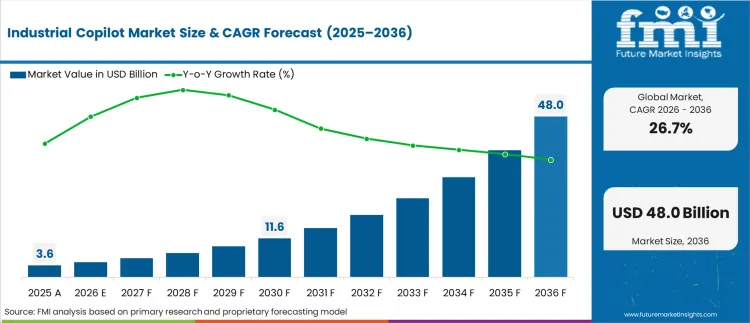
At USD 3.58 billion in 2025, the industrial copilot market is on course for USD 4.54 billion in 2026 and USD 48.3 billion by 2036, a 26.70% CAGR as plant directors replace fragmented dashboard diagnostics with conversational, generative-AI interfaces that execute multi-system queries automatically. This transition from passive monitoring to active, prompt-driven machine intervention addresses immediate workforce attrition pressures. Senior operators retiring over the next decade take undocumented troubleshooting heuristics with them; algorithmic systems capture this tacit knowledge, converting complex programmable logic controller (PLC) fault codes into plain-language resolution steps for junior technicians.
Capital deployment into cognitive automation now yields measurable macroeconomic throughput. The White House Council of Economic Advisers reported that in the first half of 2025 alone, AI-related investment increased United States GDP by an annualized rate of 1.3% [1]. Facility managers interpret this aggregate expansion as a direct mandate to accelerate localized deployment, shifting procurement from experimental pilots to fleet-wide enterprise software agreements.
Aamir Paul, President of North America Operations at Schneider Electric (May 2025), opined, “To enhance US competitiveness and address the growing skills gap, the industrial workforce needs new tools. Our copilot, developed in collaboration with Microsoft, bridges this gap by simplifying processes and boosting worker confidence. It ensures that engineers and operators can leverage Schneider Electric's deep domain expertise to bring systems online faster and optimize them for long-term success.” [2] This executive validation signals a definitive shift in procurement rationale: AI assistants are no longer marketed solely as optimization engines, but as critical workforce enablement tools. Human resources and operations directors must jointly fund these deployments to bridge the technical skills gap, forcing automation vendors to compete on user-interface intuitiveness rather than pure algorithmic complexity over the 2026 to 2036 cycle.
Summary of Industrial Copilot Market
- Industrial Copilot Market Definition
- A generative AI-powered software assistant embedded within industrial control systems, manufacturing execution systems (MES), or enterprise resource planning (ERP) platforms that translates natural language queries into executable operational, diagnostic, and engineering commands.
- Demand Drivers in the Market
- Severe shortages of specialized automation engineers compel facilities to deploy AI overlays that guide junior technicians through complex PLC troubleshooting.
- Escalating unplanned downtime costs force manufacturers to transition from reactive maintenance to AI-prescribed predictive interventions.
- The integration of large language models (LLMs) with proprietary machine data securely within on-premise environments alleviates corporate data privacy concerns.
- Key Segments Analyzed in the Report
- Software subscriptions command the revenue base (66.00%), reflecting the industry transition toward continuous-update SaaS models over static licensing.
- Manufacturing dominates end-use applications (45.00%), driven by the immediate return on investment realized in high-speed assembly and defect detection workflows.
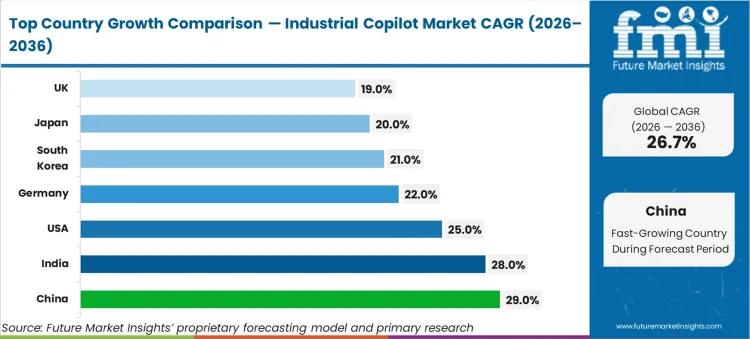
- China (29.00% CAGR) and India (28.00% CAGR) outpace Western counterparts by bypassing legacy integration phases and directly embedding cloud-native AI infrastructures.
- Analyst Opinion at FMI
- Nikhil Kaitwade, Principal Consultant for Industrial Automation, opines, 'We observe that successful industrial copilot integration hinges entirely on context grounding. Generic LLMs fail on the factory floor; models explicitly trained on a facility's distinct historical fault logs and digital twin telemetry are securing the enterprise-level contracts. Vendors failing to provide seamless API connections to legacy SCADA systems face immediate disqualification during vendor shortlisting.'
- Strategic Implications / Executive Takeaways
- Mandate localized, on-premise model hosting options during vendor selection to satisfy strict industrial data sovereignty requirements.
- Prioritize copilots that offer bidirectional capability not just reading machine states but safely writing optimized parameters back to the control loop.
- Restructure maintenance training programs around prompt engineering and AI-assisted diagnostics to maximize software ROI.
- Methodology
- Validated through first-hand corporate production and capacity data.
- Zero reliance on speculative third-party market research reports.
- Based on verifiable industrial benchmarks and verified sources.
Driven by state-backed automation initiatives and aggressive digital infrastructure scaling, China (29.00%) and India (28.00%) dictate the highest regional expansion rates as emerging manufacturing hubs adopt cognitive tools natively. The United States (25.00%) and Germany (22.00%) leverage mature Industry 4.0 foundations to upgrade existing operational technology architectures. South Korea (21.00%), Japan (20.00%), and the United Kingdom (19.00%) cluster as sophisticated adopters where aging workforce demographics compel the deployment of engineering and maintenance copilots to preserve institutional knowledge and sustain production yields.
Industrial Copilot Market Definition
An industrial copilot is a generative artificial intelligence interface integrated directly into industrial software ecosystems such as SCADA, MES, or product lifecycle management (PLM) platforms designed to interpret natural language, synthesize machine telemetry, and automate complex engineering or operational tasks. These systems utilize specialized, domain-grounded large language models to assist human operators in code generation, predictive maintenance diagnostics, and real-time process optimization without requiring advanced programming syntax.
Industrial Copilot Market Inclusions
The market encompasses conversational AI agents deployed via cloud environments or localized edge servers specifically configured for industrial applications. This includes API-driven diagnostic assistants, generative design engineering plugins, operations-focused natural language processing (NLP) dashboards, and the accompanying subscription models or integration services required to maintain model accuracy against proprietary enterprise data.
Industrial Copilot Market Exclusions
The scope strictly excludes generic, consumer-grade large language models that lack native connectivity to industrial control protocols or operational technology (OT) networks. Hardware components such as industrial PCs, standalone PLCs, and physical robotic systems are excluded unless revenue is explicitly derived from an embedded generative AI software subscription. Traditional, rules-based advanced process control (APC) software lacking generative or conversational capabilities is also omitted.
Industrial Copilot Market Research Methodology
- Primary Research: Direct interviews with automation engineering directors, chief digital officers at tier-1 manufacturing firms, and AI integration specialists provided baseline pricing models, deployment preferences, and capacity utilization metrics.
- Desk Research: Custom datasets evaluating enterprise software procurement trends, corporate AI capacity announcements, and industrial patent filings substantiated regional deployment models.
- Market-Sizing and Forecasting: Analysts developed a bottom-up adoption model starting from regional industrial software expenditure, applying historical generative AI penetration ratios to project available enterprise licensing revenues.
- Data Validation and Update Cycle: Findings underwent cross-verification against official tech-sector labor projections and peer-reviewed automation science journals before final forecast integration.
Segmental Market Analysis
Industrial Copilot Market Analysis by Deployment
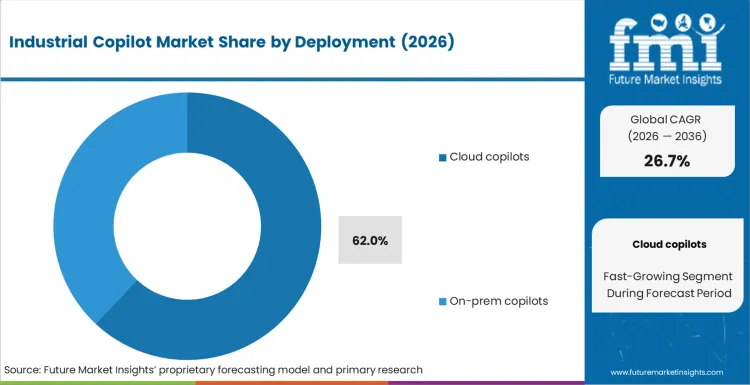
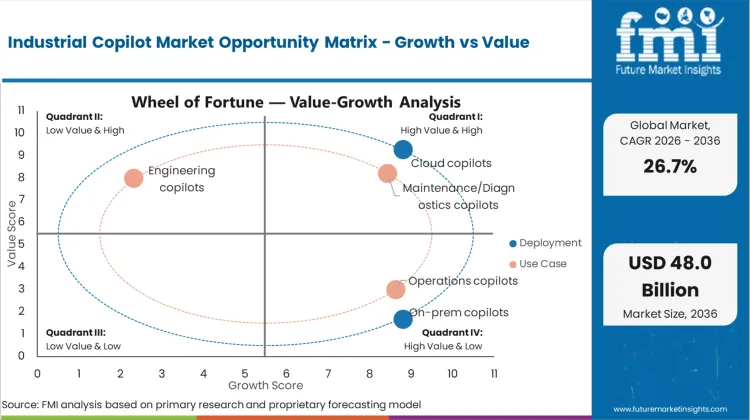
Procurement architectures favor centralized scalability, establishing Cloud copilots as the dominant infrastructure layer with a 62.00% share in 2026. According to the St. Louis Federal Reserve's revised August 2025 survey data, generative AI adoption among U.S. adults ages 18-64 reached 54.6% overall, with work-related adoption rising to 37.4% [3]. Facility directors leverage this expanding user familiarity to roll out cloud-hosted interfaces that synchronize diagnostics across global plant networks instantly. Hyperscaler partnerships lower the initial capital expenditure threshold, allowing mid-market manufacturers to access enterprise-grade inference capabilities previously restricted to tier-one budgets. Network latency constraints traditionally limiting smart factory cloud deployments are mitigated by optimized API query routing. Consequently, IT departments prioritize platforms offering seamless remote updates over air-gapped systems unless strict defense or aerospace compliance dictates otherwise.
- Technical validation: Cloud-native architectures enable continuous model fine-tuning against aggregated, multi-site operational data sets.
- Deployment accelerates where: Corporate IT policies approve secure, encrypted telemetry streaming to external sovereign cloud environments.
- Supplier positioning improves as: Software vendors guarantee zero-downtime over-the-air updates for underlying language models.
Industrial Copilot Market Analysis by Use Case
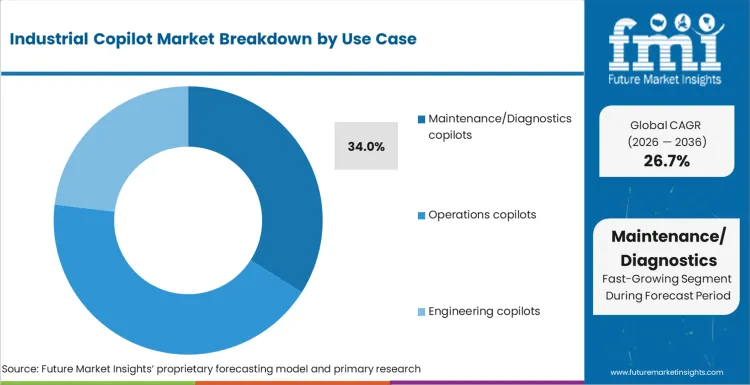
Maintenance/diagnostics copilots command 34.00% of segment revenue in 2026 as operators focus on reducing mean-time-to-repair (MTTR) metrics. The Federal Reserve Governor's February 2026 speech states that as of December 2025, 17% of USA businesses in the Census Business Trends and Outlook Survey report using AI in their business functions, rising to 30% for firms with more than 250 employees [4]. Large-scale industrial automation facilities utilize these diagnostic assistants to parse thousands of pages of PDF equipment manuals and historical fault logs in seconds, delivering actionable repair sequences directly to a technician's mobile device. This specific use case circumvents the regulatory complexities of autonomous control by keeping human engineers in the decision loop while dramatically compressing the diagnostic phase.
- Operational advantage: Conversational interfaces allow technicians to query machine states using natural voice commands while wearing heavy protective equipment.
- Adoption accelerates where: Legacy machinery experiences frequent, undocumented failure modes that perplex newer maintenance staff.
- Procurement shifts because: Plant managers recognize diagnostic AI as a direct offset to the escalating costs of unplanned mechanical downtime.
Industrial Copilot Market Analysis by End Use
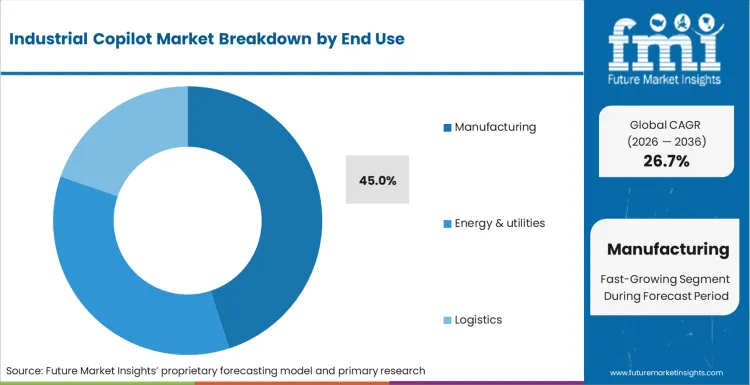
Driven by hyper-competitive margin environments, the Manufacturing sector captures a 45.00% segment share. The assembly line managers face immense pressure to simultaneously customize outputs and maintain high throughput, rendering traditional manual line-balancing obsolete. As per research, AI could raise average productivity by 11.5% in relevant sectors, including manufacturing task automation [5]. Copilots specifically engineered for line level ai optimization allow production planners to request dynamic schedule adjustments via text prompts when supply chain disruptions occur, instantly simulating the impact on overall equipment effectiveness (OEE). This capability converts rigid manufacturing floors into responsive environments capable of real-time adaptation without requiring teams of data scientists on staff.
- Process compatibility: Modern MES architectures feature native API gateways designed to accept conversational AI plugin modules securely.
- Cost structures tighten when: Facilities attempt to manage high-mix, low-volume production runs using legacy, static scheduling software.
- Volume concentration narrows to: Tier-1 automotive and electronics manufacturers where minute-level optimization yields million-dollar savings.
Industrial Copilot Market Analysis by Offering
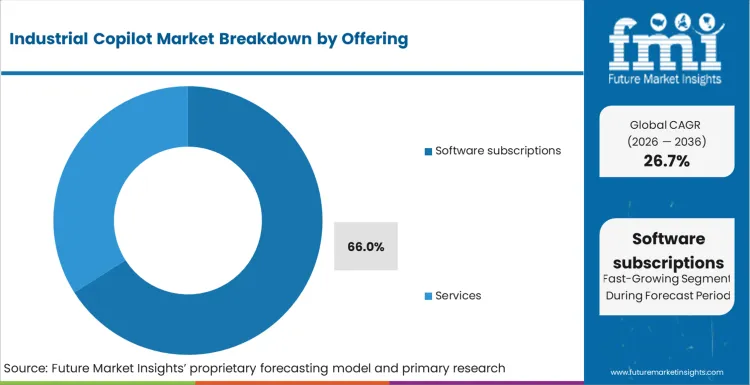
Continuous capability upgrades define enterprise AI strategies, pushing Software subscriptions to capture 66.00% of category volumes. The BLS 2025 article on AI impacts in employment projections notes that software developers' employment is projected to increase 17.9% from 2023 to 2033 due to AI-driven demand in industrial applications [6]. This talent concentration allows software vendors to continually refine specialized generative ai models, delivering new functional modules via recurring licensing tiers rather than perpetual licenses. Facilities willingly absorb operational expenditure (OpEx) models to guarantee their copilots remain trained on the latest industrial communication standards and cybersecurity threat vectors.
- Procurement shifts because: Capital expenditure freezes force automation directors to fund cognitive upgrades through flexible operational budgets.
- Supplier positioning improves as: Vendors bundle foundational model access with specialized, industry-specific data grounding services.
- Requalification cycles lengthen as: Embedded copilots become deeply entangled with daily engineering workflows, creating high barriers to switching.
Industrial Copilot Market Drivers, Restraints, and Opportunities
National productivity mandates directly force the rapid scaling of cognitive automation across critical infrastructure sectors. NIST announced in December 2025 that it is investing USD 20 million to establish two AI centers focused on manufacturing productivity and critical infrastructure cybersecurity [7]. This institutional capital injection signals to risk-averse factory automation and industrial controls buyers that generative architectures have cleared experimental phases and now possess federal validation. Procurement teams, previously hesitant to integrate LLMs into operational networks, now view these deployments as baseline modernization prerequisites, effectively mandating copilot functionality in all incoming request-for-proposals (RFPs) for enterprise software upgrades.
Conversely, the complexity of securely bridging IT and OT networks restricts rapid capacity scaling for highly integrated operations copilots. Plant managers refuse to expose proprietary telemetry to public inference engines, requiring complex edge ai for smart manufacturing deployments that escalate initial integration costs and compress vendor margins. However, Siemens expanded its Industrial Copilot with a new generative AI-powered maintenance offering in March 2025, with pilots demonstrating up to 25% savings in reactive maintenance time [8]. This measurable cost-offset justifies the premium engineering hours required to establish secure, localized data pipelines, allowing buyers to mitigate the integration friction.
- Real-time Operations Insight: Rockwell Automation introduced the FactoryTalk Generative AI Copilot with Microsoft integration for real-time operations insights in 2025 [9]. Facility directors deploying these systems bypass traditional dashboard building, allowing floor supervisors to query production bottlenecks conversationally.
- Engineering and Logistics Optimization: PTC launched its ThingWorx AI Copilot for engineering and logistics optimization in industrial IoT platforms during 2025 [10]. Supply chain managers utilize this capability to simulate routing adjustments dynamically without relying on external analytics teams.
- Supply Chain and Manufacturing Unification: SAP released Joule Copilot enhancements for manufacturing operations and supply chain in its 2025 S/4HANA update [11]. Enterprise IT architects leverage unified conversational interfaces to bridge the data visibility gap between material procurement and shop-floor execution.
Regional Analysis
Based on the regional analysis, the Industrial Copilot market is segmented into North America, Latin America, Europe, East Asia, South Asia, Oceania and Middle East & Africa across 40+ countries. The full report also offers market attractiveness analysis based on regional trends.
.webp "Top Country Growth Comparison Industrial Copilot Market Cagr (2026 2036)")
| Country | CAGR (2026 to 2036) |
|---|---|
| China | 29.00% |
| India | 28.00% |
| USA | 25.00% |
| Germany | 22.00% |
| South Korea | 21.00% |
| Japan | 20.00% |
| UK | 19.00% |
Source: Future Market Insights (FMI) analysis, based on proprietary forecasting model and primary research
Asia Pacific Industrial Copilot Market Analysis
Asia Pacific’s commercialization pace is dictated by aggressive state-backed smart factory scaling and the rapid digitization of massive legacy industrial bases. The OECD reported in January 2026 that more than one-third of individuals across the OECD used generative AI tools in 2025, with surges linked to tools like Copilot in industrial contexts [12]. Instead of incrementing through traditional model based manufacturing technologies, domestic enterprises are leapfrogging directly to LLM-orchestrated operations. This structural shift allows regional conglomerates to offset rising labor costs by multiplying the output of their existing engineering talent pools. The mandate for supply chain resilience further accelerates this transition, as manufacturers deploy localized inference models to optimize output regardless of geopolitical software restrictions.
- China: As industrial formulation capabilities scale and facility operators formalize long-term digital contracts, industrial copilot sales in China are projected to grow at a 29.00% CAGR between 2026 and 2036. Microsoft expanded Azure AI Copilot for cloud-based industrial operations in partnership announcements in 2025 [13], establishing enterprise-grade inference pipelines. Procurement teams increasingly prioritize these embedded cognitive overlays to maintain throughput dominance amid shifting global trade dynamics.
- India: Demand for cognitive software in India is projected to expand at a 28.0% CAGR through 2036, supported by rapid cloud adoption across the SME manufacturing sector. Honeywell introduced its Forge AI Copilot for industrial asset management and diagnostics in 2025 [14], confirming that advanced predictive capabilities are now accessible to mid-tier operators. In rapidly expanding industrial corridors, cost efficiency and immediate equipment uptime improvement consistently dictate software selection behavior.
- Japan: Japan's 20.0% CAGR trajectory relies on precision manufacturing diagnostics rather than generalized cloud operations, because acute demographic aging uniquely constrains technical labor availability. Japanese plant operators are systematically embedding specialized ai enabled robotic retrofits for legacy equipment to preserve operational continuity. Suppliers entering this market without proven Japanese natural language processing capabilities face an immediate technical disqualification barrier.
- South Korea: South Korea’s highly consolidated electronics and automotive sectors must integrate cognitive design tools before 2027 to sustain hyper-competitive product iteration cycles. Demand is set for a 21.00% CAGR as semiconductor fab operators face unprecedented complexity in yield management, forcing the adoption of conversational data analytics. Vendors lacking sub-millisecond API response times cannot clear the stringent qualification thresholds demanded by Tier-1 Korean conglomerates.
FMI's report includes comprehensive tracking of the Asia Pacific software landscape, connecting digital infrastructure investments to functional AI capacity. Southeast Asian hubs like Vietnam and Malaysia present significant secondary growth vectors as multi-national corporations relocate final assembly operations and mandate uniform, AI-assisted quality control standards across their new regional footprints.
North America Industrial Copilot Market Analysis
North America’s software landscape is undergoing recalibration as established industrial conglomerates pivot from pilot testing to enterprise-wide LLM standardization. The Kansas City Fed's February 2026 bulletin notes that USA productivity growth from 2022:Q3 to 2025:Q2 shows an upward climb coinciding with generative AI emergence in manufacturing sectors [15]. This measurable macroeconomic impact validates the aggressive capital allocation strategies of corporate boards, moving AI budgets from speculative R&D into core operational expenditure. System integrators face intense pressure to deliver measurable ai workload management frameworks that bridge modern cloud inference capabilities with decades-old, proprietary on-premise hardware environments securely.
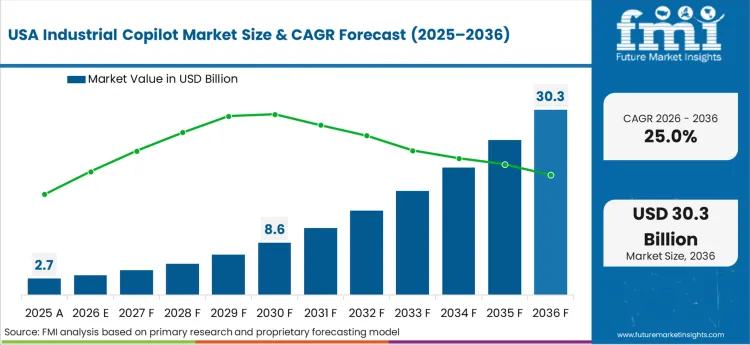
- USA: A CAGR of 25.00% is projected for industrial copilots in the United States through 2036, anchored by unprecedented federal funding aimed at reshoring critical manufacturing. Schneider Electric launched its industrial generative AI copilot in collaboration with Microsoft at Automate 2025 for automation engineering workflows [16], confirming that the partner ecosystem is aligning to solve complex integration bottlenecks. Plant directors executing these upgrades immediately realize shortened engineering cycles and improved localized operational resilience.
FMI's report includes detailed analysis of the North American deployment environment, mapping the shift from generic cloud computing to specialized industrial AI ecosystems. Canada and Mexico operate as critical expansion nodes, where cross-border manufacturing integration relies on unified conversational interfaces to standardize maintenance protocols and logistics tracking across bilingual operational footprints.
Europe Industrial Copilot Market Analysis
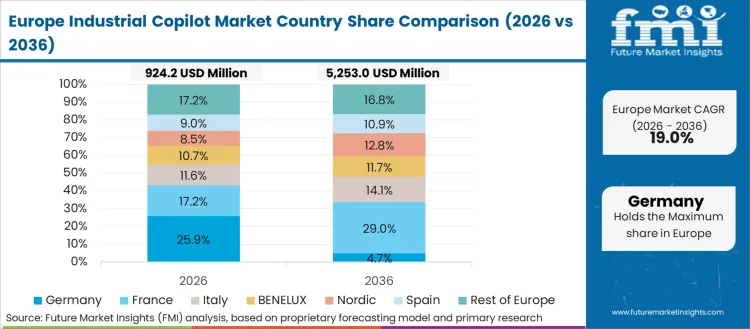
Europe functions as a strict regulatory proving ground for advanced AI isolation methods, where data privacy and ethical implementation frameworks dictate deployment speeds. The Philadelphia Fed's February 2026 survey indicates that about half of respondent firms in the Third Federal Reserve District are using generative AI in late 2025, mirroring aggressive adoption trends pushing into the EU market [17]. Regulatory scrutiny compels manufacturers to source entirely transparent, explainable AI models while maintaining compliance with the AI Act. This dynamic reinforces a strategic pivot toward hybrid architectures where critical edge al processing remains strictly localized, while non-sensitive generative design queries leverage broader hyperscaler networks.
- Germany: In Germany, industrial copilot demand is forecast to expand at a 22.00% CAGR through 2036, supported by a maturing Industry 4.0 ecosystem and defined corporate digitization budgets. ABB introduced ABB Ability Genix Copilot for predictive maintenance and operations in industrial plants in 2025 [18], demonstrating measurable pathways to optimize heavy machinery lifecycles. German automation engineers compete globally on the precision of their digital twins, utilizing conversational AI to continuously refine simulation accuracy.
- United Kingdom: Rising software subscription models reshape procurement economics across the United Kingdom's logistics and pharmaceutical sectors. Against this backdrop, industrial copilot demand is projected to rise at a 19.00% CAGR between 2026 and 2036. Capgemini detailed in its October 2025 report that agentic AI and industrial copilots are reshaping manufacturing plants, driving a global wave of reindustrialization fueled by over USD 3.4 trillion in planned investments [19], confirming that specific, use-case-driven interfaces are replacing generic dashboards. Facility managers leverage these targeted tools to differentiate operational efficiency amid persistent skilled labor shortages.
FMI's report includes extensive coverage of the European regulatory environment and its direct impact on vendor qualification. France and Italy benefit from strong aerospace and automotive design bases that increasingly rely on generative engineering copilots to accelerate component prototyping. Resilient operational autonomy across the continent requires software architectures capable of navigating stringent data localization laws without sacrificing inferential capability.
Competitive Aligners for Market Players
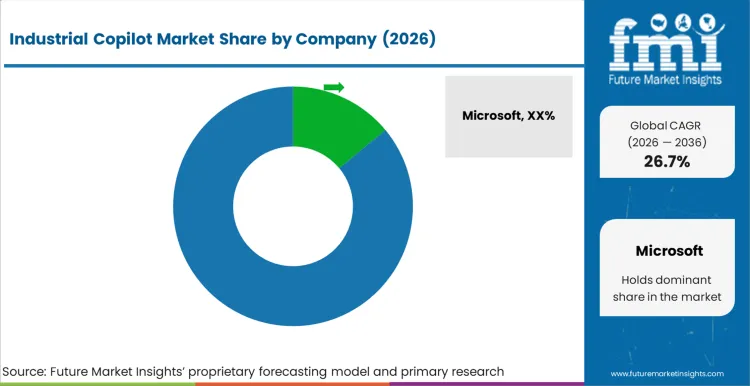
Market structure relies heavily on deep, pre-existing integration within industrial automation ecosystems, advantaging incumbent hardware and software providers. IBM integrated its Granite large language model into SAP's Generative AI Hub in late 2024, enabling enterprises to deploy conversational AI specifically optimized for industrial manufacturing and supply chain data [20]. Facilities already operating on these platforms recognize seamless module upgrades as structurally superior to bolting on third-party inference engines, severely compressing the total addressable market for independent, software-only startups lacking native OT connectivity.
Strategic consortiums and enterprise partnerships compress commercialization timelines for hyperscale cloud providers entering the industrial space. Oracle launched its AI Data Platform in October 2025, allowing manufacturers to seamlessly connect automated data ingestion and semantic enrichment with built-in generative AI agents to orchestrate production workflows [21]. Co-investment models allow cloud titans to provide the immense computational architecture required for factory floor edge ai industrial pcs, while legacy industrial firms provide the proprietary machine telemetry essential for context grounding.
Technological capability differentiates premium enterprise suppliers from basic API wrappers. NVIDIA introduced NIM microservices for manufacturing, empowering industrial companies to rapidly deploy generative AI models and digital twins from the data center to edge environments [22]. Technical validation remains the primary barrier to entry; vendors must prove their models will not generate operational hallucinations that could trigger catastrophic physical machinery failures, cementing trust and safety architecture as the ultimate procurement decider.
Recent Developments
The report includes full coverage of key trends from competitive benchmarking. Some of the recent developments covered in the reports:
- In November 2025, Rockwell Automation introduced the integration of NVIDIA Nemotron Nano, a purpose-built small language model (SLM), into FactoryTalk Design Studio, enabling edge-based generative AI to operate locally in industrial environments with limited space and power. [23]
- In early 2025, Siemens unveiled its Industrial Copilot for Operations at CES, bringing industrial AI directly to the shop floor to facilitate rapid, real-time decision-making for operators, while simultaneously collaborating with Amazon Web Services (AWS) to democratize industrial technology access. [24]
- In December 2024, PwC and AWS expanded their strategic alliance to build industry-specific generative AI applications, integrating Amazon Bedrock Automated Reasoning checks to validate that large language model (LLM) outputs comply with strict operational and safety regulations in industrial and highly regulated settings. [25]
Key Players in Industrial Copilot Market
- Microsoft
- Siemens
- PTC
- SAP
- Rockwell Automation
- Schneider Electric
- ABB
Scope of the Report
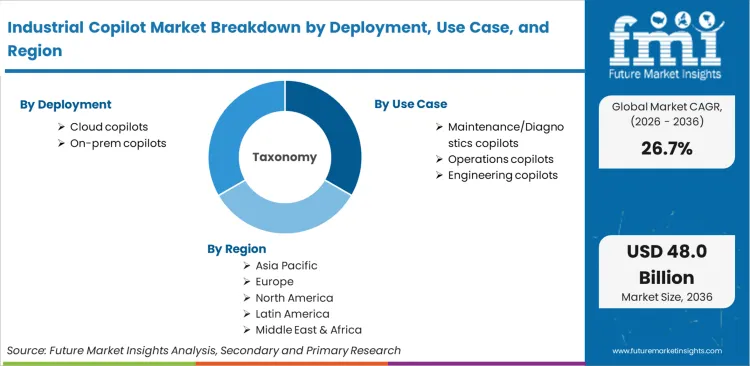
| Metric | Value |
|---|---|
| Quantitative Units | USD 4.54 billion (2026) to USD 48.3 billion (2036), at a CAGR of 26.70% |
| Market Definition | A generative AI-powered software assistant embedded within industrial systems that translates natural language queries into executable engineering commands. |
| Deployment Segmentation | Cloud copilots, On-prem copilots |
| Use case Segmentation | Maintenance/diagnostics copilots, Operations copilots, Engineering copilots |
| End use Segmentation | Manufacturing, Energy & utilities, Logistics |
| Offering Segmentation | Software subscriptions, Services |
| Regions Covered | North America, Latin America, Europe, East Asia, South Asia, Oceania, Middle East & Africa |
| Countries Covered | United States, Canada, Mexico, Brazil, Argentina, Germany, France, United Kingdom, Italy, Spain, China, India, Japan, South Korea, Indonesia, Australia and 40 plus countries |
| Key Companies Profiled | Microsoft, Siemens, PTC, SAP, Rockwell Automation, Schneider Electric, ABB |
| Forecast Period | 2026 to 2036 |
| Approach | Bottom-up adoption modeling validated through primary interviews with automation engineering directors, supported by enterprise software expenditure benchmarking |
Source: Future Market Insights (FMI) analysis, based on proprietary forecasting model and primary research
Industrial Copilot Market Analysis by Segments
Deployment:
- Cloud copilots
- On-prem copilots
Use case:
- Maintenance/diagnostics copilots
- Operations copilots
- Engineering copilots
End use:
- Manufacturing
- Energy & utilities
- Logistics
Offering:
- Software subscriptions
- Services
Region:
- Asia Pacific
- India
- China
- Japan
- South Korea
- Indonesia
- Australia & New Zealand
- ASEAN
- Rest of Asia Pacific
- Europe
- Germany
- Italy
- France
- United Kingdom
- Spain
- Benelux
- Nordics
- Central & Eastern Europe
- Rest of Europe
- North America
- United States
- Canada
- Mexico
- Latin America
- Brazil
- Argentina
- Chile
- Rest of Latin America
- Middle East & Africa
- Kingdom of Saudi Arabia
- United Arab Emirates
- South Africa
- Turkey
- Rest of Middle East & Africa
Bibliography
- [1] White House Council of Economic Advisers. (2026, January). Artificial intelligence and the great divergence (Government report).
- [2] Schneider Electric. (2025, May 12). Schneider Electric unveils innovations advancing American manufacturing at Automate 2025 [Press release].
- [3] Federal Reserve Bank of St. Louis. (2025, November). State of generative AI adoption (Statistical database entry).
- [4] Board of Governors of the Federal Reserve System. (2026, February 17). Speech by Vice Chair for Supervision Michael S. Barr (Government report).
- [5] Morgan Stanley. (2026, February). AI adoption surges driving productivity gains and job shifts (Research report).
- [6] Bureau of Labor Statistics. (2025). Incorporating AI impacts in employment projections (Government report).
- [7] National Institute of Standards and Technology. (2025, December). NIST launches centers for AI in manufacturing (Government report).
- [8] Siemens AG. (2025, March). Siemens expands industrial copilot with new generative AI-powered maintenance offering (Press release).
- [9] Rockwell Automation. (2025). FactoryTalk generative AI copilot launch (Press release).
- [10] PTC Inc. (2025). PTC ThingWorx AI copilot launch (Press release).
- [11] SAP SE. (2025). SAP Joule copilot manufacturing enhancements (Press release).
- [12] Organisation for Economic Co-operation and Development. (2026, January). AI use by individuals surges across the OECD (Government report).
- [13] Microsoft Corporation. (2025). Azure AI copilot industrial cloud expansion (Press release).
- [14] Honeywell International Inc. (2025). Honeywell Forge AI copilot industrial launch (Press release).
- [15] Federal Reserve Bank of Kansas City. (2026, February). Economic bulletin on US productivity and AI (Government report).
- [16] Schneider Electric. (2025). Schneider Electric launches industrial copilot (Press release).
- [17] Federal Reserve Bank of Philadelphia. (2026, February). Generative artificial intelligence adoption survey (Government report).
- [18] ABB Ltd. (2025). ABB Ability Genix copilot launch (Press release).
- [19] Capgemini. (2025, October). The new AI imperative in manufacturing (Report).
- [20] IBM Corporation. (2024, October). IBM Granite LLM now available through the generative AI hub in SAP AI Core (Press release).
- [21] Oracle Corporation. (2025, October). Oracle unveils AI data platform, empowering customers to innovate in the AI era (Press release).
- [22] NVIDIA Corporation. (2026). NVIDIA NIM for manufacturing (Corporate page).
- [23] Rockwell Automation. (2025, November 13). Rockwell Automation to Advance Industrial Intelligence Through Edge-based Generative AI with Nvidia Nemotron (Press release).
- [24] Siemens AG. (2025, January 6). Siemens unveils breakthrough innovations in industrial AI and digital twin technology at CES 2025 (Press release).
- [25] PwC. (2024, December 3). PwC, AWS Expand Strategic Alliance to Catalyze Generative-AI powered Transformation for Industry Customers (Press release).
This bibliography is provided for reader reference and is not exhaustive. The full report contains the complete reference list and detailed citations.
This Report Addresses
- Market intelligence to enable structured strategic decision-making across the industrial automation software sector, including both legacy control systems and emerging generative AI overlays.
- Market size estimation and 10-year revenue forecasts from 2026 to 2036 for the industrial copilot software category, supported by validated enterprise IT expenditure data, software adoption benchmarks, and capacity patterns across key geographies.
- Growth opportunity mapping across cloud and on-premise architectures, with a focus on real-time code generation, predictive fault diagnostics, and dynamic production scheduling as value-driving differentiators.
- Segment and regional revenue forecasts covering major operational categories including manufacturing workflows, logistics routing, and energy grid management, structured by deployment type, use case, and geography.
- Competition strategy assessment including market share analysis, integration ecosystem mapping, and positioning of key automation players such as Microsoft, Siemens, and PTC within the industrial AI landscape.
- Technology roadmap tracking covering advancements in edge inference capability, secure LLM grounding techniques, and API gateways, with emphasis on how these capabilities reshape software qualification criteria for Tier-1 buyers.
- Regulatory impact analysis covering national AI frameworks, cross-border industrial data sovereignty laws, and critical infrastructure protection protocols, and their direct effect on on-premise software procurement specifications.
- Supply chain vulnerability assessment identifying computational hardware concentration risks, high-bandwidth memory shortages, and data center capacity bottlenecks across major industrial zones over the 2026–2036 forecast window.
- Market report delivery in PDF, Excel, PPT, and interactive dashboard formats for executive and operational use, providing actionable insights for chief digital officers, plant managers, and enterprise IT architects.
Frequently Asked Questions
How large is the demand for industrial copilots in the global market in 2026?
Demand for industrial copilots in the global market is estimated to be valued at USD 4.54 billion in 2026.
What will be the market size of industrial copilots in the global market by 2036?
Market size for industrial copilots is projected to reach USD 48.3 billion by 2036.
What is the expected demand growth for industrial copilots in the global market between 2026 and 2036?
Demand for industrial copilots is expected to grow at a CAGR of 26.70% between 2026 and 2036.
Which Deployment type is poised to lead global sales by 2026?
Cloud copilots command 62.00% of the volume in 2026 as IT directors prioritize continuous model updates and seamless multi-site synchronization over localized hosting.
How significant is the role of Manufacturing in driving industrial copilot adoption in 2026?
Manufacturing represents 45.00% of segment share as assembly managers race to offset critical automation engineering shortages through AI-guided diagnostics.
What is driving demand in China?
Aggressive state-backed smart factory initiatives and the necessity to manage highly complex, hyper-scaled production networks drive native cloud AI adoption.
What compliance standards or regulations are referenced for China?
Strict cross-border data transfer laws and national AI security mandates directly influence domestic on-premise hosting requirements.
What is the China growth outlook in this report?
China is projected to grow at a CAGR of 29.00% during 2026 to 2036.
Why is North America described as a priority region in this report?
Unprecedented federal funding for domestic manufacturing capacity and strong macroeconomic productivity gains validate massive corporate software investments.
What type of demand dominates in North America?
Hybrid infrastructure deployments seeking to modernize legacy on-premise hardware with secure cloud-based inference engines dominate regional procurement.
What is India's growth outlook in this report?
India is projected to expand at a CAGR of 28.00% during 2026 to 2036.
Does the report cover United States in its regional analysis?
Yes, the United States is included within North America under the regional scope of analysis.
What are the sources referred to for analyzing the United States?
Official macroeconomic data from the Federal Reserve network and corporate AI software expenditure announcements form the analytical basis.
What is the main demand theme linked to the United States in its region coverage?
Scaling generative AI from pilot phase to enterprise-wide standardization to capture measurable operational efficiency gains.
Does the report cover Germany in its regional analysis?
Yes, Germany is included within Europe under the regional coverage framework.
What is the main Germany-related demand theme in its region coverage?
Deepening digital twin accuracy and optimizing complex automotive engineering workflows via secure, localized natural language models.
Which product formats or configurations are strategically important for Asia Pacific supply chains?
Multi-lingual, edge-capable conversational interfaces that can operate effectively across fragmented legacy machinery hold immense strategic importance.
What is an industrial copilot and what is it mainly used for?
It is a generative AI assistant integrated into factory systems, utilized primarily to troubleshoot machinery, optimize processes, and generate engineering code via text commands.
What does industrial copilot mean in this report?
The market refers to the enterprise software subscriptions and integration services enabling natural-language AI interaction with industrial operational technology.
What is included in the scope of this industrial copilot report?
Scope includes cloud and on-premise software tools used for predictive maintenance diagnostics, operations scheduling, and automation engineering.
What is excluded from the scope of this report?
Consumer-grade AI chatbots, standalone hardware, and traditional rule-based control software without generative capabilities are strictly excluded.
What does market forecast mean on this page?
The market forecast represents a model-based projection built on defined industrial software expenditure and AI adoption assumptions for strategic planning purposes.
How does FMI build and validate the industrial copilot forecast?
Forecasts combine top-down tech expenditure data with bottom-up deployment metrics, validated by primary interviews with automation engineering directors.
What does zero reliance on speculative third-party market research mean here?
Primary interviews, verified corporate deployment releases, and official federal economic datasets are used exclusively instead of unverified syndicated estimates.
Preview the report firsthand - request a free sample
Get SampleGet the brochure for pricing and purchase details.
Get PDFTable of Content
- Executive Summary
- Global Market Outlook
- Demand-side Trends
- Supply-side Trends
- Technology Roadmap Analysis
- Analysis and Recommendations
- Market Overview
- Market Coverage / Taxonomy
- Market Definition / Scope / Limitations
- Research Methodology
- Chapter Orientation
- Analytical Lens and Working Hypotheses
- Market Structure, Signals, and Trend Drivers
- Benchmarking and Cross-market Comparability
- Market Sizing, Forecasting, and Opportunity Mapping
- Research Design and Evidence Framework
- Desk Research Programme (Secondary Evidence)
- Company Annual and Sustainability Reports
- Peer-reviewed Journals and Academic Literature
- Corporate Websites, Product Literature, and Technical Notes
- Earnings Decks and Investor Briefings
- Statutory Filings and Regulatory Disclosures
- Technical White Papers and Standards Notes
- Trade Journals, Industry Magazines, and Analyst Briefs
- Conference Proceedings, Webinars, and Seminar Materials
- Government Statistics Portals and Public Data Releases
- Press Releases and Reputable Media Coverage
- Specialist Newsletters and Curated Briefings
- Sector Databases and Reference Repositories
- FMI Internal Proprietary Databases and Historical Market Datasets
- Subscription Datasets and Paid Sources
- Social Channels, Communities, and Digital Listening Inputs
- Additional Desk Sources
- Expert Input and Fieldwork (Primary Evidence)
- Primary Modes
- Qualitative Interviews and Expert Elicitation
- Quantitative Surveys and Structured Data Capture
- Blended Approach
- Why Primary Evidence is Used
- Field Techniques
- Interviews
- Surveys
- Focus Groups
- Observational and In-context Research
- Social and Community Interactions
- Stakeholder Universe Engaged
- C-suite Leaders
- Board Members
- Presidents and Vice Presidents
- R&D and Innovation Heads
- Technical Specialists
- Domain Subject-matter Experts
- Scientists
- Physicians and Other Healthcare Professionals
- Governance, Ethics, and Data Stewardship
- Research Ethics
- Data Integrity and Handling
- Primary Modes
- Tooling, Models, and Reference Databases
- Desk Research Programme (Secondary Evidence)
- Data Engineering and Model Build
- Data Acquisition and Ingestion
- Cleaning, Normalisation, and Verification
- Synthesis, Triangulation, and Analysis
- Quality Assurance and Audit Trail
- Market Background
- Market Dynamics
- Drivers
- Restraints
- Opportunity
- Trends
- Scenario Forecast
- Demand in Optimistic Scenario
- Demand in Likely Scenario
- Demand in Conservative Scenario
- Opportunity Map Analysis
- Product Life Cycle Analysis
- Supply Chain Analysis
- Investment Feasibility Matrix
- Value Chain Analysis
- PESTLE and Porter’s Analysis
- Regulatory Landscape
- Regional Parent Market Outlook
- Production and Consumption Statistics
- Import and Export Statistics
- Market Dynamics
- Global Market Analysis 2021 to 2025 and Forecast, 2026 to 2036
- Historical Market Size Value (USD Million) Analysis, 2021 to 2025
- Current and Future Market Size Value (USD Million) Projections, 2026 to 2036
- Y-o-Y Growth Trend Analysis
- Absolute $ Opportunity Analysis
- Global Market Pricing Analysis 2021 to 2025 and Forecast 2026 to 2036
- Global Market Analysis 2021 to 2025 and Forecast 2026 to 2036, By Deployment
- Introduction / Key Findings
- Historical Market Size Value (USD Million) Analysis By Deployment , 2021 to 2025
- Current and Future Market Size Value (USD Million) Analysis and Forecast By Deployment , 2026 to 2036
- Cloud copilots
- On-prem copilots
- Cloud copilots
- Y-o-Y Growth Trend Analysis By Deployment , 2021 to 2025
- Absolute $ Opportunity Analysis By Deployment , 2026 to 2036
- Global Market Analysis 2021 to 2025 and Forecast 2026 to 2036, By Use Case
- Introduction / Key Findings
- Historical Market Size Value (USD Million) Analysis By Use Case, 2021 to 2025
- Current and Future Market Size Value (USD Million) Analysis and Forecast By Use Case, 2026 to 2036
- Maintenance/Diagnostics copilots
- Operations copilots
- Engineering copilots
- Maintenance/Diagnostics copilots
- Y-o-Y Growth Trend Analysis By Use Case, 2021 to 2025
- Absolute $ Opportunity Analysis By Use Case, 2026 to 2036
- Global Market Analysis 2021 to 2025 and Forecast 2026 to 2036, By End Use
- Introduction / Key Findings
- Historical Market Size Value (USD Million) Analysis By End Use, 2021 to 2025
- Current and Future Market Size Value (USD Million) Analysis and Forecast By End Use, 2026 to 2036
- Manufacturing
- Energy & utilities
- Logistics
- Manufacturing
- Y-o-Y Growth Trend Analysis By End Use, 2021 to 2025
- Absolute $ Opportunity Analysis By End Use, 2026 to 2036
- Global Market Analysis 2021 to 2025 and Forecast 2026 to 2036, By Offering
- Introduction / Key Findings
- Historical Market Size Value (USD Million) Analysis By Offering, 2021 to 2025
- Current and Future Market Size Value (USD Million) Analysis and Forecast By Offering, 2026 to 2036
- Software subscriptions
- Services
- Software subscriptions
- Y-o-Y Growth Trend Analysis By Offering, 2021 to 2025
- Absolute $ Opportunity Analysis By Offering, 2026 to 2036
- Global Market Analysis 2021 to 2025 and Forecast 2026 to 2036, By Region
- Introduction
- Historical Market Size Value (USD Million) Analysis By Region, 2021 to 2025
- Current Market Size Value (USD Million) Analysis and Forecast By Region, 2026 to 2036
- North America
- Latin America
- Western Europe
- Eastern Europe
- East Asia
- South Asia and Pacific
- Middle East & Africa
- Market Attractiveness Analysis By Region
- North America Market Analysis 2021 to 2025 and Forecast 2026 to 2036, By Country
- Historical Market Size Value (USD Million) Trend Analysis By Market Taxonomy, 2021 to 2025
- Market Size Value (USD Million) Forecast By Market Taxonomy, 2026 to 2036
- By Country
- USA
- Canada
- Mexico
- By Deployment
- By Use Case
- By End Use
- By Offering
- By Country
- Market Attractiveness Analysis
- By Country
- By Deployment
- By Use Case
- By End Use
- By Offering
- Key Takeaways
- Latin America Market Analysis 2021 to 2025 and Forecast 2026 to 2036, By Country
- Historical Market Size Value (USD Million) Trend Analysis By Market Taxonomy, 2021 to 2025
- Market Size Value (USD Million) Forecast By Market Taxonomy, 2026 to 2036
- By Country
- Brazil
- Chile
- Rest of Latin America
- By Deployment
- By Use Case
- By End Use
- By Offering
- By Country
- Market Attractiveness Analysis
- By Country
- By Deployment
- By Use Case
- By End Use
- By Offering
- Key Takeaways
- Western Europe Market Analysis 2021 to 2025 and Forecast 2026 to 2036, By Country
- Historical Market Size Value (USD Million) Trend Analysis By Market Taxonomy, 2021 to 2025
- Market Size Value (USD Million) Forecast By Market Taxonomy, 2026 to 2036
- By Country
- Germany
- UK
- Italy
- Spain
- France
- Nordic
- BENELUX
- Rest of Western Europe
- By Deployment
- By Use Case
- By End Use
- By Offering
- By Country
- Market Attractiveness Analysis
- By Country
- By Deployment
- By Use Case
- By End Use
- By Offering
- Key Takeaways
- Eastern Europe Market Analysis 2021 to 2025 and Forecast 2026 to 2036, By Country
- Historical Market Size Value (USD Million) Trend Analysis By Market Taxonomy, 2021 to 2025
- Market Size Value (USD Million) Forecast By Market Taxonomy, 2026 to 2036
- By Country
- Russia
- Poland
- Hungary
- Balkan & Baltic
- Rest of Eastern Europe
- By Deployment
- By Use Case
- By End Use
- By Offering
- By Country
- Market Attractiveness Analysis
- By Country
- By Deployment
- By Use Case
- By End Use
- By Offering
- Key Takeaways
- East Asia Market Analysis 2021 to 2025 and Forecast 2026 to 2036, By Country
- Historical Market Size Value (USD Million) Trend Analysis By Market Taxonomy, 2021 to 2025
- Market Size Value (USD Million) Forecast By Market Taxonomy, 2026 to 2036
- By Country
- China
- Japan
- South Korea
- By Deployment
- By Use Case
- By End Use
- By Offering
- By Country
- Market Attractiveness Analysis
- By Country
- By Deployment
- By Use Case
- By End Use
- By Offering
- Key Takeaways
- South Asia and Pacific Market Analysis 2021 to 2025 and Forecast 2026 to 2036, By Country
- Historical Market Size Value (USD Million) Trend Analysis By Market Taxonomy, 2021 to 2025
- Market Size Value (USD Million) Forecast By Market Taxonomy, 2026 to 2036
- By Country
- India
- ASEAN
- Australia & New Zealand
- Rest of South Asia and Pacific
- By Deployment
- By Use Case
- By End Use
- By Offering
- By Country
- Market Attractiveness Analysis
- By Country
- By Deployment
- By Use Case
- By End Use
- By Offering
- Key Takeaways
- Middle East & Africa Market Analysis 2021 to 2025 and Forecast 2026 to 2036, By Country
- Historical Market Size Value (USD Million) Trend Analysis By Market Taxonomy, 2021 to 2025
- Market Size Value (USD Million) Forecast By Market Taxonomy, 2026 to 2036
- By Country
- Kingdom of Saudi Arabia
- Other GCC Countries
- Turkiye
- South Africa
- Other African Union
- Rest of Middle East & Africa
- By Deployment
- By Use Case
- By End Use
- By Offering
- By Country
- Market Attractiveness Analysis
- By Country
- By Deployment
- By Use Case
- By End Use
- By Offering
- Key Takeaways
- Key Countries Market Analysis
- USA
- Pricing Analysis
- Market Share Analysis, 2025
- By Deployment
- By Use Case
- By End Use
- By Offering
- Canada
- Pricing Analysis
- Market Share Analysis, 2025
- By Deployment
- By Use Case
- By End Use
- By Offering
- Mexico
- Pricing Analysis
- Market Share Analysis, 2025
- By Deployment
- By Use Case
- By End Use
- By Offering
- Brazil
- Pricing Analysis
- Market Share Analysis, 2025
- By Deployment
- By Use Case
- By End Use
- By Offering
- Chile
- Pricing Analysis
- Market Share Analysis, 2025
- By Deployment
- By Use Case
- By End Use
- By Offering
- Germany
- Pricing Analysis
- Market Share Analysis, 2025
- By Deployment
- By Use Case
- By End Use
- By Offering
- UK
- Pricing Analysis
- Market Share Analysis, 2025
- By Deployment
- By Use Case
- By End Use
- By Offering
- Italy
- Pricing Analysis
- Market Share Analysis, 2025
- By Deployment
- By Use Case
- By End Use
- By Offering
- Spain
- Pricing Analysis
- Market Share Analysis, 2025
- By Deployment
- By Use Case
- By End Use
- By Offering
- France
- Pricing Analysis
- Market Share Analysis, 2025
- By Deployment
- By Use Case
- By End Use
- By Offering
- India
- Pricing Analysis
- Market Share Analysis, 2025
- By Deployment
- By Use Case
- By End Use
- By Offering
- ASEAN
- Pricing Analysis
- Market Share Analysis, 2025
- By Deployment
- By Use Case
- By End Use
- By Offering
- Australia & New Zealand
- Pricing Analysis
- Market Share Analysis, 2025
- By Deployment
- By Use Case
- By End Use
- By Offering
- China
- Pricing Analysis
- Market Share Analysis, 2025
- By Deployment
- By Use Case
- By End Use
- By Offering
- Japan
- Pricing Analysis
- Market Share Analysis, 2025
- By Deployment
- By Use Case
- By End Use
- By Offering
- South Korea
- Pricing Analysis
- Market Share Analysis, 2025
- By Deployment
- By Use Case
- By End Use
- By Offering
- Russia
- Pricing Analysis
- Market Share Analysis, 2025
- By Deployment
- By Use Case
- By End Use
- By Offering
- Poland
- Pricing Analysis
- Market Share Analysis, 2025
- By Deployment
- By Use Case
- By End Use
- By Offering
- Hungary
- Pricing Analysis
- Market Share Analysis, 2025
- By Deployment
- By Use Case
- By End Use
- By Offering
- Kingdom of Saudi Arabia
- Pricing Analysis
- Market Share Analysis, 2025
- By Deployment
- By Use Case
- By End Use
- By Offering
- Turkiye
- Pricing Analysis
- Market Share Analysis, 2025
- By Deployment
- By Use Case
- By End Use
- By Offering
- South Africa
- Pricing Analysis
- Market Share Analysis, 2025
- By Deployment
- By Use Case
- By End Use
- By Offering
- USA
- Market Structure Analysis
- Competition Dashboard
- Competition Benchmarking
- Market Share Analysis of Top Players
- By Regional
- By Deployment
- By Use Case
- By End Use
- By Offering
- Competition Analysis
- Competition Deep Dive
- Microsoft
- Overview
- Product Portfolio
- Profitability by Market Segments (Product/Age /Sales Channel/Region)
- Sales Footprint
- Strategy Overview
- Marketing Strategy
- Product Strategy
- Channel Strategy
- Siemens
- PTC
- SAP
- Rockwell Automation
- Schneider Electric
- ABB
- Microsoft
- Competition Deep Dive
- Assumptions & Acronyms Used


