

- Industry Size (2026)
- USD 25.9 Bn
- Forecast (2036)
- USD 50.2 Bn
- CAGR (2026 to 2036)
- 7.6%
Industrial Battery Market Size, Market Forecast and Outlook By FMI
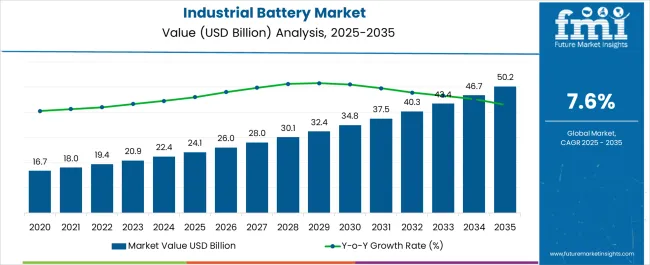
In 2025, the industrial battery market was valued at USD 24.1 billion. Based on Future Market Insights' analysis, demand for industrial batteries is estimated to grow to USD 25.9 billion in 2026 and USD 50.2 billion by 2036. FMI projects a CAGR of 7.6% during the forecast period. An absolute dollar growth of USD 24.3 billion between 2026 and 2036 reflects structural shifts in industrial energy storage rather than volume-only expansion of conventional battery technologies. Industrial energy storage is becoming application led, with growth tied to where batteries are specified, fast-charge motive power, extended-runtime telecom backup, and broader storage systems supporting modern power needs, rather than unit-volume expansion alone.
As EnerSys President & CEO, David M. Shaffer framed this shift, “Our new factory will provide lithium-ion cells supporting a wide range of our products across all of our business segments, including fast charge and storage systems, NexSys® iON batteries to power electric forklifts, Alpha® XRT-Li extended runtime power systems for communications networks, and future incremental high-energy Li6T batteries for DOD ground vehicles.[13]” This aligns with the view that absolute dollar growth through 2036 will be driven by chemistry optimization, intelligent management systems, and application-specific engineering that improves reliability and lowers total cost of ownership for industrial operators and data center managers.
As per FMI, battery manufacturers are capturing value not from incremental unit counts alone, but from chemistry optimization, intelligent management systems, and application-specific design that reduce total cost of ownership for industrial operators and data center managers.
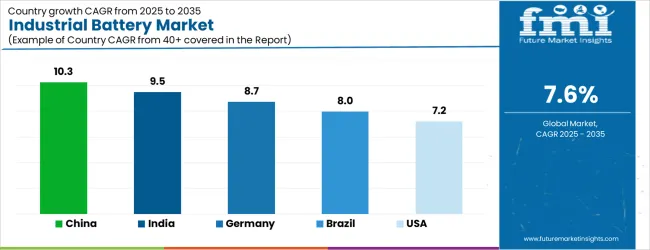
China leads global expansion, supported by its dominant position in lithium-ion battery manufacturing, rapid growth in e-commerce and warehouse automation, and massive investments in renewable energy and grid storage infrastructure. India follows, driven by expansion of telecommunications networks, growth in data center construction, and government initiatives promoting domestic battery manufacturing under the Production Linked Incentive scheme.
Germany grows on the back of its strong industrial automation sector, leadership in renewable energy integration, and stringent requirements for uninterruptible power in manufacturing. Brazil benefits from expanding telecommunications infrastructure, growth in material handling equipment adoption, and increasing renewable energy deployment.
Mature markets such as the United States, the United Kingdom, and Japan generate comparatively slower expansion, where demand is shaped more by replacement cycles, technology upgrades to lithium-based systems, and data center capacity expansion than by new industrial capacity growth, with intense competition and price pressure in commodity segments acting as structural constraints on value growth.
Industrial Battery Market Definition
The industrial battery market covers the global production and supply of rechargeable battery systems designed for heavy-duty, high-cycling, and mission-critical applications across industrial, commercial, and infrastructure sectors. These batteries provide motive power for electric material handling equipment, backup power for telecommunications and data centers, and energy storage for grid stabilization and renewable integration. They are manufactured using lead-acid, lithium-ion, and other chemistries optimized for specific performance requirements including deep cycling, high-rate discharge, and long operational life.
Market Inclusions
The report includes global and regional market size estimates in value terms, with a forecast period from 2026 to 2036. It provides segmentation by Type Outlook, Application Outlook, and Region. The analysis incorporates manufacturing technology trends, chemistry advancements, battery management system integration, and the impact of renewable energy policies. Regional demand dynamics, country-level growth rates, and competitive positioning are also evaluated as per FMI methodology.
Market Exclusions
The scope excludes automotive starting batteries and consumer electronics batteries, focusing strictly on batteries designed for industrial applications. It also excludes revenue from battery raw material extraction and processing, and from downstream equipment such as forklifts and UPS systems that incorporate batteries as components.
Research Methodology
- Primary Research: Interviews were conducted with industrial battery manufacturers, material handling equipment suppliers, data center operators, telecommunications infrastructure managers, and renewable energy project developers.
- Desk Research: Public company filings from EnerSys, Exide Technologies, and GS Yuasa were reviewed alongside industry statistics from the International Energy Agency, telecommunications infrastructure data from the International Telecommunication Union, and material handling equipment market analysis from industry associations.
- Market-Sizing and Forecasting: A hybrid top-down and bottom-up model was constructed, reconstructing demand from material handling equipment shipments, data center capacity additions, telecommunications tower counts, and grid storage project pipelines.
- Data Validation and Update Cycle: Outputs were subjected to variance testing against production capacity data, trade flow benchmarking using UN Comtrade data, and structured internal review prior to publication.
Summary of the Industrial Battery Market
- Market Definition
- The market comprises rechargeable battery systems designed for motive power, backup power, and energy storage applications across industrial, telecommunications, data center, and utility sectors.
- Demand Drivers
- Rapid growth in e-commerce and warehouse automation driving demand for electric forklifts and automated guided vehicles requiring reliable motive power batteries.
- Exponential growth in data center construction and cloud infrastructure requiring uninterruptible power supply systems with high reliability.
- Telecommunications network expansion, particularly 5G infrastructure, requiring backup power for tower sites and central offices.
- Accelerating renewable energy deployment creating demand for grid-scale energy storage systems.
- Key Segments Analyzed
- Type Outlook: Lead-Acid currently leads with 45.2% share in 2025, favored for cost-effectiveness, reliability, and established recycling infrastructure.
- Application Outlook: Motive Power represents the largest application segment at 38.7% share, driven by material handling equipment electrification.
- Geography: Asia-Pacific leads volume growth through manufacturing concentration and infrastructure investment, while North America and Europe drive value through technology upgrades and data center expansion.
- Analyst Opinion at FMI
- Nikhil Kaitwade, Principal Consultant for Industrial Automation at Future Market Insights, opines, 'In this revamped edition of the Industrial Battery Market report, value is migrating from conventional lead-acid workhorses to intelligent lithium-ion platforms. Opportunity lies in delivering batteries that store energy and communicate state-of-health, predict maintenance needs, and integrate with facility management systems.'
- Strategic Implications/Executive Takeaways
- Invest in lithium-ion manufacturing capabilities for motive power and UPS applications where fast charging and long cycle life justify premium pricing.
- Develop battery management systems with predictive analytics enabling proactive maintenance and reduced downtime.
- Build recycling infrastructure and closed-loop material strategies to address lifecycle costs and regulatory requirements.
- Strengthen partnerships with material handling equipment OEMs and data center developers to secure early specification.
- Methodology
- Built on primary interviews with industrial battery manufacturers and end-user procurement leaders.
- Benchmarked against material handling equipment shipment data and data center construction statistics.
- Validated using UN Comtrade trade data and internal peer review as per FMI modeling standards.
Industrial Battery Market Drivers, Restraints, and Opportunities
Future Market Insights analysis indicates the market is fundamentally tied to industrial automation, digital infrastructure, and energy transition trends. Its baseline scale is anchored in the essential nature of reliable power for material handling, data center operations, and telecommunications. As per FMI, the market's valuation is increasingly influenced by chemistry evolution and intelligent system integration, where batteries offering higher performance and predictive capabilities command premium pricing.
FMI analysts observe a clear transition from traditional lead-acid batteries toward lithium-ion and advanced lead-acid technologies with enhanced performance characteristics. Standard flooded lead-acid batteries face replacement pressure where operators seek reduced maintenance and faster charging, while growth is concentrated in applications that justify higher initial costs through improved productivity and lower total cost of ownership. This shift nets out as healthy value growth because chemistry complexity and management system integration support margin expansion.
- E-commerce and warehouse automation growth: Global e-commerce expansion drives demand for automated warehouses and distribution centers equipped with electric forklifts and automated guided vehicles. The material handling equipment market has seen sustained growth, with electric forklifts representing an increasing share of new equipment shipments. These vehicles require reliable motive power batteries capable of supporting multi-shift operations with opportunity charging [1].
- Data center infrastructure expansion: Cloud computing, streaming services, and artificial intelligence workloads drive exponential growth in data center capacity. These facilities require uninterruptible power supply systems with battery backup to maintain operations during grid disturbances. The Uptime Institute reports that data center outages remain costly, driving investment in high-reliability battery systems with advanced monitoring capabilities [2].
- Telecommunications network evolution: 5G network deployment requires power backup at numerous small cell sites and centralized facilities. Telecommunications infrastructure expansion in emerging markets creates additional demand for reliable backup power where grid reliability is inconsistent. The International Telecommunication Union tracks continued growth in global telecommunications infrastructure investment [3].
- Renewable energy integration: Grid-scale energy storage deployment accelerates as renewable generation penetration increases. Lithium-ion battery systems provide frequency regulation, peak shaving, and renewable firming services essential for grid stability. The International Energy Agency projects substantial growth in battery storage capacity through 2035 as part of global energy transition pathways [4].
- Raw material price volatility: Lithium, cobalt, nickel, and lead prices fluctuate based on mining supply and demand dynamics, creating margin pressure for battery manufacturers without effective cost management strategies. This volatility particularly impacts lithium-ion battery economics and influences technology adoption decisions [5].
- Safety and regulatory compliance: Industrial batteries, particularly lithium-ion, require careful thermal management and protection systems to prevent thermal runaway incidents. Regulatory frameworks including UN transportation regulations and installation codes add compliance costs and complexity, particularly for larger installations [6].
Segmental Analysis
Industrial Battery Market Analysis by Type Outlook
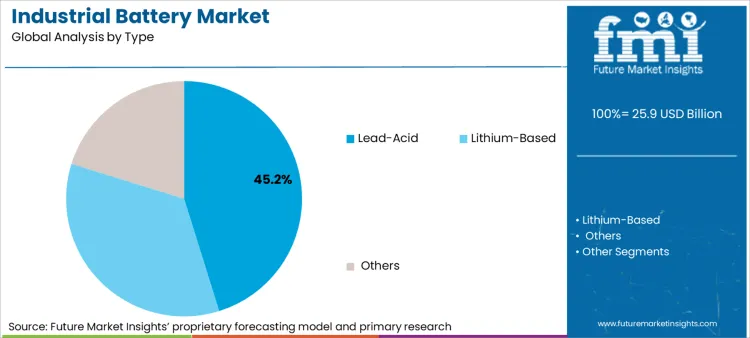
Based on FMI's industrial battery market report, lead-acid batteries represent the leading type outlook segment, projected to hold 45.2% of the market revenue share in 2025. This dominance is driven by proven reliability, cost-effectiveness, and established recycling infrastructure that supports lifecycle value. Lead-acid batteries provide consistent performance for high-load and continuous duty applications, making them ideal for motive power in material handling equipment and backup power in telecommunications and UPS systems.
Flooded lead-acid batteries remain widely used in applications where cost sensitivity outweighs maintenance considerations. Valve-regulated lead-acid batteries, including absorbed glass mat and gel technologies, offer maintenance-free operation valued in telecommunications and data center applications where regular maintenance access is limited. Ongoing improvements in grid alloy design and active material utilization continue extending cycle life and performance.
Lithium-based batteries represent the fastest-growing segment, driven by superior energy density, longer cycle life, fast charging capability, and decreasing costs. Lithium iron phosphate chemistry has gained particular traction in motive power and grid storage applications due to its safety profile and cycle life. Lithium-ion batteries enable opportunity charging in material handling applications, allowing multi-shift operation with fewer battery changeouts. Their adoption in data center UPS applications accelerates as operators seek smaller footprint and longer service life.
- Lead-acid recycling advantage: Lead-acid batteries benefit from mature recycling infrastructure achieving over 95% recycling rates in developed markets, creating lifecycle cost advantages and regulatory compliance benefits.
- Lithium-ion cost reduction: Lithium-ion battery pack prices have declined substantially over the past decade, with further reductions expected as manufacturing scale expands and chemistry improvements continue. This trend accelerates lithium-ion adoption across industrial applications [4].
- Chemistry diversification: Emerging battery chemistries including sodium-ion and flow batteries may capture specific application niches, but lithium-ion and advanced lead-acid are expected to dominate the forecast period.
Industrial Battery Market Analysis by Application Outlook
The motive power application segment is anticipated to account for 38.7% of the market revenue share in 2025, establishing it as the largest application area. Growth is driven by increasing use of industrial batteries in electric forklifts, automated guided vehicles, and other material handling equipment in manufacturing, warehousing, and logistics operations. Batteries in this segment must deliver high power output, long operational cycles, and reliable performance under demanding conditions with opportunity charging capability.
Warehouse automation expansion, driven by e-commerce growth, creates sustained demand for motive power batteries. Modern distribution centers operate multiple shifts with high-intensity equipment utilization, requiring batteries that support fast charging and maintain performance through thousands of cycles. Lithium-ion adoption in this segment accelerates as operators recognize total cost of ownership benefits despite higher initial investment.
Telecom and data communication applications represent a significant and growing segment, requiring reliable backup power for network infrastructure. Telecommunications towers, central offices, and data centers depend on battery systems to maintain operations during grid disturbances. The transition to 5G networks and continued data center expansion drive demand for high-reliability battery systems with remote monitoring capabilities.
Uninterruptible power supply/backup applications serve critical facilities including hospitals, industrial processes, and commercial buildings where power continuity is essential. These applications typically specify valve-regulated lead-acid batteries for their maintenance-free operation, though lithium-ion adoption increases where space constraints or high ambient temperatures favor alternative chemistries.
Grid-level energy storage represents the fastest-growing application segment, driven by renewable energy integration and grid modernization. Utility-scale battery systems provide frequency regulation, renewable firming, and peak capacity services. Lithium-ion dominates this segment due to its response speed, cycle life, and declining costs.
- Motive power technology evolution: Opportunity charging capability enabled by lithium-ion chemistry transforms warehouse operations, eliminating battery changeout requirements and reducing equipment fleet size.
- Data center reliability requirements: Hyperscale data centers specify battery systems with comprehensive monitoring and predictable end-of-life characteristics to maintain five-nines availability targets [2].
- Grid storage policy support: Government policies and utility procurement targets for energy storage accelerate grid-scale deployment, particularly in markets with high renewable penetration [4].
Regional Analysis
The industrial battery market is segmented geographically across North America, Europe, Asia-Pacific, Latin America, and Middle East & Africa. Growth dynamics differ based on industrial automation adoption, data center investment, telecommunications infrastructure maturity, and renewable energy policy frameworks.
| Country | CAGR |
|---|---|
| China | 10.3% |
| India | 9.5% |
| Germany | 8.7% |
| Brazil | 8.0% |
| USA | 7.2% |
| UK | 6.5% |
| Japan | 5.7% |
Source: Future Market Insights (FMI) analysis, based on proprietary forecasting model and primary research
Asia-Pacific Market Analysis
Asia-Pacific stands as the dominant production and consumption region for industrial batteries, accounting for the largest share of global demand. The region's leadership is built on concentrated lithium-ion battery manufacturing in China, rapid industrial automation adoption, massive telecommunications infrastructure investment, and accelerating renewable energy deployment.
- China: Industrial battery demand in China is projected to rise at 10.3% CAGR through 2036, the highest among major markets. Growth is supported by China's position as the world's largest lithium-ion battery manufacturer, with extensive production capacity serving domestic and export markets. The country's rapid e-commerce growth drives warehouse automation and material handling equipment demand, requiring substantial motive power batteries.
China's telecommunications infrastructure expansion, including 5G network deployment, creates backup power requirements for numerous new cell sites. Grid-scale energy storage deployment accelerates under government renewable energy targets, with substantial battery storage capacity added to support wind and solar integration [4].
The Chinese government's focus on strategic industries including electric vehicles and energy storage supports continued battery manufacturing investment and technology development. Environmental regulations have consolidated production among larger, compliant manufacturers, improving quality consistency and reducing supply volatility. FMI's analysis of industrial battery market in Asia-Pacific consists of country-wise assessment that includes China, India, Japan, South Korea, and ASEAN nations.
- India: Industrial battery demand in India is projected to rise at 9.5% CAGR through 2036. Growth is supported by telecommunications network expansion, with continued tower construction and 5G deployment requiring backup power systems. Data center construction accelerates driven by digitalization and cloud service adoption, creating UPS battery demand.
Government initiatives including the Production Linked Incentive scheme for advanced chemistry cell manufacturing aim to build domestic battery production capacity, reducing import dependence and supporting local value addition. Material handling equipment adoption grows with industrial automation and organized retail expansion.
India's renewable energy targets include substantial battery storage deployment to support solar and wind integration, though policy implementation and procurement mechanisms continue evolving [5]. FMI's analysis of industrial battery market in Asia-Pacific consists of country-wise assessment that includes China, India, Japan, and South Korea.
- Japan: Japan represents a mature, technology-intensive market where industrial battery demand is projected at 5.7% CAGR through 2036. Japanese consumption focuses on high-quality batteries for industrial automation, data center UPS, and grid storage applications. Japanese manufacturers including GS Yuasa maintain strong positions in specialty battery markets with emphasis on quality and reliability.
The country's sophisticated industrial sector requires reliable motive power for automated manufacturing and logistics operations. Data center construction, while moderate compared to growth markets, demands high-reliability UPS systems with advanced monitoring. Grid storage deployment supports renewable energy integration following the Fukushima nuclear transition. FMI's analysis of industrial battery market in Asia-Pacific consists of country-wise assessment that includes China, India, Japan, and South Korea.
North America Market Analysis
North America functions as a significant consumption region driven by data center expansion, warehouse automation, and grid storage deployment. The United States serves as the primary market, with demand shaped by e-commerce growth, cloud infrastructure investment, and renewable energy policies.
- United States: Demand for industrial batteries in the United States is projected to advance at 7.2% CAGR through 2036. The USA market combines motive power demand from warehouse automation, UPS requirements from hyperscale data centers, and grid storage deployment under federal and state policies [2].
E-commerce growth drives warehouse construction and automation investment, with major logistics operators expanding fulfillment center networks equipped with electric forklifts and automated guided vehicles. These facilities require motive power batteries capable of supporting multi-shift operations with opportunity charging.
Data center construction accelerates driven by cloud computing, streaming services, and artificial intelligence workloads. Northern Virginia remains the world's largest data center market, with substantial UPS battery requirements for new facilities. The Uptime Institute reports that data center operators prioritize battery reliability and monitoring capabilities to prevent costly outages [2].
Grid storage deployment expands under Investment Tax Credit provisions and state procurement targets. California leads with substantial battery storage capacity supporting renewable integration, while other states develop storage procurement frameworks [4]. FMI's analysis of industrial battery market in North America consists of country-wise assessment that includes the United States and Canada.
Europe Market Analysis
Europe represents a quality-driven market where stringent environmental regulations, renewable energy targets, and industrial automation requirements shape battery specifications. The region's strong manufacturing sector, data center investment, and grid storage deployment create sustained demand for advanced battery technologies.
- Germany: Demand for industrial batteries in Germany is projected to rise at 8.7% CAGR through 2036. Growth is influenced by Germany's position as Europe's largest industrial economy, with sophisticated manufacturing and logistics sectors requiring reliable motive power. The country's automotive industry and machinery sectors drive demand for automated material handling equipment.
Germany's renewable energy transition, the Energiewende, creates substantial grid storage requirements as variable renewable generation increases. Battery storage provides frequency regulation and grid services essential for stability with high renewable penetration. Industrial battery applications in Germany emphasize quality, reliability, and environmental compliance.
Data center construction in Frankfurt and other German cities supports UPS battery demand, with operators specifying high-reliability systems for mission-critical facilities. Telecommunications infrastructure maintains backup power requirements as networks evolve. FMI's analysis of industrial battery market in Europe consists of country-wise assessment that includes Germany, United Kingdom, France, Italy, and Spain.
Competitive Aligners for Market Players
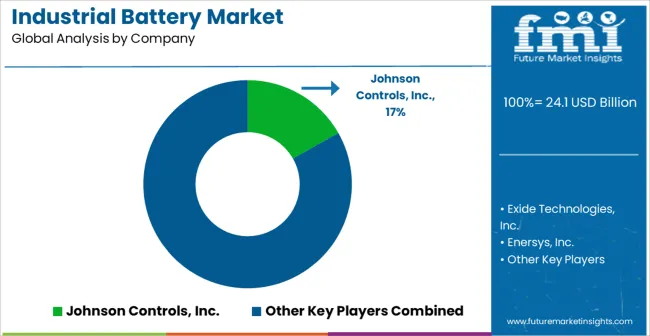
The industrial battery market features a mix of global battery specialists and diversified industrial companies, with established players leveraging manufacturing scale, technology expertise, and customer relationships. Major players include EnerSys, Exide Technologies, GS Yuasa, Johnson Controls, and Saft Groupe S.A., alongside lithium-ion specialists and regional manufacturers.
EnerSys maintains a leading position in motive power and backup power applications with comprehensive product portfolios spanning lead-acid and lithium-ion technologies. The company's global service network supports customers across material handling, telecommunications, and data center markets. Exide Technologies serves industrial markets with extensive lead-acid manufacturing and recycling capabilities.
GS Yuasa brings Japanese quality and technology expertise to industrial battery markets, with strong positions in specialty applications. Saft Groupe S.A. focuses on advanced lithium-ion and nickel-based batteries for demanding industrial and infrastructure applications. Northstar Battery Company specializes in thin plate pure lead technology for high-performance UPS applications.
Lithium-ion specialists including contemporary players increasingly compete in industrial segments as costs decline and performance improves. Traditional battery manufacturers are expanding lithium-ion capabilities through internal development and strategic partnerships.
Recent Developments:
- In November 2025, EnerSys acquired Industrial Battery and Charger Services Limited (IBCS) to expand its motive power service offerings and strengthen its UK presence [14].
- In January 2026, EnPower, Inc. announced an investment in automated battery cell assembly lines at its Indianapolis headquarters to expand domestic battery cell assembly capacity (stated +60 MWh annually) with equipment expected to be fully operational by Q2 2026 [15].
- In February 2026, Magellan Power secured a minority investment from Viburnum Funds to scale manufacturing and fund expansion of its battery-based power systems, including industrial UPS products, and indicated plans to scale manufacturing capacity up to 250 MWh annually [16].
Key Players in the Industrial Battery Market
- Johnson Controls, Inc.
- Exide Technologies, Inc.
- Enersys, Inc.
- Saft Groupe S.A.
- GS Yuasa Corp.
- Northstar Battery Company LLC
- C&D Technologies, Inc.
- Robert Bosch GmbH
- East Penn Manufacturing Co.
- Smiths Interconnect
- Schneider Electric
Scope of Report
| Metric | Value |
|---|---|
| Quantitative Units | USD 25.9 billion (2026) to USD 50.2 billion (2036), at a CAGR of 7.6% |
| Market Definition | The industrial battery market comprises the global production and supply of rechargeable battery systems designed for motive power, backup power, and energy storage applications across material handling, telecommunications, data center, and utility sectors. |
| Type Outlook Segmentation | Lead-Acid, Lithium-Based, Others |
| Application Outlook Segmentation | Motive Power, Telecom and Data Communication, Uninterruptible Power Supply/Backup, Grid-Level Energy Storage |
| Region Segmentation | North America, Europe, Asia-Pacific, Latin America, Middle East & Africa |
| Countries Covered | United States, Canada, Germany, United Kingdom, France, Italy, Spain, China, India, Japan, South Korea, Brazil and 40+ countries |
| Key Companies Profiled | Johnson Controls, Inc., Exide Technologies, Inc., Enersys, Inc., Saft Groupe S.A., GS Yuasa Corp., Northstar Battery Company LLC, C&D Technologies, Inc., Robert Bosch GmbH, East Penn Manufacturing Co., Smiths Interconnect, Schneider Electric |
| Forecast Period | 2026 to 2036 |
| Approach | Hybrid top-down and bottom-up market modeling validated through primary interviews with industrial battery manufacturers, material handling equipment suppliers, and data center operators, supported by industry association data and trade statistics |
Industrial Battery Market Analysis by Segments
Type Outlook
- Lead-Acid
- Lithium-Based
- Others
Application Outlook
- Motive Power
- Telecom and Data Communication
- Uninterruptible Power Supply/Backup
- Grid-Level Energy Storage
Region
- North America (United States, Canada, Mexico)
- Latin America (Brazil, Chile, Rest of Latin America)
- Western Europe (Germany, United Kingdom, Italy, Spain, France, Nordic, BENELUX, Rest of Western Europe)
- Eastern Europe (Russia, Poland, Hungary, Balkan & Baltic, Rest of Eastern Europe)
- East Asia (China, Japan, South Korea)
- South Asia and Pacific (India, ASEAN, Australia & New Zealand, Rest of South Asia and Pacific)
- Middle East & Africa (Kingdom of Saudi Arabia, Other GCC Countries, Turkiye, South Africa, Other African Union, Rest of Middle East & Africa)
Bibliography
- [1] Material Handling Equipment Distributors Association. (2024). Industrial Truck Statistics Report. MHEDA Annual Report.
- [2] Uptime Institute. (2024). Annual Data Center Survey Results. Uptime Institute Intelligence.
- [3] International Telecommunication Union. (2024). Global Connectivity Report 2024. ITU Publications.
- [4] International Energy Agency. (2024). Batteries and Secure Energy Transitions. IEA World Energy Outlook Special Report.
- [5] International Energy Agency. (2025). World Energy Investment 2025. IEA Publications.
- [6] United Nations. (2025). UN Manual of Tests and Criteria for Lithium Battery Transport. UN Economic Commission for Europe.
- [7] United Nations Comtrade Database. (2025). HS Code 8507 – Electric Accumulators Trade Statistics. UN Statistics Division.
- [8] EnerSys. (2025). Annual Report 2025. EnerSys Investor Relations.
- [9] Exide Technologies. (2025). Annual Report 2025. Exide Technologies.
- [10] GS Yuasa Corporation. (2025). Integrated Report 2025. GS Yuasa.
- [11] Johnson Controls International. (2025). Annual Report 2025. Johnson Controls.
- [12] USA Energy Information Administration. (2025). Battery Storage in the United States. EIA Electricity Monthly Update.
- [13] EnerSys. (2024, September 20). EnerSys selected for $199 million award negotiation to develop state-of-the-art lithium-ion cell gigafactory.
- [14] EnerSys. (2025, November 4). EnerSys acquires Industrial Battery and Charger Services Limited and expands its motive power service offerings in the UK.
- [15] EnPower, Inc. (2026, January 7). EnPower, Inc. expands US battery manufacturing capacity with significant investment in state-of-the-art battery assembly equipment. AUVSI.
- [16] Energy Storage News. (2026, February 17). Australian battery manufacturer lands funds for expansion plans.
Frequently Asked Questions
How large is the industrial battery market in 2026?
Demand for industrial batteries is estimated to be valued at USD 25.9 billion in 2026.
What will be the market size of industrial batteries by 2036?
Market size for industrial batteries is projected to reach USD 50.2 billion by 2036.
What is the expected demand growth for industrial batteries between 2026 and 2036?
Demand for industrial batteries is expected to grow at a 7.6% CAGR between 2026 and 2036.
Which type outlook segment is poised to lead global sales?
Lead-acid batteries lead with 45.2% share in 2025, favored for cost-effectiveness, reliability, and established recycling infrastructure.
Which application outlook segment contributes the largest revenue share?
Motive power commands 38.7% share, driven by material handling equipment electrification in warehouses and distribution centers.
How significant is e-commerce growth in driving battery demand?
E-commerce growth directly drives warehouse automation and material handling equipment adoption, creating substantial motive power battery demand [1].
What is driving demand in China?
China's position as the world's largest lithium-ion battery manufacturer, rapid e-commerce growth driving warehouse automation, and massive renewable energy deployment drive market leadership.
What is the China growth outlook?
China is projected to expand at a 10.3% CAGR during 2026 to 2036.
What drives India's market growth?
Telecommunications network expansion, data center construction, and government initiatives supporting domestic battery manufacturing drive India's growth [5].
What is the India growth outlook?
India is projected to expand at a 9.5% CAGR during 2026 to 2036.
What characterizes the German market?
Germany's strong industrial automation sector, renewable energy transition requirements, and data center investment drive demand for advanced industrial batteries.
What is the Germany growth outlook?
Germany is projected to expand at an 8.7% CAGR during 2026 to 2036.
What drives the United States market?
Data center expansion, warehouse automation driven by e-commerce, and grid storage deployment under federal and state policies shape U.S. demand [2][4].
What is the United States growth outlook?
The United States is projected to expand at a 7.2% CAGR during 2026 to 2036.
What is the Brazil growth outlook?
Brazil is projected to expand at an 8.0% CAGR during 2026 to 2036, supported by telecommunications infrastructure expansion and material handling equipment adoption.
What are industrial batteries and what are they mainly used for?
Industrial batteries are rechargeable battery systems designed for heavy-duty applications including motive power for electric forklifts, backup power for telecommunications and data centers, and grid-scale energy storage.
What does the industrial battery market mean in this report?
It refers to the global manufacturing and supply of batteries for industrial applications by type outlook, application outlook, and region, measured in value terms.
What is included in the scope of this report?
Scope includes market sizing and forecasting for 2026 to 2036, segmentation by type outlook, application outlook, and region, along with competitive assessment and country-wise outlook.
What is excluded from the scope of this report?
The scope excludes automotive starting batteries, consumer electronics batteries, battery raw materials, and downstream equipment such as forklifts and UPS systems.
Preview the report firsthand - request a free sample
Get SampleGet the brochure for pricing and purchase details.
Get PDFTable of Content
- Executive Summary
- Global Market Outlook
- Demand-side Trends
- Supply-side Trends
- Technology Roadmap Analysis
- Analysis and Recommendations
- Market Overview
- Market Coverage / Taxonomy
- Market Definition / Scope / Limitations
- Research Methodology
- Chapter Orientation
- Analytical Lens and Working Hypotheses
- Market Structure, Signals, and Trend Drivers
- Benchmarking and Cross-market Comparability
- Market Sizing, Forecasting, and Opportunity Mapping
- Research Design and Evidence Framework
- Desk Research Programme (Secondary Evidence)
- Company Annual and Sustainability Reports
- Peer-reviewed Journals and Academic Literature
- Corporate Websites, Product Literature, and Technical Notes
- Earnings Decks and Investor Briefings
- Statutory Filings and Regulatory Disclosures
- Technical White Papers and Standards Notes
- Trade Journals, Industry Magazines, and Analyst Briefs
- Conference Proceedings, Webinars, and Seminar Materials
- Government Statistics Portals and Public Data Releases
- Press Releases and Reputable Media Coverage
- Specialist Newsletters and Curated Briefings
- Sector Databases and Reference Repositories
- FMI Internal Proprietary Databases and Historical Market Datasets
- Subscription Datasets and Paid Sources
- Social Channels, Communities, and Digital Listening Inputs
- Additional Desk Sources
- Expert Input and Fieldwork (Primary Evidence)
- Primary Modes
- Qualitative Interviews and Expert Elicitation
- Quantitative Surveys and Structured Data Capture
- Blended Approach
- Why Primary Evidence is Used
- Field Techniques
- Interviews
- Surveys
- Focus Groups
- Observational and In-context Research
- Social and Community Interactions
- Stakeholder Universe Engaged
- C-suite Leaders
- Board Members
- Presidents and Vice Presidents
- R&D and Innovation Heads
- Technical Specialists
- Domain Subject-matter Experts
- Scientists
- Physicians and Other Healthcare Professionals
- Governance, Ethics, and Data Stewardship
- Research Ethics
- Data Integrity and Handling
- Primary Modes
- Tooling, Models, and Reference Databases
- Desk Research Programme (Secondary Evidence)
- Data Engineering and Model Build
- Data Acquisition and Ingestion
- Cleaning, Normalisation, and Verification
- Synthesis, Triangulation, and Analysis
- Quality Assurance and Audit Trail
- Market Background
- Market Dynamics
- Drivers
- Restraints
- Opportunity
- Trends
- Scenario Forecast
- Demand in Optimistic Scenario
- Demand in Likely Scenario
- Demand in Conservative Scenario
- Opportunity Map Analysis
- Product Life Cycle Analysis
- Supply Chain Analysis
- Investment Feasibility Matrix
- Value Chain Analysis
- PESTLE and Porter’s Analysis
- Regulatory Landscape
- Regional Parent Market Outlook
- Production and Consumption Statistics
- Import and Export Statistics
- Market Dynamics
- Global Market Analysis 2021 to 2025 and Forecast, 2026 to 2036
- Historical Market Size Value (USD Million) Analysis, 2021 to 2025
- Current and Future Market Size Value (USD Million) Projections, 2026 to 2036
- Y-o-Y Growth Trend Analysis
- Absolute $ Opportunity Analysis
- Global Market Pricing Analysis 2021 to 2025 and Forecast 2026 to 2036
- Global Market Analysis 2021 to 2025 and Forecast 2026 to 2036, By Type
- Introduction / Key Findings
- Historical Market Size Value (USD Million) Analysis By Type , 2021 to 2025
- Current and Future Market Size Value (USD Million) Analysis and Forecast By Type , 2026 to 2036
- Lead-Acid
- Lithium-Based
- Others
- Lead-Acid
- Y-o-Y Growth Trend Analysis By Type , 2021 to 2025
- Absolute $ Opportunity Analysis By Type , 2026 to 2036
- Global Market Analysis 2021 to 2025 and Forecast 2026 to 2036, By Application
- Introduction / Key Findings
- Historical Market Size Value (USD Million) Analysis By Application, 2021 to 2025
- Current and Future Market Size Value (USD Million) Analysis and Forecast By Application, 2026 to 2036
- Motive Power
- Telecom and Data Communication
- Uninterruptible Power Supply/Backup
- Grid-Level Energy Storage
- Motive Power
- Y-o-Y Growth Trend Analysis By Application, 2021 to 2025
- Absolute $ Opportunity Analysis By Application, 2026 to 2036
- Global Market Analysis 2021 to 2025 and Forecast 2026 to 2036, By Region
- Introduction
- Historical Market Size Value (USD Million) Analysis By Region, 2021 to 2025
- Current Market Size Value (USD Million) Analysis and Forecast By Region, 2026 to 2036
- North America
- Latin America
- Western Europe
- Eastern Europe
- East Asia
- South Asia and Pacific
- Middle East & Africa
- Market Attractiveness Analysis By Region
- North America Market Analysis 2021 to 2025 and Forecast 2026 to 2036, By Country
- Historical Market Size Value (USD Million) Trend Analysis By Market Taxonomy, 2021 to 2025
- Market Size Value (USD Million) Forecast By Market Taxonomy, 2026 to 2036
- By Country
- USA
- Canada
- Mexico
- By Type
- By Application
- By Country
- Market Attractiveness Analysis
- By Country
- By Type
- By Application
- Key Takeaways
- Latin America Market Analysis 2021 to 2025 and Forecast 2026 to 2036, By Country
- Historical Market Size Value (USD Million) Trend Analysis By Market Taxonomy, 2021 to 2025
- Market Size Value (USD Million) Forecast By Market Taxonomy, 2026 to 2036
- By Country
- Brazil
- Chile
- Rest of Latin America
- By Type
- By Application
- By Country
- Market Attractiveness Analysis
- By Country
- By Type
- By Application
- Key Takeaways
- Western Europe Market Analysis 2021 to 2025 and Forecast 2026 to 2036, By Country
- Historical Market Size Value (USD Million) Trend Analysis By Market Taxonomy, 2021 to 2025
- Market Size Value (USD Million) Forecast By Market Taxonomy, 2026 to 2036
- By Country
- Germany
- UK
- Italy
- Spain
- France
- Nordic
- BENELUX
- Rest of Western Europe
- By Type
- By Application
- By Country
- Market Attractiveness Analysis
- By Country
- By Type
- By Application
- Key Takeaways
- Eastern Europe Market Analysis 2021 to 2025 and Forecast 2026 to 2036, By Country
- Historical Market Size Value (USD Million) Trend Analysis By Market Taxonomy, 2021 to 2025
- Market Size Value (USD Million) Forecast By Market Taxonomy, 2026 to 2036
- By Country
- Russia
- Poland
- Hungary
- Balkan & Baltic
- Rest of Eastern Europe
- By Type
- By Application
- By Country
- Market Attractiveness Analysis
- By Country
- By Type
- By Application
- Key Takeaways
- East Asia Market Analysis 2021 to 2025 and Forecast 2026 to 2036, By Country
- Historical Market Size Value (USD Million) Trend Analysis By Market Taxonomy, 2021 to 2025
- Market Size Value (USD Million) Forecast By Market Taxonomy, 2026 to 2036
- By Country
- China
- Japan
- South Korea
- By Type
- By Application
- By Country
- Market Attractiveness Analysis
- By Country
- By Type
- By Application
- Key Takeaways
- South Asia and Pacific Market Analysis 2021 to 2025 and Forecast 2026 to 2036, By Country
- Historical Market Size Value (USD Million) Trend Analysis By Market Taxonomy, 2021 to 2025
- Market Size Value (USD Million) Forecast By Market Taxonomy, 2026 to 2036
- By Country
- India
- ASEAN
- Australia & New Zealand
- Rest of South Asia and Pacific
- By Type
- By Application
- By Country
- Market Attractiveness Analysis
- By Country
- By Type
- By Application
- Key Takeaways
- Middle East & Africa Market Analysis 2021 to 2025 and Forecast 2026 to 2036, By Country
- Historical Market Size Value (USD Million) Trend Analysis By Market Taxonomy, 2021 to 2025
- Market Size Value (USD Million) Forecast By Market Taxonomy, 2026 to 2036
- By Country
- Kingdom of Saudi Arabia
- Other GCC Countries
- Turkiye
- South Africa
- Other African Union
- Rest of Middle East & Africa
- By Type
- By Application
- By Country
- Market Attractiveness Analysis
- By Country
- By Type
- By Application
- Key Takeaways
- Key Countries Market Analysis
- USA
- Pricing Analysis
- Market Share Analysis, 2025
- By Type
- By Application
- Canada
- Pricing Analysis
- Market Share Analysis, 2025
- By Type
- By Application
- Mexico
- Pricing Analysis
- Market Share Analysis, 2025
- By Type
- By Application
- Brazil
- Pricing Analysis
- Market Share Analysis, 2025
- By Type
- By Application
- Chile
- Pricing Analysis
- Market Share Analysis, 2025
- By Type
- By Application
- Germany
- Pricing Analysis
- Market Share Analysis, 2025
- By Type
- By Application
- UK
- Pricing Analysis
- Market Share Analysis, 2025
- By Type
- By Application
- Italy
- Pricing Analysis
- Market Share Analysis, 2025
- By Type
- By Application
- Spain
- Pricing Analysis
- Market Share Analysis, 2025
- By Type
- By Application
- France
- Pricing Analysis
- Market Share Analysis, 2025
- By Type
- By Application
- India
- Pricing Analysis
- Market Share Analysis, 2025
- By Type
- By Application
- ASEAN
- Pricing Analysis
- Market Share Analysis, 2025
- By Type
- By Application
- Australia & New Zealand
- Pricing Analysis
- Market Share Analysis, 2025
- By Type
- By Application
- China
- Pricing Analysis
- Market Share Analysis, 2025
- By Type
- By Application
- Japan
- Pricing Analysis
- Market Share Analysis, 2025
- By Type
- By Application
- South Korea
- Pricing Analysis
- Market Share Analysis, 2025
- By Type
- By Application
- Russia
- Pricing Analysis
- Market Share Analysis, 2025
- By Type
- By Application
- Poland
- Pricing Analysis
- Market Share Analysis, 2025
- By Type
- By Application
- Hungary
- Pricing Analysis
- Market Share Analysis, 2025
- By Type
- By Application
- Kingdom of Saudi Arabia
- Pricing Analysis
- Market Share Analysis, 2025
- By Type
- By Application
- Turkiye
- Pricing Analysis
- Market Share Analysis, 2025
- By Type
- By Application
- South Africa
- Pricing Analysis
- Market Share Analysis, 2025
- By Type
- By Application
- USA
- Market Structure Analysis
- Competition Dashboard
- Competition Benchmarking
- Market Share Analysis of Top Players
- By Regional
- By Type
- By Application
- Competition Analysis
- Competition Deep Dive
- Johnson Controls, Inc.
- Overview
- Product Portfolio
- Profitability by Market Segments (Product/Age /Sales Channel/Region)
- Sales Footprint
- Strategy Overview
- Marketing Strategy
- Product Strategy
- Channel Strategy
- Exide Technologies, Inc.
- Enersys, Inc.
- Saft Groupe S.A.
- GS Yuasa Corp.
- Northstar Battery Company LLC
- C&D Technologies, Inc.
- Robert Bosch GmbH
- Johnson Controls, Inc.
- Competition Deep Dive
- Assumptions & Acronyms Used


