

- Market Size (2026)
- USD 1490.6 Mn
- Forecast (2036)
- USD 4387.5 Mn
- CAGR (2026 to 2036)
- 11.4%
Industrial UV-C Disinfection Lighting Market Size, Forecast, and Outlook By FMI
Summary of the Industrial UV-C Disinfection Lighting Market
- Demand and Growth Drivers
- Food processing plants are expected to buy UV-C fixtures to reduce surface risk between wet cleaning cycles.
- Cleanroom operators are likely to choose validated systems that fit Good Manufacturing Practice documentation.
- HVAC contractors are likely to lift in-duct use as air handling upgrades include germicidal add-ons.
- Safety compliance is expected to shape buying as users need shields and interlocks for occupied areas.
- Product and Segment View
- In-duct HVAC is projected to lead the System Format segment with 35.0% share as duct placement limits direct worker exposure.
- Pharma Cleanrooms are estimated to lead the End Use segment with 36.0% share with validation records shaping purchases.
- Mercury Lamps are anticipated to dominate the UV Source segment with 58.0% share due to known output and dosing history.
- UL IEC Safety is expected to lead the Compliance Standard segment with 46.0% share as industrial buyers screen lamp risk earlier.
- Fixed Installations are projected to lead Installation Scope with 54.0% share as buyers prefer stable dose mapping.
- Geography and Competitive Outlook
- South Korea is expected to post 13.6% CAGR by 2036 as semiconductor and food plants support controlled-space disinfection.
- The United Kingdom is projected at 13.0% CAGR by 2036 with food and healthcare facilities shaping demand.
- Japan is forecast at 12.3% CAGR by 2036 as hospital density and precision manufacturing favor enclosed UV-C use.
- Signify and ams OSRAM compete with lighting scale and component depth in UV-C system channels.
- Analyst Opinion
- Nikhil Kaitwade, Principal Analyst for Automotive at FMI says, "Industrial UV-C disinfection lighting is no longer sold only as a lamp replacement cycle. Buyers now ask whether the fixture gives a measured dose without adding exposure risk for workers. I see the strongest demand in ducts, cleanrooms and enclosed process lines. These settings let suppliers prove performance before operators expand the system across a wider site. Mercury lamps keep share because plant engineers understand their output profile."
- Industrial UV-C Disinfection Lighting Market Value Analysis
- The market is moving from simple lamp replacement into documented air and surface treatment packages.
- Higher value comes from fixtures with shielding and controls that reduce worker exposure during plant operation.
- Cleanroom buyers pay more for validation files that support audit trails and batch release confidence.
- UV-C LED value is rising in compact tools as component suppliers improve output and operating life.
- Service revenue expands when lamp replacement and dose checks are tied to planned site maintenance.
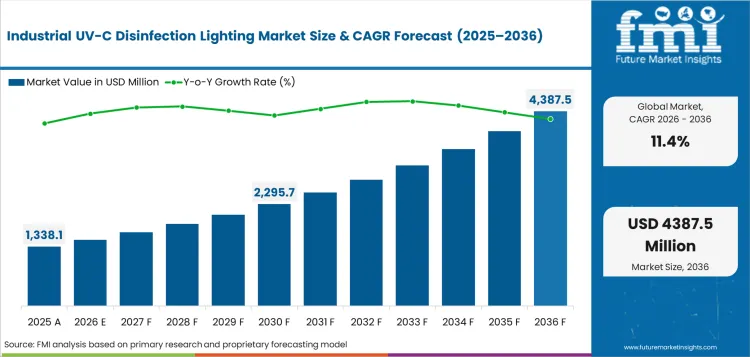
Key Takeaways, Market Size, and Forecast
- The industrial UV-C disinfection lighting market was valued at USD 1,338.1 million in 2025.
- By 2036, the industrial uv-c disinfection lighting market is expected to reach USD 4,387.5 million.
- From 2026 to 2036, the market is projected to expand at a 11.4% CAGR.
- The market is projected to create an incremental opportunity of USD 2,896.9 million between 2026 and 2036.
- In 2026, mercury lamps are projected to account for 58.0% of the UV source segment.
- South Korea at 13.6% CAGR and the United Kingdom at 13.0% CAGR are two faster expanding country markets.
Air-handling contamination control is pushing industrial UV-C disinfection lighting toward engineered dose and safety documentation. ASHRAE states that in-duct UV-C air disinfection needs 1,500 µJ/cm² target dose and 500 fpm or slower airstream speed. Those numbers give facility teams a clearer design basis for HVAC-integrated disinfection. Signify’s Philips leaflet dated August 2024 states that its upper-air wall-mounted unit uses a 25 W T5 TUV lamp with a 253.7 nm UV-C peak. Upper-air systems therefore fit occupied industrial offices and plant support rooms where disinfection must continue above workers. The USA Department of Energy CALiPER report stated in October 2024 that GUV buyers need accurate performance claims and data for safe deployment. Measured output data is likely to become a tender-screening requirement. EN IEC 60068-2-87:2024 also adds a durability angle by covering UV-C exposure tests for materials and components used in UVGI systems.
Industrial UV-C Disinfection Lighting Market Definition
The industrial UV-C disinfection lighting market includes germicidal lighting systems used to reduce microbes in air paths and on controlled surfaces. Scope covers upper-room fixtures, in-duct HVAC units, mobile robots, conveyor systems and enclosed process-line chambers. The market includes mercury lamps, UV-C LEDs and excimer sources used in industrial and institutional sites. Scope excludes household lamps, handheld consumer wands and water-only treatment systems without lighting fixtures.
Industrial UV-C Disinfection Lighting Market Inclusions
Market scope covers system formats, end-use settings, UV source types, safety standards, installation scope and regional demand across factories and institutional facilities, with stakeholders including manufacturers, food processors, cleanroom operators, hospitals, HVAC contractors and safety auditors.
Industrial UV-C Disinfection Lighting Market Exclusions
Scope does not include consumer sanitizing boxes, handheld wands, laboratory exposure cabinets sold as instruments, municipal water reactors, chemical disinfectants or general LED lighting without a germicidal UV-C function.
Industrial UV-C Disinfection Lighting Market Research Methodology
- Primary Research: FMI analysts spoke with fixture suppliers, lamp makers, cleanroom service firms, HVAC contractors and industrial safety planners in key markets.
- Desk Research: The study combined information from public health bodies, standards organizations, government statistics and company product records.
- Market sizing and forecasting: The model used system volume, fixture pricing, lamp replacement cycles and end-use installation patterns from the bottom up.
- Data validation: Forecasts were cross-checked against building stock, cleanroom activity, food processing plants and UV source supply signals.
Why is the Industrial UV-C Disinfection Lighting Market Growing?
- Industrial buyers are adding UV-C units where cleaning windows are short and contamination risk carries high cost.
- HVAC upgrades are creating demand for in-duct fixtures that treat moving air without occupying production space.
- Cleanroom and pharma users are choosing documented installations that support audit files and safety review.
Industrial UV-C disinfection lighting is witnessing expansion ad facilities need microbial control without adding chemical residue. The United States Centers for Disease Control and Prevention described germicidal ultraviolet as a layered workplace control in October 2024. That framing supports use in buildings that already combine ventilation and surface cleaning. Suppliers able to present dose files and worker safety controls gain access to buyers with strict operating rules.
Air-side use is gaining attention as facility teams add controls inside ducts and air handling units. The American Society of Heating, Refrigerating and Air-Conditioning Engineers lists 1,500 microwatt seconds per square centimeter as a target in-duct UV dose for certain HVAC designs. That figure gives engineers a practical starting point for fixture layout. It also shifts sales toward providers that can size lamps and service access together.
Market Segmentation Analysis
- In-duct HVAC is projected to account for 35.0% of system format demand in 2026 due to safer enclosed placement.
- Pharma Cleanrooms are expected to hold 36.0% of end-use demand in 2026 as validation records affect site audits.
- Mercury Lamps are forecast to represent 58.0% of UV source demand in 2026 with known dose performance.
- UL IEC Safety is projected to account for 46.0% of compliance demand in 2026 as exposure control guides purchases.
- Fixed Installations are expected to make up 54.0% of installation scope demand in 2026 as dose mapping is easier to repeat.
The market is divided into five main segment groups based on system format, end use, UV source, compliance standard and installation scope. System format includes Upper-room Fixtures, In-duct HVAC, Mobile Robots and Conveyor Systems. End use includes Food Processing, Pharma Cleanrooms, Hospitals Labs and Logistics Chain. UV source includes Mercury Lamps, UV-C LEDs and Excimer Sources. Compliance standard includes UL IEC Safety, GMP Validated and General Industrial.
Insights into the System Format Segment
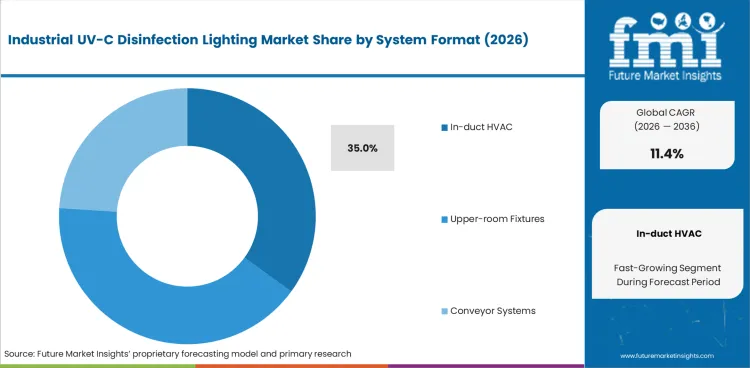
- In 2026, In-duct HVAC is projected to make up 35.0% of the System Format segment. Enclosed placement reduces direct exposure risk and works well with planned air handling maintenance.
- Upper-room Fixtures are expected to account for 32.0% share in 2026. Their use is stronger in high-ceiling spaces that need air treatment without line stoppage.
- Mobile Robots are projected at 22.0% share in 2026. Their value improves in rooms that need scheduled treatment after people leave.
System format choice is mainly a safety and access decision. The United States Department of Energy tested germicidal ultraviolet luminaires in October 2024 and found large differences in beam control among tested products. That difference affects where fixtures can be installed. Buyers will favor formats that match maintenance access and worker exposure limits.
Insights into the End Use Segment
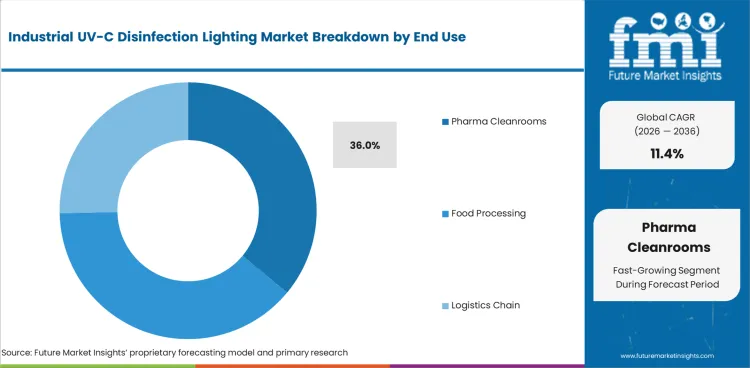
- Pharma Cleanrooms are expected to hold 36.0% share of end-use demand in 2026. Validation needs make UV-C purchases part of controlled process design.
- End-use demand is shaped by the cost of contamination and the proof needed during audits. The United States Food and Drug Administration listed 4,619 manufacturing sites in its drug quality catalog at the end of fiscal year 2024. Site complexity makes cleanroom buyers careful about fixture records.
Insights into the UV Source Segment
- Mercury Lamps are projected to account for 58.0% of the UV Source segment in 2026. Plant teams know their output and service needs.
- UV source selection is changing as component makers improve output at short wavelengths. National Institute of Standards and Technology research in November 2024 noted that 222 nm and 254 nm sources can create different indoor chemistry effects. That finding pushes buyers to check room conditions and exposure rules. Source choice will depend on dose stability and safety approval.
Insights into the Compliance Standard Segment
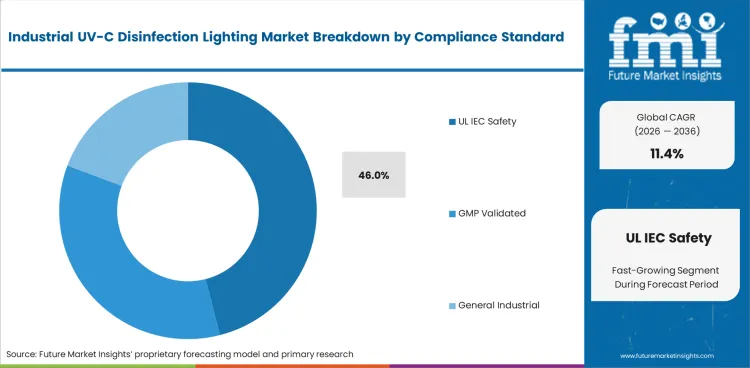
- UL IEC Safety is expected to lead with 46.0% share of compliance demand in 2026. Optical radiation safety review is now part of early supplier screening.
- Compliance demand rises when buyers need proof that a lamp will not create unsafe exposure. The International Electrotechnical Commission issued a germicidal ultraviolet lamp safety standard in May 2024 for optical radiation risks. That standard strengthens the role of labeled safety design.
Insights into the Installation Scope Segment
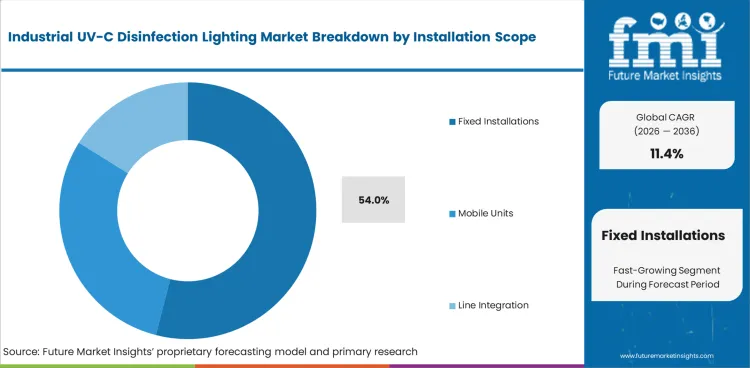
- Fixed Installations are projected to hold 54.0% share of Installation Scope in 2026. Repeatable placement supports stable dose mapping and service plans.
- Installation scope depends on whether the buyer wants repeatable treatment or flexible room use. The Environmental Protection Agency ordered a stop-sale in September 2024 for certain UV light antimicrobial products that failed registration rules. That action shows why industrial buyers ask for clear product claims. Fixed systems with documented use instructions reduce claim and misuse risk.
Industrial UV-C Disinfection Lighting Market Drivers, Restraints, and Opportunities
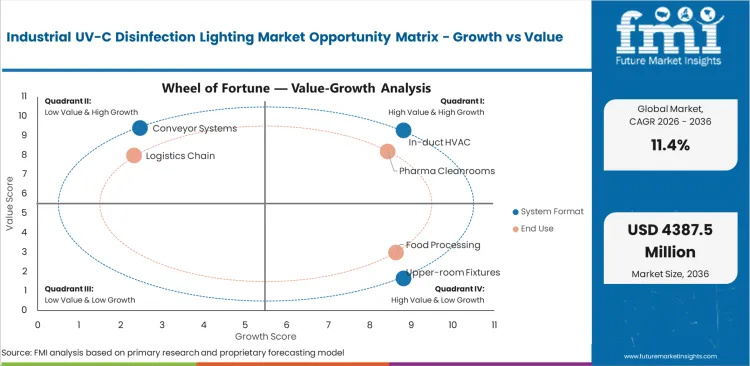
- Duct-mounted disinfection demand is rising as air handling upgrades create easier access to enclosed UV-C placement.
- Optical radiation safety limits restrain use in occupied zones unless fixtures include shielding and control systems.
- UV-C LED integration creates opportunity in compact machinery and closed process-line chambers.
Industrial UV-C disinfection lighting gains share when buyers can place fixtures in zones with limited worker exposure. The strongest route is not open-room lamp volume. It is controlled use in ducts, cleanrooms and production equipment. These applications let suppliers show dose evidence and service needs before a facility expands coverage. The practical result is a market that rewards engineering support over simple fixture availability.
Duct Placement Lowers Exposure Risk
In-duct systems are gaining buying attention as they fit inside air handling units and reduce direct exposure to workers. American Society of Heating, Refrigerating and Air-Conditioning Engineers guidance notes that UV surface treatment is often placed 12 to 36 inches from coils or drain pans. This supports service teams that already inspect those points. The same access pattern makes maintenance easier for facilities with strict safety control.
Safety Claims Slow Open Use
Open area use faces a harder path because user safety depends on fixture height and beam cutoff. The United States Department of Energy round two testing showed uneven beam distribution across sampled upper-room luminaires in October 2024. Poor beam control can create exposure risk. Buyers will require stronger layout support before they accept visible-room installations.
LED Modules Enter Equipment Channels
UV-C LED modules are moving into equipment channels where small size and quick switching carry value. In October 2024, ams OSRAM introduced a 265 nm device with 115 mW typical radiant flux and 20,000 hour lifetime rating. This supports compact disinfection tools that do not fit mercury tubes. Adoption will depend on thermal control and stable output during long operating cycles.
Analysis of Industrial UV-C Disinfection Lighting Market By Key Countries
.webp "Top Country Growth Comparison Industrial Uv C Disinfection Lighting Market Cagr (2026 2036)")
| Country | CAGR |
|---|---|
| United States | 10.0% |
| China | 10.5% |
| India | 10.8% |
| Germany | 11.7% |
| Japan | 12.3% |
| United Kingdom | 13.0% |
| South Korea | 13.6% |
Source: Future Market Insights, 2026.
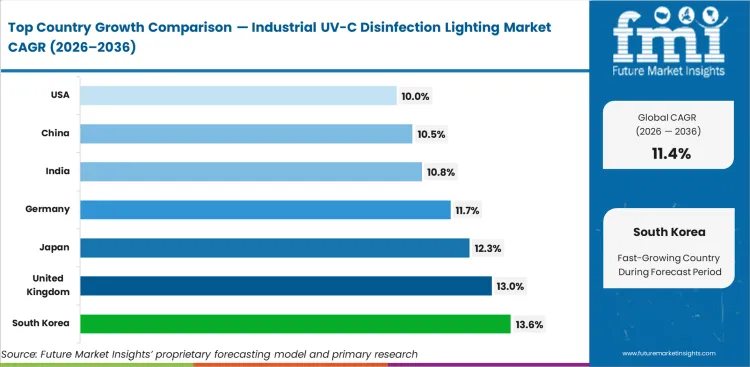
Industrial UV-C Disinfection Lighting Market CAGR Analysis By Country
- South Korea is expected to post 13.6% CAGR by 2036 as semiconductor and food plants support controlled clean zones.
- The United Kingdom is projected at 13.0% CAGR by 2036 as food plants and healthcare spaces create steady replacement demand.
- Japan is forecast at 12.3% CAGR by 2036 with hospital density and precision production supporting enclosed UV-C use.
- Germany is expected to advance at 11.7% CAGR through 2036 as manufacturing orders and cleanroom upgrades support installations.
- India and China are forecast above the global pace due to pharma output and healthcare infrastructure growth.
Demand for industrial UV-C disinfection lighting is projected to expand at 11.4% CAGR from 2026 to 2036. Country-level analysis covers the seven markets that matter most for supplier planning. These countries combine large industrial sites, healthcare demand, electronics production and cleanroom use. The following sections explain why each country is commercially important.
Demand Outlook for Industrial UV-C Disinfection Lighting Market in the United States
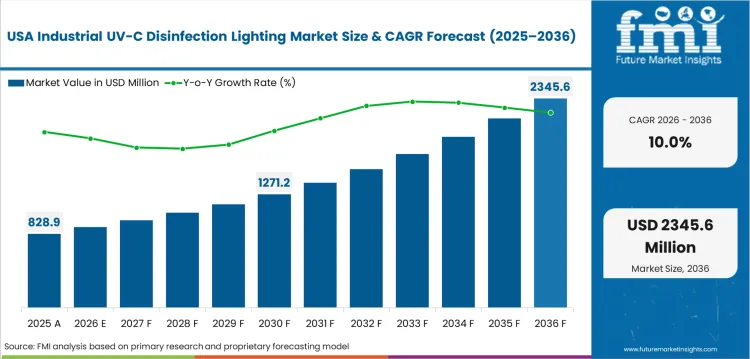
The United States is projected to record a 10.0% CAGR through 2036 as healthcare and controlled manufacturing sustain UV-C buying. The United States Centers for Disease Control and Prevention named germicidal ultraviolet as a layered workplace control in October 2024. That guidance supports use in facilities that already plan air and surface controls. Suppliers must prove safety and dose control before large buyers expand installations.
- Healthcare and lab sites favor UVC surface systems that can show controlled use and operator protection.
- HVAC service firms can attach demand for disinfection equipment in the USA to air handling upgrades.
- Product safety files matter as the Environmental Protection Agency has acted against unsupported UV antimicrobial claims.
Sales Analysis of Industrial UV-C Disinfection Lighting Market in China
China is expected to expand at 10.5% CAGR through 2036 as healthcare scale and industrial production support adoption. By the end of 2024, China had 1.092 million medical and health institutions. That large facility network creates a wide pool for controlled air and surface disinfection. Local suppliers can gain if they combine fixture supply with safety support.
- Hospitals and factories create a mixed buyer group for UVC disinfection products across air and surface use.
- Domestic electronics production supports shorter channels for UV-C LED modules and enclosed systems.
- Buyers are likely to favor products with clear exposure controls and service instructions.
Demand Outlook for Industrial UV-C Disinfection Lighting Market in India
India is forecast to grow at 10.8% CAGR through 2036 as pharma exports and food processing sites lift cleanroom use. India exported pharmaceuticals to 191 countries in 2024-25 according to the national industry ministry release. Export-facing production pushes factories toward documented hygiene and quality systems. UV-C suppliers can gain by supporting validation at plant level.
- Pharma cleanrooms support cleanroom technologies that include air and surface control packages.
- Food plants can use food sterilization equipment around enclosed product flow and packaging lines.
- Suppliers need local service coverage because lamp replacement and dose checks affect repeat orders.
Opportunity Analysis of Industrial UV-C Disinfection Lighting Market in Germany
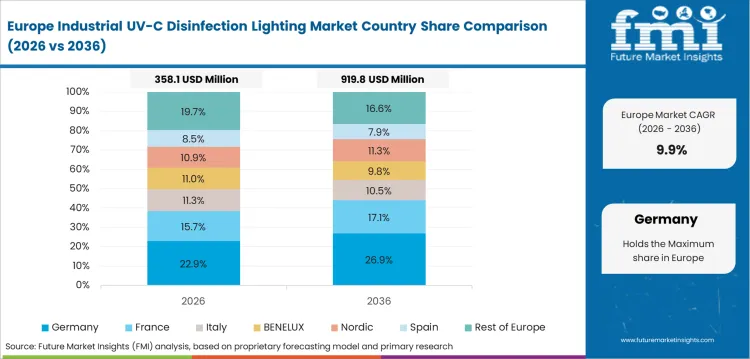
Germany is expected to advance at 11.7% CAGR through 2036 as industrial buyers add safety-backed disinfection systems. German manufacturing orders rose 5.0% month-on-month in March 2026 according to the national statistics office. Short-term orders do not define UV-C demand alone. They show a manufacturing setting that can support investment in plant upgrades and controlled process environments.
- Clean production sites favor cleanroom construction that can include UV-C disinfection planning.
- Food and pharma buyers are expected to prefer fixtures with European safety documentation.
- Engineering depth supports conveyor and in-duct systems that need layout support before installation.
Future Outlook for Industrial UV-C Disinfection Lighting Market in Japan
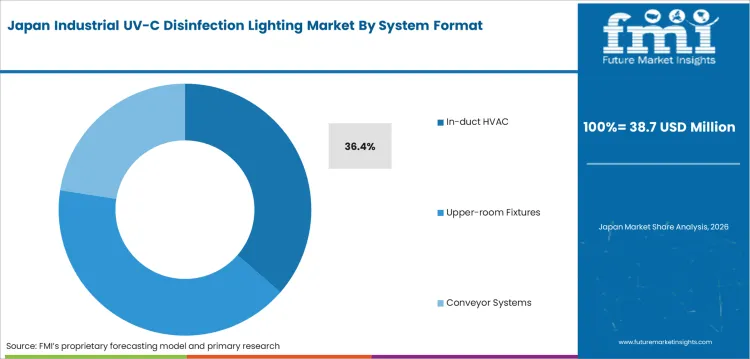
Japan is projected to rise at 12.3% CAGR through 2036 as healthcare sites and precision plants favor enclosed UV-C systems. Japan had 8,122 hospitals and 1,481,183 hospital beds as recorded in the 2025 Statistical Handbook. This facility stock supports repeat demand for controlled disinfection tools. Suppliers with compact fixtures can serve space-constrained rooms and equipment bays.
- Healthcare sites can use sterilization equipment where treatment happens inside controlled spaces.
- Factory buyers can apply UV-C sterilizing conveyors where product movement is consistent.
- Japanese buyers are expected to place high weight on reliability and safe service access.
Demand Outlook for Industrial UV-C Disinfection Lighting Market in the United Kingdom
The United Kingdom is forecast at 13.0% CAGR through 2036 as food plants and healthcare settings create steady interest. The United Kingdom statistics office released 2024 and 2025 food and drink manufacturing unit counts in February 2026. That data supports a clear production setting for hygiene upgrades. UV-C vendors can gain where they match fixtures with cleaning routines and worker safety checks.
- Food manufacturers can add food and beverage air filters and UV-C lighting as part of indoor control upgrades.
- Facility teams can evaluate air purifiers alongside in-duct UV-C for indoor air planning.
- Suppliers need clear safety training to support use in shared work areas.
Opportunity Analysis of Industrial UV-C Disinfection Lighting Market in South Korea
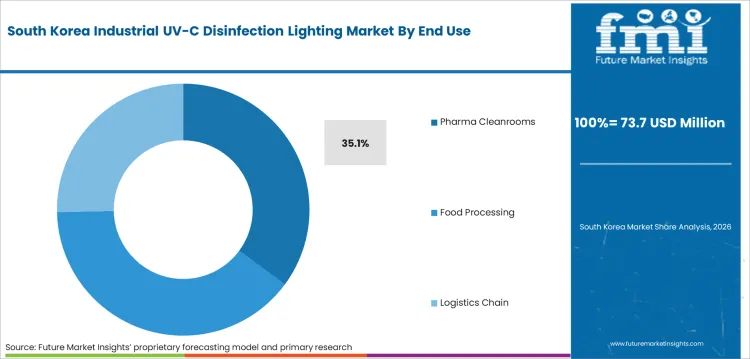
South Korea is expected to post 13.6% CAGR through 2036 as food manufacturing and electronics clean spaces support growth. The national agriculture ministry reported 44,438 food manufacturing businesses in 2024. Food plants need repeatable hygiene support around lines and storage zones. UV-C fixture suppliers can grow faster where systems fit enclosed use and service routines.
- Electronics plants support cleanroom air handling units where UV-C can be planned inside controlled airflow.
- Food manufacturing supports sterilization tunnels when product flow allows repeatable exposure control.
- Component suppliers with UV-C LED depth are expected to gain attention from local equipment makers.
Competitive Landscape and Strategic Positioning
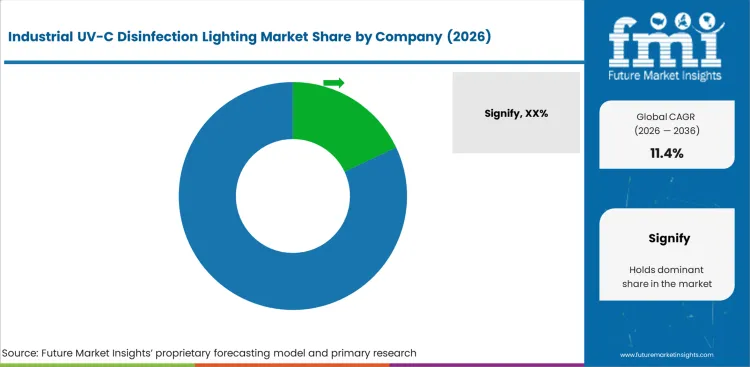
- Signify leads with lighting channel depth and experience in UV-C fixtures for air and surface treatment.
- ams OSRAM and Nichia compete through UV-C LED components that support compact equipment design.
- Ushio and Excelitas Technologies serve industrial buyers with lamp and photonics portfolios across germicidal uses.
Competition is split between full fixture suppliers and UV source manufacturers. Buyers often shortlist full system providers first when worker exposure risk is high. Component firms gain influence inside enclosed equipment and OEM channels. This structure favors companies that can support dose control, safety documentation and replacement planning without forcing the buyer to manage many vendors.
The market also includes water and industrial treatment specialists that know disinfection validation. Halma strengthened its role through Nuvonic and related operating companies. Xylem Wedeco and Trojan Technologies bring ultraviolet treatment experience from water applications. Their challenge is to adapt that strength to lighting layouts and worker-facing safety requirements in industrial buildings.
Key Companies in the Industrial UV-C Disinfection Lighting Market
The competitive field combines lighting brands, UV source makers and industrial disinfection specialists.
- Global Leaders: Signify and Excelitas Technologies have broad lighting and photonics portfolios. Excelitas Technologies carries the former Heraeus Noblelight business after closing the acquisition in January 2024. Their strength is stronger where buyers need lamp output records, service access and safety files for plant-level approval.
- Component Specialists: ams OSRAM, Nichia, Ushio and Seoul Viosys influence equipment design through UV-C LEDs and lamp components. Their role is strongest in enclosed chambers and compact machinery. Buyers evaluate radiant flux, lifetime and thermal stability before choosing these sources for repeat use.
- Industrial System Players: Halma, Eaton, Xylem Wedeco and Trojan Technologies compete in disinfection systems and safety-related channels. Their advantage improves when buyers need integration support and service cover. These firms are better placed in projects that connect electrical control, facility maintenance and disinfection records.
Competitive Benchmarking: Industrial UV-C Disinfection Lighting Market
| Company | UV Source Depth | Safety Documentation | Industrial Integration | Geographic Footprint |
|---|---|---|---|---|
| Signify | High | Strong | High | Global lighting channels across Europe, North America and Asia |
| ams OSRAM | High | Medium | Medium | Global component footprint with strength in Europe and Asia |
| Nichia | High | Medium | Medium | Asia centered with global LED component reach |
| Ushio | High | Strong | Medium | Japan centered with global specialty lamp channels |
| Excelitas Technologies | High | Strong | High | Global photonics platform with former Heraeus Noblelight assets |
| Halma | Medium | Strong | High | Global safety and environmental technology group |
| Eaton | Medium | Strong | High | Global electrical infrastructure and control footprint |
| Xylem Wedeco | High | Strong | Medium | Global water treatment and UV system footprint |
| Trojan Technologies | High | Strong | Medium | North America centered with global UV treatment experience |
| Seoul Viosys | High | Medium | Medium | South Korea centered with global UV LED reach |
Source: Future Market Insights competitive analysis, 2026. Ratings reflect relative positioning based on UV Source Depth, Safety Documentation and Industrial Integration.
Key Developments in Industrial UV-C Disinfection Lighting Market
- In January 2024, Excelitas Technologies closed the acquisition of the Heraeus Noblelight business. This moved a major UV lamp portfolio into a broader photonics platform.
- In October 2024, ams OSRAM launched the OSLON UV 3535 LED at 265 nm with 115 mW typical output. This supports compact UV-C equipment design.
- In November 2024, Excelitas Technologies announced a German production consolidation plan for its Noblelight operations. The move supports scale planning for specialty light sources.
- In June 2025, ams OSRAM and Hergy announced collaboration for Perazim drinking water sterilizers. The project shows UV-C LEDs moving into applied disinfection equipment.
- In May 2025, Seoul Viosys described Violeds uses across sterilization, air treatment and water treatment. This shows continued component focus on applied UV functions.
Key Players in the Industrial UV-C Disinfection Lighting Market
Major global companies leading the industrial UV-C disinfection lighting market include:
Major Global Players:
- Signify
- ams OSRAM
- Nichia
- Ushio
- Excelitas Technologies
Specialist Players:
- Halma
- Eaton
- Trojan Technologies
- Xylem Wedeco
- Seoul Viosys
Report Scope and Coverage
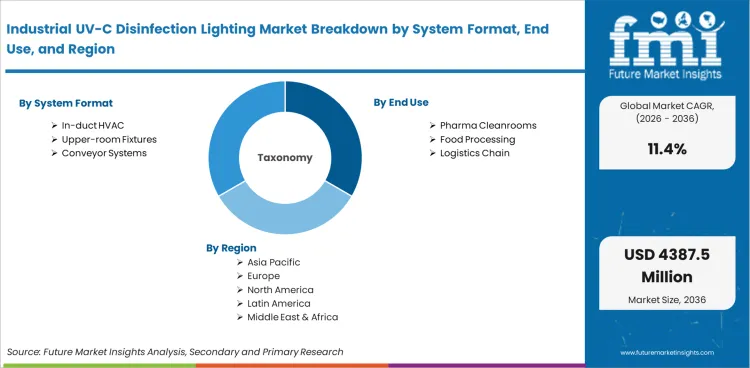
| Parameter | Details |
|---|---|
| Quantitative Units | USD 1,490.6 million to USD 4,387.5 million, at a 11.4% CAGR |
| Market Definition | Germicidal UV-C lighting systems used for air and controlled surface disinfection in industrial and institutional settings |
| By System Format | Upper-room Fixtures, In-duct HVAC, Mobile Robots and Conveyor Systems |
| By End Use | Food Processing, Pharma Cleanrooms, Hospitals Labs and Logistics Chain |
| By UV Source | Mercury Lamps, UV-C LEDs and Excimer Sources |
| By Compliance Standard | UL IEC Safety, GMP Validated and General Industrial |
| Regions Covered | North America, Latin America, Europe, East Asia, South Asia and Pacific, Middle East and Africa |
| Countries Covered | United States, United Kingdom, Germany, China, India, Japan, South Korea and 30 plus countries |
| Key Companies Profiled | Signify, ams OSRAM, Nichia, Ushio, Excelitas Technologies, Halma and Seoul Viosys |
| Forecast Period | 2026 to 2036 |
| Approach | Hybrid bottom-up and top-down method starting with fixture demand and verified end-use activity patterns |
Source: Future Market Insights, 2026.
Industrial UV-C Disinfection Lighting Market by Segments
Industrial UV-C Disinfection Lighting Market Segmented by System Format:
- Upper-room Fixtures
- In-duct HVAC
- Mobile Robots
- Conveyor Systems
Industrial UV-C Disinfection Lighting Market Segmented by End Use:
- Food Processing
- Pharma Cleanrooms
- Hospitals Labs
- Logistics Chain
Industrial UV-C Disinfection Lighting Market Segmented by UV Source:
- Mercury Lamps
- UV-C LEDs
- Excimer Sources
Industrial UV-C Disinfection Lighting Market Segmented by Compliance Standard:
- UL IEC Safety
- GMP Validated
- General Industrial
Industrial UV-C Disinfection Lighting Market Segmented by Installation Scope:
- Fixed Installations
- Mobile Units
- Line Integration
Industrial UV-C Disinfection Lighting Market by Region:
- North America
- United States
- Canada
- Mexico
- Latin America
- Brazil
- Chile
- Rest of Latin America
- Europe
- Germany
- United Kingdom
- Italy
- Spain
- France
- Rest of Europe
- East Asia
- China
- Japan
- South Korea
- South Asia and Pacific
- India
- ASEAN
- Australia and New Zealand
- Rest of South Asia and Pacific
- Middle East and Africa
- Saudi Arabia
- Other GCC Countries
- South Africa
- Rest of Middle East and Africa
Research Sources and Bibliography
- Centers for Disease Control and Prevention. (2024, October). Germicidal ultraviolet as a workplace control.
- American Society of Heating, Refrigerating and Air-Conditioning Engineers. (2025, March). Filtration and disinfection guidance for HVAC applications.
- United States Department of Energy. (2024, October). CALiPER exploratory testing of germicidal ultraviolet luminaires: Round 2.
- National Institute of Standards and Technology. (2024, November). Indoor air chemistry implications of germicidal ultraviolet sources.
- United States Food and Drug Administration. (2025, January). Report on the state of pharmaceutical quality: Fiscal year 2024.
- National Bureau of Statistics of China. (2025, February). Statistical communique of the People's Republic of China on the 2024 national economic and social development.
- India Ministry of Chemicals and Fertilizers. (2026, March). Economic Survey 2025-26 highlights India's pharmaceutical exports.
- Federal Statistical Office of Germany. (2026, April). New orders in manufacturing in March 2026.
- Statistics Bureau of Japan. (2025, September). Statistical handbook of Japan 2025.
- Office for National Statistics. (2026, February). Food and drink manufacture in England: 2024 and 2025.
- Ministry of Agriculture, Food and Rural Affairs of South Korea. (2025, July). Food industry statistics for 2024.
- International Electrotechnical Commission. (2024, May). IEC 62471-6: Photobiological safety of lamps and lamp systems.
- United States Environmental Protection Agency. (2024, September). EPA orders Med Solutions to stop selling certain UV light antimicrobial products.
- ams OSRAM. (2024, October). New OSLON UV 3535 raises UV-C LED output for sterilization applications.
- Excelitas Technologies. (2024, January). Excelitas Technologies completes acquisition of Heraeus Noblelight.
- Excelitas Technologies. (2024, November). Excelitas Technologies announces Noblelight production consolidation in Germany.
- ams OSRAM. (2025, June). ams OSRAM and Hergy collaborate on Perazim water sterilization products.
- Seoul Viosys. (2025, May). Seoul Viosys shares Violeds applications across sterilization and air treatment.
This Report Answers
- What is the forecast value of the Industrial UV-C Disinfection Lighting Market by 2036?
- Which system format is projected to lead industrial UV-C disinfection lighting demand in 2026?
- Which UV source is expected to hold the highest share during the 2026 starting year?
- How do compliance standards shape fixture selection in industrial sites?
- Which countries are projected to grow faster than the global average during the forecast period?
- How are component suppliers and fixture makers positioned in this market?
- What operating factors can slow adoption in occupied work areas?
Frequently Asked Questions
What is the Industrial UV-C Disinfection Lighting Market value in 2026?
The Industrial UV-C Disinfection Lighting Market is forecast at USD 1,490.6 million in 2026 and USD 4,387.5 million by 2036.
What CAGR is expected for the Industrial UV-C Disinfection Lighting Market?
The Industrial UV-C Disinfection Lighting Market is projected to expand at a 11.4% CAGR from 2026 to 2036.
Which system format leads the Industrial UV-C Disinfection Lighting Market?
In-duct HVAC is projected to lead the system format segment with 35.0% share in 2026 due to safer enclosed placement.
Which UV source leads the Industrial UV-C Disinfection Lighting Market?
Mercury Lamps are expected to lead the UV source segment with 58.0% share in 2026 due to known dose behavior.
Which country grows fastest in the Industrial UV-C Disinfection Lighting Market?
South Korea is expected to post the fastest country pace at 13.6% CAGR by 2036 due to cleanroom and food plant needs.
How does industrial UV-C disinfection lighting work?
Industrial UV-C systems use short-wavelength ultraviolet energy to reduce microbes on air paths or controlled surfaces. Safe use needs shielding and access control.
How should buyers compare mercury lamps and UV-C LEDs?
Mercury lamps suit proven dose needs and larger fixtures. UV-C LEDs fit compact equipment when output stability and heat control are verified.
What affects the cost of industrial UV-C disinfection lighting?
Cost is shaped by fixture count, shielding needs, control systems and service access. Validation files can raise cost in pharma cleanroom projects.
How long can industrial UV-C disinfection lighting last?
Service life depends on lamp type, heat control and replacement planning. Buyers should track output decay rather than only rated operating hours.
Preview the report firsthand - request a free sample
Get SampleGet the brochure for pricing and purchase details.
Get PDFTable of Content
- Executive Summary
- Global Market Outlook
- Demand-side Trends
- Supply-side Trends
- Technology Roadmap Analysis
- Analysis and Recommendations
- Market Overview
- Market Coverage / Taxonomy
- Market Definition / Scope / Limitations
- Research Methodology
- Chapter Orientation
- Market Structure, Signals, and Trend Drivers
- Benchmarking and Cross-market Comparability
- Market Sizing, Forecasting, and Opportunity Mapping
- Research Design and Evidence Framework
- Desk Research Programme (Secondary Evidence)
- Company Annual and Sustainability Reports
- Peer-reviewed Journals and Academic Literature
- Corporate Websites, Product Literature, and Technical Notes
- Earnings Decks and Investor Briefings
- Statutory Filings and Regulatory Disclosures
- Technical White Papers and Standards Notes
- Trade Journals, Industry Magazines, and Analyst Briefs
- Conference Proceedings, Webinars, and Seminar Materials
- Government Statistics Portals and Public Data Releases
- Press Releases and Reputable Media Coverage
- Specialist Newsletters and Curated Briefings
- Sector Databases and Reference Repositories
- FMI Internal Proprietary Databases and Historical Market Datasets
- Subscription Datasets and Paid Sources
- Social Channels, Communities, and Digital Listening Inputs
- Additional Desk Sources
- Expert Input and Fieldwork (Primary Evidence)
- Primary Modes
- Qualitative Interviews and Expert Elicitation
- Quantitative Surveys and Structured Data Capture
- Blended Approach
- Why Primary Evidence is Used
- Observational and In-context Research
- Social and Community Interactions
- Primary Modes
- Stakeholder Universe Engaged
- C-suite Leaders
- Board Members
- Presidents and Vice Presidents
- R&D and Innovation Heads
- Technical Specialists
- Domain Subject-matter Experts
- Scientists
- Physicians and Other Healthcare Professionals
- Governance, Ethics, and Data Stewardship
- Research Ethics
- Data Integrity and Handling
- Desk Research Programme (Secondary Evidence)
- Tooling, Models, and Reference Databases
- Data Engineering and Model Build
- Data Acquisition and Ingestion
- Cleaning, Normalisation, and Verification
- Synthesis, Triangulation, and Analysis
- Quality Assurance and Audit Trail
- Market Background
- Market Dynamics
- Drivers
- Restraints
- Opportunity
- Trends
- Scenario Forecast
- Demand in Optimistic Scenario
- Demand in Likely Scenario
- Demand in Conservative Scenario
- Opportunity Map Analysis
- Product Life Cycle Analysis
- Supply Chain Analysis
- Investment Feasibility Matrix
- Value Chain Analysis
- PESTLE and Porter’s Analysis
- Regulatory Landscape
- Regional Parent Market Outlook
- Production and Consumption Statistics
- Import and Export Statistics
- Market Dynamics
- Global Market Analysis 2021 to 2025 and Forecast, 2026 to 2036
- Historical Market Size Value (USD Million) Analysis, 2021 to 2025
- Current and Future Market Size Value (USD Million) Projections, 2026 to 2036
- Y-o-Y Growth Trend Analysis
- Absolute $ Opportunity Analysis
- Global Market Pricing Analysis 2021 to 2025 and Forecast 2026 to 2036
- Global Market Analysis 2021 to 2025 and Forecast 2026 to 2036, By System Format
- Introduction / Key Findings
- Historical Market Size Value (USD Million) Analysis By System Format , 2021 to 2025
- Current and Future Market Size Value (USD Million) Analysis and Forecast By System Format , 2026 to 2036
- In-duct HVAC
- Upper-room Fixtures
- Conveyor Systems
- In-duct HVAC
- Y-o-Y Growth Trend Analysis By System Format , 2021 to 2025
- Absolute $ Opportunity Analysis By System Format , 2026 to 2036
- Global Market Analysis 2021 to 2025 and Forecast 2026 to 2036, By End Use
- Introduction / Key Findings
- Historical Market Size Value (USD Million) Analysis By End Use, 2021 to 2025
- Current and Future Market Size Value (USD Million) Analysis and Forecast By End Use, 2026 to 2036
- Pharma Cleanrooms
- Food Processing
- Logistics Chain
- Pharma Cleanrooms
- Y-o-Y Growth Trend Analysis By End Use, 2021 to 2025
- Absolute $ Opportunity Analysis By End Use, 2026 to 2036
- Global Market Analysis 2021 to 2025 and Forecast 2026 to 2036, By Compliance Standard
- Introduction / Key Findings
- Historical Market Size Value (USD Million) Analysis By Compliance Standard, 2021 to 2025
- Current and Future Market Size Value (USD Million) Analysis and Forecast By Compliance Standard, 2026 to 2036
- UL IEC Safety
- GMP Validated
- General Industrial
- UL IEC Safety
- Y-o-Y Growth Trend Analysis By Compliance Standard, 2021 to 2025
- Absolute $ Opportunity Analysis By Compliance Standard, 2026 to 2036
- Global Market Analysis 2021 to 2025 and Forecast 2026 to 2036, By Installation Scope
- Introduction / Key Findings
- Historical Market Size Value (USD Million) Analysis By Installation Scope, 2021 to 2025
- Current and Future Market Size Value (USD Million) Analysis and Forecast By Installation Scope, 2026 to 2036
- Fixed Installations
- Mobile Value (USD Million)s
- Line Integration
- Fixed Installations
- Y-o-Y Growth Trend Analysis By Installation Scope, 2021 to 2025
- Absolute $ Opportunity Analysis By Installation Scope, 2026 to 2036
- Global Market Analysis 2021 to 2025 and Forecast 2026 to 2036, By Region
- Introduction
- Historical Market Size Value (USD Million) Analysis By Region, 2021 to 2025
- Current Market Size Value (USD Million) Analysis and Forecast By Region, 2026 to 2036
- North America
- Latin America
- Western Europe
- Eastern Europe
- East Asia
- South Asia and Pacific
- Middle East & Africa
- Market Attractiveness Analysis By Region
- North America Market Analysis 2021 to 2025 and Forecast 2026 to 2036, By Country
- Historical Market Size Value (USD Million) Trend Analysis By Market Taxonomy, 2021 to 2025
- Market Size Value (USD Million) Forecast By Market Taxonomy, 2026 to 2036
- By Country
- USA
- Canada
- Mexico
- By System Format
- By End Use
- By Compliance Standard
- By Installation Scope
- By Country
- Market Attractiveness Analysis
- By Country
- By System Format
- By End Use
- By Compliance Standard
- By Installation Scope
- Key Takeaways
- Latin America Market Analysis 2021 to 2025 and Forecast 2026 to 2036, By Country
- Historical Market Size Value (USD Million) Trend Analysis By Market Taxonomy, 2021 to 2025
- Market Size Value (USD Million) Forecast By Market Taxonomy, 2026 to 2036
- By Country
- Brazil
- Chile
- Rest of Latin America
- By System Format
- By End Use
- By Compliance Standard
- By Installation Scope
- By Country
- Market Attractiveness Analysis
- By Country
- By System Format
- By End Use
- By Compliance Standard
- By Installation Scope
- Key Takeaways
- Western Europe Market Analysis 2021 to 2025 and Forecast 2026 to 2036, By Country
- Historical Market Size Value (USD Million) Trend Analysis By Market Taxonomy, 2021 to 2025
- Market Size Value (USD Million) Forecast By Market Taxonomy, 2026 to 2036
- By Country
- Germany
- UK
- Italy
- Spain
- France
- Nordic
- BENELUX
- Rest of Western Europe
- By System Format
- By End Use
- By Compliance Standard
- By Installation Scope
- By Country
- Market Attractiveness Analysis
- By Country
- By System Format
- By End Use
- By Compliance Standard
- By Installation Scope
- Key Takeaways
- Eastern Europe Market Analysis 2021 to 2025 and Forecast 2026 to 2036, By Country
- Historical Market Size Value (USD Million) Trend Analysis By Market Taxonomy, 2021 to 2025
- Market Size Value (USD Million) Forecast By Market Taxonomy, 2026 to 2036
- By Country
- Russia
- Poland
- Hungary
- Balkan & Baltic
- Rest of Eastern Europe
- By System Format
- By End Use
- By Compliance Standard
- By Installation Scope
- By Country
- Market Attractiveness Analysis
- By Country
- By System Format
- By End Use
- By Compliance Standard
- By Installation Scope
- Key Takeaways
- East Asia Market Analysis 2021 to 2025 and Forecast 2026 to 2036, By Country
- Historical Market Size Value (USD Million) Trend Analysis By Market Taxonomy, 2021 to 2025
- Market Size Value (USD Million) Forecast By Market Taxonomy, 2026 to 2036
- By Country
- China
- Japan
- South Korea
- By System Format
- By End Use
- By Compliance Standard
- By Installation Scope
- By Country
- Market Attractiveness Analysis
- By Country
- By System Format
- By End Use
- By Compliance Standard
- By Installation Scope
- Key Takeaways
- South Asia and Pacific Market Analysis 2021 to 2025 and Forecast 2026 to 2036, By Country
- Historical Market Size Value (USD Million) Trend Analysis By Market Taxonomy, 2021 to 2025
- Market Size Value (USD Million) Forecast By Market Taxonomy, 2026 to 2036
- By Country
- India
- ASEAN
- Australia & New Zealand
- Rest of South Asia and Pacific
- By System Format
- By End Use
- By Compliance Standard
- By Installation Scope
- By Country
- Market Attractiveness Analysis
- By Country
- By System Format
- By End Use
- By Compliance Standard
- By Installation Scope
- Key Takeaways
- Middle East & Africa Market Analysis 2021 to 2025 and Forecast 2026 to 2036, By Country
- Historical Market Size Value (USD Million) Trend Analysis By Market Taxonomy, 2021 to 2025
- Market Size Value (USD Million) Forecast By Market Taxonomy, 2026 to 2036
- By Country
- Kingdom of Saudi Arabia
- Other GCC Countries
- Turkiye
- South Africa
- Other African Union
- Rest of Middle East & Africa
- By System Format
- By End Use
- By Compliance Standard
- By Installation Scope
- By Country
- Market Attractiveness Analysis
- By Country
- By System Format
- By End Use
- By Compliance Standard
- By Installation Scope
- Key Takeaways
- Key Countries Market Analysis
- USA
- Pricing Analysis
- Market Share Analysis, 2025
- By System Format
- By End Use
- By Compliance Standard
- By Installation Scope
- Canada
- Pricing Analysis
- Market Share Analysis, 2025
- By System Format
- By End Use
- By Compliance Standard
- By Installation Scope
- Mexico
- Pricing Analysis
- Market Share Analysis, 2025
- By System Format
- By End Use
- By Compliance Standard
- By Installation Scope
- Brazil
- Pricing Analysis
- Market Share Analysis, 2025
- By System Format
- By End Use
- By Compliance Standard
- By Installation Scope
- Chile
- Pricing Analysis
- Market Share Analysis, 2025
- By System Format
- By End Use
- By Compliance Standard
- By Installation Scope
- Germany
- Pricing Analysis
- Market Share Analysis, 2025
- By System Format
- By End Use
- By Compliance Standard
- By Installation Scope
- UK
- Pricing Analysis
- Market Share Analysis, 2025
- By System Format
- By End Use
- By Compliance Standard
- By Installation Scope
- Italy
- Pricing Analysis
- Market Share Analysis, 2025
- By System Format
- By End Use
- By Compliance Standard
- By Installation Scope
- Spain
- Pricing Analysis
- Market Share Analysis, 2025
- By System Format
- By End Use
- By Compliance Standard
- By Installation Scope
- France
- Pricing Analysis
- Market Share Analysis, 2025
- By System Format
- By End Use
- By Compliance Standard
- By Installation Scope
- India
- Pricing Analysis
- Market Share Analysis, 2025
- By System Format
- By End Use
- By Compliance Standard
- By Installation Scope
- ASEAN
- Pricing Analysis
- Market Share Analysis, 2025
- By System Format
- By End Use
- By Compliance Standard
- By Installation Scope
- Australia & New Zealand
- Pricing Analysis
- Market Share Analysis, 2025
- By System Format
- By End Use
- By Compliance Standard
- By Installation Scope
- China
- Pricing Analysis
- Market Share Analysis, 2025
- By System Format
- By End Use
- By Compliance Standard
- By Installation Scope
- Japan
- Pricing Analysis
- Market Share Analysis, 2025
- By System Format
- By End Use
- By Compliance Standard
- By Installation Scope
- South Korea
- Pricing Analysis
- Market Share Analysis, 2025
- By System Format
- By End Use
- By Compliance Standard
- By Installation Scope
- Russia
- Pricing Analysis
- Market Share Analysis, 2025
- By System Format
- By End Use
- By Compliance Standard
- By Installation Scope
- Poland
- Pricing Analysis
- Market Share Analysis, 2025
- By System Format
- By End Use
- By Compliance Standard
- By Installation Scope
- Hungary
- Pricing Analysis
- Market Share Analysis, 2025
- By System Format
- By End Use
- By Compliance Standard
- By Installation Scope
- Kingdom of Saudi Arabia
- Pricing Analysis
- Market Share Analysis, 2025
- By System Format
- By End Use
- By Compliance Standard
- By Installation Scope
- Turkiye
- Pricing Analysis
- Market Share Analysis, 2025
- By System Format
- By End Use
- By Compliance Standard
- By Installation Scope
- South Africa
- Pricing Analysis
- Market Share Analysis, 2025
- By System Format
- By End Use
- By Compliance Standard
- By Installation Scope
- USA
- Market Structure Analysis
- Competition Dashboard
- Competition Benchmarking
- Market Share Analysis of Top Players
- By Regional
- By System Format
- By End Use
- By Compliance Standard
- By Installation Scope
- Competition Analysis
- Competition Deep Dive
- Signify
- Overview
- Product Portfolio
- Profitability by Market Segments (Product/Age /Sales Channel/Region)
- Sales Footprint
- Strategy Overview
- Marketing Strategy
- Product Strategy
- Channel Strategy
- ams OSRAM
- Nichia
- Ushio
- Excelitas Technologies
- Signify
- Competition Deep Dive
- Assumptions & Acronyms Used


