

- Market Size (2026)
- USD 6.4 Bn
- Forecast (2036)
- USD 10.5 Bn
- CAGR (2026 to 2036)
- 5.0%
Industrial Food Processing By-Product Valorisation into Animal Feed in EU Industry Size, Market Forecast and Outlook by FMI
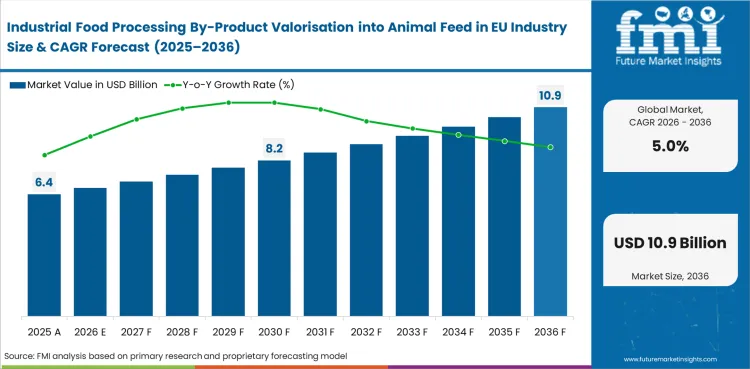
Industrial food processing by-product valorisation into animal feed in the European Union industry reached USD 6.1 billion in 2025 and is projected at USD 6.4 billion in 2026. The industry is expected to reach USD 10.5 billion by 2036 at a 5.0% CAGR during the forecast period.
Summary of Industrial Food Processing By-Product Valorisation into Animal Feed in EU Industry
- The market is estimated to reach USD 6.4 billion in 2026 and projected to surpass USD 10.5 billion by 2036.
- The industry is projected to expand at a 5.0% CAGR from 2026 to 2036, creating USD 4.1 billion in incremental opportunity across the assessment period.
- The market was valued at USD 6.1 billion in 2025, reflecting an already established industrial base rather than an early-stage conversion theme.
- Distillers grains lead source mix with an estimated 24% share in 2026 owing to scale, nutrient density, and regular bioethanol-linked supply.
- Dry meal leads by physical form with an expected 42% share in 2026 due to better storage stability and simpler freight economics.
- Ruminants hold the largest livestock with 39% share in 2026 as fibrous side streams suit dairy and beef feeding programs.
- Energy feed is the largest nutrient role at 34% share in 2026, while protein-linked upgrading continues lifting premium value.
- Compound feed leads application with 51% share in 2026, and compound mills lead channel structure with 46% share.
- Spain is anticipated to grow at 5.8% CAGR, while Germany is the steadiest large-volume industrial demand base through 2036.
Key Takeaways, Market Size, and Forecast
- Industrial Food Processing By-Product Valorisation into Animal Feed in EU Industry is projected to grow from USD 6.4 billion in 2026 to USD 10.5 billion by 2036, at a CAGR of 5.0%.
- The industrial food processing by-product valorisation into animal feed in EU industry was valued at USD 6.1 billion in 2025.
- By 2036, the Industrial Food Processing By-Product Valorisation into Animal Feed in EU Industry is expected to be worth USD 10.5 billion.
- From 2026 to 2036, the industry is anticipated to expand at a CAGR of 5.0%.
- The industry is predicted to create an incremental opportunity of USD 4.1 billion between 2026 and 2036.
- In 2026, Distillers Grains are expected to account for 24.0% of the source segment.
- Spain (5.8%) is projected to remain the fastest growing market through 2036, while Germany stays the steadiest large-volume demand base.
Industrial Food Processing By-Product Valorisation into Animal Feed in EU Industry Key Takeaways
| Parameter | Details |
|---|---|
| Market Value (2026) | USD 6.4 billion |
| Forecast Value (2036) | USD 10.5 billion |
| CAGR (2026 to 2036) | 5.0% |
| Estimated Market Value (2025) | USD 6.1 billion |
| Incremental Opportunity | USD 4.1 billion |
| Leading Source | Distillers grains at 24% share |
| Leading Form | Dry meal at 42% share |
| Leading Livestock Use | Ruminants at 39% share |
| Leading Nutrient Role | Energy feed at 34% share |
| Leading Application | Compound feed at 51% share |
| Leading Sales Channel | Compound mills at 46% share |
| Leading Processing Method | Drying at 44% share |
Source: Future Market Insights, 2026
Incremental opportunity across 2026 to 2036 is estimated at USD 4.1 billion and is tied to current feed use rather than broad residue generation. Value expansion reflects wider industrial use of standardized side streams and stronger mill acceptance across formal feed programs. Linked areas such as animal feed alternative protein and feed enzymes support the same direction as European formulators continue widening ingredient options while protecting feed performance and purchasing discipline.
Untapped opportunity for key players is expected in turning uneven industrial side streams into dependable feed ingredients through stronger drying and steadier nutrient consistency across formal mill supply. Spain is projected to reach 5.8% CAGR through 2036. Belgium is expected to reach 5.6% CAGR, while Poland is estimated to reach 5.4% CAGR and Denmark is forecast to reach 5.2% CAGR through disciplined industrial handling. Germany is predicted to reach 4.8% CAGR, while France is expected to reach 4.7% CAGR and Italy is expected to reach 4.5% CAGR. This growth outlook shows that feed-factory readiness and side-stream usability holds importance across the European Union.
Industrial Food Processing By-Product Valorisation into Animal Feed in EU Industry Definition
This industry covers industrial food-processing and bio-processing side streams upgraded into feed ingredients for animal nutrition across the European Union. It includes materials sold as usable feed inputs after collection and stabilization. Drying and blending are covered under this scope. Fermentation and similar treatment methods are also included. Coverage also includes formal placement into animal feed programs across commercial livestock production systems.
Industrial Food Processing By-Product Valorisation into Animal Feed in EU Industry Inclusions
Wheat bran and corn gluten are within the defined scope. Brewer’s grains and potato pulp enter feed use after feed grade handling. Bakery meal and whey powders are included as similar industrial side streams. Coverage also includes dry and wet formats. Liquid and pelleted forms are part of the scope as well. These materials are sold through compound mills and other formal feed channels across EU livestock systems.
Industrial Food Processing By-Product Valorisation into Animal Feed in EU Industry Exclusions
Excluded from scope are finished compound feed sales and municipal food waste. Household waste streams and disposal only waste handling are also excluded. Fertilizer only placement falls outside the scope. Untreated residues without feed grade stabilization or traceability are not included. Pet-food brand sales and broad waste management contracts also stay outside this market boundary unless a clearly defined feed ingredient sale occurs inside formal animal nutrition channels.
Industrial Food Processing By-Product Valorisation into Animal Feed in EU Industry Research Methodology
- Primary Research included current review of official feed-sector publications, trade association material, company positioning, and country-level feed evidence across major EU livestock economies.
- Desk Research relied on recent statistical releases and association data linked to compound feed output, bioethanol co-products, national feed manufacturing, and animal nutrition use across industrial side streams.
- Market Sizing and Forecasting used a bottom-up method based on co-product tonnage anchors, conservative realized pricing, and cross-checks against formal feed-industry scale inside the European Union.
- Data Validation and Update Cycle included final review of country estimates, segment shares, active company presence, and internal FMI interlinks placed across the report narrative.
Why is the Industrial Food Processing By-Product Valorisation into Animal Feed in EU Industry Growing?
- Feed formulators need lower-cost nutrient inputs supporting diversification away from tighter imported raw material exposure.
- EU mills already use large co-product volumes, which reduces adoption risk across qualified industrial side streams.
- Better drying, blending, and testing support broader feed use across large mills and dense livestock zones.
Demand outlook is propelled by regular industrial use, which means familiar formulation practice are more important than speculative residue conversion. European mills understand intake behavior and nutritional roles across these materials, and the gluten feed trade reflects that established base. Better drying and storage extend usable distance and preserve value, while high-protein feed supports rising interest in upgraded streams with stronger nutrient positioning. Feed manufacturers also favor ingredients that offer stable function and lower exposure to imported price swings or irregular availability. Interest across Europe animal feed alternative protein reinforces this direction, so demand continues building through practical formulation needs and disciplined handling.
Segmental Analysis
- Distillers grains are anticipated to lead source structure with 24% share in 2026 owing to steady industrial bioethanol-linked supply.
- Ruminants are expected to remain the main livestock outlet with 39% share in 2026 across fibrous and moisture-rich side streams.
- Compound feed and compound mills are projected at 51% and 46% share in 2026 by application and channel structure.
Segmentation within this industry is primarily driven by the physical and nutritional characteristics of industrial side streams rather than by branded product differentiation. Source type and physical form are the main determinants of realized market value, while livestock application and nutrient role define formulation suitability and inclusion rates. End‑use application further influences value outcomes, and the combined structure of sales channels and processing methods shapes overall commercial realization. Dry formats benefit from wider geographic reach and easier integration into large‑scale feed mills, whereas wet materials are typically confined to proximity markets and require tighter handling discipline. Demand patterns also vary by livestock mix, as ruminant systems can accommodate higher‑fiber and higher‑moisture inputs more effectively than monogastric diets.
Insights into the By-Product Source Segment
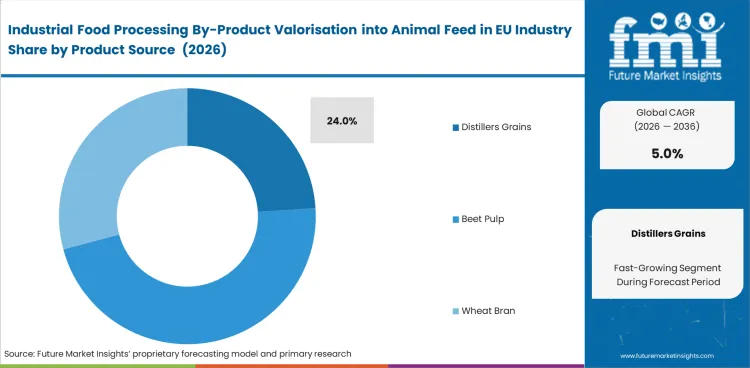
Strong industrial supply keeps distillers grains ahead of other by‑product sources in the EU feed market. Ethanol‑linked production provides regular output and supports stable use across livestock systems. In 2026, distillers grains are expected to hold a 24% share of the source mix. Beet pulp and wheat bran remain widely used feed ingredients. Corn gluten and brewer’s grains also maintain steady market relevance. Bakery meal and potato pulp add supply in regions with concentrated processing activity. Whey powders are used where processing capacity supports consistent feed placement.
Insights into the Form Segment
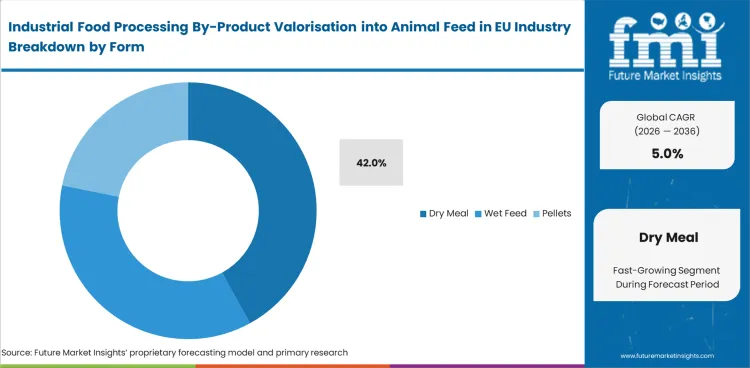
Better storage stability and simpler freight handling promotes consumption of dry meal across physical form. This is because wet feed holds value near dairy and beef zones with short haul delivery. Dry meal is projected to reach a 42% share in 2026. Liquid feed and pellets serve selected programs and need tighter handling control. This structure supports dry meal leadership through operating ease and wider geographic use across Europe. Insights into the Livestock Segment
Dairy and beef systems absorb fibrous and higher-moisture side streams more comfortably than swine or poultry formulas across industrial feed use. This advantage supports broader placement of pulp and bran across major livestock regions. Brewer’s residues and similar materials also see wider use under this structure. Alignment with the cattle feed business also supports this structure across European dairy and beef production. Ruminants are likely to secure 39% share in 2026 across livestock use. Swine and poultry use by‑product volumes that focus on energy‑rich materials and former foodstuff inputs, while ruminants accept a wider range of ingredients.
Insights into the Nutrient Role Segment
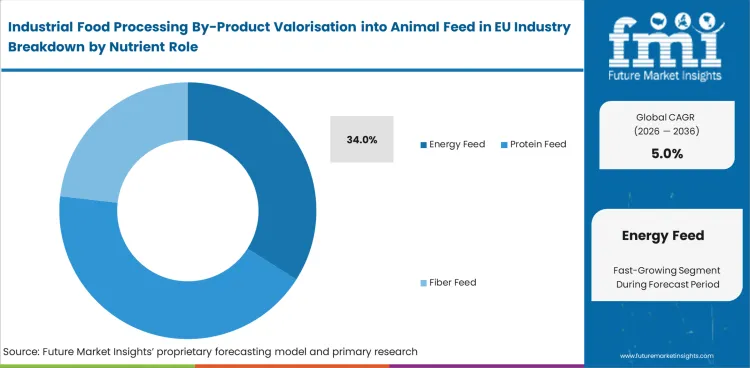
Many industrial side streams enter feed programs first as economical energy contributors replacing part of cereal use across livestock diets. Protein feed and fiber feed both hold important positions, while premium protein upgrading continues drawing attention across selected industrial users. Large-volume value leans toward energy-oriented streams serving broader species demand and practical inclusion rates. Energy feed is anticipated to represent 34% of the market in 2026 across nutrient role. This balance leaves the market split between bulk nutritional use and a smaller premium layer linked with more refined functionality.
Insights into the Application Segment
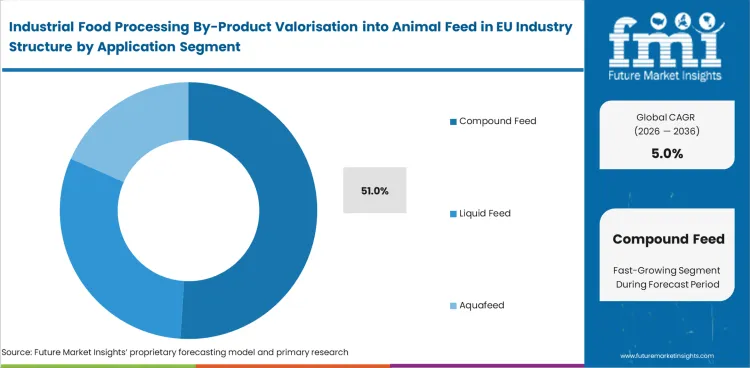
Formal feed manufacturing is the main outlet for industrial side streams entering organized animal nutrition. Mills can blend variable inputs into standardized formulas under routine documentation and quality control, which supports wider acceptance than smaller specialized outlets. Pet feed and premixes are narrower in comparison due to tighter screening requirements. Aquafeed also faces a lower tolerance for variation across incoming material. By application structure, compound feed is set to make up 51% of the market in 2026. Similar pattern can be observed in the wider poultry feed and aquafeed market, since mainstream farm-feed programs accept a wider ingredient mix than highly controlled nutrition segments.
Insights into the Sales Channel and Processing Segment
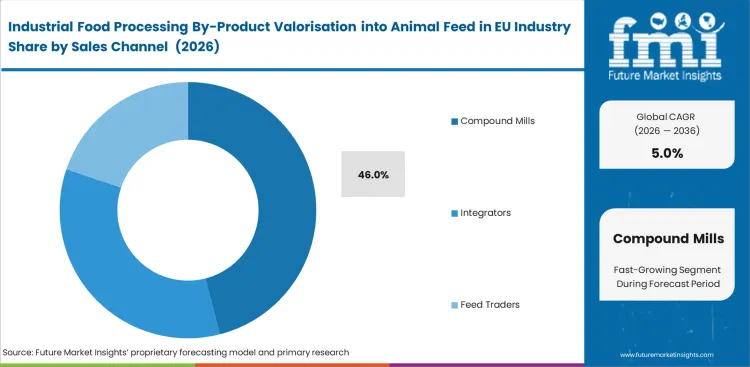
Large mills hold an advantage through testing and standardization. They also benefit from blending capability and stronger documentation across variable industrial side streams. Moisture reduction strengthens material stability during storage and transport, which keeps drying ahead of other processing options across broader industrial use. Integrators and traders serve important local functions near food processing plants and livestock clusters. On-farm mixers also play a role by supporting shorter-distance supply flows. Compound mills lead sales channel with 46% share in 2026, while drying leads processing structure with 44% share in 2026. Wider use of feed premix across organized feed systems supports this position because documented input handling is more common across structured manufacturing environments.
What are the Drivers, Restraints, and Key Trends in the Industrial Food Processing By-Product Valorisation into Animal Feed in EU Industry?
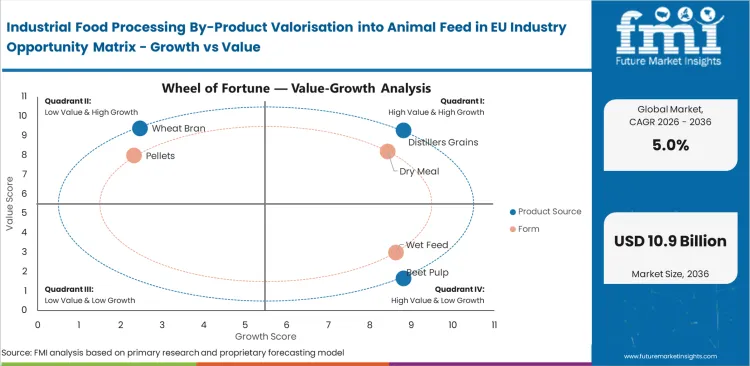
- Large feed mills already use residue-based ingredients, which supports wider industrial uptake across qualified streams and formal feed programs.
- Moisture and freight pressure continue to limit usable volume across many industrial by product streams. Uneven nutrient range further constrains wider feed use.
- Upgraded protein and better documented side streams are raising value across selected feed programs and organized supply systems.
Market outlook is driven by plant discipline and feed-grade preparation rather than broad sustainability messaging alone. Residue value rises after intake control and safe storage are in place. Drying and blending support this improvement under formal feed standards. Large mills can absorb more volume than smaller handlers, while only part of the available residue base reaches stable daily feed readiness. This keeps the forecast measured and grounded, and it aligns with evidence across medicated feed additives where buyers prefer documented inputs and repeatable plant performance.
Moisture and Freight Constraints in Industrial Food Processing By-Product Valorisation into Animal Feed
Transport cost shapes realized value almost as strongly as nutrient content across many industrial side streams. Wet materials perform best near dairy and beef zones with short haul delivery. Longer transport distances reduce delivered value through higher freight pressure. Drying improves product stability and supports wider market reach. Higher realized value comes from better handling and stricter control rather than raw residue availability.
Rotterdam Soybean Meal Benchmarks Are Capping Valorised Feed Prices
In the EU industry for industrial food processing by-product valorisation into animal feed, price negotiations are being shaped by softer imported protein benchmarks rather than by-product availability alone. The World Bank’s April 2026 Pink Sheet lists soybean meal at US$442/mt in 2024, US$366/mt in 2025, US$386/mt in January 2026, and US$404/mt in March 2026.The benchmark for mainstream protein feed remains below its 2024 level, so buyers have less room to justify stronger pricing for valorised food-processing by-products even after the partial rebound seen in March 2026.
Compound Feed Prices Are Pressuring By-Product Realisations
Compound feed pricing trends continue to shape the commercial outcome for valorised food by‑products across the EU. Data from FoodDrinkEurope’s January 2026 INPUT COST BULLETIN Q3 2025 places the producer price index for prepared animal feed at 114 in December 2024. The index increased to 116 during early 2025 before easing to 112 by September 2025. This movement directly affects by‑products such as brewery residues and bakery leftovers sold into feed channels. As feed prices lose momentum buyer leverage increases. This limits the ability of processors to pass through handling and formulation costs.Analysis of Industrial Food Processing By-Product Valorisation into Animal Feed in EU Industry by Key Countries
- Spain is estimated at 5.8% CAGR through 2036 and leads this country group on feed-industry scale.
- Belgium is placed at 5.6% CAGR, while Poland follows at 5.4% CAGR through efficient handling and large farm demand.
- Denmark is modeled at 5.2% CAGR, with strong documentation culture and efficient livestock feed systems.
- Germany, France, and Italy are important value bases even with more moderate estimates through 2036.
.webp "Top Country Growth Comparison Industrial Food Processing By Product Valorisation Into Animal Feed In Eu Industry Cagr (2026 2036)")
| Country | CAGR |
|---|---|
| Spain | 5.8% |
| Belgium | 5.6% |
| Poland | 5.4% |
| Denmark | 5.2% |
| Germany | 4.8% |
| France | 4.7% |
| Italy | 4.5% |
Source: FMI analysis based on primary research and proprietary forecasting model
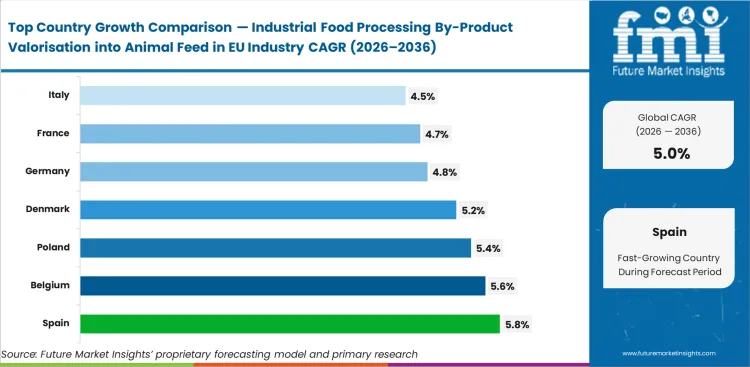
Country performance reflects feed-manufacturing depth, livestock concentration, and the quality of local residue handling. Large countries absorb higher absolute volumes, while smaller organized economies can post stronger estimates when plant systems work efficiently. This explains why Belgium and Denmark are experiencing steady growth despite smaller geographic scale. Germany, France, and Italy hold major value because of mature industrial feed capacity and diverse species demand. Country variation follows feed-factory readiness and by-product usability more than size alone.
Demand outlook for Industrial Food Processing By-Product Valorisation into Animal Feed in EU Industry in Spain
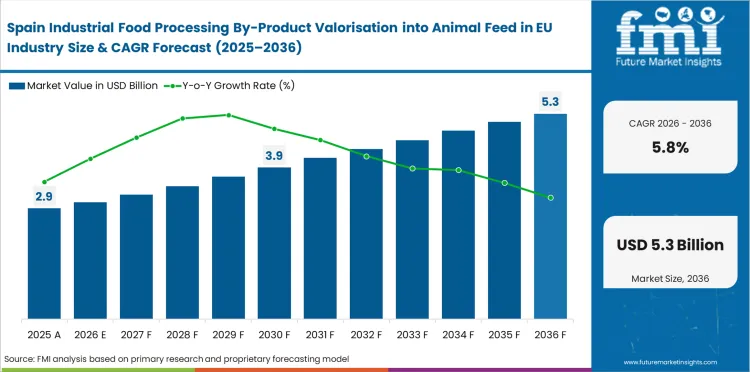
Spain is projected to record a 5.8% CAGR over the forecast years and leads this country set because of scale and industrial depth. Large feed output and dense livestock production enable regular absorption of multiple side-stream types. Extensive crop processing activity further strengthens intake consistency. Catalonia plays a central role through organized feed manufacturing, while Aragón and Castilla y León add heavy daily intake across major livestock systems. The interlink with demand for animal feed additives in EU also supports Spain’s standing within the wider European feed structure. Spain remains the strongest national base in this study.
- Catalonia supports major swine and poultry activity linked with large feed manufacturing units.
- Aragón adds dense livestock presence and regular movement of bulk feed ingredients.
- Castilla y León supports wider cattle demand and mixed-feed use across inland production zones.
Sales analysis of Industrial Food Processing By-Product Valorisation into Animal Feed in EU Industry in Belgium
Belgium combines a smaller domestic footprint with unusually efficient industrial handling across food-processing residues and organized feed placement. Short distances between processors, storage points, feed plants, and livestock zones support stronger economics across side streams that face pressure under longer transport patterns. Under this operating structure, demand for industrial food processing by-product valorisation into animal feed in Belgium is likely to rise at a 5.6% CAGR by 2036. Flanders is the main commercial core, while proximity to neighboring livestock and feed markets strengthens daily circulation across multiple input streams. Belgium therefore outperforms several larger economies in the forecast ranking through tighter industrial coordination.
- Flanders holds dense clustering of feed mills, storage assets, and food-processing plants.
- Port-linked logistics support regional redistribution across variable industrial side streams.
- Cross-border trade strengthens ingredient placement across nearby livestock production belts.
In-depth analysis of Industrial Food Processing By-Product Valorisation into Animal Feed in EU Industry in Poland
Poland presents a broad and mixed demand base shaped by agricultural scale and direct farm-level feed use. National grain processing and regular raw material availability strengthen industrial conversion across several by-product streams entering formal nutrition channels. Support from domestic agricultural depth leaves Poland forecast to post 5.4% CAGR in this sector over the assessment period. Wielkopolskie, Mazowieckie, and Kujawsko-Pomorskie are highly relevant because of feed manufacturing strength and livestock-linked absorption across large agricultural districts.
- Wielkopolskie is one of Poland’s strongest provinces for livestock and feed-mill activity.
- Mazowieckie supports dairy and mixed-animal demand across extensive agricultural districts.
- Kujawsko-Pomorskie adds grain-linked processing and regular industrial feed activity.
Industry analysis of Industrial Food Processing By-Product Valorisation into Animal Feed in EU Industry in Denmark
Denmark has a smaller tonnage base but its feed discipline remains very high across its livestock industries and organized manufacturing systems. Over the assessment period, Denmark is set to expand at a 5.2% CAGR in this industry. Strong documentation culture and efficient production support better acceptance of ingredients that require reliable handling and stable nutritional positioning. Jutland is imp through livestock concentration and strong compound feed manufacturing across the national base.
- Jutland is the main livestock and compound feed manufacturing region.
- Efficient farm systems support acceptance of documented and stabilized side-stream ingredients.
- Smaller national scale leaves room for more refined nutrient-oriented products.
Demand outlook for Industrial Food Processing By-Product Valorisation into Animal Feed in EU Industry in Germany
Germany is one of the significant countries with , despite a more measured forecast line. Large feed mill infrastructure supports the continued use of qualified by‑products. Wide species coverage also contributes to steady adoption. Strong industrial documentation enables placement within formal nutrition programs. Lower Saxony and North Rhine‑Westphalia are potential hubs due to high livestock density and strong feed manufacturing presence. Bavaria also plays a key role through its livestock base and established feed industry. Demand in Germany is expected to rise at a 4.8% CAGR from 2026 to 2036. owing to standardizationand organized placement across circular feed inputs.
- Lower Saxony supports one of Europe’s largest livestock and feed-manufacturing clusters.
- North Rhine-Westphalia adds distribution depth and food-processing adjacency across western corridors.
- Bavaria strengthens dairy-linked use of pulp, bran, and moisture-rich co-products.
Industry analysis of Industrial Food Processing By-Product Valorisation into Animal Feed in EU Industry in France
France offers a mature industrial setting supported by broad species demand and long-standing crop-processing depth across several regions. Grain, starch, sugar, and dairy-linked side streams support commercial relevance across national feed manufacturing and livestock systems. France is expected to register 4.7% CAGR over the forecast as Brittany is witnessing demand for poultry and swine feed, while Grand Est and Hauts-de-France support cereal-based processing and regular feed manufacturing. France remains a dependable value center even without leading the country ranking in forecast pace.
- Brittany holds large poultry and swine feed demand across western France.
- Grand Est supports cereal-linked processing and structured animal nutrition manufacturing.
- Hauts-de-France adds starch and sugar-linked by-product availability across northern districts.
Demand outlook for Industrial Food Processing By-Product Valorisation into Animal Feed in EU Industry in Italy
Industrial food processing by-product valorisation into animal feed in EU industry in Italy is forecast to rise at a 4.5% CAGR through 2036. Italy combines a meaningful feed sector with a more selective expansion profile across industrial by-product use and formal livestock nutrition. Dairy and mixed livestock demand support daily needs across several organized production districts with close food-processing linkages. Lombardy, Emilia-Romagna, and Veneto are the main demand centers through dense animal production and strong industrial adjacency.
- Lombardy supports dairy-linked demand and high feed-mill concentration.
- Emilia-Romagna adds swine nutrition demand and strong food-processing adjacency.
- Veneto supports mixed livestock activity and efficient regional ingredient circulation.
Competitive Landscape of Industrial Food Processing By-Product Valorisation into Animal Feed in EU Industry
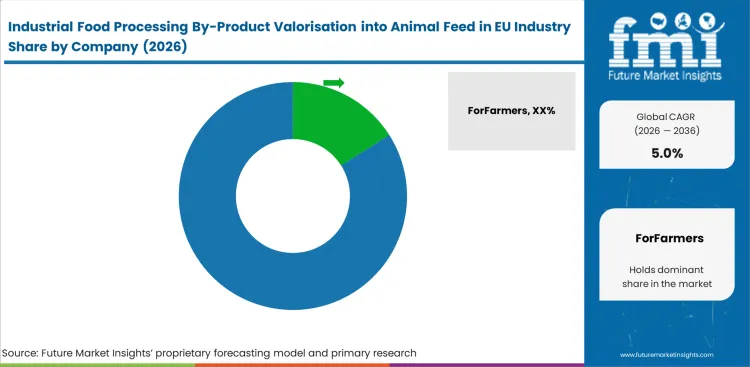
- Market is fragmented since side-stream generation stays dispersed across many food and bio-processing operations.
- Large integrated groups hold advantages in sourcing depth and regular mill access.
- Specialists in the industry local volume through tighter handling and shorter-haul collection across livestock-dense areas.
Competitive Aligners
Competition in this industry depends on execution quality rather than brand strength alone. Value emerges only after proper sorting, stabilization, drying, blending, testing, and documented use in formal feed channels. Supply remains fragmented across sugar processors, dairies, breweries, ethanol biorefineries, and bakeries across Europe. The wider algae based animal feed discussion points to the same lesson because feed buyers reward verified performance and steady specification. Traceability and safe storage therefore matter more than novelty or opportunistic volume.
Large integrated companies hold an advantage through mills and storage assets, while their nutrition relationships span multiple countries and livestock systems. Local specialists still retain room in shorter-distance supply systems through careful handling and better familiarity with variable industrial side streams. Entry favors firms that can standardize uneven intake and protect pricing through longer buyer relationships. Competition therefore remains active across both usability and cost.
Major Industry Players
A mix of integrated feed groups, crop processors, circular ingredient specialists, and newer fermentation-led firms shapes current competitive activity across this industry.
- Global Player: ForFarmers, De Heus, AGRANA, Tereos, CropEnergies, and Roquette belong in this group owing to broader manufacturing reach, stronger quality systems, wider ingredient programs, and established access to industrial animal nutrition across several European regions.
- Regional Player: FeedValid and SFP Group fit this group through a stronger focus on collection, stabilization, and placement of local industrial residues across selected livestock and processing corridors inside Europe.
- Emerging Players: Enifer and MicroHarvest represent the emerging group through fermentation-led upgrading of industrial side streams into higher-spec feed ingredients, with future scale tied to plant execution and feed-market acceptance.
Competitive Benchmarking: Industrial Food Processing By-Product Valorisation into Animal Feed in EU Industry
| Company | Residual Stream Access | Feed Ingredient Breadth | Scale Readiness | Geographic Footprint |
|---|---|---|---|---|
| ForFarmers | High | High | Strong | Multi-region |
| AGRANA | High | Medium | Strong | Global |
| Tereos | High | Medium | Strong | Multi-region |
| CropEnergies | High | Medium | Moderate | Multi-region |
| De Heus | Medium | High | Strong | Global |
| Roquette | Medium | High | Moderate | Global |
| FeedValid | High | High | Moderate | Regional |
| SFP Group | Medium | Low | Moderate | Regional |
| Enifer | Low | Medium | Low | Regional |
| MicroHarvest | Low | Medium | Low | Regional |
Source: Future Market Insights, 2026.
Key Developments in Industrial Food Processing By-Product Valorisation into Animal Feed in EU Industry
- In April 2025, FEFAC published Feed & Food Report 2024 and highlighted EU-27 compound feed production of 145 million tons with 17.5 million tons of food and bioethanol co-products in feed use.
- In September 2025, ePURE released audited 2024 figures showing 9.62 million tonnes of biorefinery coproducts, including 6.92 million tonnes used in food and feed chains.
- In March 2025, DVT reported German mixed feed production at 21.9 million tonnes in 2024, marking a 1.1% increase after several weaker years.
Key Players in the Industrial Food Processing By-Product Valorisation into Animal Feed in EU Industry
Major Global Players
- ForFarmers
- De Heus
- AGRANA
- Tereos
- CropEnergies
- Roquette
Key Emerging Players/Startups
- FeedValid
- Enifer
- MicroHarvest
- SFP Group
Scope of the Report
| Metric | Value |
|---|---|
| Quantitative Units | USD billion for market value, CAGR for forecast pace, and 2026 share values for leading segments |
| Market Definition | Industrial food-processing and bio-processing side streams upgraded into feed ingredients for animal nutrition across the European Union |
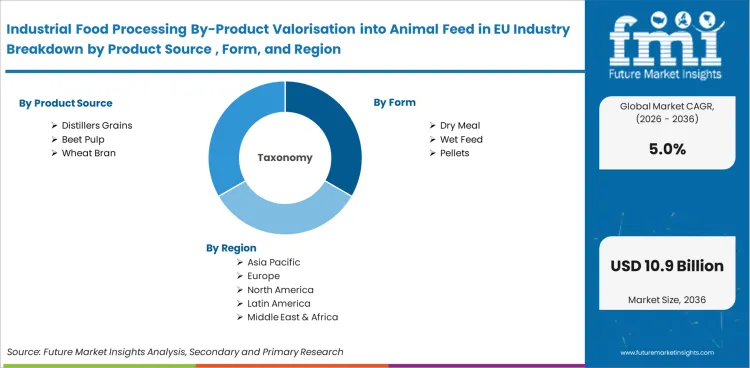
| Segmentation |
|
| Regions Covered | European Union with emphasis on major Western and Central feed economies |
| Countries Covered | Spain, Belgium, Poland, Denmark, Germany, France, and Italy |
| Key Companies Profiled | ForFarmers, De Heus, AGRANA, Tereos, CropEnergies, Roquette, FeedValid, Enifer, MicroHarvest, and SFP Group |
| Forecast Period | 2026 to 2036, with 2025 as the estimated base year |
| Approach | Bottom-up modeling from official feed tonnage and co-product anchors, followed by conservative pricing and cross-checks against industrial feed-system depth |
Industrial Food Processing By-Product Valorisation into Animal Feed in EU Industry by Segments
Industrial Food Processing By-Product Valorisation into Animal Feed in EU Industry Segmented as Source
- Distillers grains
- Beet pulp
- Wheat bran
- Corn gluten
- Brewer’s grains
- Potato pulp
- Bakery meal
- Whey powders
Industrial Food Processing By-Product Valorisation into Animal Feed in EU Industry Classified by Form
- Dry meal
- Wet feed
- Liquid feed
- Pellets
Industrial Food Processing By-Product Valorisation into Animal Feed in EU Industry Analyzed by Livestock
- Ruminants
- Swine
- Poultry
- Aquaculture
- Others
Industrial Food Processing By-Product Valorisation into Animal Feed in EU Industry Classified by Nutrient Role
- Energy feed
- Protein feed
- Fiber feed
- Functional feed
Industrial Food Processing By-Product Valorisation into Animal Feed in EU Industry Classified by Application
- Compound feed
- Liquid feed
- Pet feed
- Aquafeed
- Premixes
Industrial Food Processing By-Product Valorisation into Animal Feed in EU Industry Classified by Sales Channel
- Compound mills
- Integrators
- Feed traders
- On-farm mixers
Industrial Food Processing By-Product Valorisation into Animal Feed in EU Industry Classified by Processing Method
- Drying
- Blending
- Fermentation
- Ensiling
- Pelletizing
Industrial Food Processing By-Product Valorisation into Animal Feed in EU Industry by Region and Country
- Western Europe
- Germany
- UK
- Italy
- Spain
- France
- Nordic
- BENELUX
- Rest of Western Europe
- Eastern Europe
- Russia
- Poland
- Hungary
- Balkan & Baltic
- Rest of Eastern Europe
Bibliography
- World Bank. (2026, April 2). World Bank Commodities Price Data (The Pink Sheet).
- FoodDrinkEurope. (2026, January). INPUT COST BULLETIN Q3 2025.
- European Feed Manufacturers' Federation. (2025, April). Feed & Food Report 2024.
- ePURE. (2025, March 11). European renewable ethanol: Key figures 2024.
- Deutscher Verband Tiernahrung e.V. (2025, March 11). Mischfutterproduktion 2024: Erster leichter Zuwachs nach vier Jahren.
- Ministerio de Agricultura, Pesca y Alimentación. (2025). Datos de producción de piensos en España 2024.
- Agreste. (2025). GraphAgri 2025 - Alimentation animale.
- Assalzoo. (2024). Annuario 2024.
- Government of Poland. (2026). Funduszu Promocji Ziarna zbóż i Przetworów Zbożowych.
- Statistics Denmark. (2026). Production of Compound Feed: Statistical presentation.
This bibliography is provided for reader's reference.
This Report Addresses
- Market sizing and value forecasting for EU industrial food-processing side streams entering animal nutrition from 2026 to 2036.
- Segment analysis across source stream, form, livestock use, nutrient role, application, sales channel, and processing method.
- Country evaluation for Spain, Belgium, Poland, Denmark, Germany, France, and Italy with comparative CAGR estimates.
- Competitive assessment across integrated feed groups, crop processors, specialist handlers, and newer fermentation-led ingredient firms.
- Review of feed-grade discipline, traceability, moisture handling, and standardization factors shaping daily industrial acceptance.
- Opportunity mapping across distillers grains, bran, pulp, former foodstuffs, whey-linked materials, and upgraded protein streams.
- Value-chain coverage from residue generation through stabilization, channel placement, and final use in formal animal feed formulas.
Frequently Asked Questions
What is the market value estimated in 2026?
FMI estimates the market at USD 6.4 billion in 2026 under a conservative model anchored to current EU feed and co-product use.
What industry value is projected for 2036?
Projected market value reaches USD 10.5 billion by 2036 under the base forecast used in this assessment.
What CAGR is used for 2026 to 2036?
FMI uses a 5.0% CAGR across the forecast period to keep the outlook aligned with a mature industrial ingredient business.
Which source segment leads in 2026?
Distillers grains lead source structure with an estimated 24% share in 2026 due to industrial ethanol-linked supply depth.
Which form segment is largest?
Dry meal leads physical form with an estimated 42% share in 2026 through shelf-life and freight advantages.
Which application holds the largest share?
Compound feed is the largest application at an estimated 51% share in 2026 across formal industrial feed manufacturing.
Which country rises fastest in this study?
Spain leads the country pack with an estimated 5.8% CAGR through 2036 due to very large feed output and dense livestock regions.
What is included inside the market scope?
Scope includes industrial food and bio-processing side streams upgraded into feed ingredients, while finished feed sales and untreated waste stay outside.
Preview the report firsthand - request a free sample
Get SampleGet the brochure for pricing and purchase details.
Get PDFTable of Content
- Executive Summary
- Global Market Outlook
- Demand-side Trends
- Supply-side Trends
- Technology Roadmap Analysis
- Analysis and Recommendations
- Market Overview
- Market Coverage / Taxonomy
- Market Definition / Scope / Limitations
- Research Methodology
- Chapter Orientation
- Analytical Lens and Working Hypotheses
- Market Structure, Signals, and Trend Drivers
- Benchmarking and Cross-market Comparability
- Market Sizing, Forecasting, and Opportunity Mapping
- Research Design and Evidence Framework
- Desk Research Programme (Secondary Evidence)
- Company Annual and Sustainability Reports
- Peer-reviewed Journals and Academic Literature
- Corporate Websites, Product Literature, and Technical Notes
- Earnings Decks and Investor Briefings
- Statutory Filings and Regulatory Disclosures
- Technical White Papers and Standards Notes
- Trade Journals, Industry Magazines, and Analyst Briefs
- Conference Proceedings, Webinars, and Seminar Materials
- Government Statistics Portals and Public Data Releases
- Press Releases and Reputable Media Coverage
- Specialist Newsletters and Curated Briefings
- Sector Databases and Reference Repositories
- FMI Internal Proprietary Databases and Historical Market Datasets
- Subscription Datasets and Paid Sources
- Social Channels, Communities, and Digital Listening Inputs
- Additional Desk Sources
- Expert Input and Fieldwork (Primary Evidence)
- Primary Modes
- Qualitative Interviews and Expert Elicitation
- Quantitative Surveys and Structured Data Capture
- Blended Approach
- Why Primary Evidence is Used
- Field Techniques
- Interviews
- Surveys
- Focus Groups
- Observational and In-context Research
- Social and Community Interactions
- Stakeholder Universe Engaged
- C-suite Leaders
- Board Members
- Presidents and Vice Presidents
- R&D and Innovation Heads
- Technical Specialists
- Domain Subject-matter Experts
- Scientists
- Physicians and Other Healthcare Professionals
- Governance, Ethics, and Data Stewardship
- Research Ethics
- Data Integrity and Handling
- Primary Modes
- Tooling, Models, and Reference Databases
- Desk Research Programme (Secondary Evidence)
- Data Engineering and Model Build
- Data Acquisition and Ingestion
- Cleaning, Normalisation, and Verification
- Synthesis, Triangulation, and Analysis
- Quality Assurance and Audit Trail
- Market Background
- Market Dynamics
- Drivers
- Restraints
- Opportunity
- Trends
- Scenario Forecast
- Demand in Optimistic Scenario
- Demand in Likely Scenario
- Demand in Conservative Scenario
- Opportunity Map Analysis
- Product Life Cycle Analysis
- Supply Chain Analysis
- Investment Feasibility Matrix
- Value Chain Analysis
- PESTLE and Porter’s Analysis
- Regulatory Landscape
- Regional Parent Market Outlook
- Production and Consumption Statistics
- Import and Export Statistics
- Market Dynamics
- Global Market Analysis 2021 to 2025 and Forecast, 2026 to 2036
- Historical Market Size Value (USD Million) Analysis, 2021 to 2025
- Current and Future Market Size Value (USD Million) Projections, 2026 to 2036
- Y-o-Y Growth Trend Analysis
- Absolute $ Opportunity Analysis
- Global Market Pricing Analysis 2021 to 2025 and Forecast 2026 to 2036
- Global Market Analysis 2021 to 2025 and Forecast 2026 to 2036, By Product Source
- Introduction / Key Findings
- Historical Market Size Value (USD Million) Analysis By Product Source , 2021 to 2025
- Current and Future Market Size Value (USD Million) Analysis and Forecast By Product Source , 2026 to 2036
- Distillers Grains
- Beet Pulp
- Wheat Bran
- Distillers Grains
- Y-o-Y Growth Trend Analysis By Product Source , 2021 to 2025
- Absolute $ Opportunity Analysis By Product Source , 2026 to 2036
- Global Market Analysis 2021 to 2025 and Forecast 2026 to 2036, By Form
- Introduction / Key Findings
- Historical Market Size Value (USD Million) Analysis By Form, 2021 to 2025
- Current and Future Market Size Value (USD Million) Analysis and Forecast By Form, 2026 to 2036
- Dry Meal
- Wet Feed
- Pellets
- Dry Meal
- Y-o-Y Growth Trend Analysis By Form, 2021 to 2025
- Absolute $ Opportunity Analysis By Form, 2026 to 2036
- Global Market Analysis 2021 to 2025 and Forecast 2026 to 2036, By Livestock
- Introduction / Key Findings
- Historical Market Size Value (USD Million) Analysis By Livestock, 2021 to 2025
- Current and Future Market Size Value (USD Million) Analysis and Forecast By Livestock, 2026 to 2036
- Ruminants
- Swine
- Poultry
- Ruminants
- Y-o-Y Growth Trend Analysis By Livestock, 2021 to 2025
- Absolute $ Opportunity Analysis By Livestock, 2026 to 2036
- Global Market Analysis 2021 to 2025 and Forecast 2026 to 2036, By Nutrient Role
- Introduction / Key Findings
- Historical Market Size Value (USD Million) Analysis By Nutrient Role, 2021 to 2025
- Current and Future Market Size Value (USD Million) Analysis and Forecast By Nutrient Role, 2026 to 2036
- Energy Feed
- Protein Feed
- Fiber Feed
- Energy Feed
- Y-o-Y Growth Trend Analysis By Nutrient Role, 2021 to 2025
- Absolute $ Opportunity Analysis By Nutrient Role, 2026 to 2036
- Global Market Analysis 2021 to 2025 and Forecast 2026 to 2036, By Application
- Introduction / Key Findings
- Historical Market Size Value (USD Million) Analysis By Application, 2021 to 2025
- Current and Future Market Size Value (USD Million) Analysis and Forecast By Application, 2026 to 2036
- Compound Feed
- Liquid Feed
- Aquafeed
- Compound Feed
- Y-o-Y Growth Trend Analysis By Application, 2021 to 2025
- Absolute $ Opportunity Analysis By Application, 2026 to 2036
- Global Market Analysis 2021 to 2025 and Forecast 2026 to 2036, By Sales Channel
- Introduction / Key Findings
- Historical Market Size Value (USD Million) Analysis By Sales Channel, 2021 to 2025
- Current and Future Market Size Value (USD Million) Analysis and Forecast By Sales Channel, 2026 to 2036
- Compound Mills
- Integrators
- Feed Traders
- Compound Mills
- Y-o-Y Growth Trend Analysis By Sales Channel, 2021 to 2025
- Absolute $ Opportunity Analysis By Sales Channel, 2026 to 2036
- Global Market Analysis 2021 to 2025 and Forecast 2026 to 2036, By Region
- Introduction
- Historical Market Size Value (USD Million) Analysis By Region, 2021 to 2025
- Current Market Size Value (USD Million) Analysis and Forecast By Region, 2026 to 2036
- North America
- Latin America
- Western Europe
- Eastern Europe
- East Asia
- South Asia and Pacific
- Middle East & Africa
- Market Attractiveness Analysis By Region
- North America Market Analysis 2021 to 2025 and Forecast 2026 to 2036, By Country
- Historical Market Size Value (USD Million) Trend Analysis By Market Taxonomy, 2021 to 2025
- Market Size Value (USD Million) Forecast By Market Taxonomy, 2026 to 2036
- By Country
- USA
- Canada
- Mexico
- By Product Source
- By Form
- By Livestock
- By Nutrient Role
- By Application
- By Sales Channel
- By Country
- Market Attractiveness Analysis
- By Country
- By Product Source
- By Form
- By Livestock
- By Nutrient Role
- By Application
- By Sales Channel
- Key Takeaways
- Latin America Market Analysis 2021 to 2025 and Forecast 2026 to 2036, By Country
- Historical Market Size Value (USD Million) Trend Analysis By Market Taxonomy, 2021 to 2025
- Market Size Value (USD Million) Forecast By Market Taxonomy, 2026 to 2036
- By Country
- Brazil
- Chile
- Rest of Latin America
- By Product Source
- By Form
- By Livestock
- By Nutrient Role
- By Application
- By Sales Channel
- By Country
- Market Attractiveness Analysis
- By Country
- By Product Source
- By Form
- By Livestock
- By Nutrient Role
- By Application
- By Sales Channel
- Key Takeaways
- Western Europe Market Analysis 2021 to 2025 and Forecast 2026 to 2036, By Country
- Historical Market Size Value (USD Million) Trend Analysis By Market Taxonomy, 2021 to 2025
- Market Size Value (USD Million) Forecast By Market Taxonomy, 2026 to 2036
- By Country
- Germany
- UK
- Italy
- Spain
- France
- Nordic
- BENELUX
- Rest of Western Europe
- By Product Source
- By Form
- By Livestock
- By Nutrient Role
- By Application
- By Sales Channel
- By Country
- Market Attractiveness Analysis
- By Country
- By Product Source
- By Form
- By Livestock
- By Nutrient Role
- By Application
- By Sales Channel
- Key Takeaways
- Eastern Europe Market Analysis 2021 to 2025 and Forecast 2026 to 2036, By Country
- Historical Market Size Value (USD Million) Trend Analysis By Market Taxonomy, 2021 to 2025
- Market Size Value (USD Million) Forecast By Market Taxonomy, 2026 to 2036
- By Country
- Russia
- Poland
- Hungary
- Balkan & Baltic
- Rest of Eastern Europe
- By Product Source
- By Form
- By Livestock
- By Nutrient Role
- By Application
- By Sales Channel
- By Country
- Market Attractiveness Analysis
- By Country
- By Product Source
- By Form
- By Livestock
- By Nutrient Role
- By Application
- By Sales Channel
- Key Takeaways
- East Asia Market Analysis 2021 to 2025 and Forecast 2026 to 2036, By Country
- Historical Market Size Value (USD Million) Trend Analysis By Market Taxonomy, 2021 to 2025
- Market Size Value (USD Million) Forecast By Market Taxonomy, 2026 to 2036
- By Country
- China
- Japan
- South Korea
- By Product Source
- By Form
- By Livestock
- By Nutrient Role
- By Application
- By Sales Channel
- By Country
- Market Attractiveness Analysis
- By Country
- By Product Source
- By Form
- By Livestock
- By Nutrient Role
- By Application
- By Sales Channel
- Key Takeaways
- South Asia and Pacific Market Analysis 2021 to 2025 and Forecast 2026 to 2036, By Country
- Historical Market Size Value (USD Million) Trend Analysis By Market Taxonomy, 2021 to 2025
- Market Size Value (USD Million) Forecast By Market Taxonomy, 2026 to 2036
- By Country
- India
- ASEAN
- Australia & New Zealand
- Rest of South Asia and Pacific
- By Product Source
- By Form
- By Livestock
- By Nutrient Role
- By Application
- By Sales Channel
- By Country
- Market Attractiveness Analysis
- By Country
- By Product Source
- By Form
- By Livestock
- By Nutrient Role
- By Application
- By Sales Channel
- Key Takeaways
- Middle East & Africa Market Analysis 2021 to 2025 and Forecast 2026 to 2036, By Country
- Historical Market Size Value (USD Million) Trend Analysis By Market Taxonomy, 2021 to 2025
- Market Size Value (USD Million) Forecast By Market Taxonomy, 2026 to 2036
- By Country
- Kingdom of Saudi Arabia
- Other GCC Countries
- Turkiye
- South Africa
- Other African Union
- Rest of Middle East & Africa
- By Product Source
- By Form
- By Livestock
- By Nutrient Role
- By Application
- By Sales Channel
- By Country
- Market Attractiveness Analysis
- By Country
- By Product Source
- By Form
- By Livestock
- By Nutrient Role
- By Application
- By Sales Channel
- Key Takeaways
- Key Countries Market Analysis
- USA
- Pricing Analysis
- Market Share Analysis, 2025
- By Product Source
- By Form
- By Livestock
- By Nutrient Role
- By Application
- By Sales Channel
- Canada
- Pricing Analysis
- Market Share Analysis, 2025
- By Product Source
- By Form
- By Livestock
- By Nutrient Role
- By Application
- By Sales Channel
- Mexico
- Pricing Analysis
- Market Share Analysis, 2025
- By Product Source
- By Form
- By Livestock
- By Nutrient Role
- By Application
- By Sales Channel
- Brazil
- Pricing Analysis
- Market Share Analysis, 2025
- By Product Source
- By Form
- By Livestock
- By Nutrient Role
- By Application
- By Sales Channel
- Chile
- Pricing Analysis
- Market Share Analysis, 2025
- By Product Source
- By Form
- By Livestock
- By Nutrient Role
- By Application
- By Sales Channel
- Germany
- Pricing Analysis
- Market Share Analysis, 2025
- By Product Source
- By Form
- By Livestock
- By Nutrient Role
- By Application
- By Sales Channel
- UK
- Pricing Analysis
- Market Share Analysis, 2025
- By Product Source
- By Form
- By Livestock
- By Nutrient Role
- By Application
- By Sales Channel
- Italy
- Pricing Analysis
- Market Share Analysis, 2025
- By Product Source
- By Form
- By Livestock
- By Nutrient Role
- By Application
- By Sales Channel
- Spain
- Pricing Analysis
- Market Share Analysis, 2025
- By Product Source
- By Form
- By Livestock
- By Nutrient Role
- By Application
- By Sales Channel
- France
- Pricing Analysis
- Market Share Analysis, 2025
- By Product Source
- By Form
- By Livestock
- By Nutrient Role
- By Application
- By Sales Channel
- India
- Pricing Analysis
- Market Share Analysis, 2025
- By Product Source
- By Form
- By Livestock
- By Nutrient Role
- By Application
- By Sales Channel
- ASEAN
- Pricing Analysis
- Market Share Analysis, 2025
- By Product Source
- By Form
- By Livestock
- By Nutrient Role
- By Application
- By Sales Channel
- Australia & New Zealand
- Pricing Analysis
- Market Share Analysis, 2025
- By Product Source
- By Form
- By Livestock
- By Nutrient Role
- By Application
- By Sales Channel
- China
- Pricing Analysis
- Market Share Analysis, 2025
- By Product Source
- By Form
- By Livestock
- By Nutrient Role
- By Application
- By Sales Channel
- Japan
- Pricing Analysis
- Market Share Analysis, 2025
- By Product Source
- By Form
- By Livestock
- By Nutrient Role
- By Application
- By Sales Channel
- South Korea
- Pricing Analysis
- Market Share Analysis, 2025
- By Product Source
- By Form
- By Livestock
- By Nutrient Role
- By Application
- By Sales Channel
- Russia
- Pricing Analysis
- Market Share Analysis, 2025
- By Product Source
- By Form
- By Livestock
- By Nutrient Role
- By Application
- By Sales Channel
- Poland
- Pricing Analysis
- Market Share Analysis, 2025
- By Product Source
- By Form
- By Livestock
- By Nutrient Role
- By Application
- By Sales Channel
- Hungary
- Pricing Analysis
- Market Share Analysis, 2025
- By Product Source
- By Form
- By Livestock
- By Nutrient Role
- By Application
- By Sales Channel
- Kingdom of Saudi Arabia
- Pricing Analysis
- Market Share Analysis, 2025
- By Product Source
- By Form
- By Livestock
- By Nutrient Role
- By Application
- By Sales Channel
- Turkiye
- Pricing Analysis
- Market Share Analysis, 2025
- By Product Source
- By Form
- By Livestock
- By Nutrient Role
- By Application
- By Sales Channel
- South Africa
- Pricing Analysis
- Market Share Analysis, 2025
- By Product Source
- By Form
- By Livestock
- By Nutrient Role
- By Application
- By Sales Channel
- USA
- Market Structure Analysis
- Competition Dashboard
- Competition Benchmarking
- Market Share Analysis of Top Players
- By Regional
- By Product Source
- By Form
- By Livestock
- By Nutrient Role
- By Application
- By Sales Channel
- Competition Analysis
- Competition Deep Dive
- ForFarmers
- Overview
- Product Portfolio
- Profitability by Market Segments (Product/Age /Sales Channel/Region)
- Sales Footprint
- Strategy Overview
- Marketing Strategy
- Product Strategy
- Channel Strategy
- De Heus
- AGRANA
- Tereos
- CropEnergies
- Roquette
- ForFarmers
- Competition Deep Dive
- Assumptions & Acronyms Used


