

- Industry Size (2026)
- USD 10.2 Mn
- Forecast (2036)
- USD 36.1 Mn
- CAGR (2026 to 2036)
- 13.5%
Onshore Wind Turbine Blade Composites Shredding and Co-Processing in Europe Industry Size, Market Forecast and Outlook By FMI
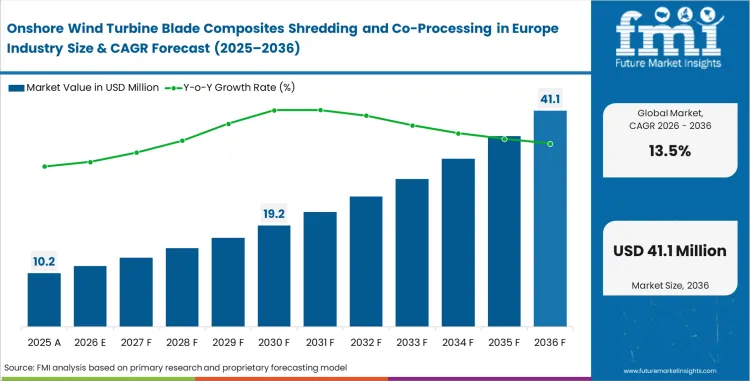
The onshore wind turbine blade composites shredding and co-processing industry in Europe crossed a valuation of USD 9.0 million in 2025 and is estimated to reach USD 10.2 million in 2026. The industry will expand at a CAGR of 13.5% from 2026 to 2036, taking total valuation to USD 36.1 million by 2036.
Summary of Onshore Wind Turbine Blade Composites Shredding and Co-Processing in Europe Industry
- The market is forecast to reach USD 36.1 million by 2036.
- The market is expected to grow at a CAGR of 13.5% from 2026 to 2036.
- The market was estimated at USD 9.0 million in 2025.
- The forecast period represents an incremental opportunity of USD 25.9 million.
- The market is projected to reach USD 10.2 million in 2026.
- Shredding leads the service stage segment with a 52% share, as size reduction is required before processing.
- Epoxy resin systems dominate with a 63% share, reflecting legacy blade material composition.
- Glass fiber leads the fiber type segment with an 82% share, as most onshore blades use glass-fiber composites.
- Wind operators account for 58% share, driven by responsibility for decommissioning and disposal.
- Decommissioning dominates the lifecycle segment with a 68% share, as retired blades form the main waste stream.
- Key companies in the market include Holcim (Geocycle), Veolia, Vestas, Stena Recycling, ACCIONA Energía, RenerCycle, and FCC Ámbito / EnergyLOOP.
Operators also need practical treatment routes for end-of-life blade sections as repowering activity increases across older onshore fleets. Storage remains costly. Transport is still difficult. Disposal pathways have become narrower, which is changing the economics of blade treatment. Access to cement plants with approved acceptance protocols is becoming more important for large-scale disposal. This route depends on preparing wind turbine composite waste to kiln-ready specification. Output quality matters at every stage. Particle size, calorific value, and mineral residue all affect whether shredded blade material can move steadily into cement co-processing streams.
Wider adoption is likely once cement producers gain more confidence in feedstock consistency. Kiln operators are more willing to take higher volumes when shredding partners can supply stable output with predictable combustion performance and controlled ash content for clinker use. Until that level of consistency is reached, activity is likely to stay concentrated in local trials and limited commercial projects. Once processing standards improve, regional hub models are expected to gain traction. These hubs can handle blade cutting, transport preparation, shredding, and dispatch into co-processing networks.
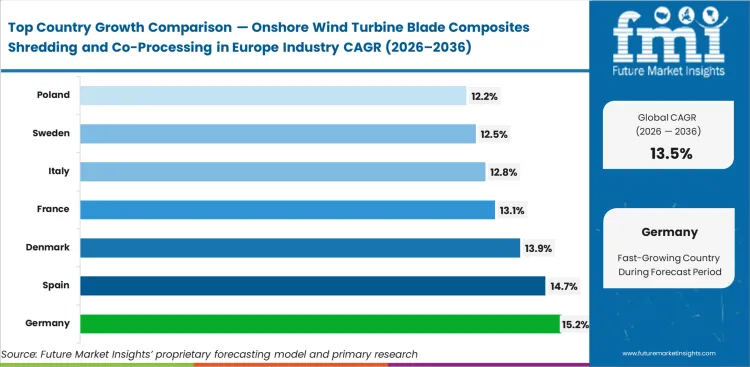
Germany is projected to expand at a 15.2% CAGR during 2026 to 2036, supported by a large base of aging onshore turbines and strong domestic cement capacity. A larger share of older wind assets entering repowering cycles is expected to support Spain, where demand is forecast to rise at a 14.7% CAGR through 2036. Denmark is likely to benefit from a more established ecosystem for composite recovery and industrial reuse, and demand there is anticipated to increase at a 13.9% CAGR over the forecast period. In France, added domestic preprocessing capacity is expected to support future blade retirement requirements, with demand projected to advance at a 13.1% CAGR during 2026 to 2036. Italy is expected to record a 12.8% CAGR as regional repowering activity increases the need for structured disposal and co-processing routes. Sweden is projected to grow at a 12.5% CAGR, supported by more disciplined handling of retired utility-scale assets. In Poland, improving local disposal and processing capacity is expected to support a 12.2% CAGR through 2036. Variation across these countries reflects differences in turbine age, proximity to cement kilns, and the ability to move dismantled blade sections into treatment networks at commercial scale.
Segmental Analysis
Onshore Wind Turbine Blade Composites Shredding and Co-Processing in Europe Industry Analysis by Service Stage
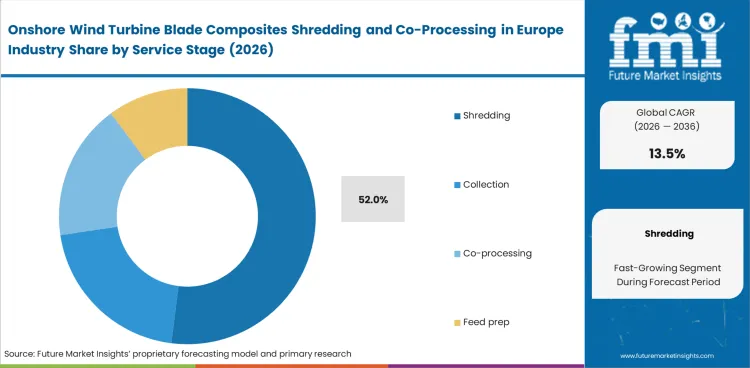
Blade recycling economics in Europe are shaped first by transport practicality rather than by downstream processing preference. Intact blades are too large and costly to move efficiently over long road distances, so size reduction becomes the operational starting point for nearly every project. FMI’s assessment indicates shredding is expected to account for 52.0% share in 2026 because it converts oversized composite structures into material that can enter standard freight and co-processing routes. This has also widened the role of firms linked to wind turbine blade repair material, many of which are extending their field logistics capability into end-of-life blade handling. Mobile shredding reduces haulage burden, but fragment preparation still must be controlled carefully before cement kilns can accept the output. Operators that underestimate cutter wear and secondary sizing requirements often face downtime at the exact moment repowering schedules leave little room for delay.
- Mobile extraction: On-site primary reduction avoids the transport burden associated with moving intact blades through constrained rural routes. This helps decommissioning teams control both permitting complexity and project timing.
- Secondary sizing: Preparation hubs further refine shredded blade pieces to meet kiln feed specifications. Out-of-range fragment size can disrupt injection consistency and thermal balance.
- Logistical consolidation: Regional hubs absorb uneven blade inflow from wind farm retirements and align it with steady industrial demand. This helps stabilize supply to co-processing facilities over time.
Onshore Wind Turbine Blade Composites Shredding and Co-Processing in Europe Industry Analysis by Resin System
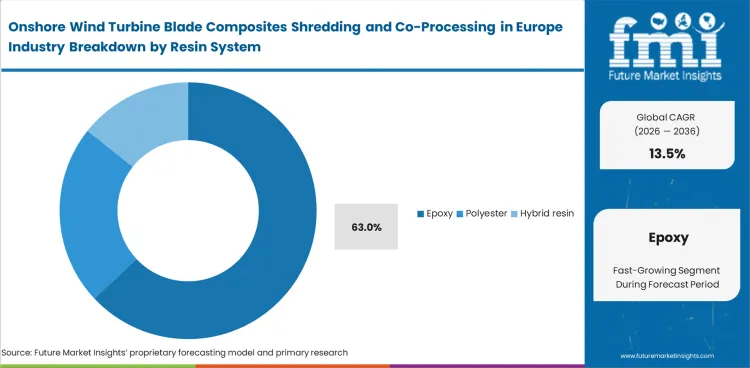
The current disposal stream reflects the resin choices made when much of Europe’s installed wind fleet was originally built. Early utility-scale blades relied heavily on epoxy chemistry because of its fatigue resistance and structural durability in long-service applications. Epoxy systems are likely to account for 63.0% share in 2026, which keeps them central to the technical profile of blade waste entering co-processing channels. FMI analysts note that this creates a disposal challenge because cured thermosets offer useful calorific value but also require close combustion control to avoid unstable kiln conditions. Operators that previously relied on wind blade inspection equipment during service life are increasingly needing resin-level material data at retirement as well. Cement plants receiving poorly characterized blade waste often raise gate fees to cover the handling and emissions risk.
- Thermal substitution: Epoxy-rich composite waste can replace part of the fossil fuel load used in cement kilns. This gives processors both disposal utility and energy value from the same input stream.
- Matrix degradation: Incomplete combustion of highly cross-linked thermosets can lead to emissions control issues if kiln temperatures fluctuate. That makes process stability essential during co-processing.
- Blending protocols: Feedstock teams balance epoxy-rich fragments with lower-energy waste to maintain a stable thermal profile. Consistent blending helps protect clinker quality and kiln operation.
Onshore Wind Turbine Blade Composites Shredding and Co-Processing in Europe Industry Analysis by Fiber Type
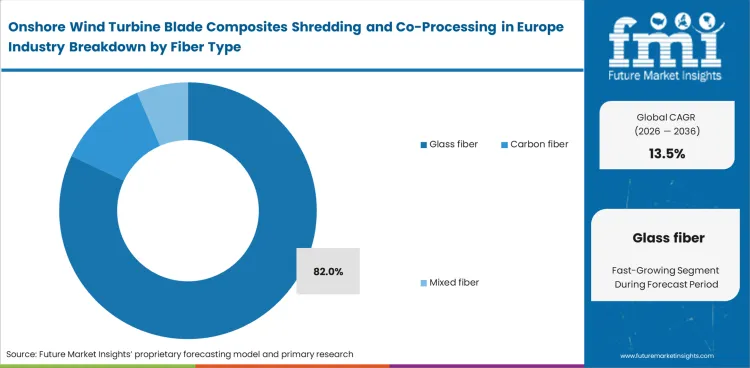
Fiber composition largely determines how blade waste behaves once it enters cement and material recovery systems. Most retired onshore blades in Europe are still built around glass fiber, which means the disposal stream is dominated by mineral-rich composite feed rather than higher-value carbon-based structures. Following FMI’s estimates, glass fiber is projected to represent 82.0% share in 2026, making it the defining material base for current FRP recycling activity in this industry. Its silica and calcium contribution gives cement producers a secondary raw material input, but that benefit comes with wear and handling challenges during feed preparation. Carbon fiber continues to attract attention, yet near-term commercial volume remains shaped by glass-heavy blade retirements. Operators that do not account properly for glass content in the kiln chemistry risk producing off-spec clinker.
- Silica substitution: Melted glass reinforcement contributes directly to clinker chemistry during high-temperature processing. This gives plants a limited substitute for part of their virgin mineral input.
- Abrasive wear: Pulverized glass composite feed accelerates wear across pipes, valves, and other delivery components. Hardened internal surfaces are often required to sustain reliable operation.
- Quality verification: Incoming blade waste must be sampled to confirm the glass-to-resin balance before use. Poorly characterized material can disrupt both kiln stability and final product quality.
Onshore Wind Turbine Blade Composites Shredding and Co-Processing in Europe Industry Analysis by Customer Type
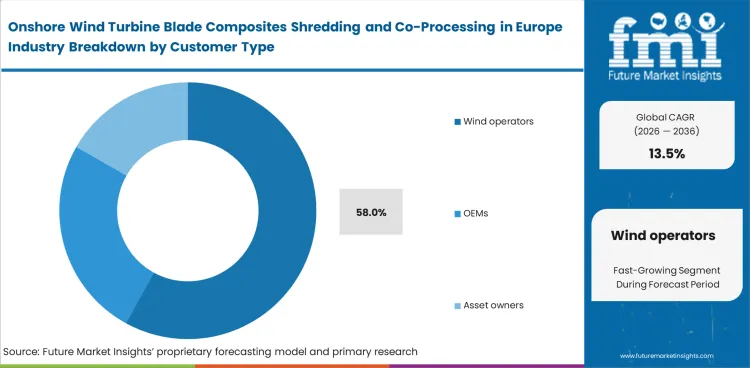
End-of-life responsibility in this market sits mainly with the party operating the wind asset rather than with the original equipment supplier. Site permit closure, removal compliance, and disposal execution all fall back on the operator once turbines reach retirement or replacement stage. Wind operators are anticipated to account for 58.0% share in 2026, reflecting their direct responsibility for clearing blades and securing compliant treatment routes. According to FMI’s analysis, these buyers usually prioritize certainty of removal and audit-ready disposal records over extracting theoretical maximum value from recycled carbon fiber or glass content. They often package blade removal, hauling, and processing into one contract to reduce execution risk during repowering. Utilities that misjudge nearby treatment capacity can end up moving blade waste across borders at much higher cost than originally planned.
- Liability transfer: Operators require contractors to provide documentation confirming final treatment of composite blade waste. This supports permit closeout and reduces regulatory exposure.
- Volume aggregation: Large utilities combine multiple blade retirement projects into regional tenders. That creates more stable volume commitments for disposal and preparation contractors.
- Repowering synchronization: Blade removal must match construction timing for the next turbine installation phase. Delays in processing can disrupt the wider project schedule and increase downtime costs.
Onshore Wind Turbine Blade Composites Shredding and Co-Processing in Europe Industry Analysis by Blade Lifecycle
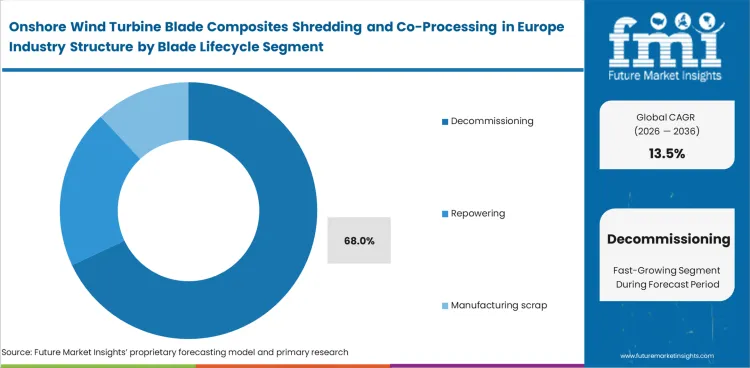
The current market is shaped less by factory scrap and more by the age profile of Europe’s installed wind base. Early projects built in the 2000s are now reaching the point where full removal becomes more practical than continued operation, especially during repowering. Decommissioning is expected to account for 68.0% share in 2026. FMI observes that future blade designs using recyclable thermoset resins may eventually change this mix, but today’s volumes are still dominated by conventional materials that are difficult to recover through higher-value routes. Processing demand therefore centers on fast site clearance and reliable intake rather than advanced material optimization. Facilities unprepared for sudden surges from large wind farm retirements often hit storage and throughput limits very quickly.
- Site clearance: Fast mechanical breakdown allows cranes and removal crews to move quickly from one turbine position to the next. This is essential where decommissioning windows are tight.
- Regulatory pressure: Disposal pathways for retired turbine components are increasingly scrutinized by environmental authorities. Cross-border movement becomes more complex when local capacity is limited.
Capacity strain: Large regional retirement waves can pressurize nearby shredding and co-processing infrastructure. Intake planning with end users is therefore critical well before teardown begins.
Onshore Wind Turbine Blade Composites Shredding and Co-Processing in Europe Industry Drivers, Restraints, and Opportunities
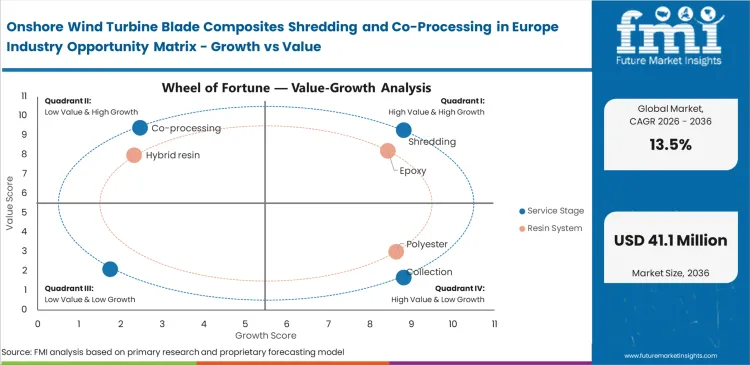
National landfill bans enforce the immediate commercial reality for utility operators managing retiring fleets. Firms can no longer rely on burying composite waste; they must secure active processing contracts or face compounding storage fees and regulatory penalties. This legislative pressure forces companies to accept higher gate fees at cement facilities, instantly creating a viable economic floor for the specialized shredding and transport sector while altering the equation for wind blade recycling vs landfill cost. Delaying the establishment of these logistical pipelines threatens the financial viability of lucrative repowering projects, as operators cannot erect new megawatt-class turbines until legacy materials completely vacate the site.
Inconsistent material specifications create severe operational friction at the kiln gate. Cement chemists demand precise calorific values and predictable ash content, yet decommissioned blades represent a heterogeneous mix of balsa wood, epoxies, structural adhesives, and varying glass densities. This variability forces preparation hubs to blend blade fragments heavily with other waste streams, structurally limiting the sheer tonnage of composite material any single kiln can absorb daily. While optical sorting technologies show promise in stabilizing feed quality, current mechanical shredding limitations ensure that quality control rejections remain the primary bottleneck slowing broader adoption and increasing the overall wind blade recycling cost per ton in Europe.
Opportunities in the Onshore Wind Turbine Blade Composites Shredding and Co-Processing in Europe Industry
- Mobile preprocessing units: Deploying high-torque, tracked shredders directly to wind farms eliminates oversize transport costs. Immediate margin improvements are captured by delivering densified bulk material straight to regional hubs.
- Advanced feed calibration: Developing automated mixing systems that guarantee precise resin-to-glass ratios unlocks higher intake limits at cement facilities. Firms utilizing advanced composites methodologies secure premium gate fees by offering stabilized alternative fuels.
- Cross-border logistics networks: Establishing dedicated rail corridors between Northern European decommissioning sites and Eastern European kilns bypasses local capacity constraints. Companies dominate the sector by moving massive tonnages efficiently across regulatory jurisdictions.
Regional Analysis
Based on regional analysis, Onshore Wind Turbine Blade Composites Shredding and Co-Processing in Europe Industry is segmented into Western Europe, Southern Europe, Northern Europe, and Eastern Europe across 40 plus countries to assess which countries in Europe lead blade recycling demand.
.webp "Top Country Growth Comparison Onshore Wind Turbine Blade Composites Shredding And Co Processing In Europe Industry Cagr (2026 2036)")
| Country | CAGR (2026 to 2036) |
|---|---|
| Germany | 15.2% |
| Spain | 14.7% |
| Denmark | 13.9% |
| France | 13.1% |
| Italy | 12.8% |
| Sweden | 12.5% |
| Poland | 12.2% |
Source: Future Market Insights (FMI) analysis, based on proprietary forecasting model and primary research
Western Europe Onshore Wind Turbine Blade Composites Shredding and Co-Processing in Europe Market Analysis
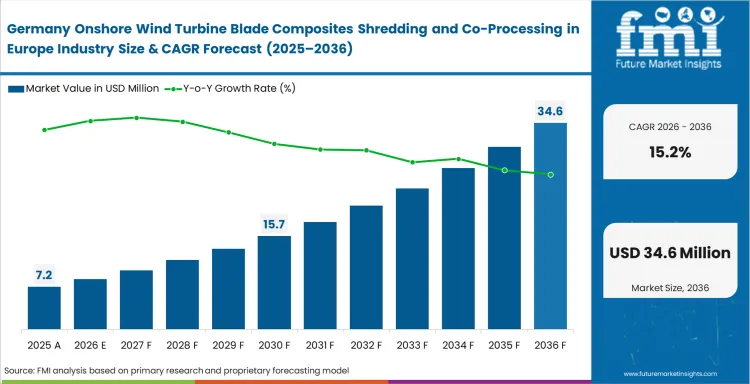
Mature wind asset concentrations situated near regulated heavy industry shape commercial operations across Western Europe. Regional environmental mandates eliminate traditional disposal methods, driving direct integration between waste generators and cement kilns. Proximity between aging turbine fleets and thermal processing sites creates structural advantages by reducing transport distances. Evaluating this ecosystem through [advanced composites industry share analysis] shows established waste management firms using existing networks to capture high-value decommissioning contracts. Manufacturers managing these projects prioritize operational reliability to prevent schedule disruptions during complex repowering phases.
- Germany: Dense concentrations of early wind installations combined with a large domestic cement sector create strong commercial foundations. Demand for onshore wind turbine blade composites shredding in Germany is poised to expand at a CAGR of 15.2% through 2036. Manufacturers secure long-term offtake agreements with local kilns to ensure continuous site clearance. Integrating shredded composites offsets elevated energy costs across heavy industry, anchoring the Germany wind blade recycling industry.
- France: Active deployment of regional preprocessing hubs helps operators localize disposal networks efficiently. Network operators establish staging areas near major transport arteries to blend composite waste with other industrial byproducts before kiln delivery. France is set to record a CAGR of 13.1% in blade composites co-processing during the assessment period. Decentralizing these operations generates distinct contracting opportunities for specialized mobile shredding providers serving domestic installations.
FMI's report includes detailed analysis of capacity constraints within localized preparation hubs across the broader Western European industrial corridor.
Southern Europe Onshore Wind Turbine Blade Composites Shredding and Co-Processing in Europe Industry Analysis
Imminent repowering schedules dictate operational realities across the Iberian and Italian peninsulas. Firms controlling first-generation fleets must clear high-yield wind sites efficiently to install larger modern turbines. Structural investments focus on upgrading existing waste handling infrastructure to process incoming volumes of [structural composites]. Cement manufacturers actively seek alternative fuels with high calorific value to manage rising conventional energy prices. Fast-tracking necessary environmental permits for co-processing facilities helps regional authorities support this industrial integration.
- Spain: Fleet modernization targets force asset owners to remove thousands of obsolete blades from prime wind corridors safely. Activity across the Spain wind turbine blade recycling sector is anticipated to gain momentum, with demand rising at a CAGR of 14.7% over the forecast period. Specialized joint ventures between energy producers and waste management firms shape competitive positioning, ensuring consistent material flow from decommissioned sites to active cement kilns.
- Italy: Regulatory frameworks prioritizing material recovery encourage industrial facilities to adjust their operational parameters. Domestic cement manufacturers actively recalibrate raw meal formulations to maximize safe inclusion of glass-fiber ash. Italian onshore wind blade co-processing adoption is likely to advance at a CAGR of 12.8% by 2036. Systematic adaptation alters physical outcomes inside kilns, permanently reducing reliance on virgin mineral extraction while supporting consistent disposal capacities.
FMI's report includes an assessment of cross-border transport dynamics as Southern European facilities occasionally absorb excess decommissioned tonnage from neighboring jurisdictions.
Northern and Eastern Europe Onshore Wind Turbine Blade Composites Shredding and Co-Processing in Europe Industry Analysis
Advanced recovery frameworks shape Northern operations, while Eastern markets develop localized capacity to handle imported infrastructure materials. Nordic operators manage waste as heavily regulated resources requiring precise supply chain coordination. FMI observes Eastern European waste processors capturing value by establishing dedicated hubs offering competitive gate fees to foreign asset owners. Balancing detailed environmental tracking in Northern zones with expanding industrial capabilities eastward forms regional market structures.
- Denmark: Early wind adoption combined with strict environmental targets forces rigorous downstream auditing of waste partners. Denmark is projected to witness 13.9% CAGR in the blade composites shredding industry through 2036. Utility companies enforce strict compliance with zero-landfill mandates across all operational phases. Established domestic firms frequently export standardized blade shredding technical knowledge to developing European industry, solidifying their role as regional industry leaders.
- Sweden: Decarbonization efforts within heavy materials manufacturing require targeted capital expenditure on specialized equipment. Cement producers invest heavily in advanced pneumatic injection systems to handle abrasive pulverized turbine blades safely. Sweden is anticipated to see shredding services grow at a CAGR of 12.5% over the forecast period. Infrastructure upgrades guarantee long-term offtake capacity for an expanding wave of regional wind farm decommissioning projects.
- Poland: Foreign investment flowing into localized disposal solutions supports new processing infrastructure development. Local waste processors establish specialized receiving facilities to handle decommissioned blades arriving from Germany and Scandinavia. Operations in Poland are expected to register a CAGR of 12.2% in shredding services through 2036. Capitalizing on favorable transport economics positions domestic facilities as central consolidation hubs for broader European composite waste volumes moving eastward.
FMI's report includes evaluation of the regulatory variances that occasionally complicate cross-border waste shipments between Northern and Eastern European states.
Competitive Aligners for Market Players
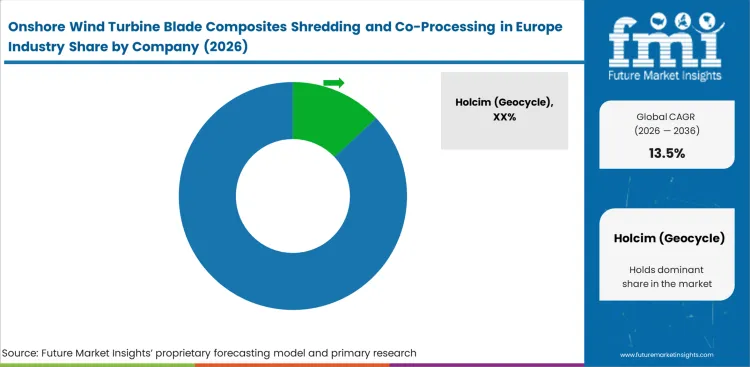
The competitive dynamic diverges from standard waste management because success requires simultaneously satisfying utility asset owners and cement plant chemists. Competitive advantage increasingly sits with firms that control or secure dependable kiln offtake, not only with firms that own shredding assets. These conglomerates leverage their massive installed base of epoxy composite compatible kilns to offer utilities guaranteed, risk-free disposal contracts. Competitors lacking direct ownership of a blade recycling plant in Europe must operate as vulnerable middlemen, entirely dependent on negotiating favorable gate fees with the very entities they compete against for primary utility contracts.
Incumbents defend their market share by maintaining vast, highly permitted regional processing hubs that challengers cannot replicate without years of environmental impact studies. Firms possess the critical capability to absorb massive, unpredictable volume spikes during large-scale repowering events, buffering the erratic supply before feeding it steadily to cement partners. Challengers attempting to enter the space routinely fail when they underestimate the capital requirements for high-torque mobile reduction equipment and the severe maintenance costs associated with processing abrasive glass-fiber laminates at scale.
Wind operators exercise buyer power by demanding comprehensive, end-to-end traceability of their decommissioned assets to satisfy corporate ESG mandates. Utilities actively form strategic joint ventures to ensure their proprietary disposal networks remain insulated from external price shocks at the kiln gate. Integration between turbine OEMs and specialized recyclers defines the realistic path forward, effectively locking out purely logistical transport firms from the highest-value, multi-year decommissioning frameworks.
Key Players in Onshore Wind Turbine Blade Composites Shredding and Co-Processing in Europe Industry
- Holcim (Geocycle)
- Veolia
- Vestas Wind Systems
- Stena Recycling
- ACCIONA Energía
- RenerCycle
- FCC Ámbito / EnergyLOOP
Scope of the Report
| Metric | Value |
|---|---|
| Quantitative Units | USD 10.2 million to USD 36.1 million, at a CAGR of 13.50% |
| Market Definition | This sector captures the commercial activities transforming retired wind turbine composite structures into specified alternative fuels and mineral additives for the European cement industry. |
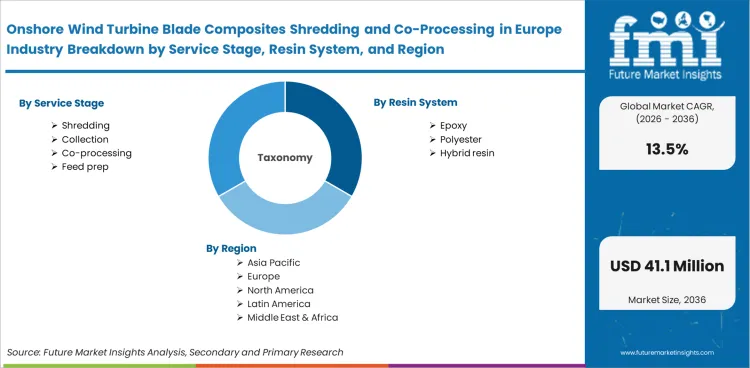
| Segmentation | By service stage, By resin system, By fiber type, By customer type, By blade lifecycle, and Region |
| Regions Covered | Western Europe, Southern Europe, Northern Europe, Eastern Europe |
| Countries Covered | Germany, Spain, Denmark, France, Italy, Sweden, Poland |
| Key Companies Profiled | Holcim (Geocycle), Veolia, Vestas Wind Systems, Stena Recycling, ACCIONA Energía, RenerCycle, FCC Ámbito / EnergyLOOP |
| Forecast Period | 2026 to 2036 |
| Approach | Baseline established by mapping the age profile of the European onshore fleet against cement kiln alternative fuel intake capacities. |
Onshore Wind Turbine Blade Composites Shredding and Co-Processing in Europe Industry Analysis by Segments
By Service Stage:
- Shredding
- Collection
- Co-processing
- Feed prep
By Resin System:
- Epoxy
- Polyester
- Hybrid resin
By Fiber Type:
- Glass fiber
- Carbon fiber
- Mixed fiber
By Customer Type:
- Wind operators
- OEMs
- Asset owners
- By blade lifecycle
- Decommissioning
- Repowering
- Manufacturing scrap
Region:
- Western Europe
- Germany
- France
- Southern Europe
- Spain
- Italy
- Northern Europe
- Denmark
- Sweden
- Eastern Europe
- Poland
Bibliography
- Hu, Y., Zhang, Y., & co-authors. (2024). Wind turbine blade recycling: A review of the recovery and high-value utilization of decommissioned wind turbine blades. Resources, Conservation and Recycling, 210, 107813.
- Tyurkay, A., Tumkur Karnick, S., & co-authors. (2024). State-of-the-art circular economy practices for end-of-life management of wind turbine blades. Sustainable Production and Consumption, 47, 425-441.
- WindEurope. (2025). Wind energy in Europe: 2024 statistics and the outlook for 2025-2030.
- Fachagentur Wind und Solar. (2025). Status of onshore wind energy development in Germany: Year 2024.
This bibliography is provided for reader reference. The full FMI report contains the complete reference list with primary source documentation.
This Report Addresses
- Identifies exact calorific and material requirements cement plant chemists demand before accepting shredded composite blades.
- Explains why the rapid mechanical breakdown of epoxy structures dictates the logistics of modern utility repowering projects.
- Outlines the liability transfer mechanisms wind operators use to legally offload end-of-life composite materials to waste management conglomerates.
- Analyzes the specific equipment degradation costs associated with reducing high-density glass-fiber reinforced plastics in mobile settings.
- Pinpoints how variations in regional landfill bans instantly initiate commercial viability for co-processing networks.
- Details the silica substitution effects that occur when clinker formations integrate pulverized blade fragments.
- Examines the joint venture strategies turbine OEMs deploy to guarantee downstream disposal capacity for their clients.
- Maps the cross-border transport corridors facilitating composite waste movement from congested Western sites to Eastern processing hubs.
Frequently Asked Questions
How are wind turbine blades recycled in Europe?
The dominant method involves mechanical shredding followed by thermal co-processing in cement kilns. Decommissioned blades are reduced to specific sizes, mixed with other waste to stabilize their calorific value, and injected into kilns where the resin burns as fuel and the glass integrates into the clinker.
Why are wind turbine blades hard to recycle?
First-generation fleets consist primarily of highly cross-linked epoxy and glass fiber. This specific thermoset chemistry prevents the materials from being melted down or reshaped, leaving thermal destruction and mineral substitution as the one of the few currently commercialized large-scale routes for thermoset blade waste in Europe.
Compare co-processing vs chemical recycling for wind blades.
Chemical recycling uses solvents to extract intact glass or carbon fibers from the resin matrix, which requires massive energy inputs and extremely clean feedstock. Co-processing destroys the resin entirely for fuel and utilizes the remaining glass as a raw material substitute, prioritizing volume destruction over material recovery.
Co-processing vs mechanical recycling wind blades: what is the difference?
Mechanical recycling grinds the blades into fine powders or short fibers for use as low-value fillers in decking or concrete. Co-processing uses the shredded material directly as an alternative fuel and mineral substitute inside high-temperature cement kilns, permanently consuming the waste.
What is the forecast for Europe wind blade shredding services to 2036?
The sector is projected to advance from USD 10.2 million in 2026 to USD 36.1 million by 2036. This growth is maintained by stringent European landfill bans forcing utility operators to secure active thermal integration pathways for their retiring assets.
What is the onshore wind blade recycling forecast 2026 2036?
The market is set to expand at a 13.50% CAGR over the next decade. The surge is driven by the massive wave of early-2000s turbine installations reaching their twenty-year design limits and requiring immediate site clearance for modern repowering projects.
What specific operational hurdle restricts broader cement integration?
Kiln systems demand absolute consistency in feed particle size and caloric value. Heterogeneous blade chunks cause severe temperature fluctuations and pneumatic blockages, leading plants to reject out-of-spec shipments instantly.
Why do wind operators hold the primary market share for customer type?
Utility companies hold the original environmental permits mandating total site clearance upon asset retirement. They bear the direct financial and legal liability for ensuring the composite structures are verifiably destroyed rather than illegally stockpiled.
What difference explains Germany's leading regional position?
Germany simultaneously possesses the largest fleet of early-2000s turbines reaching end-of-life and a dense network of active cement kilns. This geographical proximity eliminates the massive cross-border transport costs that hinder other European industries.
How do incumbents defend their position against specialized shredding startups?
Firms like Holcim and Veolia control the actual cement kilns where the material must ultimately go. Independent shredders remain entirely vulnerable to the gate fees dictated by these vertically integrated waste management conglomerates.
What hidden cost routinely undermines logistics providers in this space?
Contractors consistently underestimate the extreme abrasive wear glass-reinforced plastics inflict on industrial cutting equipment. Frequent tooling replacement and unpredicted downtime severely compress operating margins during aggressive decommissioning schedules.
Why does repowering lag raw decommissioning in volume?
Many original turbine pads lack the grid infrastructure or spatial clearance required to support modern multi-megawatt units. Operators frequently clear old sites entirely rather than attempting complex upgrades on constrained legacy footprints.
How does Denmark maintain above-average growth despite a smaller total landmass?
Danish operators established aggressive circularity policies years ahead of broader European mandates. Their deeply integrated ecosystem prioritizes sophisticated material tracking and supports highly specialized processing hubs that often accept imported waste.
What role do mobile shredders play in the logistical chain?
Deploying high-torque reduction equipment directly to the turbine pad eliminates specialized oversize transport requirements. This localized densification allows firms to clear sites rapidly using standard bulk freight vehicles.
Why is carbon fiber currently a minor factor in the co-processing stream?
Most blades retiring today were manufactured before carbon reinforcement became common. Waste processors optimize their equipment and chemical blending protocols specifically for the massive volumes of legacy glass-epoxy structures.
How do regional preprocessing hubs stabilize the market?
Wind farm teardowns produce sudden, massive gluts of material that individual kilns cannot immediately absorb. Intermediate hubs buffer this volatile supply, blending it with other industrial waste to provide a steady, consistent feed to cement partners.
What changes when operators export blade waste to Eastern Europe?
Differences in local processing capacity force Western utilities to seek cross-border solutions. Polish logistics capitalize on this by establishing specialized receiving facilities that offer competitive gate fees to foreign asset owners.
Why do cement chemists closely monitor the resin-to-glass ratio?
Fluctuations in epoxy content wildly alter the thermal energy delivered to the precalciner. Without strict homogenization, these unpredicted caloric spikes threaten the integrity of the continuous clinker production process.
How do OEMs participate in the end-of-life disposal market?
Turbine manufacturers increasingly form joint ventures with established recycling firms to offer full-lifecycle service contracts. This strategic integration ensures operators have guaranteed downstream disposal routes when purchasing new equipment.
What happens to operators who delay securing co-processing contracts?
Vendors face compounding intermediate storage costs and potential regulatory fines. Without a verified disposal destination, utilities cannot complete the legal requirements for site clearance, effectively stalling lucrative repowering efforts.
How does Spain navigate its massive decommissioning requirements?
Spanish operators leverage specialized joint ventures to upgrade existing waste infrastructure rapidly. The focus remains on establishing localized shredding capacity to prevent the costly export of multi-ton blade sections across the Pyrenees.
What advantage does co-processing offer over traditional incineration?
Standard incinerators leave behind massive volumes of useless glass ash that still requires landfilling. Cement kilns utilize the extreme heat to destroy the resins while physically integrating the residual glass directly into the final mineral product.
How do operators verify successful thermal destruction?
Certified audit trails from shredding and cement partners are required to prove exact tonnage integration. This documentation is legally required to close out the environmental permits associated with the original turbine installation.
Why do pneumatic injection systems require extensive modification?
Pulverized glass composites are highly abrasive compared to traditional alternative fuels. Plant engineers must install hardened, wear-resistant piping and specialized valves to prevent rapid equipment failure during the continuous feed process.
Preview the report firsthand - request a free sample
Get SampleGet the brochure for pricing and purchase details.
Get PDFTable of Content
- Executive Summary
- Global Market Outlook
- Demand-side Trends
- Supply-side Trends
- Technology Roadmap Analysis
- Analysis and Recommendations
- Market Overview
- Market Coverage / Taxonomy
- Market Definition / Scope / Limitations
- Research Methodology
- Chapter Orientation
- Analytical Lens and Working Hypotheses
- Market Structure, Signals, and Trend Drivers
- Benchmarking and Cross-market Comparability
- Market Sizing, Forecasting, and Opportunity Mapping
- Research Design and Evidence Framework
- Desk Research Programme (Secondary Evidence)
- Company Annual and Sustainability Reports
- Peer-reviewed Journals and Academic Literature
- Corporate Websites, Product Literature, and Technical Notes
- Earnings Decks and Investor Briefings
- Statutory Filings and Regulatory Disclosures
- Technical White Papers and Standards Notes
- Trade Journals, Industry Magazines, and Analyst Briefs
- Conference Proceedings, Webinars, and Seminar Materials
- Government Statistics Portals and Public Data Releases
- Press Releases and Reputable Media Coverage
- Specialist Newsletters and Curated Briefings
- Sector Databases and Reference Repositories
- FMI Internal Proprietary Databases and Historical Market Datasets
- Subscription Datasets and Paid Sources
- Social Channels, Communities, and Digital Listening Inputs
- Additional Desk Sources
- Expert Input and Fieldwork (Primary Evidence)
- Primary Modes
- Qualitative Interviews and Expert Elicitation
- Quantitative Surveys and Structured Data Capture
- Blended Approach
- Why Primary Evidence is Used
- Field Techniques
- Interviews
- Surveys
- Focus Groups
- Observational and In-context Research
- Social and Community Interactions
- Stakeholder Universe Engaged
- C-suite Leaders
- Board Members
- Presidents and Vice Presidents
- R&D and Innovation Heads
- Technical Specialists
- Domain Subject-matter Experts
- Scientists
- Physicians and Other Healthcare Professionals
- Governance, Ethics, and Data Stewardship
- Research Ethics
- Data Integrity and Handling
- Primary Modes
- Tooling, Models, and Reference Databases
- Desk Research Programme (Secondary Evidence)
- Data Engineering and Model Build
- Data Acquisition and Ingestion
- Cleaning, Normalisation, and Verification
- Synthesis, Triangulation, and Analysis
- Quality Assurance and Audit Trail
- Market Background
- Market Dynamics
- Drivers
- Restraints
- Opportunity
- Trends
- Scenario Forecast
- Demand in Optimistic Scenario
- Demand in Likely Scenario
- Demand in Conservative Scenario
- Opportunity Map Analysis
- Product Life Cycle Analysis
- Supply Chain Analysis
- Investment Feasibility Matrix
- Value Chain Analysis
- PESTLE and Porter’s Analysis
- Regulatory Landscape
- Regional Parent Market Outlook
- Production and Consumption Statistics
- Import and Export Statistics
- Market Dynamics
- Global Market Analysis 2021 to 2025 and Forecast, 2026 to 2036
- Historical Market Size Value (USD Million) Analysis, 2021 to 2025
- Current and Future Market Size Value (USD Million) Projections, 2026 to 2036
- Y-o-Y Growth Trend Analysis
- Absolute $ Opportunity Analysis
- Global Market Pricing Analysis 2021 to 2025 and Forecast 2026 to 2036
- Global Market Analysis 2021 to 2025 and Forecast 2026 to 2036, By Service Stage
- Introduction / Key Findings
- Historical Market Size Value (USD Million) Analysis By Service Stage , 2021 to 2025
- Current and Future Market Size Value (USD Million) Analysis and Forecast By Service Stage , 2026 to 2036
- Shredding
- Collection
- Co-processing
- Feed prep
- Shredding
- Y-o-Y Growth Trend Analysis By Service Stage , 2021 to 2025
- Absolute $ Opportunity Analysis By Service Stage , 2026 to 2036
- Global Market Analysis 2021 to 2025 and Forecast 2026 to 2036, By Resin System
- Introduction / Key Findings
- Historical Market Size Value (USD Million) Analysis By Resin System, 2021 to 2025
- Current and Future Market Size Value (USD Million) Analysis and Forecast By Resin System, 2026 to 2036
- Epoxy
- Polyester
- Hybrid resin
- Epoxy
- Y-o-Y Growth Trend Analysis By Resin System, 2021 to 2025
- Absolute $ Opportunity Analysis By Resin System, 2026 to 2036
- Global Market Analysis 2021 to 2025 and Forecast 2026 to 2036, By Fiber Type
- Introduction / Key Findings
- Historical Market Size Value (USD Million) Analysis By Fiber Type, 2021 to 2025
- Current and Future Market Size Value (USD Million) Analysis and Forecast By Fiber Type, 2026 to 2036
- Glass fiber
- Carbon fiber
- Mixed fiber
- Glass fiber
- Y-o-Y Growth Trend Analysis By Fiber Type, 2021 to 2025
- Absolute $ Opportunity Analysis By Fiber Type, 2026 to 2036
- Global Market Analysis 2021 to 2025 and Forecast 2026 to 2036, By Customer Type
- Introduction / Key Findings
- Historical Market Size Value (USD Million) Analysis By Customer Type, 2021 to 2025
- Current and Future Market Size Value (USD Million) Analysis and Forecast By Customer Type, 2026 to 2036
- Wind operators
- OEMs
- Asset owners
- Wind operators
- Y-o-Y Growth Trend Analysis By Customer Type, 2021 to 2025
- Absolute $ Opportunity Analysis By Customer Type, 2026 to 2036
- Global Market Analysis 2021 to 2025 and Forecast 2026 to 2036, By Blade Lifecycle
- Introduction / Key Findings
- Historical Market Size Value (USD Million) Analysis By Blade Lifecycle, 2021 to 2025
- Current and Future Market Size Value (USD Million) Analysis and Forecast By Blade Lifecycle, 2026 to 2036
- Decommissioning
- Repowering
- Manufacturing scrap
- Decommissioning
- Y-o-Y Growth Trend Analysis By Blade Lifecycle, 2021 to 2025
- Absolute $ Opportunity Analysis By Blade Lifecycle, 2026 to 2036
- Global Market Analysis 2021 to 2025 and Forecast 2026 to 2036, By Region
- Introduction
- Historical Market Size Value (USD Million) Analysis By Region, 2021 to 2025
- Current Market Size Value (USD Million) Analysis and Forecast By Region, 2026 to 2036
- North America
- Latin America
- Western Europe
- Eastern Europe
- East Asia
- South Asia and Pacific
- Middle East & Africa
- Market Attractiveness Analysis By Region
- North America Market Analysis 2021 to 2025 and Forecast 2026 to 2036, By Country
- Historical Market Size Value (USD Million) Trend Analysis By Market Taxonomy, 2021 to 2025
- Market Size Value (USD Million) Forecast By Market Taxonomy, 2026 to 2036
- By Country
- USA
- Canada
- Mexico
- By Service Stage
- By Resin System
- By Fiber Type
- By Customer Type
- By Blade Lifecycle
- By Country
- Market Attractiveness Analysis
- By Country
- By Service Stage
- By Resin System
- By Fiber Type
- By Customer Type
- By Blade Lifecycle
- Key Takeaways
- Latin America Market Analysis 2021 to 2025 and Forecast 2026 to 2036, By Country
- Historical Market Size Value (USD Million) Trend Analysis By Market Taxonomy, 2021 to 2025
- Market Size Value (USD Million) Forecast By Market Taxonomy, 2026 to 2036
- By Country
- Brazil
- Chile
- Rest of Latin America
- By Service Stage
- By Resin System
- By Fiber Type
- By Customer Type
- By Blade Lifecycle
- By Country
- Market Attractiveness Analysis
- By Country
- By Service Stage
- By Resin System
- By Fiber Type
- By Customer Type
- By Blade Lifecycle
- Key Takeaways
- Western Europe Market Analysis 2021 to 2025 and Forecast 2026 to 2036, By Country
- Historical Market Size Value (USD Million) Trend Analysis By Market Taxonomy, 2021 to 2025
- Market Size Value (USD Million) Forecast By Market Taxonomy, 2026 to 2036
- By Country
- Germany
- UK
- Italy
- Spain
- France
- Nordic
- BENELUX
- Rest of Western Europe
- By Service Stage
- By Resin System
- By Fiber Type
- By Customer Type
- By Blade Lifecycle
- By Country
- Market Attractiveness Analysis
- By Country
- By Service Stage
- By Resin System
- By Fiber Type
- By Customer Type
- By Blade Lifecycle
- Key Takeaways
- Eastern Europe Market Analysis 2021 to 2025 and Forecast 2026 to 2036, By Country
- Historical Market Size Value (USD Million) Trend Analysis By Market Taxonomy, 2021 to 2025
- Market Size Value (USD Million) Forecast By Market Taxonomy, 2026 to 2036
- By Country
- Russia
- Poland
- Hungary
- Balkan & Baltic
- Rest of Eastern Europe
- By Service Stage
- By Resin System
- By Fiber Type
- By Customer Type
- By Blade Lifecycle
- By Country
- Market Attractiveness Analysis
- By Country
- By Service Stage
- By Resin System
- By Fiber Type
- By Customer Type
- By Blade Lifecycle
- Key Takeaways
- East Asia Market Analysis 2021 to 2025 and Forecast 2026 to 2036, By Country
- Historical Market Size Value (USD Million) Trend Analysis By Market Taxonomy, 2021 to 2025
- Market Size Value (USD Million) Forecast By Market Taxonomy, 2026 to 2036
- By Country
- China
- Japan
- South Korea
- By Service Stage
- By Resin System
- By Fiber Type
- By Customer Type
- By Blade Lifecycle
- By Country
- Market Attractiveness Analysis
- By Country
- By Service Stage
- By Resin System
- By Fiber Type
- By Customer Type
- By Blade Lifecycle
- Key Takeaways
- South Asia and Pacific Market Analysis 2021 to 2025 and Forecast 2026 to 2036, By Country
- Historical Market Size Value (USD Million) Trend Analysis By Market Taxonomy, 2021 to 2025
- Market Size Value (USD Million) Forecast By Market Taxonomy, 2026 to 2036
- By Country
- India
- ASEAN
- Australia & New Zealand
- Rest of South Asia and Pacific
- By Service Stage
- By Resin System
- By Fiber Type
- By Customer Type
- By Blade Lifecycle
- By Country
- Market Attractiveness Analysis
- By Country
- By Service Stage
- By Resin System
- By Fiber Type
- By Customer Type
- By Blade Lifecycle
- Key Takeaways
- Middle East & Africa Market Analysis 2021 to 2025 and Forecast 2026 to 2036, By Country
- Historical Market Size Value (USD Million) Trend Analysis By Market Taxonomy, 2021 to 2025
- Market Size Value (USD Million) Forecast By Market Taxonomy, 2026 to 2036
- By Country
- Kingdom of Saudi Arabia
- Other GCC Countries
- Turkiye
- South Africa
- Other African Union
- Rest of Middle East & Africa
- By Service Stage
- By Resin System
- By Fiber Type
- By Customer Type
- By Blade Lifecycle
- By Country
- Market Attractiveness Analysis
- By Country
- By Service Stage
- By Resin System
- By Fiber Type
- By Customer Type
- By Blade Lifecycle
- Key Takeaways
- Key Countries Market Analysis
- USA
- Pricing Analysis
- Market Share Analysis, 2025
- By Service Stage
- By Resin System
- By Fiber Type
- By Customer Type
- By Blade Lifecycle
- Canada
- Pricing Analysis
- Market Share Analysis, 2025
- By Service Stage
- By Resin System
- By Fiber Type
- By Customer Type
- By Blade Lifecycle
- Mexico
- Pricing Analysis
- Market Share Analysis, 2025
- By Service Stage
- By Resin System
- By Fiber Type
- By Customer Type
- By Blade Lifecycle
- Brazil
- Pricing Analysis
- Market Share Analysis, 2025
- By Service Stage
- By Resin System
- By Fiber Type
- By Customer Type
- By Blade Lifecycle
- Chile
- Pricing Analysis
- Market Share Analysis, 2025
- By Service Stage
- By Resin System
- By Fiber Type
- By Customer Type
- By Blade Lifecycle
- Germany
- Pricing Analysis
- Market Share Analysis, 2025
- By Service Stage
- By Resin System
- By Fiber Type
- By Customer Type
- By Blade Lifecycle
- UK
- Pricing Analysis
- Market Share Analysis, 2025
- By Service Stage
- By Resin System
- By Fiber Type
- By Customer Type
- By Blade Lifecycle
- Italy
- Pricing Analysis
- Market Share Analysis, 2025
- By Service Stage
- By Resin System
- By Fiber Type
- By Customer Type
- By Blade Lifecycle
- Spain
- Pricing Analysis
- Market Share Analysis, 2025
- By Service Stage
- By Resin System
- By Fiber Type
- By Customer Type
- By Blade Lifecycle
- France
- Pricing Analysis
- Market Share Analysis, 2025
- By Service Stage
- By Resin System
- By Fiber Type
- By Customer Type
- By Blade Lifecycle
- India
- Pricing Analysis
- Market Share Analysis, 2025
- By Service Stage
- By Resin System
- By Fiber Type
- By Customer Type
- By Blade Lifecycle
- ASEAN
- Pricing Analysis
- Market Share Analysis, 2025
- By Service Stage
- By Resin System
- By Fiber Type
- By Customer Type
- By Blade Lifecycle
- Australia & New Zealand
- Pricing Analysis
- Market Share Analysis, 2025
- By Service Stage
- By Resin System
- By Fiber Type
- By Customer Type
- By Blade Lifecycle
- China
- Pricing Analysis
- Market Share Analysis, 2025
- By Service Stage
- By Resin System
- By Fiber Type
- By Customer Type
- By Blade Lifecycle
- Japan
- Pricing Analysis
- Market Share Analysis, 2025
- By Service Stage
- By Resin System
- By Fiber Type
- By Customer Type
- By Blade Lifecycle
- South Korea
- Pricing Analysis
- Market Share Analysis, 2025
- By Service Stage
- By Resin System
- By Fiber Type
- By Customer Type
- By Blade Lifecycle
- Russia
- Pricing Analysis
- Market Share Analysis, 2025
- By Service Stage
- By Resin System
- By Fiber Type
- By Customer Type
- By Blade Lifecycle
- Poland
- Pricing Analysis
- Market Share Analysis, 2025
- By Service Stage
- By Resin System
- By Fiber Type
- By Customer Type
- By Blade Lifecycle
- Hungary
- Pricing Analysis
- Market Share Analysis, 2025
- By Service Stage
- By Resin System
- By Fiber Type
- By Customer Type
- By Blade Lifecycle
- Kingdom of Saudi Arabia
- Pricing Analysis
- Market Share Analysis, 2025
- By Service Stage
- By Resin System
- By Fiber Type
- By Customer Type
- By Blade Lifecycle
- Turkiye
- Pricing Analysis
- Market Share Analysis, 2025
- By Service Stage
- By Resin System
- By Fiber Type
- By Customer Type
- By Blade Lifecycle
- South Africa
- Pricing Analysis
- Market Share Analysis, 2025
- By Service Stage
- By Resin System
- By Fiber Type
- By Customer Type
- By Blade Lifecycle
- USA
- Market Structure Analysis
- Competition Dashboard
- Competition Benchmarking
- Market Share Analysis of Top Players
- By Region
- By Service Stage
- By Resin System
- By Fiber Type
- By Customer Type
- By Blade Lifecycle
- Competition Analysis
- Competition Deep Dive
- Holcim (Geocycle)
- Overview
- Product Portfolio
- Profitability by Market Segments (Product/Age /Sales Channel/Region)
- Sales Footprint
- Strategy Overview
- Marketing Strategy
- Product Strategy
- Channel Strategy
- Veolia
- Vestas Wind Systems
- Stena Recycling
- ACCIONA Energía
- RenerCycle
- FCC Ámbito / EnergyLOOP
- Holcim (Geocycle)
- Competition Deep Dive
- Assumptions & Acronyms Used


