

- Industry Size (2026)
- USD 3.3 Bn
- Forecast (2036)
- USD 10.2 Bn
- CAGR (2026 to 2036)
- 11.9%
Wind Blade Inspection Equipment Market Forecast and Outlook 2026 to 2036
The wind blade inspection equipment market is likely to be valued at USD 3.3 billion in 2026 and is expected to reach USD 10.2 billion by 2036, reflecting a CAGR of 11.90%. These systems support asset integrity programs rather than project construction activity, since blade condition directly affects availability, power output, and warranty exposure. Inspection demand follows the size and age profile of installed wind fleets, with higher intensity in regions that deployed large capacities a decade earlier. Methods range from rope access tools to drone based imaging and sensor platforms, and selection depends on turbine size, site access, and inspection interval policies rather than on equipment cost alone.
Maintenance strategy and insurer requirements shape purchasing behavior more than headline technology features. Once an operator standardizes an inspection method and data format, it becomes embedded in reporting, defect classification, and repair decision workflows, which limits frequent switching. Service providers and owners focus on detection reliability, documentation quality, and integration with blade repair planning. Offshore and remote onshore sites place additional weight on inspection speed and logistics simplification. The market is set to rise through fleet aging and tighter condition monitoring regimes, not through new turbine installations alone or short cycle technology refresh cycles.
Quick Stats for Wind Blade Inspection Equipment Market
- Wind Blade Inspection Equipment Market Value (2026): USD 3.3 billion
- Wind Blade Inspection Equipment Market Forecast Value (2036): USD 10.2 billion
- Wind Blade Inspection Equipment Market Forecast CAGR 2026 to 2036: 11.9%
- Leading Inspection Type in Wind Blade Inspection Equipment Market: Drone or UAV inspection systems
- Key Growth Regions in Wind Blade Inspection Equipment Market: Asia Pacific, Europe, North America
- Top Players in Wind Blade Inspection Equipment Market: GE Renewable Energy, Siemens Gamesa Renewable Energy, Vestas Wind Systems, TPI Composites, Enerpac (Inspection Solutions), Rosen Group, BladeEye Technologies

What is the Growth Forecast for the Wind Blade Inspection Equipment Market through 2036?
The wind blade inspection equipment market is driven primarily by the economics of asset availability and lifetime energy yield rather than by turbine installation volumes alone. In 2020, when the wind blade inspection equipment market is approximately USD 1.9 billion, inspection activity is still dominated by scheduled visual checks and rope-access methods, with limited use of advanced digital tools. As the wind blade inspection equipment market reaches about USD 2.4 billion in 2023 and approximately USD 3.3 billion by 2026, operators increasingly adopt drone-based and sensor-assisted inspection to reduce downtime, lower safety risk, and improve defect detection consistency. At this stage, inspection is no longer treated only as a maintenance obligation but as a performance management function linked to availability, warranty enforcement, and blade life extension strategies.
Further expansion of the wind blade inspection equipment market is shaped by the aging global turbine fleet and by the rising financial impact of unplanned outages. By 2030, when the wind blade inspection equipment market reaches roughly USD 4.6 billion, inspection frequency and technical depth increase as operators focus on early detection of leading-edge erosion, bonding defects, and structural fatigue. As the wind blade inspection equipment market approaches about USD 7.2 billion in 2033-2034 and reaches approximately USD 10.2 billion by 2036, value growth is driven by higher inspection intensity per turbine, wider use of automated and data-integrated systems, and stricter performance and warranty management practices. Purchasing decisions increasingly prioritize data quality, repeatability, and integration with asset management platforms rather than inspection speed or hardware cost alone.
Wind Blade Inspection Equipment Market Key Takeaways
| Metric | Value |
|---|---|
| Market Value (2026) | USD 3.3 billion |
| Forecast Value (2036) | USD 10.2 billion |
| Forecast CAGR 2026 to 2036 | 11.9% |
How Is the Wind Blade Inspection Equipment Market Enhancing Turbine Reliability and Maintenance?
Wind blade inspection equipment is increasingly adopted to monitor blade integrity, detect defects, and extend operational life in wind energy installations. Historically, inspections relied on visual assessments or manual climbing, which limited accuracy, increased safety risks, and often failed to identify early-stage damage. Modern inspection systems integrate high-resolution cameras, drones, ultrasonic sensors, and 3D scanning technologies to provide precise, comprehensive evaluations without requiring direct human contact. Wind farm operators, maintenance service providers, and turbine manufacturers prioritize inspection accuracy, data analysis capability, and operational safety. Early adoption focused on offshore wind farms and high-value turbines, while current demand spans onshore wind projects, turbine manufacturing facilities, and large-scale maintenance programs, driven by performance monitoring, predictive maintenance, and cost reduction. Sensor resolution, mobility, and software analytics influence supplier selection.
Ensuring early defect detection and efficient maintenance scheduling is shaping market growth. Compared with traditional inspection methods, modern equipment delivers higher precision, reduces downtime, and minimizes safety risks during assessments. Cost structures depend on sensor quality, data processing systems, and mobility platforms, concentrating margins among suppliers capable of providing reliable, end-to-end solutions. Operators adopt these systems to optimize maintenance cycles, prevent blade failures, and maximize energy generation. Looking forward, wind blade inspection equipment is expected to become a standard tool in turbine lifecycle management, enabling data-driven maintenance, improved operational safety, and prolonged blade performance across wind energy projects.
How is Wind Blade Inspection Equipment Market Structured?
The Wind Blade Inspection Equipment Market in 2026 is structured primarily by turbine availability targets, access cost management, and life-extension strategies rather than by inspection technology capability alone. By inspection type, demand in the Wind Blade Inspection Equipment Market is distributed across drone or UAV inspection systems, ultrasonic or eddy current scanners, laser and optical profilometry systems, and thermographic or infrared inspection tools.
By end-use industry, demand in the Wind Blade Inspection Equipment Market is concentrated in onshore wind turbines, offshore wind turbines, wind farm operations and maintenance service providers, and blade OEM quality control operations. These segments reflect differences in inspection frequency, access constraints, and tolerance for undetected structural degradation. In most wind fleets, blades represent one of the highest contributors to unplanned downtime and energy yield loss.
How Do Access Constraints and Downtime Economics Shape Inspection Type Demand in the Wind Blade Inspection Equipment Market?
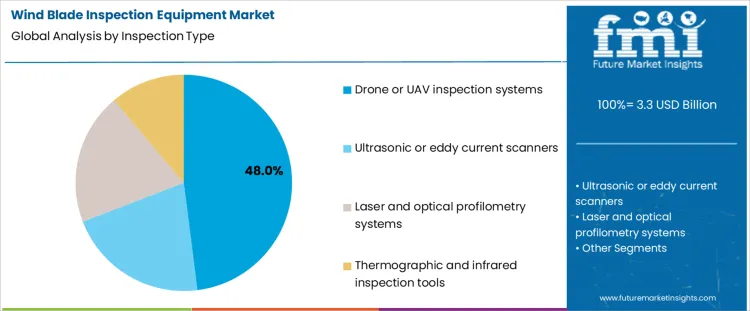
Drone or UAV inspection systems account for approximately 48% of demand in the Wind Blade Inspection Equipment Market because they offer the most efficient method of reducing inspection time, access cost, and turbine downtime. Traditional rope-access or platform-based inspections require turbine shutdowns, specialized crews, and favorable weather windows, all of which carry significant direct and opportunity costs. UAV-based systems allow operators to perform frequent visual and surface condition assessments with minimal interruption to power generation, which aligns with availability-driven operating models.
Ultrasonic, eddy current, and thermographic tools are used where subsurface defect detection or moisture ingress assessment is required, but these methods are typically applied selectively due to their higher setup and execution costs. Laser and optical profilometry systems serve niche roles in erosion mapping and surface geometry monitoring, often in conjunction with performance optimization programs. The structure of the Wind Blade Inspection Equipment Market is therefore driven less by the technical superiority of any single method and more by how effectively each inspection type reduces the combined cost of access, lost generation, and deferred defect detection.
Why Do Onshore Wind Turbines Represent the Largest End Use Segment in the Wind Blade Inspection Equipment Market?
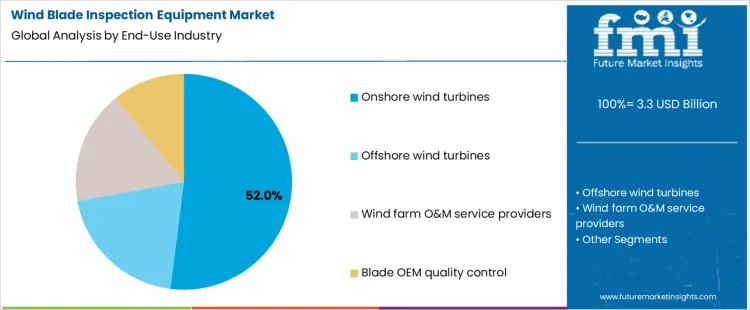
Onshore wind turbines account for approximately 52% of demand in the Wind Blade Inspection Equipment Market because they represent the largest installed base of operating assets and require frequent, distributed inspection coverage. Although offshore turbines involve higher inspection complexity and higher per-visit costs, the total population of onshore turbines is substantially larger and more geographically dispersed. This creates sustained demand for scalable and repeatable inspection solutions that can be deployed across entire fleets. Wind farm operations and maintenance service providers account for a significant share of equipment utilization, but their purchasing decisions are ultimately driven by the needs of onshore and offshore asset owners.
Blade OEM quality control uses advanced inspection systems, but this demand is limited to manufacturing throughput rather than field population size. Onshore operators also face shorter inspection intervals due to higher exposure to dust, insects, and localized weather conditions, which accelerate surface erosion and defect formation. The combination of asset volume, inspection frequency, and availability-driven maintenance strategies explains why onshore wind turbines remain the dominant end-use segment in the Wind Blade Inspection Equipment Market.
How Are the Key Dynamics Reshaping the Wind Blade Inspection Equipment Market?
The Wind Blade Inspection Equipment Market is shaped less by technology limits and more by how inspection budgets are owned, approved, and contracted. In many operators, blade inspection sits in an awkward space between operations, maintenance, and asset management, which means nobody fully controls the tooling strategy. Some fleets buy equipment, others outsource everything, and many mix both without a clear rule. This fragmentation creates inconsistent demand patterns. Growth happens when companies standardize inspection responsibility and tooling strategy at fleet level rather than leaving decisions to site-by-site contracting and annual maintenance negotiations.
Why the Wind Blade Inspection Equipment Market Is Procurement-Structure Driven?
In many wind operators, inspection is not a capital program. It is a service line item. That changes everything. When inspection is bought as a service, equipment decisions belong to contractors, not asset owners. When inspection is internalized, tools suddenly become strategic assets. The Wind Blade Inspection Equipment Market grows fastest when operators bring inspection in-house or standardize global framework contracts that specify methods and tools. Otherwise, buying remains fragmented, price-driven, and inconsistent. Demand therefore follows how inspection is organized commercially, not how many turbines exist or how fast fleets are expanding.
Why the Wind Blade Inspection Equipment Market Is Stuck in Budget Silos?
Blade inspection competes with many invisible priorities. It does not increase capacity, does not reduce headcount, and rarely has a dramatic before-and-after story. In many organizations, its cost sits in OPEX while equipment sits in CAPEX, owned by different managers with different incentives. This slows tool investment even when everyone agrees inspections matter. The Wind Blade Inspection Equipment Market is constrained by this accounting split more than by technology maturity. Where companies unify responsibility for inspection outcomes and tooling budgets, adoption accelerates. Where they do not, reliance on manual or outsourced methods persists.
Why the Wind Blade Inspection Equipment Market Follows Contracting Models?
Some operators run long-term service agreements where inspection methods are locked in for years. Others tender inspection annually and reward lowest price. These two models produce completely different equipment behavior. Long-term contracts justify investment in drones, robots, and data systems. Short-term contracts favor rope access and visual checks. The Wind Blade Inspection Equipment Market therefore follows how owners structure service relationships; not how sophisticated inspection technology becomes. As more fleets move toward multi-year performance-based service contracts, tooling standardization increases and equipment ownership shifts from opportunistic to strategic.
What is the Demand for Wind Blade Inspection Equipment by Country?
| Country | CAGR (%) |
|---|---|
| USA | 11.0% |
| UK | 10.5% |
| China | 12.8% |
| India | 13.5% |
| Brazil | 11.2% |
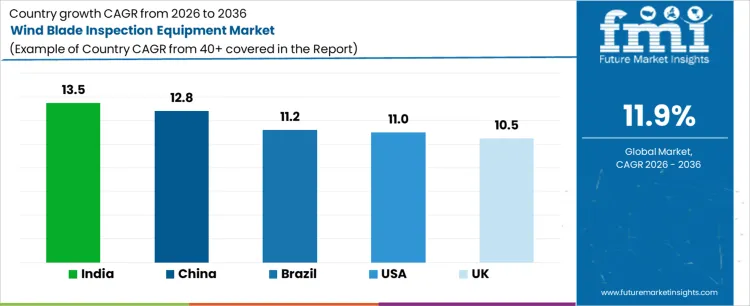
Demand for wind blade inspection equipment is rising as wind energy operators adopt advanced monitoring solutions to ensure turbine performance, detect defects, and extend operational life. India leads with a 13.5% CAGR, driven by rapid wind power capacity expansion, growing maintenance needs, and adoption of precision inspection technologies. China follows at 12.8%, supported by large-scale wind farms and demand for condition-based monitoring. Brazil records 11.2% growth, shaped by turbine maintenance requirements and expansion of renewable energy projects. The USA grows at 11.0%, influenced by upgrades and inspection of existing wind energy infrastructure. The UK shows 10.5% CAGR, reflecting steady adoption of inspection equipment across commercial wind farms.
How do fleet scale and warranty exposure shape demand in the United States?
Fleet scale and warranty exposure keep wind blade inspection equipment demand in United States on an 11% CAGR path. Spending follows service contract calendars and annual inspection planning. Asset owners and O and M contractors control tool standardization across regions. Equipment choice emphasizes defect detection reliability, data capture, and inspection speed in varied terrain. Drone, rope access, and ground systems coexist under site access rules. Replacement of manual visual methods continues across older farms. Insurance requirements influence inspection frequency and documentation depth. Procurement timing aligns with maintenance season planning. Training burden and data integration affect acceptance. Revenue stability depends on fleet size growth and contract coverage. Commercial success depends on approval by service providers and placement on standardized tool lists.
Why do lifecycle management programs drive purchases in the United Kingdom?
Lifecycle management programs keep wind blade inspection equipment demand in United Kingdom expanding at a 10.5% CAGR. Many operators move toward scheduled inspection cycles across mature fleets. Service contractors and asset managers define approved equipment lists. Tool choice emphasizes repeatable defect classification, report quality, and audit acceptance. Drone inspection gains share where access rules permit. Rope based methods remain necessary in complex terrain and offshore support zones. Insurance and financing covenants influence documentation standards. Procurement follows multi-year service agreements. Training and data integration affect acceptance. Revenue growth links to aging fleet needs more than capacity additions. Commercial visibility depends on framework inclusion with service providers and placement on standardized tool lists across operating fleets today and tomorrow plans.
What scale effects drive growth in China?
Rapid expansion of installed capacity keeps wind blade inspection equipment demand in China on a 12.8% CAGR trajectory. Large state owned operators manage inspection programs across extensive fleets. Standardization across regions drives volume purchases. Domestic suppliers dominate basic platforms through pricing and delivery speed. International providers retain roles in advanced analytics and offshore systems. Procurement follows group level planning with limited site discretion. Data integration and reporting requirements influence selection. Replacement of manual methods continues across older farms. Training burden affects rollout speed. Margin structure depends on mix between hardware platforms and data systems. Commercial success depends on access to national operator programs and placement on approved equipment lists across operating groups with long term service agreements in place.
Why does service industry formalization accelerate demand in India?
Formalization of service providers and growing fleets keep wind blade inspection equipment demand in India on a 13.5% CAGR path. Asset owners move toward scheduled inspection regimes to control failure risk. Tool selection emphasizes ease of deployment, documentation quality, and training support. Import systems serve complex sites and larger portfolios. Domestic suppliers cover routine inspection tasks. Procurement authority sits with central asset management teams and service firms. Spending follows maintenance contract cycles and fleet expansion plans. Drone inspection adoption grows where regulation allows. Data handling and reporting standards affect acceptance. Revenue stability depends on fleet growth and contract coverage. Commercial success depends on inclusion in service company standard toolkits and placement on approved equipment lists widely across operating regions today.
How do asset reliability priorities shape Brazil demand?
Asset availability priorities and growing fleets keep wind blade inspection equipment demand in Brazil on an 11.2% CAGR track. Operators prioritize early defect detection to limit blade repair costs. Service contractors and turbine owners define equipment standards. Tool choice balances inspection coverage, data quality, and field practicality. Import systems serve higher complexity sites. Local providers handle routine onshore inspections. Procurement timing aligns with annual maintenance planning. Insurance and financing terms influence inspection rigor. Data workflows and reporting formats affect acceptance. Spending growth links to fleet maturation more than new site additions. Commercial position depends on acceptance by service contractors and placement on standardized equipment lists within long term service agreements across operating regions today for large multi-site fleets.
How Are Suppliers Innovating in the Wind Blade Inspection Equipment Market?
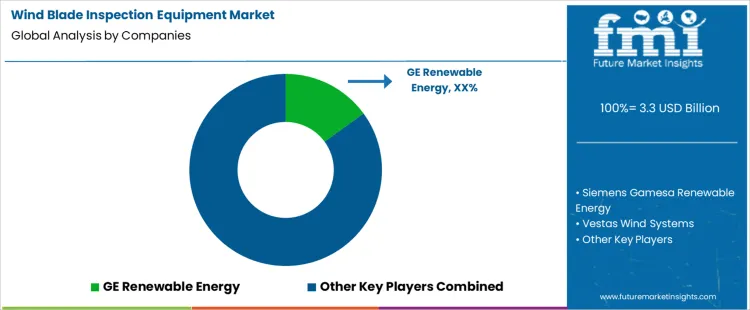
GE Renewable Energy develops inspection tools coupled with analytics that assess blade integrity across on-shore and offshore fleets. Its focus includes laser and optical scanning systems that detect cracks, delamination, and erosion before failures escalate. Siemens Gamesa Renewable Energy integrates inspection equipment within service offerings, pairing high-resolution sensors with maintenance planning systems to support predictive decision-making. Vestas Wind Systems supplies inspection solutions aligned with its global service network, emphasizing data standardization and condition-based maintenance across varied turbine platforms. TPI Composites, as a major blade manufacturer, applies inspection technology that aligns manufacturing quality control with field inspection, enabling early detection of material or process-related defects. Enerpac (Inspection Solutions) provides specialized non-destructive evaluation (NDE) tools such as ultrasonic and eddy current systems that support internal blade assessment without disassembly.
Rosen Group offers advanced blade inspection systems including phased array and guided wave technologies tuned for composite structures. BladeEye Technologies supplies automated inspection platforms that integrate robotics and machine vision to generate detailed surface and subsurface maps of blade condition. Other regional and niche technology providers contribute portable or drone-mounted systems optimized for access challenges and varied environmental conditions. Competitive differentiation arises from sensor fidelity, automation level, ease of integration with maintenance workflows, and analytics that translate raw measurements into actionable insights. Adoption reflects operator priorities for reducing downtime, extending blade service life, and improving safety by minimizing manual inspection risks. Suppliers that combine robust hardware, validated inspection methodologies, and service support help asset owners transition from reactive repairs to proactive structural health monitoring.
Key Players in the Wind Blade Inspection Equipment Market
- GE Renewable Energy
- Siemens Gamesa Renewable Energy
- Vestas Wind Systems
- TPI Composites
- Enerpac (Inspection Solutions)
- Rosen Group (Blade inspection systems)
- BladeEye Technologies
Scope of the Report
| Items | Values |
|---|---|
| Quantitative Units (2026) | USD billion |
| Inspection Type | Drone or UAV inspection systems, Ultrasonic or eddy current scanners, Laser and optical profilometry systems, Thermographic and infrared inspection tools |
| End-Use Industry | Onshore wind turbines, Offshore wind turbines, Wind farm O&M service providers, Blade OEM quality control |
| Region | Asia Pacific, Europe, North America, Latin America, Middle East & Africa |
| Countries Covered | China, Japan, South Korea, India, Australia & New Zealand, ASEAN, Germany, United Kingdom, France, Italy, Spain, Nordic, BENELUX, United States, Canada, Mexico, Brazil, Chile, Saudi Arabia, Turkey, South Africa, and other regional markets |
| Key Companies Profiled | GE Renewable Energy, Siemens Gamesa Renewable Energy, Vestas Wind Systems, TPI Composites, Enerpac (Inspection Solutions), Rosen Group, BladeEye Technologies |
| Additional Attributes | Dollar by sales by inspection type and end-use; demand driven by fleet aging, warranty exposure, and availability targets; growth led by higher inspection intensity and drone adoption; purchasing shaped by data quality, repeatability, reporting integration, and compatibility with asset management workflows rather than hardware cost alone. |
Wind Blade Inspection Equipment Market Segmentation
Inspection Type:
- Drone or UAV inspection systems
- Ultrasonic or eddy current scanners
- Laser and optical profilometry systems
- Thermographic and infrared inspection tools
End-Use Industry:
- Onshore wind turbines
- Offshore wind turbines
- Wind farm O&M service providers
- Blade OEM quality control
Region:
- Asia Pacific
- China
- Japan
- South Korea
- India
- Australia & New Zealand
- ASEAN
- Rest of Asia Pacific
- Europe
- Germany
- United Kingdom
- France
- Italy
- Spain
- Nordic
- BENELUX
- Rest of Europe
- North America
- United States
- Canada
- Mexico
- Latin America
- Brazil
- Chile
- Rest of Latin America
- Middle East & Africa
- Kingdom of Saudi Arabia
- Other GCC Countries
- Turkey
- South Africa
- Other African Union
- Rest of Middle East & Africa
Bibliography
- Lu, R., & Shen, Y. (2024). Structural health monitoring of wind turbine blades using guided waves. Proceedings of the ASME 2024 International Mechanical Engineering Congress & Exposition.
- Feng, W., et al. (2023). In situ structural health monitoring of full-scale wind turbine blades using stereo digital image correlation. Sustainability, 15(18), 13783.
- Sikdar, S., Kalgutkar, A. P., & Banerjee, S. (2024). Guided-wave-based structural health monitoring of composite wind turbine blades. Proceedings of NDT 2024.
- Sun, S., Wang, T., & Chu, F. (2024). Review of structural health monitoring of wind turbine blades based on vibration and acoustic measurement. Journal of Mechanical Engineering, 60(7), 79-92.
Frequently Asked Questions
How big is the wind blade inspection equipment market in 2026?
The global wind blade inspection equipment market is estimated to be valued at USD 3.3 billion in 2026.
What will be the size of wind blade inspection equipment market in 2036?
The market size for the wind blade inspection equipment market is projected to reach USD 10.2 billion by 2036.
How much will be the wind blade inspection equipment market growth between 2026 and 2036?
The wind blade inspection equipment market is expected to grow at a 11.9% CAGR between 2026 and 2036.
What are the key product types in the wind blade inspection equipment market?
The key product types in wind blade inspection equipment market are drone or uav inspection systems , ultrasonic or eddy current scanners, laser and optical profilometry systems and thermographic and infrared inspection tools.
Which end‑use industry segment to contribute significant share in the wind blade inspection equipment market in 2026?
In terms of end‑use industry, onshore wind turbines segment to command 52.0% share in the wind blade inspection equipment market in 2026.
Preview the report firsthand - request a free sample
Get SampleGet the brochure for pricing and purchase details.
Get PDFTable of Content
- Executive Summary
- Global Market Outlook
- Demand-side Trends
- Supply-side Trends
- Technology Roadmap Analysis
- Analysis and Recommendations
- Market Overview
- Market Coverage / Taxonomy
- Market Definition / Scope / Limitations
- Market Background
- Market Dynamics
- Drivers
- Restraints
- Opportunity
- Trends
- Scenario Forecast
- Demand in Optimistic Scenario
- Demand in Likely Scenario
- Demand in Conservative Scenario
- Opportunity Map Analysis
- Product Life Cycle Analysis
- Supply Chain Analysis
- Investment Feasibility Matrix
- Value Chain Analysis
- PESTLE and Porter’s Analysis
- Regulatory Landscape
- Regional Parent Market Outlook
- Production and Consumption Statistics
- Import and Export Statistics
- Market Dynamics
- Global Market Analysis 2021 to 2025 and Forecast, 2026 to 2036
- Historical Market Size Value (USD Million) Analysis, 2021 to 2025
- Current and Future Market Size Value (USD Million) Projections, 2026 to 2036
- Y-o-Y Growth Trend Analysis
- Absolute $ Opportunity Analysis
- Global Market Pricing Analysis 2021 to 2025 and Forecast 2026 to 2036
- Global Market Analysis 2021 to 2025 and Forecast 2026 to 2036, By Inspection Type
- Introduction / Key Findings
- Historical Market Size Value (USD Million) Analysis By Inspection Type , 2021 to 2025
- Current and Future Market Size Value (USD Million) Analysis and Forecast By Inspection Type , 2026 to 2036
- Drone or UAV inspection systems
- Ultrasonic or eddy current scanners
- Laser and optical profilometry systems
- Thermographic and infrared inspection tools
- Drone or UAV inspection systems
- Y-o-Y Growth Trend Analysis By Inspection Type , 2021 to 2025
- Absolute $ Opportunity Analysis By Inspection Type , 2026 to 2036
- Global Market Analysis 2021 to 2025 and Forecast 2026 to 2036, By End‑Use Industry
- Introduction / Key Findings
- Historical Market Size Value (USD Million) Analysis By End‑Use Industry, 2021 to 2025
- Current and Future Market Size Value (USD Million) Analysis and Forecast By End‑Use Industry, 2026 to 2036
- Onshore wind turbines
- Offshore wind turbines
- Wind farm O&M service providers
- Blade OEM quality control
- Onshore wind turbines
- Y-o-Y Growth Trend Analysis By End‑Use Industry, 2021 to 2025
- Absolute $ Opportunity Analysis By End‑Use Industry, 2026 to 2036
- Global Market Analysis 2021 to 2025 and Forecast 2026 to 2036, By Region
- Introduction
- Historical Market Size Value (USD Million) Analysis By Region, 2021 to 2025
- Current Market Size Value (USD Million) Analysis and Forecast By Region, 2026 to 2036
- North America
- Latin America
- Western Europe
- Eastern Europe
- East Asia
- South Asia and Pacific
- Middle East & Africa
- Market Attractiveness Analysis By Region
- North America Market Analysis 2021 to 2025 and Forecast 2026 to 2036, By Country
- Historical Market Size Value (USD Million) Trend Analysis By Market Taxonomy, 2021 to 2025
- Market Size Value (USD Million) Forecast By Market Taxonomy, 2026 to 2036
- By Country
- USA
- Canada
- Mexico
- By Inspection Type
- By End‑Use Industry
- By Country
- Market Attractiveness Analysis
- By Country
- By Inspection Type
- By End‑Use Industry
- Key Takeaways
- Latin America Market Analysis 2021 to 2025 and Forecast 2026 to 2036, By Country
- Historical Market Size Value (USD Million) Trend Analysis By Market Taxonomy, 2021 to 2025
- Market Size Value (USD Million) Forecast By Market Taxonomy, 2026 to 2036
- By Country
- Brazil
- Chile
- Rest of Latin America
- By Inspection Type
- By End‑Use Industry
- By Country
- Market Attractiveness Analysis
- By Country
- By Inspection Type
- By End‑Use Industry
- Key Takeaways
- Western Europe Market Analysis 2021 to 2025 and Forecast 2026 to 2036, By Country
- Historical Market Size Value (USD Million) Trend Analysis By Market Taxonomy, 2021 to 2025
- Market Size Value (USD Million) Forecast By Market Taxonomy, 2026 to 2036
- By Country
- Germany
- UK
- Italy
- Spain
- France
- Nordic
- BENELUX
- Rest of Western Europe
- By Inspection Type
- By End‑Use Industry
- By Country
- Market Attractiveness Analysis
- By Country
- By Inspection Type
- By End‑Use Industry
- Key Takeaways
- Eastern Europe Market Analysis 2021 to 2025 and Forecast 2026 to 2036, By Country
- Historical Market Size Value (USD Million) Trend Analysis By Market Taxonomy, 2021 to 2025
- Market Size Value (USD Million) Forecast By Market Taxonomy, 2026 to 2036
- By Country
- Russia
- Poland
- Hungary
- Balkan & Baltic
- Rest of Eastern Europe
- By Inspection Type
- By End‑Use Industry
- By Country
- Market Attractiveness Analysis
- By Country
- By Inspection Type
- By End‑Use Industry
- Key Takeaways
- East Asia Market Analysis 2021 to 2025 and Forecast 2026 to 2036, By Country
- Historical Market Size Value (USD Million) Trend Analysis By Market Taxonomy, 2021 to 2025
- Market Size Value (USD Million) Forecast By Market Taxonomy, 2026 to 2036
- By Country
- China
- Japan
- South Korea
- By Inspection Type
- By End‑Use Industry
- By Country
- Market Attractiveness Analysis
- By Country
- By Inspection Type
- By End‑Use Industry
- Key Takeaways
- South Asia and Pacific Market Analysis 2021 to 2025 and Forecast 2026 to 2036, By Country
- Historical Market Size Value (USD Million) Trend Analysis By Market Taxonomy, 2021 to 2025
- Market Size Value (USD Million) Forecast By Market Taxonomy, 2026 to 2036
- By Country
- India
- ASEAN
- Australia & New Zealand
- Rest of South Asia and Pacific
- By Inspection Type
- By End‑Use Industry
- By Country
- Market Attractiveness Analysis
- By Country
- By Inspection Type
- By End‑Use Industry
- Key Takeaways
- Middle East & Africa Market Analysis 2021 to 2025 and Forecast 2026 to 2036, By Country
- Historical Market Size Value (USD Million) Trend Analysis By Market Taxonomy, 2021 to 2025
- Market Size Value (USD Million) Forecast By Market Taxonomy, 2026 to 2036
- By Country
- Kingdom of Saudi Arabia
- Other GCC Countries
- Turkiye
- South Africa
- Other African Union
- Rest of Middle East & Africa
- By Inspection Type
- By End‑Use Industry
- By Country
- Market Attractiveness Analysis
- By Country
- By Inspection Type
- By End‑Use Industry
- Key Takeaways
- Key Countries Market Analysis
- USA
- Pricing Analysis
- Market Share Analysis, 2025
- By Inspection Type
- By End‑Use Industry
- Canada
- Pricing Analysis
- Market Share Analysis, 2025
- By Inspection Type
- By End‑Use Industry
- Mexico
- Pricing Analysis
- Market Share Analysis, 2025
- By Inspection Type
- By End‑Use Industry
- Brazil
- Pricing Analysis
- Market Share Analysis, 2025
- By Inspection Type
- By End‑Use Industry
- Chile
- Pricing Analysis
- Market Share Analysis, 2025
- By Inspection Type
- By End‑Use Industry
- Germany
- Pricing Analysis
- Market Share Analysis, 2025
- By Inspection Type
- By End‑Use Industry
- UK
- Pricing Analysis
- Market Share Analysis, 2025
- By Inspection Type
- By End‑Use Industry
- Italy
- Pricing Analysis
- Market Share Analysis, 2025
- By Inspection Type
- By End‑Use Industry
- Spain
- Pricing Analysis
- Market Share Analysis, 2025
- By Inspection Type
- By End‑Use Industry
- France
- Pricing Analysis
- Market Share Analysis, 2025
- By Inspection Type
- By End‑Use Industry
- India
- Pricing Analysis
- Market Share Analysis, 2025
- By Inspection Type
- By End‑Use Industry
- ASEAN
- Pricing Analysis
- Market Share Analysis, 2025
- By Inspection Type
- By End‑Use Industry
- Australia & New Zealand
- Pricing Analysis
- Market Share Analysis, 2025
- By Inspection Type
- By End‑Use Industry
- China
- Pricing Analysis
- Market Share Analysis, 2025
- By Inspection Type
- By End‑Use Industry
- Japan
- Pricing Analysis
- Market Share Analysis, 2025
- By Inspection Type
- By End‑Use Industry
- South Korea
- Pricing Analysis
- Market Share Analysis, 2025
- By Inspection Type
- By End‑Use Industry
- Russia
- Pricing Analysis
- Market Share Analysis, 2025
- By Inspection Type
- By End‑Use Industry
- Poland
- Pricing Analysis
- Market Share Analysis, 2025
- By Inspection Type
- By End‑Use Industry
- Hungary
- Pricing Analysis
- Market Share Analysis, 2025
- By Inspection Type
- By End‑Use Industry
- Kingdom of Saudi Arabia
- Pricing Analysis
- Market Share Analysis, 2025
- By Inspection Type
- By End‑Use Industry
- Turkiye
- Pricing Analysis
- Market Share Analysis, 2025
- By Inspection Type
- By End‑Use Industry
- South Africa
- Pricing Analysis
- Market Share Analysis, 2025
- By Inspection Type
- By End‑Use Industry
- USA
- Market Structure Analysis
- Competition Dashboard
- Competition Benchmarking
- Market Share Analysis of Top Players
- By Regional
- By Inspection Type
- By End‑Use Industry
- Competition Analysis
- Competition Deep Dive
- GE Renewable Energy
- Overview
- Product Portfolio
- Profitability by Market Segments (Product/Age /Sales Channel/Region)
- Sales Footprint
- Strategy Overview
- Marketing Strategy
- Product Strategy
- Channel Strategy
- Siemens Gamesa Renewable Energy
- Vestas Wind Systems
- TPI Composites
- Enerpac (Inspection Solutions)
- Rosen Group (Blade inspection systems)
- BladeEye Technologies
- GE Renewable Energy
- Competition Deep Dive
- Assumptions & Acronyms Used
- Research Methodology


