

- Market Size (2026)
- USD 160.8 Mn
- Forecast (2036)
- USD 344.1 Mn
- CAGR (2026 to 2036)
- 7.90%
Wind Turbine Gearbox Vibration and Condition Monitoring Test Platforms Market Size, Forecast, and Outlook
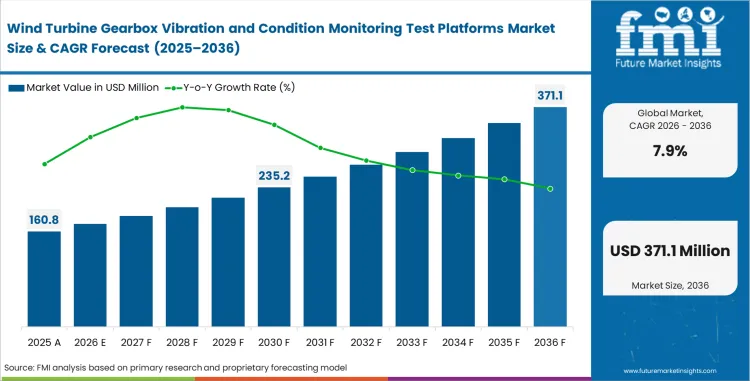
The wind turbine gearbox vibration and condition monitoring test platforms market crossed a valuation of USD 149.0 million in 2025 and is estimated to reach USD 160.8 million in 2026. Market value is projected to rise to USD 344.1 million by 2036, reflecting a 7.9% CAGR over 2026 to 2036. Demand is rising because operators need earlier warning before gearbox faults turn into crane-heavy repairs, long outages, and lost generation. That requirement is gaining importance as delayed fault detection carries a heavier cost exposure through crane deployment, lost generation, and longer service turnaround.
Summary of Wind Turbine Gearbox Vibration and Condition Monitoring Test Platforms Market
- The market is forecast to reach USD 344.1 million by 2036.
- The market is expected to expand at a 7.9% CAGR from 2026 to 2036.
- The market was valued at USD 149.0 million in 2025.
- Market value is estimated at USD 160.8 million in 2026.
- The forecast period reflects an incremental opportunity of USD 183.3 million.
- Demand is being shaped by the need to identify gearbox faults earlier, before they develop into crane-intensive repairs, prolonged outages, and higher lost-generation costs.
- Vibration-based platforms remain the core commercial method, while online systems continue to gain preference as fleets become more dispersed and service windows tighten.
- ONYX Insight, SKF, Schaeffler, Baker Hughes, and Bruel & Kjaer Vibro are among the companies referenced in the market landscape.
Key Takeaways, Market Size, and Forecast
- Wind Turbine Gearbox Vibration and Condition Monitoring Test Platforms Market is expected to advance from USD 160.8 million in 2026 to USD 344.1 million by 2036, at a CAGR of 7.9%.
- The wind turbine gearbox vibration and condition monitoring test platforms market was valued at USD 149.0 million in 2025.
- By 2036, the Wind Turbine Gearbox Vibration and Condition Monitoring Test Platforms Market is expected to total USD 344.1 million.
- The market is forecast to register a CAGR of 7.9% from 2026 to 2036.
- The market is projected to create an incremental opportunity of USD 183.3 million.
- In 2026, Vibration is expected to account for 39.0% of the monitoring method segment.
- India (9.4%) and China (8.7%) are two of the fastest growing markets.
- If you want, I can convert the same set into an even tighter copy-ready style with identical line breaks for direct pasting into your draft.
Wind Turbine Gearbox Vibration and Condition Monitoring Test Platforms Market key takeaways
| Parameter | Details |
|---|---|
| Market value (2026) | USD 160.8 million |
| Forecast value (2036) | USD 344.1 million |
| CAGR (2026 to 2036) | 7.9% |
| Estimated market value (2025) | USD 149.0 million |
| Incremental opportunity | USD 183.3 million |
| Leading monitoring method | Vibration |
| Leading platform type | Online systems |
| Leading component focus | Gearbox |
| Leading turbine location | Onshore |
| Leading turbine rating | 3-5 MW |
| Leading installation mode | Retrofit |
| Leading end user | Asset owners |
| Fastest-growing country | India |
| Key supplier brands referenced in market landscape | ONYX Insight, SKF, Schaeffler, Baker Hughes |
Operators are moving away from failure confirmation and toward earlier intervention, because once gearbox distress becomes operationally obvious, the range of lower-cost maintenance options usually narrows. They are using monitoring systems earlier to plan maintenance before damage spreads. Asset owners are moving spending toward platforms that can support day-to-day reliability planning because late-stage failures now carry a much higher operating penalty. Buyers increasingly evaluate these platforms across three linked criteria: diagnostic confidence, software usability, and post-alert service support. That shift is moving competition away from sensor hardware alone and toward platforms that fit real maintenance workflows. The commercial value of monitoring depends less on whether a platform can generate alerts and more on whether it can generate actionable alerts early enough to guide intervention timing without creating repeated false positives that drain technician time and undermine system trust.
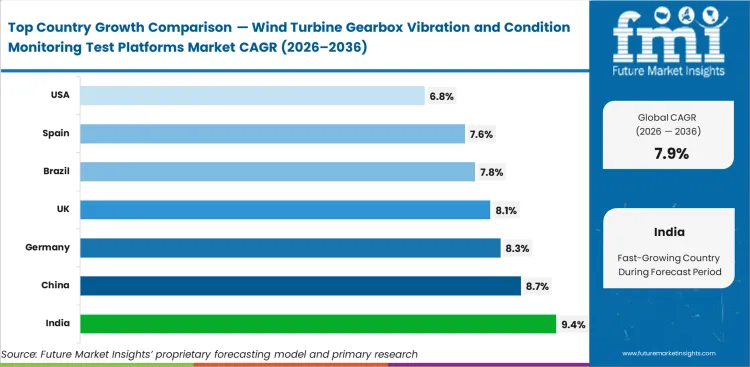
India is expected to register 9.4% CAGR in this market through 2036, supported by new wind additions and rising reliability requirements across expanding fleets. China is projected to grow at 8.7% CAGR, while Germany is likely to record 8.3% CAGR as repowering activity and operating-life management keep monitoring demand firm. The United Kingdom is anticipated to post 8.1% CAGR, followed by Brazil at 7.8% CAGR and Spain at 7.6% CAGR, where uptime pressure continues to support monitoring investment. Market growth in the United States is estimated at 6.8% CAGR over the forecast period. Demand also rises with broader vibration monitoring adoption, although wind operators continue to judge platform value mainly through gearbox relevance, fault clarity, and service usefulness rather than through generic plant-monitoring positioning.
Data Fusion Is Beating Standalone Vibration
Buyers increasingly ask whether traditional vibration monitoring is still enough for gearbox risk. The evidence suggests it is not. A 2024 real-world case study found that standard diagnostic techniques failed to detect a severe planetary-stage gearbox fault in time to prevent prolonged downtime, while a workflow combining industrial SCADA and vibration data detected the issue weeks earlier and identified the faulty component. That changes what qualifies as a competitive test platform. The commercial requirement is shifting from signal capture to signal interpretation across data layers. Vendors that still position vibration as a self-contained answer risk being pushed into commodity hardware territory. The stronger proposition is a platform that combines vibration, operating context, fault classification, and maintenance workflow logic, because owners increasingly want fewer false alarms, earlier warnings, and more confidence in intervention timing.
Segmental Analysis
Key Facts About Segments
- Vibration is projected to account for 39.0% share by monitoring method in 2026, supported by its stronger ability to detect bearing and gear stress before visible output loss appears.
- Online systems are expected to contribute 46.0% share by platform type in 2026, as operators increasingly prefer continuous remote monitoring across wider turbine fleets.
- Gearbox is likely to hold 44.0% share by component focus in 2026 because it remains one of the most expensive and operationally disruptive drivetrain components to repair.
- Onshore is estimated to represent 72.0% share by turbine location in 2026, reflecting the much broader installed base across land-based wind fleets.
- The 3-5 MW category is projected to account for 34.0% share by turbine rating in 2026, as this band aligns well with utility-scale fleet coverage and repeatable service needs.
- Retrofit is expected to capture 57.0% share by installation mode in 2026, as most demand continues to come from turbines already in operation and moving deeper into age-related maintenance cycles.
- Asset Owners are likely to contribute 48.0% share by end user in 2026 because they carry the direct cost of downtime, lost generation, and repair planning.
Wind Turbine Gearbox Vibration and Condition Monitoring Test Platforms Market Analysis by Monitoring Method
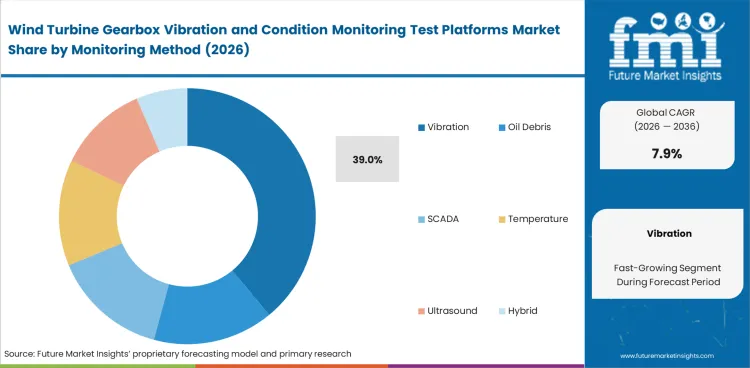
Vibration is expected to account for 39.0% share in 2026 within the monitoring-method segment. Gearbox faults rarely wait for a convenient inspection window, so owners still favor methods that can reveal mechanical stress before turbine output shows an obvious decline. That preference comes from the way vibration stays close to bearing looseness, imbalance, and gear-mesh change, which makes it useful as an early warning signal rather than a late confirmation tool. Oil debris, temperature, and SCADA inputs still matter, but they usually create more value when they strengthen fault confidence around an emerging issue rather than serving as the primary trigger for gearbox intervention. Buyers that choose a weaker primary method often end up diagnosing the problem later than they should, and that delay can turn a manageable stop into a heavier repair plan around power transmission gearbox risk. Segment value depends on whether the method gives operators enough clarity early enough to narrow down the maintenance decision before damage spreads through the drivetrain.
- Early signal clarity: Vibration gives a faster read on rotating stress than methods that wait for debris, heat change, or visible output loss.
- Closer bearing relevance: Mechanical faults become easier to sort when the method stays tied to the motion of the gearbox itself.
- Better alert timing: Earlier diagnosis preserves repair options and lowers the chance that a service stop becomes a longer outage.
Wind Turbine Gearbox Vibration and Condition Monitoring Test Platforms Market Analysis by Platform Type
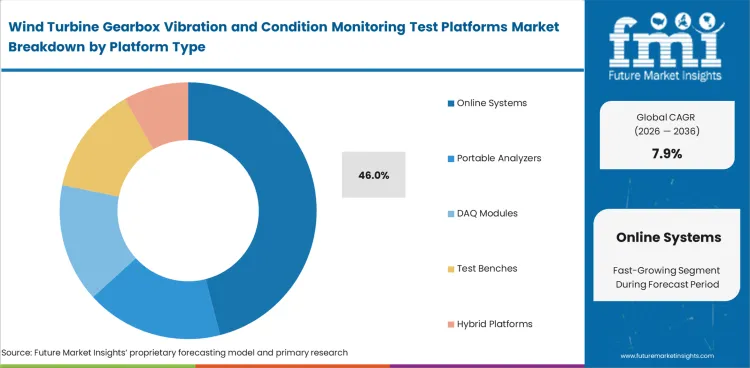
Continuous fleet visibility becomes more important once turbines are spread across harder-to-reach sites, and service windows grow tighter. Online systems lead because they reduce dependence on technician visits and help operators act faster across dispersed fleets. In 2026, online systems are expected to account for 46.0% share within platform type because that always-on approach fits the way geographically dispersed fleets are managed. Portable tools still matter for follow-up checks and fault confirmation, while benches and data-acquisition modules support validation around service events. Fixed systems also make it easier to compare trend changes across turbines rather than treating each event as an isolated case. Platform choice is usually a trade-off between broader continuous visibility and lower upfront commitment. Online systems suit fleets that need faster cross-site response, while periodic tools remain relevant where buyers still want proof of diagnostic value before wider rollout. Segment value depends on how effectively the chosen platform reduces blind time between condition change and maintenance action.
- Continuous fleet watch: Online systems suit operators that need regular alerts without depending on repeated site visits.
- Stronger site coverage: Permanent monitoring makes cross-turbine comparison easier within the same operating period.
- Lower crew dependence: Portable checks still help, but they rely more heavily on travel time and technician's availability.
Wind Turbine Gearbox Vibration and Condition Monitoring Test Platforms Market Analysis by Component Focus
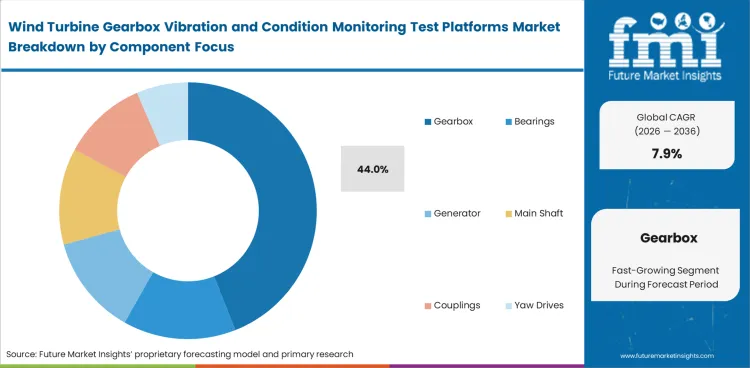
Repair budgets tighten fastest when gearbox wear moves from early degradation into visible damage, which is why most monitoring decisions still center on the part of the drivetrain that is hardest to replace. Bearings, generators, and main shafts remain relevant in the diagnostic picture, yet the gearbox usually determines the urgency behind condition-monitoring spend because downtime, crane use, and spare-part lead times all concentrate there. Gearbox is projected to hold 44.0% share in 2026 because it remains one of the costliest and most disruptive drivetrain components to repair across geared fleets. Sensor layout follows the same logic, as buyers want cleaner readings near the most likely fault zone instead of scattering instruments everywhere with limited diagnostic discipline. Poor component focus can blur the source of the problem and weaken the value of each vibration sensor installed in the nacelle. Segment value rests on whether the monitoring setup puts the first and clearest answer near the component that drives the heaviest maintenance consequence.
- Higher repair exposure: Gearbox-centered monitoring reflects where heavy repair costs and longer downtime usually sit.
- Clearer inspection burden: Broad nacelle coverage sounds attractive, but buyers still want the first answer near the likely fault.
- Faster fleet judgment: Stronger component focus improves how quickly crews decide whether a stop can safely wait.
Wind Turbine Gearbox Vibration and Condition Monitoring Test Platforms Market Analysis by Turbine Location
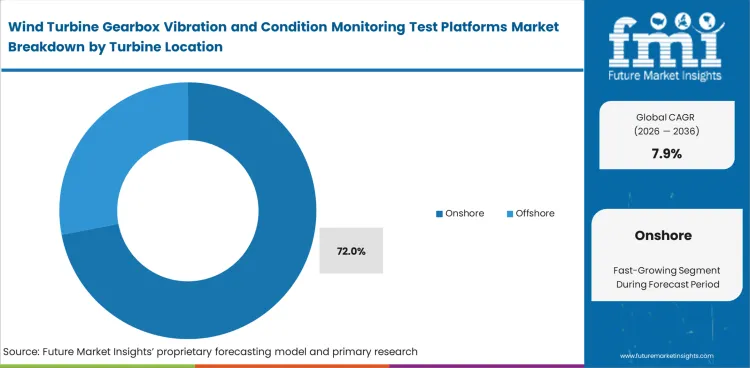
Location changes monitoring economics because access, fleet size, and service penalty do not look the same across land-based and offshore turbines. Onshore owners usually balance monitoring depth against the scale of the installed fleet, while offshore owners place more weight on avoiding return visits, weather delays, and heavier logistics. Offshore demand is not minor, but the broader field opportunity still sits with land-based assets because the installed base is much larger across more regions. Onshore is likely to represent 72.0% share of turbine location in 2026 for that reason. Onshore leads by installed base, but offshore often justifies higher monitoring spend per turbine because access delays, vessel use, and repair logistics raise the cost of a late fault call. Similar installed-base logic can also be seen in small wind turbine activity, where demand spread often follows fleet reach rather than per-unit technical intensity. Segment value depends on how well suppliers balance large-scale onshore opportunities against the higher service burden attached to offshore assets.
- Larger installed base: Onshore volume keeps its lead because far more turbines are operating across more geographies.
- Heavier offshore penalty: Each missed warning becomes more painful offshore because access takes longer to arrange.
- Different site economics: Location changes how much value an owner places on continuous monitoring and early alerts.
Wind Turbine Gearbox Vibration and Condition Monitoring Test Platforms Market Analysis by Turbine Rating
Utility-scale turbines in the mid-capacity band remain the practical center of service demand because they occupy a large share of the existing geared fleet and create enough commonality to support broader platform use. Buyers in this rating range usually want monitoring systems that match common operating patterns instead of turning every deployment into a custom engineering exercise. Smaller machines still create demand, but the platform value per unit is often lower and the monitoring case is harder to justify at the same depth. Larger turbines can require more tailored monitoring logic, more site-specific analysis, and different service planning. That is why 3-5 MW is expected to account for 34.0% share of turbine rating in 2026. Choices in this band also mirror the service economics seen across gearbox and gear motors applications, where standardization improves equipment fit and maintenance planning. Segment value comes from sitting in the rating class where fleet coverage, repeatability, and service practicality align most clearly.
- Stronger utility-scale fit: Mid-range turbines carry a broad share of real fleet service activity across geared installations.
- Higher service commonality: Common rating bands make platform standardization easier across sites and maintenance teams.
- Clearer upgrade timing: Very large units often require more customized monitoring logic and more tailored service plans.
Wind Turbine Gearbox Vibration and Condition Monitoring Test Platforms Market Analysis by Installation Mode
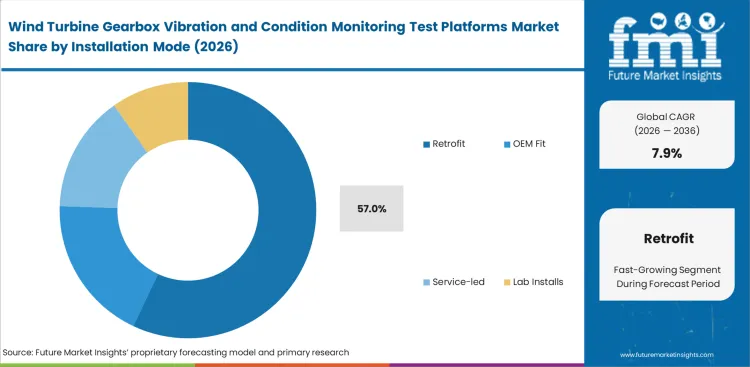
Most spending in this market follows turbines that are already running, already aging, and already creating questions around the next phase of maintenance. OEM-linked installations still matter for new orders, but the strongest practical demand comes from fleets that were commissioned before today’s expectations around continuous condition visibility became common. Retrofit projects also spread more quickly when one site proves that alert quality is good enough to support wider rollout across similar turbines. Owners usually need that proof before budgets loosen across the rest of the fleet, especially when monitoring spend must compete with other life-extension priorities. That adoption pattern increasingly resembles the operating logic behind AI-driven predictive maintenance, though wind buyers remain more demanding about field usefulness and fault relevance. Retrofit is expected to hold 57.0% share in 2026 because most demand comes from turbines already in service, especially those facing age-related wear, warranty exit, and tighter maintenance planning. Segment value depends on whether retrofit programs can convert older turbines into more predictable maintenance assets without forcing operators into excessive implementation complexity.
- Stronger existing-fleet focus: Retrofit demand follows turbines already facing age, warranty, and life-extension questions.
- Lower downtime exposure: Older units create a clearer case for earlier warning before a larger gearbox repair is needed.
- Better pilot-to-fleet proof: One successful retrofit site can reduce resistance across the rest of the operating fleet.
Wind Turbine Gearbox Vibration and Condition Monitoring Test Platforms Market Analysis by End User
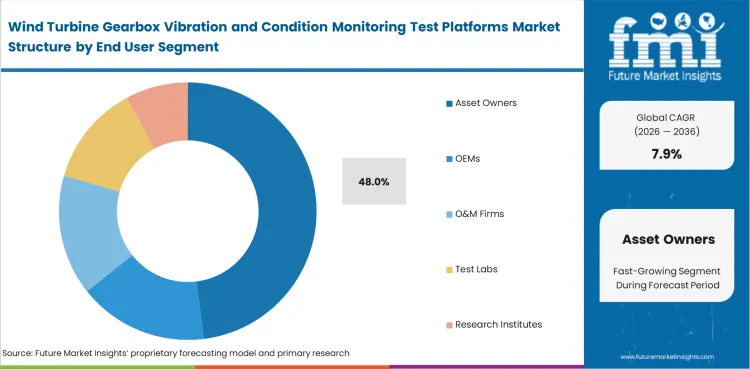
End-user leadership in this market stays with the party that carries the direct cost of downtime, lost generation, delayed repair, and crane mobilization over the turbine life cycle. OEMs, O&M firms, and test labs all shape specification and influence platform selection, yet final spending power usually remains with the owner because availability risk sits there most heavily. That keeps the buying process practical, since suppliers must explain how alerts will improve maintenance timing rather than merely present a stronger dashboard or more technical analytics. Service firms can support diagnosis, but the commercial trigger still comes from the side paying for lost output. Temporary approaches remain relevant where buyers want narrower fault checks before larger commitments are made, especially through a handheld vibration analyzer used for confirmation work. Asset owners are expected to account for 48.0% share in 2026 because they carry the direct cost of lost generation, repair delay, and outage planning. Segment value therefore depends on how directly the platform helps the main user convert diagnosis into service action instead of leaving the insight parked in review reports.
- Direct owner exposure: Asset owners feel the full cost of lost availability and delayed repair action first.
- Stronger budget control: Final platform choice usually follows the party paying for outage risk across the fleet.
- Practical diagnostic support: Service firms and labs influence decisions, but owner economics still shape the purchase outcome.
Wind Turbine Gearbox Vibration and Condition Monitoring Test Platforms Market Drivers, Restraints, and Opportunities
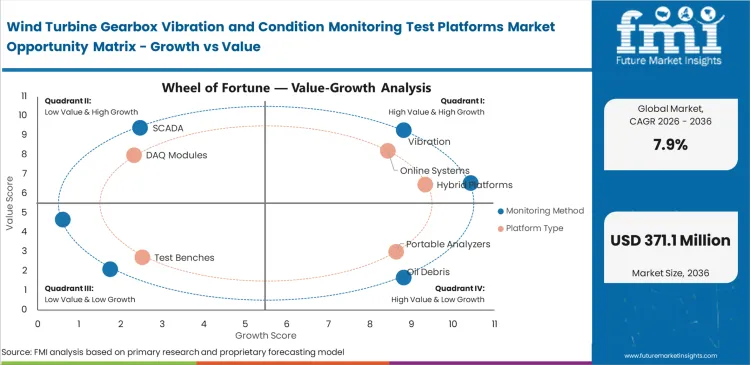
Gearbox repair exposure keeps this market moving because owners need a clearer picture of fault timing before maintenance windows close. Monitoring budgets rise fastest when a fleet has started to age and when life-extension decisions can no longer wait for manual checks alone. Wind portfolios are also borrowing ideas from adjacent reliability categories such as solar farm predictive maintenance monitoring, where earlier warning and better maintenance timing have become easier to justify at portfolio level. Demand grows here because the cost of waiting is easy to understand. A late gearbox call usually means a heavier service event and a weaker planning position. Rollout slows when operators cannot connect alerts to clear maintenance action, especially across fleets with different turbine vintages and control systems.
Mixed turbine fleets remain a practical adoption barrier because older controls, uneven sensor histories, and inconsistent site-level data structures make cross-fleet alerts harder to compare, validate, and operationalize. Older control layouts, uneven sensor history, and inconsistent naming across sites make data harder to compare, which weakens trust in the alert before the maintenance side has time to act on it. Systems also become harder to roll out when software must fit several turbine vintages at once and when data acquisition hardware choices differ across sites. Suppliers can reduce part of that burden, though integration still takes patience and internal agreement around how alerts will be handled after they appear. Sourcing decisions are rarely based on sensor hardware alone. Buyers also assess alarm accuracy, software clarity, integration effort, and engineering support before approving fleet-wide rollout.
Opportunities in the Wind Turbine Gearbox Vibration and Condition Monitoring Test Platforms Market
- Offshore retrofit programs: Harder access and longer repair lead times give offshore owners a stronger reason to install permanent monitoring before the next gearbox issue turns into a larger outage.
- Hybrid fault reading: Buyers that combine vibration with oil, SCADA, or temperature signals can improve confidence around diagnosis and reduce weak service calls.
- Validation-linked services: Test and inspection work tied to non-destructive testing equipment can help suppliers move from hardware sales into steadier diagnostic support around gearbox condition.
Regional Analysis
Key Facts About Country
- India is identified as the fastest-growing market among the countries highlighted, with a projected 9.4% CAGR through 2036, supported by new wind additions and broader fleet-reliability requirements.
- China follows at 8.7%, with growth supported by its large operating wind base and continued project flow across major wind regions.
- Germany records 8.3%, keeping it among the stronger European markets as repowering activity and aging onshore fleets sustain monitoring demand.
- The United Kingdom is expected to expand at 8.1%, where offshore service exposure and higher delay costs keep early-fault visibility commercially important.
- Brazil posts 7.8%, reflecting continued wind expansion alongside a rising need to protect turbine uptime across more dispersed fleets.
- Spain stands at 7.6%, with demand supported by selective retrofit activity across mature onshore assets.
- The United States records 6.8%, remaining commercially significant due to its large installed fleet, even though growth is slower than in the faster-building wind markets.
Regional demand does not move for one reason alone. Installed fleet size, new wind additions, repowering activity, and service difficulty all shape how quickly operators decide a gearbox monitoring platform is worth the spend.
.webp "Top Country Growth Comparison Wind Turbine Gearbox Vibration And Condition Monitoring Test Platforms Market Cagr (2026 2036)")
| Country | CAGR (2026 to 2036) |
|---|---|
| India | 9.4% |
| China | 8.7% |
| Germany | 8.3% |
| United Kingdom | 8.1% |
| Brazil | 7.8% |
| Spain | 7.6% |
| United States | 6.8% |
Source: Future Market Insights (FMI) analysis, based on proprietary forecasting model and primary research
Asia Pacific Wind Turbine Gearbox Vibration and Condition Monitoring Test Platforms Market Analysis
Asia Pacific keeps a strong position because it combines fresh wind additions with a large and varied installed base that needs better reliability control as fleets spread across wider territory. Service decisions here are shaped by scale first. Operators often need tools that can work across many turbines without forcing a separate operating routine at each site. Rapid buildout also means newer projects and older geared units can sit in the same portfolio, which raises the value of a clearer monitoring logic. FMI analysis also sees this region benefiting from adjacent digital maintenance work in structural health monitoring, where remote visibility and cleaner data use have become part of wider asset planning. Growth stays fast because expansion and maintenance pressure arrive together rather than in separate phases.
- India: Fleet additions keep expanding the service base in India, and that growth makes gearbox visibility harder to ignore once turbines start moving beyond early operating years. Demand for gearbox vibration and condition monitoring platforms in India is expected to rise at a CAGR of 9.4% from 2026 to 2036 because owners need earlier warning across larger wind portfolios and tighter maintenance planning. Sites in Tamil Nadu, Gujarat, and Rajasthan continue to matter because installed capacity and service activity stay concentrated there. Budget discipline still shapes buying behavior, so suppliers that explain alarm quality and service use in simple terms are easier to place. India is growing quickly, though adoption will still depend on whether monitoring can show a clear maintenance benefit rather than just more data.
- China: China carries a wide wind operating base and a heavy flow of new projects, which gives this category more room to grow without depending on a single demand pattern. Owners also tend to evaluate monitoring through fleet management and service efficiency rather than through hardware novelty. Gearbox monitoring demand in China is forecast to post a CAGR of 8.7% during the forecast period, supported by both new turbine deployment and the need to manage repair risk across a very large operating footprint. Inner Mongolia, Xinjiang, and coastal wind belts keep that pressure visible because scale makes each delay harder to absorb. Growth remains strong, though local success will still depend on how well suppliers fit software, sensors, and service support into everyday operations.
FMI's report also covers Japan, South Korea, Australia, and several Southeast Asian markets within the wider Asia Pacific view. Some of those countries move slower because fleet size is smaller, while others show promise where offshore programs and grid expansion deepen reliability needs.
Europe Wind Turbine Gearbox Vibration and Condition Monitoring Test Platforms Market Analysis
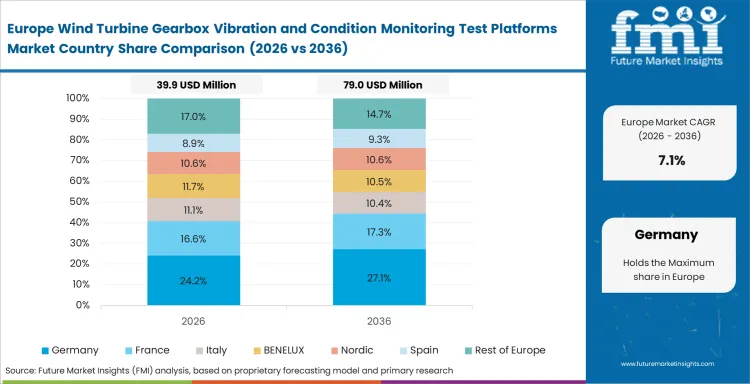
Europe reads differently because a mature fleet, repowering work, and offshore service pressure all push operators to think hard about what older turbines need over the next decade. Many sites are not deciding whether monitoring matters. They are deciding how much depth is worth paying for and which fleets need it first. That keeps the regional market grounded in repair exposure, inspection timing, and life-extension plans rather than simple capacity growth. FMI analysis also sees Europe moving closer to software-led maintenance routines linked to AI predictive maintenance SAAS platforms, though wind buyers still want stronger proof at the gearbox level. Regional growth is healthy because installed assets already create a large service case before new capacity is added.
- Germany: Repowering and long-running onshore fleets keep Germany close to the center of European reliability spending. Demand for gearbox vibration and condition monitoring platforms in Germany is expected to grow at a CAGR of 8.3% from 2026 to 2036, helped by the need to manage aging assets more carefully while newer projects expand in parallel. North German wind corridors and industrial service networks support that demand because they shorten the path from alarm to maintenance action. Buyers usually focus on tools that reduce doubt in the diagnosis, since false calls can waste service time on already busy fleets. Germany remains important because monitoring sits directly inside decisions around asset life and repair timing.
- United Kingdom: Offshore exposure gives the United Kingdom a different cost picture than many other industries in Europe. Owners there feel repair delay more sharply because vessel access, weather windows, and high-value generation all raise the price of a late gearbox call. That is why the demand in the United Kingdom is likely to expand at a CAGR of 8.1% over the forecast period, even without the largest turbine count in Europe. East coast hubs and Scottish waters keep the service case active because offshore operations place more value on dependable alarms than on low sticker price alone. Monitoring demand stays firm where uptime protection carries more weight than a modest saving on platform cost.
- Spain: Mature wind assets across Spain are pushing operators to make more targeted maintenance choices as service budgets come under closer review. Full-scale monitoring is not being deployed across every turbine, yet buyers are spending where stronger fault visibility can reduce the risk of costly gearbox intervention. The market for this segment in Spain is expected to grow at a CAGR of 7.6% over the assessment period. Castile and Leon, Aragon, and Galicia remain central to demand because service work is still concentrated in established wind belts. Spain holds its position on the strength of practical retrofit demand rather than expansion headlines alone.
FMI's report also assesses France, Italy, the Nordics, and other European markets beyond the countries highlighted above. Some show slower platform uptake where fleets are smaller or where owners remain selective about retrofit depth.
America Wind Turbine Gearbox Vibration and Condition Monitoring Test Platforms Market Analysis
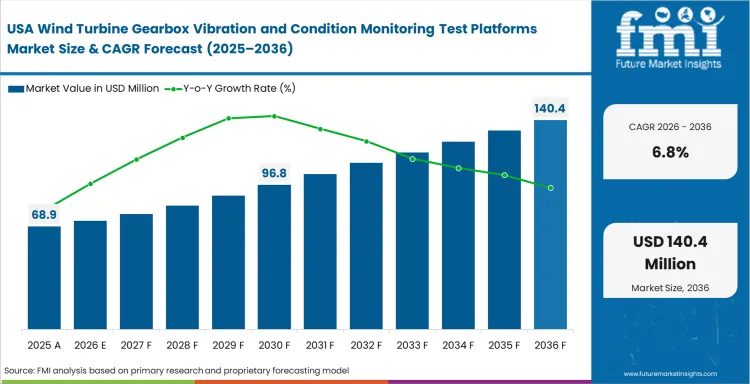
North and Latin America show a wider split between mature fleet management and fresh expansion, which gives suppliers very different sales conversations across the region. United States demand leans on installed-base management, while Brazil still combines ongoing expansion with a growing need for reliability support. Both markets matter, though they move for different reasons and at different speeds. Buyer attention in the Americas also sits close to service practicality, software fit, and maintenance timing rather than to diagnostic novelty alone. Regional growth therefore depends on how well monitoring can fit each country's operating reality rather than on a single regional pattern.
- United States: The United States carries one of the world's largest operating wind fleets, so even moderate percentage growth creates meaningful room for retrofit and platform upgrades. Demand for gearbox vibration and condition monitoring platforms in the United States is expected to rise at a CAGR of 6.8% during the forecast years, with buying decisions tied more to fleet age, service budgets, and repowering priorities than to fresh capacity alone. Texas, the Midwest, and parts of the Great Plains keep the service case visible because scale makes each maintenance delay more noticeable. Growth is slower than in faster-building countries, yet the installed base still gives suppliers a large field to work with. Success in the United States depends on whether monitoring can fit practical maintenance routines across mixed turbine portfolios.
- Brazil: Brazil combines continuing wind expansion with a growing need to protect availability as operating fleets become larger and more spread out. Service planning matters more there each year because distance, site access, and repair coordination can all stretch the cost of a late gearbox call. That operating reality is expected to lift the demand in Brazil at an anticipated CAGR of 7.8% from 2026 to 2036. Northeastern wind corridors remain central because project concentration keeps both new additions and maintenance demand active in the same areas. Brazil looks attractive when suppliers can show that better alerts lead to fewer disruptive service events instead of just more monitoring screens.
FMI's report also reviews Canada, Mexico, Chile, and other markets across the wider Americas. Some stay smaller because fleet scale is limited, while others offer selective openings where expansion is building faster than local reliability practice.
Competitive Aligners for Market Players
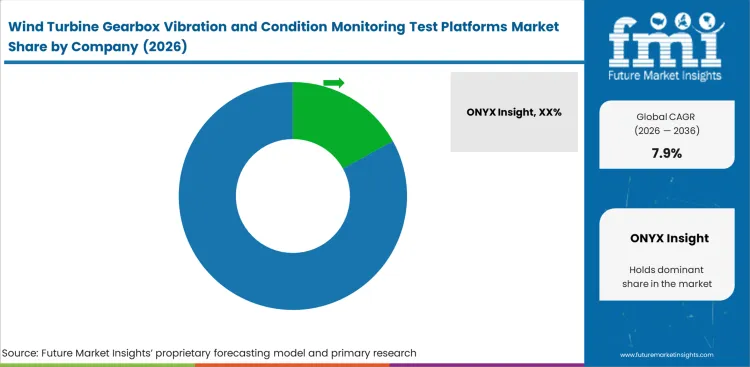
Supplier evaluation within this market is driven more by operating fit than by visibility alone. Consideration typically centers on whether monitoring systems can generate meaningful alarms, deliver software that maintenance teams can interpret with confidence, and provide dependable support once a fault develops in an industrial planetary gearbox. Vendors with strong wind-focused diagnostic orientation, such as ONYX Insight, tend to align well where turbine-specific interpretation is valued. In comparison, organizations such as SKF are more often assessed when alignment with established rotating‑equipment reliability standards is a key priority.
Market credibility develops steadily and is closely linked to alert reliability and the depth of engagement that follows an identified issue. Asset owners remain cautious, as earlier experiences with false alerts or inconsistent follow‑through often shape long-term sourcing preferences. Providers that connect sensing technologies with detailed component understanding, including Schaeffler, are commonly viewed as offering stronger continuity between condition data and service decision-making. In parallel, firms like Baker Hughes may gain preference in environments where condition-monitoring frameworks already extend across a broader set of industrial assets.
Sourcing dynamics remain flexible, as fleet operators rarely rely on one supplier to cover every monitoring layer. Fixed installations, portable diagnostic tools, software analytics, and external services are frequently combined, particularly where confirmation of faults in industrial planetary gearbox systems is required closer to daily maintenance activity. This modular approach helps maintain open competition, even when certain suppliers remain visible across multiple tenders. Participants such as Bruel & Kjaer Vibro and SDT Ultrasound continue to remain relevant in site-level or maintenance-support roles. Competitive intensity is likely to stay moderate through 2036, with supplier success depending more on fit with wind-service workflows than on broad industrial monitoring claims.
Key Players in Wind Turbine Gearbox Vibration and Condition Monitoring Test Platforms Market
- ONYX Insight
- SKF
- Schaeffler
- Baker Hughes
- Bruel & Kjaer Vibro
Scope of the Report
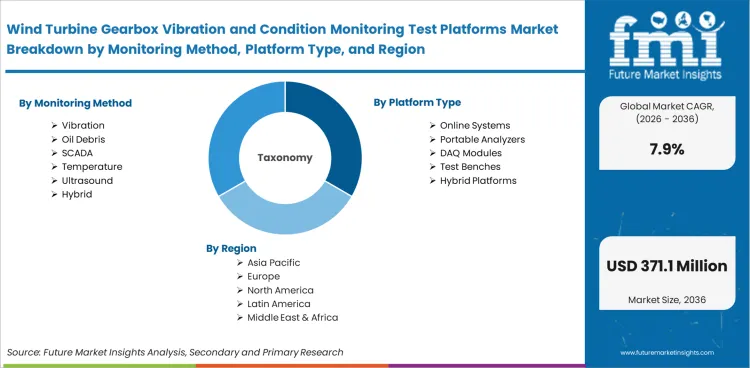
| Metric | Value |
|---|---|
| Quantitative Units | USD 160.8 million to USD 344.1 million, at a CAGR of 7.9% |
| Market Definition | Covers vibration and condition monitoring platforms used to assess wind turbine gearbox health, including fixed and portable test systems linked to diagnostic decision-making. |
| Monitoring Method Segmentation | Vibration, Oil Debris, SCADA, Temperature, Ultrasound, Hybrid |
| Platform Type Segmentation | Online Systems, Portable Analyzers, DAQ Modules, Test Benches, Hybrid Platforms |
| Component Focus Segmentation | Gearbox, Bearings, Generator, Main Shaft, Couplings, Yaw Drives |
| Turbine Location Segmentation | Onshore, Offshore |
| Turbine Rating Segmentation | Up to 3 MW, 3–5 MW, 5–8 MW, Above 8 MW |
| Installation Mode Segmentation | Retrofit, OEM Fit, Service-led, Lab Installs |
| End User Segmentation | Asset Owners, OEMs, O&M Firms, Test Labs, Research Institutes |
| Regions Covered | Asia Pacific, Europe, Americas, and 40 plus countries |
| Countries Covered | India, China, Germany, United Kingdom, Brazil, Spain, United States, and 40 plus countries |
| Key Companies Profiled | ONYX Insight, SKF, Schaeffler, Baker Hughes, Bruel & Kjaer Vibro |
| Forecast Period | 2026 to 2036 |
| Approach | Built on fleet-based demand logic, segment-level share assessment, country growth modelling, and primary research with reliability-focused interpretation. |
Source: Future Market Insights (FMI) analysis, based on proprietary forecasting model and primary research
Wind Turbine Gearbox Vibration and Condition Monitoring Test Platforms Market Analysis by Segments
Monitoring Method:
- Vibration
- Oil Debris
- SCADA
- Temperature
- Ultrasound
- Hybrid
Platform Type:
- Online Systems
- Portable Analyzers
- DAQ Modules
- Test Benches
- Hybrid Platforms
Component Focus:
- Gearbox
- Bearings
- Generator
- Main Shaft
- Couplings
- Yaw Drives
Turbine Location:
- Onshore
- Offshore
Turbine Rating:
- Up to 3 MW
- 3-5 MW
- 5-8 MW
- Above 8 MW
Installation Mode:
- Retrofit
- OEM Fit
- Service-led
- Lab Installs
End User:
- Asset Owners
- OEMs
- O&M Firms
- Test Labs
- Research Institutes
Region:
- North America
- United States
- Canada
- Europe
- Germany
- United Kingdom
- France
- Italy
- Spain
- Asia Pacific
- China
- Japan
- South Korea
- Taiwan
- Singapore
- Latin America
- Brazil
- Mexico
- Argentina
- Middle East & Africa
- GCC Countries
- South Africa
Bibliography
- National Renewable Energy Laboratory. (2024). Distributed Wind Energy Monitoring Best Practices. NREL.
- WindEurope. (2026). Wind energy in Europe: 2025 Statistics and the outlook for 2026-2030.
- Mostafavi, A., & Friedmann, A. (2024). Wind turbine condition monitoring dataset of Fraunhofer LBF.
- Wang, S., Chen, B., Zhang, J., & Vidal, Y. (2026). Recent advances in wind turbine condition monitoring using SCADA data: A review.
- Zhu, Y., Zhang, C., Wang, J., & others. (2026). Condition monitoring of wind turbine gearbox based on adaptive learning with temporal distribution characterization and matching.
This bibliography is provided for reader reference. The full FMI report contains the complete reference list with primary source documentation.
This Report Addresses
- Market intelligence to support strategy decisions across gearbox monitoring platforms, vibration systems, and wind drivetrain diagnostics.
- Market size estimation and ten-year forecasts from 2026 to 2036, supported by fleet-based demand logic and primary research.
- Growth opportunity mapping across monitoring method, platform type, component focus, turbine location, turbine rating, installation mode, and end user.
- Segment and regional forecasts covering retrofit programs, online systems, gearbox-led monitoring priorities, and country-level growth differences.
- Competition assessment across software usability, alert quality, field response, engineering support, and service practicality.
- Technology and workflow analysis covering vibration, SCADA, oil debris, portable diagnostics, fixed monitoring, and test-bench validation.
- Market access analysis across mature wind fleets, offshore service exposure, repowering activity, and life-extension planning.
- Report delivery is designed for executive planning, commercial benchmarking, product strategy, and reliability-focused investment review.
Frequently Asked Questions
How much is the wind turbine gearbox vibration and condition monitoring test platforms market worth in 2026?
Industry value is expected to reach USD 160.8 million in 2026.
Where does the wind turbine gearbox vibration and condition monitoring test platforms market stand by 2036?
Total market value is projected to reach USD 344.1 million by 2036
What pace of growth is projected for the market through 2036?
Demand is expected to rise at a 7.90% CAGR from 2026 to 2036.
Which monitoring method sets the commercial base of demand in the market?
Vibration leads Monitoring Method and is expected to account for 39.0% share in 2026.
Which platform type attracts the largest share of spending in the market?
Online Systems lead Platform Type and are projected to represent 46.0% share in 2026.
Which component focus anchors the wind turbine gearbox vibration and condition monitoring test platforms market?
Gearbox leads Component Focus and is likely to contribute 44.0% share in 2026.
Why are gearbox-focused platforms seeing sustained uptake across this market?
Earlier warning on bearing and gear stress helps owners avoid repair delays and protect turbine availability.
What slows wider rollout across operating wind fleets in this market?
Mixed turbine fleets and uneven signal quality reduce trust in alerts and make rollout harder across older assets.
Which country is forecast to expand fastest in the wind turbine gearbox vibration and condition monitoring test platforms market?
India leads the country outlook with a forecast CAGR of 9.4% through 2036.
Why does vibration remain central to the wind turbine gearbox monitoring platforms market?
Vibration stays central because it reads bearing and gear distress earlier than many supporting methods used around the gearbox.
Why does retrofit demand stay ahead of OEM-fit demand in this market?
Retrofit demand leads because owners need better condition visibility on turbines already in service across large installed fleets.
How does offshore repair exposure change platform selection in the market?
Offshore exposure raises the cost of delay and makes continuous monitoring easier to justify on operating turbines.
Why do fleet operators lean toward online systems in this market?
Online systems appeal because they support remote oversight across many sites without waiting for scheduled field checks.
Online systems appeal because they support remote oversight across many sites without waiting for scheduled field checks.
China remains important because a large operating base and steady project flow keep monitoring demand commercially meaningful.
What keeps Germany commercially relevant in this space?
Germany stays relevant because repowering activity and mature onshore fleets keep gearbox reliability high on the operating agenda.
Why does the United Kingdom hold a strong growth position in this market?
United Kingdom demand stays firm because offshore service timing and access pressure raise the value of earlier fault visibility.
What keeps USA demand steady even at a lower growth rate?
USA demand is shaped by installed-base upkeep, repowering plans, and retrofit needs across mixed turbine fleets.
Why does Brazil stay important for future demand?
Brazil benefits from ongoing wind expansion and a growing need to protect uptime across wider operating fleets.
What keeps Spain in the forecast mix for this market?
Spain remains relevant because mature onshore assets are creating steady retrofit demand tied to selective maintenance planning.
What falls inside the scope of the wind turbine gearbox monitoring platforms market report?
Scope includes gearbox vibration and condition monitoring platforms, field and lab systems, data-acquisition layers, and diagnostic software.
What sits outside the scope of this report?
Generic plant-wide monitoring tools, non-wind machinery systems, and broad asset software without gearbox-specific test purposes are excluded.
Preview the report firsthand - request a free sample
Get SampleGet the brochure for pricing and purchase details.
Get PDFTable of Content
- Executive Summary
- Global Market Outlook
- Demand-side Trends
- Supply-side Trends
- Technology Roadmap Analysis
- Analysis and Recommendations
- Market Overview
- Market Coverage / Taxonomy
- Market Definition / Scope / Limitations
- Research Methodology
- Chapter Orientation
- Analytical Lens and Working Hypotheses
- Market Structure, Signals, and Trend Drivers
- Benchmarking and Cross-market Comparability
- Market Sizing, Forecasting, and Opportunity Mapping
- Research Design and Evidence Framework
- Desk Research Programme (Secondary Evidence)
- Company Annual and Sustainability Reports
- Peer-reviewed Journals and Academic Literature
- Corporate Websites, Product Literature, and Technical Notes
- Earnings Decks and Investor Briefings
- Statutory Filings and Regulatory Disclosures
- Technical White Papers and Standards Notes
- Trade Journals, Industry Magazines, and Analyst Briefs
- Conference Proceedings, Webinars, and Seminar Materials
- Government Statistics Portals and Public Data Releases
- Press Releases and Reputable Media Coverage
- Specialist Newsletters and Curated Briefings
- Sector Databases and Reference Repositories
- FMI Internal Proprietary Databases and Historical Market Datasets
- Subscription Datasets and Paid Sources
- Social Channels, Communities, and Digital Listening Inputs
- Additional Desk Sources
- Expert Input and Fieldwork (Primary Evidence)
- Primary Modes
- Qualitative Interviews and Expert Elicitation
- Quantitative Surveys and Structured Data Capture
- Blended Approach
- Why Primary Evidence is Used
- Field Techniques
- Interviews
- Surveys
- Focus Groups
- Observational and In-context Research
- Social and Community Interactions
- Stakeholder Universe Engaged
- C-suite Leaders
- Board Members
- Presidents and Vice Presidents
- R&D and Innovation Heads
- Technical Specialists
- Domain Subject-matter Experts
- Scientists
- Physicians and Other Healthcare Professionals
- Governance, Ethics, and Data Stewardship
- Research Ethics
- Data Integrity and Handling
- Primary Modes
- Tooling, Models, and Reference Databases
- Desk Research Programme (Secondary Evidence)
- Data Engineering and Model Build
- Data Acquisition and Ingestion
- Cleaning, Normalisation, and Verification
- Synthesis, Triangulation, and Analysis
- Quality Assurance and Audit Trail
- Market Background
- Market Dynamics
- Drivers
- Restraints
- Opportunity
- Trends
- Scenario Forecast
- Demand in Optimistic Scenario
- Demand in Likely Scenario
- Demand in Conservative Scenario
- Opportunity Map Analysis
- Product Life Cycle Analysis
- Supply Chain Analysis
- Investment Feasibility Matrix
- Value Chain Analysis
- PESTLE and Porter’s Analysis
- Regulatory Landscape
- Regional Parent Market Outlook
- Production and Consumption Statistics
- Import and Export Statistics
- Market Dynamics
- Global Market Analysis 2021 to 2025 and Forecast, 2026 to 2036
- Historical Market Size Value (USD Million) Analysis, 2021 to 2025
- Current and Future Market Size Value (USD Million) Projections, 2026 to 2036
- Y-o-Y Growth Trend Analysis
- Absolute $ Opportunity Analysis
- Global Market Pricing Analysis 2021 to 2025 and Forecast 2026 to 2036
- Global Market Analysis 2021 to 2025 and Forecast 2026 to 2036, By Monitoring Method
- Introduction / Key Findings
- Historical Market Size Value (USD Million) Analysis By Monitoring Method , 2021 to 2025
- Current and Future Market Size Value (USD Million) Analysis and Forecast By Monitoring Method , 2026 to 2036
- Vibration
- Oil Debris
- SCADA
- Temperature
- Ultrasound
- Hybrid
- Vibration
- Y-o-Y Growth Trend Analysis By Monitoring Method , 2021 to 2025
- Absolute $ Opportunity Analysis By Monitoring Method , 2026 to 2036
- Global Market Analysis 2021 to 2025 and Forecast 2026 to 2036, By Platform Type
- Introduction / Key Findings
- Historical Market Size Value (USD Million) Analysis By Platform Type, 2021 to 2025
- Current and Future Market Size Value (USD Million) Analysis and Forecast By Platform Type, 2026 to 2036
- Online Systems
- Portable Analyzers
- DAQ Modules
- Test Benches
- Hybrid Platforms
- Online Systems
- Y-o-Y Growth Trend Analysis By Platform Type, 2021 to 2025
- Absolute $ Opportunity Analysis By Platform Type, 2026 to 2036
- Global Market Analysis 2021 to 2025 and Forecast 2026 to 2036, By Component Focus
- Introduction / Key Findings
- Historical Market Size Value (USD Million) Analysis By Component Focus, 2021 to 2025
- Current and Future Market Size Value (USD Million) Analysis and Forecast By Component Focus, 2026 to 2036
- Gearbox
- Bearings
- Generator
- Main Shaft
- Couplings
- Yaw Drives
- Gearbox
- Y-o-Y Growth Trend Analysis By Component Focus, 2021 to 2025
- Absolute $ Opportunity Analysis By Component Focus, 2026 to 2036
- Global Market Analysis 2021 to 2025 and Forecast 2026 to 2036, By Turbine Location
- Introduction / Key Findings
- Historical Market Size Value (USD Million) Analysis By Turbine Location, 2021 to 2025
- Current and Future Market Size Value (USD Million) Analysis and Forecast By Turbine Location, 2026 to 2036
- Onshore
- Offshore
- Onshore
- Y-o-Y Growth Trend Analysis By Turbine Location, 2021 to 2025
- Absolute $ Opportunity Analysis By Turbine Location, 2026 to 2036
- Global Market Analysis 2021 to 2025 and Forecast 2026 to 2036, By Turbine Rating
- Introduction / Key Findings
- Historical Market Size Value (USD Million) Analysis By Turbine Rating, 2021 to 2025
- Current and Future Market Size Value (USD Million) Analysis and Forecast By Turbine Rating, 2026 to 2036
- 3-5 MW
- Up to 3 MW
- 5-8 MW
- Above 8 MW
- 3-5 MW
- Y-o-Y Growth Trend Analysis By Turbine Rating, 2021 to 2025
- Absolute $ Opportunity Analysis By Turbine Rating, 2026 to 2036
- Global Market Analysis 2021 to 2025 and Forecast 2026 to 2036, By Installation Mode
- Introduction / Key Findings
- Historical Market Size Value (USD Million) Analysis By Installation Mode, 2021 to 2025
- Current and Future Market Size Value (USD Million) Analysis and Forecast By Installation Mode, 2026 to 2036
- Retrofit
- OEM Fit
- Service-led
- Lab Installs
- Retrofit
- Y-o-Y Growth Trend Analysis By Installation Mode, 2021 to 2025
- Absolute $ Opportunity Analysis By Installation Mode, 2026 to 2036
- Global Market Analysis 2021 to 2025 and Forecast 2026 to 2036, By End User
- Introduction / Key Findings
- Historical Market Size Value (USD Million) Analysis By End User, 2021 to 2025
- Current and Future Market Size Value (USD Million) Analysis and Forecast By End User, 2026 to 2036
- Asset Owners
- OEMs
- O&M Firms
- Test Labs
- Research Institutes
- Asset Owners
- Y-o-Y Growth Trend Analysis By End User, 2021 to 2025
- Absolute $ Opportunity Analysis By End User, 2026 to 2036
- Global Market Analysis 2021 to 2025 and Forecast 2026 to 2036, By Region
- Introduction
- Historical Market Size Value (USD Million) Analysis By Region, 2021 to 2025
- Current Market Size Value (USD Million) Analysis and Forecast By Region, 2026 to 2036
- North America
- Latin America
- Western Europe
- Eastern Europe
- East Asia
- South Asia and Pacific
- Middle East & Africa
- Market Attractiveness Analysis By Region
- North America Market Analysis 2021 to 2025 and Forecast 2026 to 2036, By Country
- Historical Market Size Value (USD Million) Trend Analysis By Market Taxonomy, 2021 to 2025
- Market Size Value (USD Million) Forecast By Market Taxonomy, 2026 to 2036
- By Country
- USA
- Canada
- Mexico
- By Monitoring Method
- By Platform Type
- By Component Focus
- By Turbine Location
- By Turbine Rating
- By Installation Mode
- By End User
- By Country
- Market Attractiveness Analysis
- By Country
- By Monitoring Method
- By Platform Type
- By Component Focus
- By Turbine Location
- By Turbine Rating
- By Installation Mode
- By End User
- Key Takeaways
- Latin America Market Analysis 2021 to 2025 and Forecast 2026 to 2036, By Country
- Historical Market Size Value (USD Million) Trend Analysis By Market Taxonomy, 2021 to 2025
- Market Size Value (USD Million) Forecast By Market Taxonomy, 2026 to 2036
- By Country
- Brazil
- Chile
- Rest of Latin America
- By Monitoring Method
- By Platform Type
- By Component Focus
- By Turbine Location
- By Turbine Rating
- By Installation Mode
- By End User
- By Country
- Market Attractiveness Analysis
- By Country
- By Monitoring Method
- By Platform Type
- By Component Focus
- By Turbine Location
- By Turbine Rating
- By Installation Mode
- By End User
- Key Takeaways
- Western Europe Market Analysis 2021 to 2025 and Forecast 2026 to 2036, By Country
- Historical Market Size Value (USD Million) Trend Analysis By Market Taxonomy, 2021 to 2025
- Market Size Value (USD Million) Forecast By Market Taxonomy, 2026 to 2036
- By Country
- Germany
- UK
- Italy
- Spain
- France
- Nordic
- BENELUX
- Rest of Western Europe
- By Monitoring Method
- By Platform Type
- By Component Focus
- By Turbine Location
- By Turbine Rating
- By Installation Mode
- By End User
- By Country
- Market Attractiveness Analysis
- By Country
- By Monitoring Method
- By Platform Type
- By Component Focus
- By Turbine Location
- By Turbine Rating
- By Installation Mode
- By End User
- Key Takeaways
- Eastern Europe Market Analysis 2021 to 2025 and Forecast 2026 to 2036, By Country
- Historical Market Size Value (USD Million) Trend Analysis By Market Taxonomy, 2021 to 2025
- Market Size Value (USD Million) Forecast By Market Taxonomy, 2026 to 2036
- By Country
- Russia
- Poland
- Hungary
- Balkan & Baltic
- Rest of Eastern Europe
- By Monitoring Method
- By Platform Type
- By Component Focus
- By Turbine Location
- By Turbine Rating
- By Installation Mode
- By End User
- By Country
- Market Attractiveness Analysis
- By Country
- By Monitoring Method
- By Platform Type
- By Component Focus
- By Turbine Location
- By Turbine Rating
- By Installation Mode
- By End User
- Key Takeaways
- East Asia Market Analysis 2021 to 2025 and Forecast 2026 to 2036, By Country
- Historical Market Size Value (USD Million) Trend Analysis By Market Taxonomy, 2021 to 2025
- Market Size Value (USD Million) Forecast By Market Taxonomy, 2026 to 2036
- By Country
- China
- Japan
- South Korea
- By Monitoring Method
- By Platform Type
- By Component Focus
- By Turbine Location
- By Turbine Rating
- By Installation Mode
- By End User
- By Country
- Market Attractiveness Analysis
- By Country
- By Monitoring Method
- By Platform Type
- By Component Focus
- By Turbine Location
- By Turbine Rating
- By Installation Mode
- By End User
- Key Takeaways
- South Asia and Pacific Market Analysis 2021 to 2025 and Forecast 2026 to 2036, By Country
- Historical Market Size Value (USD Million) Trend Analysis By Market Taxonomy, 2021 to 2025
- Market Size Value (USD Million) Forecast By Market Taxonomy, 2026 to 2036
- By Country
- India
- ASEAN
- Australia & New Zealand
- Rest of South Asia and Pacific
- By Monitoring Method
- By Platform Type
- By Component Focus
- By Turbine Location
- By Turbine Rating
- By Installation Mode
- By End User
- By Country
- Market Attractiveness Analysis
- By Country
- By Monitoring Method
- By Platform Type
- By Component Focus
- By Turbine Location
- By Turbine Rating
- By Installation Mode
- By End User
- Key Takeaways
- Middle East & Africa Market Analysis 2021 to 2025 and Forecast 2026 to 2036, By Country
- Historical Market Size Value (USD Million) Trend Analysis By Market Taxonomy, 2021 to 2025
- Market Size Value (USD Million) Forecast By Market Taxonomy, 2026 to 2036
- By Country
- Kingdom of Saudi Arabia
- Other GCC Countries
- Turkiye
- South Africa
- Other African Union
- Rest of Middle East & Africa
- By Monitoring Method
- By Platform Type
- By Component Focus
- By Turbine Location
- By Turbine Rating
- By Installation Mode
- By End User
- By Country
- Market Attractiveness Analysis
- By Country
- By Monitoring Method
- By Platform Type
- By Component Focus
- By Turbine Location
- By Turbine Rating
- By Installation Mode
- By End User
- Key Takeaways
- Key Countries Market Analysis
- USA
- Pricing Analysis
- Market Share Analysis, 2025
- By Monitoring Method
- By Platform Type
- By Component Focus
- By Turbine Location
- By Turbine Rating
- By Installation Mode
- By End User
- Canada
- Pricing Analysis
- Market Share Analysis, 2025
- By Monitoring Method
- By Platform Type
- By Component Focus
- By Turbine Location
- By Turbine Rating
- By Installation Mode
- By End User
- Mexico
- Pricing Analysis
- Market Share Analysis, 2025
- By Monitoring Method
- By Platform Type
- By Component Focus
- By Turbine Location
- By Turbine Rating
- By Installation Mode
- By End User
- Brazil
- Pricing Analysis
- Market Share Analysis, 2025
- By Monitoring Method
- By Platform Type
- By Component Focus
- By Turbine Location
- By Turbine Rating
- By Installation Mode
- By End User
- Chile
- Pricing Analysis
- Market Share Analysis, 2025
- By Monitoring Method
- By Platform Type
- By Component Focus
- By Turbine Location
- By Turbine Rating
- By Installation Mode
- By End User
- Germany
- Pricing Analysis
- Market Share Analysis, 2025
- By Monitoring Method
- By Platform Type
- By Component Focus
- By Turbine Location
- By Turbine Rating
- By Installation Mode
- By End User
- UK
- Pricing Analysis
- Market Share Analysis, 2025
- By Monitoring Method
- By Platform Type
- By Component Focus
- By Turbine Location
- By Turbine Rating
- By Installation Mode
- By End User
- Italy
- Pricing Analysis
- Market Share Analysis, 2025
- By Monitoring Method
- By Platform Type
- By Component Focus
- By Turbine Location
- By Turbine Rating
- By Installation Mode
- By End User
- Spain
- Pricing Analysis
- Market Share Analysis, 2025
- By Monitoring Method
- By Platform Type
- By Component Focus
- By Turbine Location
- By Turbine Rating
- By Installation Mode
- By End User
- France
- Pricing Analysis
- Market Share Analysis, 2025
- By Monitoring Method
- By Platform Type
- By Component Focus
- By Turbine Location
- By Turbine Rating
- By Installation Mode
- By End User
- India
- Pricing Analysis
- Market Share Analysis, 2025
- By Monitoring Method
- By Platform Type
- By Component Focus
- By Turbine Location
- By Turbine Rating
- By Installation Mode
- By End User
- ASEAN
- Pricing Analysis
- Market Share Analysis, 2025
- By Monitoring Method
- By Platform Type
- By Component Focus
- By Turbine Location
- By Turbine Rating
- By Installation Mode
- By End User
- Australia & New Zealand
- Pricing Analysis
- Market Share Analysis, 2025
- By Monitoring Method
- By Platform Type
- By Component Focus
- By Turbine Location
- By Turbine Rating
- By Installation Mode
- By End User
- China
- Pricing Analysis
- Market Share Analysis, 2025
- By Monitoring Method
- By Platform Type
- By Component Focus
- By Turbine Location
- By Turbine Rating
- By Installation Mode
- By End User
- Japan
- Pricing Analysis
- Market Share Analysis, 2025
- By Monitoring Method
- By Platform Type
- By Component Focus
- By Turbine Location
- By Turbine Rating
- By Installation Mode
- By End User
- South Korea
- Pricing Analysis
- Market Share Analysis, 2025
- By Monitoring Method
- By Platform Type
- By Component Focus
- By Turbine Location
- By Turbine Rating
- By Installation Mode
- By End User
- Russia
- Pricing Analysis
- Market Share Analysis, 2025
- By Monitoring Method
- By Platform Type
- By Component Focus
- By Turbine Location
- By Turbine Rating
- By Installation Mode
- By End User
- Poland
- Pricing Analysis
- Market Share Analysis, 2025
- By Monitoring Method
- By Platform Type
- By Component Focus
- By Turbine Location
- By Turbine Rating
- By Installation Mode
- By End User
- Hungary
- Pricing Analysis
- Market Share Analysis, 2025
- By Monitoring Method
- By Platform Type
- By Component Focus
- By Turbine Location
- By Turbine Rating
- By Installation Mode
- By End User
- Kingdom of Saudi Arabia
- Pricing Analysis
- Market Share Analysis, 2025
- By Monitoring Method
- By Platform Type
- By Component Focus
- By Turbine Location
- By Turbine Rating
- By Installation Mode
- By End User
- Turkiye
- Pricing Analysis
- Market Share Analysis, 2025
- By Monitoring Method
- By Platform Type
- By Component Focus
- By Turbine Location
- By Turbine Rating
- By Installation Mode
- By End User
- South Africa
- Pricing Analysis
- Market Share Analysis, 2025
- By Monitoring Method
- By Platform Type
- By Component Focus
- By Turbine Location
- By Turbine Rating
- By Installation Mode
- By End User
- USA
- Market Structure Analysis
- Competition Dashboard
- Competition Benchmarking
- Market Share Analysis of Top Players
- By Regional
- By Monitoring Method
- By Platform Type
- By Component Focus
- By Turbine Location
- By Turbine Rating
- By Installation Mode
- By End User
- Competition Analysis
- Competition Deep Dive
- ONYX Insight
- Overview
- Product Portfolio
- Profitability by Market Segments (Product/Age /Sales Channel/Region)
- Sales Footprint
- Strategy Overview
- Marketing Strategy
- Product Strategy
- Channel Strategy
- SKF
- Schaeffler
- Baker Hughes
- Bruel & Kjaer Vibro
- ONYX Insight
- Competition Deep Dive
- Assumptions & Acronyms Used


