

- Industry Size (2026)
- USD 965.1 Mn
- Forecast (2036)
- USD 1970.7 Mn
- CAGR (2026 to 2036)
- 7.40%
Solar Farm Predictive Maintenance Monitoring Market Forecast and Outlook 2026 to 2036
The solar farm predictive maintenance monitoring market is set to reach USD 965.1 million in 2026 and is projected to reach USD 1,970.7 million by 2036, expanding at a CAGR of 7.40% over the forecast period. Commercial relevance is being defined by the economics of uptime as solar portfolios scale and revenue exposure to even short outages rises. Procurement is increasingly being triggered by board-level expectations on asset availability, lender covenants tied to performance ratios, and tighter O&M budgets that leave less tolerance for reactive repairs.
For operators managing multi-site fleets, predictive monitoring is being treated as a control layer that improves maintenance prioritization and reduces unnecessary truck rolls, particularly when sites are remote or labor is constrained. Buyer intent is also being shaped by warranty management and contract structures, where faster fault attribution can influence claims outcomes and service accountability. Between 2026 and 2036, decision-making impact is expected to concentrate on systems that help quantify production risk, standardize oversight across regions, and protect cash flows by stabilizing yield and limiting volatility in operating costs.
Quick Stats for Solar Farm Predictive Maintenance Monitoring Market
- Solar Farm Predictive Maintenance Monitoring Market Value (2026): USD 965.1 Million
- Solar Farm Predictive Maintenance Monitoring Market Forecast Value (2036): USD 1,970.7 Million
- Solar Farm Predictive Maintenance Monitoring Market Forecast CAGR 2026 to 2036: 7.40%
- Leading Plant Size in Solar Farm Predictive Maintenance Monitoring Market: Utility-Scale Solar Farms (>50 MW)
- Leading Deployment Model in Solar Farm Predictive Maintenance Monitoring Market: Cloud-Based Platforms
- Key Growth Regions in Solar Farm Predictive Maintenance Monitoring Market: Asia Pacific, North America, Europe
- Top Key Players in Solar Farm Predictive Maintenance Monitoring Market: Siemens Energy, GE Vernova, Schneider Electric, ABB, Hitachi Energy, SMA Solar
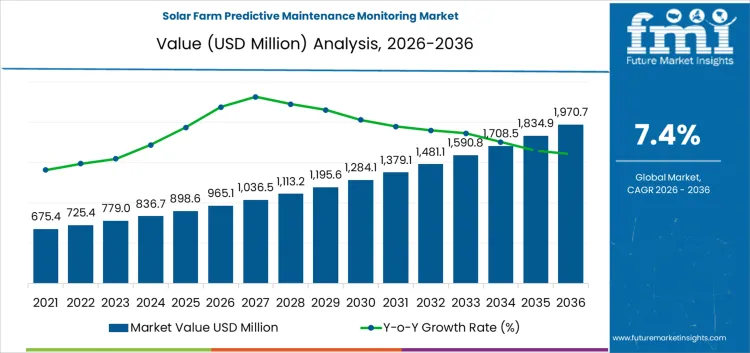
Solar Farm Predictive Maintenance Monitoring Market Key Takeaways
| Metric | Value |
|---|---|
| Industry Value (2026) | USD 965.1 Million |
| Forecast Value (2036) | USD 1,970.7 Million |
| Forecast CAGR 2026 to 2036 | 7.40% |
How Is the Global Solar Farm Predictive Maintenance Monitoring Market Advancing?
The global solar farm predictive maintenance monitoring market is advancing steadily, driven by the rapid expansion of utility-scale solar installations and the need to improve operational reliability across large solar assets. Predictive maintenance monitoring systems are increasingly deployed to detect performance degradation, equipment faults, and component failures in advance, enabling operators to minimize unplanned downtime and optimize asset availability.
A key driver supporting market growth is the rising focus on reducing operation and maintenance costs across large solar farms. Predictive monitoring platforms use sensor data, performance analytics, and historical operating patterns to identify early indicators of inverter failures, panel degradation, tracker misalignment, and electrical faults. This allows operators to shift from reactive maintenance to condition-based interventions, improving system uptime and extending equipment service life.
Advancements in data analytics, machine learning algorithms, and remote monitoring technologies are further strengthening market adoption. Improved fault detection accuracy, real-time performance dashboards, and integration with asset management systems are enabling more efficient maintenance planning across geographically dispersed solar farms. As solar capacity continues to scale and asset owners prioritize long-term performance optimization, the predictive maintenance monitoring market is expected to register consistent growth over the forecast period.
What Is the Segment-Wise Overview of the Solar Farm Predictive Maintenance Monitoring Market?
The solar farm predictive maintenance monitoring market is shaped by plant size and deployment architecture preferences. Utility-scale solar farms exceeding 50 MW lead with a 48% share, driven by the need to monitor large asset bases, reduce unplanned downtime, and optimize operational efficiency across extensive installations. These projects generate high volumes of performance and condition data, making advanced monitoring systems essential. By deployment model, cloud-based platforms account for 44% of demand, supported by centralized analytics, remote accessibility, and scalability across multiple sites. Hybrid cloud-edge and edge-only deployments follow, addressing latency-sensitive monitoring and connectivity constraints.
Why Do Utility-Scale Solar Farms Lead the Solar Farm Predictive Maintenance Monitoring Market?
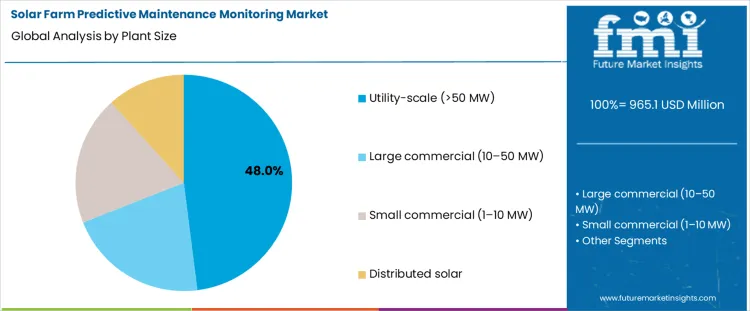
Utility-scale solar farms above 50 MW account for 48% of market demand due to their high asset density, operational complexity, and financial exposure to unplanned downtime. These installations comprise thousands of panels, inverters, trackers, and balance-of-system components spread across large geographic areas. Predictive maintenance monitoring is essential to detect early-stage equipment degradation, performance anomalies, and environmental stress impacts. Advanced monitoring platforms enable operators to prioritize maintenance activities, optimize spare part utilization, and reduce revenue losses caused by outages. The scale of utility-level projects also justifies investment in sophisticated analytics and AI-driven diagnostics. As global utility-scale solar capacity continues to expand, demand for comprehensive predictive maintenance solutions remains concentrated in this segment.
Why Do Cloud-Based Platforms Dominate the Solar Farm Predictive Maintenance Monitoring Market?
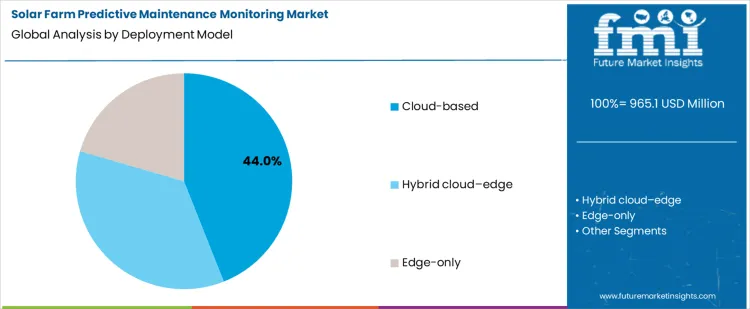
Cloud-based deployment models hold a 44% share of the Solar Farm Predictive Maintenance Monitoring Market due to their scalability, centralized data management, and ease of multi-site integration. Large solar operators often manage portfolios spread across multiple regions, making cloud platforms ideal for aggregating performance data and applying uniform analytics. Cloud-based systems support advanced machine learning models for fault prediction, trend analysis, and asset benchmarking without requiring extensive on-site infrastructure. They also enable remote access for operators, service providers, and asset owners, improving collaboration and response times. Lower upfront infrastructure costs and faster deployment further strengthen adoption. As predictive maintenance strategies mature, cloud-based platforms remain the preferred choice for managing large, geographically distributed solar assets.
What Are the Key Dynamics for the Solar Farm Predictive Maintenance Monitoring Market?
The solar farm predictive maintenance monitoring market is driven by the increasing deployment of large-scale solar photovoltaic (PV) installations and the need to maximize operational uptime and energy output. Predictive maintenance monitoring uses data analytics, sensors, and machine learning to forecast equipment failures and optimize service schedules before breakdowns occur. Key market dynamics include rising solar capacity additions globally, focus on reducing operational costs, and demand for enhanced asset reliability and performance. As solar farm operators seek to improve return on investment and prolong equipment life, predictive maintenance solutions are becoming integral to efficient solar plant management.
Why Is the Solar Farm Predictive Maintenance Monitoring Market Growing?
The market is growing as solar energy adoption expands across utility, commercial, and industrial segments, increasing the complexity and scale of installations needing ongoing monitoring. Predictive maintenance technologies enable real-time performance insights, early detection of faults in inverters, trackers, and modules, and reduction of unplanned downtime. Growth is further supported by advancements in Internet of Things (IoT) connectivity, cloud computing, and AI-based analytics that provide more accurate failure forecasts and actionable insights. Competitive energy markets and tighter return expectations are motivating operators to adopt monitoring technologies that minimize losses and improve energy yield.
How Are the Key Drivers Shaping the Solar Farm Predictive Maintenance Monitoring Market?
Key drivers shaping the market include the need to control lifecycle costs of solar assets and improve grid reliability. Predictive maintenance systems leverage data from sensors, drones, and thermographic imaging to identify performance degradation early, reducing maintenance expenses and extending equipment lifespan. Advances in AI and edge analytics are enhancing predictive accuracy and reducing dependency on manual inspection. Integration of monitoring platforms with enterprise asset management systems allows centralized oversight of multi-site operations, supporting scalability for portfolio operators. Regulatory incentives promoting renewable energy also indirectly support investments in digital monitoring solutions that enhance plant performance.
What Is the Growth Outlook for the Solar Farm Predictive Maintenance Monitoring Market by Country?
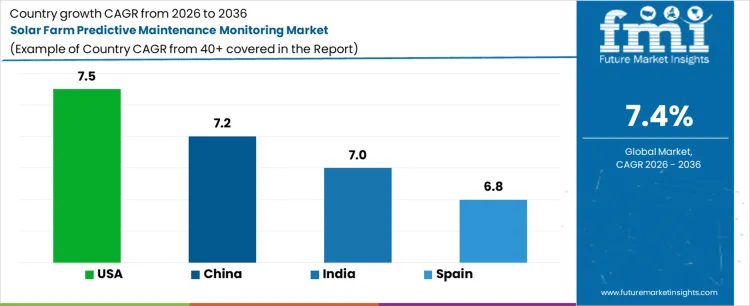
| Country | CAGR (%) |
|---|---|
| USA | 7.5% |
| China | 7.2% |
| India | 7.0% |
| Spain | 6.8% |
The solar farm predictive maintenance monitoring market is expanding steadily as solar operators focus on improving asset reliability and operational efficiency. The USA leads at 7.5%, driven by large-scale solar deployments and increasing emphasis on uptime optimization. China follows at 7.2%, supported by its vast installed solar base and growing use of AI-enabled monitoring platforms. India grows at 7.0%, driven by rapid capacity additions and the need to manage performance in challenging operating conditions. Spain expands at 6.8%, supported by modernization of solar assets and performance optimization initiatives. As solar capacity continues to rise globally, predictive maintenance monitoring is expected to become an essential component of solar farm operations.
What Is Driving the Growth of the Solar Farm Predictive Maintenance Monitoring Market in the USA?
The Solar Farm Predictive Maintenance Monitoring Market in the USA is growing at a CAGR of 7.5%, driven by the rapid expansion of utility-scale solar installations and increasing focus on maximizing asset uptime. Large solar farms across the USA are adopting predictive maintenance solutions to reduce unexpected equipment failures, inverter downtime, and performance degradation. Advanced monitoring platforms that combine sensors, AI analytics, and real-time performance data help operators identify faults before they escalate into costly outages. Aging solar assets and long project lifecycles are further increasing the need for condition-based maintenance rather than reactive servicing. In addition, rising operational expenditure pressures are pushing solar owners to optimize maintenance schedules and extend equipment life. Integration of predictive monitoring systems with SCADA and energy management platforms is also improving operational visibility. As solar capacity continues to expand nationwide, demand for predictive maintenance monitoring solutions is expected to grow steadily.
How Is the Solar Farm Predictive Maintenance Monitoring Market Expanding in China?
The Solar Farm Predictive Maintenance Monitoring Market in China is expanding at a CAGR of 7.2%, supported by the country’s large installed base of utility-scale solar projects. China’s extensive solar farms require advanced monitoring tools to manage performance across vast and geographically dispersed sites. Predictive maintenance solutions help operators detect panel degradation, inverter inefficiencies, and grid-connection issues at an early stage. Growing emphasis on improving power output efficiency and reducing curtailment losses is encouraging adoption of data-driven maintenance strategies. In addition, domestic technology providers are increasingly offering AI-enabled monitoring platforms tailored to large-scale solar assets. Government focus on improving renewable energy utilization rates further supports investment in advanced monitoring systems. As China continues to optimize its solar infrastructure, predictive maintenance monitoring is expected to play a larger role in long-term asset management.
What Is Supporting Growth of the Solar Farm Predictive Maintenance Monitoring Market in India?
The Solar Farm Predictive Maintenance Monitoring Market in India is growing at a CAGR of 7.0%, driven by rapid expansion of solar power capacity and increasing focus on improving plant performance. Many Indian solar farms operate in challenging environmental conditions, including high temperatures and dust exposure, increasing the risk of component degradation. Predictive maintenance monitoring systems help operators proactively identify faults, reduce downtime, and improve energy yield. Cost sensitivity within the market is encouraging adoption of solutions that lower long-term maintenance expenses and minimize revenue losses. In addition, growing participation of private developers and independent power producers is increasing demand for digital asset management tools. Integration of remote monitoring platforms is particularly valuable for solar farms located in remote regions. As India continues to scale solar generation capacity, predictive maintenance monitoring adoption is expected to increase steadily.
How Is the Solar Farm Predictive Maintenance Monitoring Market Developing in Spain?
The Solar Farm Predictive Maintenance Monitoring Market in Spain is expanding at a CAGR of 6.8%, supported by strong growth in solar energy deployment and modernization of existing solar assets. Spain’s solar farms are increasingly adopting predictive monitoring tools to improve reliability and manage aging infrastructure. Advanced analytics help identify early signs of module degradation, inverter failures, and thermal anomalies, enabling timely maintenance interventions. Rising competition among solar operators is also pushing adoption of performance-optimization technologies to maximize returns. In addition, Spain’s integration of solar power into a flexible energy grid increases the importance of stable and predictable generation. Adoption of digital monitoring platforms aligned with European energy management standards further supports market growth. As Spain continues to expand and upgrade its solar capacity, predictive maintenance monitoring solutions are expected to see consistent demand.
How Are Companies Competing in the Solar Farm Predictive Maintenance Monitoring Market?
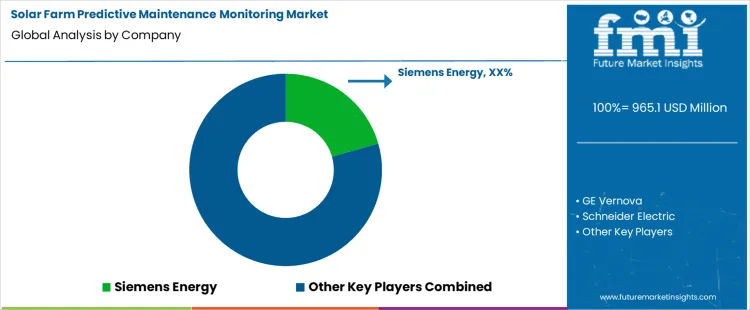
Competition in the solar farm predictive maintenance monitoring market is driven by analytics accuracy, asset-level visibility, and the ability to convert operational data into actionable maintenance decisions. As utility-scale and large commercial solar farms expand, operators increasingly rely on predictive monitoring platforms to reduce downtime, optimize inverter performance, and extend asset life. Vendors differentiate through AI-driven fault detection, digital twin capabilities, and seamless integration with SCADA, energy management systems, and plant control architectures.
Siemens Energy, GE Vernova, and Schneider Electric compete through comprehensive digital energy platforms that combine monitoring, analytics, and grid integration. Siemens Energy emphasizes advanced diagnostics and condition-based monitoring tied to its energy automation portfolio, enabling early identification of component degradation. GE Vernova leverages its grid and renewable expertise to offer predictive analytics that connect solar asset health with broader power system performance. Schneider Electric differentiates through software-centric platforms that integrate predictive maintenance with energy management, cybersecurity, and remote operations, supporting multi-site solar portfolios.
ABB, Hitachi Energy, and SMA Solar compete through equipment-native intelligence and inverter-focused monitoring depth. ABB integrates predictive maintenance algorithms directly into power electronics and control systems, enabling real-time fault detection and performance optimization. Hitachi Energy applies digital asset management and AI analytics to improve reliability across solar and grid-connected assets, particularly in complex hybrid power systems. SMA Solar differentiates by embedding advanced monitoring and predictive features within its inverter and plant management solutions, providing granular visibility into inverter health and yield performance. Across the market, competitive advantage is shaped by analytics reliability, system interoperability, scalability across large solar fleets, and the ability to translate data insights into measurable uptime and performance gains.
Key Players in Solar Farm Predictive Maintenance Monitoring Market
- Siemens Energy
- GE Vernova
- Schneider Electric
- ABB
- Hitachi Energy
- SMA Solar
Scope of Report
| Attributes | Description |
|---|---|
| Quantitative Unit (2026) | USD Million |
| Plant Size | Utility-Scale (>50 MW), Large Commercial (10-50 MW), Small Commercial (1-10 MW), Distributed Solar |
| Deployment Model | Cloud-Based, Hybrid Cloud-Edge, Edge-Only |
| Regions Covered | Asia Pacific, Europe, North America, Latin America, Middle East & Africa |
| Countries Covered | China, Japan, South Korea, India, Australia & New Zealand, ASEAN, Rest of Asia Pacific, Germany, United Kingdom, France, Italy, Spain, Nordic, BENELUX, Rest of Europe, United States, Canada, Mexico, Brazil, Chile, Rest of Latin America, Kingdom of Saudi Arabia, Other GCC Countries, Turkey, South Africa, Other African Union, Rest of Middle East & Africa |
| Key Companies Profiled | Siemens Energy, GE Vernova, Schneider Electric, ABB, Hitachi Energy, SMA Solar |
| Additional Attributes | Dollar sales by plant size and deployment model; regional market size and forecast analysis; growth outlook across major regions; adoption trends for predictive maintenance and condition monitoring platforms in solar farms; assessment of uptime optimization needs, analytics deployment preferences, and monitoring architecture adoption patterns. |
Solar Farm Predictive Maintenance Monitoring Market by Key Segments
Plant Size
- Utility-scale (>50 MW)
- Large commercial (10-50 MW)
- Small commercial (1-10 MW)
- Distributed solar
Deployment Model
- Cloud-based
- Hybrid cloud-edge
- Edge-only
Region
- Asia Pacific
- China
- Japan
- South Korea
- India
- Australia & New Zealand
- ASEAN
- Rest of Asia Pacific
- Europe
- Germany
- United Kingdom
- France
- Italy
- Spain
- Nordic
- BENELUX
- Rest of Europe
- North America
- United States
- Canada
- Mexico
- Latin America
- Brazil
- Chile
- Rest of Latin America
- Middle East & Africa
- Kingdom of Saudi Arabia
- Other GCC Countries
- Turkey
- South Africa
- Other African Union
- Rest of Middle East & Africa
Bibliography
- National Renewable Energy Laboratory (NREL). (2023). PV O&M Cost Model: User Guide and Model Description. U.S. Department of Energy / NREL Publications.
- International Renewable Energy Agency (IRENA). (2024). Renewable Energy Operations and Maintenance: Digitalization, Predictive Analytics, and Asset Optimization. IRENA Technical Report.
- International Energy Agency (IEA). (2024). Solar PV Operations, Maintenance, and Data Analytics 2024: Enhancing Performance and Reducing Lifecycle Costs. IEA Publications.
- European Commission. (2024). Digitalization in the Energy Sector: Predictive Maintenance and AI Applications in Renewable Assets. Directorate-General for Energy (DG ENER) Report.
- U.S. Department of Energy (DOE). (2024). Condition-Based Maintenance for Renewable Energy Assets: Predictive Analytics and AI Models for Solar Farms. Office of Energy Efficiency and Renewable Energy (EERE) Publications.
Frequently Asked Questions
How big is the solar farm predictive maintenance monitoring market in 2026?
The global solar farm predictive maintenance monitoring market is estimated to be valued at USD 965.1 million in 2026.
What will be the size of solar farm predictive maintenance monitoring market in 2036?
The market size for the solar farm predictive maintenance monitoring market is projected to reach USD 1,970.7 million by 2036.
How much will be the solar farm predictive maintenance monitoring market growth between 2026 and 2036?
The solar farm predictive maintenance monitoring market is expected to grow at a 7.4% CAGR between 2026 and 2036.
What are the key product types in the solar farm predictive maintenance monitoring market?
The key product types in solar farm predictive maintenance monitoring market are utility-scale (>50 mw), large commercial (10–50 mw), small commercial (1–10 mw) and distributed solar.
Which deployment model segment to contribute significant share in the solar farm predictive maintenance monitoring market in 2026?
In terms of deployment model, cloud-based segment to command 44.0% share in the solar farm predictive maintenance monitoring market in 2026.
Preview the report firsthand - request a free sample
Get SampleGet the brochure for pricing and purchase details.
Get PDFTable of Content
- Executive Summary
- Global Market Outlook
- Demand-side Trends
- Supply-side Trends
- Technology Roadmap Analysis
- Analysis and Recommendations
- Market Overview
- Market Coverage / Taxonomy
- Market Definition / Scope / Limitations
- Market Background
- Market Dynamics
- Drivers
- Restraints
- Opportunity
- Trends
- Scenario Forecast
- Demand in Optimistic Scenario
- Demand in Likely Scenario
- Demand in Conservative Scenario
- Opportunity Map Analysis
- Product Life Cycle Analysis
- Supply Chain Analysis
- Investment Feasibility Matrix
- Value Chain Analysis
- PESTLE and Porter’s Analysis
- Regulatory Landscape
- Regional Parent Market Outlook
- Production and Consumption Statistics
- Import and Export Statistics
- Market Dynamics
- Global Market Analysis 2021 to 2025 and Forecast, 2026 to 2036
- Historical Market Size Value (USD Million) Analysis, 2021 to 2025
- Current and Future Market Size Value (USD Million) Projections, 2026 to 2036
- Y-o-Y Growth Trend Analysis
- Absolute $ Opportunity Analysis
- Global Market Pricing Analysis 2021 to 2025 and Forecast 2026 to 2036
- Global Market Analysis 2021 to 2025 and Forecast 2026 to 2036, By Plant Size
- Introduction / Key Findings
- Historical Market Size Value (USD Million) Analysis By Plant Size , 2021 to 2025
- Current and Future Market Size Value (USD Million) Analysis and Forecast By Plant Size , 2026 to 2036
- Utility-scale (>50 MW)
- Large commercial (10-50 MW)
- Small commercial (1-10 MW)
- Distributed solar
- Utility-scale (>50 MW)
- Y-o-Y Growth Trend Analysis By Plant Size , 2021 to 2025
- Absolute $ Opportunity Analysis By Plant Size , 2026 to 2036
- Global Market Analysis 2021 to 2025 and Forecast 2026 to 2036, By Deployment Model
- Introduction / Key Findings
- Historical Market Size Value (USD Million) Analysis By Deployment Model, 2021 to 2025
- Current and Future Market Size Value (USD Million) Analysis and Forecast By Deployment Model, 2026 to 2036
- Cloud-based
- Hybrid cloud-edge
- Edge-only
- Cloud-based
- Y-o-Y Growth Trend Analysis By Deployment Model, 2021 to 2025
- Absolute $ Opportunity Analysis By Deployment Model, 2026 to 2036
- Global Market Analysis 2021 to 2025 and Forecast 2026 to 2036, By Region
- Introduction
- Historical Market Size Value (USD Million) Analysis By Region, 2021 to 2025
- Current Market Size Value (USD Million) Analysis and Forecast By Region, 2026 to 2036
- North America
- Latin America
- Western Europe
- Eastern Europe
- East Asia
- South Asia and Pacific
- Middle East & Africa
- Market Attractiveness Analysis By Region
- North America Market Analysis 2021 to 2025 and Forecast 2026 to 2036, By Country
- Historical Market Size Value (USD Million) Trend Analysis By Market Taxonomy, 2021 to 2025
- Market Size Value (USD Million) Forecast By Market Taxonomy, 2026 to 2036
- By Country
- USA
- Canada
- Mexico
- By Plant Size
- By Deployment Model
- By Country
- Market Attractiveness Analysis
- By Country
- By Plant Size
- By Deployment Model
- Key Takeaways
- Latin America Market Analysis 2021 to 2025 and Forecast 2026 to 2036, By Country
- Historical Market Size Value (USD Million) Trend Analysis By Market Taxonomy, 2021 to 2025
- Market Size Value (USD Million) Forecast By Market Taxonomy, 2026 to 2036
- By Country
- Brazil
- Chile
- Rest of Latin America
- By Plant Size
- By Deployment Model
- By Country
- Market Attractiveness Analysis
- By Country
- By Plant Size
- By Deployment Model
- Key Takeaways
- Western Europe Market Analysis 2021 to 2025 and Forecast 2026 to 2036, By Country
- Historical Market Size Value (USD Million) Trend Analysis By Market Taxonomy, 2021 to 2025
- Market Size Value (USD Million) Forecast By Market Taxonomy, 2026 to 2036
- By Country
- Germany
- UK
- Italy
- Spain
- France
- Nordic
- BENELUX
- Rest of Western Europe
- By Plant Size
- By Deployment Model
- By Country
- Market Attractiveness Analysis
- By Country
- By Plant Size
- By Deployment Model
- Key Takeaways
- Eastern Europe Market Analysis 2021 to 2025 and Forecast 2026 to 2036, By Country
- Historical Market Size Value (USD Million) Trend Analysis By Market Taxonomy, 2021 to 2025
- Market Size Value (USD Million) Forecast By Market Taxonomy, 2026 to 2036
- By Country
- Russia
- Poland
- Hungary
- Balkan & Baltic
- Rest of Eastern Europe
- By Plant Size
- By Deployment Model
- By Country
- Market Attractiveness Analysis
- By Country
- By Plant Size
- By Deployment Model
- Key Takeaways
- East Asia Market Analysis 2021 to 2025 and Forecast 2026 to 2036, By Country
- Historical Market Size Value (USD Million) Trend Analysis By Market Taxonomy, 2021 to 2025
- Market Size Value (USD Million) Forecast By Market Taxonomy, 2026 to 2036
- By Country
- China
- Japan
- South Korea
- By Plant Size
- By Deployment Model
- By Country
- Market Attractiveness Analysis
- By Country
- By Plant Size
- By Deployment Model
- Key Takeaways
- South Asia and Pacific Market Analysis 2021 to 2025 and Forecast 2026 to 2036, By Country
- Historical Market Size Value (USD Million) Trend Analysis By Market Taxonomy, 2021 to 2025
- Market Size Value (USD Million) Forecast By Market Taxonomy, 2026 to 2036
- By Country
- India
- ASEAN
- Australia & New Zealand
- Rest of South Asia and Pacific
- By Plant Size
- By Deployment Model
- By Country
- Market Attractiveness Analysis
- By Country
- By Plant Size
- By Deployment Model
- Key Takeaways
- Middle East & Africa Market Analysis 2021 to 2025 and Forecast 2026 to 2036, By Country
- Historical Market Size Value (USD Million) Trend Analysis By Market Taxonomy, 2021 to 2025
- Market Size Value (USD Million) Forecast By Market Taxonomy, 2026 to 2036
- By Country
- Kingdom of Saudi Arabia
- Other GCC Countries
- Turkiye
- South Africa
- Other African Union
- Rest of Middle East & Africa
- By Plant Size
- By Deployment Model
- By Country
- Market Attractiveness Analysis
- By Country
- By Plant Size
- By Deployment Model
- Key Takeaways
- Key Countries Market Analysis
- USA
- Pricing Analysis
- Market Share Analysis, 2025
- By Plant Size
- By Deployment Model
- Canada
- Pricing Analysis
- Market Share Analysis, 2025
- By Plant Size
- By Deployment Model
- Mexico
- Pricing Analysis
- Market Share Analysis, 2025
- By Plant Size
- By Deployment Model
- Brazil
- Pricing Analysis
- Market Share Analysis, 2025
- By Plant Size
- By Deployment Model
- Chile
- Pricing Analysis
- Market Share Analysis, 2025
- By Plant Size
- By Deployment Model
- Germany
- Pricing Analysis
- Market Share Analysis, 2025
- By Plant Size
- By Deployment Model
- UK
- Pricing Analysis
- Market Share Analysis, 2025
- By Plant Size
- By Deployment Model
- Italy
- Pricing Analysis
- Market Share Analysis, 2025
- By Plant Size
- By Deployment Model
- Spain
- Pricing Analysis
- Market Share Analysis, 2025
- By Plant Size
- By Deployment Model
- France
- Pricing Analysis
- Market Share Analysis, 2025
- By Plant Size
- By Deployment Model
- India
- Pricing Analysis
- Market Share Analysis, 2025
- By Plant Size
- By Deployment Model
- ASEAN
- Pricing Analysis
- Market Share Analysis, 2025
- By Plant Size
- By Deployment Model
- Australia & New Zealand
- Pricing Analysis
- Market Share Analysis, 2025
- By Plant Size
- By Deployment Model
- China
- Pricing Analysis
- Market Share Analysis, 2025
- By Plant Size
- By Deployment Model
- Japan
- Pricing Analysis
- Market Share Analysis, 2025
- By Plant Size
- By Deployment Model
- South Korea
- Pricing Analysis
- Market Share Analysis, 2025
- By Plant Size
- By Deployment Model
- Russia
- Pricing Analysis
- Market Share Analysis, 2025
- By Plant Size
- By Deployment Model
- Poland
- Pricing Analysis
- Market Share Analysis, 2025
- By Plant Size
- By Deployment Model
- Hungary
- Pricing Analysis
- Market Share Analysis, 2025
- By Plant Size
- By Deployment Model
- Kingdom of Saudi Arabia
- Pricing Analysis
- Market Share Analysis, 2025
- By Plant Size
- By Deployment Model
- Turkiye
- Pricing Analysis
- Market Share Analysis, 2025
- By Plant Size
- By Deployment Model
- South Africa
- Pricing Analysis
- Market Share Analysis, 2025
- By Plant Size
- By Deployment Model
- USA
- Market Structure Analysis
- Competition Dashboard
- Competition Benchmarking
- Market Share Analysis of Top Players
- By Regional
- By Plant Size
- By Deployment Model
- Competition Analysis
- Competition Deep Dive
- Siemens Energy
- Overview
- Product Portfolio
- Profitability by Market Segments (Product/Age /Sales Channel/Region)
- Sales Footprint
- Strategy Overview
- Marketing Strategy
- Product Strategy
- Channel Strategy
- GE Vernova
- Schneider Electric
- ABB
- Hitachi Energy
- SMA Solar
- Siemens Energy
- Competition Deep Dive
- Assumptions & Acronyms Used
- Research Methodology


