

- Market Size (2026)
- USD 1.3 Bn
- Forecast (2036)
- USD 3.0 Bn
- CAGR (2026 to 2036)
- 8.7%
Condition Monitoring-Linked Fluid Additive Service Kits Market Size, Forecast, and Outlook By FMI
Summary of the Condition Monitoring-Linked Fluid Additive Service Kits Market
- Demand and Growth Drivers
- Planned maintenance programs are creating demand for service kits that help operators decide whether fluid can be treated before full replacement.
- Fluid testing is gaining use in fleet workshops as engine wear readings help maintenance managers reduce unplanned repair costs.
- Plants use coolant and hydraulic fluid checks more often that need better control over sump condition and machine uptime.
- Product and Segment View
- Oil analysis kits are likely to stay the leading kit type as engines and gearboxes need repeat sampling during service cycles.
- Anti-wear boosters are set to hold a clear role as wear-metal readings often require corrective additive treatment.
- OEM programs are gaining preference because approved kits give service teams clearer guidance on fluid care and warranty-linked maintenance.
- Geography and Competitive Outlook
- India is likely to record faster growth as factory output and fleet servicing move toward planned maintenance. China is expected to see steady kit demand due to its large machinery base and wider use of documented service routines.
- Companies with fluid analysis depth and clear additive guidance are expected to gain more repeat orders through distributor and OEM channels.
- Analyst Opinion
- Anurag Sharma, Principal Consultant at FMI says, “I view condition monitoring-connected fluid additive service kits as a maintenance service rather than a simple consumable. The best suppliers will win when they connect oil analysis with additive dosing. Cost pressure is clear because operators do not want to replace oil too early. Compliance pressure is rising as plants document lubricant handling and coolant control more carefully..”
- Condition Monitoring-Linked Fluid Additive Service Kits Market Value Analysis
- Condition monitoring-linked fluid additive service kits support maintenance decisions by turning fluid test results into clear service actions.
- Oil analysis kits support repeat spending because engines and gearboxes need regular checks before drain decisions.
- Manufacturing plants use these kits to protect production equipment from wear and fluid breakdown.
- OEM programs stay important because approved service kits help maintenance teams follow equipment care rules.
- Supplier capability depends on fast sample handling and practical additive guidance after test results.
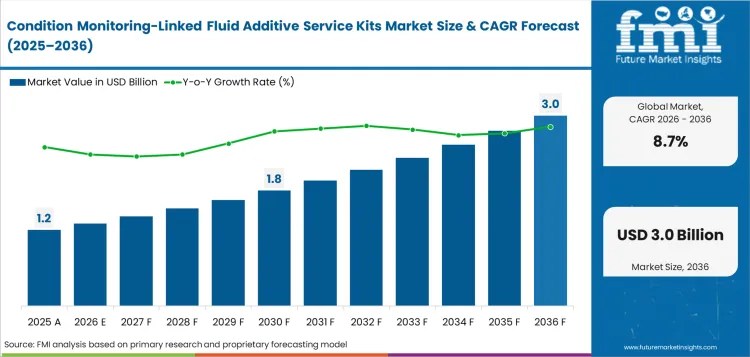
Key Takeaways, Market Size, and Forecast
- The condition monitoring-linked fluid additive service kits market market was valued at USD 1.2 billion in 2025.
- Industry is estimated at USD 1.3 billion in 2026 as oil analysis moves closer to field service work.
- Fluid testing used in planned maintenance is forecast to lift demand to USD 3.0 billion by 2036.
- Across the 2026 to 2036 period, the market is projected to expand at an 8.7% CAGR.
- Incremental opportunity is forecast at USD 1.7 billion during the study period.
- Oil analysis kits are projected to form 38.0% of kit type demand in 2026 due to engine and gearbox use.
- Wear readings require fast correction, so anti-wear boosters are forecast to represent 31.0% of additive function demand in 2026.
- India (10.8% CAGR) and China (10.1% CAGR) are the countries with lucrative growth prospects through 2036.
Fluid service is becoming harder to manage through fixed intervals because lubricant stress varies by load, duty cycle and contamination. Shell’s October 2025 LubeAnalyst model shows the shift toward laboratory testing, detailed reports and portal access. Service-kit suppliers gain a clearer route to link additive replenishment with measured oil condition. Formulators can use recognized test logic to support kit timing and additive selection. Texaco’s April 2024 LubeWatch workflow also matters because users can order sampling kits through Chevron Business Point and submit sample information online. Distributors gain repeat demand when sampling, reporting and kit ordering connect digitally. Castrol’s sensor-linked SmartMonitor points to the next stage. Additive kits are predicted to become condition-triggered service items, and not routine consumables.
Condition Monitoring-Linked Fluid Additive Service Kits Market Definition
The condition monitoring-linked fluid additive service kits market includes packaged service kits that combine fluid testing materials with additive replenishment packs. These kits serve lubricating oils and coolants used in industrial machinery or fleets. Hydraulic fluids and gear oils are also covered under the scope.
Condition Monitoring-Linked Fluid Additive Service Kits Market Inclusions
Market scope covers oil analysis kits and coolant analysis kits. Hydraulic kits and grease kits are also included. Gear oil kits, anti-wear boosters and corrosion inhibitors fall within the scope. Viscosity stabilizers and oxidation inhibitors are included along with detergent dispersants. Service coverage includes OEM programs and distributor service. Lab subscriptions, field technician support and digital portals are covered. Stakeholders include lubricant formulators and additive suppliers. Oil analysis labs and equipment OEMs are included. Industrial MRO distributors and fleet maintenance operators are covered. Manufacturing plants and mining operators are also included. Marine service providers and power generation operators complete the stakeholder scope.
Condition Monitoring-Linked Fluid Additive Service Kits Market Exclusions
Scope excludes bulk engine oils and standard coolant cans. Standalone additive bottles and vibration sensors are outside the scope. Unrelated lab testing and maintenance software sold without fluid additive kit support are also excluded.
Condition Monitoring-Linked Fluid Additive Service Kits Market Research Methodology
- Primary Research: FMI analysts reviewed service kit use with lubricant formulators and fleet maintenance teams. Interviews covered kit replacement cycles and additive dosing decisions. Service package pricing was also reviewed.
- Desk Research: Desk work assessed lubricant service programs and oil analysis workflows. Public data from official sources was used to check industrial activity and maintenance-linked demand.
- Market Sizing and Forecasting: The model combined service kit volumes and additive refill pricing. Fluid type penetration was reviewed separately. Country forecasts were checked against industrial output and service network depth.
- Data Validation: Forecasts were cross-checked against condition monitoring services and lubricant additive demand. Company portfolios and official service launches were reviewed before final sizing.
Why is the Condition Monitoring-Linked Fluid Additive Service Kits Market Growing?
- Plants use service kits to decide whether oil needs additive correction or replacement.
- Fleet operators need faster wear signals as engine and drivetrain repair costs rise.
- Coolant service kits gain use as machining shops seek cleaner sump control.
- Digital portals help fluid reports feed into maintenance planning.
- Lab subscription models help smaller operators access testing without internal lab spend.
The Federal Reserve reported in April 2026 that USA manufacturing output grew at a 3.0% annual rate in the first quarter. A larger active production base keeps rotating assets in use for longer shifts. Routine oil checks become more useful before additive dosing. Service kits answer a practical need because maintenance teams can test fluid health before ordering additive treatment. Suppliers gain when reports translate lab values into simple dosage guidance.
Off-road and site equipment create a separate demand path for fluid monitoring. The USA Census Bureau reported that construction spending reached a seasonally adjusted annual rate of USD 2,185.5 billion in March 2026. The spending base keeps hydraulic systems and gearboxes in regular use across contractors and rental fleets. Kits that connect sampling with additive guidance help field teams decide when service is needed. Heavy equipment cycles create recurring fluid checks for hydraulic and gear oil systems.
Market Segmentation Analysis
- By 2026, oil analysis kits are forecast at 38.0% of kit type demand as engines and gearboxes need repeat fluid checks before drain decisions.
- Wear-metal alerts keep anti-wear boosters ahead in additive function, with the segment forecast at 31.0% for 2026.
- Lubricating oils lead fluid type demand during the 2026 assessment at 42.0% because rotating equipment creates the widest sampling base.
- A 34.0% share places OEM programs ahead in service channel for 2026 as warranty-linked maintenance favors approved kits.
- Manufacturing plants are projected to form the leading end-use base at 29.0% in 2026 as production lines need routine fluid checks.
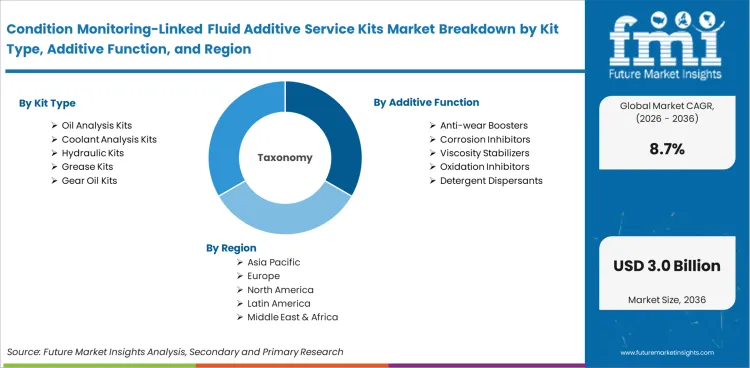
the condition monitoring-linked fluid additive service kits market is segmented by kit type, additive function, fluid type, service channel, end use, and region. Kit type includes oil analysis kits, coolant analysis kits, hydraulic kits, grease kits, and gear oil kits. Additive function includes anti-wear boosters, corrosion inhibitors, viscosity stabilizers, oxidation inhibitors, and detergent dispersants. Fluid type includes lubricating oils, hydraulic fluids, coolants, greases, and gear oils. Service channel includes OEM programs, distributor service, lab subscription, field technician, and digital portals. End use includes manufacturing plants, fleet operators, mining sites, marine operators, and power generation.
Insights into Condition Monitoring-Linked Fluid Additive Service Kits Market by Kit Type
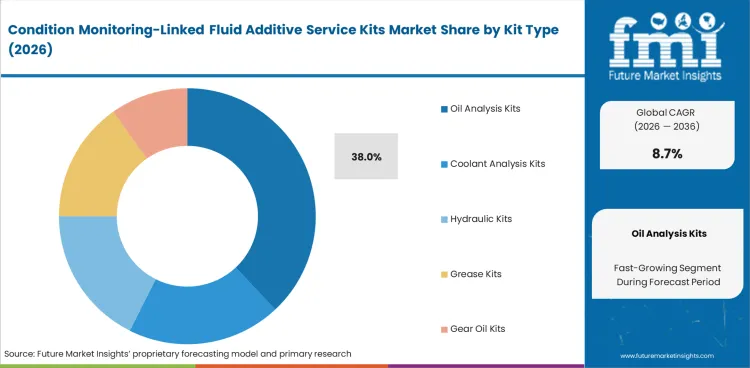
- By 2026, oil analysis kits are forecast at 38.0% of kit type demand. Maintenance groups use these kits because engines and gearboxes need repeat sampling before drain decisions.
- Metalworking shops use coolant analysis kits more often when they need cleaner sump control and fewer fluid-related surface defects.
Insights into Condition Monitoring-Linked Fluid Additive Service Kits Market by Additive Function
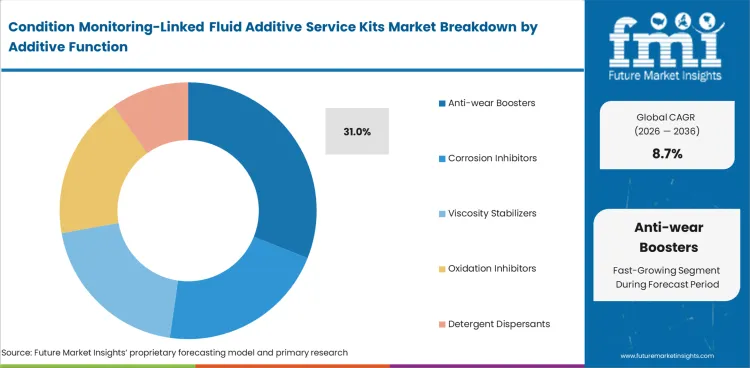
- Anti-wear boosters are expected to be leading segment in 2026 with 31.0% share. Wear-metal readings often call for corrective dosing before a full oil change becomes necessary.
- Corrosion Inhibitors serve mixed-metal systems that face water ingress and acidity during heavy operating cycles.
Insights into Condition Monitoring-Linked Fluid Additive Service Kits Market by Fluid Type
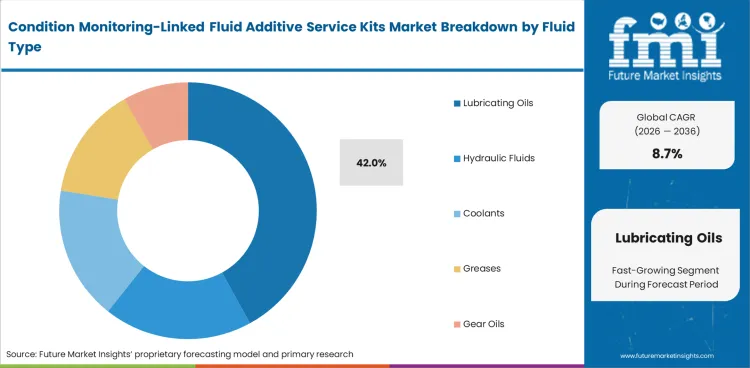
- A 42.0% share places lubricating oils ahead in fluid type for 2026. Engines, compressors and gearboxes create the widest monitored fluid base across plants and fleets.
- Hydraulic fluids hold a steady second position because pump life depends on clean fluid and stable viscosity.
Insights into Condition Monitoring-Linked Fluid Additive Service Kits Market by Service Channel
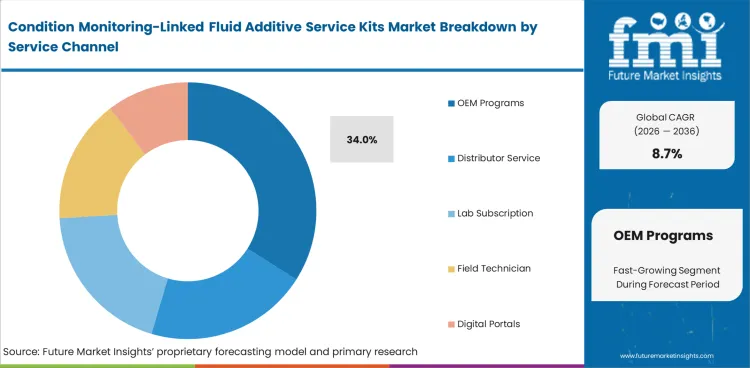
- Within service channel, OEM programs are projected at 34.0% by 2026. Approved service kits help maintenance teams follow equipment care rules and warranty-linked service schedules.
- Distributor service stays useful for smaller plants that need local sample pickup and additive refill support.
Insights into Condition Monitoring-Linked Fluid Additive Service Kits Market by End Use
- Manufacturing plants are expected to form the leading end-use base at 29.0% in 2026. Production lines need fluid checks across rotating assets and hydraulic systems.
- Fleet operators use service kits around mileage cycles, engine condition and downtime control.
Condition Monitoring-Linked Fluid Additive Service Kits Market Drivers, Restraints, and Opportunities
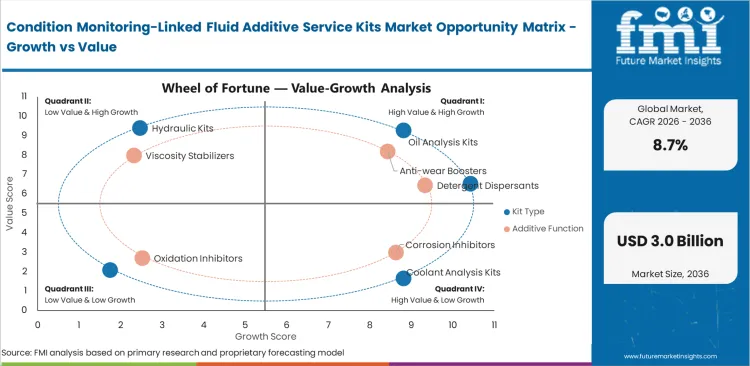
- Wear-alert dosing supports demand as service kits convert oil analysis findings into additive refill decisions.
- Coolant sump control lifts kit use in machining plants that need pH and concentration checks.
- Cost pressure limits uptake as some workshops still choose early oil replacement over testing.
- Lab-backed digital reports create opportunity as service data helps plants justify longer fluid use.
- OEM service bundling expands kit access through approved maintenance programs.
Wear-alert Additive Dosing
Wear-alert dosing changes how operators view additive packs. A service kit is useful when test results point to anti-wear treatment before a full oil change. Chevron’s official LubeWatch Fluid Analysis Program states that routine lubricant testing helps track wear trends and guide maintenance action before failures occur because oil analysis compares lubricant condition with equipment condition and maintenance decisions. Suppliers that pair test data with additive guidance can create repeat service demand beyond one-time kit sales.
Coolant Sump Control
Coolant service kits are expanding from basic pH checks into automated machining fluid care. In September 2025, Castrol launched Castrol SmartCoolant as a technical service solution for real-time condition monitoring and automated coolant management. Castrol states that the system monitors concentration and pH while adjusting coolant in real time. Coolant additive service kits need fluid readings that point to a treatment action.
Lab Turnaround Constraint
Lab support can limit service kit value when sample movement is slow. Intertek’s official Oil Condition Monitoring service states that its accredited labs operate across 24 global locations and provide oil and lube testing reports. Turnaround speed depends on lab access and report delivery. Regional workshops are most exposed when they rely on sample collection through distributors. Local service partners can compete by offering pickup support and clearer field interpretation.
Analysis of Condition Monitoring-Linked Fluid Additive Service Kits Market by Key Countries
.webp "Top Country Growth Comparison Condition Monitoring Linked Fluid Additive Service Kits Market Cagr (2026 2036)")
| Country | CAGR |
|---|---|
| India | 10.8% |
| China | 10.1% |
| United States | 8.9% |
| South Korea | 8.6% |
| Germany | 7.8% |
| United Kingdom | 7.5% |
| Japan | 7.2% |
Source: FMI analysis based on primary research and proprietary forecasting model.
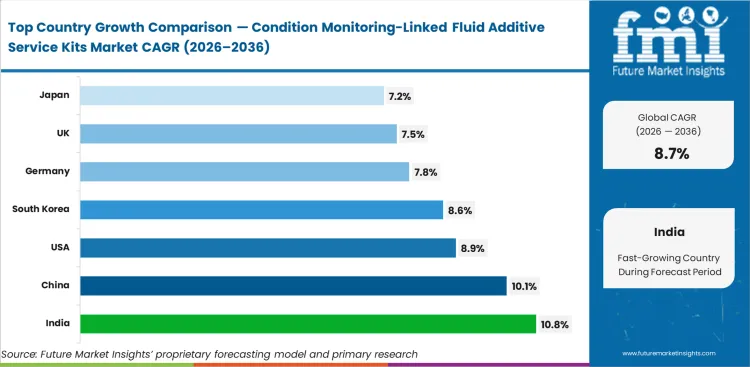
Condition Monitoring-Linked Fluid Additive Service Kits Market CAGR Analysis by Country
- India’s 10.8% CAGR during 2026 to 2036 reflects wider factory activity and stronger service coverage in major industrial clusters.
- China is assessed at 10.1% CAGR during the forecast period due to its large machinery base and deeper industrial fluid use.
- United States demand is forecast to move at 8.9% CAGR by 2036 as fleets and plants use oil analysis for service decisions.
- An 8.6% CAGR outlook places South Korea ahead of mature markets because electronics and automotive plants need precise equipment care.
- Germany records 7.8% CAGR across 2026 to 2036 through documented maintenance practice in machine tools and process industries.
- During 2026 to 2036, the United Kingdom is forecast at 7.5% CAGR as production recovery supports planned fluid service.
- Japan’s market outlook stands at 7.2% CAGR for 2026 to 2036 due to cautious spending and high equipment reliability standards.
Demand Outlook for Condition Monitoring-Linked Fluid Additive Service Kits Market in India
The India condition monitoring-linked fluid additive service kits market reflects factory service growth across major industrial clusters. During 2026 to 2036, India is projected to record 10.8% CAGR as lubricant distributors expand sample collection and additive refill support. Demand is tied to oil analysis before additive dosing in automotive plants and chemical units. Pune and Chennai offer a clear base for service kit uptake because both locations have dense machinery and vehicle maintenance activity.
Pune automotive suppliers need oil analysis kits to protect gearboxes during high-duty production cycles.
Chennai fleet workshops use distributor-backed kits for bus engines and commercial vehicle maintenance.
Gujarat chemical plants need corrosion inhibitor support for pumps exposed to aggressive process conditions.
Sales Analysis of Condition Monitoring-Linked Fluid Additive Service Kits Market in China
China has a large machinery base that creates frequent fluid service needs across manufacturing provinces. The market is expected to expand at 10.1% CAGR during the forecast period as equipment makers pair fluid testing with approved additive treatment. Coastal manufacturing provinces use lubricating oils and hydraulic fluids across machine tools and presses. Local service providers can gain repeat orders when they reduce sample delays and give direct action after oil test results.
Jiangsu machinery plants need lubricating oil checks to reduce stoppage risk across machine tools.
Guangdong electronics producers support demand for coolant kits used in precision machining support areas.
Shandong equipment workshops use hydraulic kits to manage contamination in presses and mobile machinery.
Demand Analysis of Condition Monitoring-Linked Fluid Additive Service Kits Market in the United States
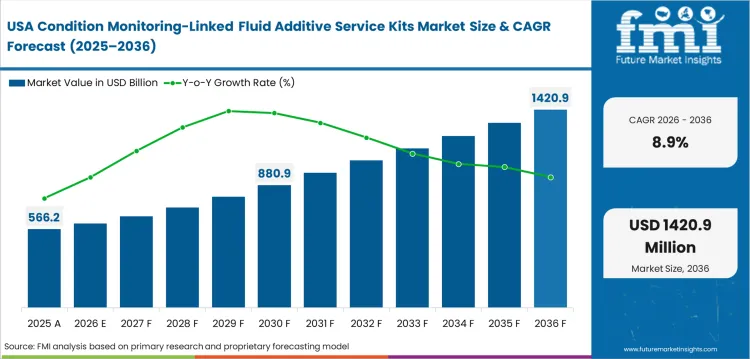
The United States condition monitoring-linked fluid additive service kits market has a mature service base across fleets and industrial plants. Service kit demand is forecast to grow at 8.9% CAGR by 2036 as oil analysis programs support additive decisions in heavy-duty maintenance. Contractors and rental fleets use hydraulic checks to protect machines that face long duty cycles. Industrial plants use fluid readings to decide whether additive treatment can extend oil life without raising repair risk.
Texas oilfield service fleets need hydraulic and gear oil kits for pumps and mobile equipment.
Midwest manufacturing plants use oil checks to plan service around production uptime.
California port equipment operators need corrosion checks due to heavy container handling cycles.
Opportunity Analysis for Condition Monitoring-Linked Fluid Additive Service Kits Market in South Korea
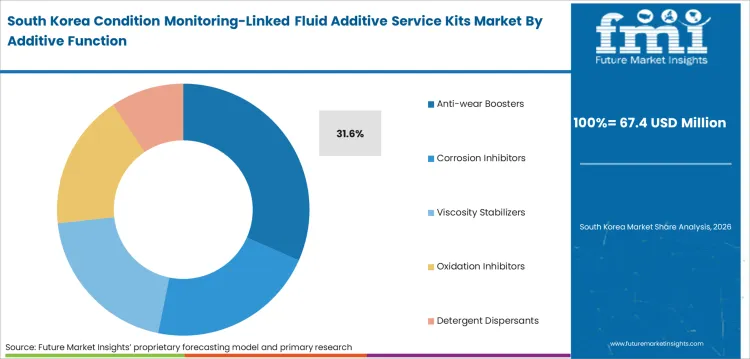
South Korea’s 8.6% CAGR outlook from 2026 to 2036 reflects demand for clean coolants and stable lubricants in precision manufacturing sites. High-value equipment use shapes the market in electronics and automotive production. Gyeonggi and Ulsan create practical service opportunities due to dense factory activity and regular equipment care. Suppliers with field technician support can win service work from plants that lack internal fluid testing teams.
Gyeonggi semiconductor support facilities need coolant checks for precision tool reliability.
Ulsan automotive suppliers use oil analysis kits to protect gearboxes during line operation.
Daegu machinery firms need field technician support because smaller plants often lack internal test staff.
Future Outlook for Condition Monitoring-Linked Fluid Additive Service Kits Market in Germany
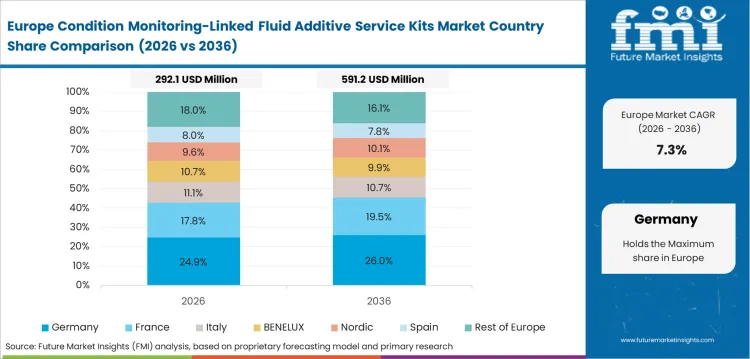
Germany’s market reflects documented maintenance practice across mechanical engineering and process industries. Maintenance demand is projected to rise at 7.8% CAGR across 2026 to 2036 as plants favor verified fluid performance over reactive servicing. Machine tool users place value on oil testing because spindle damage and gearbox wear can raise service costs quickly. Regional distributors can gain repeat demand when they offer fast sample routing for factory maintenance teams.
Baden-Württemberg machine tool users need oil analysis kits for spindles and high-value drives.
Bavaria automotive plants use anti-wear additives when load cycles expose gears to wear risk.
North Rhine-Westphalia chemical plants need corrosion inhibitor kits for pumps and rotating systems.
Demand Outlook for Condition Monitoring-Linked Fluid Additive Service Kits Market in the United Kingdom
The United Kingdom condition monitoring-linked fluid additive service kits market is tied to factory maintenance and marine service. The market is forecast at 7.5% CAGR for 2026 to 2036 as distributors bundle testing with refill additive support. Midlands manufacturing plants need oil and coolant checks because production teams want fewer fluid-related stoppages. Aberdeen supports marine service demand through vessel maintenance and offshore equipment work.
West Midlands manufacturers need oil and coolant kits for machine tool service routines.
Aberdeen marine service firms use gear oil checks for offshore vessel maintenance.
Teesside process plants need oxidation inhibitor kits for compressors and circulating oil systems.
In-depth Analysis of Condition Monitoring-Linked Fluid Additive Service Kits Market in Japan
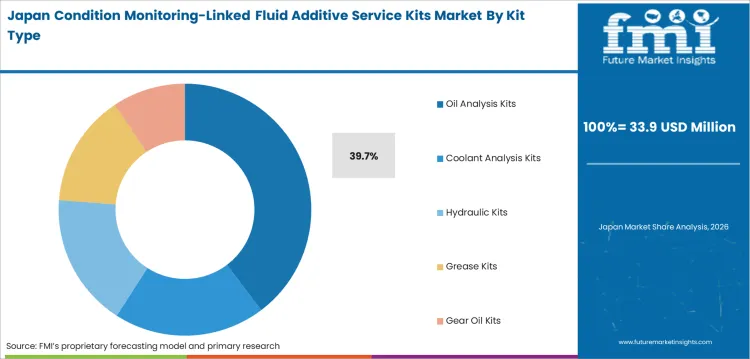
Japan’s demand base reflects careful equipment care and high replacement costs. Automotive and machine tool plants prefer verified service steps before changing oil or adding treatment packs. Japan is expected to post 7.2% CAGR during 2026 to 2036 as operators favor measured adoption of additive service kits. Suppliers need precise documentation and fluid compatibility support to serve OEM-linked maintenance programs.
Aichi automotive plants need service kits that match OEM-approved lubricants.
Osaka machine shops use coolant checks to control concentration and surface finish quality.
Yokohama marine operators need gear oil kits for vessel maintenance schedules.
Competitive Landscape and Strategic Positioning
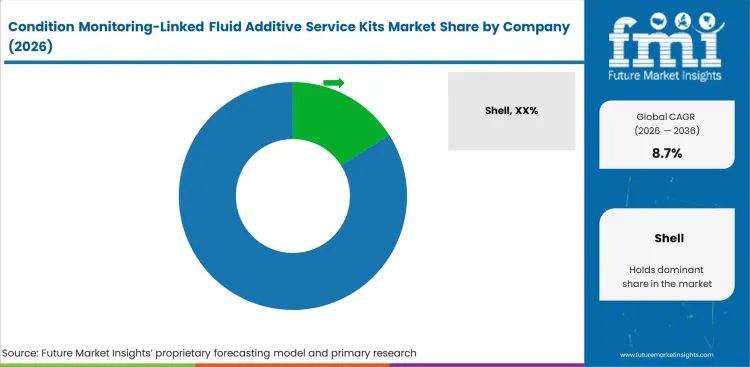
- Market concentration is moderate as lubricant majors compete with testing labs and regional service distributors.
- Large suppliers win through lubricant portfolios and oil analysis platforms.
- Specialist labs compete on turnaround time and interpretation quality.
- Entry barriers come from test credibility and approved additive compatibility.
Competition depends on how well a supplier turns fluid test results into a clear service action. In May 2024, Shell Lubricants introduced Shell LubeAnalyst in the Philippines as an oil condition monitoring service for fleet engines and machinery lubrication systems. The launch is relevant because it pairs lubricant testing with maintenance action in fleet and industrial service accounts. Service kit suppliers need similar interpretation support if they want repeat orders beyond sample bottles.
Digital reporting is a service difference in fluid additive programs. In July 2025, Castrol won the 2025 IoT Emerging Technology Award for Castrol SmartOil and Castrol SmartMonitor. Castrol states that both technologies support predictive maintenance for industrial applications. Connected lubricant monitoring helps users decide when oil treatment or service action is needed.
Key Companies in the Condition Monitoring-Linked Fluid Additive Service Kits Market
- Integrated lubricant suppliers include Shell, ExxonMobil and Chevron. Castrol, TotalEnergies and FUCHS compete through lubricant portfolios and oil analysis programs.
- Testing and inspection providers include Intertek and SGS. Bureau Veritas and ALS Limited support the market through laboratory testing and tribology analysis.
- Specialist service partners include regional lubricant distributors and field maintenance firms. These firms compete through sample pickup and technician visits.
Competitive Benchmarking: Condition Monitoring-Linked Fluid Additive Service Kits Market
| Company | Fluid Analysis Depth | Additive Guidance | Field Service Reach | Geographic Footprint |
|---|---|---|---|---|
| Shell | High | Strong | Strong | Global |
| Castrol | High | Strong | Strong | Global |
| ExxonMobil | High | Strong | Strong | Global |
| Chevron | High | Strong | Strong | Global |
| TotalEnergies | High | Medium | Strong | Global |
| FUCHS | Medium | Strong | Moderate | Global |
| Intertek | High | Medium | Strong | Global |
| SGS | High | Medium | Strong | Global |
| Bureau Veritas | High | Medium | Moderate | Global |
| ALS Limited | High | Medium | Moderate | Global |
Source: Future Market Insights competitive analysis, 2026. Ratings reflect relative positioning based on fluid analysis depth, additive guidance and field service reach.
Key Developments in Condition Monitoring-Linked Fluid Additive Service Kits Market
- In August 2025, SGS Australia launched a secure digital platform for oil condition monitoring kits.
- In September 2025, TotalEnergies Lubmarine highlighted LubDiag as a lubricant condition monitoring service that helps track lubricant and equipment health.
Key Players in the Condition Monitoring-Linked Fluid Additive Service Kits Market
Integrated Lubricant Suppliers
- Shell
- ExxonMobil
- Chevron
- Castrol
- TotalEnergies
- FUCHS
Testing and Inspection Providers
- Intertek
- SGS
- Bureau Veritas
- ALS Limited
Specialist Service Partners
- Regional lubricant distributors
- Field maintenance service firms
- Industrial MRO service providers
Report Scope and Coverage
| Parameter | Details |
|---|---|
| Quantitative Units | USD 1.3 billion to USD 3.0 billion at 8.7% CAGR |
| Market Definition | Service kits that combine fluid testing materials with additive replenishment packs for industrial machinery and fleet fluids |
| Regions Covered | North America, Latin America, Europe, East Asia, South Asia and Pacific, Middle East and Africa |
| Countries Covered | India, China, United States, South Korea, Germany, United Kingdom, Japan, more than 30 countries |
| Key Companies Profiled | Shell, ExxonMobil, Chevron, Castrol, TotalEnergies, FUCHS, Intertek |
| Forecast Period | 2026 to 2036 |
| Approach | Hybrid bottom-up and top-down methodology using service kit volume checks and country-level maintenance adoption assumptions |
Condition Monitoring-Linked Fluid Additive Service Kits Market by Segments
Condition Monitoring-Linked Fluid Additive Service Kits Market Segmented by Kit Type
- Oil Analysis Kits
- Coolant Analysis Kits
- Hydraulic Kits
- Grease Kits
- Gear Oil Kits
Condition Monitoring-Linked Fluid Additive Service Kits Market Segmented by Additive Function
- Anti-wear Boosters
- Corrosion Inhibitors
- Viscosity Stabilizers
- Oxidation Inhibitors
- Detergent Dispersants
Condition Monitoring-Linked Fluid Additive Service Kits Market Segmented by Fluid Type
- Lubricating Oils
- Hydraulic Fluids
- Coolants
- Greases
- Gear Oils
Condition Monitoring-Linked Fluid Additive Service Kits Market Segmented by Service Channel
- OEM Programs
- Distributor Service
- Lab Subscription
- Field Technician
- Digital Portals
Condition Monitoring-Linked Fluid Additive Service Kits Market Segmented by End Use
- Manufacturing Plants
- Fleet Operators
- Mining Sites
- Marine Operators
- Power Generation
Condition Monitoring-Linked Fluid Additive Service Kits Market by Region
- North America
- United States
- Canada
- Mexico
- Latin America
- Brazil
- Chile
- Rest of Latin America
- Western Europe
- Germany
- United Kingdom
- Italy
- Spain
- France
- Nordic
- BENELUX
- Rest of Western Europe
- Eastern Europe
- Russia
- Poland
- Hungary
- Balkan and Baltic
- Rest of Eastern Europe
- East Asia
- China
- Japan
- South Korea
- South Asia and Pacific
- India
- ASEAN
- Australia and New Zealand
- Rest of South Asia and Pacific
- Middle East and Africa
- Kingdom of Saudi Arabia
- Other GCC Countries
- Turkiye
- South Africa
- Other African Union
- Rest of Middle East and Africa
Research Sources and Bibliography
- Board of Governors of the Federal Reserve System. (2026, April 16). Industrial production and capacity utilization. Federal Reserve.
- USA Census Bureau. (2026, May 7). Monthly construction spending, March 2026. USA Census Bureau.
- Ministry of Statistics and Programme Implementation. (2026, March 25). Quick estimate of index of industrial production and use-based index for March 2026. Government of India.
- National Bureau of Statistics of China. (2026, February 28). Statistical communiqué of the People’s Republic of China on the 2025 national economic and social development. National Bureau of Statistics of China.
- Chevron Lubricants. (2024, October 24). Condition monitoring through LubeWatch fluid analysis. Chevron Lubricants.
- Castrol. (2025, September 16). Introducing Castrol SmartCoolant. Castrol.
- Castrol. (2025, July 24). IoT award win for industrial applications. Castrol.
- Intertek. (2026). Oil condition monitoring. Intertek.
- Shell Lubricants. (2024, May 16). Shell Lubricants introduces expert oil analysis service to the Philippines’ fastest-growing industries. Shell Philippines.
- SGS. (2025, August 25). New secure digital platform for OCM kits. SGS.
- TotalEnergies Lubmarine. (2025, September 24). Simplify your lubrication maintenance programme with Lubmarine. TotalEnergies Lubmarine.
This Report Answers
- What is the current and future value of the condition monitoring-linked fluid additive service kits market from 2026 to 2036?
- What CAGR is expected for condition monitoring-linked fluid additive service kits during the forecast period?
- Which kit type is projected to lead service kit demand in 2026?
- Which additive function is forecast to hold a significant demand share in 2026?
- What factors move plants and fleets toward fluid testing with additive treatment?
- How do OEM service programs affect supplier selection for fluid additive service kits?
- Which countries are expected to grow fastest in the service kits market?
- Which companies are positioned across lubricant analysis and additive-backed service programs?
- How does FMI define the condition monitoring-linked fluid additive service kits market scope?
- What method was used to estimate service kit demand from 2026 to 2036?
Frequently Asked Questions
What is the global market demand for condition monitoring-linked fluid additive service kits in 2026?
In 2026, global demand for condition monitoring-linked fluid additive service kits is estimated at USD 1.3 billion across service and refill use.
How big will the condition monitoring-linked fluid additive service kits market be in 2036?
By 2036, the market is forecast to reach USD 3.0 billion as fluid testing becomes part of planned maintenance.
What CAGR is expected for the condition monitoring-linked fluid additive service kits market?
Demand is forecast to grow at 8.7% CAGR from 2026 to 2036 across industrial and fleet service channels.
Which kit type is projected to lead demand by 2026?
Oil analysis kits are projected to form 38.0% of kit type demand in 2026 due to wide engine and gearbox use.
Which additive function is expected to lead service kit demand in 2026?
Anti-wear boosters are forecast to represent 31.0% of additive function demand in 2026 as wear readings require quick correction.
What is driving demand growth in India?
India is forecast to grow at 10.8% CAGR through 2036 as factories and fleets expand planned fluid maintenance use.
What does FMI mean by condition monitoring-linked fluid additive service kits?
The term covers service kits that combine fluid testing, additive packs and guidance for lubricant or coolant maintenance decisions.
How does FMI estimate the condition monitoring-linked fluid additive service kits forecast?
FMI uses bottom-up kit volume estimates, additive refill pricing, channel checks and country-level maintenance adoption assumptions.
Preview the report firsthand - request a free sample
Get SampleGet the brochure for pricing and purchase details.
Get PDFTable of Content
- Key Takeaways
- Market Size and CAGR
- Top Growth Driver
- Fastest Growing Segment
- Leading Region
- Key Companies
- Emerging Opportunities
- Executive Summary
- Global Market Outlook
- Demand-side Trends
- Supply-side Trends
- Technology Roadmap Analysis
- Analysis and Recommendations
- Analyst Perspective (What is happening? Why now? What should investors know?)
- Key Questions Answered
- How large is the market?
- What is the CAGR?
- What are key trends?
- Which region dominates?
- Who are the leaders?
- Market Overview
- Market Coverage / Taxonomy
- Market Definition / Scope / Limitations
- Research Methodology
- Chapter Orientation
- Analytical Lens and Working Hypotheses
- Market Structure, Signals, and Trend Drivers
- Benchmarking and Cross-market Comparability
- Market Sizing, Forecasting, and Opportunity Mapping
- Research Design and Evidence Framework
- Desk Research Programme (Secondary Evidence)
- Expert Input and Fieldwork (Primary Evidence)
- Tooling, Models, and Reference Databases
- Data Engineering and Model Build
- Quality Assurance and Audit Trail
- Market Background
- Market Dynamics (Drivers, Restraints, Opportunity, Trends)
- Scenario Forecast (Optimistic, Likely, Conservative)
- Impact Analysis
- AI Impact
- Sustainability Impact
- Regulatory Impact
- Technology Impact
- Consumer / Buyer Analysis
- Purchase Drivers
- Adoption Barriers
- Buyer Journey
- Opportunity Map Analysis
- Product Life Cycle Analysis
- Supply Chain Analysis
- Investment Feasibility Matrix
- Value Chain Analysis
- PESTLE and Porter's Analysis
- Regulatory Landscape
- Regional Parent Market Outlook
- Production and Consumption Statistics
- Import and Export Statistics
- Global Market Analysis and Forecast, 2021 to 2036
- Historical Market Size Value (USD Billion) & Volume (Unit) Analysis, 2021 to 2025
- Current and Future Market Size Value (USD Billion) & Volume (Unit) Projections, 2026 to 2036
- Y-o-Y Growth Trend Analysis
- Absolute $ Opportunity Analysis
- Global Market Pricing Analysis, 2021 to 2036
- Global Market Analysis and Forecast, By Kit Type, 2021 to 2036
- Introduction / Key Findings
- Historical Market Size Value (USD Billion) & Volume (Unit) Analysis By Kit Type, 2021 to 2025
- Current and Future Market Size Value (USD Billion) & Volume (Unit) Analysis and Forecast By Kit Type, 2026 to 2036
- Oil Analysis Kits
- Coolant Analysis Kits
- Hydraulic Kits
- Grease Kits
- Gear Oil Kits
- Oil Analysis Kits
- Y-o-Y Growth Trend Analysis By Kit Type, 2021 to 2025
- Absolute $ Opportunity Analysis By Kit Type, 2026 to 2036
- Global Market Analysis and Forecast, By Additive Function, 2021 to 2036
- Introduction / Key Findings
- Historical Market Size Value (USD Billion) & Volume (Unit) Analysis By Additive Function, 2021 to 2025
- Current and Future Market Size Value (USD Billion) & Volume (Unit) Analysis and Forecast By Additive Function, 2026 to 2036
- Anti-wear Boosters
- Corrosion Inhibitors
- Viscosity Stabilizers
- Oxidation Inhibitors
- Detergent Dispersants
- Anti-wear Boosters
- Y-o-Y Growth Trend Analysis By Additive Function, 2021 to 2025
- Absolute $ Opportunity Analysis By Additive Function, 2026 to 2036
- Global Market Analysis and Forecast, By Fluid Type, 2021 to 2036
- Introduction / Key Findings
- Historical Market Size Value (USD Billion) & Volume (Unit) Analysis By Fluid Type, 2021 to 2025
- Current and Future Market Size Value (USD Billion) & Volume (Unit) Analysis and Forecast By Fluid Type, 2026 to 2036
- Lubricating Oils
- Hydraulic Fluids
- Coolants
- Greases
- Gear Oils
- Lubricating Oils
- Y-o-Y Growth Trend Analysis By Fluid Type, 2021 to 2025
- Absolute $ Opportunity Analysis By Fluid Type, 2026 to 2036
- Global Market Analysis and Forecast, By Service Channel, 2021 to 2036
- Introduction / Key Findings
- Historical Market Size Value (USD Billion) & Volume (Unit) Analysis By Service Channel, 2021 to 2025
- Current and Future Market Size Value (USD Billion) & Volume (Unit) Analysis and Forecast By Service Channel, 2026 to 2036
- OEM Programs
- Distributor Service
- Lab Subscription
- Field Technician
- Digital Portals
- OEM Programs
- Y-o-Y Growth Trend Analysis By Service Channel, 2021 to 2025
- Absolute $ Opportunity Analysis By Service Channel, 2026 to 2036
- Global Market Analysis and Forecast, By End Use, 2021 to 2036
- Introduction / Key Findings
- Historical Market Size Value (USD Billion) & Volume (Unit) Analysis By End Use, 2021 to 2025
- Current and Future Market Size Value (USD Billion) & Volume (Unit) Analysis and Forecast By End Use, 2026 to 2036
- Manufacturing Plants
- Fleet Operators
- Mining Sites
- Marine Operators
- Power Generation
- Manufacturing Plants
- Y-o-Y Growth Trend Analysis By End Use, 2021 to 2025
- Absolute $ Opportunity Analysis By End Use, 2026 to 2036
- Global Market Analysis and Forecast, By Region, 2021 to 2036
- Introduction
- Historical Market Size Value (USD Billion) & Volume (Unit) Analysis By Region, 2021 to 2025
- Current Market Size Value (USD Billion) & Volume (Unit) Analysis and Forecast By Region, 2026 to 2036
- North America
- Latin America
- Western Europe
- Eastern Europe
- East Asia
- South Asia and Pacific
- Middle East & Africa
- Market Attractiveness Analysis By Region
- North America Market Analysis and Forecast, By Country, 2021 to 2036
- Historical Market Size Value (USD Billion) & Volume (Unit) Trend Analysis By Market Taxonomy, 2021 to 2025
- Market Size Value (USD Billion) & Volume (Unit) Forecast By Market Taxonomy, 2026 to 2036
- By Country
- USA
- Canada
- Mexico
- By Kit Type
- By Additive Function
- By Fluid Type
- By Service Channel
- By End Use
- By Country
- Market Attractiveness Analysis
- By Country
- By Kit Type
- By Additive Function
- By Fluid Type
- By Service Channel
- By End Use
- Key Takeaways
- Latin America Market Analysis and Forecast, By Country
- Historical Market Size Value (USD Billion) & Volume (Unit) Trend Analysis By Market Taxonomy, 2021 to 2025
- Market Size Value (USD Billion) & Volume (Unit) Forecast By Market Taxonomy, 2026 to 2036
- By Country
- Brazil
- Chile
- Rest of Latin America
- By Kit Type
- By Additive Function
- By Fluid Type
- By Service Channel
- By End Use
- By Country
- Market Attractiveness Analysis
- By Country
- By Kit Type
- By Additive Function
- By Fluid Type
- By Service Channel
- By End Use
- Key Takeaways
- Western Europe Market Analysis and Forecast, By Country
- Historical Market Size Value (USD Billion) & Volume (Unit) Trend Analysis By Market Taxonomy, 2021 to 2025
- Market Size Value (USD Billion) & Volume (Unit) Forecast By Market Taxonomy, 2026 to 2036
- By Country
- Germany
- UK
- Italy
- Spain
- France
- Nordic
- BENELUX
- Rest of Western Europe
- By Kit Type
- By Additive Function
- By Fluid Type
- By Service Channel
- By End Use
- By Country
- Market Attractiveness Analysis
- By Country
- By Kit Type
- By Additive Function
- By Fluid Type
- By Service Channel
- By End Use
- Key Takeaways
- Eastern Europe Market Analysis and Forecast, By Country
- Historical Market Size Value (USD Billion) & Volume (Unit) Trend Analysis By Market Taxonomy, 2021 to 2025
- Market Size Value (USD Billion) & Volume (Unit) Forecast By Market Taxonomy, 2026 to 2036
- By Country
- Russia
- Poland
- Hungary
- Balkan & Baltic
- Rest of Eastern Europe
- By Kit Type
- By Additive Function
- By Fluid Type
- By Service Channel
- By End Use
- By Country
- Market Attractiveness Analysis
- By Country
- By Kit Type
- By Additive Function
- By Fluid Type
- By Service Channel
- By End Use
- Key Takeaways
- East Asia Market Analysis and Forecast, By Country
- Historical Market Size Value (USD Billion) & Volume (Unit) Trend Analysis By Market Taxonomy, 2021 to 2025
- Market Size Value (USD Billion) & Volume (Unit) Forecast By Market Taxonomy, 2026 to 2036
- By Country
- China
- Japan
- South Korea
- By Kit Type
- By Additive Function
- By Fluid Type
- By Service Channel
- By End Use
- By Country
- Market Attractiveness Analysis
- By Country
- By Kit Type
- By Additive Function
- By Fluid Type
- By Service Channel
- By End Use
- Key Takeaways
- South Asia and Pacific Market Analysis and Forecast, By Country
- Historical Market Size Value (USD Billion) & Volume (Unit) Trend Analysis By Market Taxonomy, 2021 to 2025
- Market Size Value (USD Billion) & Volume (Unit) Forecast By Market Taxonomy, 2026 to 2036
- By Country
- India
- ASEAN
- Australia & New Zealand
- Rest of South Asia and Pacific
- By Kit Type
- By Additive Function
- By Fluid Type
- By Service Channel
- By End Use
- By Country
- Market Attractiveness Analysis
- By Country
- By Kit Type
- By Additive Function
- By Fluid Type
- By Service Channel
- By End Use
- Key Takeaways
- Middle East & Africa Market Analysis and Forecast, By Country
- Historical Market Size Value (USD Billion) & Volume (Unit) Trend Analysis By Market Taxonomy, 2021 to 2025
- Market Size Value (USD Billion) & Volume (Unit) Forecast By Market Taxonomy, 2026 to 2036
- By Country
- Kingdom of Saudi Arabia
- Other GCC Countries
- Türkiye
- South Africa
- Other African Union
- Rest of Middle East & Africa
- By Kit Type
- By Additive Function
- By Fluid Type
- By Service Channel
- By End Use
- By Country
- Market Attractiveness Analysis
- By Country
- By Kit Type
- By Additive Function
- By Fluid Type
- By Service Channel
- By End Use
- Key Takeaways
- Key Countries Market Analysis
- USA
- Pricing Analysis
- Market Share Analysis, 2025
- By Kit Type
- By Additive Function
- By Fluid Type
- By Service Channel
- By End Use
- Canada
- Pricing Analysis
- Market Share Analysis, 2025
- By Kit Type
- By Additive Function
- By Fluid Type
- By Service Channel
- By End Use
- Mexico
- Pricing Analysis
- Market Share Analysis, 2025
- By Kit Type
- By Additive Function
- By Fluid Type
- By Service Channel
- By End Use
- Brazil
- Pricing Analysis
- Market Share Analysis, 2025
- By Kit Type
- By Additive Function
- By Fluid Type
- By Service Channel
- By End Use
- Chile
- Pricing Analysis
- Market Share Analysis, 2025
- By Kit Type
- By Additive Function
- By Fluid Type
- By Service Channel
- By End Use
- Germany
- Pricing Analysis
- Market Share Analysis, 2025
- By Kit Type
- By Additive Function
- By Fluid Type
- By Service Channel
- By End Use
- UK
- Pricing Analysis
- Market Share Analysis, 2025
- By Kit Type
- By Additive Function
- By Fluid Type
- By Service Channel
- By End Use
- Italy
- Pricing Analysis
- Market Share Analysis, 2025
- By Kit Type
- By Additive Function
- By Fluid Type
- By Service Channel
- By End Use
- Spain
- Pricing Analysis
- Market Share Analysis, 2025
- By Kit Type
- By Additive Function
- By Fluid Type
- By Service Channel
- By End Use
- France
- Pricing Analysis
- Market Share Analysis, 2025
- By Kit Type
- By Additive Function
- By Fluid Type
- By Service Channel
- By End Use
- India
- Pricing Analysis
- Market Share Analysis, 2025
- By Kit Type
- By Additive Function
- By Fluid Type
- By Service Channel
- By End Use
- ASEAN
- Pricing Analysis
- Market Share Analysis, 2025
- By Kit Type
- By Additive Function
- By Fluid Type
- By Service Channel
- By End Use
- Australia & New Zealand
- Pricing Analysis
- Market Share Analysis, 2025
- By Kit Type
- By Additive Function
- By Fluid Type
- By Service Channel
- By End Use
- China
- Pricing Analysis
- Market Share Analysis, 2025
- By Kit Type
- By Additive Function
- By Fluid Type
- By Service Channel
- By End Use
- Japan
- Pricing Analysis
- Market Share Analysis, 2025
- By Kit Type
- By Additive Function
- By Fluid Type
- By Service Channel
- By End Use
- South Korea
- Pricing Analysis
- Market Share Analysis, 2025
- By Kit Type
- By Additive Function
- By Fluid Type
- By Service Channel
- By End Use
- Russia
- Pricing Analysis
- Market Share Analysis, 2025
- By Kit Type
- By Additive Function
- By Fluid Type
- By Service Channel
- By End Use
- Poland
- Pricing Analysis
- Market Share Analysis, 2025
- By Kit Type
- By Additive Function
- By Fluid Type
- By Service Channel
- By End Use
- Hungary
- Pricing Analysis
- Market Share Analysis, 2025
- By Kit Type
- By Additive Function
- By Fluid Type
- By Service Channel
- By End Use
- Kingdom of Saudi Arabia
- Pricing Analysis
- Market Share Analysis, 2025
- By Kit Type
- By Additive Function
- By Fluid Type
- By Service Channel
- By End Use
- Türkiye
- Pricing Analysis
- Market Share Analysis, 2025
- By Kit Type
- By Additive Function
- By Fluid Type
- By Service Channel
- By End Use
- South Africa
- Pricing Analysis
- Market Share Analysis, 2025
- By Kit Type
- By Additive Function
- By Fluid Type
- By Service Channel
- By End Use
- USA
- Market Structure Analysis
- Competition Dashboard
- Competition Benchmarking
- Market Share Analysis of Top Players
- By Regional
- By Kit Type
- By Additive Function
- By Fluid Type
- By Service Channel
- By End Use
- Emerging Startups
- Innovation Benchmarking
- Competition Analysis
- Competition Deep Dive
- Shell
- Overview
- Product Portfolio
- Profitability by Market Segments (Product/Region/Sales Channel)
- Sales Footprint
- Strategy Overview
- Marketing Strategy
- Product Strategy
- Channel Strategy
- ExxonMobil
- Chevron
- Castrol
- TotalEnergies
- FUCHS
- Intertek
- SGS
- Bureau Veritas
- ALS Limited
- Shell
- Case Studies
- Success Stories
- Recent Developments
- Competition Deep Dive
- Assumptions & Acronyms Used


