

- Industry Size (2026)
- USD 199.4 Mn
- Forecast (2036)
- USD 587.7 Mn
- CAGR (2026 to 2036)
- 11.4%
Additive Manufacturing Generative AI Copilots Market Forecast and Outlook 2026 to 2036
The additive manufacturing generative AI copilots market is valued at USD 199.4 million in 2026 and is projected to reach USD 587.7 million by 2036, reflecting a CAGR of 11.4%. Market performance is concentrated among suppliers providing AI-driven design and optimization solutions integrated with industrial 3D printing platforms. Adoption varies across regions depending on the maturity of additive manufacturing ecosystems, regulatory approvals, and enterprise investment capacity. Geographic cost advantages are observed where software development, computing infrastructure, and engineering talent are locally accessible. Smaller providers face challenges in scaling AI capabilities while ensuring cross-platform compatibility and compliance with industrial standards.
Market outcomes are influenced by alignment with high-volume industrial clients, aerospace, and automotive programs. Margin concentration favors operators delivering certified, multi-platform AI copilots with predictive analytics and design validation capabilities. Fragmentation persists among niche or regional software developers, while leading companies capture concentrated value through integration with additive manufacturing platforms, validated performance, and operational reliability rather than the number of deployments alone. Adoption speed is dictated by enterprise digital readiness, regulatory frameworks, and program-specific complexity.
Quick Stats of the Additive Manufacturing Generative AI Copilots Market
- Additive Manufacturing Generative AI Copilots Market Value (2026): USD 199.4 million
- Additive Manufacturing Generative AI Copilots Forecast Value (2036): USD 587.7 million
- Additive Manufacturing Generative AI Copilots Forecast CAGR 2026 to 2036: 11.4%
- Leading Function in Additive Manufacturing Generative AI Copilots Market: Generative design (34 % share)
- Leading End Use in Additive Manufacturing Generative AI Copilots Market: Aerospace (32 % share)
- Key Growth Regions in Additive Manufacturing Generative AI Copilots Market: USA, Germany, China, Japan
- Top Players in Additive Manufacturing Generative AI Copilots Market: Autodesk, Siemens Digital Industries, Dassault Systèmes, PTC, Ansys, Hexagon
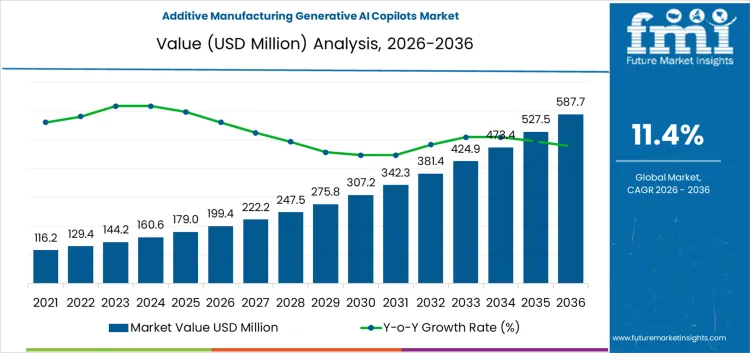
What is the Growth Forecast for Additive Manufacturing Generative AI Copilots Market through 2036?
Between 2026 and 2031, the additive manufacturing generative AI copilots market is projected to grow from USD 199.4 million to USD 307 million, generating an absolute increase of USD 107.6 million and reflecting a CAGR of 11.4%. Growth is driven by adoption of generative design, topology optimisation, process simulation, cost and material AI, and qualification automation across aerospace, automotive, industrial, medical, and defense end uses. Cloud, hybrid, and on-prem deployments enable flexible integration into additive manufacturing workflows. Expansion is supported by increasing demand for design efficiency, material optimization, and faster prototyping cycles.
From 2031 to 2036, the market is expected to expand from USD 307 million to USD 587.7 million, adding USD 281.2 million. Growth is fueled by broader adoption of AI-driven design tools, enhanced generative algorithms, and integration with industrial additive manufacturing operations. Market drivers include accelerated product development, cost reduction, and improved part quality through AI-assisted design. Competitive advantage favors suppliers offering validated AI platforms, scalable deployment, and industry-specific functionality. Leading companies include Autodesk, Siemens Digital Industries, Dassault Systèmes, PTC, Ansys, and Hexagon.
Additive Manufacturing Generative AI Copilots Market Key Takeaways
| Metric | Value |
|---|---|
| Market Value (2026) | USD 199.4 million |
| Forecast Value (2036) | USD 587.7 million |
| Forecast CAGR 2026 to 2036 | 11.40% |
What Is Driving Demand for Additive Manufacturing Generative AI Copilots?
Additive manufacturing generative AI copilots are increasingly adopted to optimize design, improve production efficiency, and reduce material waste in 3D printing workflows. Historically, design and process planning relied on manual iteration and simulation, which limited innovation speed and increased errors. Modern AI copilots integrate generative design algorithms, real-time feedback, and predictive process analytics to assist engineers in creating optimized geometries, selecting materials, and simulating print performance.
OEMs, industrial manufacturers, and 3D printing service providers prioritize system integration, accuracy, and usability. Early adoption focused on aerospace and high-value industrial components, while current demand spans automotive, healthcare, and consumer products driven by digital manufacturing growth, customization requirements, and operational efficiency objectives. AI model accuracy, integration with CAD/PLM systems, and computational performance influence adoption.
Increasing demand for lightweight structures, rapid prototyping, and production optimization is shaping market growth. Compared with conventional design tools, generative AI copilots emphasize automated geometry generation, predictive error correction, and process-aware optimization for additive manufacturing. Cost structures depend on AI software development, computational resources, and integration, concentrating margins among providers capable of delivering high-performance, validated AI tools. Manufacturers adopt AI copilots to accelerate product development, minimize material usage, and improve part performance. By 2036, generative AI copilots for additive manufacturing are expected to be standard design and production tools, supporting efficiency, innovation, and precision in industrial 3D printing applications.
What Factors Are Shaping the Demand for Additive Manufacturing Generative AI Copilots in Terms of Function and End Use?
The demand for additive manufacturing generative AI copilots is segmented by function and end use. Functions include generative design, topology optimization, process simulation, cost and material AI, and qualification automation. End uses include aerospace, automotive, industrial manufacturing, medical devices, and defense. Adoption is influenced by product complexity, precision requirements, and material efficiency. Uptake is driven by reduced design cycles, enhanced structural performance, and regulatory compliance. Function and end-use selection depend on part criticality, production volume, and workflow integration, ensuring reliable, high-performance, and cost-effective additive manufacturing processes across multiple sectors, including high-value aerospace and industrial applications.
Why Is Generative Design Leading the Function Segment in Additive Manufacturing Generative AI Copilots?

Generative design accounts for approximately 34% of total function demand, making it the leading category. AI copilots generate optimized geometries by evaluating functional requirements, load conditions, and material constraints. Adoption is driven by the need to reduce weight, accelerate prototyping, and improve product performance. Systems integrate with CAD software, simulation platforms, and additive manufacturing workflows to create manufacturable parts efficiently. Operational procedures include defining performance criteria, material selection, and iterative optimization of design solutions. Generative design enables significant reductions in material use, prototyping cycles, and development time, supporting high-performance applications in aerospace, automotive, and industrial manufacturing.
Operational factors further reinforce adoption. Copilots must evaluate manufacturability, ensure compliance with engineering standards, and integrate with verification tools. Designs must withstand stress, thermal, and environmental conditions while remaining lightweight. Generative design leads because it delivers measurable efficiency improvements, reduced costs, and enhanced performance across complex additive manufacturing workflows, providing scalable, reliable, and repeatable outcomes.
Why Is Aerospace Representing the Largest End-Use Segment in Additive Manufacturing Generative AI Copilots?
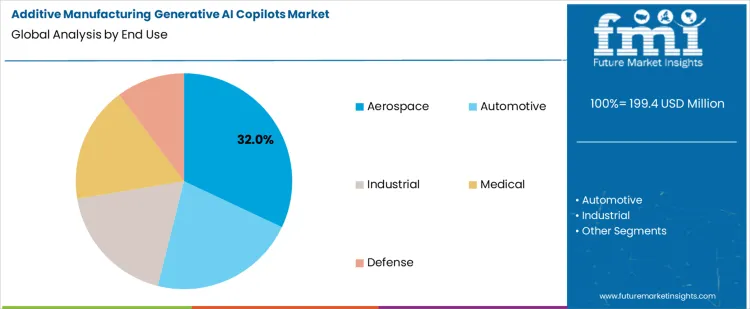
Aerospace accounts for approximately 32% of total end-use demand, making it the largest category. Adoption is driven by the critical need for lightweight, high-performance components that meet stringent safety and certification requirements. AI copilots support the design of structurally optimized parts for aircraft, satellites, and unmanned aerial vehicles. Operational protocols include material selection, simulation, iterative verification, and production planning. Integration with additive manufacturing allows the creation of complex geometries that cannot be produced conventionally, reducing assembly complexity and weight.
Operational and functional factors further shape adoption. Components must meet certification standards, withstand high mechanical stress, and maintain repeatable production quality. Copilots optimize designs to balance performance, manufacturability, and compliance. Aerospace leads because AI-assisted generative design accelerates development, improves material efficiency, and ensures operational reliability, providing measurable benefits across high-value aviation applications while supporting regulatory and safety requirements.
How Are Generative AI Copilots Transforming Additive Manufacturing Workflows?
Generative AI copilots are increasingly adopted in additive manufacturing to optimize design, enhance production efficiency, and reduce material waste. Adoption is strongest in regions with advanced manufacturing sectors, high R&D investment, and complex component production needs. Systems are selected for real-time design suggestions, simulation integration, and adaptive learning capabilities. Growth is driven by demand for rapid prototyping, customization, and operational efficiency. Investment focuses on AI algorithm development, integration with CAD/CAM software, and compatibility with multi-material 3D printers. Manufacturers prioritize copilots that accelerate design cycles while ensuring manufacturability, precision, and compliance with production constraints.
Why Are Regional Industry 4.0 Initiatives and R&D Incentives Driving Adoption?
Demand is influenced by local industrial modernization programs, government innovation grants, and competitive pressures for rapid product development. Companies adopt AI copilots to enhance design creativity, reduce trial-and-error iterations, and improve production throughput. Platforms offering real-time optimization, multi-objective design suggestions, and integration with existing AM workflows gain preference. Adoption is concentrated in regions with strong industrial digitization and additive manufacturing capabilities. Operational efficiency, reduced material consumption, and faster prototyping drive procurement rather than cost. Suppliers providing validated, AI-driven solutions gain competitive advantage among OEMs and design-focused manufacturers.
What Factors Restrict Broader Deployment of AI Copilots in Additive Manufacturing?
High software licensing costs, integration complexity, and data management requirements limit adoption. Copilot performance can be affected by limited training datasets, complex geometry handling, and printer variability. Implementation requires skilled personnel for workflow adaptation and validation. Smaller manufacturers or regions with limited digital infrastructure adopt systems more slowly. These factors concentrate early deployment among advanced AM labs, large OEMs, and R&D-intensive manufacturers with resources to leverage AI-driven design.
How Are Technological Innovation and Collaborative Development Shaping Market Growth?
Recent developments include multi-material optimization algorithms, predictive defect detection, and automated build preparation tools. Collaboration between AI developers, AM equipment manufacturers, and industrial design teams ensures system validation, workflow integration, and production reliability. Pilot projects evaluate design quality, build efficiency, and material usage before large-scale adoption. Quality monitoring, traceability, and algorithm refinement maintain consistency and reliability. Focus is on design optimization, operational efficiency, and manufacturability rather than cost or volume. Collaborative initiatives enable broader adoption of generative AI copilots in additive manufacturing across regional and global industrial sectors.
What is the Demand for Additive Manufacturing Generative AI Copilots by Country?
| Country | CAGR (%) |
|---|---|
| USA | 11.0% |
| Germany | 10.5% |
| China | 10.0% |
| Japan | 9.5% |
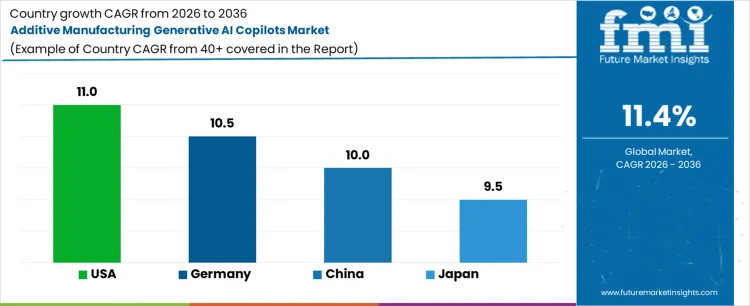
Demand for additive manufacturing generative AI copilots is rising as manufacturers integrate AI-driven design, simulation, and production optimization in 3D printing workflows. The USA leads with an 11.0% CAGR, driven by adoption in aerospace, automotive, and industrial sectors, and investment in AI-assisted design tools. Germany follows at 10.5%, supported by advanced manufacturing infrastructure, industrial AI applications, and strong automotive and aerospace industries. China records 10.0% growth, shaped by rapid adoption of additive manufacturing technologies and integration of AI copilots for design efficiency. Japan shows 9.5% CAGR, reflecting steady implementation in industrial 3D printing and design optimization for high-precision manufacturing.
How Is the United States Experiencing Growth in the Additive Manufacturing Generative AI Copilots Market?
United States is experiencing growth at a CAGR of 11%, supported by adoption of Additive Manufacturing Generative AI Copilots Market solutions to enhance design automation, optimize production workflows, and improve part performance. Manufacturers and technology providers are deploying AI systems designed for real-time design suggestions, topology optimization, and predictive modeling for 3D printing processes. Demand is concentrated in aerospace, automotive, and industrial additive manufacturing hubs. Investments focus on AI system integration, computational efficiency, and compliance with design and quality standards rather than large-scale deployment. Growth reflects increasing adoption of advanced manufacturing technologies, industrial focus on production optimization, and innovation in AI-assisted design.
- Additive manufacturing drives adoption.
- AI copilots optimize design, topology, and workflow.
- Aerospace and automotive hubs concentrate demand.
- System integration and quality compliance guide investment.
How Is Germany Witnessing Growth in the Additive Manufacturing Generative AI Copilots Market?
Germany is witnessing growth at a CAGR of 10.5%, fueled by adoption of Additive Manufacturing Generative AI Copilots Market solutions to improve production efficiency, reduce material waste, and accelerate design cycles. Manufacturers and technology providers are deploying systems optimized for predictive modeling, automated part validation, and topology optimization. Demand is concentrated in automotive, industrial machinery, and aerospace additive manufacturing hubs. Investments prioritize computational efficiency, AI integration, and regulatory compliance rather than fleet-scale deployment. Growth reflects industrial adoption of AI-assisted design tools, focus on efficient additive manufacturing, and innovation in complex part production.
- AI-driven additive manufacturing drives adoption.
- Systems optimize predictive modeling and part validation.
- Industrial and aerospace hubs concentrate demand.
- Computational efficiency and AI integration guide investment.
How Is China Experiencing Growth in the Additive Manufacturing Generative AI Copilots Market?
China is experiencing growth at a CAGR of 10%, supported by deployment of Additive Manufacturing Generative AI Copilots Market solutions to enhance design automation, improve production efficiency, and optimize material usage. Manufacturers and technology providers are producing systems optimized for topology optimization, predictive analytics, and real-time design guidance. Demand is concentrated in aerospace, automotive, and industrial additive manufacturing centers. Investments focus on AI system performance, integration with existing workflows, and compliance with industrial standards rather than large-scale fleet deployment. Growth reflects rapid industrial adoption of AI-assisted design, increased 3D printing activity, and innovation in manufacturing processes.
- Industrial AI copilots drive adoption.
- Systems enhance design automation and predictive analytics.
- Aerospace and automotive manufacturing hubs concentrate demand.
- AI system performance and workflow integration guide investment.
How Is Japan Witnessing Growth in the Additive Manufacturing Generative AI Copilots Market?
Japan is witnessing growth at a CAGR of 9.5%, fueled by adoption of Additive Manufacturing Generative AI Copilots Market solutions to optimize design processes, reduce production errors, and improve material efficiency. Manufacturers and technology providers are deploying systems optimized for real-time design feedback, predictive modeling, and automated part optimization. Demand is concentrated in industrial additive manufacturing hubs, automotive production centers, and aerospace facilities. Investments prioritize computational efficiency, system integration, and compliance with design and quality standards rather than fleet-scale deployment. Growth reflects industrial adoption of AI-assisted 3D printing, technological innovation, and focus on efficient, precise additive manufacturing.
- AI-assisted additive design drives adoption.
- Systems optimize real-time design feedback and predictive modeling.
- Industrial hubs and aerospace centers concentrate demand.
- Computational efficiency and system integration guide investment.
Who Competes in the Additive Manufacturing Generative AI Copilots Market and What Defines Their Capabilities?
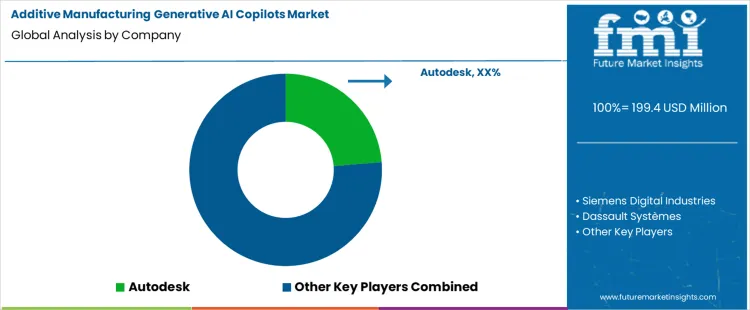
Competition in the additive manufacturing generative AI copilots market is defined by AI-driven design optimization, integration with manufacturing workflows, and simulation capabilities. Autodesk provides generative design platforms with AI copilots that optimize additive manufacturing structures for weight, strength, and material efficiency. Siemens Digital Industries delivers AI-enhanced manufacturing software integrating simulation, workflow planning, and generative design for industrial 3D printing applications. Dassault Systèmes supplies digital twin and generative design tools that allow engineers to explore multiple design iterations and optimize for additive manufacturing constraints. PTC provides AI-assisted design copilot solutions integrated with CAD and PLM platforms for manufacturing workflow optimization. Ansys develops AI-driven simulation copilots that evaluate performance and manufacturability for additive components.
Hexagon focuses on AI copilot solutions integrated with metrology and additive manufacturing planning systems to enhance design validation. Other competitors include regional CAD and additive manufacturing software providers offering AI-guided optimization, simulation, and design recommendation capabilities. Differentiation arises from AI model sophistication, integration with existing CAD/PLM systems, multi-material design support, and simulation accuracy. Market relevance depends on how effectively AI copilots accelerate design cycles, improve material efficiency, ensure manufacturability, and enable engineers to generate optimized geometries suitable for complex additive manufacturing processes.
Key Players in the Additive Manufacturing Generative AI Copilots Market
- Autodesk
- Siemens Digital Industries
- Dassault Systèmes
- PTC
- Ansys
- Hexagon
Scope of the Report
| Items | Values |
|---|---|
| Quantitative Units (2026) | USD million |
| Function | Generative design, Topology optimisation, Process simulation, Cost and material AI, Qualification automation |
| End Use | Aerospace, Automotive, Industrial, Medical, Defense |
| Deployment | Cloud, Hybrid, On-prem |
| Region | Asia Pacific, Europe, North America, Latin America, Middle East & Africa |
| Key Countries Covered | USA, Germany, China, Japan, UK, France, Italy |
| Key Companies Profiled | Autodesk, Siemens Digital Industries, Dassault Systèmes, PTC, Ansys, Hexagon |
| Additional Attributes | Dollar sales by function, end use, and deployment type; regional CAGR, value and volume growth projections; adoption across aerospace, automotive, industrial, medical, and defense sectors; AI algorithm performance, simulation accuracy, and topology optimisation efficiency; integration with CAD/PLM and additive manufacturing workflows; deployment flexibility (cloud, hybrid, on-prem); design validation and manufacturability assurance; operational reliability and material efficiency; partnerships with OEMs and industrial clients. |
Additive Manufacturing Generative AI Copilots Market Segmentation
Function:
- Generative design
- Topology optimisation
- Process simulation
- Cost and material AI
- Qualification automation
End Use:
- Aerospace
- Automotive
- Industrial
- Medical
- Defense
Deployment:
- Cloud
- Hybrid
- On-prem
Region:
- Asia Pacific
- China
- Japan
- South Korea
- India
- Australia & New Zealand
- ASEAN
- Rest of Asia Pacific
- Europe
- Germany
- United Kingdom
- France
- Italy
- Spain
- Nordic
- BENELUX
- Rest of Europe
- North America
- United States
- Canada
- Mexico
- Latin America
- Brazil
- Chile
- Rest of Latin America
- Middle East & Africa
- Kingdom of Saudi Arabia
- Other GCC Countries
- Turkey
- South Africa
- Other African Union
- Rest of Middle East & Africa
Bibliography
- National Institute of Standards and Technology (NIST). (2024). Artificial intelligence for advanced and additive manufacturing. NIST Advanced Manufacturing Series.
- U.S. Department of Energy (DOE). (2023). Advanced manufacturing and additive manufacturing research initiatives. Office of Energy Efficiency and Renewable Energy.
- National Aeronautics and Space Administration (NASA). (2023). Additive manufacturing and generative design for aerospace applications. NASA Technical Reports Server (NTRS).
- European Commission. (2024). Artificial intelligence in advanced manufacturing and Industry 4.0 systems. Directorate‑General for Communications Networks, Content and Technology.
- German Aerospace Center (DLR). (2024). AI‑based design optimization and simulation for additive manufacturing. DLR Institute of Materials Research.
Frequently Asked Questions
How big is the additive manufacturing generative ai copilots market in 2026?
The global additive manufacturing generative ai copilots market is estimated to be valued at USD 199.4 million in 2026.
What will be the size of additive manufacturing generative ai copilots market in 2036?
The market size for the additive manufacturing generative ai copilots market is projected to reach USD 587.7 million by 2036.
How much will be the additive manufacturing generative ai copilots market growth between 2026 and 2036?
The additive manufacturing generative ai copilots market is expected to grow at a 11.4% CAGR between 2026 and 2036.
What are the key product types in the additive manufacturing generative ai copilots market?
The key product types in additive manufacturing generative ai copilots market are generative design, topology optimisation, process simulation, cost and material ai and qualification automation.
Which end use segment to contribute significant share in the additive manufacturing generative ai copilots market in 2026?
In terms of end use, aerospace segment to command 32.0% share in the additive manufacturing generative ai copilots market in 2026.
Preview the report firsthand - request a free sample
Get SampleGet the brochure for pricing and purchase details.
Get PDFTable of Content
- Executive Summary
- Global Market Outlook
- Demand-side Trends
- Supply-side Trends
- Technology Roadmap Analysis
- Analysis and Recommendations
- Market Overview
- Market Coverage / Taxonomy
- Market Definition / Scope / Limitations
- Market Background
- Market Dynamics
- Drivers
- Restraints
- Opportunity
- Trends
- Scenario Forecast
- Demand in Optimistic Scenario
- Demand in Likely Scenario
- Demand in Conservative Scenario
- Opportunity Map Analysis
- Product Life Cycle Analysis
- Supply Chain Analysis
- Investment Feasibility Matrix
- Value Chain Analysis
- PESTLE and Porter’s Analysis
- Regulatory Landscape
- Regional Parent Market Outlook
- Production and Consumption Statistics
- Import and Export Statistics
- Market Dynamics
- Global Market Analysis 2021 to 2025 and Forecast, 2026 to 2036
- Historical Market Size Value (USD Million) Analysis, 2021 to 2025
- Current and Future Market Size Value (USD Million) Projections, 2026 to 2036
- Y-o-Y Growth Trend Analysis
- Absolute $ Opportunity Analysis
- Global Market Pricing Analysis 2021 to 2025 and Forecast 2026 to 2036
- Global Market Analysis 2021 to 2025 and Forecast 2026 to 2036, By Function
- Introduction / Key Findings
- Historical Market Size Value (USD Million) Analysis By Function , 2021 to 2025
- Current and Future Market Size Value (USD Million) Analysis and Forecast By Function , 2026 to 2036
- Generative design
- Topology optimisation
- Process simulation
- Cost and material AI
- Qualification automation
- Generative design
- Y-o-Y Growth Trend Analysis By Function , 2021 to 2025
- Absolute $ Opportunity Analysis By Function , 2026 to 2036
- Global Market Analysis 2021 to 2025 and Forecast 2026 to 2036, By End Use
- Introduction / Key Findings
- Historical Market Size Value (USD Million) Analysis By End Use, 2021 to 2025
- Current and Future Market Size Value (USD Million) Analysis and Forecast By End Use, 2026 to 2036
- Aerospace
- Automotive
- Industrial
- Medical
- Defense
- Aerospace
- Y-o-Y Growth Trend Analysis By End Use, 2021 to 2025
- Absolute $ Opportunity Analysis By End Use, 2026 to 2036
- Global Market Analysis 2021 to 2025 and Forecast 2026 to 2036, By Deployment
- Introduction / Key Findings
- Historical Market Size Value (USD Million) Analysis By Deployment, 2021 to 2025
- Current and Future Market Size Value (USD Million) Analysis and Forecast By Deployment, 2026 to 2036
- Cloud
- Hybrid
- On-prem
- Cloud
- Y-o-Y Growth Trend Analysis By Deployment, 2021 to 2025
- Absolute $ Opportunity Analysis By Deployment, 2026 to 2036
- Global Market Analysis 2021 to 2025 and Forecast 2026 to 2036, By Region
- Introduction
- Historical Market Size Value (USD Million) Analysis By Region, 2021 to 2025
- Current Market Size Value (USD Million) Analysis and Forecast By Region, 2026 to 2036
- North America
- Latin America
- Western Europe
- Eastern Europe
- East Asia
- South Asia and Pacific
- Middle East & Africa
- Market Attractiveness Analysis By Region
- North America Market Analysis 2021 to 2025 and Forecast 2026 to 2036, By Country
- Historical Market Size Value (USD Million) Trend Analysis By Market Taxonomy, 2021 to 2025
- Market Size Value (USD Million) Forecast By Market Taxonomy, 2026 to 2036
- By Country
- USA
- Canada
- Mexico
- By Function
- By End Use
- By Deployment
- By Country
- Market Attractiveness Analysis
- By Country
- By Function
- By End Use
- By Deployment
- Key Takeaways
- Latin America Market Analysis 2021 to 2025 and Forecast 2026 to 2036, By Country
- Historical Market Size Value (USD Million) Trend Analysis By Market Taxonomy, 2021 to 2025
- Market Size Value (USD Million) Forecast By Market Taxonomy, 2026 to 2036
- By Country
- Brazil
- Chile
- Rest of Latin America
- By Function
- By End Use
- By Deployment
- By Country
- Market Attractiveness Analysis
- By Country
- By Function
- By End Use
- By Deployment
- Key Takeaways
- Western Europe Market Analysis 2021 to 2025 and Forecast 2026 to 2036, By Country
- Historical Market Size Value (USD Million) Trend Analysis By Market Taxonomy, 2021 to 2025
- Market Size Value (USD Million) Forecast By Market Taxonomy, 2026 to 2036
- By Country
- Germany
- UK
- Italy
- Spain
- France
- Nordic
- BENELUX
- Rest of Western Europe
- By Function
- By End Use
- By Deployment
- By Country
- Market Attractiveness Analysis
- By Country
- By Function
- By End Use
- By Deployment
- Key Takeaways
- Eastern Europe Market Analysis 2021 to 2025 and Forecast 2026 to 2036, By Country
- Historical Market Size Value (USD Million) Trend Analysis By Market Taxonomy, 2021 to 2025
- Market Size Value (USD Million) Forecast By Market Taxonomy, 2026 to 2036
- By Country
- Russia
- Poland
- Hungary
- Balkan & Baltic
- Rest of Eastern Europe
- By Function
- By End Use
- By Deployment
- By Country
- Market Attractiveness Analysis
- By Country
- By Function
- By End Use
- By Deployment
- Key Takeaways
- East Asia Market Analysis 2021 to 2025 and Forecast 2026 to 2036, By Country
- Historical Market Size Value (USD Million) Trend Analysis By Market Taxonomy, 2021 to 2025
- Market Size Value (USD Million) Forecast By Market Taxonomy, 2026 to 2036
- By Country
- China
- Japan
- South Korea
- By Function
- By End Use
- By Deployment
- By Country
- Market Attractiveness Analysis
- By Country
- By Function
- By End Use
- By Deployment
- Key Takeaways
- South Asia and Pacific Market Analysis 2021 to 2025 and Forecast 2026 to 2036, By Country
- Historical Market Size Value (USD Million) Trend Analysis By Market Taxonomy, 2021 to 2025
- Market Size Value (USD Million) Forecast By Market Taxonomy, 2026 to 2036
- By Country
- India
- ASEAN
- Australia & New Zealand
- Rest of South Asia and Pacific
- By Function
- By End Use
- By Deployment
- By Country
- Market Attractiveness Analysis
- By Country
- By Function
- By End Use
- By Deployment
- Key Takeaways
- Middle East & Africa Market Analysis 2021 to 2025 and Forecast 2026 to 2036, By Country
- Historical Market Size Value (USD Million) Trend Analysis By Market Taxonomy, 2021 to 2025
- Market Size Value (USD Million) Forecast By Market Taxonomy, 2026 to 2036
- By Country
- Kingdom of Saudi Arabia
- Other GCC Countries
- Turkiye
- South Africa
- Other African Union
- Rest of Middle East & Africa
- By Function
- By End Use
- By Deployment
- By Country
- Market Attractiveness Analysis
- By Country
- By Function
- By End Use
- By Deployment
- Key Takeaways
- Key Countries Market Analysis
- USA
- Pricing Analysis
- Market Share Analysis, 2025
- By Function
- By End Use
- By Deployment
- Canada
- Pricing Analysis
- Market Share Analysis, 2025
- By Function
- By End Use
- By Deployment
- Mexico
- Pricing Analysis
- Market Share Analysis, 2025
- By Function
- By End Use
- By Deployment
- Brazil
- Pricing Analysis
- Market Share Analysis, 2025
- By Function
- By End Use
- By Deployment
- Chile
- Pricing Analysis
- Market Share Analysis, 2025
- By Function
- By End Use
- By Deployment
- Germany
- Pricing Analysis
- Market Share Analysis, 2025
- By Function
- By End Use
- By Deployment
- UK
- Pricing Analysis
- Market Share Analysis, 2025
- By Function
- By End Use
- By Deployment
- Italy
- Pricing Analysis
- Market Share Analysis, 2025
- By Function
- By End Use
- By Deployment
- Spain
- Pricing Analysis
- Market Share Analysis, 2025
- By Function
- By End Use
- By Deployment
- France
- Pricing Analysis
- Market Share Analysis, 2025
- By Function
- By End Use
- By Deployment
- India
- Pricing Analysis
- Market Share Analysis, 2025
- By Function
- By End Use
- By Deployment
- ASEAN
- Pricing Analysis
- Market Share Analysis, 2025
- By Function
- By End Use
- By Deployment
- Australia & New Zealand
- Pricing Analysis
- Market Share Analysis, 2025
- By Function
- By End Use
- By Deployment
- China
- Pricing Analysis
- Market Share Analysis, 2025
- By Function
- By End Use
- By Deployment
- Japan
- Pricing Analysis
- Market Share Analysis, 2025
- By Function
- By End Use
- By Deployment
- South Korea
- Pricing Analysis
- Market Share Analysis, 2025
- By Function
- By End Use
- By Deployment
- Russia
- Pricing Analysis
- Market Share Analysis, 2025
- By Function
- By End Use
- By Deployment
- Poland
- Pricing Analysis
- Market Share Analysis, 2025
- By Function
- By End Use
- By Deployment
- Hungary
- Pricing Analysis
- Market Share Analysis, 2025
- By Function
- By End Use
- By Deployment
- Kingdom of Saudi Arabia
- Pricing Analysis
- Market Share Analysis, 2025
- By Function
- By End Use
- By Deployment
- Turkiye
- Pricing Analysis
- Market Share Analysis, 2025
- By Function
- By End Use
- By Deployment
- South Africa
- Pricing Analysis
- Market Share Analysis, 2025
- By Function
- By End Use
- By Deployment
- USA
- Market Structure Analysis
- Competition Dashboard
- Competition Benchmarking
- Market Share Analysis of Top Players
- By Regional
- By Function
- By End Use
- By Deployment
- Competition Analysis
- Competition Deep Dive
- Autodesk
- Overview
- Product Portfolio
- Profitability by Market Segments (Product/Age /Sales Channel/Region)
- Sales Footprint
- Strategy Overview
- Marketing Strategy
- Product Strategy
- Channel Strategy
- Siemens Digital Industries
- Dassault Systèmes
- PTC
- Ansys
- Hexagon
- Autodesk
- Competition Deep Dive
- Assumptions & Acronyms Used
- Research Methodology


