

- Market Size (2026)
- USD 29.1 Bn
- Forecast (2036)
- USD 200.8 Bn
- CAGR (2026 to 2036)
- 21.3%
AI Platform Market Size, Market Forecast and Outlook By FMI
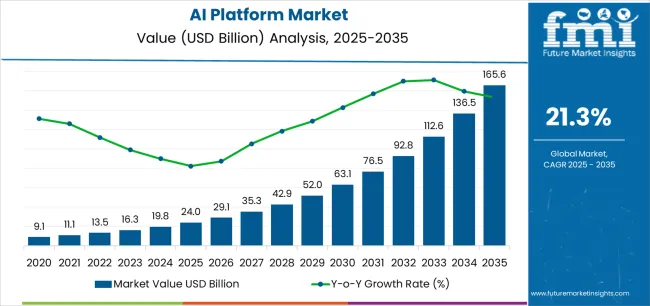
The AI platform market was valued at USD 24.0 billion in 2025. The market is set to reach USD 29.1 billion by 2026-end and grow at a CAGR of 21.3% between 2026-2036 to reach USD 200.8 billion by 2036. AI Machine Learning Platforms will dominate with a 30.0% share, while Cloud-Based will lead with a 75.0%% share.
Summary of AI Platform Market
- Demand and Growth Drivers
- Enterprise AI adoption is maturing from experimental pilots to production-scale deployment, creating demand for platforms that manage the full ML lifecycle from data preparation through model monitoring and governance.
- Multi-cloud and hybrid deployment requirements are driving platform investment as enterprises seek AI infrastructure that operates consistently across cloud providers and on-premises environments.
- AI governance and compliance requirements are increasing as regulatory frameworks mandate transparency, fairness, and auditability in AI-driven decisions, creating demand for platform-level governance capabilities.
- Product and Segment View
- AI Machine Learning Platforms holds 30% of the component segment in 2026, supported by enterprise demand for comprehensive ML infrastructure spanning model development, training, deployment, and operational monitoring.
- Cloud-Based accounts for 75% of the deployment segment, reflecting enterprise preference for scalable AI infrastructure that reduces on-premises hardware investment and accelerates deployment timelines.
- IT and telecom holds 25.0% of the industry segment, driven by telecommunications and technology companies deploying AI platforms for network optimization, customer experience, and operational automation.
- Geography and Competitive Outlook
- China leads country-level growth at 22.1% CAGR, supported by massive technology industry scale, enterprise AI adoption across manufacturing and services, and government AI investment programs.
- India follows at 21.6% CAGR, driven by rapid enterprise digitization, IT services industry AI capability building, and government digital transformation programs.
- Competition spans major cloud hyperscalers offering integrated AI platforms, enterprise software vendors adding AI platform capabilities, and specialized MLOps companies providing focused model lifecycle management tools.
- Analyst Opinion
- The AI platform market is consolidating around comprehensive offerings that address the full ML lifecycle, from data preparation through production monitoring and governance. Enterprises are moving beyond point tools toward integrated platforms that reduce the complexity of managing AI across multiple teams, use cases, and deployment environments. The critical differentiator is not raw model training performance but operational maturity: platforms that simplify model deployment, monitoring, and governance at enterprise scale will capture the largest share of spending as AI moves from experimental to mission-critical production workloads.
- MLOps maturity is becoming a key procurement criterion as enterprises scale from dozens to hundreds of production AI models requiring systematic management.
- Foundation model and generative AI integration is reshaping platform architectures, with enterprises requiring platforms that support both custom model development and pre-trained model fine-tuning.
- AI platform vendor lock-in concerns are driving demand for open-source compatible and multi-cloud capable platforms that preserve deployment flexibility.
Key Takeaways, Market Size, and Forecast
- The AI Platform Market was valued at USD 24.00 billion in 2025.
- By 2036, the AI Platform Market is expected to be worth USD 200.76 billion.
- From 2026 to 2036, the market is projected to expand at a CAGR of 21.3%.
- The market is projected to create an incremental opportunity of USD 171.65 billion between 2026 and 2036.
- In 2026, AI machine learning platforms is expected to account for 30% of the component segment, driven by enterprise demand for end-to-end ML infrastructure covering model development, training, deployment, and monitoring.
- China (22.1%) and India (21.6%) are two of the fastest growing markets in the world.
AI Platform Market Definition
The AI platform market includes cloud-based and on-premises software platforms that provide end-to-end infrastructure for developing, training, deploying, and managing artificial intelligence and machine learning models across enterprise applications.
AI Platform Market Inclusions
Market scope covers AI platforms segmented by component (AI machine learning platforms, AI tools, AI NLP platforms, AI services), deployment (cloud-based, on-premises), and industry (IT and telecom, retail, BFSI, healthcare, manufacturing, robotics, others). The revenue range extends from 2026 to 2036.
AI Platform Market Exclusions
The scope does not include standalone AI applications without platform capabilities, basic data analytics tools without ML model management, consumer AI applications, and AI-specific hardware without integrated platform software.
AI Platform Market Research Methodology
- Primary Research: FMI analysts conducted interviews with technology vendors, industry practitioners, and domain specialists across key markets.
- Desk Research: Integrated data from industry publications, regulatory databases, and technology vendor disclosures.
- Market Sizing and Forecasting: Bottom-up aggregation across segments and regional adoption curves with cross-validation against industry spending data.
- Data Validation: Cross-checked quarterly against vendor revenue disclosures, industry surveys, and regulatory filings.
Why is the AI Platform Market Growing?
- Enterprise AI production deployment is scaling beyond pilot programs, creating demand for platforms that manage hundreds of ML models across diverse business functions with consistent governance and monitoring.
- Foundation model integration requirements are reshaping AI platforms as enterprises need infrastructure that supports both custom model development and pre-trained model adaptation for domain-specific applications.
- Regulatory AI governance mandates are driving platform investment as compliance frameworks require auditable model lifecycle management, bias detection, and decision transparency capabilities.
The AI platform market reflects the maturation of enterprise AI from experimental technology to core operational infrastructure. Organizations that moved beyond proof-of-concept AI projects are discovering that production-scale AI requires systematic platform capabilities for model management, deployment, and governance that ad-hoc toolchains cannot provide.
Cloud-based deployment at 75.0% of the deployment segment reflects the enterprise preference for scalable AI infrastructure that reduces the capital investment and operational complexity of on-premises AI computing environments.
AI machine learning platforms at 30.0% of the component segment represent the core infrastructure category, providing end-to-end model development environments with integrated data processing, feature engineering, model training, and deployment capabilities.
Market Segmentation Analysis
- AI Machine Learning Platforms holds 30% of the component segment, supported by enterprise demand for comprehensive ML infrastructure spanning model development, training, deployment, and operational monitoring.
- Cloud-Based at 75% leads the deployment segment, reflecting enterprise preference for scalable AI infrastructure that reduces on-premises hardware investment and accelerates deployment timelines.
- Additional segments contribute to market diversification across applications.
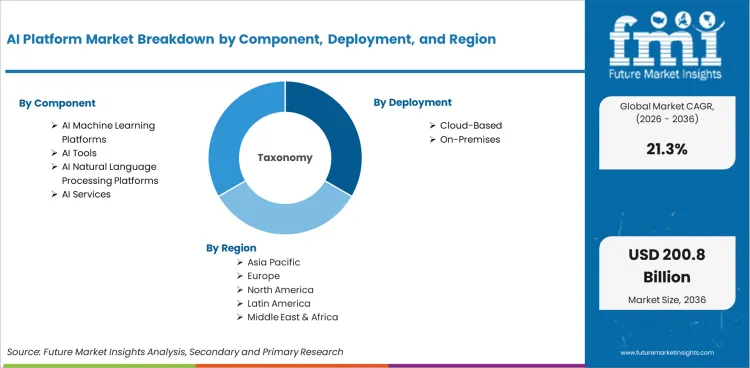
The ai platform market is segmented by component (AI machine learning platforms, AI tools, AI NLP platforms, AI services), deployment (cloud-based, on-premises), and industry (IT and telecom, retail and e-commerce, BFSI, healthcare and life sciences, manufacturing, robotics, others).
Insights into the AI Machine Learning Platforms Component
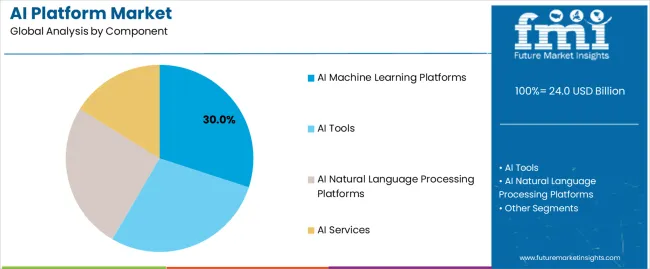
AI machine learning platforms hold 30.0% of the component segment in 2026. These platforms provide integrated environments for the full ML lifecycle including data ingestion, feature engineering, model training, hyperparameter optimization, deployment automation, and production monitoring within unified interfaces.
Platform differentiation centers on ease of use for data science teams, integration depth with enterprise data systems, and operational capabilities for managing production model fleets at scale.
Insights into the Cloud-Based Deployment Segment
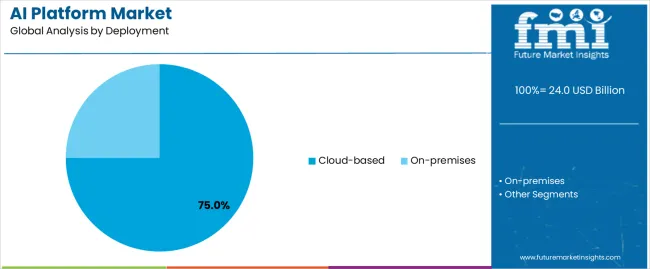
Cloud-based deployment accounts for 75.0% of the deployment segment in 2026. Enterprise preference for cloud AI platforms reflects the practical advantages of elastic compute scaling for model training workloads, managed infrastructure reducing operational burden, and rapid provisioning of AI development environments.
Hybrid deployment models are gaining traction as enterprises require cloud-based model development combined with on-premises or edge deployment for latency-sensitive and data-residency-constrained applications.
AI Platform Market Drivers, Restraints, and Opportunities
- Enterprise AI production scaling and governance requirements are the primary structural drivers, converting AI platforms from optional developer tools to mandatory enterprise infrastructure.
- Platform complexity, vendor lock-in risks, and skills shortages in ML engineering constrain adoption velocity, particularly among mid-market organizations.
- Edge AI deployment and industry-specific AI platforms create growth opportunities as AI processing extends beyond cloud into manufacturing, healthcare, and retail operational environments.
The AI platform market is shaped by the enterprise imperative to operationalize AI at scale while maintaining governance, compliance, and cost efficiency across expanding AI workloads.
Enterprise AI Scaling as Structural Driver
Organizations scaling from pilot AI projects to enterprise-wide deployment require platforms that systematize model development, deployment, and monitoring. The alternative, managing AI through ad-hoc toolchains, creates governance gaps and operational fragility.
Complexity and Vendor Lock-in Barriers
AI platform adoption requires ML engineering expertise that remains scarce. Platform vendor lock-in concerns, particularly around proprietary model formats and cloud-specific APIs, create procurement hesitation among enterprise technology leaders.
Edge AI and Vertical Platform Opportunities
AI processing at the edge for manufacturing, autonomous systems, and real-time applications requires platform capabilities for model optimization, deployment to constrained hardware, and remote monitoring, creating a distinct growth segment.
Analysis of AI Platform Market by Key Countries
.webp "Top Country Growth Comparison Ai Platform Market Cagr (2026 2036)")
| Country | CAGR |
|---|---|
| China | 22.1% |
| India | 21.6% |
| USA | 19.1% |
| Germany | 18.5% |
| UK | 17.4% |
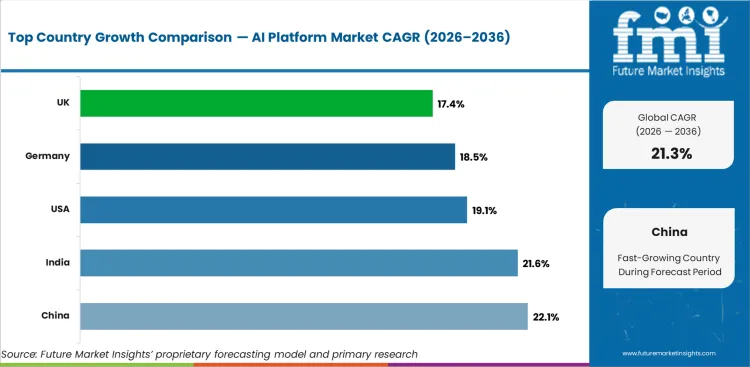
- China leads at 22.1% CAGR through 2036, supported by massive technology industry scale and enterprise AI adoption programs.
- India at 21.6% CAGR driven by rapid enterprise digitization and IT services industry AI platform investment.
- USA (19.1%) and Germany (18.5%) maintain growth driven by enterprise digital transformation and regulatory AI governance requirements.
The ai platform market is projected to expand at 21.3% CAGR globally from 2026 to 2036. The analysis covers more than 30 countries, with the leading markets detailed below.
Demand Outlook for AI Platform Market in China
China is growing at 22.1% CAGR through 2036, leading country-level growth. Technology industry scale, enterprise AI adoption across manufacturing and services, and government AI development programs are driving platform investment.
- Technology industry concentration creates high-density AI platform demand across cloud providers and enterprise software companies.
- Manufacturing sector AI adoption drives platform investment for industrial AI applications at scale.
- Government AI development programs fund platform infrastructure across research institutions and state enterprises.
Future Outlook for AI Platform Market in India
India is expanding at 21.6% CAGR through 2036, supported by IT services industry AI capability building, enterprise digitization programs, and government digital transformation initiatives.
- IT services industry deploys AI platforms to build AI delivery capabilities for global enterprise clients.
- Enterprise digitization across banking, telecom, and manufacturing drives AI platform procurement.
- Government Digital India programs include AI platform infrastructure for public service applications.
Opportunity Analysis of AI Platform Market in the USA
The USA is growing at 19.1% CAGR through 2036, maintaining the largest revenue base globally. Enterprise AI platform investment spans technology, financial services, healthcare, and manufacturing sectors.
- Enterprise AI production deployment at scale drives platform procurement across Fortune 500 organizations.
- Cloud hyperscaler platform competition benefits enterprise buyers through feature expansion and price optimization.
- Healthcare and financial services AI governance requirements drive platform capabilities for regulated industries.
In-depth Analysis of AI Platform Market in Germany
Germany is growing at 18.5% CAGR through 2036, reflecting industrial AI platform adoption, EU AI Act compliance requirements, and enterprise investment in AI governance infrastructure.
- Industrial AI platform adoption across automotive and manufacturing drives production-scale deployment.
- EU AI Act compliance creates demand for platforms with built-in governance, transparency, and risk management capabilities.
- Enterprise AI Centers of Excellence are standardizing on platform infrastructure for cross-functional AI deployment.
Sales Analysis of AI Platform Market in the UK
The UK is growing at 17.4% CAGR through 2036, supported by financial services AI platform investment, technology sector concentration, and government AI strategy programs.
- Financial services sector leads enterprise AI platform adoption for risk management, compliance, and customer analytics.
- Technology sector concentration in London drives AI platform development and early enterprise adoption.
- Government AI strategy includes platform infrastructure investment for public sector AI applications.
Competitive Landscape and Strategic Positioning
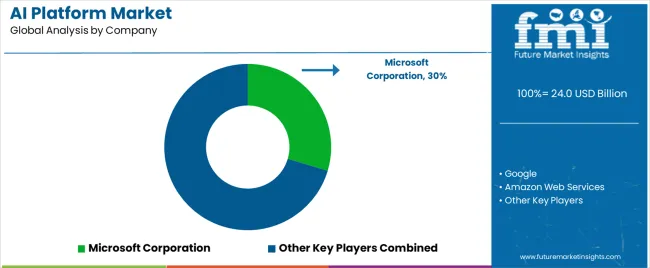
- Microsoft maintains leadership through Azure AI platform combining cloud infrastructure, ML services, and OpenAI integration for enterprise AI development and deployment.
- Google and AWS compete through comprehensive cloud AI platforms offering managed ML services, pre-trained models, and enterprise deployment tools.
- Specialized MLOps companies and enterprise software vendors provide focused platform capabilities for specific AI lifecycle stages and industry verticals.
Microsoft Azure AI maintains a strong market position through its comprehensive platform combining Azure Machine Learning, Cognitive Services, and OpenAI model access within an integrated enterprise cloud environment. Google Cloud AI Platform competes through Vertex AI with strong model training and AutoML capabilities.
AWS offers SageMaker as its primary AI platform, providing end-to-end ML capabilities with deep integration into the AWS ecosystem. IBM offers Watson Studio and watsonx for enterprise AI development with emphasis on governance and compliance.
Salesforce, Oracle, and SAP integrate AI platform capabilities into their enterprise application ecosystems, providing industry-specific AI tools within established business software environments.
Key Companies in the AI Platform Market
Key global companies leading the ai platform market include:
- Microsoft Corporation (USA), Google (USA), Amazon Web Services (USA), and IBM Corporation (USA) maintain dominant positions through comprehensive cloud AI platforms with enterprise integration and governance capabilities.
- Salesforce (USA), Oracle Corporation (USA), and SAP SE (Germany) compete through AI platform capabilities integrated into enterprise application ecosystems.
- Infogain Corporation (USA), Avenga (USA), and Vital AI LLC (USA) represent specialized players providing focused AI platform services and implementation capabilities.
Competitive Benchmarking: AI Platform Market
| Company | Platform Scope | AI Capability | Enterprise Access | Geographic Reach |
|---|---|---|---|---|
| Microsoft | Comprehensive | Advanced | Strong | Global |
| Comprehensive | Advanced | Strong | Global | |
| AWS | Comprehensive | Advanced | Strong | Global |
| IBM | Broad | Advanced | Strong | Global |
| Salesforce | CRM-focused | Advanced | Strong | Global |
| Oracle | Enterprise | Moderate | Strong | Global |
| SAP SE | Enterprise | Moderate | Strong | Global |
| Infosys | Services | Moderate | Moderate | Global |
| Kasisto | Vertical | Advanced | Niche | N. America |
| Receptiviti | NLP | Advanced | Niche | N. America |
Source: Future Market Insights competitive analysis, 2026.
Key Players in the AI Platform Market
Major Global Players
- Microsoft Corporation
- Amazon Web Services
- IBM Corporation
- Salesforce
- Oracle Corporation
- SAP SE
Emerging Players/Startups
- Infogain Corporation
- Avenga
- Vital AI, LLC
- Infosys Limited
- Receptiviti Inc.
- Kasisto
- Premonition
- Rainbird Decision Intelligence
Report Scope and Coverage
| Parameter | Details |
|---|---|
| Quantitative Units | USD 29.11 billion to USD 200.76 billion, at a CAGR of 21.3% |
| Market Definition | The AI platform market includes cloud-based and on-premises software platforms that provide end-to-end infrastructure for developing, training, deploying, and managing artificial intelligence and machine learning models across enterprise applications. |
| Regions Covered | North America, Latin America, Europe, East Asia, South Asia and Pacific, Middle East and Africa |
| Countries Covered | China, India, USA, Germany, UK, 30 plus countries |
| Key Companies Profiled | Microsoft Corporation, Google, Amazon Web Services, IBM Corporation, Salesforce, Infogain Corporation, Avenga, Vital AI, LLC |
| Forecast Period | 2026 to 2036 |
| Approach | Hybrid bottom-up and top-down methodology starting with verified industry data, projecting adoption velocity across segments and regions. |
Market Segmentation Analysis
AI Platform Market Segmented by Component:
- AI Machine Learning Platforms
- AI Tools
- AI Natural Language Processing Platforms
- AI Services
AI Platform Market Segmented by Deployment:
- Cloud-Based
- On-Premises
AI Platform Market Segmented by Industry:
- IT and Telecom
- Retail and E-commerce
- BFSI (Banking, Financial Services, and Insurance)
- Healthcare and Life Sciences
- Manufacturing
- Robotics
- Others
AI Platform Market by Region:
- North America
- USA
- Canada
- Mexico
- Latin America
- Brazil
- Chile
- Rest of Latin America
- Western Europe
- Germany
- UK
- Italy
- Spain
- France
- Nordic
- BENELUX
- Rest of Western Europe
- Eastern Europe
- Russia
- Poland
- Hungary
- Balkan & Baltic
- Rest of Eastern Europe
- East Asia
- China
- Japan
- South Korea
- South Asia and Pacific
- India
- ASEAN
- Australia & New Zealand
- Rest of South Asia and Pacific
- Middle East & Africa
- Kingdom of Saudi Arabia
- Other GCC Countries
- Turkiye
- South Africa
- Other African Union
- Rest of Middle East & Africa
Research Sources and Bibliography
- Gartner. (2025). Magic Quadrant for Cloud AI Developer Services. Gartner.
- European Commission. (2025). EU AI Act: Platform Provider Compliance Requirements. EC.
- National Institute of Standards and Technology. (2025). AI Risk Management Framework: Platform Implementation Guide. NIST.
- World Economic Forum. (2024). Enterprise AI Platform Adoption: Global Assessment. WEF.
- OECD. (2025). AI Infrastructure and Platform Market Economic Analysis. OECD.
This bibliography is provided for reader reference.
This Report Answers
- Estimating the size of the ai platform market and revenue projections from 2026 to 2036.
- Segmentation by component (AI machine learning platforms, AI tools, AI NLP platforms.
- Insights about more than 30 markets in the region.
- Analysis of key technology, application, and deployment segments.
- Assessment of the competitive landscape.
- Finding investment opportunities across key segments and regions.
- Tracking regulatory frameworks and industry standards.
Frequently Asked Questions
What is the global market demand for ai platform in 2026?
In 2026, the global ai platform market is expected to be worth USD 29.11 billion.
How big will the ai platform market be in 2036?
By 2036, the market is expected to be worth USD 200.76 billion.
How much is demand expected to grow between 2026 and 2036?
Between 2026 and 2036, the market is expected to grow at a CAGR of 21.3%.
Which component segment is likely to lead globally in 2026?
AI Machine Learning Platforms is expected to hold 30% of the component segment in 2026, supported by enterprise demand for comprehensive ML infrastructure spanning model development, training, deployment, and operational monitoring.
What is causing demand to rise in China?
China is growing at 22.1% CAGR through 2036, supported by massive technology industry scale, enterprise AI adoption across manufacturing and services, and government AI investment programs.
What is causing demand to rise in India?
India is expanding at 21.6% CAGR through 2036, driven by rapid enterprise digitization, IT services industry AI capability building, and government digital transformation programs.
What does this report mean by ai platform market definition?
The AI platform market includes cloud-based and on-premises software platforms that provide end-to-end infrastructure for developing, training, deploying, and managing artificial intelligence and machine learning models across enterprise applications.
How does FMI make this forecast and validate it?
Forecasting uses a hybrid bottom-up and top-down approach, starting with verified industry data and cross-checking against vendor disclosures and industry spending surveys.
Preview the report firsthand - request a free sample
Get SampleGet the brochure for pricing and purchase details.
Get PDFTable of Content
- Executive Summary
- Global Market Outlook
- Demand-side Trends
- Supply-side Trends
- Technology Roadmap Analysis
- Analysis and Recommendations
- Market Overview
- Market Coverage / Taxonomy
- Market Definition / Scope / Limitations
- Research Methodology
- Chapter Orientation
- Analytical Lens and Working Hypotheses
- Market Structure, Signals, and Trend Drivers
- Benchmarking and Cross-market Comparability
- Market Sizing, Forecasting, and Opportunity Mapping
- Research Design and Evidence Framework
- Desk Research Programme (Secondary Evidence)
- Company Annual and Sustainability Reports
- Peer-reviewed Journals and Academic Literature
- Corporate Websites, Product Literature, and Technical Notes
- Earnings Decks and Investor Briefings
- Statutory Filings and Regulatory Disclosures
- Technical White Papers and Standards Notes
- Trade Journals, Industry Magazines, and Analyst Briefs
- Conference Proceedings, Webinars, and Seminar Materials
- Government Statistics Portals and Public Data Releases
- Sector Databases and Reference Repositories
- FMI Internal Proprietary Databases and Historical Market Datasets
- Subscription Datasets and Paid Sources
- Social Channels, Communities, and Digital Listening Inputs
- Additional Desk Sources
- Expert Input and Fieldwork (Primary Evidence)
- Primary Modes
- Qualitative Interviews and Expert Elicitation
- Quantitative Surveys and Structured Data Capture
- Blended Approach
- Why Primary Evidence is Used
- Field Techniques
- Interviews
- Surveys
- Focus Groups
- Observational and In-context Research
- Social and Community Interactions
- Stakeholder Universe Engaged
- C-suite Leaders
- Board Members
- Presidents and Vice Presidents
- R&D and Innovation Heads
- Technical Specialists
- Domain Subject-matter Experts
- Scientists
- Physicians and Other Healthcare Professionals
- Governance, Ethics, and Data Stewardship
- Research Ethics
- Data Integrity and Handling
- Primary Modes
- Tooling, Models, and Reference Databases
- Desk Research Programme (Secondary Evidence)
- Data Engineering and Model Build
- Data Acquisition and Ingestion
- Cleaning, Normalisation, and Verification
- Synthesis, Triangulation, and Analysis
- Quality Assurance and Audit Trail
- Market Background
- Market Dynamics
- Drivers
- Restraints
- Opportunity
- Trends
- Scenario Forecast
- Demand in Optimistic Scenario
- Demand in Likely Scenario
- Demand in Conservative Scenario
- Opportunity Map Analysis
- Product Life Cycle Analysis
- Supply Chain Analysis
- Investment Feasibility Matrix
- Value Chain Analysis
- PESTLE and Porter’s Analysis
- Regulatory Landscape
- Regional Parent Market Outlook
- Production and Consumption Statistics
- Import and Export Statistics
- Market Dynamics
- Global Market Analysis 2021 to 2025 and Forecast, 2026 to 2036
- Historical Market Size Value (USD Billion) Analysis, 2021 to 2025
- Current and Future Market Size Value (USD Billion) Projections, 2026 to 2036
- Y-o-Y Growth Trend Analysis
- Absolute $ Opportunity Analysis
- Global Market Pricing Analysis 2021 to 2025 and Forecast 2026 to 2036
- Global Market Analysis 2021 to 2025 and Forecast 2026 to 2036, By Component
- Introduction / Key Findings
- Historical Market Size Value (USD Billion) Analysis By Component , 2021 to 2025
- Current and Future Market Size Value (USD Billion) Analysis and Forecast By Component , 2026 to 2036
- AI Machine Learning Platforms
- AI Tools
- AI Natural Language Processing Platforms
- AI Services
- AI Machine Learning Platforms
- Y-o-Y Growth Trend Analysis By Component , 2021 to 2025
- Absolute $ Opportunity Analysis By Component , 2026 to 2036
- Global Market Analysis 2021 to 2025 and Forecast 2026 to 2036, By Deployment
- Introduction / Key Findings
- Historical Market Size Value (USD Billion) Analysis By Deployment, 2021 to 2025
- Current and Future Market Size Value (USD Billion) Analysis and Forecast By Deployment, 2026 to 2036
- Cloud-Based
- On-Premises
- Cloud-Based
- Y-o-Y Growth Trend Analysis By Deployment, 2021 to 2025
- Absolute $ Opportunity Analysis By Deployment, 2026 to 2036
- Global Market Analysis 2021 to 2025 and Forecast 2026 to 2036, By Industry
- Introduction / Key Findings
- Historical Market Size Value (USD Billion) Analysis By Industry, 2021 to 2025
- Current and Future Market Size Value (USD Billion) Analysis and Forecast By Industry, 2026 to 2036
- IT and Telecom
- Retail and E-commerce
- BFSI (Banking, Financial Services, and Insurance)
- Healthcare and Life Sciences
- Manufacturing
- Robotics
- Others
- IT and Telecom
- Y-o-Y Growth Trend Analysis By Industry, 2021 to 2025
- Absolute $ Opportunity Analysis By Industry, 2026 to 2036
- Global Market Analysis 2021 to 2025 and Forecast 2026 to 2036, By Region
- Introduction
- Historical Market Size Value (USD Billion) Analysis By Region, 2021 to 2025
- Current Market Size Value (USD Billion) Analysis and Forecast By Region, 2026 to 2036
- North America
- Latin America
- Western Europe
- Eastern Europe
- East Asia
- South Asia and Pacific
- Middle East & Africa
- Market Attractiveness Analysis By Region
- North America Market Analysis 2021 to 2025 and Forecast 2026 to 2036, By Country
- Historical Market Size Value (USD Billion) Trend Analysis By Market Taxonomy, 2021 to 2025
- Market Size Value (USD Billion) Forecast By Market Taxonomy, 2026 to 2036
- By Country
- USA
- Canada
- Mexico
- By Component
- By Deployment
- By Industry
- By Country
- Market Attractiveness Analysis
- By Country
- By Component
- By Deployment
- By Industry
- Key Takeaways
- Latin America Market Analysis 2021 to 2025 and Forecast 2026 to 2036, By Country
- Historical Market Size Value (USD Billion) Trend Analysis By Market Taxonomy, 2021 to 2025
- Market Size Value (USD Billion) Forecast By Market Taxonomy, 2026 to 2036
- By Country
- Brazil
- Chile
- Rest of Latin America
- By Component
- By Deployment
- By Industry
- By Country
- Market Attractiveness Analysis
- By Country
- By Component
- By Deployment
- By Industry
- Key Takeaways
- Western Europe Market Analysis 2021 to 2025 and Forecast 2026 to 2036, By Country
- Historical Market Size Value (USD Billion) Trend Analysis By Market Taxonomy, 2021 to 2025
- Market Size Value (USD Billion) Forecast By Market Taxonomy, 2026 to 2036
- By Country
- Germany
- UK
- Italy
- Spain
- France
- Nordic
- BENELUX
- Rest of Western Europe
- By Component
- By Deployment
- By Industry
- By Country
- Market Attractiveness Analysis
- By Country
- By Component
- By Deployment
- By Industry
- Key Takeaways
- Eastern Europe Market Analysis 2021 to 2025 and Forecast 2026 to 2036, By Country
- Historical Market Size Value (USD Billion) Trend Analysis By Market Taxonomy, 2021 to 2025
- Market Size Value (USD Billion) Forecast By Market Taxonomy, 2026 to 2036
- By Country
- Russia
- Poland
- Hungary
- Balkan & Baltic
- Rest of Eastern Europe
- By Component
- By Deployment
- By Industry
- By Country
- Market Attractiveness Analysis
- By Country
- By Component
- By Deployment
- By Industry
- Key Takeaways
- East Asia Market Analysis 2021 to 2025 and Forecast 2026 to 2036, By Country
- Historical Market Size Value (USD Billion) Trend Analysis By Market Taxonomy, 2021 to 2025
- Market Size Value (USD Billion) Forecast By Market Taxonomy, 2026 to 2036
- By Country
- China
- Japan
- South Korea
- By Component
- By Deployment
- By Industry
- By Country
- Market Attractiveness Analysis
- By Country
- By Component
- By Deployment
- By Industry
- Key Takeaways
- South Asia and Pacific Market Analysis 2021 to 2025 and Forecast 2026 to 2036, By Country
- Historical Market Size Value (USD Billion) Trend Analysis By Market Taxonomy, 2021 to 2025
- Market Size Value (USD Billion) Forecast By Market Taxonomy, 2026 to 2036
- By Country
- India
- ASEAN
- Australia & New Zealand
- Rest of South Asia and Pacific
- By Component
- By Deployment
- By Industry
- By Country
- Market Attractiveness Analysis
- By Country
- By Component
- By Deployment
- By Industry
- Key Takeaways
- Middle East & Africa Market Analysis 2021 to 2025 and Forecast 2026 to 2036, By Country
- Historical Market Size Value (USD Billion) Trend Analysis By Market Taxonomy, 2021 to 2025
- Market Size Value (USD Billion) Forecast By Market Taxonomy, 2026 to 2036
- By Country
- Kingdom of Saudi Arabia
- Other GCC Countries
- Turkiye
- South Africa
- Other African Union
- Rest of Middle East & Africa
- By Component
- By Deployment
- By Industry
- By Country
- Market Attractiveness Analysis
- By Country
- By Component
- By Deployment
- By Industry
- Key Takeaways
- Key Countries Market Analysis
- USA
- Pricing Analysis
- Market Share Analysis, 2025
- By Component
- By Deployment
- By Industry
- Canada
- Pricing Analysis
- Market Share Analysis, 2025
- By Component
- By Deployment
- By Industry
- Mexico
- Pricing Analysis
- Market Share Analysis, 2025
- By Component
- By Deployment
- By Industry
- Brazil
- Pricing Analysis
- Market Share Analysis, 2025
- By Component
- By Deployment
- By Industry
- Chile
- Pricing Analysis
- Market Share Analysis, 2025
- By Component
- By Deployment
- By Industry
- Germany
- Pricing Analysis
- Market Share Analysis, 2025
- By Component
- By Deployment
- By Industry
- UK
- Pricing Analysis
- Market Share Analysis, 2025
- By Component
- By Deployment
- By Industry
- Italy
- Pricing Analysis
- Market Share Analysis, 2025
- By Component
- By Deployment
- By Industry
- Spain
- Pricing Analysis
- Market Share Analysis, 2025
- By Component
- By Deployment
- By Industry
- France
- Pricing Analysis
- Market Share Analysis, 2025
- By Component
- By Deployment
- By Industry
- India
- Pricing Analysis
- Market Share Analysis, 2025
- By Component
- By Deployment
- By Industry
- ASEAN
- Pricing Analysis
- Market Share Analysis, 2025
- By Component
- By Deployment
- By Industry
- Australia & New Zealand
- Pricing Analysis
- Market Share Analysis, 2025
- By Component
- By Deployment
- By Industry
- China
- Pricing Analysis
- Market Share Analysis, 2025
- By Component
- By Deployment
- By Industry
- Japan
- Pricing Analysis
- Market Share Analysis, 2025
- By Component
- By Deployment
- By Industry
- South Korea
- Pricing Analysis
- Market Share Analysis, 2025
- By Component
- By Deployment
- By Industry
- Russia
- Pricing Analysis
- Market Share Analysis, 2025
- By Component
- By Deployment
- By Industry
- Poland
- Pricing Analysis
- Market Share Analysis, 2025
- By Component
- By Deployment
- By Industry
- Hungary
- Pricing Analysis
- Market Share Analysis, 2025
- By Component
- By Deployment
- By Industry
- Kingdom of Saudi Arabia
- Pricing Analysis
- Market Share Analysis, 2025
- By Component
- By Deployment
- By Industry
- Turkiye
- Pricing Analysis
- Market Share Analysis, 2025
- By Component
- By Deployment
- By Industry
- South Africa
- Pricing Analysis
- Market Share Analysis, 2025
- By Component
- By Deployment
- By Industry
- USA
- Market Structure Analysis
- Competition Dashboard
- Competition Benchmarking
- Market Share Analysis of Top Players
- By Regional
- By Component
- By Deployment
- By Industry
- Competition Analysis
- Competition Deep Dive
- Microsoft Corporation
- Overview
- Product Portfolio
- Profitability by Market Segments (Product/Age /Sales Channel/Region)
- Sales Footprint
- Strategy Overview
- Marketing Strategy
- Product Strategy
- Channel Strategy
- Amazon Web Services
- IBM Corporation
- Salesforce
- Oracle Corporation
- SAP SE
- Infogain Corporation
- Avenga
- Vital AI, LLC
- Infosys Limited
- Receptiviti Inc.
- Kasisto
- Premonition
- Rainbird Decision Intelligence
- Microsoft Corporation
- Competition Deep Dive
- Assumptions & Acronyms Used


