

- Industry Size (2026)
- USD 13.5 Bn
- Forecast (2036)
- USD 24.6 Bn
- CAGR (2026 to 2036)
- 6.2%
Cable Maintenance Services Market Forecast and Outlook 2026 to 2036
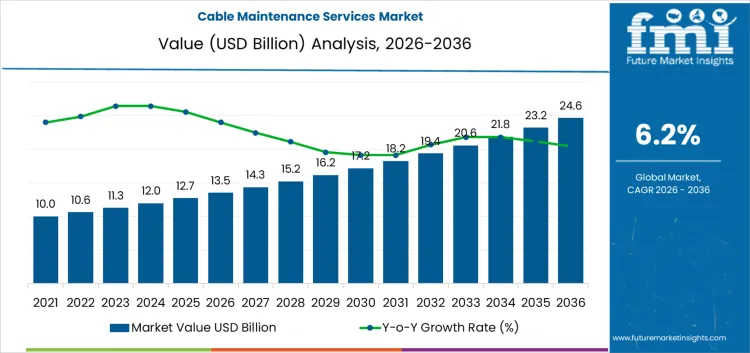
The cable maintenance services market is projected to reach USD 13.5 billion in 2026 and USD 24.6 billion by 2036, with a forecasted CAGR of 6.2% over the period. The performance of this market is heavily influenced by the concentration of production and regional manufacturing capabilities. Supply chains within this industry are highly dependent on specialized equipment, skilled labor, and technological infrastructure, often constrained by limited suppliers capable of meeting the stringent requirements for cable maintenance operations.
The reliance on a few key manufacturers for maintenance tools, diagnostic systems, and service vessels poses risks, particularly in the face of disruptions like geopolitical tensions or supply chain bottlenecks. Furthermore, regional disparities in manufacturing control influence service delivery times and costs, particularly in emerging markets where local infrastructure may not be as advanced. These constraints in production and supply reliability drive the need for more localized partnerships and adaptive procurement strategies to ensure uninterrupted service delivery across diverse global markets.
Quick Stats for Cable Maintenance Services Market
- Cable Maintenance Services Market Value (2026): USD 13.5 Billion
- Cable Maintenance Services Market Forecast Value (2036): USD 24.6 Billion
- Cable Maintenance Services Market Forecast CAGR 2026 to 2036: 6.2%
- Leading Service Type in Cable Maintenance Services Market: Preventive Maintenance (40% share)
- Leading End-User in Cable Maintenance Services Market: Utilities (35% share)
- Key Growth Regions in Cable Maintenance Services Market: Asia Pacific, Europe, North America
- Top Key Players in Cable Maintenance Services Market: Orange Marine, NKT Cable Maintenance, A-2-Sea, TD&I Cable Maintenance, Global Marine
Cable Maintenance Services Market Key Takeaways
| Metric | Value |
|---|---|
| Cable Maintenance Services Market Value (2026) | USD 13.5 Billion |
| Cable Maintenance Services Market Forecast Value (2036) | USD 24.6 Billion |
| Cable Maintenance Services Market Forecast CAGR 2026 to 2036 | 6.2% |
Why is the Cable Maintenance Services Market Experiencing Steady Growth?
The cable maintenance services market is growing steadily due to increasing investments in infrastructure maintenance and the growing complexity of modern cable networks. The rising demand for reliable, uninterrupted communication and power transmission services in industries like telecommunications, utilities, and transportation is driving the need for specialized cable maintenance. As networks expand and the demand for connectivity increases, regular maintenance and timely repair services are becoming more critical for ensuring system uptime and minimizing operational disruptions.
Technological advancements in cable inspection, diagnostic tools, and predictive maintenance are further supporting growth in the cable maintenance services market. Innovations such as automated inspection systems, advanced cable monitoring solutions, and remote diagnostics enhance the efficiency of maintenance tasks, reduce downtime, and lower operational costs. These technologies help service providers predict potential failures, optimize repair schedules, and improve cable performance, thus driving continued demand for maintenance services.
The expansion of telecom and energy networks, along with the increasing focus on infrastructure resilience, is reinforcing market growth. As industries and cities become more dependent on reliable communication and power systems, cable maintenance services are seen as a critical part of ensuring network longevity and performance. The increasing demand for these services across emerging markets is further contributing to the market’s growth, sustaining its steady expansion over the forecast period.
What Does The Segment Overview Indicate About The Cable Maintenance Services Market?
The cable maintenance services market is segmented by service type and end-user, highlighting the varying levels of service required across industries. Preventive maintenance leads the service type segment with 40% share, as it is critical for ensuring long-term cable reliability and minimizing unexpected downtime. Predictive maintenance and corrective repairs support proactive and reactive approaches to cable system health. On the end-user side, utilities account for 35% of the market share, as they depend heavily on reliable cable infrastructure for power distribution.
Why Does Preventive Maintenance Hold The Leading Service Type Share In The Cable Maintenance Services Market?
Preventive maintenance accounts for the largest 40% share in the cable maintenance services market due to its proactive approach in identifying and addressing potential issues before they lead to system failures. Preventive tasks such as insulation testing, cable cleaning, and routine inspections reduce the risk of major damage, which is particularly important for critical infrastructure like power and telecommunication networks. Early identification of wear, corrosion, or environmental factors helps extend cable lifespan and ensures uninterrupted service. This type of maintenance is especially crucial for utilities and large-scale networks that require continuous operation. As industries prioritize operational efficiency and cost reduction, preventive maintenance continues to dominate in cable service contracts.
How Do Utilities Drive End-User Demand In The Cable Maintenance Services Market?
Utilities represent the largest end-user segment in the cable maintenance services market with 35% share, as they rely on a robust cable infrastructure for the continuous transmission of electricity and data. Power distribution networks require regular maintenance to ensure the safety and reliability of electricity supply. Preventive maintenance, inspection, and corrective services are crucial for avoiding power outages and minimizing system downtime. With increasing investments in smart grids, renewable energy integration, and aging infrastructure, utilities are focused on maintaining high-performing cable systems. The growing need for system upgrades and resilience to weather events further strengthens the demand for cable maintenance services within the utility sector.
What Are The Key Dynamics Of The Cable Maintenance Services Market?
The cable maintenance services market is driven by the continual need to ensure reliability, safety, and performance of electrical, telecommunications, and data cabling infrastructure across utilities, industrial operations, commercial buildings, and data centers. Aging infrastructure, strict regulatory compliance standards, and heightened expectations for uptime and fault prevention are increasing demand for preventive maintenance, diagnostics, and repair services. For service providers and contractors, capabilities in condition monitoring, predictive analytics, and rapid fault localization are key differentiators. Long-term service agreements, SLAs tied to performance metrics, and geographic service coverage significantly influence competitive positioning and customer retention in this market.
How Are Technology Trends Enhancing Cable Maintenance Services?
Technology trends are enhancing cable maintenance services by improving diagnostic precision, reducing downtime, and enabling proactive interventions. Advanced tools such as reflectometry, time-domain reflectometers (TDR), distributed acoustic sensing (DAS), and infrared thermography enable early detection of insulation degradation, partial discharges, and joint failures. Integration with IoT sensors and wireless data loggers allows continuous condition monitoring of critical cable assets. Data analytics and machine learning algorithms translate sensor readings into actionable health scores, failure predictions, and maintenance prioritization. For service firms, investing in digital platforms that deliver real-time reporting, mobile workforce management, and automated work orders increases service efficiency and transparency with clients.
Why Do Operational Challenges And Regulatory Compliance Restrain The Cable Maintenance Services Market?
Operational challenges and regulatory compliance restrain the cable maintenance services market by increasing service complexity and cost. Diverse cable types, power distribution, control, fiber optics, and coaxial, require specialized diagnostic tools and technician expertise, limiting workforce scalability. High safety standards and regulatory mandates for testing intervals, documentation, and certifications impose procedural rigor and administrative overhead. Access limitations in live environments, traffic control for underground utilities, and coordination with multiple stakeholders extend service durations and raise operational costs. For service providers, balancing compliance obligations with competitive pricing pressures and margin targets remains a persistent challenge.
What Is the Country-Wise Growth Outlook for the Cable Maintenance Services Market?
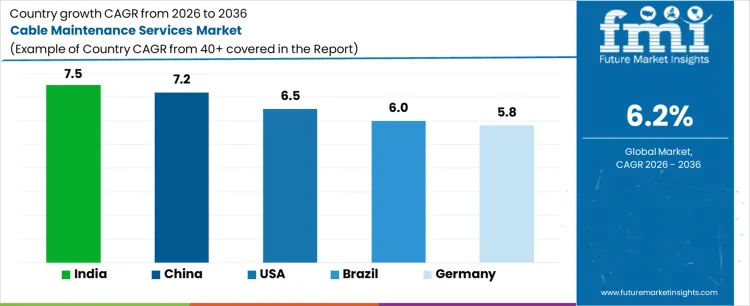
The cable maintenance services market is expanding steadily across global regions, driven by increasing investments in energy infrastructure, telecommunication networks, and the growing complexity of cable systems. India leads with a 7.5% CAGR, supported by the country’s rapid urbanization, industrialization, and increasing demand for reliable telecommunication and energy networks. China follows closely with a 7.2% CAGR, driven by its large-scale infrastructure development, including expansion in both telecommunications and power grids.
The USA records a 6.5% CAGR, propelled by upgrades in aging infrastructure and the rising need for efficient cable network management. Germany sees a 5.8% CAGR, supported by a strong focus on maintaining industrial cable systems and urban energy grids. Brazil grows at a 6.0% CAGR, driven by increasing investment in energy, telecom, and urban development projects across the country.
| Country | CAGR |
|---|---|
| USA | 6.5% |
| China | 7.2% |
| India | 7.5% |
| Germany | 5.8% |
| Brazil | 6.0% |
Why Is India Leading in the Cable Maintenance Services Market?
Demand for cable maintenance services in India is growing at a CAGR of 7.5%, driven by rapid urbanization, industrial expansion, and an increasing need for robust telecommunications and power grid infrastructure. India’s growing population and expanding cities have led to a significant rise in both energy consumption and communication requirements, necessitating ongoing cable maintenance to ensure system reliability and performance. The government’s focus on smart cities and infrastructure upgrades, along with increased industrial activity in sectors like manufacturing, construction, and agriculture, has heightened the demand for cable network management and fault prevention services. Energy transmission companies and telecom providers are prioritizing investments in preventive maintenance and network monitoring services to reduce downtime and improve system stability. Additionally, the rising adoption of smart meters and connected devices in homes and businesses is fueling the need for specialized cable maintenance services. These factors collectively contribute to India’s rapid growth in the cable maintenance services market.
What Is Driving China’s Growth in the Cable Maintenance Services Market?
Sales for cable maintenance services in China are increasing at a CAGR of 7.2%, driven by large-scale infrastructure development and the expansion of telecommunications and energy systems. As China continues to develop and modernize its cities, both residential and industrial cable networks are being expanded and maintained to meet growing demand. The country’s aggressive push for smart city development, along with the increasing use of connected devices in homes and businesses, has heightened the need for reliable and efficient cable systems. Government investments in power generation and distribution systems are also driving demand for cable maintenance services, particularly in the renewable energy sector. China’s rapidly growing electric vehicle infrastructure, including charging stations and smart grid networks, further contributes to the demand for cable maintenance services. As these networks become more complex, specialized maintenance and repair services are required to ensure long-term stability and efficiency.
Why Is the USA Expanding in the Cable Maintenance Services Market?
Demand for cable maintenance services in the USA is growing at a CAGR of 6.5%, driven by ongoing investments in the country’s aging energy infrastructure, telecommunication networks, and industrial systems. The USA’s expanding need for reliable, high-performance cable systems in both urban and rural areas is prompting investments in cable network management services. Aging power grids, especially in areas experiencing rapid population growth, are being upgraded to improve energy distribution and reduce outages, driving demand for cable maintenance services. Telecommunications companies are also prioritizing the maintenance of cable systems used for broadband internet and 5G deployment. As companies continue to deploy more complex cable systems in residential, commercial, and industrial settings, the need for regular inspections, repairs, and preventive maintenance becomes more pressing. The USA’s focus on maintaining critical infrastructure and modernizing energy and telecom networks is expected to sustain steady demand for cable maintenance services in the coming years.
What Is Supporting Growth in Germany’s Cable Maintenance Services Market?
Sales for cable maintenance services in Germany are increasing at a CAGR of 5.8%, supported by the country’s strong industrial base and its growing focus on sustainability and energy efficiency. Germany is investing heavily in the modernization of its electrical grids and telecommunication networks, especially with the continued integration of renewable energy sources into the national power grid. The demand for cable maintenance services in industrial settings, including automotive manufacturing, is rising due to Germany’s position as a leader in manufacturing and innovation.
Germany’s emphasis on maintaining high standards for energy transmission and distribution networks ensures that the need for specialized cable maintenance services remains strong. The continued growth in smart cities and the adoption of advanced telecommunication services like 5G is also pushing the demand for cable management services. As Germany focuses on both modernizing infrastructure and expanding its renewable energy sector, the need for high-quality and efficient cable maintenance services is projected to continue growing.
Why Is Brazil Seeing Growth in the Cable Maintenance Services Market?
Demand for cable maintenance services in Brazil is growing at a CAGR of 6.0%, driven by significant investments in energy infrastructure, telecom networks, and urban development projects. Brazil’s rapid urbanization and population growth are pushing the need for reliable cable networks, particularly in its expanding cities. The government’s commitment to modernizing the energy sector and expanding access to electricity in remote areas is contributing to rising demand for cable maintenance services, especially for power distribution systems. The telecom industry is seeing growth as demand for broadband and mobile services increases, which is driving the need for cable management and maintenance services. The country’s growing focus on renewable energy and smart grid technology is also encouraging investments in cable infrastructure, which require regular maintenance and repair to ensure optimal performance. Brazil’s expanding industrial base and increased infrastructure development are expected to drive sustained demand for cable maintenance services in the coming years.
How Are Leading Companies Competing And Differentiating In The Cable Maintenance Services Market?
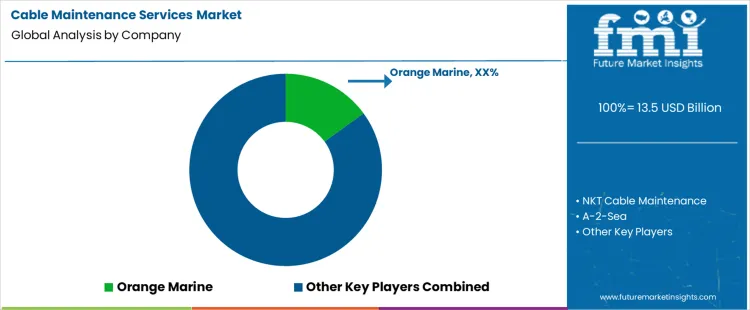
Competition in the cable maintenance services market is shaped by technical expertise, service reliability, and global reach. Orange Marine is being positioned around its advanced fleet of cable-laying and maintenance vessels, emphasizing its global presence and specialized services in both subsea and terrestrial cable maintenance. Product brochures highlight its extensive experience in managing high-risk, high-reward projects, such as offshore wind farm connections and deep-sea cables. NKT Cable Maintenance differentiates itself through its comprehensive range of services, from initial installation to long-term service and repair. NKT emphasizes proactive maintenance and rapid response times, helping clients extend the lifespan and efficiency of their cable systems.
Operational flexibility and customer-focused solutions are being leveraged by A-2-Sea and TD&I Cable Maintenance. A-2-Sea focuses on providing flexible, cost-effective services for both telecommunications and power cables, with a reputation for efficient offshore cable repairs and installations. TD&I Cable Maintenance emphasizes its innovative approach to cable fault detection and repair, with a focus on reducing downtime and providing minimal disruption to client operations. Both companies highlight their specialized teams and state-of-the-art equipment that enable quick and efficient service delivery.
Global Marine is taking a different competitive angle by positioning itself as a leader in offshore cable maintenance services. The company focuses on offering end-to-end solutions for submarine cable installation, maintenance, and repair, with strong emphasis on its specialized fleet, expertise in cable route surveys, and long-term support for clients across industries. Across the market, differentiation is driven by the breadth of service offerings, global capabilities, and specialized technology for effective and reliable cable maintenance solutions.
Key Players in Cable Maintenance Services Market
- Orange Marine
- NKT Cable Maintenance
- A‑2‑Sea
- TD&I Cable Maintenance
- Global Marine
Scope of Report
| Attributes | Description |
|---|---|
| Quantitative Unit | USD Million |
| Service Type | Preventive Maintenance, Predictive Maintenance, Corrective Repairs, Consulting & Inspection |
| End-User | Utilities, Telecommunication Networks, Industrial & Manufacturing, Commercial & Residential, Others |
| Regions Covered | Asia Pacific, Europe, North America, Latin America, Middle East & Africa |
| Countries Covered | China, Japan, South Korea, India, Australia & New Zealand, ASEAN, Rest of Asia Pacific, Germany, United Kingdom, France, Italy, Spain, Nordic, BENELUX, Rest of Europe, United States, Canada, Mexico, Brazil, Chile, Rest of Latin America, Kingdom of Saudi Arabia, Other GCC Countries, Turkey, South Africa, Other African Union, Rest of Middle East & Africa |
| Key Companies Profiled | Orange Marine, NKT Cable Maintenance, A-2-Sea, TD&I Cable Maintenance, Global Marine |
| Additional Attributes | Market size and CAGR projections from 2026 to 2036 by service type, regional growth analysis, technological advancements in cable maintenance, competitive landscape with company strategies, emerging trends in maintenance practices, supply chain overview, key drivers and challenges in the market. |
Cable Maintenance Services Market by Key Segments
Service Type:
- Preventive Maintenance
- Predictive Maintenance
- Corrective Repairs
- Consulting & Inspection
End‑User:
- Utilities
- Telecommunication Networks
- Industrial & Manufacturing
- Commercial & Residential
- Others
Region:
- Asia Pacific
- China
- Japan
- South Korea
- India
- Australia & New Zealand
- ASEAN
- Rest of Asia Pacific
- Europe
- Germany
- United Kingdom
- France
- Italy
- Spain
- Nordic
- BENELUX
- Rest of Europe
- North America
- United States
- Canada
- Mexico
- Latin America
- Brazil
- Chile
- Rest of Latin America
- Middle East & Africa
- Kingdom of Saudi Arabia
- Other GCC Countries
- Turkey
- South Africa
- Other African Union
- Rest of Middle East & Africa
Bibiliography
- International Energy Agency (IEA). (2024). Electricity grids and networks: Reliability, maintenance, and infrastructure resilience in modern power systems.
- International Telecommunication Union (ITU). (2024). Guidelines for maintenance and resilience of global telecommunication cable networks.
- World Bank Group. (2024). Infrastructure asset management and maintenance strategies for power and communication networks.
- International Electrotechnical Commission (IEC). (2024). Power and communication cable systems - Operation, inspection, and maintenance standards.
- European Commission - Joint Research Centre (JRC). (2025). Resilience, monitoring, and maintenance of critical energy and communication infrastructure.
Frequently Asked Questions
How big is the cable maintenance services market in 2026?
The global cable maintenance services market is estimated to be valued at USD 13.5 billion in 2026.
What will be the size of cable maintenance services market in 2036?
The market size for the cable maintenance services market is projected to reach USD 24.6 billion by 2036.
How much will be the cable maintenance services market growth between 2026 and 2036?
The cable maintenance services market is expected to grow at a 6.2% CAGR between 2026 and 2036.
What are the key product types in the cable maintenance services market?
The key product types in cable maintenance services market are preventive maintenance , predictive maintenance, corrective repairs and consulting & inspection.
Which end‑user segment to contribute significant share in the cable maintenance services market in 2026?
In terms of end‑user, utilities segment to command 0.0% share in the cable maintenance services market in 2026.
Preview the report firsthand - request a free sample
Get SampleGet the brochure for pricing and purchase details.
Get PDFTable of Content
- Executive Summary
- Global Market Outlook
- Demand-side Trends
- Supply-side Trends
- Technology Roadmap Analysis
- Analysis and Recommendations
- Market Overview
- Market Coverage / Taxonomy
- Market Definition / Scope / Limitations
- Market Background
- Market Dynamics
- Drivers
- Restraints
- Opportunity
- Trends
- Scenario Forecast
- Demand in Optimistic Scenario
- Demand in Likely Scenario
- Demand in Conservative Scenario
- Opportunity Map Analysis
- Product Life Cycle Analysis
- Supply Chain Analysis
- Investment Feasibility Matrix
- Value Chain Analysis
- PESTLE and Porter’s Analysis
- Regulatory Landscape
- Regional Parent Market Outlook
- Production and Consumption Statistics
- Import and Export Statistics
- Market Dynamics
- Global Market Analysis 2021 to 2025 and Forecast, 2026 to 2036
- Historical Market Size Value (USD Million) Analysis, 2021 to 2025
- Current and Future Market Size Value (USD Million) Projections, 2026 to 2036
- Y-o-Y Growth Trend Analysis
- Absolute $ Opportunity Analysis
- Global Market Pricing Analysis 2021 to 2025 and Forecast 2026 to 2036
- Global Market Analysis 2021 to 2025 and Forecast 2026 to 2036, By Service Type
- Introduction / Key Findings
- Historical Market Size Value (USD Million) Analysis By Service Type, 2021 to 2025
- Current and Future Market Size Value (USD Million) Analysis and Forecast By Service Type, 2026 to 2036
- Preventive Maintenance
- Predictive Maintenance
- Corrective Repairs
- Consulting & Inspection
- Preventive Maintenance
- Y-o-Y Growth Trend Analysis By Service Type, 2021 to 2025
- Absolute $ Opportunity Analysis By Service Type, 2026 to 2036
- Global Market Analysis 2021 to 2025 and Forecast 2026 to 2036, By End‑User
- Introduction / Key Findings
- Historical Market Size Value (USD Million) Analysis By End‑User, 2021 to 2025
- Current and Future Market Size Value (USD Million) Analysis and Forecast By End‑User, 2026 to 2036
- Utilities
- Telecommunication Networks
- Industrial & Manufacturing
- Commercial & Residential
- Others
- Utilities
- Y-o-Y Growth Trend Analysis By End‑User, 2021 to 2025
- Absolute $ Opportunity Analysis By End‑User, 2026 to 2036
- Global Market Analysis 2021 to 2025 and Forecast 2026 to 2036, By Region
- Introduction
- Historical Market Size Value (USD Million) Analysis By Region, 2021 to 2025
- Current Market Size Value (USD Million) Analysis and Forecast By Region, 2026 to 2036
- North America
- Latin America
- Western Europe
- Eastern Europe
- East Asia
- South Asia and Pacific
- Middle East & Africa
- Market Attractiveness Analysis By Region
- North America Market Analysis 2021 to 2025 and Forecast 2026 to 2036, By Country
- Historical Market Size Value (USD Million) Trend Analysis By Market Taxonomy, 2021 to 2025
- Market Size Value (USD Million) Forecast By Market Taxonomy, 2026 to 2036
- By Country
- USA
- Canada
- Mexico
- By Service Type
- By End‑User
- By Country
- Market Attractiveness Analysis
- By Country
- By Service Type
- By End‑User
- Key Takeaways
- Latin America Market Analysis 2021 to 2025 and Forecast 2026 to 2036, By Country
- Historical Market Size Value (USD Million) Trend Analysis By Market Taxonomy, 2021 to 2025
- Market Size Value (USD Million) Forecast By Market Taxonomy, 2026 to 2036
- By Country
- Brazil
- Chile
- Rest of Latin America
- By Service Type
- By End‑User
- By Country
- Market Attractiveness Analysis
- By Country
- By Service Type
- By End‑User
- Key Takeaways
- Western Europe Market Analysis 2021 to 2025 and Forecast 2026 to 2036, By Country
- Historical Market Size Value (USD Million) Trend Analysis By Market Taxonomy, 2021 to 2025
- Market Size Value (USD Million) Forecast By Market Taxonomy, 2026 to 2036
- By Country
- Germany
- UK
- Italy
- Spain
- France
- Nordic
- BENELUX
- Rest of Western Europe
- By Service Type
- By End‑User
- By Country
- Market Attractiveness Analysis
- By Country
- By Service Type
- By End‑User
- Key Takeaways
- Eastern Europe Market Analysis 2021 to 2025 and Forecast 2026 to 2036, By Country
- Historical Market Size Value (USD Million) Trend Analysis By Market Taxonomy, 2021 to 2025
- Market Size Value (USD Million) Forecast By Market Taxonomy, 2026 to 2036
- By Country
- Russia
- Poland
- Hungary
- Balkan & Baltic
- Rest of Eastern Europe
- By Service Type
- By End‑User
- By Country
- Market Attractiveness Analysis
- By Country
- By Service Type
- By End‑User
- Key Takeaways
- East Asia Market Analysis 2021 to 2025 and Forecast 2026 to 2036, By Country
- Historical Market Size Value (USD Million) Trend Analysis By Market Taxonomy, 2021 to 2025
- Market Size Value (USD Million) Forecast By Market Taxonomy, 2026 to 2036
- By Country
- China
- Japan
- South Korea
- By Service Type
- By End‑User
- By Country
- Market Attractiveness Analysis
- By Country
- By Service Type
- By End‑User
- Key Takeaways
- South Asia and Pacific Market Analysis 2021 to 2025 and Forecast 2026 to 2036, By Country
- Historical Market Size Value (USD Million) Trend Analysis By Market Taxonomy, 2021 to 2025
- Market Size Value (USD Million) Forecast By Market Taxonomy, 2026 to 2036
- By Country
- India
- ASEAN
- Australia & New Zealand
- Rest of South Asia and Pacific
- By Service Type
- By End‑User
- By Country
- Market Attractiveness Analysis
- By Country
- By Service Type
- By End‑User
- Key Takeaways
- Middle East & Africa Market Analysis 2021 to 2025 and Forecast 2026 to 2036, By Country
- Historical Market Size Value (USD Million) Trend Analysis By Market Taxonomy, 2021 to 2025
- Market Size Value (USD Million) Forecast By Market Taxonomy, 2026 to 2036
- By Country
- Kingdom of Saudi Arabia
- Other GCC Countries
- Turkiye
- South Africa
- Other African Union
- Rest of Middle East & Africa
- By Service Type
- By End‑User
- By Country
- Market Attractiveness Analysis
- By Country
- By Service Type
- By End‑User
- Key Takeaways
- Key Countries Market Analysis
- USA
- Pricing Analysis
- Market Share Analysis, 2025
- By Service Type
- By End‑User
- Canada
- Pricing Analysis
- Market Share Analysis, 2025
- By Service Type
- By End‑User
- Mexico
- Pricing Analysis
- Market Share Analysis, 2025
- By Service Type
- By End‑User
- Brazil
- Pricing Analysis
- Market Share Analysis, 2025
- By Service Type
- By End‑User
- Chile
- Pricing Analysis
- Market Share Analysis, 2025
- By Service Type
- By End‑User
- Germany
- Pricing Analysis
- Market Share Analysis, 2025
- By Service Type
- By End‑User
- UK
- Pricing Analysis
- Market Share Analysis, 2025
- By Service Type
- By End‑User
- Italy
- Pricing Analysis
- Market Share Analysis, 2025
- By Service Type
- By End‑User
- Spain
- Pricing Analysis
- Market Share Analysis, 2025
- By Service Type
- By End‑User
- France
- Pricing Analysis
- Market Share Analysis, 2025
- By Service Type
- By End‑User
- India
- Pricing Analysis
- Market Share Analysis, 2025
- By Service Type
- By End‑User
- ASEAN
- Pricing Analysis
- Market Share Analysis, 2025
- By Service Type
- By End‑User
- Australia & New Zealand
- Pricing Analysis
- Market Share Analysis, 2025
- By Service Type
- By End‑User
- China
- Pricing Analysis
- Market Share Analysis, 2025
- By Service Type
- By End‑User
- Japan
- Pricing Analysis
- Market Share Analysis, 2025
- By Service Type
- By End‑User
- South Korea
- Pricing Analysis
- Market Share Analysis, 2025
- By Service Type
- By End‑User
- Russia
- Pricing Analysis
- Market Share Analysis, 2025
- By Service Type
- By End‑User
- Poland
- Pricing Analysis
- Market Share Analysis, 2025
- By Service Type
- By End‑User
- Hungary
- Pricing Analysis
- Market Share Analysis, 2025
- By Service Type
- By End‑User
- Kingdom of Saudi Arabia
- Pricing Analysis
- Market Share Analysis, 2025
- By Service Type
- By End‑User
- Turkiye
- Pricing Analysis
- Market Share Analysis, 2025
- By Service Type
- By End‑User
- South Africa
- Pricing Analysis
- Market Share Analysis, 2025
- By Service Type
- By End‑User
- USA
- Market Structure Analysis
- Competition Dashboard
- Competition Benchmarking
- Market Share Analysis of Top Players
- By Regional
- By Service Type
- By End‑User
- Competition Analysis
- Competition Deep Dive
- Orange Marine
- Overview
- Product Portfolio
- Profitability by Market Segments (Product/Age /Sales Channel/Region)
- Sales Footprint
- Strategy Overview
- Marketing Strategy
- Product Strategy
- Channel Strategy
- NKT Cable Maintenance
- A‑2‑Sea
- TD&I Cable Maintenance
- Global Marine
- Orange Marine
- Competition Deep Dive
- Assumptions & Acronyms Used
- Research Methodology


