

- Industry Size (2026)
- USD 0.6 Bn
- Forecast (2036)
- USD 2.2 Bn
- CAGR
- 13.9% (2026 to 2036)
Cable Retention Packaging Market Forecast and Outlook 2026 to 2036
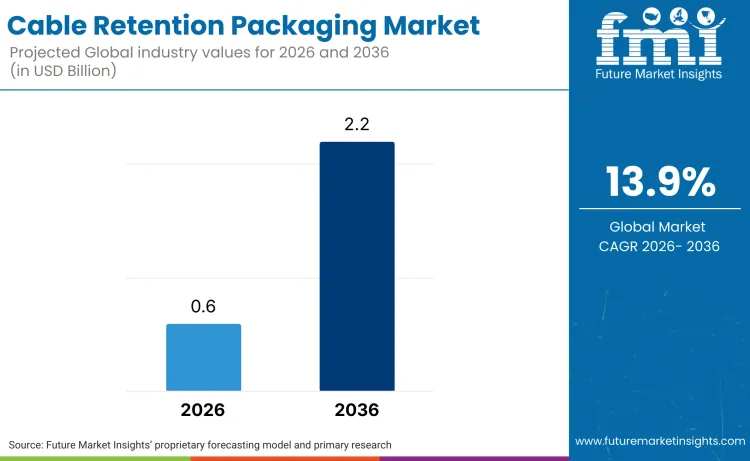
The global cable retention packaging market is set to record a valuation of USD 0.6 billion in 2026, advancing toward USD 2.2 billion by 2036, representing a robust 13.9% CAGR. Accelerated expansion is fundamentally driven by the consumer electronics sector's pivot toward plastic-free "unboxing" experiences and the operational demands of high-speed e-commerce fulfillment centers.
The trajectory of the market is heavily influenced by the European Union's Packaging and Packaging Waste Regulation (PPWR), which has intensified the scrutiny on void space and non-recyclable materials. Lisa Jackson, VP of Environment, Policy, and Social Initiatives at Apple, highlighted the scale of this corporate shift in April 2024, stating: "The proof of Apple’s commitment to climate action is in our progress: We’ve slashed emissions by more than half, all while serving more users than ever before." This sentiment underscores a sector-wide mandate where carbon reduction is no longer a CSR footnote but a core operational requirement for accessing global retail channels.
Manufacturers are aggressively re-engineering packaging to eliminate mixed materials that complicate recycling streams. With major OEMs like Sony targeting the total elimination of plastic from newly designed small product packaging, the demand for engineered cardboard frames and paper-based strap systems is surging. Recognizing that approximately 20% of global CO2 emissions stem from transportation, companies like Nefab Group continue to focus on a holistic approach to supply chains to reduce logistical carbon footprints. This push for sustainability is creating a new competitive landscape where the ability to provide plastic-free, shock-resistant retention solutions is the primary determinant of supplier selection.
Summary of Cable Retention Packaging Market
What Is the Growth Outlook for the Cable Retention Packaging Market as per Future Market Insights Projection?
Future Market Insights projects the global cable retention packaging market to grow from USD 0.6 billion in 2026 to USD 2.2 billion by 2036, representing a robust 13.9% CAGR over the forecast period.
FMI Research Approach: Based on FMI’s proprietary global modeling framework incorporating regulatory compliance mandates (EU PPWR), e-commerce shipment volume projections, and industrial demand assessments informed by consumer electronics export data.
How Do FMI Analysts Perceive the Cable Retention Packaging Market to Evolve?
FMI analysts perceive the market transitioning away from traditional twist ties and blister packs toward suspension/retention films and fiber-based locking mechanisms.
FMI Research Approach: Developed using analysis of corporate sustainability reports from major tech OEMs (Apple, Sony), examination of material innovation pipelines such as Sealed Air’s "Korrvu," and facility expansion disclosures from integrated packaging manufacturers.
Which Country Holds the Largest Share in the Global Cable Retention Packaging Market?
The United States holds one of the highest value shares globally, supported by a massive consumer electronics consumption base and a forecasted 53.8% increase in e-commerce revenue by 2025.
FMI Research Approach: Built using country-level retail activity indicators, analysis of packaging material shifts driven by e-commerce efficiency requirements, and mapping of supplier concentration among North America’s protective packaging manufacturers.
How Large Will the Cable Retention Packaging Market Be by 2036?
The global cable retention packaging market is expected to reach USD 2.2 billion by 2036, supported by sustained demand from the consumer electronics segment, which currently commands a 46% share.
FMI Research Approach: Long-term forecasts rely on device shipment trends, industrial capacity expansion data supporting global paperboard availability, and channel-specific scaling assumptions for premium sustainable packaging value.
What Is the Definition of the Cable Retention Packaging Market?
The cable retention packaging market encompasses all revenue generated from purpose-designed primary and secondary packaging solutions used for securing cables, chargers, and wires within product boxes. It includes suspension films, retention frames, paper-based ties, and carded inserts marketed explicitly for stabilization and presentation.
FMI Research Approach: Definition structured using FMI’s segmentation taxonomy covering product types, end-use channels, and material compositions. The classification draws from operational inclusion criteria for OEM electronics kits, alongside explicit exclusions for general bulk loose-fill packaging.
What Are Globally Unique Trends Shaping the Cable Retention Packaging Market?
Globally, the sector is shaped by an ongoing shift toward "void reduction" and the elimination of single-use plastics in favor of cellulose-based retention systems.
FMI Research Approach: Insights derived from global regulatory tracking (EU PPWR void space limits), sustainability performance disclosures from major manufacturers like Mondi and Amcor, and assessment of competitive reinvestment patterns across Europe, Asia, and North America.
Cable Retention Packaging Market Key Takeaways
| Metric | Details |
|---|---|
| Industry Size (2026) | USD 0.6 billion |
| Industry Value (2036) | USD 2.2 billion |
| CAGR (2026-2036) | 13.9% |
Source: Future Market Insights (FMI) analysis, based on proprietary forecasting model and primary research.
How Sustainability Regulations Drive Design Overhaul?
The implementation of stringent environmental laws is the primary engine for design overhaul, effectively creating a recurring demand for compliant packaging structures. The European Union's Packaging and Packaging Waste Regulation (PPWR) has established strict guidelines, where packaging deemed unnecessary or designed solely to increase the perceived volume of a product may no longer be placed on the market. This regulatory pressure is forcing manufacturers to abandon bulky plastic inserts in favor of slim, material-efficient retention designs. Furthermore, strict heavy metal restrictions now enforce a limit of 100 mg/kg for the sum total of all concentrations of lead, cadmium, mercury, and hexavalent chromium.
These mandates are catalyzing a shift in wire and cable management strategies within packaging. Brands are moving away from PVC-based components toward clean, repulpable materials that do not contaminate recycling streams. The EU's push also establishes minimum recycled content requirements, such as up to 65% for single-use plastic bottles by 2040, effectively signaling the end for virgin plastic in disposable packaging applications. Consequently, packaging engineers are redesigning cable trays and inserts to be purely fiber-based to avoid these rising compliance costs.
How is the Cable Retention Packaging Market Segmented?
The cable retention packaging market is segmented by cable type, retention mechanism, and material. It is segmented by cable type into consumer electronics cables, industrial cables, and precision wiring, each requiring distinct levels of shock protection and presentation. The material landscape spans PET, clip & tie mounts, and carded retention packs, illustrating the industry’s balance between visibility and the growing preference for renewable substrates. These segmentation layers define how manufacturers design, position, and supply packaging solutions tailored to both high-volume consumer goods and specialized industrial equipment.
Why do Consumer Electronics Cables hold a dominant share?
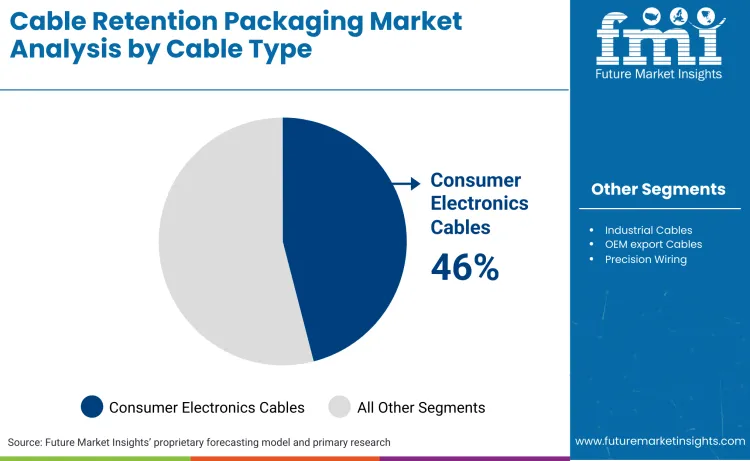
Consumer electronics cables lead the product category with a 46% share, driven by the sheer volume of global smartphone and laptop shipments that require premium "out-of-box" presentation. Tech giants are setting the pace; Apple, for instance, has released multiple product lineups with over 95 percent fiber-based packaging, including the iPhone 15 and Apple Watch. This massive scale of adoption forces the supply chain to standardize around paper-based cable accessories and retention systems. The shift is also functional; as devices become slimmer, the packaging must reduce in size to optimize logistics, making bulky plastic trays obsolete in favor of slim, fold-flat fiber designs.
Why are Clip & Tie Mounts evolving?
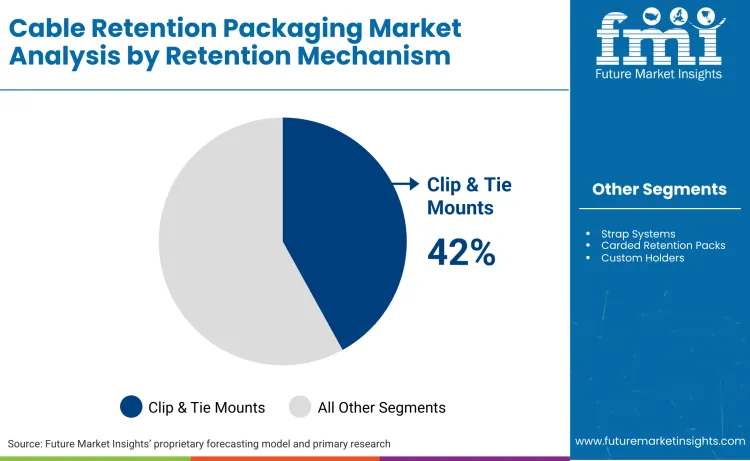
Clip & tie mounts currently hold a 42% market share, but the segment is undergoing a rapid material transformation. While traditional plastic fasteners offered cheap utility, they are being replaced by paper-based alternatives to meet single-use plastic reduction targets. Botta EcoPackaging launched recyclable kraft paper cable ties designed to replace single-use plastic ties, supplied flat to optimize storage and prevent product damage. This evolution is critical for twist tie manufacturers who must now offer cellulose-based solutions that maintain the requisite tensile strength for securing cable connectors and adapters without relying on non-recyclable polymers.
Why does PET still hold a significant material share?
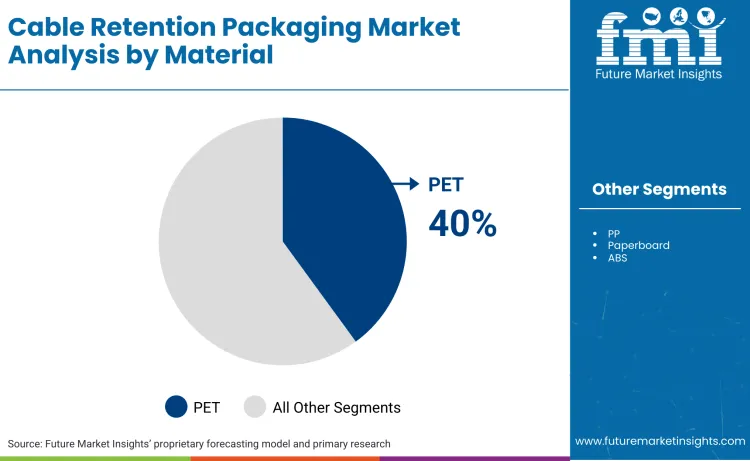
Despite the green shift, PET retains a 40% share, primarily due to its transparency and durability for retail display applications where product visibility is paramount. However, this segment is under immense pressure to integrate high levels of recycled content. The EU Packaging Regulation establishes minimum recycled content requirements, pushing manufacturers to innovate with rPET. While wire harness manufacturers in the automotive sector still rely on robust plastic retention for heavy-duty protection, the consumer sector is rapidly pivoting. The future of this segment lies in hybrid solutions that minimize plastic usage while retaining the protective benefits required for global automotive wiring harness shipments.
Why Is the Material Transition to Fiber Accelerating?
The primary conflict line lies between fiber innovators and plastic incumbents, forcing companies to rethink how they protect sensitive electronics. Approximately 57% of respondents now believe that paper-based packaging is more environmentally friendly compared to other materials. This consumer sentiment is driving brands to adopt control cable packaging that feels organic and sustainable. The average CO2 emissions for the production of one tonne of paper in Europe are around 0.8 tonnes, significantly lower than fossil-fuel-based alternatives, providing a quantifiable carbon benefit for companies auditing their Scope 3 emissions.
How Is E-commerce efficiency driving retention innovation?
The explosion of online retail is prioritizing packaging that survives the "last mile" without bulky void fill. David Masa, Portfolio Marketing Senior Manager at Sealed Air (SEE), explained in January 2025: "Korrvu Rapid Fix replaces the need for manual void fill and cushioning, while still maximizing product protection. The retention insert can be put in place in seconds, with its highly resilient low-slip film locking products in place to protect against shock and vibration." This speed is vital as fulfillment companies face pressure to ship same-day orders, driving the adoption of retention systems that reduce manual bottlenecks.
Why are Corporate Giants removing cables entirely?
A unique trend shaping the wire and cable packaging landscape is the reduction of the product itself. Sony Group began removing charging cables entirely from phone boxes starting with the Xperia 10 VII in October 2025, citing environmental goals to reduce plastic waste and packaging size. This strategy, part of their "Road to Zero" plan, fundamentally alters the market by eliminating the need for complex data center cabling retention structures in consumer boxes, shifting the focus to smaller, denser packaging formats.
What is the Regional Outlook for Cable Retention Packaging Market?
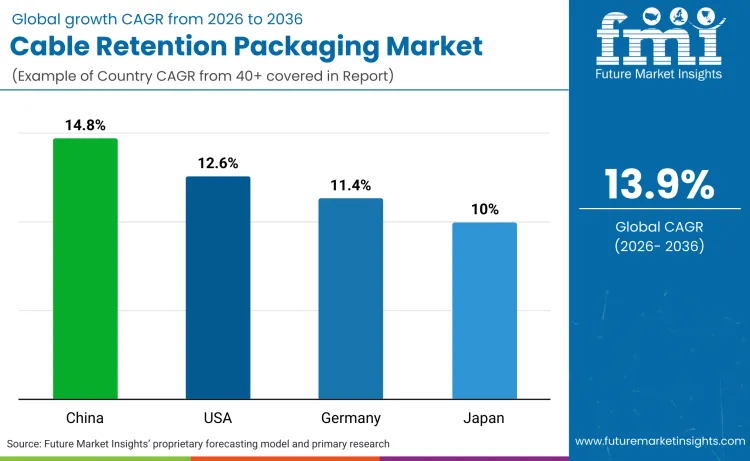
The global cable retention packaging market exhibits a clear regional divide, with Asian markets expanding on the strength of manufacturing exports and Western markets growing through strict regulatory compliance and e-commerce velocity. China leads the growth trajectory with a 14.8% CAGR, fueled by its status as the world's electronics assembly hub. The USA follows with 12.6% growth, driven by a massive logistics sector serving e-commerce demand. Germany (11.4%) and Japan (10.0%) represent mature markets focused on industrial precision and premium aesthetic sustainability, respectively.
| Country | CAGR (2026 to 2036) |
|---|---|
| China | 14.8% |
| USA | 12.6% |
| Germany | 11.4% |
| Japan | 10.0% |
Source: FMI historical analysis and forecast data.
Why is China dominating with Export Cables?
China is projected to register a leading 14.8% CAGR, driven by its dominance in OEM export cables. As the manufacturing engine for the world's consumer electronics packaging, Chinese suppliers are rapidly adopting carded retention packs to meet the "green entry" requirements of European and American buyers. According to the General Administration of Customs of China (GACC), China exported 240,000 metric tons of wire and cable in June 2024, representing a 19.3% year‑on‑year increase, with an export value of RMB 15.95 billion, up 16.4% from the previous year. The shift is not just about cost but compliance; export-grade cables must now come in packaging that satisfies the destination country's waste laws, effectively exporting EU standards back to Chinese factories.
Why is the USA driven by E-commerce Revenue?
Expansion in the USA is forecast at a 12.6% CAGR, underpinned by a forecasted 53.8% increase in e-commerce revenue for US consumer electronics by 2025. This surge drives demand for e-commerce packaging that can survive automated sorting facilities. ZipDo reported in August 2023 that retail revenue reached $487 billion, confirming the massive scale of goods requiring shipping-safe packaging. US brands are increasingly turning to solutions like retention frames that eliminate the need for plastic peanuts or bubble wrap, aligning with consumer preferences for curb-side recyclability in the europe and usa consumer electronics packaging sectors.
Why is Germany focusing on Industrial Strapping?
The market in Germany is poised to register an 11.4% CAGR, heavily influenced by the industrial cables sector. German manufacturers, adhering to strict circular economy principles, are pioneering reusable strap systems and industrial electronics packaging. Mondi plc's management team highlighted their transition to serve key themes in sustainability, led by their mantra: "Paper where possible, plastic when useful." This philosophy is reshaping how heavy industrial cables are secured, moving away from single-use plastic straps to robust paper-based alternatives that can support significant weight without tearing.
Why is Japan prioritizing Precision Wiring Holders?
Development in Japan is estimated to register a 10.0% CAGR, defined by a focus on custom holders for precision wiring. Sony Group has set aggressive targets, stating that their Green Management 2025 targets include the total elimination of plastic from the packaging of newly designed small products. This drives innovation in the blister packaging replacement space, where Japanese engineers are creating intricate folded paper structures that hold delicate electronics securely without the static generation associated with plastic, satisfying both aesthetic and technical requirements.
How Is Competition Evolving in the Cable Retention Packaging Market?
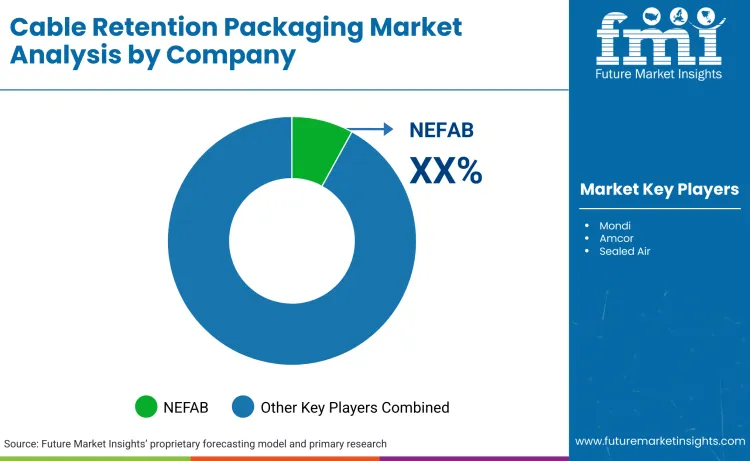
The competitive outlook is characterized by a race to acquire sustainable capabilities and vertically integrate recycling streams. Amcor plc is aggressively expanding its footprint, having opened its fourth global Innovation Center in Ghent, Belgium, in May 2024 to focus on material science and packaging design. This move signifies a strategic pivot toward becoming a comprehensive solution provider for clamshell packaging replacements. With 41,000 people generating $13.6 billion in sales across 40 countries, Amcor leverages its scale to dictate market trends in material conversion.
Specialized players are challenging incumbents with niche innovations. Sealed Air (SEE) introduced the Korrvu Rapid Fix retention system in January 2025, featuring a cardboard frame with >50% PCR content. By enhancing sustainability using up to 50% recycled materials, they directly address the demand for clamshell packaging shifts toward fiber. Alex Necovski, Head of Nordics Europe Region at Nefab, emphasized this proactive stance in October 2024, stating: "We’re not merely adhering to regulatory norms; we’re establishing a higher standard for safety and sustainability in the industry."
Strategic partnerships are further consolidating the market. Mondi collaborated with Amazon in September 2024 to replace bubble wrap with paper-padded envelopes, a move that fundamentally disrupts the corrugated and folding carton packaging landscape for e-commerce. To support this demand, Mondi also completed the acquisition of the Hinton Pulp mill in February 2025, securing integrated production capabilities for kraft paper.
Recent Developments:
- In November 2025, Sealed Air Corporation, a leading provider in the cable retention packaging market, agreed to be acquired by funds affiliated with CD&R in a $10.3 billion all-cash transaction. This deal positions Sealed Air to accelerate investments in sustainable packaging technologies, potentially advancing solutions for secure cable management and protection in electronics and industrial sectors.
- In April 2025, Amcor completed its merger with Berry Global, creating a major force in the packaging industry with enhanced capabilities in flexible and protective solutions. This combination strengthens Amcor's offerings in the cable retention packaging market, improving innovation in materials for anti-tangle and connector protection applications.
- In April 2025, Mondi Group acquired Schumacher Packaging's Western Europe operations, adding significant capacity in corrugated and solid board packaging. This expansion bolsters Mondi's portfolio in the cable retention packaging market, enabling better support for customized, sustainable retention mechanisms like clip and tie mounts for consumer electronics and industrial cables.
Key Players in Cable Retention Packaging Market
-
NEFAB
- Mondi
- Amcor
- Sealed Air
- Smurfit Westrock
- DS Smith
- Sonoco Products Company
- Huhtamaki
- WestRock
- Stora Enso
- Pregis
- Georgia-Pacific
Market Definition
The cable retention packaging market represents revenue generated from the sale of packaging components designed to secure, organize, and display cables, wires, and electronic accessories within primary retail or industrial packaging. As operationally defined in the article, the market measures the commercial value of retention frames, suspension films, clip mounts, and carded inserts. Market sizing reflects the value of packaging sold to OEMs, electronics manufacturers, and automotive suppliers, expressed in USD billion.
The market explicitly includes retention solutions for consumer electronics (chargers, headphones), industrial wiring harnesses, and precision data cables. It includes both plastic (PET, PP) and fiber-based (corrugated, paperboard) materials. The market excludes general void fill materials (peanuts, bubble wrap) that are not engineered specifically for cable retention, as well as the cables themselves.
Scope of Report
| Items | Values |
|---|---|
| Quantitative Units (2026) | USD 0.6 billion |
| Product Type | Consumer Electronics Cables (46%), Industrial Cables, Precision Wiring |
| Retention Mechanism | Clip & Tie Mounts (42%), Strap Systems, Carded Retention Packs, Custom Holders |
| Material Type | PET (40%), Paperboard, PP, ABS |
| Regions Covered | North America, Europe, Asia Pacific, Latin America, Middle East & Africa |
| Countries Covered | United States, Germany, China, Japan, and key global markets |
| Key Companies Profiled | NEFAB, Mondi, Amcor, Sealed Air |
| Additional Attributes | Revenue analysis by cable type and material, regulatory impact assessment (EU PPWR), sustainable material penetration, e-commerce adoption trends, competitive consolidation analysis |
Source: FMI historical analysis and forecast data.
Cable Retention Packaging Market by Segments
By Cable Type:
- Consumer Electronics Cables
- Industrial Cables
- OEM Export Cables
- Precision Wiring
By Retention Mechanism:
- Clip & Tie Mounts
- Strap Systems
- Carded Retention Packs
- Custom Holders
By Material:
- PET
- Paperboard
- PP (Polypropylene)
- ABS
By Region:
- North America
- Europe
- Asia Pacific
- Latin America
- Middle East & Africa
Bibliography
- Bureau of Transportation Statistics. (2024). Freight analysis framework for paper, packaging, and retail goods. U.S. DOT.
- International Resource Panel. (2024). Global material flows and circular economy indicators. UNEP IRP.
- Statistics Canada. (2024). Manufacturing sales for paper and packaging product industries. Government of Canada.
- Ministry of the Environment of Japan. (2024). Containers and packaging recycling law performance report. Government of Japan.
- Central Pollution Control Board. (2024). Annual report on plastic and packaging waste management. Government of India.
- European Topic Centre on Circular Economy and Resource Use. (2024). Material flow indicators for packaging waste streams. ETC-CE.
- Association for the Advancement of Medical Instrumentation. (2024). Guidance on sterile barrier systems and packaging validation. AAMI.
Frequently Asked Questions
What is the current global market size for Cable Retention Packaging?
The global market is valued at USD 0.6 billion in 2026, driven by the increasing need for secure and sustainable packaging in the consumer electronics sector.
What is the projected CAGR for the Cable Retention Packaging market?
Market revenues are projected to grow at a robust 13.9% CAGR from 2026 to 2036, driven by the rapid expansion of e-commerce and strict plastic reduction mandates.
Which cable type segment currently dominates the industry?
Consumer electronics cables hold the dominant 46% market share, due to the high volume of mobile device shipments and the focus on premium unboxing experiences.
What are the primary drivers for adoption in the USA?
The exponential growth of e-commerce revenue and the demand for automated, void-reducing packaging solutions are the primary drivers for adoption in the USA.
Who are the leading players in the Cable Retention Packaging market?
NEFAB, Mondi, Amcor, and Sealed Air lead the sector, leveraging their global innovation centers and extensive portfolios of fiber-based retention solutions.
Preview the report firsthand - request a free sample
Get SampleGet the brochure for pricing and purchase details.
Get PDFTable of Content
- Executive Summary
- Global Market Outlook
- Demand Side Trends
- Supply Side Trends
- Technology Roadmap Analysis
- Analysis and Recommendations
- Market Overview
- Market Coverage / Taxonomy
- Market Definition / Scope / Limitations
- Research Methodology
- Chapter Orientation
- Analytical Lens and Working Hypotheses
- Market Structure, Signals, and Trend Drivers
- Benchmarking and Cross-market Comparability
- Market Sizing, Forecasting, and Opportunity Mapping
- Research Design and Evidence Framework
- Desk Research Programme (Secondary Evidence)
- Company Annual and Sustainability Reports
- Peer-reviewed Journals and Academic Literature
- Corporate Websites, Product Literature, and Technical Notes
- Earnings Decks and Investor Briefings
- Statutory Filings and Regulatory Disclosures
- Technical White Papers and Standards Notes
- Trade Journals, Industry Magazines, and Analyst Briefs
- Conference Proceedings, Webinars, and Seminar Materials
- Government Statistics Portals and Public Data Releases
- Press Releases and Reputable Media Coverage
- Specialist Newsletters and Curated Briefings
- Sector Databases and Reference Repositories
- FMI Internal Knowledge Base and Historical Datasets
- Subscription Datasets and Paid Sources
- Social Channels, Communities, and Digital Listening Inputs
- Additional Desk Sources
- Expert Input and Fieldwork (Primary Evidence)
- Primary Modes
- Qualitative Interviews and Expert Elicitation
- Quantitative Surveys and Structured Data Capture
- Blended Approach
- Why Primary Evidence is Used
- Field Techniques
- Interviews
- Surveys
- Focus Groups
- Observational and In-context Research
- Social and Community Interactions
- Stakeholder Universe Engaged
- C-suite Leaders
- Board Members
- Presidents and Vice Presidents
- R&D and Innovation Heads
- Technical Specialists
- Domain Subject-matter Experts
- Scientists
- Physicians and Other Healthcare Professionals
- Governance, Ethics, and Data Stewardship
- Research Ethics
- Data Integrity and Handling
- Primary Modes
- Tooling, Models, and Reference Databases
- Desk Research Programme (Secondary Evidence)
- Data Engineering and Model Build
- Data Acquisition and Ingestion
- Cleaning, Normalisation, and Verification
- Synthesis, Triangulation, and Analysis
- Quality Assurance and Audit Trail
- Market Background
- Market Dynamics
- Drivers
- Restraints
- Opportunity
- Trends
- Scenario Forecast
- Demand in Optimistic Scenario
- Demand in Likely Scenario
- Demand in Conservative Scenario
- Opportunity Map Analysis
- Product Life Cycle Analysis
- Supply Chain Analysis
- Investment Feasibility Matrix
- Value Chain Analysis
- PESTLE and Porter's Analysis
- Regulatory Landscape
- Regional Parent Market Outlook
- Production and Consumption Statistics
- Import and Export Statistics
- Market Dynamics
- Global Market Analysis 2021 to 2025 and Forecast, 2026 to 2036
- Historical Market Size Value (USD Billion) Analysis, 2021 to 2025
- Current and Future Market Size Value (USD Billion) Projections, 2026 to 2036
- Y-o-Y Growth Trend Analysis
- Absolute $ Opportunity Analysis
- Global Market Pricing Analysis 2021 to 2025 and Forecast 2026 to 2036
- Y-o-Y Growth Trend Analysis 2021 to 2025
- Absolute $ Opportunity Analysis 2026 to 2036
- Global Market Analysis 2021 to 2025 and Forecast 2026 to 2036, By Cable Type
- Introduction / Key Findings
- Historical Market Size Value (USD Billion) Analysis By Cable Type, 2021 to 2025
- Current and Future Market Size Value (USD Billion) Analysis and Forecast By Cable Type, 2026 to 2036
- Consumer Electronics Cables
- Industrial Cables
- OEM Export Cables
- Precision Wiring
- Y-o-Y Growth Trend Analysis By Cable Type, 2021 to 2025
- Absolute $ Opportunity Analysis By Cable Type, 2026 to 2036
- Global Market Analysis 2021 to 2025 and Forecast 2026 to 2036, By Retention Mechanism
- Introduction / Key Findings
- Historical Market Size Value (USD Billion) Analysis By Retention Mechanism, 2021 to 2025
- Current and Future Market Size Value (USD Billion) Analysis and Forecast By Retention Mechanism, 2026 to 2036
- Clip & Tie Mounts
- Strap Systems
- Carded Retention Packs
- Custom Holders
- Y-o-Y Growth Trend Analysis By Retention Mechanism, 2021 to 2025
- Absolute $ Opportunity Analysis By Retention Mechanism, 2026 to 2036
- Global Market Analysis 2021 to 2025 and Forecast 2026 to 2036, By Material
- Introduction / Key Findings
- Historical Market Size Value (USD Billion) Analysis By Material, 2021 to 2025
- Current and Future Market Size Value (USD Billion) Analysis and Forecast By Material, 2026 to 2036
- PET
- Paperboard
- PP (Polypropylene)
- ABS
- Y-o-Y Growth Trend Analysis By Material, 2021 to 2025
- Absolute $ Opportunity Analysis By Material, 2026 to 2036
- Global Market Analysis 2021 to 2025 and Forecast 2026 to 2036, By Region
- Introduction
- Historical Market Size Value (USD Billion) Analysis By Region, 2021 to 2025
- Current Market Size Value (USD Billion) Analysis and Forecast By Region, 2026 to 2036
- North America
- Latin America
- Western Europe
- Eastern Europe
- East Asia
- South Asia and Pacific
- Middle East & Africa
- Market Attractiveness Analysis By Region
- North America Market Analysis 2021 to 2025 and Forecast 2026 to 2036, By Country
- Historical Market Size Value (USD Billion) Trend Analysis By Market Taxonomy, 2021 to 2025
- Market Size Value (USD Billion) Forecast By Market Taxonomy, 2026 to 2036
- By Country
- USA
- Canada
- Mexico
- By Cable Type
- By Retention Mechanism
- By Material
- By Country
- Market Attractiveness Analysis
- By Country
- By Cable Type
- By Retention Mechanism
- By Material
- Key Takeaways
- Latin America Market Analysis 2021 to 2025 and Forecast 2026 to 2036, By Country
- Historical Market Size Value (USD Billion) Trend Analysis By Market Taxonomy, 2021 to 2025
- Market Size Value (USD Billion) Forecast By Market Taxonomy, 2026 to 2036
- By Country
- Brazil
- Chile
- Rest of Latin America
- By Cable Type
- By Retention Mechanism
- By Material
- By Country
- Market Attractiveness Analysis
- By Country
- By Cable Type
- By Retention Mechanism
- By Material
- Key Takeaways
- Western Europe Market Analysis 2021 to 2025 and Forecast 2026 to 2036, By Country
- Historical Market Size Value (USD Billion) Trend Analysis By Market Taxonomy, 2021 to 2025
- Market Size Value (USD Billion) Forecast By Market Taxonomy, 2026 to 2036
- By Country
- Germany
- UK
- Italy
- Spain
- France
- Nordic
- BENELUX
- Rest of Western Europe
- By Cable Type
- By Retention Mechanism
- By Material
- By Country
- Market Attractiveness Analysis
- By Country
- By Cable Type
- By Retention Mechanism
- By Material
- Key Takeaways
- Eastern Europe Market Analysis 2021 to 2025 and Forecast 2026 to 2036, By Country
- Historical Market Size Value (USD Billion) Trend Analysis By Market Taxonomy, 2021 to 2025
- Market Size Value (USD Billion) Forecast By Market Taxonomy, 2026 to 2036
- By Country
- Russia
- Poland
- Hungary
- Balkan & Baltic
- Rest of Eastern Europe
- By Cable Type
- By Retention Mechanism
- By Material
- By Country
- Market Attractiveness Analysis
- By Country
- By Cable Type
- By Retention Mechanism
- By Material
- Key Takeaways
- East Asia Market Analysis 2021 to 2025 and Forecast 2026 to 2036, By Country
- Historical Market Size Value (USD Billion) Trend Analysis By Market Taxonomy, 2021 to 2025
- Market Size Value (USD Billion) Forecast By Market Taxonomy, 2026 to 2036
- By Country
- China
- Japan
- South Korea
- By Cable Type
- By Retention Mechanism
- By Material
- By Country
- Market Attractiveness Analysis
- By Country
- By Cable Type
- By Retention Mechanism
- By Material
- Key Takeaways
- South Asia and Pacific Market Analysis 2021 to 2025 and Forecast 2026 to 2036, By Country
- Historical Market Size Value (USD Billion) Trend Analysis By Market Taxonomy, 2021 to 2025
- Market Size Value (USD Billion) Forecast By Market Taxonomy, 2026 to 2036
- By Country
- India
- ASEAN
- Australia & New Zealand
- Rest of South Asia and Pacific
- By Cable Type
- By Retention Mechanism
- By Material
- By Country
- Market Attractiveness Analysis
- By Country
- By Cable Type
- By Retention Mechanism
- By Material
- Key Takeaways
- Middle East & Africa Market Analysis 2021 to 2025 and Forecast 2026 to 2036, By Country
- Historical Market Size Value (USD Billion) Trend Analysis By Market Taxonomy, 2021 to 2025
- Market Size Value (USD Billion) Forecast By Market Taxonomy, 2026 to 2036
- By Country
- Kingdom of Saudi Arabia
- Other GCC Countries
- Turkiye
- South Africa
- Other African Union
- Rest of Middle East & Africa
- By Cable Type
- By Retention Mechanism
- By Material
- By Country
- Market Attractiveness Analysis
- By Country
- By Cable Type
- By Retention Mechanism
- By Material
- Key Takeaways
- Key Countries Market Analysis
- USA
- Pricing Analysis
- Market Share Analysis, 2025
- By Cable Type
- By Retention Mechanism
- By Material
- Canada
- Pricing Analysis
- Market Share Analysis, 2025
- By Cable Type
- By Retention Mechanism
- By Material
- Mexico
- Pricing Analysis
- Market Share Analysis, 2025
- By Cable Type
- By Retention Mechanism
- By Material
- Brazil
- Pricing Analysis
- Market Share Analysis, 2025
- By Cable Type
- By Retention Mechanism
- By Material
- Chile
- Pricing Analysis
- Market Share Analysis, 2025
- By Cable Type
- By Retention Mechanism
- By Material
- Germany
- Pricing Analysis
- Market Share Analysis, 2025
- By Cable Type
- By Retention Mechanism
- By Material
- UK
- Pricing Analysis
- Market Share Analysis, 2025
- By Cable Type
- By Retention Mechanism
- By Material
- Italy
- Pricing Analysis
- Market Share Analysis, 2025
- By Cable Type
- By Retention Mechanism
- By Material
- Spain
- Pricing Analysis
- Market Share Analysis, 2025
- By Cable Type
- By Retention Mechanism
- By Material
- France
- Pricing Analysis
- Market Share Analysis, 2025
- By Cable Type
- By Retention Mechanism
- By Material
- India
- Pricing Analysis
- Market Share Analysis, 2025
- By Cable Type
- By Retention Mechanism
- By Material
- ASEAN
- Pricing Analysis
- Market Share Analysis, 2025
- By Cable Type
- By Retention Mechanism
- By Material
- Australia & New Zealand
- Pricing Analysis
- Market Share Analysis, 2025
- By Cable Type
- By Retention Mechanism
- By Material
- China
- Pricing Analysis
- Market Share Analysis, 2025
- By Cable Type
- By Retention Mechanism
- By Material
- Japan
- Pricing Analysis
- Market Share Analysis, 2025
- By Cable Type
- By Retention Mechanism
- By Material
- South Korea
- Pricing Analysis
- Market Share Analysis, 2025
- By Cable Type
- By Retention Mechanism
- By Material
- Russia
- Pricing Analysis
- Market Share Analysis, 2025
- By Cable Type
- By Retention Mechanism
- By Material
- Poland
- Pricing Analysis
- Market Share Analysis, 2025
- By Cable Type
- By Retention Mechanism
- By Material
- Hungary
- Pricing Analysis
- Market Share Analysis, 2025
- By Cable Type
- By Retention Mechanism
- By Material
- Kingdom of Saudi Arabia
- Pricing Analysis
- Market Share Analysis, 2025
- By Cable Type
- By Retention Mechanism
- By Material
- Turkiye
- Pricing Analysis
- Market Share Analysis, 2025
- By Cable Type
- By Retention Mechanism
- By Material
- South Africa
- Pricing Analysis
- Market Share Analysis, 2025
- By Cable Type
- By Retention Mechanism
- By Material
- USA
- Market Structure Analysis
- Competition Dashboard
- Competition Benchmarking
- Market Share Analysis of Top Players
- By Regional
- By Cable Type
- By Retention Mechanism
- By Material
- Competition Analysis
- Competition Deep Dive
- NEFAB
- Mondi
- Amcor
- Sealed Air
- Smurfit Westrock
- DS Smith
- Sonoco Products Company
- Huhtamaki
- WestRock
- Stora Enso
- Pregis
- Georgia-Pacific
- Competition Deep Dive
- Assumptions & Acronyms Used


