

- Industry Size (2026)
- USD 0.7 Bn
- Forecast (2036)
- USD 1.3 Bn
- CAGR (2026 to 2036)
- 6.4%
Portable Oil Analysis Kits Market Size and Share Forecast Outlook 2026 to 2036
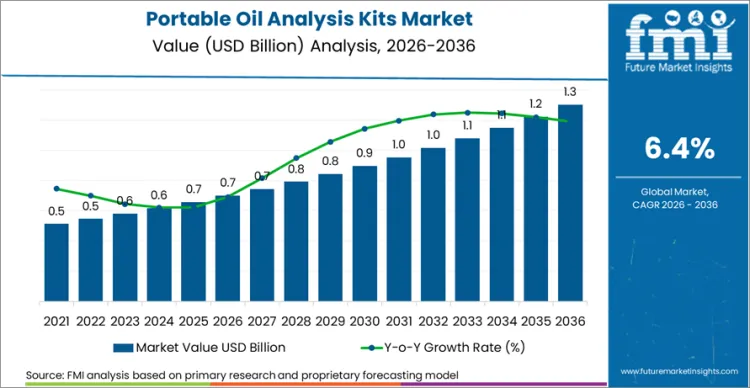
The portable oil analysis kits market is likely to total USD 0.7 billion in 2026, anticipated to rise further to USD 1.3 billion by 2036. FMI expects this demand to advance at a 6.4% CAGR from 2026 to 2036. The industry is in store for several major developments.
Handheld diagnostic instrumentation is undergoing a rapid transition toward all-in-one functionality, with recent launches at ArabLab 2025 highlighting the integration of viscometry, particle counting, and water detection into singular, ruggedized units. These systems are deployed to address high-value asset readiness in harsh environments, utilizing technologies originally developed for defense applications.
Major OEMs are shifting focus toward high-frequency sampling sensors that allow for continuous condition monitoring, effectively reducing the reliance on traditional laboratory-based testing for routine maintenance. Dave Zapico, Chairman and CEO of AMETEK, Inc., emphasized this momentum during the February 2026 earnings call:
"We enter 2026 with a record backlog, improving end market dynamics, and significant financial flexibility to support both our organic growth initiatives and to deploy capital on strategic acquisitions, driving continued long-term value creation."- AMETEK Fourth Quarter and Full Year Results, February 3, 2026.
Consolidation in the industrial services landscape is being driven by a pursuit of technology-led revenue streams. Parker Hannifin announced the acquisition of Filtration Group Corporation in late 2025, a move intended to broaden its aftermarket filtration and condition monitoring offerings.
SKF has inaugurated a highly automated precision bearing facility in Italy and launched SKF Ventures to explore emerging diagnostic technologies. These investments coincide with a strategic pivot among market leaders to separate automotive and industrial business lines, allowing for more targeted capital allocation toward industrial automation and circular remanufacturing solutions.
Legislative updates are significantly influencing the verification and deployment of portable instrumentation. In October 2025, India amended its Legal Metrology (GATC) Rules to include flow meters and moisture meters, broadening the scope for decentralized, government-approved testing centers. This aligns with global trends where regulatory frameworks are being modernized to support public-private partnerships in measurement accuracy.
On a macroeconomic level, the implementation of new trade tariffs in 2025 and 2026 is forcing manufacturers to optimize supply chains and adjust pricing models for hardware components, particularly for spectroscopic and electronic sensing equipment.
The evolution of portable kits is increasingly tied to enterprise-level software platforms that provide unified data access across varied facility environments. Organizations are moving toward modular licensing and cloud-based fluid intelligence platforms to manage fleet-wide diagnostics.
This digital transition is supported by the adoption of AI-powered analytics designed to predict failure modes before they occur. Companies are also prioritizing cybersecurity and data integrity within these platforms to comply with heightened industrial standards, ensuring that decentralized field data can be securely integrated into broader predictive maintenance ecosystems.
Summary of Portable Oil Analysis Kits Market
What is Growth Outlook for Portable Oil Analysis Kits Market as per Future Market Insights Projection?
Future Market Insights projects the portable oil analysis kits market to expand at a CAGR of 6.4% from 2026 to 2036, increasing from USD 0.7 billion in 2026 to USD 1.3 billion by 2036.
FMI Research Approach: FMI proprietary forecasting model integrating industrial asset utilization rates, predictive maintenance adoption, regulatory verification requirements, and penetration of handheld diagnostic instrumentation across manufacturing, energy, and transport sectors.
How do FMI Analysts Perceive Portable Oil Analysis Kits Market to Evolve?
FMI analysts perceive the market evolving from standalone diagnostic tools into digitally connected edge-intelligence systems embedded within enterprise maintenance and asset-management platforms. Growth is increasingly driven by the need for real-time condition monitoring, reduced dependence on centralized laboratories, and tighter alignment between oil health data and predictive maintenance algorithms. Market momentum is anchored in industrial digitization rather than incremental expansion of routine testing.
FMI Research Approach: Assessment of digital twin deployment, IIoT-enabled maintenance strategies, and integration of portable diagnostics with cloud-based analytics platforms.
Which Country Holds Largest Share in Global Portable Oil Analysis Kits Market?
China holds the largest share of the global portable oil analysis kits market, supported by large-scale industrial internet deployment, rapid adoption of intelligent manufacturing systems, and integration of portable diagnostics into standardized predictive maintenance frameworks.
FMI Research Approach: Country-level modeling based on industrial automation penetration, adoption of condition-based maintenance systems, and public investment in digital industrial infrastructure.
How Large will the Portable Oil Analysis Kits Market Be by 2036?
The global portable oil analysis kits market is projected to reach USD 1.3 billion by 2036.
FMI Research Approach: Long-term revenue forecasting derived from predictive maintenance adoption curves, industrial asset base expansion, and replacement cycles for portable diagnostic instrumentation.
What is the Definition of Portable Oil Analysis Kits Market?
The portable oil analysis kits market comprises handheld, benchtop, and chemically based diagnostic systems designed to assess lubricant condition, contamination levels, and wear indicators at the point of use, enabling on-site decision-making for asset maintenance across industrial, marine, energy, and transportation applications.
FMI Research Approach: FMI market taxonomy and inclusion-exclusion framework covering test types, instrumentation formats, and end-use environments for portable lubricant diagnostics.
What are some Globally Unique Trends Shaping Portable Oil Analysis Kits Market?
Globally unique trends include the convergence of portable diagnostics with industrial AI platforms, rising use of oil analysis to extend lubricant life under sustainability mandates, growing deployment in remote and offshore environments enabled by satellite connectivity, and increasing demand for audit-ready, regulation-compliant field diagnostics.
FMI Research Approach: Synthesis of industrial digitization initiatives, regulatory verification trends, and technology advancements in portable sensing and analytics.
Portable oil Analysis Kits Market Key Takeaways
| Metrics | Values |
|---|---|
| Expected Value (2026E) | USD 0.7 billion |
| Projected Value (2036F) | USD 1.3 billion |
| CAGR (2026-2036) | 6.4% |
Source: Future Market Insights (FMI) analysis, based on proprietary forecasting model and primary research
Why is the Portable Oil Analysis Kits Market Growing?
The integration of portable diagnostics into enterprise-level digital twin frameworks is fundamentally altering asset management strategies. This transformation redefines portable oil kits as essential edge-computing nodes that transmit real-time fluid health data to synchronize physical assets with their virtual replicas.
In 2026, digital twins have shifted from static models to dynamic ecosystems that use AI-driven predictive analytics to reduce unexpected downtime. This connectivity allows enterprises to map sensor data onto historical models and manufacturer thresholds to identify anomalies and suggest corrective actions before mechanical failures occur.
High-speed connectivity is facilitating a surge in remote-site deployments, particularly within the maritime and offshore sectors. Expansion of LEO satellite constellations is delivering low-latency broadband that rivals fiber, even in unreachable ocean regions. In 2026, these networks support end-user spending of nearly USD 15 billion as businesses prioritize global IoT connectivity for asset tracking and remote monitoring.
Wärtsilä Marine and other industry leaders leverage this high-throughput infrastructure to transmit high-fidelity oil analysis data from vessels to onshore experts. This real-time exchange allows for precise operational recommendations that lower fuel consumption and manage the complexity of modern hybrid power systems.
Sustainability mandates are repositioning oil analysis as a primary tool for lubricant life extension. LCA models demonstrate that extending the service life of in-service oil through precise monitoring can reduce a product's total carbon footprint by over 40%. In response, the India Ministry of Environment has enforced EPR for waste oils, which mandates that producers recycle 20% of their total lubricant sales by weight in 2025-2026, rising to 30% in 2026-27. These rules require bulk generators to utilize portable verification tools and digital monitoring portals to ensure that waste is treated as a resource rather than a disposable byproduct, fostering a circular economy where high-calorific waste is diverted for energy recovery.
How is Portable Oil Analysis Kits Market Segmented?
The segment analysis details all primary segments of the portable oil analysis kits market. The transition toward data-driven maintenance is intensifying, with specific hardware and end-use categories showing distinct growth trajectories based on industrial requirements and regulatory shifts.
How do Viscosity and Basic Property Kits Maintain their Dominance?
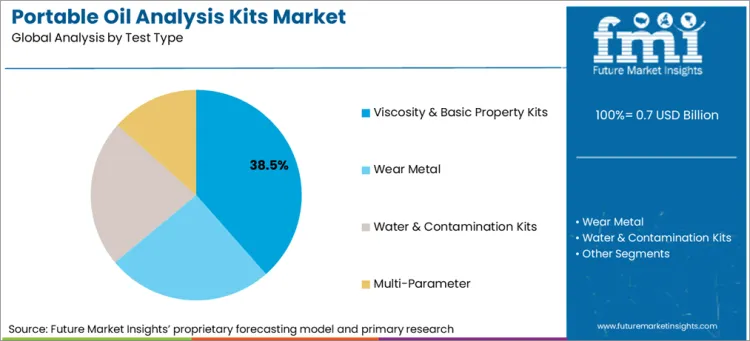
Viscosity and basic property kits account for 38.5% of the market share. Its prominence is sustained by the critical role of viscosity as the primary physical indicator of lubricant health. Rapid adoption of high-performance lubricants and premium viscosity index improvers in 2025 and 2026 is forcing operators to conduct frequent on-site verification to prevent film thickness breakdown.
Advanced manufacturing and power generation sectors prioritize these kits to ensure lubricants perform efficiently across a wide range of temperatures. AI-driven capabilities are also being integrated into these kits to analyze molecular structures and shear stability in real time, enabling smarter manufacturing decisions.
Why does Purely Chemical Instrumentation Continue to Lead by Technology?
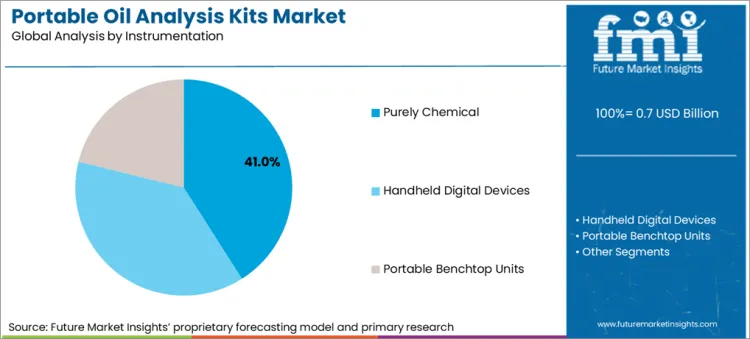
Purely chemical instrumentation holds the largest technology share at 41%. This segment thrives on the established reliability of traditional test methods for detecting oxidation and acid levels. While digital tools are advancing, purely chemical kits are indispensable for field teams requiring immediate, high-confidence results without the calibration complexity of electronic sensors.
In 2026, the chemical industry is focusing on specialty and tailored products that offer higher margins and address unmet needs in harsh industrial environments. These kits remain the baseline for regulatory compliance and audit trails in sectors where data integrity and physical verification are paramount.
What is driving the Focus on Industrial and Manufacturing Sectors?
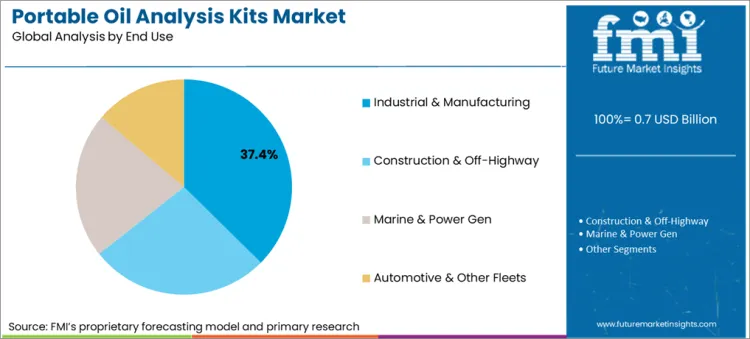
The industrial and manufacturing segment represents 37.4% of the end-use market. The expansion is largely attributed to the universal shift from reactive to predictive maintenance. Unplanned equipment failures can account for up to 20% of total maintenance costs in heavy industries, creating a powerful economic incentive for routine on-site diagnostics.
In 2026, the rise of Industry 4.0 and IIoT is fueling the demand for portable kits that can act as edge-computing nodes. Additionally, legislative updates like India’s 2025 Legal Metrology (GATC) Rules are broadening the infrastructure for decentralized, verified testing, further embedding these tools into the standard manufacturing workflow.
What Drivers, Restraints, Opportunities, and Trends Prevail in the Portable oil analysis kits Market?
The global portable oil analysis market is entering a pivotal phase in 2026, defined by a complex interplay of rigorous cybersecurity mandates, digital sovereignty initiatives, and resource-scarcity mitigation strategies. The IACS Unified Requirements E26 and E27, which became mandatory for vessels contracted from 2025 onwards, are accelerating expansion. These regulations necessitate full visibility of computer-based assets and real-time network monitoring. In 2026, this regulatory framework is compelling shipowners to adopt connected portable kits that can securely transmit condition-based data from remote maritime environments to onshore Technical Operations Centers, effectively turning isolated field tests into integrated nodes of a secure "defense-in-depth" maritime ecosystem.
Production and adoption are being challenged by the full implementation of the EU Critical Raw Materials Act in 2026. This legislation imposes strict domestic capacity benchmarks, including a 25% recycling target for strategic raw materials such as silicon and gallium. Manufacturers are navigating increased production costs as they shift away from single-country import dependencies toward more expensive, localized, and circular supply chains.
The UK Business compounds this pressure and Trade Committee’s 2026 Priorities, which highlight that high compliance costs and energy-intensive manufacturing are stalling capital investment, forcing portable kit providers to demonstrate immediate productivity gains to justify procurement.
A defining trend for 2026 is the state-led transition toward AI-Human collaborative diagnostics. In January 2026, China’s Ministry of Industry and Information Technology launched its 2026-2028 Action Plan, aiming to deploy 1,000 industrial intelligent agents for predictive maintenance. This aligns with Japan’s METI DX Certification system, where companies like NTN Corporation were certified in February 2026 for their readiness in AI-driven asset monitoring. These initiatives are shifting the market from providing simple hardware to delivering earning power through automated reporting and predictive analytics, where portable tools act as the primary data gatherers for national-scale industrial internet platforms.
Analysis of Portable Oil Analysis Kits Market by Key Countries
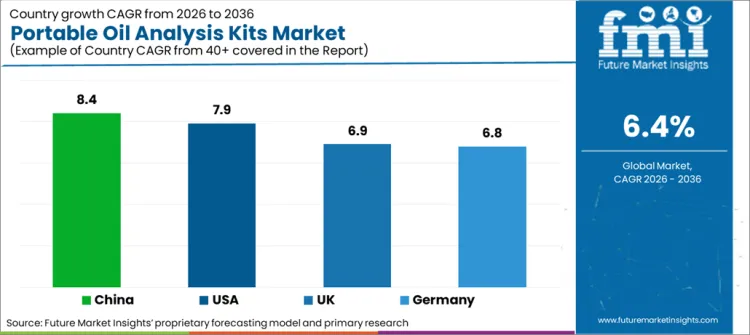
| Country | CAGR (2026-2036) |
|---|---|
| USA | 7.9% |
| UK | 6.9% |
| Germany | 6.8% |
| China | 8.4% |
Source: Future Market Insights (FMI) analysis, based on proprietary forecasting model and primary research
Will Federal R&D Stimulate Portable Oil Analysis Kits Demand in USA?
USA is projected to expand at a 7.9% CAGR through 2036, driven by a strategic realignment of federal funding toward energy supply chain resilience. In January 2026, the U.S. Department of Energy initiated the Genesis Mission, a high-priority initiative leveraging AI for scientific breakthroughs in industrial technologies. Its Transmission Reliability and Resilience program is advancing real-time system monitoring and diagnostics to manage the increasing complexity of the nation’s power grid, creating a surge in demand for on-site analytical tools.
Domestic manufacturing is bolstered by private sector investments in smart sensing. In early 2026, companies are prioritizing hard tech innovations, with $134 million in new funding allocated for domestic rare earth supply chains essential for sensor production. The launch of the ATUSA wearable 3D system and other FDA-cleared handheld diagnostic devices in late 2025 illustrates a broader trend of miniaturizing complex analytical hardware for field use, ensuring that high-fidelity data is accessible at the point of need.
How does UK align with its New Advanced Manufacturing Plan in this Landscape?
UK is expected to achieve a 6.9% CAGR, supported by the government’s Advanced Manufacturing Plan, which allocated £4.5 billion in funding starting in 2025. A significant portion of this, including £3 billion for the automotive and aerospace sectors, is earmarked for digital and clean manufacturing technologies. This policy environment encourages the adoption of portable oil analysis as a method to reduce waste and meet net-zero targets by extending the operational life of high-value machinery.
Industry sentiment remains robust, with the Make UK Executive Survey 2026 reporting that 68% of manufacturers are increasing investment in new product development despite rising employment costs. Organizations are specifically embedding AI and automation into their maintenance workflows to combat labor shortages. This focus is leading to a higher penetration of portable kits within "Investment Zones" across South Yorkshire and the West Midlands, where anchor investments in advanced manufacturing are fostering a specialized ecosystem for condition monitoring.
Is Germany’s Growth sustained by the digital transformation of the Mittelstand?
Germany is set to grow at a 6.8% CAGR, catalyzed by the High-Tech Agenda Germany, which identifies AI and climate-neutral energy as core pillars for national sovereignty. At Hannover Messe 2026, the new Predictive Maintenance & Machine Learning Pavilion has become a focal point for the Mittelstand, highlighting how circular thinking can be transformed into industrial reality through precision monitoring. This encourages the shift toward condition-based maintenance strategies that lower operational costs by 20% to 30%.
The government has moved toward a more active industrial policy, aiming to increase industrial value-add to 25% by 2030. Funding through the Digital Europe Programme is providing SMEs with access to AI regulatory sandboxes, allowing for the safe testing of cloud-connected diagnostic tools. These efforts ensure that even smaller manufacturers can integrate advanced spectroscopic analysis into their facilities, aligning with the national goal of becoming a leading technology nation through "sovereign" innovation and resource efficiency.
Can China’s Portable Oil Analysis Kits Landscape maintain its Global Leadership in Industrial Internet Integration?
China leads the global market with a projected 8.4% CAGR, underpinned by the 2026-2028 Industrial Internet Action Plan released by the Ministry of Industry and Information Technology (MIIT). The plan targets a penetration rate of over 55% for industrial internet platforms and aims to connect more than 120 million industrial devices. By treating portable diagnostic kits as "intelligent industrial agents," China is transforming its early advantages in data accumulation into a competitive edge for high-quality manufacturing development.
The 14th Five-Year Plan progress reports from early 2026 highlight the establishment of over 500 smart manufacturing demonstration factories. These facilities utilize "gradient nurturing" to accelerate the adoption of autonomous, controllable industrial software and equipment. Large-scale equipment upgrades and trade-in policies have already driven a 15.7% increase in machinery investment, ensuring that portable oil analysis is no longer a niche tool but a standardized component of China's rapidly expanding digital industrial infrastructure.
What is the Competition Outlook for Portable Oil Analysis Kits?
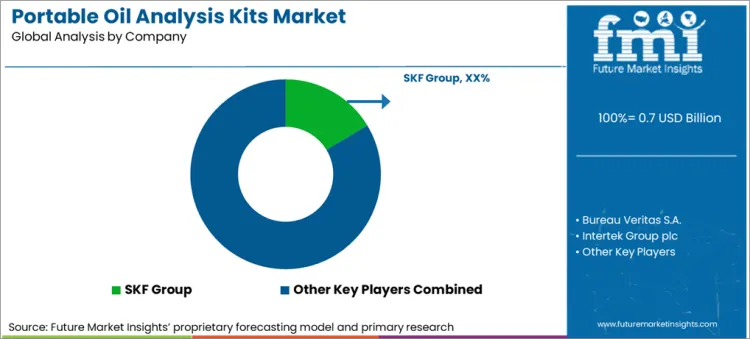
The competitive landscape for portable oil analysis kits is undergoing a structural realignment, characterized by the convergence of traditional fluid expertise and aggressive "Industrial AI" integration. In 2026, the intensity of competition has shifted from hardware accuracy to the provision of Decision Intelligence.
Established players like SKF Group and Hydac International are defending their market share against the digitization of aftermarket services by large energy majors. The market is increasingly bifurcated: high-precision instrumentation specialists like Spectro Scientific are expanding the physical limits of handheld sensors, while service-oriented giants such as Bureau Veritas and Intertek are pivoting toward end-to-end "Total Quality Assurance" architectures that integrate field data into global compliance dashboards.
Caterpillar SOS Services and Shell LubeAnalyst, who are leveraging their vast proprietary datasets to lock in users through predictive algorithms, further intensify the rivalry. In early 2026, the competitive focus has moved toward edge-computing capability, where diagnostic tools must operate autonomously in remote, off-grid locations without cloud dependency. This shift is evident in the surge of strategic R&D spending, with industry leaders focusing on all-in-one ruggedized units that can detect everything from biodiesel dilution to sub-micron wear particles. Differentiation is no longer achieved solely through a product’s test range, but through its ability to provide immediate, legally verifiable audit trails that meet the evolving 2026 environmental and safety mandates.
Key Developments
- Caterpillar Inc. unveiled the SOS 2.0 in early 2026, a fully integrated fluid analysis platform within VisionLink® that utilizes the Cat AI Assistant (launched at CES 2026) to provide multimodal, voice-activated service recommendations and automated parts ordering.
- Spectro Scientific (AMETEK), released the a new generation of FluidScan (1000/1100) handheld analyzers in 2025, featuring a biodiesel detection algorithm and a expanded oil library of nearly 800 references to eliminate the need for manual user-fluid entries.
- Intertek Group plc expanded its global footprint in 2024-2025 with new high-tech fuel and lubricant testing laboratories in Guyana and Algeciras, Spain, and introduced a Digital Product Passport platform to provide lifecycle traceability for industrial fluids.
Key Players Profiled
- SKF Group
- Bureau Veritas S.A.
- Intertek Group plc
- Hydac International GmbH
- Spectro Scientific
- Parker Kittiwake
- Shell LubeAnalyst
- Chevron ISOCLEAN
- Caterpillar SOS Services
Market Definition
The portable oil analysis kits market comprises compact, field-deployable diagnostic systems designed to assess the condition and performance of lubricating oils, hydraulic fluids, and related industrial fluids at or near the point of use. These kits enable rapid evaluation of parameters such as viscosity, contamination, water content, wear metals, and chemical degradation without reliance on centralized laboratories. The market reflects the shift toward condition-based and predictive maintenance, where real-time fluid health insights are critical to asset reliability, uptime optimization, and lifecycle cost control across industrial environments.
The report includes portable and handheld oil analysis kits incorporating purely chemical test methods, handheld digital analyzers, and portable benchtop units used across industrial and manufacturing facilities, construction and off-highway equipment, marine and power generation assets, and automotive or mixed fleets. It covers test types such as viscosity and basic property kits, wear metal detection, water and contamination analysis, and multi-parameter systems, including solutions integrated with digital platforms for data logging, diagnostics, and predictive maintenance workflows.
The scope excludes centralized laboratory oil analysis services, permanently installed online oil monitoring sensors, and standalone software platforms not bundled with portable testing hardware. It also excludes bulk laboratory instrumentation, consumables sold independently of kits, and non-lubricant fluid testing systems unrelated to industrial oil condition monitoring. Asset repair services, lubricant manufacturing, and waste oil processing activities fall outside the defined market boundary.
Scope of Report
| Items | Values |
|---|---|
| Quantitative Units | USD 0.7 billion |
| Test Type | Viscosity & Basic Property Kits, Wear Metal, Water & Contamination Kits, Multi-Parameter |
| Instrumentation | Purely Chemical, Handheld Digital Devices, Portable Benchtop Units |
| End Use | Industrial & Manufacturing, Construction & Off-Highway, Marine & Power Generation, Automotive & Other Fleets |
| Regions Covered | North America, Western Europe, Eastern Europe, East Asia, South Asia & Pacific, Latin America, Middle East & Africa |
| Countries | USA, UK, Germany, China and 40+ countries |
| Key Companies | SKF Group, Bureau Veritas S.A., Intertek Group plc, Hydac International GmbH, Spectro Scientific, Parker Kittiwake, Shell LubeAnalyst, Chevron ISOCLEAN, Caterpillar SOS Services |
Source: Future Market Insights (FMI) analysis, based on proprietary forecasting model and primary research
Portable Oil Analysis Kits Market Key Segments
Test Type:
- Viscosity & Basic Property Kits
- Wear Metal
- Water & Contamination Kits
- Multi-Parameter
Instrumentation:
- Purely Chemical
- Handheld Digital Devices
- Portable Benchtop Units
End Use:
- Industrial & Manufacturing
- Construction & Off-Highway
- Marine & Power Gen
- Automotive & Other Fleets
Region:
- North America
- Western Europe
- Eastern Europe
- East Asia
- South Asia & Pacific
- Latin America
- Middle East & Africa
Bibliography
- ASTM International. (2025). ASTM D445: Standard test method for kinematic viscosity of transparent and opaque liquids. ASTM Standards.
- International Council on Combustion Engines (CIMAC). (2025). Guidelines for lubrication oil condition monitoring and analysis in marine and stationary engines. CIMAC Working Group Publication.
- International Organization for Standardization. (2025). ISO 13379-1: Condition monitoring and diagnostics of machines - Data interpretation and diagnostics techniques. ISO Publishing.
- SKF Group. (2025). Condition monitoring and portable oil analysis for predictive maintenance in industrial assets. SKF Technical White Paper.
- AMETEK Spectro Scientific. (2024). Portable infrared and viscosity-based oil analysis technologies for field diagnostics. Spectro Scientific Application Note.
- DNV. (2024). Condition-based monitoring and maintenance of rotating equipment. DNV Recommended Practice.
Frequently Asked Questions
How large is the portable oil analysis kits market from a technology adoption perspective?
The market is valued at around USD 0.7 billion in 2026, reflecting the growing deployment of handheld and portable diagnostic devices as edge technologies within industrial maintenance ecosystems.
What core technologies define modern portable oil analysis kits?
Modern kits combine viscometry, particle counting, moisture detection, and chemical analysis within ruggedized handheld or portable benchtop devices, increasingly supported by embedded sensors and onboard computing.
Why are portable oil analysis kits becoming integral to predictive maintenance systems?
These kits act as edge-computing nodes that generate real-time fluid health data, enabling integration with digital twins, AI-based analytics, and enterprise asset management platforms for condition-based maintenance.
How are connectivity and software platforms shaping kit deployment?
Cloud-enabled software, modular licensing, and secure data transmission allow results from decentralized field testing to be aggregated, analyzed, and audited across fleets and facilities in near real time.
What technical challenges limit faster adoption of portable oil analysis technologies?
Key challenges include instrument cost, calibration and contamination control, cybersecurity requirements, and the need for skilled operators to ensure data accuracy in harsh and remote operating environments.
Preview the report firsthand - request a free sample
Get SampleGet the brochure for pricing and purchase details.
Get PDFTable of Content
- Executive Summary
- Global Market Outlook
- Demand-side Trends
- Supply-side Trends
- Technology Roadmap Analysis
- Analysis and Recommendations
- Market Overview
- Market Coverage / Taxonomy
- Market Definition / Scope / Limitations
- Research Methodology
- Chapter Orientation
- Analytical Lens and Working Hypotheses
- Market Structure, Signals, and Trend Drivers
- Benchmarking and Cross-market Comparability
- Market Sizing, Forecasting, and Opportunity Mapping
- Research Design and Evidence Framework
- Desk Research Programme (Secondary Evidence)
- Company Annual and Sustainability Reports
- Peer-reviewed Journals and Academic Literature
- Corporate Websites, Product Literature, and Technical Notes
- Earnings Decks and Investor Briefings
- Statutory Filings and Regulatory Disclosures
- Technical White Papers and Standards Notes
- Trade Journals, Industry Magazines, and Analyst Briefs
- Conference Proceedings, Webinars, and Seminar Materials
- Government Statistics Portals and Public Data Releases
- Press Releases and Reputable Media Coverage
- Specialist Newsletters and Curated Briefings
- Sector Databases and Reference Repositories
- FMI Internal Proprietary Databases and Historical Market Datasets
- Subscription Datasets and Paid Sources
- Social Channels, Communities, and Digital Listening Inputs
- Additional Desk Sources
- Expert Input and Fieldwork (Primary Evidence)
- Primary Modes
- Qualitative Interviews and Expert Elicitation
- Quantitative Surveys and Structured Data Capture
- Blended Approach
- Why Primary Evidence is Used
- Field Techniques
- Interviews
- Surveys
- Focus Groups
- Observational and In-context Research
- Social and Community Interactions
- Stakeholder Universe Engaged
- C-suite Leaders
- Board Members
- Presidents and Vice Presidents
- R&D and Innovation Heads
- Technical Specialists
- Domain Subject-matter Experts
- Scientists
- Physicians and Other Healthcare Professionals
- Governance, Ethics, and Data Stewardship
- Research Ethics
- Data Integrity and Handling
- Primary Modes
- Tooling, Models, and Reference Databases
- Desk Research Programme (Secondary Evidence)
- Data Engineering and Model Build
- Data Acquisition and Ingestion
- Cleaning, Normalisation, and Verification
- Synthesis, Triangulation, and Analysis
- Quality Assurance and Audit Trail
- Market Background
- Market Dynamics
- Drivers
- Restraints
- Opportunity
- Trends
- Scenario Forecast
- Demand in Optimistic Scenario
- Demand in Likely Scenario
- Demand in Conservative Scenario
- Opportunity Map Analysis
- Product Life Cycle Analysis
- Supply Chain Analysis
- Investment Feasibility Matrix
- Value Chain Analysis
- PESTLE and Porter’s Analysis
- Regulatory Landscape
- Regional Parent Market Outlook
- Production and Consumption Statistics
- Import and Export Statistics
- Market Dynamics
- Global Market Analysis 2021 to 2025 and Forecast, 2026 to 2036
- Historical Market Size Value (USD Million) Analysis, 2021 to 2025
- Current and Future Market Size Value (USD Million) Projections, 2026 to 2036
- Y-o-Y Growth Trend Analysis
- Absolute $ Opportunity Analysis
- Global Market Pricing Analysis 2021 to 2025 and Forecast 2026 to 2036
- Global Market Analysis 2021 to 2025 and Forecast 2026 to 2036, By Test Type
- Introduction / Key Findings
- Historical Market Size Value (USD Million) Analysis By Test Type , 2021 to 2025
- Current and Future Market Size Value (USD Million) Analysis and Forecast By Test Type , 2026 to 2036
- Viscosity & Basic Property Kits
- Wear Metal
- Water & Contamination Kits
- Multi-Parameter
- Viscosity & Basic Property Kits
- Y-o-Y Growth Trend Analysis By Test Type , 2021 to 2025
- Absolute $ Opportunity Analysis By Test Type , 2026 to 2036
- Global Market Analysis 2021 to 2025 and Forecast 2026 to 2036, By Instrumentation
- Introduction / Key Findings
- Historical Market Size Value (USD Million) Analysis By Instrumentation, 2021 to 2025
- Current and Future Market Size Value (USD Million) Analysis and Forecast By Instrumentation, 2026 to 2036
- Purely Chemical
- Handheld Digital Devices
- Portable Benchtop Value (USD Million)s
- Purely Chemical
- Y-o-Y Growth Trend Analysis By Instrumentation, 2021 to 2025
- Absolute $ Opportunity Analysis By Instrumentation, 2026 to 2036
- Global Market Analysis 2021 to 2025 and Forecast 2026 to 2036, By End Use
- Introduction / Key Findings
- Historical Market Size Value (USD Million) Analysis By End Use, 2021 to 2025
- Current and Future Market Size Value (USD Million) Analysis and Forecast By End Use, 2026 to 2036
- Industrial & Manufacturing
- Construction & Off-Highway
- Marine & Power Gen
- Automotive & Other Fleets
- Industrial & Manufacturing
- Y-o-Y Growth Trend Analysis By End Use, 2021 to 2025
- Absolute $ Opportunity Analysis By End Use, 2026 to 2036
- Global Market Analysis 2021 to 2025 and Forecast 2026 to 2036, By Region
- Introduction
- Historical Market Size Value (USD Million) Analysis By Region, 2021 to 2025
- Current Market Size Value (USD Million) Analysis and Forecast By Region, 2026 to 2036
- North America
- Latin America
- Western Europe
- Eastern Europe
- East Asia
- South Asia and Pacific
- Middle East & Africa
- Market Attractiveness Analysis By Region
- North America Market Analysis 2021 to 2025 and Forecast 2026 to 2036, By Country
- Historical Market Size Value (USD Million) Trend Analysis By Market Taxonomy, 2021 to 2025
- Market Size Value (USD Million) Forecast By Market Taxonomy, 2026 to 2036
- By Country
- USA
- Canada
- Mexico
- By Test Type
- By Instrumentation
- By End Use
- By Country
- Market Attractiveness Analysis
- By Country
- By Test Type
- By Instrumentation
- By End Use
- Key Takeaways
- Latin America Market Analysis 2021 to 2025 and Forecast 2026 to 2036, By Country
- Historical Market Size Value (USD Million) Trend Analysis By Market Taxonomy, 2021 to 2025
- Market Size Value (USD Million) Forecast By Market Taxonomy, 2026 to 2036
- By Country
- Brazil
- Chile
- Rest of Latin America
- By Test Type
- By Instrumentation
- By End Use
- By Country
- Market Attractiveness Analysis
- By Country
- By Test Type
- By Instrumentation
- By End Use
- Key Takeaways
- Western Europe Market Analysis 2021 to 2025 and Forecast 2026 to 2036, By Country
- Historical Market Size Value (USD Million) Trend Analysis By Market Taxonomy, 2021 to 2025
- Market Size Value (USD Million) Forecast By Market Taxonomy, 2026 to 2036
- By Country
- Germany
- UK
- Italy
- Spain
- France
- Nordic
- BENELUX
- Rest of Western Europe
- By Test Type
- By Instrumentation
- By End Use
- By Country
- Market Attractiveness Analysis
- By Country
- By Test Type
- By Instrumentation
- By End Use
- Key Takeaways
- Eastern Europe Market Analysis 2021 to 2025 and Forecast 2026 to 2036, By Country
- Historical Market Size Value (USD Million) Trend Analysis By Market Taxonomy, 2021 to 2025
- Market Size Value (USD Million) Forecast By Market Taxonomy, 2026 to 2036
- By Country
- Russia
- Poland
- Hungary
- Balkan & Baltic
- Rest of Eastern Europe
- By Test Type
- By Instrumentation
- By End Use
- By Country
- Market Attractiveness Analysis
- By Country
- By Test Type
- By Instrumentation
- By End Use
- Key Takeaways
- East Asia Market Analysis 2021 to 2025 and Forecast 2026 to 2036, By Country
- Historical Market Size Value (USD Million) Trend Analysis By Market Taxonomy, 2021 to 2025
- Market Size Value (USD Million) Forecast By Market Taxonomy, 2026 to 2036
- By Country
- China
- Japan
- South Korea
- By Test Type
- By Instrumentation
- By End Use
- By Country
- Market Attractiveness Analysis
- By Country
- By Test Type
- By Instrumentation
- By End Use
- Key Takeaways
- South Asia and Pacific Market Analysis 2021 to 2025 and Forecast 2026 to 2036, By Country
- Historical Market Size Value (USD Million) Trend Analysis By Market Taxonomy, 2021 to 2025
- Market Size Value (USD Million) Forecast By Market Taxonomy, 2026 to 2036
- By Country
- India
- ASEAN
- Australia & New Zealand
- Rest of South Asia and Pacific
- By Test Type
- By Instrumentation
- By End Use
- By Country
- Market Attractiveness Analysis
- By Country
- By Test Type
- By Instrumentation
- By End Use
- Key Takeaways
- Middle East & Africa Market Analysis 2021 to 2025 and Forecast 2026 to 2036, By Country
- Historical Market Size Value (USD Million) Trend Analysis By Market Taxonomy, 2021 to 2025
- Market Size Value (USD Million) Forecast By Market Taxonomy, 2026 to 2036
- By Country
- Kingdom of Saudi Arabia
- Other GCC Countries
- Turkiye
- South Africa
- Other African Union
- Rest of Middle East & Africa
- By Test Type
- By Instrumentation
- By End Use
- By Country
- Market Attractiveness Analysis
- By Country
- By Test Type
- By Instrumentation
- By End Use
- Key Takeaways
- Key Countries Market Analysis
- USA
- Pricing Analysis
- Market Share Analysis, 2025
- By Test Type
- By Instrumentation
- By End Use
- Canada
- Pricing Analysis
- Market Share Analysis, 2025
- By Test Type
- By Instrumentation
- By End Use
- Mexico
- Pricing Analysis
- Market Share Analysis, 2025
- By Test Type
- By Instrumentation
- By End Use
- Brazil
- Pricing Analysis
- Market Share Analysis, 2025
- By Test Type
- By Instrumentation
- By End Use
- Chile
- Pricing Analysis
- Market Share Analysis, 2025
- By Test Type
- By Instrumentation
- By End Use
- Germany
- Pricing Analysis
- Market Share Analysis, 2025
- By Test Type
- By Instrumentation
- By End Use
- UK
- Pricing Analysis
- Market Share Analysis, 2025
- By Test Type
- By Instrumentation
- By End Use
- Italy
- Pricing Analysis
- Market Share Analysis, 2025
- By Test Type
- By Instrumentation
- By End Use
- Spain
- Pricing Analysis
- Market Share Analysis, 2025
- By Test Type
- By Instrumentation
- By End Use
- France
- Pricing Analysis
- Market Share Analysis, 2025
- By Test Type
- By Instrumentation
- By End Use
- India
- Pricing Analysis
- Market Share Analysis, 2025
- By Test Type
- By Instrumentation
- By End Use
- ASEAN
- Pricing Analysis
- Market Share Analysis, 2025
- By Test Type
- By Instrumentation
- By End Use
- Australia & New Zealand
- Pricing Analysis
- Market Share Analysis, 2025
- By Test Type
- By Instrumentation
- By End Use
- China
- Pricing Analysis
- Market Share Analysis, 2025
- By Test Type
- By Instrumentation
- By End Use
- Japan
- Pricing Analysis
- Market Share Analysis, 2025
- By Test Type
- By Instrumentation
- By End Use
- South Korea
- Pricing Analysis
- Market Share Analysis, 2025
- By Test Type
- By Instrumentation
- By End Use
- Russia
- Pricing Analysis
- Market Share Analysis, 2025
- By Test Type
- By Instrumentation
- By End Use
- Poland
- Pricing Analysis
- Market Share Analysis, 2025
- By Test Type
- By Instrumentation
- By End Use
- Hungary
- Pricing Analysis
- Market Share Analysis, 2025
- By Test Type
- By Instrumentation
- By End Use
- Kingdom of Saudi Arabia
- Pricing Analysis
- Market Share Analysis, 2025
- By Test Type
- By Instrumentation
- By End Use
- Turkiye
- Pricing Analysis
- Market Share Analysis, 2025
- By Test Type
- By Instrumentation
- By End Use
- South Africa
- Pricing Analysis
- Market Share Analysis, 2025
- By Test Type
- By Instrumentation
- By End Use
- USA
- Market Structure Analysis
- Competition Dashboard
- Competition Benchmarking
- Market Share Analysis of Top Players
- By Regional
- By Test Type
- By Instrumentation
- By End Use
- Competition Analysis
- Competition Deep Dive
- SKF Group
- Overview
- Product Portfolio
- Profitability by Market Segments (Product/Age /Sales Channel/Region)
- Sales Footprint
- Strategy Overview
- Marketing Strategy
- Product Strategy
- Channel Strategy
- Bureau Veritas S.A.
- Intertek Group plc
- Hydac International GmbH
- Spectro Scientific
- Parker Kittiwake
- Shell LubeAnalyst
- Chevron ISOCLEAN
- Caterpillar SOS Services
- SKF Group
- Competition Deep Dive
- Assumptions & Acronyms Used


