

- Market Size (2026)
- USD 760.6 Mn
- Forecast (2036)
- USD 1299.2 Mn
- CAGR (2026 to 2036)
- 5.5%
How big is Dye Penetrant Kits Market in 2026?
USD 760.6 million in 2026 and USD 1299.2 million by 2036 at a 5.5% CAGR.
Sales in dye penetrant kits market is forecast to rise from USD 760.6 million in 2026 to USD 1299.2 million by 2036 at a 5.5% CAGR, supported by recurring chemistry replacement. Aviation maintenance reinforces the purchasing cycle through formal controls on inspection methods and qualified personnel across approved organizations. EASA’s September 2025 rules classify dye penetrant as a particular NDT method and require relevant personnel to qualify under EN 4179. The qualification framework sustains testing and certification activity across networks that require validated personnel and repeatable inspection results.
Inspection frequency sets consumable order volume because each approved procedure uses fresh penetrant and developer during every completed cycle. Portable kits support remote maintenance teams without permanent processing lines for dispersed industrial operators worldwide. Chemetall connects Ardrox chemistry with application support that maintains controlled inspection conditions across regulated sites. Comparable welding consumables programs require documented compatibility across substrates and procedures prior to routine production approval.
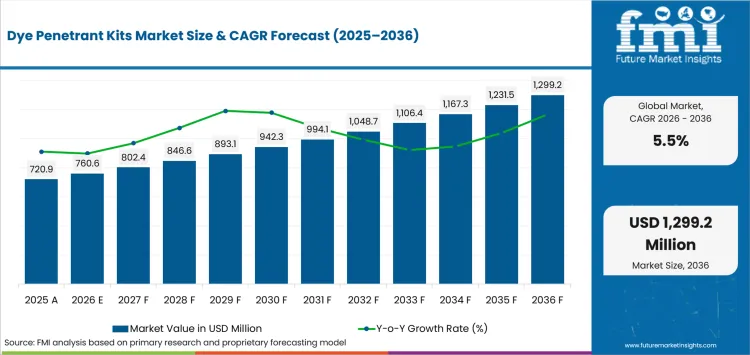
Key Takeaways of Dye Penetrant Kits Market
- Safety-critical maintenance programs create recurring demand because every completed inspection consumes penetrant plus remover and developer materials.
- Visible dye penetrant kits are projected to represent 31% share in 2026 owing to simple daylight evaluation and limited equipment requirements.
- Penetrant formulations are estimated to account for 27% share in 2026 supported by direct consumption across every prepared test surface.
- Weld inspection is forecast to capture 29% share in 2026 attributable to codified checks across fabricated structures and pressure systems.
- Chemical compatibility, storage control and wastewater treatment can extend qualification programs across regulated manufacturing and maintenance sites.
- Magnaflux; Chemetall / BASF; Sherwin Incorporated; MR Chemie; KARL DEUTSCH; Johnson & Allen; NDT Italiana; and MARKTEC provide penetrant chemistry with technical support.
Analyst Perspective
"Commercial advantage depends on connecting approved chemistry with dependable local service across regulated inspection programs. Customers rarely replace penetrant systems for price alone since each material change requires fresh compatibility checks and procedure control. Portfolio breadth carries less weight than proven performance across the exact substrate and sensitivity level used at each inspection site."
- Nikhil Kaitwade, Principal Analyst, Future Market Insights.
How is the Dye Penetrant Kits Market segmented?
The dye penetrant kits industry is segmented by kit type, component, application, end use, packaging and region.
The market taxonomy covers kit type plus component and application alongside end use and packaging for commercial comparison. Kit type includes visible and fluorescent systems plus three removal configurations that address different sensitivity requirements. Component analysis covers penetrant plus cleaner and developer and complete kits across each inspection workflow. Applications span welds and formed parts plus marine and aerospace work while end use and packaging identify purchasing context.
Why do visible dye penetrant kits lead demand within the kit type category?
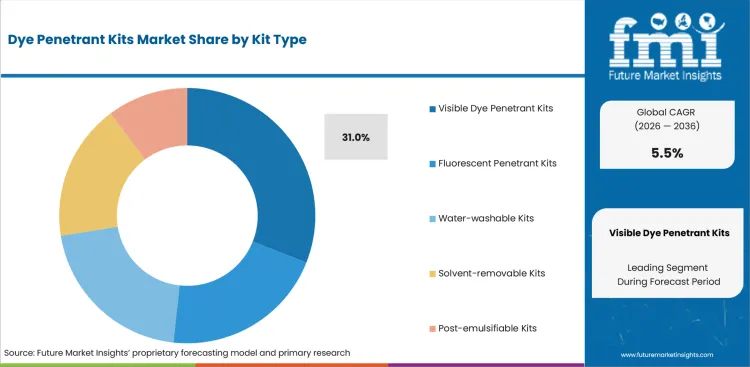
Normal-light evaluation gives visible systems a practical role across field inspections that lack dedicated ultraviolet equipment. Magnaflux supports controlled field inspection through SKL-SP2 for welds and pressure vessels at regulated sites. Approved industrial cleaners protect surface wetting by removing contamination without altering subsequent penetrant performance during fieldwork.
- Based on kit type, visible dye penetrant kits are projected to account for 31% in 2026 due to daylight readability and limited auxiliary equipment requirements.
- Maintenance contractors favor aerosol kits that fit inside service vehicles and reduce setup work at remote assets. Surface condition and removal technique remain separate adoption constraints because poor preparation can weaken indication quality across documented procedures.
Why does penetrant lead demand within the component category?
Penetrant volumes track every prepared surface and therefore scale directly with inspection throughput across manual stations or automated lines. MR Chemie supports visible and fluorescent routes through matched chemistry families for different procedure requirements. Compatible industrial cleaning chemicals protect capillary action by removing residues without disrupting surface wetting during processing.
- By component, penetrant is estimated to hold 27% in 2026 owing to direct application across every prepared inspection area.
- High-volume inspection lines purchase bulk penetrant to maintain bath consistency across repetitive component programs at industrial scale. Mobile teams instead prioritize matched component sets and batch documentation because unqualified substitutions can invalidate approved procedures.
Why does weld inspection lead demand within the application category?
Surface-breaking cracks often form near weld toes and heat-affected zones that remain accessible during fabrication or repair. Johnson & Allen supports localized inspection through JAP penetrant for welded fabrications and pressure vessels at regulated sites. Recurring pipeline integrity work extends the same portable method across distributed field assets requiring repeated local testing.
- In 2026, weld inspection is expected to lead application demand with 29% share because regulated fabrication programs require recurring checks across joints and pressure boundaries.
- Fabricators value portable kits that inspect localized weld areas without transferring heavy assemblies into fixed processing lines. Rough surfaces and trapped contamination create a separate friction because inadequate preparation can obscure relevant indications.
Why does aerospace lead demand within the end use category?
Aerospace maintenance applies penetrant inspection to high-value components that require documented sensitivity plus qualified personnel and controlled processing. Magnaflux supports this workflow through ZL-27A for post-emulsifiable fluorescent inspection at regulated aerospace sites worldwide. Established aircraft maintenance operations favor approved chemistry families that reduce requalification risk across maintenance networks.
- Aerospace is set to lead the end use category with 23% share in 2026 due to multi-stage inspection and traceability requirements.
- Maintenance organizations purchase complete chemistry families because each component must perform consistently under written procedures. Adjacent aerospace maintenance chemicals also require residue control so component preparation does not interfere with capillary action or indication visibility.
Why do aerosol cans lead demand within the packaging category?
Field teams need measured chemistry that travels without separate pumps across temporary maintenance locations and localized industrial inspections. MARKTEC supports this requirement through Super Check products supplied in aerosol and bulk formats worldwide.
- The aerosol can segment is likely to capture 47% share in 2026 attributable to portable application and controlled dispensing.
- Service contractors favor aerosols that carry matched chemistry directly to each inspected asset during field inspections. Propellant performance and shelf-life control remain separate constraints as partially used cans can produce uneven coverage.
What are the drivers, restraints and opportunities in the Dye Penetrant Kits Market?
Driver: Formal NDT programs sustain recurring chemistry purchases across regulated maintenance operations. Restraint: Chemistry compatibility plus storage and disposal requirements can extend qualification. Opportunity: Lower-hazard penetrants can reduce wastewater work within approved inspection procedures.
- Driver: Formal NDT programs sustain repeat chemistry purchases because every completed penetrant inspection consumes fresh materials across the defined inspection area.
- Restraint: Chemistry changes require compatibility review and increase storage plus disposal work across regulated manufacturing or maintenance facilities.
- Opportunity: Lower-hazard penetrants reduce wastewater treatment burdens while preserving the established surface-flaw inspection principle and trained workflow.
Formal inspection programs sustain repeat purchases across government and industrial maintenance operations that consume chemistry during every completed cycle. NASA’s Johnson Space Center laboratories listed liquid penetrant testing with fluorescent and visible media in January 2026. Comparable ship repair services use portable chemistry for localized checks across vessels and dockside assets. Manufacturers therefore compete on replenishment reliability across long-lived approved procedures and regional maintenance sites worldwide.
Chemical compatibility materially restrains adoption because cleaners and removers must preserve surface wetting plus substrate condition across each approved procedure. Revised approvals and storage controls extend qualification schedules for operators managing several regulated inspection locations.
Lower-hazard formulations provide a credible route for facilities seeking less demanding wastewater treatment within established penetrant workflows. MR Chemie’s July 2026 biodegradable penetrant disclosure linked reduced treatment effort with authority-dependent drain disposal across approved locations. Commercial adoption therefore depends on equivalent sensitivity plus local disposal approval across each defined substrate and removal method.
Which country CAGRs are profiled in the Dye Penetrant Kits Market?
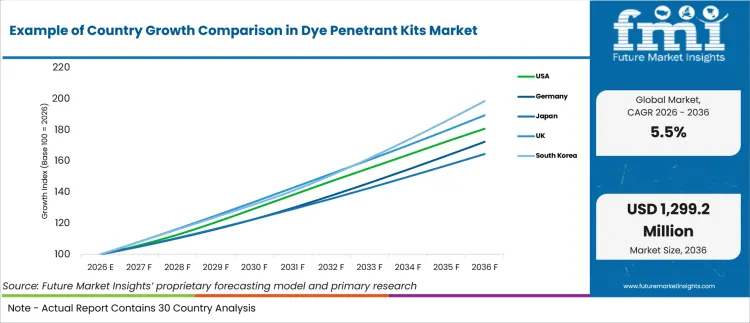
| Country | CAGR |
|---|---|
| United States | 6.1% |
| Germany | 5.6% |
| Japan | 5.1% |
| United Kingdom | 6.6% |
| South Korea | 7.1% |
How do country-level CAGRs compare in the Dye Penetrant Kits Market?
The country forecasts remain relatively close across the dye penetrant kits market, with a 2.0 percentage point difference between South Korea and Japan. South Korea and the United Kingdom form an upper group, reflecting strong demand for non-destructive testing (NDT) solutions across manufacturing, aerospace and industrial inspection applications. The United States follows within a narrow range and benefits from a large installed base of inspection and maintenance operations. Germany and Japan create a lower pair with limited separation, indicating steady demand supported by advanced manufacturing and quality assurance requirements. The pattern suggests that growth is driven by industrial safety standards, asset integrity programs and expanding use of NDT methods across critical industries.
- South Korea benefits from strong activity in shipbuilding, automotive manufacturing and industrial equipment inspection.
- The United Kingdom supports demand through aerospace maintenance, engineering services and regulatory quality requirements.
- The United States reflects steady adoption of dye penetrant testing across aviation, energy and industrial maintenance applications.
- Germany maintains demand through precision manufacturing and strict quality control standards.
- Japan continues to support market growth through advanced production environments where defect detection and product reliability remain critical.
Comparable CAGRs may still reflect different market conditions because end-use industries, inspection standards, certification requirements and maintenance practices vary across countries. The full report provides country-level CAGR analysis across North America, Latin America, Europe, East Asia, South Asia, Oceania and the Middle East and Africa.
Country-wise Analysis
- United States aviation mechanic testing now requires liquid penetrant equipment for relevant practical tasks across approved examination locations. Adoption of dye penetrant kits in the United States is estimated to expand at 6.1% CAGR through 2036, supported by aerospace maintenance and fabrication activity. The FAA specified the liquid penetrant kit requirement in its April 2026 advisory with a June 1 implementation date. Domestic non-destructive testing equipment channels improve access although customer approvals and state chemical requirements complicate multi-site standardization.
- German aerospace and machinery facilities require controlled chemistry plus qualified personnel across approved inspection procedures. Germany’s dye penetrant kits outlook is anticipated to advance at 5.6% CAGR over the assessment period, shaped by export manufacturing and regulated maintenance. MR Chemie’s March 2025 introduction of MR 955-1 added an NSF H2-positioned fluorescent option for inspections in sensitive processing areas. Domestic formulation support shortens service distance yet export-customer approvals can delay chemistry changes across several qualified production sites.
- Japanese manufacturers emphasize controlled procedures and material traceability across precision production networks serving aerospace and automotive export customers. Dye penetrant kit demand in Japan is forecast to rise at 5.1% CAGR over the forecast period, attributable to established quality systems and replacement activity. MARKTEC revised the declared shelf life for Eco Glo fluorescent penetrants through an official May 2025 customer notice. Domestic support and corrosion protection coatings expertise strengthen surface preparation although conservative formulation changes remain a material friction.
- United Kingdom defense and industrial programs maintain NDT consumable access through formal purchasing routes and domestic technical support. The United Kingdom is estimated to post 6.6% CAGR over the forecast period, aided by aerospace maintenance and specialized inspection contractors. Defence Equipment and Support confirmed an ongoing requirement for NDT consumables plus accessories and equipment in February 2026. Johnson & Allen improves local service access although low-halogen requirements and contract qualification narrow acceptable chemistry across defense programs.
- South Korean shipyards require documented inspection methods across welded marine structures and approved manufacturing processes. Dye penetrant kit sales in South Korea are forecast to expand at 7.1% CAGR by 2036, influenced by shipbuilding and export production. Korean Register published its 2026 classification rules in April 2026, giving shipyards a current approval framework for construction and survey work. Large production sites support volume demand although classification acceptance remains a friction for unfamiliar imported formulations.
Who are the notable companies in the Dye Penetrant Kits Market?
Magnaflux; Chemetall / BASF; Sherwin Incorporated; MR Chemie; KARL DEUTSCH; Johnson & Allen; NDT Italiana; and MARKTEC are the notable companies shaping this market.
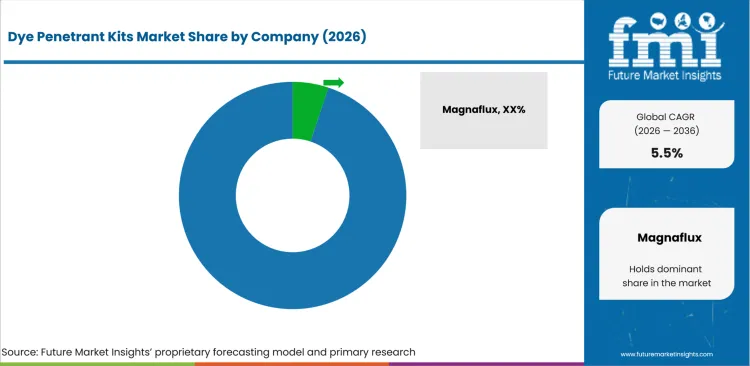
Established NDT chemistry brands concentrate much of the field while regional specialists retain space through local approvals and rapid support. Competition centers on method coverage plus matched chemistry and service access across regulated accounts worldwide. Entry remains difficult in aerospace or defense accounts because chemistry changes require renewed procedure validation across customer sites.
- Magnaflux and Chemetall / BASF support multinational accounts through broad method coverage plus equipment and process assistance. Sherwin Incorporated adds qualified water-based options and laboratory support during customer qualification across regulated accounts.
- MR Chemie and KARL DEUTSCH combine penetrant chemistry with ultraviolet equipment and technical guidance across European networks. NDT Italiana adds ecological formulations plus automated processing systems for global industrial customers and service networks.
- Johnson & Allen serves portable field work through complete kits plus in-house system design and repair services. MARKTEC supplies visible and fluorescent families alongside ecological chemistry for international industrial and maintenance networks.
Competitive Benchmarking: Dye Penetrant Kits Market
| Company | Method Coverage | Environmental Formulations | Equipment and Service | Geographic Reach |
|---|---|---|---|---|
| Magnaflux | High | High | High | Global |
| Chemetall / BASF | High | Medium | High | Global |
| Sherwin Incorporated | High | High | Medium | Global |
| MR Chemie | High | High | High | Global |
| KARL DEUTSCH | High | Medium | High | Global |
| Johnson & Allen | Medium | Low | High | Global |
| NDT Italiana | High | High | High | Global |
| MARKTEC | High | High | Medium | Global |
Key Developments in the Dye Penetrant Kits Market
- In March 2025, Magnaflux issued a five-year shelf-life standard for unopened penetrant materials in aerosol or bulk packaging to support predictable inventory rotation across approved programs.
- In April 2025, KARL DEUTSCH published modular KD-CHECK penetrant systems and fluorescent water-based penetrants to extend integrated chemistry and equipment choices for industrial lines.
- In September 2025, MR Chemie and KARL DEUTSCH introduced the next MR 976 UV LED handheld lamp with improved energy management plus simplified white-light and ultraviolet operation.
Dye Penetrant Kits Market - Report Scope
| Coverage field | Report scope |
|---|---|
| Market breakdown | By kit type, component, application, end use, packaging and region. |
| Quantitative Units | Revenue in USD million and CAGR in %. |
| Market Definition | Integrated or component-level consumable systems used to reveal surface-breaking flaws on nonporous materials through liquid penetrant inspection. |
| Regions Covered | North America, Latin America, Western Europe, Eastern Europe, East Asia, South Asia and Pacific, and Middle East and Africa. |
| Countries Covered | United States, Germany, Japan, United Kingdom, South Korea. |
| Key Companies Profiled | Magnaflux, Chemetall / BASF, Sherwin Incorporated, MR Chemie, KARL DEUTSCH, Johnson & Allen, NDT Italiana, MARKTEC. |
| Forecast Period | 2026–2036. |
| Approach | Primary and secondary research with market triangulation. |
Dye Penetrant Kits Market - Research Methodology
| Method | Approach |
|---|---|
| Primary Research | FMI analysts gathered input from manufacturers, service providers, technology developers, distributors, end users, procurement teams, and subject-matter experts. Interviews examined purchasing decisions, product or service evaluation, adoption barriers, approval requirements, pricing considerations, and expectations for technical or commercial support. Respondents were also asked what evidence is required before a trial, pilot, or initial order develops into regular purchasing. |
| Desk Research | Desk research covered government statistics, regulatory publications, trade data, industry associations, technical literature, standards, company filings, product information, and official corporate announcements. Sources were reviewed for relevance, publication date, geographic coverage, and consistency with the defined market scope. Claims relating to performance, applications, approvals, capacity, investment, and commercial activity were retained only when supported by credible public evidence. |
| Market Sizing and Forecasting | The market model combined the baseline value with historical performance, segment structure, pricing and volume indicators, adoption levels, company participation, and country-level demand conditions. Forecast assumptions considered economic activity, investment trends, regulatory developments, technology adoption, purchasing cycles, supply availability, and barriers to wider market use. Segment and regional estimates were reconciled before the final market total was calculated. |
| Data Validation | Estimates were checked against multiple independent indicators, including public data, company activity, trade patterns, industry developments, and findings from primary interviews. Validation also tested whether products, services, applications, and company revenues fell within the defined market boundaries. Adjacent categories, unsupported claims, overlapping revenues, and activities without direct market relevance were excluded to reduce double counting and maintain consistency across segments and countries. |
Dye Penetrant Kits Market by Segments
Dye Penetrant Kits Market segmented by Kit Type:
- Visible Dye Penetrant Kits
- Fluorescent Penetrant Kits
- Water-washable Kits
- Solvent-removable Kits
- Post-emulsifiable Kits
Dye Penetrant Kits Market segmented by Component:
- Penetrant
- Cleaner / Remover
- Developer
- Complete Inspection Kits
Dye Penetrant Kits Market segmented by Application:
- Weld Inspection
- Casting / Forging Inspection
- Machined Part Inspection
- Marine Component Inspection
- Aerospace / Safety Critical
Dye Penetrant Kits Market segmented by End Use:
- Aerospace
- Marine & Shipyards
- Automotive
- Oil & Gas
- General Manufacturing
Dye Penetrant Kits Market segmented by Packaging:
- Aerosol Cans
- Bulk Liquid
- Portable Kits
Dye Penetrant Kits Market by Region:
- North America
- United States
- Canada
- Latin America
- Brazil
- Chile
- Mexico
- Rest of Latin America
- Western Europe
- Germany
- United Kingdom
- Italy
- Spain
- France
- Nordics
- Benelux
- Rest of Western Europe
- Eastern Europe
- Russia
- Poland
- Hungary
- Balkan and Baltic States
- Rest of Eastern Europe
- East Asia
- China
- Japan
- South Korea
- South Asia and Pacific
- India
- ASEAN
- Australia and New Zealand
- Rest of South Asia and Pacific
- Middle East and Africa
- Kingdom of Saudi Arabia
- Other GCC Countries
- Türkiye
- South Africa
- Other African Union Countries
- Rest of Middle East and Africa
Research Sources and Bibliography
- Federal Aviation Administration. (2026, April).
- European Union Aviation Safety Agency. (2025, September 10).
- Defence Equipment and Support. (2026, February 5).
- Korean Register. (2026, April 22).
- Magnaflux. (n.d.).
- Magnaflux. (n.d.).
- Magnaflux. (n.d.).
- Chemetall. (n.d.).
- Sherwin Incorporated. (n.d.)
- Johnson & Allen. (n.d.).
- Johnson & Allen. (n.d.).
- MR Chemie. (2025, March 31).
- MR Chemie. (2025, September 30).
- MR Chemie. (2026, July 9).
- KARL DEUTSCH. (2025, April 24).
- KARL DEUTSCH. (n.d.)
- MARKTEC Corporation. (2025, October 14).
- National Aeronautics and Space Administration. (2026, January 22).
- MARKTEC Corporation. (2025, May 19).
- Magnaflux. (2025, March 26).
- Chemetall. (n.d.).
- Johnson & Allen. (n.d.).
- MARKTEC Corporation. (n.d.).
- MARKTEC Corporation. (n.d.).
This bibliography is provided for reader reference and is not exhaustive. The full report contains the complete reference list and detailed citations
This Report Answers
- How large is the dye penetrant kits market in 2026 and 2036?
- Which operating conditions sustain demand for dye penetrant kits?
- Which kit type holds the largest share in 2026?
- How does component consumption shape recurring market revenue?
- Which application and end use categories concentrate demand?
- How do country growth rates differ for dye penetrant kits?
- Which companies serve the dye penetrant kits market?
- What currently limits dye penetrant kit adoption?
- How should inspection teams compare chemistry and packaging options?
Frequently Asked Questions
How big is the Dye Penetrant Kits Market in 2026?
The dye penetrant kits market is valued at USD 760.6 million in 2026 and is forecast to reach USD 1299.2 million by 2036. Growth is supported by formal NDT qualification programs that sustain recurring chemistry purchases as every completed inspection consumes fresh penetrant, remover, and developer materials.
What is the CAGR of the Dye Penetrant Kits Market from 2026 to 2036?
The dye penetrant kits market grows at a CAGR of 5.5% between 2026 and 2036, supported by formal non-destructive testing programs across aviation, energy, and industrial maintenance operations that sustain repeat chemistry purchases with every completed penetrant inspection cycle.
Which kit type leads the Dye Penetrant Kits Market?
Visible dye penetrant kits account for 31% of the dye penetrant kits market by kit type in 2026, driven by daylight readability and limited auxiliary equipment requirements that suit field inspections lacking dedicated ultraviolet equipment at remote or dispersed maintenance sites.
How much will the Dye Penetrant Kits Market add between 2026 and 2036?
The dye penetrant kits market is set to add USD 538.6 million between 2026 and 2036, growing from USD 760.6 million to USD 1299.2 million as formal NDT qualification programs sustain recurring chemistry replenishment across aerospace, marine, and industrial inspection networks worldwide.
Who are the leading companies in the Dye Penetrant Kits Market?
Eight companies lead the dye penetrant kits market, including Magnaflux, Chemetall / BASF, Sherwin Incorporated, MR Chemie, KARL DEUTSCH, Johnson & Allen, NDT Italiana, and MARKTEC, competing through method coverage, environmental formulations, and equipment and service support across global networks.
Preview the report firsthand - request a free sample
Get SampleGet the brochure for pricing and purchase details.
Get PDFTable of Content
- Key Takeaways
- Market Size and CAGR
- Top Growth Driver
- Fastest Growing Segment
- Leading Region
- Key Companies
- Emerging Opportunities
- Executive Summary
- Global Market Outlook
- Demand-side Trends
- Supply-side Trends
- Technology Roadmap Analysis
- Analysis and Recommendations
- Analyst Perspective (What is happening? Why now? What should investors know?)
- Key Questions Answered
- How large is the market?
- What is the CAGR?
- What are key trends?
- Which region dominates?
- Who are the leaders?
- Market Overview
- Market Coverage / Taxonomy
- Market Definition / Scope / Limitations
- Research Methodology
- Chapter Orientation
- Analytical Lens and Working Hypotheses
- Market Structure, Signals, and Trend Drivers
- Benchmarking and Cross-market Comparability
- Market Sizing, Forecasting, and Opportunity Mapping
- Research Design and Evidence Framework
- Desk Research Programme (Secondary Evidence)
- Expert Input and Fieldwork (Primary Evidence)
- Tooling, Models, and Reference Databases
- Data Engineering and Model Build
- Quality Assurance and Audit Trail
- Market Background
- Market Dynamics (Drivers, Restraints, Opportunity, Trends)
- Scenario Forecast (Optimistic, Likely, Conservative)
- Impact Analysis
- AI Impact
- Sustainability Impact
- Regulatory Impact
- Technology Impact
- Consumer / Buyer Analysis
- Purchase Drivers
- Adoption Barriers
- Buyer Journey
- Opportunity Map Analysis
- Product Life Cycle Analysis
- Supply Chain Analysis
- Investment Feasibility Matrix
- Value Chain Analysis
- PESTLE and Porter's Analysis
- Regulatory Landscape
- Regional Parent Market Outlook
- Production and Consumption Statistics
- Import and Export Statistics
- Global Market Analysis and Forecast, 2021 to 2036
- Historical Market Size Value (USD Million) Analysis, 2021 to 2025
- Current and Future Market Size Value (USD Million) Projections, 2026 to 2036
- Y-o-Y Growth Trend Analysis
- Absolute $ Opportunity Analysis
- Global Market Pricing Analysis, 2021 to 2036
- Global Market Analysis and Forecast, By Kit Type, 2021 to 2036
- Introduction / Key Findings
- Historical Market Size Value (USD Million) Analysis By Kit Type, 2021 to 2025
- Current and Future Market Size Value (USD Million) Analysis and Forecast By Kit Type, 2026 to 2036
- Visible Dye Penetrant Kits
- Fluorescent Penetrant Kits
- Water-washable Kits
- Solvent-removable Kits
- Post-emulsifiable Kits
- Visible Dye Penetrant Kits
- Y-o-Y Growth Trend Analysis By Kit Type, 2021 to 2025
- Absolute $ Opportunity Analysis By Kit Type, 2026 to 2036
- Global Market Analysis and Forecast, By Component, 2021 to 2036
- Introduction / Key Findings
- Historical Market Size Value (USD Million) Analysis By Component, 2021 to 2025
- Current and Future Market Size Value (USD Million) Analysis and Forecast By Component, 2026 to 2036
- Penetrant
- Cleaner / Remover
- Developer
- Complete Inspection Kits
- Penetrant
- Y-o-Y Growth Trend Analysis By Component, 2021 to 2025
- Absolute $ Opportunity Analysis By Component, 2026 to 2036
- Global Market Analysis and Forecast, By Application, 2021 to 2036
- Introduction / Key Findings
- Historical Market Size Value (USD Million) Analysis By Application, 2021 to 2025
- Current and Future Market Size Value (USD Million) Analysis and Forecast By Application, 2026 to 2036
- Weld Inspection
- Casting / Forging Inspection
- Machined Part Inspection
- Marine Component Inspection
- Aerospace / Safety Critical
- Weld Inspection
- Y-o-Y Growth Trend Analysis By Application, 2021 to 2025
- Absolute $ Opportunity Analysis By Application, 2026 to 2036
- Global Market Analysis and Forecast, By End Use, 2021 to 2036
- Introduction / Key Findings
- Historical Market Size Value (USD Million) Analysis By End Use, 2021 to 2025
- Current and Future Market Size Value (USD Million) Analysis and Forecast By End Use, 2026 to 2036
- Aerospace
- Marine & Shipyards
- Automotive
- Oil & Gas
- General Manufacturing
- Aerospace
- Y-o-Y Growth Trend Analysis By End Use, 2021 to 2025
- Absolute $ Opportunity Analysis By End Use, 2026 to 2036
- Global Market Analysis and Forecast, By Packaging, 2021 to 2036
- Introduction / Key Findings
- Historical Market Size Value (USD Million) Analysis By Packaging, 2021 to 2025
- Current and Future Market Size Value (USD Million) Analysis and Forecast By Packaging, 2026 to 2036
- Aerosol Cans
- Bulk Liquid
- Portable Kits
- Aerosol Cans
- Y-o-Y Growth Trend Analysis By Packaging, 2021 to 2025
- Absolute $ Opportunity Analysis By Packaging, 2026 to 2036
- Global Market Analysis and Forecast, By Region, 2021 to 2036
- Introduction
- Historical Market Size Value (USD Million) Analysis By Region, 2021 to 2025
- Current Market Size Value (USD Million) Analysis and Forecast By Region, 2026 to 2036
- North America
- Latin America
- Western Europe
- Eastern Europe
- East Asia
- South Asia and Pacific
- Middle East & Africa
- Market Attractiveness Analysis By Region
- North America Market Analysis and Forecast, By Country, 2021 to 2036
- Historical Market Size Value (USD Million) Trend Analysis By Market Taxonomy, 2021 to 2025
- Market Size Value (USD Million) Forecast By Market Taxonomy, 2026 to 2036
- By Country
- USA
- Canada
- By Kit Type
- By Component
- By Application
- By End Use
- By Packaging
- By Country
- Market Attractiveness Analysis
- By Country
- By Kit Type
- By Component
- By Application
- By End Use
- By Packaging
- Key Takeaways
- Latin America Market Analysis and Forecast, By Country
- Historical Market Size Value (USD Million) Trend Analysis By Market Taxonomy, 2021 to 2025
- Market Size Value (USD Million) Forecast By Market Taxonomy, 2026 to 2036
- By Country
- Brazil
- Mexico
- Chile
- Rest of Latin America
- By Kit Type
- By Component
- By Application
- By End Use
- By Packaging
- By Country
- Market Attractiveness Analysis
- By Country
- By Kit Type
- By Component
- By Application
- By End Use
- By Packaging
- Key Takeaways
- Western Europe Market Analysis and Forecast, By Country
- Historical Market Size Value (USD Million) Trend Analysis By Market Taxonomy, 2021 to 2025
- Market Size Value (USD Million) Forecast By Market Taxonomy, 2026 to 2036
- By Country
- Germany
- UK
- Italy
- Spain
- France
- Nordic
- BENELUX
- Rest of Western Europe
- By Kit Type
- By Component
- By Application
- By End Use
- By Packaging
- By Country
- Market Attractiveness Analysis
- By Country
- By Kit Type
- By Component
- By Application
- By End Use
- By Packaging
- Key Takeaways
- Eastern Europe Market Analysis and Forecast, By Country
- Historical Market Size Value (USD Million) Trend Analysis By Market Taxonomy, 2021 to 2025
- Market Size Value (USD Million) Forecast By Market Taxonomy, 2026 to 2036
- By Country
- Russia
- Poland
- Hungary
- Balkan & Baltic
- Rest of Eastern Europe
- By Kit Type
- By Component
- By Application
- By End Use
- By Packaging
- By Country
- Market Attractiveness Analysis
- By Country
- By Kit Type
- By Component
- By Application
- By End Use
- By Packaging
- Key Takeaways
- East Asia Market Analysis and Forecast, By Country
- Historical Market Size Value (USD Million) Trend Analysis By Market Taxonomy, 2021 to 2025
- Market Size Value (USD Million) Forecast By Market Taxonomy, 2026 to 2036
- By Country
- China
- Japan
- South Korea
- By Kit Type
- By Component
- By Application
- By End Use
- By Packaging
- By Country
- Market Attractiveness Analysis
- By Country
- By Kit Type
- By Component
- By Application
- By End Use
- By Packaging
- Key Takeaways
- South Asia and Pacific Market Analysis and Forecast, By Country
- Historical Market Size Value (USD Million) Trend Analysis By Market Taxonomy, 2021 to 2025
- Market Size Value (USD Million) Forecast By Market Taxonomy, 2026 to 2036
- By Country
- India
- ASEAN
- Australia & New Zealand
- Rest of South Asia and Pacific
- By Kit Type
- By Component
- By Application
- By End Use
- By Packaging
- By Country
- Market Attractiveness Analysis
- By Country
- By Kit Type
- By Component
- By Application
- By End Use
- By Packaging
- Key Takeaways
- Middle East & Africa Market Analysis and Forecast, By Country
- Historical Market Size Value (USD Million) Trend Analysis By Market Taxonomy, 2021 to 2025
- Market Size Value (USD Million) Forecast By Market Taxonomy, 2026 to 2036
- By Country
- Kingdom of Saudi Arabia
- Other GCC Countries
- Türkiye
- South Africa
- Other African Union
- Rest of Middle East & Africa
- By Kit Type
- By Component
- By Application
- By End Use
- By Packaging
- By Country
- Market Attractiveness Analysis
- By Country
- By Kit Type
- By Component
- By Application
- By End Use
- By Packaging
- Key Takeaways
- Key Countries Market Analysis
- USA
- Pricing Analysis
- Market Share Analysis, 2025
- By Kit Type
- By Component
- By Application
- By End Use
- By Packaging
- Canada
- Pricing Analysis
- Market Share Analysis, 2025
- By Kit Type
- By Component
- By Application
- By End Use
- By Packaging
- Mexico
- Pricing Analysis
- Market Share Analysis, 2025
- By Kit Type
- By Component
- By Application
- By End Use
- By Packaging
- Brazil
- Pricing Analysis
- Market Share Analysis, 2025
- By Kit Type
- By Component
- By Application
- By End Use
- By Packaging
- Chile
- Pricing Analysis
- Market Share Analysis, 2025
- By Kit Type
- By Component
- By Application
- By End Use
- By Packaging
- Germany
- Pricing Analysis
- Market Share Analysis, 2025
- By Kit Type
- By Component
- By Application
- By End Use
- By Packaging
- UK
- Pricing Analysis
- Market Share Analysis, 2025
- By Kit Type
- By Component
- By Application
- By End Use
- By Packaging
- Italy
- Pricing Analysis
- Market Share Analysis, 2025
- By Kit Type
- By Component
- By Application
- By End Use
- By Packaging
- Spain
- Pricing Analysis
- Market Share Analysis, 2025
- By Kit Type
- By Component
- By Application
- By End Use
- By Packaging
- France
- Pricing Analysis
- Market Share Analysis, 2025
- By Kit Type
- By Component
- By Application
- By End Use
- By Packaging
- India
- Pricing Analysis
- Market Share Analysis, 2025
- By Kit Type
- By Component
- By Application
- By End Use
- By Packaging
- ASEAN
- Pricing Analysis
- Market Share Analysis, 2025
- By Kit Type
- By Component
- By Application
- By End Use
- By Packaging
- Australia & New Zealand
- Pricing Analysis
- Market Share Analysis, 2025
- By Kit Type
- By Component
- By Application
- By End Use
- By Packaging
- China
- Pricing Analysis
- Market Share Analysis, 2025
- By Kit Type
- By Component
- By Application
- By End Use
- By Packaging
- Japan
- Pricing Analysis
- Market Share Analysis, 2025
- By Kit Type
- By Component
- By Application
- By End Use
- By Packaging
- South Korea
- Pricing Analysis
- Market Share Analysis, 2025
- By Kit Type
- By Component
- By Application
- By End Use
- By Packaging
- Russia
- Pricing Analysis
- Market Share Analysis, 2025
- By Kit Type
- By Component
- By Application
- By End Use
- By Packaging
- Poland
- Pricing Analysis
- Market Share Analysis, 2025
- By Kit Type
- By Component
- By Application
- By End Use
- By Packaging
- Hungary
- Pricing Analysis
- Market Share Analysis, 2025
- By Kit Type
- By Component
- By Application
- By End Use
- By Packaging
- Kingdom of Saudi Arabia
- Pricing Analysis
- Market Share Analysis, 2025
- By Kit Type
- By Component
- By Application
- By End Use
- By Packaging
- Türkiye
- Pricing Analysis
- Market Share Analysis, 2025
- By Kit Type
- By Component
- By Application
- By End Use
- By Packaging
- South Africa
- Pricing Analysis
- Market Share Analysis, 2025
- By Kit Type
- By Component
- By Application
- By End Use
- By Packaging
- USA
- Market Structure Analysis
- Competition Dashboard
- Competition Benchmarking
- Market Share Analysis of Top Players
- By Regional
- By Kit Type
- By Component
- By Application
- By End Use
- By Packaging
- Emerging Startups
- Innovation Benchmarking
- Competition Analysis
- Competition Deep Dive
- Magnaflux
- Overview
- Product Portfolio
- Profitability by Market Segments
- Sales Footprint
- Strategy Overview
- Marketing Strategy
- Product Strategy
- Channel Strategy
- Chemetall / BASF
- Sherwin-Williams
- Parker Research
- NDT Italiana
- KARL DEUTSCH
- Met-L-Chek
- MR Chemie
- NDT Systems
- Johnson & Allen
- Magnaflux
- Case Studies
- Success Stories
- Recent Developments
- Competition Deep Dive
- Assumptions & Acronyms Used


