

- Industry Size (2026)
- USD 6.6 Bn
- Forecast (2036)
- USD 17.6 Bn
- CAGR (2026 to 2036)
- 10.3%
Soil Testing Kit Market Size, Market Forecast and Outlook By FMI
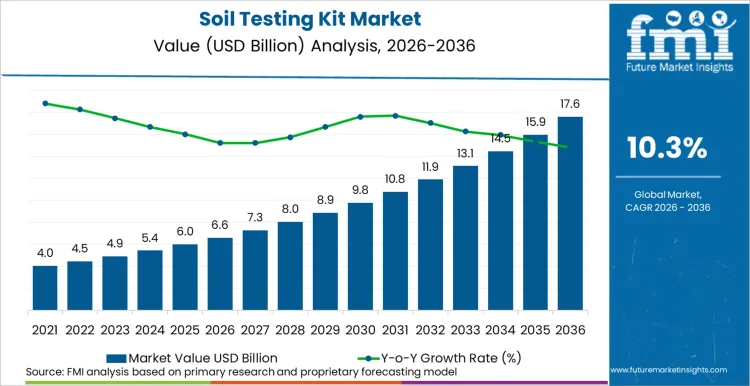
The soil testing kit market is expected to expand from USD 6.636 billion in 2026 to USD 17.687 billion by 2036. The market is anticipated to register a 10.3% CAGR during the forecast period as precision farming investment rises across major agriculture economies. Multi-test kits are likely to lead with a 63.3% share in 2026 as users prefer broader soil checks. Chemical testing is projected to account for 50.4% of the testing property segment in 2026.
Summary of the Soil Testing Kit Market
- Demand and Growth Drivers
- Precision agriculture programs are expected to lift demand for kits able to provide fast nutrient readings.
- Fertilizer cost pressure is likely to increase interest in soil checks across farms and landscaping projects.
- Environmental monitoring needs are anticipated to raise testing frequency for pH and heavy metal levels.
- Product and Segment View
- Multi-test kits are expected to lead kit type demand as farms prefer one kit for several soil readings.
- Chemical testing is likely to keep a central role in nutrient planning across nitrogen and potassium management.
- Digital sensor-based kits are anticipated to gain adoption as field teams reduce delays from laboratory sampling.
- Geography and Competitive Outlook
- Brazil is expected to post the fastest expansion as large farm systems invest in better soil data.
- India is likely to see strong adoption as soil health programs increase farmer access to testing.
- Manufacturers with field-ready devices and calibration strength are anticipated to improve their position in precision agriculture.
- Analyst Opinion
- Nikhil Kaitwade, Principal Consultant for Testing Equipment at FMI suggests, “The soil testing kit market is likely to favor manufacturers able to pair reliable field readings with practical farm use. Digital sensor providers and reagent kit makers are expected to gain traction as buyers seek faster soil decisions and lower testing delays.”
- Soil Testing Kit Market Value Analysis
- The soil testing kit market is expected to expand from lab-led testing into practical field analysis tools.
- Demand is likely to rise as farmers seek faster nutrient readings before fertilizer planning decisions.
- Adoption is anticipated to improve as portable kits reduce sampling delays for farms and consultants.
- Spending is expected to strengthen as digital devices connect soil readings with precision agriculture platforms.
Key Takeaways, Market Size, and Forecast
- The soil testing kit market is expected to reach USD 6.636 billion in 2026 as field testing adoption increases.
- By 2036, the soil testing kit market is projected to reach USD 17.687 billion worldwide.
- From 2026 to 2036, the market is anticipated to expand at a CAGR of 10.3%.
- Multi-test kits are likely to account for 63.3% share of the kit type segment in 2026.
- Chemical testing is expected to hold 50.4% share of the testing property segment in 2026.
- Brazil is projected to record the fastest country-level expansion at 11.2% CAGR through 2036 across assessed countries.
As stated by Precision Planting regarding its Radicle Lab system, 'Radicle Agronomics allows agronomists to spend more time with their farmers and less time on the manual processes of soil testing.' [1]
India (12.5% CAGR) leads growth through government soil health card programmes and precision agriculture adoption. Africa (11.8% CAGR) benefits from NGO-funded handheld sensor deployments and smallholder farmer access expansion. The United States (9.5% CAGR) grows through precision agriculture investment and EPA soil contamination monitoring requirements. China (10.0% CAGR) benefits from agricultural modernization programmes. Germany (8.5% CAGR) grows through EU fertilizer regulation compliance testing.
Soil Testing Kit Market Market Definition
The soil testing kit market covers the manufacture, sale, and deployment of portable and field-deployable testing systems used to analyse soil nutrient content, pH, moisture, organic matter, and contaminant levels. Products range from chemical reagent-based kits to digital sensor-based systems and handheld spectroscopy devices.
Soil Testing Kit Market Inclusions
The report covers global and regional market sizes by revenue for the 2026 to 2036 forecast period. It includes segmental breakdowns by product type, end use, and testing parameter. Pricing analysis by technology tier, precision agriculture integration tracking, and regulatory compliance mapping are included.
Soil Testing Kit Market Exclusions
The scope excludes laboratory-fixed soil analysis instruments (ICP-MS, GC-MS) unless sold in portable field-deployable configurations. It also omits seed testing kits, water testing kits, and air quality monitoring devices.
Soil Testing Kit Market Research Methodology
- Primary Research: Interviews were conducted with soil testing kit manufacturers, precision agriculture platform providers, extension service officers, NGO field deployment managers, and environmental consultants across the United States, India, Europe, and Africa.
- Desk Research: USDA soil health programme databases, EU Fertilisers Regulation implementation records, FAO soil mapping data, and precision agriculture adoption surveys supported demand benchmarking.
- Market-Sizing and Forecasting: A hybrid model combined top-down agricultural input spending analysis with bottom-up kit unit sales and sensor device shipment data, validated against manufacturer revenue disclosures and government programme procurement records.
- Data Validation and Update Cycle: Outputs undergo anomaly screening, variance checks across agricultural input and testing device datasets, and structured peer review prior to release.
Category-wise Insights
This section contains information about leading segments in the global market exhibiting highest value share during the forecast period.
Multi-Test Kits Revolutionize Soil Health for Sustainable Agriculture
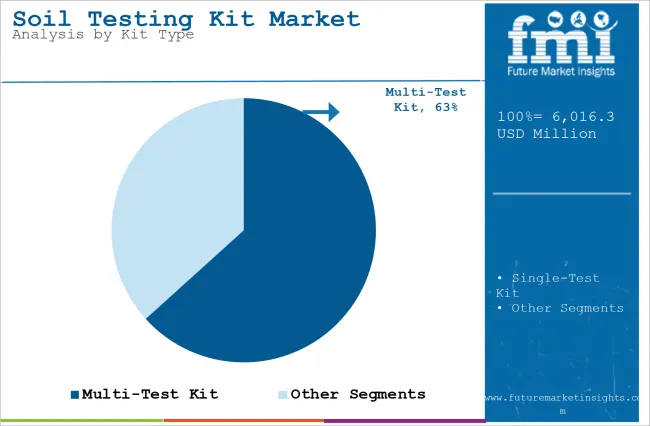
| Segment | Kit Type (Multi-Test Kit) |
|---|---|
| Value Share | 63.3% |
Multi-test kits are gradually becoming a tool that is increasingly indispensable in agriculture. They have proved to be multi-functional and cost-effective. It enables farmer to assess an array of soil properties such as pH levels, nutrient content, moisture, and organic matter. By involving several tests in a single test kit, farmers can better understand soil health and determine correct fertilizing schedules so that informed decisions can be made for increased crop productivity.
Apart from precision Livestock farming, such kits are imperative for sustainable farm practices as they contribute toward organic farming while also decreasing reliance on chemical inputs by providing information that helps soil management precisely.
With the ongoing integration of sustainability and environmental conservation into agricultural practices, multi-test kits help farmers to monitor their soil quality as well as diminish soil degradation. Being used in regenerative agriculture to enhance and maintain vitality in soils by replenishing health, the demand for these kits is increasing with the emphasis on soil health globally.
In emerging regions, affordability and accessibility are crucial, and developing cost-effective multi-test kits allows small-scale farmers to adopt these tools for better crop management. Multi-test kits are also used in agricultural research and environmental monitoring and, more prominently, in carrying out comprehensive soil analysis for large-scale ecosystem management and land restoration projects.
Chemical Property Testing Paves the Way for Sustainable Farming and Efficient Crop Management
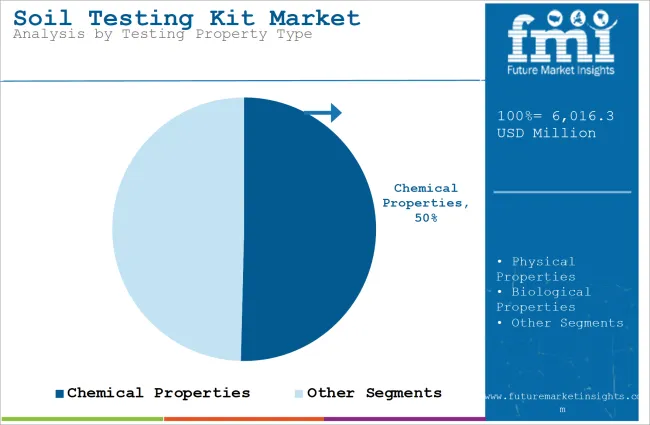
| Segment | Testing Property Type (Chemical Testing) |
|---|---|
| Value Share | 50.4% |
Based on the testing property type segment, the Chemical property testing category maintains a dominant 50.4% share in the market throughout the forecast period, owing to the growing requirement for testing of basic nutrients like nitrogen, phosphorus, potassium, and pH to assess soil fertility and crop suitability.
For instance, the Indian government’s soil health management initiative promotes widespread usage of soil testing. Since the launch, it has resulted in the testing of over 10 million hectors of soil annually, providing valuable insights into chemical imbalances and fertilizer usage.
The Green Deal of the European Union works toward sustainability while promoting organic or low-input farm management in this region. Consequently, farmers increasingly use chemical property testing to optimize fertilizer use and preserve soil health.
The EU Farm to Fork Strategy aims to reduce the usage of chemical pesticides and fertilizers by 50% by 2030, thereby emphasizing the importance of precise chemical soil testing in agriculture. With the growth in global food demand, the role of chemical property testing for efficient and environment-friendly farming will be further amplified.
Key Industry Highlights
Multi-Parameter Kits and Integration with IoT Meeting the Demand for Comprehensive Soil Health Analysis
The soil testing industry is benefiting from the technological advancements, propelled by the convergence of cutting-edge digital devices. The growing use of IoT-integrated soil analysis kits accompanies this development and provides features such as cloud data storage, historical comparisons, and predictive analytics for better agronomy and soil quality.
These digital tools enable agronomists and farmers to monitor soil health from remote locations and make precise decisions to increase crop yield. The cloud-computing platforms that serve as warehouses for soil test data are not only providers of data storage for historical comparison but also predictors for more sustainable farming.
As crop producers demand for immediate and accurate in situ soil testing, manufacturers are innovating their products by offering testing kits that are portable, lightweight, and carry solenoid valves for fast operation. Advanced multi-functional sampling kits have also been introduced to assess various aspects of soil health, including micronutrients, organic matter, enzyme activities, and contaminant testing.
This move points towards the sector's resolve to develop products that promote thorough examination and assessment of soil health. Accurate assessments, and reliability are key attributes making it sure that these devices become widely used in various agricultural, landscaping, gardening and environmental fields. Example of one such product includes Hanna Instruments’ HI-3896 Soil Test Kit, which offers multi-parameter testing. The lightweight and portable kit enables users to measure pH, nitrogen, phosphorus, and potassium levels accurately.
Customized Soil Testing Kits for Precise and Versatile Applications
Customization of soil testing kits is providing valuable solutions for diverse industries, improving precision in soil management. The demand for testing kits is rising as manufacturers are increasingly focusing on innovating customized kits for specific industrial and horticulture applications.
Horticulture kits cater to gardeners and landscapers, offering specialized tests to determine soil conditions for specific plants such as roses, vegetables, or turfgrass. Brands including Luster Leaf's Rapitest offers simple quality testing kits designed for testing pH level, nutrient levels in soil, and moisture, ensuring optimum conditions for garden plants. These kits provide tailored solutions to enhance plant health, improving gardening experience.
For construction projects, accurate soil testing is vital for determining the stability, compaction of soil, and soil density essential for infrastructural foundations. Testing Kits such as ProDirt are specifically designed to evaluate soil’s holding and bearing capacity and compaction in construction sites. These kits are vital in determining whether the soil can support heavy structures, helping engineers to make informed decisions before construction begins. Customized kits for construction ensure safety, reduce risks, and help avoid costly mistakes.
Soil Testing Made Easier with Accessible and Affordable Solutions for All
Soil testing kits are becoming more widely accessible to all owing to the rise of e-commerce platforms and the introduction of affordable options for all the needs.
Online marketplaces like Amazon and eBay have made it easier for small-scale farmers, hobbyists, and individual gardeners to buy soil assessment tools. Companies like MySoil and Jersey Garden Tools are selling their products through these platforms, expanding their customer reach beyond traditional retail stores. The ability to purchase kits online has made soil testing more accessible globally, especially in remote areas where agricultural supplies may not be easily available.
To cater to emerging countries and smaller agricultural players, manufacturers are hosting budget-friendly testing kits. Brands like Soil Savvy and Gardener's Supply Company offer affordable, entry-level soil test kits that are user-friendly and provide essential information without breaking the bank.
These kits are crucial for small-scale farmers and individual gardeners in developing countries. With affordable options, more users can assess and improve soil health, ultimately contributing to better crop production yield and sustainable agricultural practices. Increased availability and affordability are democratizing access to soil testing, benefiting users across the globe.
Revolutionizing Soil Testing with Robotic Systems Leading the Way
The new robotic systems revolutionize soil testing, especially for large-scale agriculture and environmental use, by streamlining the whole process and enhancing accuracy. Among the latest innovative examples is the Smartcore by Rogo, an autonomous robot designed and developed to collect accurate and repeatable soil samples from vast agricultural fields. It travels autonomously across the larger fields, taking samples of soil at specific intervals and collecting them at a specific point to make shipping easy to a lab for further study.
Owners of Rogo Ag LLC aim to commercialize this technology and make it available to the broader agricultural community. Smartcore ensures consistency in sampling, minimizing human error and providing reliable data that farmers can use for better decision-making.
The autonomous nature of the robot allows it to perform repetitive tasks across large tracts of land, increasing sampling efficiency. Therefore, robotic systems such as Smartcore promise to revolutionize the soil testing method by providing the farmer with precise and actionable information to optimize the management of his soil and boost crop yields.
Smart Soil Solutions with Drones and Robotics Revolutionizing Testing
Drones-based soil testing has changed the face of regular agricultural life as it offers new, efficient techniques for mass measurement of large areas of soil. With advanced sensors and cameras, drones can autonomously take pictures over vast fields, capturing real-time, high-resolution details of soil compositions, moisture content, pH, and nutrient levels.
Such companies as Sentera provide drone-based systems, integrating high-precision sensors, to enable farmers to determine accurate soil testing across large areas without relying on manually sampling it. They help produce spatial maps to reflect the variations in soil conditions across different plots of land.
The ability to collect large amounts of data promptly and efficiently reduces labor and increases productivity with drones, farmers can track real-time information about soil health, which, in turn makes them make swifter, wiser decisions pertaining to fertilizing, irrigating, and cropping.
Drones can also get to large places that are difficult or impossible to get to, allowing no part of the field to be left behind. It supports precision farming through a data-driven approach and allows farmers to optimize resources, increase crop yields, and minimize the negative impacts on the environment, hence a necessary tool for modern agriculture.
2021 to 2025 Global Soil Testing Kit Sales Outlook Compared to Demand Forecast from 2026 to 2036
The demand for soil testing kits has witnessed significant growth with the advent of technology and increasing awareness of sustainable agriculture. From 2021 to 2025, the demand grew steadily, with a growth rate of 10.1%, driven by diverse applications in industries such as agriculture, environmental management, and infrastructure.
Demand for portable and accurate soil testing tools increased among small-scale farmers, allowing for on-site testing of critical parameters such as pH, moisture, and nutrient levels. For example, user-friendly kits launched by startups such as Boon. So revolutionized access in remote areas. National programs in countries like Kenya through its Soil Fertility Management Program and China's national initiatives on soil health monitoring have also spurred the adoption process.
The market for soil testing kits is likely to grow at a CAGR of 10.3% from 2026 to 2036. This will be driven by expanding sectors such as precision agriculture, environmental conservation, and infrastructure development. In agriculture, soil testing is critical in enhancing yield efficiency, especially in regions facing soil degradation. The construction sector would also play a pivotal role with increasing demand for soil stability analysis to ensure the safety of infrastructure projects.
The market is also likely to transform with the integration of AI and IoT technologies, making soil health assessments automated and real-time. As the focus on sustainability and resource optimization continues to grow, the requirement for testing kits is bound to grow in various industries.
Market Concentration
Tier 1 players accounts for approximately 50-55% market share. They are large-scale companies with vast portfolios of high-end soil testing products, strong global distribution networks, and significant R&D investments. The companies that belong to this tier include Agilent Technologies, LaMOtte Company, Luster Leaf Products, Inc., Merck Group and others
Tier 2 holds around 45-50% market share. Players focusing on mid-level revenue and captures regional or niche applications by providing affordable and reliable soil testing solutions. They include companies such as Swan Analytical Instruments, Horiba Scientific, KSE Testing Equipment, Harvesto, and others.
Country-wise Insights
The table below evaluates the growth potential for key countries, considering the influence of various factors on the soil testing kit market, including agricultural modernization. Countries with high infrastructure development and agricultural activities, such as India, Brazil, and Australia, have significant growth prospects. Emerging regions are likely to adopt portable and affordable solutions, while developed regions demand advanced, high-precision kits integrated with IoT and AI technologies.
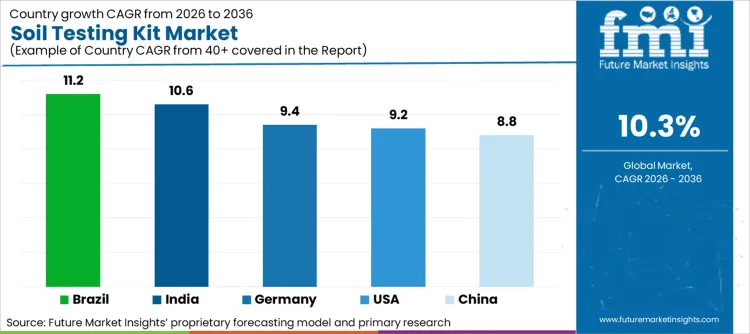
| Countries | Value CAGR (2026 to 2036) |
|---|---|
| USA | 9.2% |
| China | 8.8% |
| Germany | 9.4% |
| India | 10.6% |
| Brazil | 11.2% |
USA Pioneers Precision Farming with Soil Testing Innovation
Increasing soil health awareness and rising adoption of precision agricultural practices are fuelling demand for soil testing kits in the USA. Demand for soil testing kits and services is very high among large-scale farmers aiming to optimize crop yield and proper soil management.
The growing emphasis on sustainability has led to the integration of advanced technologies such as AI and IoT for the processing of soil test results, delivering results at lower costs and precise accuracy. Companies such as Sentera and AgLeader are changing the game of soil analysis through drone-based and sensor-driven solutions. These technologies enable farmers to gather real-time data on soil properties, making it easier to manage large farm fields or lands.
Government initiatives such as Soil Health Partnerships and Natural Resources Conservation Service (NRCS) by USDA, USA government plays a significant role in promoting soil heath awareness among the local and small scale farmers & landscapers.
It supports farmers to implement advanced soil testing & soil conservation practices. As of 2023, over 500,000 farmers have participated in these soil health programs across the USA. With growing interest in sustainable farming practices and precision agriculture, owing to technological advancements and government initiatives, the soil testing kits market in the USA is poised for continued growth during the forecast period.
Brazil: A Global Agricultural Powerhouse Driving Soil Testing Kits Demand
Brazil's demand for soil testing kits is growing rapidly, as it is one of the world's biggest agricultural producers. From 2022 to 2023, agricultural activities in Brazil grew by 15.1%, influencing the performance of the Brazilian GDP, with crops like soybeans, coffee, and sugarcane largely dominating Brazil's economy.
The government is increasingly emphasizing sustainable agriculture practices, providing financial incentives for soil testing and fertility management through programs like Agricultural Zoning. This program encourages farmers to use best practices for land use and soil health testing, which helps in better crop yields and resource management.
The integration of technologies such as AI, IoT, and precision agriculture has further accelerated the adoption of soil testing solutions. Companies are providing Brazilian farmers with advanced soil testing kits and equipment to optimize fertilizer usage and manage soil health effectively. With the increased demand for sustainable farming and higher awareness of the importance of soil health, Brazil's soil testing kit market is projected to grow at a fast pace in the coming years.
Empowering Farmers as India's Soil Testing Market Thrives with Innovation
India's soil testing kits market is growing rapidly due to government efforts and the increased demand for sustainable agriculture. In 2024, the Indian government relaunched its Soil Health Card portal and released a mobile app which makes soil sampling easy and quick. It is part of a larger drive to educate farmers about SHC and balanced nutrient application in farming and landscaping.
In India, with agriculture dominating the economy, soil testing has emerged as an important tool in combating the issue of declining fertility in the soil and maximizing crop yield. So far, millions of farmers have been reached by the Soil Health Card scheme. The investment of over USD 84.5 million as of 2024 is aimed at improving soil testing infrastructure and raising awareness.
In India, agri-tech start-ups are also a significant role by transforming the market by producing user-friendly, portable testing kits, making accessible to remote areas for soil testing, aiding small-scale farmers in making accurate decisions. Hence, with technological advancements and continuing government support, the demand for soil testing kits is expected to grow to a great extent in India in its pursuit to go sustainable and organic.
Competition Landscape
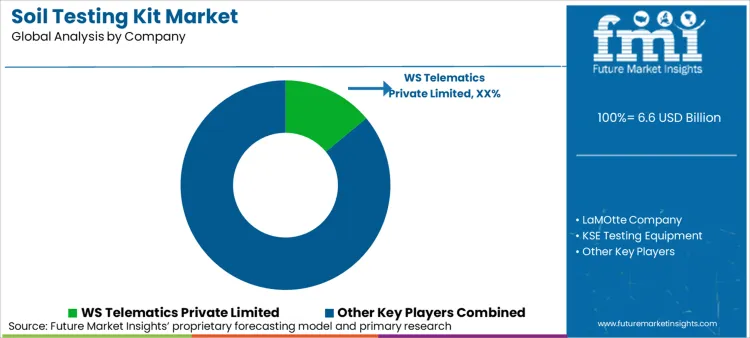
The soil testing kit market is moderately fragmented, with key players holding around 50 to 55% share, along with the presence of many medium- and small-scale manufacturers. Key manufacturers are engaged in developing innovative, user-friendly testing kits with enhance accuracy, portability, and real time data processing with cost-effectiveness.
Recent Developments
- The report includes full coverage of key trends from competitive benchmarking. Some of the recent developments covered in the report:
- In January 2026, AgroCares reported that its Nutrient Scanner, a handheld NIR tool, is being deployed at scale by NGOs and cooperatives in Africa and Southeast Asia for on-the-spot fertilizer recommendations. [1]
- In August 2025, LaMotte updated its soil test kit line for home and semi-professional use, with university studies in early 2026 confirming improved accuracy. [2]
- In 2025, Precision Planting launched the Radicle Lab automated soil analysis system, reducing manual processing time for agronomists. [3]
- In 2025, India's government expanded its Soil Health Card programme to provide free soil testing and nutrient recommendations to smallholder farmers. [4]
- In 2025, the EU Fertilisers Regulation implementation accelerated mandatory soil testing requirements for fertilizer application planning across member states. [5]
Key Players
- WS Telematics Private Limited
- LaMOtte Company
- KSE Testing Equipment
- Harvesto
- Luster Leaf Products, Inc.
- Merck Group
- Hanna Instrumental
- Agilent Technologies
- Sentera
- Swan Analytics
Scope of the Report
| Metric | Value |
|---|---|
| Quantitative Units | USD 6.6 billion (2026) to USD 17.6 billion (2036), at a CAGR of 10.3% |
| Market Definition | Covers manufacture, sale, and deployment of portable and field-deployable soil testing systems for nutrient content, pH, moisture, and contaminant analysis. |
| Product Type Segmentation | Chemical/Reagent-based, Digital/Sensor-based, Portable Spectroscopy |
| End Use Segmentation | Agriculture, Environmental Monitoring, Construction, Horticulture |
| Regions Covered | North America, Latin America, Europe, East Asia, South Asia, Africa, Oceania, Middle East |
| Countries Covered | United States, India, China, Germany, France, Brazil, Nigeria, Kenya, Australia, Japan and 30 plus countries |
| Key Companies Profiled | AgroCares, LaMotte, Precision Planting (AGCO), Hach (Danaher), YSI (Xylem), Palintest, Hanna Instruments, SGS, Eurofins, SpectraVista |
| Forecast Period | 2026 to 2036 |
| Approach | Hybrid top-down and bottom-up modeling validated through primary interviews with soil testing kit manufacturers, precision agriculture providers, and government extension services |
Key Segmentation
By Kit Type:
By Kit Type segment is categorized as Single-Test Kit and Multi-Test Kit.
By Testing Property Type:
Testing Property Type Segment is categorized as chemical testing, physical testing and biological testing.
By Testing Method:
Testing Method is divided into Analog Testing and Digital Testing.
By Sales Channel:
By Sales Channel segment is further categorized as Offline Sales & Online Sales.
By End User:
By End user segment is divided into Agricultural, Horticulture & Landscaping, Infrastructure & Construction, Mining & Resource Exploration, Environmental Monitoring, Education & Research and Others.
By Region:
Based on the region, the market is segmented into North America, Latin America, Western Europe, South Asia, Eastern Europe, East Asia, Middle East & Africa.
Bibliography
- [1] AgroCares. (2026). Nutrient Scanner Field Deployment Report. January 2026.
- [2] LaMotte. (2025). Soil Test Kit Line Update. August 2025.
- [3] Precision Planting / AGCO. (2025). Radicle Lab Automated Soil Analysis System Launch.
- [4] India Ministry of Agriculture. (2025). Soil Health Card Programme Expansion.
- [5] European Commission. (2025). EU Fertilisers Regulation Implementation.
- [6] USDA. (2025). Soil Science Division: Soil Health Assessment.
- [7] FAO. (2025). Global Soil Partnership.
- [8] EPA. (2025). Soil Contamination Monitoring Standards.
- [9] World Bank. (2025). Agricultural Productivity and Soil Health.
- [10] CGIAR. (2025). One CGIAR Soil Research Programme.
- [11] Future Market Insights. (2026). Soil Testing Kit Market Report.
- [12] Future Market Insights. (2025). Precision Agriculture Market.
This Report Addresses
- Market intelligence for precision agriculture technology and environmental monitoring procurement
- Market size estimation and 10-year revenue forecasts from 2026 to 2036
- Growth opportunity mapping across chemical, digital sensor, and spectroscopy testing platforms
- Segment and regional revenue forecasts covering agriculture, environmental, construction, and horticulture
- Competition strategy assessment including lab-to-field transition dynamics and digital platform positioning
- Technology tracking including NIR spectroscopy, smartphone-connected sensors, and AI-powered nutrient analysis
- Regulatory impact analysis covering EPA soil standards, EU Fertilisers Regulation, and India Soil Health Card programme
- Market report delivery in PDF, Excel, PPT, and interactive dashboard formats
Frequently Asked Questions
How large is the soil testing kit market in 2026?
The global market is estimated at USD 6,636.0 million in 2026.
What will the market size be by 2036?
The market is projected to reach USD 17,687.2 million by 2036.
What is the expected CAGR?
Demand is expected to grow at a CAGR of 10.3% between 2026 and 2036.
Which product type is growing fastest?
Digital sensor-based kits and handheld spectroscopy devices are the fastest-growing segments.
Which country leads growth?
India at 12.5% CAGR, driven by government soil health card programmes and precision agriculture adoption.
What testing parameter is most common?
NPK (nitrogen, phosphorus, potassium) testing is the most frequently performed soil analysis parameter.
Preview the report firsthand - request a free sample
Get SampleGet the brochure for pricing and purchase details.
Get PDFTable of Content
- Executive Summary
- Global Market Outlook
- Demand-side Trends
- Supply-side Trends
- Technology Roadmap Analysis
- Analysis and Recommendations
- Market Overview
- Market Coverage / Taxonomy
- Market Definition / Scope / Limitations
- Research Methodology
- Chapter Orientation
- Analytical Lens and Working Hypotheses
- Market Structure, Signals, and Trend Drivers
- Benchmarking and Cross-market Comparability
- Market Sizing, Forecasting, and Opportunity Mapping
- Research Design and Evidence Framework
- Desk Research Programme (Secondary Evidence)
- Company Annual and Sustainability Reports
- Peer-reviewed Journals and Academic Literature
- Corporate Websites, Product Literature, and Technical Notes
- Earnings Decks and Investor Briefings
- Statutory Filings and Regulatory Disclosures
- Technical White Papers and Standards Notes
- Trade Journals, Industry Magazines, and Analyst Briefs
- Conference Proceedings, Webinars, and Seminar Materials
- Government Statistics Portals and Public Data Releases
- Press Releases and Reputable Media Coverage
- Specialist Newsletters and Curated Briefings
- Sector Databases and Reference Repositories
- FMI Internal Proprietary Databases and Historical Market Datasets
- Subscription Datasets and Paid Sources
- Social Channels, Communities, and Digital Listening Inputs
- Additional Desk Sources
- Expert Input and Fieldwork (Primary Evidence)
- Primary Modes
- Qualitative Interviews and Expert Elicitation
- Quantitative Surveys and Structured Data Capture
- Blended Approach
- Why Primary Evidence is Used
- Field Techniques
- Interviews
- Surveys
- Focus Groups
- Observational and In-context Research
- Social and Community Interactions
- Stakeholder Universe Engaged
- C-suite Leaders
- Board Members
- Presidents and Vice Presidents
- R&D and Innovation Heads
- Technical Specialists
- Domain Subject-matter Experts
- Scientists
- Physicians and Other Healthcare Professionals
- Governance, Ethics, and Data Stewardship
- Research Ethics
- Data Integrity and Handling
- Primary Modes
- Tooling, Models, and Reference Databases
- Desk Research Programme (Secondary Evidence)
- Data Engineering and Model Build
- Data Acquisition and Ingestion
- Cleaning, Normalisation, and Verification
- Synthesis, Triangulation, and Analysis
- Quality Assurance and Audit Trail
- Market Background
- Market Dynamics
- Drivers
- Restraints
- Opportunity
- Trends
- Scenario Forecast
- Demand in Optimistic Scenario
- Demand in Likely Scenario
- Demand in Conservative Scenario
- Opportunity Map Analysis
- Product Life Cycle Analysis
- Supply Chain Analysis
- Investment Feasibility Matrix
- Value Chain Analysis
- PESTLE and Porter’s Analysis
- Regulatory Landscape
- Regional Parent Market Outlook
- Production and Consumption Statistics
- Import and Export Statistics
- Market Dynamics
- Global Market Analysis 2021 to 2025 and Forecast, 2026 to 2036
- Historical Market Size Value (USD Billion) Analysis, 2021 to 2025
- Current and Future Market Size Value (USD Billion) Projections, 2026 to 2036
- Y-o-Y Growth Trend Analysis
- Absolute $ Opportunity Analysis
- Global Market Pricing Analysis 2021 to 2025 and Forecast 2026 to 2036
- Global Market Analysis 2021 to 2025 and Forecast 2026 to 2036, By Kit Type
- Introduction / Key Findings
- Historical Market Size Value (USD Billion) Analysis By Kit Type , 2021 to 2025
- Current and Future Market Size Value (USD Billion) Analysis and Forecast By Kit Type , 2026 to 2036
- Multi-Test Kit
- . Single-Test Kit
- Multi-Test Kit
- Y-o-Y Growth Trend Analysis By Kit Type , 2021 to 2025
- Absolute $ Opportunity Analysis By Kit Type , 2026 to 2036
- Global Market Analysis 2021 to 2025 and Forecast 2026 to 2036, By Testing Property Type
- Introduction / Key Findings
- Historical Market Size Value (USD Billion) Analysis By Testing Property Type, 2021 to 2025
- Current and Future Market Size Value (USD Billion) Analysis and Forecast By Testing Property Type, 2026 to 2036
- Chemical Testing
- Physical Properties
- Biological Properties
- Chemical Testing
- Y-o-Y Growth Trend Analysis By Testing Property Type, 2021 to 2025
- Absolute $ Opportunity Analysis By Testing Property Type, 2026 to 2036
- Global Market Analysis 2021 to 2025 and Forecast 2026 to 2036, By Region
- Introduction
- Historical Market Size Value (USD Billion) Analysis By Region, 2021 to 2025
- Current Market Size Value (USD Billion) Analysis and Forecast By Region, 2026 to 2036
- North America
- Latin America
- Western Europe
- Eastern Europe
- East Asia
- South Asia and Pacific
- Middle East & Africa
- Market Attractiveness Analysis By Region
- North America Market Analysis 2021 to 2025 and Forecast 2026 to 2036, By Country
- Historical Market Size Value (USD Billion) Trend Analysis By Market Taxonomy, 2021 to 2025
- Market Size Value (USD Billion) Forecast By Market Taxonomy, 2026 to 2036
- By Country
- USA
- Canada
- Mexico
- By Kit Type
- By Testing Property Type
- By Country
- Market Attractiveness Analysis
- By Country
- By Kit Type
- By Testing Property Type
- Key Takeaways
- Latin America Market Analysis 2021 to 2025 and Forecast 2026 to 2036, By Country
- Historical Market Size Value (USD Billion) Trend Analysis By Market Taxonomy, 2021 to 2025
- Market Size Value (USD Billion) Forecast By Market Taxonomy, 2026 to 2036
- By Country
- Brazil
- Chile
- Rest of Latin America
- By Kit Type
- By Testing Property Type
- By Country
- Market Attractiveness Analysis
- By Country
- By Kit Type
- By Testing Property Type
- Key Takeaways
- Western Europe Market Analysis 2021 to 2025 and Forecast 2026 to 2036, By Country
- Historical Market Size Value (USD Billion) Trend Analysis By Market Taxonomy, 2021 to 2025
- Market Size Value (USD Billion) Forecast By Market Taxonomy, 2026 to 2036
- By Country
- Germany
- UK
- Italy
- Spain
- France
- Nordic
- BENELUX
- Rest of Western Europe
- By Kit Type
- By Testing Property Type
- By Country
- Market Attractiveness Analysis
- By Country
- By Kit Type
- By Testing Property Type
- Key Takeaways
- Eastern Europe Market Analysis 2021 to 2025 and Forecast 2026 to 2036, By Country
- Historical Market Size Value (USD Billion) Trend Analysis By Market Taxonomy, 2021 to 2025
- Market Size Value (USD Billion) Forecast By Market Taxonomy, 2026 to 2036
- By Country
- Russia
- Poland
- Hungary
- Balkan & Baltic
- Rest of Eastern Europe
- By Kit Type
- By Testing Property Type
- By Country
- Market Attractiveness Analysis
- By Country
- By Kit Type
- By Testing Property Type
- Key Takeaways
- East Asia Market Analysis 2021 to 2025 and Forecast 2026 to 2036, By Country
- Historical Market Size Value (USD Billion) Trend Analysis By Market Taxonomy, 2021 to 2025
- Market Size Value (USD Billion) Forecast By Market Taxonomy, 2026 to 2036
- By Country
- China
- Japan
- South Korea
- By Kit Type
- By Testing Property Type
- By Country
- Market Attractiveness Analysis
- By Country
- By Kit Type
- By Testing Property Type
- Key Takeaways
- South Asia and Pacific Market Analysis 2021 to 2025 and Forecast 2026 to 2036, By Country
- Historical Market Size Value (USD Billion) Trend Analysis By Market Taxonomy, 2021 to 2025
- Market Size Value (USD Billion) Forecast By Market Taxonomy, 2026 to 2036
- By Country
- India
- ASEAN
- Australia & New Zealand
- Rest of South Asia and Pacific
- By Kit Type
- By Testing Property Type
- By Country
- Market Attractiveness Analysis
- By Country
- By Kit Type
- By Testing Property Type
- Key Takeaways
- Middle East & Africa Market Analysis 2021 to 2025 and Forecast 2026 to 2036, By Country
- Historical Market Size Value (USD Billion) Trend Analysis By Market Taxonomy, 2021 to 2025
- Market Size Value (USD Billion) Forecast By Market Taxonomy, 2026 to 2036
- By Country
- Kingdom of Saudi Arabia
- Other GCC Countries
- Turkiye
- South Africa
- Other African Union
- Rest of Middle East & Africa
- By Kit Type
- By Testing Property Type
- By Country
- Market Attractiveness Analysis
- By Country
- By Kit Type
- By Testing Property Type
- Key Takeaways
- Key Countries Market Analysis
- USA
- Pricing Analysis
- Market Share Analysis, 2025
- By Kit Type
- By Testing Property Type
- Canada
- Pricing Analysis
- Market Share Analysis, 2025
- By Kit Type
- By Testing Property Type
- Mexico
- Pricing Analysis
- Market Share Analysis, 2025
- By Kit Type
- By Testing Property Type
- Brazil
- Pricing Analysis
- Market Share Analysis, 2025
- By Kit Type
- By Testing Property Type
- Chile
- Pricing Analysis
- Market Share Analysis, 2025
- By Kit Type
- By Testing Property Type
- Germany
- Pricing Analysis
- Market Share Analysis, 2025
- By Kit Type
- By Testing Property Type
- UK
- Pricing Analysis
- Market Share Analysis, 2025
- By Kit Type
- By Testing Property Type
- Italy
- Pricing Analysis
- Market Share Analysis, 2025
- By Kit Type
- By Testing Property Type
- Spain
- Pricing Analysis
- Market Share Analysis, 2025
- By Kit Type
- By Testing Property Type
- France
- Pricing Analysis
- Market Share Analysis, 2025
- By Kit Type
- By Testing Property Type
- India
- Pricing Analysis
- Market Share Analysis, 2025
- By Kit Type
- By Testing Property Type
- ASEAN
- Pricing Analysis
- Market Share Analysis, 2025
- By Kit Type
- By Testing Property Type
- Australia & New Zealand
- Pricing Analysis
- Market Share Analysis, 2025
- By Kit Type
- By Testing Property Type
- China
- Pricing Analysis
- Market Share Analysis, 2025
- By Kit Type
- By Testing Property Type
- Japan
- Pricing Analysis
- Market Share Analysis, 2025
- By Kit Type
- By Testing Property Type
- South Korea
- Pricing Analysis
- Market Share Analysis, 2025
- By Kit Type
- By Testing Property Type
- Russia
- Pricing Analysis
- Market Share Analysis, 2025
- By Kit Type
- By Testing Property Type
- Poland
- Pricing Analysis
- Market Share Analysis, 2025
- By Kit Type
- By Testing Property Type
- Hungary
- Pricing Analysis
- Market Share Analysis, 2025
- By Kit Type
- By Testing Property Type
- Kingdom of Saudi Arabia
- Pricing Analysis
- Market Share Analysis, 2025
- By Kit Type
- By Testing Property Type
- Turkiye
- Pricing Analysis
- Market Share Analysis, 2025
- By Kit Type
- By Testing Property Type
- South Africa
- Pricing Analysis
- Market Share Analysis, 2025
- By Kit Type
- By Testing Property Type
- USA
- Market Structure Analysis
- Competition Dashboard
- Competition Benchmarking
- Market Share Analysis of Top Players
- By Regional
- By Kit Type
- By Testing Property Type
- Competition Analysis
- Competition Deep Dive
- WS Telematics Private Limited
- Overview
- Product Portfolio
- Profitability by Market Segments (Product/Age /Sales Channel/Region)
- Sales Footprint
- Strategy Overview
- Marketing Strategy
- Product Strategy
- Channel Strategy
- LaMOtte Company
- KSE Testing Equipment
- Harvesto
- Luster Leaf Products, Inc.
- Merck Group
- Hanna Instrumental
- WS Telematics Private Limited
- Competition Deep Dive
- Assumptions & Acronyms Used


