

- Industry Size (2025)
- USD 1.3 Bn
- Forecast (2035)
- USD 2.9 Bn
- CAGR (2025 to 2035)
- 8.5%
Soil Erosion Testing Market Size and Share Forecast Outlook 2025 to 2035
The Soil Erosion Testing Market is estimated to be valued at USD 1.3 billion in 2025 and is projected to reach USD 2.9 billion by 2035, registering a compound annual growth rate (CAGR) of 8.5% over the forecast period.
Quick Stats for Soil Erosion Testing Market
- Soil Erosion Testing Market Value (2025): USD 1.3 billion
- Soil Erosion Testing Market Forecast Value (2035): USD 2.9 billion
- Soil Erosion Testing Market Forecast CAGR: 8.5%
- Leading Segment in Soil Erosion Testing Market in 2025: Manual Soil Erosion Testing Equipment (55.0%)
- Key Growth Regions in Soil Erosion Testing Market: North America, Asia-Pacific, Europe
- Top Key Players in Soil Erosion Testing Market: SGS SA, TRI Environmental, AgSource Laboratories, Apal Agricultural Laboratory, Soiltech India Pvt. Ltd, Apex Analytical, Camlab Limited
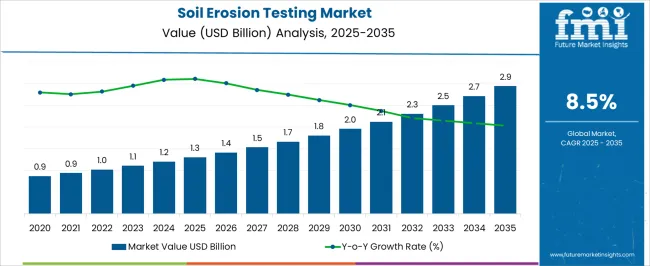
Soil Erosion Testing Market Key Takeaways
| Metric | Value |
|---|---|
| Soil Erosion Testing Market Estimated Value in (2025 E) | USD 1.3 billion |
| Soil Erosion Testing Market Forecast Value in (2035 F) | USD 2.9 billion |
| Forecast CAGR (2025 to 2035) | 8.5% |
Why is the Soil Erosion Testing Market Growing?
The Soil Erosion Testing market is experiencing steady growth as the need for effective land management and environmental monitoring increases across agricultural and environmental sectors. The market is being influenced by growing awareness about soil degradation, sustainable farming practices, and the implementation of government regulations aimed at preventing land erosion. The rising focus on climate change mitigation and the protection of fertile land has further encouraged investment in soil testing solutions.
Technological developments are enabling more precise assessment of erosion patterns, sediment transport, and soil stability, allowing researchers and practitioners to make informed decisions. The market outlook is expected to remain positive due to the increasing adoption of soil conservation techniques, the growing use of data-driven agricultural practices, and the integration of testing results into broader land management strategies.
Additionally, as agricultural productivity and food security remain global priorities, the Soil Erosion Testing market is anticipated to benefit from ongoing funding in environmental monitoring and the adoption of best practices for soil preservation These factors collectively support long-term growth and the expansion of testing solutions across regions.
Segmental Analysis
The soil erosion testing market is segmented by technology, end user, and geographic regions. By technology, soil erosion testing market is divided into Manual Soil Erosion Testing Equipment and Automated Soil Erosion Testing Equipment. In terms of end user, soil erosion testing market is classified into Agriculture, Construction, and Others. Regionally, the soil erosion testing industry is classified into North America, Latin America, Western Europe, Eastern Europe, Balkan & Baltic Countries, Russia & Belarus, Central Asia, East Asia, South Asia & Pacific, and the Middle East & Africa.
Insights into the Manual Soil Erosion Testing Equipment Segment
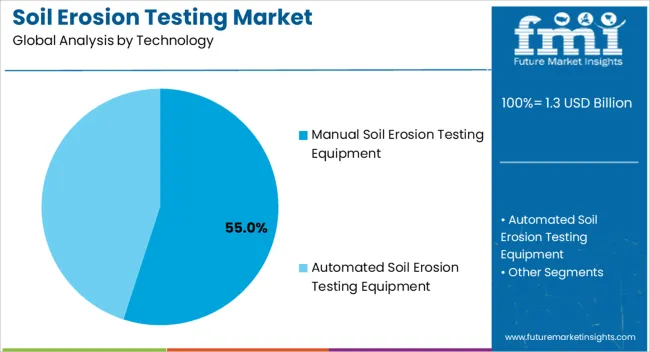
The Manual Soil Erosion Testing Equipment segment is projected to hold 55.00% of the total market revenue in 2025, establishing it as the leading technology type in the market. This prominence is being attributed to its simplicity, reliability, and cost-effectiveness, particularly in areas where sophisticated automated systems may be impractical or too expensive. The segment has benefited from wide usage in academic research, field trials, and smaller-scale agricultural operations where manual observation and sample collection are preferred.
Adoption has been supported by the ease of operation, minimal training requirements, and the flexibility to conduct testing under diverse environmental conditions. Furthermore, the ability to produce accurate, site-specific data has made manual testing a trusted method for long-term soil erosion studies and comparative assessments.
The segment’s growth has also been reinforced by initiatives promoting sustainable agriculture and soil conservation, which prioritize accessible and practical testing solutions With continued emphasis on land preservation and resource management, the Manual Soil Erosion Testing Equipment segment is expected to maintain its leading market position in the foreseeable future.
Insights into the Agriculture End User Segment
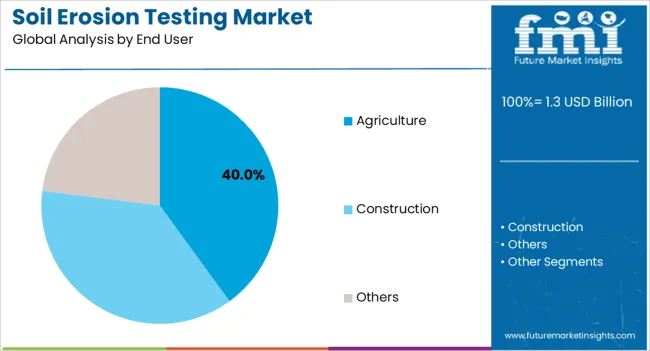
The Agriculture end user segment is anticipated to account for 40.00% of the Soil Erosion Testing market revenue in 2025, representing the largest share among all end-use sectors. This leadership is being driven by the critical need to monitor soil health and prevent degradation in farmland, ensuring long-term productivity and crop sustainability. Adoption has been supported by the growing emphasis on precision agriculture, where soil erosion testing is integrated into broader land management strategies to optimize irrigation, reduce nutrient loss, and maintain soil fertility.
The segment has also benefited from the rising awareness of climate change impacts, which have made erosion control and soil conservation top priorities for farmers and agribusinesses. Additionally, governmental and private initiatives encouraging sustainable farming practices have created favorable conditions for widespread testing adoption.
The ability of soil erosion testing solutions to deliver actionable insights into land quality and resource management has reinforced their use in agricultural operations As the global population grows and the demand for food security intensifies, the Agriculture end user segment is expected to continue leading the market, supported by practical, effective, and scalable soil assessment solutions.
Market Overview
Soil Erosion Testing Market: Introduction
Agriculture industry is an important part for living beings, as it provides food with lots of minerals and proteins. For growing any crop or fruit it is very essential to provide quality soil to seeds, as it provides the medium for plant growth. Nowadays, soil erosion is a challenging task for farmers.
So, many companies are developing soil erosion testing equipment to test the nature of soil in any region for the growth of crops. These soil erosion testing equipment are developed to control soil erosion and offer soil stability until vegetation can be established. These soil erosion testing equipment enables the assessment of the soil erosion and dispersion potential of a site, which is dependent on the scope of the proposed development area.
The companies are manufacturing soil erosion testing simulators, which allows erosion to take place on a small areas. These soil erosion testing equipment allows the customers to cross check the quality and amount of the product.
These soil erosion testing equipment provides lots of benefits, such as it can supply rain storm for comparative research, it requires small amount of soil, which directly results into small weight. These soil erosion testing equipment do not require trucks to transport soil for testing purposes.
Analysis of Soil Erosion Testing Market By Key Countries
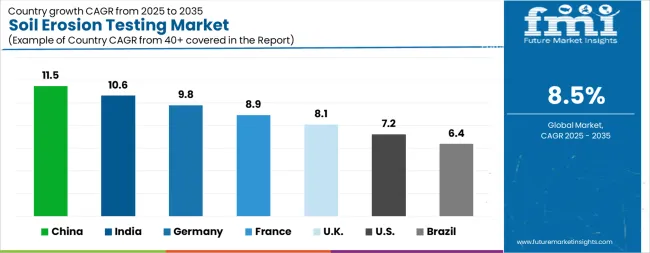
| Country | CAGR |
|---|---|
| China | 11.5% |
| India | 10.6% |
| Germany | 9.8% |
| France | 8.9% |
| UK | 8.1% |
| USA | 7.2% |
| Brazil | 6.4% |
Country-wise Analysis
The Soil Erosion Testing Market is expected to register a CAGR of 8.5% during the forecast period, exhibiting varied country level momentum. China leads with the highest CAGR of 11.5%, followed by India at 10.6%. Developed markets such as Germany, France, and the UK continue to expand steadily, while the USA is likely to grow at consistent rates. Brazil posts the lowest CAGR at 6.4%, yet still underscores a broadly positive trajectory for the global Soil Erosion Testing Market. In 2024, Germany held a dominant revenue in the Western Europe market and is expected to grow with a CAGR of 9.8%. The USA Soil Erosion Testing Market is estimated to be valued at USD 486.9 million in 2025 and is anticipated to reach a valuation of USD 978.2 million by 2035. Sales are projected to rise at a CAGR of 7.2% over the forecast period between 2025 and 2035. While Japan and South Korea markets are estimated to be valued at USD 59.6 million and USD 44.2 million respectively in 2025.
Key Players in the Soil Erosion Testing Market
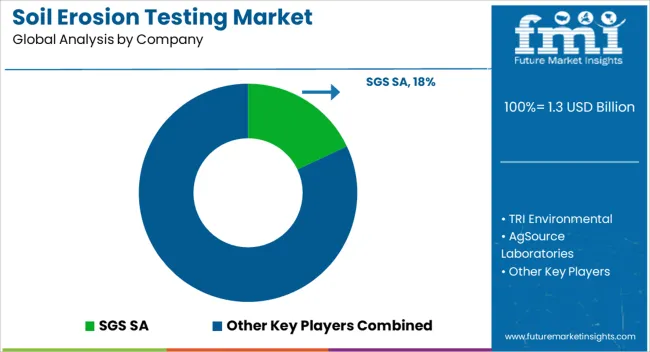
- SGS SA
- TRI Environmental
- AgSource Laboratories
- Apal Agricultural Laboratory
- Soiltech India Pvt. Ltd
- Apex Analytical
- Camlab Limited
Scope of the Report
| Item | Value |
|---|---|
| Quantitative Units | USD 1.3 Billion |
| Technology | Manual Soil Erosion Testing Equipment and Automated Soil Erosion Testing Equipment |
| End User | Agriculture, Construction, and Others |
| Regions Covered | North America, Europe, Asia-Pacific, Latin America, Middle East & Africa |
| Country Covered | United States, Canada, Germany, France, United Kingdom, China, Japan, India, Brazil, South Africa |
| Key Companies Profiled | SGS SA, TRI Environmental, AgSource Laboratories, Apal Agricultural Laboratory, Soiltech India Pvt. Ltd, Apex Analytical, and Camlab Limited |
Soil Erosion Testing Market by Segments
Technology:
- Manual Soil Erosion Testing Equipment
- Automated Soil Erosion Testing Equipment
End User:
- Agriculture
- Construction
- Others
Region:
- North America
- USA
- Canada
- Mexico
- Latin America
- Brazil
- Chile
- Rest of Latin America
- Western Europe
- Germany
- UK
- Italy
- Spain
- France
- Nordic
- BENELUX
- Rest of Western Europe
- Eastern Europe
- Russia
- Poland
- Hungary
- Balkan & Baltic
- Rest of Eastern Europe
- East Asia
- China
- Japan
- South Korea
- South Asia and Pacific
- India
- ASEAN
- Australia & New Zealand
- Rest of South Asia and Pacific
- Middle East & Africa
- Kingdom of Saudi Arabia
- Other GCC Countries
- Turkiye
- South Africa
- Other African Union
- Rest of Middle East & Africa
Frequently Asked Questions
How big is the soil erosion testing market in 2025?
The global soil erosion testing market is estimated to be valued at USD 1.3 billion in 2025.
What will be the size of soil erosion testing market in 2035?
The market size for the soil erosion testing market is projected to reach USD 2.9 billion by 2035.
How much will be the soil erosion testing market growth between 2025 and 2035?
The soil erosion testing market is expected to grow at a 8.5% CAGR between 2025 and 2035.
What are the key product types in the soil erosion testing market?
The key product types in soil erosion testing market are manual soil erosion testing equipment and automated soil erosion testing equipment.
Which end user segment to contribute significant share in the soil erosion testing market in 2025?
In terms of end user, agriculture segment to command 40.0% share in the soil erosion testing market in 2025.
Preview the report firsthand - request a free sample
Get SampleGet the brochure for pricing and purchase details.
Get PDFTable of Content
- Executive Summary
- Global Market Outlook
- Demand-side Trends
- Supply-side Trends
- Technology Roadmap Analysis
- Analysis and Recommendations
- Market Overview
- Market Coverage / Taxonomy
- Market Definition / Scope / Limitations
- Market Background
- Market Dynamics
- Drivers
- Restraints
- Opportunity
- Trends
- Scenario Forecast
- Demand in Optimistic Scenario
- Demand in Likely Scenario
- Demand in Conservative Scenario
- Opportunity Map Analysis
- Product Life Cycle Analysis
- Supply Chain Analysis
- Investment Feasibility Matrix
- Value Chain Analysis
- PESTLE and Porter’s Analysis
- Regulatory Landscape
- Regional Parent Market Outlook
- Production and Consumption Statistics
- Import and Export Statistics
- Market Dynamics
- Global Market Analysis 2020 to 2024 and Forecast, 2025 to 2035
- Historical Market Size Value (USD Million) Analysis, 2020 to 2024
- Current and Future Market Size Value (USD Million) Projections, 2025 to 2035
- Y-o-Y Growth Trend Analysis
- Absolute $ Opportunity Analysis
- Global Market Pricing Analysis 2020 to 2024 and Forecast 2025 to 2035
- Global Market Analysis 2020 to 2024 and Forecast 2025 to 2035, By Technology
- Introduction / Key Findings
- Historical Market Size Value (USD Million) Analysis By Technology , 2020 to 2024
- Current and Future Market Size Value (USD Million) Analysis and Forecast By Technology , 2025 to 2035
- Manual Equipment
- Automated Equipment
- Y-o-Y Growth Trend Analysis By Technology , 2020 to 2024
- Absolute $ Opportunity Analysis By Technology , 2025 to 2035
- Global Market Analysis 2020 to 2024 and Forecast 2025 to 2035, By End User
- Introduction / Key Findings
- Historical Market Size Value (USD Million) Analysis By End User, 2020 to 2024
- Current and Future Market Size Value (USD Million) Analysis and Forecast By End User, 2025 to 2035
- Agriculture
- Construction
- Others
- Y-o-Y Growth Trend Analysis By End User, 2020 to 2024
- Absolute $ Opportunity Analysis By End User, 2025 to 2035
- Global Market Analysis 2020 to 2024 and Forecast 2025 to 2035, By Region
- Introduction
- Historical Market Size Value (USD Million) Analysis By Region, 2020 to 2024
- Current Market Size Value (USD Million) Analysis and Forecast By Region, 2025 to 2035
- North America
- Latin America
- Western Europe
- Eastern Europe
- East Asia
- South Asia and Pacific
- Middle East & Africa
- Market Attractiveness Analysis By Region
- North America Market Analysis 2020 to 2024 and Forecast 2025 to 2035, By Country
- Historical Market Size Value (USD Million) Trend Analysis By Market Taxonomy, 2020 to 2024
- Market Size Value (USD Million) Forecast By Market Taxonomy, 2025 to 2035
- By Country
- USA
- Canada
- Mexico
- By Technology
- By End User
- By Country
- Market Attractiveness Analysis
- By Country
- By Technology
- By End User
- Key Takeaways
- Latin America Market Analysis 2020 to 2024 and Forecast 2025 to 2035, By Country
- Historical Market Size Value (USD Million) Trend Analysis By Market Taxonomy, 2020 to 2024
- Market Size Value (USD Million) Forecast By Market Taxonomy, 2025 to 2035
- By Country
- Brazil
- Chile
- Rest of Latin America
- By Technology
- By End User
- By Country
- Market Attractiveness Analysis
- By Country
- By Technology
- By End User
- Key Takeaways
- Western Europe Market Analysis 2020 to 2024 and Forecast 2025 to 2035, By Country
- Historical Market Size Value (USD Million) Trend Analysis By Market Taxonomy, 2020 to 2024
- Market Size Value (USD Million) Forecast By Market Taxonomy, 2025 to 2035
- By Country
- Germany
- UK
- Italy
- Spain
- France
- Nordic
- BENELUX
- Rest of Western Europe
- By Technology
- By End User
- By Country
- Market Attractiveness Analysis
- By Country
- By Technology
- By End User
- Key Takeaways
- Eastern Europe Market Analysis 2020 to 2024 and Forecast 2025 to 2035, By Country
- Historical Market Size Value (USD Million) Trend Analysis By Market Taxonomy, 2020 to 2024
- Market Size Value (USD Million) Forecast By Market Taxonomy, 2025 to 2035
- By Country
- Russia
- Poland
- Hungary
- Balkan & Baltic
- Rest of Eastern Europe
- By Technology
- By End User
- By Country
- Market Attractiveness Analysis
- By Country
- By Technology
- By End User
- Key Takeaways
- East Asia Market Analysis 2020 to 2024 and Forecast 2025 to 2035, By Country
- Historical Market Size Value (USD Million) Trend Analysis By Market Taxonomy, 2020 to 2024
- Market Size Value (USD Million) Forecast By Market Taxonomy, 2025 to 2035
- By Country
- China
- Japan
- South Korea
- By Technology
- By End User
- By Country
- Market Attractiveness Analysis
- By Country
- By Technology
- By End User
- Key Takeaways
- South Asia and Pacific Market Analysis 2020 to 2024 and Forecast 2025 to 2035, By Country
- Historical Market Size Value (USD Million) Trend Analysis By Market Taxonomy, 2020 to 2024
- Market Size Value (USD Million) Forecast By Market Taxonomy, 2025 to 2035
- By Country
- India
- ASEAN
- Australia & New Zealand
- Rest of South Asia and Pacific
- By Technology
- By End User
- By Country
- Market Attractiveness Analysis
- By Country
- By Technology
- By End User
- Key Takeaways
- Middle East & Africa Market Analysis 2020 to 2024 and Forecast 2025 to 2035, By Country
- Historical Market Size Value (USD Million) Trend Analysis By Market Taxonomy, 2020 to 2024
- Market Size Value (USD Million) Forecast By Market Taxonomy, 2025 to 2035
- By Country
- Kingdom of Saudi Arabia
- Other GCC Countries
- Turkiye
- South Africa
- Other African Union
- Rest of Middle East & Africa
- By Technology
- By End User
- By Country
- Market Attractiveness Analysis
- By Country
- By Technology
- By End User
- Key Takeaways
- Key Countries Market Analysis
- USA
- Pricing Analysis
- Market Share Analysis, 2024
- By Technology
- By End User
- Canada
- Pricing Analysis
- Market Share Analysis, 2024
- By Technology
- By End User
- Mexico
- Pricing Analysis
- Market Share Analysis, 2024
- By Technology
- By End User
- Brazil
- Pricing Analysis
- Market Share Analysis, 2024
- By Technology
- By End User
- Chile
- Pricing Analysis
- Market Share Analysis, 2024
- By Technology
- By End User
- Germany
- Pricing Analysis
- Market Share Analysis, 2024
- By Technology
- By End User
- UK
- Pricing Analysis
- Market Share Analysis, 2024
- By Technology
- By End User
- Italy
- Pricing Analysis
- Market Share Analysis, 2024
- By Technology
- By End User
- Spain
- Pricing Analysis
- Market Share Analysis, 2024
- By Technology
- By End User
- France
- Pricing Analysis
- Market Share Analysis, 2024
- By Technology
- By End User
- India
- Pricing Analysis
- Market Share Analysis, 2024
- By Technology
- By End User
- ASEAN
- Pricing Analysis
- Market Share Analysis, 2024
- By Technology
- By End User
- Australia & New Zealand
- Pricing Analysis
- Market Share Analysis, 2024
- By Technology
- By End User
- China
- Pricing Analysis
- Market Share Analysis, 2024
- By Technology
- By End User
- Japan
- Pricing Analysis
- Market Share Analysis, 2024
- By Technology
- By End User
- South Korea
- Pricing Analysis
- Market Share Analysis, 2024
- By Technology
- By End User
- Russia
- Pricing Analysis
- Market Share Analysis, 2024
- By Technology
- By End User
- Poland
- Pricing Analysis
- Market Share Analysis, 2024
- By Technology
- By End User
- Hungary
- Pricing Analysis
- Market Share Analysis, 2024
- By Technology
- By End User
- Kingdom of Saudi Arabia
- Pricing Analysis
- Market Share Analysis, 2024
- By Technology
- By End User
- Turkiye
- Pricing Analysis
- Market Share Analysis, 2024
- By Technology
- By End User
- South Africa
- Pricing Analysis
- Market Share Analysis, 2024
- By Technology
- By End User
- USA
- Market Structure Analysis
- Competition Dashboard
- Competition Benchmarking
- Market Share Analysis of Top Players
- By Regional
- By Technology
- By End User
- Competition Analysis
- Competition Deep Dive
- SGS SA
- Overview
- Product Portfolio
- Profitability by Market Segments (Product/Age /Sales Channel/Region)
- Sales Footprint
- Strategy Overview
- Marketing Strategy
- Product Strategy
- Channel Strategy
- TRI Environmental
- AgSource Laboratories
- Apal Agricultural Laboratory
- Soiltech India Pvt. Ltd
- Apex Analytical
- Camlab Limited
- SGS SA
- Competition Deep Dive
- Assumptions & Acronyms Used
- Research Methodology


