

- Industry Size (2025)
- USD 1052.3 Mn
- Forecast (2035)
- USD 2987.9 Mn
- CAGR (2025 to 2035)
- 11.0%
Solar Panel Cleaning Market Size and Share Forecast Outlook 2025 to 2035
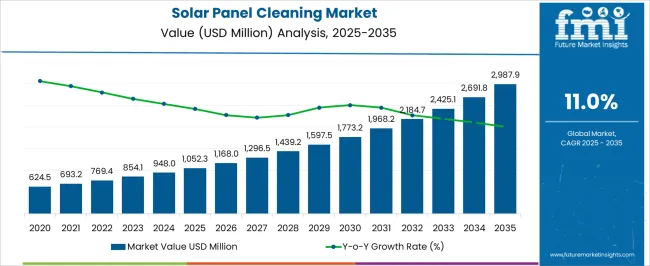
The solar panel cleaning market is estimated to be valued at USD 1052.3 million in 2025 and is projected to reach USD 2987.9 million by 2035, registering a compound annual growth rate (CAGR) of 11.0% over the forecast period.
The year-on-year (YoY) growth analysis of the solar panel cleaning market indicates a significant upward trajectory, with values projected to rise from USD 1,052.3 million in 2025 to USD 2,987.9 million by 2035, reflecting a compound annual growth rate (CAGR) of 11%. Over the first few years, the market is expected to grow steadily, increasing from USD 1,052.3 million in 2025 to USD 1,168 million in 2026, reaching USD 1,296.5 million by 2027. This increase is likely to be driven by the rapid expansion of the solar energy sector and the rising need for maintaining optimal efficiency in solar panel systems. As solar installations continue to grow globally, the demand for cleaning and maintenance services is set to increase.
By 2035, the solar panel cleaning market is projected to have grown significantly, reaching USD 2,987.9 million, driven by the expanding global solar power capacity and the increased recognition of the importance of regular panel maintenance. The YoY growth pattern suggests that companies involved in solar panel cleaning services and technologies will see a steady rise in demand for their offerings. As the need for cost-effective and efficient cleaning solutions intensifies, the market is expected to see continued investment and innovation, making solar panel cleaning an essential component of the solar energy ecosystem.
Utility-scale solar installations drive substantial demand for automated cleaning systems including robotic platforms, water recovery systems, and centralized control equipment that can service thousands of panels across expansive solar farms. Desert installations face particular challenges from sand accumulation, mineral deposits, and water scarcity that influence cleaning frequency and methodology selection.
Operations and maintenance teams evaluate cleaning system performance through energy output monitoring, cost per megawatt hour calculations, and equipment reliability metrics that determine optimal cleaning intervals and technology selection. Water treatment systems address local water quality issues including mineral content, pH levels, and filtration requirements that prevent spot formation and panel damage during cleaning operations.
Commercial rooftop markets involve cleaning equipment designed for building-mounted arrays where access limitations, safety requirements, and structural considerations affect equipment selection and operational procedures. Building owners and facility managers coordinate cleaning activities with rooftop maintenance schedules, HVAC service requirements, and tenant operations to minimize disruption while maintaining system performance.
Mobile cleaning equipment accommodates diverse installation configurations, panel angles, and roof access constraints that vary significantly across different building types and architectural designs. Insurance considerations influence safety equipment requirements, personnel training protocols, and liability coverage that affect service pricing and contractor selection.
Quick Stats for Solar Panel Cleaning Market
- Solar Panel Cleaning Market Value (2025): USD 1052.3 million
- Solar Panel Cleaning Market Forecast Value (2035): USD 2987.9 million
- Solar Panel Cleaning Market Forecast CAGR: 11.0%
- Leading Segment in Solar Panel Cleaning Market in 2025: Wet Cleaning (56.3%)
- Key Growth Regions in Solar Panel Cleaning Market: North America, Asia-Pacific, Europe
- Top Players in Solar Panel Cleaning Market: Ecoppia, Saint-Gobain, Miraikikai, Premier Solar Cleaning, Pacific Panel Cleaners, Clean Solar Solutions, Sharp Corporation, Indisolar Products, Solar Cleaning Machinery, Solbright, and Solar Service Professionals.
Solar Panel Cleaning Market Key Takeaways
| Metric | Value |
|---|---|
| Solar Panel Cleaning Market Estimated Value in (2025 E) | USD 1052.3 million |
| Solar Panel Cleaning Market Forecast Value in (2035 F) | USD 2987.9 million |
| Forecast CAGR (2025 to 2035) | 11.0% |
Why is the Solar Panel Cleaning Market Growing?
The solar panel cleaning market is experiencing strong growth as the efficiency and long-term performance of photovoltaic systems increasingly depend on proper maintenance practices. Rising global solar power capacity installations, supported by government incentives and corporate sustainability commitments, are driving demand for effective cleaning solutions that maximize energy output. The accumulation of dust, dirt, and pollutants on panels can significantly reduce energy generation, making professional and automated cleaning technologies essential.
Advancements in specialized cleaning equipment, water-efficient systems, and non-abrasive materials are improving operational outcomes and lowering maintenance costs. Growing awareness of return-on-investment benefits from regular cleaning, combined with the expansion of large-scale solar farms, is further supporting market adoption.
Environmental regulations encouraging the use of eco-friendly cleaning processes are shaping innovation trends, with manufacturers developing solutions that minimize water usage and chemical impact As solar infrastructure expands across arid and industrial regions where soiling rates are high, the demand for efficient, scalable, and sustainable cleaning solutions is expected to grow steadily over the coming years.
Segmental Analysis
The solar panel cleaning market is segmented by technology, process, and geographic regions. By technology, solar panel cleaning market is divided into Wet Cleaning and Dry Cleaning. In terms of process, solar panel cleaning market is classified into Automated, Semi-Automated, Water Brushes, Electrostatic, Automated Robotic, and Others. Regionally, the solar panel cleaning industry is classified into North America, Latin America, Western Europe, Eastern Europe, Balkan & Baltic Countries, Russia & Belarus, Central Asia, East Asia, South Asia & Pacific, and the Middle East & Africa.
Insights into the Wet Cleaning Technology Segment
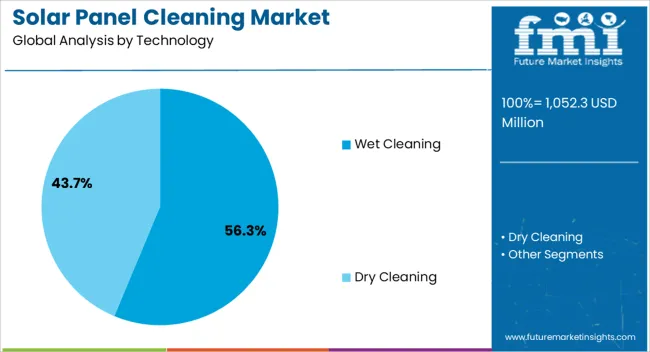
The wet cleaning technology segment is projected to account for 56.3% of the solar panel cleaning market revenue share in 2025, making it the leading technology type. This dominance is being driven by its high effectiveness in removing stubborn dirt, bird droppings, and environmental residues that can significantly reduce panel efficiency. Wet cleaning techniques, which often use purified or demineralized water, help prevent residue build-up and avoid damage to the glass surface, thereby extending the operational lifespan of panels.
The segment is also benefiting from its suitability across a wide range of solar installations, including utility-scale farms, rooftop systems, and industrial facilities. Growing demand in regions with high dust accumulation, such as arid and semi-arid zones, is reinforcing its market position.
Technological advancements in water-efficient systems, coupled with the integration of soft-bristle brushes and controlled pressure mechanisms, are improving cleaning precision while reducing water consumption The continued emphasis on maintaining peak energy generation rates is expected to sustain the strong adoption of wet cleaning solutions in the global market.
Insights into the Automated Process Segment
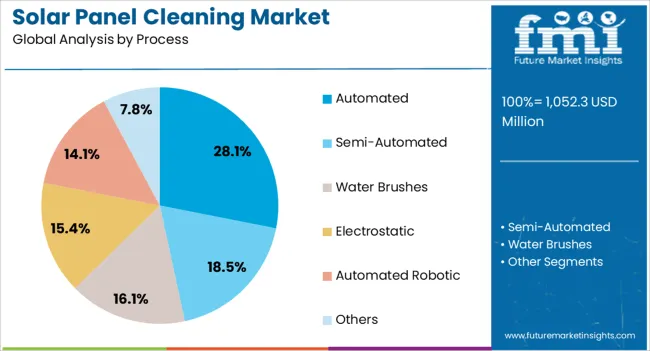
The automated process segment is anticipated to represent 28.1% of the solar panel cleaning market revenue share in 2025, positioning it as the leading process type. Its growth is being supported by the increasing need for cost-effective, labor-efficient, and scalable cleaning methods, particularly for large solar farms. Automated systems minimize downtime and reduce reliance on manual labor, allowing for consistent and timely cleaning schedules that preserve panel efficiency throughout the year.
These systems are designed to operate with minimal water usage and can be programmed to adapt to site-specific conditions, making them suitable for diverse environments. The integration of robotics, AI-driven control systems, and sensor-based navigation is enhancing operational precision and reducing maintenance requirements.
Adoption is further reinforced by the rising cost of manual labor and the push for operational efficiency in renewable energy projects As solar power installations continue to expand in size and complexity, automated cleaning processes are expected to play a critical role in sustaining long-term performance and maximizing return on investment.
What are the Drivers, Restraints, and Key Trends of the Solar Panel Cleaning Market?
The solar panel cleaning market is expanding due to the increasing demand for maintaining solar panel efficiency in a growing renewable energy landscape. Opportunities are emerging with automated and eco-friendly cleaning solutions, including robotic and waterless technologies. However, high cleaning equipment costs and maintenance requirements remain challenges, particularly for smaller users. Despite these barriers, the market outlook remains positive, driven by technological innovations and sustainability trends that enhance the efficiency and affordability of solar panel cleaning systems.
Rising Demand for Solar Panel Efficiency
The solar panel cleaning market is growing as the global shift towards renewable energy increases the need for maintaining solar panel efficiency. Dust, dirt, and other environmental factors can significantly reduce the energy output of solar panels. As the adoption of solar power systems expands, particularly in regions with high dust and pollution levels, the demand for effective solar panel cleaning solutions is rising. Regular cleaning helps maximize energy efficiency, making it an essential service for solar plant operators and homeowners alike.
Opportunities in Automated and Robotic Cleaning Solutions
One of the major opportunities in the solar panel cleaning market lies in the development and adoption of automated and robotic cleaning systems. These advanced cleaning technologies not only reduce labor costs but also offer precision and effectiveness in removing dirt and debris. As automation continues to evolve, solar power operators are increasingly adopting robotic solutions to reduce maintenance costs, increase operational uptime, and enhance safety. This trend is expected to accelerate with advancements in AI, robotics, and IoT integration in solar panel maintenance.
Trends in Eco-Friendly and Waterless Cleaning
There is a growing trend toward eco-friendly and waterless solar panel cleaning solutions. As water scarcity becomes a critical issue in many regions, especially in areas with large solar farms, cleaning methods that conserve water are gaining traction. Technologies such as dry cleaning brushes, air-based systems, and electrostatic cleaning are becoming popular alternatives to traditional water-based methods. These sustainable cleaning solutions are not only environmentally friendly but also reduce operational costs, further driving the adoption of waterless technologies in the market.
Challenges with High Cleaning Costs and Maintenance
A significant challenge facing the solar panel cleaning market is the high cost of cleaning equipment and maintenance. While automated and robotic systems offer efficiency, the initial investment in these technologies can be high, making them inaccessible for small-scale solar panel users. Additionally, the need for frequent maintenance and servicing of cleaning equipment adds to the overall cost. As the market matures, cost-effective cleaning solutions and improved equipment longevity will be key to overcoming these challenges and expanding adoption in residential and commercial solar sectors.
Analysis of Solar Panel Cleaning Market By Key Countries
| Country | CAGR |
|---|---|
| China | 14.9% |
| India | 13.8% |
| Germany | 12.7% |
| France | 11.6% |
| UK | 10.5% |
| USA | 9.4% |
| Brazil | 8.3% |
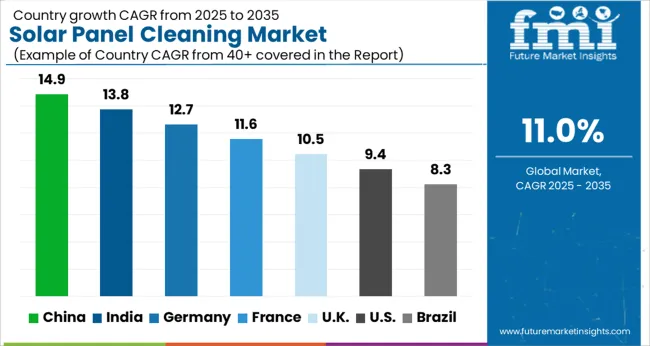
The global solar panel cleaning market is projected to grow at an 11% CAGR from 2025 to 2035. China leads with a growth rate of 14.9%, followed by India at 13.8% and France at 11.6%. The United Kingdom records a growth rate of 10.5%, while the United States shows the slowest growth at 9.4%. The varying growth rates across these markets are driven by expanding solar power capacities and increasing demand for efficient maintenance solutions. Emerging markets like China and India are experiencing faster growth due to rapid solar energy adoption and geographical factors like dust accumulation, while more mature markets like the USA and the UK see steady growth driven by renewable energy policies, technological adoption, and efficiency requirements. This report includes insights on 40+ countries; the top markets are shown here for reference.
Sales Outlook for Solar Panel Cleaning Market in China
The solar panel cleaning market in China is projected to grow at a CAGR of 14.9%. China is the world leader in solar power generation, and the rapidly expanding solar infrastructure is driving the need for efficient and cost-effective cleaning solutions. As solar power capacity continues to increase, particularly in remote, arid, and industrial regions, the demand for specialized cleaning technologies is intensifying. China’s commitment to sustainable energy and renewable sources is further pushing the adoption of solar panel cleaning systems. Moreover, the government’s focus on reducing maintenance costs and improving the efficiency of solar power systems contributes to the growing demand for cleaning services and equipment.
- China's rapid expansion of solar power capacity is driving strong demand for solar panel cleaning technologies.
- The increasing demand for cost-effective and efficient maintenance solutions for large-scale solar farms is fueling market growth in China.
- Government initiatives focused on boosting renewable energy generation and efficiency continue to accelerate the adoption of solar panel cleaning solutions in China.
Demand Analysis for Solar Panel Cleaning Market in India
The solar panel cleaning market in India is projected to grow at a CAGR of 13.8%. India is rapidly increasing its solar energy production, with solar installations growing across rural and urban landscapes. The country’s geographical features, such as high dust accumulation in desert and semi-desert regions, are contributing to the need for specialized solar panel cleaning services. As India continues to invest in clean energy, the demand for cost-effective cleaning systems that ensure optimal panel performance is growing. Government incentives for solar energy expansion, along with a focus on maximizing efficiency, are further driving the adoption of solar panel cleaning technologies in India.
- India’s growing solar capacity, particularly in dust-prone areas, is driving demand for efficient solar panel cleaning solutions.
- Government incentives and initiatives supporting renewable energy generation continue to boost the solar panel cleaning market in India.
- The rising focus on solar energy efficiency and maintenance cost reduction is contributing to the rapid adoption of solar panel cleaning technologies in India.
In-depth Analysis of Solar Panel Cleaning Market in France
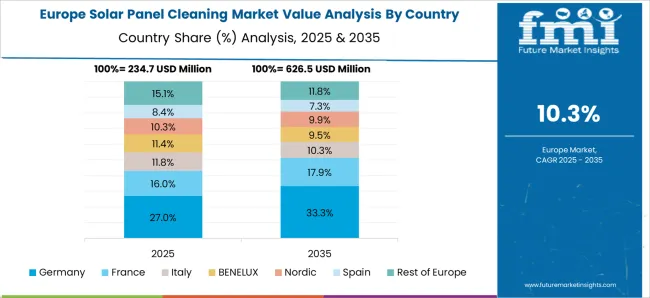
The solar panel cleaning market in France is projected to grow at a CAGR of 11.6%. France’s commitment to renewable energy, along with the growing number of solar installations, is fueling the demand for solar panel cleaning solutions. The market is particularly driven by the country’s expanding solar farms in both urban and rural areas, where maintaining optimal panel efficiency is crucial for maximizing energy production. Furthermore, the French government’s focus on reducing energy costs and improving the efficiency of solar systems through proper maintenance is expected to support the growth of the solar panel cleaning market. Increased awareness about the importance of panel upkeep is further contributing to market expansion.
- France’s increasing solar energy capacity and commitment to renewable energy solutions are driving the demand for solar panel cleaning services.
- The country’s focus on maximizing solar power efficiency through regular maintenance and cleaning is fueling market growth.
- Government support for renewable energy initiatives, combined with growing awareness of the need for solar panel upkeep, is accelerating adoption in France.
Opportunity Analysis for Solar Panel Cleaning Market in the United Kingdom
The solar panel cleaning market in the United Kingdom is projected to grow at a CAGR of 10.5%. As the UK continues to expand its renewable energy portfolio, solar power is playing an increasingly important role in the energy mix. The growing demand for solar energy, coupled with the need to maintain panel efficiency, is driving the need for solar panel cleaning technologies. With increased installations in both residential and commercial sectors, there is a rising awareness about the importance of panel upkeep to ensure consistent energy generation. The UK government’s ongoing support for green energy solutions continues to support the growth of solar panel cleaning systems across the country.
- The UK’s expanding solar capacity and growing emphasis on renewable energy solutions are driving demand for solar panel cleaning technologies.
- Increased adoption of solar energy in residential and commercial sectors is creating a greater need for regular panel maintenance and cleaning.
- Government incentives promoting renewable energy generation and efficient energy production continue to support the adoption of solar panel cleaning solutions in the UK
Growth and Expansion Outlook for Solar Panel Cleaning Market in the United States
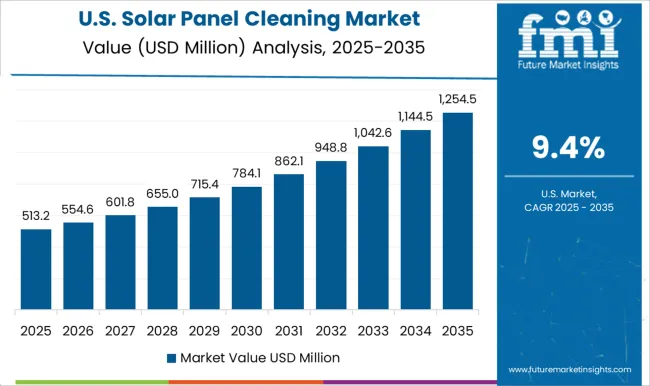
The solar panel cleaning market in the United States is projected to grow at a CAGR of 9.4%. The USA continues to experience significant growth in solar energy capacity, especially in states with high solar potential such as California, Nevada, and Arizona. The increasing number of solar farms, coupled with a need for efficiency in maintaining these systems, is driving the demand for solar panel cleaning. As the focus on renewable energy strengthens, the need to maintain the panels to avoid efficiency loss due to dust, dirt, and debris is becoming more critical. The USA government’s green energy policies and state-level support are expected to further push the adoption of solar panel cleaning technologies in the coming years.
- The USA solar energy market expansion, particularly in high-sunlight regions, is increasing the demand for efficient solar panel cleaning solutions.
- The growing importance of maintaining solar energy efficiency and reducing maintenance costs is fueling the market for cleaning technologies in the USA
- State-level policies and federal support for renewable energy systems continue to drive the adoption of solar panel cleaning solutions in the United States.
Competitive Landscape of Solar Panel Cleaning Market
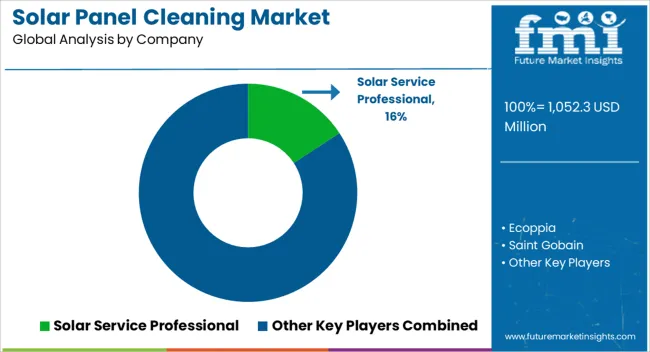
The solar panel cleaning market is led by companies offering advanced, efficient, and sustainable cleaning solutions that help maximize solar energy output and system longevity. Ecoppia dominates with fully automated robotic cleaning systems that eliminate water usage, reduce maintenance costs, and improve efficiency in large-scale solar farms. Saint-Gobain contributes through high-performance cleaning materials and surface treatment technologies that prevent dust accumulation and enhance solar transmittance.
Miraikikai, Premier Solar Cleaning, and Pacific Panel Cleaners provide both automated and manual cleaning systems, serving utility-scale and residential installations with flexible, on-site maintenance solutions. Clean Solar Solutions and Solar Cleaning Machinery specialize in scalable, commercial-grade cleaning equipment and services designed to minimize panel downtime and labor dependency.
Sharp Corporation, Indisolar Products, and Solbright strengthen regional markets by offering customized, cost-effective cleaning technologies suited to diverse climatic and environmental conditions. Solar Service Professionals focuses on integrated maintenance packages that combine cleaning, inspection, and performance monitoring for solar installations.
Key Players in the Solar Panel Cleaning Market
- Ecoppia
- Saint-Gobain
- Miraikikai
- Premier Solar Cleaning
- Pacific Panel Cleaners
- Clean Solar Solutions
- Sharp Corporation
- Indisolar Products
- Solar Cleaning Machinery
- Solbright
- Solar Service Professionals
Scope of the Report
| Item | Value |
|---|---|
| Quantitative Units | USD 1052.3 Million |
| Technology | Wet Cleaning and Dry Cleaning |
| Process | Automated, Semi-Automated, Water Brushes, Electrostatic, Automated Robotic, and Others |
| Regions Covered | North America, Europe, Asia-Pacific, Latin America, Middle East & Africa |
| Country Covered | United States, Canada, Germany, France, United Kingdom, China, Japan, India, Brazil, South Africa |
| Key Companies Profiled | Ecoppia, Saint-Gobain, Miraikikai, Premier Solar Cleaning, Pacific Panel Cleaners, Clean Solar Solutions, Sharp Corporation, Indisolar Products, Solar Cleaning Machinery, Solbright, and Solar Service Professionals. |
| Additional Attributes | Dollar sales by cleaning method (manual, robotic, chemical) and panel type (flat, curved, bifacial) are key metrics. Trends include increasing demand for efficient, waterless cleaning solutions and automation in large-scale solar installations. Regional adoption, technological advancements in cleaning equipment, and sustainability concerns are driving market growth. |
Solar Panel Cleaning Market by Segments
Technology:
- Wet Cleaning
- Dry Cleaning
Process:
- Automated
- Semi-Automated
- Water Brushes
- Electrostatic
- Automated Robotic
- Others
Region:
- North America
- USA
- Canada
- Mexico
- Latin America
- Brazil
- Chile
- Rest of Latin America
- Western Europe
- Germany
- UK
- Italy
- Spain
- France
- Nordic
- BENELUX
- Rest of Western Europe
- Eastern Europe
- Russia
- Poland
- Hungary
- Balkan & Baltic
- Rest of Eastern Europe
- East Asia
- China
- Japan
- South Korea
- South Asia and Pacific
- India
- ASEAN
- Australia & New Zealand
- Rest of South Asia and Pacific
- Middle East & Africa
- Kingdom of Saudi Arabia
- Other GCC Countries
- Turkiye
- South Africa
- Other African Union
- Rest of Middle East & Africa
Frequently Asked Questions
How big is the solar panel cleaning market in 2025?
The global solar panel cleaning market is estimated to be valued at USD 1,052.3 million in 2025.
What will be the size of solar panel cleaning market in 2035?
The market size for the solar panel cleaning market is projected to reach USD 2,987.9 million by 2035.
How much will be the solar panel cleaning market growth between 2025 and 2035?
The solar panel cleaning market is expected to grow at a 11.0% CAGR between 2025 and 2035.
What are the key product types in the solar panel cleaning market?
The key product types in solar panel cleaning market are wet cleaning, _semi-automated, _automated, _water brushes, _others, dry cleaning, _electrostatic, _automated robotic and _others.
Which process segment to contribute significant share in the solar panel cleaning market in 2025?
In terms of process, automated segment to command 28.1% share in the solar panel cleaning market in 2025.
Preview the report firsthand - request a free sample
Get SampleGet the brochure for pricing and purchase details.
Get PDFTable of Content
- Executive Summary
- Global Market Outlook
- Demand-side Trends
- Supply-side Trends
- Technology Roadmap Analysis
- Analysis and Recommendations
- Market Overview
- Market Coverage / Taxonomy
- Market Definition / Scope / Limitations
- Market Background
- Market Dynamics
- Drivers
- Restraints
- Opportunity
- Trends
- Scenario Forecast
- Demand in Optimistic Scenario
- Demand in Likely Scenario
- Demand in Conservative Scenario
- Opportunity Map Analysis
- Product Life Cycle Analysis
- Supply Chain Analysis
- Investment Feasibility Matrix
- Value Chain Analysis
- PESTLE and Porter’s Analysis
- Regulatory Landscape
- Regional Parent Market Outlook
- Production and Consumption Statistics
- Import and Export Statistics
- Market Dynamics
- Global Solar Panel Cleaning Market Analysis 2020-2024 and Forecast, 2025-2035
- Historical Market Size Value (USD Mn) Analysis, 2020-2024
- Current and Future Market Size Value (USD Mn) Projections, 2025-2035
- Y-o-Y Growth Trend Analysis
- Absolute $ Opportunity Analysis
- Global Solar Panel Cleaning Market Pricing Analysis 2020-2024 and Forecast 2025-2035
- Global Solar Panel Cleaning Market Analysis 2020-2024 and Forecast 2025-2035, By Technology
- Introduction / Key Findings
- Historical Market Size Value (USD Mn) Analysis By Technology , 2020-2024
- Current and Future Market Size Value (USD Mn) Analysis and Forecast By Technology , 2025-2035
- Wet Cleaning
- Semi-Automated
- Automated
- Water Brushes
- Others
- Dry Cleaning
- Electrostatic
- Automated Robotic
- Others
- Wet Cleaning
- Y-o-Y Growth Trend Analysis By Technology , 2020-2024
- Absolute $ Opportunity Analysis By Technology , 2025-2035
- Global Solar Panel Cleaning Market Analysis 2020-2024 and Forecast 2025-2035, By Process
- Introduction / Key Findings
- Historical Market Size Value (USD Mn) Analysis By Process, 2020-2024
- Current and Future Market Size Value (USD Mn) Analysis and Forecast By Process, 2025-2035
- Automated
- Semi-Automated
- Water Brushes
- Electrostatic
- Automated Robotic
- Others
- Y-o-Y Growth Trend Analysis By Process, 2020-2024
- Absolute $ Opportunity Analysis By Process, 2025-2035
- Global Solar Panel Cleaning Market Analysis 2020-2024 and Forecast 2025-2035, By Region
- Introduction
- Historical Market Size Value (USD Mn) Analysis By Region, 2020-2024
- Current Market Size Value (USD Mn) Analysis and Forecast By Region, 2025-2035
- North America
- Latin America
- Western Europe
- Eastern Europe
- East Asia
- South Asia and Pacific
- Middle East & Africa
- Market Attractiveness Analysis By Region
- North America Solar Panel Cleaning Market Analysis 2020-2024 and Forecast 2025-2035, By Country
- Historical Market Size Value (USD Mn) Trend Analysis By Market Taxonomy, 2020-2024
- Market Size Value (USD Mn) Forecast By Market Taxonomy, 2025-2035
- By Country
- USA
- Canada
- Mexico
- By Technology
- By Process
- By Country
- Market Attractiveness Analysis
- By Country
- By Technology
- By Process
- Key Takeaways
- Latin America Solar Panel Cleaning Market Analysis 2020-2024 and Forecast 2025-2035, By Country
- Historical Market Size Value (USD Mn) Trend Analysis By Market Taxonomy, 2020-2024
- Market Size Value (USD Mn) Forecast By Market Taxonomy, 2025-2035
- By Country
- Brazil
- Chile
- Rest of Latin America
- By Technology
- By Process
- By Country
- Market Attractiveness Analysis
- By Country
- By Technology
- By Process
- Key Takeaways
- Western Europe Solar Panel Cleaning Market Analysis 2020-2024 and Forecast 2025-2035, By Country
- Historical Market Size Value (USD Mn) Trend Analysis By Market Taxonomy, 2020-2024
- Market Size Value (USD Mn) Forecast By Market Taxonomy, 2025-2035
- By Country
- Germany
- UK
- Italy
- Spain
- France
- Nordic
- BENELUX
- Rest of Western Europe
- By Technology
- By Process
- By Country
- Market Attractiveness Analysis
- By Country
- By Technology
- By Process
- Key Takeaways
- Eastern Europe Solar Panel Cleaning Market Analysis 2020-2024 and Forecast 2025-2035, By Country
- Historical Market Size Value (USD Mn) Trend Analysis By Market Taxonomy, 2020-2024
- Market Size Value (USD Mn) Forecast By Market Taxonomy, 2025-2035
- By Country
- Russia
- Poland
- Hungary
- Balkan & Baltic
- Rest of Eastern Europe
- By Technology
- By Process
- By Country
- Market Attractiveness Analysis
- By Country
- By Technology
- By Process
- Key Takeaways
- East Asia Solar Panel Cleaning Market Analysis 2020-2024 and Forecast 2025-2035, By Country
- Historical Market Size Value (USD Mn) Trend Analysis By Market Taxonomy, 2020-2024
- Market Size Value (USD Mn) Forecast By Market Taxonomy, 2025-2035
- By Country
- China
- Japan
- South Korea
- By Technology
- By Process
- By Country
- Market Attractiveness Analysis
- By Country
- By Technology
- By Process
- Key Takeaways
- South Asia and Pacific Solar Panel Cleaning Market Analysis 2020-2024 and Forecast 2025-2035, By Country
- Historical Market Size Value (USD Mn) Trend Analysis By Market Taxonomy, 2020-2024
- Market Size Value (USD Mn) Forecast By Market Taxonomy, 2025-2035
- By Country
- India
- ASEAN
- Australia & New Zealand
- Rest of South Asia and Pacific
- By Technology
- By Process
- By Country
- Market Attractiveness Analysis
- By Country
- By Technology
- By Process
- Key Takeaways
- Middle East & Africa Solar Panel Cleaning Market Analysis 2020-2024 and Forecast 2025-2035, By Country
- Historical Market Size Value (USD Mn) Trend Analysis By Market Taxonomy, 2020-2024
- Market Size Value (USD Mn) Forecast By Market Taxonomy, 2025-2035
- By Country
- Kingdom of Saudi Arabia
- Other GCC Countries
- Turkiye
- South Africa
- Other African Union
- Rest of Middle East & Africa
- By Technology
- By Process
- By Country
- Market Attractiveness Analysis
- By Country
- By Technology
- By Process
- Key Takeaways
- Key Countries Solar Panel Cleaning Market Analysis
- USA
- Pricing Analysis
- Market Share Analysis, 2024
- By Technology
- By Process
- Canada
- Pricing Analysis
- Market Share Analysis, 2024
- By Technology
- By Process
- Mexico
- Pricing Analysis
- Market Share Analysis, 2024
- By Technology
- By Process
- Brazil
- Pricing Analysis
- Market Share Analysis, 2024
- By Technology
- By Process
- Chile
- Pricing Analysis
- Market Share Analysis, 2024
- By Technology
- By Process
- Germany
- Pricing Analysis
- Market Share Analysis, 2024
- By Technology
- By Process
- UK
- Pricing Analysis
- Market Share Analysis, 2024
- By Technology
- By Process
- Italy
- Pricing Analysis
- Market Share Analysis, 2024
- By Technology
- By Process
- Spain
- Pricing Analysis
- Market Share Analysis, 2024
- By Technology
- By Process
- France
- Pricing Analysis
- Market Share Analysis, 2024
- By Technology
- By Process
- India
- Pricing Analysis
- Market Share Analysis, 2024
- By Technology
- By Process
- ASEAN
- Pricing Analysis
- Market Share Analysis, 2024
- By Technology
- By Process
- Australia & New Zealand
- Pricing Analysis
- Market Share Analysis, 2024
- By Technology
- By Process
- China
- Pricing Analysis
- Market Share Analysis, 2024
- By Technology
- By Process
- Japan
- Pricing Analysis
- Market Share Analysis, 2024
- By Technology
- By Process
- South Korea
- Pricing Analysis
- Market Share Analysis, 2024
- By Technology
- By Process
- Russia
- Pricing Analysis
- Market Share Analysis, 2024
- By Technology
- By Process
- Poland
- Pricing Analysis
- Market Share Analysis, 2024
- By Technology
- By Process
- Hungary
- Pricing Analysis
- Market Share Analysis, 2024
- By Technology
- By Process
- Kingdom of Saudi Arabia
- Pricing Analysis
- Market Share Analysis, 2024
- By Technology
- By Process
- Turkiye
- Pricing Analysis
- Market Share Analysis, 2024
- By Technology
- By Process
- South Africa
- Pricing Analysis
- Market Share Analysis, 2024
- By Technology
- By Process
- USA
- Market Structure Analysis
- Competition Dashboard
- Competition Benchmarking
- Market Share Analysis of Top Players
- By Regional
- By Technology
- By Process
- Competition Analysis
- Competition Deep Dive
- Solar Service Professional
- Overview
- Product Portfolio
- Profitability by Market Segments (Product/Age /Sales Channel/Region)
- Sales Footprint
- Strategy Overview
- Marketing Strategy
- Product Strategy
- Channel Strategy
- Ecoppia
- Saint Gobain
- Miraikikai
- Premier Solar Cleaning
- Pacific Panel Cleaners
- Clean Solar Solutions
- Sharp
- Indisolar Products
- Solar Cleaning Machinery
- Solbright
- Solar Service Professional
- Competition Deep Dive
- Assumptions & Acronyms Used
- Research Methodology


