

- Industry Size (2026)
- USD 3.2 Bn
- Forecast (2036)
- USD 21.5 Bn
- CAGR (2026 to 2036)
- 21.0%
AI Predictive Maintenance SAAS Platforms Market Size, Market Forecast and Outlook By FMI
The AI predictive maintenance SAAS Platforms market scaled the valuation of USD 2.6 billion in 2025 and is poised to surpass USD 3.2 billion in 2026 at a CAGR of 21.0% during the forecast period, with a significant market growth to USD 21.5 billion through 2036 as industrial operators transition from interval-based routines to dynamic asset monitoring, fundamentally expanding the AI-based predictive maintenance platforms category.
Buyers are being forced to decide whether to continue managing maintenance through fragmented OEM dashboards or consolidate telemetry into a single, hardware-agnostic AI layer. The stakes for delay involve compounding operational blind spots, where isolated machine failures trigger cascading line stoppages. Procurement teams evaluating how does AI predictive maintenance SAAS work recognize that the algorithm is rarely the bottleneck; the actual challenge is organizational trust. Maintenance teams often ignore early AI alerts until the system correctly predicts a failure they missed. Solutions in AI driven predictive maintenance resolve this by mapping failure modes directly to predictive maintenance SAAS pricing models, justifying the software cost through avoided downtime.
Summary of AI Predictive Maintenance SAAS Platforms Market
- AI Predictive Maintenance SAAS Platforms Market Definition
- Functional boundary encompassing software platforms that ingest continuous machine telemetry to identify anomalous patterns and forecast equipment failure, distinct from static CMMS tools.
- Demand Drivers in the Market
- Legacy equipment aging profiles compel plant operations directors to overlay predictive analytics to extend asset lifecycles safely.
- Unplanned downtime financial penalties obligate supply chain managers to require continuous health monitoring for critical path machinery.
- Shrinking pools of experienced reliability engineers force industrial IT architects to digitize diagnostic expertise into centralized cloud algorithms.
- Key Segments Analyzed in the FMI Report
- Manufacturing: Expected to garner 42.0% share in 2026, driven by highly interdependent production lines where single-node failures cascade into total plant shutdowns.
- Cloud-based SAAS: Expected to grab 78.0% share in 2026, as buyers prioritize rapid deployment and continuous algorithm updates over data localization.
- Large Enterprises: Anticipated to hold 65.0% share in 2026, due to their capital capacity to ingest massive telemetry volumes across global facilities.
- China: 28.0% compound growth, fueled by state-directed greenfield smart factory initiatives that bypass legacy retrofit stages.
- Analyst Opinion at FMI
- Rahul Pandita, Principal Analyst, Technology, at FMI, opines, "The general market belief is that organizations delay adoption because predictive maintenance SAAS pricing is prohibitive. However, the actual barrier is data readiness. A plant operations director can secure the budget for the software in weeks using an AI predictive maintenance ROI calculator, but mapping the baseline telemetry of a 30-year-old compressor network to feed that algorithm takes months. Vendors that offer an AI predictive maintenance SAAS implementation guide as a native part of their deployment capture the accounts that competitors leave stalled in the pilot phase."
- Strategic Implications / Executive Takeaways
- Plant operations directors must integrate predictive alerts directly into existing work-order software to achieve operational utility before the next capital planning cycle.
- Cloud infrastructure architects should prioritize edge-filtering capabilities to avoid prohibitive data ingress costs.
- Reliability vendors face structural constraints regarding OEM data silos that require aggressive predictive maintenance SAAS API integration strategies.
- Methodology
- Primary Research: Reliability engineers, plant operations directors, and industrial IT architects.
- Desk Research: OEM API documentation, industrial communication protocol standards, and cloud vendor uptime SLAs.
- Market-Sizing and Forecasting: Baselines anchor to active industrial IoT sensor node subscriptions across tier-1 manufacturing hubs.
- Data Validation and Update Cycle: Forecasts are triangulated against cloud compute consumption metrics specific to industrial edge workloads.
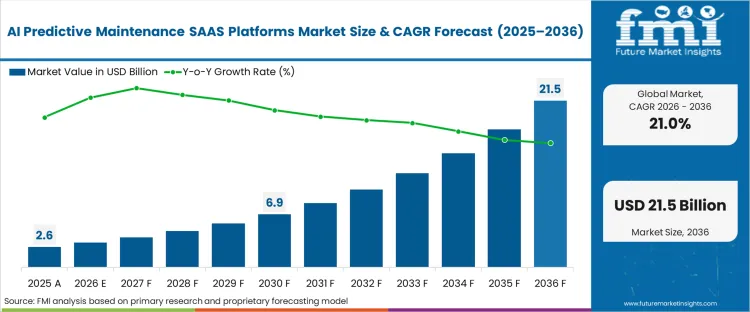
The standardization of edge-to-cloud data ingestion serves as the primary inflection condition. Once enterprise AI predictive maintenance platforms deploy APIs that normalize telemetry from disparate legacy machines, deployment drops from months to days, creating self-reinforcing adoption. The integration of predictive maintenance architectures ensures this scaled data pipeline becomes standard across heavy industries, shifting the focus from data collection to prescriptive action.
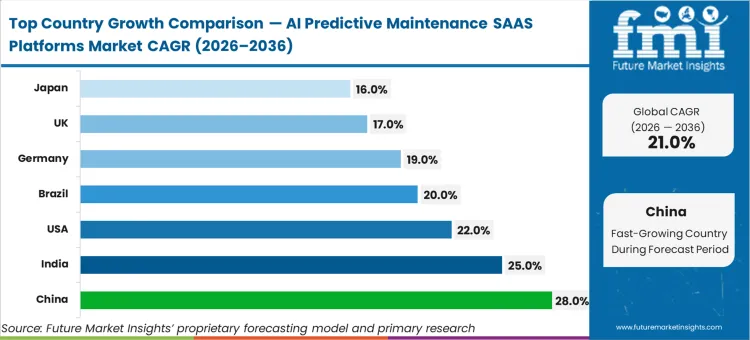
China expands at 28.0%, India at 25.0%, the United States at 22.0%, Brazil at 20.0%, Germany at 19.0%, the United Kingdom at 17.0%, and Japan at 16.0%. China AI predictive maintenance market growth accelerates aggressively as state-subsidized factory upgrades force the abandonment of legacy schedules. The India AI predictive maintenance adoption rate tracks closely as greenfield industrial parks mandate embedded telemetry. The divergence reflects a core reality: regions building new infrastructure embed AI natively, while mature hubs face the friction of retrofitting decades-old installed bases.
AI Predictive Maintenance SAAS Platforms Market Definition
The functional boundary of this market encompasses software platforms that ingest continuous machine telemetry to identify anomalous patterns and forecast equipment failure before it occurs. When assessing AI predictive maintenance vs traditional maintenance, the defining boundary is the use of self-learning algorithms for probabilistic failure prediction rather than static, interval-based computerized maintenance management systems (CMMS).
AI Predictive Maintenance SAAS Platforms Market Inclusions
Scope encompasses cloud-hosted analytics engines, machine learning anomaly detection modules, and digital twin virtualization layers used for maintenance forecasting. The ecosystem also includes proactive maintenance agents that trigger automated work orders based on predictive health scoring, as well as the API bridges required to ingest data from distributed sensory networks.
AI Predictive Maintenance SAAS Platforms Market Exclusions
Explicitly excluded are hardware-only condition monitoring tools, raw IoT gateway devices, and traditional reactive ticketing software. These are excluded when evaluating predictive maintenance SAAS vs CMMS because they merely transmit or log states without generating probabilistic failure models, placing them functionally outside the predictive SAAS architecture.
AI Predictive Maintenance SAAS Platforms Market Research Methodology
- Primary Research: Reliability engineers, plant operations directors, and industrial IT architects.
- Desk Research: OEM API documentation, industrial communication protocol standards, and cloud vendor uptime SLAs.
- Market-Sizing and Forecasting: Baselines anchor to active industrial IoT sensor node subscriptions across tier-1 manufacturing hubs.
- Data Validation and Update Cycle: Forecasts are triangulated against cloud compute consumption metrics specific to industrial edge workloads to verify AI predictive maintenance adoption statistics 2025.
Segmental Analysis
AI Predictive Maintenance SAAS Platforms Market Analysis by End-Use Industry
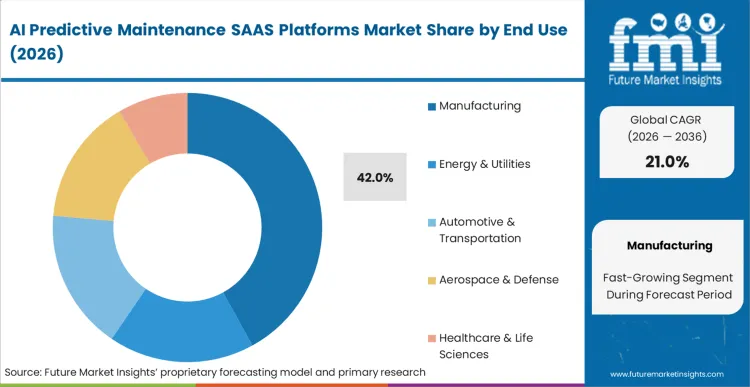
The reason Manufacturing holds 42.0% of this market comes down to the unforgiving nature of continuous production lines. Procurement teams searching for the best AI predictive maintenance software 2026 realize that unlike isolated mobile fleets, a single blocked valve or failed motor in a chemical or automotive plant halts the entire downstream workflow. According to FMI's estimates, this interdependence makes the cost of unplanned downtime geometrically higher than in standalone asset sectors, cementing AI predictive maintenance for manufacturing as the primary vertical. Operations directors are abandoning interval-based checks because physical inspections cannot scale to the frequency required by modern throughput demands. The integration of edge AI for smart manufacturing ensures instantaneous response times without cloud latency. Facilities that delay this transition face catastrophic mechanical shearing that destroys capital equipment. The deployment of industrial AI agents addresses this by autonomously mapping vibrations to specific bearing faults.
- Initial Validation: What triggers the initial purchase is an AI predictive maintenance SAAS case study manufacturing operations teams review that proves a direct reduction in catastrophic failure rates.
- Residual Vulnerability: What residual risk remains even with this choice is the cultural resistance of floor technicians who may initially ignore algorithmic prescriptions.
- Expansion Criteria: What the buyer must do operationally to capture the full benefit is explicitly link predictive health scoring to the daily CMMS work-order dispatch logic.
AI Predictive Maintenance SAAS Platforms Market Analysis by Deployment Model
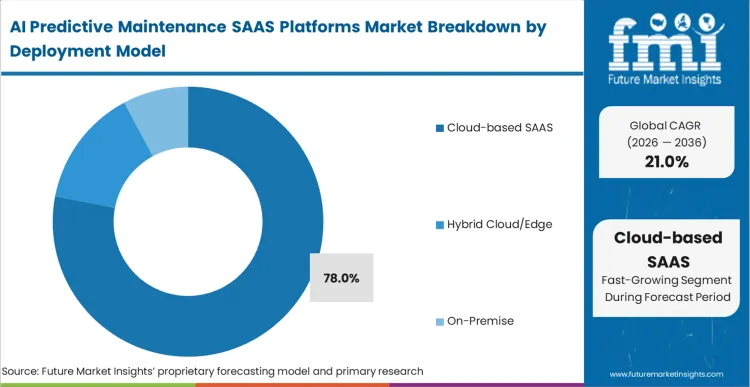
On-premise diagnostic servers failed to deliver value because they isolated machine learning models to the telemetry of a single facility, preventing the algorithm from learning from fleet-wide failure patterns. Cloud SAAS predictive maintenance AI captures 78.0% share by pooling anonymized vibration and thermal data across thousands of global deployments, drastically shortening the time required to recognize a novel fault signature. FMI analysts opine that industrial IT architects prioritize this collective intelligence over the perceived security of localized networks when evaluating cloud vs edge AI predictive maintenance platforms. Platforms functioning as machine condition monitoring backbones require this cloud elasticity to process millions of data points per second. Modern factory floor edge AI industrial pcs filter this data before transmission. Facilities that insist on air-gapped deployments suffer from stagnant algorithms that fail to identify emerging mechanical degradation.
- Origin of Savings: Where cost savings originate in the procurement cycle is the elimination of localized server hardware and the associated IT maintenance headcount.
- Hidden Operational Costs: What hidden costs emerge in the operational phase are the cloud data ingress fees if edge filtering is not properly configured.
- Lifecycle Reality: What the total lifecycle cost comparison reveals is that cloud agility outperforms the high maintenance burden of localized deployment despite ongoing subscription fees.
AI Predictive Maintenance SAAS Platforms Market Analysis by Organization Size
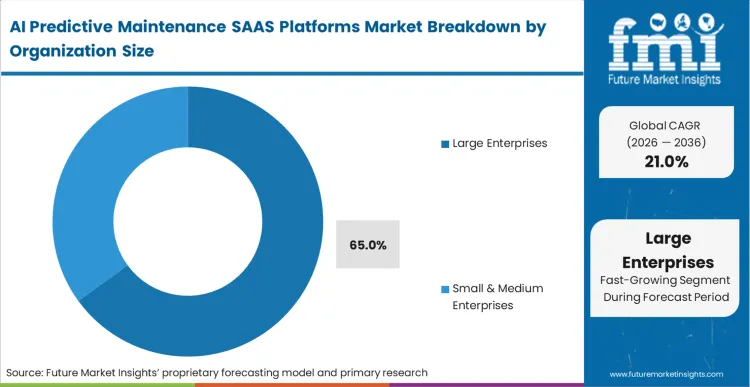
As per FMI's projection, AI predictive maintenance SAAS scalability is a structural requirement for these buyers, allowing them to negotiate direct API access with machinery builders, a leverage point unavailable to smaller operators. Integrating asset performance management suites across borders requires predictive maintenance SAAS integration with ERP. Chief Operations Officers at multinational firms are being forced to decide how to standardize maintenance across dozens of facilities that each run different generations of OEM equipment. Enterprise AI predictive maintenance platforms dominate with 65.0% share because large organizations possess the capital to overlay hardware-agnostic sensor networks that bypass OEM data silos entirely. The rise of utility energy as a service models further complicates these enterprise deployments. Smaller operators evaluating an AI predictive maintenance SAAS for SMEs face expanding margin gaps as their larger competitors virtually eliminate unplanned capacity losses.
- Early Adopters: Who adopts first and why are tier-1 automotive and aerospace manufacturers who cannot absorb the financial penalties of supply chain interruptions.
- Secondary Wave: Who follows and what changes for them are mid-market chemical processors who adopt the technology once deployment templates become standardized.
- Final Conversion: Who reaches this sub-segment last and what makes them finally convert are regional food and beverage packagers, pushed by margin compression to finally abandon reactive repair strategies.
AI Predictive Maintenance SAAS Platforms Market Drivers, Restraints, and Opportunities
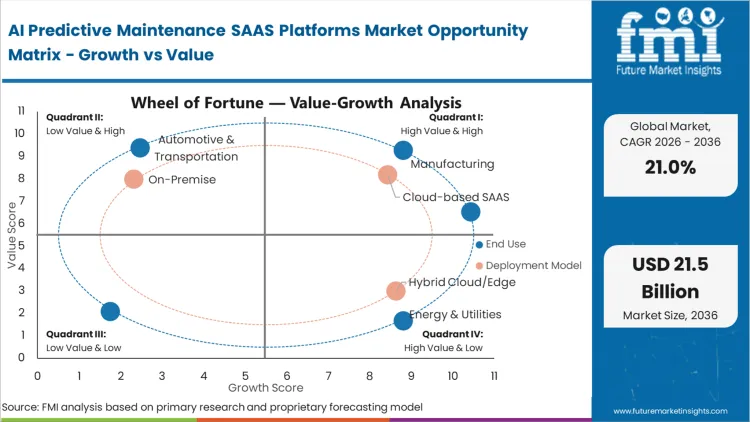
The pressure comes from the mathematical impossibility of humans monitoring thousands of high-frequency data streams simultaneously. Operations directors are forced to consolidate fragmented OEM telemetry dashboards into a single predictive layer. Generative AI in predictive maintenance platforms is shifting the decision dynamic by allowing technicians to query machine health using natural language rather than parsing complex vibration charts. The stakes for delay are immediate which are the facilities relying on human data synthesis suffer from cascading machine failures that wipe out quarterly margin gains. This shift compels organizations to embed algorithmic oversight directly into their core production logic, transitioning maintenance from a reactive expense line to a predictable operational variable defining AI predictive maintenance trends 2026.
Older machinery lacks native digital output, and OEM builders actively restrict API access to protect their own lucrative aftermarket service contracts. This is not a temporary integration issue; it represents one of the major challenges implementing AI predictive maintenance SAAS, requiring operators to physically retrofit assets with aftermarket vibration and acoustic sensors. The primary structural friction involves AI predictive maintenance data requirements and the siloing inherent in legacy industrial environments. While IOT enabled equipment maintenance solutions offer a bridge, they add significant capital expenditure upfront, delaying the deployment velocity of pure SAAS overlay models.
Opportunities in the AI Predictive Maintenance SAAS Platforms Market
- Financial Justification: Vendors providing an embedded AI predictive maintenance ROI calculator accelerate the sales cycle. Procurement directors leverage these natively generated financial models to secure board-level capital expenditure approvals rapidly.
- Dynamic Modeling: The availability of continuous health telemetry allows heavy equipment OEMs to transition from time-based to usage-based warranties. Actuarial teams leverage automotive AI agents to rewrite service contracts dynamically based on verified wear.
- Energy Correlation: Connecting mechanical degradation to excessive power draw enables the fusion of maintenance and sustainability budgets. Facility managers using predictive analytics secure funding by proving that tuned machines directly lower utility expenditure, representing the best AI predictive maintenance for energy sector applications.
Regional Analysis
The global landscape for AI predictive maintenance SAAS is fragmenting along distinct geographic lines, defined by the stark contrast between economies retrofitting legacy infrastructure and those weaving algorithms directly into greenfield industrial builds. This section dissects how distinct labor constraints, economic mandates, and baseline digital readiness dictate divergent adoption trajectories across the Americas, Asia Pacific, and Europe, with the industry being segmented into the Americas, Asia Pacific, and Europe across 40 plus countries.
.webp "Top Country Growth Comparison Ai Predictive Maintenance Saas Platforms Market Cagr (2026 2036)")
| Country | CAGR (2026 to 2036) |
|---|---|
| China | 28.0% |
| India | 25.0% |
| United States | 22.0% |
| Brazil | 20.0% |
| Germany | 19.0% |
| United Kingdom | 17.0% |
| Japan | 16.0% |
Source: Future Market Insights (FMI) analysis, based on proprietary forecasting model and primary research
Americas AI Predictive Maintenance SAAS Platforms Market Analysis
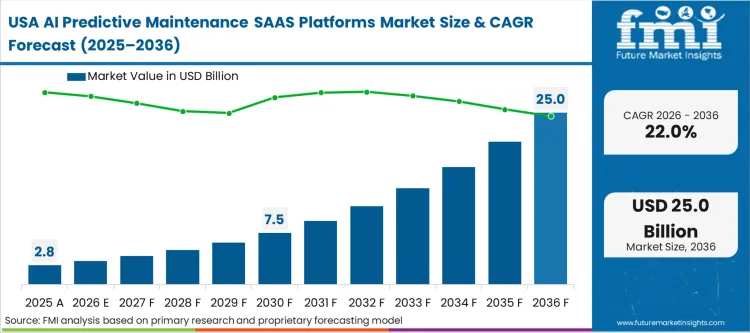
Rather than waiting for regulatory pressure, industrial hubs across North and South America are letting the pure economics of uptime dictate their transition away from calendar-based maintenance schedules. As enterprise SAAS licensing costs fall below the soaring wages of scarce reliability engineers, buyers exploring AI predictive maintenance platforms USA deployments are accelerating software adoption. The cross-industry innovation is further taking root; for instance, diagnostic workflows are becoming increasingly streamlined as heavy industry begins to adapt architectures originally designed for automotive genAI copilot systems.
- United States: Advancing at a commanding CAGR of 22.0% through 2036, the United States market is fundamentally shaped by a severe deficit of specialized industrial mechanics. Anticipating the retirement of their most experienced personnel, facility directors are aggressively overlaying AI systems to act as translation engines, converting dense vibration analytics into highly readable, plain-English work orders for a junior workforce. This dynamic in the end is hurtling toward a tipping point where securing industrial insurance policies will strictly require active predictive telemetry as a baseline operational standard.
- Brazil: To circumvent the punitive import tariffs levied on heavy replacement machinery, operators exploring the Brazil AI predictive maintenance energy sector are treating asset lifecycle extension as an absolute financial necessity. Resulting with the demand for these platforms to expand at a 20.0% CAGR, as procurement teams rely heavily on AI in energy distribution networks to extract years of additional utility from aging mining and manufacturing equipment. By successfully operationalizing these predictive layers, directors are securing measurable reductions in emergency capital expenditures, subsequently freeing up vital funds for broader process automation initiatives.
FMI's report includes additional markets across the Americas not detailed above. The structural pattern across these extended territories demonstrates a heavy reliance on cellular IoT gateways to bridge the connectivity gaps in remote extraction facilities.
Asia Pacific AI Predictive Maintenance SAAS Platforms Market Analysis
State-backed manufacturing initiatives across the Asia Pacific region are treating digital connectivity as a fundamental utility, equal in importance to water or power supply. Because these operators are launching massive greenfield industrial parks, they can natively embed predictive telemetry from day one, entirely avoiding the cumbersome legacy retrofit hurdles that plague Western markets. By establishing this clean-slate architecture, the region is dramatically accelerating the training speed of machine learning models, especially as predictive quality assurance equipment functions in seamless synergy with these new maintenance nodes.
- China: At the heart of China AI predictive maintenance market growth is a massive, state-subsidized push toward fully autonomous production lines that inherently depend on machine-level self-diagnosis. To command thousands of robotic nodes without a proportional increase in human workforce, operations directors at mega-factories are leaning heavily on AI SAAS frameworks. China to achieve an aggressive 28.0% CAGR over the forecast period is propelled by these deployments that tend to favor brute-force compute power and massive data ingestion volumes over highly refined algorithmic elegance.
- India: Propelled by a powerful 25.0% annual growth rate, the Indian market benefits from a unique convergence of rapid industrial physical expansion and a thriving domestic software services sector. This synergy has spawned localized startup ecosystems that provide plant managers in booming automotive hubs with highly tailored, cost-effective telemetry monitoring, directly driving the India AI predictive maintenance adoption rate. By acting decisively to standardize these data pipelines early, forward-thinking operators are capturing preferred vendor status within global supply chains that increasingly penalize supplier unreliability.
- Japan: A deeply entrenched cultural preference for preventative maintenance introduces a distinct friction against the deployment of algorithmic "black boxes" in Japanese factories. Because reliability engineers demand complete explainability over simple prescriptive alerts, often opting for self diagnosing industrial machines, the Japan AI predictive maintenance market outlook charts a steady but more deliberate compound annual rate of 16.0%. This uncompromising demand for transparent logic forces SAAS vendors to radically improve their global user interfaces, inadvertently raising the qualitative standard for the entire international market.
FMI's report includes emerging Southeast Asian manufacturing hubs. These secondary markets are skipping localized server deployments entirely, adopting mobile-first cloud dashboards to manage newly established production lines.
Europe AI Predictive Maintenance SAAS Platforms Market Analysis
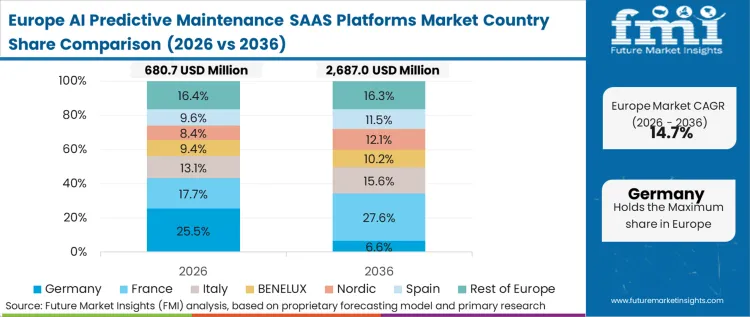
FMI analysts note that throughout European industrial sectors, mechanical degradation is no longer monitored merely to prevent unexpected downtime; it is aggressively tracked to curb the excessive power consumption that failing parts notoriously draw. This dual mandate is forging a tight link between predictive maintenance rollouts and strict regional sustainability and energy efficiency reporting obligations. The operators as a result are finding that the seamless integration of AI enabled robotic retrofits perfectly supports both their reliability targets and their rigorous environmental compliance goals.
- Germany: Strict mandates forcing automotive and chemical manufacturing directors to prove their operational efficiency are creating an environment where OEM machinery must maintain deeply integrated data pipelines with third-party analytics engines. Navigating the dense web of Germany AI predictive maintenance regulations requires a level of algorithmic integration that, if delayed, will immediately disqualify facilities from participating in tier-1 European automotive supply chains. The German market is projected to expand at a 19.0% CAGR, driven by this absolute requirement for continuous telemetry sharing.
- United Kingdom: Expanding at a steady 17.0% CAGR over the forecast period, the UK market is heavily influenced by intense decarbonization targets that force offshore energy and heavy utility operators to push equipment right to its functional limits. To safely navigate the razor-thin margin between maximum yield efficiency and catastrophic mechanical failure, asset managers reviewing the UK AI predictive maintenance market are leaning on predictive SAAS solutions and exploring net zero retrofit AI building management frameworks. This aggressive operational posture in the end equips UK energy firms with a significant margin advantage over conservative rivals who remain shackled to interval-based maintenance.
FMI's report includes broader European Union member states. Across these territories, data sovereignty regulations strictly govern where predictive telemetry can be processed, forcing SAAS vendors to establish localized cloud instances.
Competitive Aligners for Market Players
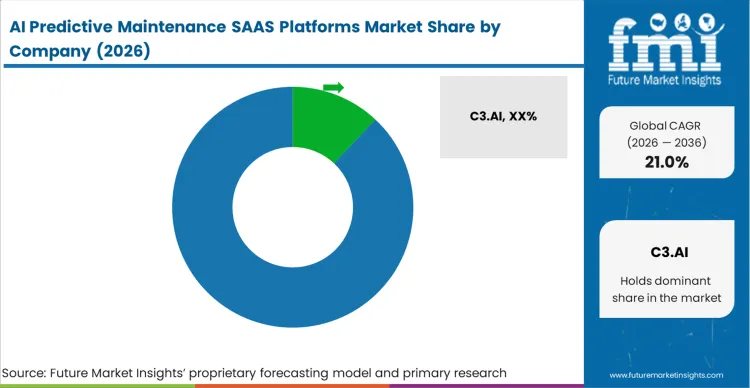
The competitive landscape is structurally bifurcated, heavily concentrated among enterprise platform giants while remaining highly fragmented at the sensor-ingestion edge. Buyers reviewing an AI predictive maintenance platform vendors comparison distinguish qualified vendors not by raw compute power, but by the depth of their pre-trained asset libraries. Industrial operators refuse to wait six months for an algorithm to learn what a failing pump sounds like; they select platform providers because their systems arrive with thousands of established failure signatures ready to deploy on day one.
Incumbents like C3.AI hold a profound advantage rooted in historical data volume. As large enterprises evaluate alternatives to C3.AI predictive maintenance and conduct C3.AI predictive maintenance vs Augury analyses, they recognize that companies with decades of proprietary mechanical telemetry create a moat that pure-play software challengers struggle to cross. A challenger entering this space must build extensive data-sharing partnerships to replicate this baseline intelligence. Systems utilizing solar farm predictive maintenance monitoring demonstrate how specialized algorithms require massive historical datasets to distinguish actual degradation from benign environmental variables.
Large industrial buyers actively resist vendor lock-in by demanding hardware-agnostic platforms that can ingest data from any OEM machine via standard APIs. They also enforce strict AI predictive maintenance SAAS cybersecurity protocols before granting network access. Through 2036, the highest margins will accrue to the platforms that successfully bridge disparate proprietary networks without requiring costly custom code, neutralizing the OEM data monopoly.
Key Players in AI Predictive Maintenance SAAS Platforms Market
- C3.AI
- Augury
- Uptake
- IBM (Maximo)
- Siemens (Senseye)
- PTC (ThingWorx)
- Rockwell Automation
Scope of the Report
| Metric | Value |
|---|---|
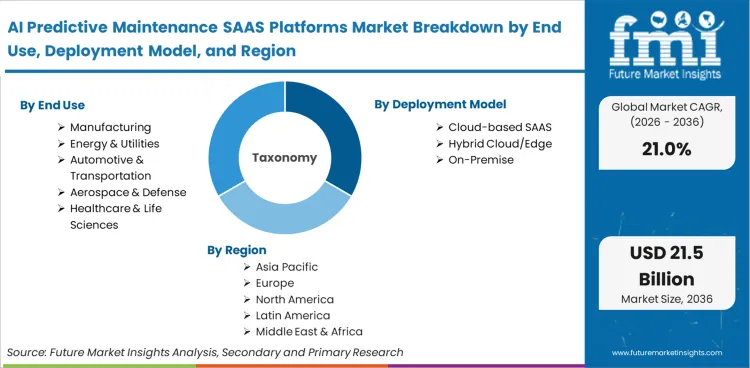
| Quantitative Units | USD 3.2 billion to USD 21.5 billion, at a CAGR of 21.0% |
| Market Definition | Functional boundary encompassing software platforms that ingest continuous machine telemetry to identify anomalous patterns and forecast equipment failure before it occurs. |
| End-Use Industry Segmentation | Manufacturing, Energy & Utilities, Automotive & Transportation, Aerospace & Defense, Healthcare & Life Sciences |
| Deployment Model Segmentation | Cloud-based SAAS, Hybrid Cloud/Edge, On-Premise |
| Organization Size Segmentation | Large Enterprises, Small & Medium Enterprises |
| Regions Covered | Americas, Asia Pacific, Europe |
| Countries Covered | China, India, United States, Brazil, Germany, United Kingdom, Japan, and 40 plus countries |
| Key Companies Profiled | C3.AI, Augury, Uptake, IBM (Maximo), Siemens (Senseye), PTC (ThingWorx), Rockwell Automation |
| Forecast Period | 2026 to 2036 |
| Approach | Primary research targeted reliability engineers and plant operations directors. Market baselines anchor to active industrial IoT sensor node subscriptions across manufacturing hubs. Forecasts are triangulated against cloud compute consumption metrics specific to industrial edge workloads. |
Source: Future Market Insights (FMI) analysis, based on proprietary forecasting model and primary research
AI Predictive Maintenance SAAS Segments
End-Use Industry:
- Manufacturing
- Energy & Utilities
- Automotive & Transportation
- Aerospace & Defense
- Healthcare & Life Sciences
Deployment Model:
- Cloud-based SAAS
- Hybrid Cloud/Edge
- On-Premise
Organization Size:
- Large Enterprises
- Small & Medium Enterprises
Regions:
- North America
- United States
- Canada
- Latin America
- Brazil
- Mexico
- Europe
- Germany
- United Kingdom
- France
- Italy
- Spain
- Asia-Pacific
- China
- Japan
- South Korea
- India
- Rest of Asia-Pacific
Bibliography
- C3.AI, Inc. (2025, May). Form 10-K for the fiscal year ended April 30, 2025. USA Securities and Exchange Commission.
- Siemens AG. (2024, October). The True Cost of Downtime 2024. Siemens Digital Industries.
- Stanford Institute for Human-Centered Artificial Intelligence. (2025, February). Artificial Intelligence Index Report 2025. Stanford University.
- Karountzos, V., et al. (2025, September). The Impact of Artificial Intelligence Adoption on Productivity Across FinTech, Manufacturing and Public Services. The Productivity Institute.
- PTC Inc. (2025, May). SPARK MatrixTM : Industrial Internet of Things (IIoT) Platform, Q2 2025. PTC.
This bibliography is provided for reader reference. The full FMI report contains the complete reference list with primary source documentation.
Frequently Asked Questions
How AI predictive maintenance reduces downtime?
By shifting from calendar-based scheduling to condition-based reality, the AI identifies micro-vibrations indicative of bearing wear weeks before physical failure, allowing technicians to schedule parts replacement during planned shift changes rather than suffering emergency outages.
What is the predictive maintenance SAAS market forecast 2036 and AI predictive maintenance CAGR forecast?
The predictive maintenance SAAS market forecast 2036 projects a valuation of USD 21.5 billion, driven by an AI predictive maintenance CAGR forecast of 21.0% that captures the compounding effect of cloud elasticity lowering the barrier to entry for mid-sized operators.
Who are the top AI predictive maintenance companies?
The top 10 AI predictive maintenance SAAS 2026 leaders include C3.AI, Augury, Uptake, IBM, Siemens, PTC, and Rockwell Automation, who are distinguished by the massive historical failure signature datasets they have accumulated rather than mere compute power.
How to choose AI predictive maintenance SAAS for manufacturing?
To learn how to choose AI predictive maintenance SAAS, operations directors must prioritize vendors whose algorithms arrive with established failure signatures for their specific OEM equipment, thereby bypassing the costly six-month model calibration phase that plagues generic software.
What ROI of AI predictive maintenance SAAS can I expect?
The ROI of AI predictive maintenance SAAS is captured almost entirely through the avoidance of catastrophic failures, as a single predictive alert that prevents a critical-path motor from shearing often covers the annual platform subscription fee within the first two production cycles.
What are the main predictive maintenance SAAS integration challenges?
The primary predictive maintenance SAAS integration challenges involve data siloing and legacy machinery formats, which require significant upfront capital in aftermarket sensor networks before the SAAS analytics layer can function effectively.
How does cloud SAAS predictive maintenance AI differ from edge solutions?
While cloud SAAS predictive maintenance AI pools massive datasets globally to train algorithms on rare anomalies, edge platforms process high-frequency vibration data locally at the machine, allowing true enterprise solutions to utilize edge computing for noise filtering and the cloud for model refinement.
What are the AI predictive maintenance data requirements?
AI predictive maintenance data requirements mandate continuous, high-frequency telemetry, primarily vibration, acoustic, and thermal data, alongside clean historical failure logs to accurately map specific sensor anomalies to actual mechanical degradation events.
Which industries benefit most from AI predictive maintenance SAAS?
Highly interdependent sectors like chemical processing, automotive manufacturing, and offshore energy benefit most because a single localized component failure causes massive downstream yield losses, making the cost of unplanned downtime exponentially higher.
How do generative AI predictive maintenance platforms improve operations?
Generative AI predictive maintenance platforms translate complex diagnostic charts into natural language, allowing junior technicians on the floor to query the system conversationally and instantly generate step-by-step diagnostic workflows based on predictive alerts.
How does predictive maintenance SAAS vs CMMS compare?
When comparing predictive maintenance SAAS vs CMMS, traditional computerized maintenance management systems only log historical actions or schedule calendar-based checks, whereas AI predictive maintenance SAAS provides probabilistic foresight by generating predictive health scores that traditional systems cannot calculate.
How large is the AI predictive maintenance SAAS market in 2026?
The predictive maintenance SAAS market size is valued at USD 3.2 billion in 2026, reflecting the initial wave of legacy equipment retrofits scaling across tier-1 manufacturing hubs and signaling that early adoption phases are complete.
Which Deployment Model segment leads?
Cloud-based SAAS dominates by allowing algorithms to learn from anonymized failure patterns across global fleets, whereas localized servers simply lack the data volume required to efficiently train models on rare mechanical faults.
Which Organization Size segment leads?
Large Enterprises command the market because they possess the operational leverage to demand direct API access from legacy machinery OEMs, allowing them to bypass the severe data siloing that restricts smaller firms.
What drives rapid growth?
Growth is forced by the mathematical impossibility of humans monitoring thousands of high-frequency sensor streams, compelling plant directors to deploy algorithmic oversight to prevent catastrophic blind spots in aging infrastructure.
What is the primary restraint?
The primary friction is the deliberate data siloing maintained by legacy equipment builders, requiring significant upfront capital in aftermarket sensor networks before the SAAS analytics layer can ingest functional data.
Which country grows fastest?
China expands at 28.0%, significantly outpacing the United States at 22.0%, because China's greenfield smart factories natively embed telemetry and entirely bypass the slow, costly retrofit phase required in mature Western facilities.
How is the software validated during procurement?
IT security teams act as the primary gatekeepers by requiring vendors to demonstrate end-to-end encryption for all outbound data, without which plant managers cannot authorize the transmission of proprietary production telemetry into public cloud environments.
How does predictive maintenance enable usage-based warranties?
Continuous health telemetry allows machinery builders to monitor exactly how hard an asset is being run, providing verified data streams that actuaries use to transition from flat time-based service contracts to dynamic usage-based pricing models.
Why is algorithm transparency crucial in Japan?
Japanese reliability engineers operate under strict preventative maintenance cultures and reject "black box" prescriptive alerts, demanding platforms that explain exactly which telemetry inputs triggered a failure warning before authorizing a costly line shutdown.
Why are hardware-agnostic platforms essential for large enterprises?
Multinational firms operating dozens of facilities with wildly different generations of OEM equipment require a single, agnostic SAAS layer to normalize this chaotic data landscape into a unified corporate dashboard.
How do import tariffs shape the market in Brazil?
High tariffs on replacement machinery make extending the life of existing capital equipment financially imperative, driving Brazilian operators to deploy predictive layers specifically to stretch operational lifespans rather than optimize pure throughput.
Preview the report firsthand - request a free sample
Get SampleGet the brochure for pricing and purchase details.
Get PDFTable of Content
- Executive Summary
- Global Market Outlook
- Demand-side Trends
- Supply-side Trends
- Technology Roadmap Analysis
- Analysis and Recommendations
- Market Overview
- Market Coverage / Taxonomy
- Market Definition / Scope / Limitations
- Research Methodology
- Chapter Orientation
- Analytical Lens and Working Hypotheses
- Market Structure, Signals, and Trend Drivers
- Benchmarking and Cross-market Comparability
- Market Sizing, Forecasting, and Opportunity Mapping
- Research Design and Evidence Framework
- Desk Research Programme (Secondary Evidence)
- Company Annual and Sustainability Reports
- Peer-reviewed Journals and Academic Literature
- Corporate Websites, Product Literature, and Technical Notes
- Earnings Decks and Investor Briefings
- Statutory Filings and Regulatory Disclosures
- Technical White Papers and Standards Notes
- Government Statistics Portals and Public Data Releases
- Press Releases and Reputable Media Coverage
- Specialist Newsletters and Curated Briefings
- Sector Databases and Reference Repositories
- FMI Internal Proprietary Databases and Historical Market Datasets
- Subscription Datasets and Paid Sources
- Social Channels, Communities, and Digital Listening Inputs
- Additional Desk Sources
- Expert Input and Fieldwork (Primary Evidence)
- Primary Modes
- Qualitative Interviews and Expert Elicitation
- Quantitative Surveys and Structured Data Capture
- Blended Approach
- Why Primary Evidence is Used
- Field Techniques
- Interviews
- Surveys
- Focus Groups
- Observational and In-context Research
- Social and Community Interactions
- Stakeholder Universe Engaged
- C-suite Leaders
- Board Members
- Presidents and Vice Presidents
- R&D and Innovation Heads
- Technical Specialists
- Domain Subject-matter Experts
- Scientists
- Physicians and Other Healthcare Professionals
- Governance, Ethics, and Data Stewardship
- Research Ethics
- Data Integrity and Handling
- Primary Modes
- Tooling, Models, and Reference Databases
- Desk Research Programme (Secondary Evidence)
- Data Engineering and Model Build
- Data Acquisition and Ingestion
- Cleaning, Normalisation, and Verification
- Synthesis, Triangulation, and Analysis
- Quality Assurance and Audit Trail
- Market Background
- Market Dynamics
- Drivers
- Restraints
- Opportunity
- Trends
- Scenario Forecast
- Demand in Optimistic Scenario
- Demand in Likely Scenario
- Demand in Conservative Scenario
- Opportunity Map Analysis
- Product Life Cycle Analysis
- Supply Chain Analysis
- Investment Feasibility Matrix
- Value Chain Analysis
- PESTLE and Porter’s Analysis
- Regulatory Landscape
- Regional Parent Market Outlook
- Production and Consumption Statistics
- Import and Export Statistics
- Market Dynamics
- Global Market Analysis 2021 to 2025 and Forecast, 2026 to 2036
- Historical Market Size Value (USD Million) Analysis, 2021 to 2025
- Current and Future Market Size Value (USD Million) Projections, 2026 to 2036
- Y-o-Y Growth Trend Analysis
- Absolute $ Opportunity Analysis
- Global Market Pricing Analysis 2021 to 2025 and Forecast 2026 to 2036
- Global Market Analysis 2021 to 2025 and Forecast 2026 to 2036, By End Use
- Introduction / Key Findings
- Historical Market Size Value (USD Million) Analysis By End Use , 2021 to 2025
- Current and Future Market Size Value (USD Million) Analysis and Forecast By End Use , 2026 to 2036
- Manufacturing
- Energy & Utilities
- Automotive & Transportation
- Aerospace & Defense
- Healthcare & Life Sciences
- Manufacturing
- Y-o-Y Growth Trend Analysis By End Use , 2021 to 2025
- Absolute $ Opportunity Analysis By End Use , 2026 to 2036
- Global Market Analysis 2021 to 2025 and Forecast 2026 to 2036, By Deployment Model
- Introduction / Key Findings
- Historical Market Size Value (USD Million) Analysis By Deployment Model, 2021 to 2025
- Current and Future Market Size Value (USD Million) Analysis and Forecast By Deployment Model, 2026 to 2036
- Cloud-based SAAS
- Hybrid Cloud/Edge
- On-Premise
- Cloud-based SAAS
- Y-o-Y Growth Trend Analysis By Deployment Model, 2021 to 2025
- Absolute $ Opportunity Analysis By Deployment Model, 2026 to 2036
- Global Market Analysis 2021 to 2025 and Forecast 2026 to 2036, By Organization Size
- Introduction / Key Findings
- Historical Market Size Value (USD Million) Analysis By Organization Size, 2021 to 2025
- Current and Future Market Size Value (USD Million) Analysis and Forecast By Organization Size, 2026 to 2036
- Large Enterprises
- Small & Medium Enterprises
- Large Enterprises
- Y-o-Y Growth Trend Analysis By Organization Size, 2021 to 2025
- Absolute $ Opportunity Analysis By Organization Size, 2026 to 2036
- Global Market Analysis 2021 to 2025 and Forecast 2026 to 2036, By Region
- Introduction
- Historical Market Size Value (USD Million) Analysis By Region, 2021 to 2025
- Current Market Size Value (USD Million) Analysis and Forecast By Region, 2026 to 2036
- North America
- Latin America
- Western Europe
- Eastern Europe
- East Asia
- South Asia and Pacific
- Middle East & Africa
- Market Attractiveness Analysis By Region
- North America Market Analysis 2021 to 2025 and Forecast 2026 to 2036, By Country
- Historical Market Size Value (USD Million) Trend Analysis By Market Taxonomy, 2021 to 2025
- Market Size Value (USD Million) Forecast By Market Taxonomy, 2026 to 2036
- By Country
- USA
- Canada
- Mexico
- By End Use
- By Deployment Model
- By Organization Size
- By Country
- Market Attractiveness Analysis
- By Country
- By End Use
- By Deployment Model
- By Organization Size
- Key Takeaways
- Latin America Market Analysis 2021 to 2025 and Forecast 2026 to 2036, By Country
- Historical Market Size Value (USD Million) Trend Analysis By Market Taxonomy, 2021 to 2025
- Market Size Value (USD Million) Forecast By Market Taxonomy, 2026 to 2036
- By Country
- Brazil
- Chile
- Rest of Latin America
- By End Use
- By Deployment Model
- By Organization Size
- By Country
- Market Attractiveness Analysis
- By Country
- By End Use
- By Deployment Model
- By Organization Size
- Key Takeaways
- Western Europe Market Analysis 2021 to 2025 and Forecast 2026 to 2036, By Country
- Historical Market Size Value (USD Million) Trend Analysis By Market Taxonomy, 2021 to 2025
- Market Size Value (USD Million) Forecast By Market Taxonomy, 2026 to 2036
- By Country
- Germany
- UK
- Italy
- Spain
- France
- Nordic
- BENELUX
- Rest of Western Europe
- By End Use
- By Deployment Model
- By Organization Size
- By Country
- Market Attractiveness Analysis
- By Country
- By End Use
- By Deployment Model
- By Organization Size
- Key Takeaways
- Eastern Europe Market Analysis 2021 to 2025 and Forecast 2026 to 2036, By Country
- Historical Market Size Value (USD Million) Trend Analysis By Market Taxonomy, 2021 to 2025
- Market Size Value (USD Million) Forecast By Market Taxonomy, 2026 to 2036
- By Country
- Russia
- Poland
- Hungary
- Balkan & Baltic
- Rest of Eastern Europe
- By End Use
- By Deployment Model
- By Organization Size
- By Country
- Market Attractiveness Analysis
- By Country
- By End Use
- By Deployment Model
- By Organization Size
- Key Takeaways
- East Asia Market Analysis 2021 to 2025 and Forecast 2026 to 2036, By Country
- Historical Market Size Value (USD Million) Trend Analysis By Market Taxonomy, 2021 to 2025
- Market Size Value (USD Million) Forecast By Market Taxonomy, 2026 to 2036
- By Country
- China
- Japan
- South Korea
- By End Use
- By Deployment Model
- By Organization Size
- By Country
- Market Attractiveness Analysis
- By Country
- By End Use
- By Deployment Model
- By Organization Size
- Key Takeaways
- South Asia and Pacific Market Analysis 2021 to 2025 and Forecast 2026 to 2036, By Country
- Historical Market Size Value (USD Million) Trend Analysis By Market Taxonomy, 2021 to 2025
- Market Size Value (USD Million) Forecast By Market Taxonomy, 2026 to 2036
- By Country
- India
- ASEAN
- Australia & New Zealand
- Rest of South Asia and Pacific
- By End Use
- By Deployment Model
- By Organization Size
- By Country
- Market Attractiveness Analysis
- By Country
- By End Use
- By Deployment Model
- By Organization Size
- Key Takeaways
- Middle East & Africa Market Analysis 2021 to 2025 and Forecast 2026 to 2036, By Country
- Historical Market Size Value (USD Million) Trend Analysis By Market Taxonomy, 2021 to 2025
- Market Size Value (USD Million) Forecast By Market Taxonomy, 2026 to 2036
- By Country
- Kingdom of Saudi Arabia
- Other GCC Countries
- Turkiye
- South Africa
- Other African Union
- Rest of Middle East & Africa
- By End Use
- By Deployment Model
- By Organization Size
- By Country
- Market Attractiveness Analysis
- By Country
- By End Use
- By Deployment Model
- By Organization Size
- Key Takeaways
- Key Countries Market Analysis
- USA
- Pricing Analysis
- Market Share Analysis, 2025
- By End Use
- By Deployment Model
- By Organization Size
- Canada
- Pricing Analysis
- Market Share Analysis, 2025
- By End Use
- By Deployment Model
- By Organization Size
- Mexico
- Pricing Analysis
- Market Share Analysis, 2025
- By End Use
- By Deployment Model
- By Organization Size
- Brazil
- Pricing Analysis
- Market Share Analysis, 2025
- By End Use
- By Deployment Model
- By Organization Size
- Chile
- Pricing Analysis
- Market Share Analysis, 2025
- By End Use
- By Deployment Model
- By Organization Size
- Germany
- Pricing Analysis
- Market Share Analysis, 2025
- By End Use
- By Deployment Model
- By Organization Size
- UK
- Pricing Analysis
- Market Share Analysis, 2025
- By End Use
- By Deployment Model
- By Organization Size
- Italy
- Pricing Analysis
- Market Share Analysis, 2025
- By End Use
- By Deployment Model
- By Organization Size
- Spain
- Pricing Analysis
- Market Share Analysis, 2025
- By End Use
- By Deployment Model
- By Organization Size
- France
- Pricing Analysis
- Market Share Analysis, 2025
- By End Use
- By Deployment Model
- By Organization Size
- India
- Pricing Analysis
- Market Share Analysis, 2025
- By End Use
- By Deployment Model
- By Organization Size
- ASEAN
- Pricing Analysis
- Market Share Analysis, 2025
- By End Use
- By Deployment Model
- By Organization Size
- Australia & New Zealand
- Pricing Analysis
- Market Share Analysis, 2025
- By End Use
- By Deployment Model
- By Organization Size
- China
- Pricing Analysis
- Market Share Analysis, 2025
- By End Use
- By Deployment Model
- By Organization Size
- Japan
- Pricing Analysis
- Market Share Analysis, 2025
- By End Use
- By Deployment Model
- By Organization Size
- South Korea
- Pricing Analysis
- Market Share Analysis, 2025
- By End Use
- By Deployment Model
- By Organization Size
- Russia
- Pricing Analysis
- Market Share Analysis, 2025
- By End Use
- By Deployment Model
- By Organization Size
- Poland
- Pricing Analysis
- Market Share Analysis, 2025
- By End Use
- By Deployment Model
- By Organization Size
- Hungary
- Pricing Analysis
- Market Share Analysis, 2025
- By End Use
- By Deployment Model
- By Organization Size
- Kingdom of Saudi Arabia
- Pricing Analysis
- Market Share Analysis, 2025
- By End Use
- By Deployment Model
- By Organization Size
- Turkiye
- Pricing Analysis
- Market Share Analysis, 2025
- By End Use
- By Deployment Model
- By Organization Size
- South Africa
- Pricing Analysis
- Market Share Analysis, 2025
- By End Use
- By Deployment Model
- By Organization Size
- USA
- Market Structure Analysis
- Competition Dashboard
- Competition Benchmarking
- Market Share Analysis of Top Players
- By Regional
- By End Use
- By Deployment Model
- By Organization Size
- Competition Analysis
- Competition Deep Dive
- C3.AI
- Overview
- Product Portfolio
- Profitability by Market Segments (Product/Age /Sales Channel/Region)
- Sales Footprint
- Strategy Overview
- Marketing Strategy
- Product Strategy
- Channel Strategy
- Augury
- Uptake
- IBM (Maximo)
- Siemens (Senseye)
- PTC (ThingWorx)
- Rockwell Automation
- C3.AI
- Competition Deep Dive
- Assumptions & Acronyms Used


