

- Market Size (2026)
- USD 4.3 Bn
- Forecast (2036)
- SD 31.19 Bn
- CAGR (2026 to 2036)
- 22.0%
AI Security Platforms Market Size, Market Forecast and Outlook By FMI
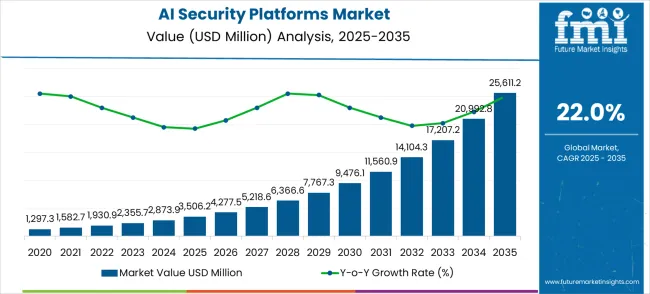
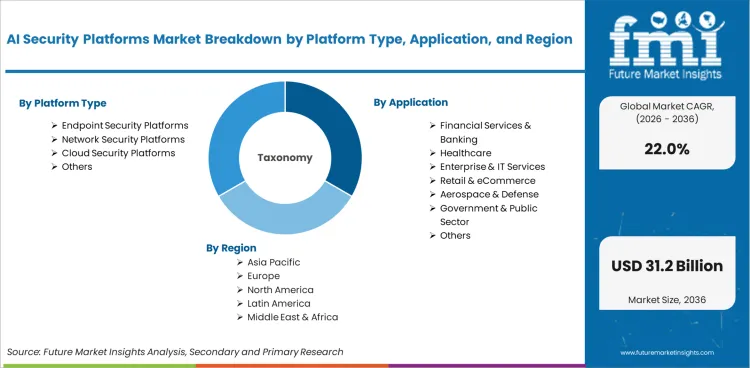
The AI security platforms market was valued at USD 3.5 billion in 2025. The market is set to reach USD 4.3 billion by 2026-end and grow at a CAGR of 22.0% between 2026–2036 to reach USD 31.2 billion by 2036. Endpoint Security Platforms will dominate with a 48.0% share, while Financial Services & Banking will lead with a 42.0%% share.
Summary of the AI Security Platforms Market Size, Market Forecast and Outlook By FMI
- Demand and Growth Drivers
- Cyberattack sophistication is outpacing signature-based security defenses, creating demand for AI-powered platforms that detect novel threats through behavioral analysis and anomaly detection rather than known attack pattern matching.
- Security operations center analyst shortage is driving investment in AI platforms that automate threat triage, investigation, and response, enabling security teams to manage increasing alert volumes without proportional staffing increases.
- Cloud migration is expanding the enterprise attack surface, creating demand for AI security platforms that provide consistent threat detection and response across on-premises, cloud, and hybrid infrastructure environments.
- Product and Segment View
- Endpoint Security Platforms holds 48% of the platform type segment in 2026, supported by enterprise demand for AI-powered endpoint detection and response that identifies sophisticated threats traditional signature-based security cannot detect.
- Financial Services and Banking accounts for 42% of the application segment, reflecting the concentration of AI security investment in financial institutions facing the most frequent and costly cyberattacks.
- Cloud security platforms represent the fastest-growing sub-segment, driven by enterprise cloud migration creating demand for AI-powered workload protection, identity management, and configuration monitoring across multi-cloud environments.
- Geography and Competitive Outlook
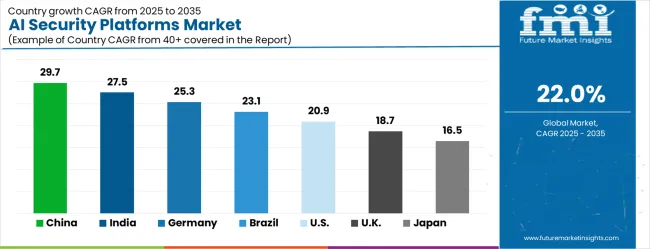
- China leads country-level growth at 28.1% CAGR, supported by large-scale enterprise digitization, growing cybersecurity threat landscape, and government investment in critical infrastructure protection.
- Brazil follows at 23.1% CAGR, driven by rapid digital transformation, expanding financial services cyber exposure, and growing government cybersecurity program investment.
- Competition spans established cybersecurity platform vendors upgrading to AI-native threat detection, cloud security companies building AI-powered protection for cloud workloads, and AI-focused security startups addressing specific threat vectors.
- Analyst Opinion
- AI security platforms are becoming the default architecture for enterprise cybersecurity as the volume and sophistication of threats exceed human analyst capacity. The economic case is compelling: AI-powered security operations reduce mean time to detect and respond to threats by orders of magnitude compared to manual investigation workflows. The market is consolidating around platform vendors that combine endpoint, network, and cloud security within unified AI-powered architectures. Companies that deliver accurate threat detection with low false-positive rates while automating investigation and response workflows will capture the largest share of enterprise security spending during the forecast period.
- Extended detection and response (XDR) architectures are emerging as the platform standard, correlating threat signals across endpoints, networks, cloud, and identity sources through unified AI analytics.
- AI-powered security platforms are themselves becoming targets of adversarial AI attacks, requiring continuous model hardening and adversarial robustness capabilities.
- Managed detection and response (MDR) services built on AI platforms are expanding the addressable market to organizations that lack in-house security operations capabilities.
Key Takeaways, Market Size, and Forecast
- The AI Security Platforms Market was valued at USD 3.50 billion in 2025.
- By 2036, the AI Security Platforms Market is expected to be worth USD 31.19 billion.
- From 2026 to 2036, the market is projected to expand at a CAGR of 22.0%.
- The market is projected to create an incremental opportunity of USD 26.92 billion between 2026 and 2036.
- In 2026, endpoint security platforms is expected to account for 48% of the platform type segment, driven by enterprise demand for AI-powered endpoint protection that detects and responds to advanced persistent threats, zero-day exploits, and fileless malware in real time.
- China (28.1%) and Brazil (23.1%) are two of the fastest growing markets in the world.
AI Security Platforms Market Definition
The AI security platforms market includes cybersecurity platforms that apply artificial intelligence to threat detection, incident response, and security operations, covering endpoint protection, network security, cloud security, and identity management across enterprise and government applications.
AI Security Platforms Market Inclusions
Market scope covers AI security platforms segmented by platform type (endpoint security platforms, network security platforms, cloud security platforms, others) and application (financial services and banking, healthcare, enterprise and IT services, retail and eCommerce, aerospace and defense, government and public sector, others). The revenue range extends from 2026 to 2036.
AI Security Platforms Market Exclusions
The scope does not include traditional signature-based antivirus software without AI capabilities, basic firewall appliances without AI analytics, physical security systems, and manual security audit services.
AI Security Platforms Market Research Methodology
- Primary Research: FMI analysts conducted interviews with technology vendors, industry practitioners, and domain specialists across key markets.
- Desk Research: Integrated data from industry publications, regulatory databases, and technology vendor disclosures.
- Market Sizing and Forecasting: Bottom-up aggregation across segments and regional adoption curves with cross-validation against industry spending data.
- Data Validation: Cross-checked quarterly against vendor revenue disclosures, industry surveys, and regulatory filings.
Why is the AI Security Platforms Market Growing?
- Cyber threat sophistication is accelerating beyond the detection capability of signature-based security tools, requiring AI-powered behavioral analysis that identifies novel attack techniques through anomaly detection and attack chain correlation.
- Security analyst workforce shortage is creating a structural capacity gap in security operations, with AI platforms automating the threat triage, investigation, and response tasks that currently consume the majority of analyst time.
- Multi-cloud and hybrid infrastructure deployment is expanding enterprise attack surfaces, creating demand for AI security platforms that provide consistent threat visibility and response across diverse computing environments.
The AI security platforms market reflects the fundamental asymmetry between cyber threat evolution and traditional security defense capabilities. Attackers continuously develop novel techniques including living-off-the-land attacks, supply chain compromises, and AI-generated social engineering that signature-based security tools cannot detect. AI-powered platforms address this asymmetry through behavioral analysis that identifies malicious activity patterns rather than matching known signatures.
Endpoint security platforms at 48.0% of the platform type segment represent the largest individual category, as endpoints remain the primary entry point for cyberattacks. AI-powered endpoint detection and response platforms analyze process behavior, file activity, and network connections to identify threat indicators that traditional endpoint protection misses.
Financial services and banking at 42.0% of the application segment reflects the concentration of cybersecurity investment in the industry facing the most frequent, most costly, and most regulated cyber threat exposure. Financial institutions deploy comprehensive AI security platforms to protect customer assets, maintain regulatory compliance, and preserve institutional trust.
Market Segmentation Analysis
- Endpoint Security Platforms holds 48% of the platform type segment, supported by enterprise demand for AI-powered endpoint detection and response that identifies sophisticated threats traditional signature-based security cannot detect.
- Financial Services and Banking at 42% leads the application segment, reflecting the concentration of AI security investment in financial institutions facing the most frequent and costly cyberattacks.
- Additional segments contribute to market diversification across applications.
The ai security platforms market is segmented by platform type (endpoint security platforms, network security platforms, cloud security platforms, others) and application (financial services and banking, healthcare, enterprise and IT services, retail and eCommerce, aerospace and defense, government and public sector, others).
Insights into the Endpoint Security Platforms Type
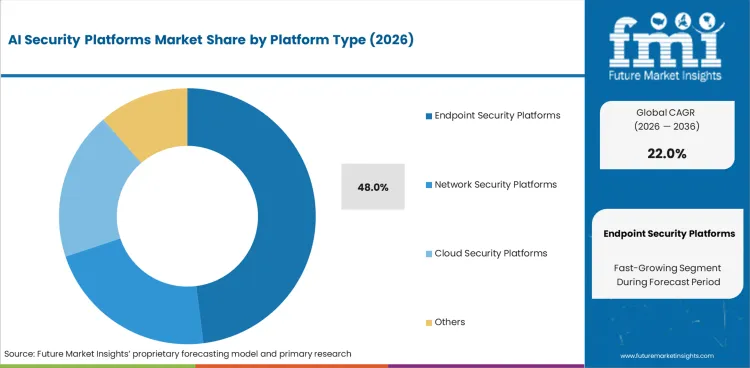
Endpoint security platforms hold 48.0% of the platform type segment in 2026. AI-powered endpoint detection and response (EDR) platforms analyze behavioral patterns across processes, files, registry activity, and network connections to identify sophisticated threats including fileless malware, living-off-the-land attacks, and advanced persistent threats.
Extended detection and response (XDR) is evolving endpoint security toward unified platforms that correlate endpoint telemetry with network, cloud, and identity data sources, providing security teams with comprehensive attack chain visibility through AI-powered analytics.
Insights into the Financial Services and Banking Application
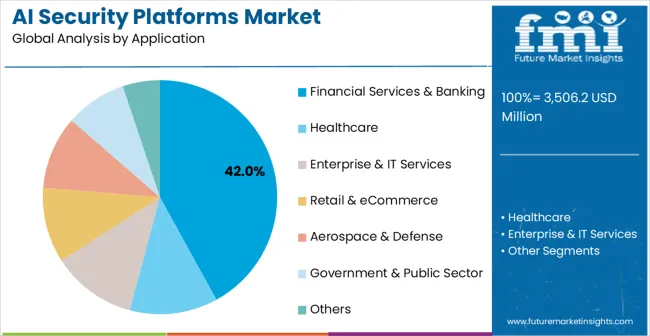
Financial services and banking accounts for 42.0% of the application segment in 2026. Financial institutions face the most concentrated cyber threat targeting due to the direct monetary value of successful attacks, driving investment in comprehensive AI security platforms that address the full threat spectrum from endpoint to cloud.
Regulatory compliance requirements including DORA (EU), SOX, PCI-DSS, and banking regulatory cybersecurity guidelines create compliance-driven demand for AI security platforms with auditable detection, response, and reporting capabilities.
AI Security Platforms Market Drivers, Restraints, and Opportunities
- Escalating cyber threat sophistication and security analyst workforce shortage are the primary structural drivers, creating demand for AI platforms that detect threats faster and automate response workflows beyond human analyst capacity.
- False-positive alert volumes and AI model accuracy concerns constrain operational value, requiring continuous platform refinement to balance threat detection sensitivity with investigation efficiency.
- Cloud-native security and managed detection and response services create growth opportunities as enterprises require AI-powered protection across expanding cloud infrastructure and as SMEs access enterprise-grade security through service models.
The AI security platforms market is shaped by the escalating arms race between cyber attackers and defenders, where AI capabilities are becoming essential on both sides of the equation.
Threat Sophistication as Structural Driver
Novel attack techniques including AI-generated phishing, supply chain compromise, and living-off-the-land tactics create threats that rule-based security tools cannot detect. AI behavioral analysis provides the adaptive detection capability required for these evolving threats.
Alert Volume and Accuracy Barriers
Security teams face thousands of daily alerts, with high false-positive rates consuming analyst time on non-threats. AI platforms that accurately prioritize genuine threats while suppressing false positives deliver the operational efficiency improvement that justifies investment.
Cloud Security and MDR Expansion Opportunities
Enterprise cloud migration creates demand for AI-native cloud security platforms. Managed detection and response services extend AI-powered security operations to organizations without in-house SOC capabilities, expanding the total addressable market.
Analysis of AI Security Platforms Market by Key Countries
.webp "Top Country Growth Comparison Ai Security Platforms Market Cagr (2026 2036)")
| Country | CAGR |
|---|---|
| China | 28.1% |
| Brazil | 23.1% |
| USA | 20.9% |
| UK | 18.7% |
| Germany | 16.0% |
| India | 15.4% |
| Japan | 16.5% |
- China leads at 28.1% CAGR through 2036, supported by large-scale enterprise digitization and growing critical infrastructure cybersecurity investment.
- Brazil at 23.1% CAGR driven by rapid financial services digital transformation and expanding government cybersecurity programs.
- USA (20.9%) and UK (18.7%) maintain growth through enterprise cybersecurity investment and regulatory compliance requirements.
The ai security platforms market is projected to expand at 22.0% CAGR globally from 2026 to 2036. The analysis covers more than 30 countries, with the leading markets detailed below.
Demand Outlook for AI Security Platforms Market in China
China is growing at 28.1% CAGR through 2036, leading country-level growth. Large-scale enterprise digitization, expanding cybersecurity threat landscape, and government critical infrastructure protection investment are driving AI security platform demand.
- Enterprise digitization scale creates massive cybersecurity threat surface requiring AI-powered protection.
- Government critical infrastructure protection programs fund AI security platform deployment across key sectors.
- Financial services cybersecurity investment is accelerating as digital banking and payment transaction volumes increase.
Future Outlook for AI Security Platforms Market in Brazil
Brazil is expanding at 23.1% CAGR through 2036, driven by rapid financial services digital transformation, growing cybersecurity threat exposure, and government cybersecurity program investment.
- Financial services digital transformation creates concentrated demand for AI-powered security across banking and payment platforms.
- Growing cybersecurity threat landscape drives enterprise investment in advanced AI-powered detection and response.
- Government cybersecurity programs fund public sector AI security platform deployment.
Opportunity Analysis of AI Security Platforms Market in the USA
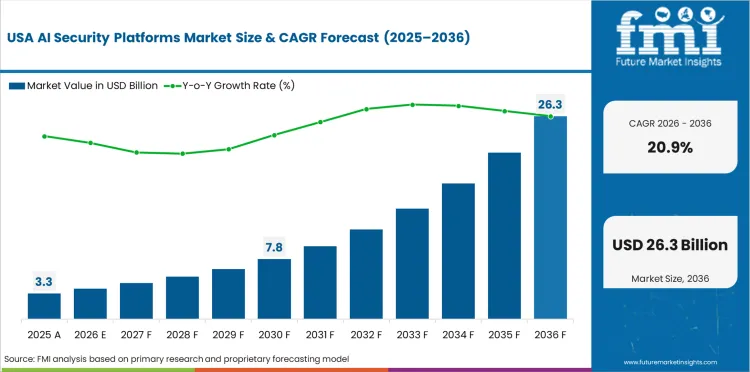
The USA is growing at 20.9% CAGR through 2036, maintaining the largest revenue concentration globally. Enterprise AI security platform investment spans critical infrastructure, financial services, healthcare, and technology sectors.
- Critical infrastructure protection drives AI security platform investment across energy, telecommunications, and financial sectors.
- Enterprise security operations center modernization replaces legacy tools with AI-powered detection and response platforms.
- Federal government cybersecurity mandates drive AI security platform procurement across civilian and defense agencies.
In-depth Analysis of AI Security Platforms Market in the UK
The UK is growing at 18.7% CAGR through 2036, reflecting financial services cybersecurity investment, government cyber strategy programs, and enterprise AI security adoption across regulated industries.
- Financial services cybersecurity leadership drives AI security platform investment across banking and insurance.
- National Cyber Security Centre programs support AI security capability development across public and private sectors.
- Regulatory compliance requirements drive AI security platform adoption in healthcare, utilities, and telecommunications.
Sales Analysis of AI Security Platforms Market in Germany
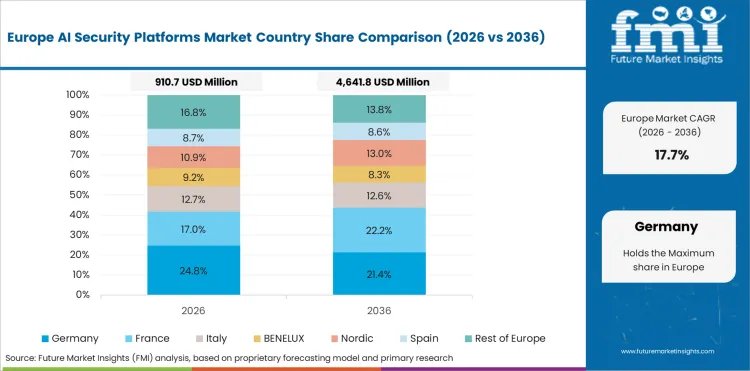
Germany is growing at 16.0% CAGR through 2036, driven by industrial cybersecurity requirements, EU regulatory frameworks, and enterprise investment in AI security for manufacturing and critical infrastructure protection.
- Industrial cybersecurity requirements drive AI security platform deployment across manufacturing and critical infrastructure.
- EU NIS2 directive and cybersecurity regulations create compliance-driven demand for AI security capabilities.
- Enterprise SOC modernization investment is replacing legacy security tools with AI-powered platforms.
Competitive Landscape and Strategic Positioning
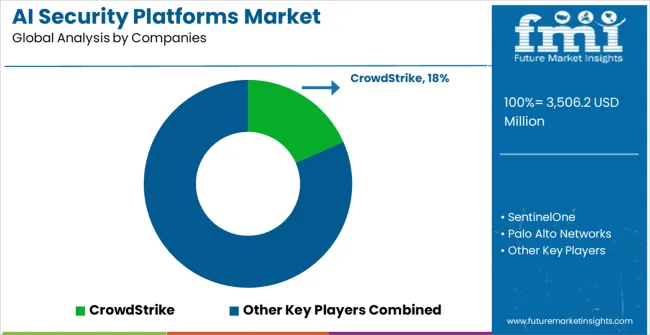
- CrowdStrike leads through its Falcon platform combining AI-powered endpoint detection, cloud security, and identity protection within a unified cloud-native architecture.
- Palo Alto Networks and Microsoft compete through comprehensive AI security platform portfolios spanning network, endpoint, cloud, and identity security with integrated AI analytics.
- Specialized AI security companies focus on specific threat domains including network detection, email security, and AI model protection.
CrowdStrike maintains market leadership through its cloud-native Falcon platform, which combines AI-powered endpoint detection and response, cloud workload protection, and identity threat detection within a unified data architecture. SentinelOne competes through its Singularity platform with autonomous AI-powered endpoint protection and XDR capabilities.
Palo Alto Networks offers a comprehensive AI security portfolio spanning network security (Strata), cloud security (Prisma), and security operations (Cortex XSIAM). Microsoft provides AI security through Defender, Sentinel, and Security Copilot integrated into its enterprise ecosystem.
Darktrace offers AI-powered network detection and response using unsupervised machine learning for autonomous threat identification. Fortinet and Check Point provide AI-enhanced network and cloud security platforms.
Key Companies in the AI Security Platforms Market
Key global companies leading the ai security platforms market include:
- CrowdStrike (USA), Palo Alto Networks (USA), Microsoft (USA), and SentinelOne (USA) maintain dominant positions through comprehensive AI-powered security platforms with endpoint, cloud, and identity protection capabilities.
- Darktrace (UK), Fortinet (USA), and Check Point Software Technologies (Israel) compete through AI-enhanced network security and threat detection platforms with established enterprise customer bases.
- Zscaler (USA), Cybereason (USA), Vectra AI (USA), and SparkCognition (USA) represent specialized players addressing cloud security, endpoint protection, network detection, and industrial AI security applications.
Competitive Benchmarking: AI Security Platforms Market
| Company | Platform Scope | AI Capability | Enterprise Access | Geographic Reach |
|---|---|---|---|---|
| CrowdStrike | Comprehensive | Advanced | Strong | Global |
| SentinelOne | EDR/XDR | Advanced | Strong | Global |
| Palo Alto Networks | Comprehensive | Advanced | Strong | Global |
| Microsoft | Comprehensive | Advanced | Strong | Global |
| Darktrace | NDR | Advanced | Moderate | Global |
| Fortinet | Network | Advanced | Strong | Global |
| Check Point | Network | Moderate | Strong | Global |
| Zscaler | Cloud | Advanced | Moderate | Global |
| Vectra AI | NDR | Advanced | Niche | Global |
| SparkCognition | Industrial | Advanced | Niche | N. America |
Source: Future Market Insights competitive analysis, 2026.
Key Players in the AI Security Platforms Market
Major Global Players
- CrowdStrike
- SentinelOne
- Palo Alto Networks
- Darktrace
- Microsoft Security Copilot
- Fortinet
- Check Point Software Technologies
Emerging Players/Startups
- Zscaler
- Cybereason
- Vectra AI
- Tessian
- SparkCognition
- Theom
- Valarian
- Cloudflare
- HiddenLayer
- Protect AI
Report Scope and Coverage
| Parameter | Details |
|---|---|
| Quantitative Units | USD 4.27 billion to USD 31.19 billion, at a CAGR of 22.0% |
| Market Definition | The AI security platforms market includes cybersecurity platforms that apply artificial intelligence to threat detection, incident response, and security operations, covering endpoint protection, network security, cloud security, and identity management across enterprise and government applications. |
| Regions Covered | North America, Latin America, Europe, East Asia, South Asia and Pacific, Middle East and Africa |
| Countries Covered | China, Brazil, USA, UK, Germany, India, Japan, 30 plus countries |
| Key Companies Profiled | CrowdStrike, SentinelOne, Palo Alto Networks, Darktrace, Microsoft Security Copilot, Zscaler, Cybereason, Vectra AI |
| Forecast Period | 2026 to 2036 |
| Approach | Hybrid bottom-up and top-down methodology starting with verified industry data, projecting adoption velocity across segments and regions. |
Market Segmentation Analysis
AI Security Platforms Market Segmented by Platform Type:
- Endpoint Security Platforms
- Network Security Platforms
- Cloud Security Platforms
- Others
AI Security Platforms Market Segmented by Application:
- Financial Services & Banking
- Healthcare
- Enterprise & IT Services
- Retail & eCommerce
- Aerospace & Defense
- Government & Public Sector
- Others
AI Security Platforms Market by Region:
- North America
- USA
- Canada
- Mexico
- Latin America
- Brazil
- Chile
- Rest of Latin America
- Western Europe
- Germany
- UK
- Italy
- Spain
- France
- Nordic
- BENELUX
- Rest of Western Europe
- Eastern Europe
- Russia
- Poland
- Hungary
- Balkan & Baltic
- Rest of Eastern Europe
- East Asia
- China
- Japan
- South Korea
- South Asia and Pacific
- India
- ASEAN
- Australia & New Zealand
- Rest of South Asia and Pacific
- Middle East & Africa
- Kingdom of Saudi Arabia
- Other GCC Countries
- Turkiye
- South Africa
- Other African Union
- Rest of Middle East & Africa
Research Sources and Bibliography
- National Institute of Standards and Technology. (2025). AI-Powered Cybersecurity: Framework for Enterprise Implementation. NIST.
- European Union Agency for Cybersecurity. (2025). AI in Cybersecurity: Threat Landscape and Defense Assessment. ENISA.
- Cybersecurity and Infrastructure Security Agency. (2024). AI for Critical Infrastructure Protection: Technology Assessment. CISA.
- World Economic Forum. (2025). Global Cybersecurity Outlook: AI-Powered Defense Assessment. WEF.
- Bank for International Settlements. (2024). AI in Financial Sector Cybersecurity: Regulatory Considerations. BIS.
This bibliography is provided for reader reference.
This Report Answers
- Estimating the size of the ai security platforms market and revenue projections from 2026 to 2036.
- Segmentation by platform type (endpoint security platforms, network security platforms, cloud security platforms.
- Insights about more than 30 markets in the region.
- Analysis of key technology, application, and deployment segments.
- Assessment of the competitive landscape.
- Finding investment opportunities across key segments and regions.
- Tracking regulatory frameworks and industry standards.
Frequently Asked Questions
What is the global market demand for ai security platforms in 2026?
In 2026, the global ai security platforms market is expected to be worth USD 4.27 billion.
How big will the ai security platforms market be in 2036?
By 2036, the market is expected to be worth USD 31.19 billion.
How much is demand expected to grow between 2026 and 2036?
Between 2026 and 2036, the market is expected to grow at a CAGR of 22.0%.
Which platform type segment is likely to lead globally in 2026?
Endpoint Security Platforms is expected to hold 48% of the platform type segment in 2026, supported by enterprise demand for AI-powered endpoint detection and response that identifies sophisticated threats traditional signature-based security cannot detect.
What is causing demand to rise in China?
China is growing at 28.1% CAGR through 2036, supported by large-scale enterprise digitization, growing cybersecurity threat landscape, and government investment in critical infrastructure protection.
What is causing demand to rise in Brazil?
Brazil is expanding at 23.1% CAGR through 2036, driven by rapid digital transformation, expanding financial services cyber exposure, and growing government cybersecurity program investment.
What does this report mean by ai security platforms market definition?
The AI security platforms market includes cybersecurity platforms that apply artificial intelligence to threat detection, incident response, and security operations, covering endpoint protection, network security, cloud security, and identity management across enterprise and government applications.
How does FMI make this forecast and validate it?
Forecasting uses a hybrid bottom-up and top-down approach, starting with verified industry data and cross-checking against vendor disclosures and industry spending surveys.
Preview the report firsthand - request a free sample
Get SampleGet the brochure for pricing and purchase details.
Get PDFTable of Content
- Executive Summary
- Global Market Outlook
- Demand-side Trends
- Supply-side Trends
- Technology Roadmap Analysis
- Analysis and Recommendations
- Market Overview
- Market Coverage / Taxonomy
- Market Definition / Scope / Limitations
- Research Methodology
- Chapter Orientation
- Analytical Lens and Working Hypotheses
- Market Structure, Signals, and Trend Drivers
- Benchmarking and Cross-market Comparability
- Market Sizing, Forecasting, and Opportunity Mapping
- Research Design and Evidence Framework
- Desk Research Programme (Secondary Evidence)
- Company Annual and Sustainability Reports
- Peer-reviewed Journals and Academic Literature
- Corporate Websites, Product Literature, and Technical Notes
- Earnings Decks and Investor Briefings
- Statutory Filings and Regulatory Disclosures
- Technical White Papers and Standards Notes
- Primary Modes
- Qualitative Interviews and Expert Elicitation
- Quantitative Surveys and Structured Data Capture
- Blended Approach
- Why Primary Evidence is Used
- Field Techniques
- Interviews
- Surveys
- Focus Groups
- Observational and In-context Research
- Social and Community Interactions
- Stakeholder Universe Engaged
- C-suite Leaders
- Board Members
- Presidents and Vice Presidents
- R&D and Innovation Heads
- Technical Specialists
- Domain Subject-matter Experts
- Scientists
- Physicians and Other Healthcare Professionals
- Governance, Ethics, and Data Stewardship
- Research Ethics
- Data Integrity and Handling
- Tooling, Models, and Reference Databases
- Desk Research Programme (Secondary Evidence)
- Data Engineering and Model Build
- Data Acquisition and Ingestion
- Cleaning, Normalisation, and Verification
- Synthesis, Triangulation, and Analysis
- Quality Assurance and Audit Trail
- Market Background
- Market Dynamics
- Drivers
- Restraints
- Opportunity
- Trends
- Scenario Forecast
- Demand in Optimistic Scenario
- Demand in Likely Scenario
- Demand in Conservative Scenario
- Opportunity Map Analysis
- Product Life Cycle Analysis
- Supply Chain Analysis
- Investment Feasibility Matrix
- Value Chain Analysis
- PESTLE and Porter’s Analysis
- Regulatory Landscape
- Regional Parent Market Outlook
- Production and Consumption Statistics
- Import and Export Statistics
- Market Dynamics
- Global Market Analysis 2021 to 2025 and Forecast, 2026 to 2036
- Historical Market Size Value (USD Million) Analysis, 2021 to 2025
- Current and Future Market Size Value (USD Million) Projections, 2026 to 2036
- Y-o-Y Growth Trend Analysis
- Absolute $ Opportunity Analysis
- Global Market Pricing Analysis 2021 to 2025 and Forecast 2026 to 2036
- Global Market Analysis 2021 to 2025 and Forecast 2026 to 2036, By Platform Type
- Introduction / Key Findings
- Historical Market Size Value (USD Million) Analysis By Platform Type , 2021 to 2025
- Current and Future Market Size Value (USD Million) Analysis and Forecast By Platform Type , 2026 to 2036
- Endpoint Security Platforms
- Network Security Platforms
- Cloud Security Platforms
- Others
- Endpoint Security Platforms
- Y-o-Y Growth Trend Analysis By Platform Type , 2021 to 2025
- Absolute $ Opportunity Analysis By Platform Type , 2026 to 2036
- Global Market Analysis 2021 to 2025 and Forecast 2026 to 2036, By Application
- Introduction / Key Findings
- Historical Market Size Value (USD Million) Analysis By Application, 2021 to 2025
- Current and Future Market Size Value (USD Million) Analysis and Forecast By Application, 2026 to 2036
- Financial Services & Banking
- Healthcare
- Enterprise & IT Services
- Retail & eCommerce
- Aerospace & Defense
- Government & Public Sector
- Others
- Financial Services & Banking
- Y-o-Y Growth Trend Analysis By Application, 2021 to 2025
- Absolute $ Opportunity Analysis By Application, 2026 to 2036
- Global Market Analysis 2021 to 2025 and Forecast 2026 to 2036, By Region
- Introduction
- Historical Market Size Value (USD Million) Analysis By Region, 2021 to 2025
- Current Market Size Value (USD Million) Analysis and Forecast By Region, 2026 to 2036
- North America
- Latin America
- Western Europe
- Eastern Europe
- East Asia
- South Asia and Pacific
- Middle East & Africa
- Market Attractiveness Analysis By Region
- North America Market Analysis 2021 to 2025 and Forecast 2026 to 2036, By Country
- Historical Market Size Value (USD Million) Trend Analysis By Market Taxonomy, 2021 to 2025
- Market Size Value (USD Million) Forecast By Market Taxonomy, 2026 to 2036
- By Country
- USA
- Canada
- Mexico
- By Platform Type
- By Application
- By Country
- Market Attractiveness Analysis
- By Country
- By Platform Type
- By Application
- Key Takeaways
- Latin America Market Analysis 2021 to 2025 and Forecast 2026 to 2036, By Country
- Historical Market Size Value (USD Million) Trend Analysis By Market Taxonomy, 2021 to 2025
- Market Size Value (USD Million) Forecast By Market Taxonomy, 2026 to 2036
- By Country
- Brazil
- Chile
- Rest of Latin America
- By Platform Type
- By Application
- By Country
- Market Attractiveness Analysis
- By Country
- By Platform Type
- By Application
- Key Takeaways
- Western Europe Market Analysis 2021 to 2025 and Forecast 2026 to 2036, By Country
- Historical Market Size Value (USD Million) Trend Analysis By Market Taxonomy, 2021 to 2025
- Market Size Value (USD Million) Forecast By Market Taxonomy, 2026 to 2036
- By Country
- Germany
- UK
- Italy
- Spain
- France
- Nordic
- BENELUX
- Rest of Western Europe
- By Platform Type
- By Application
- By Country
- Market Attractiveness Analysis
- By Country
- By Platform Type
- By Application
- Key Takeaways
- Eastern Europe Market Analysis 2021 to 2025 and Forecast 2026 to 2036, By Country
- Historical Market Size Value (USD Million) Trend Analysis By Market Taxonomy, 2021 to 2025
- Market Size Value (USD Million) Forecast By Market Taxonomy, 2026 to 2036
- By Country
- Russia
- Poland
- Hungary
- Balkan & Baltic
- Rest of Eastern Europe
- By Platform Type
- By Application
- By Country
- Market Attractiveness Analysis
- By Country
- By Platform Type
- By Application
- Key Takeaways
- East Asia Market Analysis 2021 to 2025 and Forecast 2026 to 2036, By Country
- Historical Market Size Value (USD Million) Trend Analysis By Market Taxonomy, 2021 to 2025
- Market Size Value (USD Million) Forecast By Market Taxonomy, 2026 to 2036
- By Country
- China
- Japan
- South Korea
- By Platform Type
- By Application
- By Country
- Market Attractiveness Analysis
- By Country
- By Platform Type
- By Application
- Key Takeaways
- South Asia and Pacific Market Analysis 2021 to 2025 and Forecast 2026 to 2036, By Country
- Historical Market Size Value (USD Million) Trend Analysis By Market Taxonomy, 2021 to 2025
- Market Size Value (USD Million) Forecast By Market Taxonomy, 2026 to 2036
- By Country
- India
- ASEAN
- Australia & New Zealand
- Rest of South Asia and Pacific
- By Platform Type
- By Application
- By Country
- Market Attractiveness Analysis
- By Country
- By Platform Type
- By Application
- Key Takeaways
- Middle East & Africa Market Analysis 2021 to 2025 and Forecast 2026 to 2036, By Country
- Historical Market Size Value (USD Million) Trend Analysis By Market Taxonomy, 2021 to 2025
- Market Size Value (USD Million) Forecast By Market Taxonomy, 2026 to 2036
- By Country
- Kingdom of Saudi Arabia
- Other GCC Countries
- Turkiye
- South Africa
- Other African Union
- Rest of Middle East & Africa
- By Platform Type
- By Application
- By Country
- Market Attractiveness Analysis
- By Country
- By Platform Type
- By Application
- Key Takeaways
- Key Countries Market Analysis
- USA
- Pricing Analysis
- Market Share Analysis, 2025
- By Platform Type
- By Application
- Canada
- Pricing Analysis
- Market Share Analysis, 2025
- By Platform Type
- By Application
- Mexico
- Pricing Analysis
- Market Share Analysis, 2025
- By Platform Type
- By Application
- Brazil
- Pricing Analysis
- Market Share Analysis, 2025
- By Platform Type
- By Application
- Chile
- Pricing Analysis
- Market Share Analysis, 2025
- By Platform Type
- By Application
- Germany
- Pricing Analysis
- Market Share Analysis, 2025
- By Platform Type
- By Application
- UK
- Pricing Analysis
- Market Share Analysis, 2025
- By Platform Type
- By Application
- Italy
- Pricing Analysis
- Market Share Analysis, 2025
- By Platform Type
- By Application
- Spain
- Pricing Analysis
- Market Share Analysis, 2025
- By Platform Type
- By Application
- France
- Pricing Analysis
- Market Share Analysis, 2025
- By Platform Type
- By Application
- India
- Pricing Analysis
- Market Share Analysis, 2025
- By Platform Type
- By Application
- ASEAN
- Pricing Analysis
- Market Share Analysis, 2025
- By Platform Type
- By Application
- Australia & New Zealand
- Pricing Analysis
- Market Share Analysis, 2025
- By Platform Type
- By Application
- China
- Pricing Analysis
- Market Share Analysis, 2025
- By Platform Type
- By Application
- Japan
- Pricing Analysis
- Market Share Analysis, 2025
- By Platform Type
- By Application
- South Korea
- Pricing Analysis
- Market Share Analysis, 2025
- By Platform Type
- By Application
- Russia
- Pricing Analysis
- Market Share Analysis, 2025
- By Platform Type
- By Application
- Poland
- Pricing Analysis
- Market Share Analysis, 2025
- By Platform Type
- By Application
- Hungary
- Pricing Analysis
- Market Share Analysis, 2025
- By Platform Type
- By Application
- Kingdom of Saudi Arabia
- Pricing Analysis
- Market Share Analysis, 2025
- By Platform Type
- By Application
- Turkiye
- Pricing Analysis
- Market Share Analysis, 2025
- By Platform Type
- By Application
- South Africa
- Pricing Analysis
- Market Share Analysis, 2025
- By Platform Type
- By Application
- USA
- Market Structure Analysis
- Competition Dashboard
- Competition Benchmarking
- Market Share Analysis of Top Players
- By Regional
- By Platform Type
- By Application
- Competition Analysis
- Competition Deep Dive
- CrowdStrike
- Overview
- Product Portfolio
- Profitability by Market Segments (Product/Age /Sales Channel/Region)
- Sales Footprint
- Strategy Overview
- Marketing Strategy
- Product Strategy
- Channel Strategy
- SentinelOne
- Palo Alto Networks
- Darktrace
- Microsoft Security Copilot
- Fortinet
- Check Point Software Technologies
- Zscaler
- Cybereason
- Vectra AI
- Tessian
- SparkCognition
- Theom
- Valarian
- Cloudflare
- HiddenLayer
- Protect AI
- CrowdStrike
- Competition Deep Dive
- Assumptions & Acronyms Used


