

- Market Size (2026)
- USD 1.38 Bn
- Forecast (2036)
- USD 3.86 Bn
- CAGR (2026 to 2036)
- 10.8%
OBD-Linked Predictive Maintenance Diagnostic Platforms Market Size, Forecast and Outlook by FMI
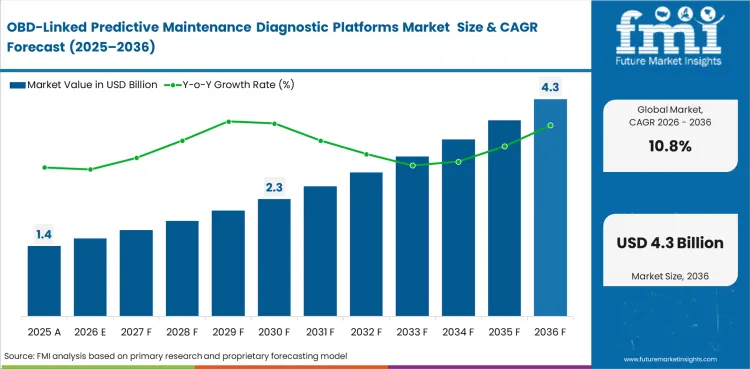
OBD-linked predictive maintenance diagnostic platforms market size was valued at USD 1.25 billion in 2025. Industry is projected to reach USD 1.38 billion in 2026, and rise to USD 3.86 billion by 2036 at a 10.8% CAGR during the forecast period. As per FMI analysis, around USD 2.48 billion in absolute dollar opportunity is likely to be generated between 2026 and 2036. Remote fault prediction and service workflow automation are changing platform buying through 2036.
Summary of OBD-Linked Predictive Maintenance Diagnostic Platforms Market
- The OBD-Linked Predictive Maintenance Diagnostic Platforms market is forecast to reach USD 3.86 billion by 2036.
- Industry is expected to grow at a CAGR of 10.8% from 2026 to 2036.
- Market valuation was estimated at USD 1.25 billion in 2025.
- Incremental opportunity across the forecast period totals USD 2.48 billion.
- Market estimates place Fleet platforms at 34% of platform type demand in 2026.
- A 38% share belongs to OBD-II dongles in the connectivity interface segment in 2026.
- Fault prediction is expected to account for 31% share in the analytics layer in 2026.
- Cloud SaaS is projected to contribute 63% of deployment demand in 2026.
Key Takeaways, Market Size, and Forecast
- The OBD-linked predictive maintenance diagnostic platforms market was valued at USD 1.25 billion in 2025.
- The market is set to reach USD 1.38 billion by 2026-end and grow at a CAGR of 10.8% between 2026-2036 to reach USD 3.86 billion by 2036.
- Cloud SaaS will dominate with a 63% share, while OBD-II dongles will lead with a 38% share.
- The OBD-linked predictive maintenance diagnostic platforms market was valued at USD 1.25 billion in 2025.
- By 2036, the OBD-Linked Predictive Maintenance Diagnostic Platforms Market is expected to be worth USD 3.86 billion.
- From 2026 to 2036, the market is projected to expand at a CAGR of 10.8%.
- The market is projected to create an incremental opportunity of USD 2.48 billion between 2026 and 2036.
- In 2026, Fleet platforms are expected to account for 34% of the platform type segment, driven by stronger ROI from uptime optimization and maintenance planning across managed fleets.
- OBD-II dongles are expected to account for 38% of the connectivity interface segment in 2026, supported by easy retrofit installation and wide compatibility across vehicle fleets.
- Fault prediction is projected to hold 31% of the analytics layer segment in 2026, reflecting rising demand for actionable insights over raw diagnostic codes.
- Cloud SaaS is expected to account for 63% of the deployment segment in 2026 due to scalability, remote updates, and seamless workflow integration.
- India (13.2%) and China (12.4%) are among the fastest-growing markets globally, driven by fleet expansion and increasing adoption of predictive maintenance solutions.
OBD-Linked Predictive Maintenance Diagnostic Platforms Market Key Takeaways
| Parameter | Details |
|---|---|
| Market Value (2026) | USD 1.38 billion |
| Forecast Value (2036) | USD 3.86 billion |
| CAGR (2026 to 2036) | 10.8% |
| Estimated Market Value (2025) | USD 1.25 billion |
| Incremental Opportunity | USD 2.48 billion |
| Leading Platform Type | Fleet platforms (34% of platform type segment) |
| Leading Connectivity Interface | OBD-II dongles (38% of connectivity interface segment) |
| Leading Analytics Layer | Fault prediction (31% of analytics layer segment) |
| Leading Vehicle Class | Light commercial vehicles (36% of vehicle class segment) |
| Key Players | Bosch, Geotab, Noregon, ACTIA, Repairify |
Source: Future Market Insights, 2026
Fleet maintenance teams are attaching more value to vehicle health monitoring software because fault data can move straight into service timing. Older van and truck fleets in Europe keep the payoff visible because fault rates rise as assets age. India is projected to record a CAGR of 13.2% CAGR during the forecast period, followed by China at 12.4% CAGR through 2036. Key players in the industry such as Bosch and Geotab hold an edge when remote vehicle diagnostics is tied closely to work orders and workshop action.
OBD-Linked Predictive Maintenance Diagnostic Platforms Market Definition
The OBD-linked predictive maintenance diagnostic platforms market covers software, workflow tools, and linked data capture used to predict vehicle faults and schedule service across fleet and workshop environments.
OBD-Linked Predictive Maintenance Diagnostic Platforms Market Inclusions
Market scope includes platform type, connectivity interface, analytics layer, vehicle class, and deployment model across the 2026 to 2036 forecast period. Coverage spans fleet platforms, workshop platforms, OEM portals, insurer platforms, OBD-linked interfaces, and predictive maintenance workflows.
OBD-Linked Predictive Maintenance Diagnostic Platforms Market Exclusions
Scope excludes broad fleet tracking revenue, insurance telematics without maintenance logic, stand-alone scan tools sold without predictive software, and full remote diagnostics markets outside this narrow platform layer.
OBD-Linked Predictive Maintenance Diagnostic Platforms Market Research Methodology
- Primary Research: FMI analysts interviewed fleet maintenance managers and workshop software specialists across North America, Europe, and Asia.
- Desk Research: Data from transport agencies, vehicle registries, and automotive associations set the baseline parameters.
- Market Sizing and Forecasting: Baseline values come from platform attach estimates across fleets and workshop networks, adjusted using connected vehicle reach and service software spend.
- Data Validation and Update Cycle: A quarterly data refresh compares projections to vendor disclosures and public vehicle parc statistics.
Why Is the OBD-Linked Predictive Maintenance Diagnostic Platforms Market Growing?
- Commercial fleet operators are spending more on platforms that turn diagnostic events into earlier workshop action.
- European van and truck fleets are aging, which raises the value of predictive service timing and fault ranking.
- Cloud-linked maintenance tools are widening adoption because updates and work order flows can move across many vehicles quickly.
Commercial operators want fewer roadside failures and tighter service timing across active fleets. SIAM reported 10.80 lakh commercial vehicle sales in India for FY 2025-26. Fresh fleet additions enlarge the part of the vehicle parc that can adopt commercial vehicle remote diagnostics subscriptions with maintenance logic. Software spending becomes easier to justify when breakdown risk hits route completion and workshop loading in the same week.
Europe adds a different support factor because active vehicles are older across large van and truck pools. ACEA reported 31.1 million vans and 6.2 million medium and heavy commercial vehicles on EU roads in 2024. European trucks were on average 14 years old in the same year. That setting lifts the value of automotive remote diagnostic platforms that can rank faults before they become unplanned workshop events. Monetization is usually stronger in commercial fleets because downtime costs are visible and easier to measure.
Platform demand is rising as maintenance software moves closer to execution and not just code reading. Geotab introduced Work Order Management and Fault Code Enrichment in February 2025. Samsara added Fault Code Intelligence and Automated Work Orders in June 2025. These releases show how fleet management software is absorbing more predictive maintenance work. Smaller operators adopt more slowly because recurring subscriptions compete with lower-cost tool buying.
Segmental Analysis
- Fleet platforms account for 34% of platform type demand in 2026 because managed fleets offer the clearest near-term software return.
- OBD-II dongles hold 38% of connectivity interface demand in 2026 since retrofit coverage is broad and installation is simple.
- Cloud SaaS is expected to represent 63% of deployment demand in 2026 as updates and service workflows move faster in remote environments.
Coverage runs across platform type, connectivity interface, analytics layer, vehicle class, and deployment model. Fleet platforms lead one segment while OBD-II dongles lead another. Fault prediction holds the top analytics position. Light commercial vehicles stand first in vehicle class. Cloud SaaS leads deployment because remote updates and workflow links are central to platform value. Vendor selection depends on service fit and data access more than hardware range alone.
Insights into the Fleet Platforms Segment
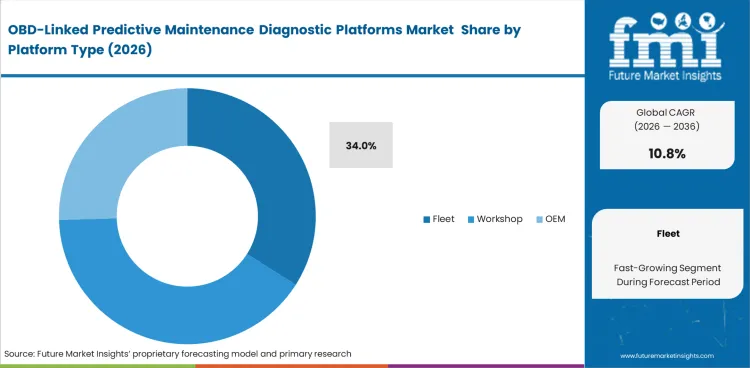
Fleet platforms are projected to lead the platform type segment with a 34% share in 2026. Their lead reflects the clearer payback that managed fleets get from uptime planning and repair timing. Workshop platforms are expanding at a healthy pace because service networks want prediction tools inside daily repair flow. Enterprise contracts move faster when diagnostic alerts link to dispatch and work order action.
Insights into the OBD-II Dongles Segment
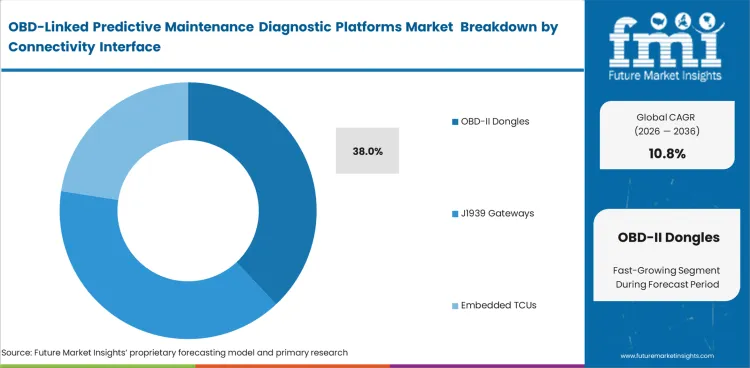
In 2026, OBD-II dongles are expected to account for 38% of the connectivity interface segment. This format leads because retrofit coverage is wide and installation can be done without deep vehicle redesign. Embedded TCUs are growing in newer vehicle programs as OEM data access improves across connected fleets. Retrofit hardware stays important because large active fleets need low-cost entry into predictive maintenance tools.
Insights into the Fault Prediction Segment
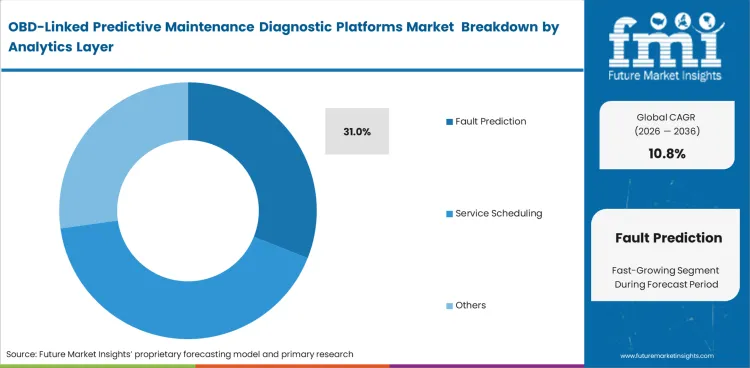
The analytics layer is expected to dominate with a share of 31% in 2026. Fleet maintenance teams place higher value on ranked failure risk than on raw trouble-code lists. Service scheduling keeps growing as platforms connect fault history with mileage and repair timing. Product depth matters here because workshop managers need action steps and not only alerts.
Insights into the Light Commercial Vehicles Segment
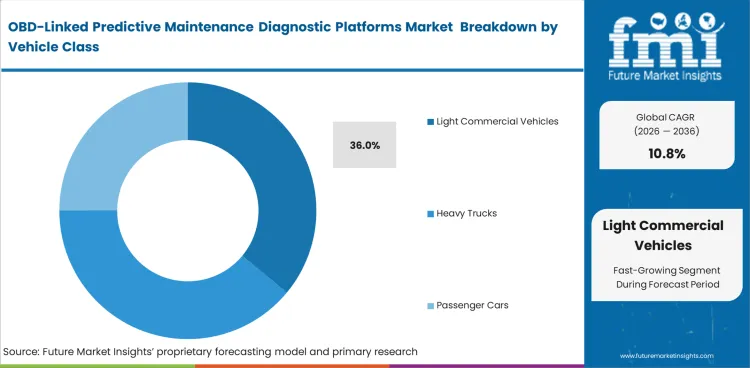
Market estimates place light commercial vehicles at 36% share in 2026 within vehicle class. Vans and service vehicles combine high daily use with retrofit economics that are easier to justify than in many passenger fleets.
Heavy trucks create strong revenue potential because downtime costs are higher across linehaul operations. Van fleets still hold the lead because addressable volume is broader across delivery and field service work.
Insights into the Cloud SaaS Segment
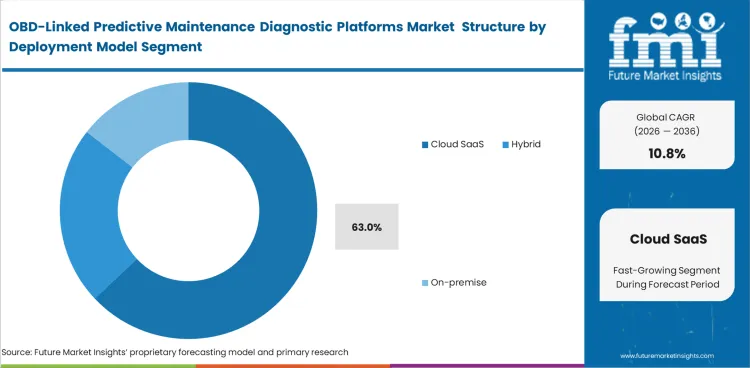
By 2026 Cloud SaaS is likely to contribute 63% of total deployment demand. This model leads because updates and workflow integration are easier to manage across many fleets and workshop sites. Hybrid deployments keep a place where local data control matters more in enterprise IT review. Cloud growth keeps the lead because recurring software value depends on quick feature updates and remote support.
Section 5
Market Drivers and Commercial Restraints
- Large vehicle parcs in the United States and China keep the addressable platform base wide for subscriptions and workshop links.
- Fragmented OEM permissions and mixed data formats slow rollout in fleets that use many vehicle brands.
- Workflow automation is lifting software value because fault data can move straight into inspections and repair planning.
Vehicle scale is a crucial demand driver because software monetization improves when a platform can spread alerts and service logic across a large active base. FHWA reported 297,525,836 motor vehicles registered in the United States in 2024. China sold 34.4 million vehicles in 2025. These anchors support recurring demand for connected vehicle technology and predictive maintenance software. Revenue capture is strongest where fleet operators can connect fault signals to service action at scale.
Data Access Gaps Slow Rollout
Mixed fleets often combine older OBD hardware with uneven OEM permissions and separate maintenance systems. That raises onboarding work for platform vendors and slows full deployment across enterprise fleets. Repairify's plan to combine with Opus IVS in January 2026 shows why scale matters in diagnostics support. Broader brand coverage helps workshops reduce tool sprawl and subscription overlap.
Workshop Logic Raises Platform Stickiness
Predictive platforms hold value longer when they connect inspections and work orders to daily workshop flow. Noregon updated ShopPulse and Truck Check-Up in September 2025 with preventive maintenance inspections and PM scheduling. That direction supports automotive diagnostic scan tools vendors that are moving toward software-led service control. Fleet maintenance managers keep renewing platforms when operational steps are clear and repeatable.
Targeted Modules Expand Spend
Subsystem modules can widen platform spending because fleets often buy practical fixes before broad analytics layers. MICHELIN Connected Fleet launched Smart Predictive Tire for Class 7-8 fleets in March 2026. Targeted monitoring makes the first return easier to show in high-mileage operations. Cross-sell tends to improve after fleets trust one focused predictive module inside the wider maintenance stack.
Regional and Country Market Performance
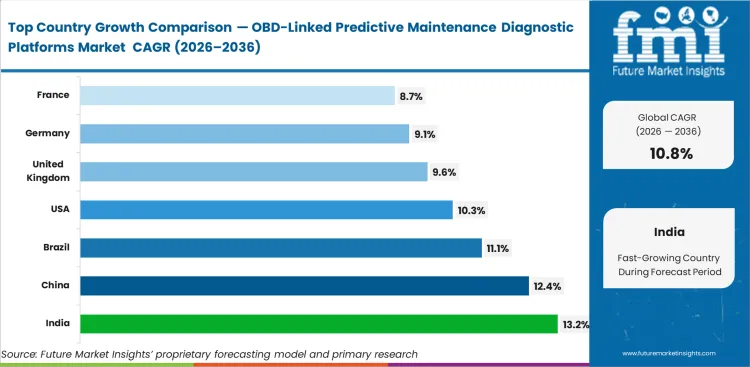
- India leads at 13.2% CAGR because commercial vehicle additions and workshop digitization are widening platform attach.
- China follows at 12.4% CAGR as its connected vehicle base and service software demand keep scaling.
- Brazil posts 11.1% CAGR because low-cost OBD-led monitoring fits a large mixed vehicle parc under cost pressure.
- The United States, the United Kingdom, Germany, and France grow from larger installed bases with more upgrade-led demand.
.webp "Top Country Growth Comparison Obd Linked Predictive Maintenance Diagnostic Platforms Market Cagr (2026 2036)")
| Country | CAGR |
|---|---|
| India | 13.2% |
| China | 12.4% |
| Brazil | 11.1% |
| United States | 10.3% |
| United Kingdom | 9.6% |
| Germany | 9.1% |
| France | 8.7% |
OBD-linked predictive maintenance diagnostic platforms demand is projected to grow globally at a CAGR of 10.8% from 2026 to 2036. India leads the tracked country set at 13.2%. China follows at 12.4% while Brazil posts 11.1%. United States growth runs at 10.3%. The United Kingdom, Germany, and France expand at 9.6%, 9.1%, and 8.7% across a more upgrade-led demand mix.
Demand Outlook for OBD-Linked Predictive Maintenance Diagnostic Platforms Market in India
Commercial vehicle additions are widening the installed base that can adopt predictive maintenance platforms in India. The market for OBD-linked predictive maintenance diagnostic platforms in India is set to expand at a CAGR of 13.2% over the assessment period. SIAM reported 10.80 lakh commercial vehicle sales in FY 2025-26. Fleet operators and workshop networks want earlier fault action as uptime pressure rises across active commercial assets. Platform vendors that keep installation practical can scale faster across mixed fleet environments.
OBD-Linked Predictive Maintenance Diagnostic Platforms Market in China
China's auto scale keeps the service software opportunity wide across fleet and workshop channels. China is forecast to post 12.4% CAGR in the OBD-linked predictive maintenance diagnostic platforms market through 2036. Auto sales reached 34.4 million units in 2025. More vehicles in use create more trouble-code events and more need for scheduling logic inside repair workflows. Local integration depth will shape how far global vendors can widen platform attach.
OBD-Linked Predictive Maintenance Diagnostic Platforms Market in Brazil
Brazil passed 71 million vehicles in circulation in 2024 and that gives low-cost monitoring tools a broad operating base. OBD-linked predictive maintenance platform demand in Brazil is likely to expand at 11.1% CAGR during the forecast period. Cost pressure keeps simple retrofit paths attractive across mixed fleets. Vendors that keep workflows practical and subscription pricing disciplined are more likely to win in this market.
Future Outlook for OBD-Linked Predictive Maintenance Diagnostic Platforms Market in the United States
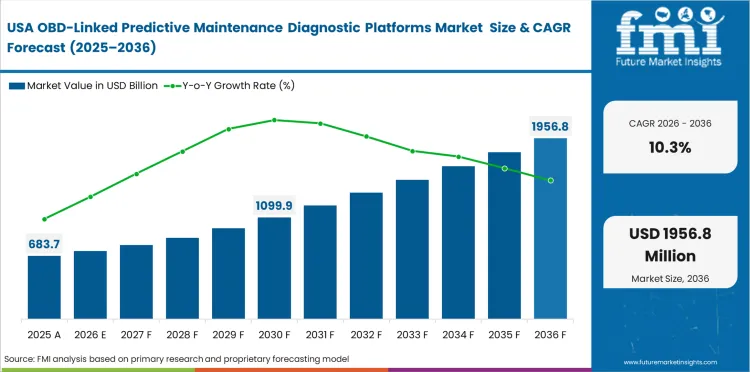
A very large in-use vehicle base keeps the United States as the strongest direct revenue market in this frame. Demand for OBD-linked predictive maintenance diagnostic platforms in the United States is expected to rise at a CAGR of 10.3% through 2036. FHWA reported 297,525,836 motor vehicles registered in 2024. Scale supports richer fault histories and better prediction models across fleets and service networks. Enterprise contracts move toward vendors that connect diagnostics closely with maintenance execution.
OBD-Linked Predictive Maintenance Diagnostic Platforms Market in the United Kingdom
The UK had 41.9 million licensed vehicles at the end of March 2025 and that includes 1.517 million zero-emission vehicles. United Kingdom is projected to record a CAGR of 9.6% in this market during the forecast period. Predictive platforms fit well when fleet operators and workshops want one software layer for fault monitoring and service history. A growing connected vehicle mix supports subscription models that join diagnostics with recurring maintenance action.
Opportunity Analysis of OBD-Linked Predictive Maintenance Diagnostic Platforms Market in Germany
Germany entered 2025 with 61,097,943 registered motor vehicles and a deep workshop software base. OBD-linked predictive maintenance diagnostic platform adoption across Germany is anticipated to grow at 9.1% CAGR during the study period. Demand usually skews toward higher-value platforms that turn diagnostic data into service planning and uptime control. Mature workshop systems moderate growth speed while supporting stronger monetization per active vehicle.
In-depth Analysis of OBD-Linked Predictive Maintenance Diagnostic Platforms Market in France
France had 6.5 million vans in operation and that was the largest van base in the EU. Through 2036 OBD-linked predictive maintenance diagnostic platform sales in France are expected to grow at a CAGR of 8.7%. Van-heavy service activity supports workshop-linked maintenance planning and remote fault triage. Platform suppliers benefit when route productivity and repair timing carry visible cost impact in light commercial fleets.
Competitive Landscape of OBD-Linked Predictive Maintenance Diagnostic Platforms Market
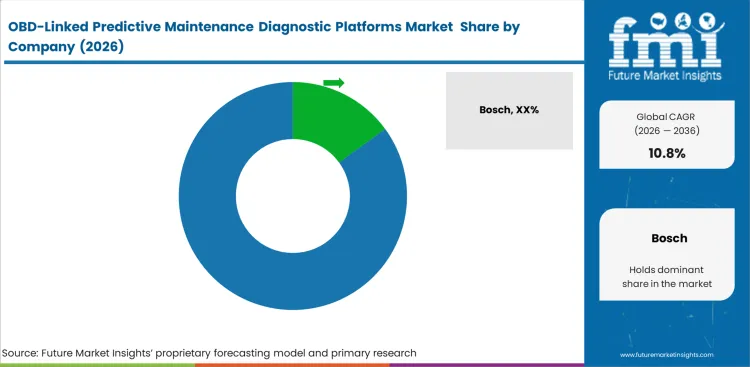
- Bosch is the leading vendor in this industry holding a dominant share over the forecast.
- Competition is shaped by analytics depth, work order automation and fit with fleet and workshop service flow.
- Heavy-duty diagnostics specialists can win where repair execution matters more than broad telematics breadth.
Supply is moderately fragmented across fleet software vendors, diagnostics specialists, and connected vehicle data providers. Bosch, Geotab, Noregon, ACTIA, Repairify, Continental, and Samsara all hold active positions in this market frame. Revenue is moving toward the software layer that interprets faults and schedules service inside fleet telematics control units and tracking devices environments. Vendors compete on data quality and workflow fit more than on basic fault reading alone.
Bosch raised its analytics position in March 2026 when it announced the acquisition of Uptake. That move adds fleet-focused predictive AI maintenance capability to an already strong diagnostics base. Scale matters here because platforms hold more value when prediction, data access, and execution sit closer together. Large vendors are stronger when enterprise fleets want one supplier across broad service workflows.
Geotab and Samsara show a different route through product updates tied closely to maintenance action. Geotab released Work Order Management and Fault Code Enrichment in February 2025. Samsara added Connected Asset Maintenance in May 2025 and Fault Code Intelligence in June 2025. These launches strengthen vendors that can turn diagnostic events into work orders with less manual effort.
Noregon, Repairify, and ACTIA hold room to win where heavy-duty depth or workshop fit matters more than broad fleet software coverage. Noregon linked PM inspections and scheduling into ShopPulse in September 2025. Repairify moved to combine with Opus IVS in January 2026. ACTIA highlighted telematics solutions with onboard diagnostics and predictive maintenance in April 2025. Challenger vendors win more often when execution is practical and deployment needs are lighter.
Major Industry Players
- Bosch, Geotab, Noregon, ACTIA, Repairify, Continental, and Samsara hold visible positions in the market based on active platform presence.
- Large fleet software vendors hold an edge in enterprise accounts where integrations and work orders are central.
- Diagnostics specialists can win in heavy-duty and workshop-led settings where repair depth matters most.
Key Developments in OBD-Linked Predictive Maintenance Diagnostic Platforms Market
- In May 2025, Samsara announced Connected Asset Maintenance with smart fault-code alerts, AI-generated technician action steps, and invoice analysis tools.
- In July 2025, Fleetio said fleets had completed more than 52 million service tasks on its platform in its first-half 2025 update.
- In April 2025, ACTIA said its BAUMA 2025 press kit highlighted telematics solutions that integrate onboard diagnostics and predictive maintenance technologies.
- In December 2025, Noregon released JPRO Professional 2025 v3 with new CAN Bus diagnostic features and broader vehicle coverage.
Key Players in the OBD-Linked Predictive Maintenance Diagnostic Platforms Market
Major Global Players
- Bosch
- Geotab
- Noregon
- ACTIA
- Repairify
Other Notable Participants
- Continental
- Samsara
- Fleetio
- MICHELIN Connected Fleet
Scope of the Report
| Metric | Value |
|---|---|
| Quantitative Units | USD 1.38 billion (2026) to USD 3.86 billion (2036) at a CAGR of 10.8% |
| Market Definition | The market covers software, workflow engines, predictive analytics, and OBD-linked data capture used to predict vehicle faults and plan service across fleet and workshop environments. |
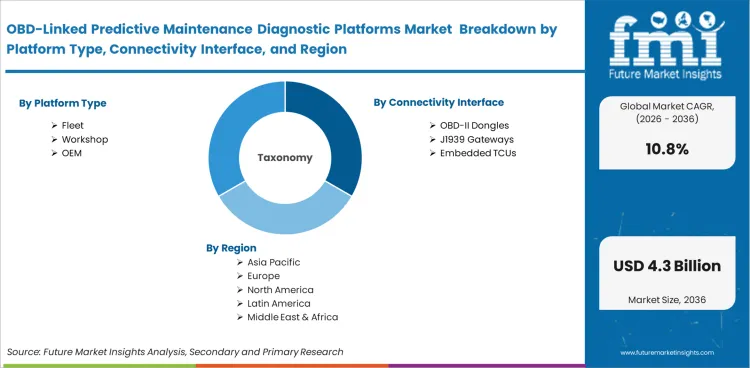
| Segmentation | By Platform Type: Fleet platforms, Workshop platforms, OEM portals, Insurer platforms By Connectivity Interface: OBD-II dongles, J1939 gateways, Embedded TCUs, Bluetooth adapters By Analytics Layer: Fault prediction, Service scheduling, Remaining life, Repair workflow By Vehicle Class: Light commercial, Heavy trucks, Passenger cars, Mixed fleets By Deployment Model: Cloud SaaS, Hybrid, On-premise |
| Regions Covered | North America, Europe, Asia Pacific, Latin America |
| Countries Covered | India, China, Brazil, United States, United Kingdom, Germany, France |
| Key Companies Profiled | Bosch, Geotab, Noregon, ACTIA, Repairify, Continental, Samsara |
| Forecast Period | 2026 to 2036 |
| Approach | The niche was modeled as a software-and-platform layer inside remote vehicle diagnostics and fleet maintenance systems with demand tied to OBD-linked fault data and prediction logic. |
OBD-Linked Predictive Maintenance Diagnostic Platforms Market by Segments
OBD-Linked Predictive Maintenance Diagnostic Platforms Market Segmented by Platform Type
- Fleet platforms
- Workshop platforms
- OEM portals
- Insurer platforms
OBD-Linked Predictive Maintenance Diagnostic Platforms Market Classified by Connectivity Interface
- OBD-II dongles
- J1939 gateways
- Embedded TCUs
- Bluetooth adapters
OBD-Linked Predictive Maintenance Diagnostic Platforms Market Analyzed by Analytics Layer
- Fault prediction
- Service scheduling
- Remaining life
- Repair workflow
OBD-Linked Predictive Maintenance Diagnostic Platforms Market Classified by Vehicle Class
- Light commercial vehicles
- Heavy trucks
- Passenger cars
- Mixed fleets
OBD-Linked Predictive Maintenance Diagnostic Platforms Market Classified by Deployment Model
- Cloud SaaS
- Hybrid
- On-premise
Bibliography
- Federal Highway Administration. (2026, February 23). Table MV-1 - Highway Statistics 2024.
- Department for Transport. (2025, August 13). Vehicle licensing statistics: January to March 2025.
- Kraftfahrt-Bundesamt. (2025, March 4). Der Fahrzeugbestand am 1. Januar 2025 Pressemitteilung Nr. 10/2025.
- Society of Indian Automobile Manufacturers. (2026, April 14). Auto Industry Performance of Q4 (Jan- March 2026) & FY 2025-26.
- The State Council, The People's Republic of China. (2026, January 14). China's auto output, sales reach new highs in 2025.
- Ministério do Meio Ambiente e Mudança do Clima. (2026, March 10). MMA e Ministério dos Transportes divulgam inventário nacional de emissões do transporte rodoviario com série histórica de 45 anos.
- European Automobile Manufacturers' Association. (2026). Vehicles on European roads 2026.
- Bosch. (2026, March 19). Bosch strengthens U.S. mobility services portfolio.
- Geotab. (2025, February 26). Geotab Introduces Work Order Management and Fault Code Enrichment to Help Fleets Reduce Cost and Downtime.
- Noregon. (2025, September 2). Noregon Announces Major Updates for ShopPulse and Truck Check-Up.
This Report Addresses
- Market size across 2025, 2026, and 2036 with a stated 10.8% CAGR.
- Why fleet platforms and cloud deployment lead the 2026 segment structure.
- How OBD-II retrofit logic supports near-term platform attach.
- Why India, China, and Brazil outpace mature markets on growth rate.
- How older European van and truck fleets support predictive maintenance demand.
- What Bosch, Geotab, and Samsara are doing to deepen workflow value.
- Where fragmented OEM permissions and mixed data formats slow adoption.
- Why workshop-linked execution matters as much as fault-code visibility.
Frequently Asked Questions
How large is the OBD-Linked Predictive Maintenance Diagnostic Platforms market in 2026?
Global demand for OBD-Linked Predictive Maintenance Diagnostic Platforms is estimated at USD 1.38 billion in 2026 across fleet and workshop software environments.
What is the forecast for the OBD-Linked Predictive Maintenance Diagnostic Platforms market?
Revenue is forecast to reach USD 3.86 billion by 2036 at a CAGR of 10.8% from the 2026 base year.
Which platform type leads the OBD-Linked Predictive Maintenance Diagnostic Platforms market?
Fleet platforms lead the platform type segment with an estimated 34% share in 2026 because managed fleets show clearer uptime returns.
Which connectivity interface leads the OBD-Linked Predictive Maintenance Diagnostic Platforms market?
OBD-II dongles lead connectivity interface demand with an estimated 38% share in 2026 because retrofit coverage is broad and cost-effective.
Which analytics layer leads the OBD-Linked Predictive Maintenance Diagnostic Platforms market?
Fault prediction leads the analytics layer with an estimated 31% share in 2026 because fleet teams want ranked failure risk.
Which vehicle class leads the OBD-Linked Predictive Maintenance Diagnostic Platforms market?
Light commercial vehicles lead vehicle class demand with an estimated 36% share in 2026 because utilization is high and retrofit economics work.
Which country grows fastest in the OBD-Linked Predictive Maintenance Diagnostic Platforms market?
India posts the fastest tracked growth at 13.2% CAGR through 2036 because commercial fleet additions and workshop digitization are widening adoption.
Who are the leading companies in the OBD-Linked Predictive Maintenance Diagnostic Platforms market?
Leading companies in OBD-Linked Predictive Maintenance Diagnostic Platforms include Bosch, Geotab, Noregon, ACTIA, Repairify, Continental, and Samsara.
Preview the report firsthand - request a free sample
Get SampleGet the brochure for pricing and purchase details.
Get PDFTable of Content
- Executive Summary
- Global Market Outlook
- Demand-side Trends
- Supply-side Trends
- Technology Roadmap Analysis
- Analysis and Recommendations
- Market Overview
- Market Coverage / Taxonomy
- Market Definition / Scope / Limitations
- Research Methodology
- Chapter Orientation
- Analytical Lens and Working Hypotheses
- Market Structure, Signals, and Trend Drivers
- Benchmarking and Cross-market Comparability
- Market Sizing, Forecasting, and Opportunity Mapping
- Research Design and Evidence Framework
- Desk Research Programme (Secondary Evidence)
- Company Annual and Sustainability Reports
- Peer-reviewed Journals and Academic Literature
- Corporate Websites, Product Literature, and Technical Notes
- Earnings Decks and Investor Briefings
- Statutory Filings and Regulatory Disclosures
- Technical White Papers and Standards Notes
- Trade Journals, Industry Magazines, and Analyst Briefs
- Conference Proceedings, Webinars, and Seminar Materials
- Government Statistics Portals and Public Data Releases
- Press Releases and Reputable Media Coverage
- Specialist Newsletters and Curated Briefings
- Sector Databases and Reference Repositories
- FMI Internal Proprietary Databases and Historical Market Datasets
- Subscription Datasets and Paid Sources
- Social Channels, Communities, and Digital Listening Inputs
- Additional Desk Sources
- Expert Input and Fieldwork (Primary Evidence)
- Primary Modes
- Qualitative Interviews and Expert Elicitation
- Quantitative Surveys and Structured Data Capture
- Blended Approach
- Why Primary Evidence is Used
- Field Techniques
- Interviews
- Surveys
- Focus Groups
- Observational and In-context Research
- Social and Community Interactions
- Stakeholder Universe Engaged
- C-suite Leaders
- Board Members
- Presidents and Vice Presidents
- R&D and Innovation Heads
- Technical Specialists
- Domain Subject-matter Experts
- Scientists
- Physicians and Other Healthcare Professionals
- Governance, Ethics, and Data Stewardship
- Research Ethics
- Data Integrity and Handling
- Primary Modes
- Tooling, Models, and Reference Databases
- Desk Research Programme (Secondary Evidence)
- Data Engineering and Model Build
- Data Acquisition and Ingestion
- Cleaning, Normalisation, and Verification
- Synthesis, Triangulation, and Analysis
- Quality Assurance and Audit Trail
- Market Background
- Market Dynamics
- Drivers
- Restraints
- Opportunity
- Trends
- Scenario Forecast
- Demand in Optimistic Scenario
- Demand in Likely Scenario
- Demand in Conservative Scenario
- Opportunity Map Analysis
- Product Life Cycle Analysis
- Supply Chain Analysis
- Investment Feasibility Matrix
- Value Chain Analysis
- PESTLE and Porter’s Analysis
- Regulatory Landscape
- Regional Parent Market Outlook
- Production and Consumption Statistics
- Import and Export Statistics
- Market Dynamics
- Global Market Analysis 2021 to 2025 and Forecast, 2026 to 2036
- Historical Market Size Value (USD Million) Analysis, 2021 to 2025
- Current and Future Market Size Value (USD Million) Projections, 2026 to 2036
- Y-o-Y Growth Trend Analysis
- Absolute $ Opportunity Analysis
- Global Market Pricing Analysis 2021 to 2025 and Forecast 2026 to 2036
- Global Market Analysis 2021 to 2025 and Forecast 2026 to 2036, By Platform Type
- Introduction / Key Findings
- Historical Market Size Value (USD Million) Analysis By Platform Type , 2021 to 2025
- Current and Future Market Size Value (USD Million) Analysis and Forecast By Platform Type , 2026 to 2036
- Fleet
- Workshop
- OEM
- Fleet
- Y-o-Y Growth Trend Analysis By Platform Type , 2021 to 2025
- Absolute $ Opportunity Analysis By Platform Type , 2026 to 2036
- Global Market Analysis 2021 to 2025 and Forecast 2026 to 2036, By Connectivity Interface
- Introduction / Key Findings
- Historical Market Size Value (USD Million) Analysis By Connectivity Interface, 2021 to 2025
- Current and Future Market Size Value (USD Million) Analysis and Forecast By Connectivity Interface, 2026 to 2036
- OBD-II Dongles
- J1939 Gateways
- Embedded TCUs
- OBD-II Dongles
- Y-o-Y Growth Trend Analysis By Connectivity Interface, 2021 to 2025
- Absolute $ Opportunity Analysis By Connectivity Interface, 2026 to 2036
- Global Market Analysis 2021 to 2025 and Forecast 2026 to 2036, By Analytics Layer
- Introduction / Key Findings
- Historical Market Size Value (USD Million) Analysis By Analytics Layer, 2021 to 2025
- Current and Future Market Size Value (USD Million) Analysis and Forecast By Analytics Layer, 2026 to 2036
- Fault Prediction
- Service Scheduling
- Others
- Fault Prediction
- Y-o-Y Growth Trend Analysis By Analytics Layer, 2021 to 2025
- Absolute $ Opportunity Analysis By Analytics Layer, 2026 to 2036
- Global Market Analysis 2021 to 2025 and Forecast 2026 to 2036, By Vehicle Class
- Introduction / Key Findings
- Historical Market Size Value (USD Million) Analysis By Vehicle Class, 2021 to 2025
- Current and Future Market Size Value (USD Million) Analysis and Forecast By Vehicle Class, 2026 to 2036
- Light Commercial Vehicles
- Heavy Trucks
- Passenger Cars
- Light Commercial Vehicles
- Y-o-Y Growth Trend Analysis By Vehicle Class, 2021 to 2025
- Absolute $ Opportunity Analysis By Vehicle Class, 2026 to 2036
- Global Market Analysis 2021 to 2025 and Forecast 2026 to 2036, By Deployment Model
- Introduction / Key Findings
- Historical Market Size Value (USD Million) Analysis By Deployment Model, 2021 to 2025
- Current and Future Market Size Value (USD Million) Analysis and Forecast By Deployment Model, 2026 to 2036
- Cloud SaaS
- Hybrid
- On-premise
- Cloud SaaS
- Y-o-Y Growth Trend Analysis By Deployment Model, 2021 to 2025
- Absolute $ Opportunity Analysis By Deployment Model, 2026 to 2036
- Global Market Analysis 2021 to 2025 and Forecast 2026 to 2036, By Region
- Introduction
- Historical Market Size Value (USD Million) Analysis By Region, 2021 to 2025
- Current Market Size Value (USD Million) Analysis and Forecast By Region, 2026 to 2036
- North America
- Latin America
- Western Europe
- Eastern Europe
- East Asia
- South Asia and Pacific
- Middle East & Africa
- Market Attractiveness Analysis By Region
- North America Market Analysis 2021 to 2025 and Forecast 2026 to 2036, By Country
- Historical Market Size Value (USD Million) Trend Analysis By Market Taxonomy, 2021 to 2025
- Market Size Value (USD Million) Forecast By Market Taxonomy, 2026 to 2036
- By Country
- USA
- Canada
- Mexico
- By Platform Type
- By Connectivity Interface
- By Analytics Layer
- By Vehicle Class
- By Deployment Model
- By Country
- Market Attractiveness Analysis
- By Country
- By Platform Type
- By Connectivity Interface
- By Analytics Layer
- By Vehicle Class
- By Deployment Model
- Key Takeaways
- Latin America Market Analysis 2021 to 2025 and Forecast 2026 to 2036, By Country
- Historical Market Size Value (USD Million) Trend Analysis By Market Taxonomy, 2021 to 2025
- Market Size Value (USD Million) Forecast By Market Taxonomy, 2026 to 2036
- By Country
- Brazil
- Chile
- Rest of Latin America
- By Platform Type
- By Connectivity Interface
- By Analytics Layer
- By Vehicle Class
- By Deployment Model
- By Country
- Market Attractiveness Analysis
- By Country
- By Platform Type
- By Connectivity Interface
- By Analytics Layer
- By Vehicle Class
- By Deployment Model
- Key Takeaways
- Western Europe Market Analysis 2021 to 2025 and Forecast 2026 to 2036, By Country
- Historical Market Size Value (USD Million) Trend Analysis By Market Taxonomy, 2021 to 2025
- Market Size Value (USD Million) Forecast By Market Taxonomy, 2026 to 2036
- By Country
- Germany
- UK
- Italy
- Spain
- France
- Nordic
- BENELUX
- Rest of Western Europe
- By Platform Type
- By Connectivity Interface
- By Analytics Layer
- By Vehicle Class
- By Deployment Model
- By Country
- Market Attractiveness Analysis
- By Country
- By Platform Type
- By Connectivity Interface
- By Analytics Layer
- By Vehicle Class
- By Deployment Model
- Key Takeaways
- Eastern Europe Market Analysis 2021 to 2025 and Forecast 2026 to 2036, By Country
- Historical Market Size Value (USD Million) Trend Analysis By Market Taxonomy, 2021 to 2025
- Market Size Value (USD Million) Forecast By Market Taxonomy, 2026 to 2036
- By Country
- Russia
- Poland
- Hungary
- Balkan & Baltic
- Rest of Eastern Europe
- By Platform Type
- By Connectivity Interface
- By Analytics Layer
- By Vehicle Class
- By Deployment Model
- By Country
- Market Attractiveness Analysis
- By Country
- By Platform Type
- By Connectivity Interface
- By Analytics Layer
- By Vehicle Class
- By Deployment Model
- Key Takeaways
- East Asia Market Analysis 2021 to 2025 and Forecast 2026 to 2036, By Country
- Historical Market Size Value (USD Million) Trend Analysis By Market Taxonomy, 2021 to 2025
- Market Size Value (USD Million) Forecast By Market Taxonomy, 2026 to 2036
- By Country
- China
- Japan
- South Korea
- By Platform Type
- By Connectivity Interface
- By Analytics Layer
- By Vehicle Class
- By Deployment Model
- By Country
- Market Attractiveness Analysis
- By Country
- By Platform Type
- By Connectivity Interface
- By Analytics Layer
- By Vehicle Class
- By Deployment Model
- Key Takeaways
- South Asia and Pacific Market Analysis 2021 to 2025 and Forecast 2026 to 2036, By Country
- Historical Market Size Value (USD Million) Trend Analysis By Market Taxonomy, 2021 to 2025
- Market Size Value (USD Million) Forecast By Market Taxonomy, 2026 to 2036
- By Country
- India
- ASEAN
- Australia & New Zealand
- Rest of South Asia and Pacific
- By Platform Type
- By Connectivity Interface
- By Analytics Layer
- By Vehicle Class
- By Deployment Model
- By Country
- Market Attractiveness Analysis
- By Country
- By Platform Type
- By Connectivity Interface
- By Analytics Layer
- By Vehicle Class
- By Deployment Model
- Key Takeaways
- Middle East & Africa Market Analysis 2021 to 2025 and Forecast 2026 to 2036, By Country
- Historical Market Size Value (USD Million) Trend Analysis By Market Taxonomy, 2021 to 2025
- Market Size Value (USD Million) Forecast By Market Taxonomy, 2026 to 2036
- By Country
- Kingdom of Saudi Arabia
- Other GCC Countries
- Turkiye
- South Africa
- Other African Union
- Rest of Middle East & Africa
- By Platform Type
- By Connectivity Interface
- By Analytics Layer
- By Vehicle Class
- By Deployment Model
- By Country
- Market Attractiveness Analysis
- By Country
- By Platform Type
- By Connectivity Interface
- By Analytics Layer
- By Vehicle Class
- By Deployment Model
- Key Takeaways
- Key Countries Market Analysis
- USA
- Pricing Analysis
- Market Share Analysis, 2025
- By Platform Type
- By Connectivity Interface
- By Analytics Layer
- By Vehicle Class
- By Deployment Model
- Canada
- Pricing Analysis
- Market Share Analysis, 2025
- By Platform Type
- By Connectivity Interface
- By Analytics Layer
- By Vehicle Class
- By Deployment Model
- Mexico
- Pricing Analysis
- Market Share Analysis, 2025
- By Platform Type
- By Connectivity Interface
- By Analytics Layer
- By Vehicle Class
- By Deployment Model
- Brazil
- Pricing Analysis
- Market Share Analysis, 2025
- By Platform Type
- By Connectivity Interface
- By Analytics Layer
- By Vehicle Class
- By Deployment Model
- Chile
- Pricing Analysis
- Market Share Analysis, 2025
- By Platform Type
- By Connectivity Interface
- By Analytics Layer
- By Vehicle Class
- By Deployment Model
- Germany
- Pricing Analysis
- Market Share Analysis, 2025
- By Platform Type
- By Connectivity Interface
- By Analytics Layer
- By Vehicle Class
- By Deployment Model
- UK
- Pricing Analysis
- Market Share Analysis, 2025
- By Platform Type
- By Connectivity Interface
- By Analytics Layer
- By Vehicle Class
- By Deployment Model
- Italy
- Pricing Analysis
- Market Share Analysis, 2025
- By Platform Type
- By Connectivity Interface
- By Analytics Layer
- By Vehicle Class
- By Deployment Model
- Spain
- Pricing Analysis
- Market Share Analysis, 2025
- By Platform Type
- By Connectivity Interface
- By Analytics Layer
- By Vehicle Class
- By Deployment Model
- France
- Pricing Analysis
- Market Share Analysis, 2025
- By Platform Type
- By Connectivity Interface
- By Analytics Layer
- By Vehicle Class
- By Deployment Model
- India
- Pricing Analysis
- Market Share Analysis, 2025
- By Platform Type
- By Connectivity Interface
- By Analytics Layer
- By Vehicle Class
- By Deployment Model
- ASEAN
- Pricing Analysis
- Market Share Analysis, 2025
- By Platform Type
- By Connectivity Interface
- By Analytics Layer
- By Vehicle Class
- By Deployment Model
- Australia & New Zealand
- Pricing Analysis
- Market Share Analysis, 2025
- By Platform Type
- By Connectivity Interface
- By Analytics Layer
- By Vehicle Class
- By Deployment Model
- China
- Pricing Analysis
- Market Share Analysis, 2025
- By Platform Type
- By Connectivity Interface
- By Analytics Layer
- By Vehicle Class
- By Deployment Model
- Japan
- Pricing Analysis
- Market Share Analysis, 2025
- By Platform Type
- By Connectivity Interface
- By Analytics Layer
- By Vehicle Class
- By Deployment Model
- South Korea
- Pricing Analysis
- Market Share Analysis, 2025
- By Platform Type
- By Connectivity Interface
- By Analytics Layer
- By Vehicle Class
- By Deployment Model
- Russia
- Pricing Analysis
- Market Share Analysis, 2025
- By Platform Type
- By Connectivity Interface
- By Analytics Layer
- By Vehicle Class
- By Deployment Model
- Poland
- Pricing Analysis
- Market Share Analysis, 2025
- By Platform Type
- By Connectivity Interface
- By Analytics Layer
- By Vehicle Class
- By Deployment Model
- Hungary
- Pricing Analysis
- Market Share Analysis, 2025
- By Platform Type
- By Connectivity Interface
- By Analytics Layer
- By Vehicle Class
- By Deployment Model
- Kingdom of Saudi Arabia
- Pricing Analysis
- Market Share Analysis, 2025
- By Platform Type
- By Connectivity Interface
- By Analytics Layer
- By Vehicle Class
- By Deployment Model
- Turkiye
- Pricing Analysis
- Market Share Analysis, 2025
- By Platform Type
- By Connectivity Interface
- By Analytics Layer
- By Vehicle Class
- By Deployment Model
- South Africa
- Pricing Analysis
- Market Share Analysis, 2025
- By Platform Type
- By Connectivity Interface
- By Analytics Layer
- By Vehicle Class
- By Deployment Model
- USA
- Market Structure Analysis
- Competition Dashboard
- Competition Benchmarking
- Market Share Analysis of Top Players
- By Regional
- By Platform Type
- By Connectivity Interface
- By Analytics Layer
- By Vehicle Class
- By Deployment Model
- Competition Analysis
- Competition Deep Dive
- Bosch
- Overview
- Product Portfolio
- Profitability by Market Segments (Product/Age /Sales Channel/Region)
- Sales Footprint
- Strategy Overview
- Marketing Strategy
- Product Strategy
- Channel Strategy
- Geotab
- Noregon
- ACTIA
- Repairify
- Continental
- Fleetio
- Bosch
- Competition Deep Dive
- Assumptions & Acronyms Used


