

- Industry Size (2026)
- USD 16100.0 Mn
- Forecast (2036)
- USD 37421.0 Mn
- CAGR (2026 to 2036)
- 8.8%
Fleet Telematics Control Units and Tracking Devices Market Forecast and Outlook 2026 to 2036
The fleet telematics control units and tracking devices market is valued at USD 16,100.0 million in 2026 and is projected to reach USD 37,421.0 million by 2036, registering a CAGR of 8.8%. Value expansion is driven by structural dependence on continuous vehicle data across logistics, commercial transport, and service fleets rather than discretionary technology upgrades. Spending concentrates on GPS tracking devices and telematics control units that provide persistent visibility into vehicle location, utilization, and compliance status. Commercial trucking fleets account for a significant share of value formation due to regulatory exposure, high asset intensity, and operational scale. Revenue growth remains closely tied to subscription-based service models layered on top of installed hardware bases.
Quick Stats for Fleet Telematics Control Units and Tracking Devices Market
- Fleet Telematics Control Units and Tracking Devices Market Value (2026): USD 16,100.0 million
- Fleet Telematics Control Units and Tracking Devices Market Forecast Value (2036): USD 37,421.0 million
- Fleet Telematics Control Units and Tracking Devices Market Forecast CAGR 2026 to 2036: 8.8%
- Leading Device Type by Demand Share: GPS Tracking Devices
- Fastest-Growing Countries: China, Brazil, USA, Germany, South Korea
- Key Participants in Global Demand: Geotab, Verizon Connect, Samsara, Trimble, Omnitracs, TomTom Telematics (Webfleet), CalAmp, Gurtam, Inseego, Queclink
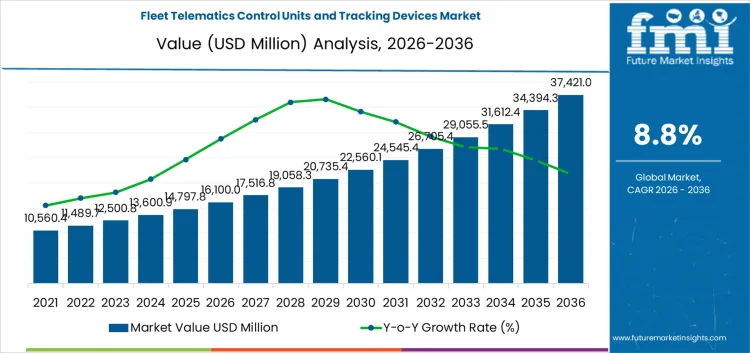
Outlook over the forecast period reflects increasing integration of telematics hardware with enterprise fleet management, compliance reporting, and analytics platforms. Scalability is influenced by data management capability, connectivity reliability, and cost sensitivity among small and mid-sized fleet operators. Regulatory mandates for electronic logging, emissions tracking, and safety monitoring continue to anchor baseline demand across developed and emerging transport systems. Electrification of fleets adds incremental value through monitoring of battery health and charging behavior, increasing data intensity per vehicle. Adoption favors standardized, ruggedized devices with broad cellular coverage rather than bespoke configurations. Growth remains sustained but disciplined, shaped by operational return expectations, cybersecurity requirements, and gradual consolidation of fleet telematics platforms.
Fleet Telematics Control Units and Tracking Devices Market Key Takeaways
| Metric | Value |
|---|---|
| Market Value (2026) | USD 16,100.0 million |
| Market Forecast Value (2036) | USD 37,421.0 million |
| Forecast CAGR 2026 to 2036 | 8.8% |
Why is the Demand for Fleet Telematics Control Units and Tracking Devices Growing?
Demand for fleet telematics control units and tracking devices is rising as transport and logistics operators require precise vehicle location and operational data to enhance efficiency and safety across distributed assets. Commercial fleets depend on continuous visibility into vehicle routes, engine diagnostics, and driver behavior to support predictive maintenance planning and uptime forecasting. Procurement teams evaluate device ruggedness, communication protocol compatibility, and data integration capability with enterprise resource planning and dispatch systems when selecting solutions for vehicle programs. Regulatory frameworks for hours of service monitoring, cargo security, and emissions reporting influence specification of telematics hardware that supports compliance with reporting and accountability standards.
Transport planners and operations managers emphasize scalable platforms that support remote configuration and secure data transfer over cellular and satellite networks because uninterrupted connectivity underpins real-time decision making. Growth in e commerce distribution and demand for just in time delivery services is reinforcing adoption of telematics control units and tracking devices that deliver actionable insights from vehicle fleets. System integrators design solutions that aggregate geolocation, fuel usage, and sensor inputs to support route optimization and cost control initiatives. Training for technical staff on device installation and data interpretation enhances operational readiness and supports consistent performance across fleet categories. These dynamics support sustained uptake of telematics and tracking solutions in complex transport and logistics environments.
How Are the Segments Classified in the Fleet Telematics Control Units and Tracking Devices Market?
Demand for fleet telematics control units and tracking devices is shaped by operational visibility requirements, fuel efficiency targets, and regulatory compliance obligations. Fleet operators prioritize real-time location tracking, asset monitoring, and driver behavior analysis to improve utilization and cost control. Adoption aligns with digital fleet management platforms integrating analytics, diagnostics, and reporting functions. Connectivity reliability and device durability influence deployment decisions across vehicle categories. Segment classification reflects differentiation by device function, communication technology, and fleet composition. Structure highlights how hardware capability, network availability, and fleet usage patterns influence installation density, data intensity, and operational dependence across commercial mobility operations.
Which Device Type Represents the Largest Share of Demand?
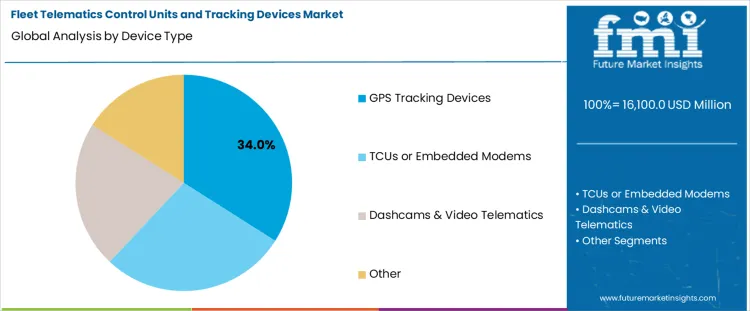
GPS tracking devices hold 34.0%, representing the largest share among telematics device types due to foundational location monitoring needs. These devices provide continuous vehicle positioning, route history, and geofencing capability supporting core fleet management functions. Simplicity of installation and broad compatibility support adoption across mixed fleets. Data outputs integrate easily with fleet software platforms for dispatch and compliance reporting. TCUs and embedded modems enable deeper vehicle data access with higher integration complexity. Dashcams and video telematics support safety monitoring and incident analysis. Device type segmentation reflects priority placed on reliable location intelligence as the baseline telematics requirement.
Key Points
- GPS tracking supports foundational fleet visibility needs.
- Simple deployment enables use across diverse vehicle types.
- Other devices expand data depth and safety monitoring scope.
Which Connectivity Type Accounts for the Highest Share of Demand?
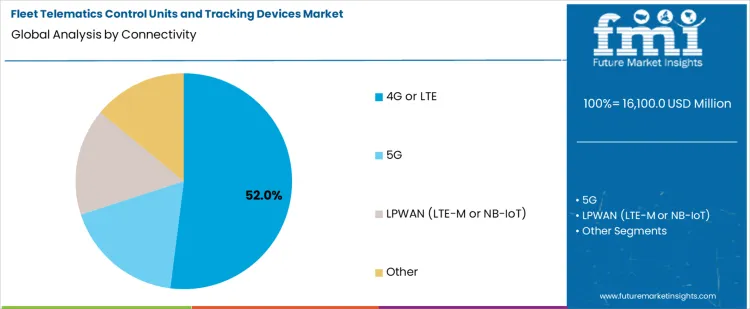
4G or LTE connectivity holds 52.0%, representing the largest share among connectivity options due to network coverage maturity. LTE networks support consistent data transmission across urban and intercity routes. Latency and bandwidth characteristics meet requirements for tracking, diagnostics, and basic video transmission. Infrastructure availability supports dependable operation across regions. 5G enables higher data throughput and lower latency with limited coverage footprint. LPWAN technologies support low-power, low-data applications. Connectivity segmentation reflects reliance on established cellular networks balancing performance, coverage, and cost efficiency for large-scale fleet deployments.
Key Points
- LTE connectivity offers broad coverage and reliability.
- Network maturity supports consistent fleet data transmission.
- Other technologies address high-bandwidth or low-power needs.
Which Fleet Type Drives the Largest Share of Demand?
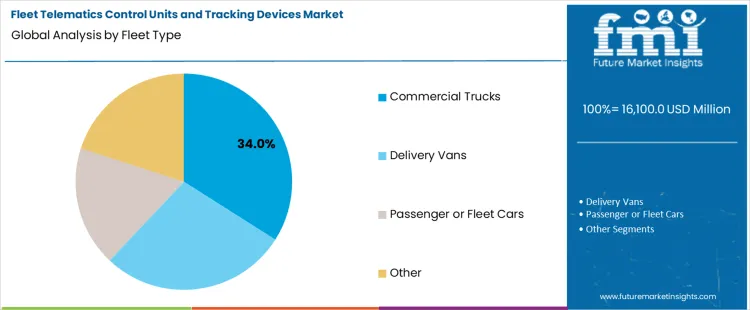
Commercial trucks hold 34.0%, representing the largest share among fleet types deploying telematics solutions. Long-haul and regional trucking operations require continuous tracking, compliance logging, and asset utilization monitoring. Telematics supports route optimization, fuel management, and regulatory reporting across trucking fleets. Vehicle value and operating cost intensity reinforce investment in tracking systems. Delivery vans and fleet cars apply telematics for routing and productivity management. Other fleet types address mixed operational needs. Fleet type segmentation reflects concentration of telematics adoption where operational scale, regulatory exposure, and cost sensitivity remain highest.
Key Points
- Commercial trucking relies on continuous tracking and compliance data.
- High operating costs justify extensive telematics deployment.
- Other fleets adopt systems based on routing and productivity needs.
What are the Key Dynamics in the Fleet Telematics Control Units and Tracking Devices Market?
Demand for fleet telematics control units and tracking devices reflects operational need for vehicle visibility, compliance monitoring, and asset utilization control. Adoption spans commercial fleets, logistics providers, public transport operators, and service vehicles. Global scope aligns with digital fleet management integration and real-time data capture requirements. Usage centers on onboard hardware enabling location tracking, diagnostics, driver behavior monitoring, and data transmission to centralized platforms.
How do operational visibility and compliance requirements shape adoption?
Fleet operators require continuous insight into vehicle location, utilization, and operating condition to control cost and service reliability. Demand increases as regulatory mandates enforce electronic logging, emissions reporting, and safety monitoring. Telematics units support route optimization, fuel consumption analysis, and preventive maintenance scheduling. Tracking devices enable theft recovery and asset security across high-value fleets. Integration with dispatch and enterprise systems improves coordination and response time. Insurance-linked monitoring programs encourage adoption through risk profiling and premium adjustment. Driver performance analytics support training and incident reduction initiatives. Adoption reflects reliance on data-driven fleet governance rather than discretionary technology upgrades.
How do data management complexity and cost sensitivity influence market scalability?
Hardware installation and subscription fees affect adoption among small fleet operators. Demand sensitivity rises where return justification depends on utilization scale and operational maturity. Data overload challenges emerge without analytical capability to convert telemetry into actionable insight. Integration complexity increases across mixed vehicle types and legacy systems. Connectivity reliability varies by geography, affecting data continuity. Cybersecurity and data privacy compliance increase system validation burden. Device maintenance and replacement add lifecycle cost. Regulatory variation across regions complicates standardized deployment, constraining rapid scalability across fragmented fleet environments.
How Is Demand for Fleet Telematics Control Units and Tracking Devices Evolving Globally?
Demand for fleet telematics control units and tracking devices is expanding globally due to logistics digitization, regulatory compliance needs, and operational cost optimization across commercial fleets. Adoption reflects increasing reliance on real-time vehicle data for routing, fuel efficiency, safety monitoring, and asset utilization. Integration with analytics platforms and cloud-based fleet management systems supports decision automation. Electrification of fleets further increases need for monitoring battery health and charging behavior. Growth rates in China at 10.6%, Brazil at 10.4%, USA at 8.4%, Germany at 8.2%, and South Korea at 8.0% indicate sustained expansion driven by fleet scale growth, regulatory oversight, and data-driven transport operations.
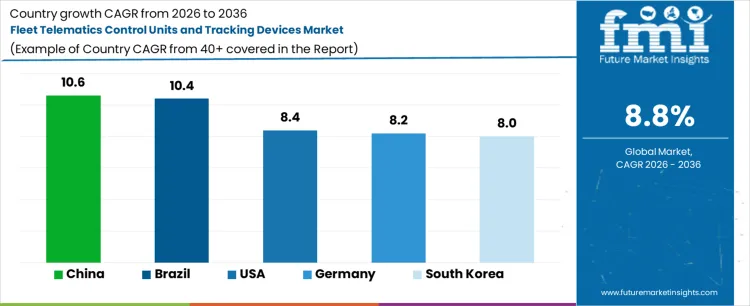
| Country | CAGR (%) |
|---|---|
| China | 10.6% |
| Brazil | 10.4% |
| USA | 8.4% |
| Germany | 8.2% |
| South Korea | 8.0% |
What Is Driving Rapid Growth of Fleet Telematics Demand in China?

Large-scale commercial fleet operations are driving fleet telematics control unit and tracking device demand in China, expanding at a CAGR of 10.6%. Logistics, construction, and municipal fleets require continuous tracking to manage high vehicle utilization. Government mandates for commercial vehicle monitoring support widespread device installation. E-commerce expansion increases reliance on route optimization and delivery visibility. Integration with digital freight platforms supports real-time dispatch and performance analytics. Domestic telematics hardware manufacturing enables rapid deployment across large fleets with standardized configurations.
- Large logistics and municipal fleet sizes
- Regulatory mandates for vehicle monitoring
- E-commerce-driven delivery optimization needs
- Strong domestic telematics hardware supply
Why Is Brazil Experiencing Accelerated Adoption of Fleet Telematics Systems?
Operational risk management is shaping fleet telematics control unit demand growth in Brazil at a CAGR of 10.4%. Long-distance freight movement increases need for location tracking and driver behavior monitoring. Fuel cost volatility encourages efficiency-focused fleet analytics. Security concerns support adoption of real-time tracking and geofencing. Fleet operators deploy telematics to reduce downtime and improve asset protection. Growth is concentrated among logistics, agriculture transport, and urban delivery fleets seeking operational visibility.
- Long-haul freight transport requirements
- Fuel efficiency and cost control priorities
- Security-driven tracking and geofencing needs
- Adoption across logistics and agricultural fleets
How Is the USA Sustaining Growth in Fleet Telematics Control Units and Tracking Devices?
Data-driven fleet management practices support fleet telematics demand growth in the USA, expanding at a CAGR of 8.4%. Commercial fleets prioritize analytics for route optimization, compliance reporting, and safety monitoring. Regulatory requirements for electronic logging reinforce device installation. Integration with enterprise software platforms enhances operational decision-making. Electrified fleet segments increase monitoring needs for charging and battery performance. Demand growth reflects system upgrades and feature expansion within established fleet management frameworks.
- Regulatory compliance through electronic logging
- Analytics-driven route and safety optimization
- Integration with enterprise fleet software
- Monitoring needs from electrified fleet adoption
What Factors Are Sustaining Fleet Telematics Demand in Germany?
Structured fleet operations are sustaining fleet telematics control unit demand in Germany, growing at a CAGR of 8.2%. Logistics operators emphasize efficiency, punctuality, and emissions tracking. Regulatory focus on transport transparency supports telematics adoption. Integration with supply chain management systems improves coordination. Fleet electrification programs increase demand for advanced data collection. Growth remains steady, driven by compliance, optimization, and sustainability reporting requirements.
- Emphasis on efficiency and punctuality metrics
- Regulatory transparency and compliance needs
- Supply chain system integration
- Electrified fleet monitoring requirements
Why Is South Korea Showing Steady Growth in Fleet Telematics Adoption?
Technology-enabled fleet optimization is driving fleet telematics control unit demand in South Korea, expanding at a CAGR of 8.0%. High urban density increases importance of route efficiency and congestion management. Logistics and delivery fleets adopt telematics for real-time coordination. Integration with smart city infrastructure enhances traffic data utilization. Export-oriented industries require reliable fleet tracking for supply chain precision. Growth reflects technology standardization across commercial fleets rather than rapid fleet size expansion.
- Urban congestion management requirements
- Real-time coordination for delivery fleets
- Integration with smart city traffic systems
- Supply chain precision needs in export industries
What is the competitive landscape of demand for the fleet telematics control units and tracking devices market globally?
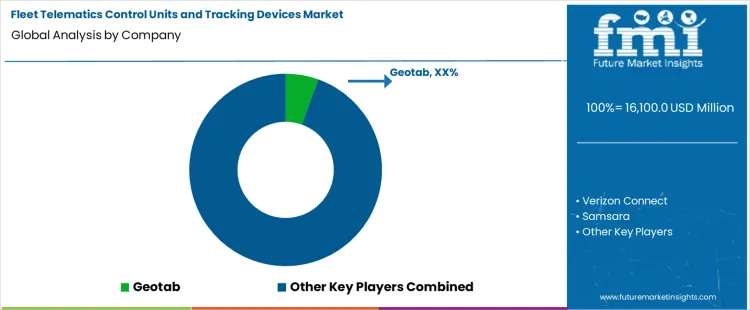
Demand for fleet telematics control units and tracking devices is driven by logistics optimization, regulatory compliance, safety monitoring, and cost-efficiency goals across commercial transport, delivery services, and asset management sectors. Buyers evaluate device connectivity (4G/5G/LTE), GPS accuracy, sensor integration, over-the-air update capability, and compatibility with fleet management platforms. Procurement teams prioritize suppliers with robust data security, global roaming support, scalable device provisioning, and comprehensive analytics capabilities. Trend in the global market reflects expansion of connected vehicle ecosystems, growing use of predictive maintenance data, and integration with routing and fuel management solutions to improve operational performance.
Geotab holds leading positioning through extensive deployment of telematics control units and device-agnostic tracking platforms supported by strong analytics and integration capabilities. Verizon Connect supports demand with end-to-end fleet tracking, control units, and services leveraging its global network infrastructure. Samsara participates with integrated telematics devices and cloud-native fleet management tools emphasizing real-time visibility and data insights. Trimble contributes robust telematics hardware and tracking systems tailored to transportation and heavy equipment applications worldwide. Omnitracs supplies fleet control units and tracking solutions focused on regulatory compliance, routing, and driver performance analytics. Competitive differentiation depends on connectivity reliability, platform integration depth, hardware durability, and ability to support evolving fleet telematics use cases.
Key Players in the Fleet Telematics Control Units and Tracking Devices Market
- Geotab
- Verizon Connect
- Samsara
- Trimble
- Omnitracs
- TomTom Telematics (Webfleet)
- CalAmp
- Gurtam
- Inseego
- Queclink
Scope of the Report
| Items | Values |
|---|---|
| Quantitative Units | USD million |
| Device Type | GPS Tracking Devices; TCUs or Embedded Modems; Dashcams & Video Telematics; Other |
| Connectivity | 4G or LTE; 5G; LPWAN (LTE-M or NB-IoT); Other |
| Fleet Type | Commercial Trucks; Delivery Vans; Passenger or Fleet Cars; Other |
| Sales Channel | Direct to Fleets; OEM Embedded; Telecom or Channel Partners; Other |
| Regions Covered | Asia Pacific, Europe, North America, Latin America, Middle East & Africa |
| Countries Covered | China, Brazil, USA, Germany, South Korea, and 40+ countries |
| Key Companies Profiled | Geotab; Verizon Connect; Samsara; Trimble; Omnitracs; TomTom Telematics; CalAmp; Gurtam; Inseego; Queclink |
| Additional Attributes | Dollar sales by device type and fleet type; adoption trends for embedded TCUs and video telematics supporting compliance, safety, and route optimization; positioning accuracy, latency, uptime, and data throughput performance metrics; interoperability with OEM vehicle architectures, cloud platforms, and APIs; installation complexity, power management, and lifecycle cost considerations; compliance with data privacy, cybersecurity, and regional telecom certification requirements influencing fleet telematics deployment. |
Fleet Telematics Control Units and Tracking Devices Market by Segment
Device Type:
- GPS Tracking Devices
- TCUs or Embedded Modems
- Dashcams & Video Telematics
- Other
Connectivity:
- 4G or LTE
- 5G
- LPWAN (LTE-M or NB-IoT)
- Other
Fleet Type:
- Commercial Trucks
- Delivery Vans
- Passenger or Fleet Cars
- Other
Sales Channel:
- Direct to Fleets
- OEM Embedded
- Telecom or Channel Partners
- Other
Region:
- Asia Pacific
- China
- Japan
- South Korea
- India
- Australia & New Zealand
- ASEAN
- Rest of Asia Pacific
- Europe
- Germany
- United Kingdom
- France
- Italy
- Spain
- Nordic
- BENELUX
- Rest of Europe
- North America
- United States
- Canada
- Mexico
- Latin America
- Brazil
- Chile
- Rest of Latin America
- Middle East & Africa
- Kingdom of Saudi Arabia
- Other GCC Countries
- Turkey
- South Africa
- Other African Union
- Rest of Middle East & Africa
Bibliography
- International Transport Forum, OECD. (2024). Digitalisation of road freight transport and fleet management systems. ITF Transport Outlook and Policy Papers.
- GSMA. (2023). Cellular IoT for fleet telematics and asset tracking. GSMA Mobile IoT Reports.
- European Commission Directorate-General for Mobility and Transport. (2024). Digital transport, vehicle data, and compliance monitoring in commercial fleets. EU Transport Studies.
- Society of Automotive Engineers International. (2023). Telematics control units, vehicle connectivity, and data security architectures. SAE Technical Papers.
Frequently Asked Questions
How big is the fleet telematics control units and tracking devices market in 2026?
The global fleet telematics control units and tracking devices market is estimated to be valued at USD 16,100.0 million in 2026.
What will be the size of fleet telematics control units and tracking devices market in 2036?
The market size for the fleet telematics control units and tracking devices market is projected to reach USD 37,421.0 million by 2036.
How much will be the fleet telematics control units and tracking devices market growth between 2026 and 2036?
The fleet telematics control units and tracking devices market is expected to grow at a 8.8% CAGR between 2026 and 2036.
What are the key product types in the fleet telematics control units and tracking devices market?
The key product types in fleet telematics control units and tracking devices market are gps tracking devices, tcus or embedded modems, dashcams & video telematics and other.
Which connectivity segment to contribute significant share in the fleet telematics control units and tracking devices market in 2026?
In terms of connectivity, 4g or lte segment to command 52.0% share in the fleet telematics control units and tracking devices market in 2026.
Preview the report firsthand - request a free sample
Get SampleGet the brochure for pricing and purchase details.
Get PDFTable of Content
- Executive Summary
- Global Market Outlook
- Demand-side Trends
- Supply-side Trends
- Technology Roadmap Analysis
- Analysis and Recommendations
- Market Overview
- Market Coverage / Taxonomy
- Market Definition / Scope / Limitations
- Market Background
- Market Dynamics
- Drivers
- Restraints
- Opportunity
- Trends
- Scenario Forecast
- Demand in Optimistic Scenario
- Demand in Likely Scenario
- Demand in Conservative Scenario
- Opportunity Map Analysis
- Product Life Cycle Analysis
- Supply Chain Analysis
- Investment Feasibility Matrix
- Value Chain Analysis
- PESTLE and Porter’s Analysis
- Regulatory Landscape
- Regional Parent Market Outlook
- Production and Consumption Statistics
- Import and Export Statistics
- Market Dynamics
- Global Market Analysis 2021 to 2025 and Forecast, 2026 to 2036
- Historical Market Size Value (USD Million) Analysis, 2021 to 2025
- Current and Future Market Size Value (USD Million) Projections, 2026 to 2036
- Y-o-Y Growth Trend Analysis
- Absolute $ Opportunity Analysis
- Global Market Pricing Analysis 2021 to 2025 and Forecast 2026 to 2036
- Global Market Analysis 2021 to 2025 and Forecast 2026 to 2036, By Device Type
- Introduction / Key Findings
- Historical Market Size Value (USD Million) Analysis By Device Type , 2021 to 2025
- Current and Future Market Size Value (USD Million) Analysis and Forecast By Device Type , 2026 to 2036
- GPS Tracking Devices
- TCUs or Embedded Modems
- Dashcams & Video Telematics
- Other
- GPS Tracking Devices
- Y-o-Y Growth Trend Analysis By Device Type , 2021 to 2025
- Absolute $ Opportunity Analysis By Device Type , 2026 to 2036
- Global Market Analysis 2021 to 2025 and Forecast 2026 to 2036, By Connectivity
- Introduction / Key Findings
- Historical Market Size Value (USD Million) Analysis By Connectivity, 2021 to 2025
- Current and Future Market Size Value (USD Million) Analysis and Forecast By Connectivity, 2026 to 2036
- 4G or LTE
- 5G
- LPWAN (LTE-M or NB-IoT)
- Other
- 4G or LTE
- Y-o-Y Growth Trend Analysis By Connectivity, 2021 to 2025
- Absolute $ Opportunity Analysis By Connectivity, 2026 to 2036
- Global Market Analysis 2021 to 2025 and Forecast 2026 to 2036, By Fleet Type
- Introduction / Key Findings
- Historical Market Size Value (USD Million) Analysis By Fleet Type, 2021 to 2025
- Current and Future Market Size Value (USD Million) Analysis and Forecast By Fleet Type, 2026 to 2036
- Commercial Trucks
- Delivery Vans
- Passenger or Fleet Cars
- Other
- Commercial Trucks
- Y-o-Y Growth Trend Analysis By Fleet Type, 2021 to 2025
- Absolute $ Opportunity Analysis By Fleet Type, 2026 to 2036
- Global Market Analysis 2021 to 2025 and Forecast 2026 to 2036, By Sales Channel
- Introduction / Key Findings
- Historical Market Size Value (USD Million) Analysis By Sales Channel, 2021 to 2025
- Current and Future Market Size Value (USD Million) Analysis and Forecast By Sales Channel, 2026 to 2036
- Direct to Fleets
- OEM Embedded
- Telecom or Channel Partners
- Other
- Direct to Fleets
- Y-o-Y Growth Trend Analysis By Sales Channel, 2021 to 2025
- Absolute $ Opportunity Analysis By Sales Channel, 2026 to 2036
- Global Market Analysis 2021 to 2025 and Forecast 2026 to 2036, By Region
- Introduction
- Historical Market Size Value (USD Million) Analysis By Region, 2021 to 2025
- Current Market Size Value (USD Million) Analysis and Forecast By Region, 2026 to 2036
- North America
- Latin America
- Western Europe
- Eastern Europe
- East Asia
- South Asia and Pacific
- Middle East & Africa
- Market Attractiveness Analysis By Region
- North America Market Analysis 2021 to 2025 and Forecast 2026 to 2036, By Country
- Historical Market Size Value (USD Million) Trend Analysis By Market Taxonomy, 2021 to 2025
- Market Size Value (USD Million) Forecast By Market Taxonomy, 2026 to 2036
- By Country
- USA
- Canada
- Mexico
- By Device Type
- By Connectivity
- By Fleet Type
- By Sales Channel
- By Country
- Market Attractiveness Analysis
- By Country
- By Device Type
- By Connectivity
- By Fleet Type
- By Sales Channel
- Key Takeaways
- Latin America Market Analysis 2021 to 2025 and Forecast 2026 to 2036, By Country
- Historical Market Size Value (USD Million) Trend Analysis By Market Taxonomy, 2021 to 2025
- Market Size Value (USD Million) Forecast By Market Taxonomy, 2026 to 2036
- By Country
- Brazil
- Chile
- Rest of Latin America
- By Device Type
- By Connectivity
- By Fleet Type
- By Sales Channel
- By Country
- Market Attractiveness Analysis
- By Country
- By Device Type
- By Connectivity
- By Fleet Type
- By Sales Channel
- Key Takeaways
- Western Europe Market Analysis 2021 to 2025 and Forecast 2026 to 2036, By Country
- Historical Market Size Value (USD Million) Trend Analysis By Market Taxonomy, 2021 to 2025
- Market Size Value (USD Million) Forecast By Market Taxonomy, 2026 to 2036
- By Country
- Germany
- UK
- Italy
- Spain
- France
- Nordic
- BENELUX
- Rest of Western Europe
- By Device Type
- By Connectivity
- By Fleet Type
- By Sales Channel
- By Country
- Market Attractiveness Analysis
- By Country
- By Device Type
- By Connectivity
- By Fleet Type
- By Sales Channel
- Key Takeaways
- Eastern Europe Market Analysis 2021 to 2025 and Forecast 2026 to 2036, By Country
- Historical Market Size Value (USD Million) Trend Analysis By Market Taxonomy, 2021 to 2025
- Market Size Value (USD Million) Forecast By Market Taxonomy, 2026 to 2036
- By Country
- Russia
- Poland
- Hungary
- Balkan & Baltic
- Rest of Eastern Europe
- By Device Type
- By Connectivity
- By Fleet Type
- By Sales Channel
- By Country
- Market Attractiveness Analysis
- By Country
- By Device Type
- By Connectivity
- By Fleet Type
- By Sales Channel
- Key Takeaways
- East Asia Market Analysis 2021 to 2025 and Forecast 2026 to 2036, By Country
- Historical Market Size Value (USD Million) Trend Analysis By Market Taxonomy, 2021 to 2025
- Market Size Value (USD Million) Forecast By Market Taxonomy, 2026 to 2036
- By Country
- China
- Japan
- South Korea
- By Device Type
- By Connectivity
- By Fleet Type
- By Sales Channel
- By Country
- Market Attractiveness Analysis
- By Country
- By Device Type
- By Connectivity
- By Fleet Type
- By Sales Channel
- Key Takeaways
- South Asia and Pacific Market Analysis 2021 to 2025 and Forecast 2026 to 2036, By Country
- Historical Market Size Value (USD Million) Trend Analysis By Market Taxonomy, 2021 to 2025
- Market Size Value (USD Million) Forecast By Market Taxonomy, 2026 to 2036
- By Country
- India
- ASEAN
- Australia & New Zealand
- Rest of South Asia and Pacific
- By Device Type
- By Connectivity
- By Fleet Type
- By Sales Channel
- By Country
- Market Attractiveness Analysis
- By Country
- By Device Type
- By Connectivity
- By Fleet Type
- By Sales Channel
- Key Takeaways
- Middle East & Africa Market Analysis 2021 to 2025 and Forecast 2026 to 2036, By Country
- Historical Market Size Value (USD Million) Trend Analysis By Market Taxonomy, 2021 to 2025
- Market Size Value (USD Million) Forecast By Market Taxonomy, 2026 to 2036
- By Country
- Kingdom of Saudi Arabia
- Other GCC Countries
- Turkiye
- South Africa
- Other African Union
- Rest of Middle East & Africa
- By Device Type
- By Connectivity
- By Fleet Type
- By Sales Channel
- By Country
- Market Attractiveness Analysis
- By Country
- By Device Type
- By Connectivity
- By Fleet Type
- By Sales Channel
- Key Takeaways
- Key Countries Market Analysis
- USA
- Pricing Analysis
- Market Share Analysis, 2025
- By Device Type
- By Connectivity
- By Fleet Type
- By Sales Channel
- Canada
- Pricing Analysis
- Market Share Analysis, 2025
- By Device Type
- By Connectivity
- By Fleet Type
- By Sales Channel
- Mexico
- Pricing Analysis
- Market Share Analysis, 2025
- By Device Type
- By Connectivity
- By Fleet Type
- By Sales Channel
- Brazil
- Pricing Analysis
- Market Share Analysis, 2025
- By Device Type
- By Connectivity
- By Fleet Type
- By Sales Channel
- Chile
- Pricing Analysis
- Market Share Analysis, 2025
- By Device Type
- By Connectivity
- By Fleet Type
- By Sales Channel
- Germany
- Pricing Analysis
- Market Share Analysis, 2025
- By Device Type
- By Connectivity
- By Fleet Type
- By Sales Channel
- UK
- Pricing Analysis
- Market Share Analysis, 2025
- By Device Type
- By Connectivity
- By Fleet Type
- By Sales Channel
- Italy
- Pricing Analysis
- Market Share Analysis, 2025
- By Device Type
- By Connectivity
- By Fleet Type
- By Sales Channel
- Spain
- Pricing Analysis
- Market Share Analysis, 2025
- By Device Type
- By Connectivity
- By Fleet Type
- By Sales Channel
- France
- Pricing Analysis
- Market Share Analysis, 2025
- By Device Type
- By Connectivity
- By Fleet Type
- By Sales Channel
- India
- Pricing Analysis
- Market Share Analysis, 2025
- By Device Type
- By Connectivity
- By Fleet Type
- By Sales Channel
- ASEAN
- Pricing Analysis
- Market Share Analysis, 2025
- By Device Type
- By Connectivity
- By Fleet Type
- By Sales Channel
- Australia & New Zealand
- Pricing Analysis
- Market Share Analysis, 2025
- By Device Type
- By Connectivity
- By Fleet Type
- By Sales Channel
- China
- Pricing Analysis
- Market Share Analysis, 2025
- By Device Type
- By Connectivity
- By Fleet Type
- By Sales Channel
- Japan
- Pricing Analysis
- Market Share Analysis, 2025
- By Device Type
- By Connectivity
- By Fleet Type
- By Sales Channel
- South Korea
- Pricing Analysis
- Market Share Analysis, 2025
- By Device Type
- By Connectivity
- By Fleet Type
- By Sales Channel
- Russia
- Pricing Analysis
- Market Share Analysis, 2025
- By Device Type
- By Connectivity
- By Fleet Type
- By Sales Channel
- Poland
- Pricing Analysis
- Market Share Analysis, 2025
- By Device Type
- By Connectivity
- By Fleet Type
- By Sales Channel
- Hungary
- Pricing Analysis
- Market Share Analysis, 2025
- By Device Type
- By Connectivity
- By Fleet Type
- By Sales Channel
- Kingdom of Saudi Arabia
- Pricing Analysis
- Market Share Analysis, 2025
- By Device Type
- By Connectivity
- By Fleet Type
- By Sales Channel
- Turkiye
- Pricing Analysis
- Market Share Analysis, 2025
- By Device Type
- By Connectivity
- By Fleet Type
- By Sales Channel
- South Africa
- Pricing Analysis
- Market Share Analysis, 2025
- By Device Type
- By Connectivity
- By Fleet Type
- By Sales Channel
- USA
- Market Structure Analysis
- Competition Dashboard
- Competition Benchmarking
- Market Share Analysis of Top Players
- By Regional
- By Device Type
- By Connectivity
- By Fleet Type
- By Sales Channel
- Competition Analysis
- Competition Deep Dive
- Geotab
- Overview
- Product Portfolio
- Profitability by Market Segments (Product/Age /Sales Channel/Region)
- Sales Footprint
- Strategy Overview
- Marketing Strategy
- Product Strategy
- Channel Strategy
- Verizon Connect
- Samsara
- Trimble
- Omnitracs
- TomTom Telematics (Webfleet)
- CalAmp
- Gurtam
- Inseego
- Queclink
- Geotab
- Competition Deep Dive
- Assumptions & Acronyms Used
- Research Methodology


