

- Industry Size (2026)
- USD 554.0 Mn
- Forecast (2036)
- USD 1039.9 Mn
- CAGR (2026 to 2036)
- 6.5%
City Bus Door Actuators and Door Control Units Market Forecast and Outlook 2026 to 2036
The city bus door actuators and door control units market is valued at USD 554.0 million in 2026 and is projected to reach USD 1,039.9 million by 2036 at a CAGR of 6.5%. Value formation reflects operational criticality of door systems within high-frequency urban transit service rather than discretionary feature adoption. Demand concentration is linked to front and middle door assemblies exposed to repeated opening cycles, passenger load variation, and regulatory safety oversight. Procurement volume is anchored to fleet renewal programs, electrified bus deployments, and retrofit activity across aging urban fleets. Revenue stability is reinforced by safety certification requirements, mandated accessibility standards, and standardized door architectures specified by transit authorities.
Outlook over the forecast period is shaped by reliability expectations, lifecycle cost discipline, and system standardization across municipal fleets. Replacement demand remains predictable due to high cycle counts, exposure to vibration and contamination, and strict maintenance schedules. Technology selection continues to favor configurations compatible with existing vehicle control networks and workshop capabilities.
Quick Stats for City Bus Door Actuators and Door Control Units Market
- City Bus Door Actuators and Door Control Units Market Value (2026): USD 554.0 million
- City Bus Door Actuators and Door Control Units Market Forecast Value (2036): USD 1,039.9 million
- City Bus Door Actuators and Door Control Units Market Forecast CAGR 2026 to 2036: 6.5%
- Leading Door Type by Demand Share: Front Door Systems
- Fastest-Growing Countries: China, Brazil, USA, Germany, South Korea
- Top Players in Global Demand: Knorr-Bremse, Bode-Schaltbau, Ventura Systems, Masats, Kiepe Electric, Festo, Parker Hannifin, Bosch, Continental
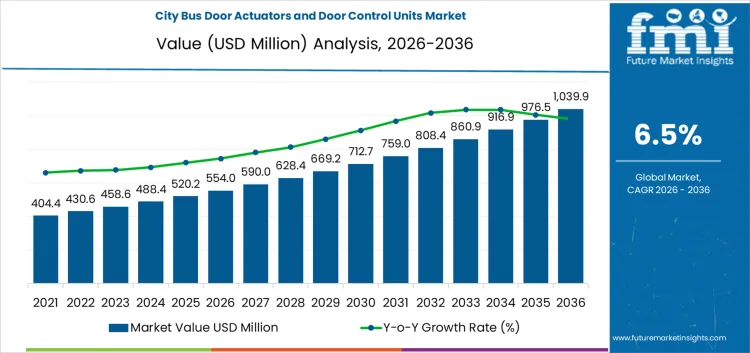
Electrification influences control unit specification without materially increasing unit complexity at scale. Manufacturing expansion remains constrained by safety validation, transit authority approval cycles, and integration requirements with braking and kneeling systems. Demand progression remains steady, supported by urban ridership recovery, disciplined fleet maintenance, and structured public transport investment rather than expansion of route density or vehicle count.
City Bus Door Actuators and Door Control Units Market Key Takeaways
| Metric | Value |
|---|---|
| Market Value (2026) | USD 554.0 million |
| Market Forecast Value (2036) | USD 1,039.9 million |
| Forecast CAGR 2026 to 2036 | 6.5% |
Why is the Demand for City Bus Door Actuators and Door Control Units Growing?
Demand for city bus door actuators and door control units is rising as transit authorities and fleet operators require reliable systems that support frequent stop start operations and passenger safety. Urban transit planners specify actuators and control units that meet performance criteria for rapid response, weather tolerance, and low maintenance needs because buses operate in diverse conditions with heavy daily cycles. Engineers assess torque output, latch integrity, and control logic compatibility with vehicle electronics when selecting components for new buses and retrofit programs. Safety regulators emphasize compliance with passenger access standards and fail safe door operation to support accessibility requirements and collision avoidance protocols.
Transit maintenance teams prioritize units that reduce downtime and simplify diagnostics to support scheduled service intervals and operational continuity. Growth in public transportation usage and fleet renewal programs reinforces adoption of advanced door actuators and control units because reliable door operation affects passenger flow and schedule adherence. Procurement professionals evaluate supplier support, spare part availability, and integration with vehicle communication networks to minimize service disruptions in high utilization environments. Coordination with bus body builders and system integrators ensures solutions align with vehicle architecture and support diagnostic feedback loops that inform maintenance planning. These factors support sustained uptake of door actuation and control solutions in evolving transit operations.
How Are the Segments Classified in the City Bus Door Actuators and Door Control Units Market?
Demand for city bus door actuators and control units is shaped by passenger safety requirements, boarding efficiency targets, and urban transit operating intensity. Public transport operators prioritize reliable door operation supporting high passenger turnover and frequent stop cycles. System selection emphasizes response consistency, fault tolerance, and compliance with safety regulations. Electrification of bus fleets and automation of door functions influence technology choices. Segment classification reflects differentiation by door position, actuation mechanism, and control system configuration. Structure highlights how door usage frequency, actuation reliability, and control integration influence specification priorities, maintenance cycles, and deployment patterns across urban bus fleets.
Which Door Type Represents the Largest Share of Demand?
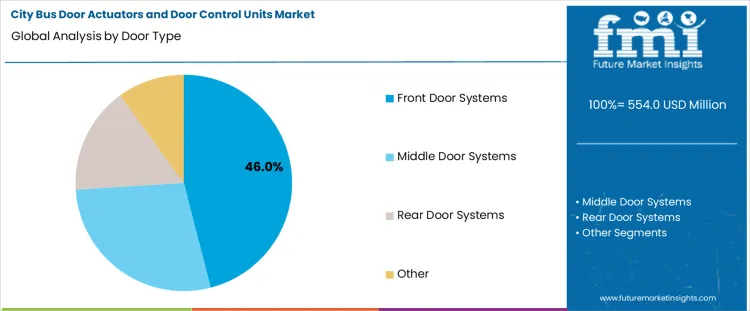
Front door systems hold 46.0%, representing the largest share among door types due to primary passenger boarding and fare interaction functions. These doors experience the highest cycle frequency during daily operations. Reliability directly affects schedule adherence and passenger flow efficiency. Integration with ticketing, accessibility, and driver control interfaces increases system complexity and specification priority. Middle and rear door systems support passenger distribution and alighting with lower individual cycle intensity. Other door configurations address specialized layouts. Door type segmentation reflects emphasis on front-door reliability where operational continuity and safety oversight remain most critical.
Key Points
- Front doors handle the highest passenger interaction frequency.
- System reliability affects dwell time and schedule adherence.
- Other doors support flow distribution with lower cycle intensity.
Which Actuation Method Accounts for the Highest Share of Demand?
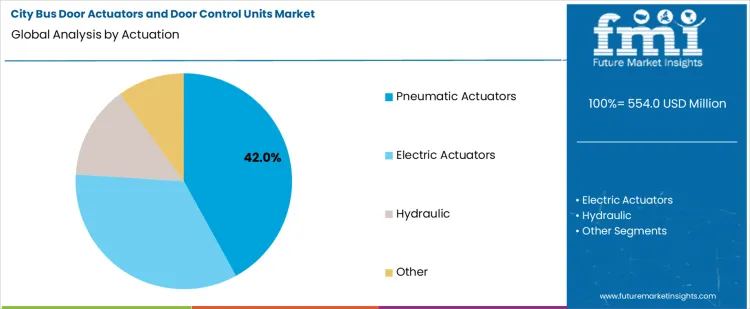
Pneumatic actuators hold 42.0%, representing the largest share among actuation methods due to proven robustness in transit environments. Pneumatic systems deliver consistent force and tolerate frequent cycling under variable weather conditions. Existing compressed air infrastructure on buses supports integration without significant redesign. Maintenance familiarity among operators reinforces continued use. Electric actuators offer precise control and reduced noise with growing adoption. Hydraulic systems address high-force requirements with added complexity. Actuation segmentation reflects preference for established, resilient solutions aligned with existing bus system architectures and maintenance practices.
Key Points
- Pneumatic actuation supports frequent, high-cycle operation.
- Existing air systems simplify integration and maintenance.
- Other actuation methods address precision or force requirements.
Which Control Unit Configuration Drives the Largest Share of Demand?
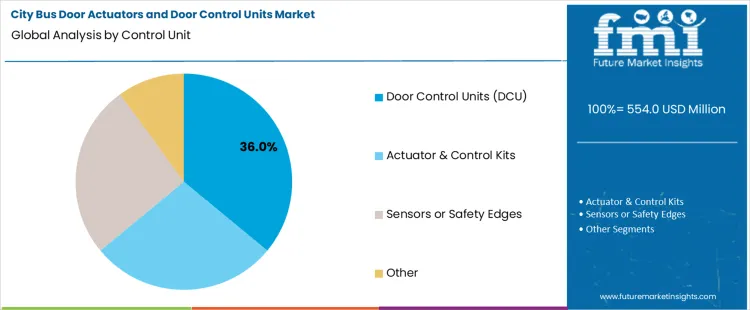
Door control units hold 36.0%, representing the largest share among control configurations due to centralized management capability. DCUs coordinate actuator movement, safety interlocks, and sensor feedback. Centralized logic improves fault detection and response consistency across door systems. Integration supports compliance with safety standards governing obstruction detection and emergency operation. Actuator and control kits offer modular deployment flexibility. Sensors and safety edges provide critical protection functions with supportive roles. Control unit segmentation reflects reliance on centralized electronic control for predictable, safe, and coordinated door operation in urban bus service conditions.
Key Points
- Centralized control improves safety and operational consistency.
- Integrated logic supports fault detection and compliance.
- Other components provide modularity and protection support.
What are the Key Dynamics in the City Bus Door Actuators and Door Control Units Market?
Demand for city bus door actuators and door control units reflects operational need for safe, reliable, and high-cycle passenger access systems in urban transit fleets. Adoption spans pneumatic, electric, and electro-pneumatic actuation paired with centralized control electronics. Global scope aligns with public transport utilization intensity, accessibility standards, and fleet modernization programs. Usage centers on rapid opening cycles, fault tolerance, and integration with vehicle control networks.
How do passenger throughput requirements and safety compliance shape adoption?
Urban bus operations require fast, synchronized door movement to minimize dwell time at stops while maintaining passenger safety. Demand increases as high-frequency routes experience repeated opening cycles under peak load conditions. Accessibility regulations drive adoption of precise control units enabling obstacle detection, interlock logic, and ramp coordination. Electric actuators gain preference where noise reduction and energy efficiency support urban operating constraints. Integration with braking, kneeling, and driver alert systems improves coordinated door operation. Fleet operators value diagnostics that report faults and cycle counts to support preventive maintenance. Adoption reflects requirement for consistent performance across varied weather and contamination conditions common to city routes.
How does lifecycle cost pressure and reliability expectations influence market scalability?
Public transport procurement emphasizes total ownership cost, placing pressure on component pricing and durability. Demand sensitivity rises where budget allocations favor refurbishment over full vehicle replacement. Actuators operate under vibration, dust, and moisture exposure, elevating failure risk and warranty scrutiny. Standardization across fleet models limits supplier flexibility when legacy interfaces persist. Certification requirements for safety-critical systems increase validation expense and lead times. Maintenance access constraints affect replacement labor cost. Supply chain dependence on valves, motors, sensors, and control electronics introduces availability risk. High reliability expectations restrict rapid design changes, constraining scalable rollout across heterogeneous bus platforms.
How Is Demand for City Bus Door Actuators and Door Control Units Evolving Globally?
Demand for city bus door actuators and door control units is expanding globally due to public transport fleet renewal, accessibility compliance, and reliability requirements in high-frequency urban operations. Automatic door systems remain critical for passenger safety, dwell time reduction, and operational efficiency. Electrification of bus fleets and adoption of electronic control architectures influence actuator and control unit specification. Retrofit demand also contributes where aging fleets undergo modernization. Growth rates in China at 7.9%, Brazil at 7.7%, USA at 6.2%, Germany at 6.0%, and South Korea at 5.9% indicate sustained expansion driven by urban transit investment, fleet standardization, and lifecycle replacement dynamics.
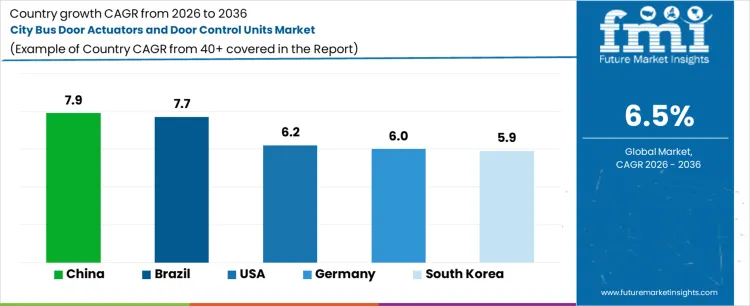
| Country | CAGR (%) |
|---|---|
| China | 7.9% |
| Brazil | 7.7% |
| USA | 6.2% |
| Germany | 6.0% |
| South Korea | 5.9% |
What Is Driving Growth of City Bus Door System Demand in China?
City bus door actuator and control unit demand in China is growing at a CAGR of 7.9%, supported by large-scale urban transit deployment and fleet electrification. High passenger throughput places mechanical and electronic stress on door systems, accelerating replacement cycles. Municipal procurement standards emphasize reliability, rapid actuation, and fault monitoring capabilities. Expansion of electric bus fleets requires door systems compatible with low-voltage electronic architectures. High-frequency stop patterns in dense cities reinforce demand for durable actuators. Strong domestic bus manufacturing enables standardized integration across new vehicles and retrofit programs.
- Large urban electric bus fleet deployment
- High passenger throughput increasing duty cycles
- Municipal standards for door reliability and safety
- Strong domestic bus OEM integration
Why Is Brazil Experiencing Rising Demand for Bus Door Actuators?
City bus door actuator and control unit demand in Brazil is expanding at a CAGR of 7.7%, driven by fleet modernization and urban transport capacity expansion. High daily operating hours in metropolitan bus systems accelerate wear on pneumatic and electric door actuators. Accessibility regulations increase adoption of controlled, synchronized door operation. Electric and hybrid bus pilots introduce electronically controlled door systems. Climate exposure and vibration from road conditions increase maintenance-driven replacement. Demand growth reflects operational intensity and regulatory compliance rather than expansion of route networks.
- High daily bus utilization in urban corridors
- Accessibility compliance requirements
- Introduction of electric and hybrid buses
- Maintenance-driven replacement under harsh conditions
How Is the USA Sustaining Demand for City Bus Door Control Systems?
City bus door actuator and control unit demand in the USA is growing at a CAGR of 6.2%, supported by transit authority fleet replacement programs. Aging bus fleets undergo systematic upgrades to improve reliability and safety. Door control units integrate with vehicle diagnostics to reduce service disruptions. Accessibility standards influence actuator responsiveness and control logic. Electric bus adoption introduces demand for electrically driven door mechanisms. Growth remains steady, reflecting replacement cycles and technology upgrades within established public transit systems.
- Transit agency fleet replacement programs
- Integration with vehicle diagnostics systems
- Accessibility-driven door control requirements
- Gradual electrification of city bus fleets
What Factors Are Supporting Demand for Bus Door Systems in Germany?
City bus door actuator and control unit demand in Germany is expanding at a CAGR of 6.0%, shaped by engineering standards and preventive maintenance practices. Public transport operators prioritize precise door control to manage passenger flow and safety. High-quality electronic control units support fault detection and system redundancy. Electrification of bus fleets reinforces shift toward electric actuators. Structured maintenance schedules create predictable replacement demand. Growth reflects disciplined fleet management rather than rapid expansion of bus numbers.
- High engineering and safety standards
- Preventive maintenance-driven replacement cycles
- Electric actuator adoption with bus electrification
- Emphasis on passenger flow efficiency
Why Is South Korea Showing Controlled Growth in City Bus Door Actuators?
City bus door actuator and control unit demand in South Korea is growing at a CAGR of 5.9%, influenced by dense urban transit usage and efficient fleet management. High-frequency stop operations require reliable door actuation with minimal downtime. Smart transit initiatives integrate door control with onboard electronics and monitoring systems. Electric bus deployment increases demand for electronically controlled door units. Strong maintenance discipline moderates replacement frequency. Growth remains controlled, driven by system upgrades and standardization rather than fleet size expansion.
- High-frequency urban bus operations
- Integration with smart transit electronics
- Expansion of electric city bus fleets
- Strong maintenance discipline limiting failures
What is the competitive landscape of demand for the city bus door actuators and door control units market globally?
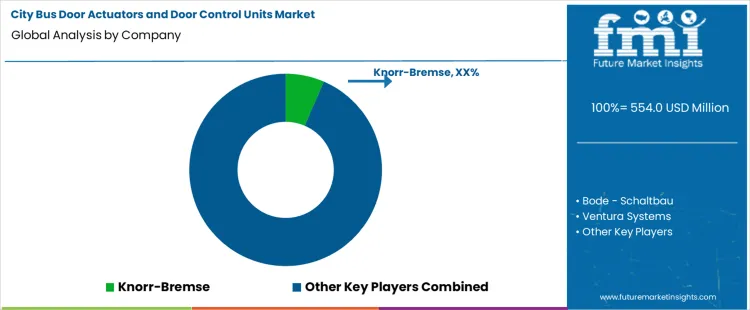
Demand for city bus door actuators and door control units is driven by urban mass transit growth, focus on passenger safety, and requirements for rapid, reliable door operation in high-frequency service environments. Buyers evaluate actuator force, cycle life, response time, redundancy, compliance with safety standards, noise levels, and compatibility with modular bus platforms. Procurement teams prioritize suppliers with proven reliability, global service networks, integration expertise with vehicle electronics, and certification to international transit and safety norms. Trend in the global market reflects increased electrification of transit fleets, expansion of articulated and double-decker buses, and emphasis on fail-safe door control logic to improve passenger flow and operational uptime.
Knorr-Bremse holds leading positioning through a comprehensive portfolio of door actuation systems and control units integrated with vehicle safety and electronic subsystems. Bode-Schaltbau supports demand with robust door actuators and control solutions designed for heavy-duty transit applications and high-cycle operation. Ventura Systems participates with modular actuator and control platforms optimized for urban bus designs and global deployment. Masats supplies door actuation mechanisms and control logic tailored to transit and rail applications with strong engineering integration. Kiepe Electric contributes door control units and automation interfaces used in electric and hybrid bus systems. Competitive differentiation depends on actuator durability, control unit logic reliability, safety feature support, and ability to meet stringent transit authority standards across regions.
Key Players in the City Bus Door Actuators and Door Control Units Market
- Knorr-Bremse
- Bode-Schaltbau
- Ventura Systems
- Masats
- Kiepe Electric
- Festo
- Parker Hannifin
- Bosch
- Continental
Scope of the Report
| Items | Values |
|---|---|
| Quantitative Units | USD million |
| Door Type | Front Door Systems; Middle Door Systems; Rear Door Systems; Other |
| Actuation | Pneumatic Actuators; Electric Actuators; Hydraulic; Other |
| Control Unit | Door Control Units (DCU); Actuator & Control Kits; Sensors or Safety Edges; Other |
| Sales Channel | Bus OEM Line-Fit; Aftermarket; Dealer or OES; Other |
| Regions Covered | Asia Pacific, Europe, North America, Latin America, Middle East & Africa |
| Countries Covered | China, Brazil, USA, Germany, South Korea, and 40+ countries |
| Key Companies Profiled | Knorr-Bremse; Bode-Schaltbau; Ventura Systems; Masats; Kiepe Electric; Festo; Parker Hannifin; Bosch; Continental |
| Additional Attributes | Dollar sales by door type and actuation; adoption trends for electric door actuators replacing pneumatic systems in urban bus fleets; opening and closing cycle time, obstruction detection sensitivity, and fail-safe performance metrics; integration with vehicle CAN networks, passenger counting, and accessibility systems; maintenance intervals, component durability, and lifecycle cost considerations; compliance with public transport safety standards, accessibility regulations, and OEM validation requirements influencing city bus door system selection. |
City Bus Door Actuators and Door Control Units Market by Segment
Door Type:
- Front Door Systems
- Middle Door Systems
- Rear Door Systems
- Other
Actuation:
- Pneumatic Actuators
- Electric Actuators
- Hydraulic
- Other
Control Unit:
- Door Control Units (DCU)
- Actuator & Control Kits
- Sensors or Safety Edges
- Other
Sales Channel:
- Bus OEM Line-Fit
- Aftermarket
- Dealer or OES
- Other
Region:
- Asia Pacific
- China
- Japan
- South Korea
- India
- Australia & New Zealand
- ASEAN
- Rest of Asia Pacific
- Europe
- Germany
- United Kingdom
- France
- Italy
- Spain
- Nordic
- BENELUX
- Rest of Europe
- North America
- United States
- Canada
- Mexico
- Latin America
- Brazil
- Chile
- Rest of Latin America
- Middle East & Africa
- Kingdom of Saudi Arabia
- Other GCC Countries
- Turkey
- South Africa
- Other African Union
- Rest of Middle East & Africa
Bibliography
- International Association of Public Transport (UITP). (2024).Urban bus fleet renewal, accessibility requirements, and door system reliability standards. UITP Knowledge Briefs.
- International Organization of Motor Vehicle Manufacturers (OICA). (2024).Bus production trends and component demand in urban public transport. OICA Statistical Publications.
- Society of Automotive Engineers International. (2023).Design considerations, safety logic, and lifecycle performance of bus door actuators and control units. SAE Technical Papers.
- European Commission Directorate-General for Mobility and Transport. (2024).Accessibility, safety, and technical requirements for doors in public service vehicles. EU Transport Studies.
Frequently Asked Questions
How big is the city bus door actuators and door control units market in 2026?
The global city bus door actuators and door control units market is estimated to be valued at USD 554.0 million in 2026.
What will be the size of city bus door actuators and door control units market in 2036?
The market size for the city bus door actuators and door control units market is projected to reach USD 1,039.9 million by 2036.
How much will be the city bus door actuators and door control units market growth between 2026 and 2036?
The city bus door actuators and door control units market is expected to grow at a 6.5% CAGR between 2026 and 2036.
What are the key product types in the city bus door actuators and door control units market?
The key product types in city bus door actuators and door control units market are front door systems, middle door systems, rear door systems and other.
Which actuation segment to contribute significant share in the city bus door actuators and door control units market in 2026?
In terms of actuation, pneumatic actuators segment to command 42.0% share in the city bus door actuators and door control units market in 2026.
Preview the report firsthand - request a free sample
Get SampleGet the brochure for pricing and purchase details.
Get PDFTable of Content
- Executive Summary
- Global Market Outlook
- Demand-side Trends
- Supply-side Trends
- Technology Roadmap Analysis
- Analysis and Recommendations
- Market Overview
- Market Coverage / Taxonomy
- Market Definition / Scope / Limitations
- Market Background
- Market Dynamics
- Drivers
- Restraints
- Opportunity
- Trends
- Scenario Forecast
- Demand in Optimistic Scenario
- Demand in Likely Scenario
- Demand in Conservative Scenario
- Opportunity Map Analysis
- Product Life Cycle Analysis
- Supply Chain Analysis
- Investment Feasibility Matrix
- Value Chain Analysis
- PESTLE and Porter’s Analysis
- Regulatory Landscape
- Regional Parent Market Outlook
- Production and Consumption Statistics
- Import and Export Statistics
- Market Dynamics
- Global Market Analysis 2021 to 2025 and Forecast, 2026 to 2036
- Historical Market Size Value (USD Million) Analysis, 2021 to 2025
- Current and Future Market Size Value (USD Million) Projections, 2026 to 2036
- Y-o-Y Growth Trend Analysis
- Absolute $ Opportunity Analysis
- Global Market Pricing Analysis 2021 to 2025 and Forecast 2026 to 2036
- Global Market Analysis 2021 to 2025 and Forecast 2026 to 2036, By Door Type
- Introduction / Key Findings
- Historical Market Size Value (USD Million) Analysis By Door Type , 2021 to 2025
- Current and Future Market Size Value (USD Million) Analysis and Forecast By Door Type , 2026 to 2036
- Front Door Systems
- Middle Door Systems
- Rear Door Systems
- Other
- Front Door Systems
- Y-o-Y Growth Trend Analysis By Door Type , 2021 to 2025
- Absolute $ Opportunity Analysis By Door Type , 2026 to 2036
- Global Market Analysis 2021 to 2025 and Forecast 2026 to 2036, By Actuation
- Introduction / Key Findings
- Historical Market Size Value (USD Million) Analysis By Actuation, 2021 to 2025
- Current and Future Market Size Value (USD Million) Analysis and Forecast By Actuation, 2026 to 2036
- Pneumatic Actuators
- Electric Actuators
- Hydraulic
- Other
- Pneumatic Actuators
- Y-o-Y Growth Trend Analysis By Actuation, 2021 to 2025
- Absolute $ Opportunity Analysis By Actuation, 2026 to 2036
- Global Market Analysis 2021 to 2025 and Forecast 2026 to 2036, By Control Value (USD Million)
- Introduction / Key Findings
- Historical Market Size Value (USD Million) Analysis By Control Value (USD Million), 2021 to 2025
- Current and Future Market Size Value (USD Million) Analysis and Forecast By Control Value (USD Million), 2026 to 2036
- Door Control Value (USD Million)s (DCU)
- Actuator & Control Kits
- Sensors or Safety Edges
- Other
- Door Control Value (USD Million)s (DCU)
- Y-o-Y Growth Trend Analysis By Control Value (USD Million), 2021 to 2025
- Absolute $ Opportunity Analysis By Control Value (USD Million), 2026 to 2036
- Global Market Analysis 2021 to 2025 and Forecast 2026 to 2036, By Sales Channel
- Introduction / Key Findings
- Historical Market Size Value (USD Million) Analysis By Sales Channel, 2021 to 2025
- Current and Future Market Size Value (USD Million) Analysis and Forecast By Sales Channel, 2026 to 2036
- Bus OEM Line-Fit
- Aftermarket / MRO
- Dealer or OES
- Other
- Bus OEM Line-Fit
- Y-o-Y Growth Trend Analysis By Sales Channel, 2021 to 2025
- Absolute $ Opportunity Analysis By Sales Channel, 2026 to 2036
- Global Market Analysis 2021 to 2025 and Forecast 2026 to 2036, By Region
- Introduction
- Historical Market Size Value (USD Million) Analysis By Region, 2021 to 2025
- Current Market Size Value (USD Million) Analysis and Forecast By Region, 2026 to 2036
- North America
- Latin America
- Western Europe
- Eastern Europe
- East Asia
- South Asia and Pacific
- Middle East & Africa
- Market Attractiveness Analysis By Region
- North America Market Analysis 2021 to 2025 and Forecast 2026 to 2036, By Country
- Historical Market Size Value (USD Million) Trend Analysis By Market Taxonomy, 2021 to 2025
- Market Size Value (USD Million) Forecast By Market Taxonomy, 2026 to 2036
- By Country
- USA
- Canada
- Mexico
- By Door Type
- By Actuation
- By Control Value (USD Million)
- By Sales Channel
- By Country
- Market Attractiveness Analysis
- By Country
- By Door Type
- By Actuation
- By Control Value (USD Million)
- By Sales Channel
- Key Takeaways
- Latin America Market Analysis 2021 to 2025 and Forecast 2026 to 2036, By Country
- Historical Market Size Value (USD Million) Trend Analysis By Market Taxonomy, 2021 to 2025
- Market Size Value (USD Million) Forecast By Market Taxonomy, 2026 to 2036
- By Country
- Brazil
- Chile
- Rest of Latin America
- By Door Type
- By Actuation
- By Control Value (USD Million)
- By Sales Channel
- By Country
- Market Attractiveness Analysis
- By Country
- By Door Type
- By Actuation
- By Control Value (USD Million)
- By Sales Channel
- Key Takeaways
- Western Europe Market Analysis 2021 to 2025 and Forecast 2026 to 2036, By Country
- Historical Market Size Value (USD Million) Trend Analysis By Market Taxonomy, 2021 to 2025
- Market Size Value (USD Million) Forecast By Market Taxonomy, 2026 to 2036
- By Country
- Germany
- UK
- Italy
- Spain
- France
- Nordic
- BENELUX
- Rest of Western Europe
- By Door Type
- By Actuation
- By Control Value (USD Million)
- By Sales Channel
- By Country
- Market Attractiveness Analysis
- By Country
- By Door Type
- By Actuation
- By Control Value (USD Million)
- By Sales Channel
- Key Takeaways
- Eastern Europe Market Analysis 2021 to 2025 and Forecast 2026 to 2036, By Country
- Historical Market Size Value (USD Million) Trend Analysis By Market Taxonomy, 2021 to 2025
- Market Size Value (USD Million) Forecast By Market Taxonomy, 2026 to 2036
- By Country
- Russia
- Poland
- Hungary
- Balkan & Baltic
- Rest of Eastern Europe
- By Door Type
- By Actuation
- By Control Value (USD Million)
- By Sales Channel
- By Country
- Market Attractiveness Analysis
- By Country
- By Door Type
- By Actuation
- By Control Value (USD Million)
- By Sales Channel
- Key Takeaways
- East Asia Market Analysis 2021 to 2025 and Forecast 2026 to 2036, By Country
- Historical Market Size Value (USD Million) Trend Analysis By Market Taxonomy, 2021 to 2025
- Market Size Value (USD Million) Forecast By Market Taxonomy, 2026 to 2036
- By Country
- China
- Japan
- South Korea
- By Door Type
- By Actuation
- By Control Value (USD Million)
- By Sales Channel
- By Country
- Market Attractiveness Analysis
- By Country
- By Door Type
- By Actuation
- By Control Value (USD Million)
- By Sales Channel
- Key Takeaways
- South Asia and Pacific Market Analysis 2021 to 2025 and Forecast 2026 to 2036, By Country
- Historical Market Size Value (USD Million) Trend Analysis By Market Taxonomy, 2021 to 2025
- Market Size Value (USD Million) Forecast By Market Taxonomy, 2026 to 2036
- By Country
- India
- ASEAN
- Australia & New Zealand
- Rest of South Asia and Pacific
- By Door Type
- By Actuation
- By Control Value (USD Million)
- By Sales Channel
- By Country
- Market Attractiveness Analysis
- By Country
- By Door Type
- By Actuation
- By Control Value (USD Million)
- By Sales Channel
- Key Takeaways
- Middle East & Africa Market Analysis 2021 to 2025 and Forecast 2026 to 2036, By Country
- Historical Market Size Value (USD Million) Trend Analysis By Market Taxonomy, 2021 to 2025
- Market Size Value (USD Million) Forecast By Market Taxonomy, 2026 to 2036
- By Country
- Kingdom of Saudi Arabia
- Other GCC Countries
- Turkiye
- South Africa
- Other African Union
- Rest of Middle East & Africa
- By Door Type
- By Actuation
- By Control Value (USD Million)
- By Sales Channel
- By Country
- Market Attractiveness Analysis
- By Country
- By Door Type
- By Actuation
- By Control Value (USD Million)
- By Sales Channel
- Key Takeaways
- Key Countries Market Analysis
- USA
- Pricing Analysis
- Market Share Analysis, 2025
- By Door Type
- By Actuation
- By Control Value (USD Million)
- By Sales Channel
- Canada
- Pricing Analysis
- Market Share Analysis, 2025
- By Door Type
- By Actuation
- By Control Value (USD Million)
- By Sales Channel
- Mexico
- Pricing Analysis
- Market Share Analysis, 2025
- By Door Type
- By Actuation
- By Control Value (USD Million)
- By Sales Channel
- Brazil
- Pricing Analysis
- Market Share Analysis, 2025
- By Door Type
- By Actuation
- By Control Value (USD Million)
- By Sales Channel
- Chile
- Pricing Analysis
- Market Share Analysis, 2025
- By Door Type
- By Actuation
- By Control Value (USD Million)
- By Sales Channel
- Germany
- Pricing Analysis
- Market Share Analysis, 2025
- By Door Type
- By Actuation
- By Control Value (USD Million)
- By Sales Channel
- UK
- Pricing Analysis
- Market Share Analysis, 2025
- By Door Type
- By Actuation
- By Control Value (USD Million)
- By Sales Channel
- Italy
- Pricing Analysis
- Market Share Analysis, 2025
- By Door Type
- By Actuation
- By Control Value (USD Million)
- By Sales Channel
- Spain
- Pricing Analysis
- Market Share Analysis, 2025
- By Door Type
- By Actuation
- By Control Value (USD Million)
- By Sales Channel
- France
- Pricing Analysis
- Market Share Analysis, 2025
- By Door Type
- By Actuation
- By Control Value (USD Million)
- By Sales Channel
- India
- Pricing Analysis
- Market Share Analysis, 2025
- By Door Type
- By Actuation
- By Control Value (USD Million)
- By Sales Channel
- ASEAN
- Pricing Analysis
- Market Share Analysis, 2025
- By Door Type
- By Actuation
- By Control Value (USD Million)
- By Sales Channel
- Australia & New Zealand
- Pricing Analysis
- Market Share Analysis, 2025
- By Door Type
- By Actuation
- By Control Value (USD Million)
- By Sales Channel
- China
- Pricing Analysis
- Market Share Analysis, 2025
- By Door Type
- By Actuation
- By Control Value (USD Million)
- By Sales Channel
- Japan
- Pricing Analysis
- Market Share Analysis, 2025
- By Door Type
- By Actuation
- By Control Value (USD Million)
- By Sales Channel
- South Korea
- Pricing Analysis
- Market Share Analysis, 2025
- By Door Type
- By Actuation
- By Control Value (USD Million)
- By Sales Channel
- Russia
- Pricing Analysis
- Market Share Analysis, 2025
- By Door Type
- By Actuation
- By Control Value (USD Million)
- By Sales Channel
- Poland
- Pricing Analysis
- Market Share Analysis, 2025
- By Door Type
- By Actuation
- By Control Value (USD Million)
- By Sales Channel
- Hungary
- Pricing Analysis
- Market Share Analysis, 2025
- By Door Type
- By Actuation
- By Control Value (USD Million)
- By Sales Channel
- Kingdom of Saudi Arabia
- Pricing Analysis
- Market Share Analysis, 2025
- By Door Type
- By Actuation
- By Control Value (USD Million)
- By Sales Channel
- Turkiye
- Pricing Analysis
- Market Share Analysis, 2025
- By Door Type
- By Actuation
- By Control Value (USD Million)
- By Sales Channel
- South Africa
- Pricing Analysis
- Market Share Analysis, 2025
- By Door Type
- By Actuation
- By Control Value (USD Million)
- By Sales Channel
- USA
- Market Structure Analysis
- Competition Dashboard
- Competition Benchmarking
- Market Share Analysis of Top Players
- By Regional
- By Door Type
- By Actuation
- By Control Value (USD Million)
- By Sales Channel
- Competition Analysis
- Competition Deep Dive
- Knorr-Bremse
- Overview
- Product Portfolio
- Profitability by Market Segments (Product/Age /Sales Channel/Region)
- Sales Footprint
- Strategy Overview
- Marketing Strategy
- Product Strategy
- Channel Strategy
- Bode - Schaltbau
- Ventura Systems
- Masats
- Irisbus supplier networks
- Kiepe Electric
- Festo
- Parker Hannifin
- Bosch
- Continental
- Knorr-Bremse
- Competition Deep Dive
- Assumptions & Acronyms Used
- Research Methodology


