

- Industry Size (2026)
- USD 8.5 Bn
- Forecast (2036)
- USD 19.4 Bn
- CAGR (2026 to 2036)
- 8.6%
GPS Tracking Device Market Forecast and Outlook 2026 to 2036
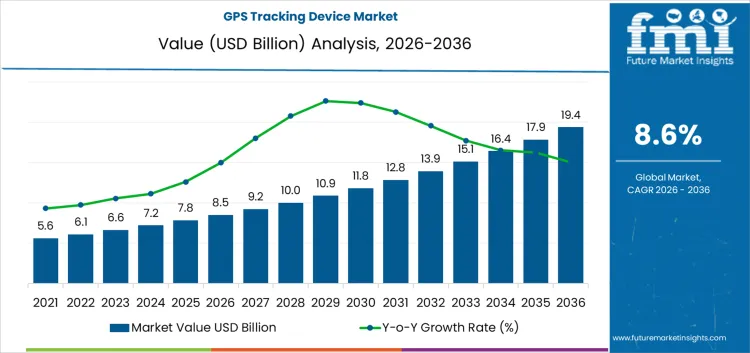
A move from USD 8.5 billion in 2026 to USD 19.4 billion by 2036 places the GPS tracking device market on an 8.6% CAGR path. Demand is concentrated in regions with large commercial vehicle fleets, formal logistics networks, and strong insurance and compliance enforcement, notably North America, Western Europe, and parts of East Asia. Adoption remains uneven because many markets still rely on manual logs or basic telematics. Public safety rules, fleet oversight mandates, and theft recovery programs shape procurement more than consumer usage. Electronics manufacturing and assembly cost advantages in East Asia continue to influence global pricing and supply structures.
Total cost of ownership governs most purchasing decisions in this category. Fleet operators evaluate installation labor, data connectivity, software integration, and device lifespan when standardizing platforms. Once tracking systems are embedded into dispatch, billing, and regulatory reporting workflows, switching costs rise and supplier lists narrow. Smaller operators often enter through bundled hardware and service offers, while large fleets negotiate multi-year contracts. The market expands through regulatory enforcement and operational digitization rather than through uniform consumer adoption of standalone tracking devices.
Quick Stats for GPS Tracking Device Market
- GPS Tracking Device Market Value (2026): USD 8.5 billion
- GPS Tracking Device Market Forecast Value (2036): USD 19.4 billion
- GPS Tracking Device Market Forecast CAGR 2026 to 2036: 8.6%
- Leading Type in GPS Tracking Device Market: Personal GPS trackers
- Key Growth Regions in GPS Tracking Device Market: Asia Pacific, North America, Europe
- Top Players in GPS Tracking Device Market: Garmin, TomTom, Trimble, Aptiv (via Mojio), CalAmp, Teletrac Navman, Sierra Wireless
What is the Growth Forecast for GPS Tracking Device Market through 2036?
The GPS tracking device market has been expanding on the back of operational visibility becoming a baseline requirement rather than a premium feature. In 2020, the market was still around USD 4.7 billion and crossed USD 5.6 billion by 2022 as fleet operators, logistics companies, and service businesses began treating tracking as standard equipment. By 2024 it had moved past USD 6.6 billion and reached about USD 8.5 billion by 2026, driven largely by commercial vehicles, asset tracking, and basic telematics deployments. This phase of growth is volume-led and installation-led, with many operators still in the first wave of equipping vehicles, containers, and high-value assets. Price pressure remains visible, but rising unit counts keep total market value moving upward.
As the installed base expands, the market shifts into a density and upgrade phase rather than a first-install phase. After crossing roughly USD 10.9 billion and then USD 13.0 billion in the early 2030s, demand is increasingly shaped by multi-device deployments per fleet, replacement of older 2G and 3G units, and integration into broader fleet and asset management platforms. By the time the market moves through the USD 15.6 to 17.1 billion range and approaches about USD 19.4 billion toward the end of the period, growth is coming more from deeper penetration per customer and higher-value devices than from simple new user additions. The economics shift toward software compatibility, data reliability, and lifecycle management rather than hardware alone, making platform lock-in and service continuity more important than unit price competition.
GPS Tracking Device Market Key Takeaways
| Metric | Value |
|---|---|
| Market Value (2026) | USD 8.5 billion |
| Forecast Value (2036) | USD 19.4 billion |
| Forecast CAGR 2026 to 2036 | 8.6% |
How Is the GPS Tracking Device Market Shaping Asset and Fleet Management?
GPS tracking devices are increasingly adopted to monitor vehicles, assets, and shipments in real time, enabling operational efficiency, route optimization, and theft prevention. Historically, asset tracking relied on manual logs and radio-based systems, which offered limited visibility, delayed reporting, and higher risk of loss or mismanagement. Modern GPS devices integrate satellite positioning, cellular connectivity, and cloud-based software to provide continuous tracking, geofencing, and analytics for fleet operators and logistics providers.
Early adoption focused on commercial fleets and high-value asset management, while current demand spans consumer vehicles, supply chain logistics, and industrial equipment, driven by operational efficiency, regulatory compliance, and security concerns. Device accuracy, connectivity reliability, and data integration capabilities influence supplier selection.
Operational oversight, compliance with transportation regulations, and asset security are driving market dynamics. Compared with conventional tracking methods, modern GPS systems emphasize real-time visibility, predictive analytics, and integration with fleet management platforms to enhance efficiency and reduce losses.
Cost structures depend on device quality, communication infrastructure, and software platforms, concentrating margins among suppliers capable of delivering reliable, high-performance solutions. Fleet operators, logistics companies, and consumers adopt GPS tracking devices to optimize routes, safeguard assets, and improve operational accountability. By 2036, GPS tracking solutions are expected to become a standard tool for fleet and asset management, supporting operational efficiency, theft prevention, and informed decision-making across industries.
What Factors Are Shaping the Segment Wise Demand for GPS Tracking Devices by Device Form and Use Case in 2026?
The GPS tracking device market in 2026 is segmented by device type and by application. By device form, demand is divided into personal GPS trackers, vehicle trackers, asset trackers, and wearable GPS devices, each designed around different power, mounting, and usage patterns. By application, demand is organized around fleet management, personal safety and fitness, asset tracking and logistics, and pet tracking, which differ in scale of deployment, data reporting frequency, and tolerance for downtime. These segments reflect how buyers balance coverage scale, operating cost, and reliability while selecting tracking solutions for either continuous monitoring or event driven use.
Why Do Personal GPS Trackers Lead Device Volumes?
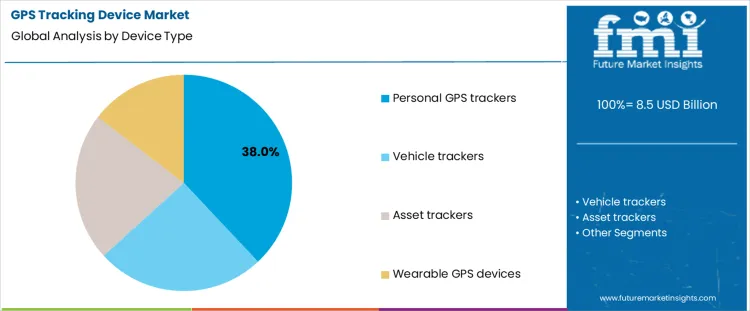
Personal GPS trackers account for about 38% of demand in 2026, largely because they serve a wide range of individual and family use cases. These devices are used for child and elderly monitoring, travel safety, and basic location sharing, which creates a broad consumer base rather than a narrow professional one. Unit prices are relatively low, and replacement cycles are short because products are frequently upgraded or lost. Setup is simple and does not require vehicle integration or professional installation. This combination of low entry barrier and wide applicability drives high shipment volumes even though the value per unit is modest.
Vehicle and asset trackers follow more structured procurement patterns. Vehicle trackers are often purchased in batches by fleet operators or logistics companies, which concentrates demand but limits the number of buyers. Asset trackers are tied to specific projects or inventory pools rather than to everyday consumer use. Wearable GPS devices focus on niche segments such as sports or health monitoring. These categories are important, yet none matches the sheer breadth of use cases and consumer driven replacement frequency that keeps personal GPS trackers as the largest volume device type.
Why Does Fleet Management Dominate Application Demand?
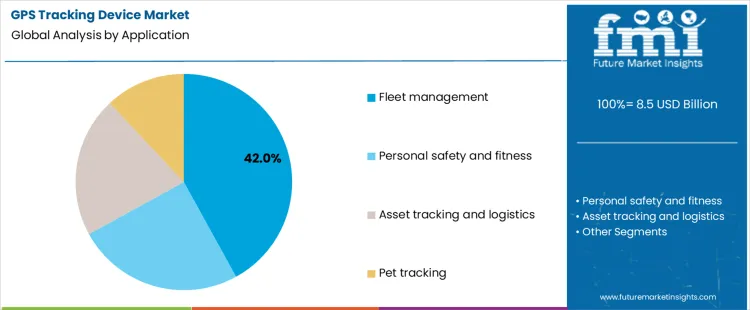
Fleet management represents about 42% of demand in 2026 because it involves large scale, continuous deployments rather than occasional or personal use. Logistics companies, service fleets, and delivery operators install tracking devices across entire vehicle pools to manage routing, utilization, and compliance. Once a fleet adopts a tracking platform, devices are installed in every vehicle and maintained over long periods, which creates stable and repeat demand. The operational value of even small efficiency gains is high when multiplied across hundreds or thousands of vehicles. This scale effect explains why fleet management absorbs the largest share of total device deployments.
Personal safety, asset logistics, and pet tracking follow different volume patterns. Personal safety devices are bought individually and often used intermittently. Asset tracking is project based and tied to specific shipments or equipment pools. Pet tracking remains a niche consumer category with limited penetration. These uses grow steadily, yet their deployments are fragmented and smaller in scale. In contrast, fleet management purchases are centralized, large, and continuous, which keeps this application as the primary driver of overall GPS tracking device demand.
How Are the Key Dynamics of Fleet Digitization, Data Governance Friction, and Platform Based Service Models Reshaping the GPS Tracking Device Market through 2036?
The category is being shaped less by hardware adoption and more by how location data is operationalized. Tracking devices are becoming standard equipment in fleets, logistics, and asset intensive operations, but growth is increasingly driven by software platforms and service models built around them. At the same time, adoption is moderated by concerns around data ownership, privacy, and integration with existing systems. Many buyers now prefer end to end solutions rather than standalone devices, which changes procurement and competitive positioning. The result is a market where scale comes from network level deployments and long term contracts, not from one off device sales.
Why Is Fleet Digitization and Asset Visibility Driving the GPS Tracking Device Market through 2036?
Demand is anchored in how organizations manage utilization, risk, and service commitments. Logistics operators, service fleets, rental companies, and public agencies rely on real time location data to reduce idle time, improve routing, and document performance. In many sectors, tracking is no longer a theft prevention tool but a core operations input. Once workflows are built around dispatch systems, geofencing, and usage analytics, tracking devices become mandatory infrastructure. Replacement and expansion follow fleet growth and network coverage goals rather than discretionary spending. This ties volume to the spread of data driven operations models and to the increasing expectation that assets should always be visible and accountable.
What Data Governance, Integration Complexity, and Organizational Resistance Are Slowing Wider Adoption?
The main barrier is not device cost but system trust. Tracking generates continuous data about vehicles, assets, and sometimes people, which raises concerns about privacy, labor relations, and regulatory compliance. Integrating location data into existing ERP, dispatch, or maintenance systems is also complex and often exposes poor data quality or process gaps. Some organizations resist the cultural change that comes with transparent monitoring. In regulated sectors, approval and policy alignment take time. These factors stretch deployment timelines and lead many buyers to start with limited pilots before committing to full fleet or network wide rollouts.
How Are Platformization and Service Based Procurement Changing the Structure of This Market?
The trend is moving away from selling devices toward selling managed visibility. Buyers increasingly choose bundled solutions that include hardware, connectivity, software, and support under multi-year contracts. This favors providers with scalable platforms and strong integration capabilities rather than pure hardware vendors. Standard device families are deployed across regions, while functionality is differentiated in software. Once a platform is selected, switching becomes costly, which reinforces long term relationships. Over time, competition shifts from unit pricing to service reliability, data quality, and ability to support large, distributed fleets as a continuous operations layer rather than as a collection of tracked objects.
What is the Demand for GPS Tracking Devices by Country?
| Country | CAGR (%) |
|---|---|
| USA | 8.0% |
| UK | 7.5% |
| China | 9.5% |
| India | 10.2% |
| Brazil | 8.3% |
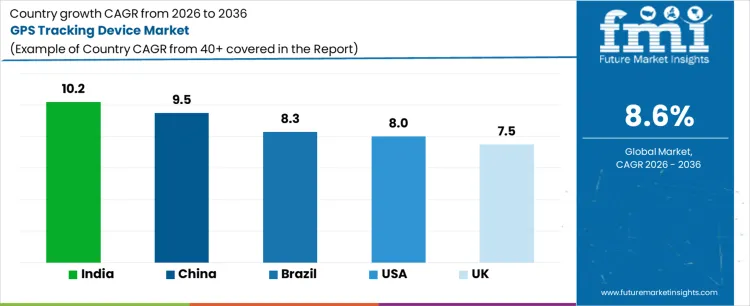
Demand for GPS tracking devices is rising as logistics, transportation, and consumer sectors adopt solutions for real-time tracking, fleet management, and asset security. India leads with a 10.2% CAGR, driven by growing transportation networks, logistics optimization needs, and rising adoption of tracking technology in commercial and personal vehicles. China follows at 9.5%, supported by fleet management requirements and expansion of commercial logistics operations. Brazil records 8.3% growth, shaped by increasing demand for vehicle and asset tracking. The USA grows at 8.0%, influenced by adoption in fleet management and consumer applications. The UK shows 7.5% CAGR, reflecting steady deployment of GPS tracking solutions in commercial and private sectors.
How is the United States experiencing growth in the GPS tracking device market?
United States is experiencing growth at a CAGR of 8%, supported by widespread adoption in fleet management, logistics, and personal vehicle tracking across states such as California, Texas, and Florida. Urban concentration and high transportation density create strong demand for real-time tracking, route optimization, and vehicle monitoring. Investments focus on integrating GPS devices with telematics platforms, mobile applications, and cloud analytics. Growth reflects operational efficiency requirements, compliance with transport regulations, and rising demand for connected fleet solutions.
- Fleet management and logistics drive adoption.
- Urban transport hubs concentrate demand.
- Devices integrate with telematics and analytics platforms.
- Regulatory compliance enhances deployment.
How is the United Kingdom witnessing growth in the GPS tracking device market?
United Kingdom is witnessing growth at a CAGR of 7.5%, driven by demand from logistics, courier services, and public transportation monitoring in London, Birmingham, and Manchester. Market concentration is moderate, with regional dispersion requiring devices capable of handling varying traffic conditions. Investments prioritize reliability, connectivity, and ease of integration into fleet management software. Growth reflects increasing emphasis on operational visibility, transport efficiency, and public safety through GPS-enabled tracking solutions.
- Logistics and courier operations drive adoption.
- Urban and regional transport networks concentrate demand.
- Reliability and integration with management software guide investment.
- Monitoring and safety requirements enhance deployment.
How is China experiencing growth in the GPS tracking device market?
China is experiencing growth at a CAGR of 9.5%, fueled by large-scale logistics operations, e-commerce fulfillment, and industrial transportation in Shanghai, Beijing, and Shenzhen. Market concentration is high in industrial clusters, with GPS tracking devices supporting real-time location monitoring, route optimization, and asset management. Investments focus on network connectivity, integration with IoT platforms, and industrial-grade device durability. Growth reflects the country’s expanding logistics and e-commerce sectors and rising demand for operational efficiency.
- Industrial logistics and e-commerce drive adoption.
- Urban and industrial clusters concentrate demand.
- Devices integrate with IoT platforms for monitoring.
- Durability and connectivity guide deployment.
How is India witnessing growth in the GPS tracking device market?
India is experiencing growth at a CAGR of 10.2%, supported by rapid expansion of logistics, delivery services, and public transport networks in Mumbai, Delhi, and Bengaluru. Market dispersion is broad, with GPS devices needed for both urban and rural transport systems. Investments prioritize low-cost, durable devices, ease of installation, and integration with digital monitoring platforms. Growth reflects the need for efficient fleet management, transport safety, and optimization of delivery networks across diverse geographies.
- Logistics and public transport expansion drive adoption.
- Urban and rural transport systems concentrate demand.
- Affordable and durable devices enhance deployment.
- Integration with digital monitoring supports growth.
How is Brazil experiencing growth in the GPS tracking device market?
Brazil is experiencing growth at a CAGR of 8.3%, driven by demand in urban delivery services, fleet logistics, and industrial transportation in São Paulo, Rio de Janeiro, and Paraná. Market concentration is moderate, with regional dispersion across large states requiring reliable GPS tracking solutions. Investments focus on device durability, network connectivity, and integration with fleet management software. Growth reflects rising operational efficiency needs, urban traffic monitoring, and expanding commercial transport networks.
- Urban delivery and industrial logistics drive adoption.
- Major urban centers concentrate demand.
- Devices integrate with fleet management platforms.
- Durability and connectivity guide investment.
Who Are the Leading Players Shaping the GPS Tracking Device Market and How Do They Differ?
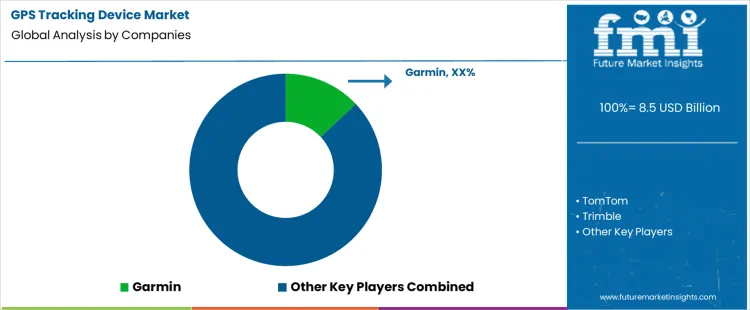
Competition in the GPS tracking device market is shaped by positioning accuracy, data connectivity, and integration with software platforms for fleet management, asset tracking, and personal navigation. Garmin supplies GPS devices with robust satellite positioning, dependable navigation algorithms, and broad product lines spanning consumer, automotive, and light fleet applications. TomTom offers tracking solutions that leverage map data and real-time traffic updates, with emphasis on route accuracy for vehicles and personal navigation. Trimble provides high-precision GPS tracking systems tailored to industrial, construction, and agriculture environments, combining rugged hardware with enterprise software integration. Aptiv, via its Mojio platform, delivers connected vehicle solutions that source GPS data from onboard telematics to support fleet analytics and driver insights. CalAmp supplies GPS tracking hardware and cloud services that enable remote monitoring of vehicles, equipment, and shipments, focusing on scalability for fleet operators.
Teletrac Navman offers GPS tracking solutions designed for fleet and mobile workforce management, with emphasis on real-time location data, compliance reporting, and integration with operational dashboards. Sierra Wireless provides embedded GPS and wireless connectivity modules that support tracking within IoT ecosystems, enabling OEMs to incorporate location services into broader telematics offerings. Other regional and specialized device makers contribute trackers optimized for low-power, narrowband IoT, and asset-specific applications such as cargo containers or rental equipment. Competitive differentiation arises from positioning accuracy, update frequency, battery life, network compatibility (cellular, GNSS constellations), and end-to-end software support. Suppliers that combine reliable hardware, secure connectivity, and analytics platforms attract buyers seeking solutions for real-time tracking, operational visibility, and integration with enterprise systems across transportation, logistics, and field services.
Key Players in the GPS Tracking Device Market
- Garmin
- TomTom
- Trimble
- Aptiv (via Mojio)
- CalAmp
- Teletrac Navman
- Sierra Wireless
Scope of the Report
| Items | Values |
|---|---|
| Quantitative Units (2026) | USD billion |
| Device Type | Personal GPS Trackers, Vehicle Trackers, Asset Trackers, Wearable GPS Devices |
| Application | Fleet Management, Personal Safety and Fitness, Asset Tracking and Logistics, Pet Tracking |
| Regions Covered | Asia Pacific, Europe, North America, Latin America, Middle East & Africa |
| Countries Covered | China, Japan, South Korea, India, Australia & New Zealand, ASEAN, Germany, United Kingdom, France, Italy, Spain, Nordic, BENELUX, United States, Canada, Mexico, Brazil, Chile, Saudi Arabia, Turkey, South Africa, and other regional markets |
| Key Companies Profiled | Garmin, TomTom, Trimble, Aptiv (via Mojio), CalAmp, Teletrac Navman, Sierra Wireless |
| Additional Attributes | Dollar sales by device type and application; fleet management as the largest deployment segment; personal trackers leading unit volumes; growth driven by fleet digitization and regulatory enforcement; replacement of legacy 2G/3G units and multi-device fleet deployments; shift toward platform-based, bundled hardware-software services; procurement shaped by total cost of ownership, data integration, and long-term service contracts. |
GPS Tracking Device Market Segmentation
Device Type:
- Personal GPS trackers
- Vehicle trackers
- Asset trackers
- Wearable GPS devices
Application:
- Fleet management
- Personal safety and fitness
- Asset tracking and logistics
- Pet tracking
Region
- Asia Pacific
- China
- Japan
- South Korea
- India
- Australia & New Zealand
- ASEAN
- Rest of Asia Pacific
- Europe
- Germany
- United Kingdom
- France
- Italy
- Spain
- Nordic
- BENELUX
- Rest of Europe
- North America
- United States
- Canada
- Mexico
- Latin America
- Brazil
- Chile
- Rest of Latin America
- Middle East & Africa
- Kingdom of Saudi Arabia
- Other GCC Countries
- Turkey
- South Africa
- Other African Union
- Rest of Middle East & Africa
Bibliography
- European Telecommunications Standards Institute. (2024). LTE; 5G; LTE positioning protocol (LPP) (3GPP TS 37.355 version 17.7.0 Release 17) (ETSI TS 137 355 V17.7.0). ETSI.
- Federal Highway Administration. (2024). Advanced transportation and congestion management technologies deployment (ATCMTD) program report: Status of the program from 2016 through 2023 (FHWA-HOP-24-066). U.S. Department of Transportation.
- National Institute of Standards and Technology. (2024). Recommended cybersecurity requirements for consumer-grade router products (NISTIR 8425A). U.S. Department of Commerce. doi:10.6028/NIST.IR.8425A
Frequently Asked Questions
How big is the gps tracking device market in 2026?
The global gps tracking device market is estimated to be valued at USD 8.5 billion in 2026.
What will be the size of gps tracking device market in 2036?
The market size for the gps tracking device market is projected to reach USD 19.4 billion by 2036.
How much will be the gps tracking device market growth between 2026 and 2036?
The gps tracking device market is expected to grow at a 8.6% CAGR between 2026 and 2036.
What are the key product types in the gps tracking device market?
The key product types in gps tracking device market are personal gps trackers , vehicle trackers, asset trackers and wearable gps devices.
Which application segment to contribute significant share in the gps tracking device market in 2026?
In terms of application, fleet management segment to command 42.0% share in the gps tracking device market in 2026.
Preview the report firsthand - request a free sample
Get SampleGet the brochure for pricing and purchase details.
Get PDFTable of Content
- Executive Summary
- Global Market Outlook
- Demand-side Trends
- Supply-side Trends
- Technology Roadmap Analysis
- Analysis and Recommendations
- Market Overview
- Market Coverage / Taxonomy
- Market Definition / Scope / Limitations
- Market Background
- Market Dynamics
- Drivers
- Restraints
- Opportunity
- Trends
- Scenario Forecast
- Demand in Optimistic Scenario
- Demand in Likely Scenario
- Demand in Conservative Scenario
- Opportunity Map Analysis
- Product Life Cycle Analysis
- Supply Chain Analysis
- Investment Feasibility Matrix
- Value Chain Analysis
- PESTLE and Porter’s Analysis
- Regulatory Landscape
- Regional Parent Market Outlook
- Production and Consumption Statistics
- Import and Export Statistics
- Market Dynamics
- Global Market Analysis 2021 to 2025 and Forecast, 2026 to 2036
- Historical Market Size Value (USD Million) Analysis, 2021 to 2025
- Current and Future Market Size Value (USD Million) Projections, 2026 to 2036
- Y-o-Y Growth Trend Analysis
- Absolute $ Opportunity Analysis
- Global Market Pricing Analysis 2021 to 2025 and Forecast 2026 to 2036
- Global Market Analysis 2021 to 2025 and Forecast 2026 to 2036, By Device Type
- Introduction / Key Findings
- Historical Market Size Value (USD Million) Analysis By Device Type, 2021 to 2025
- Current and Future Market Size Value (USD Million) Analysis and Forecast By Device Type, 2026 to 2036
- Personal GPS trackers
- Vehicle trackers
- Asset trackers
- Wearable GPS devices
- Personal GPS trackers
- Y-o-Y Growth Trend Analysis By Device Type, 2021 to 2025
- Absolute $ Opportunity Analysis By Device Type, 2026 to 2036
- Global Market Analysis 2021 to 2025 and Forecast 2026 to 2036, By Application
- Introduction / Key Findings
- Historical Market Size Value (USD Million) Analysis By Application, 2021 to 2025
- Current and Future Market Size Value (USD Million) Analysis and Forecast By Application, 2026 to 2036
- Fleet management
- Personal safety and fitness
- Asset tracking and logistics
- Pet tracking
- Fleet management
- Y-o-Y Growth Trend Analysis By Application, 2021 to 2025
- Absolute $ Opportunity Analysis By Application, 2026 to 2036
- Global Market Analysis 2021 to 2025 and Forecast 2026 to 2036, By Region
- Introduction
- Historical Market Size Value (USD Million) Analysis By Region, 2021 to 2025
- Current Market Size Value (USD Million) Analysis and Forecast By Region, 2026 to 2036
- North America
- Latin America
- Western Europe
- Eastern Europe
- East Asia
- South Asia and Pacific
- Middle East & Africa
- Market Attractiveness Analysis By Region
- North America Market Analysis 2021 to 2025 and Forecast 2026 to 2036, By Country
- Historical Market Size Value (USD Million) Trend Analysis By Market Taxonomy, 2021 to 2025
- Market Size Value (USD Million) Forecast By Market Taxonomy, 2026 to 2036
- By Country
- USA
- Canada
- Mexico
- By Device Type
- By Application
- By Country
- Market Attractiveness Analysis
- By Country
- By Device Type
- By Application
- Key Takeaways
- Latin America Market Analysis 2021 to 2025 and Forecast 2026 to 2036, By Country
- Historical Market Size Value (USD Million) Trend Analysis By Market Taxonomy, 2021 to 2025
- Market Size Value (USD Million) Forecast By Market Taxonomy, 2026 to 2036
- By Country
- Brazil
- Chile
- Rest of Latin America
- By Device Type
- By Application
- By Country
- Market Attractiveness Analysis
- By Country
- By Device Type
- By Application
- Key Takeaways
- Western Europe Market Analysis 2021 to 2025 and Forecast 2026 to 2036, By Country
- Historical Market Size Value (USD Million) Trend Analysis By Market Taxonomy, 2021 to 2025
- Market Size Value (USD Million) Forecast By Market Taxonomy, 2026 to 2036
- By Country
- Germany
- UK
- Italy
- Spain
- France
- Nordic
- BENELUX
- Rest of Western Europe
- By Device Type
- By Application
- By Country
- Market Attractiveness Analysis
- By Country
- By Device Type
- By Application
- Key Takeaways
- Eastern Europe Market Analysis 2021 to 2025 and Forecast 2026 to 2036, By Country
- Historical Market Size Value (USD Million) Trend Analysis By Market Taxonomy, 2021 to 2025
- Market Size Value (USD Million) Forecast By Market Taxonomy, 2026 to 2036
- By Country
- Russia
- Poland
- Hungary
- Balkan & Baltic
- Rest of Eastern Europe
- By Device Type
- By Application
- By Country
- Market Attractiveness Analysis
- By Country
- By Device Type
- By Application
- Key Takeaways
- East Asia Market Analysis 2021 to 2025 and Forecast 2026 to 2036, By Country
- Historical Market Size Value (USD Million) Trend Analysis By Market Taxonomy, 2021 to 2025
- Market Size Value (USD Million) Forecast By Market Taxonomy, 2026 to 2036
- By Country
- China
- Japan
- South Korea
- By Device Type
- By Application
- By Country
- Market Attractiveness Analysis
- By Country
- By Device Type
- By Application
- Key Takeaways
- South Asia and Pacific Market Analysis 2021 to 2025 and Forecast 2026 to 2036, By Country
- Historical Market Size Value (USD Million) Trend Analysis By Market Taxonomy, 2021 to 2025
- Market Size Value (USD Million) Forecast By Market Taxonomy, 2026 to 2036
- By Country
- India
- ASEAN
- Australia & New Zealand
- Rest of South Asia and Pacific
- By Device Type
- By Application
- By Country
- Market Attractiveness Analysis
- By Country
- By Device Type
- By Application
- Key Takeaways
- Middle East & Africa Market Analysis 2021 to 2025 and Forecast 2026 to 2036, By Country
- Historical Market Size Value (USD Million) Trend Analysis By Market Taxonomy, 2021 to 2025
- Market Size Value (USD Million) Forecast By Market Taxonomy, 2026 to 2036
- By Country
- Kingdom of Saudi Arabia
- Other GCC Countries
- Turkiye
- South Africa
- Other African Union
- Rest of Middle East & Africa
- By Device Type
- By Application
- By Country
- Market Attractiveness Analysis
- By Country
- By Device Type
- By Application
- Key Takeaways
- Key Countries Market Analysis
- USA
- Pricing Analysis
- Market Share Analysis, 2025
- By Device Type
- By Application
- Canada
- Pricing Analysis
- Market Share Analysis, 2025
- By Device Type
- By Application
- Mexico
- Pricing Analysis
- Market Share Analysis, 2025
- By Device Type
- By Application
- Brazil
- Pricing Analysis
- Market Share Analysis, 2025
- By Device Type
- By Application
- Chile
- Pricing Analysis
- Market Share Analysis, 2025
- By Device Type
- By Application
- Germany
- Pricing Analysis
- Market Share Analysis, 2025
- By Device Type
- By Application
- UK
- Pricing Analysis
- Market Share Analysis, 2025
- By Device Type
- By Application
- Italy
- Pricing Analysis
- Market Share Analysis, 2025
- By Device Type
- By Application
- Spain
- Pricing Analysis
- Market Share Analysis, 2025
- By Device Type
- By Application
- France
- Pricing Analysis
- Market Share Analysis, 2025
- By Device Type
- By Application
- India
- Pricing Analysis
- Market Share Analysis, 2025
- By Device Type
- By Application
- ASEAN
- Pricing Analysis
- Market Share Analysis, 2025
- By Device Type
- By Application
- Australia & New Zealand
- Pricing Analysis
- Market Share Analysis, 2025
- By Device Type
- By Application
- China
- Pricing Analysis
- Market Share Analysis, 2025
- By Device Type
- By Application
- Japan
- Pricing Analysis
- Market Share Analysis, 2025
- By Device Type
- By Application
- South Korea
- Pricing Analysis
- Market Share Analysis, 2025
- By Device Type
- By Application
- Russia
- Pricing Analysis
- Market Share Analysis, 2025
- By Device Type
- By Application
- Poland
- Pricing Analysis
- Market Share Analysis, 2025
- By Device Type
- By Application
- Hungary
- Pricing Analysis
- Market Share Analysis, 2025
- By Device Type
- By Application
- Kingdom of Saudi Arabia
- Pricing Analysis
- Market Share Analysis, 2025
- By Device Type
- By Application
- Turkiye
- Pricing Analysis
- Market Share Analysis, 2025
- By Device Type
- By Application
- South Africa
- Pricing Analysis
- Market Share Analysis, 2025
- By Device Type
- By Application
- USA
- Market Structure Analysis
- Competition Dashboard
- Competition Benchmarking
- Market Share Analysis of Top Players
- By Regional
- By Device Type
- By Application
- Competition Analysis
- Competition Deep Dive
- Garmin
- Overview
- Product Portfolio
- Profitability by Market Segments (Product/Age /Sales Channel/Region)
- Sales Footprint
- Strategy Overview
- Marketing Strategy
- Product Strategy
- Channel Strategy
- TomTom
- Trimble
- Aptiv (via Mojio)
- CalAmp
- Teletrac Navman
- Sierra Wireless
- Garmin
- Competition Deep Dive
- Assumptions & Acronyms Used
- Research Methodology


