

- Industry Size (2026)
- USD 178.3 Mn
- Forecast (2036)
- USD 438.0 Mn
- CAGR (2026 to 2036)
- 9.4%
GPS-Denied Drone Alternative Navigation Market Forecast and Outlook 2026 to 2036
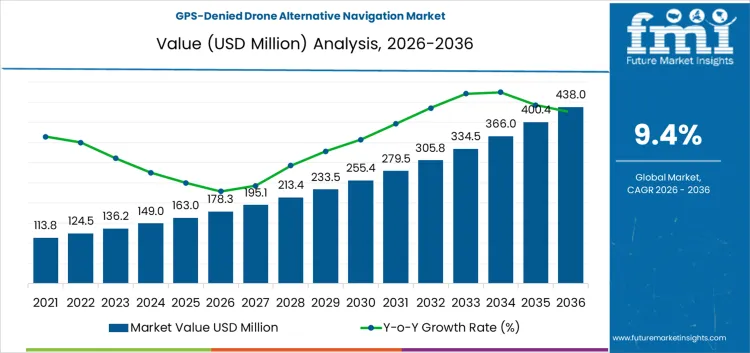
The GPS-denied drone alternative navigation market is valued at USD 178.3 million in 2026 and is projected to reach USD 438.0 million by 2036, reflecting a CAGR of 9.4%. Market performance is concentrated in regions with strong UAV development programs and defense applications. Adoption is uneven, with high uptake in North America, Europe, and select Asia-Pacific countries, while emerging markets lag due to limited infrastructure and regulatory complexity. Cost advantages are observed where regional production clusters reduce logistics and manufacturing expenses, providing strategic pricing leverage. Smaller suppliers face challenges in scaling across multiple geographies due to certification and technology validation requirements.
Growth is influenced by alignment with commercial, industrial, and military drone programs and regional operational priorities. Margin concentration favors operators offering integrated navigation solutions with proven performance and multi-platform compatibility. Fragmentation persists among regional technology developers, while leading players capture concentrated value through proximity to UAV programs, regulatory compliance, and validated performance. Adoption timelines vary according to regional regulatory approval processes, infrastructure readiness, and defense or commercial investment cycles.
Quick Stats of the GPS-Denied Drone Alternative Navigation Market
- GPS-Denied Drone Alternative Navigation Market Value (2026): USD 178.3 million
- GPS-Denied Drone Alternative Navigation Forecast Value (2036): USD 438.0 million
- GPS-Denied Drone Alternative Navigation Forecast CAGR 2026 to 2036: 9.4%
- Leading Technology in GPS-Denied Drone Navigation Market: Vision-based SLAM (28 % share)
- Leading Platform in GPS-Denied Drone Navigation Market: Military UAVs (52 % share)
- Key Growth Regions in GPS-Denied Drone Navigation Market: USA, Israel, China, Germany
- Top Players in GPS-Denied Drone Alternative Navigation Market: Collins Aerospace, Honeywell Aerospace, Safran Electronics, Elbit Systems, Thales Group, Northrop Grumman
What is the Growth Forecast for GPS-Denied Drone Alternative Navigation Market through 2036?
Between 2026 and 2031, the GPS-denied drone alternative navigation market is projected to grow from USD 178.3 million to USD 255.6 million, generating an absolute increase of USD 77.3 million and reflecting a CAGR of 9.4%. Growth is driven by adoption of vision-based SLAM, inertial + fusion, RF/SOOP, terrain-referenced, and magnetic/gravimetric navigation technologies across military, industrial, inspection, and logistics UAVs. Urban, indoor, contested, and GNSS-denied outdoor environments are key applications. Expansion is supported by increased drone deployment where GPS signals are unreliable or denied, requiring high-accuracy navigation solutions. Suppliers focus on reliability, sensor fusion, and integration with UAV platforms.
From 2031 to 2036, the market is expected to expand from USD 255.6 million to USD 438.0 million, adding USD 183.1 million. Growth is supported by broader adoption across UAV types, advanced sensor integration, and demand for resilient navigation in GPS-compromised environments. Market drivers include operational security, industrial automation, and regulatory requirements for safe autonomous operations. Competitive advantage favors suppliers with validated technology, high-precision navigation algorithms, and strong partnerships with drone manufacturers. Leading companies include Collins Aerospace, Honeywell Aerospace, Safran Electronics, Elbit Systems, Thales Group, and Northrop Grumman.
GPS Denied Drone Alternative Navigation Market Key Takeaways
| Metric | Value |
|---|---|
| Market Value (2026) | USD 178.3 million |
| Forecast Value (2036) | USD 438.0 million |
| Forecast CAGR 2026 to 2036 | 9.40% |
What Is Driving Demand for GPS-Denied Drone Alternative Navigation Systems?
GPS-denied drone alternative navigation systems are increasingly adopted to enable unmanned aerial operations in environments where satellite signals are unavailable, jammed, or unreliable. Historically, drones relied almost entirely on GPS for positioning, limiting mission capability in indoor, urban canyon, or contested areas. Modern systems integrate inertial measurement units, visual odometry, LiDAR, radar, and AI-based algorithms to provide accurate navigation without GPS dependence. Defense agencies, industrial operators, and commercial drone manufacturers prioritize reliability, positional accuracy, and integration with autonomous flight control systems. Early adoption focused on military and specialized industrial applications, while current demand spans inspection, mapping, logistics, and emergency response in GPS-challenged environments. Sensor fusion, algorithm robustness, and system latency influence adoption and performance.
Increasing reliance on autonomous drones, concerns over GPS vulnerability, and operational requirements in complex environments are shaping market growth. Compared with GPS-dependent systems, contemporary alternatives emphasize multi-sensor integration, redundancy, and real-time processing for accurate navigation. Cost factors include sensor quality, software development, and system integration, concentrating margins among suppliers capable of delivering reliable, high-performance solutions. Operators adopt GPS-denied navigation systems to maintain mission continuity, improve operational safety, and expand drone applicability in challenging environments. By 2036, these systems are expected to become standard in military, industrial, and commercial drone platforms, supporting autonomous operation and resilience in GPS-constrained scenarios.
What Factors Are Shaping the Demand for GPS-Denied Drone Alternative Navigation in Terms of Technology and Platform?
The demand for GPS-denied drone alternative navigation is segmented by technology and platform. Technologies include vision-based SLAM, inertial plus sensor fusion, RF and SOOP, terrain-referenced navigation, and magnetic or gravimetric systems. Platforms include military UAVs, industrial UAVs, inspection drones, and logistics drones. Adoption is influenced by operational reliability, mission-critical navigation, and resilience in GPS-compromised environments. Uptake is driven by defense requirements, infrastructure inspection, and industrial logistics. Technology and platform selection depend on mission complexity, environmental constraints, and operational risk, ensuring accurate, safe, and scalable navigation solutions across defense, industrial, and commercial applications.
Why Is Vision-Based SLAM Leading the Technology Segment in GPS-Denied Drone Navigation?
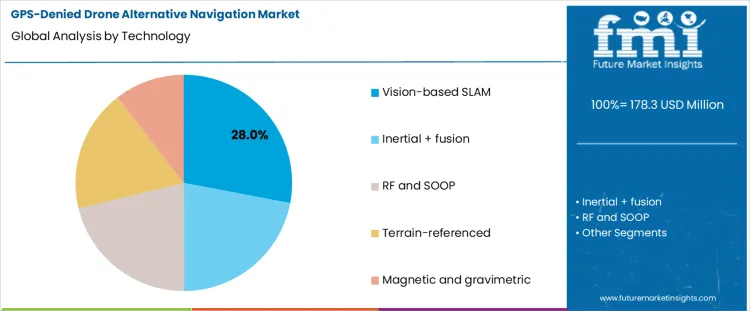
Vision-based SLAM accounts for approximately 28% of total technology demand, making it the leading category. These systems combine high-resolution cameras with computer vision algorithms to simultaneously map environments and track UAV position. Adoption is driven by operations in indoor spaces, dense urban canyons, or GPS-compromised areas. Integration with IMUs, obstacle detection, and autonomous control enables stable navigation under dynamic conditions. Operational planning includes sensor calibration, real-time map updating, and data processing optimization. Vision-based SLAM provides reliable positioning, high adaptability, and compatibility with multiple UAV classes, making it suitable for inspection, logistics, and military applications.
Operational factors further reinforce adoption. Systems must maintain stability under variable lighting, mitigate motion blur, and integrate seamlessly with flight control systems. High processing speeds and sensor fusion are required to ensure accuracy. Vision-based SLAM leads because it delivers precise position tracking, enhances mission reliability, and ensures safe UAV operation in environments where GPS signals are unavailable or jammed.
Why Are Military UAVs Representing the Largest Platform Segment in GPS-Denied Drone Navigation?
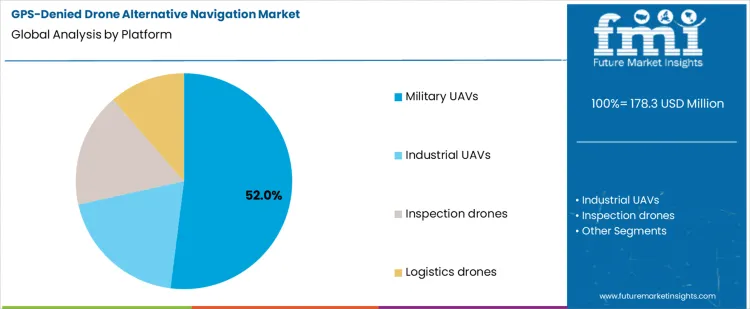
Military UAVs account for approximately 52% of total platform demand, making them the largest category. Adoption is driven by missions in contested airspace, dense urban terrain, and subterranean operations where GPS signals are unreliable. These UAVs require navigation systems that ensure operational continuity, tactical accuracy, and safety. Integration of vision-based SLAM, inertial fusion, and RF-based positioning provides redundancy and high-precision tracking. Operational protocols include pre-flight calibration, adaptive flight planning, environmental mapping, and real-time sensor monitoring to maintain precise navigation during critical missions.
Operational and functional factors further reinforce adoption. Military UAVs must withstand vibration, rapid maneuvering, electromagnetic interference, and sudden environmental changes. Systems must maintain high positional accuracy while coordinating with command and control centers. Military UAVs lead because they require reliable, resilient, and precise navigation for mission-critical applications. This ensures tactical effectiveness, operational safety, and predictable performance across diverse defense operations, including surveillance, reconnaissance, and tactical support.
How Are Drones Navigating Beyond GPS Limitations in Complex Environments?
GPS-denied navigation systems enable drones to operate reliably in urban canyons, indoor facilities, dense forests, and subterranean environments. Adoption is strongest in regions with industrial automation, disaster monitoring, and complex logistics operations. Systems are selected for adaptive path planning, multi-sensor fusion, and obstacle awareness. Growth is driven by the need for operational continuity in signal-compromised spaces, autonomous situational awareness, and real-time environmental adaptation. Investment focuses on sensor miniaturization, AI-driven navigation algorithms, and dynamic obstacle detection. Operators prioritize drones that maintain mission effectiveness, avoid collisions, and self-correct in challenging or unpredictable terrains.
Why Are Environmental Complexity and Autonomous Resilience Driving Adoption?
Demand is shaped by industries requiring continuous operation where GPS signals are obstructed or unavailable, such as warehouses, tunnels, and emergency zones. Drones with intelligent mapping, self-learning navigation, and adaptive control gain preference. Adoption is concentrated in regions with dense urban infrastructure, critical facilities, and industrial automation growth. Operational continuity, autonomous resilience, and mission reliability drive adoption more than upfront cost. Suppliers offering modular, adaptable, and sensor-integrated navigation solutions gain competitive advantage among industrial operators, first responders, and urban logistics providers.
What Operational and Technical Constraints Limit Wider Deployment?
Sensor drift, environmental noise, and processing latency can affect positional accuracy. Integration of multi-sensor arrays increases design complexity and weight. AI algorithms require continual training and calibration for new environments. Power consumption and onboard processing limits restrict deployment duration. Smaller operators or regions lacking technical expertise adopt systems more slowly. These factors concentrate early deployment among high-value industrial, urban logistics, and emergency response applications.
How Are AI-Driven Adaptation and Multi-Sensor Fusion Shaping Market Trends?
Recent innovations include LiDAR-visual-inertial fusion, SLAM-based real-time mapping, and machine learning for obstacle prediction and path correction. Collaboration between AI developers, drone manufacturers, and industrial operators ensures system adaptability, reliability, and environmental robustness. Pilot programs evaluate navigation accuracy, obstacle avoidance, and autonomous decision-making before large-scale deployment. Quality monitoring, sensor calibration, and modular design ensure consistent performance. Focus is on mission resilience, environmental adaptability, and autonomous intelligence rather than cost or volume. Collaborative strategies enable broader adoption of GPS-denied navigation drones in complex, dynamic operational settings.
What is the Demand for GPS-Denied Drone Alternative Navigation by Country?
| Country | CAGR (%) |
|---|---|
| USA | 9.5% |
| Israel | 9.0% |
| China | 8.8% |
| Germany | 8.5% |
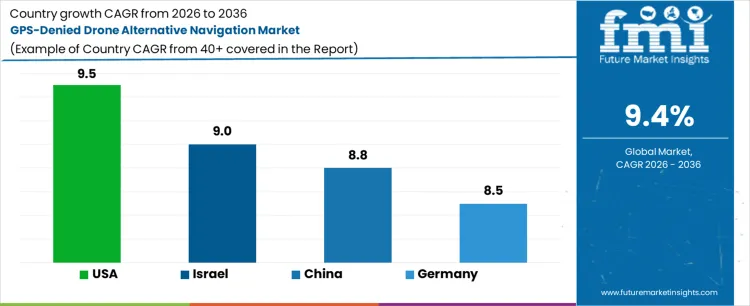
Demand for GPS-denied drone alternative navigation systems is rising as defense, commercial, and industrial operators seek reliable navigation solutions in GPS-compromised environments. The USA leads with a 9.5% CAGR, driven by military programs, research initiatives, and adoption of autonomous drones for complex operational scenarios. Israel follows at 9.0%, supported by advanced UAV development and deployment in GPS-denied missions. China records 8.8% growth, shaped by defense modernization, industrial drone applications, and research in alternative navigation technologies. Germany shows 8.5% CAGR, reflecting adoption in industrial, surveillance, and research-oriented UAV applications where GPS signals are unavailable or unreliable.
How Is the United States Experiencing Growth in the GPS-Denied Drone Alternative Navigation Market?
United States is experiencing growth at a CAGR of 9.5%, supported by adoption of alternative navigation systems in drones operating in GPS-denied environments for military, industrial, and commercial applications. Manufacturers and technology providers are deploying systems optimized for inertial navigation, visual odometry, and sensor fusion to maintain positioning accuracy under signal-denied conditions. Demand is concentrated in defense research hubs, industrial drone operators, and technology development centers. Investments focus on system performance, reliability, and compliance with operational standards rather than large-scale fleet deployment. Growth reflects increasing drone applications in complex environments, industrial adoption of navigation technologies, and government support for advanced UAV solutions.
- GPS-denied operations drive adoption.
- Systems optimize inertial navigation and sensor fusion.
- Defense and industrial hubs concentrate demand.
- System performance and reliability guide investment.
How Is Israel Witnessing Growth with Military Drone Applications?
Israel is witnessing growth at a CAGR of 9%, supported by adoption of alternative navigation solutions in drones for military reconnaissance, surveillance, and operational continuity in GPS-denied areas. Technology providers and defense contractors are producing systems optimized for inertial measurement, visual odometry, and redundant navigation capabilities. Demand is concentrated in defense R&D centers, military bases, and industrial drone operators. Investments prioritize system reliability, operational precision, and regulatory compliance rather than large-scale deployment. Growth reflects government initiatives for autonomous UAV capabilities, industrial adoption of GPS-independent navigation technologies, and strategic drone operations in complex environments.
- Military UAV applications drive adoption.
- Systems provide inertial navigation and redundancy.
- Defense R&D centers and bases concentrate demand.
- System reliability and operational precision guide investment.
How Is China Experiencing Growth with Industrial and Defense Drone Solutions?
China is experiencing growth at a CAGR of 8.8%, fueled by adoption of alternative navigation systems in drones to enable reliable operations in GPS-denied environments for industrial, surveillance, and military applications. Manufacturers and technology providers are deploying systems optimized for sensor fusion, inertial measurement, and visual odometry. Demand is concentrated in aerospace research hubs, industrial drone operators, and military facilities. Investments focus on system performance, reliability, and regulatory compliance rather than large-scale fleet deployment. Growth reflects industrial and defense adoption of autonomous navigation solutions and government support for UAV technologies in complex operational conditions.
- Industrial and defense applications drive adoption.
- Systems optimize inertial measurement and sensor fusion.
- Aerospace hubs and military facilities concentrate demand.
- System performance and regulatory compliance guide investment.
How Is Germany Witnessing Expansion with Advanced UAV Navigation?
Germany is witnessing growth at a CAGR of 8.5%, supported by adoption of alternative navigation technologies in drones to ensure reliable operations in GPS-denied environments for industrial inspections, security, and military use. Manufacturers and technology providers are producing systems optimized for visual odometry, inertial navigation, and sensor fusion integration. Demand is concentrated in industrial drone hubs, defense research centers, and urban drone operations. Investments prioritize system reliability, operational performance, and compliance with aviation regulations rather than large-scale deployment. Growth reflects industrial and defense adoption of autonomous navigation technologies, government support for UAV innovation, and increasing demand for GPS-independent flight solutions.
- Advanced UAV navigation drives adoption.
- Systems provide visual odometry and inertial navigation.
- Industrial and defense hubs concentrate demand.
- System reliability and operational performance guide investment.
Who Competes in the GPS-Denied Drone Alternative Navigation Market and What Defines Their Capabilities?
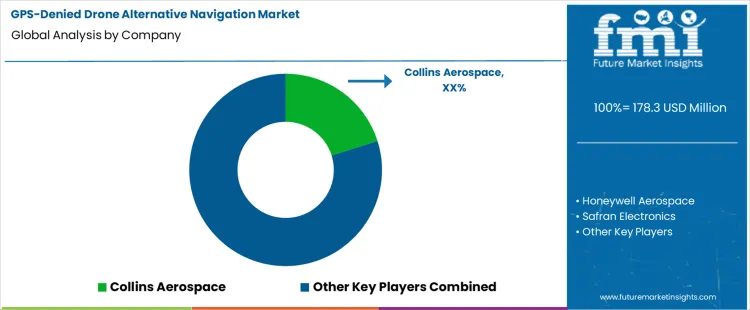
Competition in the GPS-denied drone alternative navigation market is defined by inertial measurement, sensor fusion, and robustness in environments without satellite positioning. Collins Aerospace develops navigation systems combining inertial sensors, visual odometry, and radar inputs to maintain accurate drone positioning in GPS-compromised environments. Honeywell Aerospace supplies navigation modules integrating MEMS-based inertial measurement units with environmental sensing for reliable operation under GPS denial. Safran Electronics provides inertial navigation and sensor fusion systems tailored for UAVs operating in complex urban or contested areas. Elbit Systems delivers navigation solutions combining inertial, visual, and LiDAR inputs for autonomous drones. Thales Group focuses on integrated navigation modules resilient to GPS jamming and signal loss.
Northrop Grumman provides alternative navigation systems with high-precision inertial guidance and sensor fusion for military and commercial UAVs. Other competitors include specialized UAV electronics developers offering compact, low-power navigation modules for GPS-denied environments. Differentiation arises from sensor accuracy, resistance to interference, computational efficiency, and integration with autopilot systems. Market relevance is shaped by reliability in urban canyons, indoor flight, and contested airspace, along with the ability to maintain stable autonomous flight under variable conditions. Suppliers with tested, field-proven navigation technologies retain a competitive edge in GPS-denied applications.
Key Players in the GPS-Denied Drone Alternative Navigation Market
- Collins Aerospace
- Honeywell Aerospace
- Safran Electronics
- Elbit Systems
- Thales Group
- Northrop Grumman
Scope of the Report
| Items | Values |
|---|---|
| Quantitative Units (2026) | USD million |
| Technology | Vision-based SLAM, Inertial + fusion, RF and SOOP, Terrain-referenced, Magnetic and gravimetric |
| Platform | Military UAVs, Industrial UAVs, Inspection drones, Logistics drones |
| Environment | Urban, Indoor, Contested, GNSS-denied outdoor |
| Region | Asia Pacific, Europe, North America, Latin America, Middle East & Africa |
| Key Countries Covered | USA, Israel, China, Germany, Japan, UK, France, India, Australia |
| Key Companies Profiled | Collins Aerospace, Honeywell Aerospace, Safran Electronics, Elbit Systems, Thales Group, Northrop Grumman |
| Additional Attributes | Dollar sales by technology, platform, and environment; regional CAGR, value and volume growth projections; adoption across military, industrial, inspection, and logistics UAVs; sensor fusion performance, algorithm accuracy, and system latency; integration with UAV flight control systems; reliability in GPS-compromised environments; field-proven navigation technology; scalability for multiple UAV types; regulatory compliance and operational safety; partnerships with UAV manufacturers and industrial operators. |
GPS-Denied Drone Alternative Navigation Market Segmentation
Technology:
- Vision-based SLAM
- Inertial + fusion
- RF and SOOP
- Terrain-referenced
- Magnetic and gravimetric
Platform:
- Military UAVs
- Industrial UAVs
- Inspection drones
- Logistics drones
Environment:
- Urban
- Indoor
- Contested
- GNSS-denied outdoor
Region:
- Asia Pacific
- China
- Japan
- South Korea
- India
- Australia & New Zealand
- ASEAN
- Rest of Asia Pacific
- Europe
- Germany
- United Kingdom
- France
- Italy
- Spain
- Nordic
- BENELUX
- Rest of Europe
- North America
- United States
- Canada
- Mexico
- Latin America
- Brazil
- Chile
- Rest of Latin America
- Middle East & Africa
- Kingdom of Saudi Arabia
- Other GCC Countries
- Turkey
- South Africa
- Other African Union
- Rest of Middle East & Africa
Bibliography
- European Union Aviation Safety Agency. (2025). EASA and partners release updated guidance on GNSS interference and spoofing. European Union Aviation Safety Agency.
- International Civil Aviation Organization. (2025). GNSS Spoofing in Egyptian Airspace. ICAO (Middle East regional documentation).
- European Union Agency for the Space Programme. (2025). Report on Aviation and Drones: User Needs and Requirements. EUSPA Publication.
- U.S. Department of Homeland Security, Science and Technology Directorate. (2024). Resilient Positioning, Navigation, and Timing Research and Development Update (CGSIC, September 2024). GPS.gov (CGSIC meeting material).
- Cybersecurity and Infrastructure Security Agency. (2024). Federal PNT Services Acquisitions Guidance. CISA (referenced as published May 2024 in CGSIC materials).
Frequently Asked Questions
How big is the gps-denied drone alternative navigation market in 2026?
The global gps-denied drone alternative navigation market is estimated to be valued at USD 178.3 million in 2026.
What will be the size of gps-denied drone alternative navigation market in 2036?
The market size for the gps-denied drone alternative navigation market is projected to reach USD 438.0 million by 2036.
How much will be the gps-denied drone alternative navigation market growth between 2026 and 2036?
The gps-denied drone alternative navigation market is expected to grow at a 9.4% CAGR between 2026 and 2036.
What are the key product types in the gps-denied drone alternative navigation market?
The key product types in gps-denied drone alternative navigation market are vision-based slam, inertial + fusion, rf and soop, terrain-referenced and magnetic and gravimetric.
Which platform segment to contribute significant share in the gps-denied drone alternative navigation market in 2026?
In terms of platform, military uavs segment to command 52.0% share in the gps-denied drone alternative navigation market in 2026.
Preview the report firsthand - request a free sample
Get SampleGet the brochure for pricing and purchase details.
Get PDFTable of Content
- Executive Summary
- Global Market Outlook
- Demand-side Trends
- Supply-side Trends
- Technology Roadmap Analysis
- Analysis and Recommendations
- Market Overview
- Market Coverage / Taxonomy
- Market Definition / Scope / Limitations
- Market Background
- Market Dynamics
- Drivers
- Restraints
- Opportunity
- Trends
- Scenario Forecast
- Demand in Optimistic Scenario
- Demand in Likely Scenario
- Demand in Conservative Scenario
- Opportunity Map Analysis
- Product Life Cycle Analysis
- Supply Chain Analysis
- Investment Feasibility Matrix
- Value Chain Analysis
- PESTLE and Porter’s Analysis
- Regulatory Landscape
- Regional Parent Market Outlook
- Production and Consumption Statistics
- Import and Export Statistics
- Market Dynamics
- Global Market Analysis 2021 to 2025 and Forecast, 2026 to 2036
- Historical Market Size Value (USD Million) Analysis, 2021 to 2025
- Current and Future Market Size Value (USD Million) Projections, 2026 to 2036
- Y-o-Y Growth Trend Analysis
- Absolute $ Opportunity Analysis
- Global Market Pricing Analysis 2021 to 2025 and Forecast 2026 to 2036
- Global Market Analysis 2021 to 2025 and Forecast 2026 to 2036, By Technology
- Introduction / Key Findings
- Historical Market Size Value (USD Million) Analysis By Technology , 2021 to 2025
- Current and Future Market Size Value (USD Million) Analysis and Forecast By Technology , 2026 to 2036
- Vision-based SLAM
- Inertial + fusion
- RF and SOOP
- Terrain-referenced
- Magnetic and gravimetric
- Vision-based SLAM
- Y-o-Y Growth Trend Analysis By Technology , 2021 to 2025
- Absolute $ Opportunity Analysis By Technology , 2026 to 2036
- Global Market Analysis 2021 to 2025 and Forecast 2026 to 2036, By Platform
- Introduction / Key Findings
- Historical Market Size Value (USD Million) Analysis By Platform, 2021 to 2025
- Current and Future Market Size Value (USD Million) Analysis and Forecast By Platform, 2026 to 2036
- Military UAVs
- Industrial UAVs
- Inspection drones
- Logistics drones
- Military UAVs
- Y-o-Y Growth Trend Analysis By Platform, 2021 to 2025
- Absolute $ Opportunity Analysis By Platform, 2026 to 2036
- Global Market Analysis 2021 to 2025 and Forecast 2026 to 2036, By Environment
- Introduction / Key Findings
- Historical Market Size Value (USD Million) Analysis By Environment, 2021 to 2025
- Current and Future Market Size Value (USD Million) Analysis and Forecast By Environment, 2026 to 2036
- Urban
- Indoor
- Contested
- GNSS-denied outdoor
- Urban
- Y-o-Y Growth Trend Analysis By Environment, 2021 to 2025
- Absolute $ Opportunity Analysis By Environment, 2026 to 2036
- Global Market Analysis 2021 to 2025 and Forecast 2026 to 2036, By Region
- Introduction
- Historical Market Size Value (USD Million) Analysis By Region, 2021 to 2025
- Current Market Size Value (USD Million) Analysis and Forecast By Region, 2026 to 2036
- North America
- Latin America
- Western Europe
- Eastern Europe
- East Asia
- South Asia and Pacific
- Middle East & Africa
- Market Attractiveness Analysis By Region
- North America Market Analysis 2021 to 2025 and Forecast 2026 to 2036, By Country
- Historical Market Size Value (USD Million) Trend Analysis By Market Taxonomy, 2021 to 2025
- Market Size Value (USD Million) Forecast By Market Taxonomy, 2026 to 2036
- By Country
- USA
- Canada
- Mexico
- By Technology
- By Platform
- By Environment
- By Country
- Market Attractiveness Analysis
- By Country
- By Technology
- By Platform
- By Environment
- Key Takeaways
- Latin America Market Analysis 2021 to 2025 and Forecast 2026 to 2036, By Country
- Historical Market Size Value (USD Million) Trend Analysis By Market Taxonomy, 2021 to 2025
- Market Size Value (USD Million) Forecast By Market Taxonomy, 2026 to 2036
- By Country
- Brazil
- Chile
- Rest of Latin America
- By Technology
- By Platform
- By Environment
- By Country
- Market Attractiveness Analysis
- By Country
- By Technology
- By Platform
- By Environment
- Key Takeaways
- Western Europe Market Analysis 2021 to 2025 and Forecast 2026 to 2036, By Country
- Historical Market Size Value (USD Million) Trend Analysis By Market Taxonomy, 2021 to 2025
- Market Size Value (USD Million) Forecast By Market Taxonomy, 2026 to 2036
- By Country
- Germany
- UK
- Italy
- Spain
- France
- Nordic
- BENELUX
- Rest of Western Europe
- By Technology
- By Platform
- By Environment
- By Country
- Market Attractiveness Analysis
- By Country
- By Technology
- By Platform
- By Environment
- Key Takeaways
- Eastern Europe Market Analysis 2021 to 2025 and Forecast 2026 to 2036, By Country
- Historical Market Size Value (USD Million) Trend Analysis By Market Taxonomy, 2021 to 2025
- Market Size Value (USD Million) Forecast By Market Taxonomy, 2026 to 2036
- By Country
- Russia
- Poland
- Hungary
- Balkan & Baltic
- Rest of Eastern Europe
- By Technology
- By Platform
- By Environment
- By Country
- Market Attractiveness Analysis
- By Country
- By Technology
- By Platform
- By Environment
- Key Takeaways
- East Asia Market Analysis 2021 to 2025 and Forecast 2026 to 2036, By Country
- Historical Market Size Value (USD Million) Trend Analysis By Market Taxonomy, 2021 to 2025
- Market Size Value (USD Million) Forecast By Market Taxonomy, 2026 to 2036
- By Country
- China
- Japan
- South Korea
- By Technology
- By Platform
- By Environment
- By Country
- Market Attractiveness Analysis
- By Country
- By Technology
- By Platform
- By Environment
- Key Takeaways
- South Asia and Pacific Market Analysis 2021 to 2025 and Forecast 2026 to 2036, By Country
- Historical Market Size Value (USD Million) Trend Analysis By Market Taxonomy, 2021 to 2025
- Market Size Value (USD Million) Forecast By Market Taxonomy, 2026 to 2036
- By Country
- India
- ASEAN
- Australia & New Zealand
- Rest of South Asia and Pacific
- By Technology
- By Platform
- By Environment
- By Country
- Market Attractiveness Analysis
- By Country
- By Technology
- By Platform
- By Environment
- Key Takeaways
- Middle East & Africa Market Analysis 2021 to 2025 and Forecast 2026 to 2036, By Country
- Historical Market Size Value (USD Million) Trend Analysis By Market Taxonomy, 2021 to 2025
- Market Size Value (USD Million) Forecast By Market Taxonomy, 2026 to 2036
- By Country
- Kingdom of Saudi Arabia
- Other GCC Countries
- Turkiye
- South Africa
- Other African Union
- Rest of Middle East & Africa
- By Technology
- By Platform
- By Environment
- By Country
- Market Attractiveness Analysis
- By Country
- By Technology
- By Platform
- By Environment
- Key Takeaways
- Key Countries Market Analysis
- USA
- Pricing Analysis
- Market Share Analysis, 2025
- By Technology
- By Platform
- By Environment
- Canada
- Pricing Analysis
- Market Share Analysis, 2025
- By Technology
- By Platform
- By Environment
- Mexico
- Pricing Analysis
- Market Share Analysis, 2025
- By Technology
- By Platform
- By Environment
- Brazil
- Pricing Analysis
- Market Share Analysis, 2025
- By Technology
- By Platform
- By Environment
- Chile
- Pricing Analysis
- Market Share Analysis, 2025
- By Technology
- By Platform
- By Environment
- Germany
- Pricing Analysis
- Market Share Analysis, 2025
- By Technology
- By Platform
- By Environment
- UK
- Pricing Analysis
- Market Share Analysis, 2025
- By Technology
- By Platform
- By Environment
- Italy
- Pricing Analysis
- Market Share Analysis, 2025
- By Technology
- By Platform
- By Environment
- Spain
- Pricing Analysis
- Market Share Analysis, 2025
- By Technology
- By Platform
- By Environment
- France
- Pricing Analysis
- Market Share Analysis, 2025
- By Technology
- By Platform
- By Environment
- India
- Pricing Analysis
- Market Share Analysis, 2025
- By Technology
- By Platform
- By Environment
- ASEAN
- Pricing Analysis
- Market Share Analysis, 2025
- By Technology
- By Platform
- By Environment
- Australia & New Zealand
- Pricing Analysis
- Market Share Analysis, 2025
- By Technology
- By Platform
- By Environment
- China
- Pricing Analysis
- Market Share Analysis, 2025
- By Technology
- By Platform
- By Environment
- Japan
- Pricing Analysis
- Market Share Analysis, 2025
- By Technology
- By Platform
- By Environment
- South Korea
- Pricing Analysis
- Market Share Analysis, 2025
- By Technology
- By Platform
- By Environment
- Russia
- Pricing Analysis
- Market Share Analysis, 2025
- By Technology
- By Platform
- By Environment
- Poland
- Pricing Analysis
- Market Share Analysis, 2025
- By Technology
- By Platform
- By Environment
- Hungary
- Pricing Analysis
- Market Share Analysis, 2025
- By Technology
- By Platform
- By Environment
- Kingdom of Saudi Arabia
- Pricing Analysis
- Market Share Analysis, 2025
- By Technology
- By Platform
- By Environment
- Turkiye
- Pricing Analysis
- Market Share Analysis, 2025
- By Technology
- By Platform
- By Environment
- South Africa
- Pricing Analysis
- Market Share Analysis, 2025
- By Technology
- By Platform
- By Environment
- USA
- Market Structure Analysis
- Competition Dashboard
- Competition Benchmarking
- Market Share Analysis of Top Players
- By Regional
- By Technology
- By Platform
- By Environment
- Competition Analysis
- Competition Deep Dive
- Collins Aerospace
- Overview
- Product Portfolio
- Profitability by Market Segments (Product/Age /Sales Channel/Region)
- Sales Footprint
- Strategy Overview
- Marketing Strategy
- Product Strategy
- Channel Strategy
- Honeywell Aerospace
- Safran Electronics
- Elbit Systems
- Thales Group
- Northrop Grumman
- Collins Aerospace
- Competition Deep Dive
- Assumptions & Acronyms Used
- Research Methodology


