

- Industry Size (2026)
- USD 1.25 Bn
- Forecast (2036)
- USD 4.28 Bn
- CAGR (2026 to 2036)
- 13.10%
Drone-Based NDT Inspection Systems for Energy and Infrastructure Assets Market Size, Market Forecast and Outlook By FMI
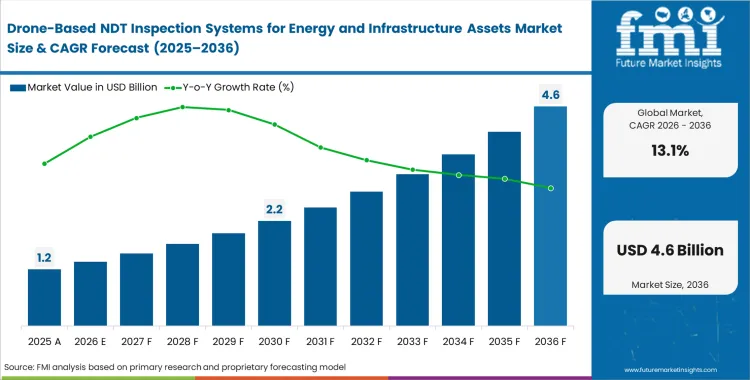
The drone-based NDT inspection systems for energy and infrastructure assets market was valued at USD 1.11 billion in 2025. Sector is set to reach USD 1.25 billion in 2026. It is expected to grow at a CAGR of 13.10% across 2026 to 2036. Total valuation is projected to reach USD 4.28 billion by 2036. Adoption is increasing as asset owners focus on continuous inspection without interrupting operations.
Asset owners are under pressure to digitize structural health records before pipeline and infrastructure failures increase risk exposure. Manual inspection cycles leave gaps in visibility and delay defect detection. Drone-based inspection systems are shifting evaluation criteria toward sensor payload integration rather than flight capability alone. Continued reliance on scaffolding increases inspection costs and extends downtime, making drone deployment a cost-control priority. Vendor selection now depends on proven compatibility across sensors, data systems, and inspection workflows.
Summary of drone-based NDT inspection systems for energy and infrastructure assets market
- Market Snapshot
- The drone-based NDT inspection systems for energy and infrastructure assets market is valued at USD 1.11 billion in 2025 and is projected to reach USD 4.28 billion by 2036.
- The market is likely to reach 13.1% CAGR from 2026 to 2036, creating an incremental opportunity of USD 3.03 billion over the period.
- This is a compliance-led industrial inspection market where drone platforms, specialized payloads, autonomy software, and asset-integrity workflows are sold into high-risk inspection tasks across utilities, pipelines, and civil infrastructure.
- Growth remains tied to infrastructure inspection economics, widening drone operating permissions, and the need to inspect aging transmission, pipeline, and industrial assets with less downtime and less work at height.
- Demand and Growth Drivers
- Demand is rising as utilities and energy operators need faster inspection cycles across large transmission and distribution networks while keeping workers off energized or hard-to-reach assets.
- Ultrasonic and thermal payloads are seeing wider use as they add wall-thickness, corrosion, and anomaly detection to what began as largely visual drone inspection.
- Pipeline monitoring is gaining support from regulation, with PHMSA explicitly recognizing unmanned aerial systems and other remote-sensing methods for right-of-way inspection and leak-detection programs.
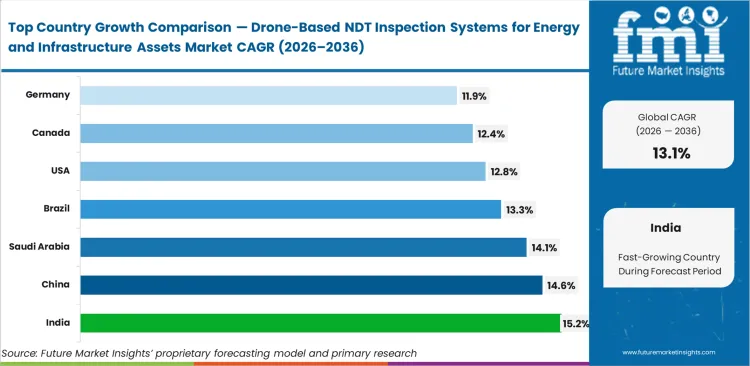
- Among key countries, India leads at 15.2% CAGR, followed by China at 14.6%, Saudi Arabia at 14.1%, Brazil at 13.3%, United States at 12.8%, Canada at 12.4%, and Germany at 11.9%.
- Growth is moderated by certification needs, data-processing complexity, and the slower rollout of fully normalized BVLOS rules across major markets.
- Product and Segment View
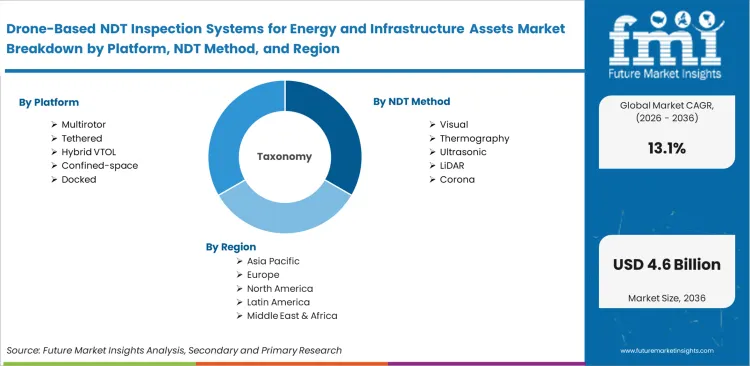
- The market covers multirotor, tethered, hybrid VTOL, confined-space, and docked drone systems equipped with RGB, thermal, ultrasonic, LiDAR, corona, and analytics payloads for condition assessment and NDT-led asset management.
- These systems are used across powerline inspection, pipeline integrity work, wind-turbine maintenance, bridge surveys, dam reviews, stacks, tanks, and similar elevated or remote assets.
- The multirotor segment is expected to account for 58.0% share of the platform segment in 2026, supported by hover stability, payload flexibility, and suitability for close-range infrastructure
- Powerlines are anticipated to represent 29.0% share of inspection.
- The visual segment is projected to hold 36.0% share of the NDT method segment in 2026, as most inspection workflows begin with imaging before adding thermal or thickness measurement.
- the asset type segment in 2026, driven by grid expansion, vegetation risk management, outage response, and routine inspection of towers and conductors.
- Service contracts are expected to capture 44.0% share of the delivery model segment in 2026, reflecting continued preference for outsourced pilots, permits, data capture, and analytics.
- Utilities are likely to account for 34.0% share of the end use segment in 2026, supported by the need for frequent inspection across extensive grid networks.
- Market scope covers drone airframes, inspection payloads, autonomy and analytics software, and integrated inspection systems for energy and infrastructure assets, while excluding recreational drones, military ISR platforms, mapping-only drones, and ground-based systems without aerial inspection capability.
- Geography and Competitive Outlook
- Significant expansion is observed across India, China, and Saudi Arabia, while the United States remains a stable, high-value demand base supported by its large installed base of utility, pipeline, and industrial assets.
- Market competition remains moderately fragmented, shaped by progress in payload design, autonomy software, utility-focused workflows, and the ability to move beyond visual inspection into measurable NDT outputs.
- Key participants in the drone-based NDT inspection systems market for energy and infrastructure assets include Voliro, Flyability, Percepto, Terra Drone, Skydio, DRONE VOLT, and Phase One. Voliro and Flyability focus in contact-based and thickness measurement applications, while Percepto and Skydio focus on autonomous and large-scale utility inspection programs.
- The market structure remains open, with the leading vendor expected to account for majority share in 2026, allowing room for regional service providers and payload-focused specialists.
Regulatory approval for beyond visual line of sight operations is changing deployment models. Centralized monitoring replaces field-based observation, allowing inspection teams to manage assets remotely. This shift reduces travel requirements and lowers inspection cost per kilometre. Wider BVLOS acceptance is expected to support scalable deployment across transmission and pipeline networks.
Adoption varies by region based on infrastructure investment and regulatory progress. India is expected to record a CAGR of 15.2% in the drone-based NDT inspection systems market for energy and infrastructure assets over 2026 to 2036, supported by grid modernization across complex terrain. China is anticipated to grow at 14.6% as renewable energy expansion increases inspection requirements. Saudi Arabia is forecast to expand at 14.1% with ongoing digitization of oil and gas facilities. Brazil is projected to grow at 13.3% as remote sensing is applied across hydroelectric assets. The United States is expected to register 12.8% driven by bridge and infrastructure repair programs. Canada is likely to expand at 12.4% as pipeline monitoring strengthens under extreme weather conditions. Germany is anticipated to record 11.9% as energy infrastructure transitions toward updated utility systems. Differences across regions are largely shaped by the pace of regulatory approval for autonomous drone inspection.
Segmental Analysis
Drone-Based NDT Inspection Systems for Energy and Infrastructure Assets Market Analysis by Platform
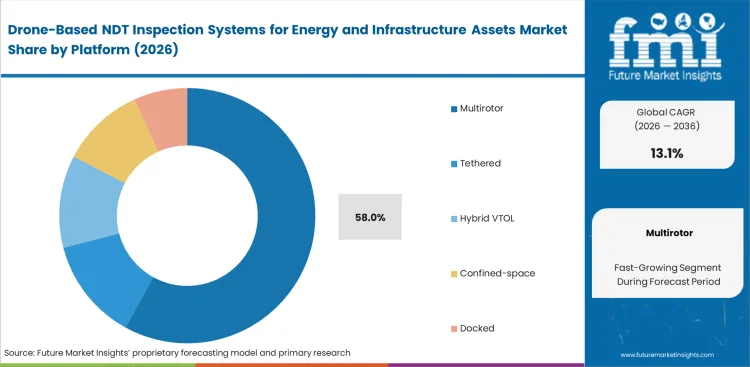
Multirotor architecture is estimated to account for 58.0% share in 2026. FMI's assessment indicates continuous proximity flying demands responsive multi-axis control that fixed-wing alternatives cannot match. Engineers require stable hovering to gather accurate baseline readings before approving continued facility operations, often evaluating best drone for ultrasonic thickness measurement parameters. Unit-cost comparisons often miss the limitation of tethered drone systems in large linear infrastructure environments. While these systems offer extended flight duration, they restrict coverage range and reduce operational flexibility. Heavy-lift multirotor platforms allow integration of ultrasonic probes along with optical sensors, expanding inspection capability. Selecting lower-capacity platforms limits future use cases and leads to early fleet replacement.
- Hover stability requirement: Precision defect scanning demands absolutely stationary aerial positioning. Reliability engineers avoid fixed-wing formats because forward-motion requirements ruin delicate thickness measurement calibrations during drone NDT inspection procedures.
- Payload modularity advantage: Multirotor frames support rapid sensor swapping between visual cameras and heavy acoustic probes. Operations managers maximize daily asset utilization by executing diverse testing protocols using single unmanned aerial vehicles.
- Range limitation reality: Battery capacity permanently restricts multirotor mission duration across long linear assets. Pipeline inspectors must deploy numerous sequential flights to cover distances fixed-wing units could analyze efficiently.
Drone-Based NDT Inspection Systems for Energy and Infrastructure Assets Market Analysis by NDT Method
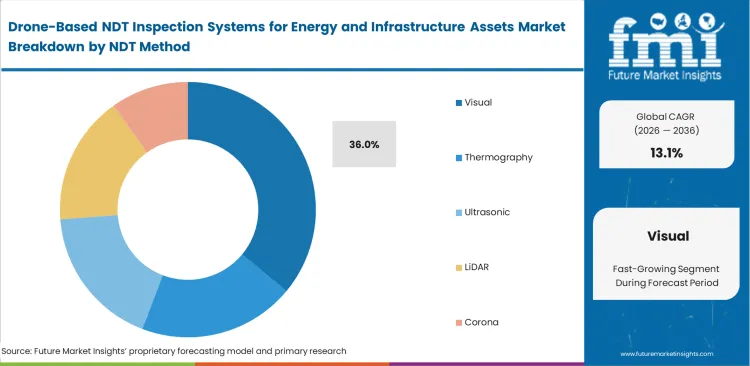
Defect identification starts with surface-level anomaly detection before moving to internal inspection methods. The visual segment is expected to account for 36.0% share of the NDT method segment in 2026. High-resolution optical sensors provide immediate visibility, helping maintenance teams plan targeted interventions. Visual data acts as a first screening layer, allowing teams to focus advanced inspection methods only on areas with higher failure probability. Teams avoid deploying ultrasonic systems without prior optical confirmation of surface degradation. Thermography-based inspection depends on specific temperature differences, which limits its usability across daily operations. Visual inspection remains more consistent for routine scheduling due to fewer environmental constraints. Using advanced sensors without initial optical validation increases false-positive detection rates. Infrared thermography adds value when combined with optical mapping, improving accuracy in identifying defect-prone zones.
- Initial defect screening: Optical scanning identifies obvious surface corrosion rapidly. Maintenance planners use this low-cost triage data to schedule targeted interventions before minor rust becomes critical structural failure.
- Ambient condition constraints: Thermal testing demands specific temperature gradients to reveal internal flaws accurately. Inspection coordinators must halt thermal operations during uniform weather conditions, falling back on reliable visual protocols utilizing standard commercial drones.
- Data processing friction: Processing raw acoustic data requires specialized engineering software and extensive computing power. IT directors struggle to integrate complex ultrasonic file formats into legacy maintenance databases built for simple image attachments.
Drone-Based NDT Inspection Systems for Energy and Infrastructure Assets Market Analysis by Asset Type
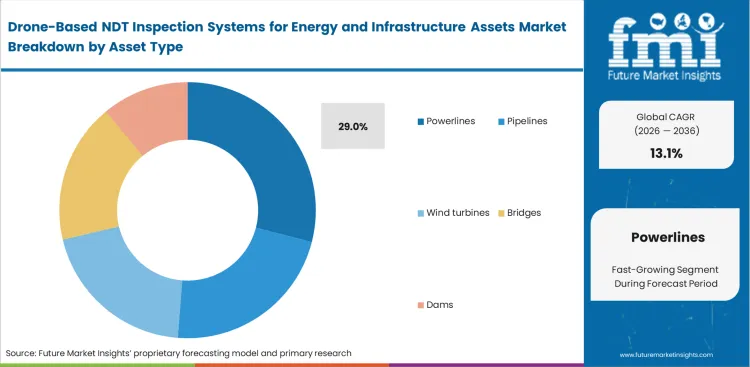
Linear geometry dictates autonomous flight path efficiency across sprawling geographic footprints. Powerlines are anticipated to capture 29.0% share in 2026. Transmission networks feature repetitive structural components that automated navigation software can track with exceptional reliability. Based on FMI's analysis, grid operators prioritize rapid defect localization over measurement precision during routine corridor patrols. Maintenance supervisors need exact coordinates for damaged insulators rather than sub-millimeter corrosion depth data. What aviation regulators fail to understand is that automated wind turbine inspections face extreme aerodynamic turbulence challenges that ground standard commercial quadcopters. Attempting manual transmission tower audits using ground personnel risks severe electrocution incidents, highlighting strong drone NDT inspection ROI. Incorporating utility asset management workflows turns raw imagery into prioritized work orders.
- Automated corridor tracking: Linear transmission lines allow software platforms to generate perfect repetitive flight paths. Grid operators minimize pilot fatigue by automating long-distance data acquisition across rural utility corridors using specialized powerline inspection drones.
- Turbulence disruption risks: Wind farm environments generate localized atmospheric disturbances near rotating turbine blades. Flight operations managers experience higher crash rates when deploying lightweight platforms near active wind generation infrastructure.
- Electromagnetic interference mitigation: High-voltage environments corrupt standard consumer-grade navigation sensors instantly. Procurement directors must specify hardened avionics packages to prevent fly-away incidents near critical transmission substations.
Drone-Based NDT Inspection Systems for Energy and Infrastructure Assets Market Analysis by Delivery Model
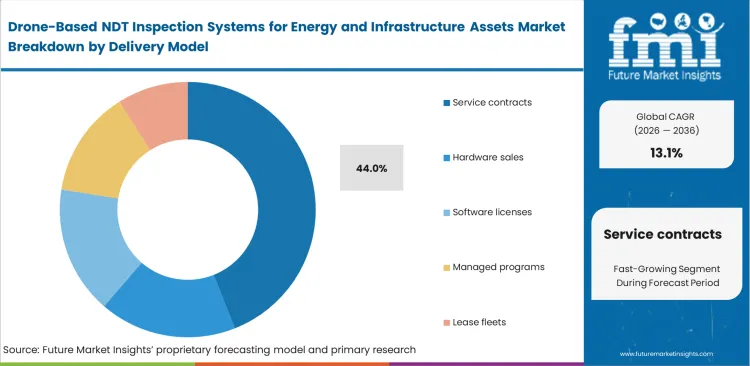
Financial flexibility shapes how organizations approach adoption of aerial inspection systems. The service contracts segment is expected to account for 44.0% share of the delivery model segment in 2026. Many operators prefer shifting technology and upgrade risk to specialized third-party service providers instead of managing it internally. Service-based models reduce upfront capital requirements and avoid delays linked to internal approval processes. Inspection teams prioritize receiving usable structural reports over managing equipment and maintenance cycles. Direct ownership of drone systems introduces additional responsibility for upkeep, compliance, and operational readiness. Combining hardware with integrated asset management platforms increases dependency on vendors, making switching more difficult over time.
- Capital expenditure avoidance: Turnkey service agreements draw funds from flexible operational budgets. Plant managers bypass rigid board-level capital approval processes by hiring external data acquisition teams offering comprehensive utility drone inspection systems.
- Liability transfer strategy: Contracting third-party operators moves aviation liability off corporate balance sheets. Risk management directors demand service providers carry huge insurance policies covering potential infrastructure collision damage.
- Hardware obsolescence protection: Rapid sensor evolution makes current hardware obsolete within three years. Operations directors utilizing service models ensure their facilities are always inspected using modern diagnostic equipment.
Drone-Based NDT Inspection Systems for Energy and Infrastructure Assets Market Analysis by End Use
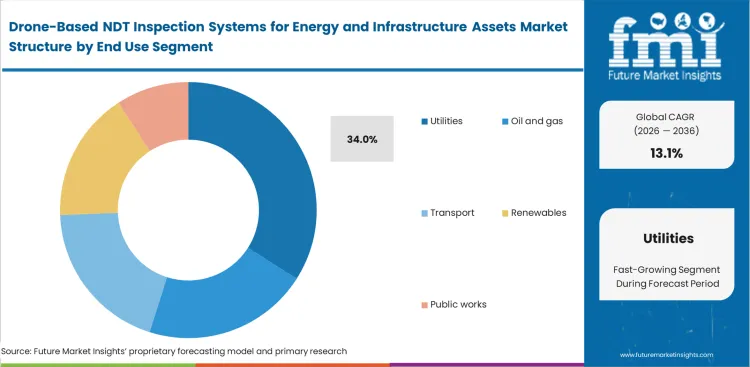
By end use, utilities are set to represent 34.0% share in 2026. Grid modernization policies require power companies to digitize their entire physical footprint rapidly. National energy ministries penalize unscheduled blackouts severely, forcing utility providers to adopt continuous preventive diagnostic routines. Maintenance directors cannot rely on slow ground-based surveys to cover millions of grid miles. Transport sector adoption stalls quietly because rail operators struggle to integrate discontinuous aerial data with existing track-geometry car databases. Delaying automated grid digitization exposes utility executives to huge fines following wildfire incidents sparked by decaying infrastructure. Validating comprehensive pipeline integrity requires sophisticated multi-modal sensor arrays.
- Mandatory compliance scanning: Regulatory bodies force utility providers to map every transmission tower annually. Compliance officers deploy automated aerial fleets to generate irrefutable digital evidence proving scheduled maintenance completion.
- Integration database friction: Rail operators utilize highly specialized track geometry databases built around continuous ground vehicle data. Data architects struggle to merge discontinuous aerial diagnostic images into these rigid legacy software architectures.
- Wildfire liability reduction: Undetected transmission line defects cause severe regional fires. Utility executives rely on continuous aerial thermography to identify overheating components before they trigger immense liability events.
Drone-Based NDT Inspection Systems for Energy and Infrastructure Assets Market Drivers, Restraints, and Opportunities
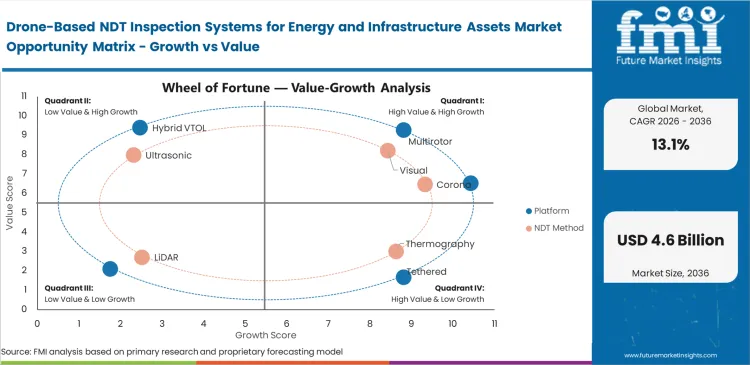
Downtime costs force petrochemical facility managers to replace periodic manual audits with continuous aerial diagnostics. Relying on ground crews to erect scaffolding around active flaring stacks consumes critical maintenance budgets and risks severe personnel injury, making drone NDT vs rope access inspection comparisons heavily favor automated solutions. Engineering directors demand technology capable of measuring pipe thickness while processing units remain fully operational. Halting production for mandatory safety inspections destroys quarterly profitability targets. Automated aerial systems bypass these physical access limitations entirely, capturing essential structural data from safe standoff distances. Delaying this transition leaves industrial operators vulnerable to material failures that slow-moving manual inspection routines routinely miss.
Data processing bottlenecks throttle adoption momentum even when facility managers eagerly acquire advanced aerial hardware. Engineering teams drown in terabytes of high-resolution structural imagery lacking clear context or categorization, creating severe drone inspection data overload utilities must manage. Software platforms struggle to automatically identify microscopic corrosion patterns against complex industrial backgrounds. IT directors cannot simply dump large-scale video files into legacy maintenance databases designed for simple text entries. Until artificial intelligence models can reliably translate raw sensor data into specific repair work orders without human intervention, scaling aerial operations remains constrained by internal engineering bandwidth. Emerging drone analytics offers partial relief but still requires heavy manual validation.
Opportunities in the Drone-Based NDT Inspection Systems for Energy and Infrastructure Assets Market
- Confined-space navigation mastery: Internal boiler inspections require collision-tolerant airframes operating without GPS signals. Asset managers aggressively fund vendors developing resilient confined space inspection drone NDT capabilities to eliminate hazardous human entry requirements.
- Automated docking integration: Remote substations demand permanent resident aerial units executing scheduled autonomous patrols. Engineering chiefs prioritize self-charging aerial work robots capable of surviving extreme weather environments.
- AI-driven defect classification: Processing raw thermal data consumes excessive engineering hours. Software directors eagerly adopt machine learning algorithms that automatically flag anomalous temperature gradients for immediate review.
Regional Analysis
.webp "Top Country Growth Comparison Drone Based Ndt Inspection Systems For Energy And Infrastructure Assets Market Cagr (2026 2036)")
Based on regional analysis, Drone-Based NDT Inspection Systems for Energy and Infrastructure Assets is segmented into North America, Latin America, Europe, East Asia, South Asia, Oceania, and Middle East and Africa across 40 plus countries.
| Country | CAGR (2026 to 2036) |
|---|---|
| India | 15.2% |
| China | 14.6% |
| Saudi Arabia | 14.1% |
| Brazil | 13.3% |
| United States | 12.8% |
| Canada | 12.4% |
| Germany | 11.9% |
Source: Future Market Insights (FMI) analysis, based on proprietary forecasting model and primary research
North America Drone-Based NDT Inspection Systems for Energy and Infrastructure Assets Market Analysis
Remote terrain and long distances between pipeline assets require inspection systems that operate without ground access. Operators are adopting autonomous aerial systems to monitor dispersed infrastructure networks. Utility regulators are enforcing automated inspection to reduce transmission losses linked to aging assets. Federal cybersecurity requirements are pushing hardware vendors to develop secure communication systems for data transmission. Service providers are being used to map large rural networks, supported by lidar-based terrain modeling for accurate asset tracking.
- United States: Regulatory compliance mandates dictate inspection frequency across critical national infrastructure sectors. Procurement directors leverage specialized domestic service providers to build massive diagnostic fleets capable of surveying vast networks. Demand for drone-based NDT inspection systems for energy and infrastructure assets in the United States is expected to grow at a CAGR of 12.8% from 2026 to 2036. Local firms are securing contracts by offering specialized analytics software designed for aging grid systems and complex inspection datasets.
- Canada: Extreme winter weather patterns restrict manual inspection windows severely. Facility managers prioritize automated docking stations capable of launching periodic patrols despite freezing ambient conditions. Canada is expected to record 12.4% CAGR through 2036. Relying on remote diagnostics allows pipeline operators to maintain structural integrity across frozen tundra environments without risking human personnel.
FMI's report includes Mexico. Cross-border energy infrastructure projects create unique regulatory harmonization challenges regarding autonomous flight approvals.
East Asia Drone-Based NDT Inspection Systems for Energy and Infrastructure Assets Market Analysis
Ultra-high-voltage transmission expansion requires continuous aerial monitoring across large grid networks. Power utilities are required to digitize infrastructure assets within defined regulatory timelines. Energy authorities impose penalties for unplanned outages, forcing preventive inspection models. Ground-based inspection cannot cover mountainous and remote networks efficiently. Automated software converts inspection data into prioritized maintenance actions.
- China: Protective trade policies force foreign manufacturers into localized joint ventures. Directors control domestic production incentives to build huge diagnostic fleets at reduced unit costs. China is set to record a CAGR of 14.6% through 2036. Dominating core battery technology allows regional vendors to outcompete international rivals on fundamental flight endurance specifications, significantly shaping China drone asset inspection initiatives.
FMI's report includes Japan and South Korea. Aging bridge infrastructure requires specialized confined-space platforms capable of navigating complex steel support structures securely.
South Asia Drone-Based NDT Inspection Systems for Energy and Infrastructure Assets Market Analysis
Domestic manufacturing mandates influence procurement decisions for aerial inspection systems. Infrastructure operators are required to digitize legacy transmission networks. Utility boards enforce automated inspection to reduce energy losses and improve grid reliability. Import tariffs require foreign suppliers to establish local partnerships. Service providers map rural electrification networks using cost-efficient drone platforms.
- India: Regulatory authorities require annual inspection of all transmission towers. Compliance teams deploy automated aerial systems to generate verifiable digital inspection records. The drone-based NDT inspection systems for energy and infrastructure assets market in India is projected to grow at a CAGR of 15.2% from 2026 to 2036. Domestic service providers dominate contracts by offering software tailored to regional grid conditions.
FMI's report includes ASEAN countries. Rapid urbanization drives intense procurement activity regarding aerial public works inspection services.
Latin America Drone-Based NDT Inspection Systems for Energy and Infrastructure Assets
Large-scale energy and transmission infrastructure creates demand for aerial inspection across remote regions. Operators require scalable systems to monitor pipelines and grid assets across difficult terrain. Regulatory frameworks differ across countries, affecting deployment and standardization.
- Brazil: Expanding transmission and pipeline infrastructure requires continuous monitoring across dispersed assets. Operators deploy drone-based systems to reduce reliance on manual inspection in remote areas. Demand for drone-based NDT inspection systems for energy and infrastructure assets in Brazil is expected to grow at a CAGR of 13.3% from 2026 to 2036. Adoption is supported by the need to improve inspection coverage and reduce operational delays.
Europe Drone-Based NDT Inspection Systems for Energy and Infrastructure Assets
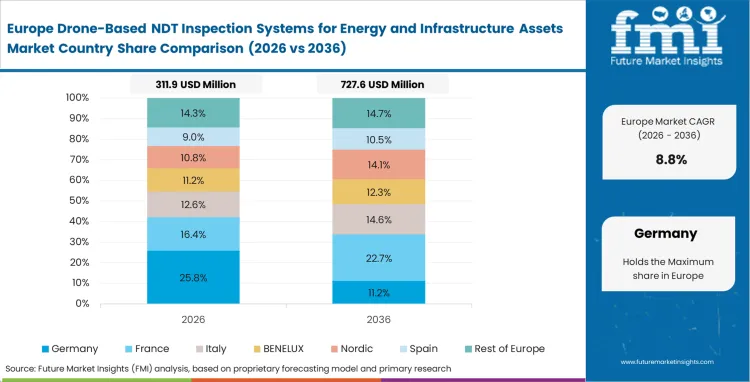
Infrastructure modernization programs require consistent monitoring of energy and industrial assets. Operators integrate drone-based inspection into maintenance workflows to improve reliability. Regulatory requirements emphasize traceable inspection data and long-term asset tracking.
- Germany: Industrial operators deploy drone-based inspection systems to monitor complex infrastructure networks. Inspection programs focus on reducing downtime and improving maintenance planning. The drone-based NDT inspection systems for energy and infrastructure assets market in Germany is expected to grow at a CAGR of 11.9% from 2026 to 2036. Adoption is linked to integration of inspection data into digital asset management systems.
Middle East and Africa Drone-Based NDT Inspection Systems for Energy and Infrastructure Assets Market Analysis
Oil and gas infrastructure expansion increases demand for aerial inspection systems in remote and high-temperature environments. Operators deploy thermal imaging drones to detect early-stage pipeline faults. Harsh climate conditions require specialized hardware configurations. Airspace regulations require formal approvals for inspection activities near critical assets.
- Saudi Arabia: Saudi Arabia is forecast to record steady growth at a CAGR of 14.1% through 2036. National economic modification initiatives fund large-scale industrial modernization projects. Oil facility managers transition away from dangerous scaffolding operations toward continuous aerial thickness measuring protocols. Favorable regulatory environments granting beyond visual line of sight permissions give regional operators a significant structural advantage over constrained western counterparts.
FMI's report includes South Africa and United Arab Emirates. Solar generation farms utilize automated thermal scanning to identify defective photovoltaic cells across massive geographic footprints.
Competitive Aligners for Market Players
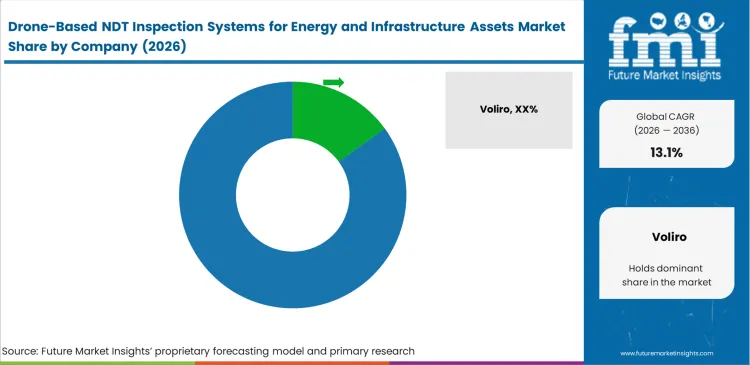
Standardization of drone hardware is shifting competition toward software and data capabilities. Multirotor airframes offer limited differentiation as similar designs are widely available through common supply chains. Vendors such as Voliro and Flyability focus on specialized designs built for confined and complex inspection environments, where stability and contact-based operation are critical. Vendor selection depends more on data accuracy and post-flight analytics than on flight performance metrics such as speed.
Established providers maintain an advantage through existing regulatory approvals and operational track records. Securing beyond visual line of sight permissions requires extensive documentation and validation, which creates entry barriers for new companies. Providers with proven autonomous flight data and prior approvals reduce deployment timelines for industrial users. Reliability in sensor integration also plays a key role, as equipment failure during inspection can disrupt operations and increase risk exposure.
Large asset operators prefer systems that support open data standards to avoid long-term dependency on a single vendor. Integration with enterprise systems remains a priority, particularly for managing inspection records alongside operational data. Service providers that support hardware-agnostic data processing can work across multiple drone platforms and deliver standardized inspection outputs. Market structure is expected to shift toward consolidation as large operators require consistent service quality across regions, which smaller providers often cannot deliver.
Key Players in Drone-Based NDT Inspection Systems for Energy and Infrastructure Assets Market
- Voliro
- Flyability
- Percepto
- Terra Drone
- Skydio
- DRONE VOLT
- Phase One
Scope of the Report
| Metric | Value |
|---|---|
| Quantitative Units | USD 1.25 billion to USD 4.28 billion, at a CAGR of 13.10% |
| Market Definition | Unmanned aerial architectures deploying specialized non-destructive evaluation instrumentation to assess structural health across active industrial environments without operational interruption. |
| Segmentation | Platform, NDT Method, Asset Type, Delivery Model, End Use |
| Regions Covered | North America, Latin America, Europe, East Asia, South Asia, Oceania, Middle East and Africa |
| Countries Covered | India, China, Saudi Arabia, Brazil, United States, Canada, Germany |
| Key Companies Profiled | Voliro, Flyability, Percepto, Terra Drone, Skydio, DRONE VOLT, Phase One |
| Forecast Period | 2026 to 2036 |
| Approach | FMI analysts mapped verified hardware deployments against active industrial service contracts to build accurate baseline valuation models. |
Source: Future Market Insights (FMI) analysis, based on proprietary forecasting model and primary research
Drone-Based NDT Inspection Systems for Energy and Infrastructure Assets Market Analysis by Segments
Platform
- Multirotor
- Tethered
- Hybrid VTOL
- Confined-space
- Docked
NDT Method
- Visual
- Thermography
- Ultrasonic
- LiDAR
- Corona
Asset Type
- Powerlines
- Pipelines
- Wind turbines
- Bridges
- Dams
Delivery Model
- Service contracts
- Hardware sales
- Software licenses
- Managed programs
- Lease fleets
End Use
- Utilities
- Oil and gas
- Transport
- Renewables
- Public works
Region
- North America
- Latin America
- Europe
- East Asia
- South Asia
- Oceania
- Middle East and Africa
Bibliography
- Federal Aviation Administration. (2025, May 1). Drone integration: Concept of operations (May 2025). USA Department of Transportation.
- Office of Inspector General, USA Department of Transportation. (2025, June 30). FAA has made progress in advancing beyond visual line of sight drone operations, but barriers remain before routine use can begin.
- Pipeline and Hazardous Materials Safety Administration. (2025, January 17). Gas pipeline leak detection and repair final rule. USA Department of Transportation.
- International Energy Agency. (2025, February 25). Building the future transmission grid.
- Oak Ridge National Laboratory. (2024, August 27). Protecting electric grid health with drone-based power line inspection. USA Department of Energy.
This bibliography is provided for reader reference. The full FMI report contains the complete reference list with primary source documentation.
This Report Addresses
- Integration pathways connecting raw aerial imagery with legacy corporate enterprise resource planning databases.
- Regulatory constraints shaping automated beyond visual line of sight flight approvals across distinct geographic zones.
- Total cost of ownership for inspection drones separating internal hardware fleet ownership from turnkey third-party aviation service agreements.
- Structural limitations preventing standard commercial quadcopters from surviving high-turbulence wind farm environments.
- Liability transfer mechanics utilized by facility managers contracting external risk-insured diagnostic data acquisition firms.
- Operational frictions slowing advanced ultrasonic testing payload adoption despite proven theoretical industrial benefits.
- Geographic divergence regarding domestic manufacturing mandates designed to protect local unmanned aviation supply chains.
- Procurement strategies engineered to prevent software vendor lock-in when scaling national infrastructure diagnostic programs.
Frequently Asked Questions
What is the drone-based NDT inspection systems market size in 2026?
Sector valuation reaches USD 1.2 billion in 2026. Revenue expands rapidly because automated aerial systems bypass expensive manual scaffolding requirements entirely, delivering essential structural data without interrupting continuous facility operations.
Why are utilities adopting NDT drones faster than other asset owners?
Grid modernization mandates force utility providers to map continuous defect points without interrupting transmission. Delaying automated grid digitization exposes utility executives to massive fines following wildfire incidents sparked by decaying infrastructure components.
How do drones perform ultrasonic thickness testing on industrial assets?
Specialized multirotor platforms carry heavy acoustic probes directly to elevated pipelines or storage tanks. Operations managers execute contact-based testing protocols utilizing stable hovering algorithms, preventing forward-motion requirements from ruining delicate thickness measurement calibrations.
Which assets are best suited to drone-based NDT inspection?
Linear transmission networks and inaccessible vertical structures dominate early adoption profiles. Maintenance supervisors need exact coordinates for damaged insulators or flare stack corrosion without risking severe personnel injury during manual climbing audits.
What is the difference between visual drone inspection and contact NDT drone inspection?
High-resolution optical sensors provide immediate contextual awareness for maintenance crews planning physical interventions. Contact testing requires actual physical interaction with target surfaces, generating complex ultrasonic data that requires specialized engineering software for accurate interpretation.
Which companies lead the drone NDT inspection systems market?
Specialized vendors including Voliro, Flyability, Percepto, and Terra Drone command significant share. Procurement directors evaluating enterprise deployments select vendors based entirely on sensor data accuracy and post-flight analytical automation capabilities rather than basic flight speed.
What regulations support BVLOS drone inspections for infrastructure?
Aviation authorities progressively grant long-distance flight waivers for unpopulated industrial corridors. Utilities achieve true scale once human observers remain centralized in control rooms rather than driving alongside high-voltage transmission lines manually.
How does drone NDT compare with rope access and scaffolding?
Automated aerial systems bypass physical access limitations entirely, capturing essential structural data from safe standoff distances. Relying on ground crews to erect scaffolding around active flaring stacks consumes critical maintenance budgets and risks severe personnel injury.
Which countries are growing fastest in utility drone inspection adoption?
India tracks at 15.2% compound growth driven by rapid grid modernization across difficult terrain. National power ministries mandate automated oversight to combat severe transmission loss rates linked to aging infrastructure components.
When should an operator outsource inspections instead of buying a fleet?
Industrial operators prefer shifting technical obsolescence risk entirely onto specialized third-party aviation vendors. Turnkey service agreements draw funds from flexible operational budgets, bypassing rigid board-level capital approval processes.
What drives the 13.10% drone inspection market CAGR?
Unscheduled downtime costs force petrochemical facility managers to replace periodic manual audits with continuous aerial diagnostics. Engineering directors demand technology capable of measuring pipe thickness while processing units remain fully operational.
Why does multirotor architecture dominate hardware selection?
Precision defect scanning demands absolutely stationary aerial positioning during testing routines. Multirotor frames support rapid sensor swapping between optical cameras and heavy acoustic probes, allowing diverse operations mid-shift.
How do tethered systems fit into broader inspection portfolios?
Continuous power supply allows uninterrupted monitoring over localized high-risk zones. Engineering directors deploy tethered units during specific active maintenance interventions rather than wide-area transmission corridor patrols.
Why do wind farm operators experience elevated hardware attrition?
Rotating turbine blades generate intense localized atmospheric disturbances. Flight operations managers experience higher crash rates when deploying lightweight platforms lacking specialized aerodynamic stabilization algorithms near active generation infrastructure.
What role does AI play in post-flight data processing?
Software platforms utilize machine learning to automatically flag anomalous temperature gradients within massive raw thermal datasets. IT directors rely on automated classification to prevent engineering teams from drowning in unanalyzed imagery.
What specific risk do autonomous docking stations mitigate?
Remote utility substations require continuous physical oversight across vast geographic footprints. Permanent resident aerial units execute scheduled patrols without requiring human transport crews, drastically reducing per-mile data acquisition costs.
How do protectionist trade policies shape East Asian hardware procurement?
Massive renewable energy buildouts require local monitoring solutions. Regional battery manufacturing dominance gives domestic hardware developers a significant advantage in pushing fundamental flight endurance specifications past international rivals.
Why do transport sectors trail utilities in automated diagnostic adoption?
Rail operators utilize highly specialized track geometry databases built around continuous ground vehicle data. Data architects struggle to merge discontinuous aerial diagnostic images into these rigid legacy software architectures.
How do extreme ambient temperatures affect Middle Eastern equipment deployments?
Petrochemical operators deploy thermal imaging platforms across arid environments. Extreme ambient heat profiles force hardware developers to engineer specialized cooling systems protecting sensitive electronic payloads from rapid degradation.
What fundamental limitation restricts fixed-wing aircraft in structural evaluation?
Reliability engineers avoid fixed-wing formats because forward-motion requirements ruin delicate thickness measurement calibrations. Accurate non-destructive testing demands stable hovering to gather precise baseline readings.
Preview the report firsthand - request a free sample
Get SampleGet the brochure for pricing and purchase details.
Get PDFTable of Content
- Executive Summary
- Global Market Outlook
- Demand-side Trends
- Supply-side Trends
- Technology Roadmap Analysis
- Analysis and Recommendations
- Market Overview
- Market Coverage / Taxonomy
- Market Definition / Scope / Limitations
- Research Methodology
- Chapter Orientation
- Analytical Lens and Working Hypotheses
- Market Structure, Signals, and Trend Drivers
- Benchmarking and Cross-market Comparability
- Market Sizing, Forecasting, and Opportunity Mapping
- Research Design and Evidence Framework
- Desk Research Programme (Secondary Evidence)
- Company Annual and Sustainability Reports
- Peer-reviewed Journals and Academic Literature
- Corporate Websites, Product Literature, and Technical Notes
- Earnings Decks and Investor Briefings
- Statutory Filings and Regulatory Disclosures
- Technical White Papers and Standards Notes
- Trade Journals, Industry Magazines, and Analyst Briefs
- Conference Proceedings, Webinars, and Seminar Materials
- Government Statistics Portals and Public Data Releases
- Press Releases and Reputable Media Coverage
- Specialist Newsletters and Curated Briefings
- Sector Databases and Reference Repositories
- FMI Internal Proprietary Databases and Historical Market Datasets
- Subscription Datasets and Paid Sources
- Social Channels, Communities, and Digital Listening Inputs
- Additional Desk Sources
- Expert Input and Fieldwork (Primary Evidence)
- Primary Modes
- Qualitative Interviews and Expert Elicitation
- Quantitative Surveys and Structured Data Capture
- Blended Approach
- Why Primary Evidence is Used
- Field Techniques
- Interviews
- Surveys
- Focus Groups
- Observational and In-context Research
- Social and Community Interactions
- Stakeholder Universe Engaged
- C-suite Leaders
- Board Members
- Presidents and Vice Presidents
- R&D and Innovation Heads
- Technical Specialists
- Domain Subject-matter Experts
- Scientists
- Physicians and Other Healthcare Professionals
- Governance, Ethics, and Data Stewardship
- Research Ethics
- Data Integrity and Handling
- Primary Modes
- Tooling, Models, and Reference Databases
- Desk Research Programme (Secondary Evidence)
- Data Engineering and Model Build
- Data Acquisition and Ingestion
- Cleaning, Normalisation, and Verification
- Synthesis, Triangulation, and Analysis
- Quality Assurance and Audit Trail
- Market Background
- Market Dynamics
- Drivers
- Restraints
- Opportunity
- Trends
- Scenario Forecast
- Demand in Optimistic Scenario
- Demand in Likely Scenario
- Demand in Conservative Scenario
- Opportunity Map Analysis
- Product Life Cycle Analysis
- Supply Chain Analysis
- Investment Feasibility Matrix
- Value Chain Analysis
- PESTLE and Porter’s Analysis
- Regulatory Landscape
- Regional Parent Market Outlook
- Production and Consumption Statistics
- Import and Export Statistics
- Market Dynamics
- Global Market Analysis 2021 to 2025 and Forecast, 2026 to 2036
- Historical Market Size Value (USD Million) Analysis, 2021 to 2025
- Current and Future Market Size Value (USD Million) Projections, 2026 to 2036
- Y-o-Y Growth Trend Analysis
- Absolute $ Opportunity Analysis
- Global Market Pricing Analysis 2021 to 2025 and Forecast 2026 to 2036
- Global Market Analysis 2021 to 2025 and Forecast 2026 to 2036, By Platform
- Introduction / Key Findings
- Historical Market Size Value (USD Million) Analysis By Platform , 2021 to 2025
- Current and Future Market Size Value (USD Million) Analysis and Forecast By Platform , 2026 to 2036
- Multirotor
- Tethered
- Hybrid VTOL
- Confined-space
- Docked
- Multirotor
- Y-o-Y Growth Trend Analysis By Platform , 2021 to 2025
- Absolute $ Opportunity Analysis By Platform , 2026 to 2036
- Global Market Analysis 2021 to 2025 and Forecast 2026 to 2036, By NDT Method
- Introduction / Key Findings
- Historical Market Size Value (USD Million) Analysis By NDT Method, 2021 to 2025
- Current and Future Market Size Value (USD Million) Analysis and Forecast By NDT Method, 2026 to 2036
- Visual
- Thermography
- Ultrasonic
- LiDAR
- Corona
- Visual
- Y-o-Y Growth Trend Analysis By NDT Method, 2021 to 2025
- Absolute $ Opportunity Analysis By NDT Method, 2026 to 2036
- Global Market Analysis 2021 to 2025 and Forecast 2026 to 2036, By Asset Type
- Introduction / Key Findings
- Historical Market Size Value (USD Million) Analysis By Asset Type, 2021 to 2025
- Current and Future Market Size Value (USD Million) Analysis and Forecast By Asset Type, 2026 to 2036
- Powerlines
- Pipelines
- Wind turbines
- Bridges
- Dams
- Powerlines
- Y-o-Y Growth Trend Analysis By Asset Type, 2021 to 2025
- Absolute $ Opportunity Analysis By Asset Type, 2026 to 2036
- Global Market Analysis 2021 to 2025 and Forecast 2026 to 2036, By Delivery Model
- Introduction / Key Findings
- Historical Market Size Value (USD Million) Analysis By Delivery Model, 2021 to 2025
- Current and Future Market Size Value (USD Million) Analysis and Forecast By Delivery Model, 2026 to 2036
- Service contracts
- Hardware sales
- Software licenses
- Managed programs
- Lease fleets
- Service contracts
- Y-o-Y Growth Trend Analysis By Delivery Model, 2021 to 2025
- Absolute $ Opportunity Analysis By Delivery Model, 2026 to 2036
- Global Market Analysis 2021 to 2025 and Forecast 2026 to 2036, By End Use
- Introduction / Key Findings
- Historical Market Size Value (USD Million) Analysis By End Use, 2021 to 2025
- Current and Future Market Size Value (USD Million) Analysis and Forecast By End Use, 2026 to 2036
- Utilities
- Oil and gas
- Transport
- Renewables
- Public works
- Utilities
- Y-o-Y Growth Trend Analysis By End Use, 2021 to 2025
- Absolute $ Opportunity Analysis By End Use, 2026 to 2036
- Global Market Analysis 2021 to 2025 and Forecast 2026 to 2036, By Region
- Introduction
- Historical Market Size Value (USD Million) Analysis By Region, 2021 to 2025
- Current Market Size Value (USD Million) Analysis and Forecast By Region, 2026 to 2036
- North America
- Latin America
- Western Europe
- Eastern Europe
- East Asia
- South Asia and Pacific
- Middle East & Africa
- Market Attractiveness Analysis By Region
- North America Market Analysis 2021 to 2025 and Forecast 2026 to 2036, By Country
- Historical Market Size Value (USD Million) Trend Analysis By Market Taxonomy, 2021 to 2025
- Market Size Value (USD Million) Forecast By Market Taxonomy, 2026 to 2036
- By Country
- USA
- Canada
- Mexico
- By Platform
- By NDT Method
- By Asset Type
- By Delivery Model
- By End Use
- By Country
- Market Attractiveness Analysis
- By Country
- By Platform
- By NDT Method
- By Asset Type
- By Delivery Model
- By End Use
- Key Takeaways
- Latin America Market Analysis 2021 to 2025 and Forecast 2026 to 2036, By Country
- Historical Market Size Value (USD Million) Trend Analysis By Market Taxonomy, 2021 to 2025
- Market Size Value (USD Million) Forecast By Market Taxonomy, 2026 to 2036
- By Country
- Brazil
- Chile
- Rest of Latin America
- By Platform
- By NDT Method
- By Asset Type
- By Delivery Model
- By End Use
- By Country
- Market Attractiveness Analysis
- By Country
- By Platform
- By NDT Method
- By Asset Type
- By Delivery Model
- By End Use
- Key Takeaways
- Western Europe Market Analysis 2021 to 2025 and Forecast 2026 to 2036, By Country
- Historical Market Size Value (USD Million) Trend Analysis By Market Taxonomy, 2021 to 2025
- Market Size Value (USD Million) Forecast By Market Taxonomy, 2026 to 2036
- By Country
- Germany
- UK
- Italy
- Spain
- France
- Nordic
- BENELUX
- Rest of Western Europe
- By Platform
- By NDT Method
- By Asset Type
- By Delivery Model
- By End Use
- By Country
- Market Attractiveness Analysis
- By Country
- By Platform
- By NDT Method
- By Asset Type
- By Delivery Model
- By End Use
- Key Takeaways
- Eastern Europe Market Analysis 2021 to 2025 and Forecast 2026 to 2036, By Country
- Historical Market Size Value (USD Million) Trend Analysis By Market Taxonomy, 2021 to 2025
- Market Size Value (USD Million) Forecast By Market Taxonomy, 2026 to 2036
- By Country
- Russia
- Poland
- Hungary
- Balkan & Baltic
- Rest of Eastern Europe
- By Platform
- By NDT Method
- By Asset Type
- By Delivery Model
- By End Use
- By Country
- Market Attractiveness Analysis
- By Country
- By Platform
- By NDT Method
- By Asset Type
- By Delivery Model
- By End Use
- Key Takeaways
- East Asia Market Analysis 2021 to 2025 and Forecast 2026 to 2036, By Country
- Historical Market Size Value (USD Million) Trend Analysis By Market Taxonomy, 2021 to 2025
- Market Size Value (USD Million) Forecast By Market Taxonomy, 2026 to 2036
- By Country
- China
- Japan
- South Korea
- By Platform
- By NDT Method
- By Asset Type
- By Delivery Model
- By End Use
- By Country
- Market Attractiveness Analysis
- By Country
- By Platform
- By NDT Method
- By Asset Type
- By Delivery Model
- By End Use
- Key Takeaways
- South Asia and Pacific Market Analysis 2021 to 2025 and Forecast 2026 to 2036, By Country
- Historical Market Size Value (USD Million) Trend Analysis By Market Taxonomy, 2021 to 2025
- Market Size Value (USD Million) Forecast By Market Taxonomy, 2026 to 2036
- By Country
- India
- ASEAN
- Australia & New Zealand
- Rest of South Asia and Pacific
- By Platform
- By NDT Method
- By Asset Type
- By Delivery Model
- By End Use
- By Country
- Market Attractiveness Analysis
- By Country
- By Platform
- By NDT Method
- By Asset Type
- By Delivery Model
- By End Use
- Key Takeaways
- Middle East & Africa Market Analysis 2021 to 2025 and Forecast 2026 to 2036, By Country
- Historical Market Size Value (USD Million) Trend Analysis By Market Taxonomy, 2021 to 2025
- Market Size Value (USD Million) Forecast By Market Taxonomy, 2026 to 2036
- By Country
- Kingdom of Saudi Arabia
- Other GCC Countries
- Turkiye
- South Africa
- Other African Union
- Rest of Middle East & Africa
- By Platform
- By NDT Method
- By Asset Type
- By Delivery Model
- By End Use
- By Country
- Market Attractiveness Analysis
- By Country
- By Platform
- By NDT Method
- By Asset Type
- By Delivery Model
- By End Use
- Key Takeaways
- Key Countries Market Analysis
- USA
- Pricing Analysis
- Market Share Analysis, 2025
- By Platform
- By NDT Method
- By Asset Type
- By Delivery Model
- By End Use
- Canada
- Pricing Analysis
- Market Share Analysis, 2025
- By Platform
- By NDT Method
- By Asset Type
- By Delivery Model
- By End Use
- Mexico
- Pricing Analysis
- Market Share Analysis, 2025
- By Platform
- By NDT Method
- By Asset Type
- By Delivery Model
- By End Use
- Brazil
- Pricing Analysis
- Market Share Analysis, 2025
- By Platform
- By NDT Method
- By Asset Type
- By Delivery Model
- By End Use
- Chile
- Pricing Analysis
- Market Share Analysis, 2025
- By Platform
- By NDT Method
- By Asset Type
- By Delivery Model
- By End Use
- Germany
- Pricing Analysis
- Market Share Analysis, 2025
- By Platform
- By NDT Method
- By Asset Type
- By Delivery Model
- By End Use
- UK
- Pricing Analysis
- Market Share Analysis, 2025
- By Platform
- By NDT Method
- By Asset Type
- By Delivery Model
- By End Use
- Italy
- Pricing Analysis
- Market Share Analysis, 2025
- By Platform
- By NDT Method
- By Asset Type
- By Delivery Model
- By End Use
- Spain
- Pricing Analysis
- Market Share Analysis, 2025
- By Platform
- By NDT Method
- By Asset Type
- By Delivery Model
- By End Use
- France
- Pricing Analysis
- Market Share Analysis, 2025
- By Platform
- By NDT Method
- By Asset Type
- By Delivery Model
- By End Use
- India
- Pricing Analysis
- Market Share Analysis, 2025
- By Platform
- By NDT Method
- By Asset Type
- By Delivery Model
- By End Use
- ASEAN
- Pricing Analysis
- Market Share Analysis, 2025
- By Platform
- By NDT Method
- By Asset Type
- By Delivery Model
- By End Use
- Australia & New Zealand
- Pricing Analysis
- Market Share Analysis, 2025
- By Platform
- By NDT Method
- By Asset Type
- By Delivery Model
- By End Use
- China
- Pricing Analysis
- Market Share Analysis, 2025
- By Platform
- By NDT Method
- By Asset Type
- By Delivery Model
- By End Use
- Japan
- Pricing Analysis
- Market Share Analysis, 2025
- By Platform
- By NDT Method
- By Asset Type
- By Delivery Model
- By End Use
- South Korea
- Pricing Analysis
- Market Share Analysis, 2025
- By Platform
- By NDT Method
- By Asset Type
- By Delivery Model
- By End Use
- Russia
- Pricing Analysis
- Market Share Analysis, 2025
- By Platform
- By NDT Method
- By Asset Type
- By Delivery Model
- By End Use
- Poland
- Pricing Analysis
- Market Share Analysis, 2025
- By Platform
- By NDT Method
- By Asset Type
- By Delivery Model
- By End Use
- Hungary
- Pricing Analysis
- Market Share Analysis, 2025
- By Platform
- By NDT Method
- By Asset Type
- By Delivery Model
- By End Use
- Kingdom of Saudi Arabia
- Pricing Analysis
- Market Share Analysis, 2025
- By Platform
- By NDT Method
- By Asset Type
- By Delivery Model
- By End Use
- Turkiye
- Pricing Analysis
- Market Share Analysis, 2025
- By Platform
- By NDT Method
- By Asset Type
- By Delivery Model
- By End Use
- South Africa
- Pricing Analysis
- Market Share Analysis, 2025
- By Platform
- By NDT Method
- By Asset Type
- By Delivery Model
- By End Use
- USA
- Market Structure Analysis
- Competition Dashboard
- Competition Benchmarking
- Market Share Analysis of Top Players
- By Regional
- By Platform
- By NDT Method
- By Asset Type
- By Delivery Model
- By End Use
- Competition Analysis
- Competition Deep Dive
- Voliro
- Overview
- Product Portfolio
- Profitability by Market Segments (Product/Age /Sales Channel/Region)
- Sales Footprint
- Strategy Overview
- Marketing Strategy
- Product Strategy
- Channel Strategy
- Flyability
- Percepto
- Terra Drone
- Skydio
- DRONE VOLT
- Phase One
- Voliro
- Competition Deep Dive
- Assumptions & Acronyms Used


