

- Market Size (2026)
- USD 118.0 Mn
- Forecast (2036)
- USD 227.8 Mn
- CAGR (2026 to 2036)
- 6.8%
High-Temperature Furnace Refractory Lining Inspection Systems Market Market Size, Market Forecast and Outlook By FMI
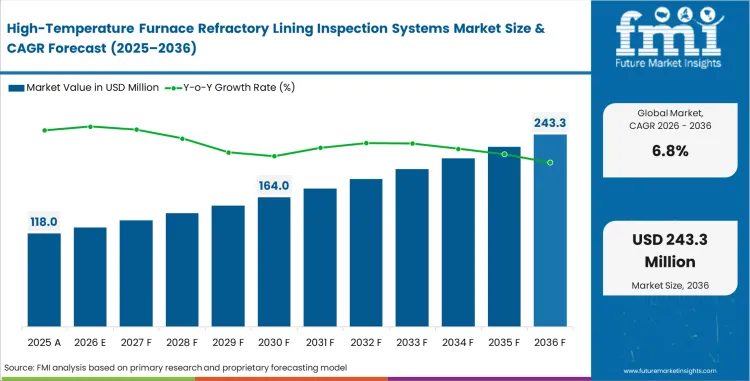
High-Temperature Furnace Refractory Lining Inspection Systems Market was valued at USD 110.5 million in 2025 and is expected to reach USD 118.0 million in 2026. By 2036, the market is projected to attain USD 227.8 million, registering a 6.8% CAGR across the forecast period. Demand is rising because furnace operators want earlier warning on lining wear before shell heat, production loss, or emergency repair turns a manageable issue into an expensive shutdown.
Summary of High-Temperature Furnace Refractory Lining Inspection Systems Market
- Market Snapshot
- The High-Temperature Furnace Refractory Lining Inspection Systems Market is valued at USD 110.5 million in 2025 and is projected to reach USD 227.8 million by 2036.
- The industry is expected to grow at a CAGR of 6.8% from 2026 to 2036, creating an incremental opportunity of USD 109.8 million.
- Category structure remains specification-driven, where cooling stability, image clarity in hot zones, and service reliability matter more than low entry price alone; adjacent insulation choices in high temperature insulation also shape the operating environment around these systems.
- Demand and Growth Drivers
- Demand is rising because steel, cement, glass, and petrochemical operators want earlier warning on hotspot formation, shell heat drift, and lining wear before a shutdown window is forced on them.
- Thermal and hybrid inspection tools are being adopted more often because they can keep watch on live hot zones where manual access is limited and decision time is short.
- Growth is also being supported by wider modernization across kiln, reheating, and process-heating assets, with demand for lining-support materials such as refractory cement continuing to reinforce refractory maintenance cycles.
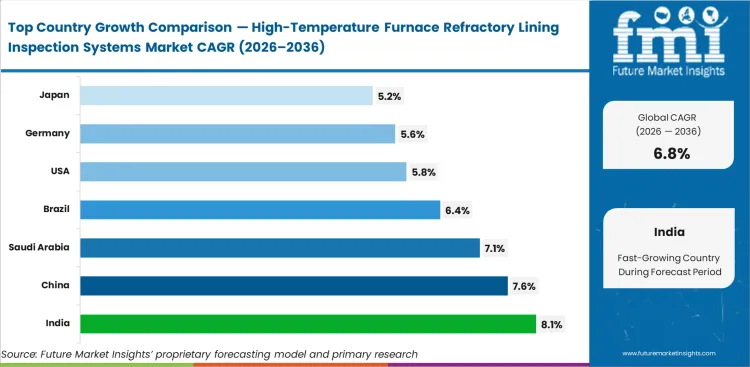
- Among key countries, India leads at 8.1% CAGR, followed by China at 7.6%, Saudi Arabia at 7.1%, Brazil at 6.4%, the United States at 5.8%, Germany at 5.6%, and Japan at 5.2%.
- Product and Segment View
- Scope covers thermal imagers, visual furnace cameras, borescopes, laser and acoustic methods, and mixed systems used to assess refractory condition in operating high-temperature assets.
- Thermal imaging dominates the Inspection Technology segment with 31.0% share in 2026, supported by its non-contact view of heat build-up and lining stress.
- Rotary kilns lead the Furnace Type segment with 24.0% share in 2026, helped by long campaigns, exposed shell conditions, and high cost when kiln downtime spills into production loss.
- Fixed-mounted systems are expected to represent 63.0% share in 2026 within Deployment Mode because operators running continuous assets prefer ongoing visibility over occasional checks.
- Condition monitoring leads Inspection Function with 34.0% share in 2026, reflecting a stronger buyer shift toward trend-based maintenance rather than one-off diagnosis.
- Steel is projected to hold 29.0% share in 2026 across End-use Industry because blast furnaces, reheating lines, and other heavy thermal assets carry large shutdown exposure.
- Direct OEM is likely to account for 57.0% share in 2026 within Sales Channel since most projects need site engineering, cooling selection, and installation support at the point of purchase.
- Water-cooled systems are expected to make up 46.0% share in 2026 under Cooling Configuration because hotter viewing positions still reward tougher thermal protection.
- Scope includes installed and portable refractory-inspection hardware, software, and viewing assemblies, but excludes unrelated furnace build-outs, broad plant automation packages, and generic observation cameras without refractory-use relevance.
- Geography and Competitive Outlook
- India, China, and Saudi Arabia remain the fastest-growing country markets, while the United States, Germany, and Japan continue to act as stable replacement-led demand bases.
- Competition remains fragmented because furnace layouts, heat loads, and maintenance practices vary too much for one supplier model to fit every site.
- AMETEK Land, Fluke Process Instruments, Tempsens, Lenox Instrument Company, SYN-FAB, and VisionTIR remain the key active names in the category.
- Supplier concentration remains moderate because installed bases differ widely by furnace type, viewing condition, and service requirement. No single vendor fits every hot-zone application equally well.
Key Takeaways, Market Size, and Forecast
- High-Temperature Furnace Refractory Lining Inspection Systems Market is projected to grow from USD 118.0 million in 2026 to USD 227.8 million by 2036, at a CAGR of 6.8%.
- The high-temperature furnace refractory lining inspection systems market was valued at USD 110.5 million in 2025.
- By 2036, the High-Temperature Furnace Refractory Lining Inspection Systems Market is expected to be worth USD 227.8 million.
- From 2026 to 2036, the market is projected to expand at a CAGR of 6.8%.
- The market is projected to create an incremental opportunity of USD 109.8 million between 2026 and 2036.
- In 2026, Thermal imaging is expected to account for 31.0% of the inspection technology segment.
- India (8.1%) and China (7.6%) are two of the fastest growing markets.
Adoption expands after maintenance and operations teams trust the same signal enough to use it in routine repair planning. At that stage, the system is no longer treated as a specialist diagnostic layer. It starts to function as part of the plant’s core furnace-monitoring base. Plants that see value after the first installation often extend coverage to nearby hot zones because the return becomes easier to defend inside the site. Systems built around reliable thermal imaging components and aligned with a broader thermal profiling system tend to move through evaluation faster, particularly where plants want inspection data that can be used directly in maintenance decisions instead of being interpreted in isolation.
India is projected to register 8.1% CAGR in this market through 2036, supported by active furnace additions and a large retrofit base across heavy-process industries. China is expected to expand at a 7.6% CAGR, helped by continued modernization across heat-intensive production lines. Saudi Arabia is likely to post 7.1% CAGR, while Brazil is set to record 6.4% CAGR as industrial operators tighten control over refractory performance and unplanned stoppage risk. Demand in the United States is anticipated to rise at a 5.8% CAGR, with Germany close behind at 5.6% CAGR, where replacement economics and integration discipline carry greater weight in buying decisions. Japan is expected to grow at 5.2% CAGR during the forecast period.
Segmental Analysis
High-Temperature Furnace Refractory Lining Inspection Systems Market Analysis by Inspection Technology
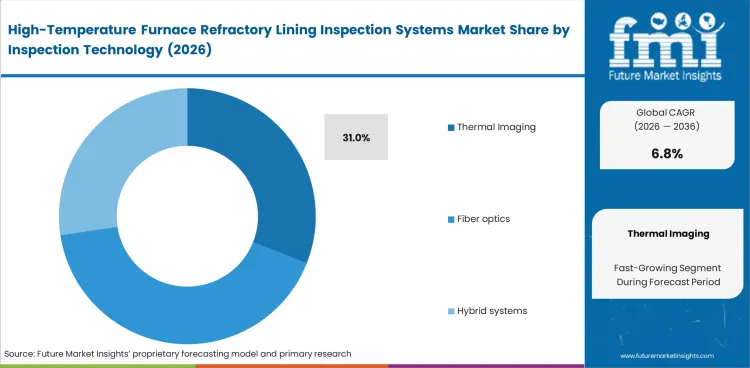
Thermal imaging is expected to account for 31.0% share in 2026 within inspection technology. Live hot-zone decisions favor tools that can show heat movement without forcing operators to wait for a shutdown window or a cooled inspection cycle. Plants using installed thermal views usually treat inspection as part of operating control rather than as a maintenance note saved for later review. That practical value grows where abnormal hot bands, heat leakage, and localized lining stress need to be judged while the furnace is still running. Demand also benefits from wider adoption of uncooled thermal imaging, especially where buyers want compact hardware and lower upkeep without giving up real-time visibility. Visual-only methods can still confirm obvious damage, but they leave a blind spot around pattern change that builds before failure becomes visible.
- Hot-zone visibility: Non-contact imaging helps teams identify abnormal heat bands before shell behavior becomes harder to explain.
- Faster operating judgment: Temperature patterns can be compared across shifts without waiting for a cooled inspection window.
- Earlier maintenance timing: Better warning signals support relining plans before a forced stop begins to reshape production schedules.
High-Temperature Furnace Refractory Lining Inspection Systems Market Analysis by Furnace Type
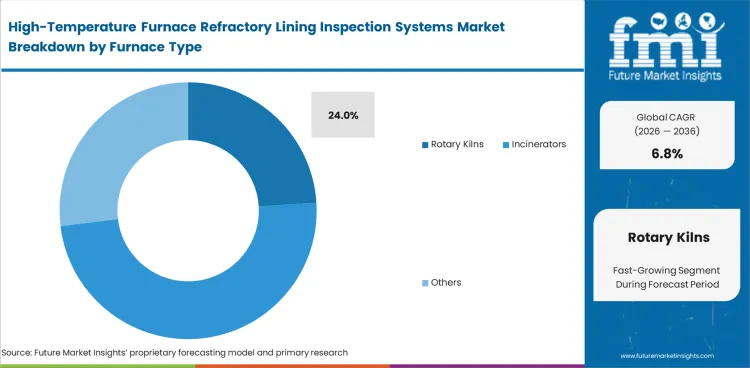
Campaign length and shutdown cost make furnace class one of the clearest buying filters in this market. Rotary kilns stay commercially important because shell exposure, continuous thermal duty, and long wear cycles make lining condition harder to judge through manual checking alone. Kiln operators usually need inspection systems that stay reliable over extended runs and still provide useful guidance during planned stoppages. That pattern sits close to the operating logic seen in intelligent rotary kiln monitoring systems, where continuous condition visibility carries more value than isolated snapshots. Plants that postpone kiln-focused monitoring often end up reacting only after shell heat has already reduced their maintenance options. Rotary kilns are likely to represent 24.0% share in 2026 because they combine large exposed surfaces with long operating campaigns that make ongoing inspection commercially easier to justify. Early temperature drift is also easier to act on when kiln review becomes part of routine process assessment.
- Broader shell exposure: Kiln operators work with large external surfaces, so early temperature drift becomes easier to catch.
- Longer campaign pressure: Wear develops gradually, making ongoing condition visibility more useful than short inspection windows.
- Higher downtime risk: A late reading compresses maintenance choices and widens production loss once a stop becomes unavoidable.
High-Temperature Furnace Refractory Lining Inspection Systems Market Analysis by Deployment Mode
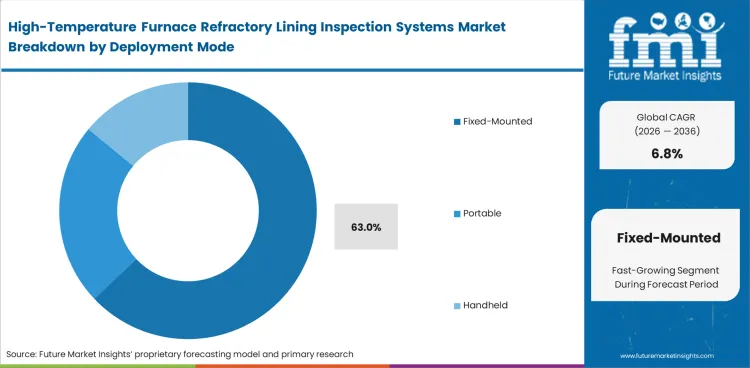
Fixed-mounted systems remain the practical choice where managers want one repeatable sight line that can be reviewed across shifts, campaigns, and maintenance intervals. Permanent placement also reduces the need to move people and equipment into hot access positions every time condition has to be checked. Interest in this setup aligns with the harsher-duty hardware logic seen in a rugged thermal camera, where mounting stability matters almost as much as image output. Portable checks still retain a role for targeted follow-up work, but they often break sequence and reduce confidence in trend interpretation. Plants that depend too heavily on movable inspection usually lose context around how shell conditions changed before and after operating adjustments. Fixed-mounted systems are expected to contribute 63.0% share in 2026 under deployment mode because permanent viewing supports steadier condition history and stronger operating discipline.
- More stable vantage: One repeatable sight line makes trend reading more believable across shifts and maintenance cycles.
- Lower operator exposure: Permanent placement reduces the need to move people and tools near hot viewing positions.
- Stronger continuity record: Condition history gains value when the same point can be reviewed before and after process changes.
High-Temperature Furnace Refractory Lining Inspection Systems Market Analysis by Inspection Function
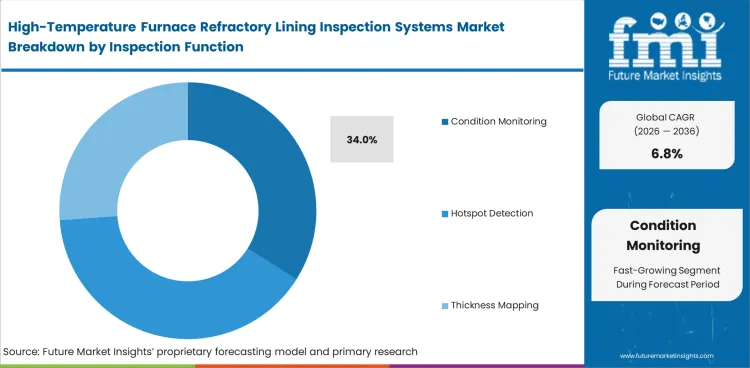
Maintenance budgets are easier to defend when inspection explains what action should come next instead of merely documenting heat damage after performance falls. Buyers increasingly want repeatable trend signals that help separate a short-term fluctuation from lining wear that is genuinely building across time. That preference becomes stronger where refractory condition, shell heat, and combustion balance interact continuously rather than through one visible failure event. In fired assets operating close to the logic of a high-temperature industrial burner, historical condition data usually carries more value than a late visual check. Plants that wait until production behavior drops often reach the answer later and with fewer repair options available. Condition monitoring leads this segment because trend evidence supports timing, priority, and repair planning in a way single-event images rarely can. With an expected 34.0% share in 2026, this function remains the clearest commercial choice within inspection function.
- Higher trend value: Repeated readings make it easier to separate a passing fluctuation from a lining problem that is building.
- Better maintenance planning: Operations staff can time repair work with more confidence when results are reviewed over longer periods.
- Stronger action quality: A functional signal matters more when it points toward timing and priority instead of showing damage late.
High-Temperature Furnace Refractory Lining Inspection Systems Market Analysis by Sales Channel
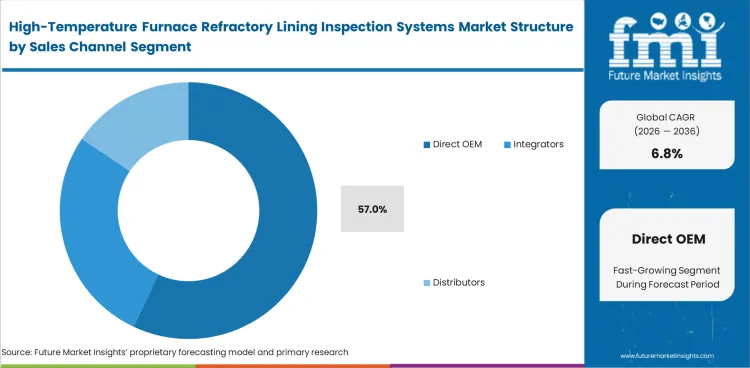
Application fit often decides the sale before price comparison becomes the main discussion because each furnace layout creates different cooling, sighting, purge, and commissioning demands. Buyers usually prefer one accountable supplier when the viewing position sits close to production-critical equipment and installation detail can affect performance later. Direct OEM routes stay stronger in these conditions because site adjustment is easier to coordinate when design and commissioning remain closely linked. Indirect channels can still support simpler jobs, but they often introduce more distance between design assumptions and real site conditions. That distance becomes costly once the system goes live and problem-solving cycles lengthen. Direct OEM is likely to hold 57.0% share in 2026 within sales channel because most installations need tailored cooling choice, sighting arrangement, purge design, and start-up support.
- Single-accountability fit: Direct supply reduces handoff gaps when buyers need both system fit and start-up support.
- Better site adjustment: OEM-led projects coordinate viewing angle, cooling method, and purge needs more effectively.
- Faster commissioning path: A cleaner installation chain usually shortens the time between purchase and usable inspection output.
High-Temperature Furnace Refractory Lining Inspection Systems Market Analysis by Cooling Configuration
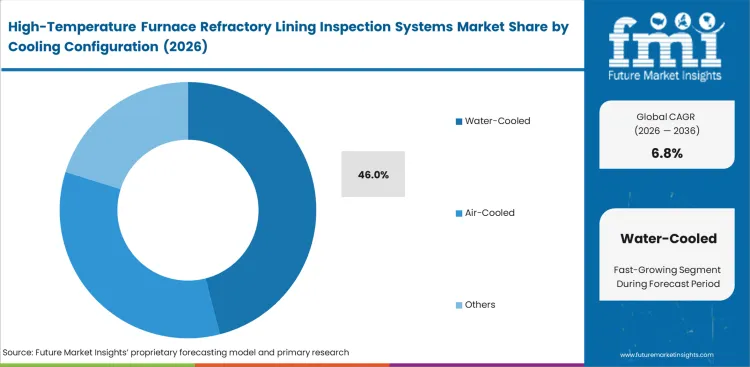
Harsh viewing positions keep cooling design central to system selection because inspection hardware near the refractory line faces heat loads that can quickly undermine credibility if protection is weak. Buyers often accept added plumbing when cooling improves survival near the hot zone and keeps image output more stable through long campaigns. Air-only approaches still work in lighter settings, but they lose strength once the furnace environment becomes more punishing or the viewing position sits too close to sustained heat. That preference is not only about protection of the assembly itself; it also affects whether operators trust the output during repeated review. Weak cooling choices can shorten service life and turn the inspection system into another maintenance burden instead of a monitoring aid. Water-cooled units are expected to account for 46.0% share in 2026 because many furnaces still expose hardware to thermal loads that air cooling alone cannot manage for long. Better thermal control around the assembly also supports clearer and more repeatable inspection results.
- Stronger thermal protection: Cooling design determines whether the system can stay credible in severe furnace positions over time.
- Clearer image stability: Better heat control around the assembly supports more repeatable inspection output.
- Longer service life: Reliable cooling lowers the chance that the monitoring tool itself becomes a maintenance burden.
High-Temperature Furnace Refractory Lining Inspection Systems Market Analysis by Mounting and Hot-Zone Durability
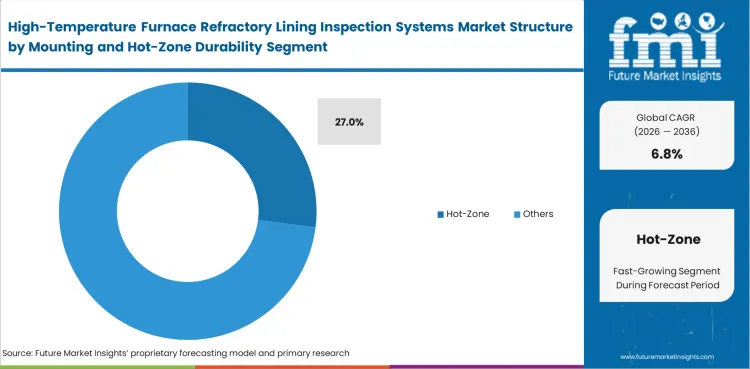
Mounting and durability matter because inspection systems in this market are not judged only by image quality, but by how long they remain stable in punishing thermal and mechanical conditions. Buyers usually want assemblies that can keep their position, resist deformation, and hold protection features in place over long campaigns without frequent intervention. That makes support hardware more commercially relevant than it may first appear, especially where vibration, shell heat, and maintenance access are all difficult. Hot-zone reliability becomes easier to justify when the mounting arrangement is treated as part of inspection performance rather than as an accessory decision. Weak anchor and support choices can shorten service life even when the sensing unit itself is technically strong. Buyers also place weight on long-run stability because inconsistent mounting weakens trust in historical comparison. Related durability-led preferences help keep specialized high-heat support configurations visible, with hot-zone-ready mounting systems expected to account for 27.0% share in 2026 in this durability-focused view of system configuration.
- More stable mounting support: Durable hot-zone fixtures help inspection assemblies stay aligned through long campaigns and harsh conditions.
- Lower maintenance strain: Stronger support hardware reduces the chance of repeat interventions near difficult furnace positions.
- Better long-run credibility: Inspection data holds more value when the assembly remains mechanically stable over time.
High-Temperature Furnace Refractory Lining Inspection Systems Market Market Drivers, Restraints, and Opportunities
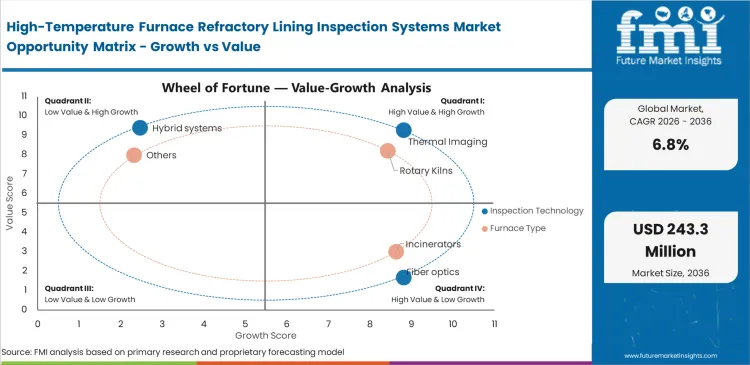
Heat-intensive plants are investing earlier because delayed visibility leaves less room to plan repairs before shell heat or process instability forces an unplanned stop. Buyers in steel, cement, glass, and petrochemicals now weigh inspection systems against downtime risk rather than against camera cost alone. Longer campaigns and tighter maintenance windows make earlier warning easier to justify. Plants that can tie inspection output to maintenance planning usually gain a cleaner case for spending because the tool supports timing rather than observation alone.
Adoption still slows when plants cannot agree on who owns the signal and how it should be used in daily decisions. Operations may want visibility, while maintenance may wait for harder proof before changing a lining plan. Cooling needs, window contamination, and site-specific mounting also stretch evaluation cycles. A system can look attractive on paper and still stall if the plant does not trust the result enough to act on it.
Opportunities in the High-Temperature Furnace Refractory Lining Inspection Systems Market
- Retrofit windows: Retrofit demand is strongest in older furnaces where plants want better lining visibility during planned outages without taking on major redesign work.
- Hybrid workflows: Plants combining thermal views with visual, acoustic, or thickness checks can build stronger maintenance confidence from the same inspection cycle.
- Service-led upgrades: Suppliers that help operators tune cooling, viewing position, and image interpretation can win where buyers want usable results rather than extra hardware.
Regional Analysis
.webp "Top Country Growth Comparison High Temperature Furnace Refractory Lining Inspection Systems Market Cagr (2026 2036)")
Based on the regional analysis, the High-Temperature Furnace Refractory Lining Inspection Systems Market market is segmented into Asia Pacific, North America, Europe, Latin America, and the Middle East & Africa across 40 plus countries. Growth patterns do not move in one line because furnace additions, replacement needs, and maintenance discipline differ widely by country.
| Country | CAGR (2026 to 2036) |
|---|---|
| India | 8.1% |
| China | 7.6% |
| Saudi Arabia | 7.1% |
| Brazil | 6.4% |
| United States | 5.8% |
| Germany | 5.6% |
| Japan | 5.2% |
Source: Future Market Insights (FMI) analysis, based on proprietary forecasting model and primary research.
Asia Pacific High-Temperature Furnace Refractory Lining Inspection Systems Market Analysis
Asia Pacific carries the strongest expansion profile because capacity growth and retrofit need are moving together. India and China add furnace demand from heavy industry while Japan remains a disciplined replacement-led market with stronger emphasis on operating precision. Buyers across the region usually focus on campaign life, heat loss, and maintenance timing before they focus on software extras. Plants that already run large kiln, steel, and glass assets tend to treat inspection to reduce uncertainty between stops. That mix keeps the region active across both new projects and upgrade decisions.
- India: Steel, cement, and minerals processing keep India close to the center of the new system demand. Plants in states with active steel and cement investment need earlier warning on lining wear because shutdown windows are costly and often tightly planned. Demand for the high-temperature furnace refractory lining inspection systems in India is expected to rise at a CAGR of 8.1% through 2036 as operators pair expansion with more structured maintenance visibility. Indian buyers prefer systems that can handle dust, heat, and difficult maintenance conditions without creating a high service burden. That keeps the market tilted toward dependable thermal and hybrid inspection setups rather than experimental tools.
- China: China is projected to record a CAGR of 7.6% in this industry during the forecast period, and that pace reflects the scale of heavy-process assets already in place. Furnace operators in steel, glass, and non-ferrous processing continue to look for condition signals that help protect campaign life and reduce sudden repair burden. Plants in China tend to compare inspection systems through operating fit, not through novelty alone, because site conditions differ sharply by asset class. Retrofit value stays visible where large installed bases still need better warning on heat drift and local shell stress. A mature manufacturing base keeps the market broad, even when buyers stay selective.
- Japan: Maintenance discipline shapes buying behavior in Japan more than raw capacity growth. Operators usually expect stable output, precise control, and clear evidence before a new inspection tool is adopted into routine decision-making. Buyers, therefore, prefer systems that can deliver repeatable results and fit cleanly into existing maintenance logic. Japan is likely to post a CAGR of 5.2% in the high-temperature furnace refractory lining inspection systems by 2036, which places it below faster-build countries but keeps it relevant for premium replacement demand. Reliable performance and low disruption during installation matter more here than headline system breadth.
South Korea, Southeast Asia, and Australia also contribute to regional demand even though they are not listed in the lead table. Cement, metals, and glass remain the main anchors across these countries, while plant-specific economics decide whether spending favors full installations or smaller upgrade programs. Regional demand stays healthiest where thermal assets run continuously and where unplanned stops carry visible cost. Buyers in slower pockets still move when maintenance evidence becomes harder to ignore.
North America and Europe High-Temperature Furnace Refractory Lining Inspection Systems Market Analysis
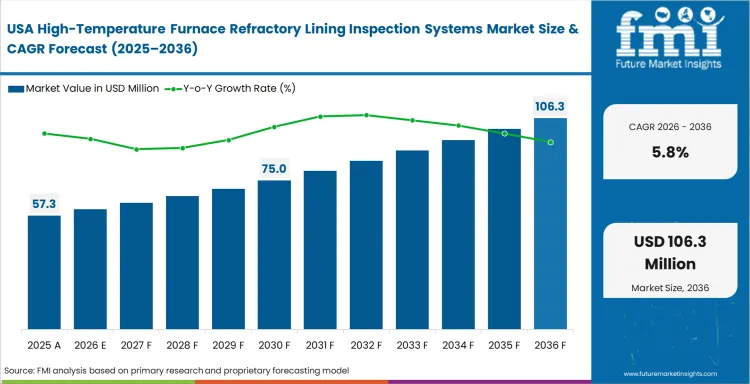
North America and Europe remain important because replacement demand is steady and operating discipline is high. Buyers in these regions usually ask harder questions on service life, maintenance fit, and signal credibility before they approve new equipment. Older furnace fleets create room for upgrades, yet plant engineers still want proof that a system will keep delivering under real site conditions. Germany and the United States therefore matter less for raw speed and more for the quality of demand they represent. A successful project in these markets often depends on trust in the data as much as on the hardware itself.
- United States: Replacement economics define much of the buying pattern in the United States, where many plants already know the cost of a forced stop and want better condition visibility before that risk rises. Operators in steel, glass, and petrochemical processing tend to compare system reliability, cooling strength, and service response before moving ahead. Demand for high-temperature furnace refractory lining inspection systems in the United States is set to grow at a CAGR of 5.8% through 2036, which reflects measured but steady expansion. Refractory maintenance habits also sit close to adjacent hardware demand seen in demand for stainless steel 330 refractory anchor in USA. Approval tends to move faster when plants treat inspection as part of maintenance control rather than as an optional monitoring add-on.
- Germany: Germany remains a disciplined replacement market because furnace operators usually put process stability and technical fit ahead of fast adoption. Demand for high-temperature furnace refractory lining inspection systems in Germany is expected to grow at a CAGR of 5.6% through 2036. Heavy engineering, specialty glass, and industrial heating applications continue to give inspection suppliers a credible operating base, but buyers still want clear proof that a system improves maintenance timing without making plant routines harder to manage.
Demand across both regions stays more replacement-led than expansion-led, which makes service quality and technical fit important to conversion. Buyers here often move after a clear maintenance case has already been established inside the plant.
Middle East, Latin America, and Other Growth Pools High-Temperature Furnace Refractory Lining Inspection Systems Market Analysis
Middle East and Latin America sit between expansion demand and replacement demand, which gives them a different shape from Asia Pacific or Western industrial markets. Saudi Arabia adds momentum through petrochemical and process-heating assets, while Brazil benefits from a broad industrial base that still needs practical upgrades. Buyers in these regions often balance performance need against service availability and installation ease. Systems that can be supported locally tend to gain ground faster because plant teams want less commissioning risk. Growth here often depends on whether a supplier can turn inspection into a usable maintenance routine rather than on whether the first demo looks impressive.
- Saudi Arabia: Petrochemical and process-heating assets make Saudi Arabia one of the stronger growth points in this industry. Furnace operators there place value on inspection systems that can stay dependable in hot, continuous service and help protect uptime in critical process units. Site decisions also favor equipment that can be maintained without long support gaps once it is installed. Sales of this segment in Saudi Arabia are expected to increase at a CAGR of 7.1% during the forecast period, which reflects both industrial scale and reliability-led buying. Plants that can connect inspection output to maintenance action are likely to widen use first.
- Brazil: Brazil carries a broader mix of steel, cement, glass, and process industries, so market expansion tends to come from many smaller decisions rather than one large push. Plant operators usually look for durable systems that can handle difficult furnace conditions without creating a high service burden. That makes practical installation and stable output more persuasive than extra feature depth. Brazil is likely to post a CAGR of 6.4% in this industry through 2036, with growth supported by gradual modernization and selective retrofit work. Buyers that see direct value in shutdown planning are the ones most likely to keep spending active.
Mexico, the Gulf states outside Saudi Arabia, and a wider group of industrial countries also create meaningful demand pockets. Growth does not always come from new furnace count alone because older hot assets can generate just as much need when maintenance uncertainty stays high. Service reach, installation confidence, and local operating support remain important in these regions. Suppliers that make the system easier to live with after purchase usually hold the stronger position.
Competitive Aligners for Market Players
Market structure remains fragmented because furnace environments differ widely across operating sites. Heat intensity cooling limits and sightline constraints prevent uniform inspection solutions. AMETEK Land and Fluke Process Instruments are commonly selected where plants expect mature inspection logic and predictable service coverage. These systems are often favored in larger installations that prioritize durability and stable long term use.
Evaluation practices tend to follow a short sequence of functional checks before approval. The first check considers whether performance remains stable at the actual thermal viewing point. The next step examines whether output directly informs maintenance planning without added interpretation effort. Service access after installation also influences selection especially where shutdown windows are tightly controlled. Tempsens appear frequently where practical hot zone coverage and close installation support are priorities.
Established participants maintain share by delivering integrated packages that link cooling optics and field support. This structure reduces operating risk and simplifies alignment with internal maintenance routines. Lenox Instrument Company and VisionTIR remain relevant in projects that require site specific alignment over standard deployment. Such openings persist when fast response or tailored configuration carries greater value. Across the high-temperature furnace refractory lining inspection systems market pressure through 2036 is expected to centre on application fit and post installation usability rather than scale.
Key Players in High-Temperature Furnace Refractory Lining Inspection Systems Market
- AMETEK Land
- Fluke Process Instruments
- Tempsens
- Lenox Instrument Company
- SYN-FAB
- VisionTIR
Scope of the Report
| Metric | Value |
|---|---|
| Quantitative Units | USD 118.0 million to USD 227.8 million, at a CAGR of 6.8% |
| Market Definition | Systems used to inspect refractory lining condition in operating or recently operated high-temperature furnaces through thermal, visual, acoustic, laser, or hybrid methods. Scope focuses on equipment and support used to detect wear, hotspots, cracking, thickness change, and related lining issues. |
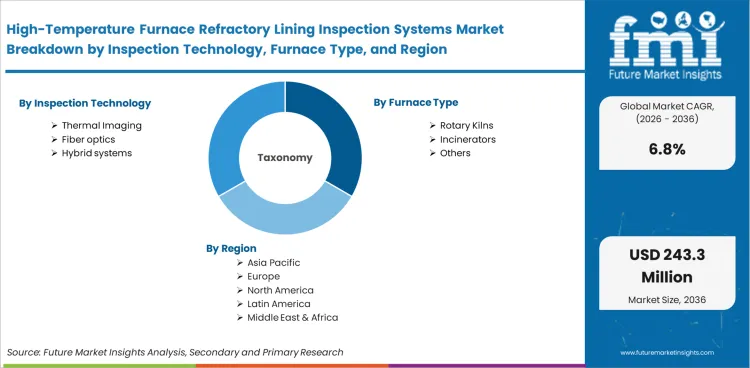
| Inspection Technology Segmentation | Thermal imaging, Visual borescopes, Laser profiling, Ultrasonic testing, Acoustic monitoring, Fiber optics, Hybrid systems |
| Furnace Type Segmentation | Rotary kilns, Blast furnaces, Reheating furnaces, Glass furnaces, Reformer furnaces, Annealing furnaces, Smelting furnaces, Incinerators |
| Deployment Mode Segmentation | Fixed-mounted, Portable, Handheld, Cart-based |
| Inspection Function Segmentation | Condition monitoring, Hotspot detection, Thickness mapping, Crack detection, Wear tracking, Post-reline validation, Campaign analytics |
| End-use Industry Segmentation | Steel, Cement, Glass, Petrochemicals, Non-ferrous, Ceramics, Power, Waste |
| Sales Channel Segmentation | Direct OEM, Integrators, Service contractors, Distributors, Retrofit specialists |
| Cooling Configuration Segmentation | Water-cooled, Air-cooled, Purge-cooled, Dual-cooled |
| Regions Covered | Asia Pacific, North America, Europe, Latin America, Middle East & Africa |
| Countries Covered | India, China, Saudi Arabia, Brazil, United States, Germany, Japan, and 40 plus countries |
| Key Companies Profiled | AMETEK Land, Fluke Process Instruments, Tempsens, Lenox Instrument Company, SYN-FAB, VisionTIR |
| Approach | Primary interviews usually focus on plant engineering, maintenance planning, and furnace operations. Baseline sizing relies on heavy-process asset logic, inspection-system adoption patterns, and replacement economics. Forecasts are cross-checked against end-use demand, installed asset behavior, and supplier activity in adjacent thermal monitoring categories. |
Source: Future Market Insights (FMI) analysis, based on proprietary forecasting model and primary research.
High-Temperature Furnace Refractory Lining Inspection Systems Market Market Analysis by Segments
Inspection Technology:
- Thermal imaging
- Visual borescopes
- Laser profiling
- Ultrasonic testing
- Acoustic monitoring
- Fiber optics
- Hybrid systems
Furnace Type:
- Rotary kilns
- Blast furnaces
- Reheating furnaces
- Glass furnaces
- Reformer furnaces
- Annealing furnaces
- Smelting furnaces
- Incinerators
Deployment Mode:
- Fixed-mounted
- Portable
- Handheld
- Cart-based
Inspection Function:
- Condition monitoring
- Hotspot detection
- Thickness mapping
- Crack detection
- Wear tracking
- Post-reline validation
- Campaign analytics
End-use Industry:
- Steel
- Cement
- Glass
- Petrochemicals
- Non-ferrous
- Ceramics
- Power
- Waste
Sales Channel:
- Direct OEM
- Integrators
- Service contractors
- Distributors
- Retrofit specialists
Cooling Configuration:
- Water-cooled
- Air-cooled
- Purge-cooled
- Dual-cooled
Region:
- Asia Pacific
- India
- China
- Japan
- North America
- United States
- Canada
- Europe
- Germany
- United Kingdom
- Italy
- Spain
- Netherlands
- Middle East & Africa
- Saudi Arabia
- Latin America
- Brazil
Bibliography
- USA Geological Survey. (2025). Mineral Commodity Summaries 2025. USA Department of the Interior.
- European Environment Agency. (2026). Zero-pollution, decarbonisation, and circular economy in energy-intensive industries. European Environment Agency.
- Ohri, R., Gupta, A., Bhattacharya, S., & Bandyopadhyay, A. (2025). A novel approach for real-time monitoring of process influencing events inside the blast furnace using infrared thermography.
- Ying, W. L., Sadri, A., & Gordon, Y. (2024). Campaign life extension of COREX furnaces. La Metallurgia Italiana.
- AMETEK Land. (2025). Thermal NIR-borescopes vs Visual Cameras: Why LAND Leads in Furnace Monitoring
This Report Addresses
- Market intelligence to support strategic decision making across refractory inspection hardware, thermal viewing systems, and plant-level furnace monitoring choices.
- Market size estimation and 10-year forecasts from 2026 to 2036, supported by heavy-process asset logic and application-based adoption assumptions.
- Growth opportunity mapping across inspection technology, furnace type, deployment mode, inspection function, end-use industry, sales channel, and cooling configuration.
- Country and regional outlooks covering India, China, Saudi Arabia, Brazil, the United States, Germany, and Japan.
- Competitive assessment across active suppliers with attention to cooling reliability, installation fit, service access, and post-installation usability.
- A practical view of what drives spending, what slows approval, and where hybrid or retrofit-led demand is most likely to deepen.
- Scope boundaries that separate refractory-lining inspection systems from broader furnace construction, generic observation cameras, and unrelated plant automation categories.
- Executive-ready takeaways for operators, maintenance planners, plant engineers, and strategy teams following high-temperature assets.
Frequently Asked Questions
What is being measured in this space?
Systems in this category are used to assess refractory wear, hotspots, cracking, thickness change, and related lining condition inside high-temperature furnace assets.
What makes this category different from a general furnace camera business?
Scope centers on refractory-condition inspection and maintenance decisions rather than broad observation or unrelated automation use.
Which inspection technology leads today?
Thermal imaging leads because it can show heat drift and possible lining stress without direct contact in live hot zones.
Why do rotary kilns matter so much?
Kilns combine long campaigns, exposed shell conditions, and costly shutdown risk, which makes inspection value easier to justify.
Why are fixed-mounted systems ahead of portable systems?
Continuous assets benefit more from repeatable viewing and condition history than from occasional spot checks.
What does condition monitoring add beyond a single inspection?
It turns isolated images into trend information that can support maintenance timing and repair priority.
Which end-use sector spends the most?
Steel leads because blast furnaces and reheating operations carry large production penalties when lining performance slips.
What holds adoption back?
Plants often slow down when operating, maintenance, and engineering groups do not yet trust the signal enough to act on it.
Which countries are expanding fastest?
India, China, and Saudi Arabia lead because heavy-process investment and modernization are still moving together.
How does the United States behave in this market?
Demand is steadier and more replacement-led, with buyers placing strong weight on reliability and service after installation.
How does Germany differ from faster-growth countries?
Germany buys carefully in a mature industrial setting, so proof of fit and stable output matters more than speed of rollout.
Where are retrofit opportunities strongest?
Older steel, cement, glass, and petrochemical assets offer the clearest case where better visibility can improve maintenance timing.
Is this still a fragmented supplier field?
Yes, because furnace conditions vary too much for one design or supplier style to fit every hot-zone application.
What changes by 2036?
Inspection is likely to sit closer to routine furnace decision making instead of being treated as a specialist add-on.
Who should use this report first?
Plant engineers, maintenance leaders, operations heads, and strategy teams following high-temperature assets will find the clearest value.
What is the practical takeaway?
Spending tends to move once a plant can connect inspection output to maintenance timing and shutdown decisions rather than to observation alone.
Preview the report firsthand - request a free sample
Get SampleGet the brochure for pricing and purchase details.
Get PDFTable of Content
- Executive Summary
- Global Market Outlook
- Demand-side Trends
- Supply-side Trends
- Technology Roadmap Analysis
- Analysis and Recommendations
- Market Overview
- Market Coverage / Taxonomy
- Market Definition / Scope / Limitations
- Research Methodology
- Chapter Orientation
- Analytical Lens and Working Hypotheses
- Market Structure, Signals, and Trend Drivers
- Benchmarking and Cross-market Comparability
- Market Sizing, Forecasting, and Opportunity Mapping
- Research Design and Evidence Framework
- Desk Research Programme (Secondary Evidence)
- Company Annual and Sustainability Reports
- Peer-reviewed Journals and Academic Literature
- Corporate Websites, Product Literature, and Technical Notes
- Earnings Decks and Investor Briefings
- Statutory Filings and Regulatory Disclosures
- Technical White Papers and Standards Notes
- Trade Journals, Industry Magazines, and Analyst Briefs
- Conference Proceedings, Webinars, and Seminar Materials
- Government Statistics Portals and Public Data Releases
- Press Releases and Reputable Media Coverage
- Specialist Newsletters and Curated Briefings
- Sector Databases and Reference Repositories
- FMI Internal Proprietary Databases and Historical Market Datasets
- Subscription Datasets and Paid Sources
- Social Channels, Communities, and Digital Listening Inputs
- Additional Desk Sources
- Expert Input and Fieldwork (Primary Evidence)
- Primary Modes
- Qualitative Interviews and Expert Elicitation
- Quantitative Surveys and Structured Data Capture
- Blended Approach
- Why Primary Evidence is Used
- Field Techniques
- Interviews
- Surveys
- Focus Groups
- Observational and In-context Research
- Social and Community Interactions
- Stakeholder Universe Engaged
- C-suite Leaders
- Board Members
- Presidents and Vice Presidents
- R&D and Innovation Heads
- Technical Specialists
- Domain Subject-matter Experts
- Scientists
- Physicians and Other Healthcare Professionals
- Governance, Ethics, and Data Stewardship
- Research Ethics
- Data Integrity and Handling
- Primary Modes
- Tooling, Models, and Reference Databases
- Desk Research Programme (Secondary Evidence)
- Data Engineering and Model Build
- Data Acquisition and Ingestion
- Cleaning, Normalisation, and Verification
- Synthesis, Triangulation, and Analysis
- Quality Assurance and Audit Trail
- Market Background
- Market Dynamics
- Drivers
- Restraints
- Opportunity
- Trends
- Scenario Forecast
- Demand in Optimistic Scenario
- Demand in Likely Scenario
- Demand in Conservative Scenario
- Opportunity Map Analysis
- Product Life Cycle Analysis
- Supply Chain Analysis
- Investment Feasibility Matrix
- Value Chain Analysis
- PESTLE and Porter’s Analysis
- Regulatory Landscape
- Regional Parent Market Outlook
- Production and Consumption Statistics
- Import and Export Statistics
- Market Dynamics
- Global Market Analysis 2021 to 2025 and Forecast, 2026 to 2036
- Historical Market Size Value (USD Million) Analysis, 2021 to 2025
- Current and Future Market Size Value (USD Million) Projections, 2026 to 2036
- Y-o-Y Growth Trend Analysis
- Absolute $ Opportunity Analysis
- Global Market Pricing Analysis 2021 to 2025 and Forecast 2026 to 2036
- Global Market Analysis 2021 to 2025 and Forecast 2026 to 2036, By Inspection Technology
- Introduction / Key Findings
- Historical Market Size Value (USD Million) Analysis By Inspection Technology , 2021 to 2025
- Current and Future Market Size Value (USD Million) Analysis and Forecast By Inspection Technology , 2026 to 2036
- Thermal Imaging
- Fiber optics
- Hybrid systems
- Thermal Imaging
- Y-o-Y Growth Trend Analysis By Inspection Technology , 2021 to 2025
- Absolute $ Opportunity Analysis By Inspection Technology , 2026 to 2036
- Global Market Analysis 2021 to 2025 and Forecast 2026 to 2036, By Furnace Type
- Introduction / Key Findings
- Historical Market Size Value (USD Million) Analysis By Furnace Type, 2021 to 2025
- Current and Future Market Size Value (USD Million) Analysis and Forecast By Furnace Type, 2026 to 2036
- Rotary Kilns
- Incinerators
- Others
- Rotary Kilns
- Y-o-Y Growth Trend Analysis By Furnace Type, 2021 to 2025
- Absolute $ Opportunity Analysis By Furnace Type, 2026 to 2036
- Global Market Analysis 2021 to 2025 and Forecast 2026 to 2036, By Deployment Mode
- Introduction / Key Findings
- Historical Market Size Value (USD Million) Analysis By Deployment Mode, 2021 to 2025
- Current and Future Market Size Value (USD Million) Analysis and Forecast By Deployment Mode, 2026 to 2036
- Fixed-Mounted
- Portable
- Handheld
- Fixed-Mounted
- Y-o-Y Growth Trend Analysis By Deployment Mode, 2021 to 2025
- Absolute $ Opportunity Analysis By Deployment Mode, 2026 to 2036
- Global Market Analysis 2021 to 2025 and Forecast 2026 to 2036, By Inspection Function
- Introduction / Key Findings
- Historical Market Size Value (USD Million) Analysis By Inspection Function, 2021 to 2025
- Current and Future Market Size Value (USD Million) Analysis and Forecast By Inspection Function, 2026 to 2036
- Condition Monitoring
- Hotspot Detection
- Thickness Mapping
- Condition Monitoring
- Y-o-Y Growth Trend Analysis By Inspection Function, 2021 to 2025
- Absolute $ Opportunity Analysis By Inspection Function, 2026 to 2036
- Global Market Analysis 2021 to 2025 and Forecast 2026 to 2036, By Sales Channel
- Introduction / Key Findings
- Historical Market Size Value (USD Million) Analysis By Sales Channel, 2021 to 2025
- Current and Future Market Size Value (USD Million) Analysis and Forecast By Sales Channel, 2026 to 2036
- Direct OEM
- Integrators
- Distributors
- Direct OEM
- Y-o-Y Growth Trend Analysis By Sales Channel, 2021 to 2025
- Absolute $ Opportunity Analysis By Sales Channel, 2026 to 2036
- Global Market Analysis 2021 to 2025 and Forecast 2026 to 2036, By Cooling Configuration
- Introduction / Key Findings
- Historical Market Size Value (USD Million) Analysis By Cooling Configuration, 2021 to 2025
- Current and Future Market Size Value (USD Million) Analysis and Forecast By Cooling Configuration, 2026 to 2036
- Water-Cooled
- Air-Cooled
- Others
- Water-Cooled
- Y-o-Y Growth Trend Analysis By Cooling Configuration, 2021 to 2025
- Absolute $ Opportunity Analysis By Cooling Configuration, 2026 to 2036
- Global Market Analysis 2021 to 2025 and Forecast 2026 to 2036, By Mounting and Hot-Zone Durability
- Introduction / Key Findings
- Historical Market Size Value (USD Million) Analysis By Mounting and Hot-Zone Durability, 2021 to 2025
- Current and Future Market Size Value (USD Million) Analysis and Forecast By Mounting and Hot-Zone Durability, 2026 to 2036
- Hot-Zone
- Others
- Hot-Zone
- Y-o-Y Growth Trend Analysis By Mounting and Hot-Zone Durability, 2021 to 2025
- Absolute $ Opportunity Analysis By Mounting and Hot-Zone Durability, 2026 to 2036
- Global Market Analysis 2021 to 2025 and Forecast 2026 to 2036, By Region
- Introduction
- Historical Market Size Value (USD Million) Analysis By Region, 2021 to 2025
- Current Market Size Value (USD Million) Analysis and Forecast By Region, 2026 to 2036
- North America
- Latin America
- Western Europe
- Eastern Europe
- East Asia
- South Asia and Pacific
- Middle East & Africa
- Market Attractiveness Analysis By Region
- North America Market Analysis 2021 to 2025 and Forecast 2026 to 2036, By Country
- Historical Market Size Value (USD Million) Trend Analysis By Market Taxonomy, 2021 to 2025
- Market Size Value (USD Million) Forecast By Market Taxonomy, 2026 to 2036
- By Country
- USA
- Canada
- Mexico
- By Inspection Technology
- By Furnace Type
- By Deployment Mode
- By Inspection Function
- By Sales Channel
- By Cooling Configuration
- By Mounting and Hot-Zone Durability
- By Country
- Market Attractiveness Analysis
- By Country
- By Inspection Technology
- By Furnace Type
- By Deployment Mode
- By Inspection Function
- By Sales Channel
- By Cooling Configuration
- By Mounting and Hot-Zone Durability
- Key Takeaways
- Latin America Market Analysis 2021 to 2025 and Forecast 2026 to 2036, By Country
- Historical Market Size Value (USD Million) Trend Analysis By Market Taxonomy, 2021 to 2025
- Market Size Value (USD Million) Forecast By Market Taxonomy, 2026 to 2036
- By Country
- Brazil
- Chile
- Rest of Latin America
- By Inspection Technology
- By Furnace Type
- By Deployment Mode
- By Inspection Function
- By Sales Channel
- By Cooling Configuration
- By Mounting and Hot-Zone Durability
- By Country
- Market Attractiveness Analysis
- By Country
- By Inspection Technology
- By Furnace Type
- By Deployment Mode
- By Inspection Function
- By Sales Channel
- By Cooling Configuration
- By Mounting and Hot-Zone Durability
- Key Takeaways
- Western Europe Market Analysis 2021 to 2025 and Forecast 2026 to 2036, By Country
- Historical Market Size Value (USD Million) Trend Analysis By Market Taxonomy, 2021 to 2025
- Market Size Value (USD Million) Forecast By Market Taxonomy, 2026 to 2036
- By Country
- Germany
- UK
- Italy
- Spain
- France
- Nordic
- BENELUX
- Rest of Western Europe
- By Inspection Technology
- By Furnace Type
- By Deployment Mode
- By Inspection Function
- By Sales Channel
- By Cooling Configuration
- By Mounting and Hot-Zone Durability
- By Country
- Market Attractiveness Analysis
- By Country
- By Inspection Technology
- By Furnace Type
- By Deployment Mode
- By Inspection Function
- By Sales Channel
- By Cooling Configuration
- By Mounting and Hot-Zone Durability
- Key Takeaways
- Eastern Europe Market Analysis 2021 to 2025 and Forecast 2026 to 2036, By Country
- Historical Market Size Value (USD Million) Trend Analysis By Market Taxonomy, 2021 to 2025
- Market Size Value (USD Million) Forecast By Market Taxonomy, 2026 to 2036
- By Country
- Russia
- Poland
- Hungary
- Balkan & Baltic
- Rest of Eastern Europe
- By Inspection Technology
- By Furnace Type
- By Deployment Mode
- By Inspection Function
- By Sales Channel
- By Cooling Configuration
- By Mounting and Hot-Zone Durability
- By Country
- Market Attractiveness Analysis
- By Country
- By Inspection Technology
- By Furnace Type
- By Deployment Mode
- By Inspection Function
- By Sales Channel
- By Cooling Configuration
- By Mounting and Hot-Zone Durability
- Key Takeaways
- East Asia Market Analysis 2021 to 2025 and Forecast 2026 to 2036, By Country
- Historical Market Size Value (USD Million) Trend Analysis By Market Taxonomy, 2021 to 2025
- Market Size Value (USD Million) Forecast By Market Taxonomy, 2026 to 2036
- By Country
- China
- Japan
- South Korea
- By Inspection Technology
- By Furnace Type
- By Deployment Mode
- By Inspection Function
- By Sales Channel
- By Cooling Configuration
- By Mounting and Hot-Zone Durability
- By Country
- Market Attractiveness Analysis
- By Country
- By Inspection Technology
- By Furnace Type
- By Deployment Mode
- By Inspection Function
- By Sales Channel
- By Cooling Configuration
- By Mounting and Hot-Zone Durability
- Key Takeaways
- South Asia and Pacific Market Analysis 2021 to 2025 and Forecast 2026 to 2036, By Country
- Historical Market Size Value (USD Million) Trend Analysis By Market Taxonomy, 2021 to 2025
- Market Size Value (USD Million) Forecast By Market Taxonomy, 2026 to 2036
- By Country
- India
- ASEAN
- Australia & New Zealand
- Rest of South Asia and Pacific
- By Inspection Technology
- By Furnace Type
- By Deployment Mode
- By Inspection Function
- By Sales Channel
- By Cooling Configuration
- By Mounting and Hot-Zone Durability
- By Country
- Market Attractiveness Analysis
- By Country
- By Inspection Technology
- By Furnace Type
- By Deployment Mode
- By Inspection Function
- By Sales Channel
- By Cooling Configuration
- By Mounting and Hot-Zone Durability
- Key Takeaways
- Middle East & Africa Market Analysis 2021 to 2025 and Forecast 2026 to 2036, By Country
- Historical Market Size Value (USD Million) Trend Analysis By Market Taxonomy, 2021 to 2025
- Market Size Value (USD Million) Forecast By Market Taxonomy, 2026 to 2036
- By Country
- Kingdom of Saudi Arabia
- Other GCC Countries
- Turkiye
- South Africa
- Other African Union
- Rest of Middle East & Africa
- By Inspection Technology
- By Furnace Type
- By Deployment Mode
- By Inspection Function
- By Sales Channel
- By Cooling Configuration
- By Mounting and Hot-Zone Durability
- By Country
- Market Attractiveness Analysis
- By Country
- By Inspection Technology
- By Furnace Type
- By Deployment Mode
- By Inspection Function
- By Sales Channel
- By Cooling Configuration
- By Mounting and Hot-Zone Durability
- Key Takeaways
- Key Countries Market Analysis
- USA
- Pricing Analysis
- Market Share Analysis, 2025
- By Inspection Technology
- By Furnace Type
- By Deployment Mode
- By Inspection Function
- By Sales Channel
- By Cooling Configuration
- By Mounting and Hot-Zone Durability
- Canada
- Pricing Analysis
- Market Share Analysis, 2025
- By Inspection Technology
- By Furnace Type
- By Deployment Mode
- By Inspection Function
- By Sales Channel
- By Cooling Configuration
- By Mounting and Hot-Zone Durability
- Mexico
- Pricing Analysis
- Market Share Analysis, 2025
- By Inspection Technology
- By Furnace Type
- By Deployment Mode
- By Inspection Function
- By Sales Channel
- By Cooling Configuration
- By Mounting and Hot-Zone Durability
- Brazil
- Pricing Analysis
- Market Share Analysis, 2025
- By Inspection Technology
- By Furnace Type
- By Deployment Mode
- By Inspection Function
- By Sales Channel
- By Cooling Configuration
- By Mounting and Hot-Zone Durability
- Chile
- Pricing Analysis
- Market Share Analysis, 2025
- By Inspection Technology
- By Furnace Type
- By Deployment Mode
- By Inspection Function
- By Sales Channel
- By Cooling Configuration
- By Mounting and Hot-Zone Durability
- Germany
- Pricing Analysis
- Market Share Analysis, 2025
- By Inspection Technology
- By Furnace Type
- By Deployment Mode
- By Inspection Function
- By Sales Channel
- By Cooling Configuration
- By Mounting and Hot-Zone Durability
- UK
- Pricing Analysis
- Market Share Analysis, 2025
- By Inspection Technology
- By Furnace Type
- By Deployment Mode
- By Inspection Function
- By Sales Channel
- By Cooling Configuration
- By Mounting and Hot-Zone Durability
- Italy
- Pricing Analysis
- Market Share Analysis, 2025
- By Inspection Technology
- By Furnace Type
- By Deployment Mode
- By Inspection Function
- By Sales Channel
- By Cooling Configuration
- By Mounting and Hot-Zone Durability
- Spain
- Pricing Analysis
- Market Share Analysis, 2025
- By Inspection Technology
- By Furnace Type
- By Deployment Mode
- By Inspection Function
- By Sales Channel
- By Cooling Configuration
- By Mounting and Hot-Zone Durability
- France
- Pricing Analysis
- Market Share Analysis, 2025
- By Inspection Technology
- By Furnace Type
- By Deployment Mode
- By Inspection Function
- By Sales Channel
- By Cooling Configuration
- By Mounting and Hot-Zone Durability
- India
- Pricing Analysis
- Market Share Analysis, 2025
- By Inspection Technology
- By Furnace Type
- By Deployment Mode
- By Inspection Function
- By Sales Channel
- By Cooling Configuration
- By Mounting and Hot-Zone Durability
- ASEAN
- Pricing Analysis
- Market Share Analysis, 2025
- By Inspection Technology
- By Furnace Type
- By Deployment Mode
- By Inspection Function
- By Sales Channel
- By Cooling Configuration
- By Mounting and Hot-Zone Durability
- Australia & New Zealand
- Pricing Analysis
- Market Share Analysis, 2025
- By Inspection Technology
- By Furnace Type
- By Deployment Mode
- By Inspection Function
- By Sales Channel
- By Cooling Configuration
- By Mounting and Hot-Zone Durability
- China
- Pricing Analysis
- Market Share Analysis, 2025
- By Inspection Technology
- By Furnace Type
- By Deployment Mode
- By Inspection Function
- By Sales Channel
- By Cooling Configuration
- By Mounting and Hot-Zone Durability
- Japan
- Pricing Analysis
- Market Share Analysis, 2025
- By Inspection Technology
- By Furnace Type
- By Deployment Mode
- By Inspection Function
- By Sales Channel
- By Cooling Configuration
- By Mounting and Hot-Zone Durability
- South Korea
- Pricing Analysis
- Market Share Analysis, 2025
- By Inspection Technology
- By Furnace Type
- By Deployment Mode
- By Inspection Function
- By Sales Channel
- By Cooling Configuration
- By Mounting and Hot-Zone Durability
- Russia
- Pricing Analysis
- Market Share Analysis, 2025
- By Inspection Technology
- By Furnace Type
- By Deployment Mode
- By Inspection Function
- By Sales Channel
- By Cooling Configuration
- By Mounting and Hot-Zone Durability
- Poland
- Pricing Analysis
- Market Share Analysis, 2025
- By Inspection Technology
- By Furnace Type
- By Deployment Mode
- By Inspection Function
- By Sales Channel
- By Cooling Configuration
- By Mounting and Hot-Zone Durability
- Hungary
- Pricing Analysis
- Market Share Analysis, 2025
- By Inspection Technology
- By Furnace Type
- By Deployment Mode
- By Inspection Function
- By Sales Channel
- By Cooling Configuration
- By Mounting and Hot-Zone Durability
- Kingdom of Saudi Arabia
- Pricing Analysis
- Market Share Analysis, 2025
- By Inspection Technology
- By Furnace Type
- By Deployment Mode
- By Inspection Function
- By Sales Channel
- By Cooling Configuration
- By Mounting and Hot-Zone Durability
- Turkiye
- Pricing Analysis
- Market Share Analysis, 2025
- By Inspection Technology
- By Furnace Type
- By Deployment Mode
- By Inspection Function
- By Sales Channel
- By Cooling Configuration
- By Mounting and Hot-Zone Durability
- South Africa
- Pricing Analysis
- Market Share Analysis, 2025
- By Inspection Technology
- By Furnace Type
- By Deployment Mode
- By Inspection Function
- By Sales Channel
- By Cooling Configuration
- By Mounting and Hot-Zone Durability
- USA
- Market Structure Analysis
- Competition Dashboard
- Competition Benchmarking
- Market Share Analysis of Top Players
- By Regional
- By Inspection Technology
- By Furnace Type
- By Deployment Mode
- By Inspection Function
- By Sales Channel
- By Cooling Configuration
- By Mounting and Hot-Zone Durability
- Competition Analysis
- Competition Deep Dive
- Competition Deep Dive
- Assumptions & Acronyms Used


