

- Industry Size (2026)
- USD 224.0 Mn
- Forecast (2036)
- USD 774.0 Mn
- CAGR (2026 to 2036)
- 13.2%
Autonomous Tank Farm Inspection and Corrosion Mapping Robot Systems Market Size, Market Forecast and Outlook By FMI
The autonomous tank farm inspection and corrosion mapping robot systems market crossed a valuation of USD 197.9 million in 2025. The market is estimated at USD 224.0 million in 2026 and is projected to reach USD 774.0 million by 2036, reflecting a CAGR of 13.2% over the forecast period.
Summary of Autonomous Tank Farm Inspection and Corrosion Mapping Robot Systems Market
- The market is forecast to reach USD 774.0 million by 2036.
- The market is expected to grow at a CAGR of 13.2% from 2026 to 2036.
- The market was estimated at USD 197.9 million in 2025.
- The forecast period represents an incremental opportunity of USD 549.9 million.
- The market is projected to reach USD 224.0 million in 2026.
- In-service robots lead the inspection mode segment with a 62% share, driven by the ability to inspect tanks without shutdown.
- UT scanners dominate the sensor suite segment with a 46% share, as thickness and corrosion mapping remain core requirements.
- Service contracts lead the deployment model with a 58% share, reflecting preference for outsourced inspection solutions.
- Refineries account for 37% share in end-use, supported by high tank density and strict safety requirements.
- Fixed roof tanks lead the tank type segment with a 41% share, due to their large installed base.
- Key companies in the market include Square Robot, Sonomatic, AYA Robotics, TechCorr, IRISNDT, TCR Arabia, and Eddyfi Technologies.
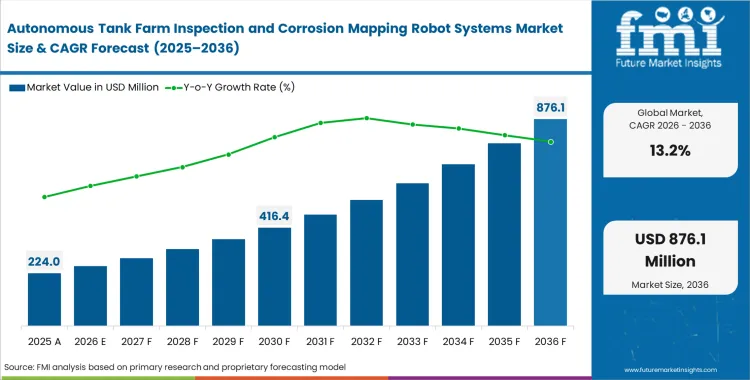
FMI analysis indicates that adoption is being driven by a practical operating need: tank owners need better internal condition data without repeatedly absorbing the cost, delay, and safety burden that come with manual shutdown-based inspection routines.
Tank operators are under pressure to inspect more often, document asset condition more clearly, and do so without disrupting product movement across storage networks. Traditional internal inspection still depends on draining, cleaning, gas freeing, and confined-space preparation before measurement work can begin. That sequence consumes time, removes revenue-generating capacity from service, and exposes maintenance teams to higher execution risk. Robotic systems change the economics because inspection can move closer to normal operating conditions while delivering repeatable corrosion and thickness data. inspection robots are gaining acceptance for that reason. Their value planning andto automation as a concept and more to the ability to reduce shutdown frequency, improve maintenance planning, and cut the operational penalty associated with tank integrity management.
Adoption also tends to accelerate once robotic inspection outputs are accepted inside formal maintenance and compliance workflows. At that point, the technology stops being treated as a trial tool and starts becoming part of routine asset-care practice. Verified floor scans, corrosion mapping, and repeatable thickness readings allow operators to compare deterioration patterns across time rather than rely on isolated manual observations. That shift supports condition-based planning and makes robotic deployment more attractive across larger storage portfolios where inspection intervals, outage coordination, and maintenance budgets all need tighter control.
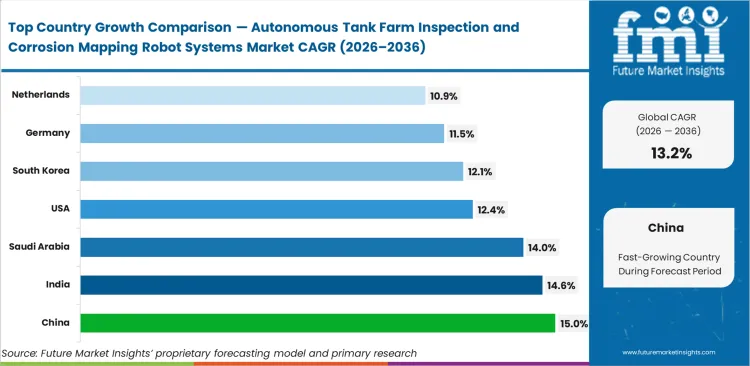
China is projected to grow at a CAGR of 15.0% through 2036, helped by continued buildout of downstream liquid storage and broader use of digitally managed maintenance programs across newer tank assets. India is expected to post 14.6%, where refining, chemicals, and terminal expansion are creating a larger base of infrastructure that benefits from lower-disruption inspection methods. Saudi Arabia, at 14.0%, is likely to remain a strong market because export-oriented storage systems place clear value on reducing time out of service. Growth in the United States is estimated at 12.4%, shaped more by retrofit demand across a large installed tank base than by greenfield construction. South Korea is projected to advance at 12.1%, supported by high-utilization industrial storage assets where maintenance windows are tightly managed. Germany is likely to record 11.5%, while the Netherlands is estimated at 10.9%, with both markets reflecting steady uptake in mature terminal networks where operators are focused on inspection efficiency rather than capacity expansion. What separates these country patterns is not one common demand driver. New-build regions are adopting robotic inspection to avoid locking old manual methods into expanding infrastructure, while mature storage markets are using it to extract more usable life and better planning discipline from assets already in service.
Segmental Analysis
Autonomous Tank Farm Inspection and Corrosion Mapping Robot Systems Market Analysis by Inspection Mode
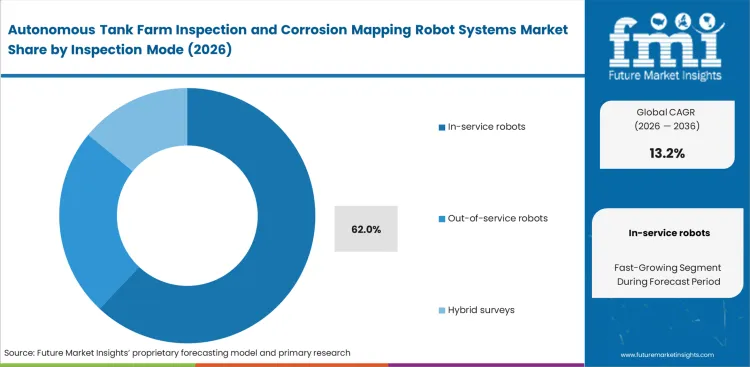
In-service robots are estimated to account for 62.0% share in 2026. Their lead reflects the clear operating advantage of inspecting storage assets without draining active product or interrupting terminal movement. Submersible systems can generate floor-thickness readings through integrated NDT equipment while tanks remain in use, which materially reduces shutdown planning and product handling complexity. The commercial case strengthens further in large crude storage environments where emptying a tank can take weeks and disrupt broader site scheduling. Performance still depends on floor accessibility, and sludge accumulation can limit how effectively an in-service unit reaches key corrosion zones. Inspection quality falls quickly when sludge behavior is not assessed before deployment.
- Deployment logistics: In-service systems allow operators to inspect active tanks through standard access points without initiating full draining and degassing procedures.
- Sludge interference: Dense sludge layers can block robot movement and reduce coverage quality across critical bottom-plate inspection areas.
- Regulatory validation: Robotic inspection results are only usable when coverage levels and data quality meet formal acceptance thresholds.
Autonomous Tank Farm Inspection and Corrosion Mapping Robot Systems Market Analysis by Sensor Suite
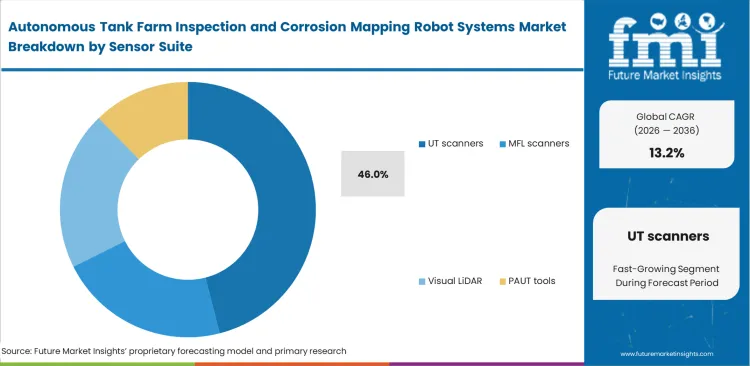
Sensor selection in this market is shaped by which inspection methods can support remaining-life decisions and fitness reviews under regulatory scrutiny. UT scanners are estimated to account for 46.0% share in 2026, as ultrasonic mapping continues to provide the dense and verifiable thickness measurement needed for tank floor inspection. Facilities require millimeter-level readings that can hold up during technical review, particularly where operating approval depends on documented corrosion evidence rather than surface-level visual checks. Such requirements keep ultrasonic systems at the center of inspection programs even when faster alternatives may appear attractive from a cost or speed standpoint. Value from raw ultrasonic output also depends heavily on testing, inspection certification, and inspection management software, since inspection data becomes more useful only after it is converted into traceable corrosion maps and review-ready records. Alternative screening tools continue to face adoption limits when they cannot deliver similar resolution or documentation quality for audit purposes.
- Verification standard: Ultrasonic arrays produce thickness data that aligns more closely with formal acceptance requirements for continued asset operation.
- Speed limitations: Accurate UT scanning requires stable contact and coupling conditions, which can slow inspection progress in difficult environments.
- Integration requirement: Large ultrasonic datasets need structured processing so results can be converted into usable corrosion maps and compliance records.
Autonomous Tank Farm Inspection and Corrosion Mapping Robot Systems Market Analysis by Deployment Model
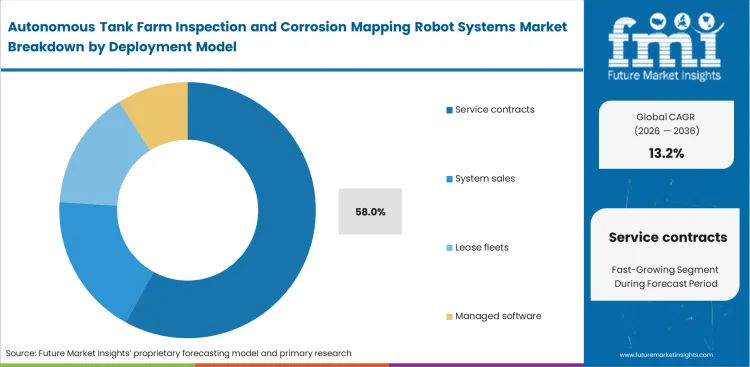
Deployment model selection in this market is influenced by how infrequently many sites use these systems and how difficult they are to manage internally over long operating cycles. Terminal operators often lean toward outsourced execution because robotic tank inspection is not a routine function at most facilities and still requires specialized technical capability. Service contracts are estimated to account for 58.0% share in 2026, reflecting the practical appeal of shifting execution, staffing, and technology upkeep to dedicated service providers. External teams also bring established workflows, trained personnel, and robotic fleets that can often be refreshed more regularly than internally owned equipment. Some operators review broader robotic inspection capability across other assets, including pipe inspection robots, before deciding whether internal ownership can be justified. In most operating settings, outsourcing remains the more workable model where inspection frequency stays low and equipment complexity remains high.
- Risk transfer: Service-based delivery reduces the need for site operators to maintain internal robotics expertise and hazardous-environment deployment capability.
- Technological currency: Contractors can refresh sensor packages and robotic fleets more quickly than most asset owners with infrequent inspection cycles.
- Data ownership: Service agreements need clear terms on raw data access so long-term history is not left under external control.
Autonomous Tank Farm Inspection and Corrosion Mapping Robot Systems Market Analysis by End Use
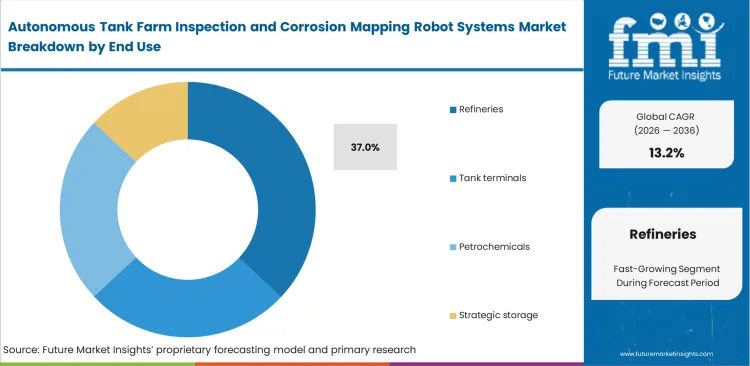
Refinery operators face stronger pressure than many other end users to keep tank availability high while maintaining credible corrosion surveillance. Product movement, feedstock continuity, and maintenance planning are closely connected in these facilities, which increases the value of in-service robotic inspection. Reliable robotic assessments also help operators time steel repair work and outage preparation with greater confidence. Refineries are estimated to account for 37.0% share in 2026, supported by the scale and continuity requirements tied to crude and refined product storage infrastructure. Equipment management software adds further value in this segment because inspection findings can be linked directly to maintenance planning, asset history, and repair prioritization. Sensor payload suitability still remains important, since corrosion behavior varies across stored products and not every inspection package performs equally well in each chemical environment.
- Throughput preservation: Refinery sites use robotic inspection to reduce the operational disruption associated with taking storage tanks offline.
- Chemical compatibility: Sensor and seal design must match stored product conditions or inspection equipment can fail during active deployment.
- Strategic planning: Accurate floor-condition mapping allows maintenance teams to plan patching scope and material needs well before tank entry begins.
Autonomous Tank Farm Inspection and Corrosion Mapping Robot Systems Market Analysis by Tank Type
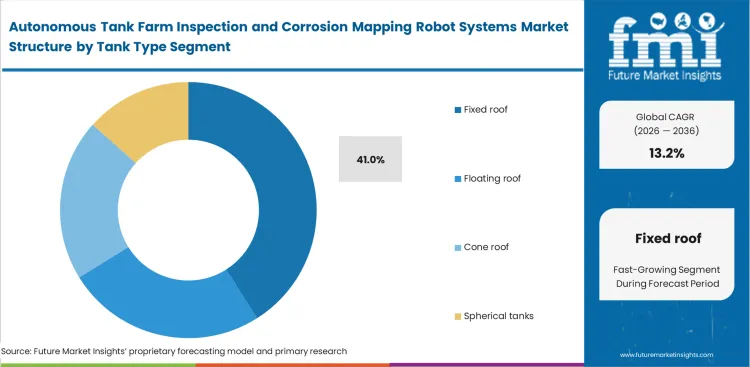
Tank geometry plays a direct role in where robotic suppliers concentrate design effort and how inspection risk is handled during field deployment. Fixed roof tanks remain a practical priority because they represent a large installed base and present recurring inspection difficulty around support zones and corrosion-prone intersections. Operators also need dependable data from annular rings and column bases, where failure exposure is often higher. Fixed roof tanks are estimated to account for 41.0% share in 2026. Their internal layout requires careful navigation planning, and robotic performance can vary meaningfully across those constraints. Layout complexity becomes even more relevant when operators compare other inspection options such as drone inspection and monitoring, which can face movement and access limits inside enclosed or obstructed tank interiors.
- Navigation hazards: Internal supports and cable-management constraints must be assessed carefully before robotic deployment begins.
- Corrosion hotspots: Column bases and annular regions require focused inspection because damage often concentrates in these areas.
- Retrieval protocols: Sites need clear recovery procedures in place before deployment in case robotic systems stall or become trapped internally.
Autonomous Tank Farm Inspection and Corrosion Mapping Robot Systems Market Drivers, Restraints, and Opportunities
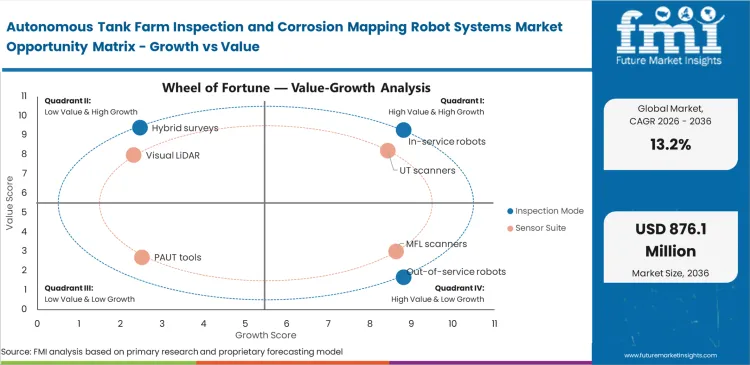
Revenue loss during mandatory shutdowns remains one of the clearest reasons operators assess corrosion mapping robots for storage tanks. Taking a large crude tank offline can interrupt daily throughput and add meaningful cost through draining, degassing, and cleaning before human entry is allowed. Robotic inspection systems are gaining attention because they can reduce those non-productive periods while keeping personnel away from confined and hazardous conditions. Long gaps between manual inspections can also increase exposure to bottom-plate leaks, unplanned repair work, and environmental risk. Demand for NDT robotics in storage tank inspection is therefore supported by both uptime protection and the need for earlier corrosion visibility.
Sludge accumulation still acts as a major operating barrier despite the financial case for robotic inspection. Dense material settled on floor plates can weaken ultrasonic signal quality and reduce the effectiveness of robotic sensor arrays. Heavier tools and sludge-handling mechanisms can improve access in some conditions, yet wax-rich deposits continue to limit mobility and mapping performance in difficult tank environments. Inspection value also falls when robots cannot achieve the floor coverage needed for a credible corrosion review. Adoption is likely to remain uneven in tanks where sludge conditions reduce signal reliability, coverage quality, or movement across the inspection surface.
Opportunities in the Autonomous Tank Farm Inspection and Corrosion Mapping Robot Systems Market
- Sludge mapping integration: Vendors developing predictive maintenance algorithms that precisely map sludge volume prior to cleaning save operators massive vacuum truck expenses.
- Digital twin generation: Software teams converting raw ultrasonic point clouds into fully navigable 3D digital twins provide facility engineers unprecedented oversight.
- High-temperature deployments: Engineering firms building robotic platforms capable of operating inside heated asphalt or bitumen tanks capture completely uncontested service contracts.
Regional Analysis
Based on regional analysis, Autonomous tank farm inspection and corrosion mapping robot systems market is segmented into North America, Latin America, Western Europe, Eastern Europe, and Asia Pacific across 40 plus countries.
.webp "Top Country Growth Comparison Autonomous Tank Farm Inspection And Corrosion Mapping Robot Systems Market Cagr (2026 2036)")
| Country | CAGR (2026 to 2036) |
|---|---|
| China | 15.0% |
| India | 14.6% |
| Saudi Arabia | 14.0% |
| United States | 12.4% |
| South Korea | 12.1% |
| Germany | 11.5% |
| Netherlands | 10.9% |
Source: Future Market Insights (FMI) analysis, based on proprietary forecasting model and primary research
Asia Pacific Autonomous Tank Farm Inspection and Corrosion Mapping Robot Systems Market Analysis
Greenfield logistics expansion shapes the regional market as operators commission large volumes of bulk liquid storage. FMI's analysis indicates facility owners prioritize digital integration over retrofitting older infrastructure. Asset owners deploy AI driven predictive maintenance tools alongside robotic hardware to establish baselines upon commissioning. Strict environmental oversight forces operators to utilize autonomous units to verify integrity without disrupting newly established supply chains.
- China: Local operators are rapidly building downstream capacity while tightening digital maintenance protocols around newly commissioned liquid storage assets. This expansion accelerates the China tank farm inspection robot segment, which is anticipated to rise at a CAGR of 15.0% from 2026 to 2036. Facility owners implement robotic baselining to secure long-term operational permits. Greenfield facilities capturing early data secure noticeable operational cost advantages over legacy competitors.
- India: Downstream expansion requirements mirror neighboring industrializing economies as operators seek efficiency in asset management. Facility owners utilize robotic tools to bypass skilled labor shortages in manual inspection workflows. Demand for autonomous inspection in India is expected to increase at a CAGR of 14.6% during the forecast period. Operators executing in-service inspections achieve measurable improvements in their annual throughput metrics.
- South Korea: Demand for robotic tank inspection in South Korea is poised to expand at a CAGR of 12.1% through 2036, heavily supported by high-throughput export infrastructure. Companies refuse extended outages that threaten critical international shipping schedules, prioritizing tools that reduce shutdown duration. South Korean operators establish a firm benchmark for integrating robotic measurement data directly into national compliance frameworks.
Middle East and Africa Autonomous Tank Farm Inspection and Corrosion Mapping Robot Systems Market Analysis
Extreme environmental conditions and large facility scale lead to robotic adoption across crucial export hubs. FMI observes that operators manage some of the largest individual storage tanks globally, making manual inspection timelines unworkable. Heat stress and confined space hazards compel facility owners to mandate robotic alternatives. Operators integrating drone analytics alongside submersible units achieve comprehensive site visibility across vast terminal footprints.
- Saudi Arabia: Large export infrastructure rewards technology that reduces shutdown time and minimizes confined-space exposure. Facility owners deploy robotic fleets to maintain continuous crude flow to global markets without regulatory interruption. Saudi Arabia is projected to witness a 14.0% CAGR in the autonomous inspection segment from 2026 to 2036. Early adopters securing reliable service contractors lock in definitive operational advantages over regional competitors.
North America and Europe Autonomous Tank Farm Inspection and Corrosion Mapping Robot Systems Market Analysis
Mature terminal networks and aging storage assets continue to shape deployment priorities across this market. Operators managing older infrastructure face steady pressure to maintain asset integrity and environmental safety under closer inspection standards. Advanced radiography and ultrasonic tools remain important where terminals need reliable evidence that long-service floor plates can continue operating safely. Proactive asset management also helps reduce the risk of unplanned outages and expensive repair events.
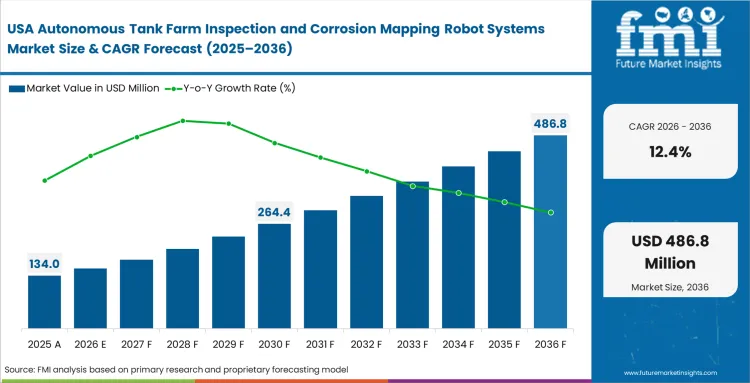
- United States: Demand for tank inspection robots in the United States is projected to expand at a CAGR of 12.4% during 2026 to 2036. Adoption in the country is influenced by long replacement cycles across established terminal networks, where operators rely on inspection data to support asset life extension decisions. Robotic assessments are gaining relevance because they help shift maintenance planning away from reactive patchwork and toward more targeted repair timing. Growth is likely to remain strongest where older tank fleets require better floor-condition visibility without increasing shutdown frequency.
- Germany: Germany is anticipated to grow at a CAGR of 11.5% in autonomous tank inspection systems from 2026 to 2036. Demand in the country is supported by mature terminal infrastructure and a clear preference for equipment that can perform reliably in hazardous operating settings. Validation standards remain high, which keeps inspection quality, safety performance, and hardware dependability central to equipment selection. Supplier fit in this market is closely tied to consistent field performance under tightly controlled operating conditions.
- Netherlands: Tank inspection robot adoption in the Netherlands is expected to rise at a CAGR of 10.9% during 2026 to 2036. Demand is supported by dense coastal terminal infrastructure, where maintenance execution must be handled carefully to protect storage continuity and port-linked product movement. Robotic inspection systems are becoming more useful in this setting because they help limit disruption during maintenance activity at high-utilization sites. Adoption is likely to remain tied to how well inspection programs align with local compliance practice and operational intensity.
Additional analysis also covers Japan, the United Kingdom, France, Italy, Brazil, and Mexico. Adoption patterns across these markets are likely to vary by infrastructure age, inspection practice, and the level of acceptance given to non-traditional compliance data. Regional operating conditions therefore remain central to deployment timing and supplier suitability.
Competitive Aligners for Market Players
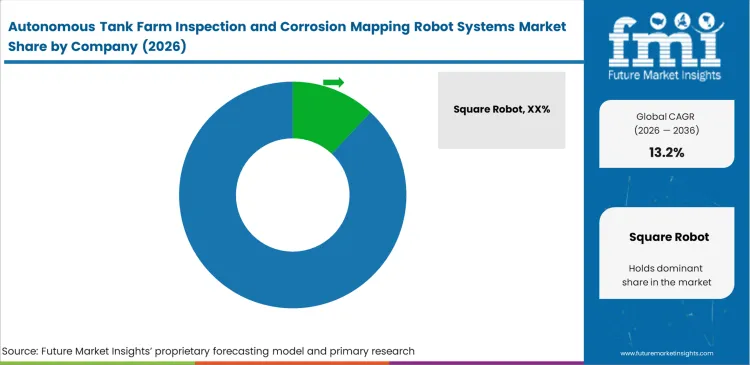
Competition in this market is shaped mainly by hazardous-environment certification and dependable navigation inside difficult tank layouts. Sensor quality still matters, though buyer confidence depends more on whether a platform can operate for extended periods in aggressive petrochemical conditions without sealing or mobility failure. Inspection systems are judged heavily on field reliability because even one serious retrieval incident can weaken supplier credibility across a close and experience-driven operator base.
Established suppliers benefit from deeper operating knowledge on how sensor packages perform across different crude densities, sludge conditions, and tank-floor environments. Historical inspection records also help validate robotic readings against known corrosion patterns and prior NDT outcomes, which gives buyers more confidence in the results. Newer entrants can face a harder path when they try to prove that alternative sensing methods or newer processing approaches can deliver the same level of inspection confidence expected in regulated tank environments. Market acceptance therefore depends as much on validation depth as on hardware design.
Terminal operators also try to avoid vendor lock-in by asking for raw inspection data instead of relying only on closed reporting formats. Open data structure is important because it protects access to long-term thickness history and makes future supplier changes easier to manage. Software interoperability has become a key point in supplier selection, especially when inspection outputs need to connect with standard asset management platforms and maintenance records. Suppliers offering stronger integration and more flexible data access are generally better placed where operators want continuity, control, and easier comparison across inspection cycles.
Key Players in Autonomous Tank Farm Inspection and Corrosion Mapping Robot Systems Market
- Square Robot
- Sonomatic
- AYA Robotics
- TechCorr
- IRISNDT
- TCR Arabia
- Eddyfi Technologies
Scope of the Report
| Metric | Value |
|---|---|
| Quantitative Units | USD 224.0 million to USD 774.0 million, at a CAGR of 13.2% |
| Market Definition | Autonomous Tank Farm Inspection and Corrosion Mapping Robot Systems includes self-directed robotic platforms engineered specifically to assess integrity inside bulk liquid storage environments. These units navigate complex internal geometries while capturing precise thickness measurements. |
| Segmentation | By Inspection Mode, By Sensor Suite, By Deployment Model, By End Use, By Tank Type, and Region |
| Regions Covered | North America, Latin America, Western Europe, Eastern Europe, and Asia Pacific |
| Countries Covered | China, India, Saudi Arabia, United States, South Korea, Germany, Netherlands |
| Key Companies Profiled | Square Robot, Sonomatic, AYA Robotics, TechCorr, IRISNDT, TCR Arabia, Eddyfi Technologies |
| Forecast Period | 2026 to 2036 |
| Approach | Global installed base of bulk liquid storage tanks cross-referenced with mandatory inspection cycles. |
Source: Future Market Insights (FMI) analysis, based on proprietary forecasting model and primary research
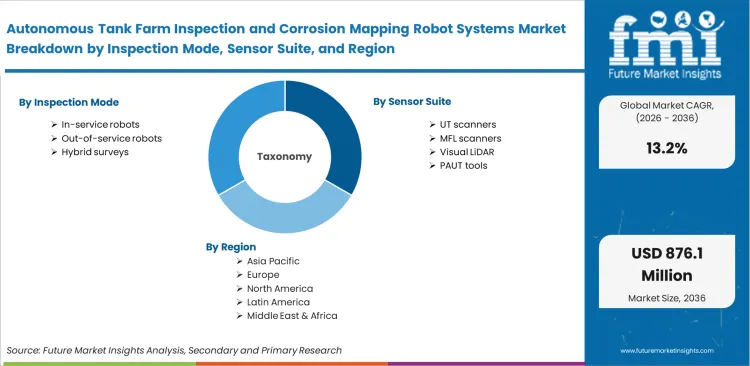
Autonomous Tank Farm Inspection and Corrosion Mapping Robot Systems Market Analysis by Segments
Inspection Mode:
- In-service robots
- Out-of-service robots
- Hybrid surveys
Sensor Suite:
- UT scanners
- MFL scanners
- Visual LiDAR
- PAUT tools
Deployment Model:
- Service contracts
- System sales
- Lease fleets
- Managed software
End Use:
- Refineries
- Tank terminals
- Petrochemicals
- Strategic storage
Tank Type:
- Fixed roof
- Floating roof
- Cone roof
- Spherical tanks
Region:
- North America
- United States
- Canada
- Europe
- Germany
- United Kingdom
- France
- Italy
- Spain
- Asia Pacific
- China
- Japan
- South Korea
- Taiwan
- Singapore
- Latin America
- Brazil
- Mexico
- Argentina
- Middle East & Africa
- GCC Countries
- South Africa
Bibliography
- Brogaard, R. Y., & Boukas, E. (2024). Autonomous GPU-based UAS for inspection of confined spaces: Application to marine vessel classification. Robotics and Autonomous Systems, 172, 104590.
- Krishnan, B., Ali, A., Al Harbi, M., & Natarajan, E. (2024). Advancing Aboveground Storage Tank Integrity: Exploring and Implementing Online Robotic Inspection. Society of Petroleum Engineers.
- Li, J., Tu, C., Xu, F., & Wang, X. (2024). Weld Seam Recognition and Tracking With Omnidirectional Wall-Climbing Robot for Spherical Tank Inspection. Journal of Autonomous Vehicles and Systems, 5(1), 011002.
- Materials Technology Institute. (2024). Corrosion Mapping in Storage Tank Bottoms.
- Özgüven, K., & Sarıtaş, İ. (2025). Inspection of Storage Tank Bottoms and Corrosion Mapping Via Ultrasonic Testing and Signal Processing Methods. Proceedings of International Conference on Intelligent Systems and New Applications, 3, 121-124.
- Stoicescu, A.-A., Ripeanu, R. G., Tănase, M., & Toader, L. (2025). Current Methods and Technologies for Storage Tank Condition Assessment: A Comprehensive Review. Materials, 18(5), 1074.
This bibliography is provided for reader reference. The full FMI report contains the complete reference list with primary source documentation.
This Report Addresses
- Triggers driving rapid submersible robotics adoption among major petroleum storage terminal operators globally.
- Cost differences between traditional draining procedures and localized in-service thickness measurement protocols.
- Operational impacts of dense sludge accumulation on robotic floor scanning accuracy and coverage.
- Regulatory compliance shifts regarding API 653 acceptance of ultrasonic arrays versus manual entry.
- Technical barriers preventing widespread adoption of automated equipment in highly corrosive refined product environments.
- Growth disparities between mature European infrastructure networks and expanding Asian greenfield storage complexes.
- Evaluation criteria turnaround planners use when selecting third-party NDT service contractors.
- Navigation challenges associated with deploying tethered systems inside fixed versus floating roof architectures.
Frequently Asked Questions
What is the autonomous tank farm inspection and corrosion mapping robot systems market?
This sector includes self-directed robotic platforms engineered specifically to assess integrity inside bulk liquid storage environments. These units navigate complex internal geometries while capturing precise thickness measurements without requiring human confined space entry.
How large is the tank inspection robot market in 2025 and 2036?
Revenue was valued at USD 197.9 million in 2025. Continued investment pushes total valuation to USD 774.0 million by 2036 as regulatory bodies broadly codify robotic data acceptance.
Are robotic tank inspections API 653 compliant?
API standards accept robotic thickness data under strict coverage requirements. It must be verified that ultrasonic arrays capture millimeter-level resolution across mandated minimum surface areas.
How do buyers compare robotic tank inspection and manual API 653 inspection?
Terminal operators weigh massive revenue losses associated with draining tanks against the capital cost of robotic deployment. Manual inspections require weeks of zero-revenue downtime, while submersibles maintain active throughput.
How do corrosion mapping robots inspect storage tanks?
Submersible units enter through standard roof hatches while product remains entirely active. Robotic platforms navigate the floor plate, utilizing ultrasonic arrays to generate dense topological maps of steel thickness.
What sensors are used in tank floor corrosion mapping robots?
UT scanners dominate because ultrasonic technology represents the undisputed standard for compliance mapping. Basic magnetic flux leakage screening often requires secondary UT verification to satisfy regulatory bodies.
Which companies make tank farm inspection robots?
Key hardware manufacturers include Square Robot, AYA Robotics, and Eddyfi Technologies. Service contractors executing deployments include Sonomatic, TechCorr, IRISNDT, and TCR Arabia.
Who are the key players in robotic tank inspection?
Competition hinges on hazardous environment certification. Prominent players include Square Robot, Sonomatic, AYA Robotics, TechCorr, IRISNDT, TCR Arabia, and Eddyfi Technologies.
Why are refineries adopting in-service tank robots?
Turnaround coordinators deploy robotic baselining to maintain uninterrupted crude feedstock flows critical for daily operations. Refineries avoid multi-million-dollar production bottlenecks associated with tank outages.
Which countries are growing fastest in this market?
China expands at 15.0% CAGR and India tracks at 14.6% CAGR. Massive greenfield logistics commissioning in Asia outpaces steady replacement cycles across established networks.
How much does robotic tank inspection cost?
Service contracts form the primary purchase model. Facilities calculate cost not just by daily contractor rates, but by calculating the total avoided revenue loss of a traditional physical shutdown.
What secures the dominant position of UT scanners?
UT scanners hold 46.0% share in 2026. Ultrasonic technology is mandated because API standards rigidly require high-resolution thickness verification.
Why do service contracts dominate deployment models?
Service contracts secure 58.0% share in 2026. Firms refuse to bear hardware depreciation and specialized training costs for rarely used internal tools.
How does tank architecture impact adoption?
Fixed roof configurations account for 41.0% share in 2026. High global installed base numbers force vendors to design specific navigation algorithms for internal columns.
How do sludge profiles limit deployment?
Thick waxy crude deposits block ultrasonic sensors entirely. Robotic reports are rejected if sludge prevents units from mapping mandatory minimum surface areas.
What role do digital twins play?
Software teams convert dense point clouds into navigable 3D models. Engineers utilize these maps to plan precise patch repairs years before actual physical entry.
Preview the report firsthand - request a free sample
Get SampleGet the brochure for pricing and purchase details.
Get PDFTable of Content
- Executive Summary
- Global Market Outlook
- Demand-side Trends
- Supply-side Trends
- Technology Roadmap Analysis
- Analysis and Recommendations
- Market Overview
- Market Coverage / Taxonomy
- Market Definition / Scope / Limitations
- Research Methodology
- Chapter Orientation
- Analytical Lens and Working Hypotheses
- Market Structure, Signals, and Trend Drivers
- Benchmarking and Cross-market Comparability
- Market Sizing, Forecasting, and Opportunity Mapping
- Research Design and Evidence Framework
- Desk Research Programme (Secondary Evidence)
- Company Annual and Sustainability Reports
- Peer-reviewed Journals and Academic Literature
- Corporate Websites, Product Literature, and Technical Notes
- Earnings Decks and Investor Briefings
- Statutory Filings and Regulatory Disclosures
- Technical White Papers and Standards Notes
- Trade Journals, Industry Magazines, and Analyst Briefs
- Conference Proceedings, Webinars, and Seminar Materials
- Government Statistics Portals and Public Data Releases
- Press Releases and Reputable Media Coverage
- Specialist Newsletters and Curated Briefings
- Sector Databases and Reference Repositories
- FMI Internal Proprietary Databases and Historical Market Datasets
- Subscription Datasets and Paid Sources
- Social Channels, Communities, and Digital Listening Inputs
- Additional Desk Sources
- Expert Input and Fieldwork (Primary Evidence)
- Primary Modes
- Qualitative Interviews and Expert Elicitation
- Quantitative Surveys and Structured Data Capture
- Blended Approach
- Why Primary Evidence is Used
- Field Techniques
- Interviews
- Surveys
- Focus Groups
- Observational and In-context Research
- Social and Community Interactions
- Stakeholder Universe Engaged
- C-suite Leaders
- Board Members
- Presidents and Vice Presidents
- R&D and Innovation Heads
- Technical Specialists
- Domain Subject-matter Experts
- Scientists
- Physicians and Other Healthcare Professionals
- Governance, Ethics, and Data Stewardship
- Research Ethics
- Data Integrity and Handling
- Primary Modes
- Tooling, Models, and Reference Databases
- Desk Research Programme (Secondary Evidence)
- Data Engineering and Model Build
- Data Acquisition and Ingestion
- Cleaning, Normalisation, and Verification
- Synthesis, Triangulation, and Analysis
- Quality Assurance and Audit Trail
- Market Background
- Market Dynamics
- Drivers
- Restraints
- Opportunity
- Trends
- Scenario Forecast
- Demand in Optimistic Scenario
- Demand in Likely Scenario
- Demand in Conservative Scenario
- Opportunity Map Analysis
- Product Life Cycle Analysis
- Supply Chain Analysis
- Investment Feasibility Matrix
- Value Chain Analysis
- PESTLE and Porter’s Analysis
- Regulatory Landscape
- Regional Parent Market Outlook
- Production and Consumption Statistics
- Import and Export Statistics
- Market Dynamics
- Global Market Analysis 2021 to 2025 and Forecast, 2026 to 2036
- Historical Market Size Value (USD Million) Analysis, 2021 to 2025
- Current and Future Market Size Value (USD Million) Projections, 2026 to 2036
- Y-o-Y Growth Trend Analysis
- Absolute $ Opportunity Analysis
- Global Market Pricing Analysis 2021 to 2025 and Forecast 2026 to 2036
- Global Market Analysis 2021 to 2025 and Forecast 2026 to 2036, By Inspection Mode
- Introduction / Key Findings
- Historical Market Size Value (USD Million) Analysis By Inspection Mode , 2021 to 2025
- Current and Future Market Size Value (USD Million) Analysis and Forecast By Inspection Mode , 2026 to 2036
- In-service robots
- Out-of-service robots
- Hybrid surveys
- In-service robots
- Y-o-Y Growth Trend Analysis By Inspection Mode , 2021 to 2025
- Absolute $ Opportunity Analysis By Inspection Mode , 2026 to 2036
- Global Market Analysis 2021 to 2025 and Forecast 2026 to 2036, By Sensor Suite
- Introduction / Key Findings
- Historical Market Size Value (USD Million) Analysis By Sensor Suite, 2021 to 2025
- Current and Future Market Size Value (USD Million) Analysis and Forecast By Sensor Suite, 2026 to 2036
- UT scanners
- MFL scanners
- Visual LiDAR
- PAUT tools
- UT scanners
- Y-o-Y Growth Trend Analysis By Sensor Suite, 2021 to 2025
- Absolute $ Opportunity Analysis By Sensor Suite, 2026 to 2036
- Global Market Analysis 2021 to 2025 and Forecast 2026 to 2036, By Deployment Model
- Introduction / Key Findings
- Historical Market Size Value (USD Million) Analysis By Deployment Model, 2021 to 2025
- Current and Future Market Size Value (USD Million) Analysis and Forecast By Deployment Model, 2026 to 2036
- Service contracts
- System sales
- Lease fleets
- Managed software
- Service contracts
- Y-o-Y Growth Trend Analysis By Deployment Model, 2021 to 2025
- Absolute $ Opportunity Analysis By Deployment Model, 2026 to 2036
- Global Market Analysis 2021 to 2025 and Forecast 2026 to 2036, By End Use
- Introduction / Key Findings
- Historical Market Size Value (USD Million) Analysis By End Use, 2021 to 2025
- Current and Future Market Size Value (USD Million) Analysis and Forecast By End Use, 2026 to 2036
- Refineries
- Tank terminals
- Petrochemicals
- Strategic storage
- Refineries
- Y-o-Y Growth Trend Analysis By End Use, 2021 to 2025
- Absolute $ Opportunity Analysis By End Use, 2026 to 2036
- Global Market Analysis 2021 to 2025 and Forecast 2026 to 2036, By Tank Type
- Introduction / Key Findings
- Historical Market Size Value (USD Million) Analysis By Tank Type, 2021 to 2025
- Current and Future Market Size Value (USD Million) Analysis and Forecast By Tank Type, 2026 to 2036
- Fixed roof
- Floating roof
- Cone roof
- Spherical tanks
- Fixed roof
- Y-o-Y Growth Trend Analysis By Tank Type, 2021 to 2025
- Absolute $ Opportunity Analysis By Tank Type, 2026 to 2036
- Global Market Analysis 2021 to 2025 and Forecast 2026 to 2036, By Region
- Introduction
- Historical Market Size Value (USD Million) Analysis By Region, 2021 to 2025
- Current Market Size Value (USD Million) Analysis and Forecast By Region, 2026 to 2036
- North America
- Latin America
- Western Europe
- Eastern Europe
- East Asia
- South Asia and Pacific
- Middle East & Africa
- Market Attractiveness Analysis By Region
- North America Market Analysis 2021 to 2025 and Forecast 2026 to 2036, By Country
- Historical Market Size Value (USD Million) Trend Analysis By Market Taxonomy, 2021 to 2025
- Market Size Value (USD Million) Forecast By Market Taxonomy, 2026 to 2036
- By Country
- USA
- Canada
- Mexico
- By Inspection Mode
- By Sensor Suite
- By Deployment Model
- By End Use
- By Tank Type
- By Country
- Market Attractiveness Analysis
- By Country
- By Inspection Mode
- By Sensor Suite
- By Deployment Model
- By End Use
- By Tank Type
- Key Takeaways
- Latin America Market Analysis 2021 to 2025 and Forecast 2026 to 2036, By Country
- Historical Market Size Value (USD Million) Trend Analysis By Market Taxonomy, 2021 to 2025
- Market Size Value (USD Million) Forecast By Market Taxonomy, 2026 to 2036
- By Country
- Brazil
- Chile
- Rest of Latin America
- By Inspection Mode
- By Sensor Suite
- By Deployment Model
- By End Use
- By Tank Type
- By Country
- Market Attractiveness Analysis
- By Country
- By Inspection Mode
- By Sensor Suite
- By Deployment Model
- By End Use
- By Tank Type
- Key Takeaways
- Western Europe Market Analysis 2021 to 2025 and Forecast 2026 to 2036, By Country
- Historical Market Size Value (USD Million) Trend Analysis By Market Taxonomy, 2021 to 2025
- Market Size Value (USD Million) Forecast By Market Taxonomy, 2026 to 2036
- By Country
- Germany
- UK
- Italy
- Spain
- France
- Nordic
- BENELUX
- Rest of Western Europe
- By Inspection Mode
- By Sensor Suite
- By Deployment Model
- By End Use
- By Tank Type
- By Country
- Market Attractiveness Analysis
- By Country
- By Inspection Mode
- By Sensor Suite
- By Deployment Model
- By End Use
- By Tank Type
- Key Takeaways
- Eastern Europe Market Analysis 2021 to 2025 and Forecast 2026 to 2036, By Country
- Historical Market Size Value (USD Million) Trend Analysis By Market Taxonomy, 2021 to 2025
- Market Size Value (USD Million) Forecast By Market Taxonomy, 2026 to 2036
- By Country
- Russia
- Poland
- Hungary
- Balkan & Baltic
- Rest of Eastern Europe
- By Inspection Mode
- By Sensor Suite
- By Deployment Model
- By End Use
- By Tank Type
- By Country
- Market Attractiveness Analysis
- By Country
- By Inspection Mode
- By Sensor Suite
- By Deployment Model
- By End Use
- By Tank Type
- Key Takeaways
- East Asia Market Analysis 2021 to 2025 and Forecast 2026 to 2036, By Country
- Historical Market Size Value (USD Million) Trend Analysis By Market Taxonomy, 2021 to 2025
- Market Size Value (USD Million) Forecast By Market Taxonomy, 2026 to 2036
- By Country
- China
- Japan
- South Korea
- By Inspection Mode
- By Sensor Suite
- By Deployment Model
- By End Use
- By Tank Type
- By Country
- Market Attractiveness Analysis
- By Country
- By Inspection Mode
- By Sensor Suite
- By Deployment Model
- By End Use
- By Tank Type
- Key Takeaways
- South Asia and Pacific Market Analysis 2021 to 2025 and Forecast 2026 to 2036, By Country
- Historical Market Size Value (USD Million) Trend Analysis By Market Taxonomy, 2021 to 2025
- Market Size Value (USD Million) Forecast By Market Taxonomy, 2026 to 2036
- By Country
- India
- ASEAN
- Australia & New Zealand
- Rest of South Asia and Pacific
- By Inspection Mode
- By Sensor Suite
- By Deployment Model
- By End Use
- By Tank Type
- By Country
- Market Attractiveness Analysis
- By Country
- By Inspection Mode
- By Sensor Suite
- By Deployment Model
- By End Use
- By Tank Type
- Key Takeaways
- Middle East & Africa Market Analysis 2021 to 2025 and Forecast 2026 to 2036, By Country
- Historical Market Size Value (USD Million) Trend Analysis By Market Taxonomy, 2021 to 2025
- Market Size Value (USD Million) Forecast By Market Taxonomy, 2026 to 2036
- By Country
- Kingdom of Saudi Arabia
- Other GCC Countries
- Turkiye
- South Africa
- Other African Union
- Rest of Middle East & Africa
- By Inspection Mode
- By Sensor Suite
- By Deployment Model
- By End Use
- By Tank Type
- By Country
- Market Attractiveness Analysis
- By Country
- By Inspection Mode
- By Sensor Suite
- By Deployment Model
- By End Use
- By Tank Type
- Key Takeaways
- Key Countries Market Analysis
- USA
- Pricing Analysis
- Market Share Analysis, 2025
- By Inspection Mode
- By Sensor Suite
- By Deployment Model
- By End Use
- By Tank Type
- Canada
- Pricing Analysis
- Market Share Analysis, 2025
- By Inspection Mode
- By Sensor Suite
- By Deployment Model
- By End Use
- By Tank Type
- Mexico
- Pricing Analysis
- Market Share Analysis, 2025
- By Inspection Mode
- By Sensor Suite
- By Deployment Model
- By End Use
- By Tank Type
- Brazil
- Pricing Analysis
- Market Share Analysis, 2025
- By Inspection Mode
- By Sensor Suite
- By Deployment Model
- By End Use
- By Tank Type
- Chile
- Pricing Analysis
- Market Share Analysis, 2025
- By Inspection Mode
- By Sensor Suite
- By Deployment Model
- By End Use
- By Tank Type
- Germany
- Pricing Analysis
- Market Share Analysis, 2025
- By Inspection Mode
- By Sensor Suite
- By Deployment Model
- By End Use
- By Tank Type
- UK
- Pricing Analysis
- Market Share Analysis, 2025
- By Inspection Mode
- By Sensor Suite
- By Deployment Model
- By End Use
- By Tank Type
- Italy
- Pricing Analysis
- Market Share Analysis, 2025
- By Inspection Mode
- By Sensor Suite
- By Deployment Model
- By End Use
- By Tank Type
- Spain
- Pricing Analysis
- Market Share Analysis, 2025
- By Inspection Mode
- By Sensor Suite
- By Deployment Model
- By End Use
- By Tank Type
- France
- Pricing Analysis
- Market Share Analysis, 2025
- By Inspection Mode
- By Sensor Suite
- By Deployment Model
- By End Use
- By Tank Type
- India
- Pricing Analysis
- Market Share Analysis, 2025
- By Inspection Mode
- By Sensor Suite
- By Deployment Model
- By End Use
- By Tank Type
- ASEAN
- Pricing Analysis
- Market Share Analysis, 2025
- By Inspection Mode
- By Sensor Suite
- By Deployment Model
- By End Use
- By Tank Type
- Australia & New Zealand
- Pricing Analysis
- Market Share Analysis, 2025
- By Inspection Mode
- By Sensor Suite
- By Deployment Model
- By End Use
- By Tank Type
- China
- Pricing Analysis
- Market Share Analysis, 2025
- By Inspection Mode
- By Sensor Suite
- By Deployment Model
- By End Use
- By Tank Type
- Japan
- Pricing Analysis
- Market Share Analysis, 2025
- By Inspection Mode
- By Sensor Suite
- By Deployment Model
- By End Use
- By Tank Type
- South Korea
- Pricing Analysis
- Market Share Analysis, 2025
- By Inspection Mode
- By Sensor Suite
- By Deployment Model
- By End Use
- By Tank Type
- Russia
- Pricing Analysis
- Market Share Analysis, 2025
- By Inspection Mode
- By Sensor Suite
- By Deployment Model
- By End Use
- By Tank Type
- Poland
- Pricing Analysis
- Market Share Analysis, 2025
- By Inspection Mode
- By Sensor Suite
- By Deployment Model
- By End Use
- By Tank Type
- Hungary
- Pricing Analysis
- Market Share Analysis, 2025
- By Inspection Mode
- By Sensor Suite
- By Deployment Model
- By End Use
- By Tank Type
- Kingdom of Saudi Arabia
- Pricing Analysis
- Market Share Analysis, 2025
- By Inspection Mode
- By Sensor Suite
- By Deployment Model
- By End Use
- By Tank Type
- Turkiye
- Pricing Analysis
- Market Share Analysis, 2025
- By Inspection Mode
- By Sensor Suite
- By Deployment Model
- By End Use
- By Tank Type
- South Africa
- Pricing Analysis
- Market Share Analysis, 2025
- By Inspection Mode
- By Sensor Suite
- By Deployment Model
- By End Use
- By Tank Type
- USA
- Market Structure Analysis
- Competition Dashboard
- Competition Benchmarking
- Market Share Analysis of Top Players
- By Region
- By Inspection Mode
- By Sensor Suite
- By Deployment Model
- By End Use
- By Tank Type
- Competition Analysis
- Competition Deep Dive
- Square Robot
- Overview
- Product Portfolio
- Profitability by Market Segments (Product/Age /Sales Channel/Region)
- Sales Footprint
- Strategy Overview
- Marketing Strategy
- Product Strategy
- Channel Strategy
- Sonomatic
- AYA Robotics
- TechCorr
- IRISNDT
- TCR Arabia
- Eddyfi Technologies
- Square Robot
- Competition Deep Dive
- Assumptions & Acronyms Used


