

- Industry Size (2026)
- USD 58.4 Mn
- Forecast (2036)
- USD 412.8 Mn
- CAGR (2026 to 2036)
- 21.6%
Swarm Robotics Microsurgery Systems Market Size, Market Forecast and Outlook By FMI
The robotic microsurgery systems market was valued at USD 48.0 million in 2025. The sector is set to hit USD 58.4 million in 2026 at a CAGR of 21.6% during the forecast period. Continued capital infusion is expected to drive the market’s value to USD 412.8 million by 2036, as surgical centres reach the performance limits of human tremor‑control and increasingly transition to untethered, field‑directed micromanipulation for ultra‑fine anatomical tasks.
Surgical directors analyzing the growth outlook for swarm robotics microsurgery systems must recognize an important change: buyers are no longer deciding whether to adopt motion-scaling systems, but rather how to navigate anatomies where tethered instruments cannot physically fit. This transition forces a switch from rigid kinematic linkages to programmable magnetic fields that allow untethered entities to perform collective tasks like thrombus treatment microrobots or delicate tissue reconstruction. The commercial stakes for delaying this capability involve surrendering high-margin neurological and ophthalmic reconstruction caseloads to specialized centers that have already qualified these advanced digital microsurgery workflows. According to FMI's estimates, the initial capital friction is high, but the resulting procedural throughput offsets the acquisition cost for early adopters.
Summary of Swarm Robotics Microsurgery Systems Market
- Swarm Robotics Microsurgery Systems Market Definition
- Swarm robotics microsurgery encompasses cooperative, untethered micro-scale agents guided by external fields to perform sub-millimeter interventions. It is defined by the complete removal of mechanical tethers, allowing navigation through deep or tortuous anatomies previously inaccessible to conventional instrumentation.
- Demand Drivers in the Market
- The physical limitations of human tremor control at the sub-millimeter scale force neurosurgical teams to seek external motion-scaling and autonomous stabilization frameworks.
- Rising volumes of complex microvascular procedures compel hospital administrators to invest in ai based surgical robots that standardize outcomes across varying surgeon skill levels.
- The movement toward ultra-minimally invasive protocols drives clinical governance boards to mandate platforms capable of navigating tortuous vascular beds without causing endothelial shear stress.
- Key Segments Analyzed in the FMI Report
- Magnetically actuated swarm microrobotic systems: Magnetically actuated swarm microrobotic systems is poised to hold 36.0% share in 2026, as programmable magnetic fields provide the only commercially viable method for deep-tissue penetration without attenuation.
- Microvascular and lymphatic reconstruction: Microvascular and lymphatic reconstruction is expected to garner 31.0% in 2026, owing to the high clinical penalty of anastomotic failure and the need for flawless sub-millimeter suturing.
- Image-guided magnetic navigation: Image-guided magnetic navigation is anticipated to grab 42.0% in 2026, because untethered swarms require constant, closed-loop spatial verification to prevent systemic migration.
- Tertiary care hospitals and academic medical centers: Tertiary care hospitals and academic medical centers is estimated to hold 58.0% in 2026, as only these institutions possess the hybrid imaging suites required to support the capital footprint.
- Capital systems: Capital systems is likely to account for 54.0% in 2026, driven by the massive initial hardware requirements for magnetic field generators and integrated control consoles.
- India: 25.4% compound growth, unburdened by legacy tethered robotics, allowing a direct leap to next-generation autonomous architectures.
- Analyst Opinion at FMI
- Sabyasachi Ghosh, Principal Analyst, Healthcare, at FMI, says, "The general expectation is that swarm robotics will incrementally replace traditional master-slave systems. However, the true change happens when surgical directors realize these systems are not just smaller tools, but entirely new therapeutic delivery mechanisms. The delay in adoption isn't about surgical skepticism; it's about the lack of hybrid imaging theatres capable of real-time swarm tracking. Once a hospital retrofits its infrastructure to close the navigation loop, the procedural throughput for retinal and neurovascular interventions scales exponentially."
- Strategic Implications / Executive Takeaways
- Chief Medical Officers must secure early access to clinical trial consortia to build institutional expertise before swarm robotic surgery applications become the mandated standard of care.
- Procurement directors should decouple capital acquisition strategies, prioritizing modular field generators over locked, proprietary imaging suites to avoid vendor entrapment.
- Bioengineering development leads face rigid biocompatibility constraints that require partnerships with specialized materials firms to achieve reliable in vivo degradation profiles.
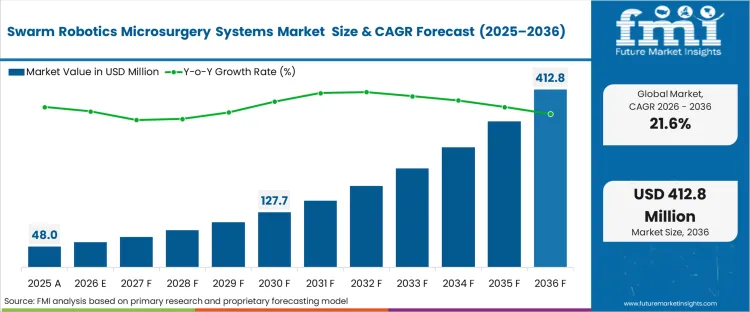
Swarm Robotics Microsurgery Systems Market Key Takeaways
| Metric | Details |
|---|---|
| Industry Size (2026) | USD 58.4 million |
| Industry Value (2036) | USD 412.8 million |
| CAGR (2026-2036) | 21.6% |
Source: Future Market Insights (FMI) analysis, based on proprietary forecasting model and primary research
Scaling this capability requires passing a critical structural gate: the integration of real-time imaging with collective microrobot control in surgery. Regulatory bodies and clinical governance boards trigger this transition when they approve software frameworks that filter human latency out of the navigation loop. Once this threshold is crossed, the cost of adding subsequent surgical robot procedures drops dramatically, allowing parallel utilization across multiple surgical theaters using advanced supermicrosurgery robot systems.
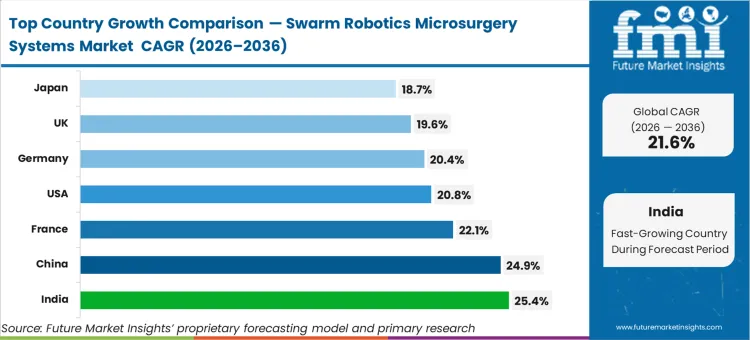
India is expected to advance at 25.4%, driven by rapid scaling of tertiary infrastructure unburdened by legacy robotic investments. China tracks at 24.9% as domestic translation institutes aggressively pilot frontier surgical platforms. France is poised to expand at 22.1%, anchored by concentrated European microrobot innovation hubs. The United States will record a 20.8% trajectory, constrained slightly by extensive qualification cycles within mature hospital networks. Germany follows at 20.4%, balancing strong baseline clinical engineering with cautious reimbursement frameworks. The United Kingdom is likely to grow at 19.6%, followed by Japan posting 18.7%. The divergence across this range reflects a reality regarding which countries will lead the swarm robotics microsurgery market: markets with smaller legacy installed bases are leapfrogging directly to swarm-level deployments, while mature healthcare economies manage slower, phased replacements of existing tethered capital.
Swarm Robotics Microsurgery Systems Market Definition
Swarm robotics microsurgery systems encompass untethered, micro- or nano-scale robotic entities that operate cooperatively inside the human body under external guidance, typically magnetic, acoustic, or chemical,to perform localised interventions. This boundary explicitly defines digital microsurgery robotics by the absence of continuous physical linkages between the operator and the end-effector, distinguishing them entirely from conventional macro-scale robotic platforms.
Swarm Robotics Microsurgery Systems Market Inclusions
The scope includes magnetically actuated micro-swarms, biohybrid microrobots surgery platforms, image-guided magnetic control consoles, and the specialized navigational software required to coordinate multiple untethered agents simultaneously. It incorporates both the external generating hardware and the injectable or deployable consumable agents utilized during procedures. Platforms orchestrating these interventions often function alongside medical robots designed for gross anatomical access.
Swarm Robotics Microsurgery Systems Market Exclusions
Traditional single-port laparoscopy systems and macro-scale orthopedic robots are excluded because they rely on fixed kinematic chains rather than untethered swarm behaviours. Passive contrast agents and standalone imaging modalities without a dedicated actuation layer are also omitted, as they provide observation rather than active, programmable mechanical intervention at the microvascular level.
Swarm Robotics Microsurgery Systems Market Research Methodology
- Primary Research: Chief Medical Officers, Directors of Surgical Robotics, and Clinical Translation Leads at tier-1 academic medical centers.
- Desk Research: Clinical trial registries, specialized medical device clearance databases, and bioengineering commercialization frameworks.
- Market-Sizing and Forecasting: Baseline anchored to procurement budgets allocated for experimental surgical theater upgrades and advanced imaging-actuation combinations.
- Data Validation and Update Cycle: Forecasts triangulated against institutional grant funding flows and venture deployment in translational microrobotics medtech.
Segmental Analysis
Swarm Robotics Microsurgery Systems Market Analysis by System type
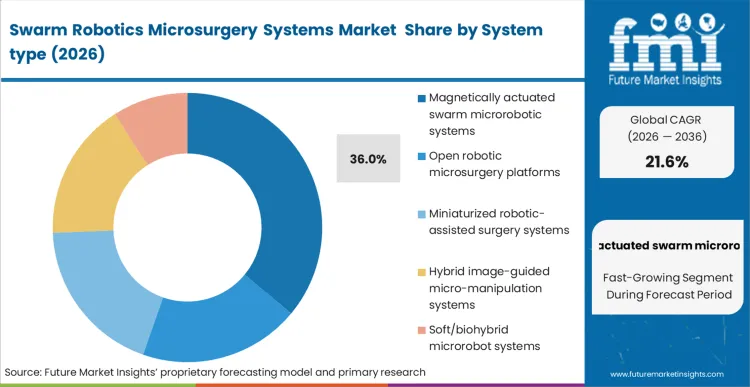
The reality behind magnetically actuated swarm microrobotic systems holding 36.0% of the magnetic microrobot surgery market is that chemical and acoustic actuation methods struggle with deep-tissue attenuation and precise steering in variable fluid flows. Procurement teams at translational institutes prioritize magnetic architectures because they integrate cleanly with existing MRI and fluoroscopic infrastructure.
In FMI's view, these microrobotic surgery systems transform the surgical approach, allowing clinicians to project force deep within the body without opening a physical tract. When operators deploy these swarms, they switch from manual spatial navigation to algorithmic trajectory planning, drastically reducing the cognitive load required to manage complex micro-environments. Institutions that attempt to utilise hybrid or softer modalities often face extended qualification timelines as they struggle to prove reliable retrieval or degradation of the untethered agents.
- Actuation reliability: Magnetic fields penetrate tissue without losing signal integrity. This guarantees that surgical teams maintain absolute control over the swarm even deep within the cranial vault.
- Infrastructure compatibility: Existing imaging suites can be modified rather than replaced entirely. Hospital administrators capture significant capital efficiency by leveraging legacy diagnostic hardware.
- Retrieval certainty: High-gradient magnetic traps ensure all microrobots are extracted post-procedure. Clinical governance boards mandate this capability to prevent systemic toxicity risks.
Swarm Robotics Microsurgery Systems Market Analysis by Clinical application
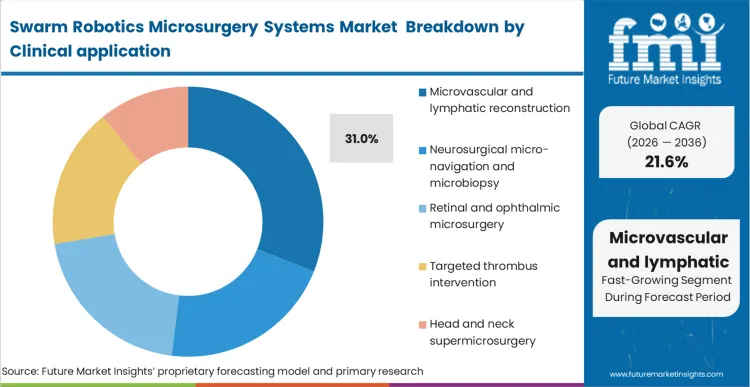
When traditional suturing techniques fail to achieve reliable patency in sub-millimeter vessels, surgical teams are forced to qualify advanced alternatives like microvascular reconstruction robots. Microvascular and lymphatic reconstruction commands 31.0% share because the cost of failure, tissue necrosis or graft loss, justifies the premium associated with robotic intervention, particularly in demanding fields like lymphatic microsurgery robotics.
As per FMI's projection, the precision required to manipulate 0.3mm vessels exceeds human physiological limits, making external tremor filtration non-negotiable for neurosurgical microrobots. When utilizing these systems, reconstructive surgeons operate through robotics assisted telesurgery interfaces, relying heavily on visual overlays rather than tactile feedback. Departments that delay integrating these capabilities find their success rates plateauing, ultimately losing referrals for complex free-flap reconstructions to more advanced centers.
- Tremor elimination: Motion scaling algorithms reduce gross hand movements to micrometer end-effector actions. Reconstructive surgeons achieve perfect intimal alignment during anastomoses.
- Ischemia reduction: Accelerated suturing protocols minimize the time tissue remains without blood flow. Patients experience significantly higher rates of graft survival and faster recovery times.
- Ergonomic preservation: Operating via console rather than hunched over traditional microscopes prevents surgeon fatigue. Departments maintain higher procedural volumes across longer shifts without compromising outcome quality.
Swarm Robotics Microsurgery Systems Market Analysis by Control architecture
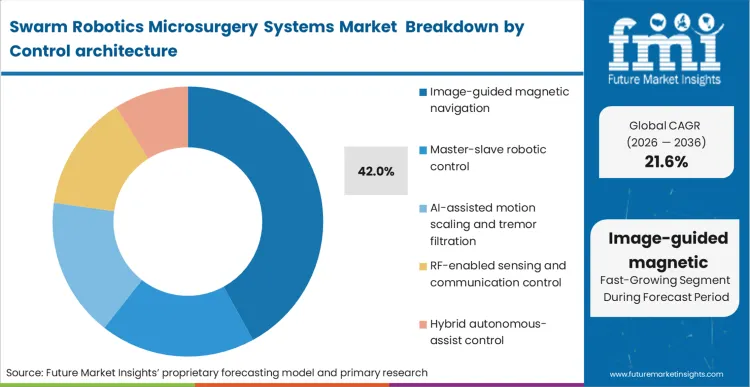
The decision facing clinical engineering directors is no longer whether to adopt external guidance, but how to ensure zero-latency tracking of untethered entities using image-guided microrobotics for surgery. Image-guided magnetic navigation holds 42.0% share because operators cannot manipulate what they cannot see, and swarms require continuous, closed-loop spatial verification.
According to FMI's estimates, magnetic navigation in microsurgery dictates the entire workflow, as the tracking software must communicate with the magnetic generators at millisecond intervals to prevent swarm dispersion. By embedding this control layer into their robot assisted surgical microscope systems, hospitals achieve the necessary synchronization for complex tasks. Facilities attempting to rely on open-loop or purely predictive models face unacceptable risks of collateral tissue damage during delicate interventions.
- Closed-loop verification: Real-time imaging feedback continuously adjusts the magnetic field strength. Operators navigate tortuous vasculatures without relying solely on preoperative maps.
- Swarm cohesion: Algorithmic field shaping prevents the individual agents from dispersing in high-flow arterial environments. The surgical team maintains a concentrated therapeutic payload at the target site.
- Latency suppression: Predictive AI compensates for inherent imaging delays during rapid anatomical changes. Clinical directors authorize more aggressive navigation protocols knowing the system will auto-correct.
Swarm Robotics Microsurgery Systems Market Analysis by End user
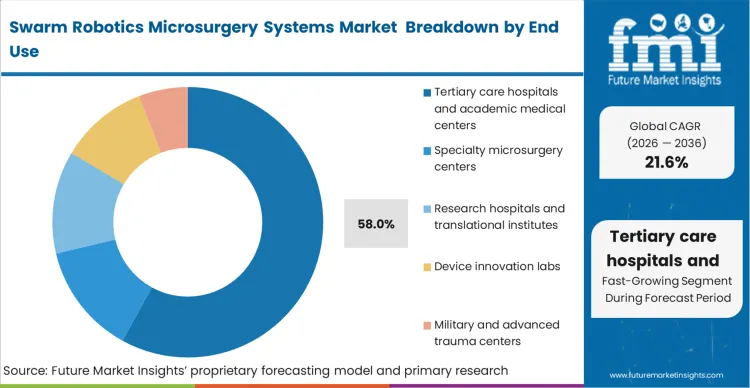
Tertiary care hospitals and academic medical centers do not just purchase equipment; they construct entire ecosystems capable of supporting experimental modalities, which is why they capture 58.0% of the market. FMI projects that these institutions possess the multi-disciplinary teams,surgeons, physicists, and bioengineers, required to safely deploy untethered microrobots, including specialized soft microrobots in microsurgery. They are uniquely positioned to absorb the massive footprint of the magnetic generators and the specialized surgical operating microscope suites. When these centers transition to swarm protocols, they restructure their entire scheduling and sterilization workflows to accommodate the new hardware. Smaller specialty centers that attempt to integrate these systems without the prerequisite imaging and engineering support face severe operational bottlenecks and extended downtime.
- Capital concentration: These facilities command the budgets necessary to retrofit entire surgical theaters. Administrators leverage these investments to attract top-tier surgical talent and secure high-value research grants.
- Multidisciplinary oversight: The presence of on-site biomedical engineering teams allows for immediate troubleshooting. Surgical directors maintain high utilization rates even during early-stage technology deployment.
- Trial qualification: Academic centers dominate the early-access clinical trial networks for untethered interventions. They establish the foundational outcome data that eventually dictates national reimbursement policies.
Swarm Robotics Microsurgery Systems Market Analysis by Revenue stream
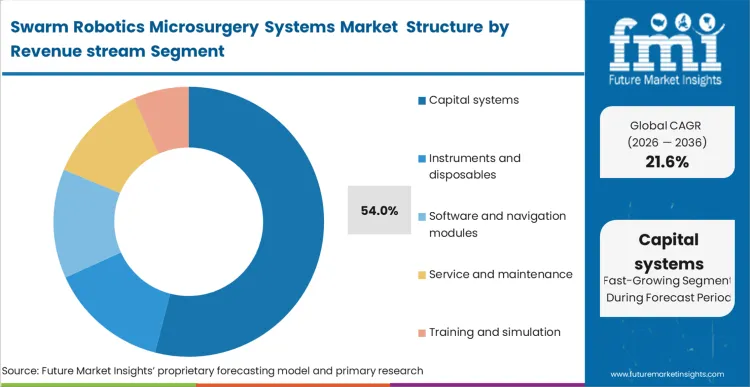
The commercial trajectory of this market is heavily front-loaded, with capital systems representing 54.0% of total revenue.
Based on FMI's assessment, the sheer complexity of the external magnetic generation coils, combined with sophisticated 3d surgical microscope systems, forces a massive initial layout before a single procedure occurs. Hospitals treat this not as a tool purchase, but as a facility-level infrastructure upgrade. Once the capital is installed, the dynamic changes; procurement teams lock into proprietary consumable streams for the microrobots themselves. Vendors who fail to secure the initial capital footprint are entirely locked out of the subsequent, highly lucrative recurring revenue generated by the specialized agents and proprietary software updates.
- Infrastructure lock-in: The proprietary nature of the magnetic generators ensures all subsequent consumables must be purchased from the OEM. Hospital procurement teams lose leverage in negotiating per-procedure costs.
- Lifecycle maintenance: Complex cooling and power systems require continuous OEM service contracts. Facility managers must budget for substantial ongoing operational expenditures beyond the initial purchase.
- Software monetization: Advanced swarm behaviors and specific anatomical navigation modules are sold as recurring licenses. Administrators face continuous subscription costs to unlock the full capability of the installed hardware.
Swarm Robotics Microsurgery Systems Market Drivers, Restraints, and Opportunities
The necessity to resolve complex microvascular pathologies without inducing collateral trauma compels neurosurgical and ophthalmic departments to abandon traditional instrumentation in favour of a specialized head and neck supermicrosurgery robot. This pressure requires surgical directors to evaluate untethered platforms that can navigate deep, tortuous anatomy while maintaining sub-millimeter precision. Because the clinical penalty for endothelial damage in procedures like targeted thrombus intervention is severe, hospital networks must invest in systems that completely eliminate human tremor and physical tether friction. The inability to achieve these outcomes with legacy tools makes the transition to swarm architectures an operational imperative rather than a discretionary upgrade.
When evaluating what are the biggest barriers to swarm robotic microsurgery adoption, integrating these systems into existing clinical workflows faces severe friction due to the massive physical and infrastructural footprint required by magnetic field generators. Hospital facility managers cannot simply wheel a swarm control unit into a standard operating room; the surrounding environment requires extensive magnetic shielding and integration with advanced surgical navigation system arrays. This constraint limits early adoption to institutions capable of undertaking significant architectural renovations. While modular, lower-field generators are emerging, they currently lack the penetration depth necessary for complex cranial or deep-torso interventions.
Opportunities in the Swarm Robotics Microsurgery Systems Market
- Targeted drug delivery: The ability to concentrate therapeutics exactly at a tumor site utilizing japan surgical navigation system architectures drastically reduces systemic toxicity. Oncological surgeons leverage this capability to administer previously intolerable dosages directly to aggressive micro-metastases.
- Thrombus dissolution: Programmable swarms can mechanically agitate and chemically degrade blood clots in distal vessels where traditional catheters cannot reach. Interventional neurologists utilize this approach to rapidly restore perfusion in critical stroke windows.
- Retinal peeling: Biohybrid soft robots offer the exact compliance needed to manipulate delicate ocular tissues without tearing. Ophthalmic specialists deploy these agents to automate highly tedious macular procedures, ensuring consistent outcomes regardless of operator fatigue.
Regional Analysis
The regional breakdown shows that the Swarm Robotics Microsurgery Systems market spans more than 40 countries and is divided into three primary regions: Asia Pacific, Europe, and North America.
.webp "Top Country Growth Comparison Swarm Robotics Microsurgery Systems Market Cagr (2026 2036)")
| Country | CAGR (2026 to 2036) |
|---|---|
| India | 25.4% |
| China | 24.9% |
| France | 22.1% |
| United States | 20.8% |
| Germany | 20.4% |
| United Kingdom | 19.6% |
| Japan | 18.7% |
Source: Future Market Insights (FMI) analysis, based on proprietary forecasting model and primary research
Asia Pacific Swarm Robotics Microsurgery Systems Market Analysis
Infrastructure readiness uniquely shapes the adoption pattern in this region, as expanding healthcare networks leapfrog legacy master-slave robotics directly into advanced untethered paradigms. Unlike mature Western markets burdened by massive installed bases of conventional robotic systems, major hospitals here are integrating swarm-capable hybrid imaging suites directly into their greenfield facility designs.
In FMI's view, this lack of entrenched capital allows clinical directors to bypass intermediate technologies. The procurement cycle prioritises high-throughput platforms capable of managing immense patient volumes, favouring systems that integrate flawlessly with orthopedic navigation systems and neurological imaging tools.
- India: India's rapid expansion of private tertiary infrastructure allows hospital groups to design surgical theatres specifically around the architectural requirements of magnetic field generators. Procurement heads in these networks are consolidating capital purchases to include fully integrated swarm control rooms rather than standalone tools. The robotic catheterization systems landscape in India is set to achieve a CAGR of 25.4%. Moving early on these installations allows tier-1 private hospitals to dominate lucrative medical tourism channels for complex reconstructive and neurovascular surgeries.
- China: Over the forecast period, China is set for a CAGR of 24.9%. Extensive government funding for domestic translational robotics research aggressively pushes locally developed biohybrid and magnetic swarm systems into advanced clinical trials, defining the China microrobotic surgery market. Chinese device innovation labs mandate rapid iteration cycles, pushing prototypes from benchtop to in vivo testing faster than their Western counterparts. This trajectory establishes a robust domestic supply chain, fundamentally altering how regional healthcare networks source advanced surgical capital.
- Japan: Japan's highly mature healthcare market exhibits a cautious, data-driven approach, where strict qualification standards regarding swarm retrieval and systemic toxicity slow immediate adoption. FMI estimates the market in Japan to expand at an annual growth rate of 18.7%. Clinical governance boards require exhaustive longitudinal data before authorizing the transition from established tethered micro-instruments. The nuance here is that while adoption is slower, integration is exceptionally deep, resulting in highly optimized, zero-error workflows once a platform is finally greenlit.
FMI's report includes secondary markets across Southeast Asia and Oceania. These emerging zones largely function as fast-followers, waiting for regulatory harmonization and cost-reduction in capital hardware before committing to extensive facility upgrades.
Europe Swarm Robotics Microsurgery Systems Market Analysis
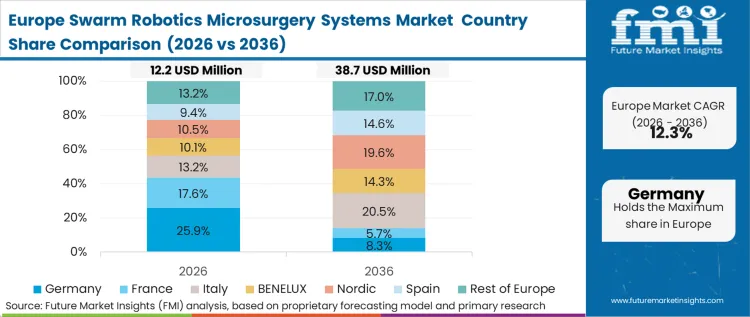
The regulatory environment defining the Europe robotic microsurgery systems market, driven by stringent directives on clinical efficacy and patient safety, forces buyers to heavily prioritize systems with impeccable retrieval and degradation profiles. Rather than evaluating sheer technological capability, procurement committees focus strictly on the biocompatibility and clearance mechanisms of the untethered agents. FMI analysts suggests that this policy-led environment restricts early commercialization to platforms that can definitively prove zero residual toxicity. Consequently, adoption is concentrated in specialized innovation hubs that maintain close relationships with regulatory bodies, allowing for careful, phased rollouts of robotic assisted endovascular systems.
- France: France's concentration of elite microrobotic commercialization hubs creates an environment where academic research seamlessly transitions into pilot clinical programs. Surgical directors at Parisian translational institutes work directly with engineers to refine swarm control algorithms for specific vascular applications. The sector in France is projected to witness growth at a CAGR of 22.1%. This close proximity between developers and end-users dramatically shortens the feedback loop, allowing French hospitals to operationalize complex protocols faster than neighboring regions.
- Germany: Strict reimbursement frameworks in Germany compel hospital administrators to demand clear health-economic evidence before funding the massive infrastructure required for magnetic navigation suites. Demand in Germany is estimated to expand at a CAGR of 20.4%. Procurement cycles are extended as clinical teams must demonstrate that swarm interventions significantly reduce readmissions or length of stay compared to traditional techniques. The commercial opportunity lies in securing foundational contracts with major university hospitals, which then dictate the procurement standards for the broader regional networks.
- United Kingdom: The United Kingdom robotic microsurgery systems market is likely to post a CAGR of 19.6%. The centralized procurement architecture of the NHS dictates that swarm systems must demonstrate scalable utility across multiple surgical disciplines before achieving widespread qualification. Trust directors prioritize platforms capable of handling both neurosurgical biopsies and targeted ophthalmic interventions to justify the capital outlay. Organizations that succeed in navigating this rigorous evaluation process gain access to a massive, consolidated patient base, effectively locking out fragmented competitors.
FMI's report includes analysis of the Nordic and Benelux regions. Hospitals in these areas prioritize software interoperability, ensuring new swarm control modules can interface securely with their existing digital health records and imaging archives.
North America Swarm Robotics Microsurgery Systems Market Analysis
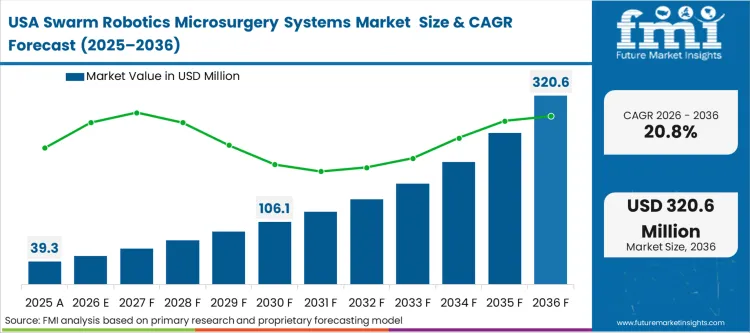
Capital availability and competitive intensity define the North American trajectory, as elite academic medical centers race to be the first to market with cutting-edge micro-interventions. This economics-led environment shaping the United States swarm robotics microsurgery market means that while the technology is still experimental, the marketing value of possessing a "swarm-capable" surgical suite drives immediate investment from top-tier institutions. These early adopters leverage their massive endowments to absorb the high initial costs, utilizing the technology to attract high-net-worth patients and leading surgical innovators. The integration with existing micro guide catheters infrastructure provides a familiar operational baseline for surgical teams transitioning to untethered modalities.
- United States: The intense competition among major USA healthcare networks forces Chief Medical Officers to aggressively pursue FDA early-access programs for novel microrobotic platforms. Facility managers are undertaking rapid architectural upgrades to house the necessary magnetic shielding and control consoles before rival institutions. FMI estimates the market in the United States to expand at an annual growth rate of 20.8%. This dynamic creates a highly concentrated tier of "super-users" who will ultimately define the clinical best practices and training protocols for the rest of the domestic market.
FMI's report includes detailed assessments of the Canadian market landscape. Provincial health authorities there exhibit a markedly different pattern, pooling capital resources into centralized, highly specialized surgical hubs rather than attempting distributed adoption.
Competitive Aligners for Market Players
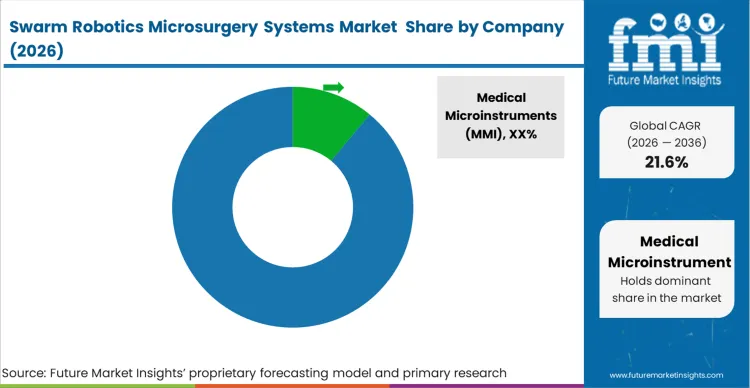
Evaluating the supplier landscape for robotic microsurgery systems, the highly concentrated nature of the swarm robotics microsurgery market stems from the massive intellectual property and capital barriers required to develop real-time closed-loop magnetic navigation. Medical Microinstruments (MMI), Intuitive Surgical, and Distalmotion operate in an environment where the primary variable determining vendor qualification among robotic microsurgery system manufacturers is the ability to guarantee untethered agent retrieval or safe biodegradation. Procurement boards simply will not review alternatives to conventional microsurgery robots that cannot demonstrate flawless tracking within deep anatomical structures.
When assessing which companies make robotic microsurgery systems, incumbents like Moon Surgical and Asensus Surgical hold a distinct advantage because they have already navigated the complex regulatory pathways for integrating advanced motion-scaling and imaging into surgical workflows. This advantage persists because hospital IT and clinical engineering departments are highly resistant to onboarding entirely new software architectures. Challengers like Virtual Incision and Robeauté must build native interoperability with legacy microcatheter imaging arrays to replicate this capability. In FMI's view, building an isolated, proprietary imaging ecosystem is a direct path to vendor disqualification.
As the market approaches 2036, large healthcare networks are actively resisting the proprietary lock-in characteristic of early capital deployments, focusing deeply on long-term microsurgery robot pricing. Procurement directors are demanding modular control architectures that allow them to source swarm consumables independently of the magnetic field generators, leading them to engage with diverse robotic microsurgery training platform vendors. This tension between buyer desire for interoperability and vendor incentives for closed ecosystems will dictate the next phase of consolidation, forcing early hardware innovators to pivot toward high-margin micro balloon catheter software and algorithmic licensing models, moving beyond simple capability comparisons like MMI Symani vs da Vinci SP.
Key Players in Swarm Robotics Microsurgery Systems Market
- Medical Microinstruments (MMI)
- Intuitive Surgical
- Distalmotion
- Moon Surgical
- Asensus Surgical (part of KARL STORZ)
- Virtual Incision
- Robeauté
Scope of the Report
| Metric | Value |
|---|---|
| Quantitative Units | USD 58.4 million to USD 412.8 million, at a CAGR of 21.6% |
| Market Definition | Swarm robotics microsurgery encompasses untethered, micro- or nano-scale robotic entities guided by external fields to perform localized interventions. It functionally excludes traditional tethered master-slave systems, focusing entirely on programmable, fluid-environment navigation without physical linkages. |
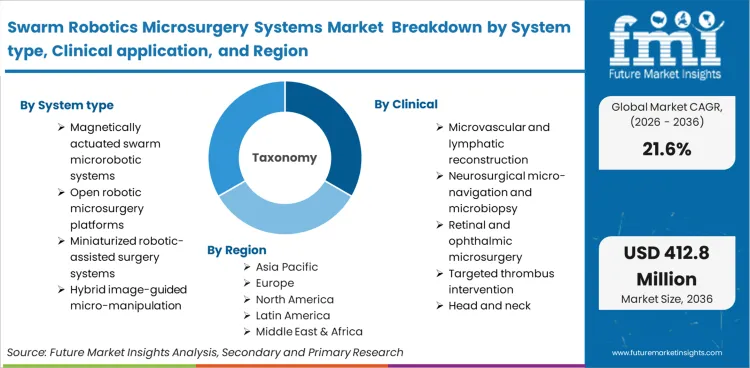
| System type Segmentation | Magnetically actuated swarm microrobotic systems, Open robotic microsurgery platforms, Miniaturized robotic-assisted surgery systems, Hybrid image-guided micro-manipulation systems, Soft/biohybrid microrobot systems |
| Clinical application Segmentation | Microvascular and lymphatic reconstruction, Neurosurgical micro-navigation and microbiopsy, Retinal and ophthalmic microsurgery, Targeted thrombus intervention, Head and neck supermicrosurgery |
| Control architecture Segmentation | Image-guided magnetic navigation, Master-slave robotic control, AI-assisted motion scaling and tremor filtration, RF-enabled sensing and communication control, Hybrid autonomous-assist control |
| End user Segmentation | Tertiary care hospitals and academic medical centers, Specialty microsurgery centers, Research hospitals and translational institutes, Device innovation labs, Military and advanced trauma centers |
| Revenue stream Segmentation | Capital systems, Instruments and disposables, Software and navigation modules, Service and maintenance, Training and simulation |
| Regions Covered | Asia Pacific, Europe, North America |
| Countries Covered | India, China, France, United States, Germany, United Kingdom, Japan, and 40 plus countries |
| Key Companies Profiled | Medical Microinstruments (MMI), Intuitive Surgical, Distalmotion, Moon Surgical, Asensus Surgical (part of KARL STORZ), Virtual Incision, Robeauté |
| Forecast Period | 2026 to 2036 |
| Approach | Primary interviews targeted Chief Medical Officers and surgical robotics directors. The baseline was anchored to hospital procurement budgets allocated for advanced imaging and surgical suite retrofits. Forecasts were cross-validated against institutional grant funding flows and bioengineering venture deployment patterns. |
Source: Future Market Insights (FMI) analysis, based on proprietary forecasting model and primary research
Swarm Robotics Microsurgery Systems Market Analysis by Segments
System type:
- Magnetically actuated swarm microrobotic systems
- Open robotic microsurgery platforms
- Miniaturized robotic-assisted surgery systems
- Hybrid image-guided micro-manipulation systems
- Soft/biohybrid microrobot systems
Clinical application:
- Microvascular and lymphatic reconstruction
- Neurosurgical micro-navigation and microbiopsy
- Retinal and ophthalmic microsurgery
- Targeted thrombus intervention
- Head and neck supermicrosurgery
Control architecture:
- Image-guided magnetic navigation
- Master-slave robotic control
- AI-assisted motion scaling and tremor filtration
- RF-enabled sensing and communication control
- Hybrid autonomous-assist control
End user:
- Tertiary care hospitals and academic medical centers
- Specialty microsurgery centers
- Research hospitals and translational institutes
- Device innovation labs
- Military and advanced trauma centers
Revenue stream:
- Capital systems
- Instruments and disposables
- Software and navigation modules
- Service and maintenance
- Training and simulation
Region:
- North America
- United States
- Canada
- Europe
- Germany
- United Kingdom
- France
- Italy
- Spain
- Asia Pacific
- China
- Japan
- South Korea
- Taiwan
- Singapore
- Latin America
- Brazil
- Mexico
- Argentina
- Middle East & Africa
- GCC Countries
- South Africa
- Israel
Bibliography
- Sun, T., Chen, J., Zhang, J., Zhao, Z., Zhao, Y., Sun, J., & Chang, H. (2024). Application of micro/nanorobot in medicine. Frontiers in Bioengineering and Biotechnology, 12, 1347312.
- Lin, J., Cong, Q., & Zhang, D. (2024). Magnetic microrobots for in vivo cargo delivery: A review. Micromachines, 15(5), 664.
- Xu, R., & Xu, Q. (2024). A survey of recent developments in magnetic microrobots for micro-/nano-manipulation. Micromachines, 15(4), 468.
- Mirkhani, N., Christiansen, M. G., Gwisai, T., Menghini, S., & Schuerle, S. (2024). Spatially selective delivery of living magnetic microrobots through torque-focusing. Nature Communications, 15, 2160.
- Alabay, H. H., Le, T.-A., & Ceylan, H. (2024). X-ray fluoroscopy guided localization and steering of miniature robots using virtual reality enhancement. Frontiers in Robotics and AI, 11, 1495445.
- von Reibnitz, D., et al. (2024). 100 anastomoses: A two-year single-center experience with robotic-assisted micro- and supermicrosurgery for lymphatic reconstruction. Journal of Robotic Surgery, 18(1), 164.
- Grünherz, L., et al. (2024). Robotic-assisted lymphovenous anastomosis of the central lymphatic system. Plastic and Reconstructive Surgery Global Open, 12(9), e6164.
- Weinzierl, A., et al. (2024). Microsurgical central lymphatic reconstruction—the role of thoracic duct lymphovenous anastomoses at different anatomical levels. Frontiers in Surgery, 11, 1415010.
- Thamm, O. C., Eschborn, J., Schäfer, R. C., & Schmidt, J. (2024). Advances in modern microsurgery. Journal of Clinical Medicine, 13(17), 5284.
This bibliography is provided for reader reference. The full FMI report contains the complete reference list with primary source documentation.
This Report Addresses
- Market intelligence to support strategic decision making across untethered biohybrid and magnetically actuated micro-platforms
- Market size estimation and 10-year revenue forecasts from 2026 to 2036, supported by clinical trial registry analysis and institutional capital budgeting trends
- Growth opportunity mapping across specific clinical applications with emphasis on the integration of real-time imaging with closed-loop swarm control
- Segment and regional revenue forecasts covering image-guided magnetic navigation and motion-scaling architectures across strict European biocompatibility regulatory environments
- Competition strategy assessment including vendor lock-in mechanics, modular control capabilities, and the tension over proprietary consumable streams
- Technology development tracking including AI-assisted latency suppression, programmable magnetic fields, and remote sensing frameworks discussed in this article
- Market access analysis covering institutional qualification standards, health-economic reimbursement proofs, and specialized innovation hub pathways
- Market report delivery in PDF, Excel, PPT, and interactive dashboard formats for executive strategy, surgical suite planning, and operational benchmarking use
Frequently Asked Questions
What is the market size of robotic microsurgery?
The industry reaches USD 58.4 million in 2026. This figure reflects the intense initial capital outlays required by early-adopter academic centers installing dedicated magnetic generation suites, rather than high procedural volumes.
What will it be valued at by 2036?
The sector advances to USD 412.8 million by 2036. This expansion signals the shift from isolated research installations to standardized deployment across broader tertiary hospital networks handling complex neurovascular caseloads.
What CAGR is projected?
A CAGR of 21.6% is projected over the forecast period. This rate is constrained by the lengthy architectural upgrade cycles required to physically shield and house peripheral micro catheters tracking modalities within existing surgical footprints.
What are swarm robotics microsurgery systems?
Functionally, they encompass untethered, micro- or nano-scale robotic entities that operate cooperatively inside the human body under external guidance,typically magnetic, acoustic, or chemical, to perform localized interventions. This boundary explicitly defines the market by the absence of continuous physical linkages between the operator and the end-effector.
How do swarm microrobots work in surgery?
Operators switch from executing manual physical pathways to plotting strategic coordinates, allowing the software to manage micro-corrections. The integration of real-time imaging with algorithmic field shaping removes human latency, directing magnetic or acoustic fields to drive untethered entities to precise sub-millimeter targets.
Compare swarm microrobots with conventional robotic surgery?
Conventional robotic surgery relies on master-slave kinematics and physical tethers to execute macroscopic motion scaling. Swarm microrobots completely eliminate physical linkages, utilizing programmed external fields to manipulate hundreds of micro-agents simultaneously within fluid environments or deep-tissue regions where mechanical arms cannot fit.
Are microrobots used in real surgeries today?
While fully autonomous swarms remain largely in advanced translational trials, foundational components of magnetically guided single-entity interventions are actively utilized in early-adopter clinical settings. Academic medical centers are the primary entities piloting these systems under strict regulatory oversight for specialized neurosurgical and ophthalmic cases.
What are the biggest barriers to swarm robotic microsurgery adoption?
The massive infrastructural footprint required to support hybrid magnetic generation suites prevents rapid adoption. Facilities must execute extensive architectural shielding and integrate new endoscopy visualization system arrays before deploying these platforms.
Which clinical specialties will adopt these systems first?
Microvascular and lymphatic reconstruction commands the highest priority as the clinical cost of anastomotic failure outweighs the acquisition premium of robotic platforms. Motion scaling is mandatory when maneuvering 0.3mm vessels beyond human physiological limits.
Why is magnetic navigation important in microrobot surgery?
Untethered entities require continuous, closed-loop spatial verification to prevent systemic migration. Operators cannot manipulate deep-tissue swarms using purely predictive minimally invasive neurosurgery devices models without the deep penetration capabilities of magnetic fields.
Which countries will lead the swarm robotics microsurgery market?
India expands at 25.4%, significantly outpacing mature markets, alongside China at 24.9%. The difference lies in greenfield tertiary expansion; Asian hospital networks are integrating swarm-capable suites into new builds, bypassing the friction of retrofitting legacy operations prevalent in the US and Europe.
Which companies make robotic microsurgery systems?
The market is led by pioneers focused on untethered guidance and motion scaling, including Medical Microinstruments (MMI), Intuitive Surgical, Distalmotion, Moon Surgical, Asensus Surgical, Virtual Incision, and Robeauté. These vendors control the proprietary consumable streams for the swarms, effectively locking the hospital into long-term service relationships.
How do European biocompatibility regulations shape the market?
Strict EU directives force procurement boards to heavily scrutinize the degradation and retrieval profiles of the untethered agents. This limits adoption to highly specialized hubs capable of executing rigorous, longitudinal safety validations before broad commercialization.
Why is the vendor landscape so concentrated?
The requirement to seamlessly interlock proprietary magnetic field hardware with sophisticated, low-latency tracking software establishes a massive barrier to entry. Buyers demand fully integrated endoscopy video systems ecosystems, leaving little room for fragmented component suppliers to compete.
Why does China experience such rapid adoption?
Domestic translational research institutes in China operate under aggressive government-mandated commercialization timelines. This accelerates the jump from benchtop prototyping to advanced clinical trials, establishing a highly self-reliant surgical capital ecosystem.
How do soft biohybrid systems differ operationally from magnetic platforms?
Biohybrid systems offer exact tissue compliance, making them essential for delicate retinal procedures where rigid instruments induce tearing. They trade the deep-tissue penetration of magnetic systems for superior surface-level precision in ocular and soft-tissue environments.
Why are academic medical centers the primary end users?
Only tier-1 academic centers possess the multidisciplinary teams, surgeons, physicists, and bioengineers required to troubleshoot early-stage untethered platforms. They leverage this capability to secure elite trial qualifications and dictate future reimbursement models.
How do targeted thrombus interventions utilize swarm technology?
Swarms can be directed to mechanically agitate and chemically degrade blockages in distal neurovascular beds that standard catheters cannot physically access. This capability alters the treatment window for critical stroke interventions.
Why does Japan's market grow slower than India's despite high healthcare expenditure?
Japan's mature, data-driven clinical governance boards require exhaustive systemic toxicity and retrieval data before authorizing untethered interventions. This meticulous qualification process delays initial adoption but results in highly optimized workflows once implemented.
How should investors benchmark this niche against digital microsurgery?
Investors should view swarm architectures as the final frontier of the digital microsurgery continuum. While digital microsurgery focuses on ergonomic visualization and tethered motion scaling, swarm systems monetize the complete removal of the mechanical instrument, capturing high-margin consumable streams that digital optics alone cannot secure.
Preview the report firsthand - request a free sample
Get SampleGet the brochure for pricing and purchase details.
Get PDFTable of Content
- Executive Summary
- Global Market Outlook
- Demand-side Trends
- Supply-side Trends
- Technology Roadmap Analysis
- Analysis and Recommendations
- Market Overview
- Market Coverage / Taxonomy
- Market Definition / Scope / Limitations
- Research Methodology
- Chapter Orientation
- Analytical Lens and Working Hypotheses
- Market Structure, Signals, and Trend Drivers
- Benchmarking and Cross-market Comparability
- Market Sizing, Forecasting, and Opportunity Mapping
- Research Design and Evidence Framework
- Desk Research Programme (Secondary Evidence)
- Company Annual and Sustainability Reports
- Peer-reviewed Journals and Academic Literature
- Corporate Websites, Product Literature, and Technical Notes
- Earnings Decks and Investor Briefings
- Statutory Filings and Regulatory Disclosures
- Technical White Papers and Standards Notes
- Trade Journals, Industry Magazines, and Analyst Briefs
- Conference Proceedings, Webinars, and Seminar Materials
- Government Statistics Portals and Public Data Releases
- Press Releases and Reputable Media Coverage
- Specialist Newsletters and Curated Briefings
- Sector Databases and Reference Repositories
- FMI Internal Proprietary Databases and Historical Market Datasets
- Subscription Datasets and Paid Sources
- Social Channels, Communities, and Digital Listening Inputs
- Additional Desk Sources
- Expert Input and Fieldwork (Primary Evidence)
- Primary Modes
- Qualitative Interviews and Expert Elicitation
- Quantitative Surveys and Structured Data Capture
- Blended Approach
- Why Primary Evidence is Used
- Field Techniques
- Interviews
- Surveys
- Focus Groups
- Observational and In-context Research
- Social and Community Interactions
- Stakeholder Universe Engaged
- C-suite Leaders
- Board Members
- Presidents and Vice Presidents
- R&D and Innovation Heads
- Technical Specialists
- Domain Subject-matter Experts
- Scientists
- Physicians and Other Healthcare Professionals
- Governance, Ethics, and Data Stewardship
- Research Ethics
- Data Integrity and Handling
- Primary Modes
- Tooling, Models, and Reference Databases
- Desk Research Programme (Secondary Evidence)
- Data Engineering and Model Build
- Data Acquisition and Ingestion
- Cleaning, Normalisation, and Verification
- Synthesis, Triangulation, and Analysis
- Quality Assurance and Audit Trail
- Market Background
- Market Dynamics
- Drivers
- Restraints
- Opportunity
- Trends
- Scenario Forecast
- Demand in Optimistic Scenario
- Demand in Likely Scenario
- Demand in Conservative Scenario
- Opportunity Map Analysis
- Product Life Cycle Analysis
- Supply Chain Analysis
- Investment Feasibility Matrix
- Value Chain Analysis
- PESTLE and Porter’s Analysis
- Regulatory Landscape
- Regional Parent Market Outlook
- Production and Consumption Statistics
- Import and Export Statistics
- Market Dynamics
- Global Market Analysis 2021 to 2025 and Forecast, 2026 to 2036
- Historical Market Size Value (USD Million) Analysis, 2021 to 2025
- Current and Future Market Size Value (USD Million) Projections, 2026 to 2036
- Y-o-Y Growth Trend Analysis
- Absolute $ Opportunity Analysis
- Global Market Pricing Analysis 2021 to 2025 and Forecast 2026 to 2036
- Global Market Analysis 2021 to 2025 and Forecast 2026 to 2036, By System type
- Introduction / Key Findings
- Historical Market Size Value (USD Million) Analysis By System type , 2021 to 2025
- Current and Future Market Size Value (USD Million) Analysis and Forecast By System type , 2026 to 2036
- Magnetically actuated swarm microrobotic systems
- Open robotic microsurgery platforms
- Miniaturized robotic-assisted surgery systems
- Hybrid image-guided micro-manipulation systems
- Soft/biohybrid microrobot systems
- Magnetically actuated swarm microrobotic systems
- Y-o-Y Growth Trend Analysis By System type , 2021 to 2025
- Absolute $ Opportunity Analysis By System type , 2026 to 2036
- Global Market Analysis 2021 to 2025 and Forecast 2026 to 2036, By Clinical application
- Introduction / Key Findings
- Historical Market Size Value (USD Million) Analysis By Clinical application, 2021 to 2025
- Current and Future Market Size Value (USD Million) Analysis and Forecast By Clinical application, 2026 to 2036
- Microvascular and lymphatic reconstruction
- Neurosurgical micro-navigation and microbiopsy
- Retinal and ophthalmic microsurgery
- Targeted thrombus intervention
- Head and neck supermicrosurgery
- Microvascular and lymphatic reconstruction
- Y-o-Y Growth Trend Analysis By Clinical application, 2021 to 2025
- Absolute $ Opportunity Analysis By Clinical application, 2026 to 2036
- Global Market Analysis 2021 to 2025 and Forecast 2026 to 2036, By Control architecture
- Introduction / Key Findings
- Historical Market Size Value (USD Million) Analysis By Control architecture, 2021 to 2025
- Current and Future Market Size Value (USD Million) Analysis and Forecast By Control architecture, 2026 to 2036
- Image-guided magnetic navigation
- Master-slave robotic control
- AI-assisted motion scaling and tremor filtration
- RF-enabled sensing and communication control
- Hybrid autonomous-assist control
- Image-guided magnetic navigation
- Y-o-Y Growth Trend Analysis By Control architecture, 2021 to 2025
- Absolute $ Opportunity Analysis By Control architecture, 2026 to 2036
- Global Market Analysis 2021 to 2025 and Forecast 2026 to 2036, By End Use
- Introduction / Key Findings
- Historical Market Size Value (USD Million) Analysis By End Use, 2021 to 2025
- Current and Future Market Size Value (USD Million) Analysis and Forecast By End Use, 2026 to 2036
- Tertiary care hospitals and academic medical centers
- Specialty microsurgery centers
- Research hospitals and translational institutes
- Device innovation labs
- Military and advanced trauma centers
- Tertiary care hospitals and academic medical centers
- Y-o-Y Growth Trend Analysis By End Use, 2021 to 2025
- Absolute $ Opportunity Analysis By End Use, 2026 to 2036
- Global Market Analysis 2021 to 2025 and Forecast 2026 to 2036, By Revenue stream
- Introduction / Key Findings
- Historical Market Size Value (USD Million) Analysis By Revenue stream, 2021 to 2025
- Current and Future Market Size Value (USD Million) Analysis and Forecast By Revenue stream, 2026 to 2036
- Capital systems
- Instruments and disposables
- Software and navigation modules
- Service and maintenance
- Training and simulation
- Capital systems
- Y-o-Y Growth Trend Analysis By Revenue stream, 2021 to 2025
- Absolute $ Opportunity Analysis By Revenue stream, 2026 to 2036
- Global Market Analysis 2021 to 2025 and Forecast 2026 to 2036, By Region
- Introduction
- Historical Market Size Value (USD Million) Analysis By Region, 2021 to 2025
- Current Market Size Value (USD Million) Analysis and Forecast By Region, 2026 to 2036
- North America
- Latin America
- Western Europe
- Eastern Europe
- East Asia
- South Asia and Pacific
- Middle East & Africa
- Market Attractiveness Analysis By Region
- North America Market Analysis 2021 to 2025 and Forecast 2026 to 2036, By Country
- Historical Market Size Value (USD Million) Trend Analysis By Market Taxonomy, 2021 to 2025
- Market Size Value (USD Million) Forecast By Market Taxonomy, 2026 to 2036
- By Country
- USA
- Canada
- Mexico
- By System type
- By Clinical application
- By Control architecture
- By End Use
- By Revenue stream
- By Country
- Market Attractiveness Analysis
- By Country
- By System type
- By Clinical application
- By Control architecture
- By End Use
- By Revenue stream
- Key Takeaways
- Latin America Market Analysis 2021 to 2025 and Forecast 2026 to 2036, By Country
- Historical Market Size Value (USD Million) Trend Analysis By Market Taxonomy, 2021 to 2025
- Market Size Value (USD Million) Forecast By Market Taxonomy, 2026 to 2036
- By Country
- Brazil
- Chile
- Rest of Latin America
- By System type
- By Clinical application
- By Control architecture
- By End Use
- By Revenue stream
- By Country
- Market Attractiveness Analysis
- By Country
- By System type
- By Clinical application
- By Control architecture
- By End Use
- By Revenue stream
- Key Takeaways
- Western Europe Market Analysis 2021 to 2025 and Forecast 2026 to 2036, By Country
- Historical Market Size Value (USD Million) Trend Analysis By Market Taxonomy, 2021 to 2025
- Market Size Value (USD Million) Forecast By Market Taxonomy, 2026 to 2036
- By Country
- Germany
- UK
- Italy
- Spain
- France
- Nordic
- BENELUX
- Rest of Western Europe
- By System type
- By Clinical application
- By Control architecture
- By End Use
- By Revenue stream
- By Country
- Market Attractiveness Analysis
- By Country
- By System type
- By Clinical application
- By Control architecture
- By End Use
- By Revenue stream
- Key Takeaways
- Eastern Europe Market Analysis 2021 to 2025 and Forecast 2026 to 2036, By Country
- Historical Market Size Value (USD Million) Trend Analysis By Market Taxonomy, 2021 to 2025
- Market Size Value (USD Million) Forecast By Market Taxonomy, 2026 to 2036
- By Country
- Russia
- Poland
- Hungary
- Balkan & Baltic
- Rest of Eastern Europe
- By System type
- By Clinical application
- By Control architecture
- By End Use
- By Revenue stream
- By Country
- Market Attractiveness Analysis
- By Country
- By System type
- By Clinical application
- By Control architecture
- By End Use
- By Revenue stream
- Key Takeaways
- East Asia Market Analysis 2021 to 2025 and Forecast 2026 to 2036, By Country
- Historical Market Size Value (USD Million) Trend Analysis By Market Taxonomy, 2021 to 2025
- Market Size Value (USD Million) Forecast By Market Taxonomy, 2026 to 2036
- By Country
- China
- Japan
- South Korea
- By System type
- By Clinical application
- By Control architecture
- By End Use
- By Revenue stream
- By Country
- Market Attractiveness Analysis
- By Country
- By System type
- By Clinical application
- By Control architecture
- By End Use
- By Revenue stream
- Key Takeaways
- South Asia and Pacific Market Analysis 2021 to 2025 and Forecast 2026 to 2036, By Country
- Historical Market Size Value (USD Million) Trend Analysis By Market Taxonomy, 2021 to 2025
- Market Size Value (USD Million) Forecast By Market Taxonomy, 2026 to 2036
- By Country
- India
- ASEAN
- Australia & New Zealand
- Rest of South Asia and Pacific
- By System type
- By Clinical application
- By Control architecture
- By End Use
- By Revenue stream
- By Country
- Market Attractiveness Analysis
- By Country
- By System type
- By Clinical application
- By Control architecture
- By End Use
- By Revenue stream
- Key Takeaways
- Middle East & Africa Market Analysis 2021 to 2025 and Forecast 2026 to 2036, By Country
- Historical Market Size Value (USD Million) Trend Analysis By Market Taxonomy, 2021 to 2025
- Market Size Value (USD Million) Forecast By Market Taxonomy, 2026 to 2036
- By Country
- Kingdom of Saudi Arabia
- Other GCC Countries
- Turkiye
- South Africa
- Other African Union
- Rest of Middle East & Africa
- By System type
- By Clinical application
- By Control architecture
- By End Use
- By Revenue stream
- By Country
- Market Attractiveness Analysis
- By Country
- By System type
- By Clinical application
- By Control architecture
- By End Use
- By Revenue stream
- Key Takeaways
- Key Countries Market Analysis
- USA
- Pricing Analysis
- Market Share Analysis, 2025
- By System type
- By Clinical application
- By Control architecture
- By End Use
- By Revenue stream
- Canada
- Pricing Analysis
- Market Share Analysis, 2025
- By System type
- By Clinical application
- By Control architecture
- By End Use
- By Revenue stream
- Mexico
- Pricing Analysis
- Market Share Analysis, 2025
- By System type
- By Clinical application
- By Control architecture
- By End Use
- By Revenue stream
- Brazil
- Pricing Analysis
- Market Share Analysis, 2025
- By System type
- By Clinical application
- By Control architecture
- By End Use
- By Revenue stream
- Chile
- Pricing Analysis
- Market Share Analysis, 2025
- By System type
- By Clinical application
- By Control architecture
- By End Use
- By Revenue stream
- Germany
- Pricing Analysis
- Market Share Analysis, 2025
- By System type
- By Clinical application
- By Control architecture
- By End Use
- By Revenue stream
- UK
- Pricing Analysis
- Market Share Analysis, 2025
- By System type
- By Clinical application
- By Control architecture
- By End Use
- By Revenue stream
- Italy
- Pricing Analysis
- Market Share Analysis, 2025
- By System type
- By Clinical application
- By Control architecture
- By End Use
- By Revenue stream
- Spain
- Pricing Analysis
- Market Share Analysis, 2025
- By System type
- By Clinical application
- By Control architecture
- By End Use
- By Revenue stream
- France
- Pricing Analysis
- Market Share Analysis, 2025
- By System type
- By Clinical application
- By Control architecture
- By End Use
- By Revenue stream
- India
- Pricing Analysis
- Market Share Analysis, 2025
- By System type
- By Clinical application
- By Control architecture
- By End Use
- By Revenue stream
- ASEAN
- Pricing Analysis
- Market Share Analysis, 2025
- By System type
- By Clinical application
- By Control architecture
- By End Use
- By Revenue stream
- Australia & New Zealand
- Pricing Analysis
- Market Share Analysis, 2025
- By System type
- By Clinical application
- By Control architecture
- By End Use
- By Revenue stream
- China
- Pricing Analysis
- Market Share Analysis, 2025
- By System type
- By Clinical application
- By Control architecture
- By End Use
- By Revenue stream
- Japan
- Pricing Analysis
- Market Share Analysis, 2025
- By System type
- By Clinical application
- By Control architecture
- By End Use
- By Revenue stream
- South Korea
- Pricing Analysis
- Market Share Analysis, 2025
- By System type
- By Clinical application
- By Control architecture
- By End Use
- By Revenue stream
- Russia
- Pricing Analysis
- Market Share Analysis, 2025
- By System type
- By Clinical application
- By Control architecture
- By End Use
- By Revenue stream
- Poland
- Pricing Analysis
- Market Share Analysis, 2025
- By System type
- By Clinical application
- By Control architecture
- By End Use
- By Revenue stream
- Hungary
- Pricing Analysis
- Market Share Analysis, 2025
- By System type
- By Clinical application
- By Control architecture
- By End Use
- By Revenue stream
- Kingdom of Saudi Arabia
- Pricing Analysis
- Market Share Analysis, 2025
- By System type
- By Clinical application
- By Control architecture
- By End Use
- By Revenue stream
- Turkiye
- Pricing Analysis
- Market Share Analysis, 2025
- By System type
- By Clinical application
- By Control architecture
- By End Use
- By Revenue stream
- South Africa
- Pricing Analysis
- Market Share Analysis, 2025
- By System type
- By Clinical application
- By Control architecture
- By End Use
- By Revenue stream
- USA
- Market Structure Analysis
- Competition Dashboard
- Competition Benchmarking
- Market Share Analysis of Top Players
- By Regional
- By System type
- By Clinical application
- By Control architecture
- By End Use
- By Revenue stream
- Competition Analysis
- Competition Deep Dive
- Medical Microinstruments (MMI)
- Overview
- Product Portfolio
- Profitability by Market Segments (Product/Age /Sales Channel/Region)
- Sales Footprint
- Strategy Overview
- Marketing Strategy
- Product Strategy
- Channel Strategy
- Intuitive Surgical
- Distalmotion
- Moon Surgical
- Asensus Surgical (part of KARL STORZ)
- Virtual Incision
- Robeauté
- Medical Microinstruments (MMI)
- Competition Deep Dive
- Assumptions & Acronyms Used


